Mr. Lloyd proves that he riffs on certain themes of both Tories, and the Blairite political infatuation, with Mrs. Thatcher’s Hayekian toxic political/economic kitsch.
The Webb’s would, in fact find, this tantamount to a betrayal of what they advocated/practiced, in ‘The New Statesman’ .
Today Labour promises less than it promised during the Corbyn years. But those promises often felt like charity, dreamt up by the privately-educated Marxists around him, with little understanding of working-class people.
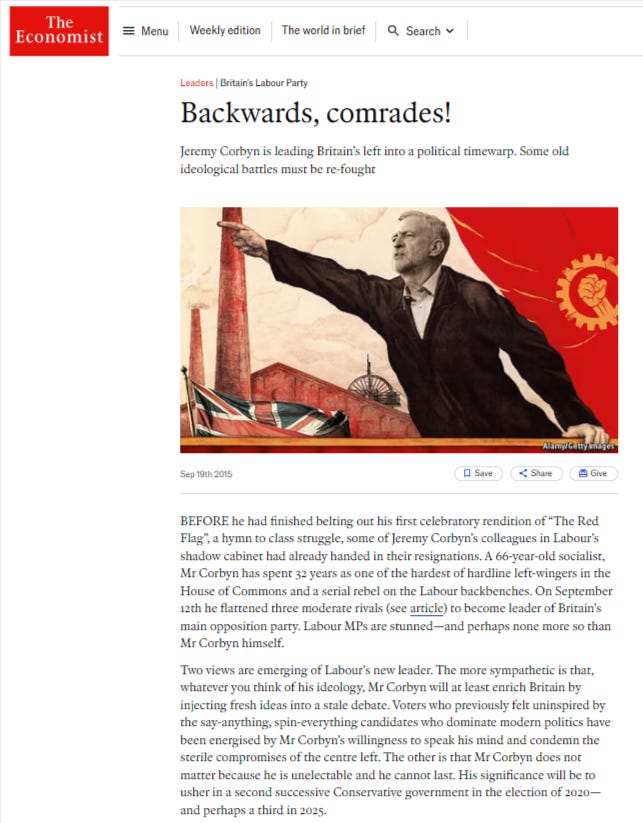
In sum Corbyn was manipulated by ‘the privately-educated Marxists around him’ Mr. Lloyd recites a not quite well worn inditement of Corbyn, here given etiolated pictorial expression in The Economist!
On the Question of Starmer: he is Blair’s undemanding/un-imaginative political creature. This from The Financial Times interview of Lynton Crosby from September 19, 2020, offers some insights on Starmer:
Crosby backs Johnson to neuter EU with a ‘bit of crazy’ negotiation
Former adviser says British PM can secure trade deal and see off Labour’s Starmer at next election.
Lynton Crosby, the Australian strategist dubbed the “wizard of Oz” by clients, said Mr Johnson could win a fifth successive election for the Tory party in 2024 despite criticism over his handling of the Covid-19 pandemic.
In contrast, Labour leader Keir Starmer would struggle to dethrone the prime minister because he is risk averse, viewed as part of the political establishment and faces intense scrutiny over his time as director of public prosecutions, he added.
“In the past, the EU has thought Britain’s an easy touch and in the end they’ll roll over. And, you know, in negotiations, like this you need a little bit of crazy to keep your opponents guessing,” Sir Lynton told the Financial Times.
Political Cynic comments upon ‘The Sky Is Falling Political Melodrama’ .
Carol Tavris reviews two books for The Times Literary Supplement of February 9, 2024. I’ll focus on one of her enthusiasm: ‘The Canceling of The American Mind:How cancel culture undermines trust, destroys institutions, and threatens us all’ 464pp. Allen Lane. £25. by Greg Lukianoff and Rikki Schlott
Ms. Tavris offers thumbnail descriptions of both the authors:
Lukianoff, a lifelong liberal who joined the Foundation for Individual Rights and Expression (FIRE) in 2001, and is now its CEO, is well positioned to survey the changing landscape and report from the trenches.
Here is an extensive, and well deserved caustic review of Greg Lukianoff and Jonathan Haidt’s ‘The Coddling of the American Mind’ by John K. Wilson of December 28, 2018. The precursor to ‘The Canceling’ !
The Myth of the Campus Coddle Crisis: The Coddling of the American Mind
I’ll quote the last five devastating paragraphs of Mr. Wilson’s review:
…
There is no better example of “good vs. evil” thinking than claiming that we have to choose King or Hitler as our models. And the notion that “religion and patriotism” help unify us by appealing to a common humanity is a laughable claim in the age of Trump. The fact is, everybody tends to invoke common enemies, including Haidt and Lukianoff.
Haidt and Lukianoff have a blind spot that’s common among people who denounce Manichean thinking. They ignore their own Manichean tendencies. The whole idea of FIRE is deeply Manichean: FIRE is the good, and the censors are evil. That’s a story FIRE tells over and over again. And it’s a true story. They urge “taking a generous view of other people”(14) which is odd considering how thoroughly they denounce people who invoke concepts like microaggressions. For example, Haidt denounces the president of LSU for once saying something as innocuous as, “we’ll keep you safe here.”(199) But there’s nothing wrong with physical safety, and no reason to believe that this president was promising psychological safety by banishing any ideas that students might find offensive.
By psychologizing the problem of censorship, Haidt and Lukianoff lead us down a delusional path. They imagine that if only we could persuade people to talk about our common humanity, rather than our common enemies, we would eliminate the motivation to censor. But that’s an impossible task, and the only way to achieve it would be by massive repression of those who talk about common enemies.
The problem is not that some people have bad ideas. The problem is when institutions use censorship to try to suppress bad ideas. When you decide to target bad thinking rather than censorship, as Haidt and Lukianoff do in this book, you’re actually contributing to the problem. Many readers may respond to Haidt and Lukianoff’s book, as many conservatives have responded to the PC wars on campus, by concluding that we don’t need to get rid of campus censorship, we just need to start censoring the bad ideas. If common-enemy identity politics is the ultimate source of evil on campus, why shouldn’t we strive to eliminate it by firing the professors who are spreading these terrible ideas like a plague?
Haidt and Lukianoff seek to medicalize the campus free speech problem and offer their preferred mental health approach of CBT as the solution. If only we could cure these poor unfortunate young’uns and their sick thoughts, they think, the campus free speech problem would be solved. The entire history of higher education begs to differ with them. If we had censorship before safetyism (and we obviously did), that suggests safetyism isn’t the core cause of repression on campus. Every generation brings a few new excuses for censorship. But these generational differences are of little importance. Even if you could banish safetyism from the world, people would gravitate to another reason for silencing views they don’t like.
Rikki Schlott bills herself as a Libertarian troublemaker @NYPost. With a comment by Steven Pinker.
“Belies the accusation that the younger generation has been hijacked by authoritarians” – Steven Pinker
Greg Lukianoff must be desperate for partners in the business of ‘The Sky Is Falling Political Melodrama’ ! Recall that Lukianoff & Jonathan Haidt’s ‘The Coddling of the American Mind’ was modeled on Allan Bloom’s ‘The Closing of the American Mind’? or just engaged in some literary shoplifting, of the title, as part of sales promotion campaign. Carol Tavris does not offer a critical review, but treats Lukianoff/Schlott’s book as political revelation :
…
The Canceling of the American Mind, Greg Lukianoff and Rikki Schlott’s extensive assessment of the origins and extent of the problem, documents case after enraging case that escalated in the years since Hindley. (The “American” mind extends to Canada and the UK.) Lukianoff, a lifelong liberal who joined the Foundation for Individual Rights and Expression (FIRE) in 2001, and is now its CEO, is well positioned to survey the changing landscape and report from the trenches. Schlott, a “right-leaning libertarian”, is a Gen Z journalist. Their collaboration is the point: left and right staking out a path between extremes of both sides.
Lukianoff and Schlott’s definition of cancel culture is broader than the individuals who are “fired, disinvited, deplatformed, or otherwise punished” for speech that should be protected by America’s First Amendment standards. Their definition adds “… and the climate of fear and conformity that has resulted”. In polls they cite, the majority of Americans of all parties and ages are reluctant to share their views on topics of politics, race, sexual orientation, gender or religion, fearing loss of their jobs, grades or social support. In the preface, the social psychologist Jonathan Haidt, who was co-author with Lukianoff on this book’s predecessor The Coddling of the American Mind (2018), notes that cancel culture “has metastasized and spread far beyond universities … [now infecting] journalism, the arts, nonprofits, K-12 education, and even medicine”. Because cancel culture seeks to punish anyone who says or does the “wrong” thing, absent knowledge of their motivation or context, people censor themselves. “Show me an organization where people are afraid to speak up, afraid to challenge dominant ideas lest they be destroyed socially,” Haidt adds, “and I’ll show you an organization that has become structurally stupid, unmoored from reality, and unable to achieve its mission.”
Many organizations and institutions now fit that description, including Harvard and other elite universities, the ACLU, even the Unitarian Universalist Church, and Lukianoff and Schlott offer an illuminating history of the “slow-motion trainwreck” by which they went off the rails. The “First Great Age of Political Correctness, 1985–1995” gave us the term, pretty much confined to college campuses; its pompous usages were eventually laughed off. But there was nothing funny about the ensuing shift of position by the political left, which began equating freedom of speech, which it had long championed as a bedrock liberal value, with freedom of hate speech, which it was determined to eradicate. Social justice goals began trampling the once inviolate goal of protecting minority opinions, even if “hateful” opinions come from the minority individuals whose rights you otherwise care about. And who defines what “hate speech” is? We all agree that slurs and insults count. But am I guilty of hate speech if I publish a study whose findings you find hateful, hold an opinion about racism or gender that doesn’t conform to yours, or speak Words That Must Not Be Said? In the UK, Lukianoff and Schlott report, more than 3,000 people in 2016 alone were “detained and questioned by police for non-crime ‘hate incidents’ related to what they had said on-line”.
Between 1995 and 2013, the authors write, “viewpoint diversity on college campuses plummeted, tuition skyrocketed, and campus bureaucracy swelled”. In 2010 cancel culture “struck like lightning on college campuses”. The new generation of anti-free-speech activists began demanding speech codes, trigger warnings and the monitoring of “microaggressions”. Speakers – the famous, the eminent, the provocative – were being disinvited, which made national news, which generated more speaker bans. DEI (Diversity, Equity, and Inclusion) policies, at first a well-intentioned and overdue approach to making universities and companies more welcoming of people of colour, have become, as Lukianoff and Schlott document, an “ideological litmus test” that faculty and students question at their peril. Students applying for admission and scholars applying for academic positions must display evidence of their commitment to diversity and social justice, but only some kinds of diversity are acceptable: if you care about including working-class people, economically disadvantaged people or conservative people, forget it. Everyone knows the rule: conform or you’re out.
Two other societal factors fed into cancel culture. By 2013 university administrators had enacted policies that accommodated new student “demands” because they couldn’t afford not to. Once students became high-paying consumers rather than, well, students, administrators had to retain them no matter how badly they behaved, no matter how many rules of civil discourse they violated. With a student’s high tuition at stake, deciding between a professor’s expertise and a student’s hurt feelings was a no-brainer. And why the hurt feelings? The year 2013, as Haidt and Lukianoff have argued, also marked the emergence of a generation of overprotected, “overcoddled” children. In their view parents’ panic over their children’s physical and emotional safety led them sharply to curtail their free play and independence, while intervening constantly to protect them from the challenges, shocks, setbacks, teasing, risks, disappointments, anxieties and losses that we all need to become socially and emotionally competent. The result was a cohort of fearful, fragile young adults obsessed with finding safe spaces and safe ideas, with trigger warnings to help them avoid dangerous ideas.
…
Like Allen Bloom, and his almost inheritors Haidt & Lukianoff, and now the low-brow Lukianoff & Schlott the enemy of the political present is our own children! Call it by it’s name bourgeois political nihilism !
Here is a review by Carol Tavris of June 5, 1983 @NYT
THE HEARTS OF MEN, American Dreams and the Flight From Commitment. By Barbara Ehrenreich. 206 pp. New York: Anchor Press/Doubleday. $13.95.
…
Diagnosis matters if men and women are to travel beyond blaming. As it is, Miss Ehrenreich shrinks from the gloomy conclusions of her own account – that men will continue to pursue their own economic and psychological self-interest and women will have to fend for themselves and their children. Perhaps, she suggests wistfully, ”the male revolt can be seen as a blow against a system of social control which operates to make men unquestioning and obedient employees. If men are not strapped into the role of breadwinners, perhaps they will be less compliant as assemblers of nuclear weapons, producers of toxic wastes, or as white-collar operatives of the remote and unaccountable corporations.”
This sounds like the early feminist vision of women entering the worlds of government and business and transforming them into arenas of warmth and nurturance. Still, this lively book will do much to get men back into the conversation.
The final paragraphs of Tavris’ essay demonstrates, in the review of Ehrenreich book, that she can write an engaging critical analysis. Yet Tavris places herself outside the political/sexual/human context, of what she is commenting upon. Have times changed so much from 1983 to the present?
Mr. Stephens in his latest contribution to @NYT . Under the pretentious rubric:
Opinion
The Point
Conversations and insights about the moment.
Updated
Feb. 2, 2024, 9:24 p.m.
Mr. Stephens is a bellicose Neo-Con, without any kind of military experience. Yet he places his faith, based upon a complete ignorance of what war might be, or its imperatives, based on a Military model of 1988. As a Neo-Con he, perhaps, draws on the expertise of his fellow Neo-Cons, in the area of effective Military Strategy? Yet the lessons of Afghanistan, Iraq and Ukraine prove that the Neo-Conservative cadre has produced murder, chaos and political instability on a World Historical Scale!
B.A. with honors from the University of Chicago, and an M.Sc. from the London School of Economics: The Master of Science (M.Sc.) is an academic degree for post-graduate candidates or researchers, it usually takes from 4 to 7 years after passing the Bachelor … confers ‘expertise’ upon its graduates?
The last four paragraphs of Mr. Stephens essay are revelatory of his posturing!
The Biden administration has responded to some of these previous attacks with precision strikes — attempting to send a message to Tehran while hoping to avoid escalation. It hasn’t worked. To adapt an adage attributed to Leon Trotsky, we may not be interested in making war on Iran, but Iran is interested in making war on us.
What could get Tehran to stand down, at least for a time? Not attacking their proxies, which are now surely dispersing their forces in anticipation of U.S. strikes. A better model was 1988’s Operation Praying Mantis, a military operation launched in retaliation for an Iranian mine that nearly sank an American frigate during a period when Tehran was constantly attacking oil shipping in the Persian Gulf.
In that daylong engagement, the U.S. Navy sank six Iranian ships and destroyed two Iranian intelligence facilities on old oil platforms. Tehran got the point. Praying Mantis helped end Iran’s attacks on international shipping, and it was one of the factors that finally persuaded Iran’s leaders to agree to an end to the Iran-Iraq war.
Iran has used its proxies to start fires across the Middle East. They won’t be put out until the arsonist is taken down.
This will acquaint The Reader of Mr. Stephens with Edwin M. Yoder’s book about Joe Alsop, a political commentator who did not serve in WWII, but was in the Asian Theater of that War, and covered the war in Korea.
See this review of Mr. Yoder’s book in the Times of April 2, 1995, Section 7, Page 9:
JOE ALSOP’S COLD WARA Study of Journalistic Influence and Intrigue. By Edwin M. Yoder Jr.220 pp. Chapel Hill: University of North Carolina Press. $24.95.
NEWSPAPER columnists once wielded more power over Washington than television anchors do today. Walter Lippmann, James Reston and the Alsops, Joe and his younger brother Stewart, to name some of the most notable, pounded home, three or four times weekly, inside stories of palace intrigues, mythologically potent notions of “missile gaps” and “domino theories” and galleries of dragon slayers and dragons. Politicians and policy makers listened. They had to.
The columnists, with their five-star social and professional connections, knew more about what was going on in Byzantium-on-the-Potomac than Presidents and Speakers of the House. Everyone talked to them privately, and everyone knew that everyone talked to them privately. Not least, they could wound foes and protect friends. And they did, with much the same sting that William Safire, perhaps alone, possesses today.
“Walter Lippmann and the American Century,” Ronald Steel’s life of Lippmann, set a magisterial standard for understanding those days. Edwin M. Yoder Jr., himself a respected columnist for The Washington Post Writers Group and a former editorial page editor at The Washington Star, did not aim so high in “Joe Alsop’s Cold War.” Rightly so, as editorial writers are wont to put it, for Joseph Alsop could not rival Walter Lippmann’s mind or James Reston’s reportorial skills.
But Joe Alsop was a clever journalistic intriguer and influencemonger, as Mr. Yoder signals in his subtitle, a man decidedly of a class and type, yet unique — and important. As a member of the Winthrop and Chubb clans, Alsop had the ultimate WASP pedigree, manners and restraint, yet the same zest for public brawls as his cousins Theodore and Franklin Roosevelt. He wrote hatchetlike columns and a book on Chinese art. He also was a columnist who would brutalize the challengers of his outsized estimate of the Soviet threat, yet valiantly defend victims of redbaiting like the State Department adviser John Paton Davies and the physicist J. Robert Oppenheimer.
…
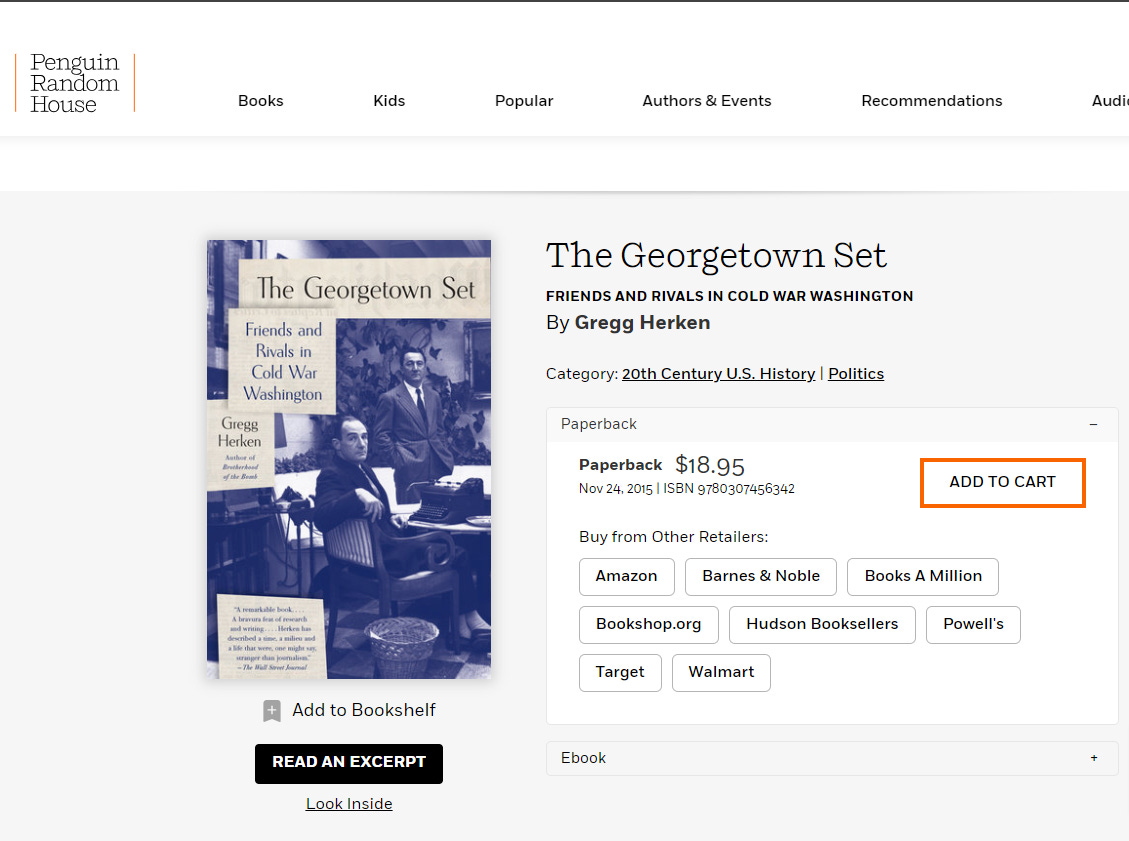
Mr. Stephens is a Zionist apologist/partisan and political propagandist, the Alsop Brothers were political operators and propagandists, with reach and influence for a reason! They were part of a long gone American Patrician Class, as explored in Mr. Yoder’s book, and Gregg Herken’s insightful book, that sometimes lapses into bestseller territory ‘The Georgetown Set’.
Like the Alsop brothers, who attended the Groton School for Boys, in Groton, Massachusetts, under the tutelage of the storied Endicott Peabody, Stephens attended an exclusive boys school Middlesex School in Concord, Massachusetts: so a sense of entitlement, attached to the pretense of expertise, is a natural attitude for Stephens to manifest?
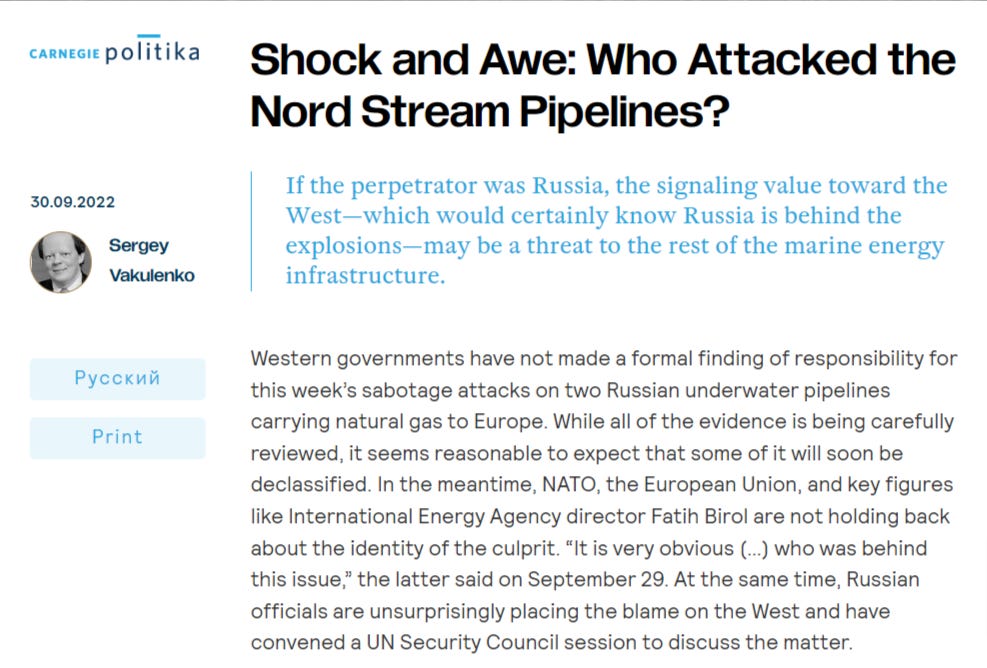
Constanze Stelzenmüller writes with the authority of a practiced journalist/propagandist. While careful in avoiding the attack on the Nord Stream Pipeline, as reported by her colleague who places, in the most maladroit way, the Russians. As part of a necessary framework for her evaluation of German politics, yet this direct attack on German Sovereignty was an Act of War against an ally! That might cause political reverberations over time, does not occur to a Political Technocrat? Although an operative of an American financed Think Tank might operate as an apologist!
Nord Stream, The Pan-European ‘Farmers Strike’, the American fomented and financed War in Ukraine, the reverberations of the Israel’s Genocide, and the enforced Famine against the Palestinians, also frames her political commentary, by their utter absence: keeping in mind that propaganda is tailored to an audience of readers, listeners, viewers , in this case a Financial Times reader. Which is not say that her essay is not readable, informative and instructive to a point, excuse my tortured syntax! The final paragraph invokes ‘The West’, but it appears in lower case , the very diminution of what a proper noun is!
In truth, it is much too early to say whether any of these extreme parties will succeed. But their presence will render Germany volatile and unpredictable in a year of high-stakes politics across the west. It will also make forming coalitions, and governing, more difficult. That could play into the hands of the extremists. But Scholz’s unhappy coalition in Berlin could take encouragement from those cheerful marchers: Germany’s middle is silent no more.
Headline: Abolish the U.N.’s Palestinian Refugee Agency
Is it predictable that three New York Times Public Intellectual’s Friedman/Brooks/Stephens should all be parties to the Gaza Genocide, and the Famine that is unfolding now? The first paragraphs of Stephens’ would be ‘bill of attainder’.
United Nations agencies and officials are no strangers to scandal and infamy.
Now comes the latest scandal of the United Nations Relief and Works Agency for Palestinian Refugees, better known as UNRWA.
Last Friday, Israeli officials presented the U.S. government with an intelligence dossier detailing the involvement of 12 UNRWA employees, seven of them schoolteachers, in the massacre of Oct. 7. As reported by The Times’s Ronen Bergman and Patrick Kingsley, the charges range from kidnapping an Israeli woman to storing rocket-propelled grenades to murdering civilians in a kibbutz.
Awful enough — and the U.N. rightly moved swiftly to terminate the employment of nine of those identified by the dossier. But that may be the least of it. “Intelligence estimates shared with the U.S. conclude that around 1,200 of UNRWA’s roughly 12,000 employees in Gaza have links to Hamas or Palestinian Islamic Jihad, and about half have close relatives who belong to the Islamist militant groups,” The Wall Street Journal reported on Monday.
…
‘Scandal and Infamy’ reeks of high dungeon. Yet Mr. Stephens like the Neo-Conservative he is, seeks to offer a Crime, that does not quite match the Zionist Crime of Genocide and Famine: though if true merits attention, and remedial legal action.
The Neo-Conservatives seeks to muddy the water of debate about crime, via mis-direction. Leo Strauss attempted to re-write the History of Philosophy, self-presenting as the holder of the vital interpretive key, that lay unnoticed for millennia? Zionist Loyalist Bret Stephens, in the present, offers himself as that indispensable political actor?
…
Defenders of UNRWA insist that without it, Palestinian civilians will suffer even more. But there is no reason other international agencies can’t shoulder the burden of the immediate relief effort for Gazans. In the meantime, the Biden administration and other governments need to ask hard questions of UNRWA’s senior officials, starting with Commissioner General Philippe Lazzarini.
To wit: If Lazzarini and his deputies didn’t know that UNRWA in Gaza was employing potentially hundreds of Hamas members or sympathizers, what sort of oversight were they exercising? And if they did know, are they not responsible? In either case — gross negligence or quiet complicity — they need to resign now.
The Israeli-Palestinian conflict should not be insoluble. But it can’t be solved so long as millions of Palestinians have been turned into the world’s only permanent refugees. By doing that, UNRWA makes itself an obstacle to peace — reason enough for it to finally go away.
Headline: How to Save a Sad, Lonely, Angry and Mean Society
A selection from Brooks’ latest Public Moralizing. Yet not a word about the Gaza Genocide! Brooks does offers an extended diagnosis of what ails us…
Many professors seem to have lost faith too. They’ve become race, class and gender political activists. The ensuing curriculum is less “How does George Eliot portray marriage?” and more “Workers of the world, unite!”
…
I confess I still cling to the old faith that culture is vastly more important than politics or some pre-professional training in algorithms and software systems. I’m convinced that consuming culture furnishes your mind with emotional knowledge and wisdom; it helps you take a richer and more meaningful view of your own experiences; it helps you understand, at least a bit, the depths of what’s going on in the people right around you.
…
The novelist Alice Walker lamented that she lacked models.
…
Then she found the novelist and anthropologist Zora Neale Hurston, who, decades before…
…
I’d argue that we have become so sad, lonely, angry and mean as a society in part because so many people have not been taught or don’t bother practicing to enter sympathetically into the minds of their fellow human beings. We’re overpoliticized while growing increasingly undermoralized, underspiritualized, undercultured.
The alternative is to rediscover the humanist code. It is based on the idea that unless you immerse yourself in the humanities, you may never confront the most important question: How should I live my life?
…
In the History of Mr. Brooks’ political opinionating/moralizing, where might The Reader place this misbegotten, vulgar, attempt to construct a usable literary/political character, Joey Tabula-Rasa: Mark Twain made both Tom Sawyer and Huckleberry Finn vivid characters in his novels! Joey is an inanimate political place-holder, conjured by a maladroit practitioner of propaganda:
…
What lessons will they draw from the events of the past month? How will the fall of Saddam affect their voting patterns, their approach to the next global crisis? One way to think about this is to conduct a thought experiment. Invent a representative 20-year-old, Joey Tabula-Rasa, and try to imagine how he would have perceived the events of the past month.
PROFESSOR ROGER Scruton, the darling of the intellectual right, was sacked as a commentator for The Wall Street Journal yesterday in an editotial after admitting he took money from the tobacco industry to place stories in the national press.
The philosopher, a professor of aesthetics at Birkbeck College, London University, has been told to “take a holiday” from the prestigious newspaper because he failed to disclose his ties with Japan Tobacco.
An editorial in yesterday’s European edition of The Wall Street Journal admitted: “We’ve come in for criticism lately because one of our contributors, the British conservative writer Roger Scruton, wrote an essay for our European edition while being paid by a Japanese tobacco company.
“Our long-time standard is that such financial ties should be disclosed, so readers can make up their own minds.” The move follows his sacking last week by the Financial Times over his tobacco links.
The Wall Street Journal had intervened to defend Professor Scruton over his £4,500-a-month contract with the tobacco giant.
But it said yesterday: “Mr Scruton had an obligation to tell us and his readers about his tobacco financing when he was writing about tobacco issues; he didn’t, and so he will be taking a holiday from our pages.”
Newspaper executives in America are said to be “furious” at Professor Scruton’s claims that he can use his contacts to place pro-tobacco articles.
In an e-mail, sent to Japan Tobacco last October, Professor Scruton boasted: “We would aim to place an article every two months in one or other of The WSJ (Wall Street Journal), The Times, the Telegraph, The Spectator, the Financial Times, The Economist, The Independent or the New Statesman.”
Professor Scruton and his wife, Sophie, are consultants to Japan Tobacco, which produces Camel cigarettes.
Yesterday, Clive Bates, the director of the anti-tobacco group Ash, said: “Japan Tobacco should follow the FT and Wall Street Journal and dump Roger Scruton. Anything he says on tobacco now will immediately be discredited.”
A spokesman for The Wall Street Journal said last night that Professor Scruton, who has worked for the paper since 1996, was not told in advance about the editorial.
Iris Murdoch :
Attention is a moral act. The key to becoming a better person, Iris Murdoch wrote, is to be able to cast a “just and loving attention” on others. It’s to shed the self-serving way of looking at the world and to see things as they really are. We can, Murdoch argued, grow by looking. Culture gives us an education in how to attend.
If attention is a moral act, where might The Reader place Mr. Brooks’ inattention to the Gaza Genocide?
My brief collection of evocative fragments from this ‘essay’:
There are many ways to explain the two biggest conflicts in the world today–while the two battlefronts may look very different- a titanic geopolitical struggle between two opposing networks of nations and nonstate actors- post-post-Cold War- the relatively stable Pax Americana/globalization era-the fall of the Berlin Wall in 1989-this is no ordinary geopolitical moment-
A collection of Friedman’s provisional rhetorical actors:
…
Resistance Network
…
Inclusion Network
…
Resisters
….
Includers
…
Further on in this Rhetorical Juggernaut The Reader encounters Chrystia Freeland:
…
At a breakfast with NATO leaders devoted to the Ukraine issue at Davos this year, Canada’s deputy prime minister, Chrystia Freeland, noted that it is we, the West, who should be thanking the Ukrainians, not forcing them to beg us for more weapons.
She also eloquently formulated the stakes: “What Putin wants is to transform the world order” that evolved since World War II and the post-Cold War — where “the competition between nations was about who can be richer and who can help their people prosper the most. … Putin hates that world because he loses in that world — his system is a loser in a peaceful, global, wealth-enhancing paradigm. And so what he wants is to move us back to dog-eat-dog, to a 19th-century, great power competition, because he thinks he can, if not win, be more effective there. … Let’s not think that this is a Ukrainian problem; this is a problem for us all.”
She is exactly right.
…
Chrystia Freeland has a problem with the truth, and Friedman as a ‘reporter’ is compromised!
Headline: Chrystia Freeland’s granddad was indeed a Nazi collaborator – so much for Russian disinformation
The news conference on Monday by Foreign Affairs Minister Chrystia Freeland was interesting not for the announcement that Canada was extending its training mission to Ukraine but for the questions and answers about the minister’s grandfather.
There have been a number of articles circulating about Freeland’s Ukrainian grandfather Michael Chomiak and his ties to the Nazis.
Some of those articles have appeared on pro-Russian websites. Freeland, who strongly supports Ukraine and is a major critic of Russia’s seizure of the Crimea, suggested to journalists that the articles about her grandfather were part of a Russian disinformation campaign. (The Russian government sees Freeland as virulently anti-Russian and has placed her on their travel ban).
“American officials have publicly said, and even Angela Merkel has publicly said, that there were efforts on the Russian side to destabilize Western democracies, and I think it shouldn’t come as a surprise if these same efforts were used against Canada,” Freeland told reporters after they raised questions about the articles about her grandfather.
The Globe and Mail also reported that an official in Freeland’s office denied the minister’s grandfather was a Nazi collaborator.
In addition, the claims were dismissed outright by those in the Canadian-Ukrainian community. “It is the continued Russian modus operandi that they have,” Paul Grod, president of the Canadian Ukrainian Congress told the Globe and Mail. “Fake news, disinformation and targeting different individuals. It is just so outlandish when you hear some of these allegations – whether they are directed at minister Freeland or others.”
Well it actually isn’t so outlandish. Michael Chomiak was a Nazi collaborator.
What are the sources for the information that Freeland’s grandfather worked for the Nazis?
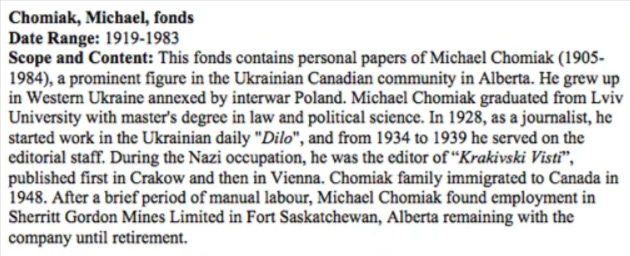
For starters, The Ukraine Archival Records held by the Province of Alberta. It has a whole file on Chomiak, including his own details about his days editing the newspaper Krakivski Visti. Chomiak noted he edited the paper first in Crakow (Cracow), Poland and then in Vienna. The reason he edited the paper in Vienna was because he had to flee with his Nazis colleagues as the Russians advanced into Poland. (The Russians tended to execute collaborators well as SS members).
See archive entry below:
So what was the Krakivski Visti? It, like a number of publications, had been seized by the Nazis from their Jewish owners and then operated as propaganda outlets.
Here is what the Los Angeles Holocaust Museum has to say about Krakivski Visti and a similar newspaper, Lvivski Visti, both publications associated with the Nazi regime.
“The editorial boards carried out a policy of soliciting Ukrainian support for the German cause,” the Holocaust Museum noted. “It was typical, within these publications, to not to give any accounts of the German genocidal policy, and largely, the editions resorted to silencing the mass killing of Jews in Galicia. Ukrainian newspapers presented the Jewish Question in light of the official Nazi propaganda, corollary to the Jewish world conspiracy.”
Now cut & paste, bricolage are tools of the writer, yet when used in tandem with outworn political cliche, attached to the practice of ersatz thought, equals what Friedman practices. Note that in this essay and his practice, as a New York Times Public Intellectual, Friedman treats word count as being equal to seriousness!
Political Observer on the Propaganda Imperatives of @NYT Bret Stephens & David Brooks.
Like his Fellow Traveler David Brooks , Bret Stephens attempts to change the subject from the 24,100 dead in Gaza, by means of his latest essay: The Meaning of Gaza’s Tunnels! The opening paragraphs.
Ever since Israel withdrew its soldiers and settlers from Gaza in 2005, critics have accused it of blockading and immiserating the territory — turning it, as they say, into an “open-air prison.”
The charge was always preposterous. Gaza shares a border with Egypt. Gazans were often treated in Israeli hospitals for cancer and other life-threatening conditions. Israel provided Gaza with much of its electricity and other critical goods even after Hamas came to power in 2007.
Now, as Israeli troops uncover more of Gaza’s vast underground city, the falsity of the accusation has become even more apparent.
According to a report this month in The New York Times, Israeli defense officials now estimate that Hamas’s tunnels measure between 350 and 450 miles in a territory that’s just 25 miles long. (By comparison, the London Underground is only 249 miles long.) Some of Gaza’s tunnels are wide enough for cars; some are more than 150 feet deep; some serve as munitions depots; others are comfortably kitted out as command bunkers.
…
The Question could be posed as : how might a captive people defend itself against its captors, that controls every aspect of their lives, including enforcing strict calorie management ! Not a question that would ever occur, to a former editor of The Jerusalem Post, a columnist and editor for the Wall Street Journal, nor a New York Times opinion writer might entertain, especially one trained by Wm. F. Buckley Jr.!
Like Mr. Brooks, Mr. Stephens’ propaganda imperative is shifting the current narrative, from the horrific Genocide practiced by Netanyahu and his Military, to a more manageable and easily manipulated set of questions, like Hamas Tunnels! And Brooks’ metastasizing ‘Administrative State’.
Both of these men are Neo-Conservatives: as such they are both the inheritors of the Legacy of Leo Strauss and his Re-Write of the History of Philosophy. And the deployment by the Platonic Guardians of the self-serving Noble Lie, as a necessity to the governance, of the lesser beings under their sway. It’s glaringly obvious that Stephens and Brooks are self-appointed members of this mendacious Political, Moral, Intellectual Class.
Let me go to the end of Mr. Stephens’ turgid melodrama, that the reader can explore at her leisure:
It’s possible that Israel could fight with more discrimination to spare Palestinian lives while still destroying Hamas’s ability to make war. If so, it behooves Israel’s constant critics to explain precisely how, and to do so in a way that doesn’t let Hamas off the hook. Otherwise, the tragic reality of this war is that it is going to be catastrophic for Gaza — not because Israel wills it, but because Hamas spent years of cynical efforts to make it so.
Hamas could have averted this tragedy if it had turned Gaza into an enclave for peace rather than terror. It could have averted it if it had not started four previous rounds of war against Israel. It could have averted it if it had honored the cease-fire that held on Oct. 6. It could have lessened the blow against Gazans by fighting in the open, not behind civilians. It could have eased it by releasing all of its hostages. It could end it now by surrendering its leaders and sending its fighters into exile.
After 75 years of subjugation and terror, the resistance to Zionism became shockingly real! The Israeli Army underwritten and supplied by American arms, and a never ending flow of money, was brought low by an ‘Army’ as yet to be defeated! A Slave Revolt while Israel commits Genocide? The Houthi’s offer the only resistance to Israeli/American teetering hegemony.
J.G.A. Pocock in the London Review of Books offers this frontal attack on The Paradise Lost of Brexit:
J.G.A. Pocock offers this on Brexit: Vol. 38 No. 14 · 14 July 2016
Profoundly anti-democratic and anti-constitutional, the EU obliges you to leave by the only act it recognises: the referendum, which can be ignored as a snap decision you didn’t really mean. If you are to go ahead, it must be by your own constitutional machinery: crown, parliament and people; election, debate and statute. This will take time and deliberation, which is the way decisions of any magnitude should be taken.
The Scots will come along, or not, deciding to live in their own history, which is not what the global market wants us to do. Avoid further referendums and act for yourselves as you know how to act and be.
Jean Monnet’s Steel and Coal Cartel that eventuated, in fact metastasized, into a slap-dash ungovernable political something, as revered by Martin Wolf, shares in the Spirit of Davos’ Collectivism? In the name of a World transformed by benign Technocratic Interventions ? What of those unruly States like Poland?
Headline: How Poland became Europe’s biggest rebel
Sub-headline: Support for the EU remains strong, but the confrontation with
Brussels is prompting a debate on the Polish right about ‘Polexit’
On October 7, from a spartan courtroom in Warsaw, Julia Przylebska read out a verdict that echoed across the whole EU. In a few sentences, the head of Poland’s constitutional court declared that key elements of the union’s law were “not compatible” with her country’s constitution.
The verdict brought to a head years of feuding between Warsaw and Brussels over a controversial overhaul of the Polish judiciary, and the backlash was immediate and sustained. Luxembourg’s foreign minister warned Poland it was “playing with fire”. When Poland’s prime minister Mateusz Morawiecki joined a fiery debate in the European Parliament this week to defend his government’s actions, MEP after MEP took the floor to lambast him.
“This is the first time ever that a court of a member state finds that the EU treaties are incompatible with the national constitution,” Ursula von der Leyen, the head of the European Commission, told Morawiecki during the debate. “This ruling calls into question the foundations of the European Union. It is a direct challenge to the unity of the European legal order.”
Monnet’s Cartel, as a possible counter weight to the Soviets, and a would be Pan-Europeanism, that collides with the once ascendent Nationalism, and the revelation of Globalism’s imperatives?
I’ll just ‘sample’ key paragraph’s of this wan apologetic that Mr. Friedman offers, on behalf Blinken, in a Newspaper that is the active partner of The American National Security State. Note that Friedman mentions Blinken being a Jew, yet not his own status as Jew! Nor the fact that his standing as a ‘Political Centrist’, and apologist for American/Israeli crimes, makes him the perfect interviewer for Davos. And its collection of Politicians, Political Technocrats, Billionaire Thieves, and their apologists, to remake ‘The West’: as it continues to sink in the mire of Neo-Liberalisms watershed of Catastrophe!
Headline: Blinken’s Search for Humanity in the Gaza War
…
My own way of dealing with the nightmarish nature of this war is to focus all my energies on thinking about how to stop it. But I can always think about China, or something else, if I want. That’s not the case if you are Secretary of State Antony Blinken and you are Jewish and you understand how unspeakably vicious the Hamas onslaught was on Oct. 7. Not to mention if you understand that Israel has a right to self-defense, but you also understand that Palestinian civilian casualties in Gaza have reached numbers you cannot ignore and that could leave a long-term stain on Israel and America.
So when I was invited to Davos to interview Blinken before a large audience today, I asked him bluntly the question people here have been asking me: One of the things you hear so often from people given the high number of civilian casualties in Gaza is, for the United States, do Jewish lives matter more than Palestinian Muslim lives or Palestinian Christian lives, given the incredible asymmetry of the casualties?
Blinken did not hesitate for a second to give an impassioned and heartfelt answer that I thought did him and America proud — an answer that neither obscured the vast human tragedy that has been triggered by Israel’s retaliation nor let Hamas off the hook for its role in starting the whole thing.
“No — period,” Blinken immediately shot back at me.
“I think for so many of us,” he continued, “what we’re seeing every single day in Gaza is gut-wrenching, and the suffering we’re seeing among innocent men, women and children breaks my heart. The question is: What is to be done? We’ve made judgments about how we thought we could be most effective in trying to shape this in ways to get more humanitarian assistance to people — to get better protections and minimize civilian casualties at every step along the way. Not only have we impressed upon Israel its responsibilities to do that, we’ve seen some progress in areas where, absent our engagement, I don’t believe it would have happened.”
Blinken continued: “But that in no way, shape or form takes away from the tragedy that we’ve seen and continue to see. It’s why we’re at it relentlessly, every single day. All I can tell you, Tom, is just on a purely human level, it’s devastating,” he said, referring to the “gut-wrenching” suffering that Israel has inflicted on the Palestinians in Gaza. “But it also reinforces my conviction that there has to be — and there is — another way that answers Israel’s most profound concerns” about security.
Mr. Brooks still thinks of himself as an agenda setting political commentator/writer. Here I will assign motive to Mr. Brook’s intervention. As the protégé of Wm. F. Buckley Jr., and a Neo-Conservative, no matter how abraded by political/careerist opportunism: The Noble Lie*, as celebrated by Leo Strauss, and his coterie of American Jingo’s is active in his mentality. Mr. Brooks seeks, in his way, to present a crisis that will render the The Gaza Genocide in shadow, as an imperative that must be acted upon, without delay!
Headline: Death by a Thousand Paper Cuts
In his 1, 245 word essay, the patient Reader arrives at these final paragraphs:
…
Organizations are trying to protect themselves from lawsuits, but the whole administrative apparatus comes with an implied view of human nature. People are weak, fragile, vulnerable and kind of stupid. They need administrators to run their lives. They have to be trained never to take initiative, lest they wander off into activities that are deemed by the authorities to be out of bounds.
The result is the soft despotism that Tocqueville warned us about centuries ago, a power that “is absolute, minute, regular, provident and mild.” In his Liberties essay, Edmundson writes that this kind of power is now centerless. Presidents and executives don’t run companies, universities or nations. Power is now held by everyone who issues work surveys and annual reports, the people who create H.R. trainings and collect data. He concludes: “They are using the terms of liberation to bring more and more free people closer to mental serfdom. Some day they will awaken in a cage of their own devising, so harshly confining that even they, drunk on their own virtue, will have to notice how their lives are the lives of snails tucked in their shells.”
Trumpian populism is about many things, but one of them is this: working-class people rebelling against administrators. It is about people who want to lead lives of freedom, creativity and vitality, who find themselves working at jobs, sending their kids to schools and visiting hospitals, where they confront “an immense and tutelary power” (Tocqueville’s words) that is out to diminish them.
Mr. Brooks ends his self-serving polemic with the notion of ‘soft despotism’ and Trump garners a mention. Yet the Murderous appetite of the Neo-Conservatives in ‘The War on Terror’ stands as the clear evidence, that Brooks’ sounding the alarm, is about a wan and self-serving attempt to change the subject!
Headline: At Least 37 Million People Have Been Displaced by America’s War on Terror
Sub-headline: A new report calculates the number of people who fled because of wars fought by the United States since Sept. 11, 2001.
*
…
In the Republic the Noble Lie is supposed to make the citizens of Callipolis care more for their city. Schofield (2009) argues that the guards, having to do philosophy from their youth, may eventually find philosophizing “more attractive than doing their patriotic duty” (115). Philosophy, claims Schofield, provides the guards with knowledge, not with love and devotion for their city. The Noble Lie is supposed to engender in them devotion for their city and instill in them the belief that they should “invest their best energies into promoting what they judge to be the city’s best interests” (113). The preambles to a number of laws in the Laws that are meant to be taken as exhortations to the laws in question and that contain elements of traditional mythology (see 790c3, 812a2, 841c6) may also be taken as “noble lies”.
…
Plato’s eschatological myths are not complete lies. There is some truth in them. In the Phaedo the statement “The soul is immortal” is presented as following logically from various premises Socrates and his interlocutors consider acceptable (cf. 106b–107a). After the final argument for immortality (102a–107b), Cebes admits that he has no further objections to, nor doubts about, Socrates’ arguments. But Simmias confesses that he still retains some doubt (107a–b), and then Socrates tells them an eschatological myth. The myth does not provide evidence that the soul is immortal. It assumes that the soul is immortal and so it may be said that it is not entirely false. The myth also claims that there is justice in the afterlife and Socrates hopes that the myth will convince one to believe that the soul is immortal and that there is justice in the afterlife. “I think”, says Socrates, that “it is fitting for a man to risk the belief—for the risk is a noble one—that this, or something like this, is true about our souls and their dwelling places” (114d–e). (Edmonds (2004) offers a interesting analysis of the final myth of Phaedo, Aristophanes’ Frogs and the funerary gold leaves, or “tablets”, that have been found in Greek tombs). At the end of the myth of Er (the eschatological myth of the Republic) Socrates says that the myth “would save us, if we were persuaded by it” (621b). Myth represents a sort of back-up: if one fails to be persuaded by arguments to change one’s life, one may still be persuaded by a good myth. Myth, as it is claimed in the Laws, may be needed to “charm” one “into agreement” (903b) when philosophy fails to do so.

 StephenKMackSD's Blog