How very convenient that Simon Kuper is both an employee of The Financial Times and and a contributor to Volta!
Simon Kuper
is a British writer. After studying History and German at Oxford and attending Harvard University as a Kennedy Scholar, he began writing about sports “from an anthropological perspective” and joined the Financial Times in 1994. His column today is called “Opening Shot” and is a fixture of the FT’s Weekend Edition.
Da Empoli understands power, partly because he once wielded some, as adviser for years to Matteo Renzi, who from 2014 to 2016 was Italy’s would-be modernising prime minister. That’s why his novel has become a guide — devoured by many western politicians — to the mindset of the Kremlin. The book covers Russian power since the 1990s, a subject that da Empoli had been obsessively researching since first visiting Moscow in 2010.
Surveying the diners in Jack’s, he remarks: “In Russia, power is a big beast. In Switzerland power is a kitten, and it’s been domesticated. Through history, it’s been diluted, distributed, at local level and through referendums. Swiss politicians are boring. That’s quite a good thing. The more spectacular a political system, the worse it is, in many ways.”
We’ve eaten together before — we know one another from Paris, where we both live, and in 2016 the progressive think-tank he ran, Volta, published some of my essays as an Italian ebook. After da Empoli switched from writing in Italian to French, I enjoyed his essayistic political books. I then watched him become a star. His novel appeared in April 2022, weeks after Russia’s full-scale invasion of Ukraine. He says: “I never thought it would sell more than 3,000 copies. And when the war broke out, I thought it would be wiped out completely.” It has sold about 650,000 copies in France alone.
…
Should this sentence surprise The Reader? It reeks of Hollywood kitsch!
I then watched him become a star. His novel appeared in April 2022, weeks after Russia’s full-scale invasion of Ukraine
The Reader can further her reading of this Anti-Putin Propaganda and Mr. Giuliano da Empoli story of his political/literary evolution.
…
Renzi was not Vladimir Putin, but da Empoli believes some aspects of power are universal. “I think the difference between leader and adviser is that the leader is 100 per cent into his action. There’s no distance between what he does and thinks and who he is. It’s so intense, you need to mobilise so many resources, that the only way is if you’re in it 100 per cent. The adviser keeps a distance, which allows him to be more lucid, and maybe keep giving good advice. This suits certain personalities. It suits me perfectly.”
The job would inform his literary depiction of the Kremlin’s “wizard”, Putin’s imagined consigliere Vadim Baranov. Putin, da Empoli explains, exercises a “premodern” type of power that baffles western European politicians. “He operates with codes that maybe some of our ancestors would have understood better than we do. But Putin’s practically never been on the internet. He’s not on social media. Baranov provides the postmodern theatrics that are also important in Putin’s power.”
…
My analysis is not complete! What I seek to comment upon is the reception of Giuliano da Empoli’s fiction, in two highfalutin journals, of respectable bourgeois political opinion. Can @TheEconomist be next? Or will the perpetually exhumed Bagehot comment from the perspective of 1843?
The New Statesman of January 15, 2024
Headline: The Wizard of the Kremlin takes us inside the mind of Putin’s spin-master
Sub-headline: Giuliano da Empoli’s fictionalized portrait of Vladislav Surkov dramatises the birth of the post-truth world.
David Sexton’s ‘review’ lacks Kuper’s melodramatic enthusiasm, if that is the right descriptor. Mr. Sexton’s paragraph about the fictional set-up -The Reader can evaluate this for what it is , Anti-Putin propaganda, refracted through a ‘character’ modeled on Vladislav Surkov .
…
The fictional set-up is creaky but effective. An unnamed narrator is in Moscow to study Yevgeny Zamyatin, the author of the pioneering dystopian novel We (1924). He spots that a Twitter account he follows, attributed to the now retired “Wizard of the Kremlin”, has cited the writer, and promptly responds by completing the quote. The following evening, a Mercedes whisks him to Baranov’s elegant house, where the Wizard, for no particular reason (“you’ve come all this way”), launches into the full story of his life, over glasses of whisky, through the night. The pretence of the fireside chat is soon dropped, however; the yarn incorporates much extended explanatory dialogue, supposedly recalled verbatim. The one apparently wholly fictional component of the story is Baranov’s grand amour, the beautiful and demanding Ksenia, whom he hooks up with while a penniless theatre student, but loses to his nerdy but super-rich friend Mikhail (Khodorkovsky). Ksenia is, I fear, a cipher for the spirit of Russia, “a tigress”, “a strange and cruel nymph”.
….
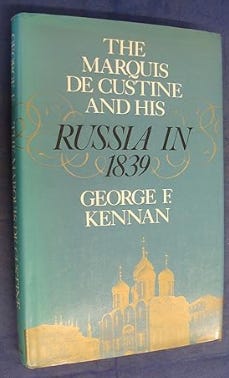
The Wizard of the Kremlin is a fast, easy read, smartly translated by Willard Wood, which efficiently dramatises great sweeps of Russia’s recent political history. Its success in France can be attributed both to the country’s special relationship with Russia and to its flattering embrace of a familiar literary perspective on Russia and its tsars. Baranov repeatedly quotes from the French aristocrat Astolphe de Custine’s scathing Letters from Russia (1839). Baranov says that his revered grandfather told him that Custine, that “son of a bitch” who said the whole country was a prison, remains the best interpreter of Russia. Robin Buss’s Penguin Classics translation of the letters is a treat.
George F. Kennan offers this:
While the War In Ukraine continues, financed by the EU, America and a collection of malign political actors; the Genocide in Gaza resisted militarily by the Houlis alone, and South Africa, in the International Court of Justice: there can be no doubt that ‘The West’ is not just in a ‘Decline’ as once diagnosed by Oswald Spengler, but a total surrender to War Criminal Benjamin Netanyahu’s Crimes against Humanity. Giuliano da Empoli’s fiction provides a necessary ‘bad actor’, on the World Stage, as a Second -Front that respectable Liberals/Neo-Liberals/Neo-Conservatives can focus their Moral Awareness, about a clear and present danger. While Trump wins handily, a political creature birthed by the New Democrats, The Republicans, The Neo-Conservatives!
In my haste to comment on Mr. Ganesh’s latest essay, I commented about the Hunger and Homelessness in Britain. I failed in my moral duty, yes Kant!, to, at the least, mention the Gaza Genocide underwritten by American weaponry, and an utterly bankrupt Political Morality; that has infected that mythical ‘Western Civilization’: that is the sine qua non of Newspapers and Websites, who publish political commentary. The European Settler State is a historical/moral toxin; the History of America is the most glaring example!
Best regards to my Readers.
StephenKMackSD
It seems rather hard to forget this report by Jim Waterson of Buzz-Feed, from 2017!
Headline: Here’s What Happened When Jeremy Corbyn Supporters Protested Outside The New Statesman
Sub-headline: “With this kind of New Statesman who needs Murdoch?” ask protestors who took their campaign against media coverage of Corbyn to the streets.
A selective yet informative selection of this report:
A group of Jeremy Corbyn supporters gathered outside the offices of the New Statesman on Thursday night to demand the left-wing magazine recants its criticisms of the Labour leader, does more to promote his agenda, and asked to be given 30 pages in the magazine’s next issue to make a pro-Corbyn case.
…
The current issue of the magazine features a cover entitled “Wanted: An opposition” and features multiple articles criticising Corbyn and the current state of the Labour party, which the protestors said filled at least 30 print pages.
…
Sam Weinstein, a retired union official, aged 68, told BuzzFeed News the magazine was guilty of “scabbing” on the Labour party by opposing the leader shortly before the local elections. He suggested it was part of a plan to ensure the party performed badly and to make it easier to remove Corbyn.
“We expect it from the Daily Mail – what we don’t expect is to be stabbed in the back by people who claim they’re supporters of ours,” he said. “It’s nothing but treachery.”
…
“There is nobody who is unbiased in relation to Corbyn – Paul Mason has been good. The Guardian has been terrible. The Independent at times has been a bit better. Every interview you watch is absolutely biased. Who needs Murdoch if the New Statesman is going to behave like this? You would expect the Labour media would not trash the elected Labour leader.”
…
The initial request for pro-Corbyn coverage may have failed. New Statesman deputy editor Helen Lewis said they would struggle to find the room to accommodate the protestors’ demand for 30 pages: “The normal flatplan is 64 pages, so it would have a pretty severe effect on the critics section. And there’s no way we would drop the crossword, the readers would go mad. Compared with that, being rude about Jeremy Corbyn is really small fry.”
The above demonstrates, to say the least, a betrayal of political solidarity , or just cowardice on the part of the New Statesman and it’s deputy editor Helen Lewis.
Freddy is in top form when evaluating the oily Mr. Cameron , the reader might even call him catty! Though Cameron is never less that self-congratulatory, in his attempt at feigned modesty. He recalls the character of Flashman in Tom Brown’s School Days!
Morning Call: Cameron returns
The Foreign Secretary faces MPs for the first time since his return.
…
But first, a report from David Cameron’s first appearance before MPs since he became Foreign Secretary.
Selective quotation:
…
Cameron’s return from the wilderness (also known as the Cotswolds) was made possible by a prompt ennoblement to the House of Lords. He was handed some ermine and told to deal with the unfolding war between Israel and Hamas to allow, some speculate, Sunak to devote more time to winning over voters at home.
…
But whatever one makes of his merit as a diplomat, Cameron is the picture of a consummate politician. His ability to evade questions is second to none. He slides past questions with a disarming charm. “If we step back and look at the big picture”; “I’m a bit torn on this”; “I don’t recall every piece of paper put in front of me”; “I’ll answer a slightly different question if I may”; “I am not a lawyer.”
…
Cameron resisted answering whether Israel was breaking international law but under the persistent questioning of Kearns, who reminded him how happily he has accused other countries of war crimes in the past, the Foreign Secretary said that Israel was “de facto” occupying Gaza and that he was “worried that Israel has taken action that might be in breach of international law”. He went on to call for another humanitarian pause and threatened to upgrade the travel ban on Israeli settlers in the West Bank to a full sanction. Cameron, remember, called Gaza a “prison camp” as prime minister in 2010, and condemned Israel’s invasion of Lebanon in 2006 as “disproportionate”.
There has been a marked shift in the government’s approach since he took office. On 16 December, he wrote a joint article with Annalena Baerbock, his German counterpart, calling for a sustainable ceasefire and for Israel to kill fewer civilians.
But his belief in Britain’s ability to act on these concerns seemed minimal. When Kearns pressed Cameron on whether the UK can restrain Israeli air strikes, he could only muster: “I hope they listen to us.” For all the urbane confidence, it was not a compelling endorsement of British power abroad.
This Reader wonders what Freddie and The New Statesman will do, if Jeremy Corbyn enters as a third party candidate, in the next election? As Starmer is Tony Blair’s house pet, and a New Labour stalwart, the only real ‘Left Vote’ would be Corbyn. That is if political consistency of a kind were an imperative?
Political Commentator wonders, where the Homeless & Hungry might fit into ‘Ganesh World’?
…………………………………………………………………………………………………………………………
January 11, 2024:
In my haste to comment on Mr. Ganesh’s latest essay, I commented about the Hunger and Homelessness in Britain. I failed in my moral duty, yes Kant!, to, at the least, mention the Gaza Genocide underwritten by American weaponry, and an utterly bankrupt Political Morality; that has infected that mythical ‘Western Civilization’: that is the sine qua non of Newspapers and Websites, who publish political commentary. The European Settler State is a historical/moral toxin; the History of America is the most glaring example!
When reading Mr. Ganesh I am remined of his remarkable talent as a stylist. Yet his latest essay in which he opines about that ‘red wall’, and other vexing political questions : Kenneth Kohlrabi is the comments section, also wonders what that might be.
This expression of Mr. Ganesh as political commentator reminds this reader of Tom Wolfe’s ‘The Kingdoms Of Speech’. A possible point of intellectual/political fracture is reached between the imperatives of the feuilleton, as a form, reserved for another part of a Newspaper? Mr. Ganesh essay seems trapped, in the moment, in the rhetorical styles of both Gideon Rachman and Edward Luce, equal to lackluster political commentaries!
Here are some reviews, Wolfe’s the first of which seems to be deeply attached to Chomsky’s Marxism as indictive of what? And Jerry A. Coyne’s
There are some indicators of Mr. Ganesh’s power, yet the rhetorical prestidigitations of another literary Ganesh are missed.
That was the beginning of my comment on Mr. Ganesh latest essay. Mr. Ganesh was/is an avid reader of Mr. Wolfe’s. Yet in this instance Mr. Wolfe wrote, as if, he could hope to match, or exceed, the work of two writers, intellectuals, World Historical Thinkers. When his whole career was writing about the mundane of popular culture, in it’s widest sense, as satire from a ‘Conservative’ point of view. His most infamous project was ‘Radical Chic & Mau-Mauing the Flak Catchers (1970)’ in which he ‘satirized’ Leonard Bernstein’s soirée for the Black Panther Party. Was it an expression of Mr. Wolfe’s not so latent ‘Southern-ness’, or more pointedly his racial animus towed Jews and Blacks!
Back to Mr. Ganesh:
The Reader need only look at the Political Leaders of Britain from David Cameron, Mrs. May, Boris Johnson, Liz Truss & Kwasi Kwarteng , Rishi Sunak as expressions of political/legal exhaustion. With Tony Blairs’s house-pet Kier Starmer as Political Pretender. Will the roundly defamed, by this newspaper and its confederates, Jeremy Corbyn enter the contest?
Does this sentence answer any questions? ‘And so it is with some justification that I announce the death (through natural causes) of big-government Toryism’ This is the chatter of a would-be Party Technocrat, who acts as if Homelessness and Hunger are not epidemic?
With Homelessness at record levels:
Rough sleeping rises in UK amid tidal wave of homelessness
Dennis Moore
19 March 2023
For the first time in five years there has been a marked rise in rough sleeping across England.
Office for National Statistics (ONS) data shows that in 2022, an estimated 3,069 people were sleeping out on the streets of England, a rise of 26 percent. This is the biggest year on year rise since 2015 and exposes the pretense of the Conservative government’s 2019 manifesto promise to “end the blight of rough sleeping” by 2024.
Even this rise is not the full picture as the numbers of those sleeping out on the streets does not include those who are homeless, living in temporary shelters or hostels.
There has been a rise in rough sleeping across all regions of England. London and the southeast represented half of those on the streets, with Westminster local authority in London recording the largest number of rough sleepers, 250 people, an increase from 63. Christchurch, Poole and Bournemouth showing a doubling of rough sleepers.
Poverty across UK forces 11.3mn Britons into hunger, report reveals
A landmark research study has revealed an excruciating extent of food poverty across Britain as the general public grapple with soaring inflation and the highest cost-of-living in a generation.
More than eleven million people or one in seven persons throughout the UK faced hunger in the last year due to a shortage of money, according to a new study by a leading charity organization, the Trussell Trust.
According to the charity, the latest findings are just the tip of the iceberg and the shortage of money is not limited to just hunger pangs among the impoverished Britons.
It said the impact of poverty leads to worrying social isolation and loneliness, spiraling debt, and a decline in physical and mental health.
Trussell Trust said its food banks network distributed close to 3 million emergency food parcels in the past 12 months, as the levels of need were even more than during the peak of the coronavirus pandemic, and more people found themselves incapable of covering the cost of essentials such as heating and food.
Mr. Ganesh moral/political vacuity is the expression of a ‘Technocrat’/Reporter’, ensconced in his comfortable office! Informing his readers about questions of would be political orthodoxy, he knits together for consumption by his readers/acolytes: who can chatter to each-other about such a pressing question:
‘And so it is with some justification that I announce the death (through natural causes) of big-government Toryism’
Political Observer offers some selective quotation of Stephen’s moralizing politics.
Bret Stephens when he isn’t proclaiming his moral uprightness and virtue, he can’t resist the temptation to attack the Civil Rights Era and The Great Society of Johnson, on its periphery. The Left in the political imagination of Stephens is about that time, place , it politics , its imperatives and its political/legal evolution.
Here is a selection from Stephens essay of Jan. 2, 2024 that demonstrates his own set of imperatives . Stephens’s self-concept is about being a Political Moralist!
…
The answer, I think, is this: Where there used to be a pinnacle, there’s now a crater. It was created when the social-justice model of higher education, currently centered on diversity, equity and inclusion efforts — and heavily invested in the administrative side of the university — blew up the excellence model, centered on the ideal of intellectual merit and chiefly concerned with knowledge, discovery and the free and vigorous contest of ideas.
Why did that change happen? I’ve seen arguments that it goes back to the 1978 Bakke decision, when the Supreme Court effectively greenlit affirmative action in the name of diversity.
But the problem with Bakke isn’t that it allowed diversity to be a consideration in admissions decisions. It’s that university administrators turned an allowance into a requirement, so a kind of racial gerrymander now permeates nearly every aspect of academic life, from admissions decisions to faculty appointments to the racial makeup of contributors to essay collections. If affirmative action had been administered with a lighter hand — more nudge than mandate — it might have survived the court’s scrutiny last year. Instead, it became a pervasive regime that frequently got in the way of the universities’ higher goals, particularly the open exchange of ideas.
This is the poisoned pool in which Harvard now swims.
…
That respect is now being eroded to the point of being erased. For good reason. People admire, and will strive for, excellence — both for its own sake and for the status it confers. But status without excellence is a rapidly wasting asset, especially when it comes with an exorbitant price. That’s the position of much of American academia today. Two-hundred thousand dollars or more is a lot to pay for lessons in how to be an anti-racist.
Nobody should doubt that there is still a lot of excellence in today’s academia and plenty of good reasons to send your kids to college. But nobody should doubt, either, that the intellectual rot is pervasive and won’t stop spreading until universities return to the idea that their central purpose is to identify and nurture and liberate the best minds, not to engineer social utopias.
Sachs’s immediate concern is the implication for the Government’s budget, which must be slashed in order to bring inflation under control. If much of the nation’s health expenditures are now buried as fringe benefits on the books of enterprises that depend on Government subsidies, who will pick up the cost once the enterprises are forced to economize?
Getting a handle on the magnitude of the problem is obviously difficult in a country that cannot even explain why life expectancy has fallen sharply in the last two decades. But some number is better than none. And by pressing officials to address this and other pivotal issues, Sachs hopes to accelerate the pace of reform.
Sachs’s message of urgency is not universally accepted. Plenty of Western as well as Russian economists contend that a more gradual approach is not only possible but necessary. “Economic reform is a political process,” says Padma Desai at the Harriman Institute at Columbia University. “First, you must build consensus.”
And even his sympathizers acknowledge that Sachs’s high profile and world-class impatience could generate a backlash in a nation still adjusting to the reality that it is no longer a superpower. “There’s a real dilemma here,” says Stanley Fischer, an international economist at the Massachusetts Institute of Technology. “You have to make a lot of noise to get the attention of the West. But the more noise you make, the more you make it seem that the reform program is a Western program. And that could be the kiss of death.”
…
Please note that I’ve placed in bold font and italics Mr. Sachs reported ‘world class impatience’!
Here are the the last paragraphs of Beddoes latest broadside , about the coming Political Crises of 2024: In sum Trump and Trumpism!
Headline: 2024 will be stressful for those who care about liberal democracy
Sub-Headline: In theory it should be a triumphant year for democracy. In practice it will be the opposite
Nothing, however, will compare to America’s election, either for grim spectacle or potential consequences. It is hard to believe the most likely outcome is a rematch between two old men, both of whom the majority of voters wish were not candidates.
Donald Trump’s very candidacy undermines American democracy. That the Republican Party would nominate a man who tried to overturn the results of the previous presidential election dims America as a democratic beacon. A second Trump term would transform America into a loose cannon with isolationist tendencies at a time of grave geopolitical peril. His fondness for strongmen, particularly Mr Putin, suggests that his boast to end the Russia-Ukraine conflict in 24 hours would be at Ukraine’s expense.
Mr Trump may not become the nominee, and if he does, he may well lose. But the odds of a second Trump term are alarmingly high. The consequences could be catastrophic—for democracy and for the world. ■
Zanny Minton Beddoes, Editor-in-chief, The Economist
Headline: France is still finding its bearings with the war in Gaza
Sub-headline : In two and a half months of conflict, President Emmanuel Macron has made a series of missteps and confused initiatives, struggling to grasp the scale of the carnage caused by Israeli strikes on the Palestinian enclave.
How might The Reader even begin her approach this ‘Journalistic Monstrosity’ of 2,787 words? The first four paragraphs provide a preliminary sketch, a study, for the final rhetorical canvas?
The war in Gaza has shown no signs of de-escalation, with Israel pledging to “intensify” the fighting. French President Emmanuel Macron, just before Christmas, returned to the region for a visit to Jordan where, in keeping with tradition, he shared a Christmas meal with French troops deployed abroad. It was Macron’s third visit to the Middle East since the outbreak of hostilities, when Hamas attacked Israel on October 7.
The French president’s previous trips – first to Israel, Egypt and Jordan two weeks after the attacks; then to Dubai for COP28 and Qatar in early December – highlighted how difficult it has been for France to find its stance on the conflict. His visit to the troops taking part in Operation Chammal, which fights against the Islamic State (IS) organization in Syria and Iraq, was also to be understood in this context.
“French officials are still trying to figure out where they stand,” said a specialist of the region, who spoke on the condition of anonymity. “They’ve realized that their message isn’t getting through because of how inscrutable their positions are considered.” An official from the Elysée Palace, who also asked for anonymity, said: “We haven’t changed, events have.”
Over the past two months, French diplomacy has continually fumbled, alternating between missteps and confused initiatives, as if Paris, long in tune with Middle Eastern realities, had suddenly lost the region’s pulse.
…
That Reader encounters the eternal stand-by of ‘Journalistic Metaphysics’! Note that I have put in bold font , in the above four quoted paragraphs, examples of this style of Journalism. This is aided by sub-titles, collected here, with the word count
Setting the tone: The word count 368; A collection of Rhetorical Snapshots:
October 12 with Macron’s address, a grave tone, massacre committed by Hamas, hostages paraded like trophies, Macron, who went on to express his compassion for the Israelis, Israel has the right to defend itself,killing over1,300 people, the president empathized with only one side. The tone was set, October 24. The death toll in Gaza now stood at 6,000, international coalition against the Islamic State (IS) organization in Iraq and Syria, of which France is a member, “also fight against Hamas.”, the philosopher Bernard-Henri Lévy, as the newspaper Libération claimed in early December? To equate Hamas with the absolute evil…
‘Reality check’ The word count 368. Rhetorical Snapshots:
“Honestly, it wasn’t a brilliant idea,” said a senior Arab leader, Macron’s advisors tried to rectify the situation, Macron had a “reality check” discussion, a level-headed Italian-Swiss with a long experience in the Middle East, would fuel polarization and misunderstanding, Israel had carte blanche to wage a war without rules, Macron listened attentively., accompanied by Patrick Durel, Alexis Le Cour Grandmaison, an Arabist formerly, to limit the fallout., that Macron had been misunderstood, quite a stir within the French diplomatic apparatus., long nicknamed the “Arab Street,”, Nicolas Roche, stationed in Iran,
The Foreign Ministry’s sudden remobilization: The word count: 379. Rhetorical Snapshots:
The Elysée and the Foreign Ministry immediately sought to contain this quiet rebellion., Anne-Marie Descôtes, “duty of loyalty.”, their mailing lists to avoid leaks, says something about the prevailing feverishness,” commented one diplomat, was a “real malaise” between the ministry’s “neoconservatives,”, The Foreign Ministry, which had been bypassed, was suddenly remobilized., Three focal areas were identified:, Macron pressured his teams to organize the event in less than a week., UN Secretary-General Antonio Guterres, Kenyan President William Ruto, Macron called for a “very rapid humanitarian pause” and for “working towards a ceasefire.”, with the carnage underway in Gaza, where 10,000 people were now dead and 700,000 displaced., Humanitarianism is impossible without politics,” , lamented Hugh Lovatt, a first visit to Gaza to support UNRWA employees traumatized by the death of nearly 100 of their colleagues under Israeli strikes, made a remarkable speech.,
‘Magic formula’ The word count 424: Rhetorical Snapshots:
the horror of the bombardments on Gaza entered the president’s vocabulary., But “de facto, today, civilians are being bombed. De facto, these babies, these ladies, these old people are bombed and killed. There is no reason for that and no legitimacy. So we do urge Israel to stop.”, which marked the beginning of a belated rebalancing spurred by the ongoing events, strained relations with Netanyahu, criticized the French president for making a “serious mistake, factually and morally.”, Macron prefers to contact the Israeli president, Isaac Herzog, or opposition figures such as Yair Lapid., Prior to the war in Gaza, Macron had shown little interest in the Israeli-Palestinian conflict., The French president was more interested in the Abraham Accords,He paid no attention to the fact that these agreements were contributing to weaken the Palestinian Authority, Macron has made it a habit to lean on the European Union as a channel of influence for a declining France., The weight of the Holocaust has forced Germany to align itself with Israel, as have certain Central European capitals such as Budapest and Prague.
‘The Gaullo-Mitterrandian line’ The word count: 384 : Rhetorical Snapshots:
“France has lost the singularity that enabled it to balance the European position with the capitals most sensitive to the Palestinian cause, such as Ireland, Belgium and Spain,” said a diplomat in Brussels., the man saving Europe’s honor is Spanish Prime Minister Pedro Sanchez, Denis Bauchard, a former French ambassador to Jordan, observed: “We carry little weight, despite having clearly refocused our positions. We make the right choices at the UN, along Gaullo-Mitterrand lines, but Arab capitals don’t give us credit for it.”, On December 5, Yahya Sinwar, the head of Hamas’s political wing in Gaza, was sanctioned by Paris., Does the alleged mastermind of the October 7 attack have hidden accounts in France? “No, of course not,” said a diplomatic source, “It’s political posturing, but symbolically, it’s important.”, On the other hand, no Arab country sent an emissary, even those that had established diplomatic relations with Israel and whose aversion to Islamist movements was well known, “Macron is too fond of public initiatives and spetacle politics,” said Lovatt, of the European Council on Foreign Relations.,
Note to The Reader: have Benjamin Barthe & Philippe Ricard arrived at a point of a verifiable political critique, or something resembling such?
‘Failed 5-star cast’ the word count: 322, Rhetorical Snapshots:
The relaunch of the political process, the third pillar of the Macron plan, led to a previously unreported event:, discreetly organized with a dozen players from Israeli and Palestinian civil society., the Elysée was counting on the presence of such respected figures as Hanan Ashrawi, a veteran of the Madrid negotiations (in 1991), But this 5-star cast could not withstand the test of reality., Even the former Lebanese culture minister Ghassan Salamé, who had been approached to lead the debates, bowed out., only two Palestinians took part in the round table on December 10 – employees of NGOs with little notoriety, “This round table was a joke,” said one participant with a sigh, “a show totally detached from reality.”,
The same language for 30 years, The word count 272 .
I will end my polemical commentary/critique with the final sentence offered by Benjamin Barthe & Philippe Ricard:
A timid first step for French diplomacy, which has been sputtering the same language on the Israeli-Palestinian conflict for years.
Some further observations on Macron from September 6, 2023:
“Superb, unsettling new history …. Can these clashing Churchills be reconciled? Do we live, at the same time, in the world he helped to save and the world he helped to trash? Toye, one of Britain’s smartest young historians, has tried to pick through these questions dispassionately …. Of course, it’s easy to dismiss any criticism of these actions as anachronistic. Didn’t everybody in Britain think that way then? One of the most striking findings of Toye’s research is that they really didn’t: even at the time, Churchill was seen as standing at the most brutal and brutish end of the British imperialist spectrum …. Toye is no Nicholson Baker, the appalling pseudo-historian whose recent work Human Smoke presented Churchill as no different from Hitler. Toye sees all this, clearly and emphatically …. In the end, the words of the great and glorious Churchill who resisted dictatorship overwhelmed the works of the cruel and cramped Churchill who tried to impose it on the world’s people of color. Toye teases out these ambiguities beautifully. The fact that we now live at a time where a free and independent India is an emerging superpower in the process of eclipsing Britain, and a grandson of the Kikuyu ‘savages’ is the most powerful man in the world, is a repudiation of Churchill at his ugliest–and a sweet, unsought victory for Churchill at his best.” —Johan Hari, The New York Times Book Review
“Indeed, it is not too much to say that the story of Churchill’s life is the story of his view, vision, and valiant defense of the British Empire–the duties of empire and the maintenance of empire, the idea of empire and the ideals of empire. So it is surprising that, until Richard Toye took on the task, little has been written in book form about Churchill and the British Empire …. What is not generally or popularly recognized–but rectified by Toye–is that there were many Churchillian views on empire …. Toye argues convincingly that Churchill’s views on empire were not a fixed thing–and were not designed simply to enhance Britain’s role in the world …. The Empire faded as Churchill’s life did. But there was triumph after all, perhaps even a bit of poetry. The glory of them both–Empire and Churchill–survives them both.” —David M. Shribman, The Boston Globe
“Not a conventional biography, this is a probing and thoroughly enjoyable life focusing on the contradictions and dilemmas of Churchill’s imperialism…. Even veterans of Churchilliana will find plenty of fresh material, recounted with wit and insight into a man whose values were shaped by an age that no longer existed.” —PW, Starred Review
“Toye’s central thesis is that Churchill’s beliefs and actions were less predictable and more nuanced than his rhetoric and conventional wisdom suggest…. This is a carefully researched and exceptionally well-documented book that is a welcome addition to the literature. It is not a traditional biography but more of a study of Churchill’s behavior in a central area of his career. It makes extensive use of government archives, diaries, and secondary sources. The citation of newspaper articles to underscore the broader reaction to Churchill’s actions is especially welcome. It is fascinating reading.” —Terry Hartle, The Christian Science Monitor
“A dense, forgiving study of the great British leader who was both of his time and flexible enough to transcend it…. Toye considers this enormously complicated subject with admirable equanimity.” —Kirkus Reviews
“Lord Beaverbrook once said that Churchill had held every opinion on every subject and what Richard Toye demonstrates above all is that his opinions on the British Empire were anything but simple or consistent…. Toye traces Churchill’s shifts and velleities with impressive skill and erudition, using a vast range of contemporary newspapers to particularly good effect…. An important and original book.” —Piers Brendon, Literary Review
“Toye offers a nuanced portrait of Churchill as an imperialist that contradicts some of the simplistic views of him as a reactionary, Colonel Blimp-type character…. This work is a valuable contribution to greater understanding of an historical icon.” —Jay Freeman, Booklist
“Lucid and engaging…. Toye should be congratulated for steering clear of either simple apologia or political correctness. Following reviews, diaries and letters, he recreates the broad spectrum of imperialism at the time and presents Churchill’s drift into die-hard mode as a conscious move of political repositioning…. Churchill lovers will gain a clear sense of the culture and politics that has shaped his imperial outlook. At the same time, they will find a judicious account of the limitations of Churchill’s power…. Rather than yet another biography of Churchill, Toye has given us a thought-provoking, sensitive account of the nerve and muscle of empire.” —Frank Trentmann, The Daily Express
“There have been numerous studies of various aspects of Churchill’s relationship with the empire, but this is the first attempt at a comprehensive treatment in a single volume. It’s a complex and fascinating story…. What emerges from this densely argued book is that [Churchill’s] support for the empire was not for its own sake but as a means of keeping Britain itself as a factor on the world stage. As it declined, his concept of the commonwealth of English-speaking peoples as a major world force took its place. In the end, perhaps his greatest achievement was to accept the empire’s fall and dress it up as victory.” —David Stafford, BBC History Magazine
“Winston Churchill’s reputation as a hardline imperialist is questioned here…. This detailed, engaging biography dwells on the dichotomy between Churchill pre- and post-second world war: between a time he was considered almost a danger to the empire, and a time he was considered its saviour.” —Emmanuelle Smith, Financial Times
“An impressive new study…. This fascinating book shows how, during the second half of his career, that [die-hard] image came to replace the earlier picture where he appeared as a conciliatory figure–and even as a danger to the Empire he cherished and used against threats to Britain.” —John Hinton, The Catholic Herald
“The Churchill we salute as a lover of freedom and hater of tyranny muttered about kaffirs and blackamoors, and bore a lifelong commitment to subjecting swathes of the world to unwelcome British rule. How so? For answers, we may turn to Richard Toye’s excellent new book…. Toye presents Churchill as a complex, flexible, and ultimately a moral imperial thinker.” —Dan Jones, The Spectator
“Anyone with an interest in 20th-century history or in Churchill will find much that is surprising in this meticulously researched book, which is nevertheless written with great style and clarity.” —Susan Hill, The Lady
The first paragraph of this essay is as lackluster as Kier Starmer, as portrayed by Bagehot !
Usually, politicians try to offer optimism. Sir Keir Starmer’s Labour Party specialises in despair. “This is worse than the 1970s,” said Sir Keir in one speech. “We are in a hole.” Every Labour figure emits the same dirge about Britain’s high debt, low growth and exhausted public services. Even moments of hope are tempered with warnings of misery. In a rare bout of cheer, Sir Keir promised: “A realistic hope, a frank hope, a hope that levels with you about the hard road ahead.” Hooray!
This is followed by a Political History Made-To-Measure: dotted by almost evocative bon mots, or should they be labeled glancing insults, aimed at an un-impressive political mediocrity? The consideration of the careers of David Cameron, Mrs. May, Boris Johnson, Liz Truss and her partner Kwasi Kwarteng, Rishi Sunak, that are the thought to be precursors to a Starmer political ascendency, almost puts him – Starmer fits comfortably in the above collection of mediocrities
If Labour wins the next election, as is highly likely, the consensus is that it would inherit a total mess. In 1997 New Labour were handed a booming economy and low debt. In 2010 the Conservatives took over thriving public services. In 2024 Labour will receive neither. But the party harbours a dirty secret. Some problems will fix themselves; some things are better than they look; and a few conundrums can be solved with only a little effort. Pessimism is judicious. Sir Keir would enter office with the lowest expectations of any prime minister since the 1970s. The good thing about low expectations? They are easily met.
There is an ascertainable glee in this iteration of Bagehot, and yet The Reader …she has 835 words till the end of this polemic! In the interest of a self-serving brevity, in deference to political honesty, I’ll highlight what might be characterized as valuable to a potential Reader!
…
But the Office for Budget Responsibility, a fiscal watchdog, is already predicting growth of almost 2% by 2028 through no effort of Labour’s own.
…
That means the public finances are now highly geared: a small jump in growth can lead to a big jump in tax revenues. The Conservatives took the political pain; Labour can spend the proceeds.
…
The markets expect a slew of rate cuts in 2025, just in time to benefit a newish government. Public and private finances will then improve—and quickly. In the course of the next parliament, mortgage renewal will flip from being a moment of despair to one of relief.
…
Sir Keir says that his party will whittle down National Health Service (nhs) waiting lists, for instance, but these are due to peak next summer anyway.
…
Reforming Britain’s nhs is the more Augean task. After a bout of restrained spending from 2010, the service has been doused in cash in recent years yet barely treats more patients.
…
The backlog of moves delayed by lockdowns, when people could not travel, will clear. Labour’s promise to return net migration to its recent (and still historically high) norms is not much of a challenge, yet it will still be seen as an achievement.
…
Since eight in ten Labour voters say they would rejoin the eu, a tighter and more prosperous relationship with the eu is perfectly viable.
…
The Conservatives have swung from a vision of a small-state government sat snugly inside the eu to a free-spending one far outside it. In the process it went through five prime ministers, with often radically different agendas, in seven years.
…
Under the rubric of ‘Can’t have a triumph of low expectations without a triumph’ the last two paragraphs:
…
Bored Labour backbenchers will make trouble eventually. Assuming that things will inevitably improve is naive. Yet so is assuming that things must remain terrible.
…
But a golden inheritance brings high expectations. During the 2005 general-election campaign, Sir Tony was harangued by voters complaining that gps were too quick to see patients.
…
Luckily for Labour, when you have hit the bottom, the only way is up.
I’ll confine myself to the final three paragraphs of this ‘analysis’ – its unfortunate that the Age of Freud is long past? Though too rarified a form of Psycho-Analysis for this ‘news magazine’ still moored in 1843?
A political given might be that the Self-Made Man is irksome to the Oxbridger conformist mentality? Yet both the Oxbridger and The Self-Made Man share a certain insufferable arrogance – sparks fly when they encounter each other? I’ll highlight some of the most telling …
…
Most troubling is the messiah complex. From Tesla and SpaceX to artificial intelligence (ai), Mr Musk acts as if he is on a mission to save humanity, by preventing climate catastrophe, providing an exit route via interplanetary travel, stopping machines from out-thinking man, or averting nuclear Armageddon (last year he stymied Ukraine’s efforts to strike back against Russia by refusing to extend its access to his Starlink satellites to Russian-occupied territory, on the grounds that such an attack might lead Vladimir Putin to retaliate with nukes). At times he sounds like a capricious Greek god who believes he holds the fate of the world in his hands. “Finally the future will look like the future,” he bragged when launching Tesla’s Cybertruck pickup on November 30th.
Saving humanity is in vogue right now. It is a dangerous fetish. Last month a charter to protect the world from the dangers of rogue ai almost destroyed Openai, maker of Chatgpt. A year ago Sam Bankman-Fried, now a convicted fraudster, claimed that the disastrous risks he took with his ftx crypto-exchange were in service of humanity. Such missionary zeal is not new in business. It pushed Henry Ford, inventor of the Model t, to raise workers’ living standards. But his saviour complex got the better of him and he ended up spewing antisemitic bile.
Mr Musk’s hubris, too, may end badly. For all the futuristic twaddle about the Cybertruck, drivers struggled to find its door handles. Yet in the grand scheme of things, his technical accomplishments will probably outweigh his all-too-human imperfections. For pioneering electric cars and reusable rockets, he has earned his place in history. Future generations will probably judge him the way today’s judges Ford: a handful will decry his flawed character; most will remember the majesty of his creations.
Those highlights demonstrate that The Economist can’t quite resist kissing Capitalist Ass, while warning of the danger of Musk, as a quixotic, indeed a toxic political actor. Would that the Oxbridgers might apply that standard to themselves:


 StephenKMackSD's Blog