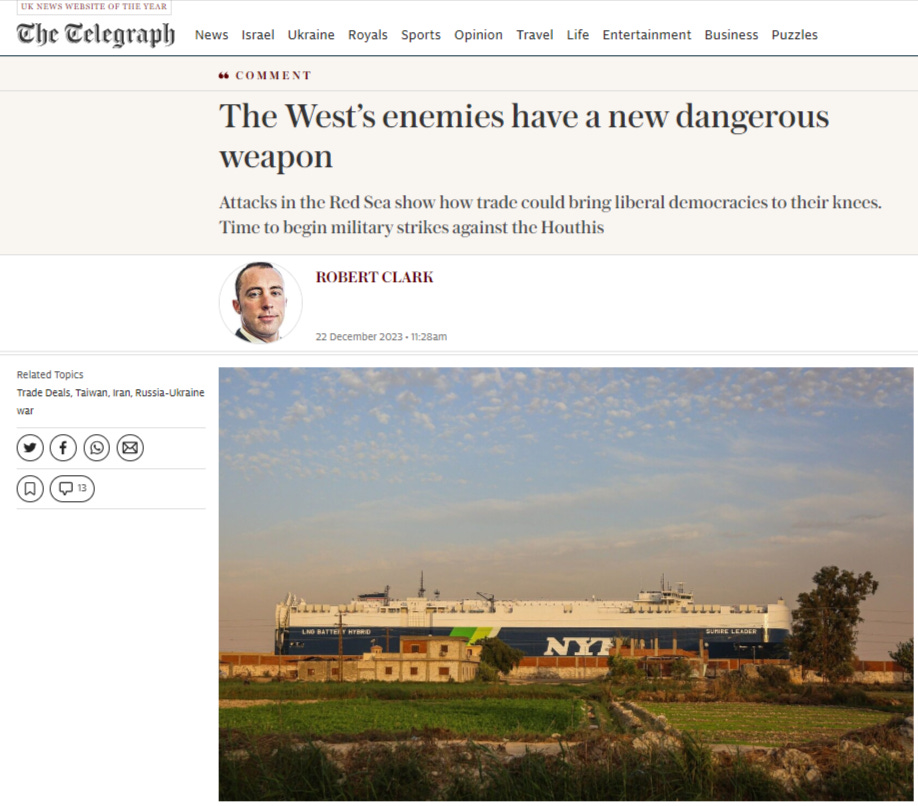
Note the framing of the Telegraph report: ‘The West’s enemies’ ! This newspaper seems to be moored in the political territory once occupied by The Economist?
The last paragraphs from this ‘news story’ are instructive of an attitude of bellicosity!
…
We can already see this played out in the Red Sea, as Iranian-funded terrorist group the Yemini Houthis are closing international shipping lanes after a relatively successful campaign of hostage-taking and firing cruise missiles over a few short weeks.
This campaign – from a non-state actor and terrorist organisation – has resulted in British Petroleum, one of the world’s largest businesses, declaring that it will be avoiding the Red Sea shipping lanes, crucial for exporting oil and gas from the Middle East to the markets of Europe and North America.
This disruption to supply chains will likely lead to a run on the petrol price at the pumps in Britain over the Christmas period, while long-term significant costs will be incurred to ease flow and supply – again the brunt of which will be passed on at the pump.
Weaponising trade cannot continue. We cannot let military and economic deterrence fail at a time when authoritarian regimes seek to damage our national interests in this way. It may not be war that brings down the current global order, but rather repeated shocks to global commerce and supply chains, should we choose to not do anything about it. A good place to start is military strikes against the Houthis.
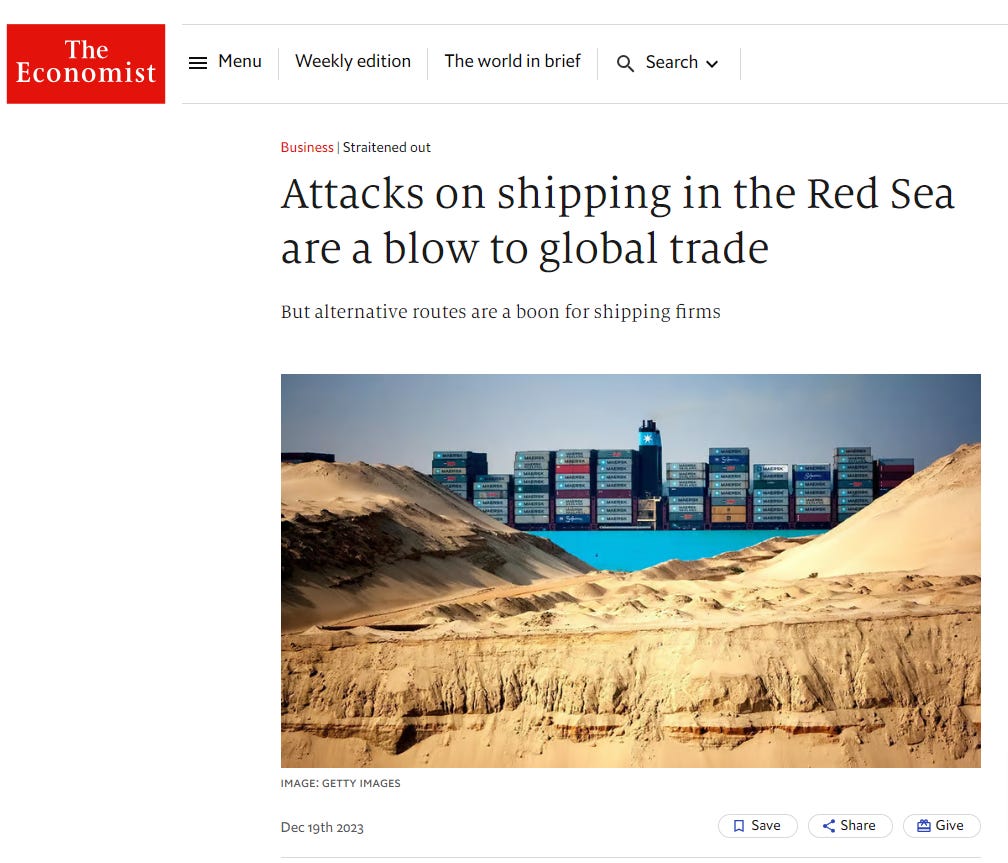
The Economist framing is sedate, even by Economist standards.
The tone of the article is sedate, even measured, as compared to the Telegraph’s bellicosity! The final paragraphs of The Economist’s news story:
…
Still, this Suez crisis will not “put a cork in global trade”, says Lars Jensen of Vespucci Maritime, a consultancy. The reason for the cautious optimism has to do with shipping’s remorseless cyclicality. In contrast to the Ever Given fiasco, supply chains are not currently under immense strain. Back then cuts to capacity coupled with a surge in spending by locked-down consumers had sent shipping rates surging to astronomical levels. A global index from Drewry, another consultancy, hit over $10,000 per standard container. On some routes, spot rates surpassed $20,000. That helped push shipping firms’ combined net profits in 2022 to $215bn, according to the John McCown Container Report, an industry compendium, compared with a cumulative loss of $8.5bn in 2016-19.
The shipping firms’ usual response to such price signals is to order new vessels. Those are starting to arrive. Though demand has remained flat over the past year or two, the global fleet’s capacity will swell by 9% this year and another 11% in 2024, according to ing, a bank. Already, the industry’s profits may have plunged by 80% in 2023. With capacity to spare, running longer routes should not cause the disruption seen at the height of covid-19. By mid-December Drewry’s index was becalmed at $1,500 or so (see chart). Rates could double as a result of the Red Sea turmoil, reckons Peter Sand at Xeneta, a freight-data firm. But they will probably stay well below their pandemic peaks—and so will shipping companies’ profits.
Headline: Time is of the essence in defending Ukraine
Sub-Headline: Western calls for peace talks ignore the Kremlin’s determination to pursue its war of conquest Time is of the essence in defending Ukraine
Read the first two paragraphs of Gwendolyn Sasse’s essay:
Time keeps ticking relentlessly. The challenge of crisis management and policymaking more generally is to get ahead of it rather than watching days, months or years go by. From the annexation of Crimea in 2014, Russia’s war against Ukraine has been characterised by diverging time horizons and the expectations that go with them. To date, connecting the different time zones of this war has proved impossible, but the urgent necessity of doing so has increased steadily. Time zones that drift apart create room for manoeuvre — in this case, for Russia and for those in western countries who want to polarise and undermine democratic values along the way.
Ukraine now has to get through its second winter since the full-scale invasion. The US presidential elections loom large over western support for Kyiv. The Israel-Hamas war reduces the already diminishing public attention span for Russia’s war in Ukraine. Next June’s European parliament elections may make the EU appear more fragile than ever. In the meantime, Russia has adjusted economically and politically to sustain a much longer war than initially intended.
Let The Reader consider this excerpt titled About us in reference to The Centre for East European and International Studies (ZOiS):
…
Eastern Europe is in a state of flux. The importance of dedicated regional research undertaken in long-term projects for providing the necessary profound knowledge is clearer today than ever before. Russia’s war of aggression against Ukraine underscores the value of our nuanced view of a region that defies common assumptions and ascriptions. A comprehensive and multi- or interdisciplinary approach is needed to capture and convey the diversity and dynamics of the region, including its entanglements.
Russia’s war on Ukraine is a watershed that presents major challenges not only to political actors worldwide but also to researchers. Data collection has become difficult or impossible in some cases, and cooperations have been terminated, adapted or newly established. As yet, we can only guess at the dimensions of the consequences of the war. Only high-quality regional research across a wide range of academic disciplines can rise to these challenges and provide crucial impetus for research, politics and public discourse.
Might the above quotation appear like a self-serving recitations of well worn cliches? that reads as if it were the rhetorical twin, of Gwendolyn Sasse’s two above quoted paragraphs?
In the interest of not wasting The Readers valuable time, let me focus on the other cliches as they appear to me… it may not be without fault, but might offer some insight into this Gwendolyn Sasse’s Political/Ideological/Methodology, if it can be named that ?
What are some of the time zones of this war?
The full-scale invasion of Ukraine felt like a surprise despite the preceding stages.
By definition, for Ukrainians, assistance always comes too late.
Making a promise for the future is one thing, delivering on promises in the present is something else.
The language framing the war is also marked by references to time.
Vladimir Putin himself thinks in centuries of continuity of Russian imperial rule.
In times of war, a word or phrase carries particular weight. But even a principled position is not sufficient in itself and has to be measured against current and future action.
It spreads a sense of uncertainty and creates space for those considering or calling for peace negotiations.
This must include a decision on using the remaining window of time to step up military assistance to Ukraine and military production in Europe.
Thinking about Russia’s war against Ukraine in temporal logic underlines that time is of the essence. The time zones of Ukraine and its western allies need to be reconnected before entirely new ones open up in 2024.
Carlos Lozada’s essay from 2017, wakes ‘us’ from our a-historical stupor? Premature Anti-Fascist wonders!
Former President Donald J. Trump said undocumented immigrants were “poisoning the blood of our country” in a recent interview, language with echoes of white supremacy and the racial hatreds of Adolf Hitler.
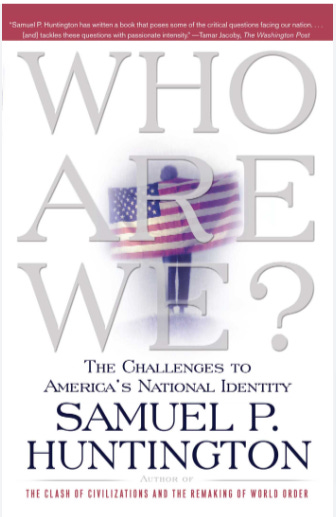
Trump simply echoes Samuel P. Huntington.
Carlos Lozada’s essay from 2017 provides answers:
Samuel Huntington, a prophet for the Trump era.
The writings of the late Harvard political scientist anticipate America’s political and intellectual battles — and point to the country we may become.
Sometimes a prophet can be right about what will come, yet torn about whether it should.
President Trump’s recent speech in Warsaw, in which he urged Europeans and Americans to defend Western civilization against violent extremists and barbarian hordes, inevitably evoked Samuel P. Huntington’s “clash of civilizations” — the notion that superpower rivalry would give way to battles among Western universalism, Islamic militance and Chinese assertiveness. In a book expanded from his famous 1993 essay, Huntington described civilizations as the broadest and most crucial level of identity, encompassing religion, values, culture and history. Rather than “which side are you on?” he wrote, the overriding question in the post-Cold War world would be “who are you?”
So when the president calls on the nations of the West to “summon the courage and the will to defend our civilization,” when he insists that we accept only migrants who “share our values and love our people,” and when he urges the transatlantic alliance to “never forget who we are” and cling to the “bonds of history, culture and memory,” I imagine Huntington, who passed away in late 2008 after a long career teaching at Harvard University, nodding from beyond.
It would be a nod of vindication, perhaps, but mainly one of grim recognition. Trump’s civilizational rhetoric is just one reason Huntington resonates today, and it’s not even the most interesting one. Huntington’s work, spanning the mid-20th century through the early 21st, reads as a long argument over America’s meaning and purpose, one that explains the tensions of the Trump era as well as anything can. Huntington both chronicles and anticipates America’s fights over its founding premises, fights that Trump’s ascent has aggravated. Huntington foresees — and, frankly, stokes — the rise of white nativism in response to Hispanic immigration. He captures the dissonance between working classes and elites, between nationalism and cosmopolitanism, that played out in the 2016 campaign. And he warns how populist demagogues appeal to alienated masses and then break faith with them.
This is Trump’s presidency, but even more so, it is Huntington’s America. Trump may believe himself a practical man, exempt from any intellectual influence, but he is the slave of a defunct political scientist.
Huntington’s books speak to one another across the decades; you find the origins of one in the unanswered questions of another. But they also reveal deep contradictions. More than a clash of civilizations, a clash of Huntingtons is evident. One Huntington regards Americans as an exceptional people united not by blood but by creed. Another disowns that idea in favor of an America that finds its essence in faith, language, culture and borders. One Huntington views new groups and identities entering the political arena as a revitalization of American democracy. Another considers such identities pernicious, anti-American.
These works embody the intellectual and political challenges for the United States in, and beyond, the Trump years. In Huntington’s writings, idealistic visions of America mingle with its basest impulses, and eloquent defenses of U.S. values betray a fear of the pluralism at the nation’s core. Which vision wins out will determine what country we become.
The Reader has to wonder at the opening of Mr. Ganesh latest feuilleton!
The Opening Players:
Premier League, Arsenal, Liverpool, AC Milan, Roma, Marseille, Lyon, Chelsea Manchester United, US-owned.
This further elucidates Mr. Ganesh’s point?
The planet’s favourite game is being steered to a considerable extent from American boardrooms.
But quickly Mr. Ganesh reaches into his political repertoire for this paragraph:
Perhaps your test of cultural influence is higher-minded than that. Well, consider that US universities continue to dominate world rankings. Or that America accounts for 45 per cent of art sales by value, according to UBS, which is more than Britain and China, the next two markets, combined. To attend the Venice Biennale now is to enter a new Jazz Age in which experts from all over the world vie to advise American patrons on how to spend the spoils of their economic boom.
Next is this World-Historical/Political Pastiche that almost resembles actual thought?
This is a personal impression, and therefore unquantifiable, but I suggest that America has more cultural reach now than it did in its supposed unipolar moment of the 1990s. The police killing of George Floyd in Minneapolis three years ago set off protests in London, Paris and beyond. The beating of Rodney King in 1991 had no such international echo. Back then, Britain’s bien pensants didn’t follow US political media as though it were domestic fare, or tell each other to stop “gaslighting” and “do better”, much less couch all this second-hand argot in Upspeak. To adapt what Jefferson said about France, everyone, or at least everyone educated and liberal, seems to have two countries now: their own and America.
Sub-Heading: American Decline’s symptomology, a selection of The Players/Actors:
All the while, the geopolitical clout of the US wanes.
…has also failed to persuade much of the world to participate in sanctions against Russia
…20 years in Afghanistan.
…Bretton Woods institutions are fighting for relevance.
…proliferation of armed conflicts
…International Institute for Strategic Studies
…Pax Americana is giving way, if not to Pax Sinica then to no kind of Pax at all.
…the US struggles to corral the “global south”
…when liberal protocol moves on in all its clockwork fickleness.
Mr. Ganesh attempts to in his way, to appeal to his would-be, and actual Oxbridger readership, with maladroit asides, along with fretting about ‘that blunt word decline’.
What is happening to the US in the 21st century is too complex to be captured in that blunt word “decline”. As the nation’s share of world output has dropped, its influence on world culture — on the tastes, idioms and habits of foreigners — is as vast as ever. Whether your concerns are high brow (where should I do a postgraduate degree?), middling (what show will I stream tonight?) or popular (who owns Declan Rice?), America is inescapable. We are now a couple of decades into its relative loss of ground to China in traditional power terms. The knock-on effect for US prestige in other domains should be registering now. It is staggeringly negligible.
A selection from the two remaining paragraphs. It’s hard to be tolerant of Mr. Ganesh’s self-congratulatory chatter, ending in cynicism!
Is this good for Americans? You can see how it might be.
At the same time, all that cultural lustre blinded the British to the extent of their demotion from the geopolitical high table.
…such as abstention from the embryonic European project.
…the same trouble as Britain in recognising its diminished geopolitical status, and adapting its statecraft to compensate.
As a long time subscriber of The Economist: I still have a page torn out of the February 24 , 2001 edition , a review of ‘Law Without Values: The Life, The Work , and The Legacy Of Justice Holmes’. I cancelled my subscription after The Economist discontinued the ‘comments section’. To my surprise, I received two telephone calls, from representatives of the magazine, asking me the ‘why’ of my cancellation? I told both of these men, that if The Economist wasn’t interested in my comments, I was no longer interested in reading this News Magazine. Time has past and I could not resist commenting upon a publication that was still moored in 1843.
I recommend Alexander Zevin book, a revelatory history, as a starting point:
At a mere , yet dizzying 17, 568 words, here are some revelatory paragraphs:
…
Whether or not American democracy endures, a central question historians are sure to ask about this era is why America came to elect Donald Trump, promoting him from a symptom of the country’s institutional, political and social degradation to its agent-in-chief. There are many reasons for Trump’s ascent, but changes in the American news media played a critical role. Trump’s manipulation and every one of his political lies became more powerful because journalists had forfeited what had always been most valuable about their work: their credibility as arbiters of truth and brokers of ideas, which for more than a century, despite all of journalism’s flaws and failures, had been a bulwark of how Americans govern themselves.
I hope those historians will also be able to tell the story of how journalism found its footing again – how editors, reporters and readers, too, came to recognise that journalism needed to change to fulfil its potential in restoring the health of American politics. As Trump’s nomination and possible re-election loom, that work could not be more urgent.
I think Sulzberger shares this analysis. In interviews and his own writings, including an essay earlier this year for the Columbia Journalism Review, he has defended “independent journalism”, or, as I understand him, fair-minded, truth-seeking journalism that aspires to be open and objective. It’s good to hear the publisher speak up in defence of such values, some of which have fallen out of fashion not just with journalists at the Times and other mainstream publicationsbut at some of the most prestigious schools of journalism. Until that miserable Saturday morning I thought I was standing shoulder-to-shoulder with him in a struggle to revive them. I thought, and still think, that no American institution could have a better chance than the Times, by virtue of its principles, its history, its people and its hold on the attention of influential Americans, to lead the resistance to the corruption of political and intellectual life, to overcome the encroaching dogmatism and intolerance.
Where might the Critical Reader place this Economist Political Moralizing, directed at The New York Times, the American National Security State’s Pravda, when compared to The Economist campaign of lies and defamation against Jeremy Corbyn?
Krzysztof Tyszka-Drozdowski is a writer and analyst with a specific focus on globalization, industrial policy, and international conflict. He worked as an analyst in one of the agencies overseeing industrial policy in Poland.
Krzysztof Tyszka-Drozdowski frames his essay via Neo-Con Ghoul Robert Kagan. What better way to assure his readership at The Telegraph that he is part of that cadre!
…
More than twenty years ago, American neocon Robert Kagan wrote in his book Of Paradise and Power that while Europe lives in a Kantian zone of peace, America could not possibly ignore the realities of power. And precisely because Washington wielded power, Europe was able to nurture its illusion that history did not concern it anymore.
While European Union can no longer afford to be a paradise oblivious to the logic of power, it hasn’t become comfortable with it just yet. Ursula von der Leyen, the president of the European Commission, would like to turn the EU into a geopolitical actor. This is evident in the more mercantilist attitude of Brussels, which wants to defend the continent’s interests with a new ‘anti-coercion instrument’.
…
But now trouble is brewing in paradise. Whereas twenty years ago, when Kagan wrote his book, Berlin and Paris, the so-called engine of Europe, formed a united front and opposed the US invasion of Iraq, today they no longer see eye to eye. The French Minister for Europe, Laurence Boone, may argue that the two countries still share the same vision, but the list of contentious issues only grows longer.
prime ministers of Belgium and Spain, Prime Minister of Slovakia, Geert Wilders , Hungary, too, Europe may be on the verge of much greater shifts, while Europe lives in a Kantian zone of peace, Europe was able to nurture its illusion that history did not concern it anymore, European Union, Ursula von der Leyen, Brussels, tariffs and export controls, European Parliament, European Council, Global Gateway project, China’s Belt and Road Initiative, European Commission, Rhodium Group analyst Noah Barkin, that Europe is afraid of geopolitics, twenty years ago, when Kagan wrote his book, The French Minister for Europe, Laurence Boone, Germany has fought vehemently against the inclusion of nuclear energy, Cancellor Scholz is instilling fear in Paris, It is the China question, the Franco-German couple with eventual break-up,
…
There are 297 words before The Reader reaches the final paragraph, that at it’s ultimate sentence, offers this dire prediction/inevitability : ‘Collision seems inevitable’.
That final paragraph:
Many countries in Europe may think that Washington’s attitude towards China is too confrontational. With the ambiguity of European capitals, America may find the temptation of unilateralism irresistible. However, if taken too far, it could trigger a similar attitude to Germany’s in other European states, namely short-sighted egoism at all cost. Above all, the break-up of the Franco-German couple opens up novel political possibilities. For the US, to shape new, more effective coalitions. For Europe, to enter the realm of power politics and leave behind its post-historical illusions.
Consider that Robert Kagan is a notorious Neo-Conservative, married to Victoria Nuland, a utterly notorious War Monger, who heads Biden’s Foreign Policy Technocrats, and participated in the 2014 Uranian Coup. Tyszka-Drozdowski demonstrates the he too is a Neo-Con, or at the least a fellow traveler. Kagan and his his coterie are steeped in Leo Struss’s appropriation of ‘The Noble Lie’:
In the Republic the Noble Lie is supposed to make the citizens of Callipolis care more for their city. Schofield (2009) argues that the guards, having to do philosophy from their youth, may eventually find philosophizing “more attractive than doing their patriotic duty” (115). Philosophy, claims Schofield, provides the guards with knowledge, not with love and devotion for their city. The Noble Lie is supposed to engender in them devotion for their city and instill in them the belief that they should “invest their best energies into promoting what they judge to be the city’s best interests” (113). The preambles to a number of laws in the Laws that are meant to be taken as exhortations to the laws in question and that contain elements of traditional mythology (see 790c3, 812a2, 841c6) may also be taken as “noble lies”.
1. Martin Ivens reviews three books, and mentions a fourth.
THE PARTY’S OVER
The rise and fall of the Conservatives from Thatcher to Sunak 368pp. Verso. Paperback, £11.99.
Phil Burton-Cartledge
THE RIGHT TO RULE
Thirteen years, five prime ministers and the implosion of the Tories 432pp. John Murray. £25.
Ben Riley-Smith
THE CASE FOR THE CENTRE RIGHT
232pp. Polity. Paperback, £15.99.
David Gauke, editor
The Mention :
John Ramsden’s influential study of the Tories, An Appetite for Power (1998)
John Ramsden’s influential study of the Tories, An Appetite for Power (1998), identified the Conservative Party’s ruthless instinct for ditching failing leaders and inconvenient principles as the key to its success. Five prime ministers and five violent changes of direction since 2016 is, however, surely overdoing it.
Opinion polls indicate that one of the democratic world’s most durable political parties is heading towards defeat some time next year, and the only question is over the margin of disaster. The Labour Party, which not long ago looked to be stuck in the permanent doldrums, has become the dull but safe alternative. After an overdose of politics dull but safe is a winning formula.
Phil Burton-Cartledge’s The Party’s Over analyses through the prism of class how the Conservatives survived their “near-death experience” in 1997 to recover power thirteen years later. In his view the party had only “postponed its inevitable demise”. Ben Riley-Smith’s The Right to Rule provides the narrative of Tory decline, fall, rise and fall again, framed by general elections from 2010 onwards. Read together the two books suggest that, in Marxist terms, history does indeed repeat itself: first as farce, second as farce.
…
Big government nativists would prefer to onshore lost manufacturing industries and end “excessive” dependence on foreign labour to fill jobs in the NHS and social care. Their conservative social principles and defence of the nuclear family echo some of the themes of the Christian right in the US, though their concern for the poor seems genuine. The Tory MP Danny Kruger’s Covenant: The new politics of home, neighbourhood and nation (2023) is their new bible.
Reading between the lines of Riley-Smith’s The Right to Rule we see how the party’s crisis is one of competence as much as of class. Recent Tory prime ministers had to reconcile the interests of their dwindling but rightward-shifting party membership with those of the wider electorate. And to do that they had to achieve three goals. First, the economy was to be guided to recovery after the financial crisis of 2008. Second, the party was expected to reduce immigration numbers – or, failing that, ministers had to prove that they were in control of secure borders and explain how mass migration brought compensating economic benefits. From Cameron’s time onwards the Tories made a series of promises on immigration that they couldn’t keep. The stubborn persistence of hundreds of thousands of job vacancies demonstrates that they have also failed to reform the domestic labour market.
…
Under Margaret Thatcher and Major the party could boast that the economy grew faster than its continental equivalents. Today Labour asks voters a variant of the Ronald Reagan campaign question: “After thirteen years of Tory government, do you feel better off?”
…
2.
Pay careful attention to the ‘how’ of Bagehot’s Story Telling approach: an exercise in schadenfreude. Or is he just following the cattiness of Adrian Wooldridge?
A readers’ lunch atthe Spectator, the world’s oldest weekly magazine, is not for the faint of heart or light of wallet. It starts with an aperitif of Lanson Le Black Reserve (a reasonable £55 per bottle). Next comes a magnum of Laurent Perrier Grand Siécle Grande Cuvée No. 23 (a less reasonable £400). Round it off with a Graillot & Perez Encinas Bierzo (a mere £26). Those with the means to drop £150 can enjoy a boozy meal in the Spectator’s boardroom, surrounded by the 195-year-old back catalogue of the magazine that counts a few chancellors, many cabinet ministers and a Conservative prime minister among its alumni.
People are willing to pay a premium for a slice of Tory life. A recent struggle over the ownership of the Spectator and its stablemates, the Daily and Sunday Telegraph, proved just that. Lloyds, a bank, put the outlets into receivership after a long-running row with the Barclay brothers, hotel magnates and Channel Island overlords who bought the titles in 2004, over a £1.2bn debt.
A consortium led by Jeff Zucker, a former cnn editor, and backed by Gulf royalty, paid off the whole Barclay debt, with a view to taking control via a debt-for-equity swap. Conservative mps, usually cheerleaders of foreign investment, were appalled that a foreign power was putting up the cash. Now the Conservative government has put the deal on hold.
Their interest is understandable. The past, present and future of the Conservative Party runs through the Spectator. More specifically, it runs through the editor’s office. At one end sits the desk of Nigel Lawson, who went on to become Margaret Thatcher’s most influential chancellor. In front of the window, looking onto St James’s Park, stands a chaise longue on which Boris Johnson once enjoyed a post-lunch “erotic reverie”.
This sentence is astonishing coming from the near twin of the Spectator:
The past, present and future of the Conservative Party runs through the Spectator.
Selective quotation
In its way The Economist exercise in schadenfreude, demonstrates the failure of ‘Conservatism’ and its political/monetary base, that has yet to reach The Economist? The Corporatization of the whole of Mass Media, in an American context, is explained by the pioneering work of Ben H. Bagdikian!
Ben H. Bagdikian, Reporter of Broad Range and Conscience, Dies at 96
Selective quotation is a defense against Economist propaganda?
…
The Spectocracy is not only a quirk of history, but a quirk of the present. Its former political editor, James Forsyth, now sits in Downing Street as Rishi Sunak’s political secretary, having left the magazine in late 2022.
…
Forthe Spectator, its influence is incidental. “We’re a cocktail party, not a political party,” in the words of one former editor. It is proudly irresponsible, mixing Westminster coverage with giggling reactionaryism.
…
Instead, the Spectator resembles another deeply English cultural institution. In the 1980s comedy, “Withnail and I”, two out-of-work, booze-soaked English actors find themselves trapped in a falling-down cottage in Penrith.
…
Results vary when a journalistic mindset is applied to government. Good polemics make poor policy. Mr Johnson first floated the idea of an eu referendum in 2003.
…
Eclecticism is positive in a magazine, but not so in a politician. The Spectator swings between liberalism and Conservatism, by turns thoughtful and thuggish. Similar behaviour dogs the government.
…
Even the Spectator’s reticence about its relations with the Conservatives feels familiar. The magazine has an anti-establishment streak, while clearly part of it.
…
The final paragraph of this ‘polemic’, of a kind, has it’s own sub-title, in bold font!
We want the finest wines available to humanity
While the personnel and the politics of the Spectator and the Conservative Party overlap, their fortunes do not. The party is heading for oblivion; the Spectator is in fine health. Circulation is at an all-time high, while the Conservatives—coddled by an uncritical media—are set for their worst performance since at least 1997, unless something dramatic happens. Opposition is a happy state for a magazine, if not a political party. Particularly with plenty of champagne in supply.
This sentence fragment offers? ‘while the Conservatives—coddled by an uncritical media—are set for their worst performance since at least 1997, unless something dramatic happens.’ Why would The Economist complain about the Conservatives, as the Tony Blair stand-in Keir Starmer waits in the wings as the New Labour candidate?
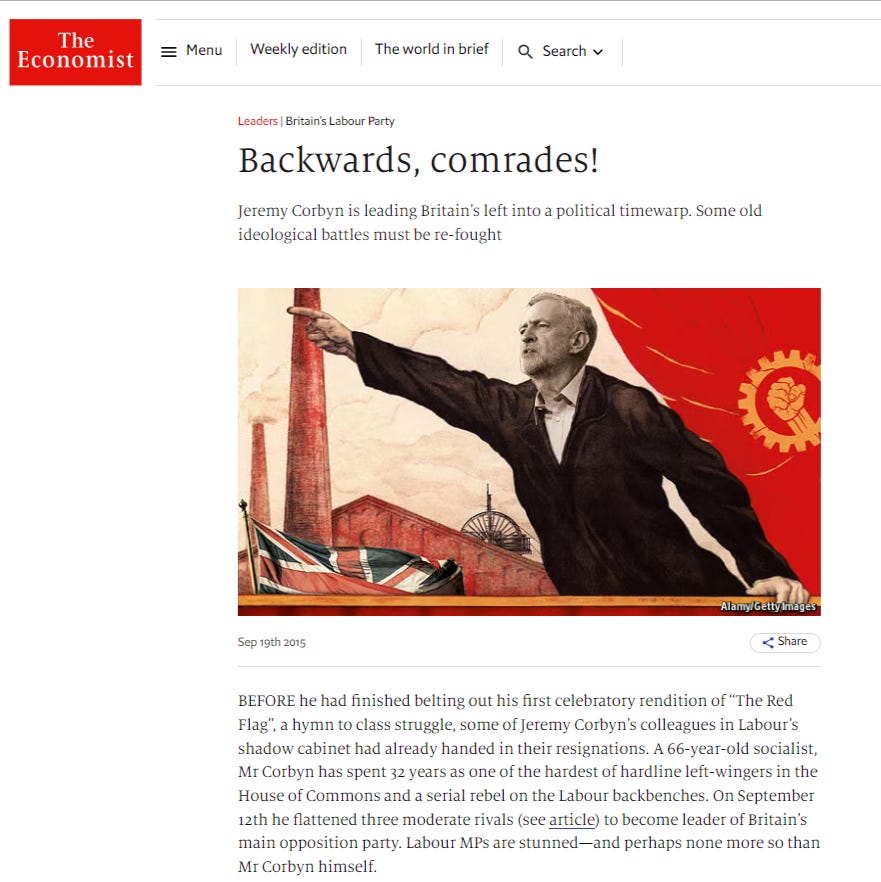
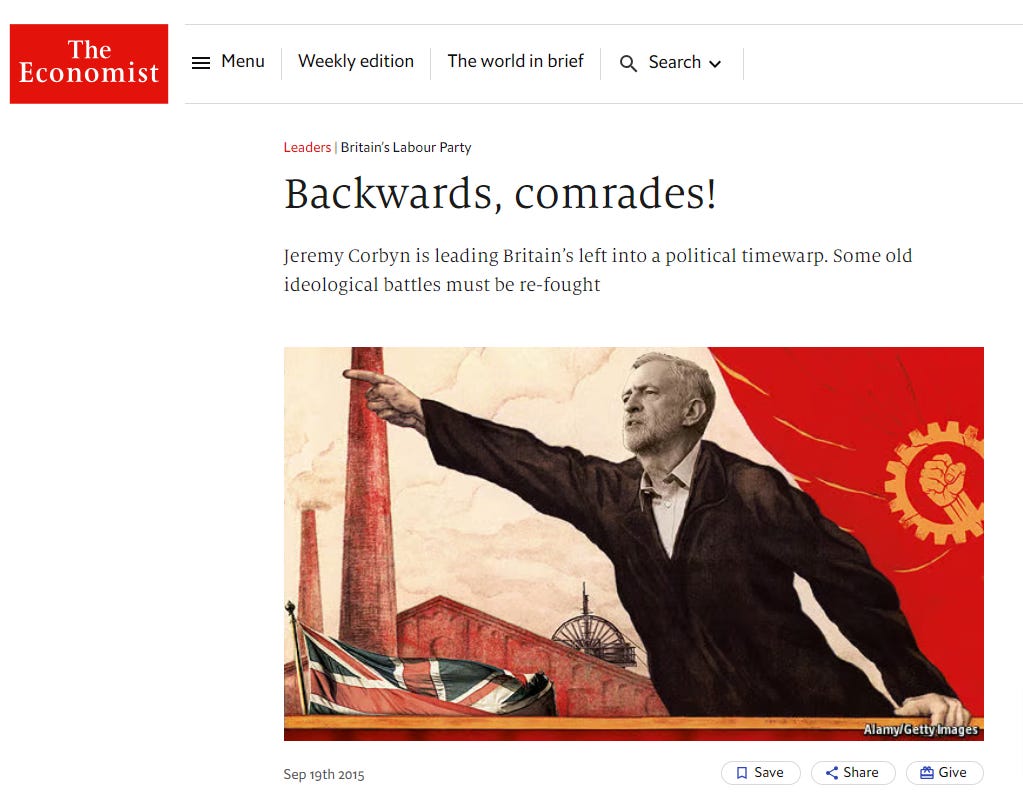
The Reader need only be reminded of The Economist’s notorious 2015 ‘Backwards, comrades’ political propaganda?
1.
Martin Ivens offers critical evaluations worth pursuing!
…
Tim Pitt’s contribution to The Case for the Centre Right, a collection of essays edited by the former treasury minister David Gauke, explains that “on a per capita basis, the UK grew by just seven percent between 2007 and 2022 and labour productivity by just four percent”.
…
Economic growth has slowed since the 1990s and productivity gains were meagre even before the financial crisis. “This slowdown is common among advanced economies”, he adds. (The US seems to be an exception.)
…
Twelve years into Tory rule, Truss became prime minister convinced that this record was a disaster. Research by the economic historian Nick Crafts (1949–2023) and his colleague Terence Mills bears her out.
…
Thatcher’s Big Bang deregulation of the City and the information technology revolution have seemingly run their course. But Truss’s plan to cut taxes while increasing public spending during a period of market volatility – Reaganomics without the safety net of the dollar reserve currency – broke all the rules. Sunak’s remedy is more austerity, eased by a few supply-side reforms. Perhaps AI will ride to the British economy’s rescue. Perhaps not.
…
Although the government could have borrowed at knockdown interest rates, it failed to invest in infrastructure and housing. In his Mais lecture as chancellor last year Sunak owned up to the country’s investment deficit. The right’s remedy is supply-side reform, public expenditure restraint and tax cuts.
…
Demographics, says the author, are against the Conservatives; the young will soon take their revenge. Nonetheless, the author doubts his own wisdom: “No one is getting rich betting against the Tories”. Quite. Note how the US Republicans have defied roughly similar trends.
…
Twelve hours before the European referendum vote I bumped into another of The Case for the Centre Right’s contributors, Andrew Cooper, Cameron’s chief pollster and now a board member of a Blairite think tank, Labour Together. Cooper assured me that Remain would win by a double-digit margin. As Riley-Smith makes clear, the modernizers and their “moderate” predecessors never got Europe right.
Michael Portillo, one of Major’s “bastards” and a contemporary avatar of socially liberal Toryism, argued in the Noughties that the modernizers were mild Eurosceptics, but were always good club men first. That was the class analysis by a state-school-educated boy of his public-school successors.
…
Without a victory to his name Cameron found that his Eurosceptic right wing, along with Ukip, slowly pushed him towards the Brexit door. Cameron’s foreign secretary, the former Conservative leader William Hague, interviewed by Riley-Smith, believes that there would have been no need for an in/out referendum had there been a vote on the EU constitutional treaty negotiated at Lisbon in 2007, saying: “Britain would have voted against the Lisbon treaty, we would have blocked European integration, but we would not then have embarked on trying to leave the EU.
…
…in the midst of the European migrant crisis. Lynton Crosby, the Australian political strategist behind Cameron’s outright victory in 2015, urged him to storm out of the talks. “That’s not me”, replied his boss. “I am a reasonable person.” Thatcher, barred from membership of St James’s clubs by reason of her sex, was not reasonable. She rudely banged the table until she got her billion-pound rebate back from Brussels. Johnson is not a gentleman and the only rule he observes is to break the rules.
…
There were other roads not taken. Riley-Smith records that Cameron was advised by Gavin Williamson, his chief parliamentary secretary, and Iain Duncan Smith, a hardline Eurosceptic and former Tory leader, to “do a Harold Wilson”: in 1975 the Labour PM made a show of stepping back from active campaigning in the first referendum on European membership, even though he wanted a “Yes” vote.
…
Cameron’s best brains, Osborne (a Remainer) and Michael Gove (a Leaver) urged him not to hold an in/out referendum.
…
Crosby warned him not to use Project Fear tactics during the campaign, but Osborne publicly threatened an emergency round of cuts and tax hikes in the event of a Leave decision.
…
Nothing succeeds like respectable failure in the British establishment, hence Cameron’s recall as foreign secretary.
…
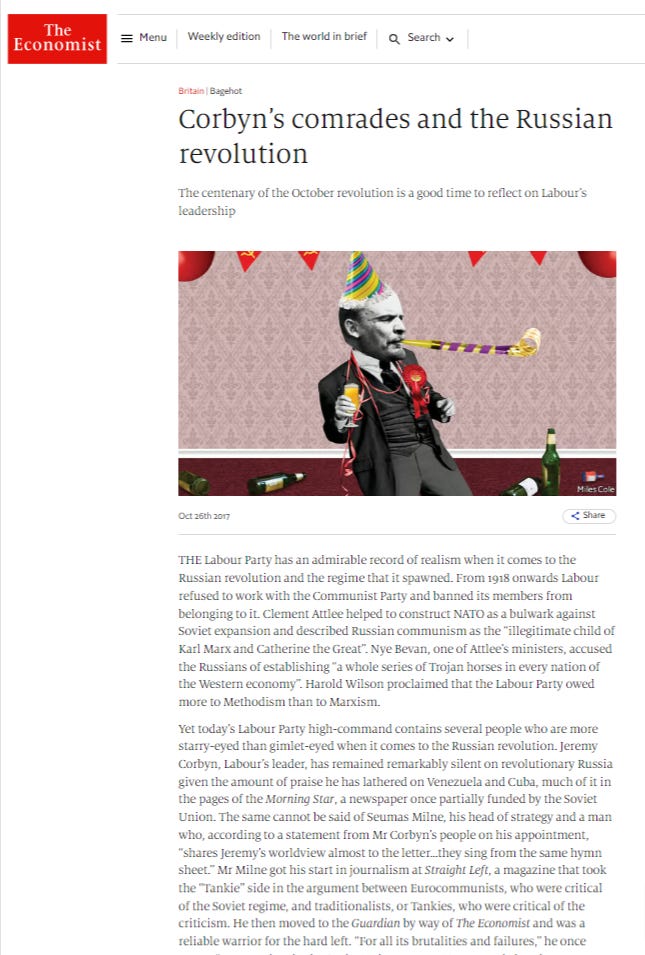
Martin Ivens insights are worth consideration and engagement, considering the latest replacement for Bagehot, Duncan Robinson ‘Political Editor and Bagehot columnist’ , in his slap-dash, back-handed way seeks through a critique of The Spectator: to produce a political narrative that is not just hobbled by its narrow focus, but is a rhetorical copy of the ‘ Backwards, comrades!’ political propaganda!
What might The Reader make of John B. Judis as thinker/writer? Below is a review of his ‘The Paradox of American Democracy: Elites, Special Interests, and the Betrayal of Public Trust’
For someone to assert today, as John Judis does in The Paradox of American Democracy, that there actually is a noble American tradition of stewardship of the public interest that can be taken at face value is arresting. Judis has been associated for years with The New Republic, and an earlier book of his, Grand Illusion: Critics and Champions of the American Century (1992), had at its center one of the magazine’s founders, Herbert Croly (also the author of the Progressive Era manifesto The Promise of American Life). In his new book Judis argues for a revival of Croly’s view that a powerful federal government should tame the excess of unbridled capitalism.
In Judis’s retelling of American history, more than a century has passed since we abandoned the idea that we could live in an innocent world without government. The notion of “big government” as a late-twentieth-century development at odds with the American tradition is, he says, a distortion by business and the Republican Party. The truth is that at the end of the nineteenth century, as the United States developed a national industrial economy, and as the previously mighty political parties faded, business corporations and their lobbyists in Washington began to dominate the political system, and the public began to look to government to curb their power. Fortunately, Judis says, a major new element appeared to help counterbalance the power of business: “elite” organizations.
Judis traces the formation, the rise, and the fall from influence of this elite. He has constructed a highly detailed and unfamiliar history of public policy research organizations, such as the Institute of Governmental Research (now the Brookings Institution), the American Association for Labor Legislation, the National Civic Association, the Twentieth Century Fund (now the Century Fund, the underwriter of Skocpol’s book), the Russell Sage Foundation, the Committee for Economic Development, and the Ford Foundation, among others, and discusses the effect they have had on government policies like the Social Security Act, the Wagner Act, and the establishment of the Rural Electrification Administration.
The difficulty with Judis’s schema, and it is considerable, is that his concept of an “elite” does not yield to precise definition. In Judis’s view, the qualities of an elite are public-spiritedness, intellectual honesty, and a commitment to rising above personal interest. In the past, he writes,
The elites and elite policy groups advocated the development of policy based on fact and knowledge. They nourished public trust in government by defending and explaining complex decisions that the ordinary voter did not have time to study. And they have carried forward a tradition of disinterested public service against the venality and corruption that interest groups have often encouraged in public life.
But there is no sure test of whether a person or an organization is a member of this elite. Judis’s definition would seem to be roughly similar to that of what people have been calling, since the late 1950s, “the Establishment,” but that term doesn’t have a precise definition either. If there is such a coherent group, within it there is both more internal disagreement about policy and more personal ambition than Judis allows for.
His account of the history of American elites begins during the late nineteenth and early twentieth centuries—the Progressive Era, which came into being substantially because of the elite’s disapproval of the Gilded Age. Although Judis concentrates largely on research organizations, he also sees the hand of the elite in the creation of objective journalism and professional philanthropy, in faith in the truth and power of social science, in the Protestant Social Gospel, and in an internationalist foreign policy. One might say that any time a group of rich or influential people organizes in an effort to move the government in a more socially responsible direction, and presents itself as expert and nonideological, it seems to meet Judis’s defining test for an elite.
Although the elite is impossible to pin down, it is also impossible to present Judis’s argument without using his terminology. He says that every liberal period in the twentieth century has coincided with an elite influence on government. During the Theodore Roosevelt administration, pressure from the elite helped to create the early regulatory agencies like the Food and Drug Administration and the Federal Trade Commission. In the Twenties the influence of the elite faded and pure business-lobbying groups like the National Association of Manufacturers and the Chamber of Commerce rose in its place, but during the New Deal the elite came back and helped to bring about legislation that created the Securities and Exchange Commission, the Social Security system, and stronger labor unions.
The early harbingers of the decline in the power of the elite, Judis tells us, were the Administrative Procedure Act of 1946 and the Taft-Hartley Act of 1947—the former empowering business to challenge government’s regulatory authority, the latter enormously strengthening the hand of employers in their competition with labor—both of which effectively diminished the mediating role that the elite should play. But the elite’s power, according to Judis, didn’t fully break down for a couple of decades. During the presidency of Dwight Eisenhower, foreign policy was controlled by patrician “wise men” and in domestic policy the Republicans accepted the major tenets of the New Deal—Judis reminds us that Eisenhower pushed through major increases in the minimum wage and Social Security. John F. Kennedy was the grandson of an ethnic political boss who had been elaborately socialized into the elite. In a speech Kennedy stated one part of the elite’s creed: “The fact of the matter is that most of the problems…that we now face, are technical problems, are administrative problems.” As late as the 1964 presidential election, elite influence was strong enough to generate overwhelming support in the business world for Lyndon Johnson’s presidential campaign.
Judis’s admiration for the presence of an elite in political life is conditional on its adhering to his kind of politics—government as a countervailing force to business. Therefore he sees the late Sixties and Seventies as having weakened the elite, because many elite organizations embraced liberal causes that he would consider secondary, such as affirmative action and improving conditions in the inner-city ghettos. He says, for example, that the appointment of Franklin Thomas as head of the Ford Foundation in 1979 meant that “business had won its decade-long struggle to emasculate the Ford Foundation.”
To Judis (perhaps more than to his readers) there is a razor-sharp distinction between elite organizations that seek to influence public policy and business organizations that function in similar ways. In the Seventies, while the former were fading, the latter were rising. The villain of Judis’s book is Irving Kristol, who, he thinks, was responsible more than anyone else for persuading business to adopt the methods of elite organizations, such as publishing serious journals and creating think tanks—but to promote, in the guise of public service, a pure lobbying agenda whose central goals are tax cuts and a reduction in the federal regulation of business. New conservative institutions in Washington like the American Enterprise Institute and the Heritage Foundation gained power, and so did old-fashioned lobbyists. The conservatives successfully purveyed the ahistorical idea that “big government” is antithetical to the American tradition.
It is amazing how dramatically American attitudes about government and business have changed in a generation. In one poll result Judis quotes, 76 percent of Americans in 1964 said they could “trust the government in Washington to do what is right,” while in 1992 only 29 percent did. The percentage of Americans who agreed with the statement “the best government is the government that governs least” went from 32 in 1974 to 59 in 1981. The percentage of college freshmen who said that being “very well-off financially” was one of their highest goals went from 41 in 1968 to 76 in 1987. Judis, who is particularly interested in the struggle between business lobbyists and elite organizations in Washington, implies that much of the national turn to the right can be attributed to the efforts of Washington lobbyists for business and of their Op-Ed and think-tank allies. Surely it isn’t that simple, and there was some element of public opinion moving in a more conservative direction on its own, without manipulation by business. Judis exaggerates the extent to which “K Street,” Washington’s rue des lobbyistes, runs the country.
It may be useful to regard Judis’s notion of the elite less as a way of explaining the course of American history and more as a description of the self-consciousness of some Washington liberals and of their political style. Liberal elite politics entails stating an overall commitment—no doubt sincerely felt—to the public good, which is defined as something apart from ideology or self-interest, and then pursuing specific goals privately, in the company of other experts. Judis’s history shows how, over the past hundred years, some people with these convictions have, indeed, often had an effect on federal policies—for just one of many possible examples, the role Paul Hoffman of the Committee on Economic Development played in the passage of the liberal Employment Act of 1946. But it is a big leap from there to the position Judis implies at the end, that a liberal resurgence now would require a newly empowered elite. The group is too diffuse and it lacks independent power, and anyway, there is no guarantee that it would take the positions Judis would like it to.
…
Reader, I have repeated the paragraphs of the above long quotation of Nicholas Lemann review, my apologies! I’ll repeat that first paragraph:
…
For someone to assert today, as John Judis does in The Paradox of American Democracy, that there actually is a noble American tradition of stewardship of the public interest that can be taken at face value is arresting. Judis has been associated for years with The New Republic, and an earlier book of his, Grand Illusion: Critics and Champions of the American Century (1992), had at its center one of the magazine’s founders, Herbert Croly (also the author of the Progressive Era manifesto The Promise of American Life). In his new book Judis argues for a revival of Croly’s view that a powerful federal government should tame the excess of unbridled capitalism
…
Perhaps Mr. Judas, at age 82 , considers himself a part of an ‘elite of the present’? enough so that he feels that this is an acceptable introduction, to his latest intervention/corrective!
As still another war rages between Hamas in Gaza and Israel, a debate has revived between critics and defenders of Israel about whether Israel is a “settler-colonial state” created by émigrés over the objection of the native inhabitants. The debate has implications for the way people view Hamas’s October 7 attacks against Israelis, but it is also relevant to understanding what the conflict between Israelis and Palestinians is really about and how it should or can be resolved.
Those who describe Israel as a settler-colonial state contend that Jews are interlopers in what was Ottoman and British Palestine; they think the Hamas attack and Israeli reprisals have to be understood in that “context.” As a long-term solution to the conflict, they advocate the “decolonization” of Israel. At the extreme, this could mean a Palestinian-dominated or even Islamic state (buttressed by the right of all refugees to return). But most Americans who voice the slogan “free Palestine from the river to the sea,” including Congresswoman Rashida Tlaib, advocate a secular democratic or binational state, in which Jews and Palestinians would have equal rights. In either case, Israel would no longer be “the nation state of the Jewish people,” as Israel’s Knesset decreed in 2018.
The opposing position, which is commonly held by many pro-Israel organizations, including AIPAC, the American Jewish Committee, and the Anti-Defamation League, as well as by many liberal Democrats and conservative Republicans, is that Israel is definitely not a settler-colonial state but is instead the reincarnation of the ancient home of the Jewish people. The pro-Israel groups insist that Israel’s Jews are entitled to live in a Jewish state by virtue of their heritage and of the antisemitic violence they endured in Europe, culminating in the Holocaust. At one extreme, Israel’s revisionist and national religious parties, and some sympathetic Republicans in the United States, contend that this state should stretch from “the river to the sea.” But most American liberals, while vehemently rejecting decolonization, favor a “two-state” solution in which a Palestinian state, composed of the West Bank, would adjoin Israel.
My contention is that both sides of this debate, which pit, roughly speaking, anti-Zionists against pro-Zionists, are wrong. The opposing stances obscure the nature of the conflict and the possibility of its resolution. My argument, based on the research I conducted in writing my 2014 book, Genesis: Truman, American Jews, and the Origins of the Arab-Israeli Conflict, is that Israel was founded as a settler-colonial state but that this indisputable fact about its origin doesn’t justify either particular terrorist attacks or what is called “decolonization.” The ideal solution to the conflict would be two adjoining states, but for the foreseeable future, no solution of this kind is in sight.
That ‘elite of the present’ can only chatter in the patois of self-congratulation, framed in the ersatz knowledge of the technocrat!
Philosophical Apprentice approaches with doubt and caution!
The first four paragraph’s of Rachman’s essay are a bit overwrought, indeed bordering on the melodramatic. It hasn’t occurred to this self-imagined Political Technocrat, that the World is changing/evolving, at such a speed that ‘it’ has left him, and his newspaper behind?
How many international conflicts can one superpower handle at the same time? The Biden administration is currently trying to deal with wars in the Middle East and Europe, while preparing for a surge in tensions between China and Taiwan.
All this is taking place under the lengthening shadow of Donald Trump. His possible return to the White House poses profound questions about the future of US democracy and the country’s role in the world.
The combination of all these events is creating a palpable sense of tension and foreboding in government offices in Washington. It is not just the sheer number of crises coming at the Biden administration, but the fact that many are heading in the wrong direction — the wars in Ukraine and the Middle East, for example. And the polls look bad for Biden.
The foreign crises could come to a head quite fast. “The next three months could determine the next few years,” is how one senior US official puts it. A prominent Democrat worries that “by January, we could be talking about how Joe Biden lost Ukraine”.
The long blind quote, attributed to ‘one senior US official’ rehearses a worn-out journalistic feint. The next three paragraphs are devoted the War in Ukraine, that appears to be lost to the experts, not employed by Corporate Newspapers, Think Tank Careerists, Network Television/Internet Hybrid employees.
New funding for the Ukrainian military and its civilian institutions is stuck in Congress…
The War in The Middle East, Rachman lacks the moral honesty to call this not War, but Genocide!
The precariousness of Ukraine’s situation is getting less attention than it should because of the Middle East. The Biden administration is paying a heavy political price, at home and abroad, for its support for Israel. The US is now putting public pressure on Israel to change its military tactics in Gaza and to kill fewer Palestinian civilians…
Four more paragraphs devoted to ‘The Middle East’:
But American concerns extend well beyond Gaza….
For consideration next, is the China/Taiwan…
The current expectation in Washington is that the Taiwanese presidential election on January 13 will be won by Lai Ching-te, who is regarded in Beijing as a dangerous separatist…
The two final paragraphs of this ‘essay’ offers an recapitulation of what has come before, that reifies the perceived ‘impression of US weakness and decline’. TheRachman essay ends in a vexing quandary, the self-serving position of a Political Thinker, who demonstrates his pretense of modesty/fallibility ?
With the US presidential election less than a year away, all these international crises feed into American politics. Trump will take every opportunity to accuse Biden of presiding over an era of weakness and retreat, citing Afghanistan, Ukraine, Gaza and the Taiwan Strait.
A chaotic and divisive US election — with Trump as the central figure — will contribute powerfully to that impression of US weakness and decline. China, Russia and Iran will relish asking how America can promise to defend democracies overseas, when its own democracy is in so much trouble at home. Unfortunately, it is a good question.
It doesn’t quite occur to Mr. Ganesh that his argued commonalities, between European and American ‘Populism’ might be the product of an utterly failed Neo-Liberal Model, that ruled the West from Thatcher/Reagan era, to its tattered remains in the political present? Or perhaps that is the point of Ganesh intervention, in sum misdirection.
At the next general election, British voters will return either a centre-right government or a centre-left one. For comparison, the spread of plausible outcomes in the US includes a second term of Donald Trump. In France? A Rassemblement National president. The Netherlands? After last week’s election, power for the hardline Geert Wilders. As for the Italian far right, power is theirs already, while the German equivalents threaten to break through in the federal elections of 2025.
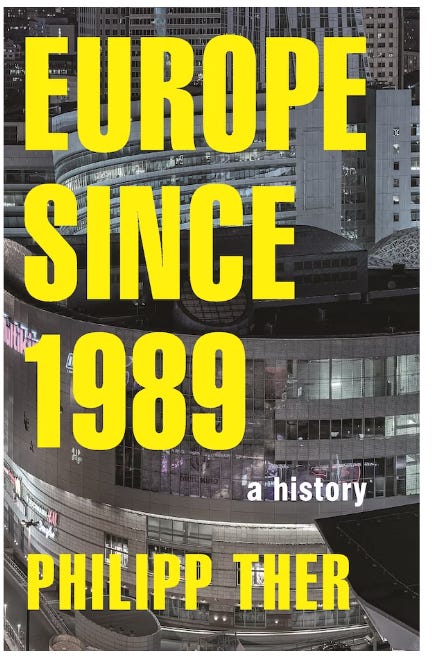
The first paragraph is alive with Historical Re-Writes, in the disguise of predictions, speculations, possibilities. The first paragraph is awash in political mendacity, as Ganesh is a ‘stylist’ , not a political thinker! Centre-right and centre left are political fictions of the political moment, not the reflection of a British Politics, but about the surrender of both Parties to the Neo-Liberal Toxin. Not to speak of an utterly bankrupt political class, composed of the afore mentioned Centre-right and centre left. Ganesh’s opening paragraph informs the reader of the European territory of his essay. If Mr. Ganesh were an honest political thinker, writer he might have resorted to Philipp Ther’s revelatory history : Europe since 1989: A History?
Chapter 4 : Getting on the Neo-Liberal Band Wagon: 77
Milestones of the Transformation 49
The Bumpy Road of Reforms in Eastern Europe 79
Neo-Liberalism’s Inherent Problems 95
A Topology of Reform Outcomes 102
Chapter 5 : Second -Wave Neo-Liberalism 112
Neo-Liberalism at Full Speed 112
Flat Tax Systems and Populism 115
Human Capital 120
New Wealth 126
Rich Cities, Poor Regions 132
The EU’s Marshall Plan for the East 144
Chapter 7
The Great Recession : 2000-9 and its Consequences 209
The End of of Economic Convergence? 209
Variation of Crises 217
Predatory Lending in Central and Eastern Europe 221
Political Reactions : Between Neo-Liberalism and Authoritarianism 226
The title and sub-title of the Ganesh essay presents a non-issue to his readership, as if it were telling, the first instance of his attempt at mis-direction?
These two paragraphs in Ganesh essay identifies his possible dissenters to be ‘some liberals’ and the fact that Britain is ‘a relative haven from populism’ . In the Neo-Liberal Mythology isn’t ‘Brexit’ the unpardonable sin against its Free Market Collectivism, as it evolved from its roots, in the Coal and Steel Cartel of Jean Monnet?
And so, as difficult as this is for some liberals to hear, Britain is now a relative haven from populism. Brexit set that cause back by allowing voters to release much of their pent-up anger, and by flopping badly enough to put them off another rightwing experiment. When enough time has passed, even some Remainers might decide that the hit to national output was worth the period of domestic civic peace. As bad as Britain is at high-speed rail and IPOs, I’d rather take my chances here than in many western democracies over the coming years, thanks.
Another thing about the UK: it is a good place from which to compare American and European populism. So often conflated with each other, it is the differences between them that stand out ever more to an observer in this in-between place.
……
On American Populism:
In contrast, we still don’t know what American populism amounts to without the elemental personal force of Trump. Mike Pence and Ron DeSantis are among those who have tried to offer Republican voters at least the gist of Trumpism. Both have flopped. Vivek Ramaswamy, who is well to the right of the 45th president, doesn’t have people swooning in the prairies. For a sense of how person- rather than idea-centred US populism has become, ask yourself: if Trump proposed a truce with China, or embraced green taxes, or even softened his line on immigration somewhat, how much of his core support would he lose?
Mr. Ganesh cultivated ignorance of the Americas Populist Tradition, is inexcusable! Ganesh’s view is myopic, a-historical, self-serving: the ready to hand of Republican specimens, of that current expression of Tea Party hysterics, winnowed by political time, are useful props. Actual History has intrinsic value, as a check on mere newspaper opinionating!
STATE AND CORPORATION IN AMERICAN POPULIST POLITICAL PHILOSOPHY, 1877–1902
Published online by Cambridge University Press: 03 December 2020
Abstract
This article examines the political theory of the late nineteenth-century American Populist movement, with a particular focus on its theories of state and corporation. Recent scholarship on populism has tended to present the phenomenon as a variant of direct democracy intrinsically opposed to intermediary bodies, a feature consistently traced back to American Populism as well. In this account, American Populists opposed new discourses of corporate personhood and free incorporation in the late nineteenth century owing to their tendency to distort natural bonds between peoples and leaders and to disperse the popular will. This article questions the tenability of this opposition through a close contextual engagement with original Populist texts. As the first self-declared ‘populist’ movement in modern history, Populists theorized about the usage of corporate personality for their own co-operatives and put forward ambitious visions of American statecraft, breaking with the proprietary individualism that characterized Jeffersonian agrarianism before. The article focuses on two particular genres of Populist thinking: first, their advocacy of the corporate form for their co-operative farm organizing and, secondly, a specifically statutory vision of state reform. It concludes with reflections on how these findings destabilize assumptions governing the current populism debate in political theory and American historiography.
Ganesh Opines:‘European populism is much less of a personality cult.’ he names the culprits: Marine Le Pen, Jean-Marie, Jordan Bardella, Giorgia Meloni, Silvio Berlusconi, Wilders.
Ganesh Opines : In contrast, we still don’t know what American populism amounts to without the elemental personal force of Trump. Mike Pence, Ron DeSantis, Vivek Ramaswamy,
The patient Reader will note that there are 344 words remaining of the essay, interpretation, speculation, tinctured in self-serving free imaginative variation, masquerading as a series vital questions. The point of arrival of the essay is not a reward for the Reader!
In which half of the west is liberalism more vulnerable: the US or Europe? Well, the raw individual clout of Trump unites and fuels America’s hard right. What serves the equivalent role in Europe is a sense of demographic and cultural siege. The difference is that Trump will one day be gone.

 StephenKMackSD's Blog