1. Martin Ivens reviews three books, and mentions a fourth.
THE PARTY’S OVER
The rise and fall of the Conservatives from Thatcher to Sunak 368pp. Verso. Paperback, £11.99.
Phil Burton-Cartledge
THE RIGHT TO RULE
Thirteen years, five prime ministers and the implosion of the Tories 432pp. John Murray. £25.
Ben Riley-Smith
THE CASE FOR THE CENTRE RIGHT
232pp. Polity. Paperback, £15.99.
David Gauke, editor
The Mention :
John Ramsden’s influential study of the Tories, An Appetite for Power (1998)
John Ramsden’s influential study of the Tories, An Appetite for Power (1998), identified the Conservative Party’s ruthless instinct for ditching failing leaders and inconvenient principles as the key to its success. Five prime ministers and five violent changes of direction since 2016 is, however, surely overdoing it.
Opinion polls indicate that one of the democratic world’s most durable political parties is heading towards defeat some time next year, and the only question is over the margin of disaster. The Labour Party, which not long ago looked to be stuck in the permanent doldrums, has become the dull but safe alternative. After an overdose of politics dull but safe is a winning formula.
Phil Burton-Cartledge’s The Party’s Over analyses through the prism of class how the Conservatives survived their “near-death experience” in 1997 to recover power thirteen years later. In his view the party had only “postponed its inevitable demise”. Ben Riley-Smith’s The Right to Rule provides the narrative of Tory decline, fall, rise and fall again, framed by general elections from 2010 onwards. Read together the two books suggest that, in Marxist terms, history does indeed repeat itself: first as farce, second as farce.
…
Big government nativists would prefer to onshore lost manufacturing industries and end “excessive” dependence on foreign labour to fill jobs in the NHS and social care. Their conservative social principles and defence of the nuclear family echo some of the themes of the Christian right in the US, though their concern for the poor seems genuine. The Tory MP Danny Kruger’s Covenant: The new politics of home, neighbourhood and nation (2023) is their new bible.
Reading between the lines of Riley-Smith’s The Right to Rule we see how the party’s crisis is one of competence as much as of class. Recent Tory prime ministers had to reconcile the interests of their dwindling but rightward-shifting party membership with those of the wider electorate. And to do that they had to achieve three goals. First, the economy was to be guided to recovery after the financial crisis of 2008. Second, the party was expected to reduce immigration numbers – or, failing that, ministers had to prove that they were in control of secure borders and explain how mass migration brought compensating economic benefits. From Cameron’s time onwards the Tories made a series of promises on immigration that they couldn’t keep. The stubborn persistence of hundreds of thousands of job vacancies demonstrates that they have also failed to reform the domestic labour market.
…
Under Margaret Thatcher and Major the party could boast that the economy grew faster than its continental equivalents. Today Labour asks voters a variant of the Ronald Reagan campaign question: “After thirteen years of Tory government, do you feel better off?”
…
2.
Pay careful attention to the ‘how’ of Bagehot’s Story Telling approach: an exercise in schadenfreude. Or is he just following the cattiness of Adrian Wooldridge?
A readers’ lunch atthe Spectator, the world’s oldest weekly magazine, is not for the faint of heart or light of wallet. It starts with an aperitif of Lanson Le Black Reserve (a reasonable £55 per bottle). Next comes a magnum of Laurent Perrier Grand Siécle Grande Cuvée No. 23 (a less reasonable £400). Round it off with a Graillot & Perez Encinas Bierzo (a mere £26). Those with the means to drop £150 can enjoy a boozy meal in the Spectator’s boardroom, surrounded by the 195-year-old back catalogue of the magazine that counts a few chancellors, many cabinet ministers and a Conservative prime minister among its alumni.
People are willing to pay a premium for a slice of Tory life. A recent struggle over the ownership of the Spectator and its stablemates, the Daily and Sunday Telegraph, proved just that. Lloyds, a bank, put the outlets into receivership after a long-running row with the Barclay brothers, hotel magnates and Channel Island overlords who bought the titles in 2004, over a £1.2bn debt.
A consortium led by Jeff Zucker, a former cnn editor, and backed by Gulf royalty, paid off the whole Barclay debt, with a view to taking control via a debt-for-equity swap. Conservative mps, usually cheerleaders of foreign investment, were appalled that a foreign power was putting up the cash. Now the Conservative government has put the deal on hold.
Their interest is understandable. The past, present and future of the Conservative Party runs through the Spectator. More specifically, it runs through the editor’s office. At one end sits the desk of Nigel Lawson, who went on to become Margaret Thatcher’s most influential chancellor. In front of the window, looking onto St James’s Park, stands a chaise longue on which Boris Johnson once enjoyed a post-lunch “erotic reverie”.
This sentence is astonishing coming from the near twin of the Spectator:
The past, present and future of the Conservative Party runs through the Spectator.
Selective quotation
In its way The Economist exercise in schadenfreude, demonstrates the failure of ‘Conservatism’ and its political/monetary base, that has yet to reach The Economist? The Corporatization of the whole of Mass Media, in an American context, is explained by the pioneering work of Ben H. Bagdikian!
Ben H. Bagdikian, Reporter of Broad Range and Conscience, Dies at 96
Selective quotation is a defense against Economist propaganda?
…
The Spectocracy is not only a quirk of history, but a quirk of the present. Its former political editor, James Forsyth, now sits in Downing Street as Rishi Sunak’s political secretary, having left the magazine in late 2022.
…
Forthe Spectator, its influence is incidental. “We’re a cocktail party, not a political party,” in the words of one former editor. It is proudly irresponsible, mixing Westminster coverage with giggling reactionaryism.
…
Instead, the Spectator resembles another deeply English cultural institution. In the 1980s comedy, “Withnail and I”, two out-of-work, booze-soaked English actors find themselves trapped in a falling-down cottage in Penrith.
…
Results vary when a journalistic mindset is applied to government. Good polemics make poor policy. Mr Johnson first floated the idea of an eu referendum in 2003.
…
Eclecticism is positive in a magazine, but not so in a politician. The Spectator swings between liberalism and Conservatism, by turns thoughtful and thuggish. Similar behaviour dogs the government.
…
Even the Spectator’s reticence about its relations with the Conservatives feels familiar. The magazine has an anti-establishment streak, while clearly part of it.
…
The final paragraph of this ‘polemic’, of a kind, has it’s own sub-title, in bold font!
We want the finest wines available to humanity
While the personnel and the politics of the Spectator and the Conservative Party overlap, their fortunes do not. The party is heading for oblivion; the Spectator is in fine health. Circulation is at an all-time high, while the Conservatives—coddled by an uncritical media—are set for their worst performance since at least 1997, unless something dramatic happens. Opposition is a happy state for a magazine, if not a political party. Particularly with plenty of champagne in supply.
This sentence fragment offers? ‘while the Conservatives—coddled by an uncritical media—are set for their worst performance since at least 1997, unless something dramatic happens.’ Why would The Economist complain about the Conservatives, as the Tony Blair stand-in Keir Starmer waits in the wings as the New Labour candidate?
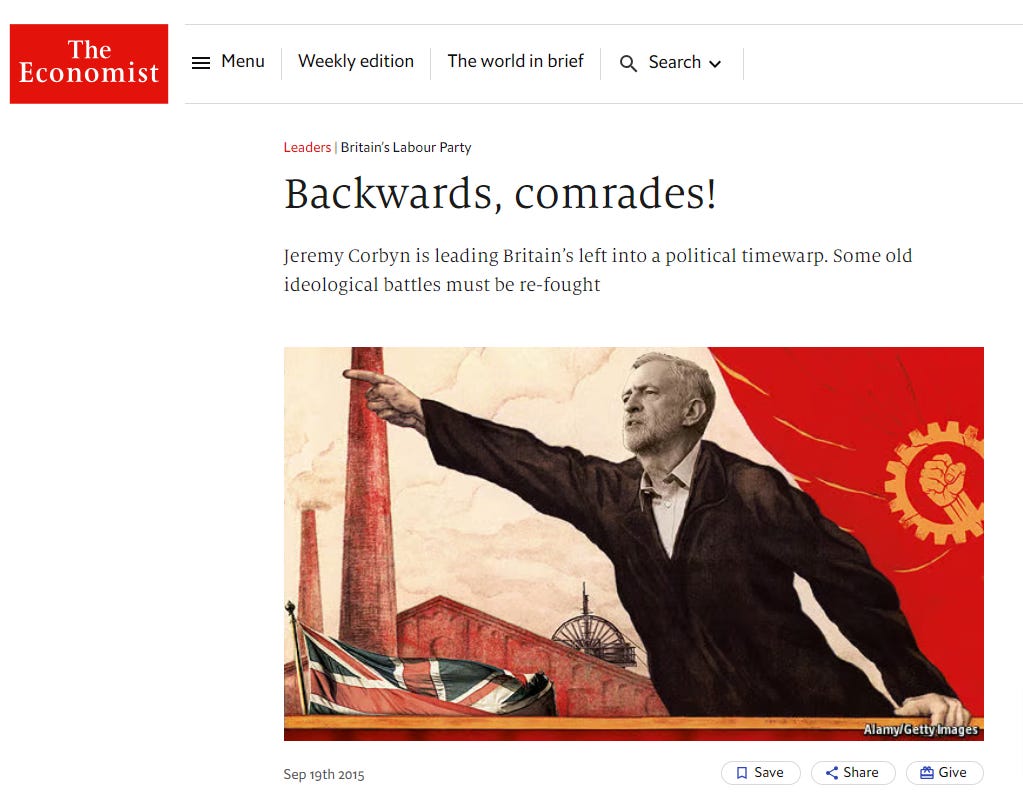
The Reader need only be reminded of The Economist’s notorious 2015 ‘Backwards, comrades’ political propaganda?
1.
Martin Ivens offers critical evaluations worth pursuing!
…
Tim Pitt’s contribution to The Case for the Centre Right, a collection of essays edited by the former treasury minister David Gauke, explains that “on a per capita basis, the UK grew by just seven percent between 2007 and 2022 and labour productivity by just four percent”.
…
Economic growth has slowed since the 1990s and productivity gains were meagre even before the financial crisis. “This slowdown is common among advanced economies”, he adds. (The US seems to be an exception.)
…
Twelve years into Tory rule, Truss became prime minister convinced that this record was a disaster. Research by the economic historian Nick Crafts (1949–2023) and his colleague Terence Mills bears her out.
…
Thatcher’s Big Bang deregulation of the City and the information technology revolution have seemingly run their course. But Truss’s plan to cut taxes while increasing public spending during a period of market volatility – Reaganomics without the safety net of the dollar reserve currency – broke all the rules. Sunak’s remedy is more austerity, eased by a few supply-side reforms. Perhaps AI will ride to the British economy’s rescue. Perhaps not.
…
Although the government could have borrowed at knockdown interest rates, it failed to invest in infrastructure and housing. In his Mais lecture as chancellor last year Sunak owned up to the country’s investment deficit. The right’s remedy is supply-side reform, public expenditure restraint and tax cuts.
…
Demographics, says the author, are against the Conservatives; the young will soon take their revenge. Nonetheless, the author doubts his own wisdom: “No one is getting rich betting against the Tories”. Quite. Note how the US Republicans have defied roughly similar trends.
…
Twelve hours before the European referendum vote I bumped into another of The Case for the Centre Right’s contributors, Andrew Cooper, Cameron’s chief pollster and now a board member of a Blairite think tank, Labour Together. Cooper assured me that Remain would win by a double-digit margin. As Riley-Smith makes clear, the modernizers and their “moderate” predecessors never got Europe right.
Michael Portillo, one of Major’s “bastards” and a contemporary avatar of socially liberal Toryism, argued in the Noughties that the modernizers were mild Eurosceptics, but were always good club men first. That was the class analysis by a state-school-educated boy of his public-school successors.
…
Without a victory to his name Cameron found that his Eurosceptic right wing, along with Ukip, slowly pushed him towards the Brexit door. Cameron’s foreign secretary, the former Conservative leader William Hague, interviewed by Riley-Smith, believes that there would have been no need for an in/out referendum had there been a vote on the EU constitutional treaty negotiated at Lisbon in 2007, saying: “Britain would have voted against the Lisbon treaty, we would have blocked European integration, but we would not then have embarked on trying to leave the EU.
…
…in the midst of the European migrant crisis. Lynton Crosby, the Australian political strategist behind Cameron’s outright victory in 2015, urged him to storm out of the talks. “That’s not me”, replied his boss. “I am a reasonable person.” Thatcher, barred from membership of St James’s clubs by reason of her sex, was not reasonable. She rudely banged the table until she got her billion-pound rebate back from Brussels. Johnson is not a gentleman and the only rule he observes is to break the rules.
…
There were other roads not taken. Riley-Smith records that Cameron was advised by Gavin Williamson, his chief parliamentary secretary, and Iain Duncan Smith, a hardline Eurosceptic and former Tory leader, to “do a Harold Wilson”: in 1975 the Labour PM made a show of stepping back from active campaigning in the first referendum on European membership, even though he wanted a “Yes” vote.
…
Cameron’s best brains, Osborne (a Remainer) and Michael Gove (a Leaver) urged him not to hold an in/out referendum.
…
Crosby warned him not to use Project Fear tactics during the campaign, but Osborne publicly threatened an emergency round of cuts and tax hikes in the event of a Leave decision.
…
Nothing succeeds like respectable failure in the British establishment, hence Cameron’s recall as foreign secretary.
…
Martin Ivens insights are worth consideration and engagement, considering the latest replacement for Bagehot, Duncan Robinson ‘Political Editor and Bagehot columnist’ , in his slap-dash, back-handed way seeks through a critique of The Spectator: to produce a political narrative that is not just hobbled by its narrow focus, but is a rhetorical copy of the ‘ Backwards, comrades!’ political propaganda!
Rootless cosmopolitan,down at heels intellectual;would be writer.
'Polemic is a discourse of conflict, whose effect depends on a delicate balance between the requirements of truth and the enticements of anger, the duty to argue and the zest to inflame. Its rhetoric allows, even enforces, a certain figurative licence. Like epitaphs in Johnson’s adage, it is not under oath.'
https://www.lrb.co.uk/v15/n20/perry-anderson/diary