Edward Skidelsky quotes one of the Great Witnesses of the Nazi period, Victor Klemperer, in his public shaming of ‘Right-Wing bigots’

Newspaper Reader comments.

Headline: Academics can no longer speak freely

Sub-headline: Solving this crisis in higher education should transcend the division between the right and the left.

https://www.newstatesman.com/comment/2024/02/academic-free-speech

For many years, left-wing opinion-makers have told us that there is no crisis of free speech in British universities, that the whole idea is a fiction put about by right-wing bigots upset that they can no longer sound off with impunity, or by politicians and journalists intent on stirring up a culture war. To quote Nesrine Malik, writing in the Guardian in 2019, “the purpose of the free-speech-crisis myth is…to blackmail good people into ceding space to bad ideas”.

Anyone who works in a university knows that this is balderdash. The crisis in academia is of course a godsend to the right, but that doesn’t mean that it isn’t also real and serious. Indeed, it is much more serious than most people realise. High-profile cancellations are what make the headlines, but they are merely the occasional effect of something deeper: the capture of entire sections of the academic bureaucracy by ideological lobbies, which insist on imposing their beliefs on all and sundry. We have seen this sort of thing before. 

“Books, newspapers, official communications and forms issued by administrative departments – all swam in the same brown sauce,” wrote the German philologist Victor Klemperer, referring to the monotony of thought and language in Hitler’s Reich. The sauce is no longer brown, but apart from that, Klemperer could be describing a modern British university. 


The Reader might look to this essay by Mr. Skidelsky at ‘The Critic’ from 2021:

Headline: The Specter of Totalitarianism

The worst offenders in the new climate of intolerance are our universities.

https://thecritic.co.uk/issues/march-2021/the-spectre-of-totalitarianism

The new intolerance is often seen as a specifically left-wing phenomenon — an intensification of the “political correctness” which emerged on US campuses in the 1980s. But that is a one-sided view of the matter. It was US Zionists who pioneered the tactic of putting pressure on organisations to disinvite unfavoured speakers; far-right nationalists are among the keenest cyberbullies; and religious zealots of all stripes are prodigal of death threats. 

Generalising, one might say that left-wing groups, being more publicly respectable in our part of the world, prefer to pursue their objectives through institutions and the law, whereas right-wing groups seek out the anonymity of the internet. But the goal on each side is the same: it is to intimidate, suppress, silence. In any case, the distinction between “left” and “right” is becoming increasingly muddled, as lines shift and alliances regroup. All one can safely say is that the various forms of contemporary extremism imitate and incite each other. What has given way is the civilised middle ground.

For this reason, I prefer to speak not of “fascism” or “political correctness” but of “totalitarianism”, a label designed to pick out what is common to fanaticisms of left and right. Totalitarianism is often thought of as a type of regime, which may make my use of the term seem hyperbolic; after all, we still live in a democracy. But it can also be understood in a broad sense, as a frame of mind and a style of political action. Totalitarianism in this broad sense existed in Russia and Germany before the establishment in either country of a totalitarian regime, and it remained a force in West European politics even after the war, if only on the radical fringe. It is totalitarianism in this sense whose recent rise to prominence alarms me. A public inured to totalitarian habits of thought and action is unlikely to offer much resistance to a totalitarian takeover of the state.

Call Mr. Skidelsky a political opportunist, who writes a ‘History Made To Measure’: its like reading The Financial Times Opinion Section.

In the context of these two essays, The Reader might gain from reading Skidelsky’s essay of 1999 on Perry Anderson?

Headline: The New Statesman Profile – Perry Anderson

Sub-headline: He is one of Britain’s great Marxist intellectuals, yet now he seems a strangely conservative figure

https://www.newstatesman.com/politics/welfare/1999/03/the-new-statesman-profile-perry-anderson

Some revelatory quotation:

On Anderson’s critique of Fukuyama, as presented by Skidelsky:

A good example of this is his essay on Francis Fukayama’s The End of History. Fukayama’s grand narrative of historical progress – even though it culminates in the triumph of bourgeois liberal democracy – is of precisely the kind to win Anderson’s admiration. Anderson defends it against its detractors, claiming, on impeccably Marxist grounds, that their various refutations of Fukayama’s hypothesis amount to nothing more than local difficulties, and do not constitute a genuine contradiction. But then – as if suddenly realising what he has admitted – he amasses a whole set of difficulties of his own, ranging from environmental problems to feminism. But these are no more a fundamental contradiction than the difficulties he has previously dismissed. All are manageable within the confines of the present world-system. Fukayama has beaten Anderson at his own game.

Editor: Nothing impressed the intellectual bumkins across continents as much as Fukuyama’s Hegelian inflected chatter. Charlatan !


Editor: added 2/28/2024:

Then there is this dubious commentary about how Anderson must comport himself as a Public Intellectual. Not to speak of Anderson’s romance with ‘Latin American terrorism’.

Anderson is notoriously elusive. No interviews, no broadcasts – and even the London School of Economics, where he is a visiting lecturer, did not have a photograph to contribute to the illustration of this profile. Yet for all his elusiveness, his influence on British intellectual life has been enormous. The conduit of this influence was the New Left Review, the socialist bi-monthly which he edited from 1962 to 1982. Anderson’s goal was the introduction into Britain of a new kind of socialist culture, alternative to both the official Marxism of the Communist Party and the stolid reformism of the Labour Party. His followers saw themselves as a revolutionary vanguard. Inspired by Gramsci, they aimed to establish a socialist hegemony in the realm of ideas from which, they hoped, a revolutionary movement would follow. The leading lights of Continental Marxism – Lucacs, Gramsci, Benjamin, Adorno, Marcuse and Althusser – were published and discussed, often for the first time in Britain. Non-Marxist structuralists such as Lacan and Levi-Strauss were also introduced. High theory was interspersed with the other amour of the era: Latin American terrorism.


Just having re-read The Origins of Post-Modernity, a work of impeccable scholarship, historical insight, not offered by any writer/thinker, other than Fredric Jameson! The reader will note that the claim made by Skidelsky, is the same claim made by the critics of that Post-Modernism, Derrida being the target of choice.
Defeated on the political plane, Anderson has at last succumbed to the “siren voices of idealism”. His latest essay, The Origins of Postmodernity, is a work of cultural criticism in the classic tradition of Benjamin and Adorno. It is essentially a defence and an elaboration of Frederic Jameson’s thesis that postmodernism constitutes “the cultural logic of late capitalism”.

Postmodernism is a natural target of attack for a Marxist. What it signifies is the final disappearance of any critical perspective on the capitalist order. The Soviet Union, for all its imperfections, provided such a perspective, and its existence sustained the avant-garde throughout Europe and America. Now there is nothing but capitalism. Any revolt is immediately assimilated and commodified. Art, realising this, has abandoned its haughty intransigence and entered into alliance with the market. The tone of the essay is one of sorrowful resignation. Anderson can diagnose the malady, but he has no cure.

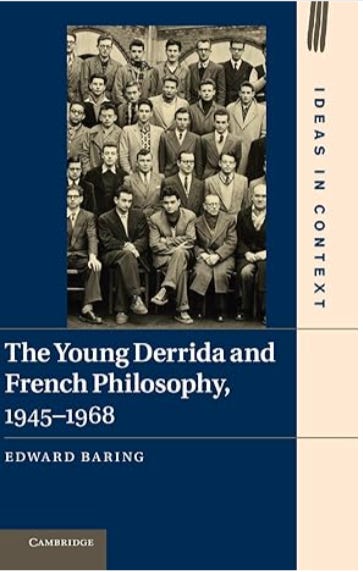
The Young Derrida and French Philosophy. 1945-1968

Edward Baring, Cambridge University Press, 2011, 326pp., $95.00 (hbk), ISBN 9781107009677.

Reviewed by Samir Haddad, Fordham University

2012.08.28

https://ndpr.nd.edu/reviews/the-young-derrida-and-french-philosophy


 Newspaper Reader 

Posted in Uncategorized | Leave a comment

@MelanieLatest self-willed forgetting of the War On Terror, and its crimes against Islamic States & Persons!

Newspaper Reader comments.

Headline: Islamophobia and antisemitism are not the same

Sub-headline: Prejudice against Muslims is deplorable but it’s not bigotry to call out the Islamist threat to Jews

https://www.thetimes.co.uk/article/islamophobia-and-antisemitism-are-not-the-same-nxgrqvxbt

Melanie’s self -willed forgetting of ‘The War On Terror’:

Melanie is a well paid Political Hysteric, whose specialty is to warn of the clear and present danger of Anti-Semitism. Yet these paragraphs below demonstrate that she is fixated on “Islamophobia” is not equivalent to antisemitism.’ Yet the Genocide being perpetrated by the Zionist State against the Palestinians, a Semitic People, can’t be used for furthering the Jewish Victimhood narrative, while Melanie’s focus is the more manageable domestic front, characterized by ‘People of goodwill parrot accusations of Islamophobia through ignorance or fear.’ To reduce Melanie’s ‘argument’ to its simplest terms Jewish Suffering/Victimhood is always Primary !

People of goodwill parrot accusations of Islamophobia through ignorance or fear. British Jewish leaders, with the community’s historic experience of antisemitism uppermost in their minds and eager to show solidarity with other victims of bigotry — and to keep their heads below any cultural parapet — have chosen to accept the definition of Islamophobia at face value. This has had unfortunate effects. Although statistics show the Islamic world is riddled with antisemitism and that “Arabs and Asians” are disproportionately involved in attacks on British Jews, Jewish community leaders never speak about the threat they face from Muslim antisemitism.

“Islamophobia” is not equivalent to antisemitism. It facilitates it. Derailing the parliamentary process last week as a result of threats to MPs over their attitude to a foreign conflict was an inflection point in the encroachment by intimidatory, radical Islamism. That danger must be called out and dealt with. To equate any such call with the Jew-hatred at the theological core of this menacing ideology is as Newspaper self-destructive as it is obscene.

Newspaper Reader

Posted in Uncategorized | Leave a comment

@FT & @TheEconomist @MESandbu on Western Plaster Saint Alexei Navalny.

Old Socialist comments.

Mr. Sandbu has many political admirers, fellow travelers!? The International Monetary Fund, in the person of Paolo Mauro, offers this in the final paragraphs of his review of ‘The Economics of Belonging’ :

His proposed policy package pushes the boundaries of the economics consensus but is not going to shock those who have followed recent debates. Key elements include net wealth taxes, universal basic income (or negative income taxation), and carbon taxes and dividends. Drawing on positive lessons from his native Norway (and an intriguing comparison of automated car washes in Scandinavia and their labor-intensive equivalent in the United States), Sandbu calls for de facto minimum wages. These force employers to select more productive processes, rather than creating low-skill jobs. To avoid the risk of unemployment for the low skilled, he calls for higher spending on education and retraining, as well as forceful demand stimulus. Economists will enjoy debating the pros and cons of each of these policies. Sandbu reasonably points out that they complement one another and work only as a package.

This book is a thorough and compelling overview of recent economic analyses of the factors underlying the electoral travails of the democracy/globalization model. I would have liked the author to venture more into the art of political persuasion. Even if the ultimate source of discontent is economic, political messages that resonate with people’s moral preferences stand a better chance of passing through parliament. Sandbu takes tentative steps in this direction. For example, he presents an intriguing right-wing perspective on universal basic income. He also points out that piecemeal reform efforts may be easier to block than his ambitious package. This reader hopes for more analysis of how to overcome political obstacles in Sandbu’s next columns and books.

Paolo Mauro is highly credentialed : director of the Economic and Market Research Department at the International Finance Corporation.


The Economist on two books, one by Sandbu:

Culture | Rethinking capitalism

Two authors wrestle with inequality and the allure of populism

https://www.economist.com/books-and-arts/2020/06/11/two-authors-wrestle-with-inequality-and-the-allure-of-populism

Martin Sandbu and Gene Sperling support free markets—but fear their power

I will comment on the Sandbu book:

On many measures inequality had not risen much over the preceding decade, or had risen more slowly than in past economic expansions. And yet political systems were gripped by a populist backlash which, at least in part, reflected an indignant reaction against perceived economic injustice. The liberals who had constructed the old order were suffering a crisis of confidence.

As usual the Oxbridgers seem to have ignored, subjected to a convenient erasure, the 2007-2008 Economic Catastrophe. And its many victims who now resort to Political Populism, as a methodology, to address their immiseration at the hands of Mises/Hyak/Friedman Cadre, and its apologists in The Corporate Media!?

In “The Economics of Belonging” Martin Sandbu, a columnist at the Financial Times, excoriates policymakers for unforced errors over recent decades and sets out an agenda for correcting course. In “Economic Dignity” Gene Sperling, a former top economic adviser to Presidents Bill Clinton and Barack Obama, argues for a new value system to underpin American economic policy.

Mr Sandbu’s book is in some respects the more optimistic of the two. He rejects the fatalistic argument that populism is a straightforward revolt against immigration and progressive cultural attitudes. Economic insecurity always triggers angst about culture and suspicion of outsiders, he points out. Fixing the economy, in other words, will heal cultural divides. The key is to get the economic diagnosis right. Trade, immigration and globalisation more broadly are easy scapegoats for lost manufacturing jobs and growing geographical inequality. But it is technological change that has really caused the rise of a service- and knowledge-based economy. The solution, thinks Mr Sandbu, is for governments to forge social contracts fit for technologically advancing economies, not to try to turn back the clock.

Yet his policy proposals do not reflect the “compensate the losers” redistribution for which economists frequently reach. Instead, he favours increasing workers’ productivity and bargaining power so that they are never too dependent on a single employer. To that end, monetary policy must put greater emphasis on keeping labour markets running hot, so that firms compete for workers rather than workers for jobs. Tax-free earnings allowances should be replaced with a small universal basic income, to reinforce safety-nets without laying poverty traps. And governments should direct investments in the knowledge economy, such as publicly funded research, towards places that have been left behind.

Mr Sandbu claims this agenda is not left-wing, and does not require an increase in government spending as a share of gdp. But it does require a recognition that individuals must not completely lose control over their economic fate to market forces. Otherwise, as they endeavour to wrench it back, they may be swayed by extremists.

On a fundamental level, these books are similar in attitude. Messrs Sandbu and Sperling both combine a basic support for free markets with a fear of their power. It is precisely because incentives are so potent that competitive forces must not be allowed to go haywire, as when firms gain an edge by reclassifying their workers as contractors, or by moving to tax havens. Such races-to-the-bottom define many of the policy failures of recent history.

And both books highlight the moral blind spots that many liberals and economists think have been exposed by the era of globalisation (and perhaps by the pandemic, too). Clarifying those problems, and finding solutions that avoid compromising too much on freedom and free markets, is crucial work

I offer the above as a prelude to Sandbu commentary on the question of Navalny. This essay by Alexey Sakhnin offers insights on Sandbu’s funeral oration:

Headline: Named Alexei Navalny Became a Liberal Hero

https://jacobin.com/2021/01/alexei-navalny-russia-protests-putin

Who was Navalny

Like most politicians in modern Russia, Navalny’s worldview was formed under the total dominance of right-wing, market liberal ideology. In 2000, he joined the liberal Yabloko party. In those years, by his own account, he was a classic neoliberal, supporting a regime of low public spending, radical privatization, reduction of social guarantees, “small government,” and total freedom for business.

However, Navalny soon realized that a purely liberal politics has no prospect of success in Russia. For most people, this ideology was discredited by the radical reforms of the 1990s. It symbolized poverty, injustice, inequality, humiliation, and theft. And after pro-Western liberal ideology had lost so much luster in the eyes of the population, it ceased to be of interest to the ruling class either. Following Vladimir Putin, Russian officials, politicians, and oligarchs proclaimed themselves as patriots and true inheritors of the Russian state. Liberal parties turned out to be of no use to anyone.

Navalny soon found a new ideological niche. In the late 2000s, he declared himself a nationalist. He participated in the far-right Russian Marches, waged war on “illegal immigration,” and even launched campaign “Stop Feeding the Caucasus” directed against government subsidies to poor, ethnic minority-populated autonomous regions in the south of the country. It was a time when right-wing sentiments were widespread, and urban youth sympathized with ultra-right groups almost en masse. It seemed to Navalny that this wind would fill his sails — and partly, it worked.

But Navalny did not get lost among the petty nationalist “führers.” He found a special niche that made him a hero far beyond the boundaries of the right-wing radical subculture. He became the country’s main fighter against corruption. He would buy small amounts of shares in large state-owned companies and thus get access to their documents. On this basis, he conducted and published high-profile investigations. Many of them were brilliant journalistic work — though some critics suspected that Navalny was simply involved in the “media wars” among rival financial-industrial groups, receiving “orders” from them and information that compromised their competitors.

In any case, the liberal narrative that corruption is the cause of the ineffectiveness of the state brought Navalny the sympathy of the mass of the middle class. Corporations’ top management and businessmen saw corruption as a major obstacle to their own success. Many subscribed to Navalny’s blog and increasingly sent him monetary donations.

In 2011-13, Russia was swept by a mass movement of protest against the rigging of parliamentary elections and growing authoritarianism, symbolized by Putin’s return to the presidency. Navalny took part in this — but failed to lead it. He got support mostly from middle-class people in the capital and the largest cities. But the working class, and the poor majority in general, did not trust him. They remained indifferent to his anti-corruption agenda, seeing corruption as only one of the techniques for enriching the elite and not the foundation of class inequality.

Indeed, it turned out that left-wing values ​​still have some influence in Russia. In those protests, thousands of people demonstrated under the red flags, and the leader of the Left Front, Sergei Udaltsov, became one of Russia’s most popular politicians. Navalny’s closest aide, Leonid Volkov, said in an interview that it was necessary to convince the Russian elite that an opposition victory would be better for them than a corrupt Putin government. But to do this, it was necessary to get rid of left-wing allies, who scared off big business.

So Navalny split the oppositional coalition and when leftist leaders were thrown in jail, he declined to intercede on their behalf.

Mr. Sandbu essay follows the Party Line on Navalny and Putin , this is The Financial Times! The final paragraphs of Sandbu political moralizing offers the plaster saint of Navalny, or just a convenient Western construct! Who has no relation to Andrei Sakharov, Yelena Bonner, Alexander Solzhenitsyn, Eugenia Semenovna Ginzburg, Varlam Tikhonovich Shalamov, Anna Akhmatova, Osip Mandelstam!

The lesson on both the military and the economic side is the danger of believing in the virtue of caution when that in practice means delay. Early “caution” has prolonged the suffering in Ukraine, emboldened the Russian dictator who thinks he can outwait Kyiv’s western supporters, and increased the cost of pushing him back. Whatever could have been achieved early, can now only be achieved in more time and at greater cost.

Navalny’s message before his last return to Russia was that “the only thing needed for the triumph of evil is for good people to do nothing”. Evil benefits, too, when good people are too cautious. Don’t keep making that mistake.

Old Socialist

Posted in Uncategorized | Leave a comment

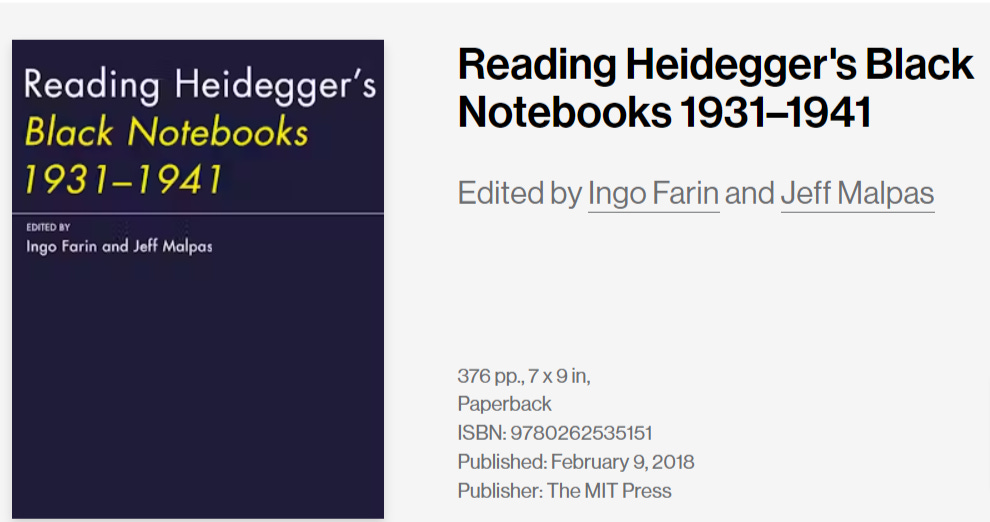
On reading reading ‘Heidegger’s Black Notebooks 1931–1941’ in light of the Gaza Genocide.

Using Kant’s Crocked Timber of Humanity as a starting point and this book:

The above tinctured in a bit of Hegelian Prestidigitation… can a possible case be made, that Heidegger’s ‘Jewish World Conspiracy’ has been realized in the Gaza Genocide, that is taking place as I write this?

Political Observer.

Posted in Uncategorized | Leave a comment

‘On Ganesh Chatter’ from February 20, 2024.

Political Cynic comments.

Headline: How Europe should negotiate with Donald Trump

Sub-headline: He is obsessed with money but his record suggests he doesn’t always drive a hard bargain

https://www.ft.com/content/191ad713-f4b2-459f-8c4c-d12e1d678232

As a regular reader of The Financial Times’ ‘Ganesh Chatter’ is always worthy of my attention, not to say of my political contempt, for his pretentious imitation of a boulevardier/raconteur. He resembles the Goncourt Brothers in a highly idiosyncratic, hybrid interpretation/political iteration.

On the question of hybridity see

Reader look what I found in my internet search, that may not be completely relevant to ‘Ganesh Chatter’ but don’t miss r/badhistory reveltory comments on Jordan Peterson & French Philosophy here:

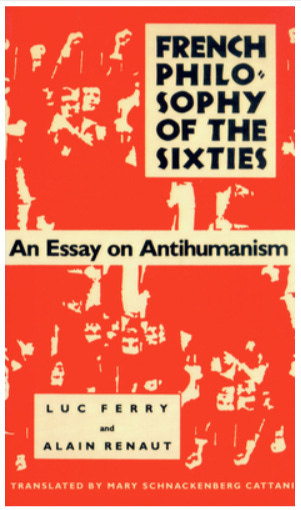
Jordan Peterson butchers French intellectual history of the 1960s: “the most reprehensible coterie of public intellectuals that any country has ever managed”

What happened to French intellectualism in the 1960s? Where did “identity politics” come from? What’s the connection to Marxism? And how do they differ in France and North America? If you’re interested in remaining confused yet angry about all of these questions, and vilifying a shape-shifting cast of (neo)marxists, postmodernists, radicals, and sundry scapegoats, allow me to introduce you to the narratives of Jordan B. Peterson, armchair intellectual historian of the transatlantic journey of French ideas to North American academia:

What happened in the late 1960s, as far as I can tell—this happened mostly in France, which has probably produced the most reprehensible coterie of public intellectuals that any country has ever managed—is that in the late 1960s when all the student activists had decided that the Marxist revolution wasn’t going to occur in the western world and finally had also realized that apologizing for the Soviet system was just not going to fly anymore given the tens of millions of bodies that had stacked up, they performed what I would call a philosophical sleight of hand and transformed the class war into an identity politics war. And that became extraordinarily popular mostly transmitted through people like Jacques Derrida, who became an absolute darling of the Yale English department and had his pernicious doctrines spread throughout north America partly as a consequence of his invasion of Yale. And what happened with the postmodernists is that they kept on peddling their murderous breed of political doctrine under a new guise. [Harvard talk]

Back to ‘Ganesh Chatter’:

He inhabits a world before David Ricardo, if not before Adam Smith, in which wealth is understood as a cake that nations compete for a cut of. More for thee means less for me.

(If Vladimir Putin had collective defence arrangements on another continent, the alt-right would hail it as “strategic depth”, not knock it as a burden.)

In other words, when Trump grumbles about “delinquent” allies, he doesn’t mean something wider or deeper or grander. It isn’t contempt for the west or admiration for predatory dictators talking.

The challenge for big thinkers in the Trump age is to accept that here is someone immersed in the bathos of accounts and invoices.

In 2018, he settled for a revised version of the North American Free Trade Agreement — achieving some demands, letting others go — instead of quitting it outright.

His amour propre is double-edged, spurring him to start quarrels but also to settle them on whatever terms he can spin as his own. It is hard to know which offends him more, in fact: being the mug in a deal, or being considered impotent to amend it.

The more practical one is how to stop him leaving or underfunding Nato in the meantime, or undermining it with his rhetoric. The answer is to take him at his word, and address the cash question. It isn’t code for something else.

but his followers and his enemies alike put a philosophical weight on him — as savior of Christendom, or 1930s fascist — that he doesn’t bear. His concerns aren’t at that level of abstraction.

Trained in ideas, the political class sees in grand terms — “authoritarian” this, “isolationist” that — a man who is, at bottom, a miser. The ultimate rule of negotiating with Trump is that no one will be worse at it than an intellectual.


The unctuous ‘savior of Christendom’ …

Political Cynic

Posted in Uncategorized | Leave a comment

Bret Stephens offers a Four Point Plan to ‘Avenge’ Navalny’s Death! (Head-Line writers Inflation!)

Political Reporter comments.

What might a New York Times columnist offer in terms of expertise on this question Policy? A four point list?

Headline: How Biden Can Avenge Navalny’s Death

Finances:

Recognition:

Dissidents:

Power:

Stephens offers the wise council of David Petraeus, on what should be done.

David Petraeus, the retired general and former C.I.A. director, had a specific suggestion: “The White House should announce the provision of the Army Tactical Missile System to Ukraine, which would double the range to approximately 300 kilometers of the missiles provided by the U.S. to date.”


David Petraeus is a political actor worthy of trust?

Headline: How David Petraeus avoided felony charges and possible prison.

By Adam Goldman

January 25, 2016 at 2:09 p.m. EST

On April 23, 2015, Petraeus pleaded guilty in Charlotte. The judge upped the fine to $100,000.

For this to go away, he said, Petraeus would have to plead guilty to lying to the FBI and mishandling classified information, a misdemeanor. In the statement of facts that would accompany the plea agreement, prosecutors also said they would want to reference a message Petraeus sent to the CIA workforce in 2012 after John Kiriakou, a former agency officer, was convicted of leaking classified information.

“Oaths do matter, and there are indeed consequences for those who believe they are above the laws that protect our fellow officers and enable American intelligence agencies to operate with the requisite degree of secrecy,” Petraeus had said.

Petraeus’s lawyer, David E. Kendall, declined to comment. But another person familiar with the meeting said he described the lying charge as “a nonstarter.” The Kiriakou reference was also off the table, he said.

https://www.washingtonpost.com/world/national-security/how-david-petraeus-avoided-felony-charges-and-possible-prison-time/2016/01/25/d77628dc-bfab-11e5-83d4-42e3bceea902_story.html

Both Petraeus and Stephens self-concepts are wedded, in Petraeus’ case to his expertise in Military Matters. Yet afflicted with the pleasures/alliances with a younger women, and the sharing of classified data, as demonstrated from the above quoted Washington Post report. While Stephens draws on the inheritance from Plato’s ‘Noble Lie’, as presented by Leo Strauss: although as a propagandist he is given to constructing a ‘History Made to Measure’, that is the first resort to which the Pundit Class practices, in its many iterations.

Political Reporter

Posted in Uncategorized | Leave a comment

@tomfriedman Witless Political Hack’s 21 Paragraphs (By my quick count)! Not even worth a word count!

Political Observer asks the burning question: How long before Old Money Gavin Newsom replaces Senile Old Joe?

Here are the opening paragraphs Of Mr. Friedmans latest’s diatribe against Trump, and his political coterie. Yet Biden, and his Neo-Cons, are in the political imagination of Friedman, above reproach. Even as the obscene death tole in Gaza, and widening war in the ‘Middle East metastasizes, by the minute, hour, day!

I’ve got a suggestion for the next Trump-G.O.P. fund-raising scheme. You know how sports memorabilia stores sometimes sell basketballs autographed by an entire N.B.A. team? Well, I was imagining that Donald Trump could sell white flags at $1,000 a pop that say, “We surrendered Ukraine to Russia,” autographed by him and the House and Senate MAGA sycophants he’s assembled to deny Ukrainians the weapons they need to stave off Vladimir Putin’s onslaught. 

For an extra $500, you could get a white flag autographed solely by Trump and J.D. Vance and emblazoned with Vance’s immortal words, “I don’t really care what happens to Ukraine.” Or one signed by House Speaker Mike Johnson, big enough to sum up his worldview: I was for Ukraine aid until I was against it, but I could be for it again if Trump is not against it. This is a matter of principle for me. Either way, it’s all Biden’s fault. 

And then the ultimate collector’s item. For an extra $1,000, a giant white surrender flag, made from the softest Sea Island cotton, signed by Lindsey Graham, that says: “I gave up the principles of John McCain and a free Ukraine because Trump told me to. But I got a round of golf at Trump’s West Palm Beach course. Can I still be on ‘Meet the Press’?” 

The last gift comes with a pair of Trump’s new branded tennis shoes, guaranteed by Trump and personally tested by Graham, to be the fastest shoe on the market to run away from any ally or foe — or anything principled that you’ve ever said. 

I’ve got a suggestion for the next Trump-G.O.P. fund-raising scheme. You know how sports memorabilia stores sometimes sell basketballs autographed by an entire N.B.A. team? Well, I was imagining that Donald Trump could sell white flags at $1,000 a pop that say, “We surrendered Ukraine to Russia,” autographed by him and the House and Senate MAGA sycophants he’s assembled to deny Ukrainians the weapons they need to stave off Vladimir Putin’s onslaught. 

For an extra $500, you could get a white flag autographed solely by Trump and J.D. Vance and emblazoned with Vance’s immortal words, “I don’t really care what happens to Ukraine.” Or one signed by House Speaker Mike Johnson, big enough to sum up his worldview: I was for Ukraine aid until I was against it, but I could be for it again if Trump is not against it. This is a matter of principle for me. Either way, it’s all Biden’s fault. 

And then the ultimate collector’s item. For an extra $1,000, a giant white surrender flag, made from the softest Sea Island cotton, signed by Lindsey Graham, that says: “I gave up the principles of John McCain and a free Ukraine because Trump told me to. But I got a round of golf at Trump’s West Palm Beach course. Can I still be on ‘Meet the Press’?” 

The last gift comes with a pair of Trump’s new branded tennis shoes, guaranteed by Trump and personally tested by Graham, to be the fastest shoe on the market to run away from any ally or foe — or anything principled that you’ve ever said. 

… 


Reader who can forget this from Jan. 31, 2024 ?

A Biden Doctrine for the Middle East Is Forming. And It’s Big.

There are two things I believe about the widening crisis in the Middle East.

We are about to see a new Biden administration strategy unfold to address this multifront war involving Gaza, Iran, Israel and the region — what I hope will be a “Biden Doctrine” that meets the seriousness and complexity of this dangerous moment.

And if we don’t see such a big, bold doctrine, the crisis in the region is going to metastasize in ways that will strengthen Iran, isolate Israel and leave America’s ability to influence events there for the better in tatters.

A Biden Doctrine — as I’m terming the convergence of strategic thinking and planning that my reporting has picked up — would have three tracks.

Besides this Mr. Friedman has read Joe Bidens’ gut!

Biden is as pro-Israel in his gut as any president I have ever covered.

Political Observer

Posted in Uncategorized | Leave a comment

@FT & @MGEmancipation i.e. Michael Goldfarb: ‘You can have justice or peace. But you can hardly ever have both’

Political Cynic comments upon a Zionist Apologetics, in thrall to 1993 Oslo Accords!

The Financial Times has a ready supply of ‘writers’, to comment upon divisive issues, that must be handled by writers not connected with this newspaper? As a kind of self-defense, against its readership’s resort to a comments section, filled with caustic rejoinders. That leads the editors of this newspaper no alternative but to post a notice to its readers that the ‘Comments have not been enabled for this article’ Such is the case of this essay by Michael Goldfarb :

 Israel-Hamas war

You can have justice or peace. But you can hardly ever have both

A popular protest slogan and the reality that for peace to prevail, sometimes justice is impossible

https://www.ft.com/content/08fa295a-3ec4-43b3-af16-baf9892a71cb?xnpe_tifc=xI4uOFPuxfYXhfQNhu4L49pJVdUZMds_O.4_x.1JOk4utIh_xfoA4kHp4ZJNOF_jtfe.4FxdbI1Z4fP.xMXj4Fo84D_7hFxXxdnXh.bl

What might The Reader make of this declaration by Michael Goldfarb?

What is the process by which an historical event becomes sacred and incorporated into religious practice? Does that process even exist in the 21st century? Do events of “Biblical proportions” still happen?

The 75th anniversary of Auschwitz’s “liberation” by the Red Army approaches. I covered the 50th anniversary commemoration for NPR and I have been wrestling with these questions ever since.

I am a secular Jew. When I arrived at the dreadful place in January 1995, I hadn’t seen the inside of a synagogue for 15 years, yet by the time my two day visit was over I had been overwhelmed by a powerful emotion that I can only describe as religious.

https://michaelgoldfarb.medium.com/auschwitz-the-new-pilgrims-tale-631b848c739b

Mr. Goldfarb begins his essay with a critique of a pro-Palestinian marchers refrain:

“No justice, no peace!” shout pro-Palestinian marchers moving through cities in Europe and the US.

Mr. Goldfarb then recounts his experiences in Northern Ireland, torture in Greece and Chile. An he argues that ‘ The Holocaust could not have happened without the willing participation of many people’ and Some 99 per cent of the perpetrators never faced justice. Many SS members simply returned to their lives after the war.  call these jejune at best! But more of the same ‘Yet many were re-employed in the legal system because peace, or at least stability, was needed so the country could provide a bulwark against Soviet expansionism.’

The Reader reaches the final five paragraphs of this lackluster exercise of Zionist Apologetics, via a maladroitly exercised History Made to Measure!

 How did survivors and their wider communities feel about this absence of justice? At the commemoration to mark the 50th anniversary of the Red Army’s liberation of Auschwitz, I stood in the small crowd at the ruins of crematorium II and listened to Holocaust survivor and Nobel peace prize winner Elie Wiesel read a prayer he had written for the occasion:

Here are some critical comments on Elie Wiesel:

Martin Peretz, editor of The New Republic, considers Wiesel a public joke and a misapplication of the dignified Nobel Peace Prize.

Irving Howe declares in The New Republic that Wiesel is a publicity seeker; Alfred Kazin augments the charge with claims that the famed death camp survivor is both shallow and self-aggrandizing.

Jeffrey Burke of the New York Times Book Review carries denunciation to greater extremes by lambasting Wiesel for redundancy and purple prose. Such strong dissent impels Wiesel to unburden his conscience and to master the same objectivity in memoir that he demands of his newspaper reportage.

https://www.cliffsnotes.com/literature/n/night/critical-essays/wiesel-and-the-critics

“God of forgiveness, do not forgive the murderers of Jewish children here.” Then he described from memory frightened children being forced down the steps to the changing room and taken into gas chambers. “God, merciful God, do not have mercy on those who had no mercy on Jewish children.” This otherwise reserved and saintly man was calling down a heavenly justice on the perpetrators, because earthly justice had fallen short.

The present crisis in Gaza will ask similar questions of those charged with its resolution. When the conflict ends, and it must, who will define what justice means for crimes that were committed? After the second world war, the victors revived the International Court of Justice as a forum for cases brought by nations, not individuals, to adjudicate among other things “genocide”, a crime that had only just been identified as the scale of the Holocaust was revealed. But the term, and the laws concerning it, are in their infancy. Genocide is difficult to prove and nearly impossible to get recompense for. The recent case brought by the South African government against Israel at the ICJ for the way it is prosecuting its war against Hamas in Gaza demonstrates this.

The court found “plausibility” in South Africa’s accusation but it did not rule that Israel was in breach of the genocide convention. It did not order Israel to end its incursion into Gaza, but “provisionally” asked it to minimise civilian casualties. It asked Israeli politicians to refrain from making genocidal statements, something most Israelis and vast swaths of the Jewish diaspora wish for.

Simple ideals rarely survive their encounter with the legal and political processes necessary to make peace or justice a reality. After the Oslo Accords were signed in 1993, marking the beginning of a process that could have led to a two-state solution, Bill Clinton, Yitzhak Rabin and Yasser Arafat spoke of a “peace of the brave”, not a peace of the just. For now, as the “justice” both sides are seeking is not tempered with mercy, there can be neither peace, nor justice, no matter how many miles are marched demanding both.

I have placed in bold font the most self-serving parts of these paragraphs, highlighting the Oslo Accords of 1993, as an expression of the toxic nostalgia engaged in by Michael Goldfarb!

Political Cynic

Posted in Uncategorized | Leave a comment

@nytdavidbrooks political romance with Isaiah Berlin.

Political Observer comments.

As a Reader of a certain age, nearing 80, I have to wonder about David Brook’s status as a New York Times Public Intellectual, born in 1961! By the 1970’s I was reading Russian ThinkersAgainst the Current, Age of Enlightenment: The 18th Century Philosophers [The Mentor Philosophers Series] And all these essay published in The New York Review of Books.

Isaiah Berlin

Isaiah Berlin (1909–1997) was a philosopher and historian of ideas who held the Chichele Professorship of Social and Political Theory at Oxford. The final volume of his correspondence, Affirming: Letters 1975–1997, was published in December 2015.

https://www.nybooks.com/contributors/isaiah-berlin

I will quote the relevant paragraphs of Brook’s essay dealing with Berlin:

That idea is known as value pluralism. It’s most associated with the British philosopher Isaiah Berlin and is based on the premise that the world doesn’t fit neatly together. We all want to pursue a variety of goods, but unfortunately, these goods can be in tension with one another. For example, we may want to use government to make society more equal, but if we do, we’ll have to expand state power so much that it will impinge on some people’s freedom, which is a good we also believe in.

As Damon Linker, who teaches a course on Berlin and others at the University of Pennsylvania, noted recently, these kinds of tensions are common in our political lives: loyalty to a particular community versus universal solidarity with all humankind; respect for authority versus individual autonomy; social progress versus social stability. I’d add that these kinds of tensions are rife within individuals as well: the desire to be enmeshed in community versus the desire to have the personal space to do what you want; the desire to stand out versus the desire to fit in; the cry for justice versus the cry for mercy.

Berlin had a word for people who think there is one right solution to our problems and that therefore we must do whatever is necessary in order to impose it: monists. Berlin was born in pre-revolutionary Russia and came of age in the 1930s, when two monist philosophies were on the march, Marxism and fascism. They claimed to be all-explaining ideologies that promised an ultimate end to political problems.

We pluralists resist that kind of Manichaean moralism.

We pluralists believe that conflict is an eternal part of public life — we’re always going to be struggling over how to balance competing goods — but it is conflict of a limited sort, a debate among patriots, not a death match between the children of light and the children of darkness.

Pluralism is a creed that induces humility (even among us pundits, who are resistant to the virtue). A pluralist never believes that he is in possession of the truth, and that all others live in error. The pluralist is slow to assert certainty, knowing that even those people who strenuously denounce him are probably partially right. “I am bored by reading people who are allies,” Berlin once confessed.

He was more interesting when writing about specific people — like Machiavelli or Churchill — than when writing about abstract ideas.

Berlin argued that if there were a final set of solutions, “a final pattern in which society could be arranged,” then “liberty would become a sin.”

I’ve left this paragraph, out of the order of its presentation, this self serving political chatter…

In the 1980s, I thought the chief worry was economic sclerosis and that Reagan/Thatcher policies, including tax cuts, were the right response. Now I think the chief worry is inequality and social fragmentation, and I think the Biden policies, including tax increases, are the right response.

Those ‘right responses’ to the 1980’s , in sum the Neo-Liberal Swindle that produced the Economic catastrophe of 2007-2008, and the ruination of both the Working Class and The Middle Class – Brooks lacks the integrity to face his culpability, while proclaiming his Pluralism.

Reader, consider this essay in The London Review of Books:

Vol. 20 No. 23 · 26 November 1998

Moderation or Death Christopher Hitchens

Many years later, reviewing Personal Impressions for the New Statesman, I mentioned the old story of Berlin acting as an academic gatekeeper, and barring the appointment of Isaac Deutscher to a chair at Sussex University. This denial had the sad effect of forcing Deutscher – who had once given Berlin a highly scornful review in the Observer – to churn out Kremlinology for a living: as a result of which he never finished his triad or troika of Stalin, Trotsky and Lenin biographies. In the next post came a letter from Berlin, stating with some anguish that while he didn’t much approve of Deutscher, his opinion had not been the deciding one. I telephoned Tamara Deutscher and others, asking if they had definite proof that Berlin had administered the bare bodkin, and was told, well, no, not definite proof. So I published a retraction. Then came a postcard from Berlin, thanking me handsomely, saying that the allegation had always worried and upset him, and asking if he wasn’t correct in thinking that he had once succeeded more in attracting me to Marxism than in repelling me from it. I was – I admit it – impressed. And now I read, in Ignatieff’s book, that it was an annihilatingly hostile letter from Berlin to the Vice-Chancellor of Sussex University which ‘put paid to Deutscher’s chances’. The fox is crafty, we know, and the hedgehog is a spiky customer, and Ignatieff proposes that the foxy Berlin always harboured the wish to metamorphose into a hedgehog. All I know is that I was once told – even assured of – one small thing.

https://www.lrb.co.uk/the-paper/v20/n23/christopher-hitchens/moderation-or-death

And this essay in The Guardian:

Review

Isaac and Isaiah: The Covert Punishment of a Cold War Heretic by David Caute – review

Tariq Ali on a renowned scholar’s vendetta against a fellow refugee

Berlin was a liberal fanatic, a staunch empire loyalist, gliding effortlessly from Britain to the US when the time came. He was at his happiest when close to power, an instinctive courtier, unless insulted or ignored. During the 1970s he was invited to Iran, then under the Shah, when dissidents were being hanged naked or toasted on racks by the hated secret police. He accepted. His fee was never disclosed, but the subject of his talk, “On the Rise of Cultural Pluralism”, irritated the empress Farah Pahlavi. He was barely halfway through when the empress signalled a factotum to bring her torture to an end and stop the lecture. Berlin later confided to a friend that it was as if he had been “stung by several wasps”. But why had he gone in the first place?

https://www.theguardian.com/books/2013/jun/20/isaac-isaiah-david-caute-review

Both of these essays explore the fact that Isaiah Berlin was not above defaming Isaac Deutscher! Pluralism matters how in Berlin’s treatment of Isaac Deutscher ?

Reader don’t miss to opportunity offered ‘Sir Isaiah Berlin Interview 1995 Michael Ignatieff’ although at times listening to Berlin, is muddled or simply beyond understanding? While Ignatieff is nearly ecstatic in his proximity to the Master.

Political Observer


February 17, 2024

The excerpts from a letter of 17, October 1989 demonstrates that Berlin was, at the least a political/moral conformist. His concerted campaign against Isaac Deutscher, proves that Berlin was just another Academic Politiker, who betrayed his ‘values’ when convenient!

Headline: The Unique Qualities of Joe Alsop

Isaiah Berlin

October 8, 2015 issue

Kaiser had good things to say, too, telling an anecdote about Alsop beguiling children in a small Vietnamese town—“Joe at his best.” But he found himself unable to place Alsop in his “mental closet.” “Certainly he was almost unique here as a genuine intellectual who knew his own mind, and also just knew a lot. He also played a very important role in the (now ended) era of punditry, but I fear the high point of his career was in intimidating JFK to make a commitment in Vietnam, a tragic error.” Moreover, Alsop “was a tormented soul, confused about his own sexuality, addicted to booze and tobacco, often just sad.” Kaiser asked Berlin: “What does all this add up to? How did you understand the man?” Following is Berlin’s reply, drawn from the fourth and final volume of his correspondence, Affirming: Letters 1975–1997, edited by Henry Hardy and Mark Pottle, to be published in the US later this year.

—Henry Hardy

With all this, he was bad-tempered, bibulous (as you say), could be a bully—but only towards people whom he suspected of opportunism, running with the tide, above all of holding views, whether in a weak and flexible way or in an obstinate and unyielding way, which he regarded as against the interests of the United States. Hence his dislike for Walter Lippmann (whom I knew well and who was indeed a twig that bent in the wind, honest, intelligent but of no character really, undone by his appalling embarrassment about his Jewish origins, which rattled like a skeleton in a half-opened cupboard); ditto my hero Stevenson, whom he regarded as a weakling, over-high-minded; Scotty Reston, for whom he had no moral or intellectual respect; but equally right-wingers like Arthur Krock, whom he despised as one of the vicious defenders of the extreme, slightly Fascist right. He was a deeply neurotic character, lonely, liable to periods of gloom and depression—hence, for the most part, the drink—and certainly to some extent undone by his crypto-homosexuality, which he sought to conceal all his life, but which became more and more widely known, although he never knew the extent to which it was known….

He could not resist charm and intelligence. Naturally, he began by violently denouncing Bob Silvers. When they met, they became fast friends. He was a great friend of my friend Stuart Hampshire, who is a lifelong socialist and whose views coincided with Joe Alsop’s at very few points. He became a friend of a man called Burdon-Muller, of whom I do not expect you to have heard (he was a rich, eccentric pro-Soviet who lived in Cambridge and Boston) as well as Franklin Roosevelt; and Ben Cohen, whom one cannot accuse of illiberal views—Joe thought him a saint and almost invariably right, though politically, of course, there were disagreements. He was friends, to my great indignation, with the horrible Lillian Hellman, who had praised his stance on civil liberties. But, of course, as time went on he became more and more reactionary, even though one could tease him about that and to some degree he laughed at himself for his lonely, rock-like attempt to stem the irresistible tide of vulgarity, decline in intellectual rigour, betrayal of the old civilisation, etc. which he perceived at Harvard, Washington and wherever.

He was a total original: the cruel bullying of which you speak did no doubt occur, and so did the drunkenness—if I had been there, even shivering in a corner, and said “Now, Joe, stop this, don’t go on like this,” I think he would have stopped. He prized friendship above almost everything—not above his patriotism, perhaps, but certainly everything else. Arthur Schlesinger’s obituary of him was fundamentally just and generous : he basically did not care for Arthur, unlike everyone else—he seemed too far to the left (!)—but adored his second wife, who is the daughter of a lady he once paid court to. So they remained on terms. Given this, Arthur’s piece about him is very creditable indeed. But they were not friends personally in the way that Chip Bohlen, Philip Graham (who once told me that he had once meditated joining the Soviet Army as a volunteer against the Finns), Fritchey, Evangeline Bruce or Aline and I were friends. In the end, it was his private person, his warm heart, his honesty, courage and integrity, which no political combination or personal advantage, of whatever kind, ever affected in the smallest degree, that drew one to him. In the end, one simply likes people for what they are, not for this or that reason—I think Montaigne said that.The way people look, speak, the expressions on their faces, what one experiences when they enter a room—this is what determines one’s fundamental feelings. He was a man on his own: his marriage was a disaster. He remained incurably solitary; his politics were more often than not deplorable—in personal conversation it became a joke—but you are right, in the kind of situations you describe he must have been often unspeakable.

I have done my best. I don’t know if that explains anything, I only hope it does. Please give my love to both your parents.

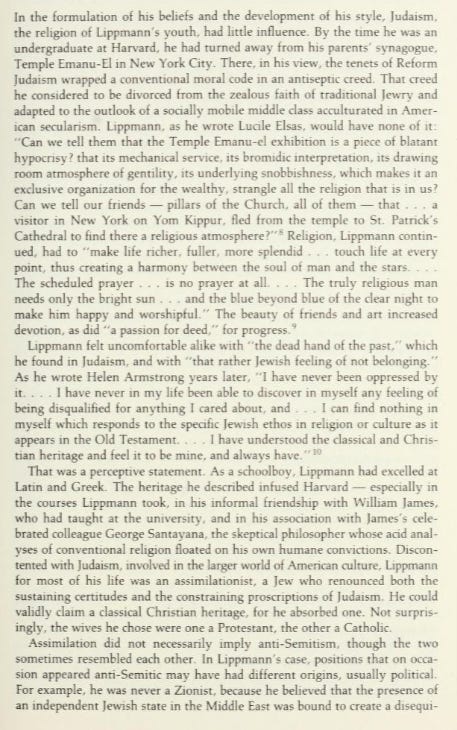
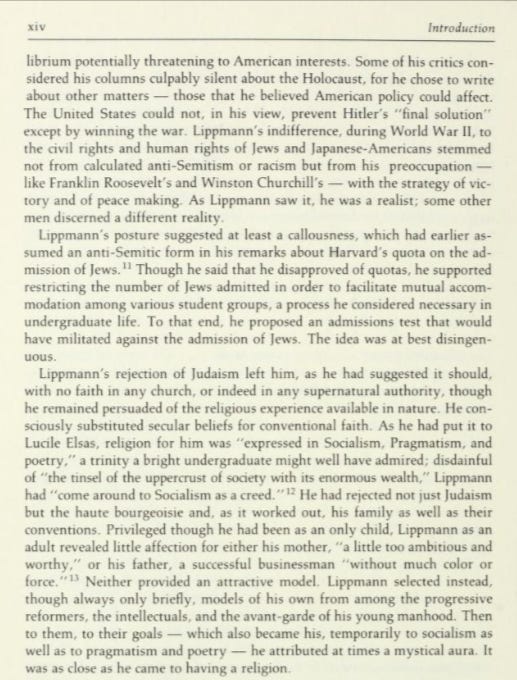
In John Morton Blum’s book Public Philosopher : The Selected Letters of Walter Lippmann presents Lippmann development on the question of Judaism, in his life and thought, sans the accusatory and shaming rhetoric of Berlin! Pages xiii to xiv

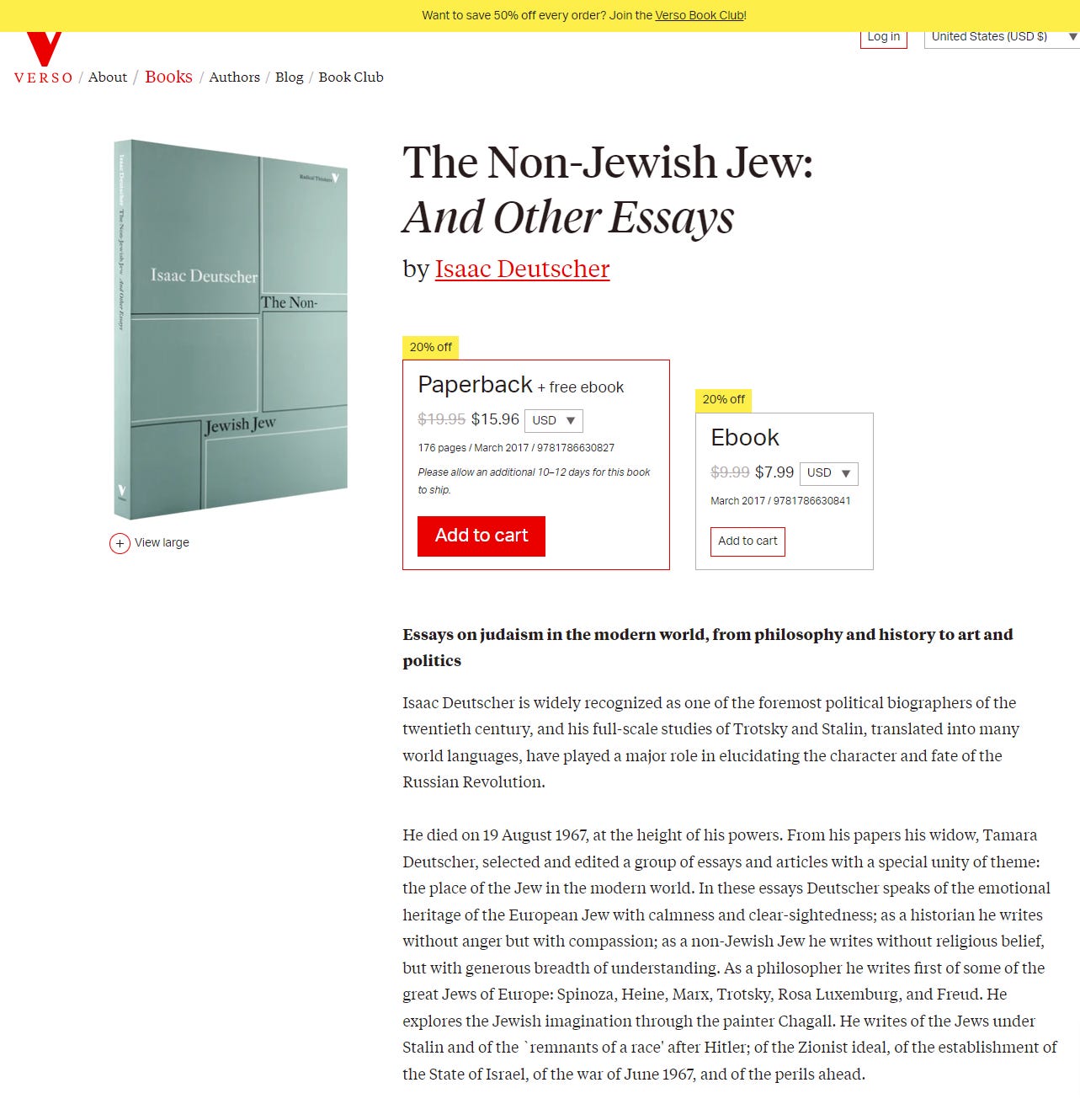
Here is a book of interest that should provide some insights into Isaac Deutscher as writer/thinker/Non-Jew:

Political Observer

Posted in Uncategorized | Leave a comment

Mendacity, Misdirection wedded to self-congratulation, is the Bret Stephens Neo-Conservative Trademark: the heritance from Leo Strauss’ attempt at a Philosophical Re-write, that metastasized!

Old Socialist comments.

Mr. Stephens first paragraph is instructive as to his self-serving ‘analysis’ of a snapshot of the bad actors in his melodrama. I will highlight these in bold font.

When historians look back on the early days of 2024, they probably won’t recall what, precisely, an elderly Democratic president couldn’t quite remember about the names or countries of other world leaders. They will note what 26 Senate Republicans chose to forget about world leadership.

On paper, the 70-to-29 vote looks like a bipartisan embrace of embattled democratic allies.

Republicans reverted to the isolationism of the original America First Committee of pre-World War II infamy.

…Oklahoma’s James Lankford. The cynicism would be breathtaking if it weren’t so predictable coming from the Trumpified right.

…Arkansas’s Cotton, there’s the argument that support for Israel’s efforts to defeat Hamas is incompatible with any civilian assistance for Gazans.

…Ron Johnson, we have the claim that although Vladimir Putin is “an evil war criminal,” Russia is certain to win the war,…

…J.D. Vance, this: “The supplemental represents an attempt by the foreign policy blob/deep state to stop President Trump from pursuing his desired policy.”

Mr Stephens inserts his diagnosis of the political opportunists:

What a mix of cruelty, defeatism, conspiracy-mongering and political servility.

Karen Sullivan offer a relevant study of the authoritarian personality that places Mr. Stephens in a larger historical and moralizing context :

The Inner Lives of Medieval Inquisitors

There have been numerous studies in recent decades of the medieval inquisitions, most emphasizing larger social and political circumstances and neglecting the role of the inquisitors themselves. In this volume, Karen Sullivan sheds much-needed light on these individuals and reveals that they had choices—both the choice of whether to play a part in the orthodox repression of heresy and, more frequently, the choice of whether to approach heretics with zeal or with charity.

In successive chapters on key figures in the Middle Ages—Bernard of Clairvaux, Dominic Guzmán, Conrad of Marburg, Peter of Verona, Bernard Gui, Bernard Délicieux, and Nicholas Eymerich—Sullivan shows that it is possible to discern each inquisitor making personal, moral choices as to what course of action he would take. All medieval clerics recognized that the church should first attempt to correct heretics through repeated admonitions and that, if these admonitions failed, it should then move toward excluding them from society. Yet more charitable clerics preferred to wait for conversion, while zealous clerics preferred not to delay too long before sending heretics to the stake. By considering not the external prosecution of heretics during the Middles Ages, but the internal motivations of the preachers and inquisitors who pursued them, as represented in their writings and in those of their peers, The Inner Lives of Medieval Inquisitors explores how it is that the most idealistic of purposes can lead to the justification of such dark ends.

https://press.uchicago.edu/ucp/books/book/chicago/I/bo10715485.html

Mr. Stephens self-presentation in this paragraph, is predictably self-congratulatory, yet The Reader confronts the political history of a Zionist without apology. Stephens engages in self-apologetics, it is his métier.

I’m surely among the most pro-Israel commentators around, but I can think of no moral or strategic argument in which hunger and disease among Gaza’s civilians serve anyone’s interests, least of all Israel’s.

It also echoes the prewar defeatism of figures like Robert Taft and Joseph Kennedy, who argued against helping Britain during the Blitz because Hitler was destined to win.

Today’s G.O.P. isolationists now have more in common with George McGovern’s “Come home, America” slogan than with anything Ronald Reagan or Dwight Eisenhower stood for.

…the Republican riposte to these failures reminds me of something the theoretical physicist Wolfgang Pauli reportedly said about a young physicist’s work: “It is not even wrong” —…

any more than a patient should put off getting a skin cancer removed until he loses 50 pounds. It is an idiotic linkage guaranteed to do harm.

In January 1945, Arthur H. Vandenberg, a Michigan Republican, gave a landmark Senate speech now remembered as the moment when his party finally began to put its reflexive isolationism behind it.

Mr. Stephens ransacks ‘History’ its ‘Bad Actors’ while Vandenberg and his arrival at an Enlightened position, while willfully forgetting George Kennan of The Long Telegram… Read the Fall 2013 of the Journal of Cold War Studies for a collection critical commentary on ‘Gaddis’s George F. Kennan: An American Life .

https://direct.mit.edu/jcws/article-abstract/15/4/233/13418/Gaddis-s-Kennan-A-Different-Kennan?redirectedFrom=fulltext

The eternally bumptious Stephens scolding of George McGovern, is just another reminder of his political posturing as a reliable New York Times Public Intellectual!

Old Socialist

Posted in Uncategorized | Leave a comment