@nytdavidbrooks celebrates the Martial Spirit, via Neo-Nazi front man Zelensky. Or the repurposing of Fourth of July picnic rhetoric!

Political Cynic comments.

Some selections from Mr. Brooks long apologetic for the Nazi Front Man Zelensky, in an almost breathless, or better yet a wan pastiche of historical style:

The cameras mostly focused on Volodymyr Zelensky during his address to Congress on Wednesday night, but I focused my attention as much as I could on the audience in the room. There was fervor, admiration, yelling and whooping. In a divided nation, we don’t often get to see the Congress rise up, virtually as one, with ovations, applause, many in blue dresses and yellow ties.

Sure, there were dissenters in the room, but they were not what mattered. Words surged into my consciousness that I haven’t considered for a while — compatriots, comrades, co-believers in a common creed.

Zelensky and his fellow Ukrainians have reminded Americans of the values and causes we used to admire in ourselves — the ardent hunger for freedom, the deep-rooted respect for equality and human dignity, the willingness to fight against brutal authoritarians who would crush the human face under the heel of their muddy boots.

Zelensky was not subtle about making this point. He said that what Ukraine is fighting for today has echoes in what so many Americans fought for over centuries. I thought of John Adams, Frederick Douglass, Theodore Roosevelt, George Marshall, Fannie Lou Hamer, the many unsung heroes of the Cold War.

This liberal ideal has been tarnished over the last six decades. Sometimes America has opposed authoritarianism with rash imprudence — the Bay of Pigs, Vietnam, Iraq.

American policy has oscillated between a hubristic interventionism and a callous non-interventionism. “We overdo our foreign crusades, and then we overdo our retrenchments, never pausing in between, where an ordinary country would try to reach a fine balance,”

Finding the balance between passionate ideals and mundane practicalities has been a persistent American problem. The movie “Lincoln” with Daniel Day-Lewis was about that. Lincoln is zigging and zagging through the swamps of reality, trying to keep his eye on true north, while some tell him he’s going too fast and others scream he’s going too slow.

For his part, Biden doesn’t fit the romantic “West Wing” fantasy that many progressives have in their heads.

The military struggle in Ukraine might turn grim in the coming months, but both men are partly responsible for a historic shift in the global struggle against brutality and authoritarianism.

I’ll skip to the last two paragraphs of Mr. Brooks’ long moralizing apologetic for Zelensky:

On his first foreign trip since the war began, Zelensky came to America. It’s a reminder that for all the talk of American decline, the world still needs American leadership. It’s a reminder that the liberal alliance is still strong. It’s a reminder that while liberal democracies blunder, they have the capacity to learn and adapt.

Finally, Zelensky reminded us that while the authoritarians of the world have shown they can amass power, there is something vital they lack: a vision of a society that preserves human dignity, which inspires people to fight and binds people to one another.

Like so many of his fellow Neo-Conservatives, Mr. Brooks has no military experience, except as an apologist for American National Security State. What Reader can forget Mr. Brook’s ‘The Collapse of the Dream Palaces’ Iraq War Propaganda with it’s hero ‘20-year-old, Joey Tabula-Rasa’ ? This was War Propaganda at it’s most dull-witted, and Mr. Brooks’ ticket to the ‘Big Time’!

Or his most recent war mongering essay of July 15, 2021 under the title: The American Identity Crisis’ The final paragraph of this essay Brooks almost bares his fangs, against what used to be named fellow travelers, like Trump, and the unnamed ‘Left’!

If we’re going to fight Trumpian authoritarianism at home, we have to fight the more venomous brands of authoritarianism that thrive around the world. That means staying on the field.

Political Observer

Posted in Uncategorized | Leave a comment

@TheEconomist,’The West’, Economic Growth, Jane Austen, Barbara Cartland & ‘A serious, slow-burning malaise’.

Political Cynic wonders…

Finance & economics | First-world problems

Headline :How the West fell out of love with economic growth

Sub-headline : A serious, slow-burning malaise

https://www.economist.com/finance-and-economics/2022/12/11/how-the-west-fell-out-of-love-with-economic-growth

This Reader has to wonder, first, at the headline, that reads as if not defined by the refined Jane Austen, one of the measures of sophisticated Oxbridridger taste, but with an exhumation of Barbara Cartland, tinctured in Neo-Liberal apologetics. And a diagnosis of the ‘West’s slow burning malaise. This marriage of literary kitsch and sobering economic doom, only encourages doubt and or provokes derision? Not forgetting that the idea/notion of ‘The West’ as a political entity dates, most recently, from the Old Cold War.

The first paragraph offers:

This year has been a good one for the West. The alliance has surprised observers with its united front against Russian aggression. As authoritarian China suffers one of its weakest periods of growth since Chairman Mao, the American economy roars along. A wave of populism across rich countries, which began in 2016 with Brexit and the election of Donald Trump, looks as if it may have crested.

A selection of highlights of the ‘Corporatist Minds’ of The Economist scribblers:

Celebration America’s Proxy War in Ukraine, weak growth in China, America’s economy roars on, A wave of populism across rich countries… looks as if it may have crested…

What follows, is screeching Neo-Liberal hysterics, featuring the threat of ‘fast-ageing populations’ which focuses on the ‘benefits’ of a Social Security, in the once enlightened Western Nation States.

Yet away from the world’s attention, rich democracies face a profound, slow-burning problem: weak economic growth. In the year before covid-19, advanced economies’ gdp grew by less than 2%. High-frequency measures suggest that rich-world productivity, the ultimate source of improved living standards, is at best stagnant and may be declining. Official forecasts suggest that by 2027 per-person gdp growth in the median rich country will be less than 1.5% a year. Some places, such as Canada and Switzerland, will see numbers closer to zero.

Perhaps rich countries are destined for weak growth. Many have fast-ageing populations. Once labour markets are opened to women, and university education democratised, important sources of growth are exhausted. Much low-hanging technological fruit, such as proper sanitation, cars and the internet, has been plucked. This growth problem is surmountable, however. Policymakers could make it easier to trade across borders, giving globalisation a boost. They could reform planning to make it possible to build, reducing outrageous housing costs. They could welcome migrants to replace retiring workers. All these reforms would raise the growth rate.

The utterly failed Neo-Liberal Project and its highfalutin ‘Globalism’, and its enlightened ‘Supply Chains’ are subject to the self-forgetting of the writers, for this publication. In thrall to the 19th Century’s Bagehot , impersonated in the political present by Adrian Wooldridge, and his hymnal to political conformity ‘The Aristocracy of Talent: How Meritocracy Made the Modern World’ offers …

The Reader has still to confront the remaining 1,297 words! What rhetorical strategy might she adopt, in the face of this self-serving rhetorical avalanche? like the intelligent gardener, a careful weeding, and/or pruning’ offers a way forward? A selection sentences from each paragraph aid The Reader in her exploration.

Unfortunately, economic growth has fallen out of fashion.

Modern politicians are less likely to extol the benefits of free markets than their predecessors, for instance.

Politicians such as Lyndon Johnson, Margaret Thatcher and Ronald Reagan offered policies based on a coherent theory of the relationship between the individual and the state.

Apathy towards growth is not merely rhetorical. Britain hints at a wider loss of zeal. In the 1970s the average budget contained tax reforms worth 2% of gdp.

Our analysis of data from the World Bank suggests that progress has slowed still further in recent years, and may even have reversed (see chart 2)

Governments have also become less friendly to new construction, whether of housing or infrastructure. Governments are spending a lot more on welfare, such as pensions and, in particular, health care.

This is likely to reflect tougher land-use policies and more powerful nimbys.

Politicians prefer splurging the proceeds of what growth exists.

Politics is increasingly an arms race, with promises of more money for health care and social protection. “Thirty or 40 years ago it was taken for granted that the elderly were not good candidates for organ transplantation, dialysis or advanced surgical procedures,” writes Daniel Callahan, an ethicist.

The above is about the drain of resources of Modern Medicine are wasted on ‘the elderly’!

People may see spending on health care and pensions as self-evidently good. But it comes with downsides.

Perfectly fit older people drop out of work to receive a pension. Funding this requires higher taxes or cuts elsewhere. Since the early 1980s government spending across the oecd on research and development, as a share of gdp, has fallen by about a third.

We have previously estimated that Uncle Sam is on the hook for liabilities worth more than six times America’s gdp.

No one cheers when a company goes bankrupt or someone falls into poverty. But the bail-out state makes economies less adaptable, ultimately constraining growth by preventing resources shifting from unproductive to productive uses.

Why has the West turned away from growth?

Yet Western populations have been ageing for decades, including during the reformist 1980s and 1990s

The above ‘ the reformist 1980s and 1990s’ i.e. the decades of the rise of The Neo-Liberal Swindle.

In 1936 Franklin Roosevelt, speaking about opponents to his New Deal, felt comfortable enough to “welcome” his opponents’ hatred. Now the aggrieved have more ways to complain. As a result, policymakers have greater incentive to limit the number of people who lose out, resulting in what Ben Ansell of Oxford University calls “countrywide decision by committee”.

FDR’s New Deal, and ‘Ben Ansell of Oxford University calls “countrywide decision by committee”… Isn’t that the very definition of the Democratic process?

The Reader has to quell her doubt, or should it be named cynicism, at the final paragraph, of this rambling exercise in bloated polemic. A ‘new direction’ is as unclear to The Economist’s committee of scribblers, as it is to The Reader.

Quite what would push the West in a new direction is unclear. There is no sign of a shift just yet, beyond the misguided attempts of Mr Trump and Ms Truss. Would another financial crisis do the job? Will a change have to wait until the baby-boomers are no longer around? Whatever the answer, until growth speeds up Western policymakers must hope their enemies continue to blunder.

Political Cynic

Posted in Uncategorized | Leave a comment

If you read this blog, and are interested, please follow my blog at Substack.

StephenKMackSD

StephenKMackSD’s Newsletter

https://stephenkmacksd.substack.com/

Thank you!

Regards to my readers

StephenKMackSD

Posted in Uncategorized | Leave a comment

Adam Tooze, with help from Hegel & Intellectual Poser Francis Fukuyama, produces a Political/Philosophical History in Aspic, with Putin as his Anti-Hero

Political Cynic scoffs!

The reader, before she attempts to read Mr. Tooze’s 3,415 word essay, might profit from reading Molly Fischer’s essay at New York Magazine.

https://nymag.com/intelligencer/article/adam-tooze-profile.html

Ms. Fischer’s essay at 5,224 words wallows in Fan Magazine gush, that informs the magazine’s readers what they should ‘think’ about Mr. Tooze, and his Fan Base! this magazine tells its readers where to eat, it keeps its readers current on the most watched television/internet programs, and its political columnists keep their readership up to date on what they should think about politics, and Madam Clairvoyant…, the latest bargains on clothes, shoes and other commodities that a New York magazine reader might need- Its a would be Silver-Fork Handbook for those who live and die by the latest trends, in the life of the New York cognoscenti, or its pretenders. The pretense of being dans la mode is the lingua franca of New York social life!

Mr. Tooze in his near historically sophisticated essay, though he can’t quite match the talent of Janan Ganesh for such rhetorical curlicues, and stylistic panache, as cover for his reactionary politicking! Mr. Tooze manages to impress with adroitly executed, not to speak of its intellectual/philosophical breath, of his particular expression of a History Made to Measure! These paragraphs demonstrates Mr. Tooze’s facility, to engage in historical pastiche of near understatement?

It was the French Revolution that defined the stakes in modern war as an existential clash between nations in arms, in which fundamental principles of rule were in question. War was the world spirit on the march. That is what the German poet Goethe thought he witnessed at the Battle of Valmy in 1792, where a rag-tag revolutionary army unexpectedly turned back a much better-equipped counter-revolutionary invasion by royalist and Prussian forces. “From this day forth,” he wrote, “begins a new era in the history of the world.” Two days later, the French Republic was declared.

A “world-soul” on horseback is what Hegel thought he saw, as Napoleon cantered through the city of Jena in October 1806 on his way to the battle that would push the Prussian state to the brink of extinction. War was not simply a violent practice of princes, a duel writ large. War was History with a capital H – the “slaughter-bench”, Hegel would call it – “at which the happiness of peoples, the wisdom of States, and the virtue of individuals have been victimised”. It was something both fascinating and horrifying. Transformative and yet also on the edge of tipping over into absolute violence, as in the horrors of guerrilla war in Spain, depicted by Goya. Two centuries later, in the commentary on the war in Ukraine, one can feel the same spirit stirring.

The spectacle of war has always evoked mixed emotions. On the one hand, enthusiasm and something akin to relief: here, finally, is real politics, real freedom. And, on the other hand, horror at the violence, suffering and destruction.

In the wake of Waterloo in 1815, both diplomacy and contemporary social science tried to put the genie back in the bottle. For all his grandeur, Napoleon had been defeated. Millions had died in the global wars sparked by the French Revolution, and his project of modernising empire had come to naught. The lesson, according to the followers of the sociologist Auguste Comte, was that the future belonged to industry, not to the soldiers.

https://www.newstatesman.com/ideas/2022/04/war-at-the-end-of-history?utm_medium=Social&utm_source=Twitter#Echobox=1649426638

Later in his essay Mr. Tooze engages in this explanation of American Seer Francis Fukuyama:

That this terrifying stand-off ended with the largely peaceful overthrow of the communist regimes in Europe in 1989 persuaded Francis Fukuyama, then a member of the policy planning staff at the US State Department, that we had reached “the End of History”. This is often described as a triumph of capitalism and democracy. It was certainly that, but no less significant was that the West had won the military contest without firing a shot in anger. The Warsaw Pact folded. By the time of Leonid Brezhnev, from the 1960s onwards, the Soviet system no longer seemed worth dying for. Mercifully, that spared Nato the question of whether the world was better off dead than red.

Anchored in American power and depoliticised neoliberalism, Fukuyama’s vision of the End of History remains a compelling interpretation of the decades since the fall of the Berlin Wall. The ideological contest seemed settled in favour of a one-dimensional vision of liberal democracy, the rule of law and markets.

The achievement of the End of History consisted in not just the triumph of the liberal model, but in that it was attained bloodlessly. That gave it both its sense of inevitability and, as Fukuyama wrote, its post-heroic quality.

Of course, the End of History did not mean the end of events or the end of war. That threat of nuclear destruction continued to hang over us. Under the de-targeting agreement of 1994, the coordinates of major cities were removed from the computers of Russian and American intercontinental ballistic missiles (ICBMs). But they could be loaded back if required. We still live under the menace of absolute atrocity. Meanwhile, actual wars have continued to be fought. But war has changed

A Strussian offers a warmed over Hegelianism, and the American Intellectual/Philosophical Provincials were instantly smitten by Fukuyama’s World Historical Merde. And what does ‘depoliticised neoliberalism’ represent but an utter lack of intellectual honesty, in service to self-promotion of Mr. Tooze – to establish his political conformity. This whole essay is awash in that imperative.

More History Made to Measure foreshortened:

The Iran-Iraq War of the 1980s was perhaps the last conflict in which two sides commanding substantial armed forces had everything at stake; any means could be mobilised to secure victory and neither side could afford to lose. The bloodiest wars in more recent decades – notably those in the former Yugoslavia, central Africa and Syria – were sprawling civil wars, often involving multiple non-state actors. In Iraq and Afghanistan the stakes were existential, but only for the locals. The US, which led the invasions, was shaken by the 9/11 attacks, but the global war on terror was always more of a policing action than a conventional war.

The Reader has arrived, after Mr. Tooze groundwork has been laid from the large canvas to the mere sketch, at Putin:

The question posed by Vladimir Putin’s invasion of Ukraine is whether in this fundamental sense the spell of the End of History has finally been broken. Has history restarted in a tragic key, as President Macron has recently put it? Have we reached the end of the end of military history?

The answer we give to that question initially depends on the interpretation of Putin’s motives.

There is yet 2,379 words left in Mr. Tooze’s polemic against Putin, still framed by ‘The End of History’, a crippled antique by a Staussian foot-soldier. The topic sentences of the remains of this essay, offer some vital clues as to the arguments Mr. Tooze marshals. Note that Mr. Tooze employs the Straussian rhetorical strategy of exhausting both the critical acuity of The Reader, and her patience!

The most obvious reading is that he has never accepted the verdict delivered by history in 1991.

But if this is his basic motivation why in 2022 was he willing to risk the ultimate trial of battle?

One argument is that Putin gambled because he is a man of war.

This embrace of war leads some analysts to describe Putin as a man of the 19th century.

These are pleasingly simple ideas.

The defining characteristic of the Russian invasion, other than its brutality, is the sense of history repeating itself as farce.

In this reading, far from rupturing the End of History, or forcing a return to primal conflict, Putin saw himself as adjusting an anomaly created by the overthrow of Ukraine’s pro-Russian Viktor Yanukovych government in 2014.

Perhaps the most telling moment came when the US secretary of state, Antony Blinken, denounced Putin’s invasion of Ukraine as a “war of choice”.

Putin’s invasion and the attack on Iraq in 2003 by the US-led coalition have in common a disregard for both international law and geopolitical logic that left much of the rest of the world aghast.

In the war in Ukraine, the wildcard is the Ukrainians.

But we should beware our Eurocentric prejudices.

What marks this war as different is that the Ukrainian resistance has stopped Putin’s invasion in its tracks.

The result is that Putin awakens from the resentful nightmare of Russia’s post-Cold War memory into a bona fide, existential crisis, a “real war” that the Russian army is far from certain of winning

Again, the experience of defeat and discredit on the part of the larger power is not itself novel.

To escape the nightmare, Putin may choose to escalate the invasion, even toying with the nuclear option

Putin may have challenged the post-Cold War order but, given the liminal status of Ukraine – neither a member of the EU nor of Nato – and the underwhelming performance of the Russian military, which makes an attack on the Baltics or Poland seem unlikely, it is up to others, principally China and the Western alliance, to decide what to make of this clash.

Ukraine, of course, has every interest in using the momentum of its early successes to widen the conflict.

Clearly, if it so chose, Nato could turn this war into World War Three.

Putin’s allegation that Ukraine was being developed as a base from which to strike at the soft underbelly of Russia seems less plausible now than it did before the war.

Although Joe Biden has blurted out his indignation that bad characters like Putin are in charge of modern states, the West remains shy about embracing regime change as its ultimate goal

As critics of the interwar order like Carl Schmitt sensed, the hegemony of the victorious powers in 1918 threatened the first End of History.

In 2022, if Putin were to be brought down by military frustration and economic exhaustion, and were his regime to be replaced by one that was pro-Western and ready for peace, all those who have levelled cheap criticism at Fukuyama over the years would owe him a giant apology

However, if the war does not escalate to a Third World War and Putin’s regime does not collapse, there will be no option but to face the difficult business of diplomacy and peace-making

Mr. Tooze demonstrates that he is a political/moral conformist, he is not John Mearsheimer, but another of a long line of apologist for the murderous political interventionism, of the Centrism of the political present: the alliance between the Neo-Liberals and the Neo-Conservatives!

***************************

Not to the reader:

On question of Hegel, let me offer my experience of trying to read The Phenomenology of the Spirit: I was stopped at entry 243, as I recall it in utter bewilderment, and then read Hegel’s Idea of a Phenomenology of Spirit by Michael N. Forster. It took me months to read this book, impressive doesn’t quite cover the scope of Prof. Forster scholarship.

Political Cynic
Posted in Uncategorized | Leave a comment

Sanctions and the fate of Globalism/Neo-Liberalism.

Political Observer’s sketch.

Its as if the concepts/practices/institutionalized twins of Globalism/Neo-Liberalism, will now be partially dismantled, in the name of Anti-Russian Hysteria: favored @TheEconmist, @FT, @bopinion , @NYT, & other Corporate apologists like @gideonrachman, @martinwolf_ ? The very fate of that Post War bulwark, against Soviet revanchism, the ‘Common Market’ , a coal and steel cartel, and its Technocrat Supreme Jean Monnet, that ‘evolved’ into the teetering E.U., might be sacrificed on the pyre of Sanctions?

Even the facts that Europe is still dependent on Russian gas, or that the ruble is strong, doesn’t factor into the policy decisions, of the Neo-Cons advisors of Biden: Antony Blinken, Wendy Sherman, Victoria Nuland, Jake Sullivan? Or that Biden’s own utterly obvious ‘cognitive deficit’, to speak in the patois of bourgeoise political commentary- or the fact that the New Democrat’s redoubtable hawk, Senator Diane Feinstein, whose own ‘cognitive deficit’ has become a topic of discussion…

Political Observer

Posted in Uncategorized | Leave a comment

The tireless self-promoter Mr. Fukuyama! A comment by Political Observer.

Mr. Fukuyama was never a ‘Conservative’, as announced in the link to this interview, but a Staussian i.e. a Neo-Conservative, and a maladroit plagiarist of Hegel. He , in his 2013 essay ‘The Decline of American Political Institutions’ attacks the meliorism of the whole of the American Politics of the 20th Century ! This was not ‘Conservatism’ using the most capacious practice of an attempt at measurement.

The Decay of American Political Institutions

His career as Political Seer is built upon ‘Straussian Principals’ the misbegotten child of Leo Strauss’ attempt to rewrite the History of Philosophy. Strauss held the key to the divination of that Tradition, all else were mere pretenders. Mr. Fukuyama is still trading on that Staussian Revelation.

Political Observer

Posted in Uncategorized | Leave a comment

Myra Breckenridge on ‘The Oscars’.

Are ‘The Oscars’ just an antique, signifying the utter irrelevance of ‘Hollywood’? And its parade of aging actors, and their Leading Ladies, who all look like bad advertisements for Restylane and Botox ? Are Bradley Cooper and Lady Gaga, in that tired exhumation of ‘A Star is Born’, representative of the predictable future of ‘Hollywood’ in the 21st Century? ‘Remake’ followed by ‘Remake’, is now the operative strategy of The Industry, to insure the profitability of ‘The Dream Factory’? Recall the halcyon year of ‘Hannah and Her Sisters’ and the S & M kitsch of ‘Blue Velvet’ ?

The alternative to this is the low brow Universe, of the Marvel World of Stan Lee, awash in 1930’s & 1940’s concepts of the Super Hero, awash in a caricature of Masculinity , celebrated in tight Lycra, bulging pecs and well stuffed crotches!

Or should The Reader turn her attention to the latest of Movies about Movies, a venerable Hollywood tradition: ‘A Star is Born’ , The Bad and The Beautiful’, ‘The Goddess’ ‘Two Weeks in Another Town’, Feud: Betty and Joan & the latest entry into this genre ‘The Offer’, running on the internet by Paramount? The ultimate Hollywood Egoist Bob Evans, as one of the featured player/stars of this Hollywood Epic. Read Robert Evans’ ‘The Kid Stay in the Picture’, till you want to vomit, at his unslakable egotism, floating on his ‘charm’! This book was once the ‘talk of Hollywood’ in its audio book form, in his own seductive voice. The apotheosis of ‘Public Relations’! Bob even ‘produced’ a one hour an thirty three minute Movie Version.

Here is Hollywood sycophant Graydon Carter, in his ‘retirement’ from Vanity Fair, who publishes Dana Brown’s nostalgia for Oscar Parties Past, Mr. Brown is a low rent Saint-Simon, who reports on Hollywood’s would be decadence? The first paragraph of Mr. Brown’s report reeks of the hipster invited into the ‘inner circles’ decadence.

So I’m smoking a joint with Seth Rogen and Danny McBride. This might sound like the setup to a joke, and it would probably be a good one, but this is what the Oscar party was like. At least for me.

Are Seth Rogan and Danny McBride ‘A Listers’, to speak in the patois of the long forgotten Joyce Haber?

Your truly,

Myra Breckenridge

Posted in Uncategorized | Leave a comment

The Economist offers a ‘diagnosis of Putin’, relying on selective quotations from seven books.

Political Observer comments.

Understanding Russia’s president:

Headline: Writers have grappled with Vladimir Putin for two decades

Sub-headline: Greyness, greed and grievance have been the dominant themes

https://www.economist.com/culture/writers-have-grappled-with-vladimir-putin-for-two-decades/21808311 

First considered, under the rubric of ‘Culture’, as the largest frame for this Ant-Putin polemic! Followed by Understanding Russia’s president: This is a political essay framed as an ersatz psychological analysis, that evolves into …

Not since the publication of ‘Thomas Woodrow Wilson, Twenty-eighth President of the United States. A Psychological Study.’ by William C. Bullitt and Sigmund Freud’s, has there been such a penetrating psychological analysis of a political leader?

The first paragraph of this ‘essay’ sets the stage:

HE WARNED US. Vladimir Putin gave notice of who he was, and what he was capable of, in “First Person”, a transcript of interviews published in 2000, at the start of his overlong rule. In his youth, he recalled, he had been a tough little hoodlum who fought rats in the stairwell of his communal-apartment building and, later, brawled with strangers on the streets of Leningrad. “A dog senses when somebody is afraid of it,” he had learned, “and bites”. He prized loyalty and feared betrayal. He was hypersensitive to slights, to both his country and himself (concepts which, in the decades that followed, became perilously blurred). He bore grudges. 

Followed by more ‘History Made to Measure’ , that buttresses the first paragraph: or should it be named self-serving political melodrama ?

One of them was over the collapse of the Soviet Union. In the interviews he reminisced about a jaunt to Abkhazia and a judo tournament in Moldova: the Soviet empire had been his wealth and pride, and when it fell, he took it hard. “I wanted something different to rise in its place,” he said of the lost Soviet influence in eastern Europe. Frantically burning papers as a KGB officer in Dresden in 1989, grieving the “paralysis of power” that seemed to have afflicted Moscow, he came to associate protesting crowds with disintegration. Corruption, meanwhile, was only to be expected in Russia, he implied—“and if somebody thinks that somebody stole something, let him go and prove it”. 

That ‘History Made to Measure’ is set aside for Richard Sakwa’s “Putin: Russia’s Choice” (2004) ‘thought the country had shaken off nationalism and imperialism’ and Andrew Jack’s “Inside Putin’s Russia” (2004) ‘noting Mr Putin’s democratic backsliding and disregard for human rights’ that appear as ballast .

Under the rubric of Darkness and the don:

David Satter’s “Darkness at Dawn” provides essential political melodrama: ‘was among the first Anglophone analysts to gauge the evil in the system.’ . Next in order of appearance is Masha Gessen’s “The Man Without a Face” (2012) that presents Putin ‘as a killer and extortionist.’ Then Catherine Belton’s “Putin’s People” (2020).and its “KGB capitalism”. Followed by Steven Lee Myers’ “The New Tsar” (2015) that points to ‘the Orange revolution in Ukraine in 2004’ as the trigger to Putin. Mr. Lee Myers offers more for the writer, and The Reader of this essay, in this:

By 2014, thought Mr Lee Myers, he had found a “millenarian” mission as the indispensable leader of an exceptional power. “The question now was where would Putin’s policy stop?”

The Economist writer/stenographer continues to mine the political commentary of the policy technocrats: “Mr Putin: Operative in the Kremlin” (2015), by Clifford Gaddy and Fiona Hill offer, or is the Economist writer embroidering upon themes?

His bid to undermine Western democracies through fifth columnists, bribery and kompromat was part of the same strategy.

Its almost ‘as if’ The Reader is forced to recall that The New Cold War, and its precursor, operated upon the notion of ‘fifth columnists’ as the enemy within. Without the proper loyalty to what? The American National Security State crimes and its Propaganda Offensives against dissidents?

Mr Gaddy and Ms. Hill—who became the top Russia adviser in Donald Trump’s National Security Council—concluded that he was more than an avaricious gangster. His objective was to survive and overcome his foes, who, in his view, were Russia’s enemies too; to that end he was waging a long, hybrid war against the West. He would pounce on weaknesses, the pair warned, and fulfil his threats. “He won’t give up, and he will fight dirty.” Yet even these authors judged that, if only for reasons of trade, Mr Putin “does not want Russia to end up being a pariah state”. 

The Reader might recall that Fiona Hill was one of the primary ‘witnesses’ at the ‘Trump Impeachment’ comedy: she became an overnight sensation. Along with Alexander Vindman, that cemented the relations between the Neo-Liberals and the Neo-Conservatives, as the defining moment of ‘Political Centrism’ re-defined, in the wake of Trump. That she was an advisor to Trump, casts a revelatory light on her ‘testimony’ !

The one place in this essay, that carries weight, is this writers comments on émigré writer Vladimir Sorokin. This kind of writer is a Russian Tradition, from the time of Alexander Herzen. Yet Mr. Sorokin is a Post-Modern writer, sure to raise the hackles of the very Conservative readers of The Economist? But more importantly Mr. Sorokin serves a propaganda purpose.

Russian novelist and playwright considered to be one of the most influential figures in postmodern Russian literature. Sorokin was known particularly for his vivid experimental, and often controversial, works that parody the Socialist Realism of the Soviet Union.

https://www.britannica.com/biography/Vladimir-Sorokin

Mr. Sorokin was successor to Alexander Zinoviev’s ‘Yawing Heights’ and ‘The Radiant Future’ . The last two paragraphs of this Anti-Putin polemic deserve to be quoted in full:

The book that most clearly saw where Putinism was heading was not a history or biography but a novel. “Day of the Oprichnik” by Vladimir Sorokin, a Russian author living in exile, is set in 2028. The Russia it depicts seems to exist in two time-frames at once, futuristic technology jostling with medieval barbarity and obscurantism. The country is walled off from Europe and the tsar has been restored. His word is law, but even he must “bow and cringe before China”, which (along with gas exports) props up the economy. The oprichnik of the title is one of his elite henchmen—the name comes from an order of pitiless enforcers under Ivan the Terrible. Their methods are murder and torture, their sidelines extortion and theft.

Published in 2006, Mr Sorokin’s satirical dystopia has come to seem more prescient than outlandish. The details are grotesque, but also, sometimes, horribly familiar. In the story, when the wall was built “opponents began to crawl out of the cracks like noxious centipedes”—imagery that anticipates Mr Putin’s dehumanisation of his critics as gnats. Chillingly, when the oprichniks gather for a debauch, one of their toasts is “Hail the Purge!”

Political Observer

Posted in Uncategorized | Leave a comment

The New York Times as propagandist for The American National Security State: Ukraine!

Political Reporter comments.

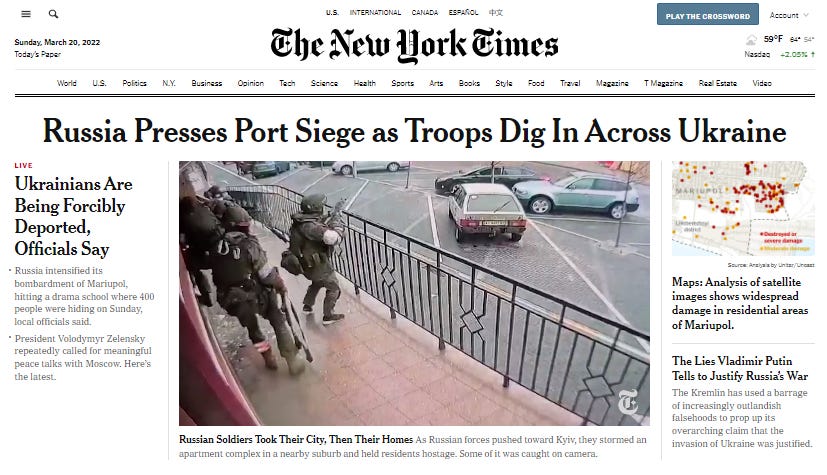
The Front page of March 20, 2022 proves that @NYT is part of The American National Security Propaganda apparatus. The Barbarism Of Putin’s War on Ukraine, as reported in the New York Times. Here is ‘its’ self-apologetic in 2004 for the War in Iraq coverage, ‘not as rigorous as it should have been’ but still wallowing in self-congratulation!

Over the last year this newspaper has shone the bright light of hindsight on decisions that led the United States into Iraq. We have examined the failings of American and allied intelligence, especially on the issue of Iraq’s weapons and possible Iraqi connections to international terrorists. We have studied the allegations of official gullibility and hype. It is past time we turned the same light on ourselves.

In doing so — reviewing hundreds of articles written during the prelude to war and into the early stages of the occupation — we found an enormous amount of journalism that we are proud of. In most cases, what we reported was an accurate reflection of the state of our knowledge at the time, much of it painstakingly extracted from intelligence agencies that were themselves dependent on sketchy information. And where those articles included incomplete information or pointed in a wrong direction, they were later overtaken by more and stronger information. That is how news coverage normally unfolds.

But we have found a number of instances of coverage that was not as rigorous as it should have been. In some cases, information that was controversial then, and seems questionable now, was insufficiently qualified or allowed to stand unchallenged. Looking back, we wish we had been more aggressive in re-examining the claims as new evidence emerged — or failed to emerge.

The ‘reporter’ Judy Miller :

Headline: Judith Miller Carried Water for the USA’s Worst Debacle Since Vietnam

Sub-headline: A publicity blitz aimed at reputation rehabilitation revives a telling personal memory for one journalist

But in the last few days, Miller has published a piece in the Wall Street Journal, “The Iraq War and Stubborn Myths, “ and The New York Times has reviewed her just-published book, The Story: A Reporter’s Journey, and I find myself thinking again about the 4,400 American dead, the hundreds of thousands of dead Iraqis, the untold wounded and maimed, the waste of $4 trillion, the connection between the shattering of Iraq and the rise of ISIS, and not least, the fact that no one involved in the greatest American disaster since Vietnam has been held remotely accountable. So when I read Judith Miller saying, yet again, that a journalist is only as good as her sources, I found my blood pressure redlining.

Judith Miller Carried Water for the USA’s Worst Debacle Since Vietnam

Manufactured Political Amnesia is the imperative of the Corporate Press!

Political Reporter

Posted in Uncategorized | Leave a comment

Johnathan Miller on his ‘Jewishness’.

Political Observer comments.

Here is Jonathan Miller, interviewed by Dick Cavett , articulating a moral/political/personal opinion on his ‘Jewishness’, that might just cause The Bespoke Suited Victimologists like @Freedland, @Baddiel, @AnthonyJulius6 to screeching polemics!

The Problem is that all of these writers, even Julius who authored the most trenchant polemic/ critique of T.S. Eliot ever written, seem to represent a class of highly successful men, who don’t seem to have suffered the effects of the Anti-Semitism they inveigh against.

Political Observer

Posted in Uncategorized | Leave a comment