Read first these paragraphs of Ari Shavit essay/book review @TLS : these paragraphs, are immediately bathed in hyperbole : Now this singular actor in a Shakespearean tragedy of his own making … This essay/book review is an apologetic of a particular kind. I’ll place in bold font the final sentences of the quoted paragraphs of this excerpt.
Benjamin Netanyahu is a unique international phenomenon. When he first strode on to the world stage, in 1984, as Israel’s ambassador to the United Nations, Ronald Reagan was the president of the United States, Margaret Thatcher was the prime minister of the United Kingdom and Freddie Mercury had yet to sing “Bohemian Rhapsody” at Live Aid. When he was first elected prime minister, in 1996, Bill Clinton was in the Oval Office, John Major in 10 Downing Street and Helmut Kohl in the Bundestag. But, decades after his illustrious counterparts have become historical figures, Netanyahu is not only alive and kicking politically, but intent on stirring up new storms. Following his election victory on November 1, he was sworn in as prime minister on December 29 for an unprecedented sixth term.
Netanyahu is also a unique Israeli phenomenon. The time he has spent in the prime minister’s office in Jerusalem – more than fifteen years – far outstrips that enjoyed by Yitzhak Rabin (six years), Menachem Begin (six) or Golda Meir (five), let alone Shimon Peres (three) or Ehud Barak (two). This tireless “wizard” (Netanyahu’s political nickname) has even surpassed David Ben-Gurion (thirteen) to become Israel’s longest-serving leader.
On the human level Netanyahu is similarly unusual. One of his close associates once told me that he has never met a more impressive – and flawed – individual. The capabilities of this seventy-three-year-old statesman are striking: he is a man of piercing insight and formidable historical and economic expertise, who has form for identifying profound sociopolitical trends before they fully emerge. He is also notable for his narcissism, suspiciousness, deep-seated pessimism and distinct lack of emotional generosity.
Now this singular actor in a Shakespearean tragedy of his own making has published an autobiography: Bibi: My story. He wrote it, as I understand, because he feared his imminent political demise, devoting nine of his recent eighteen months in parliamentary opposition to writing this 654-page account of his life’s war, his life as war. Netanyahu wrote quickly, in long-hand – and English. His text is trenchant, eloquent, barbed and fat-free. The statesman who admires Ernest Hemingway almost as much as he does Niccolò Machiavelli tries to stick to the facts and build a narrative his detractors cannot refute. Yet he is ultimately less interested in his readers than in the only deity in which he truly believes: the god of history. Netanyahu’s autobiography is the ultimate defence statement, presented to the high court of human chronicles
Compare the above with the first paragraphs of Tom Friedman New York Times essay of January 17, 2023:
If I could get a memo onto President Biden’s desk about the new Israeli government, I know exactly how it would start:
Dear Mr. President, I don’t know if you are interested in Jewish history, but Jewish history is certainly interested in you today. Israel is on the verge of a historic transformation — from a full-fledged democracy to something less, and from a stabilizing force in the region to a destabilizing one. You may be the only one able to stop Prime Minister Benjamin Netanyahu and his extremist coalition from turning Israel into an illiberal bastion of zealotry.
I’d also tell Biden that I fear that Israel is approaching some serious internal civil strife. Civil conflicts are rarely about one policy. They tend to be about power. For years, the fierce debates in Israel about the Oslo Accords were about policy. But today, this simmering clash is about power — who can tell whom how to live in a highly diverse society.
The short story: An ultranationalist, ultra-Orthodox government, formed after the Netanyahu camp won election by the tiniest sliver of votes (roughly 30,000 out of some 4.7 million), is driving a power grab that the other half of voters view not only as corrupt but also as threatening their own civil rights. That’s why a 5,000-person anti-government demonstration grew to 80,000 over the weekend.
The Israel Joe Biden knew is vanishing and a new Israel is emerging. Many ministers in this government are hostile to American values, and nearly all are hostile to the Democratic Party. Netanyahu and his minister of strategic affairs, Ron Dermer, had plotted with Republicans to engineer Netanyahu’s 2015 speech in Congress against Biden’s and President Barack Obama’s wishes and policies. They would like to see a Republican in the White House and prefer the support of evangelical Christians over liberal Jews and that of M.B.S. over A.O.C.
This essay is Mr. Friedman’s second attempt, to come to terms with Zionists Fascism, at, 1,454 words, the first attempt, 4 thousand words plus, I addressed only partially in this commentary
The imaginary Memos are the essential part of Mr. Friedman’s political intervention, I will quote these:
Framed by: ‘Biden needs to tell him, (Netanyahu) in no uncertain terms:’
Bibi, you are riding roughshod over American interests and values. I need to know some things from you right now — and you need to know some things from me. I need to know: Is Israel’s control of the West Bank a matter of temporary occupation or of an emerging annexation, as members of your coalition advocate? Because I will not be a patsy for that. I need to know if you really are going to put your courts under your political authority in a way that makes Israel more like Turkey and Hungary, because I will not be a patsy for that. I need to know if your extremist ministers will change the status quo on the Temple Mount. Because that could destabilize Jordan, the Palestinian Authority and the Abraham Accords — which would really damage U.S. interests. I will not be a patsy for that.
Framed by ‘Here is my guess of how Netanyahu would respond’, (to Biden)
Joe, Joey, my old friend, don’t press me on this stuff now. I am the only one restraining these crazies. You and I, Joe, we can make history together. Let’s join our forces not to simply deter Iran’s nuclear capabilities, but to help — in any way possible — the Iranian protesters trying to topple the clerical regime in Tehran. And let’s, you and me, forge a peace agreement between Israel and Saudi Arabia. M.B.S. is ready if I can persuade you to give Saudi Arabia security guarantees and advanced weapons. Let’s do that and then I’ll dump these crazies.
With this, to call the whole of this exercise in ‘historical speculation’ of the most dull-witted kind, is to describe Mr. Friedman’s career as a New York Times Public Intellectual. The last two paragraphs are indicative of his intellectual procedures , sometimes named Journalism.
I applaud both foreign policy goals, but I would not pay for them with a U.S. blind eye to Netanyahu’s judicial putsch. If we do that, we’ll sow the wind and reap the whirlwind.
Israel and the U.S. are friends. But today, one party in this friendship — Israel — is changing its fundamental character. President Biden, in the most caring but clear way possible, needs to declare that these changes violate America’s interests and values and that we are not going to be Netanyahu’s useful idiots and just sit in silence.
The vexing question remains of whereAri Shavit ends his ‘book review’.
What is missing from Bibi: My life story is empathy and introspection. The man who has experienced and accomplished so much is apparently ill equipped to share any genuinely sincere feelings with his readers. His memoir is light on self- criticism – and heavy on self-adulation. Two noteworthy exceptions are the endless admiration he shows for his father and the abiding love he shows for his older brother, Yonatan. The description of Yoni’s death (in his role as commander of the hostage rescue operation in Entebbe in July 1976) and the anguish that followed are heartbreaking. The young Bibi travelled seven hours from Cambridge, Massachusetts to his parents’ home in Ithaca, New York, to tell them their eldest child was gone.
As I got closer, I saw my father through the big front window. He was pacing back and forth, deep in thought, his hands clasped behind his back. Suddenly he turned and saw me. Bibi, he smiled in surprise, but when he saw my face, he instantly understood. He let out a terrible cry like a wounded animal. I heard my mother scream. If there is a moment in my life worse than hearing about Yoni’s death, it was telling my parents about it. I felt like a man on a rack whose limbs are torn from him one by one. How could I go on living?
A profound sense of mission helped Benjamin Netanyahu to overcome the tragedy underpinning the leader he has become – amplified by his belief that he is Israel’s Winston Churchill. The sure-to-be turbulent years of his latest tenure as prime minister will d.termine if his talents will indeed secure the future of his nation, or whether his flaws will endanger the very existence of the Jewish state.
Call this by its name, a mild critique in the name of The Zionist Project, as the historical/moral sine qua non. Ari Shavit and Benjamin Netanyahu share the same ‘tragic sense of mission’. As the Palestinians are subject to the ‘Zionist’s Genocide On The Installment Plan’ , recorded every day on twitter, as it happens.
Note the headline, sub-headline and the first paragraph of this self-congratulatory polemic, masquerading as political commentary, its tone, almost catty!
Headline: The great mystery of American politics
Sub-headline: Why is the country divided so evenly? What might change that?
Titillated if not surprised, America’s political obsessives saw some justice in Kevin McCarthy’s struggle to amass enough support to become speaker of the House of Representatives. Mr McCarthy has evaded the encumbrance of principle for so long that, to at least some politicians, it seemed fitting that conservatives would torture him by withholding a few votes, all but making faces while dangling the job just beyond his reach.
This paragraph highlights the fact that The Economist, not just inhabits respectable bourgeoise politics of The Right, but can recite its clichés with facility.
With the exception of three previous, brief periods of national fickleness, one party or the other held clear majority control throughout American history. The present partisan equilibrium has lasted 40 years, since Ronald Reagan broke the Democrats’ New Deal coalition. No president since his predecessor, Jimmy Carter, has kept unified control of Congress past a midterm.
The sentence I’ve highlighted ‘The present partisan equilibrium has lasted 40 years, since Ronald Reagan broke the Democrats’ New Deal coalition.’ Ronald Reagan did not break the New Deal Coalition, The New Democrats, Bill and Hillary Clinton were the betrayers of that New Deal Tradition, they were, in sum, Reaganites. The evidence is irrefutable:
The Oxbridgers present a Political Technocrat the describe the American political landscape:
…
“There’s nothing like our current era as you look back through us history,” says Frances Lee of Princeton University, who studies Congress. “I’m mystified fundamentally by it, to be honest. How do we have all these constituencies that are safe for one party or the other, yet somehow it adds up to 50-50 nationally?”
…
The Writers of this essay then resort to the patois of popular journalistic reductionism, for want of a more accurate term:
In this century Democrats lost ground in the countryside and gained it in the cities, Republicans squandered support in the Silent Generation and acquired it among Millennials, Democrats alienated white voters without college degrees and Republicans alienated white voters with them—and that all netted out, roughly, to parity.
…
It is hard to overstate how the Reagan revolution transformed politics.
…
Reagan took not just the White House but broke Democrats’ grip on the Senate for the first time since 1954, making Republicans believe they could win the House.
…
Maybe four decades of sharper “messaging” have split the electorate.
…
Now, as the Republican House squares off with Mr Biden within the arena of the 2024 campaign, its official agenda seems ill-suited to supply the black-or-white contrast that might break the impasse.
…
All bets are off, however, if the Republican berserker caucus that tormented Mr McCarthy succeeds in commandeering the party.
The White Racist Reagan, of I believe in States Rights, dominates the ‘political imaginations’ of these Oxbridgers. Yet we live in the utter collapse, of his vulgar faith in The Market- that seems to grow in its acuteness, by the day. The Reader must look elsewhere for something resembling political honesty. The Economist writes Political Propaganda!
This is a Times publication, steeped in a tradition of Anti-Left hysteria, so the notion of a radical programme is unsurprising, given the smears printed in the Times Newspaper, against Jeremy Corbyn, the dependable Times hack Dominic Sandbrook reviews a ‘biography’ of Corbyn.
Headline: Review: Dangerous Hero: Corbyn’s Ruthless Plot for Power by Tom Bower — portrait of a monomaniac
Sub-headline: If Jeremy Corbyn became prime minister, he would easily be the most dangerous, most indolent and least intelligent holder of the office in history
This is one of the most depressing books I have ever read. It is a forensically detailed portrait of a man with no inner life, a monomaniac suffused with an overwhelming sense of his own righteousness, a private schoolboy who failed one A-level and got two Es in the others, a polytechnic dropout whose first wife never knew him to read a book.
It is the story of a man who does not appear to have gone to the cinema or listened to music, takes no interest in art or fashion and refused to visit Vienna’s magnificent Schönbrunn Palace because it was “royal”. It tells how he bitterly opposed the Anglo-Irish Agreement, deeply regretted the fall of the Berlin Wall and praised the men who attacked New York on September 11, 2001, for showing an “enormous amount of skill”. In some parallel universe, this man would currently be living in well-deserved obscurity. In reality, Jeremy Corbyn is the leader of Her Majesty’s opposition and the bookmakers’ favourite to become our next prime minister.
For the veteran biographer Tom Bower, whose previous subjects include Mohamed al-Fayed, Richard Branson, Simon Cowell, Tony Blair and Prince Charles, Corbyn is the easiest target imaginable. The details of his life are well known. Born in 1949, the son of a skilled engineer and a maths teacher, he was brought up in a large 17th-century farmhouse in Shropshire called Yew Tree Manor. At school he was a loner and an underachiever, so lazy that his headmaster told him: “You’ll never make anything of your life.”
Mr. Clark is a Contributing Editor at Prospect magazine, its self-description:
Since its outset, Prospect has been politically independent, with no party-political affiliation or agenda. It is a not-for-profit organisation, supported by a trust as well as by advertisers and subscribers.
Its current editor is Alan Rusbridger :
For most of my working life I have been a journalist – mainly on the Guardian, which I edited for 20 years from 1995-2015. I was Principal of Lady Margaret Hall in Oxford for six years. Now I’m back editing again – Prospect Magazine, the UK’s leading political monthly.
Call Mr. Clark and Mr. Rusbridger ‘Liberals’ for want of a better term.
The ‘as if’ of Mr. Clark’s essay composed , eventually, of books mentioned, and some reviewed, after a long introductory political reportage: within very carefully observed political parameters. That, a marriage of opportunism and journalistic survival mechanism. Reminiscent of cobbled together clichés, from a reporters notebook, some garnished , some just quoted from that rough draft. This opening fragment is beyond cliché: All politics is relative…
All politics is relative, which is why, when I arrived at the Labour Party conference in Liverpool back in September, I found the mood comparatively harmonious. Four days earlier the then prime minister, Liz Truss, had blown up the Tories’ reputation by putting large handouts to the rich on the never-never. The markets took fright, mortgage rates spiked and – very suddenly – the sort of single-digit lead that Labour has often mislaid between the midterm and polling day was blossoming into a twenty- or even thirty-point advantage, presaging a sea change.
The factional vitriol that usually pulses through conference was hard to find. Ambitious young suits at a marketopian think tank’s event were not laying into militants, but asking detailed questions about tech entrepreneurship. At a Morning Star rally there was some grumbling, but the self-declared “lifelong socialist” MP Bell Ribeiro-Addy caught the mood with her plea: “Rule 1: stay in Labour”.
That afternoon the Labour leader, Sir Keir Starmer, hitherto little loved by his party’s right and loathed by a left whom he had courted on his ascent, only to abandon at the top, produced a unifying speech. It included some eulogizing for the late Queen, some recycling of Tony Blair (describing Labour as “the political wing of the British people”), but also – at last – a few distinct, and distinctly progressive, policies, including the idea of a new nationalized green power firm, “Great British Energy”.
The latest trove of books on Labour’s irreconcilable schisms, pumped out over the summer and autumn, seemed almost to have been overtaken. But as I was quietly departing, almost ready to believe that peace had broken out, there came a reminder of the strife seared into the party’s past – which still looms over its future. To the tune of “She’ll Be Coming ’Round the Mountain”, two dozen local dockers were serenading comers and goers with “If you don’t stand with the pickets, you’re a scab”. Their burly shop steward was bellowing through his megaphone, all too plausibly given the economic scene: “We’re striking to put food on our families’ table”. He mellowed when I approached to ask what political reaction they’d had at the docks: “We’ve had fourteen MPs down there, the socialist MPs are coming down, John McDonnell, Jeremy Corbyn and a few others. It’s just the frontbench that aren’t coming”.
…
Mr. Clark acts not like the American Theodore H. White, and his long career of following American presidential elections. At least to the Year of 1972, when Watergate revelations, demanded a re-write of his published book, on that election, he did so. Mr. Clark needn’t bother with what might be named an act of political integrity, in another context, and or maintenance on his reliability as a ‘reporter’ ? That seems unlikely since he is writing for The Times, one of the conspirators against Corbyn.
What might The Reader make of this ?
Headline: Al Jazeera’s Labour Files has blown a hole in the British media’s Corbyn narrative
Sub-headline: Shocking allegations in the documentary series have been largely ignored by the mainstream UK media
In the years leading up to the 2019 general election, the British media ran a powerful and unremitting campaign that questioned the fitness for office and motivation of Jeremy Corbyn. The most damaging claim was that he turned a blind eye or tolerated antisemitism inside the Labour Party.
This narrative often dominated front pages for days on end, and occasionally led coverage on the BBC and other news channels. There is little doubt that these charges inflicted real and lasting damage on the Labour leader, and played an important role in his crushing defeat in the last general election.
Over the past week, the Qatar-based media network Al Jazeera has challenged conventional wisdom about the Corbyn years by broadcasting a three-part documentary series alleging that many of the claims made against Corbyn’s Labour Party were either false, fabricated or twisted against him. At the same time, it vindicates those around Corbyn against claims that they were lax in dealing with antisemitism.
Surprisingly, the mainstream media has scarcely reported on the series at all. When I checked on Tuesday night, I found only a handful of articles, mostly in regional media. The papers that banged on day after day, and month after month, on allegations that Corbyn was a racist have all but ignored the Al Jazeera reports. The same applies to the BBC, which played a major role in framing the understanding of Corbyn and antisemitism in the run-up to the 2019 election.
The BBC Panorama report of July that year played a particularly important role, because it provided what appeared to be shocking evidence that people close to Corbyn intervened in the disciplinary process. Those watching the Panorama programme, after the newspaper reporting that preceded it, might have concluded that it was not just reckless, but actually immoral to vote Labour in the general election.
Al Jazeera also alleges that Panorama reflected only one side of the divided Jewish community, failing to speak with supporters of the pro-Corbyn Jewish Voice for Labour group.
The second episode of the Al Jazeera series examines that Panorama programme in detail. It alleges that in its reporting of allegations made by various former Labour Party staffers, Panorama, the BBC’s premier investigative current affairs programme misrepresented certain facts and made claims that cannot be substantiated.
…
Mr. Clarks bloated 3,506 word propaganda never mentions the revelations of the Al Jazeera documentaries, like the good hireling, who follows the script, that is not just flawed. Yet the question for the critic of Mr. Clarke’s propaganda, that combines the journalists note book sketches, his careful revisions of that raw material. A collection of comments on books, succeeded by partial reviews of books by Labour Party Members, and other political actors: demands both lengthy quotation of Mr. Clarks observations, wedded to a critical evaluation.
Let me bein with this representative paragraph, that demonstrates Mr. Clark’s ‘methodology’:
The Labour right is allergic to the very idea of a “neoliberal age” building from the late 1970s until the financial unravelling of 2008, because it lumps together the Thatcher and Blair years into a single chapter of history. Yet, however inconvenient it may be, that is the way the recent past is coming to be understood – across the intellectual spectrum. In the past year alone we have had the Cambridge professor The Labour right is allergic to the very idea of a “neoliberal age” building from the late 1970s until the financial unravelling of 2008, because it lumps together the Thatcher and Blair years into a single chapter of history. Yet, however inconvenient it may be, that is the way the recent past is coming to be understood – across the intellectual spectrum. In the past year alone we have had the Cambridge professor Helen Thompson, something like a British Gaullist, decrying in Disorder (TLS, April 29, 2022) the “finance-centred economies” that have “from the 1970s terminated economic nationhood”; the liberals’ liberal, Francis Fukuyama, warning in Liberalism and its Discontents (TLS, September 2, 2022) that the grotesque inequalities produced by the neoliberal turn have been threatening the institutions of freedom; and, now from the stoutly social-democratic Graeme Garrard, a political theorist at Cardiff, an impassioned case for The Return of the State (Yale University Press, £16.99) to “its proper role as the principal champion of the public good and general welfare” in a “post neoliberal world”. We have also had Gary Gerstle’s The Rise and Fall of the Neoliberal Order (Oxford University Press, £21.99) and Phil Tinline’s The Death of Consensus (Hurst, £20), a study of “turning points” in Britain’s political economy, which argues that a profound reset is due, now that the dominant popular 1970s “nightmare” of “domineering pickets” has been displaced by fears of “parents having to choose between heating and eating”. Next year, a book by the Financial Times’s revered commentator Martin Wolf (The Crisis of Democratic Capitalism; to be reviewed in a future issue), will argue that the rentier capitalism of the past few decades is undermining the foundations of democratic life. decrying in Disorder (TLS, April 29, 2022) the “finance-centred economies” that have “from the 1970s terminated economic nationhood”; the liberals’ liberal, Francis Fukuyama, warning in Liberalism and its Discontents (TLS, September 2, 2022) that the grotesque inequalities produced by the neoliberal turn have been threatening the institutions of freedom; and, now from the stoutly social-democratic Graeme Garrard, a political theorist at Cardiff, an impassioned case for The Return of the State (Yale University Press, £16.99) to “its proper role as the principal champion of the public good and general welfare” in a “post neoliberal world”. We have also had Gary Gerstle’s The Rise and Fall of the Neoliberal Order (Oxford University Press, £21.99) and Phil Tinline’s The Death of Consensus (Hurst, £20), a study of “turning points” in Britain’s political economy, which argues that a profound reset is due, now that the dominant popular 1970s “nightmare” of “domineering pickets” has been displaced by fears of “parents having to choose between heating and eating”. Next year, a book by the Financial Times’s revered commentator Martin Wolf (The Crisis of Democratic Capitalism; to be reviewed in a future issue), will argue that the rentier capitalism of the past few decades is undermining the foundations of democratic life.
…
Note the cast of characters, and their political books/pronouncements that foretells that elusive ‘Clark Methodology’
Helen Thompson, something like a British Gaullist, decrying in Disorder, Francis Fukuyama, warning in Liberalism and its Discontents, Graeme Garrard, a political theorist at Cardiff, an impassioned case for The Return of the State, Gary Gerstle’s The Rise and Fall of the Neoliberal Order, Phil Tinline’s The Death of Consensus, the Financial Times’s revered commentator Martin Wolf (The Crisis of Democratic Capitalism.
In the next paragraph is ‘prescriptive’ of a very particular kind?
In short, an old order is visibly shaking. But the question remains: can the Labour Party see it? And, if so, can it be creative enough to come up with meaningful answers, then united and effective enough to see them through in government? Insiders involved with Jeremy Corbyn’s “project” during his Labour leadership certainly felt big change was needed, but to read three of their books in rapid succession is to be convinced that they were never going to get it done. One by one, they pretty well admit it.
What follows are quick sketches about books, germane to where the Labour Party may, might, possibly, be headed. Mr. Clark expresses not just doubt, but cynicism about that ‘where’, for the Labour Party is not. The delivery methodology of Mr. Clark’s is the ‘review’ in miniature, that by definition is the practice of propaganda.
…
In This Is Only the Beginning (Bloomsbury, £20) Michael Chessum, a one-time anti-fees student leader who was later a speechwriter for Corbyn and Momentum’s treasurer, is eloquent on protest (the book is dedicated to the “misfits, troublemakers and idealists, who smashed the plate glass of the Conservative party headquarters and the consensus that enveloped the world”) and the dangers of machine politics. He highlights “the movements and strikes”, including Occupy and UK Uncut, that powered the Corbyn insurgency and caught an unforgivably incurious Fleet Street off guard. It is timely stuff given the drift of Starmer – who once represented environmental activists like those in the McLibel case – towards acquiescence in the “spy cops” bill (making provision for undercover officers to commit crimes while undertaking their duties) and plans to lock up disruptive climate protesters.
…
The Momentum co-founder and former Corbyn spokesman James Schneider’s Our Bloc: How we win (Verso, paperback, £8.99) shows more interest in the bloc than in the “winning”, at least as that is usually understood. The author’s main practical scheme is an “alliance of social movements, trade unions, the Labour grassroots and socialists in Parliament”, of the sort that mobilized the People’s Assembly protests against George Osborne’s cuts from 2013. Given that those cuts proceeded, and were consolidated by David Cameron’s 2015 election win, I’d have expected a bigger twist than Schneider offers – federalizing the links between the organizations involved.
…
So I was surprised to find Is Socialism Possible in Britain? (Verso, paperback, £14.99) to be the best of the Corbyn camp’s books. Murray’s disdain for parliament, political personalities, even Labourism itself, creates some detachment and room for disinterested judgement. The huge ten-point advance Corbyn achieved against expectations in the election of 2017 is justly underlined, but so too were the “cracks … immediately apparent in the electoral edifice” back then. Underlying the subsequent fall of the “red wall” was, Murray suggests with Olympian loftiness, “Not Brexit. Not Corbyn. Not even New Labour”, but rather the crumbling of industrial society.
…
Lane Kenworthy’s Would Democratic Socialism Be Better? (Oxford University Press, paperback, £18.99) offers a compendium of new evidence on how vastly better social democratic capitalist economies perform than all others on poverty, insecurity and life satisfaction, yoked together by the argument that their established advantages are bigger than any plausible gains to be had from socializing the means of production.) In dismissing the Clement Attlee administration that wove the welfare safety net, enshrined the national parks and quit India as a “normal capitalist government”, Murray sounds less interested in real-world politics than in measuring its shortfall against a mystical future in which the “flowering of real human history” begins. He salutes Corbynism for “straining in that direction” and does not judge it for bequeathing a country sliding the other way.
…
The perils of leftist impossibilism run through Labour’s Civil Wars (Haus, £16.99), a pacy 100-year history by the veteran politician Giles Radice, who recently died aged eighty-five, and Patrick Diamond, a former New Labour policy advisor. Diamond worked on both sides of the Blair-Brown divide, and the book is meticulously fair when it comes to squabbles within the moderate camp.
…
Lisa Nandy, the shadow cabinet’s punchiest communicator, wants to root public policy in communities, the theme of her new book All In (HarperNorth, £16.99). The more ordinary citizens actively engage with something, she says, the better the outcomes that will emerge, a claim backed with folksy accounts of her constituents’ efforts to save Wigan Athletic FC. There’s some repetition and, as quotes from Karl Marx, JFK, Eric Hobsbawm and the Tory MP Jesse Norman cascade in eclectic succession, it can get dizzying, but at least the mixture suggests an open mind for uncharted times.
…
After the two biggest fiscal shocks of modern times – the financial crisis and Covid – Britain’s cumulative public debt burden is still lower than it has been for most of the past 250 years, and it remains (behind Germany) the second lowest in the G7. Long-term discipline is needed: the deficit is high and will need reining in. But buy uncritically into the precise and arbitrary parameters of Jeremy Hunt’s figurative black hole and Labour could sink itself from the start. The dreams of a different tomorrow won’t be built by a party, warring or not, that can’t find a way to pay for today.
Headline: Pope Francis forced me out, says Benedict’s papal aide
The private secretary of Benedict XVI has revealed that he was in effect sacked as head of the papal household amid tensions between the former pope and his successor.
Supporters of Francis fear the revelation, in a book due to be published on Thursday, could be the opening salvo from his conservative opponents following the Pope Emeritus’s death.
Archbishop Georg Gänswein, who was appointed in 2012 before Benedict resigned, said he clashed with Francis over a book to which the former pope contributed and which appeared to pre-judge the teaching on priestly celibacy of his successor. “You remain prefect, but from tomorrow don’t come to work,” Gänswein quotes Francis as telling him.
According to Gänswein, Benedict made an ironic comment on the development, telling his private secretary: “It seems Pope Francis doesn’t trust me any more and wants you to act as my custodian.
“That’s right . . . but am I a custodian or a prison guard?” the archbishop writes that he replied to Benedict.
The book, Nothing but the truth: My life beside Benedict XVI, is part of a media blitz by the man who worked as secretary and carer for Benedict for almost 20 years.
It also includes an interview with the German Catholic weekly Tagespost, published on the day of Benedict’s death. In it Gänswein, 66, said Francis’s restrictions on the Latin mass had “broken the heart” of his predecessor. He also gave a TV interview on the circumstances surrounding Benedict’s 2013 resignation, which was broadcast on Thursday to coincide with his funeral.
Headline: ‘Benedict XVI did not understand the place of excessive power in the sexual abuse crisis’
Sub-headline: Benedict XVI was one of the first architects of the Vatican response to the problem of sexual violence in the Church, but he never realized the systemic character of those dysfunctions, according to an analysis by theologian Marie-Jo Thiel
The death of Benedict XVI marks the beginning of the discussion on his legacy for the Church and the world. A respected intellectual, he left many writings, strong decisions – including the eminently modern decision to renounce the papacy – as well as several position statements, some of which may have been ambiguous. Those adopted in the area of the sexual violence crisis marked a point of no return.
In his interviews with Peter Seewald (Benedict XVI, une vie, Benedict XVI, a Life), Benedict XVI himself recalled the Vatican guidelines that he helped establish, first as prefect of the congregation for the doctrine of the faith (between 1981 and 2005), and then as Pope. It must be said that the position of prefect placed him at the forefront in terms of awareness of the systemic sexual violence crisis. However, he never used the adjective “systemic,” and he probably never understood – like most of the prelates of the Curia – the implications of such a recognition.
International affairs were piling up on his desk at the time, and John Paul II began to mention pedophilia in his “Letter to the Bishops of the United States” and then in his “Message to the Irish Bishops.” But the Pope considered, no doubt like the prefect, that there existed a “crisis of deeply rooted sexual morality, but also of human relationships.” The Pope emeritus would clearly make this point in a letter published in April 2019 in which he blamed pedophilia on the sexual revolution of May ’68 and the ensuing evolution of post-conciliar theology, without addressing structural issues.
…
Did the report published by a Bavarian law firm in January 2022 pointing out the failings of Joseph Ratzinger as Archbishop of Munich-Freising (1977-1982) make him doubt his way of managing this crisis? The future pope was said to have made – like all the other archbishops of that diocese – “bad decisions” in four cases of clerical sexual abusers. Three weeks later, on February 8, he published a letter in a very personal style in which he asked for forgiveness for the errors committed during his pontificate.
Headline: ‘Sexual violence’ or ‘abuse?’ The Church’s debate over words
Sub-headline: The growing number of scandals has led to a semantic controversy over how best to refer to them.
Many French Catholics imagined that the issue of sexual violence would be resolved after the report of the independent commission on sexual abuse in the Church (CIASE) in 2021, but nothing seems to have been resolved.
On the contrary, it is as if the dams have burst in France, but also elsewhere, as new scandals emerge every week. In Tarbes, an abbot was banned from practicing on Monday, December 19, by Pope Francis and dismissed from the clerical state, and the courts have opened an investigation for rape. In French Guiana, the bishop emeritus of Cayenne, Emmanuel Lafont, is, according to La Croix, banned from all pastoral activity by the Vatican for alleged acts of “moral harassment” and “aggravated breach of trust.” In Slovenia, a Jesuit painter revered by the Catholic community, Marko Rupnik, was accused of “sexual violence” against several women in the context of confession. In November, the French community learned that Cardinal Michel Sentier behaved “reprehensibly” towards a young woman, who was a minor at the time.
…
“Words matter,” said Louis, a sexagenarian and victim of a pedophile priest who wished to remain anonymous. “We must name. The Church must name and speak out, so that people know exactly what happened to us, and not be content to cast a veil of secrecy,” he said. On Twitter, Marie-Hélène Lafarge, a prominent figure of the Catholic community, expressed her anger publicly in November at what she considered to be a misuse of words. “When we use these kinds of terms or expressions, we deny the victim, we only talk about the aggressor whose point of view is privileged,” she said.
Headline: Retired pope asks forgiveness over handling of abuse cases but denies wrongdoing
Retired Pope Benedict XVI asked forgiveness Tuesday for any “grievous faults” in his handling of clergy sex-abuse cases but denied any personal or specific wrongdoing after an independent report criticized his actions in four cases while he was archbishop of Munich, Germany.
Benedict’s lack of a personal apology or admission of guilt immediately riled sex abuse survivors, who said his response reflected the Catholic hierarchy’s “permanent” refusal to accept responsibility for the rape and sodomy of children by priests.
Benedict, 94, was responding to a Jan. 20 report by a German law firm that had been commissioned by Germany’s Catholic Church to look into how cases of sexual abuse were handled in the Munich archdiocese between 1945 and 2019. Benedict, the former Cardinal Joseph Ratzinger, was in charge of the archdiocese from 1977 to 1982.
The report faulted Benedict’s handling of four cases during his time as archbishop, accusing him of misconduct for having failed to restrict the ministry of the priests in the cases even after they had been convicted criminally. The report also faulted his predecessors and successors, estimating that there had been at least 497 abuse victims over the decades and at least 235 suspected perpetrators.
The Vatican on Tuesday released a letter that Benedict wrote in response to the allegations, alongside a more technical reply from his lawyers, who had provided an initial 82-page response to the law firm about his nearly five-year tenure in Munich.
The conclusion of Benedict’s lawyers was resolute: “As an archbishop, Cardinal Ratzinger was not involved in any cover-up of acts of abuse,” they wrote. They criticized the report’s authors for misinterpreting their submission, and asserted that they provided no evidence that Benedict was aware of the criminal history of any of the four priests in question.
Benedict’s response was far more nuanced and spiritual, though he went on at length to thank his legal team before addressing the allegations or the victims of abuse.
“I have had great responsibilities in the Catholic Church,” Benedict said. “All the greater is my pain for the abuses and the errors that occurred in those different places during the time of my mandate.”
In the letter, Benedict issued what he called a “confession,” though he didn’t confess to any specific fault. He recalled that daily Mass begins with believers confessing their sins and asking forgiveness for their faults and even their “grievous faults.” Benedict noted that, in his meetings with abuse victims while he was pope, “I have seen at first hand the effects of a most grievous fault.
“And I have come to understand that we ourselves are drawn into this grievous fault whenever we neglect it or fail to confront it with the necessary decisiveness and responsibility, as too often happened and continues to happen,” he wrote. “As in those meetings, once again I can only express to all the victims of sexual abuse my profound shame, my deep sorrow and my heartfelt request for forgiveness.”
His response drew swift criticism from Eckiger Tisch, a group representing German clergy abuse survivors, which said it fit into the church’s “permanent relativizing on matters of abuse — wrongdoing and mistakes took place, but no one takes concrete responsibility.”
Benedict “can’t bring himself simply to state that he is sorry not to have done more to protect the children entrusted to his church,” the group said.
The retired pope’s response will probably complicate efforts by German bishops to try to reestablish credibility with the faithful, whose demands for accountability have only increased after decades of abuse and cover-up.
The leader of the German bishops conference, Limburg Bishop Georg Baetzing, previously said that Benedict needed to respond to the report by distancing himself from his lawyers and advisors. “He must talk, and he must override his advisors and essentially say the simple sentence: ’I incurred guilt, I made mistakes and I apologize to those affected,’” Baetzing said.
But in a tweet Tuesday, Baetzing noted only that Benedict had responded.
”I am grateful to him for that and he deserves respect for it,” Baetzing wrote. The tweet didn’t address the substance of Benedict’s response.
The law firm’s report identified four cases in which Ratzinger was accused of misconduct in failing to act against abusers.
Two cases involved priests whose offenses occurred while Ratzinger was archbishop and who were punished by the German legal system but were kept in pastoral roles without any limits on their ministry. A third case involved a cleric who was convicted by a court outside Germany but was put into service in Munich. The fourth case involved a convicted pedophile priest who was allowed to transfer to Munich in 1980 and was later put into ministry. In 1986, that priest received a suspended sentence for molesting a boy.
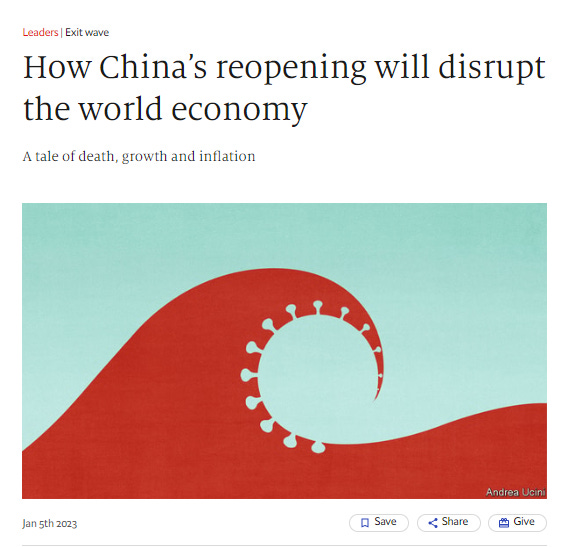
What might The Reader make of this China ‘essay’? This January 5, 2023 pronouncement seems ominous! Does the headline and the sub-headline give the game away? These paragraphs demonstrate what to The Reader?
For the better part of three years—1,016 days to be exact—China will have been closed to the world. Most foreign students left the country at the start of the pandemic. Tourists have stopped visiting. Chinese scientists have stopped attending foreign conferences. Expat executives were barred from returning to their businesses in China. So when the country opens its borders on January 8th, abandoning the last remnants of its “zero-covid” policy, the renewal of commercial, intellectual and cultural contact will have huge consequences, mostly benign.
First, however, there will be horror. Inside China, the virus is raging. Tens of millions of people are catching it every day . Hospitals are overwhelmed. Although the zero-covid policy saved many lives when it was introduced (at great cost to individual liberties), the government failed to prepare properly for its relaxation by stockpiling drugs, vaccinating more of the elderly and adopting robust protocols to decide which patients to treat where. Our modelling suggests that, if the virus spreads unchecked, some 1.5m Chinese will die in the coming months.
There is not much outsiders can do to help. For fear of looking weak, the Chinese government spurns even offers of free, effective vaccines from Europe. But the rest of the world can prepare for the economic effects of the Communist Party’s great u-turn. These will not be smooth. China’s economy could contract in the first quarter, especially if local officials reverse course and seal off towns to keep cases down. But eventually economic activity will rebound sharply, along with Chinese demand for goods, services and commodities. The impact will be felt on the beaches of Thailand, across firms such as Apple and Tesla, and at the world’s central banks. China’s reopening will be the biggest economic event of 2023.
The reader might just sample this selection of sentences, paragraphs of the remainder of this essay:
As the year progresses and the worst of the covid wave passes, many of the sick will return to work. Shoppers and travellers will spend more freely.
The party is banking on it. It hopes to be judged not on the tragedy its incompetence is compounding, but on the economic recovery to follow.
The ending of China’s self-imposed isolation will be good news for places that depended on Chinese spending.
Elsewhere, though, China’s recovery will have painful side-effects. In much of the world it could show up not in higher growth, but in higher inflation or interest rates.
Take the oil market. Rising Chinese demand should more than compensate for faltering consumption in Europe and America, as their economies slow.
According to Goldman Sachs, a bank, a rapid recovery in China could help push the price of Brent crude oil to $100 a barrel, an increase of a quarter compared with today’s prices (though still below the heights reached after Russia invaded Ukraine).
For Europe, China’s reopening is another reason not to be complacent about gas supplies later in the year.
For China itself, the post-pandemic normal will not be a return to the status quo ante. After watching the government enforce zero-covid in a draconian fashion and then scrap it without due preparation, many investment houses now see China as a riskier bet.
The final paragraph of this polemic, masquerading as reportage, is a recapitulation of English/British arrogance, a natural inheritance of The Economist writers, who have the temerity , the gall to lecture the Chinese…
Opium Wars, two armed conflicts in China in the mid-19th century between the forces of Western countries and of the Qing dynasty, which ruled China from 1644 to 1911/12. The first Opium War (1839–42) was fought between China and Britain, and the second Opium War (1856–60), also known as the Arrow War or the Anglo-French War in China, was fought by Britain and France against China. In each case the foreign powers were victorious and gained commercial privileges and legal and territorial concessions in China. The conflicts marked the start of the era of unequal treaties and other inroads on Qing sovereignty that helped weaken and ultimately topple the dynasty in favour of republican China in the early 20th century.
‘The full story of the British Yangtze gunboats is exceedingly well told in Gregory Haines’s ‘Gunboats on the Great River’, Macdonald and Jane’s, London, 1976, which is the source of much of the above material’
As Chinese officials struggle to repair the damage, they should remember some history. China’s previous great reopening, after the stultifying isolation of the Mao years, led to an explosion of prosperity as goods, people, investment and ideas surged across its borders in both directions. Both China and the world have benefited from such flows, something politicians in Beijing and Washington seldom acknowledge. With luck, China’s current reopening will ultimately succeed. But some of the paranoid, xenophobic mood that the party stoked during the pandemic years will surely linger. Exactly how open the new China will be remains to be seen
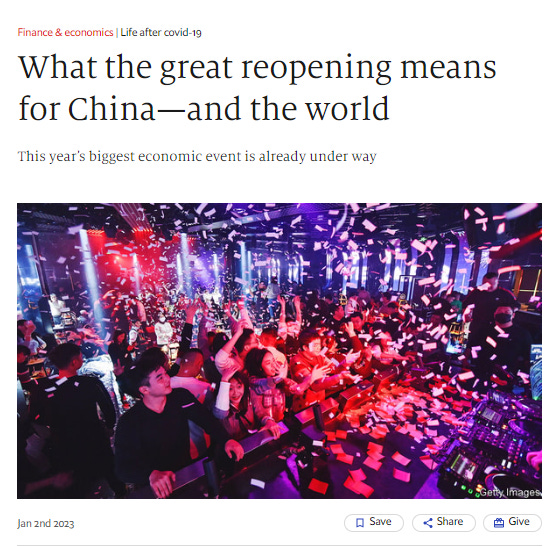
This above ‘essay’, reads like an hysterical re-write of this Economist essay of January 2, 2023:
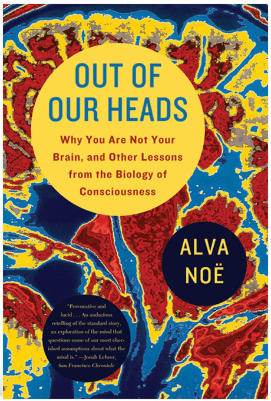
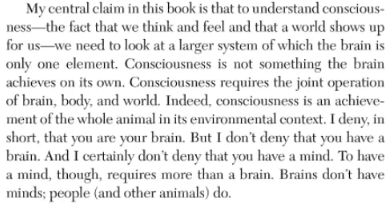
And this quotation from Noë’s book on Consciousness:
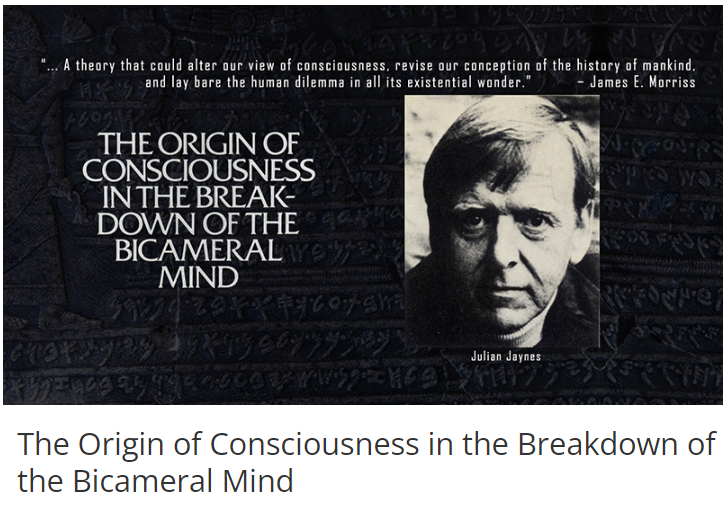
And Julian Jaynes book:
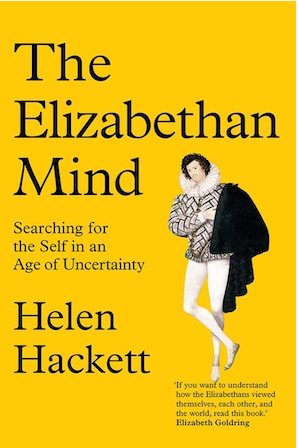
I must confess that I purchased this book in 1976, and had not yet read it. Yet when I thought of Noë’s book, I knew where I had Jaynes book stored. My intellectual ambition is subject to a disturbing lack of discipline, allied to a fear of my possible lack of ability to understand. Yet Jaynes’ style is always lucid and at times poetic , I was more that a little intimidated by the subject matter. And my lack of experience with Consciousness. I have not read these books, in their entirety: yet I was struck that The Elizabethans made me think about their view of the world, themselves and the vitality of their milieu. Both Noë and Jaynes offer thoughts on ‘Consciousness’ … perhaps further reading of both their books will offer further insights on the possible interaction between the two?
Inflation surging. Tickets for Abba selling like hotcakes. And now, yes, a wave of public sector strikes. As 2023 dawns, modern Britain appears to be just a few pairs of flared trousers away from a full-blown 1970s tribute act. In fact, the truth is rather more reassuring.
Despite the best efforts of some union barons, we are not (yet) seeing a repetition of the Winter of Discontent. The disruption to ambulance and nursing services has been less than feared, partly because of a shared desire to minimise harm to patients. The borders stayed open. No one is using the trains anyway. And Britain is hardly the only country where people are striking over what inflation is doing to their pay.
Note the ‘union barons’ is not capitalized, as a further degradation of those bad actors. This, an old @TheEconomist trick of minimization, that reinforces that degradation! Just read the sullen ghost of Bagehot, Adrian Wooldridge! The pressing question might arise what ‘tickets for Abba’ has to do with the pressing question of the strikes, and those mendacious ‘union barons’?
The Patient Reader realizes, that it doesn’t take too long, before this child of privilege to shame the greed of these Public Sector Workers, for demanding a fair wage. Mr. Colvile plays the part of Ebenezer Scrooge, before the visitations of Ghosts of The Present, The Past, and The Future. Mr. Colvile labors, aided by the toxic Ghost of Thatcher/Hayek, as a corrective to those ‘union barons’ and greedy, overpaid Public Sector Workers: who hold aloft a Nation State by their endeavors. Or does Colvile provide a political reminiscence of Bagehot?
But the blunt truth is that the average public sector employee still gets more than their private sector counterpart for doing the same work — even if the gap has been shrinking. And when you add pensions, the divide becomes cavernous. As the Institute for Fiscal Studies says, more than four fifths of public sector employees are still in gold-plated defined benefit schemes, compared with just 7 per cent of private sector employees. Every year, the state pays another 18 per cent of salary into the average employee’s pension pot, compared with 6 per cent in the private sector. This sends the raw hourly pay gap between public and private shooting up to 21 per cent.
It is not just unfair, but unaffordable. Experts calculate that the liability from public sector pensions exceeds £2 trillion — effectively doubling the national debt. In the past year alone a change in life expectancy formulae and other factors raised the expected pensions bill for the NHS by £140 billion. That’s almost as much as we spend each year on the health service itself.
If the government tried to take away these rights by force, it would face the mother of all fights. But what about giving public sector staff the right to take more of their pay upfront, rather than let it pile up in their pensions (and ideally making that the default for recruits)? That would deliver the huge pay bump nurses want, while easing the long-term pressure on public finances. It would stop the next year degenerating into a pantomime re-enactment of Scargill v Thatcher. And it would help address the increasingly unfair divide between a public sector that gets the lion’s share of the perks and protections, and those of us who foot the bill.
Political Observer confronts just a portion of its 4,037 words.
Dec 19, 2022
Headline: What in the World Is Happening in Israel?
Dec. 15, 2022
The first paragraphs, of this highly garnished, and nearly hand-wringing travelogue, betrays Friedman’s state of mind, featuring at first befuddlement, then something like resignation, and at the end faint hope?
A week of reporting from Israel and the West Bank has left me feeling that the prospect for a two-state solution has all but vanished. But no one wants to formally declare it dead and buried — because categorically ruling it out would have enormous ramifications. So, diplomats, politicians and liberal Jewish organizations pretend that it still has a faint heartbeat. I do as well. But we all know that the two-state option is not in a hospital. It’s in hospice. Only a miracle cure could save it now.
Alas, though, just because the two-state concept is vanishing doesn’t mean the one-state solution — with Israel alone controlling the West Bank, Jerusalem and pre-1967 Israel forever — automatically becomes the easy default. Not at all. The more you examine closely how Israeli Jews and Palestinian Arabs have been living together between the Jordan River and the Mediterranean Sea the more you realize three important things:
First, you realize that, despite episodic blowups, these highly diverse, often antagonistic, but deeply intertwined communities have been kept in rough equilibrium since the 1993 Oslo Accords, thanks to a combination of Israel’s security clampdowns, the workings of the Palestinian Authority, economic growth and a whole lot of pragmatic compromises and self-restraint exercised by all sides every day.
But you also realize that a variety of long-developing demographic, technological, political and social changes are reaching tipping points that are stressing all the balances between Jews and Jews, Jews and Israeli Arabs, Jews and Palestinians and Palestinians and Palestinians that have kept this place reasonably stable.
By that I am referring to the fading of the peace process and prospects of a two-state solution, the expansion of Jewish settlements in the West Bank, the corruption and breakdown of the Palestinian Authority and the prevalence of TikTok and other social media. In the past year alone, according to B’Tselem, an Israeli human rights group, roughly 20 Israelis and more than 150 Palestinians have died in violent incidents.
The fact that in America ‘Liberal Zionism’ is dead, in the face of the political evolution/rise of The Zionist Faschist State and its toxic actors led by Netanyahu:
Mondoweiss @Mondoweiss
New Knesset member Zvika Fogel told an interviewer that “the concept of proportionality must cease to exist” and that he is prepared to make “a thousand Palestinian mothers cry.”
bit.lyJewish Power’s Zvika Fogel promises to make a thousand Palestinian mothers cryNew Knesset member Zvika Fogel told an interviewer that “the concept of proportionality must cease to exist” and that he is prepared to make “a thousand Palestinian mothers cry.”
10:13 PM ∙ Dec 15, 2022
‘I don’t think a day passed on this trip when I did not read about or see TikTok or other videos of a Palestinian shot by Israeli soldiers or Israelis rammed into or attacked with knives by individual Palestinians. This conflict porn is new, it’s pervasive and it is incredibly effective at instilling hate in 15-second bites that keep everyone in a permanent state of fear and rage.’
This ‘rage and fear’ is about the power of the Zionist State to oppress, dispossess, and murder, at will, Palestinians, with the help of ‘Settlers’: the record of this available on twitter on a daily basis.
Just when The Reader might despair, Friedman presents the Zionist Fascist State’s toxic actors , under the trivializing notion of ‘One Big Mess’ :
If you ask me, that is now the most likely outcome — a total mess that will leave Israel no longer being a bedrock of stability for the region and for its American ally, but instead, a cauldron of instability and a source of anxiety for the U.S. government.
Why such a worry? Because Netanyahu’s new partners stand for the exact opposite of self-restraint. Four of the top five party leaders of the incoming coalition government — Netanyahu, Aryeh Deri, Bezalel Smotrich and Itamar Ben-Gvir — have either been arrested, indicted, convicted or served prison time on charges of corruption or incitement to racism. These are not people known for stopping at red lights.
Moreover, Netanyahu is expected to name the ultranationalist, anti-Arab Ben-Gvir, leader of the Jewish Power party, as his minister of national security. He is giving Ben-Gvir oversight not only over the Israeli Police but also over other law enforcement agencies, including the Border Police, which are very active in the occupied West Bank. Ben-Gvir would easily be able to weaponize these agencies against the Israeli Arab and Palestinian populations.
Netanyahu is also expected to make Smotrich minister of finance and also intends to give him and his party, Religious Zionism, responsibility over the Civil Administration, which has always been held by Israel’s Defense Ministry. The Civil Administration has power to expand Jewish settlements, to restrict Palestinian daily life and to enforce the law, including house demolitions.
Both Smotrich and Ben-Gvir are religious zealots who promote Jewish presence on Temple Mount, which is also holy to Muslims. The policing of Temple Mount is carried out by the Israeli Police, which Ben-Gvir is about to get control of. You get the picture?
Netanyahu has been basically telling American officials, American Jews and Israel’s Arab allies that although he’s putting foxes in charge of hen houses and distributing matches and gasoline to pyromaniacs, his personal power and savvy will be able to replace institutional checks and keep his extremist partners from taking Israel over a cliff.
We’ll just have to see. Color me dubious. In the meantime, allow me to take you on a quick tour of the political landscape and show you just how many equilibriums are being stressed and why Israel today desperately needs the most pragmatic, restrained government it could possibly produce — but is getting just the opposite.
Given this framing, Friedman begins his travelogue, I am just on page two of my copy of this essay, of nine pages.
What follows is a report on the Jewish victims of IDF brutality:
One of my first stops on this trip was the Jewish community in the heart of the Palestinian area of Hebron, near the tomb of Abraham, Isaac and Jacob, which is holy to both Jews and Muslims. A few days before my visit, several controversial encounters unfolded there between Israeli soldiers, who clearly identified with the new right-wing government, and left-wing Israeli Jews who traveled to Hebron to show solidarity with Palestinians under occupation, The Times of Israel reported,
In one encounter, caught on video, a soldier tackled a Jewish demonstrator and punched him in the face. In a separate video, a soldier confronting other protesters is heard to say: “Ben-Gvir is going to sort things out in this place. That’s it. You guys have lost. … The fun is over.”
That boasting soldier, the newspaper added, “was wearing a patch velcroed to the back of his military vest that read: ‘One shot. One kill. No remorse. I decide.’ Patches other than those showing the logo of a military unit or an Israeli flag are against military regulations.”
What happened next, though, is where the story between Jews and Jews gets complicated. The Israeli Army sentenced the soldier who taunted the protesters to 10 days in military prison. The military chief of staff, Lt. Gen. Aviv Kochavi, said the soldiers caught in the video had acted “contrary to the values of the Israeli military.
Philosophical Apprentice ask the question : Wasn’t ‘Theory’ once the province of the Post-Modernists? who were purged for political/argumentative incoherence: Derrida?
December 20, 2022
Beware of the Technocrat with a Theory: ‘The Closing of The American Mind’ by Allan Bloom, ‘The Clash of Civilizations’ by Samuel P. Huntington, ‘The End of History and the Last Man’ by Francis Fukuyama… moving into the near present ‘The Thucydides Trap: Are the U.S. and China Headed for War?’ by Graham Allison and ‘The Icarus Syndrome: A History of American Hubris’ by Peter Beinart. In a crowded field, what to name it? Mr. Tooze ‘reviews’ ‘English literature professor Jed Esty book, The Future of Decline: Anglo-American Culture at its Limits.’
Beware Reader! this essay is 2,196 words long, so plenty of breathing room for Mr. Tooze to expatiate… In this paragraph Mr. Tooze presents Mr. Etsy as the shade of a latter day Parker Tyler? Or is James Agee the more respectable choice?
As Esty puts it, it isn’t just data that matters, but the story you tell with it. It is in deciphering this complex weave of reality and narrative that Esty’s expertise as a literature professor takes effect. Ranging widely across genres, he reads cinema, TV shows and literature, from The West Wing to the Yale historian Paul Kennedy and Marvel’s Black Panther, as examples of a culture of decline.
This sentence fails to address the toxic effect that a transgenerational Neo-Liberalism, and its twin Globalism, have destroyed America’s indigenous Manufacturing superiority.
As far as America’s relative standing is concerned, there are some uncontroversial facts. In 1945 the US share of global GDP was almost 50 per cent. By 2020 its share had fallen to 16 per cent.
…
Mr. Tooze evaluates Esty in two paragraphs:
For Esty, the swirling dialectic of national exceptionalism, fear of decline and the promise of national revival delivers a cockeyed view of the world, which will be painfully familiar to British readers. The preoccupation with great power status results in too much military spending and not enough money for education and infrastructure. Global posturing distracts from sensibly-scaled civic initiatives to make the US a more liveable place for the vast majority of its population.
Like many American reformers before him, Esty proposes that to break out of this cycle of power-obsessed thinking, US political culture needs a new sense of proportion. And as Esty sees it, that would be best instilled by a suitably redesigned programme of humanities education. A proper appreciation of the West’s entangled and violent history will deflate the exceptionalist balloon and invite more sobriety and realism. Reversing the priorities that once motivated British critics of decline, Esty argues that America’s contemporary focus on tech solutionism and Stem education (science, technology, engineering and mathematics) is both a symptom and a cause of the malaise.
Mr. Tooze’s book review becomes aggressive, even hostile to Esty:
Esty, however, proposes to break with America’s national traditions. His suggestion is that in crafting a new curriculum for an age beyond great power hubris, US educators and intellectuals should take inspiration, of all places, from Britain. What he has in mind is not the Kiplingesque punditry of the likes of the historian Niall Ferguson, but its opposite. Esty’s inspiration is the British New Left, which he sees as exemplary in its efforts to come to terms with the end of imperial greatness.
It is a charming, if implausible suggestion. No one could disagree with the need to revisit classics such as Policing the Crisis (1978), a landmark work headed by Stuart Hall that used the moral panic over mugging in 1970s Britain to decipher a power structure under threat. But the suggestion that a curriculum drawn from 1970s cultural studies and back issues of the New Left Review can offer an antidote to Maga ideology is far-fetched. Apart from anything else Esty’s basic conceit, that the US’s imperial decline is analogous to that of the UK’s, does not stand up to close scrutiny. The British empire never wielded the firepower commanded by Washington today. The UK never confronted a nuclear armed Soviet Union or the rise of modern China. On the other hand, America’s domestic problems are far more severe, violent and entrenched than anything confronting postwar Britain in the 1950s, 1960s or 1970s, or today. Though they may share a common history in Atlantic slavery, Britain is a post-colonial not a post-emancipation society. There is no British equivalent to mass incarceration, Jim Crow or the Ku Klux Klan. In the 1960s and 1970s, the heyday of declinism, the UK was building a welfare state. Half a century later, as the richest and most powerful nation on Earth, the US still lacks a decent public healthcare system. Life expectancy in America lags significantly behind that in Britain.
But The Reader now confronts the root of Tooze’s miss-directed anger at Esty:
Still today, Perry Anderson, the power behind the New Left Review and repeatedly invoked by Esty, writes as if from the Olympian heights. Recently he has concentrated most of his attention on the logics of American power. If the aim is to propose a more democratic and modest approach to history would it not make more sense to draw inspiration from grassroots efforts such as the History Workshop Journal or Raphael Samuel’s remarkably capacious understanding of popular history?
The Reader need only explore Anderson’s essay on Tooze, in the ‘The New Left Review’ of September/October 2019
Mr. Tooze seems to have regained, at least a part of his composure, in this last paragraph:
In historical terms it is quite hard to think of any analogy to this moment. The Soviet Union was never as entangled with the Western economies as China is today. For all its commitment to the economic weapon and blockade, the British empire never pursued a policy as deliberately destructive of any particular commercial competitor as the one that the US has pursued against China’s Huawei. Read against the current mood in Washington, Esty’s critique of declinism and his well-meaning appeal for common sense and realism feel almost escapist. It would be comforting to imagine that America today is in a situation analogous to that of Britain in the 1950s or the 1960s, where the worst that could be unleashed is a bloody but localised postcolonial expedition. In its unipolar moment, the United States created havoc enough, in Iraq and Libya. But today the stakes are higher even than that. Rather than the Suez debacle of 1956 the relevant historical example today is the Cuban missile crisis. As tension with Russia mounts over Ukraine and with China over Taiwan, the question that overshadows our time is not American national decline, but the risk that a second Cold War might unleash a Third World War.
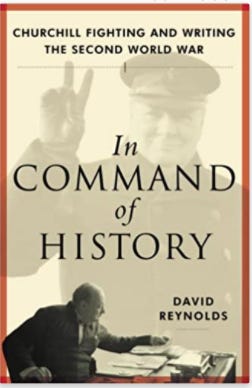
“Superb, unsettling new history …. Can these clashing Churchills be reconciled? Do we live, at the same time, in the world he helped to save and the world he helped to trash? Toye, one of Britain’s smartest young historians, has tried to pick through these questions dispassionately …. Of course, it’s easy to dismiss any criticism of these actions as anachronistic. Didn’t everybody in Britain think that way then? One of the most striking findings of Toye’s research is that they really didn’t: even at the time, Churchill was seen as standing at the most brutal and brutish end of the British imperialist spectrum …. Toye is no Nicholson Baker, the appalling pseudo-historian whose recent work Human Smoke presented Churchill as no different from Hitler. Toye sees all this, clearly and emphatically …. In the end, the words of the great and glorious Churchill who resisted dictatorship overwhelmed the works of the cruel and cramped Churchill who tried to impose it on the world’s people of color. Toye teases out these ambiguities beautifully. The fact that we now live at a time where a free and independent India is an emerging superpower in the process of eclipsing Britain, and a grandson of the Kikuyu ‘savages’ is the most powerful man in the world, is a repudiation of Churchill at his ugliest–and a sweet, unsought victory for Churchill at his best.” —Johan Hari, The New York Times Book Review
“Indeed, it is not too much to say that the story of Churchill’s life is the story of his view, vision, and valiant defense of the British Empire–the duties of empire and the maintenance of empire, the idea of empire and the ideals of empire. So it is surprising that, until Richard Toye took on the task, little has been written in book form about Churchill and the British Empire …. What is not generally or popularly recognized–but rectified by Toye–is that there were many Churchillian views on empire …. Toye argues convincingly that Churchill’s views on empire were not a fixed thing–and were not designed simply to enhance Britain’s role in the world …. The Empire faded as Churchill’s life did. But there was triumph after all, perhaps even a bit of poetry. The glory of them both–Empire and Churchill–survives them both.” —David M. Shribman, The Boston Globe
“Not a conventional biography, this is a probing and thoroughly enjoyable life focusing on the contradictions and dilemmas of Churchill’s imperialism…. Even veterans of Churchilliana will find plenty of fresh material, recounted with wit and insight into a man whose values were shaped by an age that no longer existed.” —PW, Starred Review
“Toye’s central thesis is that Churchill’s beliefs and actions were less predictable and more nuanced than his rhetoric and conventional wisdom suggest…. This is a carefully researched and exceptionally well-documented book that is a welcome addition to the literature. It is not a traditional biography but more of a study of Churchill’s behavior in a central area of his career. It makes extensive use of government archives, diaries, and secondary sources. The citation of newspaper articles to underscore the broader reaction to Churchill’s actions is especially welcome. It is fascinating reading.” —Terry Hartle, The Christian Science Monitor
“A dense, forgiving study of the great British leader who was both of his time and flexible enough to transcend it…. Toye considers this enormously complicated subject with admirable equanimity.” —Kirkus Reviews
“Lord Beaverbrook once said that Churchill had held every opinion on every subject and what Richard Toye demonstrates above all is that his opinions on the British Empire were anything but simple or consistent…. Toye traces Churchill’s shifts and velleities with impressive skill and erudition, using a vast range of contemporary newspapers to particularly good effect…. An important and original book.” —Piers Brendon, Literary Review
“Toye offers a nuanced portrait of Churchill as an imperialist that contradicts some of the simplistic views of him as a reactionary, Colonel Blimp-type character…. This work is a valuable contribution to greater understanding of an historical icon.” —Jay Freeman, Booklist
“Lucid and engaging…. Toye should be congratulated for steering clear of either simple apologia or political correctness. Following reviews, diaries and letters, he recreates the broad spectrum of imperialism at the time and presents Churchill’s drift into die-hard mode as a conscious move of political repositioning…. Churchill lovers will gain a clear sense of the culture and politics that has shaped his imperial outlook. At the same time, they will find a judicious account of the limitations of Churchill’s power…. Rather than yet another biography of Churchill, Toye has given us a thought-provoking, sensitive account of the nerve and muscle of empire.” —Frank Trentmann, The Daily Express
“There have been numerous studies of various aspects of Churchill’s relationship with the empire, but this is the first attempt at a comprehensive treatment in a single volume. It’s a complex and fascinating story…. What emerges from this densely argued book is that [Churchill’s] support for the empire was not for its own sake but as a means of keeping Britain itself as a factor on the world stage. As it declined, his concept of the commonwealth of English-speaking peoples as a major world force took its place. In the end, perhaps his greatest achievement was to accept the empire’s fall and dress it up as victory.” —David Stafford, BBC History Magazine
“Winston Churchill’s reputation as a hardline imperialist is questioned here…. This detailed, engaging biography dwells on the dichotomy between Churchill pre- and post-second world war: between a time he was considered almost a danger to the empire, and a time he was considered its saviour.” —Emmanuelle Smith, Financial Times
“An impressive new study…. This fascinating book shows how, during the second half of his career, that [die-hard] image came to replace the earlier picture where he appeared as a conciliatory figure–and even as a danger to the Empire he cherished and used against threats to Britain.” —John Hinton, The Catholic Herald
“The Churchill we salute as a lover of freedom and hater of tyranny muttered about kaffirs and blackamoors, and bore a lifelong commitment to subjecting swathes of the world to unwelcome British rule. How so? For answers, we may turn to Richard Toye’s excellent new book…. Toye presents Churchill as a complex, flexible, and ultimately a moral imperial thinker.” —Dan Jones, The Spectator
“Anyone with an interest in 20th-century history or in Churchill will find much that is surprising in this meticulously researched book, which is nevertheless written with great style and clarity.” —Susan Hill, The Lady
After Mr. Stephens self-congratulatory framing, begins his polemic:
Two of those phrases — “broad, sunlit uplands” and “the abyss of a new Dark Age” — should ring in our ears as we approach the end of this hinge year in history.
Broad, sunlit uplands are the women of Iran tearing off their hijabs the way the people of Berlin once tore down their wall. And Ukrainian soldiers raising their flag over Irpin, Lyman, Kherson and other cities liberated from Russian barbarism. And Chinese protesters demanding — and gaining — an end to their regime’s cruel and crazy Covid lockdowns by holding up blank sheets of paper, where nothing needed to be written because everyone already knew what they meant.
And then riffs on his themes of “broad, sunlit uplands” and “the abyss of a new Dark Age” some selective quotation:
First ‘“broad, sunlit uplands” …
Broad, sunlit uplands were Emmanuel Macron’s victories over the fascistic Marine Le Pen in France.
Broad, sunlit uplands are a Covid fatality rate that, in America, no longer spikes a few weeks after case counts do.
They are the lofting of a telescope that lets us peer far into the reaches of space and back to the beginning of time.
This isn’t just a laundry list of the year’s good news. It is a demonstration of the capacity of people across cultures and circumstances to demand, defend and define freedom; to defy those who would deny it; and to use freedom to broaden the boundaries of what we can know and do and imagine.
Second :We continue to stare into the abyss of a new Dark Age
The complacent include those who imagined we could leave Afghanistan to the Taliban and suffer no wider consequences.
Vladimir Putin’s second invasion of Ukraine, on Feb. 24…
The complacent include those who thought that we could trade our way to a form of perpetual peace…
Lenin may not have said that “capitalists will sell us the rope with which to hang them,” but it’s remarkable how the point never seems to be learned by successive generations of capitalists.
In summation:
The complacent are those who think that no vital American interest is at stake in a Ukrainian victory or in the outcome of the Iranian demonstrations. Or that China’s recent travails, along with Russia’s setbacks in Ukraine, might dissuade Xi Jinping from trying to seize Taiwan. Or that a corner has been turned on inflation. Or that the surging wave of migration across the southern border, sparked by a collapse in governance throughout much of Latin America, is some peculiar right-wing obsession rather than a genuine crisis that will incite a furious populist backlash if it isn’t competently managed.
The Complacent are the Fellow Travelers, that Joe McCarthy inveighed against, with his ‘List Of Names’, so long ago. The Battle Cry of Neo-Conservatives in the Political Present, allied to the threat of the rise of ‘The Left in Latin America’ , and a possible American ‘competent management’ – in sum Mr. Stephens offers the backward glance of political nostalgia, as a balm against ineluctable facts, in a grandiloquent frame.




 StephenKMackSD's Blog