Are ‘The Oscars’ just an antique, signifying the utter irrelevance of ‘Hollywood’? And its parade of aging actors, and their Leading Ladies, who all look like bad advertisements for Restylane and Botox ? Are Bradley Cooper and Lady Gaga, in that tired exhumation of ‘A Star is Born’, representative of the predictable future of ‘Hollywood’ in the 21st Century? ‘Remake’ followed by ‘Remake’, is now the operative strategy of The Industry, to insure the profitability of ‘The Dream Factory’? Recall the halcyon year of ‘Hannah and Her Sisters’ and the S & M kitsch of ‘Blue Velvet’ ?
The alternative to this is the low brow Universe, of the Marvel World of Stan Lee, awash in 1930’s & 1940’s concepts of the Super Hero, awash in a caricature of Masculinity , celebrated in tight Lycra, bulging pecs and well stuffed crotches!
Or should The Reader turn her attention to the latest of Movies about Movies, a venerable Hollywood tradition: ‘A Star is Born’ , The Bad and The Beautiful’, ‘The Goddess’ ‘Two Weeks in Another Town’, Feud: Betty and Joan & the latest entry into this genre ‘The Offer’, running on theinternet by Paramount? The ultimate Hollywood Egoist Bob Evans, as one of the featured player/stars of this Hollywood Epic. Read Robert Evans’ ‘The Kid Stay in the Picture’, till you want to vomit, at his unslakable egotism, floating on his ‘charm’! This book was once the ‘talk of Hollywood’ in its audio book form, in his own seductive voice. The apotheosis of ‘Public Relations’! Bob even ‘produced’ a one hour an thirty three minute Movie Version.
Here is Hollywood sycophant Graydon Carter, in his ‘retirement’ from Vanity Fair, who publishes Dana Brown’s nostalgia for Oscar Parties Past, Mr. Brown is a low rent Saint-Simon, who reports on Hollywood’s would be decadence? The first paragraph of Mr. Brown’s report reeks of the hipster invited into the ‘inner circles’ decadence.
So I’m smoking a joint with Seth Rogen and Danny McBride. This might sound like the setup to a joke, and it would probably be a good one, but this is what the Oscar party was like. At least for me.
Are Seth Rogan and Danny McBride ‘A Listers’, to speak in the patois of the long forgotten Joyce Haber?
First considered, under the rubric of ‘Culture’, as the largest frame for this Ant-Putin polemic! Followed by Understanding Russia’s president: This is a political essay framed as an ersatz psychological analysis, that evolves into …
Not since the publication of ‘Thomas Woodrow Wilson, Twenty-eighth President of the United States. A Psychological Study.’ by William C. Bullitt and Sigmund Freud’s, has there been such a penetrating psychological analysis of a political leader?
The first paragraph of this ‘essay’ sets the stage:
HE WARNED US. Vladimir Putin gave notice of who he was, and what he was capable of, in “First Person”, a transcript of interviews published in 2000, at the start of his overlong rule. In his youth, he recalled, he had been a tough little hoodlum who fought rats in the stairwell of his communal-apartment building and, later, brawled with strangers on the streets of Leningrad. “A dog senses when somebody is afraid of it,” he had learned, “and bites”. He prized loyalty and feared betrayal. He was hypersensitive to slights, to both his country and himself (concepts which, in the decades that followed, became perilously blurred). He bore grudges.
…
Followed by more ‘History Made to Measure’ , that buttresses the first paragraph: or should it be named self-serving political melodrama ?
One of them was over the collapse of the Soviet Union. In the interviews he reminisced about a jaunt to Abkhazia and a judo tournament in Moldova: the Soviet empire had been his wealth and pride, and when it fell, he took it hard. “I wanted something different to rise in its place,” he said of the lost Soviet influence in eastern Europe. Frantically burning papers as a KGB officer in Dresden in 1989, grieving the “paralysis of power” that seemed to have afflicted Moscow, he came to associate protesting crowds with disintegration. Corruption, meanwhile, was only to be expected in Russia, he implied—“and if somebody thinks that somebody stole something, let him go and prove it”.
That ‘History Made to Measure’ is set aside for Richard Sakwa’s “Putin: Russia’s Choice” (2004) ‘thought the country had shaken off nationalism and imperialism’ and Andrew Jack’s “Inside Putin’s Russia” (2004) ‘noting Mr Putin’s democratic backsliding and disregard for human rights’ that appear as ballast .
Under the rubric of Darkness and the don:
David Satter’s “Darkness at Dawn” provides essential political melodrama: ‘was among the first Anglophone analysts to gauge the evil in the system.’ . Next in order of appearance is Masha Gessen’s “The Man Without a Face” (2012) that presents Putin ‘as a killer and extortionist.’ Then Catherine Belton’s “Putin’s People” (2020).and its “KGB capitalism”. Followed by Steven Lee Myers’ “The New Tsar” (2015) that points to ‘the Orange revolution in Ukraine in 2004’ as the trigger to Putin. Mr. Lee Myers offers more for the writer, and The Reader of this essay, in this:
By 2014, thought Mr Lee Myers, he had found a “millenarian” mission as the indispensable leader of an exceptional power. “The question now was where would Putin’s policy stop?”
The Economist writer/stenographercontinues to mine the political commentary of the policy technocrats: “Mr Putin: Operative in the Kremlin” (2015), by Clifford Gaddy and Fiona Hill offer, or is the Economist writer embroidering upon themes?
His bid to undermine Western democracies through fifth columnists, bribery and kompromat was part of the same strategy.
Its almost ‘as if’ The Reader is forced to recall that The New Cold War, and its precursor, operated upon the notion of ‘fifth columnists’ as the enemy within. Without the proper loyalty to what? The American National Security State crimes and its Propaganda Offensives against dissidents?
Mr Gaddy and Ms. Hill—who became the top Russia adviser in Donald Trump’s National Security Council—concluded that he was more than an avaricious gangster. His objective was to survive and overcome his foes, who, in his view, were Russia’s enemies too; to that end he was waging a long, hybrid war against the West. He would pounce on weaknesses, the pair warned, and fulfil his threats. “He won’t give up, and he will fight dirty.” Yet even these authors judged that, if only for reasons of trade, Mr Putin “does not want Russia to end up being a pariah state”.
The Reader might recall that Fiona Hill was one of the primary ‘witnesses’ at the ‘Trump Impeachment’ comedy: she became an overnight sensation. Along with Alexander Vindman, that cemented the relations between the Neo-Liberals and the Neo-Conservatives, as the defining moment of ‘Political Centrism’ re-defined, in the wake of Trump. That she was an advisor to Trump, casts a revelatory light on her ‘testimony’ !
The one place in this essay, that carries weight, is this writers comments on émigré writer Vladimir Sorokin. This kind of writer is a Russian Tradition, from the time of Alexander Herzen. Yet Mr. Sorokin is a Post-Modern writer, sure to raise the hackles of the very Conservative readers of The Economist? But more importantly Mr. Sorokin serves a propaganda purpose.
Russian novelist and playwright considered to be one of the most influential figures in postmodern Russian literature. Sorokin was known particularly for his vivid experimental, and often controversial, works that parody the Socialist Realism of the Soviet Union.
Mr. Sorokin was successor to Alexander Zinoviev’s ‘Yawing Heights’ and ‘The Radiant Future’ . The last two paragraphs of this Anti-Putin polemic deserve to be quoted in full:
The book that most clearly saw where Putinism was heading was not a history or biography but a novel. “Day of the Oprichnik” by Vladimir Sorokin, a Russian author living in exile, is set in 2028. The Russia it depicts seems to exist in two time-frames at once, futuristic technology jostling with medieval barbarity and obscurantism. The country is walled off from Europe and the tsar has been restored. His word is law, but even he must “bow and cringe before China”, which (along with gas exports) props up the economy. The oprichnik of the title is one of his elite henchmen—the name comes from an order of pitiless enforcers under Ivan the Terrible. Their methods are murder and torture, their sidelines extortion and theft.
Published in 2006, Mr Sorokin’s satirical dystopia has come to seem more prescient than outlandish. The details are grotesque, but also, sometimes, horribly familiar. In the story, when the wall was built “opponents began to crawl out of the cracks like noxious centipedes”—imagery that anticipates Mr Putin’s dehumanisation of his critics as gnats. Chillingly, when the oprichniks gather for a debauch, one of their toasts is “Hail the Purge!”
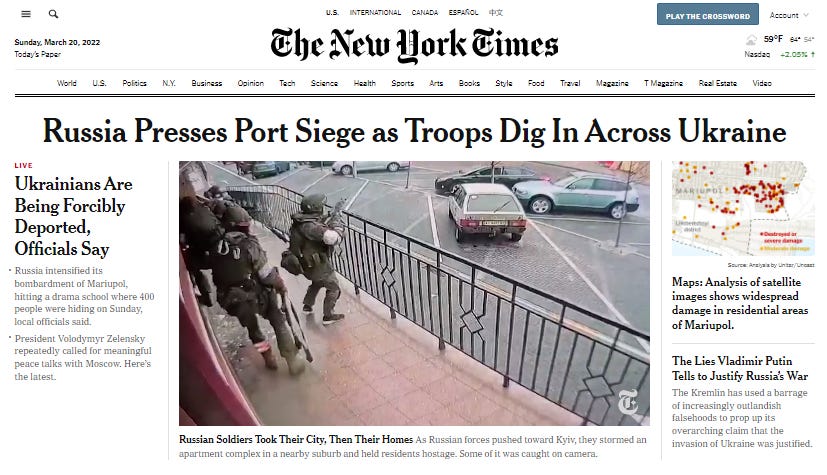
The Front page of March 20, 2022 proves that @NYT is part of The American National Security Propaganda apparatus. The Barbarism Of Putin’s War on Ukraine, as reported in the New York Times. Here is ‘its’ self-apologetic in 2004 for the War in Iraq coverage, ‘not as rigorous as it should have been’ but still wallowing in self-congratulation!
Over the last year this newspaper has shone the bright light of hindsight on decisions that led the United States into Iraq. We have examined the failings of American and allied intelligence, especially on the issue of Iraq’s weapons and possible Iraqi connections to international terrorists. We have studied the allegations of official gullibility and hype. It is past time we turned the same light on ourselves.
In doing so — reviewing hundreds of articles written during the prelude to war and into the early stages of the occupation — we found an enormous amount of journalism that we are proud of. In most cases, what we reported was an accurate reflection of the state of our knowledge at the time, much of it painstakingly extracted from intelligence agencies that were themselves dependent on sketchy information. And where those articles included incomplete information or pointed in a wrong direction, they were later overtaken by more and stronger information. That is how news coverage normally unfolds.
But we have found a number of instances of coverage that was not as rigorous as it should have been. In some cases, information that was controversial then, and seems questionable now, was insufficiently qualified or allowed to stand unchallenged. Looking back, we wish we had been more aggressive in re-examining the claims as new evidence emerged — or failed to emerge.
…
The ‘reporter’ Judy Miller :
Headline: Judith Miller Carried Water for the USA’s Worst Debacle Since Vietnam
Sub-headline: A publicity blitz aimed at reputation rehabilitation revives a telling personal memory for one journalist
…
But in the last few days, Miller has published a piece in the Wall Street Journal, “The Iraq War and Stubborn Myths, “ and The New York Times has reviewed her just-published book, The Story: A Reporter’s Journey, and I find myself thinking again about the 4,400 American dead, the hundreds of thousands of dead Iraqis, the untold wounded and maimed, the waste of $4 trillion, the connection between the shattering of Iraq and the rise of ISIS, and not least, the fact that no one involved in the greatest American disaster since Vietnam has been held remotely accountable. So when I read Judith Miller saying, yet again, that a journalist is only as good as her sources, I found my blood pressure redlining.
Here is Jonathan Miller, interviewed by Dick Cavett , articulating a moral/political/personal opinion on his ‘Jewishness’, that might just cause The Bespoke Suited Victimologists like @Freedland, @Baddiel, @AnthonyJulius6 to screeching polemics!
The Problem is that all of these writers, even Julius who authored the most trenchant polemic/ critique of T.S. Eliot ever written, seem to represent a class of highly successful men, who don’t seem to have suffered the effects of the Anti-Semitism they inveigh against.
Eric Adams doesn’t define ‘unsafe range’, because in the police mentality, consonant with authoritarianism, hasn’t quite considered that his pronouncement will determined in a Court of Law! Mayor Adams has willfully forgotten ‘Stop and Frisk’ and Mayor Bloomberg’s surreptitious removal of Judge Shira A. Scheindlin from the case? A link to her exit interview:
Does the Mayor Adams think that the victims of this travesty have forgotten? What of the Police Murders across the Nation. A portion of the Mayor’s statement :
He continued, “Stop being on top of my police officers while they’re carrying out their jobs. That is not acceptable, and it won’t be tolerated. That is a very dangerous environment that you are creating when you are on top of that officer, who has an understanding of what he’s doing at the time, yelling ‘police brutality,’ yelling at the officer, calling them names.”
Nia Prater offers this on the record of the NYPD:
…
The increasing prevalence of cell phones has resulted in more recordings of police activity, particularly in volatile and tense situations. In 2014, video footage captured the moment when Eric Garner was detained by NYPD officers and later placed in a prohibited chokehold. The recording captured Garner repeating the words “I can’t breathe” and losing consciousness. He was later pronounced dead. In 2020, a 17-year-old used her cell phone to record Derek Chauvin, a Minneapolis police officer, kneeling on the back and neck of George Floyd for more than nine minutes during an arrest. The footage became an integral piece of evidence in the resulting trial, and Chauvin was later sentenced to 22 and a half years in prison for Floyd’s murder.
The Police Reforms:
…
These are a revamped version of past anti-crime units, a type of plainclothes unit that had faced complaints of violent tactics. The units were disbanded in 2020 under then-Commissioner Dermot Shea, but Adams promised to revive them as part of his platform to decrease gun violence and the presence of illegal guns in New York.
The teams, made up of five officers each, will be deployed to 30 precincts across the city. The officers under the unit initially volunteered for the assignment but were ultimately selected following a vetting process and recommendations from their commanding officers. Team members took part in a seven-day training course beginning in February that included sections on community relations and constitutional policing.
Police policing Police? The Reporters, who video the Police, are the very necessary civic component, that will ensure, that what happens during the Police interventions, are subject to documentation. And not subject to post intervention Police Reports, as the only viable source of public information!
Essential to the rise of Eric Adam is the endorsement of The Manhattan Institute: recall its ‘Broken Windows Policing’ , the precursor to ‘Stop and Frisk’, and the enthusiasm, in its propaganda arm, of the City Journal:
Headline: The Promise of Pragmatism
Sub-headline: Can moderate Democratic leaders resist progressive excess?
I found this essay on 3 Quarks Daily: ‘Against De-Materialization: Tom Wolfe in the Age of *NFTs’ at Quillette and was scanning it and encountered this brief synopsis of ‘Bonfire’
The Bonfire of the Vanities(1987) concentrates on the convergence between the financialization of the economy and the trivialization of culture in millennial Manhattan. It eschews the flashy formal devices of postmodernism in favor of rich, deep description of figures and phenomena that are clearly recognizable from real life. The plot recounts the downfall of Sherman McCoy, a Wall Street banker who Wolfe designates by the Hegelian term “bondsman.” McCoy trades in “gold-backed bonds”: financial instruments that represent a determinate quantity of physical gold. Such bonds are referential signs, similar in form to the verbal signs with which Wolfe describes them. McCoy has made his fortune by trading in the kind of money whose value is assumed to be real. He is therefore unprepared for the eruption of hyper-reality in either economic or linguistic form.
In economic terms, hyper-reality produces “derivatives”: financial signs that refer only to other financial signs, rather than to any real-world commodity. In linguistic terms, hyper-reality is manifested in differance: Jacques Derrida’s never-ending chain of representation that never comes to rest in extra-linguistic reality. Sherman McCoy is certainly destroyed by a media wildly independent of anything that might be described as “reality.” And yet, the novel is unimpeachably realistic in form. Wolfe surveys the roiling chaos of 20th-century New York City from a detached, objective perspective. He uses realism as the antidote to the hyper-reality of real life.
Recently I read almost a hundred pages of ‘Bonfire’ and its ‘hero’ Sherman McCoy… The book itself was a doorstop, brevity, or better yet concision was not his strong suit. Nor was character development, his literary actors are utterly static, its a collection of marionets. The only time the novel comes alive, in any way, was when McCoy and his his would be conquest, are attacked, when they get lost on the Bronx Parkway, and end up in the ‘wrong part of town’ : they fend off their attackers.
Safe at home, after the attack, McCoy and friend: Wolfe sex scene is -to call it prim isn’t quite right, but its lacks the passion for conquest that a Capitalist like McCoy would relish.
Note that Julia Friedman and David Hawkes resort to Derrida. Its as if neither one of these writers, have quite grasped the fact that Modernism, of Art, Poetry and Criticism were integral parts of each other! Mallarmé, Baudelaire, Apollinaire, and in an American context Frank O’Hara.William Empson could be added to this list.
Here is part of Judith Goldman’s reviewing Wolfe’s book in September 1975:
Is there anything on that blank canvas but blankness?
Tom Wolfe goes nowhere in The Painted Word (Farrar, Straus and Giroux, $5.95) he hasn’t gone before. He tells the familiar story that earned him his reputation and made him big at the media box office: the tale of the aspiring haute bourgeoisie. With a nasty humor that conceals his Middle American morality, Wolfe dissects the trappings of the art world to make the old point that “the arts have always been a doorway into Society,” and goes on to present a theory he mistakenly believes anew: “Modern Art has become completely literary: the paintings and other works exist only to illustrate the text.” To understand modern art, one must know the words of current criticism; this is Wolfe’s seeming point.
…
Although Wolfe went to great lengths to build his case against modern art, the message of The Painted Word is not about art, but Wolfe’s familiar one against change, movement and all things different or unknown. To call Wolfe a philistine is to miss the point. He is neither an alien nor an unsophisticated man, but a reactionary who is for the status quo, deeply suspicious of radicals, black or white; intellectuals; art; and high culture. Difference is dangerous in the heartlands. And Wolfe, as the protector of Middle American values, writes for those folks back home. He brings light to their darkness and by, telling them about the moral shams that pass for big time in art and politics, he confirms their fear and prejudice. Culture, like the big city, is wicked and dangerous—at least according to Wolfe.
The final paragraph of the Goldman essay is stinging:
The sad postscript to The Painted Word was the art world’s reaction. Who’s afraid of Tom Wolfe? Many people seemed to be and grew serious and defensive. Art seldom receives the attention of journalists or the popular press and Wolfe’s image of it makes the neglect seem justified. But the less public reason for the defensiveness has to do with conditions inside the art world. Much current art writing lacks either passion or conviction. But the fault does not lie with Greenberg, Rosenberg or Steinberg, for they are passionate observers of the art scene. Not one of them has responded to Wolfe. At least they knew he was not writing about art.
Goldman’s last sentence of the above paragraph is not just insightful … Mr. Duron addendum to Goldman’s essay, speaks from the Neo-Liberal Age in a state of collapse: ‘a pillar of postwar art criticism’ ! Tom Wolfe was never anything more than an American provincial, as conjured by Walt Disney!
But such criticism aside, the book remains a pillar of postwar art criticism, and one might say that he presciently identified the International Art English that plagues so much writing about art today. —Maximilíano Durón
The Julia Friedman and David Hawkes essay rambles on and on…
Harold Rosenberg’s ‘Tradition of The New’ was published in 1959, and Robert Hughes ‘Shock of the New’ was broadcast in 1980 on the BBC, and on PBS in 1981. Just two examples of actual Art Criticism. Hughes was also the Art Critic for Time Magazine. The American Post War Art World was defined by the arrival of European refugee Artists, like Hans Hoffmann, who taught a generation of American artist, who became Abstract Expressionist, or Pop artists like Larry Rivers. Rosenberg called what this coterie practiced ‘Action Painting’. Its successor Pop Art, Op-Art, and the pioneering work Robert Smithson’s Spiral Jetty, just give a few examples of what I observed from 1960 to the present!
That anyone can be shocked by Marketing Hype in the World- Marketing Hype is the very life blood of the Neo-Liberal Age, even in its state of slow-motion fissuring. Tom Wolfe was the death rattle of The Dandy: he was not Baudelaire but Beau Brummell.
Political Observer
Added March 16, 2022:
* Note that NFT stands for ‘Non-Fungible Token’ : even in the watershed of the collapse of the Neo-Liberal Swindle in 2008, and its horrific costs, not just in monetary terms, but in human suffering – Hayek as Pontiff of The Market Mythology still holds sway in the cultural/political life of The Art Market.
In the March 11, 2022 TLS Stephen Kotkin reviews four books:
BREZHNEV
The making of a statesman Translated by John Heath 512pp. I. B. Tauris. £30.
Susanne Schattenberg
***************************
COLLAPSE
The fall of the Soviet Union 560pp. Yale University Press. £25 (US $35).
Vladislav M. Zubok
************************
NOT ONE INCH
America, Russia, and the making of post-Cold War stalemate 568pp. Yale University Press. £25 (US $35).
M. E. Sarotte
*******************************
THE WAR OF NERVES
Inside the Cold War mind 592pp. Wellcome Collection. £25.
Martin Sixsmith
*************************
The first paragraph of Mr. Kotkin’s review begins :
At Munich in 1938, Adolf Hitler succeeded in his extortion. He had menaced Czechoslovakia with subversion, border provocations and imminent invasion, charging that the Czechoslovak state was a sham, in violation of the principle of self-determination, and accusing its mild-mannered president of plotting to exterminate the ethnic German minority. Neville Chamberlain for the United Kingdom and Edouard Daladier for France, with Benito Mussolini presiding as dishonest broker, handed the predominately ethnic German Sudetenland territory of sovereign Czechoslovakia to the Reich. Germany gained possession of some 70 per cent of the industrialized country’s iron and steel production, as well as the famed Škoda Works, among Europe’s top defence plants, without having to pay compensation. Nonetheless, the Führer went home furious – the British and the French had cheated him of the victorious war he craved. He soon invaded the rest of democratic Czechoslovakia.
And in is his next paragraph:
Vladimir Putin is no Hitler. True, he forcibly annexed his Sudetenland equivalent, the predominantly ethnic Russian Crimea, and depicted this action as an exercise in self-determination. And he continued to rail against Ukraine as an artificial state, asserting that Russians and Ukrainians were “one people”, even as he baselessly charged Ukraine with genocide against ethnic Russians in Ukraine’s Donbas, where he sponsored armed separatists. He backed cyberattacks and other subversion and, beginning in late 2021, surrounded Ukraine with an immense invasion force, stationing troops in Belarus, and consolidating his hold over that country, too. He had his foreign ministry publish two draft treaties – ultimatums, for Washington and for NATO – to codify his demands, beginning with his most important one – “no more NATO expansion eastwards and especially not for Ukraine” – and extending to a total rollback of NATO deployments to all members admitted after 1997. He also called for a ban on certain weapons in Europe that he deemed a threat to Russia’s heartland. Unlike Hitler, however, Putin does not aim for conquest of the continent, and he would have been over the moon if the West had granted his demands without him having to wage war.
As a Reader, I would note, that rhetorical proximity reveals, that the Hitler reference and his denial ‘that Putin is no Hitler’ is central to Prof. Kotkin’s front page propaganda, in the TLS. That he is a Senior Fellow at The Hoover Institution should alert The Reader to Prof. Kotkin’s politics. Not to ignore this review, in Jacobin, of Prof. Kotkin’s ‘Stalin: Paradoxes of Power, 1878–1928’ by John Marot that is instructive as to Kotkin’s politics.
Stalin: Paradoxes of Power,1878–1928, is the first of a projected three-volume biography of the Soviet despot written by Stephen Kotkin, John P. Birkelund Professor of History and International Studies at Princeton University, and Senior Fellow at the Hoover Institution. Kotkin dedicates his Stalin to John P. Birkelund — “businessman, benefactor, fellow historian.” I had never heard of Mr Birkelund before, so I looked him up.
A Princeton ’52 graduate, Mr Birkelund was Chairman of the Wall Street investment firm Dillon, Read & Co. between 1986 and 1998; sat on more than a dozen Company Boards, including Barings Bank and the New York Stock Exchange; and was a trustee for a similar number of public organizations, notably the Frick Collection and the New York Public Library.
A standard-bearer of free-market politics, Birkelund was active in the Republican Party, contributing financially to the Senate electoral campaign of Pete Coors (the beer tycoon) in 2004 and the presidential runs of Bush/Cheney in 2004 and McCain/Palin in 2008. Mr Birkelund is a class act.
Prof. Kotkin again employs the proximity to Hitler:
Western leaders – this time – refused to capitulate to the extortion. And Putin rolled the iron dice. Somehow, the Russian president’s extensively telegraphed invasion stunned almost all Western capitals, Asian capitals, much of the American political establishment, and many members of Russia’s loyalist establishment. He did not shock US and UK intelligence, however.
Prof. Kotkin then writes a History Made To Measure:
Before the Soviet president Mikhail Gorbachev was out of the Kremlin, Russian president Boris Yeltsin was demanding the return of Crimea from Ukraine to the Russian republic, and throughout the 1990s Russian officials bitterly complained about the new international arrangements following the Soviet collapse. A Russia flat on its back could not prevent the United States and its allies from doggedly enlarging the West’s voluntary sphere of influence to former Warsaw Pact countries and some Soviet republics that requested inclusion, but Putin openly, methodically rebuilt the wherewithal to push back. He made it clear that he wanted a deal for spheres of influence whereby Ukraine was in a non-voluntary Russian sphere, or he would act. Again and again he said: this is about Ukraine and NATO. “We have nowhere to retreat”, he announced on state television on January 22. “They have taken it to the point where we simply must tell them: ‘Stop!’” Were there alternatives that were missed, and that even now could be reclaimed?
What escapes Prof . Kotkin’s attention, in thrall to his academic arrogance, on the Post- Soviet Russia: Gorbachev, Yeltsin and Putin. The link below from the National Security Archive is an antidote to Prof. Kotkin’s propaganda.
Headline: Weekend Read: Critical Resources on Russia’s War in Ukraine: Documents on NATO Expansion, Putin’s Rise to Power, and Russian Cyber Tactics
Also this essay is essential reading, which is linked to, in the above collection , but deserves The Readers special attention;
Headline: NATO Expansion: What Gorbachev Heard
Sub-headline: Declassified documents show security assurances against NATO expansion to Soviet leaders from Baker, Bush, Genscher, Kohl, Gates, Mitterrand, Thatcher, Hurd, Major, and Woerner… Slavic Studies Panel Addresses “Who Promised What to Whom on NATO Expansion?”
Prof. Kotkin and The Times are political fellow travelers, not to forget The Hoover Institution, as another well established, indeed sclerotic, member of that coterie. But the moment has come for the actual book reviews, still framed in that History Made to Measure:
This Susanne Schattenberg quote is the purest kind of political kitsch:
“I expected to be working on a Stalinist, a hardliner, an architect of domestic and foreign policies of repression”, she confesses. “To my surprise, I quickly realized that this was too simplistic a picture. Brezhnev left the dissidents to the KGB chiefs, [Alexander] Dubček was his protégé, not his enemy.” She adds: “Instead of a dogmatic ideologue, a heart-throb who loved fast cars and liked to crack jokes. I will not escape accusations of being something of a Brezhnev apologist”.
After this Prof. Kotkin spends 424 words on Schattenberg’s book e. g. :
The prose in Brezhnev: The making of a statesman doesn’t sparkle, but its protagonist does.
Vladislav M. Zubok’s book garners 1,038 words of praise, the first paragraph:
Vladislav M. Zubok, author of Collapse: The fall of the Soviet Union, positions himself as a still more ambitious revisionist, arguing not only that the Soviet Union was nowhere near breakdown under Brezhnev, but that almost to the very end it could have been preserved. He offers an excruciatingly paced yet remarkably reliable narrative, effectively covering two years, 1990 and 1991. His exactitude punctures many a myth, especially on the economy, as he sifts an immense body of research to discover, among other things, that egregious financial mismanagement, not excessive defence outlays, proved fatal. He also slices through the prattle about the ineluctable forces of nationalism, showing that it was not Ukraine but Yeltsin’s Russia which opportunistically drove the stake through the Soviet Union’s heart. “A former Russian peasant from the village of Butka in the Urals had just disbanded the realm that Peter the Great and Catherine the Great had built, and which Lenin and Stalin had resurrected”, Zubok writes. “It was the Soviet Union that had defeated Hitler’s armies, the country with which Yeltsin had identified until only very recently. And how would those tens of millions of people, who had voted for him and for Russia’s sovereignty, feel when they learnt that their common home had been taken away from them?” Zubok grew up there. It’s personal.
After the the unrelenting propaganda Prof. Kotkin’s essay comes alive. In the next paragraph Kotkin mentions Alexander Zinoviev’s Katastroika –I had readThe Yawing Heights in the 1980’s, but can’t seem to find an English language copy of Katastroika!
The Reader can explore this 1, 038 word excerpt of his review, for herself. Yet ‘Voices of Glasnost: Gorbachev’s Reformers Speak’, by Stephen F. Cohn and Katrina Vanden Heuvel, offer something quite valuable to The Reader, a set of interviews with the very architects of Glasnost!
The next review is of M. E. Sarotte’s ‘Not One Inch: America, Russia, and the making of post-Cold War stalemate’:
Enter M. E. Sarotte. Her engaging book, Not One Inch: America, Russia, and the making of post-Cold War stalemate, draws its title from a conversation between Baker and Gorbachev on February 9, 1990, about German unification, and superficially appears to corroborate Putin’s case. “Baker uttered the words as a hypothetical bargain”, Sarotte recounts. “What if you let your part of Germany go, and we agree that NATO will ‘not shift one inch eastward from its present position?’” Gorbachev did not fix the verbal offer in a signed agreement, and, in his meeting the next day with West German Chancellor Helmut Kohl, he bestowed an unconditional commitment to the Germans to decide their fate. Later, writes Sarotte, Gorbachev lied about these episodes because he had messed up, while Baker falsified his own memoir, drafted by his aide Andrew Carpendale, who objected to the rewriting of the record. Sarotte, along with the private National Security Archive in Washington, helped declassify many of the key documents that show a parade of Western officials suggesting, for a brief moment, limits on NATO enlargement. Despite its title, however, these vague vows are not the book’s subject. Sarotte reminds us that, in 1997, Presidents Bill Clinton and Boris Yeltsin signed the NATO-Russia Founding Act, fixing in writing the absence of restrictions on NATO expansion to former Warsaw Pact countries or former Soviet republics. Yeltsin had tried to secure a Russian veto over expansion but failed, although he announced at a press conference that he had succeeded.
…
Here is a link to an essay by Mary Sarotte, adapted from her book, published in The Financial Times of February 24, 2022. Which can give The Reader a version, that is a more easily accessible sample of her thesis:
Headline: Russia, Ukraine and the 30-year quest for a post-Soviet order
Sub-headline: Historian Mary Elise Sarotte tells the inside story of the west’s efforts to secure a post-cold-war settlement — and how Putin seized on missteps and Russian grievances to destroy it
New York Times March 1, 2022, by Mary Elise Sarotte
Headline: I’m a Cold War Historian. We’re in a Frightening New Era.
I have not read the whole of this essay, but it seems germane to the issues, and is an even more brief, and accessible version of Mary Sarotte thesis.
Next in this parade is Martin Sixsmith book:
Martin Martin Sixsmith, a lifelong Russia hand and a BBC correspondent in Moscow, Brussels and Warsaw during the fateful years (1980–97), admits to having been convinced that 1991 meant “autocracy was dead in Russia, that centuries of repression would be thrown off and replaced with freedom and democracy. But I was wrong”. Like Sarotte, albeit without her sophistication, he partly blames the West, and, to underscore the point, offers a psychological take in The War of Nerves: Inside the Cold War mind. Sixsmith observes, in his characteristic style of marshalling opinions rather than evidence, that “Vladimir Pechatnov, the head of the State Institute of International Relations of the Russian Foreign Ministry, says conflict might have been avoided if the West had paid more attention to Soviet sensitivities”.
Prof. Kotkin attacks Mr. Sixsmith: ‘Like Sarotte, albeit without her sophistication, he partly blames the West, and, to underscore the point, offers a psychological take in The War of Nerves: Inside the Cold War mind. Sixsmith observes, in his characteristic style of marshalling opinions rather than evidence,’ The Reader must look at Mr. Sixsmith as a Deviationist, to borrow a term!
There is more: ‘American leaders had their own psychological needs, Sixsmith avers, and “the bogeyman of a fearsome enemy can unite people as effectively as an inspirational leader”. Yes, it can.’
It is time to insert John Mearsheimer’s video on the Ukraine Question :
Here is Prof. Kotkin’s final paragraph, steeped in the bathos of Munich1938, Hitler’s aggression, gangster kleptocracy in Russia, and ‘the fate of the international order’: the place holder for American Hegemony, that given recent History…
Failing to understand the history of how the West defended freedom goes hand in hand with all too many analysts being willing to give away other peoples’ freedom now. At Munich in 1938, the alternative to appeasement was war or genuine deterrence, meaning the credible threat of a military response and other strong measures to inhibit and, if necessary, punish and reverse Hitler’s aggression. Even as rogue leaders of powerful states are being dealt with resolutely, whether in the case of genocidal or today’s gangster kleptocracy in Russia, their wider elites need to feel they have a stake in the international order, which means engaging in concerted, realistic diplomacy, too.
Note that the cartoon, that tops the essay by Wolf , is awash in the current vogue for Stan Lee’s Marvel Comic World that has infected even the staid Financial Times.
Wolf offers a Moral Melodrama in an almost Theological Frame, featuring Putin The Terrible. It could be an improbable hybrid of Jonathan Edwards and Joseph Alsop?
Evil exists. It sits in the Kremlin consumed by resentment and lust for power. It marches into a country whose crime was to dream of freedom and democracy. How is such evil to be defeated? Might economic sanctions, combined with the resistance of the Ukrainian people, force Vladimir Putin into retreat? Or might they even lead to his overthrow? Alternatively, might he risk escalation up to use of nuclear weapons?
After his obligatory theology Mr. Wolf then resorts to a kind of political realism?
Beyond doubt, the sanctions the west has used are powerful. Putin has even called them “akin to an act of war”. Russia has been largely cut out of the global financial system and more than half of its foreign reserves have been rendered useless. Western businesses are frightened of continuing to engage with Russia, for reputational and prudential reasons. Neil Shearing, chief economist of Capital Economics, forecasts a peak-to-trough fall in gross domestic product of 8 per cent, followed by a lengthy period of stagnation. The jump in the central bank’s interest rate to 20 per cent will on its own be costly. Shearing may well be too optimistic. (See charts.)
Restrictions on energy exports are an obvious next step, as the Biden administration argues, against German opposition. It is, to say the least, objectionable that the high energy prices caused by Putin’s crimes also finance them. The Ukrainian economist Oleg Ustenko has argued strongly for such a boycott. Harvard’s Ricardo Hausmann proposes a neat alternative: a tax of 90 per cent on Russia’s exports of oil and gas. Since supply elasticity is low, he argues, the costs would fall on Russian producers, not western consumers, and so scarcity rents would also be transferred to the latter.
Mr. Wolf moralizing gives way, in this portion of his essay, with Neil Shearing, Oleg Ustenko and Ricardo Hausmann, two Capitalists and a notorious Neo-Liberal. The cast of characters grows, awash in charts and graphs that Mr. Wolf and his employers find to be so evocative to their readership.
McWilliams, B., Sgaravatti, G., Tagliapietra, S. and G. Zachmann (2022) ‘Preparing for the first winter without Russian gas’, Bruegel Blog, 28 February
Inserted into this section is this section is this propaganda, the obedient apologist for the political present, and its imperatives he just mentions Putin, what to name it ‘political paranoia’?
Against this, one can point to the fact that Putin has not mobilised the Russian people for a long war against Ukraine and the west. He even euphemistically called it a “special military operation” against “neo-Nazis”.
The fact that Right Sector, Svoboda and The Azov Battalion are active political agents in Ukraine is irrelevant to Mr. Wolf. They were participants in the 2014 Coup and are still active!
Sergei Guriev and Markus Brunnermeier are next in line of his well credentialed Economic Technocrats.
This followed by this …
Broad sanctions of this kind are a double-edged weapon, since they work by imposing significant costs on ordinary people. Among the biggest losers will be the aspiring middle classes. The regime might find it easy to convince the victims that their pain merely proves western hostility. So, yes, some Russians might blame Putin. But, especially given Putin’s control over the media, a huge number might blame the west, instead.
The Russian ‘aspiring middle classes’ suffering from the effects of the sanctions betrays a creeping doubt in the Wolf encyclical?
Appearing next in Mr. Wolf’s Parade of Technos is Dursun Peksen that Wolf paraphrases:
…
offers these conclusions: aim for major and immediate damage to the target economy; seek international co-operation; expect autocracies to be more resistant to sanctions than democracies; expect allies to be more responsive than enemies; and, finally, expect sanctions to be less effective in achieving large objectives than modest ones.
…
The concluding paragraphs of Mr. Wolf’s essay are instructive as to the quandaries, of Western Meddlers on the periphery of Russia, even interference in the political life of Ukraine: Victoria Nuland and Joe Biden among the army of New Cold Warriors. Who are the vanguard that manufactured provocations, in sum their bating of Putin, that led to catastrophe for the Ukrainian People!
In retrospect, there should probably have been less ambiguity over western support for Ukrainian independence. Now, we must do everything we can to support Ukraine’s fight for survival, short of taking what seems the excessive and possibly futile risk of direct injection of Nato air forces into the war. We should strengthen sanctions, though they may ruin Russia’s economy without changing its policy or its regime. We should state that our war is not with Russian people, though they may not forgive us for the pain we are inflicting upon them. We should ask China and India to persuade Putin to end his war, though we must recognise that such an effort is highly likely to fail.
Only bad choices exist. Yet Ukraine cannot be abandoned. We must go on.
Political Cynic
**************************
A record of my attempts to construct a reply to Mr. Wolf’s essay. And the reply I posted at The Financial Times:
Notice Wolf’s sources on the boycott : ‘Neil Shearing, chief economist of Capital Economics’:
With Experts like Neil Shearing, Oleg Ustenko and Ricardo Hausmann, that gives way to more Experts…
The Reader confronts the last two paragraphs, as if she hadn’t even moved from the moralizing first paragraph of Mr. Wolf utterly unenlightened essay … except that ‘we’ must remain steadfast!
‘In retrospect, there should probably have been less ambiguity over western support for Ukrainian independence. Now, we must do everything we can to support Ukraine’s fight for survival, short of taking what seems the excessive and possibly futile risk of direct injection of Nato air forces into the war. We should strengthen sanctions, though they may ruin Russia’s economy without changing its policy or its regime. We should state that our war is not with Russian people, though they may not forgive us for the pain we are inflicting upon them. We should ask China and India to persuade Putin to end his war, though we must recognise that such an effort is highly likely to fail.
Only bad choices exist. Yet Ukraine cannot be abandoned. We must go on.’
Call this essay the bludgeoning of political cliché!
Here is the central conceit of Mr. Ganesh’s essay: its political actor/actors is ‘populism’ , so suggestive, yet so tantalizingly amorphous. Mr. Ganesh’s gift for the telling apercu, is repurposed into this World Historical Fiction: the diagnosis of ‘the liberal center’. Using as his tool, the resort to the rhetorical trickery, of the diminishment of small caps.
Over the course of this young century, the liberal centre has borne out its reputation for softheadedness. Stunning, then, that populism comes out of the present crisis in yet worse shape. Obama’s naiveties about the Kremlin are awkward for Democrats; Donald Trump’s active flirtation with it is much tougher for Republicans to live down. As polls favour Macron for re-election, his wilder rivals have to explain away past flattery of Vladimir Putin. Even online, an entire class of bumptious contrarians, apt to wonder if the US would put up with a communist Mexico and so on, has become tongue-tied of late.
Over the course of this young century, the liberal centre has borne out its reputation for softheadedness. Stunning, then, that populism comes out of the present crisis in yet worse shape. Obama’s naiveties about the Kremlin are awkward for Democrats; Donald Trump’s active flirtation with it is much tougher for Republicans to live down. As polls favour Macron for re-election, his wilder rivals have to explain away past flattery of Vladimir Putin. Even online, an entire class of bumptious contrarians, apt to wonder if the US would put up with a communist Mexico and so on, has become tongue-tied of late.
Mr. Ganesh presents a partial list of the political actor/actors of this ‘populism’:
The Trump presidency, Brexit, the French far-right’s entry into the last round of the 2017 presidential race: all happened after the show of force in Aleppo and Crimea.
The Reader has to piece together the fragments of an argument, that begins with the above sentence. Just tracing the progression of his argument, in fragments, might be almost as self-serving, as Mr. Ganesh resort to rhetorical collectivism, but is instructive as to motive?
Central to the appeal of populism is the idea of the effective strongman.
…the autocrat supposedly cuts through (“I alone can fix it,” said Trump of the US).
…Benito Mussolini had a way with commuter-rail logistics.
…Il Duce, then Napoleon, Ataturk and the Chinese Communist party
… had the Ukraine invasion gone to plan…
…A Russian gas-dependent Europe…
… “Autocracy works” …
Mr. Ganesh then turns to an actual argument:
But if that mode of government has structural advantages, the past few weeks have brought into clearer definition its corresponding liabilities. The hubris born of unaccountability, the advisers who are unheeded or cowed into silence, the tendency to coerce what might be better solicited or charmed out of another country over time: the demonstration of classic errors has at times almost risked cliché.
The mention of Robert Conquest on the Soviet Crimes ignores this:
Headline: Stalin Denounced by Nikita Khrushchev
Sub-headline: The Soviet leader gave his famous speech on ‘The Personality Cult and its Consequences’ in a closed session on 25 February 1956.
The twentieth congress of the Communist Party of the Soviet Union assembled in Moscow in the Great Hall of the Kremlin on February 14th, 1956. It was the first since the death of Josef Stalin in 1953, but almost nothing was said about the dead leader until, in closed session on the 25th, 1,500 delegates and many invited visitors listened to an amazing speech by Nikita Khrushchev, First Secretary of the party, on ‘The Personality Cult and its Consequences’.
Khrushchev denounced Stalin, the cult of personality he had fostered and the crimes he had perpetrated, including the execution, torture and imprisonment of loyal party members on false charges. He blamed Stalin for foreign policy errors, for the failings of Soviet agriculture, for ordering mass terror and for mistakes that had led to appalling loss of life in the Second World War and the German occupation of huge areas of Soviet territory.
Khrushchev’s audience heard him in almost complete silence, broken only by astonished murmurs. The delegates did not dare even to look at each other as the party secretary piled one horrifying accusation on another for four solid hours. At the end there was no applause and the audience left in a state of shock.
One of those who heard the speech was the young Alexander Yakovlev, later a leading architect of perestroika, who recalled that it shook him to his roots. He sensed Khrushchev was telling the truth, but it was a truth that frightened him. Generations in the Soviet Union had revered Stalin and linked their lives and hopes with him. Now the past was being shattered and what they had all lived by was being destroyed. ‘Everything crumbled, never to be made whole again.’
It was an extraordinarily dangerous and daring thing for Khrushchev to do. Solzhenitsyn believed that he spoke out of ‘a movement of the heart’, a genuine impulse to do good. Others have pointed out, more cynically, that it tarred other party leaders with the Stalinist brush, to the ostentatiously repentant Khrushchev’s advantage. It deflected blame from the party and the system on to Stalin’s shoulders. A few months later it was announced that the congress had called for measures ‘for removing wholly and entirely the cult of the individual, foreign to Marxism-Leninism… in every aspect of party, governmental and ideological activity.’
Aleksandr Solzhenitsyn’s ‘One Day in the Life of Ivan Denisovich’, first published in November 1962, in the Soviet literary magazine Novy Mir, has escaped Mr. Ganesh attention ? The other examples cited are all retrospective, yet the Medvedev brothers , Andrey Sakharov and Yelena Bonner, Boris Pasternak, Akhmatova: I recall from that time, of following the fate of so many in the Soviet period: from the death of Stalin in 1953, The Hungarian revolution in 1956, The Prague Spring of 1968, the assassination of Georgi Markov in 1978, or Solidarity of the early 1980’s. The majority of my reading was in Left/Liberal publications, like The New York Review of Books, that was the key promoter of Isaiah Berlin, and one of his most important books of Intellectual History was Russian Thinkers published in 1978!



 StephenKMackSD's Blog