Thatcherite Political Romantic @rcolvile pretends that he ‘cares’ about the welfare of ‘Striking Workers’? not to forget those ‘union barons’! The son of a peer knows Barons, of another stripe!

Old Socialist confronts a modern day Scrooge! Or is he a Bagehot?

Headline: Yes, public sector pay is low — but the blunt truth is they’d be worse off at a private firm

https://www.thetimes.co.uk/article/yes-public-sector-pay-is-low-but-the-blunt-truth-is-theyd-be-worse-off-at-a-private-firm-tv8tp65wr

Inflation surging. Tickets for Abba selling like hotcakes. And now, yes, a wave of public sector strikes. As 2023 dawns, modern Britain appears to be just a few pairs of flared trousers away from a full-blown 1970s tribute act. In fact, the truth is rather more reassuring.

Despite the best efforts of some union barons, we are not (yet) seeing a repetition of the Winter of Discontent. The disruption to ambulance and nursing services has been less than feared, partly because of a shared desire to minimise harm to patients. The borders stayed open. No one is using the trains anyway. And Britain is hardly the only country where people are striking over what inflation is doing to their pay.

Note the ‘union barons’ is not capitalized, as a further degradation of those bad actors. This, an old @TheEconomist trick of minimization, that reinforces that degradation! Just read the sullen ghost of Bagehot, Adrian Wooldridge! The pressing question might arise what ‘tickets for Abba’ has to do with the pressing question of the strikes, and those mendacious ‘union barons’?

The Patient Reader realizes, that it doesn’t take too long, before this child of privilege to shame the greed of these Public Sector Workers, for demanding a fair wage. Mr. Colvile plays the part of Ebenezer Scrooge, before the visitations of Ghosts of The Present, The Past, and The Future. Mr. Colvile labors, aided by the toxic Ghost of Thatcher/Hayek, as a corrective to those ‘union barons’ and greedy, overpaid Public Sector Workers: who hold aloft a Nation State by their endeavors. Or does Colvile provide a political reminiscence of Bagehot?

But the blunt truth is that the average public sector employee still gets more than their private sector counterpart for doing the same work — even if the gap has been shrinking. And when you add pensions, the divide becomes cavernous. As the Institute for Fiscal Studies says, more than four fifths of public sector employees are still in gold-plated defined benefit schemes, compared with just 7 per cent of private sector employees. Every year, the state pays another 18 per cent of salary into the average employee’s pension pot, compared with 6 per cent in the private sector. This sends the raw hourly pay gap between public and private shooting up to 21 per cent.

It is not just unfair, but unaffordable. Experts calculate that the liability from public sector pensions exceeds £2 trillion — effectively doubling the national debt. In the past year alone a change in life expectancy formulae and other factors raised the expected pensions bill for the NHS by £140 billion. That’s almost as much as we spend each year on the health service itself.

If the government tried to take away these rights by force, it would face the mother of all fights. But what about giving public sector staff the right to take more of their pay upfront, rather than let it pile up in their pensions (and ideally making that the default for recruits)? That would deliver the huge pay bump nurses want, while easing the long-term pressure on public finances. It would stop the next year degenerating into a pantomime re-enactment of Scargill v Thatcher. And it would help address the increasingly unfair divide between a public sector that gets the lion’s share of the perks and protections, and those of us who foot the bill.

Old Socialist

Posted in Uncategorized | Leave a comment

Thomas Friedman is befuddled about what is happening in The Zionist Faschist State!

Political Observer confronts just a portion of its 4,037 words.

Dec 19, 2022

Headline: What in the World Is Happening in Israel?

Dec. 15, 2022

The first paragraphs, of this highly garnished, and nearly hand-wringing travelogue, betrays Friedman’s state of mind, featuring at first befuddlement, then something like resignation, and at the end faint hope?

A week of reporting from Israel and the West Bank has left me feeling that the prospect for a two-state solution has all but vanished. But no one wants to formally declare it dead and buried — because categorically ruling it out would have enormous ramifications. So, diplomats, politicians and liberal Jewish organizations pretend that it still has a faint heartbeat. I do as well. But we all know that the two-state option is not in a hospital. It’s in hospice. Only a miracle cure could save it now.

Alas, though, just because the two-state concept is vanishing doesn’t mean the one-state solution — with Israel alone controlling the West Bank, Jerusalem and pre-1967 Israel forever — automatically becomes the easy default. Not at all. The more you examine closely how Israeli Jews and Palestinian Arabs have been living together between the Jordan River and the Mediterranean Sea the more you realize three important things:

First, you realize that, despite episodic blowups, these highly diverse, often antagonistic, but deeply intertwined communities have been kept in rough equilibrium since the 1993 Oslo Accords, thanks to a combination of Israel’s security clampdowns, the workings of the Palestinian Authority, economic growth and a whole lot of pragmatic compromises and self-restraint exercised by all sides every day.

But you also realize that a variety of long-developing demographic, technological, political and social changes are reaching tipping points that are stressing all the balances between Jews and Jews, Jews and Israeli Arabs, Jews and Palestinians and Palestinians and Palestinians that have kept this place reasonably stable.

By that I am referring to the fading of the peace process and prospects of a two-state solution, the expansion of Jewish settlements in the West Bank, the corruption and breakdown of the Palestinian Authority and the prevalence of TikTok and other social media. In the past year alone, according to B’Tselem, an Israeli human rights group, roughly 20 Israelis and more than 150 Palestinians have died in violent incidents.

The fact that in America ‘Liberal Zionism’ is dead, in the face of the political evolution/rise of The Zionist Faschist State and its toxic actors led by Netanyahu:

Twitter avatar for @Mondoweiss

Mondoweiss @Mondoweiss

New Knesset member Zvika Fogel told an interviewer that “the concept of proportionality must cease to exist” and that he is prepared to make “a thousand Palestinian mothers cry.”

bit.lyJewish Power’s Zvika Fogel promises to make a thousand Palestinian mothers cryNew Knesset member Zvika Fogel told an interviewer that “the concept of proportionality must cease to exist” and that he is prepared to make “a thousand Palestinian mothers cry.”

10:13 PM ∙ Dec 15, 2022


‘I don’t think a day passed on this trip when I did not read about or see TikTok or other videos of a Palestinian shot by Israeli soldiers or Israelis rammed into or attacked with knives by individual Palestinians. This conflict porn is new, it’s pervasive and it is incredibly effective at instilling hate in 15-second bites that keep everyone in a permanent state of fear and rage.’

This ‘rage and fear’ is about the power of the Zionist State to oppress, dispossess, and murder, at will, Palestinians, with the help of ‘Settlers’: the record of this available on twitter on a daily basis.

Just when The Reader might despair, Friedman presents the Zionist Fascist State’s toxic actors , under the trivializing notion of ‘One Big Mess’ :

If you ask me, that is now the most likely outcome — a total mess that will leave Israel no longer being a bedrock of stability for the region and for its American ally, but instead, a cauldron of instability and a source of anxiety for the U.S. government.

Why such a worry? Because Netanyahu’s new partners stand for the exact opposite of self-restraint. Four of the top five party leaders of the incoming coalition government — Netanyahu, Aryeh Deri, Bezalel Smotrich and Itamar Ben-Gvir — have either been arrested, indicted, convicted or served prison time on charges of corruption or incitement to racism. These are not people known for stopping at red lights.

Moreover, Netanyahu is expected to name the ultranationalist, anti-Arab Ben-Gvir, leader of the Jewish Power party, as his minister of national security. He is giving Ben-Gvir oversight not only over the Israeli Police but also over other law enforcement agencies, including the Border Police, which are very active in the occupied West Bank. Ben-Gvir would easily be able to weaponize these agencies against the Israeli Arab and Palestinian populations.

Netanyahu is also expected to make Smotrich minister of finance and also intends to give him and his party, Religious Zionism, responsibility over the Civil Administration, which has always been held by Israel’s Defense Ministry. The Civil Administration has power to expand Jewish settlements, to restrict Palestinian daily life and to enforce the law, including house demolitions.

Both Smotrich and Ben-Gvir are religious zealots who promote Jewish presence on Temple Mount, which is also holy to Muslims. The policing of Temple Mount is carried out by the Israeli Police, which Ben-Gvir is about to get control of. You get the picture?

Netanyahu has been basically telling American officials, American Jews and Israel’s Arab allies that although he’s putting foxes in charge of hen houses and distributing matches and gasoline to pyromaniacs, his personal power and savvy will be able to replace institutional checks and keep his extremist partners from taking Israel over a cliff.

We’ll just have to see. Color me dubious. In the meantime, allow me to take you on a quick tour of the political landscape and show you just how many equilibriums are being stressed and why Israel today desperately needs the most pragmatic, restrained government it could possibly produce — but is getting just the opposite.

Given this framing, Friedman begins his travelogue, I am just on page two of my copy of this essay, of nine pages.

What follows is a report on the Jewish victims of IDF brutality:

One of my first stops on this trip was the Jewish community in the heart of the Palestinian area of Hebron, near the tomb of Abraham, Isaac and Jacob, which is holy to both Jews and Muslims. A few days before my visit, several controversial encounters unfolded there between Israeli soldiers, who clearly identified with the new right-wing government, and left-wing Israeli Jews who traveled to Hebron to show solidarity with Palestinians under occupation, The Times of Israel reported,

In one encounter, caught on video, a soldier tackled a Jewish demonstrator and punched him in the face. In a separate video, a soldier confronting other protesters is heard to say: “Ben-Gvir is going to sort things out in this place. That’s it. You guys have lost. … The fun is over.”

That boasting soldier, the newspaper added, “was wearing a patch velcroed to the back of his military vest that read: ‘One shot. One kill. No remorse. I decide.’ Patches other than those showing the logo of a military unit or an Israeli flag are against military regulations.”

What happened next, though, is where the story between Jews and Jews gets complicated. The Israeli Army sentenced the soldier who taunted the protesters to 10 days in military prison. The military chief of staff, Lt. Gen. Aviv Kochavi, said the soldiers caught in the video had acted “contrary to the values of the Israeli military.

Recall Jewish Victimhood comes first!

Political Observer

Posted in Uncategorized | Leave a comment

Technocrats review the work of other Technocrats: Adam Tooze on Jed Esty’s ‘The Future of Decline: Anglo-American Culture at its Limits’: Beware the thinker/writer with a theory, or a grudge!

Philosophical Apprentice ask the question : Wasn’t ‘Theory’ once the province of the Post-Modernists? who were purged for political/argumentative incoherence: Derrida?

December 20, 2022

Beware of the Technocrat with a Theory: ‘The Closing of The American Mind’ by Allan Bloom, ‘The Clash of Civilizations’ by Samuel P. Huntington, ‘The End of History and the Last Man’ by Francis Fukuyama… moving into the near present ‘The Thucydides Trap: Are the U.S. and China Headed for War?’ by Graham Allison and ‘The Icarus Syndrome: A History of American Hubris’ by Peter Beinart. In a crowded field, what to name it? Mr. Tooze ‘reviews’ ‘English literature professor Jed Esty book, The Future of Decline: Anglo-American Culture at its Limits.’

Beware Reader! this essay is 2,196 words long, so plenty of breathing room for Mr. Tooze to expatiate… In this paragraph Mr. Tooze presents Mr. Etsy as the shade of a latter day Parker Tyler? Or is James Agee the more respectable choice?

As Esty puts it, it isn’t just data that matters, but the story you tell with it. It is in deciphering this complex weave of reality and narrative that Esty’s expertise as a literature professor takes effect. Ranging widely across genres, he reads cinema, TV shows and literature, from The West Wing to the Yale historian Paul Kennedy and Marvel’s Black Panther, as examples of a culture of decline. 

This sentence fails to address the toxic effect that a transgenerational Neo-Liberalism, and its twin Globalism, have destroyed America’s indigenous Manufacturing superiority.

As far as America’s relative standing is concerned, there are some uncontroversial facts. In 1945 the US share of global GDP was almost 50 per cent. By 2020 its share had fallen to 16 per cent.

Mr. Tooze evaluates Esty in two paragraphs:

For Esty, the swirling dialectic of national exceptionalism, fear of decline and the promise of national revival delivers a cockeyed view of the world, which will be painfully familiar to British readers. The preoccupation with great power status results in too much military spending and not enough money for education and infrastructure. Global posturing distracts from sensibly-scaled civic initiatives to make the US a more liveable place for the vast majority of its population.

Like many American reformers before him, Esty proposes that to break out of this cycle of power-obsessed thinking, US political culture needs a new sense of proportion. And as Esty sees it, that would be best instilled by a suitably redesigned programme of humanities education. A proper appreciation of the West’s entangled and violent history will deflate the exceptionalist balloon and invite more sobriety and realism. Reversing the priorities that once motivated British critics of decline, Esty argues that America’s contemporary focus on tech solutionism and Stem education (science, technology, engineering and mathematics) is both a symptom and a cause of the malaise.

Mr. Tooze’s book review becomes aggressive, even hostile to Esty:

Esty, however, proposes to break with America’s national traditions. His suggestion is that in crafting a new curriculum for an age beyond great power hubris, US educators and intellectuals should take inspiration, of all places, from Britain. What he has in mind is not the Kiplingesque punditry of the likes of the historian Niall Ferguson, but its opposite. Esty’s inspiration is the British New Left, which he sees as exemplary in its efforts to come to terms with the end of imperial greatness.

It is a charming, if implausible suggestion. No one could disagree with the need to revisit classics such as Policing the Crisis (1978), a landmark work headed by Stuart Hall that used the moral panic over mugging in 1970s Britain to decipher a power structure under threat. But the suggestion that a curriculum drawn from 1970s cultural studies and back issues of the New Left Review can offer an antidote to Maga ideology is far-fetched. Apart from anything else Esty’s basic conceit, that the US’s imperial decline is analogous to that of the UK’s, does not stand up to close scrutiny. The British empire never wielded the firepower commanded by Washington today. The UK never confronted a nuclear armed Soviet Union or the rise of modern China. On the other hand, America’s domestic problems are far more severe, violent and entrenched than anything confronting postwar Britain in the 1950s, 1960s or 1970s, or today. Though they may share a common history in Atlantic slavery, Britain is a post-colonial not a post-emancipation society. There is no British equivalent to mass incarceration, Jim Crow or the Ku Klux Klan. In the 1960s and 1970s, the heyday of declinism, the UK was building a welfare state. Half a century later, as the richest and most powerful nation on Earth, the US still lacks a decent public healthcare system. Life expectancy in America lags significantly behind that in Britain.

But The Reader now confronts the root of Tooze’s miss-directed anger at Esty:

Still today, Perry Anderson, the power behind the New Left Review and repeatedly invoked by Esty, writes as if from the Olympian heights. Recently he has concentrated most of his attention on the logics of American power. If the aim is to propose a more democratic and modest approach to history would it not make more sense to draw inspiration from grassroots efforts such as the History Workshop Journal or Raphael Samuel’s remarkably capacious understanding of popular history?

The Reader need only explore Anderson’s essay on Tooze, in the ‘The New Left Review’ of September/October 2019

SITUATIONISM À L’ENVERS?

https://newleftreview.org/issues/ii119/articles/perry-anderson-situationism-a-l-envers

Mr. Tooze seems to have regained, at least a part of his composure, in this last paragraph:

In historical terms it is quite hard to think of any analogy to this moment. The Soviet Union was never as entangled with the Western economies as China is today. For all its commitment to the economic weapon and blockade, the British empire never pursued a policy as deliberately destructive of any particular commercial competitor as the one that the US has pursued against China’s Huawei. Read against the current mood in Washington, Esty’s critique of declinism and his well-meaning appeal for common sense and realism feel almost escapist. It would be comforting to imagine that America today is in a situation analogous to that of Britain in the 1950s or the 1960s, where the worst that could be unleashed is a bloody but localised postcolonial expedition. In its unipolar moment, the United States created havoc enough, in Iraq and Libya. But today the stakes are higher even than that. Rather than the Suez debacle of 1956 the relevant historical example today is the Cuban missile crisis. As tension with Russia mounts over Ukraine and with China over Taiwan, the question that overshadows our time is not American national decline, but the risk that a second Cold War might unleash a Third World War.

Philosophical Apprentice

Posted in Uncategorized | Leave a comment

Neo-Conservative Bret Stephens frames his year end encyclical with War Time Winston Churchill’s quotation.

December 22, 2022

The Leadership of Churchill during WWII is not anything like the year end chatter of a Neo-Con scribbler.

Two books in Churchill offers clues as to who this man was, not as a self serving political prop:

Churchill’s Empire reviews:

“Superb, unsettling new history …. Can these clashing Churchills be reconciled? Do we live, at the same time, in the world he helped to save and the world he helped to trash? Toye, one of Britain’s smartest young historians, has tried to pick through these questions dispassionately …. Of course, it’s easy to dismiss any criticism of these actions as anachronistic. Didn’t everybody in Britain think that way then? One of the most striking findings of Toye’s research is that they really didn’t: even at the time, Churchill was seen as standing at the most brutal and brutish end of the British imperialist spectrum …. Toye is no Nicholson Baker, the appalling pseudo-historian whose recent work Human Smoke presented Churchill as no different from Hitler. Toye sees all this, clearly and emphatically …. In the end, the words of the great and glorious Churchill who resisted dictatorship overwhelmed the works of the cruel and cramped Churchill who tried to impose it on the world’s people of color. Toye teases out these ambiguities beautifully. The fact that we now live at a time where a free and independent India is an emerging superpower in the process of eclipsing Britain, and a grandson of the Kikuyu ‘savages’ is the most powerful man in the world, is a repudiation of Churchill at his ugliest–and a sweet, unsought victory for Churchill at his best.” —Johan Hari, The New York Times Book Review

“Indeed, it is not too much to say that the story of Churchill’s life is the story of his view, vision, and valiant defense of the British Empire–the duties of empire and the maintenance of empire, the idea of empire and the ideals of empire. So it is surprising that, until Richard Toye took on the task, little has been written in book form about Churchill and the British Empire …. What is not generally or popularly recognized–but rectified by Toye–is that there were many Churchillian views on empire …. Toye argues convincingly that Churchill’s views on empire were not a fixed thing–and were not designed simply to enhance Britain’s role in the world …. The Empire faded as Churchill’s life did. But there was triumph after all, perhaps even a bit of poetry. The glory of them both–Empire and Churchill–survives them both.” —David M. Shribman, The Boston Globe

“Not a conventional biography, this is a probing and thoroughly enjoyable life focusing on the contradictions and dilemmas of Churchill’s imperialism…. Even veterans of Churchilliana will find plenty of fresh material, recounted with wit and insight into a man whose values were shaped by an age that no longer existed.” —PW, Starred Review

“Toye’s central thesis is that Churchill’s beliefs and actions were less predictable and more nuanced than his rhetoric and conventional wisdom suggest…. This is a carefully researched and exceptionally well-documented book that is a welcome addition to the literature. It is not a traditional biography but more of a study of Churchill’s behavior in a central area of his career. It makes extensive use of government archives, diaries, and secondary sources. The citation of newspaper articles to underscore the broader reaction to Churchill’s actions is especially welcome. It is fascinating reading.” —Terry Hartle, The Christian Science Monitor

“A dense, forgiving study of the great British leader who was both of his time and flexible enough to transcend it…. Toye considers this enormously complicated subject with admirable equanimity.” —Kirkus Reviews

“Lord Beaverbrook once said that Churchill had held every opinion on every subject and what Richard Toye demonstrates above all is that his opinions on the British Empire were anything but simple or consistent…. Toye traces Churchill’s shifts and velleities with impressive skill and erudition, using a vast range of contemporary newspapers to particularly good effect…. An important and original book.” —Piers Brendon, Literary Review

“Toye offers a nuanced portrait of Churchill as an imperialist that contradicts some of the simplistic views of him as a reactionary, Colonel Blimp-type character…. This work is a valuable contribution to greater understanding of an historical icon.” —Jay Freeman, Booklist

“Lucid and engaging…. Toye should be congratulated for steering clear of either simple apologia or political correctness. Following reviews, diaries and letters, he recreates the broad spectrum of imperialism at the time and presents Churchill’s drift into die-hard mode as a conscious move of political repositioning…. Churchill lovers will gain a clear sense of the culture and politics that has shaped his imperial outlook. At the same time, they will find a judicious account of the limitations of Churchill’s power…. Rather than yet another biography of Churchill, Toye has given us a thought-provoking, sensitive account of the nerve and muscle of empire.” —Frank Trentmann, The Daily Express

“There have been numerous studies of various aspects of Churchill’s relationship with the empire, but this is the first attempt at a comprehensive treatment in a single volume. It’s a complex and fascinating story…. What emerges from this densely argued book is that [Churchill’s] support for the empire was not for its own sake but as a means of keeping Britain itself as a factor on the world stage. As it declined, his concept of the commonwealth of English-speaking peoples as a major world force took its place. In the end, perhaps his greatest achievement was to accept the empire’s fall and dress it up as victory.” —David Stafford, BBC History Magazine

“Winston Churchill’s reputation as a hardline imperialist is questioned here…. This detailed, engaging biography dwells on the dichotomy between Churchill pre- and post-second world war: between a time he was considered almost a danger to the empire, and a time he was considered its saviour.” —Emmanuelle Smith, Financial Times

“An impressive new study…. This fascinating book shows how, during the second half of his career, that [die-hard] image came to replace the earlier picture where he appeared as a conciliatory figure–and even as a danger to the Empire he cherished and used against threats to Britain.” —John Hinton, The Catholic Herald

“The Churchill we salute as a lover of freedom and hater of tyranny muttered about kaffirs and blackamoors, and bore a lifelong commitment to subjecting swathes of the world to unwelcome British rule. How so? For answers, we may turn to Richard Toye’s excellent new book…. Toye presents Churchill as a complex, flexible, and ultimately a moral imperial thinker.” —Dan Jones, The Spectator

“Anyone with an interest in 20th-century history or in Churchill will find much that is surprising in this meticulously researched book, which is nevertheless written with great style and clarity.” —Susan Hill, The Lady

This insightful review is available if you register with https://www.jstor.org/

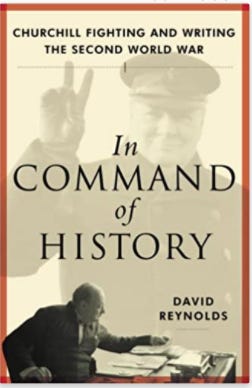
Reviewed Work: In Command of History: Churchill Fighting and Writing the Second World War by David Reynolds

Review by: Victor Feske

Journal of British Studies

Vol. 45, No. 3 (July 2006), pp. 708-710 (3 pages)

Published by: Cambridge University Press on behalf of The North American Conference on British Studies

https://www.jstor.org/stable/10.1086/507254?seq=1#metadata_info_tab_contents

After Mr. Stephens self-congratulatory framing, begins his polemic:

Two of those phrases — “broad, sunlit uplands” and “the abyss of a new Dark Age” — should ring in our ears as we approach the end of this hinge year in history.

Broad, sunlit uplands are the women of Iran tearing off their hijabs the way the people of Berlin once tore down their wall. And Ukrainian soldiers raising their flag over Irpin, Lyman, Kherson and other cities liberated from Russian barbarism. And Chinese protesters demanding — and gaining — an end to their regime’s cruel and crazy Covid lockdowns by holding up blank sheets of paper, where nothing needed to be written because everyone already knew what they meant.

And then riffs on his themes of “broad, sunlit uplands” and “the abyss of a new Dark Age” some selective quotation:

First ‘“broad, sunlit uplands” …

Broad, sunlit uplands were Emmanuel Macron’s victories over the fascistic Marine Le Pen in France.

Broad, sunlit uplands are a Covid fatality rate that, in America, no longer spikes a few weeks after case counts do.

They are the lofting of a telescope that lets us peer far into the reaches of space and back to the beginning of time.

This isn’t just a laundry list of the year’s good news. It is a demonstration of the capacity of people across cultures and circumstances to demand, defend and define freedom; to defy those who would deny it; and to use freedom to broaden the boundaries of what we can know and do and imagine.

Second :We continue to stare into the abyss of a new Dark Age

The complacent include those who imagined we could leave Afghanistan to the Taliban and suffer no wider consequences.

Vladimir Putin’s second invasion of Ukraine, on Feb. 24…

The complacent include those who thought that we could trade our way to a form of perpetual peace…

Lenin may not have said that “capitalists will sell us the rope with which to hang them,” but it’s remarkable how the point never seems to be learned by successive generations of capitalists.

In summation:

The complacent are those who think that no vital American interest is at stake in a Ukrainian victory or in the outcome of the Iranian demonstrations. Or that China’s recent travails, along with Russia’s setbacks in Ukraine, might dissuade Xi Jinping from trying to seize Taiwan. Or that a corner has been turned on inflation. Or that the surging wave of migration across the southern border, sparked by a collapse in governance throughout much of Latin America, is some peculiar right-wing obsession rather than a genuine crisis that will incite a furious populist backlash if it isn’t competently managed.

The Complacent are the Fellow Travelers, that Joe McCarthy inveighed against, with his ‘List Of Names’, so long ago. The Battle Cry of Neo-Conservatives in the Political Present, allied to the threat of the rise of ‘The Left in Latin America’ , and a possible American ‘competent management’ – in sum Mr. Stephens offers the backward glance of political nostalgia, as a balm against ineluctable facts, in a grandiloquent frame.

Political Observer

Posted in Uncategorized | Leave a comment

@nytdavidbrooks celebrates the Martial Spirit, via Neo-Nazi front man Zelensky. Or the repurposing of Fourth of July picnic rhetoric!

Political Cynic comments.

Some selections from Mr. Brooks long apologetic for the Nazi Front Man Zelensky, in an almost breathless, or better yet a wan pastiche of historical style:

The cameras mostly focused on Volodymyr Zelensky during his address to Congress on Wednesday night, but I focused my attention as much as I could on the audience in the room. There was fervor, admiration, yelling and whooping. In a divided nation, we don’t often get to see the Congress rise up, virtually as one, with ovations, applause, many in blue dresses and yellow ties.

Sure, there were dissenters in the room, but they were not what mattered. Words surged into my consciousness that I haven’t considered for a while — compatriots, comrades, co-believers in a common creed.

Zelensky and his fellow Ukrainians have reminded Americans of the values and causes we used to admire in ourselves — the ardent hunger for freedom, the deep-rooted respect for equality and human dignity, the willingness to fight against brutal authoritarians who would crush the human face under the heel of their muddy boots.

Zelensky was not subtle about making this point. He said that what Ukraine is fighting for today has echoes in what so many Americans fought for over centuries. I thought of John Adams, Frederick Douglass, Theodore Roosevelt, George Marshall, Fannie Lou Hamer, the many unsung heroes of the Cold War.

This liberal ideal has been tarnished over the last six decades. Sometimes America has opposed authoritarianism with rash imprudence — the Bay of Pigs, Vietnam, Iraq.

American policy has oscillated between a hubristic interventionism and a callous non-interventionism. “We overdo our foreign crusades, and then we overdo our retrenchments, never pausing in between, where an ordinary country would try to reach a fine balance,”

Finding the balance between passionate ideals and mundane practicalities has been a persistent American problem. The movie “Lincoln” with Daniel Day-Lewis was about that. Lincoln is zigging and zagging through the swamps of reality, trying to keep his eye on true north, while some tell him he’s going too fast and others scream he’s going too slow.

For his part, Biden doesn’t fit the romantic “West Wing” fantasy that many progressives have in their heads.

The military struggle in Ukraine might turn grim in the coming months, but both men are partly responsible for a historic shift in the global struggle against brutality and authoritarianism.

I’ll skip to the last two paragraphs of Mr. Brooks’ long moralizing apologetic for Zelensky:

On his first foreign trip since the war began, Zelensky came to America. It’s a reminder that for all the talk of American decline, the world still needs American leadership. It’s a reminder that the liberal alliance is still strong. It’s a reminder that while liberal democracies blunder, they have the capacity to learn and adapt.

Finally, Zelensky reminded us that while the authoritarians of the world have shown they can amass power, there is something vital they lack: a vision of a society that preserves human dignity, which inspires people to fight and binds people to one another.

Like so many of his fellow Neo-Conservatives, Mr. Brooks has no military experience, except as an apologist for American National Security State. What Reader can forget Mr. Brook’s ‘The Collapse of the Dream Palaces’ Iraq War Propaganda with it’s hero ‘20-year-old, Joey Tabula-Rasa’ ? This was War Propaganda at it’s most dull-witted, and Mr. Brooks’ ticket to the ‘Big Time’!

Or his most recent war mongering essay of July 15, 2021 under the title: The American Identity Crisis’ The final paragraph of this essay Brooks almost bares his fangs, against what used to be named fellow travelers, like Trump, and the unnamed ‘Left’!

If we’re going to fight Trumpian authoritarianism at home, we have to fight the more venomous brands of authoritarianism that thrive around the world. That means staying on the field.

Political Observer

Posted in Uncategorized | Leave a comment

@TheEconomist,’The West’, Economic Growth, Jane Austen, Barbara Cartland & ‘A serious, slow-burning malaise’.

Political Cynic wonders…

Finance & economics | First-world problems

Headline :How the West fell out of love with economic growth

Sub-headline : A serious, slow-burning malaise

https://www.economist.com/finance-and-economics/2022/12/11/how-the-west-fell-out-of-love-with-economic-growth

This Reader has to wonder, first, at the headline, that reads as if not defined by the refined Jane Austen, one of the measures of sophisticated Oxbridridger taste, but with an exhumation of Barbara Cartland, tinctured in Neo-Liberal apologetics. And a diagnosis of the ‘West’s slow burning malaise. This marriage of literary kitsch and sobering economic doom, only encourages doubt and or provokes derision? Not forgetting that the idea/notion of ‘The West’ as a political entity dates, most recently, from the Old Cold War.

The first paragraph offers:

This year has been a good one for the West. The alliance has surprised observers with its united front against Russian aggression. As authoritarian China suffers one of its weakest periods of growth since Chairman Mao, the American economy roars along. A wave of populism across rich countries, which began in 2016 with Brexit and the election of Donald Trump, looks as if it may have crested.

A selection of highlights of the ‘Corporatist Minds’ of The Economist scribblers:

Celebration America’s Proxy War in Ukraine, weak growth in China, America’s economy roars on, A wave of populism across rich countries… looks as if it may have crested…

What follows, is screeching Neo-Liberal hysterics, featuring the threat of ‘fast-ageing populations’ which focuses on the ‘benefits’ of a Social Security, in the once enlightened Western Nation States.

Yet away from the world’s attention, rich democracies face a profound, slow-burning problem: weak economic growth. In the year before covid-19, advanced economies’ gdp grew by less than 2%. High-frequency measures suggest that rich-world productivity, the ultimate source of improved living standards, is at best stagnant and may be declining. Official forecasts suggest that by 2027 per-person gdp growth in the median rich country will be less than 1.5% a year. Some places, such as Canada and Switzerland, will see numbers closer to zero.

Perhaps rich countries are destined for weak growth. Many have fast-ageing populations. Once labour markets are opened to women, and university education democratised, important sources of growth are exhausted. Much low-hanging technological fruit, such as proper sanitation, cars and the internet, has been plucked. This growth problem is surmountable, however. Policymakers could make it easier to trade across borders, giving globalisation a boost. They could reform planning to make it possible to build, reducing outrageous housing costs. They could welcome migrants to replace retiring workers. All these reforms would raise the growth rate.

The utterly failed Neo-Liberal Project and its highfalutin ‘Globalism’, and its enlightened ‘Supply Chains’ are subject to the self-forgetting of the writers, for this publication. In thrall to the 19th Century’s Bagehot , impersonated in the political present by Adrian Wooldridge, and his hymnal to political conformity ‘The Aristocracy of Talent: How Meritocracy Made the Modern World’ offers …

The Reader has still to confront the remaining 1,297 words! What rhetorical strategy might she adopt, in the face of this self-serving rhetorical avalanche? like the intelligent gardener, a careful weeding, and/or pruning’ offers a way forward? A selection sentences from each paragraph aid The Reader in her exploration.

Unfortunately, economic growth has fallen out of fashion.

Modern politicians are less likely to extol the benefits of free markets than their predecessors, for instance.

Politicians such as Lyndon Johnson, Margaret Thatcher and Ronald Reagan offered policies based on a coherent theory of the relationship between the individual and the state.

Apathy towards growth is not merely rhetorical. Britain hints at a wider loss of zeal. In the 1970s the average budget contained tax reforms worth 2% of gdp.

Our analysis of data from the World Bank suggests that progress has slowed still further in recent years, and may even have reversed (see chart 2)

Governments have also become less friendly to new construction, whether of housing or infrastructure. Governments are spending a lot more on welfare, such as pensions and, in particular, health care.

This is likely to reflect tougher land-use policies and more powerful nimbys.

Politicians prefer splurging the proceeds of what growth exists.

Politics is increasingly an arms race, with promises of more money for health care and social protection. “Thirty or 40 years ago it was taken for granted that the elderly were not good candidates for organ transplantation, dialysis or advanced surgical procedures,” writes Daniel Callahan, an ethicist.

The above is about the drain of resources of Modern Medicine are wasted on ‘the elderly’!

People may see spending on health care and pensions as self-evidently good. But it comes with downsides.

Perfectly fit older people drop out of work to receive a pension. Funding this requires higher taxes or cuts elsewhere. Since the early 1980s government spending across the oecd on research and development, as a share of gdp, has fallen by about a third.

We have previously estimated that Uncle Sam is on the hook for liabilities worth more than six times America’s gdp.

No one cheers when a company goes bankrupt or someone falls into poverty. But the bail-out state makes economies less adaptable, ultimately constraining growth by preventing resources shifting from unproductive to productive uses.

Why has the West turned away from growth?

Yet Western populations have been ageing for decades, including during the reformist 1980s and 1990s

The above ‘ the reformist 1980s and 1990s’ i.e. the decades of the rise of The Neo-Liberal Swindle.

In 1936 Franklin Roosevelt, speaking about opponents to his New Deal, felt comfortable enough to “welcome” his opponents’ hatred. Now the aggrieved have more ways to complain. As a result, policymakers have greater incentive to limit the number of people who lose out, resulting in what Ben Ansell of Oxford University calls “countrywide decision by committee”.

FDR’s New Deal, and ‘Ben Ansell of Oxford University calls “countrywide decision by committee”… Isn’t that the very definition of the Democratic process?

The Reader has to quell her doubt, or should it be named cynicism, at the final paragraph, of this rambling exercise in bloated polemic. A ‘new direction’ is as unclear to The Economist’s committee of scribblers, as it is to The Reader.

Quite what would push the West in a new direction is unclear. There is no sign of a shift just yet, beyond the misguided attempts of Mr Trump and Ms Truss. Would another financial crisis do the job? Will a change have to wait until the baby-boomers are no longer around? Whatever the answer, until growth speeds up Western policymakers must hope their enemies continue to blunder.

Political Cynic

Posted in Uncategorized | Leave a comment

If you read this blog, and are interested, please follow my blog at Substack.

StephenKMackSD

StephenKMackSD’s Newsletter

https://stephenkmacksd.substack.com/

Thank you!

Regards to my readers

StephenKMackSD

Posted in Uncategorized | Leave a comment

Adam Tooze, with help from Hegel & Intellectual Poser Francis Fukuyama, produces a Political/Philosophical History in Aspic, with Putin as his Anti-Hero

Political Cynic scoffs!

The reader, before she attempts to read Mr. Tooze’s 3,415 word essay, might profit from reading Molly Fischer’s essay at New York Magazine.

https://nymag.com/intelligencer/article/adam-tooze-profile.html

Ms. Fischer’s essay at 5,224 words wallows in Fan Magazine gush, that informs the magazine’s readers what they should ‘think’ about Mr. Tooze, and his Fan Base! this magazine tells its readers where to eat, it keeps its readers current on the most watched television/internet programs, and its political columnists keep their readership up to date on what they should think about politics, and Madam Clairvoyant…, the latest bargains on clothes, shoes and other commodities that a New York magazine reader might need- Its a would be Silver-Fork Handbook for those who live and die by the latest trends, in the life of the New York cognoscenti, or its pretenders. The pretense of being dans la mode is the lingua franca of New York social life!

Mr. Tooze in his near historically sophisticated essay, though he can’t quite match the talent of Janan Ganesh for such rhetorical curlicues, and stylistic panache, as cover for his reactionary politicking! Mr. Tooze manages to impress with adroitly executed, not to speak of its intellectual/philosophical breath, of his particular expression of a History Made to Measure! These paragraphs demonstrates Mr. Tooze’s facility, to engage in historical pastiche of near understatement?

It was the French Revolution that defined the stakes in modern war as an existential clash between nations in arms, in which fundamental principles of rule were in question. War was the world spirit on the march. That is what the German poet Goethe thought he witnessed at the Battle of Valmy in 1792, where a rag-tag revolutionary army unexpectedly turned back a much better-equipped counter-revolutionary invasion by royalist and Prussian forces. “From this day forth,” he wrote, “begins a new era in the history of the world.” Two days later, the French Republic was declared.

A “world-soul” on horseback is what Hegel thought he saw, as Napoleon cantered through the city of Jena in October 1806 on his way to the battle that would push the Prussian state to the brink of extinction. War was not simply a violent practice of princes, a duel writ large. War was History with a capital H – the “slaughter-bench”, Hegel would call it – “at which the happiness of peoples, the wisdom of States, and the virtue of individuals have been victimised”. It was something both fascinating and horrifying. Transformative and yet also on the edge of tipping over into absolute violence, as in the horrors of guerrilla war in Spain, depicted by Goya. Two centuries later, in the commentary on the war in Ukraine, one can feel the same spirit stirring.

The spectacle of war has always evoked mixed emotions. On the one hand, enthusiasm and something akin to relief: here, finally, is real politics, real freedom. And, on the other hand, horror at the violence, suffering and destruction.

In the wake of Waterloo in 1815, both diplomacy and contemporary social science tried to put the genie back in the bottle. For all his grandeur, Napoleon had been defeated. Millions had died in the global wars sparked by the French Revolution, and his project of modernising empire had come to naught. The lesson, according to the followers of the sociologist Auguste Comte, was that the future belonged to industry, not to the soldiers.

https://www.newstatesman.com/ideas/2022/04/war-at-the-end-of-history?utm_medium=Social&utm_source=Twitter#Echobox=1649426638

Later in his essay Mr. Tooze engages in this explanation of American Seer Francis Fukuyama:

That this terrifying stand-off ended with the largely peaceful overthrow of the communist regimes in Europe in 1989 persuaded Francis Fukuyama, then a member of the policy planning staff at the US State Department, that we had reached “the End of History”. This is often described as a triumph of capitalism and democracy. It was certainly that, but no less significant was that the West had won the military contest without firing a shot in anger. The Warsaw Pact folded. By the time of Leonid Brezhnev, from the 1960s onwards, the Soviet system no longer seemed worth dying for. Mercifully, that spared Nato the question of whether the world was better off dead than red.

Anchored in American power and depoliticised neoliberalism, Fukuyama’s vision of the End of History remains a compelling interpretation of the decades since the fall of the Berlin Wall. The ideological contest seemed settled in favour of a one-dimensional vision of liberal democracy, the rule of law and markets.

The achievement of the End of History consisted in not just the triumph of the liberal model, but in that it was attained bloodlessly. That gave it both its sense of inevitability and, as Fukuyama wrote, its post-heroic quality.

Of course, the End of History did not mean the end of events or the end of war. That threat of nuclear destruction continued to hang over us. Under the de-targeting agreement of 1994, the coordinates of major cities were removed from the computers of Russian and American intercontinental ballistic missiles (ICBMs). But they could be loaded back if required. We still live under the menace of absolute atrocity. Meanwhile, actual wars have continued to be fought. But war has changed

A Strussian offers a warmed over Hegelianism, and the American Intellectual/Philosophical Provincials were instantly smitten by Fukuyama’s World Historical Merde. And what does ‘depoliticised neoliberalism’ represent but an utter lack of intellectual honesty, in service to self-promotion of Mr. Tooze – to establish his political conformity. This whole essay is awash in that imperative.

More History Made to Measure foreshortened:

The Iran-Iraq War of the 1980s was perhaps the last conflict in which two sides commanding substantial armed forces had everything at stake; any means could be mobilised to secure victory and neither side could afford to lose. The bloodiest wars in more recent decades – notably those in the former Yugoslavia, central Africa and Syria – were sprawling civil wars, often involving multiple non-state actors. In Iraq and Afghanistan the stakes were existential, but only for the locals. The US, which led the invasions, was shaken by the 9/11 attacks, but the global war on terror was always more of a policing action than a conventional war.

The Reader has arrived, after Mr. Tooze groundwork has been laid from the large canvas to the mere sketch, at Putin:

The question posed by Vladimir Putin’s invasion of Ukraine is whether in this fundamental sense the spell of the End of History has finally been broken. Has history restarted in a tragic key, as President Macron has recently put it? Have we reached the end of the end of military history?

The answer we give to that question initially depends on the interpretation of Putin’s motives.

There is yet 2,379 words left in Mr. Tooze’s polemic against Putin, still framed by ‘The End of History’, a crippled antique by a Staussian foot-soldier. The topic sentences of the remains of this essay, offer some vital clues as to the arguments Mr. Tooze marshals. Note that Mr. Tooze employs the Straussian rhetorical strategy of exhausting both the critical acuity of The Reader, and her patience!

The most obvious reading is that he has never accepted the verdict delivered by history in 1991.

But if this is his basic motivation why in 2022 was he willing to risk the ultimate trial of battle?

One argument is that Putin gambled because he is a man of war.

This embrace of war leads some analysts to describe Putin as a man of the 19th century.

These are pleasingly simple ideas.

The defining characteristic of the Russian invasion, other than its brutality, is the sense of history repeating itself as farce.

In this reading, far from rupturing the End of History, or forcing a return to primal conflict, Putin saw himself as adjusting an anomaly created by the overthrow of Ukraine’s pro-Russian Viktor Yanukovych government in 2014.

Perhaps the most telling moment came when the US secretary of state, Antony Blinken, denounced Putin’s invasion of Ukraine as a “war of choice”.

Putin’s invasion and the attack on Iraq in 2003 by the US-led coalition have in common a disregard for both international law and geopolitical logic that left much of the rest of the world aghast.

In the war in Ukraine, the wildcard is the Ukrainians.

But we should beware our Eurocentric prejudices.

What marks this war as different is that the Ukrainian resistance has stopped Putin’s invasion in its tracks.

The result is that Putin awakens from the resentful nightmare of Russia’s post-Cold War memory into a bona fide, existential crisis, a “real war” that the Russian army is far from certain of winning

Again, the experience of defeat and discredit on the part of the larger power is not itself novel.

To escape the nightmare, Putin may choose to escalate the invasion, even toying with the nuclear option

Putin may have challenged the post-Cold War order but, given the liminal status of Ukraine – neither a member of the EU nor of Nato – and the underwhelming performance of the Russian military, which makes an attack on the Baltics or Poland seem unlikely, it is up to others, principally China and the Western alliance, to decide what to make of this clash.

Ukraine, of course, has every interest in using the momentum of its early successes to widen the conflict.

Clearly, if it so chose, Nato could turn this war into World War Three.

Putin’s allegation that Ukraine was being developed as a base from which to strike at the soft underbelly of Russia seems less plausible now than it did before the war.

Although Joe Biden has blurted out his indignation that bad characters like Putin are in charge of modern states, the West remains shy about embracing regime change as its ultimate goal

As critics of the interwar order like Carl Schmitt sensed, the hegemony of the victorious powers in 1918 threatened the first End of History.

In 2022, if Putin were to be brought down by military frustration and economic exhaustion, and were his regime to be replaced by one that was pro-Western and ready for peace, all those who have levelled cheap criticism at Fukuyama over the years would owe him a giant apology

However, if the war does not escalate to a Third World War and Putin’s regime does not collapse, there will be no option but to face the difficult business of diplomacy and peace-making

Mr. Tooze demonstrates that he is a political/moral conformist, he is not John Mearsheimer, but another of a long line of apologist for the murderous political interventionism, of the Centrism of the political present: the alliance between the Neo-Liberals and the Neo-Conservatives!

***************************

Not to the reader:

On question of Hegel, let me offer my experience of trying to read The Phenomenology of the Spirit: I was stopped at entry 243, as I recall it in utter bewilderment, and then read Hegel’s Idea of a Phenomenology of Spirit by Michael N. Forster. It took me months to read this book, impressive doesn’t quite cover the scope of Prof. Forster scholarship.

Political Cynic

Posted in Uncategorized | Leave a comment

Sanctions and the fate of Globalism/Neo-Liberalism.

Political Observer’s sketch.

Its as if the concepts/practices/institutionalized twins of Globalism/Neo-Liberalism, will now be partially dismantled, in the name of Anti-Russian Hysteria: favored @TheEconmist, @FT, @bopinion , @NYT, & other Corporate apologists like @gideonrachman, @martinwolf_ ? The very fate of that Post War bulwark, against Soviet revanchism, the ‘Common Market’ , a coal and steel cartel, and its Technocrat Supreme Jean Monnet, that ‘evolved’ into the teetering E.U., might be sacrificed on the pyre of Sanctions?

Even the facts that Europe is still dependent on Russian gas, or that the ruble is strong, doesn’t factor into the policy decisions, of the Neo-Cons advisors of Biden: Antony Blinken, Wendy Sherman, Victoria Nuland, Jake Sullivan? Or that Biden’s own utterly obvious ‘cognitive deficit’, to speak in the patois of bourgeoise political commentary- or the fact that the New Democrat’s redoubtable hawk, Senator Diane Feinstein, whose own ‘cognitive deficit’ has become a topic of discussion…

Political Observer

Posted in Uncategorized | Leave a comment

The tireless self-promoter Mr. Fukuyama! A comment by Political Observer.

Mr. Fukuyama was never a ‘Conservative’, as announced in the link to this interview, but a Staussian i.e. a Neo-Conservative, and a maladroit plagiarist of Hegel. He , in his 2013 essay ‘The Decline of American Political Institutions’ attacks the meliorism of the whole of the American Politics of the 20th Century ! This was not ‘Conservatism’ using the most capacious practice of an attempt at measurement.

The Decay of American Political Institutions

His career as Political Seer is built upon ‘Straussian Principals’ the misbegotten child of Leo Strauss’ attempt to rewrite the History of Philosophy. Strauss held the key to the divination of that Tradition, all else were mere pretenders. Mr. Fukuyama is still trading on that Staussian Revelation.

Political Observer

Posted in Uncategorized | Leave a comment