Katie talks to current MP and former Labour Party leader Jeremy Corbyn about the resignation of Keir Starmer, the Labour Party leader who smeared Corbyn as an antisemite, expelled him from the party, and then imposed a pro-war austerity agenda and enabled the Gaza genocide. Katie also talks to Jeremy about his Bill for an independent inquiry into Britain’s complicity in genocide.
Jeremy Corbyn is former Labour Party leader, current Member of Parliament for Islington North, the founder of the Corbyn Project and Parliamentary Leader of Your Party.
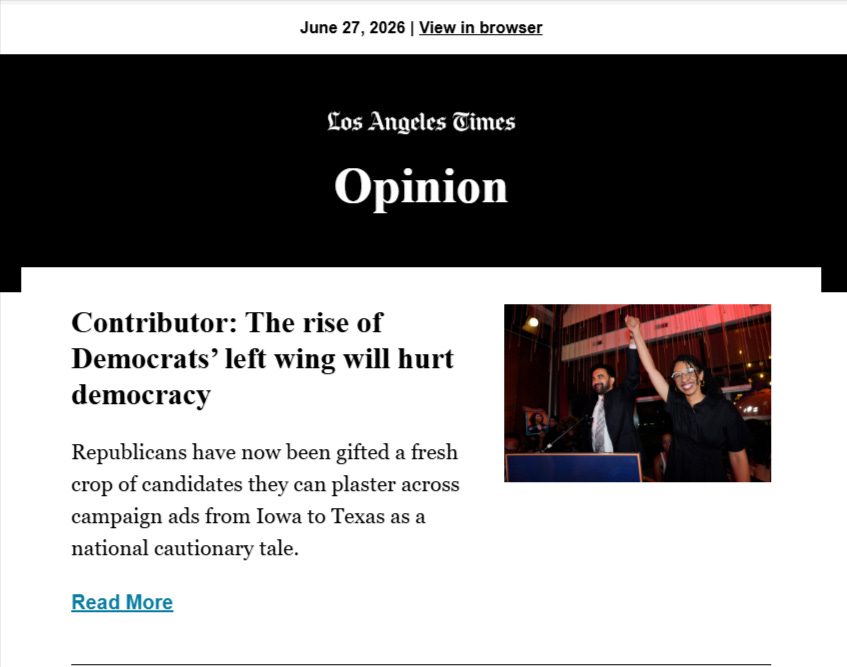
All the candidates the mayor backed won their primary races on Tuesday, enhancing his political clout in the city and the state.
The big winner in the Democratic primary was Mayor Zohran Mamdani, and he wasn’t on the ballot.
He had backed Brad Lander, a former New York City comptroller, who won a closely watched race against Representative Dan Goldman in a district in Lower Manhattan and Brooklyn. Lander ran to the left of Goldman. Mamdani and his allies, in an aggressive push to expand the power of progressives, had taken issue with Goldman’s support for Israel.
Mamdani’s influence also paid off in the race for the House seat in Brooklyn and Queens that is being vacated by Representative Nydia Velázquez. There, the candidate he had backed — Claire Valdez, a Texas-born democratic socialist serving her first term in the State Assembly — defeated the Brooklyn borough president, Antonio Reynoso, who had been a Mamdani ally.
…
Mamdani’s push to capitalize on his popularity and put more progressives on the ballot strained relationships with the left-leaning Working Families Party and labor unions. It also led to tensions with Representative Hakeem Jeffries of Brooklyn, who is in line to become speaker if the Democrats win control of the House in November. Grace Mausser, a co-chair of the New York City Democratic Socialists of America chapter, said on NY1 on Tuesday that she hoped that Jeffries had learned this from the results: “Americans are tired of status quo politics.”
…
Editor: The Cult of Francis Fukuyama will never die! Matthew Yglesias,Claire Ainsley, and Yascha Mounk are the last of the just?
Will you be in Washington, D.C. on Wednesday July 15? I will be interviewing Francis Fukuyama about how liberalism should respond to the postliberal threat. Find out more and get your free ticket here! —Yascha
Recall Mr. Zuckerberg’s triumphant ‘Listening Tour’ ?
Headline: Mark Zuckerberg says extent of opioid crisis was biggest surprise of US tour
Sub-headline: Speaking about his 30-state tour that sparked rumors of a presidential run, the Facebook CEO added: ‘We have a responsibility to remain optimistic’
During which the line of ass-kissers was long, when he lectured that the ‘Opioid Crisis’and ‘a responsibility to remain optimistic’ were his primary concerns. This in the wake of the election of Trump, in 2016, clearly demonstrates that Zuckerberg was politically out of touch and out of his league. Not to speak of his subsequent appointment of ‘Lean In’ corporate hack Sheryl Sandberg to CEO of Facebook. Here is Sandberg celebrated in the pages of Forbes in 2013:
Headline: 10 Things Sheryl Sandberg Gets Exactly Right In ‘Lean In’
The headline writers/editors have gotten carried away and misrepresent Mr. Rachman’s essay, by the way of the headline and sub-headline
Headline:Facebook is the world’s most powerful adolescent
Sub-headline: And like many teenagers, it needs to be set some rules
Mr. Rachman’s accusation:
Facebook’s founder Mark Zuckerberg was once reluctant to acknowledge the company’s political power — initially rejecting the idea that fake news on Facebook influenced the 2016 election as “crazy”. This attitude may have been naive or disingenuous, but it was certainly not sustainable.
The Guardian published this in November 2016:
Headline: Facebook’s failure: did fake news and polarized politics get Trump elected?
Sub-headline: The company is being accused of abdicating its responsibility to clamp down on fake news stories and counter the echo chamber that defined this election
All The Free Marketer’s suddenly lose their cherished faith in that ‘Market’ as the ultimate test of viability? Should the reader take the object lesson from the New York Times’ publication of the pro-war propaganda, confected by Judy Miller and Scooter Libby, as an object lesson in reliance of the standards of journalism as practiced by Corporate Media?
Or this proclamation of Zuckerberg’s ‘brilliance’ or just call him a undergrad looking for and ‘rating’ ‘hot women’!:
At 35 years old, Mr Zuckerberg has proved himself to be a brilliant engineer and businessman.
The self-proclaimed ‘Internet Geniuses‘ need to be reminded, in the starkest terms, that they owe their very existence to the U.S. Government. And its invention of the internet! That they used and use to conduct their ‘Revolution in Communication’ . And that they must compelled to follow one of the foundational freedoms of Free Speech guaranteed in the US Constitution. The corporate control of the internet has zero legitimacy, it is a Public Utility, not the playground of the aforementioned Geniuses, and their Corporatist ambitions. An Internet Bill of Rights is radical idea whose time is long overdue!
Oh my! Recall Mr. Zuckerberg’s triumphal tour of America, in which he proclaimed the ‘Opioid Crisis‘ as one of his most pressing political concerns, the other topic I can’t recall. A Politics of Non-Politics? As those Honorary Degrees were presented with great solemnity to The Internet Wunderkind. Or should we just call him an ugly duckling looking for dates?
The anguish of the defenders of respectable bourgeois ‘values’, especially coming from propaganda headquarters of the Free Market Mythology , The Financial Times, reeks of the self-exculpatory, if not utter hypocrisy: nothing new!
‘Shares fall’ is the central concern of this news story’s headline! Profit and Loss the central Capitalist dialectic. How to define that elusive Market Exceptionalism? Its permissible, until its practice offends what remains of the accepted bourgeois norms, that in a perverse way betrays that closely held Neo-Liberal Faith, of its stalwart advocates/apologists: then ‘let the heavens fall’ ! Consider the time lapse between the Zuckerberg triumphalism, to his fall from grace! 21 inch screen black and white TV melodrama.
As the internet is a public utility, overseen by profiteers of all stripes, like television, where was the FCC’s political/civic responsibility in holding public hearings, and writing laws , for Facebook and other internet companies that placed the public’s interest before all else? The FTC is exactly the wrong place for some pseudo-regulation, the pervasive and pernicious Neo-Liberalism rules our politics infected with Market Nihilism! The Free Market Mythology is a prima facie attack on the political responsibility of government, indeed the entirety of the republican tradition, to protect its citizens from the unscrupulous opportunist, in this case, under the cover of an idolatry for an ‘Internet Pioneer’
Twelve score and ten years ago—on July 4th 1776—the Second Continental Congress in Philadelphia approved the Declaration of Independence (signing would take weeks: this was before email). The United States of America, as the troublemakers styled their new creation, had already been at war with Britain for more than a year. Good King George III was not the tyrant of American legend, but we grudgingly admit that his insistence on asserting authority and raising revenue in the colonies helped turn protest into revolution.
The Declaration became America’s first great statement of liberal principle, espousing those Enlightenment ideals of natural rights and government by consent. It proclaimed that “all men are created equal”—though many of its signatories owned slaves. With rare exceptions, white women and black people were excluded from voting, as were many poor white men. Indigenous nations were ignored or exploited. The world’s first liberal republic was, in practice, a narrow aristocracy (without the noble titles). But, as George Washington said, the government’s true character would only emerge with time.
Reader: self-congetulation wedded to political mendacity is the primay goal of this attempt at an ersatz Historiography! This reader spent many years reading the political chatter of Micklethwait and Wooldridge, and their magum opus of ‘The Right Nation: Conservative Power in America’ of 2004 , an attempt at an unapologetic for Bush’ The Younger’s The War’s in Afghanistan and Iraq!
Editor: Stephens makes it easy to track his concluding paragraphs, political chatter via his underlining of what he thinks of as ‘key’ ? Though the final two paragraphs that enshrines Ronald Reagan as primay political actor! Yet in this political moment, what is compelling is the fact of Russian and Chinese ascendency, the utterly unexpected Iranian control of The Strait of Hormuz! Nor the ebbing nature , or better yet the decline of the cult of ‘Jean Monnet The First Statesman of Interdependence’ ?
To exist as a sentient American in the age of Trump is to live in a perpetual cringe — morally, aesthetically, intellectually, politically. If the administration were a play or film script, it would be neither farce nor tragedy but instead a kind of absurdist travesty, “Waiting for Godot” meets “Pulp Fiction” meets “Dumb and Dumber.”
However much we may disdain him, the president has the rest of us on the hook, as the face and voice of a country that ought to know better. Trump’s angry visage draped between the exterior columns of the Department of Justice? That’s us. His gilded, meretricious redecoration of the White House? That’s us. His repeatedly avowed admiration for Vladimir Putin? That’s us. His laughable claim about having achieved regime change in Tehran? That’s us. His Mafia-like threats against NATO allies? That’s us. His indescribably vain (and pathetically fruitless) effort to affix his name to the Kennedy Center? That’s us. His venal family profiting off his presidency in ways both transparent and tacky? That’s us.
The same goes for his insult of Meloni, which may be far from the worst of his sins but is also the most emblematic for being at once so utterly unnecessary as well as dementedly self-defeating. That’s us. The same country that freed its slaves, welcomed immigrants, invented airplanes, liberated concentration camps, landed men on the moon and challenged the Soviet Union to tear down this wall now bids to be the global equivalent of the expensively dressed man soiling his pants at a cocktail party.
For 10 years, I’ve watched my former political party work overtime not to cringe; to pretend that the Vesuvius of verbal infamies erupting daily from Trump’s mouth is either unimportant, or hilarious, or calculating and shrewd. Republicans turned their tolerance for the president’s mental goo into a shot-drinking contest — the more you drank, the manlier you were supposed to be. John McCain and Mitt Romney refused to play, to their everlasting credit; other Republicans, less admirably, did so only after Trump had ended their political futures.
But for 10 years, too, I’ve also watched the president’s opponents fail to appreciate the necessity of cringing — by understanding their role in Trump’s rise. The Democrats and their media enablers who, until June of 2024, insisted Joe Biden was fit for a second term (surely knowing, somewhere in the dim recesses of their minds, that this could only help Trump) are complicit. So are the progressives who, on one cultural issueafter another, shoved the Democratic Party so far to the left that it became the very caricature of what MAGA-world said it was.
Here, then, is our American challenge: Let’s not be afraid to cringe. Ronald Reagan predicted, correctly, that the Soviet Union would end up on the ash heap of history; now it’s our turn to risk winding up on the ash heap of idiocy.
Solet’s not look away from the parts we played in bringing America to this moment. Let’s remember who we once were, because it’s what we may yet be again — if only we feel the sting of our present shame.
Jean-Jacques Servan-Schreiber (born Feb. 13, 1924, Paris, France—died Nov. 7, 2006, Fécamp) was a French journalist and politician.
Servan-Schreiber volunteered in the Free French Army forces of Charles de Gaulle as a fighter pilot in 1943 and received the Cross of Valor for his services. In 1947 he graduated from the École Polytechnique. After serving as foreign affairs editor of the Paris daily paper Le Monde (1948–53), he founded and managed (1953–70) L’Express, a moderately left-wing weekly newsmagazine modeled on Time. The publication of L’Express was halted temporarily in 1954 when the magazine printed a top-secret government report. In 1956 Servan-Schreiber was drafted into the army, and the experience formed the basis of his first book, Lieutenant en Algérie (1957; Lieutenant in Algeria), which exposed French atrocities in the Algerian War of Independence. The controversial book was later credited with helping turn French public opinion against the Algerian conflict. In Le Défi américain (1967; The American Challenge) he warned against Europe’s becoming merely an economic colony of the United States. An immediate best seller, the work was eventually translated into more than 20 languages.
Servan-Schreiber was secretary general of the Radical Party (1969–71) and president (1971–75, 1977–79). His Ciel et terre: Manifeste radical (1970; The Radical Alternative, 1970) is a party manifesto. Elected as a deputy to the National Assembly in 1970, he served briefly as minister of reforms in the government of President Valèry Giscard d’Estaing but was ousted for opposing government policy on nuclear testing.
Servan-Schreiber founded the Mouvement Réformateur (“Reform Movement”) in 1972 with Jean Lecanuet and once again served briefly as minister of reforms in June 1974. He was president of the Regional Council of Lorraine from 1976 to 1978, and in 1979 he founded the Groupe de Paris (“Paris Group”), in conjunction with which he published Le Défi mondial (1980; The World Challenge, 1980). He also continued in the 1970s to be associated with the direction of L’Express. From 1988 to 1994 Servan-Schreiber was a professor at Carnegie Mellon University in the United States.
Quick Facts
Born:
Feb. 13, 1924, Paris, France
Died:
Nov. 7, 2006, Fécamp (aged 82)
Other publications of Servan-Schreiber include Les Réveil de la France (1968; The Spirit of May, 1969), a collection of editorials examining causes of the student uprisings in France in 1968; Forcer le destin (1970; “Forcing Destiny’s Hand”); Le Pouvoir régional (1971; “Regional Power”); Appel à la reforme (1971; “A Call to Reform”); L’Arme de la confiance (1976; “The Weapon of Confidence”); and Le Manifeste (1977; “The Manifesto”).
Sir Keir Starmer is a prisoner of the politics he pledged to end
When rigmarole becomes reality
Of all the distortions and deceits that Sir Keir Starmer deployed in order to reach Downing Street, one stands out. It was not the promise of free tuition fees offered to left-wing Labour members, ditched after the leadership contest was over. It was not the solemn pledge to forgo tax rises on income, vat or national insurance made at the last election, which will be smashed in the budget on November 26th.
It was the promise of stability. Sir Keir pledged to “stop the chaos”. Britain, he argued, was a prisoner of Westminster rigmarole. After a decade of Conservative instability, featuring minority governments, a carousel of chancellors and Britain’s first six-week prime minister, a Labour government would bring serenity, he pledged. “We’re all stuck in their psychodrama,” said Sir Keir. “All being dragged down to their level.”
In a way, Sir Keir was more right than he knew. On November 12th officials in Downing Street accused Wes Streeting, the health secretary, of planning to oust the prime minister. Mr Streeting labelled his accusers conspiracy theorists who were trying to “kneecap” him. In the space of 16 months Sir Keir’s government has managed to accumulate a stench of death that it took his Conservative predecessors a good decade to build up. Rigmarole is ascendant once more.
A man who set out to slay rigmarole has seen his government swallowed by it. It starts in the place Sir Keir still, for now, calls home. Briefings against Mr Streeting stemmed from people Sir Keir appointed. Downing Street has been in disarray since Sir Keir entered office, with a constant stream of sackings, surprisingly short tenures and ill-tempered briefings about senior advisers and, increasingly, cabinet ministers. It is a bad record for a prime minister who prided himself on being a bureaucrat. A nasty office is one thing in the private sector; it is quite another when it is supposed to be running a g7 country.
Relationships at the top of government are not just a matter for gossip. After all, Sir Keir is merely first among equals in cabinet and must rely on persuasion rather than power. The problem is that the other people at the coffin-shaped table see the prime minister as more of a lesser. Cabinet ministers regard him with increasingly ill-disguised contempt. Discipline is close to breaking down. During a reshuffle in September Ed Miliband, both the closest thing Sir Keir has to a friend at the top of politics and a potential replacement, was asked to move jobs. He refused. It is not just Mr Streeting in cabinet who thinks they could do a better job than Sir Keir. And they might be right.
Keir Starmer should be Britain’s next prime minister
Why Labour must form the next government
Jun 27th 2024
YOU WOULD never know it from a low-wattage campaign but after 14 years of Conservative rule, Britain is on the threshold of a Labour victory so sweeping that it may break records. No party fully subscribes to the ideas that The Economist holds dear. The economic consensus in Britain has shifted away from liberal values—free trade, individual choice and limits to state intervention. But elections are about the best available choice and that is clear. If we had a vote on July 4th, we, too, would pick Labour, because it has the greatest chance of tackling the biggest problem that Britain faces: a chronic and debilitating lack of economic growth.
Consider first the alternatives. We can discard some immediately. The Scottish National Party wants to dismember Britain, not run it. The Greens make student politics look rigorous. Reform UK, Nigel Farage’s outfit, offers a fevered, nativist vision of Britain that would accelerate the very decline it says it is striving to prevent.
What of the Liberal Democrats? The logic that led us to endorse them in 2019 no longer holds. Against Boris Johnson’s Brexit-obsessed Tories and Labour under Jeremy Corbyn, a hard-left charisma vacuum, they were the only choice. Today the Lib Dems still have some good policies—letting asylum-seekers work, say, or a new land-value tax—but they have become more sceptical on trade and even more nimbyish on planning. The Lib Dems do not aspire to be a credible party of government; they are barely credible as liberals.
Trying to make the case for the Tories is like a teacher struggling to say something nice about the class troublemaker. They have done some good things: on educational standards, on regional devolution and on the tax regime for capital investment. Rishi Sunak is a better prime minister than Liz Truss, though if praise came any fainter it would be invisible. The pandemic and the invasion of Ukraine—where they also did well—vastly complicated their time in office.
…
That is the negative case for voting Labour, but there are positive arguments, too. The first is that the party has been transformed. Since the last election Sir Keir Starmer has expelled Mr Corbyn, rooted out many of his fellow travellers and dragged Labour away from radical socialism. The Economist disagrees with the party on many things, such as its plan to create a publicly owned energy provider. But elections are when voters mete out rewards as well as punishments, and Labour’s reinvention deserves credit.
Readers recall this defamation of Jeremy Corbyn of Sep 19th 2015 in the The Ecocomist?
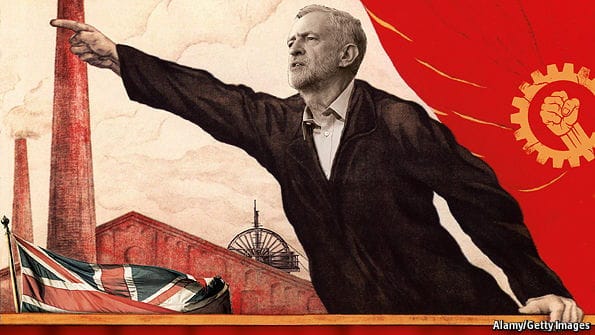
Jeremy Corbyn is leading Britain’s left into a political timewarp. Some old ideological battles must be re-fought
Sep 19th 2015|5 min read
BEFORE he had finished belting out his first celebratory rendition of “The Red Flag”, a hymn to class struggle, some of Jeremy Corbyn’s colleagues in Labour’s shadow cabinet had already handed in their resignations. A 66-year-old socialist, Mr Corbyn has spent 32 years as one of the hardest of hardline left-wingers in the House of Commons and a serial rebel on the Labour backbenches. On September 12th he flattened three moderate rivals (see article) to become leader of Britain’s main opposition party. Labour MPs are stunned—and perhaps none more so than Mr Corbyn himself.
The second positive reason to back Labour is its focus on growth. The party is right in its diagnosis that nothing matters more than solving Britain’s stagnant productivity. Its young, aspiring, urban supporters will give it permission to act in ways that the Conservatives have avoided. The most obvious of these is building more houses and infrastructure, and forging closer relations with Europe. The party of public services may also have more latitude to reform them than the Tories would.
The question that hangs over Labour is how radical it will be in pursuit of growth. It has run a maddeningly cautious campaign, choosing to reassure voters rather than seek a mandate for bold change. It does not help that Sir Keir, having been in Mr Corbyn’s shadow cabinet before ejecting him, seems to turn with the wind. Having strenuously avoided the subject in the campaign, a Labour government will need to raise taxes (as would a Conservative one if it was not to wreck public services). For all these reasons, having failed to set out a vision to steer by, prime minister Starmer could more easily be blown off course by events or sidetracked by growth-stifling left-wing preoccupations, such as beefing up workers’ rights, stamping out inequality and doling out industrial subsidies.
Stiffen the sinews, summon up the blood: (Editor: This is Pure Agitprop or a restatement of watered down Oswald Mosley? )
Sir Keir’s answer to this criticism of him as a campaigner should be his determination and competence in office. His method is to work relentlessly towards a goal, ratcheting up pressure as he goes. After years of post-Brexit Conservative ideological lurches, that in itself will be worth something. If Labour also succeeds in overhauling the planning regime, strengthening ties with Europe, giving fiscal power to cities, focusing the Treasury on growth and rationalising the tax system, the picture will brighten and Britain will be better off. Sir Keir and his party have earned the chance to try. ■
Editor: Mr. Snyder offers this in his first 1115 word diastribe, a cast of bad actors !
Trump’s capitulation before to Iran leads us back to what Trump really cares about: not losing any of his power in the congressional elections of this November.
He had to surrender for the basic reason known to all serious students of war: the Iranians were able to affect his political situationmore than he was able to affect theirs. Now, the “deal” is a mess, and the “process” is a mess, and the war in some way might continue. But the terms to which Trump has already agreed are a capitulation; and as time passes he will, if anything, have to settle for something even worse. He might be irritated by this or that, or disrupted by yet another Israeli attack in Lebanon (or Gaza), or delayed by all the money made by his friends. But he will surrender as quickly as he can (as he has now shown) because the clock to the November elections is ticking.
As an aspiring tyrant in a flawed democracy, he has to be concerned about the economy in general and gasoline prices in particular. The Iranians knew this and exploited it. But the fact that Trump capitulates to Iranians does not mean that he will abandon the utopia of violence as such. He has never really had a problem with subordinating himself to foreign dictators; lacking any sense of personal shame or any notion of American patriotism, he can shrug off defeat to Iran, just as he accepts everyday obedience to Russia. What matters to him is the convenience and comfort that comes from the presidency, and that logic leads directly to another use for the American armed forces: to intervene in the midterm elections this November or the presidential elections two years from now.
Such a move would be in keeping with Hegseth’s career and thought. Like Trump, Hegseth lacks any sense of what the interests of the United States as such might be. His ideological purge of the top officer ranks is inconsistent with battlefield success; it is consistent with the aim of creating a Trumpian praetorian guard whose only mission is to intimidate Americans. Indeed, the natural trajectory of the Department of Defense under a complete incompetent such as Hegseth (whether he explicitly wishes this or not) is to render the armed forces capable of little more than civil war against fellow citizens.
Hegseth is concerned only with the general idea of enemies, and for him the main enemies are Americans. He does not believe in the Constitution: for him, any rights come from God, and he decides whom God protects. “Sometimes,” he writes, “the fight must begin with a struggle against domestic enemies.Those who would violate the Covenant that binds us as a community of faith and that grants us blessing.” He tells us that “the Left” plans “utter annihilation” for everyone else, which of course would justify annihilating Americans defined as “the Left” first. Hegseth makes it quite clear that the violence he wants is directed against other Americans: “In more ways than you can imagine, leftists have surrounded traditional American patriots on all sides, ready to close in for the kill: killing our founders, killing our flag, and killing capitalism. The only option for survival in a near ambush is to charge; to close with, and destroy, the enemy.”
Reasonable people can draw a reasonable lesson from defeat in Iran: even putting ethical questions aside, violence will not lead where you think. History, however, instructs us fairly clearly about how utopians of violence interpret defeat in foreign war: they blame an “enemy “at home for their own poor judgements and failures, and then claim that this enemy must now be defeated. The poor performance of the armed forces cannot be explained by their own ideological folly or their own manifest incompetence; it must be the fault of someone else. It will be quite easy for Trump and Hegseth (and Vance) to shift from their current (and risible) claim that we won the war to the claim that we would have won it if not for the stab in the back at home. And that way of seeing things then becomes the justification for putting soldiers (and ICE) on the streets during an election, or claiming that a terrorist attack (most likely a fake one) means that we have to have a state of emergency instead of an election, or something else along those lines.
That is where the minds of Trump and Hegseth (and Vance) are likely to go. Vance, too, is a utopian of violence; he believed that invoking the Insurrection Act and deploying troops in Minnesota would have crushed protests and brought stability. This is unlikely; the use of violence, at home even more than abroad, opens new avenues of unpredictability, and almost never goes where you think it will go. But Trump, Hegseth, and Vance have not thus far shown themselves to be people who recognize basic social realities; they do not question their own utopias of violence, but only the motives of anyone who notes their folly. Just as they were overcome by strong feelings that violence would change Iran the way that they wanted, they will likely have strong feelings that violence in America will change America the way they want. This is very unlikely to be true; the utopianism, the faith in feelings, puts the republic in danger. But Trump and Hegseth (and Vance) are unlikely to see matters that way.
And so the rest of us have a simple duty: to recognize the utopias of violence, to note the risk to the republic. The fact that Trump and Hegseth (and Vance) are thinking about using violence at home does not mean that it will actually happen. Seeing a utopia of violence for what it is makes it far less likely to be realized. Indeed, the only way we get to soldiers at voting booths is by determinedly looking away and pretending that this isn’t what Trump and Hegseth (and Vance) wish for.
Utopian thinking can be a sign of weakness rather than strength, as it is in this case. Trump is extremely unpopular, as was his war, as are his policies generally. His charisma depends on a televisual projection of strength, but he just lost his whimsy war and looks terrible. The men who stand behind him are still less popular. Their utopianism is unappealing; and their desire for personal power is naked. It should not be hard to recognize all of this and to agree, recognizing that we will disagree about other matters, that there is no place for American military action at home, and that our elections should be held in peace.
…
Editor: Timothy Snyder as Public Moralist failes to look in a mirror, any mirrow, as to his own War Mongring in Ukraine! The psychological inability to recognize one’s own prejudice or biases is most commonly referred to as implicit bias!