Newspaper Reader.
Jun 22, 2026
Britain | Bagehot
Sir Keir Starmer is a prisoner of the politics he pledged to end
When rigmarole becomes reality
Of all the distortions and deceits that Sir Keir Starmer deployed in order to reach Downing Street, one stands out. It was not the promise of free tuition fees offered to left-wing Labour members, ditched after the leadership contest was over. It was not the solemn pledge to forgo tax rises on income, vat or national insurance made at the last election, which will be smashed in the budget on November 26th.
It was the promise of stability. Sir Keir pledged to “stop the chaos”. Britain, he argued, was a prisoner of Westminster rigmarole. After a decade of Conservative instability, featuring minority governments, a carousel of chancellors and Britain’s first six-week prime minister, a Labour government would bring serenity, he pledged. “We’re all stuck in their psychodrama,” said Sir Keir. “All being dragged down to their level.”
In a way, Sir Keir was more right than he knew. On November 12th officials in Downing Street accused Wes Streeting, the health secretary, of planning to oust the prime minister. Mr Streeting labelled his accusers conspiracy theorists who were trying to “kneecap” him. In the space of 16 months Sir Keir’s government has managed to accumulate a stench of death that it took his Conservative predecessors a good decade to build up. Rigmarole is ascendant once more.
A man who set out to slay rigmarole has seen his government swallowed by it. It starts in the place Sir Keir still, for now, calls home. Briefings against Mr Streeting stemmed from people Sir Keir appointed. Downing Street has been in disarray since Sir Keir entered office, with a constant stream of sackings, surprisingly short tenures and ill-tempered briefings about senior advisers and, increasingly, cabinet ministers. It is a bad record for a prime minister who prided himself on being a bureaucrat. A nasty office is one thing in the private sector; it is quite another when it is supposed to be running a g7 country.
Relationships at the top of government are not just a matter for gossip. After all, Sir Keir is merely first among equals in cabinet and must rely on persuasion rather than power. The problem is that the other people at the coffin-shaped table see the prime minister as more of a lesser. Cabinet ministers regard him with increasingly ill-disguised contempt. Discipline is close to breaking down. During a reshuffle in September Ed Miliband, both the closest thing Sir Keir has to a friend at the top of politics and a potential replacement, was asked to move jobs. He refused. It is not just Mr Streeting in cabinet who thinks they could do a better job than Sir Keir. And they might be right.
…
Reader here is The Econonist’s endoresment of Starmer
Leaders | The British election
Keir Starmer should be Britain’s next prime minister
Why Labour must form the next government
Jun 27th 2024
YOU WOULD never know it from a low-wattage campaign but after 14 years of Conservative rule, Britain is on the threshold of a Labour victory so sweeping that it may break records. No party fully subscribes to the ideas that The Economist holds dear. The economic consensus in Britain has shifted away from liberal values—free trade, individual choice and limits to state intervention. But elections are about the best available choice and that is clear. If we had a vote on July 4th, we, too, would pick Labour, because it has the greatest chance of tackling the biggest problem that Britain faces: a chronic and debilitating lack of economic growth.
Consider first the alternatives. We can discard some immediately. The Scottish National Party wants to dismember Britain, not run it. The Greens make student politics look rigorous. Reform UK, Nigel Farage’s outfit, offers a fevered, nativist vision of Britain that would accelerate the very decline it says it is striving to prevent.
What of the Liberal Democrats? The logic that led us to endorse them in 2019 no longer holds. Against Boris Johnson’s Brexit-obsessed Tories and Labour under Jeremy Corbyn, a hard-left charisma vacuum, they were the only choice. Today the Lib Dems still have some good policies—letting asylum-seekers work, say, or a new land-value tax—but they have become more sceptical on trade and even more nimbyish on planning. The Lib Dems do not aspire to be a credible party of government; they are barely credible as liberals.
Trying to make the case for the Tories is like a teacher struggling to say something nice about the class troublemaker. They have done some good things: on educational standards, on regional devolution and on the tax regime for capital investment. Rishi Sunak is a better prime minister than Liz Truss, though if praise came any fainter it would be invisible. The pandemic and the invasion of Ukraine—where they also did well—vastly complicated their time in office.
…
That is the negative case for voting Labour, but there are positive arguments, too. The first is that the party has been transformed. Since the last election Sir Keir Starmer has expelled Mr Corbyn, rooted out many of his fellow travellers and dragged Labour away from radical socialism. The Economist disagrees with the party on many things, such as its plan to create a publicly owned energy provider. But elections are when voters mete out rewards as well as punishments, and Labour’s reinvention deserves credit.
Readers recall this defamation of Jeremy Corbyn of Sep 19th 2015 in the The Ecocomist?
Leaders | Britain’s Labour Party
Backwards, comrades!
Jeremy Corbyn is leading Britain’s left into a political timewarp. Some old ideological battles must be re-fought
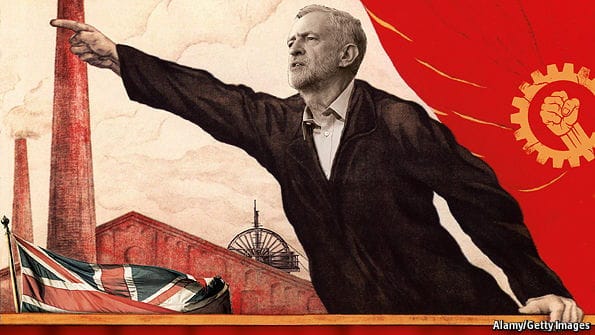
Sep 19th 2015|5 min read
BEFORE he had finished belting out his first celebratory rendition of “The Red Flag”, a hymn to class struggle, some of Jeremy Corbyn’s colleagues in Labour’s shadow cabinet had already handed in their resignations. A 66-year-old socialist, Mr Corbyn has spent 32 years as one of the hardest of hardline left-wingers in the House of Commons and a serial rebel on the Labour backbenches. On September 12th he flattened three moderate rivals (see article) to become leader of Britain’s main opposition party. Labour MPs are stunned—and perhaps none more so than Mr Corbyn himself.
https://www.economist.com/leaders/2015/09/19/backwards-comrades
The second positive reason to back Labour is its focus on growth. The party is right in its diagnosis that nothing matters more than solving Britain’s stagnant productivity. Its young, aspiring, urban supporters will give it permission to act in ways that the Conservatives have avoided. The most obvious of these is building more houses and infrastructure, and forging closer relations with Europe. The party of public services may also have more latitude to reform them than the Tories would.
The question that hangs over Labour is how radical it will be in pursuit of growth. It has run a maddeningly cautious campaign, choosing to reassure voters rather than seek a mandate for bold change. It does not help that Sir Keir, having been in Mr Corbyn’s shadow cabinet before ejecting him, seems to turn with the wind. Having strenuously avoided the subject in the campaign, a Labour government will need to raise taxes (as would a Conservative one if it was not to wreck public services). For all these reasons, having failed to set out a vision to steer by, prime minister Starmer could more easily be blown off course by events or sidetracked by growth-stifling left-wing preoccupations, such as beefing up workers’ rights, stamping out inequality and doling out industrial subsidies.
Stiffen the sinews, summon up the blood: (Editor: This is Pure Agitprop or a restatement of watered down Oswald Mosley? )
Sir Keir’s answer to this criticism of him as a campaigner should be his determination and competence in office. His method is to work relentlessly towards a goal, ratcheting up pressure as he goes. After years of post-Brexit Conservative ideological lurches, that in itself will be worth something. If Labour also succeeds in overhauling the planning regime, strengthening ties with Europe, giving fiscal power to cities, focusing the Treasury on growth and rationalising the tax system, the picture will brighten and Britain will be better off. Sir Keir and his party have earned the chance to try. ■
https://www.economist.com/leaders/2024/06/27/keir-starmer-should-be-britains-next-prime-minister


