In the Rostov region, in southern Russia, the owner of several stalls that sell local produce says she dreams of having her own fuel tanker. “They can all go to hell with their ideas and grand ambitions,” she says. “They” include Vladimir Putin, Donald Trump, Volodymyr Zelensky, Emmanuel Macron and local governors. “We used to live just fine. Now all you do is scramble from one problem to the next.”
Elena Panfilova, who conducts focus groups in Moscow, says the mood is turning from frustration to seething hatred of the authorities. It is not just the fuel shortages and internet outages that make people angry, but the widening gap between reality and the Kremlin’s rhetoric. “The only way out is to stop [hostilities],” says Valery. “We have been hearing upbeat reports that ‘Russian troops are confidently advancing along the entire front line’ for all four years. Yet if you look at the maps, everything is bogged down in a swamp.”
Mr Putin continues to insist that the war is mostly going to plan. In a recent interview, reading his answers from an autocue, he said: “Everything is operating steadily and with a substantial margin of resilience.” His bare acknowledgment of the change in circumstances suggests he may still be deciding on his next course of action. Many Russians fear that instead of cutting his losses and scaling back, he will double down on the conflict.
…
Noticeably fewer men are now on the streets. “The atmosphere in the city is terrible,” says Elena, a resident. “I forbade my husband from leaving the house. When I go out, I lock him from the outside. We keep the curtains drawn all day.” Andrey Surkov, Penza’s military commissar, claimed the raids were simply to hunt for draft dodgers and deserters.
…
“Vladimir Vladimirovich, pay attention to this. Invite me to meet you. Otherwise the army will turn its weapons on the Kremlin.” The man was predictably arrested (and later released), but by then the video had gained 20m views. From soldiers to street merchants, discontent is rising. As Sergei in Nizhny Novgorod says, “Nobody understands what all this is for, other than perhaps to satisfy Putin’s ego. If people protest, they go to jail. All we can hope for now is that he dies.”
Editor: True to form Zanny Minton Beddoes does not provide a transcript! Hardley a surprise! This is Propganda!
Episode summary
Russia is under pressure. More than four years have passed since its full-scale invasion of Ukraine, and the war is still not going to plan. Ukrainian attacks are reaching deep into Russia, disrupting fuel supplies and adding strain to the country’s economy. Ordinary Russians are feeling the pain.
Andrey Melnichenko, one of the country’s richest—and most understated—oligarchs, fears for Russia’s future. He has shared his vision for what must happen in an essay and nearly 60 hours of conversation with The Economist. It is a remarkable intervention from an insider living in Moscow who understands the risks of speaking out in Vladimir Putin’s Russia.
Zanny Minton Beddoes, The Economist’s editor-in-chief, and Edward Carr, deputy editor, discuss Mr Melnichenko’s manifesto with Arkady Ostrovsky, our Russia editor, and Oliver Carroll, our Ukraine correspondent.
Editor: True to form Zanny Minton Beddoes does not provide a transcript! Hardley a surprise! This is Propganda!
Episode summary
Russia is under pressure. More than four years have passed since its full-scale invasion of Ukraine, and the war is still not going to plan. Ukrainian attacks are reaching deep into Russia, disrupting fuel supplies and adding strain to the country’s economy. Ordinary Russians are feeling the pain.
Andrey Melnichenko, one of the country’s richest—and most understated—oligarchs, fears for Russia’s future. He has shared his vision for what must happen in an essay and nearly 60 hours of conversation with The Economist. It is a remarkable intervention from an insider living in Moscow who understands the risks of speaking out in Vladimir Putin’s Russia.
Zanny Minton Beddoes, The Economist’s editor-in-chief, and Edward Carr, deputy editor, discuss Mr Melnichenko’s manifesto with Arkady Ostrovsky, our Russia editor, and Oliver Carroll, our Ukraine correspondent.
Michelle Cottle: I’m Michelle Cottle. I cover national politics for New York Times Opinion, and this week I am here with the oh-so-illustrious columnist David French and — just to keep me on my toes — our other favorite David, David Wallace-Wells, is back. Davids, how goes it?
…
Wallace-Wells: How about “humiliation”? I’m thinking of, you know, the embarrassing spectacle of America’s 250th. I’m thinking about the U.S. soccer team embarrassing itself on the field against Belgium. I’m thinking about the online left somewhat embarrassing itself with Graham Platner. I’m also thinking about President Trump’s desperate need to avoid humiliation in this conflict with Iran.
…
French: Well, yeah. So, we had more information about Graham Platner that is changing the American political landscape, and casts the Senate into even more doubt as to how this is going to all unfold. And also, The Wall Street Journal had some very interesting series of articles about the way in which the rest of the world is handling Trump. And it really exposed the extent to which the rest of the world is making this determination that they cannot count on the United States anymore, and laid bare that they just don’t trust us.
They just don’t trust us, maybe for reasons that we might talk about here in a few minutes.
…
Cottle: OK, I like that. This is a very intriguing entree into our discussion. I’m going to latch onto the exposure and humiliation of Graham Platner. I myself cannot stop rage-texting my friends and colleagues about this — I’d like to apologize to David French, who’s already had an earful about this — and the epic disgrace that was the Democrats’ now ex-Senate nominee in Maine. We also do need to talk about the mysterious disappearance of Senator Mitch McConnell, who has been hospitalized now for nearly a month, with no clear explanation of what’s going on, which is stirring up all kinds of crazy rumors on the right — and resurrects the question of how much Americans are entitled to know about the private lives and health of our elected officials.
But first, I think we’ve got to go global. We’ve got to look the Iran cease-fire that basically never was. So, at the NATO summit this week, Trump suggested that the cease-fire with Iran is over. Turns out that that loose agreement, announced last month, left a little too many sticky issues on the table, and so here we are. As of our taping this Thursday morning, there have been tit-for-tat strikes, along with Trumpian threats to, of course, take it farther.
So, how are you guys feeling about this situation? Any chance the administration’s going to sort this out and reach a deal before the mid-August deadline, set by the memorandum of understanding? David French, you go first.
…
Editor: On and on this pretentious chatter tries the patience of the reader! The ‘as if’ here or the ‘mighe be’, reminds me of Black & White Television of another time place, before the advent of Color Television?
Frank Bruni & Bret Stephens ‘Kick The Gong Around’ about the evil Graham Platner.
Frank Bruni: Bret, you and I have talked quite a bit about Graham Platner and his candidacy — which he finally suspended Wednesday night — so we should probably parse this pathetic, ugly last chapter of it. Which, I’m guessing, doesn’t exactly surprise you?
Bret Stephens: I was about as shocked to hear about Platner’s demise as Captain Renault was to find out that there was gambling at Rick’s.
Frank: I appreciate the levity, because I’m feeling a significant measure of despair. I fear that Senator Susan Collins, the Republican incumbent, has now effectively won re-election from Maine — and thus crushed Democrats’ hopes of a Senate majority — but let’s come back to that later. First, I’m curious what lessons, beyond the elegant analysis in your most recent column about political parties falling prey to their “worst ideological impulses,” you divine in the Platner debacle. I’m definitely mulling that myself.
Bret: The most obvious: When you see lightning, you will soon hear thunder. Lyndsey Fifield, a former girlfriend of Platner’s, told The Times earlier this year that he had “twisted her arm behind her back, shoved her into a bedroom and held the door closed from the other side so that she couldn’t get out,” while also describing him as “the most toxic literally abusive man on earth.” That came out before Platner won the Maine primary. What else did Maine voters need to know about him before suspecting that even more serious allegations would emerge?
…
Editor: This is the stuff that deguiles those NYT readers, at the breakfast table?
Editor: The first paragraphs of Stephens commetary are just the very beginning of this exploration, that gathers momentem as his historical mentions of toxic political actors on the Left, in service to his adoration of ‘the Bushes or John McCain or Mitt Romney’ is demonstative of a fractured political nostalgia!
I grew up in a conservative movement that thought it had gotten the better of its worst ideological impulses.
True, there were the usual Father Coughlin throwbacks, people like Pat Buchanan, who were against free trade, sympathetic to Vladimir Putin, down on the Jews and inveterately hostile to immigration, legal or otherwise. There were outright bigots and conspiracy theorists and militia types and their assorted followers, avid or furtive. And there was an outsize share of moralizing hypocrites, inevitable among people too fond of speaking in the name of religion and character.
But that wasn’t the conservatism of the Bushes or John McCain or Mitt Romney, pragmatic men who, whether you agreed with them or not, operated on the center-right side of the liberal-democratic tradition. They were the conscience of the Republican Party, maintaining its decency by occasionally calling out the bad guys on their own side.
That was until the moment the G.O.P. chose to delete its conscience by becoming the party of Donald Trump. A similar moment may soon be upon Democrats if they aren’t careful.
…
All this is especially true when the more ideologically extreme candidates are energetic, unstuffy, authentic, and able to stir up an audience. Zohran Mamdani, the New York mayor, is emblematic of the type; so was Graham Platner, the Maine Democrat, at least until allegations about his past behavior finally caught up with him.
…
Against this tide, the position of many mainstream Democrats is to dodge the ideological fight with the left while warning that, outside of deep-blue districts like those in New York City, democratic socialism is an electoral loser that only provides Trump with political ammunition. In Michigan, Haley Stevens, El-Sayed’s opponent in the Democratic primary, is campaigning on the argument that “no one wants Abdul to win more than the Republicans” — that is, that Republicans see him as the more beatable opponent come November.
…
Socialism as a political program was born in the 19th century and died in the 20th (including in Sweden). Democracy requires a clearly defined citizenry, an idea that becomes meaningless if a country pursues a lax or open-border policy of the kind advocated by democratic socialists. The brainstorms of the far left, like the billionaire surtax on the ballot in California, have failed repeatedly wherever they’ve been tried (including in France). And “justice for Palestine” surely can’t mean taking sides with the killers and rapists of Hamas while insisting that the only nation-state on earth with no right to exist is the Jewish one. The word for that is antisemitism, the politics of the double standard toward Jews, which is yet another terrible idea from a terrible past.
…
Editor: the final paragraphs of Stephens — It does not occure to Stephens, that the Left he defames is the watershed of both the New Democrats and The Republicas, who are the bought and paid for AIPAC hirelings! (Stephens is member of the club!)
Is there a rising Democrat who will give this speech — the one that says that Democrats stand for freedom and fairness, not radicalism and self-righteousness; the one that never disdains tradition even if it seeks to improve it; the one that knows that utopianism is no substitute for pragmatism, and that purity is not superior to compromise?
That Democrat needs to stand up now, before his party gets swept away by the flood it vainly believes will soon recede.
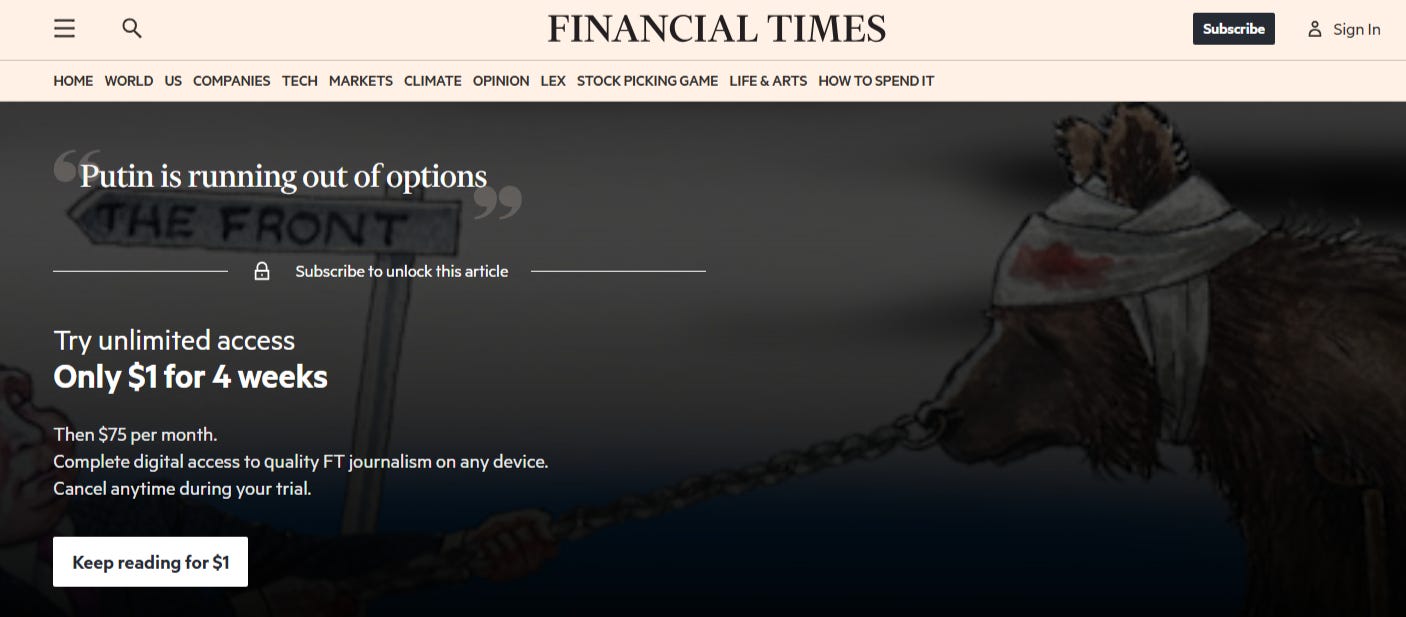
The Financial Times on : ‘Putin is running out of options’
Yet reader look to this use the of this portion of an FT headline?
Putin is Running Out of Options: George Friedman on Negotiation vs. Escalation
Will a Russian energy crisis finally lead to a negotiated settlement, or are we headed towards nuclear war? On this episode of Talking Geopolitics, GPF Chairman George Friedman joins host Christian Smith to discuss Ukrainian target shifts toward energy infrastructure and their impact on Russia’s already fragile economy, the impending political crisis inside the Kremlin, and the viability of Russia’s potential next steps, including “tactical” nukes, Belarusian involvement, and fully mobilizing reserve forces. Episode recorded on June 29, 2026.
Christian Smith: Hello and welcome to this podcast from Geopolitical Futures. I’m Christian Smith. It’s no great insight to say that energy is about as fundamental for the Russian economy as oxygen is for its citizens. Between 2014 and 2024, oil and gas made up anywhere between 30 and 50% of federal budget revenues. With the closure of the Strait of Hormuz, fears grew in the west that it could mean a bounce for Russia’s economy and its war chest. And while that could still be the case, with Ukraine targeting Russian refineries and energy storage in recent weeks, including massive attacks with hundreds of drones over the weekend, Vladimir Putin has now acknowledged that the country faces fuel shortages. So today on the podcast I am joined by George Friedman, Geopolitical Futures chairman and founder, to discuss where to from here for Russia and whether the country may try to force Belarus or even nuclear weapons into the war. George, hello. Before we get to that, let’s just set the scene as to how we go got here. Talk us through the details of Ukraine’s energy infrastructure attacks. Why is it doing this? Why is it doing it? Now?
George Friedman: It’s clear that the Russians are not prepared to reach understanding via the United States or any other source to end the war. Therefore, the Ukrainians have reached the conclusion that they must strike Russia at one of its central points, and they have now the drones technology to strike Russia at a critical point, which is its energy capability, its oil capability. Russia has to obviously have oil. It also exports oil and is one of, at this point doing quite well in the exportation of oil, given the price of oil these days. And he sends it to countries like China, India and many others. By attacking their oil capability, they strike at a fundamental asset that Russia has, both in terms of making its economy more viable by selling it overseas, but more so inside the country, dramatically reducing the amount of oil available, therefore further hurting the economy and production and the citizens as well. So for the Ukrainians, this is a major escalation, a thing designed to bring Russia to the table. And the Russians are obviously not going to want to do that under these circumstances.
…
The American geopolitical scholar, George Friedman, has divided his country’s history into three 80-year institutional cycles: from its birth in 1787 to the end of its civil war in 1865; from the latter until the end of the Second World War in 1945; and from there to 2025, when Trump will be sworn in for the second time.
Friedman also identifies 50-year socioeconomic cycles. From our viewpoint, the relevant ones are the last two: the so-called Roosevelt cycle from 1932 to 1980, marked by Franklin Delano Roosevelt’s New Deal – which overlapped US economic thinking with John Maynard Keynes’ theories – until the end of the 1970s; and the Reagan cycle, which was intellectually monopolised by Milton Friedman’s monetarism.
According to George Friedman, we are still in the Reagan socioeconomic cycle, which is projected to end in 2030.
Libido differences are a common part of relationships, sex therapists say. Here’s how to manage.
Recently, The New York Times asked readers about libido differences, and more than 1,200 wrote in, many sharing deeply personal stories of how they have navigated sexual incompatibilities. We also spoke to sex therapists and researchers who said that discrepancies in sexual desire were common, almost to the point of inevitability in long-term relationships. Research suggests that desire differences are one of the top reasons couples seek out therapy.
“I’m inclined to say that this happens in almost every partnership, either some of the time or more perpetually,” said Lauren Fogel Mersy, a psychologist, sex therapist and co-author of the forthcoming book “Desire: An Inclusive Guide to Navigating Libido Differences in Relationships.”
Many factors can influence libido: interpersonal dynamics, physical and mental health, the social messages around sexuality that people absorb during childhood and adolescence. The list goes on, and there are seldom easy fixes. But Dr. Fogel Mersy and other experts said more communication could help couples bridge gaps in sexual desire.
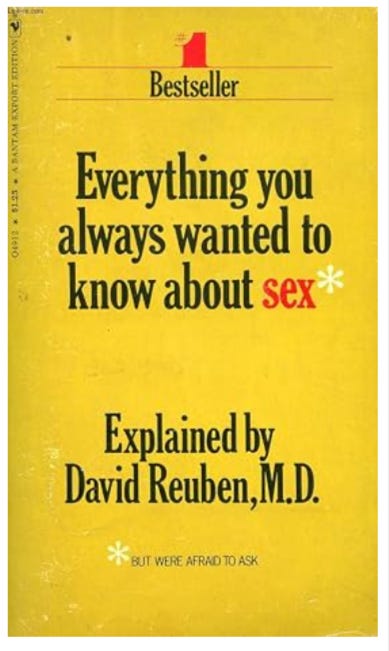
Newspaper Reader recalls the long gone Joyce Brothers, Dr. Ruth Westheimer or Dr. David Reuben?
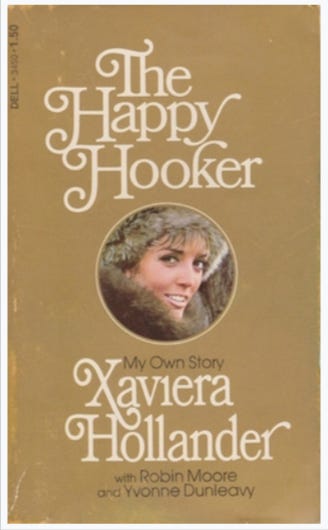
Not to forget “The Happy Hooker” by Xaviera Hollander?
Newspaper Reader.
Newspaper Reader: 7/7/2026
Reader I had forgottten Dr. Laura Schlessinger! As part of the cadre of self-appointed ‘experts’ who once ruled American Popular Media, before the Age of the Internet! Reader not to forget her ‘almost apology’ to the Gay Comnunity…
The Apology
After facing immense pressure and lost sponsorships, Schlessinger used the Jewish holy day of Yom Kippur to issue a formal apology to the gay and lesbian community. In her statement Dr. Laura Asks Gays for Forgiveness on ABC News, she admitted that her words were “poorly chosen”. However, she did not apologize for her foundational opinions or indicate that she had changed her stance on traditional families. [1, 2, 3]
Justice Ginsburg, with whom Justice Breyer, Justice Sotomayor, and Justice Kagan join, dissenting.
In the Court’s view, the very success of §5 of the Voting Rights Act demands its dormancy. Congress was of another mind. Recognizing that large progress has been made, Congress determined, based on a voluminous record, that the scourge of discrimination was not yet extirpated. The question this case presents is who decides whether, as currently operative, §5 remains justifiable,1 this Court, or a Congress charged with the obligation to enforce the post-Civil War Amendments “by appropriate legislation.” With overwhelming support in both Houses, Congress concluded that, for two prime reasons, §5 should continue in force, unabated. First, continuance would facilitate completion of the impressive gains thus far made; and second, continuance would guard against backsliding. Those assessments were well within Congress’ province to make and should elicit this Court’s unstinting approbation.
Editor: Readers, Oxbridgers can never be wrong! Zanny Minton Beddoes in even more toxic than Adrian Wooldridge & John Micklethwait of utterly notoriou’The Right Nation: Conservative Power in America’
The tone of pronouncements made in the leader pages of The Economist has been likened to the “voice of God”. The comparison is not meant flatteringly. But it raises a fair question. A deity would be omniscient. How accurate, by comparison, are our predictions? Rigorous fact-checking usually saves us from embarrassing errors about the present. The future is trickier.
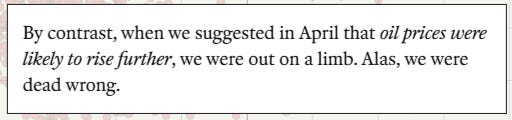
In 1999 we said oil could fall to $5 a barrel, from around $10 at the time. That $10 turned out to be a generational low. Prices rose more than tenfold in the next decade. Then, in 2013, we called a peak in global oil demand. Today it is still stubbornly trundling upwards. This April we said that oil markets were in “La La land” about the war in Iran and predicted a spike in prices. They have since fallen by about a third.
Perhaps the black stuff is our bête noire. Yet these howlers, and others, have given rise to the charge that, far from being all-knowing, The Economist is so reliably wrong that the smart move is to bet against it. There is no better time to double down on a stock-market rally than when we start fretting about a bubble. Last year the then chairman of Reform UK, a populist-right party, called The Economist the “ultimate contrarian indicator”, while complaining about our criticism of his party’s fantasyland fiscal numbers. (A few months later, the party reversed course and ditched those policies.)
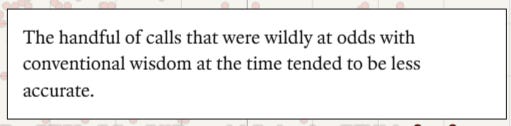
Is the accusation fair? Or can The Economist lay claim to a creditable forecasting record? Predictive perfection is not our goal and we aim mainly to inform and stretch minds. But ideally we would be right more often than wrong. To assess our record with something approaching neutrality, we took the 7,000 or so leaders The Economist has published this millennium and fed them into GPT-5.5, an artificial-intelligence model.
We asked it to assess whether each leader had made a falsifiable claim about the future as part of its main thesis. About 1,400 did. We then extracted those predictions, and asked the AI to mark out of ten both how contrarian the leader’s outlook was at the time and how accurate the prediction turned out to be. We ran those queries several times and took an average.
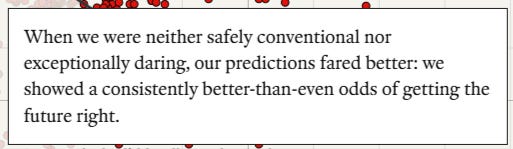
Overall, the AI assessor’s conclusions are reassuring, at least for those of us who make a living writing (and occasionally predicting) for The Economist.
Reader note the use of again the free-floating signifier as in revised July 2, 2026?
Editor: Reader recall my long comment on the use of The Economists ‘free floating signifier’ that appears and diapears, as an itegral part of the disengenious in another key?
Editor: Reader notice these five free floating paragraphs, as an itegral part to this exercise in self-serving prestidigitation, that represents a kind of bad faith, compleat with garish ilistrations, that appeares and dissapears. Not a surprise, as in carefullly revised July 2, 2026 essay!
…
Fuelled by war, colonisation and the industrial revolution, the British Empire overtook China as the world’s largest economy around 1840, when the first opium war between the countries was under way. America was, however, catching up fast.
The invention of the cotton gin in 1793 and brutal deployment of slave labour meant that the country produced most of the world’s cotton by the 1850s. America expanded, often violently, westward, gaining natural resources that would be the envy of the world.
…
Sprawling forests supplied timber for rapid construction. Well-positioned ports and the sweeping Mississippi river provided routes for export. Coal mines in Pennsylvania, Appalachia and the Midwest powered railroads and factories; the Great Lakes’ rich deposits of iron ore fed steel mills. Civil war ravaged the country but did not destroy it, ending slavery in 1865.
Industrialising rapidly, America overtook Great Britain as a guzzler of energy in 1891. We calculate that in 1899—after the Spanish-American war and the Treaty of Paris, which gave it control of Puerto Rico, Guam and the Philippines—it controlled more fertile land than any country bar the Russian empire. A few years later, in 1903, America had the world’s largest economy.
…
Sprawling forests supplied timber for rapid construction. Well-positioned ports and the sweeping Mississippi river provided routes for export. Coal mines in Pennsylvania, Appalachia and the Midwest powered railroads and factories; the Great Lakes’ rich deposits of iron ore fed steel mills. Civil war ravaged the country but did not destroy it, ending slavery in 1865.
Industrialising rapidly, America overtook Great Britain as a guzzler of energy in 1891. We calculate that in 1899—after the Spanish-American war and the Treaty of Paris, which gave it control of Puerto Rico, Guam and the Philippines—it controlled more fertile land than any country bar the Russian empire. A few years later, in 1903, America had the world’s largest economy.
…
Add immigration, a reliable rule of law, ample capital and animal spirits, and America’s economy raced ahead, growing more in absolute terms between 1945 and 1999 than any other country. Its researchers developed the building blocks of modern life, including the transistor, the computer chip, the personal computer and the internet.
…
Editor: The final paragraphs of this ‘essay’ is marked by The Economist Self-affirming chatter. It being just the companion piece to the other July 2, 2026 essay, now festooned with garish illustartions.
If The Economist was downbeat about the world’s economic prospects, we were exuberant about technology. Sometimes this exuberance turned out to be justified. We declared smartphones the future of computing in 2002, said that something like streaming would devour DVDs in 2008, and cautioned in 2011 that a flood of Chinese-made cars would wash over the West. Still, our techno-optimism occasionally got ahead of itself. Distributed electric grids (boosted by The Economist in 2000), cheap bioethanol (2003), open standards for social media (2008) and augmented reality (2016) have yet to bring about the breakthroughs we prophesied.
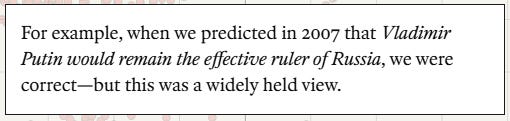
And then there is politics. It is not easy to foretell the decisions of voters or, for that matter, mercurial autocrats. The Economist was convinced by the false claim that Saddam Hussein was hiding weapons of mass destruction, but was right in 2003 to doubt Vladimir Putin was a true democrat. We toyed with the idea that China’s Communist Party might give ground on democratic reforms. In America we correctly forecast that Ted Cruz would not win the 2016 election, but for the wrong reason: we thought that his combative antics would alienate moderates. In fact, Donald Trump offered an even more furious alternative and still bested Hillary Clinton.
When covid-19 began infecting the globe, we were ahead of the crowd. By late January 2020, long before governments started ordering shutdowns, we had sounded the alarm that the disease would spread worldwide. By the end of February, we said it would be a pandemic. Stock markets tumbled by a quarter in the following weeks. Once pandemic stimulus spending fuelled inflation in 2022, we expected a much sharper rise in interest rates than the Federal Reserve, or bond markets, were pricing in. That turned out to be correct; our next bet, that this tightening would lead to a recession, did not. The world economy achieved a “soft landing” as inflation fell mostly back to normal.
So much for the past. As for the future, we expect the rich world’s debt binge to end in an inflationary mess and for AI to cause seismic economic and political disruption. We think that the global population will peak decades sooner than official projections. How are these predictions looking? It is, mostly, “too early to say”, as Zhou Enlai, communist China’s first premier, is misquoted as remarking when asked to assess the impact of the French Revolution. Come back in another quarter of a century to see how we did.
…
If The Economist was downbeat about the world’s economic prospects, we were exuberant about technology. Sometimes this exuberance turned out to be justified. We declared smartphones the future of computing in 2002, said that something like streaming would devour DVDs in 2008, and cautioned in 2011 that a flood of Chinese-made cars would wash over the West. Still, our techno-optimism occasionally got ahead of itself. Distributed electric grids (boosted by The Economist in 2000), cheap bioethanol (2003), open standards for social media (2008) and augmented reality (2016) have yet to bring about the breakthroughs we prophesied.
And then there is politics. It is not easy to foretell the decisions of voters or, for that matter, mercurial autocrats. The Economist was convinced by the false claim that Saddam Hussein was hiding weapons of mass destruction, but was right in 2003 to doubt Vladimir Putin was a true democrat. We toyed with the idea that China’s Communist Party might give ground on democratic reforms. In America we correctly forecast that Ted Cruz would not win the 2016 election, but for the wrong reason: we thought that his combative antics would alienate moderates. In fact, Donald Trump offered an even more furious alternative and still bested Hillary Clinton.
When covid-19 began infecting the globe, we were ahead of the crowd. By late January 2020, long before governments started ordering shutdowns, we had sounded the alarm that the disease would spread worldwide. By the end of February, we said it would be a pandemic. Stock markets tumbled by a quarter in the following weeks. Once pandemic stimulus spending fuelled inflation in 2022, we expected a much sharper rise in interest rates than the Federal Reserve, or bond markets, were pricing in. That turned out to be correct; our next bet, that this tightening would lead to a recession, did not. The world economy achieved a “soft landing” as inflation fell mostly back to normal.
So much for the past. As for the future, we expect the rich world’s debt binge to end in an inflationary mess and for AI to cause seismic economic and political disruption. We think that the global population will peak decades sooner than official projections. How are these predictions looking? It is, mostly, “too early to say”, as Zhou Enlai, communist China’s first premier, is misquoted as remarking when asked to assess the impact of the French Revolution. Come back in another quarter of a century to see how we did.











 StephenKMackSD's Blog