Newspaper Reader: An alternatine thought: Is George Friedman a Neo-Consevative, or just a Financial Times Fellow Traveler?
Jul 07, 2026
The Financial Times on : ‘Putin is running out of options’
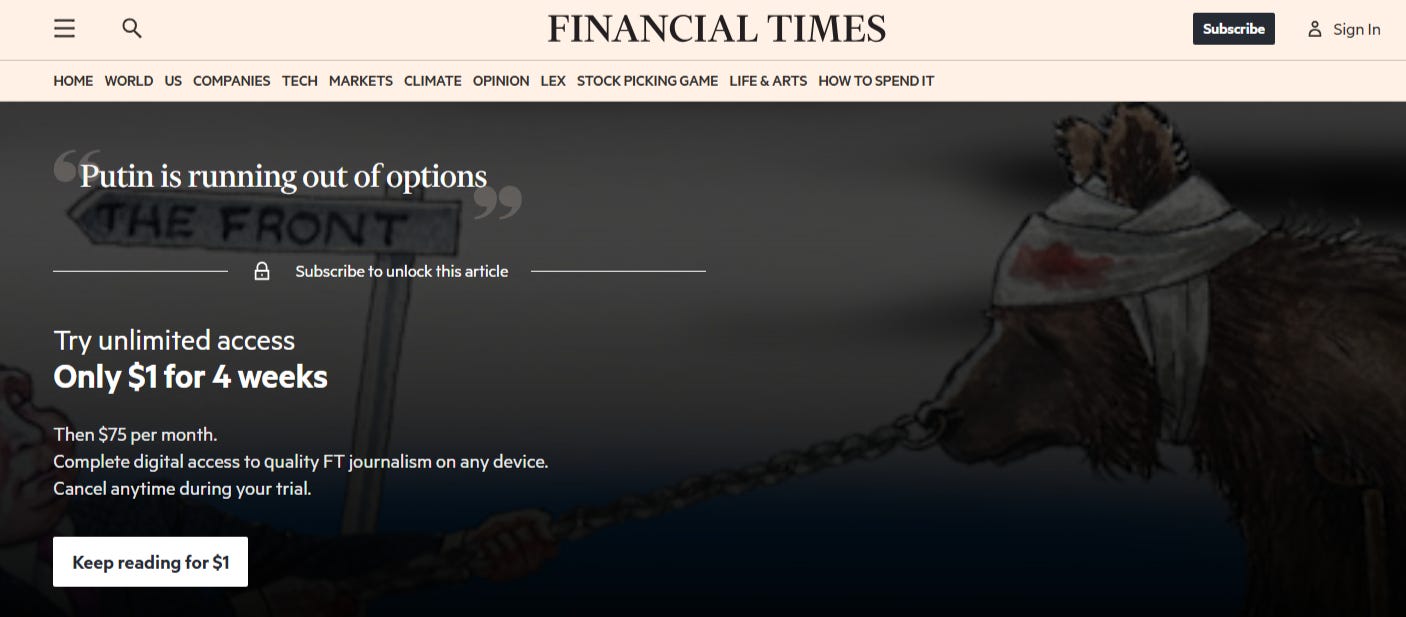
Yet reader look to this use the of this portion of an FT headline?
Putin is Running Out of Options: George Friedman on Negotiation vs. Escalation
Will a Russian energy crisis finally lead to a negotiated settlement, or are we headed towards nuclear war? On this episode of Talking Geopolitics, GPF Chairman George Friedman joins host Christian Smith to discuss Ukrainian target shifts toward energy infrastructure and their impact on Russia’s already fragile economy, the impending political crisis inside the Kremlin, and the viability of Russia’s potential next steps, including “tactical” nukes, Belarusian involvement, and fully mobilizing reserve forces. Episode recorded on June 29, 2026.
By
June 30, 2026
Christian Smith: Hello and welcome to this podcast from Geopolitical Futures. I’m Christian Smith. It’s no great insight to say that energy is about as fundamental for the Russian economy as oxygen is for its citizens. Between 2014 and 2024, oil and gas made up anywhere between 30 and 50% of federal budget revenues. With the closure of the Strait of Hormuz, fears grew in the west that it could mean a bounce for Russia’s economy and its war chest. And while that could still be the case, with Ukraine targeting Russian refineries and energy storage in recent weeks, including massive attacks with hundreds of drones over the weekend, Vladimir Putin has now acknowledged that the country faces fuel shortages. So today on the podcast I am joined by George Friedman, Geopolitical Futures chairman and founder, to discuss where to from here for Russia and whether the country may try to force Belarus or even nuclear weapons into the war. George, hello. Before we get to that, let’s just set the scene as to how we go got here. Talk us through the details of Ukraine’s energy infrastructure attacks. Why is it doing this? Why is it doing it? Now?
George Friedman: It’s clear that the Russians are not prepared to reach understanding via the United States or any other source to end the war. Therefore, the Ukrainians have reached the conclusion that they must strike Russia at one of its central points, and they have now the drones technology to strike Russia at a critical point, which is its energy capability, its oil capability. Russia has to obviously have oil. It also exports oil and is one of, at this point doing quite well in the exportation of oil, given the price of oil these days. And he sends it to countries like China, India and many others. By attacking their oil capability, they strike at a fundamental asset that Russia has, both in terms of making its economy more viable by selling it overseas, but more so inside the country, dramatically reducing the amount of oil available, therefore further hurting the economy and production and the citizens as well. So for the Ukrainians, this is a major escalation, a thing designed to bring Russia to the table. And the Russians are obviously not going to want to do that under these circumstances.
…
The American geopolitical scholar, George Friedman, has divided his country’s history into three 80-year institutional cycles: from its birth in 1787 to the end of its civil war in 1865; from the latter until the end of the Second World War in 1945; and from there to 2025, when Trump will be sworn in for the second time.
Friedman also identifies 50-year socioeconomic cycles. From our viewpoint, the relevant ones are the last two: the so-called Roosevelt cycle from 1932 to 1980, marked by Franklin Delano Roosevelt’s New Deal – which overlapped US economic thinking with John Maynard Keynes’ theories – until the end of the 1970s; and the Reagan cycle, which was intellectually monopolised by Milton Friedman’s monetarism.
According to George Friedman, we are still in the Reagan socioeconomic cycle, which is projected to end in 2030.
…
https://www.middleeasteye.net/opinion/us-trump-revolutionary-break-reagan-era
…
Editor: In what World does George Friedman reside?
Newspaper Reader.


