Cockeyed Platonist in five irerations!

Newspaper Reader.

stephenkmacksd.com/

Jul 04, 2026

Cockeyed Platonist and “The New Humanism”

Posted on March 8, 2011 by stephenkmacksd

http://www.nytimes.com/2011/03/08/opinion/08brooks.html?_r=1&src=ISMR_HP_LO_MST_FB

Cockeyed Platonist (CP) posits ‘The New Humanism’, whatever that might be. How does he define his re-imagination of this concept? Is it both theory and practice? The answers will astound! As CP seeks to redefine ‘Humanism’ in a newspaper column! His reductivism, not to speak of his intellectual aspiration, is astounding. Thousands of years and the greatest thinkers of the Ages have attempted this act of definition: remaining at the point of failed, although noble, attempts. But have no fear a newspaper deadline has, here, a metaphysical weight that drives our thinker into new breathtaking insights, not available to past, nay, even present thinkers, writers and cogitators on the existential condition of Homo sapiens. Here are the players in CP’s sketch, a Dramaturge’s notes toward an Intellectual Melodrama:

Human Capital

The French Enlightenment

The English Enlightenment

David Hume, Adam Smith (although neither is mentioned, their ideas are present and central)

Attunement

Equipoise

Metis

Sympathy

Limerance

Sigmund Freud

I would assert that the answer to his own question bears all his intellectual and moral weight, but questions remain in the reader’s mind: has he answered any question, even his own? I will let you be the judge. I hesitate to prejudice my readers as to right or wrong, success or failure in our thinker’s attempts to do what no other mortal has ever done, in a stunningly brief 802 words. Bravo!


Cockeyed Platonist and The Clash of Civilizations, Redux

Posted on March 5, 2011 by stephenkmacksd

http://www.nytimes.com/2011/03/04/opinion/04brooks.html

If one really makes an effort to discover first rate critiques of the neo-imperialism of Mr. Samuel P. Huntington’s ‘Clash of Civilizations’, the wise reader might opt for such thinkers as Edward Said and his devastating ‘Clash of Definitions’ in his essay collection ‘Reflections on Exile and Other Essays’. Or one might read Amaryta Sen whose ‘ Identity and Violence: The Illusion of Destiny’ is ­­­­­­­­­­­­ the most through going dissection of Mr. Huntington’s arguments, yet to date. Even if one favors a more ‘mainstream approach,’ the useful volume ‘The Clash of Civilizations? The Debate ( A Foreign Affairs Reader) would be a much preferred starting point. It might be argued that Cockeyed Platonist (CP) is not the best thinker to evaluate Mr. Huntington’s neo-imperialism, masquerading as highbrow comparative cultural criticism: although both Huntington and CP love the great overarching abstraction, as a key element in their forms of argument. While CP genuflects to the work and memory of the ‘great’ Huntington, his criticism lacks the depth, strength and political honesty displayed by both Said and Sen. The question might be asked as: How can a document that led the way for misguided policies and policy makers, be quoted as a document containing anything resembling wisdom and or as a guide to any reasonable political action, predicated on reliable data? This question and many others remain unanswered.


Cockeyed Platonist and Paul Ryan: A Transient Political Crush or The Real Thing?

Posted on April 9, 2011 by stephenkmacksd

http://www.nytimes.com/2011/04/08/opinion/08brooks.html?_r=1&partner=rssnyt&emc=rss

Can it last? That is the salient question that begs to asked of the latest political crush of Cockeyed Platonist (CP)? Does it have the staying power of true,lasting political fidelity,or will someone come between them? Donald Trump or Michelle Bachmann or even the sedate and respectable Mitch Daniels? The dictates of political pragmatism being his singular guide.The answer awaits the passage of time in The American Political Melodrama. But let us carefully consider a more pressing issue, the seriousness of the Mr. Ryan’s budget proposal and the ‘courage’ and ‘initiative’ that accompanied its birth, as argued by our thinker. But a more burning question obtrudes itself into this essential debate: CP cannot resist making this about morality rather that politics i.e.’This is an immoral imposition on future generations.’ This in a passage on the lifetime contributions of an average working couple: Medicare contributions of $140,000 contrasted with $430,000 of benefits. But a question arises in my mind, as to the interest paid on these lifetime contributions and the totality of all contributions in the aggregate, and the potential for accrual interest,or is this a question of the economic naif? And then in any discussion of Medicare and cost control come the question of ‘The Death Panels’ no matter how seemingly high minded the rhetorical frame: this a perennial Right Wing shibboleth. For a critique of Mr. Ryan’s budget, as to its seriousness and viability, one need turn to Mr. Paul Krugman, in the New York Times, for a cogent,unsparing evaluation. Paul Ryan is CP’s political man of the moment, of course, subject to the vagaries of his political sensibility.

As for Mr. Ryan moving us off ‘Unreality Island’: like most of his fellow Conservative Thinkers and some Liberal Thinkers, CP has yet to even acknowledge the utter failure of the myth of ‘The Self-regulating Free Market’,in practice, as the cause of the Economic Collapse of 2008. The repeal of Depression Era economic reform legislation was the reason for our current economic crisis and the propagation of the Myth of Austerity as the inescapable answer to that crisis. It is not the political romanticism masquerading as ‘Economic Theory’ of Friedman or Hayek, that will dominate this political moment in American life, but the actuality of the effectiveness of Keynesian thought and practice, even in modified form.


Cockeyed Platonist on the Fallen State of Man

Posted on January 20, 2011 by stephenkmacksd

http://www.nytimes.com/2011/01/14/opinion/14brooks.html?_r=1&partner=rssnyt&emc=rss

I missed this column by Cockeyed Platonist (CP) when it was first published. ‘The Tree Of Failure’ is a title redolent with possibilities and CP exercises his good judgment and ethical restraint to telling effect.This is not simply a column but a sermon preached by a ‘Social Conservative’ on the ‘Fallen State of Man’, to use the vocabulary suitable to this piece. This is supposed be a commentary on the speech given by President Obama in Tucson after the shootings. But CP cannot resist the opportunity to engage in his favorite rhetorical exercise, of reducing historically located actualities into large, but manageable abstractions; the better to instruct his readers, to use the opportunity for pious sounding political moralizing: for the ethical posturing, that the thinkers on the Right cannot resist.The vocabulary is a compendium of the mainstays of sermonizing: Sabbath ( the seventh day of the week),redemption, renewal, with the additions of a sociological/political nature; social organism, communal improvement, social enterprise and civility,to add sociological relevance to his narrative, but clearly understood as intellectual garnish by his readers. Joe DI Maggagio then appears, as exemplary of a non-narcissist athlete, of the old school, and almost completes this collection. Reinhold Niebuhr has that signal honor of being the final example of American Uprightness, and is quoted, at length, on forgiveness. Mr. Niebuhr, a man who eventually founded,by time and cogitation, the school of political/moral thought of ‘Christian Realism’, an apologetically rationalized American Exceptionalism: the narrative richness and diversity of The American Political Melodrama is thereby secured, made empirically concrete.


Cockeyed Platonist:The State of the Union,Political Nostalgia and Masculine Privilege

Posted on January 26, 2011 by stephenkmacksd

http://www.nytimes.com/2011/01/25/opinion/25brooks.html?ref=davidbrooks

Cockeyed Platonist (CP) like the Establishment Republican, Paul Ryan and the Tea Party’s Michele Bachmann has decided to give his own version of national political sermonizing called the State of the Union Address. Now there is nothing to compare to the love, even the addiction, of CP for long winded abstract theorizing, it’s his intellectual bread and butter: the opportunity to woo an audience with pretentious high flown phraseology, in service to the master idea of American Exceptionalism, is an occasion for pulling out all the stops. Boosterism and the pep talk are American perennials. He unenthusiastically makes the president’s choice of styles of address between standard and visionary approaches. After that CP proceeds to deliver his own address full of the afore-mentioned rhetorical devices properly inflated for the occasion. CP writes two columns a week and this has the feel of something written over his morning coffee with a deadline staring him in the face. Even the title, ‘The Talent Magnet’ has a shopworn quality and the assertion of ‘what the country hungers for’ leads one to the unpalatable notion of a decisive paternalism, as the indispensable key to success, in the proscribed realm of national occasion: an evocation of a necessary political nostalgia wedded to masculine privilege, as sine qua non.

Posted in Uncategorized | Leave a comment

Palantir CEO PANICS ON AIR About Wealth Tax

stephenkmacksd.com/

Jul 03, 2026

Palantir CEO PANICS ON AIR About Wealth Tax

Posted in Uncategorized | Leave a comment

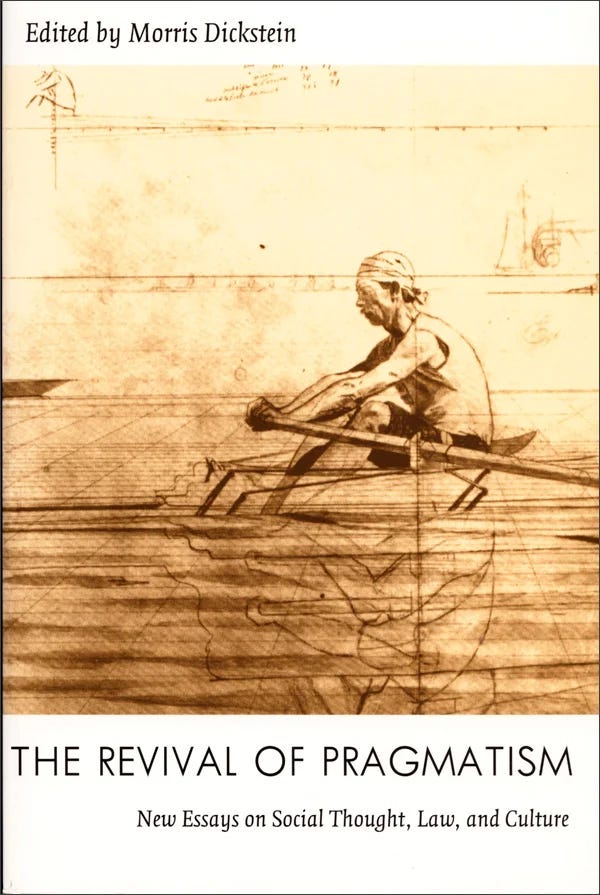
The Revival of Pragmatism New Essays on Social Thought, Law, and Culture

https://www.dukeupress.edu/the-revival-of-pragmatism

stephenkmacksd.com/

Jul 03, 2026

The Revival of Pragmatism cover image

Post-Contemporary Interventions

More about this series

Book

Pages: 464

Illustrations: 5 photographs

Published: November 1998

Editor: Morris Dickstein

Contributors: Morris DicksteinRichard RortyHilary PutnamSidney MorgenbesserRuth Anna PutnamStanley CavellJames T. KloppenbergRobert WestbrookRichard J. BernsteinNancy FraserRoss PosnockHans JoasAlan WolfeJohn Patrick DigginsRichard PosnerThomas C. GreyDavid LubanRichard WeisbergMichel RosenfeldRichard PoirierLouis MenandDavid BromwichRay CarneyGiles Gunn, and Stanley Fish

Subjects

Literature and Literary Studies > Literary TheoryTheory and PhilosophyLaw > Legal Theory

Although long considered the most distinctive American contribution to philosophy, pragmatism—with its problem-solving emphasis and its contingent view of truth—lost popularity in mid-century after the advent of World War II, the horror of the Holocaust, and the dawning of the Cold War. Since the 1960s, however, pragmatism in many guises has again gained prominence, finding congenial places to flourish within growing intellectual movements. This volume of new essays brings together leading philosophers, historians, legal scholars, social thinkers, and literary critics to examine the far-reaching effects of this revival.

As the twenty-five intellectuals who take part in this discussion show, pragmatism has become a complex terrain on which a rich variety of contemporary debates have been played out. Contributors such as Richard Rorty, Stanley Cavell, Nancy Fraser, Robert Westbrook, Hilary Putnam, and Morris Dickstein trace pragmatism’s cultural and intellectual evolution, consider its connection to democracy, and discuss its complex relationship to the work of Emerson, Nietzsche, and Wittgenstein. They show the influence of pragmatism on black intellectuals such as W. E. B. Du Bois, explore its view of poetic language, and debate its effects on social science, history, and jurisprudence. Also including essays by critics of the revival such as Alan Wolfe and John Patrick Diggins, the volume concludes with a response to the whole collection from Stanley Fish.


Including an extensive bibliography, this interdisciplinary work provides an in-depth and broadly gauged introduction to pragmatism, one that will be crucial for understanding the shape of the transformations taking place in the American social and philosophical scene at the end of the twentieth century.

Contributors. Richard Bernstein, David Bromwich, Ray Carney, Stanley Cavell, Morris Dickstein, John Patrick Diggins, Stanley Fish, Nancy Fraser, Thomas C. Grey, Giles Gunn, Hans Joas, James T. Kloppenberg, David Luban, Louis Menand, Sidney Morgenbesser, Richard Poirier, Richard A. Posner, Ross Posnock, Hilary Putnam, Ruth Anna Putnam, Richard Rorty, Michel Rosenfeld, Richard H. Weisberg, Robert B. Westbrook, Alan Wolfe

Morris Dickstein is Distinguished Professor of English at Queens College and at the Graduate School of the City University of New York. His previous books include Double Agent: The Critic and Society and Gates of Eden: American Culture in the Sixties.

Table Of Contents

Acknowledgments

Introduction: Pragmatism Then and Now / Morris Dickstein

What Difference Does Pragmatism Make? The View From Philosophy

Pragmatism as Romantic Polytheism / Richard Rorty

Pragmatism and Realism / Hilary Putnam

Response to Hilary Putnam’s “Pragmatism and Realism” / Sidney Morgenbesser

The Moral Impulse / Ruth Anna Putnam

What’s the Use of Calling Emerson a Pragmatist? / Stanley Cavell

Pragmatism and the Remaking of Social Thought

Pragmatism: An Old Name for Some New Ways of Thinking? / James T. Kloppenberg

Pragmatism and Democracy: Reconstructing the Logic of John Dewey’s Faith / Robert B. Westbrook

Community in the Pragmatic Tradition / Richard J. Bernstein

Another Pragmatism: Alain Locke, Critical “Race” Theory, and the Politics of Culture / Nancy Fraser

Going Astray, Going Forward: Du Boisian Pragmatism and Its Lineage / Ross Posnock

The Inspiration of Pragmatism: Some Personal Remarks / Hans Joas

The Missing Pragmatic Revival in American Social Science / Alan Wolfe

Pragmatism and Its Limits / John Patrick Diggins

Pragmatism and Law

Pragmatic Adjudication / Richard A. Posner

Freestanding Legal Pragmatism / Thomas C. Grey

What’s Pragmatic about Legal Pragmatism? / David Luban

Pragmatism and Law: A Response to David Luban / Richard Rorty

It’s a Positivist, It’s a Pragmatist, It’s a Codifier! Reflections on Nietzsche and Stendhal / Richard H. Weisberg

Pragmatism, Pluralism, and Legal Interpretations: Posner’s and Rorty’s Justice without Metaphysics Meets Hate Speech / Michael Rosenfeld

Pragmatism, Culture, and Art

Why Do Pragmatists Want to Be Like Poets? / Richard Poirier

Pragmatists and Poets: A Response to Richard Poirier / Louis Menand

The Novelist of Everyday Life / David Bromwich

When Mind Is a Verb: Thomas Eakins and the Work of Doing / Ray Carney

Religion and the Recent Revival of Pragmatism, Giles Gunn

Afterword

Truth and Toilets: Pragmatism and the Practices of Life / Stanely Fish

Selected Bibliography

Contributors

Index

Posted in Uncategorized | Leave a comment

On the perennial hysteria of Jonathan Turley

Newspaper Reader

stephenkmacksd.com/

Jul 03, 2026

Editor: A selection of the political chatter of the Centirst’s/Centrist!

Survey: Democrats Turning Heavily in Favor of Socialism

For many of us who were raised in liberal, Democratic families, the infusion of socialist, anti-free-speech, and anti-Semitic elements into the party has been alarming. The party was always in favor of social welfare programs but remained ardently committed to free markets and free speech. Now, we have CNN anchors openly questioning whether candidates are too Jewish-looking for the Democratic base as socialists sweep away establishment candidates. A recent poll reaffirmed that trend with a vast majority of Democrats saying that they are prepared to support the socialists.

In Rage and the Republic, I discuss this shift toward socialism:

“Much of the anti-capitalist movement is composed of young people who have never lived under a socialist or communist government. Popular politicians like Representative Alexandria Ocasio-Cortez (D-NY) have made socialism chic, alongside wealthy celebrity adherents such as Lawrence O’Donnell, Susan Sarandon, Michael Moore, and Sarah Silverman. There is a superficiality to many in this movement of wealthy celebrities wearing socialism on their designer sleeves. In one of the most glaring disconnects, Ocasio-Cortez attended the ritzy Met Gala (where tickets cost tens of thousands of dollars) wearing a designer dress with ‘Tax the Rich’ in large letters. It perfectly captured America’s armchair socialists, a commitment that often seems more performative than philosophical.”

Democratic establishment figures are maneuvering to stay ahead of the mob, many offering the far left the Supreme Court as bona fide. Others are staying silent as anti-Semitic figures fill their ranks.

Newspaper Reader.

Posted in Uncategorized | Leave a comment

Neo-Con Bret Stephens, @GrahamTAllison, “Thucydides’ trap”.

‘How Do We Manage China’s Decline?’ & …

stephenkmacksd.com/

Jul 02, 2026

How Do We Manage China’s Decline?’ & …

Posted on August 31, 2023 by stephenkmacksd

Political Cynic breathes deep, and chokes, on the incense burnt in the names of misbegotten expertise.

Mr. Bret Stephens is a political opportunist, always looking to guild his commentaries with some high sounding, and not the least pretentious opening paragraph.

Several years ago, the Harvard political scientist Graham Allison coined the term “Thucydides’ trap.” It was based on the ancient historian’s observation that the real cause of the Peloponnesian War “was the rise of Athens and the fear that this instilled in Sparta.” Allison saw the pattern of tensions — and frequent wars — between rising and ruling powers repeating itself throughout history, most recently, he believes, with the challenge that a rising China poses to American hegemony.

This offers some insights into Graham Allison:

Graham Allison is a professor of government at the Harvard Kennedy School, where he was the founding dean. He is a former U.S. assistant defense secretary and the author of Destined for War: Can America and China Escape Thucydides’s Trap?

https://foreignpolicy.com/author/graham-allison

Graham Allison was a an integral part of The American National State, who wooed the cadre of American Political Hicks, with an evocative catch phrase.

On the actual ‘American Foreign Policy And It’s Thinkers’ Read Perry Anderson’s:

https://newleftreview.org/issues/ii83/articles/perry-anderson-consilium

This paragraph acts as framing:

It’s an intriguing thesis, but in China’s case it has a glaring flaw: The main challenge we will face from the People’s Republic in the coming decade stems not from its rise but from its decline — something that has been obvious for years and has become undeniable in the past year with the country’s real estate market crash.

Stephens becomes prescriptive:

Western policymakers need to reorient their thinking around this fact. How? With five don’ts and two dos.

The Reader might observe that Allison has had actual experience as ‘ a former U.S. assistant defense secretary’, that Stephens can’t even match, nor I! Yet Stephens continues to scribble away ‘as if’ …

First, don’t think of China’s misfortunes as our good fortune.

Second, don’t assume the crisis will be short-lived.

Third, don’t assume competent economic management.

Fourth, don’t take domestic tranquillity as a given.

Fifth, don’t suppose that a declining power is a less dangerous one.

Sixth, do stick to four red lines.

Seventh, do pursue a policy of détente.

The final paragraphs:

We should not seek a new cold war with China. We cannot afford a hot one. The best response to China’s economic woes is American economic magnanimity. That could start with the removal of the Trump administration tariffs that have done as much to hurt American companies and consumers as they have the Chinese.

Whether that will change the fundamental pattern of Beijing’s bad behavior is far from certain. But as China slides toward crisis, it behooves us to try.

The New Cold War with China is of long standing, to act as if this is not a political fact, is self-serving myopia- yet for a Neo-Conservative ghoul, to play the part of The Voice Of Political Reason, is not just unconvincing, but disingenuous. The reader might ask, what expertise dose Stephens offer his readership on China, besides his list? The other Times Neo-Conservative, @nytdavidbrooks, could have written a better exercise in a proffered, for want of better descriptors, Political Realism, Political Pragmatism ?

Political Cynic

Posted in Uncategorized | Leave a comment

At the People’s History Museum, Burnham gives Labour people hope they might just have a future

John Crace.

stephenkmacksd.com/

Jul 02, 2026

John Crace

The home crowd swooned to Andy’s mood music, even if some of it could have been a Keir cover version

Mon 29 Jun 2026 10.39 EDT

https://www.theguardian.com/politics/2026/jun/29/peoples-history-museum-andy-burnham-labour-speech

There’s no pleasing some people. For most of last week, all the opposition parties were moaning that Andy Burnham had taken a vow of silence ever since the Makerfield byelection. That no one had a clue just what the prime minister designate had in mind.

On Monday, Andy sought to answer some of those questions, but before he had opened his mouth, Kemi Badenoch accused him of trying to avoid the scrutiny of MPs. He should be doing this from the dispatch box, she said. Um … except he’s not a minister. Maybe she plans to give him a guest slot from the opposition benches. There again, she was also saying that all his plans were bound to fail long before he had even told us what they were. Never change, Kemi. Just keep saying the first thing that comes into your head.

The Engine Hall annexe at the People’s History Museum in Manchester was already rammed half an hour before Andy was due to speak. The location deliberately symbolic: this is a museum dedicated to democracy. No one, though, was quite in the mood to mention that Burnham is about to become yet another prime minister installed without a general election. Without even a leadership contest. His rivals have all melted away. Instead we have a coronation.

Nor was Andy planning on subjecting himself to questions from the media. That was made clear well in advance. There would be a time and a place when he would take questions in the weeks and months ahead, but now was not that moment. He wasn’t feeling the right vibes. He had a busy schedule. He needed to be somewhere else afterwards. Though there had been nothing stopping him from beginning the event half an hour earlier. Call him the people’s prince.

Bev Craig speaking into a microphone at a lectern
Bev Craig introducing Burnham. Photograph: Temilade Adelaja/Reuters

After a brief introduction from Bev Craig, Labour’s candidate to be the new mayor of Greater Manchester, and a prolonged standing ovation just for walking into the room, Burnham took to the stage. And you have to give it to him. He is a natural. Where Keir Starmer had the unfortunate knack of making any room feel awkward, Andy looked as if he was right at home. If you’re picking your prime minister on his ability to put you at your ease, then Labour have chosen the right man.

Sooner or later, Burnham is going to have to get used to wearing a suit more frequently. It’s is the prime ministerial dress code. But today he was in Manchester mode. Black T-shirt – not sure this one wasn’t dark blue – and jacket. He quickly let us know the museum was one of his favourite places, and he had already donated an old coat he had worn in the pandemic to go on show beside Michael Foot’s donkey jacket. Maybe, once the T-shirt has been retired, he can give that to the museum, too. Along with a couple of eyelashes. There will be queues around the block.

Fair to say, Andy was speaking to a home crowd. Not just because he was back in Manchester. But because for many Labour MPs and members he is the second coming. They had thought they were dead and buried under Starmer. Now they feel they have been given a second chance. Or at least an outside chance. No longer does it seem like a done deal that Reform, possibly in coalition with the Tories, will be the next government. When Burnham talks of offering the country a new hope, this is what Labour has in mind.

The view from the back of a seated audience watching Andy Burnham speak at a lectern in a high room with tall windows in a Victorian industrial building
View image in fullscreen

Burnham ‘looked as if he was right at home’ on stage in Manchester. Photograph: Temilade Adelaja/Reuters

What came next felt worryingly familiar. Mainly because we have heard variations of it from every prime minister of recent years. Not just Starmer, but from the succession of Tory deadbeats, starting with David Cameron. Britain was broken. Yup, and who broke it? The country wasn’t working for many people whose lives were not getting better. We needed to change politics and do it now. Burnham had a bold 10-year vision of change. Which rather suggested there were no easy fixes. And also a spectacular level of optimism. Because these days a prime minister is lucky to be given two years. Butterflies broken on the wheel.

“I will build an inclusive team,” he said. Though he wouldn’t be naming any names just yet. Which wasn’t a total disappointment as many lobby journalists are enjoying the endless speculation. One Labour MP had said that if Andy’s speech was quite boring then it was likely Ed Miliband would be the next chancellor. In which case, Ed is a shoo-in. Because – not to put to fine a point on it – there were times when the speech was a bit dull. Something we had all heard before. There were times when people even forgot to clap. It could have been a Keir special. Only with a much more charismatic narrator. Maybe that’s enough.

Andy Burnham raises his hands while speaking
Andy Burnham vows to set up No 10 North as ‘nerve centre of rewired Britain’

Read more

Then came the promise to reach out to other parties. To collaborate in the national interest. A nice idea. Though one that’s fatally flawed. Because it takes a minimum of two to collaborate and you can’t see Kemi working with anyone. Not even herself. Her only mode is confrontation. Her contribution to the People’s History Museum would be an invoice from her therapist for anger management sessions. There again, Nigel Farage’s would be a £5m bank statement.

The big idea had been heavily trailed. A devolution of power to level the country up. The creation of a No 10 North. How all of this was going to work had to be rather taken on trust. This was a sales pitch. Mood music. The details would all come later. But there would be good jobs. Opportunities for all. He would build 1.5m new homes. It wasn’t clear where. Nor if these were the same 1.5m homes that Keir had promised to build two years ago, or whether we were starting again from scratch. High streets would become the new symbol of the British renaissance. Just as soon as someone finds a way of weaning the country off shopping online.

Andy ended with a message of hope. He would give Britain some breathing space when he could. He didn’t elaborate. A tax cut? Energy price caps? Or just a voucher for a spa day? Gong baths all round. Suits me. I’m up for it. “Imagine good growth, housing and jobs. Hope in every heart,” he said, nearing the end. “Imagine it no more. Let’s make it happen.” And why not? What else have we got? Surely the next 10 years can’t be as bad as the last 10. Can they? The audience rose to their feet as one. They could recognise a saviour rising from these streets. If anyone can, Andy can.

Posted in Uncategorized | Leave a comment

The Economist seeks to confound the reader with trickery that defines political desperaton!

Newspaper Reader.

stephenkmacksd.com/

Jul 02, 2026

Discussions of American power are prone to hyperbole. In his first inauguration speech, in 2017, Donald Trump lamented “American carnage”. In his second, in 2025, he declared that “America will reclaim its rightful place as the greatest, most powerful, most respected nation on earth.” Americans themselves are gloomy about their country’s role on the global stage. Six in ten now think that, by 2050, their country will be “less important in the world” than today. But has America’s global power actually been in decline? And what is the nature of American strength? These are questions on which many politicians offer opinions, which in turn can help win elections, guide policy and reshape the world.

So, to mark America’s 250th anniversary, The Economist set out to move from the subjective to the quantifiable, with an empirical examination of America’s global might. Economically, militarily and technologically, the country is richer, stronger and cleverer than ever. However its relative position is not what it was. We find that, by the numbers, its dominance appears to be eroding—with decisions being made now that may bulk up some forms of power and starve others.

The nation’s rocketing trajectory can be tracked most easily through the rise of its economy. In 1820, the year in which comparable economic figures began, America was a small country of roughly 10m people, including European settlers, slaves and native Americans. Its land area was less than half its current size; its economy about one-tenth that of the British Empire, itself overshadowed by Qing-dynasty China, which controlled roughly a quarter of the world’s economic output.


Editor: Reader notice these four free floating paragraphs, as an itegral part to this exercise in self-serving prestidigitation, that represents a kind of bad faith that appeares and dissapears. Not a surprise!

Fuelled by war, colonisation and the industrial revolution, the British Empire overtook China as the world’s largest economy around 1840, when the first opium war between the countries was under way. America was, however, catching up fast.

The invention of the cotton gin in 1793 and brutal deployment of slave labour meant that the country produced most of the world’s cotton by the 1850s. America expanded, often violently, westward, gaining natural resources that would be the envy of the world.

Sprawling forests supplied timber for rapid construction. Well-positioned ports and the sweeping Mississippi river provided routes for export. Coal mines in Pennsylvania, Appalachia and the Midwest powered railroads and factories; the Great Lakes’ rich deposits of iron ore fed steel mills. Civil war ravaged the country but did not destroy it, ending slavery in 1865.

Industrialising rapidly, America overtook Great Britain as a guzzler of energy in 1891. We calculate that in 1899—after the Spanish-American war and the Treaty of Paris, which gave it control of Puerto Rico, Guam and the Philippines—it controlled more fertile land than any country bar the Russian empire. A few years later, in 1903, America had the world’s largest economy.

Sprawling forests supplied timber for rapid construction. Well-positioned ports and the sweeping Mississippi river provided routes for export. Coal mines in Pennsylvania, Appalachia and the Midwest powered railroads and factories; the Great Lakes’ rich deposits of iron ore fed steel mills. Civil war ravaged the country but did not destroy it, ending slavery in 1865.

Industrialising rapidly, America overtook Great Britain as a guzzler of energy in 1891. We calculate that in 1899—after the Spanish-American war and the Treaty of Paris, which gave it control of Puerto Rico, Guam and the Philippines—it controlled more fertile land than any country bar the Russian empire. A few years later, in 1903, America had the world’s largest economy.

Add immigration, a reliable rule of law, ample capital and animal spirits, and America’s economy raced ahead, growing more in absolute terms between 1945 and 1999 than any other country. Its researchers developed the building blocks of modern life, including the transistor, the computer chip, the personal computer and the internet.

Today America’s economy is smaller than China’s, adjusted for local prices. But it is still by far the world’s largest at 2025 exchange rates, with a gross domestic product (GDP) of $32.4trn, 55% bigger than China’s, at number two. It is leading the development of generative artificial intelligence and has become the world’s biggest producer of crude oil and natural gas. Unlike many other countries—including China, Russia and much of East Asia and Europe—it has a population that is growing. The dollar accounts for the highest share of global trade invoices and about half of international payments. Its entrepreneurs are the world’s most successful: in the past 40 years, America has produced five of the world’s ten most valuable firms, four of them founded at least in part by immigrants.

With the country at the centre of the world’s economy, America has used its might to elevate the world’s poor and punish its enemies. It has given some $2trn, in 2026 dollars, in official development assistance (ODA) since 1960, according to tallies by the OECD, a club of mostly rich countries. The pervasive dollar lets America use economic sanctions to isolate individuals, companies and entire countries.

An examination of American military power produces a similar portrait of unmatched strength. America was at its mightiest, in relative terms, in 1945, not least because it was the only country with nuclear weapons. In the decades that followed, its role became more complex. America helped create the post-war order, then set about defending it—British and American troops sometimes met in doorways of remote outposts, as one left and the other moved in. By 1965, America had over 600,000 soldiers stationed abroad, spread across 108 countries.

In the years since, it has spent much more than other countries on its armed forces. The might and animosity of the Warsaw Pact nations, staring down America’s soldiers across the Fulda Gap during the cold war, provided one reason. America’s position within NATO supplied another. In grand alliances, game theory suggests, the largest power will spend disproportionately more, as it has more to lose.

Even comparisons of military spending may understate America’s hard power. No country has more advanced military technology or, arguably, is more experienced deploying it at scale (in some areas, generals in Ukraine now have an edge, showing the expertise that springs from desperation). America’s outlay over the decades has yielded kit that lasts: an aircraft-carrier, of which it has 11, may remain operational for half a century. China has just three, none of which has seen combat.

Why, then, all the doomsaying on America’s vertiginous decline? There is a difference between strength and dominance—a relative term that happens to be one of Mr Trump’s favourites. America is stronger than ever, but on some economic measures it is less dominant. The dollar’s share of global foreign-exchange reserves has been on a decades-long decline, to 57% last year. Most importantly, an American-led world order has buoyed other countries. That is either a feature or a flaw, depending on your vantage point.

Since 1945, the world economy has grown by a factor of 19, and average incomes have risen roughly five-fold. China’s rise, particularly after joining the World Trade Organisation (WTO) in 2001, has infuriated Mr Trump. It became the world’s largest economy at local prices about a decade ago. On two measures dear to Mr Trump—manufacturing output and the export of goods—America’s total volume has risen on an absolute basis, but has lagged in relative terms. In 1945 America produced about half of the world’s manufactured goods; by 2024, it accounted for about 15%, with China’s share of manufacturing more than twice that. Never mind that America exports twice as many services as China; Mr Trump decries the relatively low export of goods.

There is also a perception, at least among some, that the post-war order has brought ordinary citizens a measly return on investment. It has become clear—in Iraq, Afghanistan and, more recently, Iran—that military capability alone does not guarantee military success. All those aircraft-carriers cannot prevent Iran from choking off the passage of oil through the Strait of Hormuz or stop China from limiting access to rare earths.

Nearly six in ten Americans surveyed in 2024 thought that America had lost more than it had gained from trade with other countries. “The wealth of our middle class,” Mr Trump declared in 2017, “has been ripped from their homes and then redistributed across the entire world”. The so-called “China shock” did have an impact, in the loss of up to 2.4m jobs from 1999 to 2011, according to research from David Autor, David Dorn and Gordon Hanson. However painful for those individuals, that did not rattle America’s broader job market. At the end of 2011 America saw regular churn of about 4m jobs each month.

The post-war order clearly promoted American prosperity. Since 1960, real incomes have increased more in America in absolute terms than in any other large country or region, rising more than five times as much as incomes in India and twice as much as incomes in China. Among countries with more than 20m citizens, America is by far the richest, nearly 20% higher than Australia at number two. Median family income has more than doubled in real terms since 1960. Inequality in America is real, and above the average in rich countries. That has much to do with rising returns to wealth and America’s tax structure.

Mr Trump and his acolytes are now keen to renew American strength, or at least to forge a new version of it. He has a distinctly 19th-century interest in new territory, and the resources that come with it. Last year military spending by America’s allies, when adjusted for local prices, surpassed America’s. The White House has proposed a $1.5trn defence budget for the 2027 fiscal year, a 44% increase on 2026. After adjusting for factors such as higher wages for soldiers to make figures comparable across countries, America’s military spending would still be twice that of any other country. However the president is explicit that American strength does not guarantee protection of allies. A NATO summit on July 7th and 8th will centre on Europe’s need to take more responsibility for defending itself. AI may become an important new tool of leverage.

Mr Trump seems happy to let America’s power atrophy in other areas where it was once strong. Last year USAID, the country’s main development agency, was fed “into the woodchipper”, in the words and at the direction of Elon Musk, now a trillionaire. Annual transfers were slashed to $29bn, about half their former level. America now gives about as much aid as Germany, which has an economy one-fifth its size.

Mr Trump is similarly sanguine about the risks to America’s pre-eminence in research and innovation. America has more of the world’s top universities than any other country—35 out of the top 100—but this number is dropping. China’s spending on research and development exceeded America’s in 2024, OECD figures suggest. More than a third of top journal articles are now written by Chinese researchers, who published as many papers as their American, British, German and Japanese peers combined in 2025.

At the very pinnacle of science—Nobel prizes—America remains dominant. That is probably a lagging indicator. Over the past decade, the median recipient has been 72 years old. More than 7,800 research grants were frozen or terminated during the first year of Mr Trump’s second term, estimates Nature, a scientific journal, with some 25,000 scientists and staff leaving federal science agencies. The president seems happy to cede innovation in green technologies to America’s rivals.

Most dramatic, and in contrast to much of the country’s 250-year history, is the ascendant view that this nation of immigrants is harmed by them. America may have near-zero net migration in 2025 and 2026. Polling by Gallup suggests that America remains the top destination for migrants overall, but just 15% of adults who say they want to move permanently to another country now name America as their top choice, down from 24% in 2007-09. In polling by Nira Data of 46,667 people in 85 countries, respondents ranked America as the world’s fifth-most-disliked country, more abhorrent than even Russia or China.

This swing in sentiment may be temporary, linked to an unpopular president and his policies. Among America’s greatest strengths is its dynamism, and its ability to change course. For now those outside America’s borders observe, with caution, a country that is still mighty—but in motion.


Newspaper Reader:

I was born in 1945 and cast my first vote in a Presidential Election in 1968! I voted for for the Peace and Freedom Party! Will vote Peace and Freedom in the next presidential election!

Posted in Uncategorized | Leave a comment

Germany’s far-right AfD benefits from discontent with Merz

Never before has a German government been this unpopular after only one year in office as that of Chancellor Friedrich Merz.

stephenkmacksd.com/

Jul 02, 2026

Never before has a German government been this unpopular after only one year in office as that of Chancellor Friedrich Merz. The far-right AfD is capitalizing on this.

Voters’ expectations could not have been higher when Chancellor Friedrich Merz and his government coalition of center-right Christian Democrats (CDU), Christian Social Union (CSU) and the center-left Social Democratic Party (SPD) took office on May 6, 2025.

Economic recovery was to be the top priority. Within just a few months, citizens would feel that Germany was moving forward, the Chancellor promised in his first policy statement, while also holding out the prospect of major reforms to be made in the autumn of that year.

After one year in office, the Chancellor has been forced to admit that a country like Germany cannot be steered in a new direction within just a few months. His centrist coalition is prone to conflict and the arduous search for compromises has slowed it down more than expected. The economy is failing to gain momentum. Throughout the country, disappointment with the government’s performance is palpable.

AfD on the rise

Overall, 86% of respondents in the latest ARD-Deutschlandtrend survey by pollster infratest dimap say they are dissatisfied with the government. The pollster conducted a representative survey of 1,303 eligible German voters between May 4 and May 6, 2026. This level of dissatisfaction marks a record: Never before in the history of the “Deutschlandtrend” — which has been conducted every month since 1997 — has a federal government been rated so negatively after one year in office.

Only 44% of respondents believe that Merz’s government should remain in office until the next general election scheduled for 2029. But what would happen if early fresh elections were held?

According to the Deutschlandtrend poll, the ruling coalition would lose its majority. For the first time, there is a clear majority in support of the Alternative for Germany (AfD) — a party of which several regional chapters are classified as right-wing. At 27% nationwide, it has reached a new record high.

Compared to April, the conservative CDU/CSU bloc has lost two percentage points, dropping to 24% and second place. The SPD remains at 12%, the socialist Left Party remains at 10% and the environmentalist Greens have improved slightly to 15%. The Sahra Wagenknecht Alliance (BSW) and the business-oriented Free Democrats (FDP) are polling below the 5% thresshold to enter parliament.

The AfD performs even more strongly in regional polls in the eastern federal state of Saxony-Anhalt. A new state parliament is set to be elected there this September, and the AfD is currently polling at 41%, far ahead of the incumbent CDU at only 26%.

Can Merz pull off a turnaround?

Chancellor Merz sees no alternative to the coalition with the SPD. But difficult negotiations lie ahead. Following the presentation of a draft bill for healthcare reform in April, the next task is the reform of the pension system, which is scheduled to be discussed before the summer recess.

By the end of the year, a major income tax reform is to be drafted, aimed primarily at providing relief to low- and middle-income earners. However, it is yet unclear how to finance such cuts. The SPD advocates for higher taxes on the wealthy, a stance rejected by the Union.

The economy, social security issues, and curbing irregular immigration remain high on the voters’ agenda. Yet, according to the Deutschlandtrend survey, they show little confidence that the government can make much progress in these areas.

While in June 2025, just over half of respondents still trusted the new conservative-led government to boost the economy, that figure has now dropped to only 25%.

The impact of geopolitics

In interviews marking the first anniversary of his administration, Merz argued that no chancellor before him has had to contend with conditions as difficult as his own. He argued that, in light of global crises and wars, the world currently finds itself in a historic state of emergency.

However, voters are unwilling to accept these challenging circumstances as an excuse for the government’s performance: Six out of 10 respondents consider the government’s actions to be inadequate.

Only 16% of those surveyed said they are “somewhat satisfied” with Chancellor Merz — the lowest approval rating ever recorded for a chancellor. Eight out of 10 people criticize his communication style.

Finally, a look at two aspects of foreign and security policy. The German Navy is deploying two of its vessels to the Mediterranean. The minesweeper Fulda has set sail from Kiel, and the supply ship Mosel, which is currently operating in the Aegean Sea, is being prepared for a potential deployment.

Should an international naval mission be launched in the Strait of Hormuz off the coast of Iran following the cessation of hostilities, these ships are intended to be ready for action on short notice. According to the Deutschlandtrend poll, one in two respondents believes it is right for the Navy to participate in such a mission.

While the relationship between US President Donald Trump and Chancellor Friedrich Merz initially appeared quite harmonious, distinct differences of opinion have recently emerged.

German voters support Merz in standing his ground and asserting his own viewpoints. Across the entire political spectrum, the consensus is that the German government should stick to its positions — even if doing so risks antagonizing Trump. Only one in five respondents favors a more restrained approach by Germany in foreign policy disputes, aimed at avoiding any provocation of Donald Trump.

This article was translated from German.

Sabine Kinkartz
Sabine Kinkartz

Sabine Kinkartz Reporter and author

https://www.dw.com/en/germanys-far-right-afd-benefits-from-discontent-with-merz/a-77094216

Posted in Uncategorized | Leave a comment

Francis Fukuyama: a Straussian on the Trump victory.

Almost Marx comments Posted on November 12, 2016 by stephenkmacksd

stephenkmacksd.com/

Jul 01, 2026

Beware the Straussians! Intellectual bloat, windy and self-serving re-descriptions of the past, the political present and predictions on our collective, benighted future, by the stern guiding hand of the self-appointed Philosopher King! One need only read Mr. Fukuyama’s ‘The Decay of American Political Institutions’ in which he attacks the whole of the America’s melorist politics of the 20th Century. A sample of Mr. Fukuyama’s ex cathedra pronouncements, on Brown v Board, as an example of his concern for the proper functioning of American State institutions:

So familiar is this heroic narrative to Americans that they seldom realize how peculiar it is. The primary mover in the Brown case was the National Association for the Advancement of Colored People (NAACP), a private voluntary association. The initiative had to come from private groups, of course, because state governments in the South were controlled by pro-segregation forces. The NAACP pressed the case on appeal all the way to the Supreme Court. What was arguably one of the most important changes in American public policy thus came about not because Congress, as the representative of the American people, voted for it but because private individuals litigated through the court system to change the rules. Later developments, like the Civil Rights and Voting Rights Acts, were the result of congressional action, but even in these cases enforcement was carried out by courts at the behest of private parties.

No other liberal democracy proceeds in this fashion. All European countries have gone through similar changes to the legal status of racial and ethnic minorities, and women and gays in the second half of the 20th century. But in Britain, France or Germany, the same results have been achieved through a national justice ministry acting on behalf of a parliamentary majority. The legislative rule changes might well have been driven by public pressure, but they would have been carried out by the government itself, not by private parties acting in conjunction with the judiciary.

The idea and practice of ‘redress of grievances’ as legitimate, is subject to Mr. Fukuyama’s ideological myopia. Compare Mr. Fukuyama’s extensive comment on Brown to Learned Hand’s ‘evolution’ on Brown, that was his realization that ‘Judicial Restraint’ and the proper functioning of the legislative branch, in reforms like Brown, were of more import than marking the end of the legitimacy of segregation, as a legal imperative. See this informative review of ‘Reason and Imagination: The Selected Correspondence of Learned Hand’ by Lincoln Caplan in the December 5, 2013 edition of The New Your Review of Books (Behind a pay wall):

That ‘proper functioning of a legislature’ as the vanguard of reform was never going to happen! But the issue of ‘Judicial Restraint’ gave a white judiciary an intellectual/legal rationale for the status quo. And for the manifest injustice of ‘separate but equal’, visited upon generations of black children, since the collapse of Reconstruction. The Federalist Society and its political allies called Brown ‘sociology’, willfully forgetting this declaration by the Founders:

‘We hold these truths to be self-evident, that all men are created equal, that they are endowed by their Creator with certain unalienable Rights, that among these are Life, Liberty and the pursuit of Happiness.’

Like the Good Straussian Mr. Fukuyama writes History Made To Measure, so his collection of cliches beginning with the ‘International Liberal Order’, that in reality is a ‘Neo-Liberal International Order’ in collapse since 2008. That was the fertile ground that gave Populism and its leaders like Trump, Farage and Le Pen their raison d’être. Much more to be said about this self-serving intervention!

Almost Marx

https://www.ft.com/content/6a43cf54-a75d-11e6-8b69-02899e8bd9d1


Addendum, added November 12,2016 1:37 P.M., a long quotation from that New York Review of Books essay by Lincoln Caplan, as referred to in my original post.

For some very informative background on the notion/practice of ‘Judicial Restraint’ and the part this idea played in the career of Learned Hand. And his ‘evolution’ on the question of Brown v. Board, from support to opposition, see this New York Review of Books essay by Lincoln Caplan. He reviews Reason and Imagination: The Selected Correspondence of Learned Hand: 1897–1961 edited by Constance Jordan, with a preface by Ronald Dworkin.(Behind a pay wall)

Hand was a career-long champion of strict judicial restraint. His fundamental belief was that, in our American democracy, judges and especially justices of the Supreme Court should defer to Congress and uphold statutes unless they served no practical purpose, because he doubted “the wisdom of setting up courts as the final arbiters of social conflicts.” James Bradley Thayer, a Harvard Law School professor and favorite teacher of Hand’s,3 articulated this guiding stricture. The standard-setting liberal Justices Oliver Wendell Holmes Jr. (Hand’s hero) and Louis Brandeis relied on this view in the first decades of the twentieth century when they dissented from Supreme Court rulings that struck down social legislation because, the Court’s conservative majority thought, the statutes were anti-business.

In 1958, when Hand was eighty-six and called by The New York Times “the most revered of living American judges,” he summed up his case for strict restraint in The Bill of Rights, the prestigious Holmes Lectures at Harvard Law School, delivered over three nights. By then, Earl Warren had been chief justice of the Supreme Court for five years. As Gerald Gunther explained, “The achievement of social justice through invocation of the Bill of Rights and the Fourteenth Amendment was well on its way to becoming the justices’ central preoccupation.”

Hand’s lectures made the case for judicial enforcement of them only “on extreme occasions.” He contended that there was no basis in the text of the Constitution or in its history for the Supreme Court to hold acts of government unconstitutional, especially statutes passed by Congress and state legislatures.

It was not, he wrote, “a lawless act to import into the Constitution such a grant of power,” for “without some arbiter whose decision should be final the whole system would have collapsed.” But justices and other judges, he advised, should use this power only when that was essential—when a governmental act violated the clear “historical meaning” of the amendments in the Bill of Rights—or they would function as a super-legislature. “For myself it would be most irksome to be ruled by a bevy of Platonic Guardians,” he said famously, “even if I knew how to choose them, which I assuredly do not.”

The lectures were an attack on judicial activism but also the Warren Court. In 1954, Warren had led the Court to the unanimous Brown v. Board of Education ruling. Every justice then on the Court, as the legal historian Michael Klarman noted, “had criticized untethered judicial activism as undemocratic.”4 But the justices recognized that America was a transformed nation in its views about race and that history compelled the Court to find segregation of public schools unconstitutional.5 In a short opinion, Warren stated that principle.

Among liberal and centrist legal thinkers, the question was how broad a principle of equality the Court had actually stated. In his lectures, however, Hand staked out a very conservative position. The Brown ruling was unacceptable because it was second-guessing of legislative choices by the states, even though that put Hand on the wrong side of history.

http://www.nybooks.com/articles/2013/12/05/judge-who-shaped-our-law/

As Brown is considered to be simultaneously, ‘sociology’ and a betrayal of the hallowed ‘judicial restraint’: this set of claims became the central founding myths of The Federalist Society.

StephenKMackSD

Posted in Uncategorized | 1 Comment

On the Self-Willed Forgetting of Bret Stephens!

Newspaper Reader.

stephenkmacksd.com/

Jul 01, 2026

In May 1944, Learned Hand delivered a brief but timeless address in New York on “the spirit of liberty.” Freedom, the great Second Circuit jurist warned, cannot be safeguarded by constitutions, laws or courts. Nor can there be freedom wherever “men recognize no check upon their freedom” — a road down which it becomes “the possession of only a savage few.”

Instead, the judge said, the spirit of liberty lay in a combination of humility, curiosity, generosity and restraint. It was “the spirit which is not too sure that it is right,” the one that “seeks to understand the mind of other men and women” and “weighs their interests alongside its own without bias.” It was an elusive spirit, one that could exist only “as the conscience and courage of Americans create it.” Yet it was also one “for which our young men are at this moment fighting and dying.”

Hand gave his speech on the eve of D-Day. What is — or ought to be — the spirit of liberty on the eve of our 250th anniversary?

It is the spirit of public example, beginning with the character of the president; of presidential character defined by modesty, composure and integrity, which are necessary to offset the vast and sometimes terrifying powers of the office; of leadership that ensures the faithful execution of laws by submitting to them fully, transparently and unto the smallest detail; of statesmanship that never mistakes grandiosity for greatness, or rhetoric for reality, or monuments for meaning


The Judge Who Shaped Our Law

Lincoln Caplan

December 5, 2013 issue

https://www.nybooks.com/articles/2013/12/05/judge-who-shaped-our-law

Hand’s lectures made the case for judicial enforcement of them only “on extreme occasions.” He contended that there was no basis in the text of the Constitution or in its history for the Supreme Court to hold acts of government unconstitutional, especially statutes passed by Congress and state legislatures.

It was not, he wrote, “a lawless act to import into the Constitution such a grant of power,” for “without some arbiter whose decision should be final the whole system would have collapsed.” But justices and other judges, he advised, should use this power only when that was essential—when a governmental act violated the clear “historical meaning” of the amendments in the Bill of Rights—or they would function as a super-legislature. “For myself it would be most irksome to be ruled by a bevy of Platonic Guardians,” he said famously, “even if I knew how to choose them, which I assuredly do not.”

The lectures were an attack on judicial activism but also the Warren Court. In 1954, Warren had led the Court to the unanimous Brown v. Board of Education ruling. Every justice then on the Court, as the legal historian Michael Klarman noted, “had criticized untethered judicial activism as undemocratic.”

But the justices recognized that America was a transformed nation in its views about race and that history compelled the Court to find segregation of public schools unconstitutional.In a short opinion, Warren stated that principle.

Among liberal and centrist legal thinkers, the question was how broad a principle of equality the Court had actually stated. In his lectures, however, Hand staked out a very conservative position. The Brown ruling was unacceptable because it was second-guessing of legislative choices by the states, even though that put Hand on the wrong side of history.

Gunther attributed Hand’s extreme position to Felix Frankfurter, who, though younger by a decade, had authority as a longtime Harvard Law School professor. They had a memorable correspondence for fifty years, with Frankfurter signing off “Ever yours” and Hand, “Thine.” Franklin D. Roosevelt had appointed Frankfurter to succeed Benjamin Cardozo on the Supreme Court in 1939 and sustain a liberal vote but, by the time of the Brown ruling, Frankfurter’s fierce adherence to judicial restraint had repositioned him as a conservative.

While Frankfurter joined the unanimous decision in Brown, he was deeply conflicted about it. In the internal deliberations about the case, he emphasized that he could not say that the Fourteenth Amendment “meant to abolish segregation.” But as Klarman put it, he abhorred segregation more than he scorned basing a legal decision on politics.

As if he could turn an activist ruling into a restrained one, however, he persuaded Warren that the Court should take a gradualist approach, with implementation of the order to desegregate public schools the responsibility of local authorities—with no deadline. One district after another refused to obey the Court, which hardened Frankfurter’s conservatism and invigorated Warren’s liberalism. Brown introduced a new era of expanded authority and activism for the Court. Frankfurter blamed Warren and his “self-willed self-righteous power-lust.” That was the backdrop for Frankfurter’s goading of Hand, who took the ultra-restraint, anti-Brown position of his lectures.

In June 1954, after Frankfurter sent Hand a copy of the Brown decision, Hand wrote the justice that he would have reached the same result: “It is difficult for me to avoid the conclusion that the Fourteenth Amendment meant to cover such interests as a separation by race in so primary an activity as education.”

In other words, Hand’s initial view aboutBrown was that state laws calling for segregated public schools violated the historic meaning of the Fourteenth Amendment, making them unconstitutional even under his conception of judicial restraint.

But in September 1957, months before Hand’s Holmes Lectures, Frankfurter and Hand exchanged a series of letters that seemed to help change Hand’s mind about Brown. The justice asked the judge:

I hope you can spare time and energy, and that your inclination will move you to do so, to tell me with particularity what you would do in my place were the constitutionality of the conventional [anti-]miscegenation statute before you. I ought to put only one qualification in your disposition of the problem: you are to accept loyally the Court’s decision on school segregation.

(In Frankfurter’s place, Hand would have had to accept Brown as a fresh precedent.)

One of the phony claims made at the time to undermine the authority of Brown in the face of southern disobedience to the ruling was that its real purpose was the “mongrelisation” of the races, by putting blacks and whites side by side in the classroom and then legalizing marriage between men and women of different races. The Supreme Court ducked this controversy, rejecting several cases that challenged anti-mixed-race marriage statutes, and waited until 1967 to strike them down.

Hand expressed uncertainty about the history of the Fourteenth Amendment and the breadth of the reach of its clause guaranteeing equal protection of the laws—uncertainty about how much that history justified his “thinking that the Amendment was passed in a spirit of extreme, indeed extravagant, egalitarianism in favor of Negroes.” But he went on, “If what I have said is true, I cannot see how we can possibly say that it does not deny ‘equal protection’ to Negroes to forbid their marriage with Whites.”

Frankfurter responded that Hand’s “reasoning and the conclusion to which it led you make me extremely uncomfortable” and rebuffed Hand’s understanding of the Fourteenth Amendment as if it were unsupported by history or interpretation and a threat to Frankfurter’s independence as a justice. How could Hand say that “color is absolutely barred as a basis of ‘classification’ allowed by ‘equal protection’? Is the answer that IT IS!! the iron intellectual prison within which the Fourteenth confines me?”

Frankfurter did not acknowledge that Hand’s view about the breadth of the Fourteenth Amendment’s reach was a respectable one. He did not acknowledge that rigid racial discrimination, exemplified by slavery, was the paradigm for the kind of denial that the equal protection clause of the Fourteenth Amendment prohibits.

Hand wrote back to Frankfurter, “I suppose I must say something about all this in my goddam lectures.” “All this” turned out to include saying that Brown was unacceptable. Before this exchange with Frankfurter, Hand’s view had been that the ruling was correct and that he supported it. In The Bill of Rights, by contrast, as Gunther summarized, Hand said that “Brown constituted impermissible second-guessing of legislative choices.” In Hand’s words, the Court assumed “the role of a third legislative chamber.”

https://www.nybooks.com/articles/2013/12/05/judge-who-shaped-our-law

Posted in Uncategorized | Leave a comment