Cancer does funny things to time. Both to the person who has it and the family of those with the illness. It feels as if I have lived every moment with Jill over the past 14 months. There have been moments when I have wished it was me who had cancer and not her. Not just out of some misplaced heroic altruism, but because it felt as if it would be easier to bear.
Living with and loving a person with cancer is to be given daily reminders of what it means to experience loss of control. It’s like being in a half world that is part of the real one yet also separate. Time bends. Some days almost slow to a standstill, when it feels as if you are experiencing every moment and not necessarily for the better. Others, usually the good ones, seem to race past as you struggle to keep hold of them. Recovery also sometimes feels glacially slow. It is seven months since Jill’s operation and five months since she finished the last round of chemo but there are still times of the day when she feels rubbish.
We have been told it may take at least a year before she is properly her old self again. But there have been some upsides. Cancer has brought us closer together. We haven’t just done the hospital stuff together – I feel as if I know every inch of the Marsden in Sutton and Fulham – but we have got to have the important conversations that other couples might not get to have because they feel they have all the time in the world, so why spoil the moment? As a family – I’m including our children here – it feels as if we have said everything that needs to be said. Whatever happens, there will be no regrets. And things are looking up. Jill is a lot stronger than she was even a couple of months ago, and bizarrely you do even get used to the two-month cycle of PET scans, MRIs and blood tests. As the oncologist recently said to us: “You must always bank the wins when they come along.” Because one day you may lose.
So, with that in mind, we are planning to enjoy our summer. Jill recently realised she hadn’t spent a night away from home – apart from the time she was in hospital – for over a year. This will change. We are going to America to see our daughter. Jill is coming to Buxton for the night towards the end of July where I am doing an event in the opera house as part of the festival. We are planning on visiting friends. Life is restarting.
The Reader might ask the Economist Oxbridger Cadre, what went wrong with Kier Starmer?
…
That is the negative case for voting Labour, but there are positive arguments, too. The first is that the party has been transformed. Since the last election Sir Keir Starmer has expelled Mr Corbyn, rooted out many of his fellow travellers and dragged Labour away from radical socialism. The Economist disagrees with the party on many things, such as its plan to create a publicly owned energy provider. But elections are when voters mete out rewards as well as punishments, and Labour’s reinvention deserves credit.
The second positive reason to back Labour is its focus on growth. The party is right in its diagnosis that nothing matters more than solving Britain’s stagnant productivity. Its young, aspiring, urban supporters will give it permission to act in ways that the Conservatives have avoided. The most obvious of these is building more houses and infrastructure, and forging closer relations with Europe. The party of public services may also have more latitude to reform them than the Tories would.
The question that hangs over Labour is how radical it will be in pursuit of growth. It has run a maddeningly cautious campaign, choosing to reassure voters rather than seek a mandate for bold change. It does not help that Sir Keir, having been in Mr Corbyn’s shadow cabinet before ejecting him, seems to turn with the wind. Having strenuously avoided the subject in the campaign, a Labour government will need to raise taxes (as would a Conservative one if it was not to wreck public services). For all these reasons, having failed to set out a vision to steer by, prime minister Starmer could more easily be blown off course by events or sidetracked by growth-stifling left-wing preoccupations, such as beefing up workers’ rights, stamping out inequality and doling out industrial subsidies.
This is Oxbridger shit! ‘Stiffen the sinews, summon up the blood’ it reminds the reader of English Civil War 1642–1651 and of Oliver Cromwell who ruled from December 16, 1653, until his death on September 3, 1658.
Sir Keir’s answer to this criticism of him as a campaigner should be his determination and competence in office. His method is to work relentlessly towards a goal, ratcheting up pressure as he goes. After years of post-Brexit Conservative ideological lurches, that in itself will be worth something. If Labour also succeeds in overhauling the planning regime, strengthening ties with Europe, giving fiscal power to cities, focusing the Treasury on growth and rationalising the tax system, the picture will brighten and Britain will be better off. Sir Keir and his party have earned the chance to try.
Newspaper Reader engages is some revelatory Political Archelogy.
Mr. Sunstein latest political intervention on behalf of another Academic/Technocrat should not surprise. Daniel Kahneman represents the virtue of seeking ‘a consensus’ of a kind, with his critics in an Academic World, consonant with the adversarial, is presented as a virtue?
I’ll offer a selection of Sunstein’s 1093 word argument.
Our all-American belief that money really does buy happiness is roughly correct for about 85 percent of us. We know this thanks to the latest and perhaps final work of Daniel Kahneman, the Nobel Prize winner who insisted on the value of working with those with whom we disagree.
Professor Kahneman, who died last week at the age of 90, is best known for his pathbreaking explorations of human judgment and decision making and of how people deviate from perfect rationality. He should also be remembered for a living and working philosophy that has never been more relevant: his enthusiasm for collaborating with his intellectual adversaries. This enthusiasm was deeply personal. He experienced real joy working with others to discover the truth, even if he learned that he was wrong (something that often delighted him).
Back to that finding, published last year, that for a strong majority of us, more is better when it comes to money. In 2010, Professor Kahneman and the Princeton economist Angus Deaton (also a Nobel Prize winner) published a highly influential essay that found that, on average, higher-income groups show higher levels of happiness — but only to a point. Beyond a threshold at or below $90,000, Professor Kahneman and Professor Deaton found, there is no further progress in average happiness as income increases.
Sunstein offers this as an object lesson of the ‘Kahneman Methodology’:
Eleven years later, Matthew Killingsworth, a senior fellow at the Wharton School of the University of Pennsylvania, found exactly the opposite: People with higher income reported higher levels of average happiness. Period. The more money people have, the happier they are likely to be.
What gives? You could imagine some furious exchange in which Professor Kahneman and Professor Deaton made sharp objections to Dr. Killingsworth’s paper, to which Dr. Killingsworth answered equally sharply, leaving readers confused and exhausted.
Professor Kahneman saw such a dynamic as “angry science,” which he described as a “nasty world of critiques, replies and rejoinders” and “as a contest, where the aim is to embarrass.” As Professor Kahneman put it, those who live in that nasty world offer “a summary caricature of the target position, refute the weakest argument in that caricature and declare the total destruction of the adversary’s position.” In his account, angry science is “a demeaning experience.” That dynamic might sound familiar, particularly in our politics.
Instead, Professor Kahneman favored an alternative that he termed “adversarial collaboration.” When people who disagree work together to test a hypothesis, they are involved in a common endeavor. They are trying not to win but to figure out what’s true. They might even become friends.
Jeremy Waldron in The New York Review of Books offered a review of October 9, 2014 of two books by Cass Sunstein:
I’ve made some choices for The Reader, that she may not agree with, so feel free to comment! But Waldron seems to be right on target in his criticisms of these books!
…
Employers sometimes try to educate people to make better choices, offering them retirement-planning seminars, for example. But the lessons of these seminars are soon forgotten: “Employees often leave educational seminars excited about saving more but then fail to follow through on their plans.” And so Sunstein and Thaler suggested a different strategy. Instead of teaching people to overcome their inertia, we might take advantage of their inertia to solve the problem. Suppose we arrange things so that enrollment at some appropriate level of contribution is the default position—the position that obtains if the employee does nothing. Something has to be the default position; why not make it the position that accrues most to the employee’s benefit, “using inertia to increase savings rather than prevent savings”?
Resetting the default position this way is what Thaler and Sunstein call a “nudge.” It exploits the structure of the choice to encourage a more desirable option. The decision is not taken entirely out of the employee’s hands. She can still change it and revert to a strategy of no contributions or diminished contributions to her retirement funds. But in that case she has to make an effort; this is where she has to overcome her inertia.
Nudging is an attractive strategy. People are faced with choices all the time, from products to pensions, from vacations to voting, from requests for charity to ordering meals in a restaurant, and many of these choices have to be made quickly or life would be overwhelming. For most cases the sensible thing is not to agonize but to use a rule of thumb—a heuristic is the technical term—to make the decision quickly. “If it ain’t broke don’t fix it,” “Choose a round number,” “Always order the special,” and “Vote the party line” are all heuristics. But the ones people use are good for some decisions and not others, and they have evolved over a series of past situations that may or may not resemble the important choices people currently face.
Here begins Waldron’s critical analysis:
Nudging is about the self-conscious design of choice architecture. Put a certain choice architecture together with a certain heuristic and you will get a certain outcome. That’s the basic equation. So, if you want a person to reach a desirable outcome and you can’t change the heuristic she’s following, then you have to meddle with the choice architecture, setting up one that when matched with the given heuristic delivers the desirable outcome. That’s what we do when we nudge.
All of this sounds like a marketer’s dream, and I will say something about its abusive possibilities later. But Sunstein and Thaler have in mind that governments might do this in a way that promotes the interests of their citizens. Governments might also encourage businesses and employers to use it in the interests of their customers and employees. The result would be a sort of soft paternalism: paternalism without the constraint; a nudge rather than a shove; doing for people what they would do for themselves if they had more time or greater ability to pick out the better choice
…
Mr. Waldron ends his review here:
…
There’s a sense underlying such thinking that my capacities for thought and for figuring things out are not really being taken seriously for what they are: a part of my self. What matters above all for the use of these nudges is appropriate behavior, and the authorities should try to elicit it by whatever informational nudge is effective. We manipulate things so that we get what would be the rational response to true information by presenting information that strictly speaking is not relevant to the decision.
I am not attributing informational nudging to Sunstein. But it helps us see that any nudging can have a slightly demeaning or manipulative character. Would the concern be mitigated if we insisted that nudgees must always be told what’s going on? Perhaps. As long as all the facts are in principle available, as long as it is possible to find out what the nudger’s strategies are, maybe there is less of an affront to self-respect. Sunstein says he is committed to transparency, but he does acknowledge that some nudges have to operate “behind the back” of the chooser.
It may seem a bit much to saddle Cass Sunstein with all this. The objections about dignity and manipulation that I’ve been considering can sound hysterical. It is perfectly reasonable for him to ask: “Is there anything insulting or demeaning about automatic enrollment in savings and health care plans, accompanied by unconstrained opt-out rights?” The strategies he advocates, when used wisely and well, seem like a sensible advance in public regulation, particularly when we consider them nudge by nudge.
Still, it is another matter whether we should be so happy with what I have called “nudge-world.” In that world almost every decision is manipulated in this way. Choice architects nudge almost everything I choose and do, and this is complemented by the independent activity of marketers and salesmen, who nudge away furiously for their own benefit. I’m not sure I want to live in nudge-world, though—as a notoriously poor chooser—I appreciate the good-hearted and intelligent efforts of choice architects such as Sunstein to make my autonomous life a little bit better. I wish, though, that I could be made a better chooser rather than having someone on high take advantage (even for my own benefit) of my current thoughtlessness and my shabby intuitions.
Here is Sunstein’s reply to Waldron’s critical analysis and Waldron’s reply:
I am most grateful to Jeremy Waldron for his generous and clear-headed review of my books Why Nudge? The Politics of Libertarian Paternalism and Conspiracy Theories and Other Dangerous Ideas [NYR, October 9]. Waldron worries that nudging poses a risk to autonomy and dignity, but it is important to see that nudges are meant to promote both of those values. Disclosure of relevant information (about the terms of a school loan or a mortgage, for example) is hardly a threat to human dignity. When people are asked what they would like to choose, their autonomy is enhanced, not undermined. (Active choosing is a prime nudge.) A GPS certainly nudges, but it does not compromise what Waldron favors, which is “a steadfast commitment to self-respect.” Waldron is right to worry about the risk of manipulation, but the whole idea of nudging is designed to preserve freedom of choice, and in that sense both autonomy and dignity.
Cass R. Sunstein
Robert Walmsley University Professor
Harvard University
Cambridge, Massachusetts
Jeremy Waldron replies:
I appreciate this clarification. Many nudges simply involve an improvement of the decision-making environment and of the information available to choosers. Professor Sunstein is right that there can be no objection to that. But in his book, the term “nudge” also comprises attempts to manipulate people behind their backs, using their own defective decision-making to privilege outcomes that we think they ought to value. I think both of us should be concerned about that and about a world in which that more sinister sense of nudging becomes a widespread instrument of public policy.
This Issue
October 23, 2014
The Reader might think to herself, that Sunstein has ‘evolved’ in light of his praise of for the ‘Kahneman Methodology’?
Final thought: ‘Conspiracy Theories’ is/was a mask to hide the role that The American National Security State played in the assassination John Kennedy. The test of fealty to this lie, was professing a belief that only ‘crackpots’ believed in these ‘theories’. Arlen Spector was its apologist till the end!
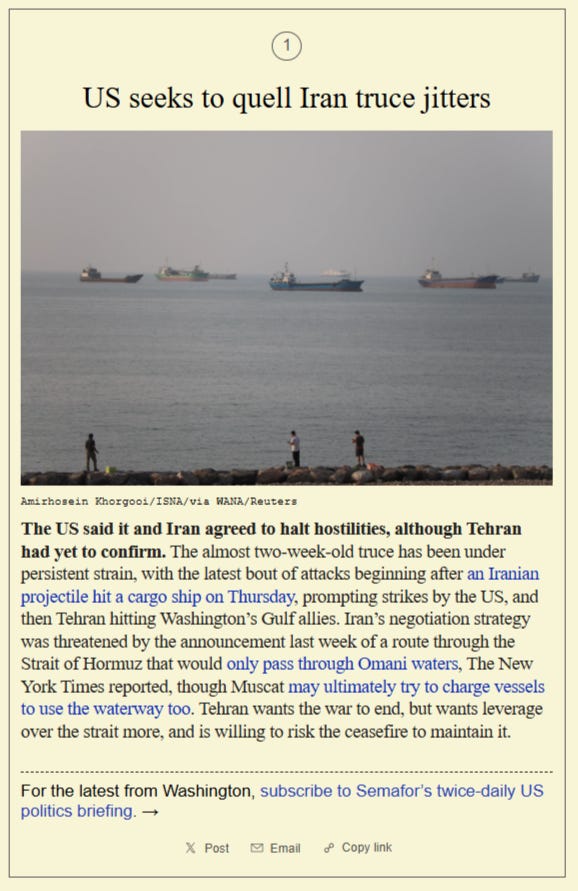
Iran is in fill control of the Strait of Hormuz, and does not have ‘truce jitters’, but is in full controll, to the shagrin of Trump and and his familiar JD Vance. ‘Semafor Flagship’ ……..
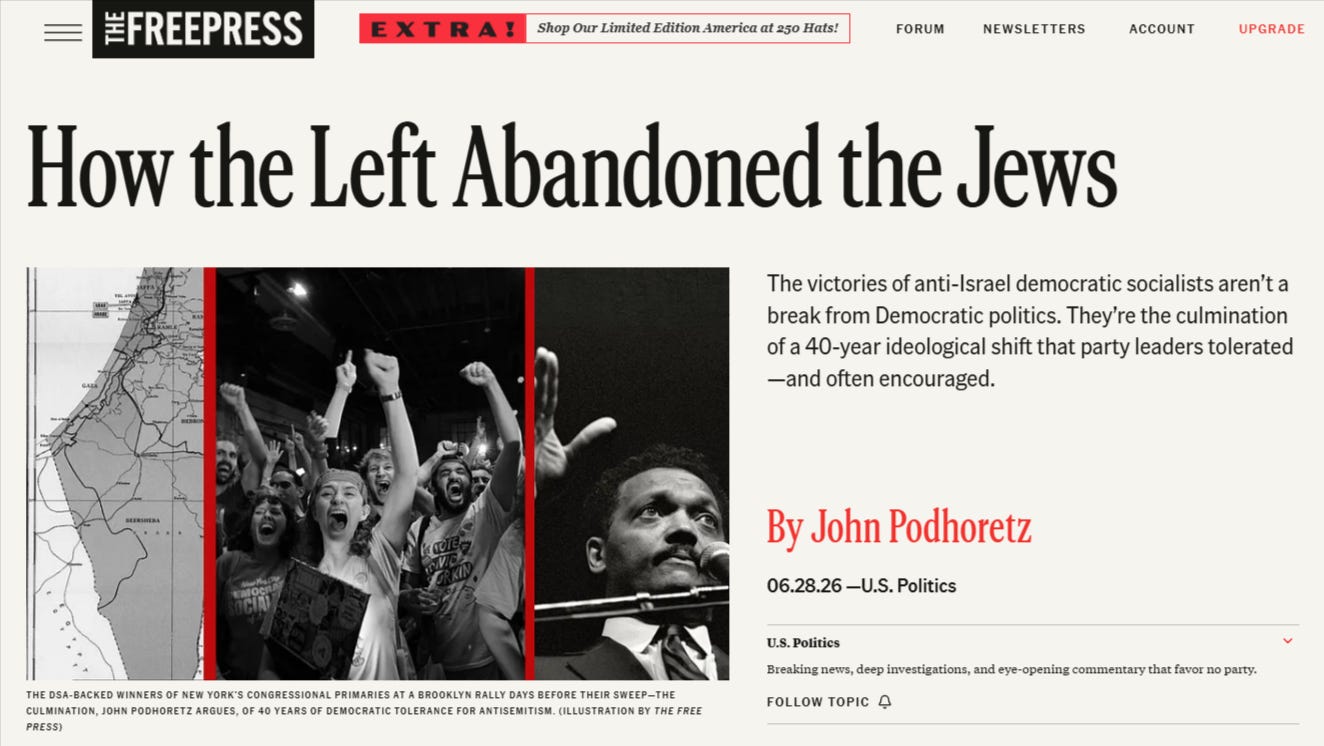
Can it even surprise that John Podhoretz is the son Norman Podhoretz and Midge Decter? Who can forget Normans claim to fame was ‘Making It’ ? His telling Jackie Kennedy to ‘fuck off’ was the epitomie of the class biass of a born political nihilist, on the make. Even the New York Review of Books republished this poisoned pen nililism.
Podhoretz mines the toxin of the Jewish Victimhood narritaive via ‘How the Left Abandoned the Jews’ & ‘The victories of anti-Israel democratic socialists aren’t a break from Democratic politics. They’re the culmination of a 40-year ideological shift that party leaders tolerated—and often encouraged’
How might the reader think about this ‘Jewish Victimhood Narrative’ refracted in the face of the continuinuing Gaza Genocide and the War in Lebanon? How can a comfortable American citizen clain the status of victimhood at such a remove? The Editors provide the preamble to the Podhoretz victimhood narritive:
In the week since New York City’s primaries—when three democratic socialist, staunchly anti-Israel candidates swept to victory—we’ve published a series of stories examining what the results mean for the country, and in particular, for Democrats, some of whom say they don’t recognize their own party any more.
This weekend brought a visceral illustration of the new mood we’ve been trying to capture. On Friday evening, California state senator Scott Wiener was on his way to a trans-led Pride Shabbat service in San Francisco—an event he’s joined for 22 years. At the entrance, protesters surrounded him, screaming: “We fucking hate you.” “You do not belong here.” And: “You stopped being queer the moment you started supporting Israel, you piece of shit.” Wiener is a Jewish, openly gay man.
His offense? His stance on Israel—specifically, his refusal at a campaign event to declare that “Israel is committing genocide in Gaza.” He later reversed course, but no matter. The damage was done.
If you haven’t seen the video, we encourage you to watch it. It’s a stark example of something increasingly difficult to deny on parts of the left: No matter who you are, how you identify, or what causes you’ve championed, if you refuse to fall in line on Israel, you risk being ostracized from communities you’ve long called home.
How, exactly, did we get here? According to John Podhoretz, editor of Commentary magazine, the DSA-style antisemitism now permeating large parts of the Democratic Party did not emerge overnight. Rather, it was cultivated over decades, tolerated and emboldened by leaders who declined to confront it. And if we ever hope to understand it, Podhoretz writes, we must go back to the very beginning. —The Editors
Editor: Nothing quites prepares the reader for retelling of ‘American History’ via the lens ofJohn Podhoretz at a mere 3872 words ! This telling excerpt offers a mere glimpse of the Podhoretz methodology:
…
Conventional American politicians in both parties loathed the resolution—and under U.S. pressure in the wake of the end of the Cold War, it was rescinded in December 1991. But the animating idea behind the resolution had already gained purchase in academic journals and university departments. In 1989, UCLA professor Kimberlé Crenshawdevised the theory of “intersectionality,” according to which all political oppression stemmed from an imbalance between the powerful and powerless. Its application to the Middle East conflict was obvious: Israel was powerful, the Palestinians powerless, and therefore Israel was, by definition, an oppressor.
It became the most influential sociopolitical theory of our time. And it dovetailed nicely with the dominant book about the modern Middle East. That was Edward Said’s Orientalism, a jeremiad against the imposition of Western ideas on non-Western cultures. Said was an English professor at Columbia by day but moonlighted as an official of the Palestine National Council, and was a critic of Palestinian leader Yasser Arafat from the left.
The ideas (and disciples) of Crenshaw and Said were disseminated throughout the academy in the 1990s and 2000s. They became the default view in political science and Middle Eastern studies departments and on tenure committees. Those who preached the intersectional anti-Zionist gospel had the loudest voices on campus and the greatest influence on the college-educated Americans who came their way. Even as the Clinton and Bush administrations were widely viewed as friendly to Israel, and even though the halls of Congress were populated by friends of Israel, the next generation of American political activists was being trained in darker and uglier ideas.
The Economist supplies Western propaganda as answer to Putin Propaganda? The New Cold War with Putin as The New Stalin has reached the point of no return. Are we continually ruled by manufactured crises?
What should we readers think of Poroshenko’s new laws?
The IMF has been reluctant to increase its own $17bn commitment, arguing that it has been carrying a disproportionate financial burden. It has been trying instead to muster new money from other international donors. Why doesn’t Soros just write a check?’
To The Economist editors: Do better than this tired recitation of the shopworn Party Line on Putin i.e. apologetics for US/NATO/EU political adventurism as the in order too of placing ABM’s at the border of Ukraine/Russia. And the imposition of Austerity in Ukraine: the advancement of the Neo-Liberal nightmare is ‘The Free Market’.
Hard to believe, but in my 12 and a half years as the Guardian’s political sketch writer, I am about to embark on my seventh prime minister. There was a time when we Britons took the piss out of the Italians for their rapid turnover of prime ministers. Now the laugh is on us.
When I first started in the lobby in 2014, there had been only four prime ministers in the previous 23 years. We’ve now churned through four in four years. The lineup of former prime ministers at the Cenotaph parade on Remembrance Day gets longer and longer. In a decade or so there will be only a handful of people who can recognise Liz Truss.
Keir Starmer’s resignation was slightly different from the others. He wasn’t being forced out as a result of a lost election or by a strong opposition. His departure had nothing to do with the Tories and was triggered by Labour winning a byelection. There was also something quite bashful about his resignation speech. Normally broadcasters and other media are given a heads-up when the prime minister is due to speak, with the lectern brought out on to Downing Street half an hour before. This time, though we all knew it was coming, Keir dashed out moments after the lectern was in place. Almost as if he wanted to get the speech over and done with, with as few people watching as possible.
Like almost every resignation speech, Keir’s was surprisingly moving. There’s something about witnessing the passing of power, the moment when the politics becomes personal, that touches me every time. Maybe it’s me that’s the softie. The one exception was Boris Johnson’s resignation speech. The one in which he accepted responsibility for nothing, blamed others for his departure and told the country we would all regret it. Oddly, we haven’t.
You can’t help wondering just how long the country will give Andy Burnham. Voters have become increasingly unforgiving if promises aren’t delivered immediately. It feels only a matter of weeks before some broadcasters start shouting: “When are you going to resign, Mr Burnham?”
…
Friday
Cancer does funny things to time. Both to the person who has it and the family of those with the illness. It feels as if I have lived every moment with Jill over the past 14 months. There have been moments when I have wished it was me who had cancer and not her. Not just out of some misplaced heroic altruism, but because it felt as if it would be easier to bear.
Living with and loving a person with cancer is to be given daily reminders of what it means to experience loss of control. It’s like being in a half world that is part of the real one yet also separate. Time bends. Some days almost slow to a standstill, when it feels as if you are experiencing every moment and not necessarily for the better. Others, usually the good ones, seem to race past as you struggle to keep hold of them. Recovery also sometimes feels glacially slow. It is seven months since Jill’s operation and five months since she finished the last round of chemo but there are still times of the day when she feels rubbish.
We have been told it may take at least a year before she is properly her old self again. But there have been some upsides. Cancer has brought us closer together. We haven’t just done the hospital stuff together – I feel as if I know every inch of the Marsden in Sutton and Fulham – but we have got to have the important conversations that other couples might not get to have because they feel they have all the time in the world, so why spoil the moment? As a family – I’m including our children here – it feels as if we have said everything that needs to be said. Whatever happens, there will be no regrets. And things are looking up. Jill is a lot stronger than she was even a couple of months ago, and bizarrely you do even get used to the two-month cycle of PET scans, MRIs and blood tests. As the oncologist recently said to us: “You must always bank the wins when they come along.” Because one day you may lose.
So, with that in mind, we are planning to enjoy our summer. Jill recently realised she hadn’t spent a night away from home – apart from the time she was in hospital – for over a year. This will change. We are going to America to see our daughter. Jill is coming to Buxton for the night towards the end of July where I am doing an event in the opera house as part of the festival. We are planning on visiting friends. Life is restarting.
Headline: The art of dealing with Donald Trump? Don’t fight him alone.
Sub-headline: This week’s trade deal is a boost for Keir Starmer. But a lasting win will only come by joining forces with other nations to resist the US president’s entire destructive agenda
These, then, are the two strategies available when the Trump juggernaut comes for you. You can seek to cut a separate deal, to protect yourself, as Columbia tried to do. Or you can stand together with all those similarly under attack, seeking to repel the entire Trump offensive, which is what happened after Harvard made its move. So far it is collective action that has got the best results.
Applied to world trade, that would mean a shift away from the every-man-for-himself approach that led to Thursday’s handshakes in the Oval Office, and towards a combined endeavour in which the UK joins forces with, say, Canada and Australia and, obviously, its nearest and biggest trading partner, the EU, to oppose Trump and his prosperity-destroying, self-harming tariffs. More Harvard, less Columbia.
Now, clearly, Starmer’s duty is to protect Britain from a US currently wrecking the global trading system. He took a step in that direction this week. But the greater, more lasting protection will surely come only when the free nations of the world don’t merely try to save their own skins, but instead come together to resist an American president bent on destroying so much that we all value – and not only on trade. Who knows, there may even be another American leader anointed this very week who would give such an effort his blessing.
Headline: Flattery gets Starmer somewhere as The Donald stays awake to toot tariff deal
Sub-hedline: Flattery gets Starmer somewhere as The Donald stays awake to toot tariff deal
Editor: Mr Crace has both literary and political talent, and a gift for story telling that evades Mr. Friedland! In the most telling way both Starmer and Freedland are locked in a toxic symbiosis, that resembles black & white television of a long-gone era!
Three days ago, Donald Trump promised an announcement that would be very possibly the greatest announcement in the whole history of announcements. Come Thursday morning, he said the US and the UK had reached a full and comprehensive trade deal.
I guess a lot depends on what you mean by the words “greatest announcement” and “full and comprehensive”. As details of the deal began to emerge, it rather looked as if the UK had managed to negotiate a worse deal with the US than we had even two months ago. One that was hardly transformative. Just reversing some of the damage that had been done to the UK by the US starting a global trade war. Tariffs as a protection racket.
Still, a deal is a deal. These days, Keir Starmer has learned you get what you can get. And it’s more than any other country has got so far. It remains to be seen if others come out of the White House with anything better. But Keir wasn’t the only one who needed a quick result. Trump did, too. He had a reputation to maintain as a deal-maker and Americans were beginning to get twitchy that none had been reached. It wasn’t clear if this was a victory for crack negotiating teams, or a sign that both the US and the UK had been a bit desperate. So both sides were keen to chalk the deal up as a win for themselves.
Editor: Mr Crace literary/political talent continues to bloom, as Mr. Freedland’s looks like and reads like, the precarious chatter of an Economist essay’s of the Micklethwait & Wooldridge era!
Trump’s powers of concentration aren’t all they might be and he finds it difficult when he’s not the centre of attention. Keir did his best to stop the president from flatlining by showering him with flattery. The Donald had been the best. Everyone and everything would be nothing without him.
At this, Trump began to perk up. The US and the UK had been working for years on a trade deal. People had said it couldn’t be done, he boasted. And yet he had done it in a matter of weeks. Truly, he was incredible. He didn’t seem to realise that he hadn’t negotiated a full trade agreement. Just a small side hustle encompassing a few sectors. There was a ripple of applause from the sycophants in the Oval Office when Trump managed to press the right switch to disconnect the call.
The Donald then invited his commerce secretary, Howard Lutnik, to expand a little on the deal. Howie is reportedly a billionaire but he also delivers a pitch-perfect impersonation of a halfwit. It’s hard to imagine him in a room negotiating the sale of a secondhand car. “This was the president’s deal,” he cooed. “If it had been left to me, it would have taken at least three years. He did everything. He is the closer.” Imagine. Howie had just told the entire world he had been out of his depth in a puddle. Truly, the world is fucked if he is one of its masters.
Next up was the British ambassador, Peter Mandelson. Bowing deeply. Full of reverence. Mandy was born for days like these. When all that is required is oleaginous smooth-talking masquerading as sincerity. Truly, The Donald was nothing short of a genius. He wasn’t fit to wipe the president’s shoes. Trump had achieved more than anyone else in the history of the world. Thank you, thank you. We have reached the end of the beginning, he sobbed. Everyone was getting in on the Churchill act this VE Day. Trump nodded. Mandy was right about him.
Back in the UK, Starmer was just starting his own press conference at the Jaguar Land Rover factory. Britain was open for business, he said. No less than the whole future of the UK had been saved. Keir, alone, had altered the course of history. Some men are born great, some achieve greatness and some have greatness thrust upon them. Keir had managed all three. This was bigger than VE Day. Bring out the bunting. Drink the pubs dry. We were entering a new era of prosperity.
This wasn’t just a victory for the UK. It was a victory for Starmer personally. Some people had said he should stand up to Agent Orange. Put the phone down. Don’t give in to bullies. But Keir had emerged triumphant. His brown-nosing had achieved the impossible. Which was, er … not quite as good as the deal we had not so long ago. It was time for the king to get out his silk pyjamas, line up the Diet Cokes and the Haribos and prepare for his sleepover with the president. If Keir had to suck it up, then so could Charles.
Alain is former News Editor of the Financial Times, Asia Editor and Middle East correspondent. He is currently a Fellow of the Centre for Welfare Reform
Thursday March 30, 2023
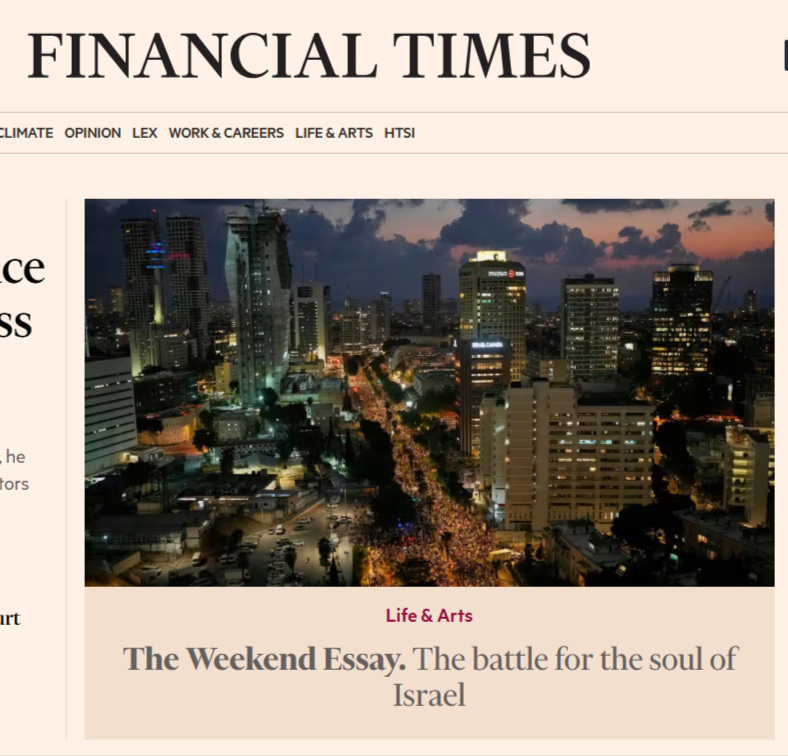
Israel is going through a period of torrid soul-searching. At the heart of this upheaval is a struggle, not between left and right, but between the desire to be safe and a longing to be free, to live in a normal, peaceful democracy. It’s a contest for Israel’s soul.
The hard-line coalition led by fifth-time Prime Minister Benjamin Netanyahu argues that accruing more power to the state — by hobbling the judiciary and curbing human rights — is necessary to protect Israel from its internal and external enemies.
Tens of thousands of Israelis, bearing rivers of blue and white Star of David flags, have taken to the streets begging to differ. They see the proposed measures as a crude power grab that would undermine the country’s democratic foundations even further.
Long nights of angry protests were made worse by Netanyahu’s decision to fire his Defence Minister Yoav Galant. The latter said the divisions caused by legislation to neuter the judiciary posed “a clear, immediate and real danger” to the state.
Warnings of serious disquiet in the army’s vital reserve units flashed red. (The last time Israeli reservists rose up in protest was after the invasion of Lebanon in 2006). The Israeli Defence Force are lionized as the embodiment of Zionist values. So when the military speaks politicians sit up.
This week Netanyahu has backed off in the face of these unprecedented protests and a stiff warning by President Joe Biden to drop his judicial reform plans. The Israeli leader told the nation “When there’s an opportunity to avoid civil war through dialogue ..I am taking time out for dialogue”. Call this realpolitik or call it breathtaking cynicism: at least it offers a pause in an incendiary situation.
History matters, as always with Israel. The Jewish state was born out of tragedy, forged in conflict and lives on in a state of perpetual apprehension. This restless search for equilibrium – pushed to its very limits by a manipulative, power-hungry Prime Minister — lies at the heart of the extraordinary events of the past few weeks.
This tension, of course, is not exceptional. Weighing up draconian measures to ward off dangers (real or perceived) against individual freedom and human rights is an occupational hazard for any democracy.
But for Israel the predicament is uniquely acute. The country has been in a perpetual state of belligerence since the first Arab-Israeli conflict when the United Nations voted in 1947 to partition the British mandate of Palestine into two states, one Jewish one Arab.
The residual fear of annihilation – a second Holocaust – is what gives its politicians a wide discretion to act, sometimes to overreact. The generation that was part of the founding of the Jewish state out of the embers of the Holocaust has, by and large, backed its government tough line over the years.
But Israel’s martial approach to what it regards as its existential challenges has not always met with approval at home: the permanent occupation of the West Bank and Gaza, the invasion of Lebanon in 2006, the aggressive Jewish settlement programme in the occupied territories have all drawn protests.
But this is different. This latest protests, mostly by a younger generation, may turn out to be a defining moment for this young, embattled country. Netanyahu’s coalition of ultra-nationalists, religious leaders and assorted far-Right rabble-rousers want to neuter the Supreme Court by turning justices into political appointees. It also wants the Knesset (the Israeli parliament) to be able override Supreme Court rulings. Britain is not unfamiliar with this impulse.
Israel’s Supreme Court wields significant power. But Israel is a country with a unicameral parliament, no formal constitution, and an increasingly volatile political landscape. There have been 37 governments in the 75 years since Israel’s creation in 1948.
The judiciary plays a crucial checks and balances role. If it’s not there to hold the ring who will? And you have to ask: what is Israel without a robust and independent judiciary? Countries that slide into dictatorship invariably start out by obliterating the independence of their judges. Is this what Israel’s founding fathers had in mind?
Netanyahu is nothing if not skilled in politics. He is a survivor who knows when to big himself up and when to show the necessary humility. The Jerusalem Post describes him as part Rambo part artful dodger. He drives his opponents crazy by being three steps ahead.
In his most recent attempt to cling to power Netanyahu has allied himself to extremists like National Security minister Itamar Ben-Gvir. The ultra-Zionist has built a legal career defending Jewish suspects charged with terrorism and hate crimes. He has been indicted more than 50 times for incitement to racial hatred.
His role model and ideological wellspring is the late Meir Kahane, a Brooklyn rabbi who moved to Israel in 1971. During a single term in the Knesset Kahane pushed the moral tenets of the country to the limit.
Kahane argued that “the idea of a democratic Jewish state is nonsense.” In his view – and he was not alone – demographic trends would lead ineluctably to a non-Jewish majority. To Kahane, Arabs were “dogs” who “must sit quietly or get the hell out.”
Leading ultra-Orthodox Rabbis have joined the call for pushing ahead with the coalition’s legal reforms. “By the grace of God, the people of Israel chose a Jewish and nationalistic government that is expected to operate in support of Torah, the people of Israel and the Land of Israel.” This is naked populism by another name. Recent citizenship laws passed by the Knesset methodically privilege Jewish Israelis and discriminate against Palestinians and Arab citizens playing to the fear of an eventual Arab majority.
The Israeli leader remains on trial for allegedly providing political favours to tycoons in exchange for personal gifts and positive press coverage—charges he denies. Perhaps he saw these measures as his get-out-of-jail card. Either way “Bibi” has badly misjudged the mood of his country.
Governing Israel – being Israel- is complicated. The story it tells of itself – the socialism of its founding fathers, the kibbutzim, the Holocaust – is essentially a European one.
The reality is more complicated. One fifth of Israel’s citizens are Arab Muslims. But many more – perhaps as many as half – have roots in the Islamic world. They are (like Arabs, Phoenicians, Babylonians) Semites.
Dragging Israel into an exclusively Jewish space where non-Jews are second-class citizens and human rights are sacrificed on the altar of national survival is a recipe for perpetual conflict.
The Palestinian issue has been temporarily silenced. But imagining that it has gone away is foolish and the Israelis are nothing if not realists.
Israelis are united in their desire to keep their country safe. But, perhaps for the first time, they are confronted by the question: at what cost?
This crisis offers a chance to pause and rethink what Israel is and what is stands for. A constitution and a Bill of Rights would go some way to paving the way for a fresh start.
Sub-headlines: Can Ukraine capitalize on chaos in Russia?
Ukraine’s counter-offensive is going slowly
Ukrainians watched with glee as Russia flirted with civil war on June 24th. They had hoped that Yevgeny Prigozhin’s march on Moscow would tie up Russian troops and destabilise Vladimir Putin’s regime. Alas, the insurrection proved short-lived. In recent days, Ukraine’s army has made modest advances in the east. But a counter-offensive that began on June 4th shows little sign of breaking through Russian lines in force any time soon, making some Western officials nervous.
Still, Ukraine has made some hay with the disarray next door. Its army made significant progress in the eastern town of Bakhmut, which Mr Prigozhin’s forces had captured only last month after almost a year of fighting. Ukrainian forces now threaten to encircle Russian defenders from the north and south. Volodymyr Zelensky, Ukraine’s president, hailed a “happy day” after visiting front lines on June 26th. Russia responded with a dinnertime missile strike on a popular restaurant in Kramatorsk on June 27th, 30km from the front line. It killed at least eight people, including three children.
The composed Headline, that reads in part ‘Party like it’s 1917’ the maladroit framing, expresses a dull-witted attempt to shanghai Prince’s 1999 best selling Pop Record? call it at best pathetic. Or an attempt to reach a generation of readers, that used to think that The Economist was the reading of choice of Economics Majors? Or for those Oxbridgers or the Pretenders who were aiming for lucrative employment opportunities? The reader has 1, 052 words of propaganda to ingest, digest or just regurgitate, to demonstrate a pastiche of highfalutin Econo-Speak?
Selective quotation of the remainder of the essay reads like more Front Line descriptions, from those ever-present ‘stringers’ who provide the near graphic costs of War?
The aim of the offensive towards Bakhmut appears less to enter the city than to surround it.
The front-lines shifted elsewhere, too. Ukraine’s capture of territory in the western suburbs of Donetsk city was especially important: troops crossed into territory which Russia had held since 2015, during its first invasion of Ukraine.
Some officials suggest that Ukraine may be able to conduct a more significant crossing of the rapidly desiccating Kakhovka reservoir in the weeks to come.
The question is whether the convulsions in Russia will have longer-lasting effects on the battlefield. One issue is the future of the Wagner Group.
Some fighters have indeed gone back to Ukraine, where Mr Putin says they will be absorbed into the Russian forces. Others, including the 2,500 to 5,000 troops who played a role in the mutiny, may join Mr Prigozhin in Belarus.
The second issue is the impact on morale. A spokesperson for the 56th Motorised Brigade, now fighting on the outskirts of the city, says her colleagues had observed new levels of “confusion” among their Russian counterparts since June 23rd. Their befuddlement is understandable.
In angry remarks on June 24th Mr Putin himself drew an indelicate comparison to 1917, a year in which revolution at home contributed to the mutiny of Russian armies in France. Anthony King, a military sociologist at Warwick University, warns against over-egging the effect of Mr Prigozhin’s subversive messaging.
Mr King says he is sceptical that “political shenanigans” will have much of an effect on platoons and companies at the tactical level.
The impact on Russia’s high command, the third question raised by the insurrection, could be more severe.
Sources : The New York Times, The Wall Street Journal, Both reports cited American intelligence, Mr. King.
On June 28th the New York Times reported that General Sergei Surovikin, the commander of Russian forces in Ukraine between October and January, had prior knowledge of the rebellion. The same day, the Wall Street Journal said that Mr Prigozhin had intended to kidnap Sergei Shoigu, Russia’s defence minister, and General Valery Gerasimov, the country’s chief of general staff, during their visit to a region near Ukraine’s border. Both reports cited American intelligence. “Fractures at that command level could have a longer-term effect on the unity of the campaign,” says Mr King.
Sources:
“It is still too early to tell how successful the ongoing counteroffensive will be,” acknowledged General Sir Patrick Sanders, Britain’s army chief, on June 26th, adding “Russia has been a country of comebacks.”
Sources:
A Ukrainian military-intelligence source complains that the country is moving as fast as it can, given the tools at its disposal. “Let me put this as diplomatically as I can,” he says. “Certain partners are telling us to go forward and fight violently, but they also take their time delivering the hardware and weapons we need.”



 StephenKMackSD's Blog