Musk being escorted by political histeric Ben Shapiro, visited the Auschwitz-Birkenau concentration camp in January 22, 2024! Is not quite enough to asuage the French prosecutors of Musks…
Apr 20, 2026
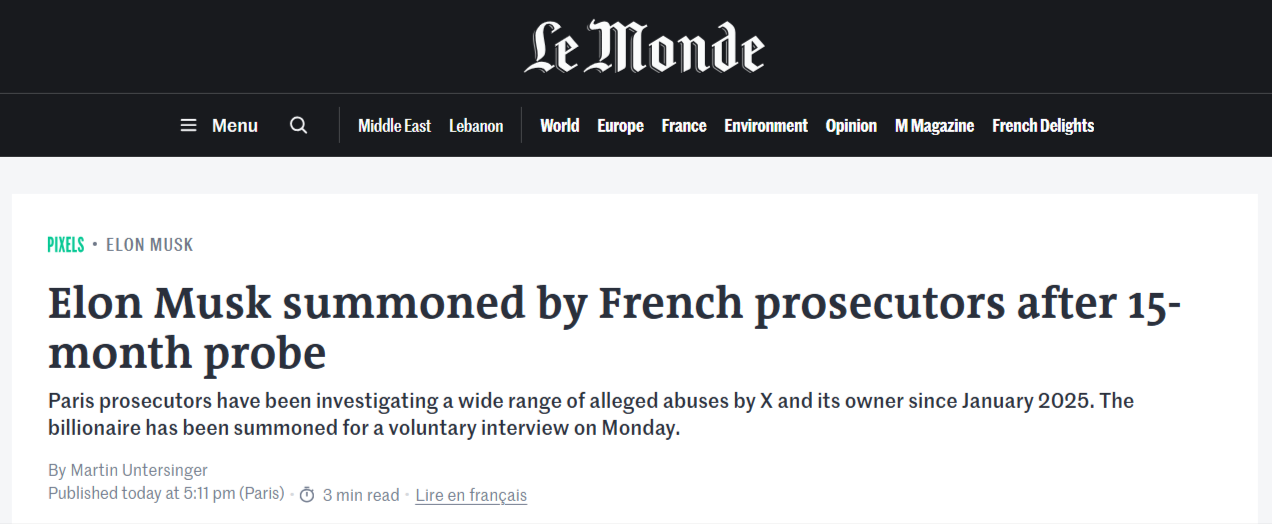
Elon Musk posts frenetically on X. In recent days, he’s shared his opinion on universal basic income, South African politics, a local election in Nevada and progressivism. But will he be in Paris on Monday, April 20? He has not said, but it seems unlikely.
He has been summoned by the head of France’s cybercrime unit for a voluntary interview as part of a preliminary investigation launched in January 2025 into the social platform he leads. Around 10 executives from the American company, including former CEO Linda Yaccarino, were also summoned.
The probe, which began after reports from a French MP and a senior figure at a public cybersecurity body, initially focused on two possible violations: the alleged deliberate manipulation of the algorithm to influence French public debate, and the potential unlawful use of sensitive users’ personal data for targeted advertising.
‘Deliberate’ maneuver
After the investigation was handed over to the national cyber unit at the start of the summer, it escalated in November. Prosecutors uncovered numerous antisemitic and Holocaust-denying messages generated by Grok, X’s artificial intelligence, and expanded their investigation to include the crime of contesting crimes against humanity.
Investigators also noted both a change in the tool X uses to detect child sexual abuse material and an 80% drop in reports by the platform about such content in France. Suspecting a deliberate move, prosecutors added complicity in possessing and disseminating child sexual abuse images to their investigation.
In January 2026, after the scandal over Grok generating thousands of sexualized images of women and minors, the investigation broadened to include possible offenses relating to the representation of persons, with prosecutors arguing that the platform had deliberately delayed taking measures to limit the appearance and spread of these images. Finally, due to the “recurrence of X being used in the commission of various offenses,” prosecutors expanded their investigation to include “operating an illicit platform.”
Over the course of 15 months, judges and investigators received assistance from several AI experts as well as “material provided by various public institutions,” according to the prosecutors’ office. The cybercrime unit also asked X to provide its algorithm so it could understand what might constitute a deliberate intervention to promote certain problematic content. The platform refused.
‘Pressure’ tactics
Investigators worked in a tense atmosphere. X, which always denied any wrongdoing, condemned the probe as “politically-motivated criminal investigation.” On February 3, when investigators searched the company’s French offices, X denounced what it called a “staged raid [that] reinforces our conviction that this investigation distorts French law.”
At the end of March, after prosecutors filed a report concerning Musk over possible manipulation of his company’s valuation, the billionaire even called the judges investigating his platform “mentally retarded.”
Even though relations between Musk and the White House have cooled considerably, the possibility of retaliatory sanctions by the US government against the French judges looms over the investigation. Thierry Breton, one of the architects of Europe’s digital rules during his tenure as European commissioner for the internal market, was sanctioned by the US administration at the end of December 2025, and his case is very much on everyone’s mind.
Five months earlier, a US State Department official had described investigating judge Johannah Brousse as an “activist French prosecutor,” amid Washington’s all-out attacks on European digital law. Meanwhile, one of the two original whistleblowers behind the investigation, MP Eric Bothorel, was removed from the list of participants in a parliamentary visit to the White House in February 2026.
Moreover, prosecutors said they were investigating several users who used X and Grok to spread Holocaust-denying or antisemitic content, but that X refused to provide information that would have made it possible to identify them – information that “had until now been provided in the vast majority of cases.”
Forcing a compromise
By going after Musk, prosecutors are taking a twofold gamble. In February, they presented their search of X’s premises as a “constructive approach, with the aim of ensuring, ultimately, that the X platform complies with French law” and the voluntary interviews as a way “to present (…) the compliance measures under consideration.”
The idea is to force Musk into compromise, much like the showdown with Pavel Durov, the head of Telegram. Detained for questioning, held in police custody and charged, notably for ignoring court orders, the Russian-born French national subsequently began responding to investigators’ requests. But since Musk hasn’t adopted any “compliance measures” since the investigation began, the outcome of the standoff with the American billionaire is less clear.
From a legal standpoint, prosecutors are also treading new ground. They suspect, among other things, that Musk has manipulated his social network’s algorithm and is therefore prosecuting him for “falsifying the operation” of an information system.
These three words from the French penal code have never been used since their introduction in 1988. It’s an “untapped resource” and yet a promising one, according to a February 2025 analysis by law professor Michel Séjean, which was read carefully on the 26th floor of the Palace of Justice. This application of the law is a subject of debate among legal experts, but seems to be supported by two recent rulings of Cour de Cassation, the highest appeals court in criminal cases.
If Musk fails to appear for his summons, prosecutors will have several options, including initiating a legal investigation and seeking an international arrest warrant.
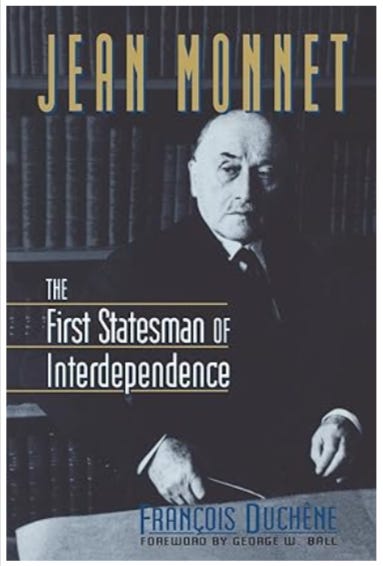
Editor: Since Musk is now an American Citizen, and considering that the European Union is now political captive of the Anti-Semitism Hystetia, nurthered by Mass Murder Benjamin Netanyahu, and President of the European Commission Ursula von der Leyen is under political attack, as that political myth nurtured by the long dead Jean Monnet, as presented by Francois Duchene has exhausted that Mythology! How can it escape the reader’s attention of Musk being escorted by political histeric Ben Shapiro visited the Auschwitz-Birkenau concentration camp in January 22, 2024?
Editor: Not to forget: ‘The Rotten Heart of Europe’ of Bernard Connolly as proof that the EU is a toxic political delusion!
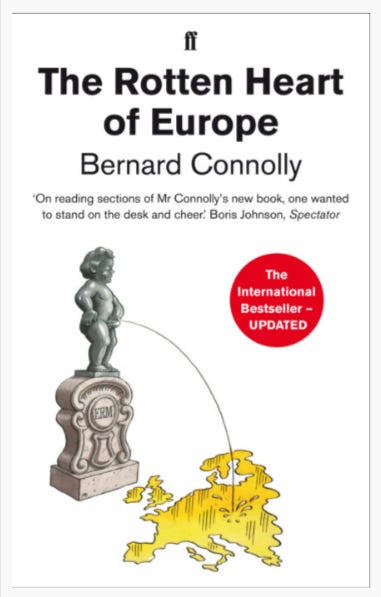
Arno Tausch (1998) The Rotten Heart of Europe? A technical note on EMU and the rise of world-wide narco-capitalism Foreword to the reprint of a book chapter from the work: Globalization and European Integration. There were many critics of European Monetary Union in the 1990s. The quantitative world systems scholar Arno Tausch, from Innsbruck University, in an electronic book, published in 1998 by the World Systems Archive of the University of California, Riverside predicted with many others that the Eurozone will disintegrate. As the analyst Christopher M. Quigley recently reminded his audience (http://www.marketoracle.co.uk/Article19081.html) recent and unfolding events in Greece were foretold by the former European Union economist Bernard Connolly in his classic book “The Rotten Heart of Europe.” [Bernard Connolly: The Rotten Heart of Europe’: The Dirty War for Europe’s Money’. Faber & Faber. London.1996. ISB) 057117521X] Tausch in his politometric essay refers precisely to this title. Connolly had to quit his job at the Commission for publishing a very critical book about the ERM (Exchange Rate Mechanism), the forerunner of the Euro. Let us quote just two passages from the Connolly book.
“As we shall see, in France the long arm of the authoritarian state has pressurized dissident economists and bankers, deployed financial information programmes on international TV channels, threatened securities houses with loss of business if they questioned the official economic line, and shamelessly used state-owned and even private-sector banks, in complete contradiction with their shareholder’s interests and Community law, to support official policy. ………. The economic profession in Europe organized literally hundreds of conferences, seminars and colloquia to which only conformist speakers were invited; and the Commission’s “research” programmes financed large numbers of economic studies to provide the right results from known believers.” Connolly also said at the time: “My central thesis is that the ERM and the EMU (European Monetary Union, the mechanism with ultimately brought the Euro into technical existence) are not only inefficient but also undemocratic: a danger not only to our wealth but to our freedom and ultimately, our peace.”
Christopher M. Quigley is right in insisting that under the current Euro regime we have stable exchange rates between the Euro countries but there is no harmony between the disparate economies that make up Euroland. The Euro is not a “currency” as such but in actual fact is an exchange rate mechanism only. The Euro is allowing cheap German goods flood Europe and explains why it has 200-300 billion Euros of trade surpluses with its economic partners. “In a survey last week over 80% of Greeks said they wanted to exit the Euro but this voice is not being reported in much the same fashion that Connolly’s concerns were silenced by elite bankers and politicos. However, in 1995 when the Euro mechanism was being set up the world was less connected. Today we have international hedge funds connected through Cray computers ready to “play” the markets. As soon as traders realize the Euro is a one way bet they will opt to profitably destroy the exchange mechanism because of its exposed failings. The Emperor has been seen to have no cloths. As sure as night follows day they are going to reap their reward. They will seek to emulate George Soros when he reaped his one billion sterling paycheck on the 16th. September 1992 (“Black Friday”). It was that day the bank of England lost 3.4 billion sterling in one single 24 hour period, defending a flawed exchange link to Euroland. It is my suspicion that Germany sees this as a very real scenario and does not desire to waste its hard won foreign reserves on a “)orman Lamont” (The “Black Friday” chancellor of the British exchequer) type endgame.” [Christopher M. Quigley, http://www.marketoracle.co.uk/Article19081.html%5D
Quigley proposes that the “PIIGS”: Portugal, Italy, Ireland, Greece and Spain, should form a league for the purpose of national economic restructure. This league should negotiate an exit from the Euro and allowing their currencies to “float” once more. This will immediately allow their economies to become competitive again without widespread deflation. Most importantly all Euro loans must be devalued based on a new negotiated exchange conversion, as per the Argentinean model. Bernard Connolly lost his job at the Commission; the European Court of Justice states in his final judgement (JUDGMENT OF THE COURT, 6 March 2001):
4 By letter of 18 August 1995, Mr Connolly applied to be reinstated in the Commission service at the end of his leave on personal grounds. The Commission, by decision of 27 September 1995, granted that request and reinstated him in his post with effect from 4 October 1995.
5 Whilst on leave on personal grounds, Mr Connolly published a book entitled The Rotten Heart of Europe – The Dirty War for Europe’s Money without requesting prior permission under the second paragraph of Article 17 of the Staff Regulations.
6 Early in September, and more specifically between 4 and 10 September 1995, a series of articles concerning the book was published in the European and, in particular, the British press.
7 By letter of 6 September 1995, the Director-General for Personnel and Administration, in his capacity as appointing authority … informed the applicant of his decision to initiate disciplinary proceedings against him for infringement of Articles 11, 12 and 17 of the Staff Regulations and, in accordance with Article 87 of those regulations, invited him to a preliminary hearing.
8 The first hearing was held on 12 September 1995. The applicant then submitted a written statement indicating that he would not answer any questions unless he was informed in advance of the specific breaches he was alleged to have committed.
9 By letter of 13 September, the appointing authority again invited the applicant to attend a hearing, in accordance with Article 87 of the Staff Regulations, and informed him that the allegations of misconduct followed publication of his book, serialisation of extracts from it in The Times newspaper, as well as the statements he made in an interview published by that newspaper, without having obtained prior permission.
Leaving the question of intellectual freedom aside, Tausch shows in his e-book, 1998 by quantitative means that the dire predictions voiced by Connolly, Freedman, Rothschild and so many others are true. He states sarcastically: “The above mentioned positive redistribution effect on a European scale between the )orth and the South (and later on, between the West and the East) could be endangered by the long-term effects of EMU. The proponents of EMU maintained all along, that it will be engine of political and economic unification on the continent. We fear that the long-term effect of the project will be an increasing nationalism and a cultural conflict along the old cultural frontier, the Limes, between the Latin and the Germanic Europe, between the wine and the beer culture, between the olive oil consumers and the sausage eaters. An increasing number of scholars propose an alternative course of action that stresses the political and social cohesion in Europe as the main pillars of a true European Monetary Union (Rothschild, 1997). There is the danger, that Euromonetarism will accelerate the tendency of the world system on its path towards financial speculation, narco-capitalism, and the shifting of resources away from the Atlantic region towards the Pacific. On the other hand, it is evident that Europe’s long-term ascent from the Long 16th Century onwards from the state of a former periphery of the world system to a center (Arrighi, 1995; Amin, 1975), which was based on agrarian reform and mass demand, is now threatening to be reversed by the application of monetary orthodoxy.”
…
Newspaper Reader.


