Newspaper Reader on : ‘one that has no weight, worth, or influence : nonentity’ !
Apr 19, 2026
Headline : How the tech lobby made secrecy part of EU law on data centers
Sub-headline” Microsoft and the tech industry lobby secured a provision from the EU to keep environmental data about the massive data centers they operate in Europe confidential, according to an investigation by the Investigate Europe consortium, in collaboration with Le Monde.
Microsoft and DigitalEurope, a Brussels-based lobbying group for the information technology industry whose members include tech giants including Amazon, Google and Meta, have obtained the introduction of a confidentiality clause in European regulations on data centers. The clause blocks public access to specific information regarding their environmental impact.
The European Union sought to regulate the sector by adopting a revision of its Energy Efficiency Directive in 2023. The reform required operators of sites whose electrical connection exceeds 500 kilowatts to submit a certain number of indicators: energy consumption, water usage, energy efficiency, and technical performance data.
The European Commission was then tasked with taking what were described as technical measures to establish “a common Union scheme for rating the sustainability of data centers located in its territory.” In a draft regulation made public in December 2023 and submitted for consultation, it initially proposed that the information provided by operators be published “in aggregated form.”
At the start of 2024, Microsoft and DigitalEurope submitted comments requesting, in identical terms, that individual data for each site be classified as confidential, citing commercial interest. When the final version of the regulation was published in March 2024, the European Commission adopted this wording almost verbatim, so the detailed, site-by-site data became secret.
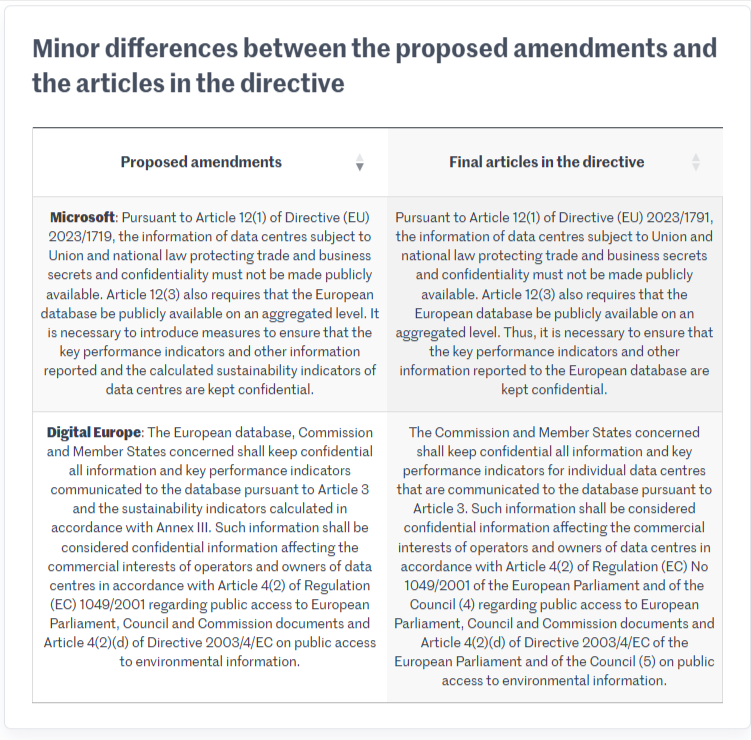
Article 5, as finally adopted, states that “the Commission and Member States concerned keep confidential all information and key performance indicators for individual data centers.” In practice, only national aggregate statistics are made public.
Member states were also encouraged to reject requests from the media or the public for access to this information. In an email sent at the beginning of 2025 and not previously made public, a senior Commission figure stressed to national authorities that they were “obliged to keep confidential all information and key performance indicators for individual data centers.”
A questionable legal basis
According to several law experts, this provision could violate European transparency rules as well as the EU’s obligations under the Aarhus Convention, which guarantees public access to environmental information.
“In two decades, I cannot recall a comparable case,” said Jerzy Jendrośka, a former member of the convention’s oversight body. According to Jendrośka, “This clearly seems not to be in line with the convention.” Luc Lavrysen, honorary president of the Belgian Constitutional Court and an environmental law expert, believes it “is clearly in violation” of European transparency rules. Kristina Irion, associate professor in information law at the University of Amsterdam, offered a similar analysis, condemning a “sweeping presumption of confidentiality” in favor of private interests. In her view, the protection of trade secrets should be assessed on a case-by-case basis.
When approached for comment, the European Commission said that the principle of confidentiality had already been included in its initial proposals. A European official, who wished to remain anonymous, said they had received “many comments” during the consultation process: “We analyzed the feedback and adopted a text reflecting it, as per usual practice.”
Reached for comment, Microsoft said, “We support greater transparency around datacenters (…) while protecting confidential business information.”
DigitalEurope did not respond to our requests for comment. According to a source close to the matter, Brussels fears that publishing data center information site by site could prompt some operators to stop submitting their data, despite their legal obligations. Yet, according to the EU’s own figures, only 36% of eligible data centers – around 770 facilities – submitted their information for 2024. And only 80% of the data received was considered accurate and reliable.
Lobbying groups push for speeping up procedures
The issue is made even more sensitive by the sector’s extremely rapid growth. In Europe, €176 billion in investments are expected between 2026 and 2031, according to the European Data Centre Association (EUDCA). This expansion has fueled concerns about the electricity consumption of these facilities, their heavy use of water for cooling and their impact on local residents and ecosystems.
And that clause is far from being the only recent sign of the sector’s influence on European and French legislation concerning data centers. In December, the European Commission unveiled a bill aiming to speed up environmental impact assessments for major construction projects, including many of the biggest data center projects. This piece of legislation is part of a broader push to reduce the administrative burden on businesses.
A document obtained by a freedom of information request shows Microsoft met with an EU official in late October to discuss the topic, with the company calling for capping deadlines.
In France, the simplification law, which Parliament finally passed on April 15 after a long legislative process, also introduced this principle into French law. Certain large-scale data centers can now be designated as projects of major national interest (PINM), a favorable status created by the 2023 green industry law. This will speed up procedures such as the authorization timelines needed to open a new site, the compatibility of urban planning documents or connecting to the power grid. That demand has been pushed by the sector since 2024, as shown by lobbying disclosures published on the website of the High Authority for Transparency in Public Life (HATVP) by Google France and France Data Center. The French lobby, which includes Amazon and Microsoft among its members, said it “welcomes this outcome,” which, in their words, “will help attract as much international and domestic investment to France as possible.”
In early March 2026, a working group focused on digital issues as part of the national electrification plan, co-chaired by Michael Reffay, director general of France Data Center and former adviser on digital regulation and sovereignty to the French minister for digital affairs under Amélie de Montchalin, called for making it easier to connect data centers to the electricity grid. In January, Anne Le Hénanff, the French junior minister for artificial intelligence and digital affairs, brought together, one year after the AI Action Summit in Paris, the key players in the data center sector. Over the course of a morning, 80 participants, including Google France, Microsoft and Amazon, met at the Finance Ministry to discuss topics such as environmental challenges and electrical connections, according to the list of attendees.