On the political redemption of Ross Douthat ?

Political Cynic speculates.

Has that time spent writing for The New Statesman, as short as his tenure has been, led to Mr. Douthat to reappraise his once obsession with the sexual lives, practices of American Women? That subject will have to wait, on the urgent questions of the political present.

In his latest essay at The New York Times Mr. Douthat takes on the vexing question of Vladimir Putin. Here are the first paragraphs of his February 26, 2022 essay titled ‘Vladimir Putin’s Clash of Civilizations’:

When the United States, in its hour of hubris, went to war to remake the Middle East in 2003, Vladimir Putin was a critic of American ambition, a defender of international institutions and multilateralism and national sovereignty.

This posture was cynical and self-interested in the extreme. But it was also vindicated by events, as our failures in Iraq and then Afghanistan demonstrated the challenges of conquest, the perils of occupation, the laws of unintended consequences in war. And Putin’s Russia, which benefited immensely from our follies, proceeded with its own resurgence on a path of cunning gradualism, small-scale land grabs amid “frozen conflicts,” the expansion of influence in careful, manageable bites.

But now it’s Putin making the world-historical gamble, embracing a more sinister version of the unconstrained vision that once led George W. Bush astray. And it’s worth asking why a leader who once seemed attuned to the perils of hubris would take this gamble now.

I assume that Putin is being sincere when he rails against Russia’s encirclement by NATO and insists that Western influence threatens the historic link between Ukraine and Russia. And he clearly sees a window of opportunity in the pandemic’s chaos, America’s imperial overstretch and an internally divided West.

It’s hard to escape that Mr. Douthat riffs on the themes of Adam Smith’s ‘The Impartial Spectator’ in the most self-serving way. These sentences and sentence fragments inform The Reader of Mr. Douthat’s gambit:

‘When the United States, in its hour of hubris, went to war to remake the Middle East in 2003,…’ , ‘This posture was cynical and self-interested in the extreme. But it was also vindicated by events, as our failures in Iraq and then Afghanistan demonstrated the challenges of conquest, the perils of occupation, the laws of unintended consequences in war.’ , ‘But now it’s Putin making the world-historical gamble, …’ ‘I assume that Putin is being sincere when he rails against Russia’s encirclement by NATO…’

Who can rescue Mr. Douthat from his false modesty, and his attempt to seem what he is not, clever in the art of the exercise of self-serving political rhetoric.

In this vision the future is neither liberal world-empire nor a renewed Cold War between competing universalisms. Rather it’s a world divided into some version of what Bruno Maçães has called “civilization-states,” culturally-cohesive great powers that aspire, not to world domination, but to become universes unto themselves — each, perhaps, under its own nuclear umbrella.

This idea, redolent of Samuel P. Huntington’s arguments in “The Clash of Civilizations” a generation ago, clearly influences many of the world’s rising powers — from the Hindutva ideology of India’s Narendra Modi to the turn against cultural exchange and Western influence in Xi Jinping’s China. Maçães himself hopes a version of civilizationism will reanimate Europe, perhaps with Putin’s adventurism as a catalyst for stronger continental cohesion. And even within the United States you can see the resurgence of economic nationalism and the wars over national identity as a turn toward these kind of civilizational concerns.

*Bruno Maçães leads the way with “civilization-states,” that leads to the racist xenophobe Samuel P. Huntington, and his bloated essay that led his even more inflated best selling book. Read Edward Said’s review here:

Headline: The Clash of Ignorance

Sub-headline: Labels like “Islam” and “the West” serve only to confuse us about a disorderly reality.

https://www.thenation.com/article/archive/clash-ignorance/

With the bit between his teeth, Mr. Douthat proceeds at a gallop, with his Anti-Putin propaganda. The last two paragraphs are not revelatory of his demonstrated ‘political modesty’ but that he follows The Party Line on Putin The Terrible, in his own idiosyncratic way. Mr. Douthat doesn’t just miss the blatant fact that Putin behaves just like an American President e.g. on a Crusade against The Soviet Union in Afghanistan, the Invasion of that state, and the eventual desertion after twenty years, The crimes of Saddam Hussein in Iraq, the Obama backed Ukrainian Coup of 2014, that legitimized fascists Right Sector, Svoboda, The Azov Battalion! But note that Mr. Douthat can’t quite escape from his penchant for self-serving public moralizing.

But if your civilization-state can’t attract its separated children with persuasion, can they really be kept inside with force? Even if the invasion succeeds, won’t much of Ukraine’s human capital — the young and talented and ambitious — find ways to flee or emigrate, leaving Putin to inherit a poor, wrecked country filled with pensioners? And to the extent that the nationalist vision of Russian self-sufficiency is fundamentally fanciful, might not Putin’s supposedly-greater-Russia end up instead as a Chinese client or vassal, pulled by Beijing’s stronger gravity into a more subordinate relationship the more its ties to Europe break?

These are the long-term challenges even for a Putinism that accepts autarky and isolation as the price of pan-Russian consolidation. But for today, and for as many days as Ukrainians still fight, the hope should be that he never gets a chance to deal with long-term problems — that the history that he imagines himself making is made instead in his defeat.

*senior fellow at the Hudson Institute.

Political Cynic
Posted in Uncategorized | Leave a comment

Mary Sarotte’s regret on the collapse of ‘the post-cold-war order’, in The Financial Times!

Old Socialist comments on her melodrama, as political temperature taking!

There is nothing quite like The Financial Times placing an essay about the end of ‘the post-cold-war order’ in the ‘Life And Arts’ section of this newspaper! And that this ‘essay’ began as a book ‘Not One Inch: America, Russia, and the Making of Post-Cold War Stalemate’, from which parts of this essay have been adapted .’ So this 2, 781 word ‘essay’ is an exercise of a cobbled together ‘journalism made to measure’?

Headline: Russia, Ukraine and the 30-year quest for a post-Soviet order

Sub-headline: Historian Mary Elise Sarotte tells the inside story of the west’s efforts to secure a post-cold-war settlement — and how Putin seized on missteps and Russian grievances to destroy it

https://www.ft.com/content/742f15fc-675a-4622-b022-cbec444651cf

The Sarotte Melodrama opens:

Why has the post-cold-war order broken apart in a violent fight over Ukraine? It is now beyond question that that order has crumbled, and that Europe will once again, as in 1989, bear a line of division between Moscow-centric and Washington-centric blocs.

It is also beyond question that the source of this tragedy is Vladimir Putin’s insistence on eliminating Ukraine’s independence — because that independence, representing Ukraine’s intolerable freedom (in the Russian president’s eyes) to choose between Russia and the west, is the ultimate reason why violence has come.

As someone who witnessed the dissolution of the old cold-war dividing line while studying abroad in West Berlin in 1989, it is hard to fathom that a latter-day version of it will now return, only further to the east, and with the Baltic states playing the role of West Berlin. I certainly did not expect to see the return of this division in my lifetime.

She sets the stage for the appearance of Vladimir Putin, as she speculates on her proximity, to this political actor in 1989. This has all the faded power, of the black and white world of television spy dramas, of the early Cold War. That were syndicated to independent TV stations in America.

Nor did I have any way of knowing that the person who would recreate it was, back in 1989, not that far away from me in my student flat in divided Berlin, namely a younger Putin as a KGB officer in the East German city of Dresden. Decades later, as president of Russia, Putin became unwilling to tolerate Ukraine’s sovereignty because of that country’s special role in what he views as the greatest catastrophe of the 20th century: the collapse of the Soviet Union.

Here is the central thesis ?

But there is another, lesser-used way to uncover why Ukraine has mattered so much — focusing not on Ukraine itself, but on the way that dispute between the US and Russia over its post-Soviet fate exacerbated tensions between Moscow and Kyiv, leading to today’s conflict. To understand how this fateful conflict evolved, it is necessary to go back to the 1990s. It is apparent from evidence that I, now a history professor, have had declassified (along with other archive materials) that western leaders knew that creating a berth for the newly independent Ukraine was the key to enduring European peace. Yet they could not devise a policy to accomplish that goal. 

Thus begins Sarotte’s version of ‘History Made To Measure’, or at least the Financial Times adaptation? That is the vexing question, that will remain unanswered?

But The Reader has another source not only on Ukraine, but of the NATO question that is central to the Russian/Putin concern:

Headline: NATO Expansion: What Gorbachev Heard

Sub-headline: Declassified documents show security assurances against NATO expansion to Soviet leaders from Baker, Bush, Genscher, Kohl, Gates, Mitterrand, Thatcher, Hurd, Major, and Woerner Slavic Studies Panel Addresses “Who Promised What to Whom on NATO Expansion?”

Washington D.C., December 12, 2017 – U.S. Secretary of State James Baker’s famous “not one inch eastward” assurance about NATO expansion in his meeting with Soviet leader Mikhail Gorbachev on February 9, 1990, was part of a cascade of assurances about Soviet security given by Western leaders to Gorbachev and other Soviet officials throughout the process of German unification in 1990 and on into 1991, according to declassified U.S., Soviet, German, British and French documents posted today by the National Security Archive at George Washington University (http://nsarchive.gwu.edu).

The documents show that multiple national leaders were considering and rejecting Central and Eastern European membership in NATO as of early 1990 and through 1991, that discussions of NATO in the context of German unification negotiations in 1990 were not at all narrowly limited to the status of East German territory, and that subsequent Soviet and Russian complaints about being misled about NATO expansion were founded in written contemporaneous memcons and telcons at the highest levels. 

The documents reinforce former CIA Director Robert Gates’s criticism of “pressing ahead with expansion of NATO eastward [in the 1990s], when Gorbachev and others were led to believe that wouldn’t happen.”[1] The key phrase, buttressed by the documents, is “led to believe.”

https://nsarchive.gwu.edu/briefing-book/russia-programs/2017-12-12/nato-expansion-what-gorbachev-heard-western-leaders-early

Without this key piece, of the vexing Ukrainian catastrophe, Mary Sarotte political intervention, remains an ungainly hybrid: political melodrama/thought experiment. That only functions as Anti-Putin propaganda, a comfortable fit with The Financial Times’ Ideology!

Old Socialist

Posted in Uncategorized | Leave a comment

Neo-Conservative Bret Stephens on the power of ‘self-belief’!

Political Observer comments.

Bret Stephens has something in common, with another Oil Man’s brat Wm. F. Buckley Jr. ! Both offered themselves as ‘the answer’ to American Decadence, and a loss of faith in American Exceptionalism’s Mission. Mr. Stephens hasn’t yet written his ‘God and Man at Yale’, because his father purchased a sinecure at The Jerusalem Post as his point of entry, into the rhetorical thickets, of an utterly corrupt Political Present. To use the notion of ‘Manifest Destiny’ outside its historical frame , is to engage in a reductivism with a point, as descriptive metaphor. The opening of his essay is awash in bumptious public moralizing, couched in a pastiche of critical evaluations of American arrogance:

Headline: This Is a Moment for America to Believe In Itself Again

Central to much of the skepticism regarding America’s involvement in the crisis in Ukraine is the question, “Who are we?”

Who are we, with our long history of invasions and interventions, to lecture Vladimir Putin about respecting national sovereignty and international law? Who are we, with our domestic record of slavery and discrimination, our foreign record of supporting friendly dictators, and the ongoing injustices of American life, to hold ourselves up as paragons of freedom and human rights? Who are we, after 198 years of the Monroe Doctrine, to try to stop Russia from delineating its own sphere of influence? Who are we, with our habitual ignorance, to meddle in faraway disputes about which we know so little?

The Patient Reader will eventually reach Mr. Stephens’ summing up. It reminds This Reader of the arrogant, self-righteous, not to speak of the hysterical tone of Jonathan Edwards’ ‘Sinners in the Hands of an Angry God’. A Sermon Preached at Enfield, July 8th, 1741, although milder. Expressed in the tone of an ersatz regretful responsibility assumed by a superior being, himself, yet none the less … Which leads this writer to the question ‘what is self-belief’ but the careful wrapping of arrogance, expressed in World Historical terms?

The United States used to have self-belief. Our civilization, multiple generations of Americans believed, represented human progress. Our political ideals — about the rule of law, human rights, individual liberties, democratic governance — were ideals for all people, including those beyond our borders. Our literature spoke to the universal human experience; our music to the universal soul. When we fought wars, it was for grand moral purposes, not avaricious aims. Even our worst blunders, as in Vietnam, stemmed from defensible principles. Our sins were real and numerous, but they were correctable flaws, not systemic features.

It goes without saying that this self-belief — like all belief — was a mixture of truth and conceit, idealism and hubris, vision and blindness. It led us to make all sorts of errors, the acute awareness of which has become the dominant strain of our intellectual life. But it also led us to our great triumphs: Yorktown and Appomattox; the 13th and 19th Amendments; the Berlin Airlift and the fall of the Berlin Wall; the Marshall Plan and PEPFAR.

These victories were not the result of asking, “Who are we?” They came about by asking, “Who but us?” In the crisis of Ukraine, which is really a crisis of the West, we might start asking the second question a little more often than the first.

Here in something Mr. Stephens has missed, as reported in his own newspaper!

Political Observer

Posted in Uncategorized | Leave a comment

The Telegraph & The Times War Mongering, a selection.

Political Observer comments.

At The Telegraph:

Headline: The West has been too slow to confront Russia

Sub-headline: At a time when leadership is needed, the UK Government deserves full credit for offering it

TELEGRAPH VIEW20 February 2022 • 6:00am

These past few weeks we have seen a Western alliance that has been slow to get its act together, with some of its members failing to realise the principles at stake in the Ukrainian crisis. A threatened assault on a democratic state – justified by bunk history and manufactured complaints about Nato expansion, which is not currently on the table – is by itself a moral outrage, made shabbier by the deployment of false-flag pretexts. Ukraine has looked to the West as a model for its development, as it should be free to do, and whether or not Moscow tolerates this should be irrelevant. Nations must be able to choose their own future.

Moreover, the strategic consequences of Vladimir Putin’s gamble are enormous. Other rogue statues are watching. China, which has ambitions to seize Taiwan, is taking notes on how the West reacts to aggression – as is Iran.

The idea that the Kremlin is only interested in guarding a historic and regional sphere of influence is nonsense. The Russian president has not hidden his desire to see the post-Cold War international order dismantled.

As the Home Secretary, Priti Patel, reminds us, the former KGB agent has permitted cyber attacks on the West and even the use of a nerve agent in Britain. We have known for many years the true nature of Mr Putin’s regime.

But one of the key reasons why the West has been so hesitant in confronting him is that too many countries have allowed themselves to become dependent upon Russian energy, deployed by Moscow as a political weapon. It is not just Germany. Last week Italy insisted that energy be excluded from a list of sanctions. The West’s failure to ensure the security of its supplies, worsened by its dash to net-zero and the German shutdown of its nuclear power stations, has left it dangerously exposed.

https://www.telegraph.co.uk/opinion/2022/02/20/west-has-slow-confront-russia/

*******************************

Headline: Toothless President Biden is failing the West

Sub-headline :His hapless leadership and utter lack of vision has diminished America on the world stage

NILE GARDINER 20 February 2022 • 7:00pm

The increasingly likely Russian invasion of Ukraine is a wake-up call for the West, a shattering of the illusion that the spectre of war can be banished from modern-day Europe. Tens of thousands may die on the altar of the vainglorious imperial ambitions of a vicious regime in Moscow headed by a brutal tyrant. Kyiv, one of the biggest cities in Europe, could be conquered by invading Russian troops in what might be the biggest urban battle the European continent has witnessed since the Second World War.

The impending war in Ukraine has exposed not just the impotence and shameful appeasement mindset of Europe’s ruling elites in Brussels, Berlin and Paris. It has also sharply illustrated the tragic decline of American leadership on the world stage.

It is no coincidence that Vladimir Putin has mobilised more than 150,000 Russian troops on Ukraine’s borders while Joe Biden is in the White House. Clearly, Mr Putin views Biden as a pushover, a weak-kneed president obsessed with his sinking domestic agenda while Rome burns across the Atlantic.

https://www.telegraph.co.uk/news/2022/02/20/toothless-president-biden-failing-west/

***********************************

At The Times :

Headline: Ukraine crisis is a wake-up call for the West

Sub-headline: If Putin invades there can be no return to normal relations and we must aggressively set about disrupting his regime

William Hague Monday February 21 2022, 5.00pm GMT, The Times

Whenever Sergey Lavrov, the Russian foreign minister, came to London, we used to retire after our talks to a wine cellar beneath St James’s Street. The one reliable way we had discovered to improve UK-Russia relations was through consuming several glasses of Scotch whisky — Highland Park Malt from the Orkneys had a particularly positive effect. Over the first glass we would complain about each other’s intelligence agencies. During the second we’d deride our respective political systems. By the third relations always seemed to improve.

Unpleasant though it felt to work on repairing links with an increasingly untrustworthy regime, it was — and has remained until now — the consensus in the West that our national interests and a functioning international system required it. Humanity is beset by issues that call for global co-operation, from climate change to arms control and rivalry in space. Russia and the West have had much to gain from expanding trade and trusting each other on defence and security. Therefore, we’ve always tried to move on from aggravating problems, to find a way forward, to make it to the third whisky.

Those efforts are continuing as I write, and rightly so. Yet the indications are that Russia is about to embark on the unprovoked invasion of Ukraine, with all the catastrophic human consequences that will entail. If it does so, our instinct to mend fences once the immediate outrage has passed must be abandoned. The entire question of how we deal with Russia will need a comprehensively different answer. For Putin’s Moscow will have assaulted not only tens of millions of people who want to live in peace, but also any notion of law, truth and civilisation in international relations. They will have expanded their aggression from the level of the opportunistic to the unashamedly premeditated and upgraded their criminality from personal to global.

https://www.thetimes.co.uk/article/ukraine-crisis-is-a-wake-up-call-for-the-west-wdh9lpjl5

What the Times can offer, that The Telegraph can’t even begin to match, is ‘access’ , of a kind, to one of actors in the Ukrainian Melodrama: the well connected William Hague, who has a ‘personal relationship’ with Sergey Lavrov. Mr. Hague opens his essay by bragging about it , what to name it? A journalistic coup? Lavrov is a diplomat, and Hague is a journalist, so their meetings are, in sum, a mutual masturbation session. The ‘Highland Park Malt from the Orkneys’ acts as the lubricant!

Later in his essay Mr. Hague periphrases ‘The Center for American Progress’ :

The Centre for American Progress, a Washington think tank, has argued in a recent report for such a “paradigm shift” in policy towards Russia and listed some of the measures this would entail. These include targeting and uprooting oligarch wealth and influence; strict export controls to stop western technology from going to Russia; a campaign of economic sanctions that are regularly adapted and updated; a big effort in Europe to decarbonise and reduce dependence on Russian gas; support for resistance in Ukraine in a protracted conflict; bolstering Nato and European security; and engaging in a diplomatic offensive to isolate and compete with Russia.

What can The Reader make of this essay about the AEI & CAP alliance?

Headline: The Unholy Neocon–Liberal Alliance

Sub-headline: They may be united in their opposition to Trump, but the coalition may backfire.

By James CardenSeptember 11, 2018

On July 31, the American Enterprise Institute (AEI) and the Center for American Progress (CAP) issued the second of two joint reports focusing on what they describe as “President Donald Trump’s assault on Europe” and “the current populist backlash against international cooperation, multilateralism, and the transatlantic alliance.”

For those lucky enough to be unfamiliar with the topography of Washington, DC’s small but influential universe of think tanks, the teaming up of AEI and CAP is noteworthy. After all, AEI has long served as the Beltway’s home to some of the leading lights of the neoconservative movement, while CAP is resolutely Clintonian in its policy preferences. Founded by longtime Democratic lobbyist John Podesta and run by former Hillary Clinton aide Neera Tanden, CAP sponsors the liberal-leaning Think Progress blog, among other projects.

But the CAP/AEI alliance is just the latest example of liberal Democrats’ teaming up with neocon hard-liners. Another widely remarked-upon merger was unveiled in July of 2017, when the German Marshall Fund of the United States launched its Alliance for Securing Democracy (ASD), which brought together Laura Rosenberger (an Obama and Clinton foreign-policy aide) and neoconservative think-tank operative and former Marco Rubio adviser Jamie Fly. The advisory council of the ASD pairs neocons like Bill Kristol and former John McCain aide David Kramer with liberal hawks like Podesta and former Clinton campaign advisers Jake Sullivan and former ambassador Michael McFaul.

https://www.thenation.com/article/archive/the-unholy-neocon-liberal-alliance/

The final paragraph of Mr Hague’s polemic proclaims ‘A new age of hardened and permanent resolve must begin.’!

It will be too easy, after a few months of sanctions and strong words, to try to move on from an invasion of Ukraine. On both sides of the Atlantic there will be commentators and governments who say we should do that. We will have to understand that international order and the security of free societies will be at stake. The time for having another whisky and being friends again will be over. A new age of hardened and permanent resolve must begin.

Political Observer

Posted in Uncategorized | Leave a comment

My replies to ‘Jorge’ in The Financial Times of January 18, 2022.

Headline: Is liberal Los Angeles ready for a billionaire mayor?

Sub-headline: Developer Rick Caruso shakes up race with vow to clean up crime and homelessness

https://www.ft.com/content/41ac42d7-c888-48bc-9065-a17520c1df53?commentID=ac062d28-d10d-490c-9a8c-0e5c50676964

I will post only my comments :

First comment:

Jorge you sound just like Richard Nixon of ’68’ of ’72, take your pick.

‘safety, law and order, whose policies exacerbate lawlessness’

When do you resurrect ‘The Silent Majority’ or a re-engineered ‘The Southern Strategy’ that demonizes the victims of The Neo-Liberal Swindle, gone bust? And the Undeserving Poor the favorite target of the Reaganites?

StephenKMackSD

https://www.ft.com/content/41ac42d7-c888-48bc-9065-a17520c1df53?commentID=ef719f7e-2a38-46da-be47-9af4f3cd9202

Jorge supplies a link in his reply to me :

Michael Shellenberger @ShellenbergerMDPeople say lack of housing forces local residents into the streets, but James says he came from Texas to San Francisco for the drugs, the non-enforcement of anti-camping laws, and the $820/month in welfare & food stamps. James says he sold fentanyl, 2 weeks ago, to a 15-year-old.

My second comment:

‘James’ is the paradigmatic figure of the undeserving poor? as presented by Schellenberger, who just by mistake, attaches MD to his name, and then makes sure he clears up the fact, that he is not an MD, as understood by most, as an honorific that denotes Education, a License to practice, and an expertise. Note that he has a books to sell!

I worked on a Legal Case, that had its offices in Santa Monica CA in the ’80’s. Where ‘James’ is? looks just like Santa Monica. I walked on the beach at lunch time, and passed the Homeless, that in those days waiting for a food truck that provided meals. I worked for two or three weeks.

What I saw were poor homeless people, and a few prediditory criminals who tried to exploit their size and strength, to terrorize those less able to defend themselves.

I knew that section of beach because my mother used to go there in 20’s & 30’s, when she was a child and women. We went in the 50’s for Birthday Parties, or when my mom got a small time case of wanderlust.

The Welfare State needs to be ressurected, and a New New Deal, as the order too of maintaining sanity, and the fact that all of ‘us’ share a common fate, or more poetically a common destiny. There are no undeserving poor , no ‘illegal aliens’ etc.

Regards,

StephenKMackSD

https://www.ft.com/content/41ac42d7-c888-48bc-9065-a17520c1df53?commentID=ac062d28-d10d-490c-9a8c-0e5c50676964

StephenKMackSD

Posted in Uncategorized | Leave a comment

At The Financial Times: George F. Kennan revisionism?

Political Observer comments.

Mr. Kuper has missed this issue of the Journal of Cold War Studies Volume 15, Issue 4 Fall 2013:

https://direct.mit.edu/jcws/article/15/4/233/13418/Gaddis-s-Kennan-A-Different-Kennan

This issue takes a critical look at the Gaddis biography, as the preferred methodology for assessing the career of Kennan. Here is an excerpt of Anders Stephenson’s assessment:

Here lies the crux of the matter, and so of Gaddis’s ediªce as well. Everything turns on two issues. The ªrst is “the Soviet issue” itself. The divergence between Kennan and Lippmann on this matter in September 1947 hinges on the notion of “normality.” Difference is inscribed in the world, but in Kennan’s depiction as opposed to Lippmann’s the Soviet regime is and has always been abnormal, alien, and hostile, and now because of World War II was also dangerously placed: an abnormality piled on an abnormality, as it were. From the moment Kennan began seriously pondering the Soviet Union in the late 1920s and into the summer of 1948, he ultimately declined to recognize Moscow’s legitimacy as an international actor (he did not consider the Nazi regime, unpleasant and aggressive though it might be, equally beyond the pale until the war). The “Long Telegram” and the “X” article express this posture. Their speciªc accounts of the Soviet Union and its foreign relations are empirically wrong and strangely structured: wrong in denying that Moscow had ever made “deals” and compromises when in fact it had made a whole string of them, as Kennan well knew; strange in rooting Soviet policy wholly in domestic sources as though the outside world had no meaning except as a construction set forth to legitimate the regime at home. Astonishingly, the massive, near-death experience of the Soviet Union in World War II is almost entirely absent from the article. Suppose the United States had gone through a similar experience, the area between the Rockies and the industrial northeast had been essentially leveled by the Wehrmacht, 25 million had been killed, New York had been under siege for 900 days, and New Yorkers, the lucky ones, had been forced to eat rats while Washington was being bombarded. Can one imagine a persuasive postwar analysis of U.S. foreign policy that largely ignored such a sequence of events? I think not (and one can visualize the kind of security claims the U.S. government would have insisted on afterward). Yet, despite the antinomies and palpable errors of the “Long Telegram” and subsequent “X” article, they were received with a stupeªed sense of discovery, a discovery of “truth revealed.” Lippmann never fell into that trap, and Kennan himself, once confronted with the effects of the truth revealed, which is to say the Cold War, began to look for alternatives and ways to reconstitute some kind of diplomacy proper. The “normality” argument did not go away. It was famously resurrcted in 1967 by Arthur Schlesinger, Jr., in Foreign Affairs; and Gaddis reiterates it now again in celebrating the virtues of the Long Telegram. In fact, the Soviet Union proved remarkably orthodox in its devotion to power politics and classical European notions of international relations. What was really “wrong” with Iosif Stalin was, one might say, his abnormal “normality”—his hyper-realist reduction of all meaning to pure and ruthless interest. This was a man who had had The Prince translated for himself and then marked it up with care. Thus one might have chosen another basis for rejecting dealings with Moscow; for example, on ethical grounds: “this regime is a horrible dictatorship and, regardless of what we said and did during our wartime alliance, one must not accept such a regime qua regime.” This is a coherent position but notoriously difficult to maintain insofar as, typically, one has to distinguish this particular dictatorship by degree from others that are worth dealing with. Right-wing dictatorships aside, the ethical aspect as regards “Communism” was soon effectively discarded because of the need to support Josip Broz Tito’s regime in Yugoslavia. In treating this issue, Gaddis seems to favor the idea that “domestic” Communism was of no real (i.e., strategic) concern to the United States as long as it did not support Moscow and expansionism in foreign affairs. The effortless oscillation between quasi-realist pragmatism and Cold War ideology is in itself characteristic of the Cold War as actual geopolitics: “freedom, indivisible and sacred, will everywhere be defended by the Leader of the Free World, but it may be that we are not really capable of doing that so China (1948–49) will have to be written off, though we will not put it exactly like that and certainly not in public.”

https://direct.mit.edu/jcws/article/15/4/233/13418/Gaddis-s-Kennan-A-Different-Kennan

These two long paragraphs point to what Mr. Kuper uses, both of the Long Telegram and the Mr. X essay, as the rhetorical frame, that just alludes to Kennan’s change of mind about the Soviets. Mr. Stephenson ends his review of the Gaddis biography with these paragraphs:

Gaddis, on reºection, might well have agreed with this and gone on to take the other side of the argument. What he does is less interesting and indeed a bit tiresome. Having said that Kennan was essentially right in 1946– 1947, he faced the task of ªguring out what to do with half a century’s worth of withering Cold War critique, which in effect repudiated his erstwhile position. The predictable solution is a bracketing operation of another order:

Kennan the Early Prophet eventually proved right in the Age of Reagan when containment ªnally brought to maturity the Soviet regime’s “seeds of its own destruction,” a regime that had been so alien to Mother Russia. Meanwhile, Kennan the Late Prophet lost his way amid his emotions, his often charming eccentricities, and his ªxations on cultural degeneration in the West, all of which prevented him, tragically, from reconciling himself to the Truth of Reagan. Kennan’s half-century of critique, then, can be safely quarantined within a realm of egocentric peculiarity. The truth of the Cold War is duly preserved. I myself happen to think that Kennan was quite right in castigating Reagan as an egregiously irresponsible ªgure, a ªgure who, like Gaddis himself, seems to have been surprised that Soviet leaders actually believed there was danger afoot when the United States moved massively to resurrect the Cold War in the name of erasing the “Evil Empire” and so brought the world yet again, unnecessarily, to the brink of nuclear liquidation.

Political Observer

Posted in Uncategorized | Leave a comment

Edward Luce Or Patrick G. Vaughan? History Made To Measure or History?

Political Reporter asks the question.

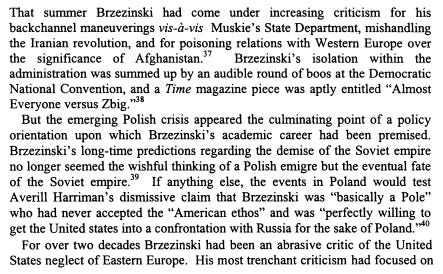
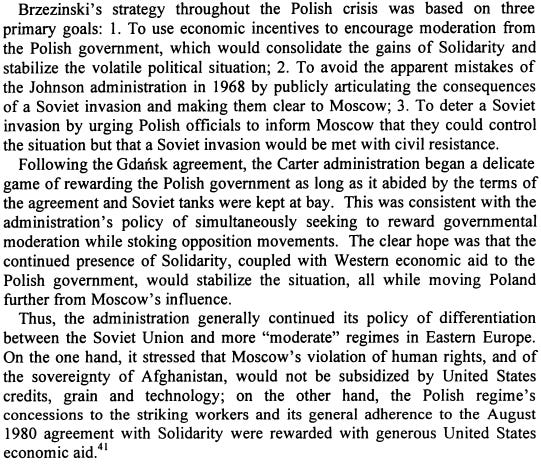
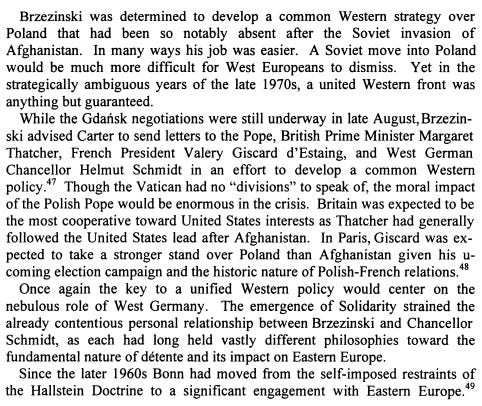
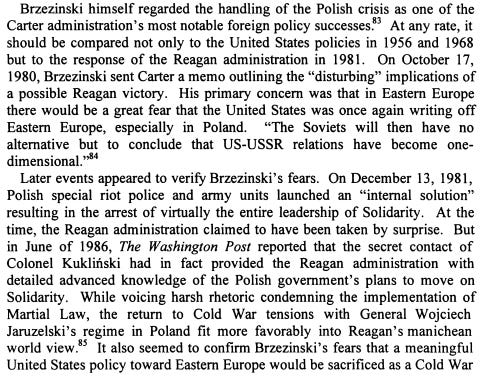
This historical essay by Patrick G. Vaughn has escaped the attention of Mr. Luce: 

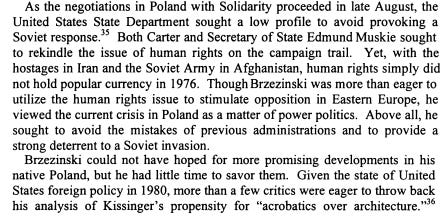
VAUGHAN, PATRICK G. “BEYOND BENIGN NEGLECT: ZBIGNIEW BRZEZINSKI AND THE POLISH CRISIS OF 1980.” The Polish Review, vol. 44, no. 1, University of Illinois Press, 1999, pp. 3–28, http://www.jstor.org/stable/25779091.

Page 11 of PDF:

Page 12 of PDF:

Page 14 of PDF:

Page 15 of PDF:

Page 26 of the PDF:

Mr. Luce was born in 1968 , so he has no actual usable historical/political memory of 1980. I was 35 years old in 1980, and recall the events of that year, especially the rise of Lech Walesa and Solidarity. Mr Luce was looking for a ‘framing device’ for his recent essay, ‘a tough guy’ ! Luce names Zbigniew Brzezinski who showed the Soviets …

Its almost programmatic in terms of History Made To Measure, steeped in Political Melodrama, that evokes the faded memory, of that 21 inch black and white screen World of 1952. What one of Luce’s readers will possess a memory of , the historical knowledge, to challenge his assertions? Or just do a bit of research?

Headline: Biden should use cold war handbook to stop Putin’s Ukraine threat

Sub-headline: Jimmy Carter’s team helped secure the 1980 Soviet ‘non-invasion’ of Poland

https://www.ft.com/content/9aff8609-34b9-478c-8563-b2f20f1ef81f


Carter’s trump card was Zbigniew Brzezinski, his hawkish national security adviser, who was a native-born fluent Polish speaker and naturalised American, and who drew on a secret weapon — Ryszard Kuklinski, a senior Polish military official and spy for the CIA. Kuklinski was also a Polish liaison to the Soviet military. His reports were so tightly held that only Carter, Brzezinski and Walter Mondale, the vice-president, were permitted to read them.

The collection of screen captures I have offered, of Patrick G. Vaughn’s revelatory essay, offers a more nuanced view, of the events and actors, that Mr. Luce’s reductivism can’t even begin to approach! Why? Because Mr. Luce has produced propaganda? Without apology!

Political Reporter

Posted in Uncategorized | Leave a comment

Name your Anti-Putin Poison @TheEconomist: The Long Form.

Political Cynic comments.

The ‘The Long Form’ begins:

Heading: Crisis in Ukraine 

 Headline: How Russia has revived NATO 

Sub-headline: Ukraine has forced America and its allies to bond. But the country’s future is still uncertain

https://www.economist.com/international/2022/02/12/how-russia-has-revived-nato 

This is a 2,389 word essay, that attempts to tell/narrate the Ukraine Crisis Story, that begins with the Macron, Putin’s meeting:

Vladimir Putin’s giant oval table in the Kremlin is as extreme as it is kitsch. Sitting far from foreign visitors may be his way of social distancing. But it also betokens the gulf that separated Russia’s leader from his guest, Emmanuel Macron of France. It may also illustrate what diplomats say is Mr Putin’s worrying isolation from the world. None can claim to read his mind as he masses some 130,000 troops on the borders around Ukraine. Is he about to launch the biggest war in Europe since the fall of the Berlin Wall? Or is it all a big bluff?

This first paragraph devolves in to Anti-Putin Hysteria, that is unsurprising. And The Reader need only look to the use of ‘nato’ in small caps, instead of NATO in capital letters, as a maladroit attempt at diminishment, in this History Made To Measure. The Major Actors, ideas, descriptors, and other useful ballast, in this War Mongering Melodrama:

Putin, Macron, NATO, Olaf Scholz, Angela Merkel,2014,, Viktor Yanukovych, Crimea, eastern Donbas, Petro Poroshenko, the Minsk accords, Rada, Volodymyr Zelensky, the separatist territories, Zerkalo Nedeli , Arsen Avakov, “Finlandisation”, Finland, Sweden, Austria, Wolfgang Ischinge, Balkans, Afghanistan, European Defence Community, Jens Stoltenberg, Britain, Iceland, Norway, eu, Canada, nato’s Article 5, Nord Stream 2, ‘non-military “grey zone” actions’, “European sovereignty”, ‘refounding moment’, ‘eu’s growing sovereignty’, Intermediate-Range Nuclear Force Treaty, force de frappe, Jacques Chirac, Estonians, Britain, Russian brutishness, America’s commitment, Mr Trump, Middle East, China, Taiwan, Mr Ischinge, American hegemon, the Mediterranean, migration.

This panoramic vision of the Political Actors, places, ideas etc. that defies The Reader attempt at constructing a possible reply – like all War Propaganda, this is designed to evoke negative emotion, rather than to place thought, analysis and Historical Inquiry, as the central imperative/obligation of that Inquiry.

But the final sentence, of this call to arms, is instructive of the use of anonymous sources, with an attachment to State Power, that must be taken on ‘faith’!

“It is the European dilemma,” says a German diplomat. “European sovereignty is impossible. But it has never been more necessary.”

Political Cynic

Posted in Uncategorized | Leave a comment

On reading Jochen Hellbeck and Mike Davis.

Philosophical Apprentice.

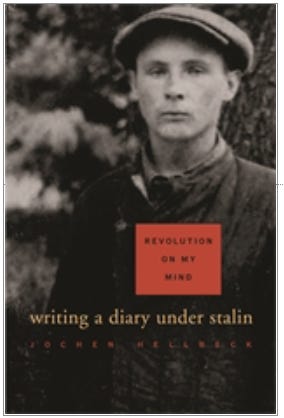
Reading ‘Revolution on My Mind:Writing a Diary under Stalin’ by Jochen Hellbeck and am on page 155, of this compelling book.

Revolution on My Mind is a stunning revelation of the inner world of Stalin’s Russia. We see into the minds and hearts of Soviet citizens who recorded their lives during an extraordinary period of revolutionary fervor and state terror. Writing a diary, like other creative expression, seems nearly impossible amid the fear and distrust of totalitarian rule; but as Jochen Hellbeck shows, diary-keeping was widespread, as individuals struggled to adjust to Stalin’s regime.

Rather than protect themselves against totalitarianism, many men and women bent their will to its demands, by striving to merge their individual identities with the collective and by battling vestiges of the old self within. We see how Stalin’s subjects, from artists to intellectuals and from students to housewives, absorbed directives while endeavoring to fulfill the mandate of the Soviet revolution—re-creation of the self as a builder of the socialist society. Thanks to a newly discovered trove of diaries, we are brought face to face with individual life stories—gripping and unforgettably poignant.

The diarists’ efforts defy our liberal imaginations and our ideals of autonomy and private fulfillment. These Soviet citizens dreamed differently. They coveted a morally and aesthetically superior form of life, and were eager to inscribe themselves into the unfolding revolution. Revolution on My Mind is a brilliant exploration of the forging of the revolutionary self, a study without precedent that speaks to the evolution of the individual in mass movements of our own time.

https://www.hup.harvard.edu/catalog.php?isbn=9780674032316+

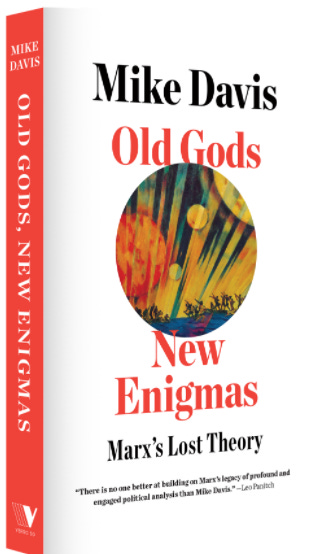
A book I am also reading, as its would be ‘counter point’, to stretch that notion to the point of fracture? or just intellectual perversity? Mike Davis’ ‘Old Gods, New Enigmas: Marx’s Lost Theory’:

Is revolution possible in the age of the Anthropocene?

Marx has returned, but which Marx? Recent biographies have proclaimed him to be an emphatically nineteenth-century figure, but in this book, Mike Davis’s first directly about Marx and Marxism, a thinker comes to light who speaks to the present as much as the past. In a series of searching, propulsive essays, Davis, the bestselling author of City of Quartz and recipient of a MacArthur Fellowship, explores Marx’s inquiries into two key questions of our time: Who can lead a revolutionary transformation of society? And what is the cause—and solution—of the planetary environmental crisis?

Davis consults a vast archive of labor history to illuminate new aspects of Marx’s theoretical texts and political journalism. He offers a “lost Marx,” whose analyses of historical agency, nationalism, and the “middle landscape” of class struggle are crucial to the renewal of revolutionary thought in our darkening age. Davis presents a critique of the current fetishism of the “anthropocene,” which suppresses the links between the global employment crisis and capitalism’s failure to ensure human survival in a more extreme climate. In a finale, Old Gods, New Enigmas looks backward to the great forgotten debates on alternative socialist urbanism (1880–1934) to find the conceptual keys to a universal high quality of life in a sustainable environment.

Old Gods, New Enigmas

Philosophical Apprentice

Posted in Uncategorized | Leave a comment

My struggle with reading ‘The Poetry of Friedrich Nietzsche’ By Philip Grundlehner.

Philosophical Apprentice comments.

I purchased ‘The Poetry of Friedrich Nietzsche’ what seemed like decades ago, from a Oxford University Press book sale.

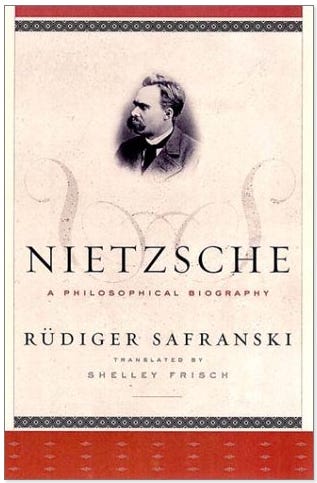
I had read Rudiger Safranski’s Philosophical Biography of Nietzsche, well before reading about Nietzsche’s poetry. Some of his thought’s, positions seemed unhinged.

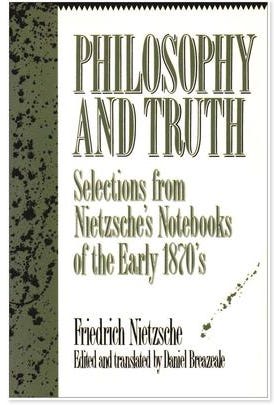
And some of ‘Philosophy and Truth’ :

As a ‘misfit’ I might have felt a sense of sympathy, or felt a kind of resonance- he inspired both Adorno and Heidegger…

Perhaps my next book should be Alexander Nehamas’ book ? Though it will have to wait.

Philosophical Apprentice

Posted in Uncategorized | Leave a comment