On the Self-Mythologizing of Bret Stephens.

Philosophical Apprentice collects some of the evocative dross of his ‘Class Day Ceremony’.

JUN 8, 2023

Stephens always plays the victim:

This is a speech about speaking your mind when other people don’t want you to.

To those of you who are protesting or planning a walkout, I thank you for not seriously disrupting my speech. And though I’m sorry you won’t hear me out, I completely respect your right to protest any speaker you dislike, including me, so long as you honor the Chicago Principles. It is one of the core liberties that all of us have a responsibility to uphold, protect and honor.

A Neo-Conservative ‘strikes a pose’, like that faded Pop Star?

Next Bob Zimmer, rhetorically brought aboard for needed ballast:

To those of you who choose to stay, I thank you for honoring another Chicago principle, one that was dear to my dear friend, Bob Zimmer: Namely, that a serious education is impossible except in an environment of unfettered intellectual challenge — an environment that, in turn, isn’t possible without the opportunity to encounter people and entertain views with whom and with which you might profoundly disagree.

A quick walk-on of Mr. Stephens, in his youth… like Wm. F. Buckley Jr., he was a self-entitled, would be polymath, in waiting. This self ascription, the purest comedy : when I was a nervous 17-year-old freshman…

To John Boyer, who welcomed me to Chicago in 1991 when I was a nervous 17-year-old freshman, I want to salute you for everything you’ve done to make the college so much better, while preserving what always made it great: the conviction that to think clearly, we must be able to speak freely; that to disagree intelligently, we must first understand the views of our opponents profoundly; that to change people’s minds, we must be open to the possibility that our minds might be changed. All of this asks us to listen charitably, argue candidly, consider deeply, examine and re-examine everything, above all our own deeply held convictions — and, unlike at so many other universities, to respond to ideas we reject with more and better speech, not heckling or censorship.

The above testimony to the ‘values’ of ‘Free Intellectual Inquiry’ from an unapologetic Neo-Conservative, in sum an apologist for The Zionist Faschist State, and the American Proxy War in Ukraine. Mr. Stephens is a bellicose Straussian in its American iteration. Stephens never served, but his appetite for War takes inspiration from an etiolated pastiche of Ernst Jünger…

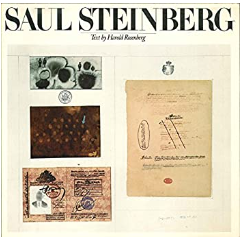
Harold Rosenberg’s essay, that Stephens links to, is from the September 1948 Commentary, not the Commentary Magazine edited by Neo-Con John Podhoretz. I spent many years reading the works of Harold Rosenberg e. g. The Tradition of The NewDiscovering The Present, and his monograph on Saul Steinberg:
Decades ago, the art critic Harold Rosenberg coined the phrase “the herd of independent minds.” It’s a line I think about often.

The herd of independent minds are the people who say they make up their own minds when it comes to politics, and yet somehow, and generally without exception, arrive at precisely the same long list of political conclusions as millions of others. The herd of independent minds were the Republicans who were ardent NeverTrumpers in 2015, fervent Trumpers from 2017-21, NeverTrumpers again after Jan. 6, and are now tilting back toward Trump: In other words, Lindsey Graham. The herd of independent minds are those who think “La La Land” is a great movie but “Miss Congeniality” isn’t.

The final paragraph lapses in Anti-Trump screeching, a favorite gambit of the New Centrist Alliance: The New Democrats/ Neo-Liberals and the Neo-Cons.

Mr. Stephens, in this paragraphs riffs on the passé territory of ‘The Coddling of the American Mind’ by Jonathan Haidt and Greg Lukianoff.

The point is: There are very few people who don’t see themselves as independent thinkers. There are even fewer people who are.

This is true wherever you go, in most walks of life. But it seems to be especially true in places and institutions heavily populated by people with elite educations: The kinds of places and institutions that many of you will soon be a part of. Groupthink is the affliction of those who ought to be — and often think of themselves as — the least vulnerable to it.

The ‘Elite Education’ a reference to the Haidt/Lukianoff postulation of a 10% of spoiled malcontents, that harbor a natural ill will to an Enlightened Cadre of Technocrats like Haidt/Lukianoff . Note that Haidt is a New Democrat.

Headline: Jonathan Haidt: ‘We got fooled into thinking liberal democracy is easy’

Sub-headline: The social psychologist on the ‘darts’ of social media, our dangerous present moment — and a decade of stupidity in America

https://www.ft.com/content/c59f57c1-ba79-4856-a322-81a8f68df1b7

His willingness to engage thoughtfully in debates often characterised by tribalism and virtue-signalling has helped him win considerable influence — Barack Obama and Jeff Bezos have both recommended his most recent essay. But Haidt, professor of ethical leadership at NYU’s Stern School of Business, is not without his detractors. To his critics, he falsely equates the excesses of the progressivist activism of the left with the disregard for truth, science or the democratic process of some on the right; they accuse him of “bothsidesism”.

While some feel Haidt focuses too much of his fire on the left, he has only ever voted Democrat. “I cannot imagine voting Republican because the Republican party has completely lost all sense of constitutional responsibility and has lost all touch with conservatism. I have a lot of respect for liberalism, but there’s a lot of illiberalism on the left, and I have a lot of respect for conservatism, but there’s not much conservatism left on the right,” he says.

https://www.ft.com/content/c59f57c1-ba79-4856-a322-81a8f68df1b7

This Reader feels sympathy for the students and faculty who had to listen to the remaining 2,106 words of his address, let me present some of his cast of characters in this first paragraph:

Meta, Mark Zuckerberg, Metaverse, New Coke, Federal Reserve, C.I.A, Afghanistan, Taliban, Ukraine, Russian Army (its the Soviet Army), Wall Street, Saddam Hussein,-Not to forget this bit of dangling hysteria: ‘Why were so many people convinced that overpopulation was going to lead to catastrophic food shortages, and that the only sensible answers were a one-child policy and forced sterilizations?’

Call this section of Mr. Stephens ‘stream of consciousness’ from his appointment with his strict Freudian Psychoanalyst? Think again of the audience, having to listen to this diatribe as it metastasizes, in the voice of a bankrupt newspaper scribbler.

Enough!

Philosophical Apprentice

Posted in Uncategorized | Leave a comment

The Telegraph & Daniel Hannan offer Spain as an object lesson to Kier Starmer.

Political Observer comments.

JUN 4, 2023

What might The Reader make of Daniel Hannan’s June 3, 2023 essay on the Spanish election, as an object lesson to New Labour’s Keir Starmer?

Headline: Cut taxes and trust people to choose: what the Tories can learn from Madrid’s election winner

Sub-headline: Socialist parties throughout Europe are being eviscerated. Labour is the one exception. Why should Britain be different?

https://www.telegraph.co.uk/news/2023/06/03/cut-taxes-and-trust-people-to-choose-what-the-tories-can-le/

Keir Starmer is swimming against the European current. Across the continent, traditional parties of the Left have been wiped out. The Dutch Labour Party won 5.7 per cent at the last election, the French Socialist Party 1.8 per cent in the presidential election. Only in Scandinavia and Iberia have parties of the mainstream Left clung on. And even that is about to change, with Spain set to give its socialists a brutal clubbing.

The notion that Starmer is a ‘Socialist’ in a product of Hannan’s imagination, in search of a reason, the New Labour dullard Starmer is headed for a defeat ?… un-mentioned is that the Labour Party, New and Old is still experiencing a continuing purge of the once ascendant Corbyn Wing of the Party. And that Corbyn was the target of defamation from The Times, The Guardian and The Telegraph. While this from Al Jazeera Investigations is subject to an historical erasure -its a Stalinist gambit. And Starmer’s banning Corbyn from running as a Labour candidate.

Mr. Hannan resorts to the role of Political Oracle, in times past, ‘thinkers’ like Alvin Toffler were deemed ‘Futurists’ who described what the possible New World would be like. Hannan riffs on those themes of yesterday, in the final sentence of my quotation. He trades upon a past that lives in the present: in France Macon’s unconstitutional Pension Reforms have re-ignited those ‘syndicalist embers’ ?

Before we get to Spain, though, it is worth delving into why the old Left has seen its support collapse. It has to do mainly with changing work patterns. I don’t expect my children to have “a job” as we understood that word in the 20th century. Rather, they will go through life constantly reskilling, freelancing and adapting as technology accelerates.

Artificial intelligence won’t make us redundant; that claim has been made of every advance in mechanisation since the industrial revolution, yet the number of people in work keeps rising. What it will do is diversify the employment market even more. When machines take on our old tasks, they free us up to find niches that no one had previously imagined.

In such a world, parties linked to mass industrialised workforces look not so much old-fashioned as cultish. The structures, slogans and symbols of syndicalist struggle seem to belong, quite literally, to another century.

Its not that Mr. Hannan doesn’t offer some interesting analysis of the Spanish Election, but that he garnishes it with …

Tellingly, Tony Blair could never bring himself to pronounce its name. Knowing how electorally toxic the word “socialist” was, he referred to it incorrectly as “the European Labour group”. Perhaps that is why, of the eight leaders Labour has gone through over the past 45 years, Blair is the only one to have won a general election.

He then presided over a coalition of separatists and Left-wing extremists; precisely the kind of wacky alliance, in fact, that Starmer might end up leading here. Almost immediately, he started losing elections – in Galicia, Madrid, Old Castile, Andalusia and, now, the whole country.

The above quote, reminds me of Ferdinand Mounts book ‘The New Few’ the chapter titled ‘Closing the local’ pages 154 and 155 ‘the looney left’ an epithet used twice by one of Mrs. Thatcher’s cadre of the ultra respectable.

No, our Labour Party will find scant comfort in what is happening across the Pyrenees. But our Conservative Party might learn a thing or two.

So, in shops, in cafés and in queues (which Spaniards are much better at than they used to be)…

First, young people are not monolithically Left-wing. Indeed, many of them support Vox, the party that overseas commentators almost always describe as far-Right.

It is here, I think, that our Tories have the most to learn. The head of Madrid’s regional government is the unapologetically Thatcherite Isabel Díaz Ayuso. If the PP had had the sense to make her its national leader last year, it would now be sweeping the board.

Spain had a bad pandemic, combining a strict lockdown with a high death rate. But Ayuso kept Madrid open, campaigning under the one-word slogan Libertad. She went on to cut taxes and give people more choice over which schools and hospitals to use. Her most recent campaign was launched in the bullring. Madrileños repaid her with an absolute majority.

All that the Left can do in response – beyond unleashing the personal abuse that female conservatives always seem to attract – is to accuse her of being too close to Vox and, by implication, an extremist.

Isabel Díaz Ayuso is an ‘ unapologetically Thatcherite’ : she is an Extremists, by definition, Thatcherism was a political catastrophe! Daniel Hannan attempts to re-write History.

The final three paragraphs this essay:

If calling your enemies fachas doesn’t work any more, what does? The old infrastructure of organised labour has gone. Wokery in its various forms – racial, gender-based or sexuality-based – is unpopular. Greenery has a certain appeal but, as the sheer expense of net zero becomes clear, voters want it toned down.

The strongest argument for the Left is the unpopularity of the other side. Since 2004, when José María Aznar stood down, the PP has been seen by many of its supporters as a milk-and-water alternative to the socialists, who made all the running. That is why Vox came into existence in the first place.

If there is a lesson from Spain’s local elections, it is that voters don’t much care about accusations of extremism. But they do care about rising taxes and rising prices. When Rightist parties are trusted on those issues, the Left has nothing left. 

‘Woke’ is a term of political abuse, its meaning lost in the fog of accusation. In the British context Mr. Hannan has missed the the rising star of Mick Lynch, the most articulate leader of ‘syndicalist nostalgia’  that is experiencing unparalleled political vigor, in the face of Tory maleficence.

Political Observer

Posted in Uncategorized | Leave a comment

Read what the Martin Amis’s death has brought forth!

Literary Apprentice offers …

JUN 1, 2023

‘High -flown English’ by Thomas Meaney:

There’s a memorable scene in Experience during which Amis kicks Hitchens’s shins under the table to get him to stop grilling Saul and Janis Bellow about Israeli atrocities. Amis’s capacity for ancestor-worship was boundless: (at least) 8 articles on Bellow, 9 on Nabokov. But I wonder if he might have benefitted more from reading less of them. From Bellow he took the street-wise tough guys (already often unpersuasive in the original) and made them even more street-wise until many of them simply became vessels of Translatlantic Amis-speak, while from Nabokov Amis cribbed a kind of cliff-notes postmodernism, furnishing pointless doppelgängers for his plots, and making his narrators pick up a toilet brush and see a ‘moustachioed sceptre’ (a parody of Nabokov, even in the mouth of a character). With the exception of Inside Story, an unexpectedly moving coda to his career, the first half of his output outshines the second by some distance. High-flown English

https://newleftreview.org/sidecar/posts/high-flown-english

Thomas Meaney offer a link to this essay by James Wolcott of 2012:

Marti Amis has reached that not entirely enviable plateau in an eminent literary career where he (and we) might be better off if he gave up writing novels and just granted interviews from now on. He could air his observations on issues throbbingly relevant in the republic of letters, then retire to his den for a nip or a nap. Giving up fiction would lighten his workload considerably, and take the pressure off having to re-prove himself to the growing sector of the literary punditry that treats him with such jaded familiarity.

Since London Fields or so, I find myself anticipating the profiles, chat sessions, and drink visits promoting the novels more than I do the results themselves—reminiscent of the patch in Mel Brooks’s career when his guest spots on “The Tonight Show” plugging his latest self-wallow were funnier, jazzier, and more turned-on to the audience than the actual releases, as any bleary survivor of Spaceballs or Robin Hood: Men in Tights can attest. The Q&A format seems to smoke out more reverie from Amis, unclenching his clam-tight control. Not that he puts on a command performance for the journalists who gingerly approach, fretful of running afoul of a verbal scowl, however graciously he offers them a suitable beverage. Nearly every Amis interview expresses the wary, battle-weary tone of a veteran interviewee hiking Boot Hill again. But within this monochromatic range he is far more engaging, perceptive, interesting, and adept at cultural landscaping than he is in the novels themselves, the forced labors of Night TrainYellow DogHouse of Meetings.

https://newrepublic.com/article/108754/martin-amis-state-decline

The Hagiography of the TLS:

Headline: Taking life sentence by sentence

Sub-headline: Martin Amis, a talent for our time

By Alan Jenkins


The final two paragraphs of this …

And perhaps it really is so, with some novelists. But Martin’s talent wasn’t like that. Those reviewers had made the most basic category error. His style was his vision; or rather, that vision expanded, deepened and darkened, took on life sentence by sentence, coterminously with the growing richness and inventiveness of his verbal gifts, his linguistic imagination – his voice. So, he was content to let plot take care of itself, while his novels proceeded according to a recurring set of patterns or obsessions (his “doublings” and pairings, his characters unsure of their parentage, his rivalries among siblings and friends, his patch of west London), and his creative energies went into the sentences, thus into unforgettable human grotesques and exorbitantly funny exchanges, crescendos, laments … His was a Dickensian talent, and one – at its best – of Dickensian amplitude. It remade the world, not as we knew it but in the image of whatever the English language – his English language – could accommodate.

Martin achieved what he did, not through talent alone but also dedication – and crucial to that was appreciation, of writers he himself loved and admired: beyond all others, Vladimir Nabokov and Saul Bellow in prose, Shakespeare and Milton in verse. Love and admiration came naturally to him, just as naturally as sharp reproof of anything that struck him as inauthentic or incompetent. His was a wonderfully witty, warm and responsive presence (his launch parties were, appropriately, bacchanals): that much I knew from experience. From Experience I learnt that he was, too, a loving father and son, unabashedly affectionate with family and close friends. Those who were much closer to him than I was will have more to say about all these qualities in the coming days. But I mourn his loss, which is a loss to us all, British or American, who care about art, about sentences and the novels and essays built from them, about talent, and about Martin’s great abiding instinct, the belief on which he built his life: “Writing is freedom”.

On the questions of Saul Bellow and Vladimir Nabokov see the long quote from Thomas Meaney, above.

Literary Apprentice

P.S. For some further insights into Martin Amis, this from The New York Times of March 9, 2008

Headline: Amis and Islam

By Rachel Donadio

In England’s left-leaning intellectual culture, traditionally somewhat hostile toward Israel and the United States, Amis has emerged as sympathetic to the two countries’ situation. Although he opposed the Iraq war and is skeptical of American power, “The Second Plane” draws admiringly on books often dismissed by some on the left: Paul Berman’s “Terror and Liberalism,” Bernard Lewis’s “What Went Wrong?” and Mark Steyn’s “America Alone.” (He also draws on the neo-atheist Sam Harris.)

On the phone last month, Amis talked about the transAtlantic divide. “The anti-Americanism is really toxic in this country, and the anti-Zionism,” he said, attributing the sentiments to empire envy. “I think we ceased to be a world power just as America was unignorably taking on that role.” The dominant ideology “told us that we don’t like empires, we’re ashamed of ever having one.” In England, he continued, “we’ve infantilized ourselves, stupefied ourselves, through a kind of sentimental multiculturalism,” Amis said. He called for open discussion “without self-righteous cries of racism. It’s not about race, it’s about ideology.”

L.A.

Posted in Uncategorized | Leave a comment

William Deresiewicz begins with ‘Boredom’ and ends with the perpetually dyspeptic Fran Liebowitz, as the ultimate expert on the power ‘connoisseurship’: & The Almost of ‘Anglo-Calvinist moralism’…

Myra Breckenridge comments.

MAY 29, 2023

Beginning:ennui

I’m bored; you’re bored; we’re all bored. By our books and movies and television shows, the endless blandness of the Netflix queue, by our music and theater and art. Culture now is strenuously cautious, nervously polite, earnestly worthy, ploddingly obvious, and above all, dismally predictable. It never dares to stray beyond the four corners of the already known. Robert Hughes spoke of the shock of the new, his phrase for modernism in the arts. Now there’s nothing that is shocking, and nothing that is new: irresponsible, dangerous; singular, original; the child of one weird, interesting brain. Decent we have, sometimes even good: well-made, professional, passing the time. But wild, indelible, commanding us without appeal to change our lives? I don’t think we even remember what that feels like.

End:revelation

A great audience, Fran Lebowitz once remarked, is more important for the creation of great art than even great artists are. She was thinking, in fact, of the postwar audience, specifically in New York, the one that nurtured Balanchine, Rauschenberg, Miles Davis, and so many others. Great audiences create great artists, she explained, by giving people the freedom to take chances: to be irresponsible, dangerous, difficult, strange. When people compete to be sophisticated, artists win. Then we all win.

Recall that old European Dependable, the feuilleton? William Deresiewicz almost resuscitates it, in this ‘essay’.

Yours,

Myra Breckenridge

P.S.

Dear Reader: note the careful , evocative namedropping, and the utter absence of American theologian Johnathan Edwards, as the homegrown bearer of Calvinism’s self-hatred, inherited from Augustine, among others.

Posted in Uncategorized | Leave a comment

Bret Stephens, of May 16, 2023, former Jerusalem Post Editor opines on the 75 years of the Zionist State.

Political Observer comments.

MAY 24, 2023

As preface to Mr. Stephens singing the praises of Israel, let me present this from Unites States Department of State:

SECURITY ASSISTANCE AND COOPERATION 

The abiding U.S. commitment to Israel’s security is buttressed by robust security assistance to Israel – including the 10-year, $38 billion MOU that was concluded in 2016.  Consistent with the MOU, the United States provides $3.3 billion annually in Foreign Military Financing and an additional $500 million in missile defense funding. Missile defense funding supports several cooperative missile defense programs, including David’s Sling and Iron Dome, as well as Arrow, Arrow II, and Arrow III, whose life-saving capabilities have proved vital to Israel’s security.  In 2022, the United States provided $1 billion in supplemental funding to replenish Israel’s stock of missile interceptors for the Iron Dome.

The United States and Israel also participate in a variety of security-related exchanges, including joint military exercises, research, and weapons development. Through the annual Joint Counterterrorism Group and other regular strategic dialogues, the United States and Israel are able to collaborate closely to address a range of regional threats.

U.S. Relations with Israel

In sum, the state of Israel is the protectorate of The American National Security State. A reality that Mr. Stephens, in his long apologetic fails to address. Should The Reader be surprised? As Mr. Stephens presents the ‘current mood’ of This State:

The Jewish state turned 75 on Sunday, mostly in a sour mood.

The country is governed by a coalition that includes political extremistsproud homophobesideological monomaniacs, and the merely corrupt. A proposed judicial reform that would have gutted the principal institutional check on rank majoritarianism has been paused, but not quite stopped, by some of the largest protests in Israeli history. Secular Israelis fear the country’s demographic balance is tilting to the religious extreme. Benjamin Netanyahu can’t get an invitation to the White House. It doesn’t seem to bother most American Jews, who struggle to understand, much less justify, the prime minister’s characteristically self-serving, but uncharacteristically inept, leadership.

The Framing of ‘most American Jews, who struggle to understand’ – on twitter daily, The World views the wonton oppression, land stealing, and murder of Palestinians enacted, by Israeli Soldiers and Settlers. The Eternal Victimhood self-presentation of Stephens doesn’t even qualify as … the cry of victimhood, from the son of absolute privilege, is now the first and last resort of the Crusaders Against Anti-Semitism: from a position of dominance founded upon a myth.

To top it off, Israelis just endured five days of rocket fire from the Gaza-based, Iranian-backed terrorist group Palestinian Islamic Jihad. It’s a reminder that, notwithstanding Israel’s recent successes in normalizing diplomatic relations with parts of the Arab world, many of its neighbors still want it wiped off the map.

And for all this, Israel is doing remarkably well.

Next to appear are other states that share a common political fate like Israel?

It helps to remember the circumstances in which the country was born. Israel is a post-colonial state. It started its national life dirt-poor. Its peer group of countries includes Syria, Pakistan, India, Indonesia, Myanmar, Sri Lanka and North and South Korea. These states came into being with many of the same core problems: hostile neighbors, unsettled borders, deep poverty, restive ethnic and religious minorities and other unresolved dilemmas from their independence struggles.

As with Israel, many of those problems still dog most of those states. The Koreas don’t have a settled border. India and Pakistan have painful memories of forced population transfers. Those who think the Palestinian issue is unique should consider the situation of Kashmiris in India, Tamils in Sri Lanka, or Kurds in Syria.

Should The Reader look at Stephens collection of States, as in large part, the former Colonies of The British Empire: might that reader look to the political toxin of Sikes-Picot and The Belfour Declaration? – Stephens writes a History Made To Measure , with Israel… to engage in hyperbole, Israel is the central axis in Stephens’ Ptolemaic Political Universe?

In his political desperation to find scapegoat’s he resorts to Sweden:

As for Israel’s disreputable political figures, to whom shall they be compared? The ruling coalition in Sweden governs “in cooperation” with the far-right, xenophobic Sweden Democrats party; nobody thinks of Sweden or most other democracies with unsavory figures like this as exemplars of political extremism. Elsewhere, when would-be despots come to power, they ban public protests, imprison or assassinate their political opponents, impose a reign of terror.

Mr. Stephens last sentence of this paragraph is:

‘Elsewhere, when would-be despots come to power, they ban public protests, imprison or assassinate their political opponents, impose a reign of terror.’

I’ll just quote this sentence of mine:

The World views the wonton oppression, land stealing, and murder of Palestinians enacted, by Israeli Soldiers and Settlers.

Mr. Stephens is an incompetent, indeed a mendacious apologist for Israel!

Political Observer

Posted in Uncategorized | Leave a comment

@TheEconomist opines: ‘Joe Biden’s global vision is too timid and pessimistic’

Political Cynic comments.

MAY 20, 2023

Twitter post :

A more optimistic, positive-sum approach would keep America strong. It should help forge—and abide by—new global rules on trade, climate, AI and more’

Leaders | A new world order

Headline: Joe Biden’s global vision is too timid and pessimistic

Sub-headline: The president underestimates America’s strengths and misunderstands how it acquired them

Begin with the History Made to Measure of the first paragraph. The political reach from the 1940 to the present is breathtakingly caricatured:

In the 1940s and early 1950s America built a new world order out of the chaos of war. For all its shortcomings, it kept the peace between superpowers and underpinned decades of growth that lifted billions out of poverty. Today that order, based on global rules, free markets and an American promise to uphold both, is fraying. Toxic partisanship at home has corroded confidence in America’s government. The financial crisis of 2007-09 dented faith in markets. America’s failures in Iraq and Afghanistan undermined its claim to spread democracy. Today most countries refuse to heed its call to enforce sanctions on Russia. And China’s rise has spurred American politicians to take a more selfish, zero-sum approach to geopolitics.

I’ve highlighted, for the reader, this collection of Atlanticist political clichés!

This next paragraph features Henry Kissinger, as the Voice of Political Reason?

China’s rise has also increased the threat of war. In a conversation with The Economist, Henry Kissinger, who will be 100 this month, warns that China and America are “on the path” to confrontation. “Both sides have convinced themselves that the other represents a strategic danger,” he says. The stakes could not be higher: both are nuclear-armed. Both are also dabbling with unpredictable artificial intelligence (ai). The elder statesmen’s eldest statesman worries that, just as before the first world war, the superpowers will stumble into catastrophe.

Biden advisor, Neo-Conservative Jake Sullivan is next to appear.

Since arriving in the Oval Office in 2021, Joe Biden has developed a new strategy to preserve American pre-eminence and reduce the risk of conflict. Jake Sullivan, the latest of Mr Kissinger’s successors as national security adviser, recently gave the fullest account yet of this Biden doctrine. His narrative weaves together middle-class prosperity, defence and climate change. He repudiates the free-market “Washington consensus” and calls for the government to play a muscular role in society, with a strong emphasis on national security.

Hyperactive Industrial Policy enters Stage Right:

This means hyperactive industrial policy. Big subsidies will catalyse private investment in semiconductors and clean energy. Export controls will create “a small yard and high fence” to keep selected technology with potential military uses out of unfriendly hands. At the same time, the administration is softening its rhetoric. Instead of “decoupling” from China’s economy, it talks of “de-risking”. It wants to find common ground on climate change, African debt and even Ukraine. On May 10th and 11th Mr Sullivan spent eight hours with his Chinese counterpart, the first high-level contact for months.

Behind the doctrine is a belief that a virtuous circle can make America and the world safer. State intervention and protectionism will boost industry, helping the middle class and cooling America’s populist fevers. Less erratic leadership (after Donald Trump’s) will restore America’s authority abroad, even if the Biden team breaks a few global economic rules. The relationship with China will be managed with “strategic maturity”. As a precaution America will keep spending large sums on its military forces to deter China from aggression

.

The Economist writers, and or the final Editor, ask the searching questions, with the final two sentences pronouncing the negative on ‘The Biden Doctrine’ as ‘flawed’ and will ‘make America weaker’. That toxic nostalgia for that ‘post-1945 order’ is about an unrealizable political delusion, when pragmatism is about a realism, born of facts, not of deeply held political fictions.

Will the new doctrine work? After the chaos of the Trump years, Mr Biden’s commitment to diplomacy is welcome. It will be on display at the g7 summit this week. He is right that American foreign policy must deal with new challenges, from Chinese coercion to climate change. However, especially when compared with the post-1945 order, the Biden doctrine is flawed. Its diagnosis of America’s problems is too pessimistic, and some of its prescriptions would make America weaker.

The Economist offers this:

The main source of America’s strength is creative destruction and open markets in a rules-based global economy. So although Mr Biden is right to reinforce the social safety-net, his state-led, insular economic vision may ultimately erode living standards and American clout.

The above more of the same resort to cliché: ‘creative destruction’, ‘open markets’, ‘rules-based global economy’, ‘his state-led, insular economic vision may ultimately erode living standards and American clout.’

Some further selective quotations of this essay are instructive:

Mr Sullivan wants to combine export controls with co-operative trade, and an arms race with collaboration.

Never mind rules on ai, America and China have no system for nuclear-arms control: China’s arsenal will almost quadruple by 2035.

Yet America’s unpredictable economic nationalism and unwillingness to offer access to its markets undermines its influence. Europe fears a subsidy race and worries escalating tensions with China will cause it severe damage: our calculations show Germany’s economy is twice as exposed to China as America’s is. The decay of global rules is accelerating the embrace of a transactional approach to foreign policy by emerging economies. The post-1945 order rested on American constancy: each administration was guided by predictable interests. Today allies and enemies know chaos may follow the election in 2024. Trumpian dysfunction is not Mr Biden’s fault, but it makes it vital to be predictable and open now.

Unfortunately the Biden doctrine fails to rebut the narrative of American decline and so has not resolved the tension between the country’s toxic politics and its role as the linchpin of a liberal order. Unless America looks out at the world with self-confidence, it will struggle to lead it.

What The Economist writers and Editors offer is more misplaced toxic nostalgia for that ‘post-1945 order’ , as the sine qua non of an American Future: based on a post WWII American Hegemony, that cannot be exhumed!

Political Cynic

Posted in Uncategorized | Leave a comment

Katy Balls interviews Niall Ferguson & Freddy Gray: They discuss the Trump Conundrum, on YouTube of May 11, 2023

Political Observer comments.

This discussion begins at the 01:20 point and ends before the 21:18 point. Katy Balls asks questions of her two guests

Ferguson and Grey act the parts of Political Technocrats, relying on ‘Polling Data’ as a reliable source- the mention, and reliance on the ‘polls’, as some kind of measure of actual reliable information, about outcomes, the cornerstones of both Ferguson and Grey, is utterly misplaced, given this from the Pew Research Center, about the 2016 American Election.

November 9, 2016

Headline: Why 2016 election polls missed their mark

The results of Tuesday’s presidential election came as a surprise to nearly everyone who had been following the national and state election polling, which consistently projected Hillary Clinton as defeating Donald Trump. Relying largely on opinion polls, election forecasters put Clinton’s chance of winning at anywhere from 70% to as high as 99%, and pegged her as the heavy favorite to win a number of states such as Pennsylvania and Wisconsin that in the end were taken by Trump.

How could the polls have been so wrong about the state of the election?

There is a great deal of speculation but no clear answers as to the cause of the disconnect, but there is one point of agreement: Across the board, polls underestimated Trump’s level of support. With few exceptions, the final round of public polling showed Clinton with a lead of 1 to 7 percentage points in the national popular vote. State-level polling was more variable, but there were few instances where polls overstated Trump’s support.

The fact that so many forecasts were off-target was particularly notable given the increasingly wide variety of methodologies being tested and reported via the mainstream media and other channels. The traditional telephone polls of recent decades are now joined by increasing numbers of high profile, online probability and nonprobability sample surveys, as well as prediction markets, all of which showed similar errors.

It isn’t that the ‘insights’ that Ferguson and Grey are not interesting, to a point. This featured quotation from Ferguson, is about his notion of what constitutes a possible ‘Left Wing’ in America?

‘The night that it’s clear that Trump has been re-elected, heads will be exploding on the Harvard campus, in the New York Times offices, in the CNN offices, and the market will be rallying.’

What is left unsaid, by both Ferguson and Grey, is that Trump is a symptom of the complete collapse of the political/ moral legitimacy of both the Republican and New Democrats, as viable political entities.

In the final portion of this interview Katy Balls asks Ferguson who he, as an American citizen, will vote for: the answer is Trump.

Political Observer

Posted in Uncategorized | 1 Comment

On the New York Times Public Intellectual of June 16, 2023 : Gail Collins & Bret Stephens mutual Therapy session, on the Trump political phenomenon.

Political Cynic opines on the politically jejune chatter of Gail Collins & Bret Stephens.


MAY 16, 2023

Gail Collins and Bret Stephens mutual therapy session, regarding the Trump political phenomenon-selective quotation of this edited transcript is an irresistible temptation:

The introductory exchange:

Gail Collins: Hey, Bret, good to be conversing again. Heck of a lot going on. Before we get to the border or the budget, though, let me admit I’m shallow and start with the Trump town hall on CNN.

Bret Stephens: Not shallow, Gail. But you are depressing me.

Collins searching reply:

Gail: Trump lost your Republican vote a long time ago, but if you were still on the fence, was there anything on display that evening that would have had an impact?

Stephens reply:

Bret: I’m not exactly a reliable gauge of how today’s Republicans think: In November, I wrote a column called “Donald Trump Is Finally Finished,” which I may have to spend the rest of my life living down.

That said, I would guess that if you’re the sort of voter who liked 80-proof Trump, you’re gonna love 120-proof Trump. And that’s what he was in that CNN town hall: more mendacious, more shameless, more unapologetic, more aggressive, nastier. But also undeniably vigorous, particularly when compared with Joe Biden. My guess is the town hall will consolidate his lead as the Republican front-runner.

Your take? Should CNN have given him the platform?

Collins reply

Gail: Don’t see any reason CNN shouldn’t have done the interview. Except that it reduces pressure on Trump to show up for any Republican primary debates. Which he naturally wants to avoid, given his ineptitude when it comes to actual policy questions.

Stephens reply:

Bret: I’m of two minds. The media has a responsibility to cover the Republican front-runner, and I thought Kaitlan Collins, the CNN moderator, handled the responsibility about as well as anyone could have. Yet nonstop media attention is the oxygen on which Trump thrives. The more attention we give him — which is what we are doing right now — the stronger he gets.

Collins reply:

Gail: About the impact: Yeah, if you liked Trump before, you wouldn’t be deterred by his willingness to let the nation default, or his being “inclined” to pardon a lot of the Jan. 6 rioters.

Really would like to hear an everybody-in primary debate, though. Without Trump, I guess the only suspense would be whether Ron DeSantis is capable of being … not terrible.

Is there anything here that qualifies as particularly insightful? The Reader can continue her journey, into respectable bourgeoise political commentary, that doesn’t emancipate itself from collective cliché, held aloft by the self-congratulation of its participants. I’ll end my ‘commentary’, such as it is, on this exchange, with its final paragraphs:

Bret: Obviously, I don’t support vigilantism. But that’s what you get when police are hampered from maintaining public order. The answer is to give the police the authorities and resources they need to deal with someone like Neely before a tragedy occurs.

Gail, this is too grim a note on which to end — and we haven’t even touched on George Santos’s indictment.

Gail: Now, there’s a high note!

Bret: Before we go, I want to put in a word for Sam Roberts’s obituary for Mike Pride, a former editor of The Concord Monitor, who died last month in Florida at 76 and whom we both knew through his stewardship of the Pulitzer Prizes. Mike showed that you can often make the greatest difference as a newsman by writing about issues that are near to people’s everyday lives. He reminded us that local journalism matters. And that it’s at least one thing that deserves to be made great again.

Political Cynic

Posted in Uncategorized | Leave a comment

@rcolvile considers ‘As we squabble over bendy bananas and bash Big Tech, investors are quietly slipping away’

Political Observer, considers Mr. Colvile, on the Economic/Political Moment, as it passes away…

MAY 14, 2023

Imagine the ‘memos’ that Mr. Colvile’s staff must provide to their boss? In an instructive reversal, might an American think of Woodward’s staff of writers, turning his raw notes into readable chapters? Or is Trollope’s Palliser Novels, in a more vulgarized form, a more apt recreation of a political past/present?

Mr. Colvile’s opening paragraph of this essay demonstrates that he might be a political satirist, of a kind?

Last week the Tories went bananas over Brexit. Bendy bananas, rather. Kemi Badenoch, the business secretary, announced that the Retained EU Law Bill would be scrapping only 600 EU rules straight off, rather than the promised thousands — with the rescued laws including the notorious regulation on the “abnormal curvature” of a certain fruit. Backbenchers drew angry comparisons with an advert from Rishi Sunak’s leadership campaign in which a white-shirted office drone fed piles of EU rules into a shredder while Ode to Joy blasted out on the soundtrack.

With this near comic opening, Mr. Colevile then ascends to High Thatcherite Politics:

The row wasn’t just about a clash between pragmatism and principle. It reflected a growing concern among Brexiteers that the government hasn’t done enough to pinpoint areas in which Britain can steal a march on the EU.

There is a slightly farcical element to this — not least the idea that you show virility and purity through the sheer number of rules you axe, never mind the actual detail. But those MPs do have a point. Post-Brexit regulation has been a policy merry-go-round, subject to endless changes of personnel and approach. It wasn’t until years after the referendum that a specific unit was created to marshal progress, and it was pitifully underpowered compared with, say, the legions working on the Cop26 climate conference. Yes, there has been good work done, such as the Edinburgh reforms to financial services. But even then the EU may actually beat us to reforming the Solvency II insurance regime, which has been weighing down our investment prospects.

https://www.thetimes.co.uk/article/as-we-squabble-over-bendy-bananas-and-bash-big-tech-investors-are-quietly-slipping-away-t0xb6t6cw

Its ‘as if’ Mr. Colvile had missed Bernard Connolly’s 1995 best seller ‘The Rotten Heart of Europe The Dirty War For Europe’s Money’.

Yanis Varoufakis in this YouTube video, exposes two kinds of corruption, relevant to the questions of the long forgotten Virtuous Norther Tier vs. The Profligate Southern Tire of 2014. That asks/answers relevant question, that Mr. Colvile’s scolding of the un-enlightened dare not consider.

The post war Collectivism of Monnet’s Coal And Steel Cartel as a bulwark against Soviet revanchism – (incidentally the product of Yalta Conference that ‘surrendered’ Central Europe to Stalin) that then evolved into the Common Market and the EU.

The expansion of the political/economic actors, who opine on British dwindling economic prospects

There is a far broader concern — forcefully expressed by Sir James Dyson in The Times yesterday —

In 2012 the economist Andy Haldane gave a speech highlighting the increased scale of financial regulation.

In other words, the number of regulators may have quadrupled in just over a decade. Likewise, the average FTSE 350 company report is 64 per cent longer than it was five years ago, because of all the extra reporting requirements — which helps explain why so few companies are listing here.

This isn’t just about finance. As Dyson says, it often feels as if the British state is doing more to deter growth and innovation than encourage them.

There was a lot of scoffing about post-Brexit Britain becoming “Singapore-on-Thames”.

In France global chief executives are whisked to the Élysée Palace.

Leaving the EU was always going to hit the economy.

And indeed on pretty much every axis we have done scandalously little to adjust. We have raised corporation tax, sharply.

I voted Remain, largely because I didn’t trust the British state to get Brexit right. But after the Leave vote I thought it would at least respond to the brute necessity to compete.

Here, Mr. Colvile reaches full screech:

Instead, the headlines are filled with bosses such as Dyson and companies such as Revolut and Johnson Matthey bemoaning Britain’s attitude to business, or national champions such as ARM listing their shares in New York because they feel London is becoming a backwater. We are about to bring in the world’s most prominent piece of tech-bashing regulation, the Online Safety Bill, and are threatening firms with multibillion-pound fines across several pieces of legislation. Meta is threatening to pull WhatsApp from British phones because of our insistence on breaking end-to-end encryption as part of the bill. Microsoft is furious that our competition authority blocked its attempt to buy the maker of Call of Duty — which, irrespective of the merits of the arguments, surely has very little to do with us, as they’re both American firms.

This, indeed, is our core Brexit delusion: that we can still carry on as we were, that the world still owes us a living, even as the terms of trade have changed.

But only £1.6 trillion was invested in this country. And the proportion of share portfolios devoted to UK firms had fallen from 37 per cent to 23 per cent in just a decade.

Put simply, the smartest investors in the country think we’re a bad long-term bet.

Badenoch’s package of announcements had good things to say on regulation as a last resort, and on getting regulators to consider the growth impact of their decisions.

A decade ago David Cameron tried to popularise the idea that Britain was in a “global race”. We still are. And it would help an awful lot if we put on some running shoes.

The toxic mirage of ‘Growth’, via the utterly exhausted Hayek/Thatcherite Model, within the stark reality of Global Warming, renders Mr. Colvile’s political intervention as antique as Trollope’s political fictions? Though a work of literary art, has value as descriptive of a political time, place and sensibility, not speak of the various moralities of its characters.

Political Observer

Posted in Uncategorized | Leave a comment

Nathan Pinkoski on Fukuyama v. Fukuyama: he takes his models from a host of would be ‘Political Moralists’, high/low. American Christians are the natural inheritors of Johnathan Edwards.

Queer Atheist (Thank you : @DouthatNYT)

MAY 13, 2023

The final paragraph of Nathan Pinkoski essay about Americas most notorious intellectual charlatan, that term is old but descriptive of Fukuyama as Political/Moral Prophet: in sum it doesn’t take much to impress American Intellectual Provincials, who swoon at the mere mention of ‘The Old Man’.

Consider the lower echelon of this kind of ‘thinker’: ‘The Closing of the American Mind’ by Allan Bloom, ‘Clash of Civilizations’ by Samuel P. Huntington, and his racist tract ‘Who Are We?: The Challenges to America’s National Identity’ that identified the Mestizo Hordes as a threat to Anglo-Protestant virtue. Not to forget the ‘Coddling The American Mind’ by Professor Jonathan Haidt, a New Democratic political operative, inveighing against a radical ‘Ten Percent’ of political malcontents, from the Upper-Classes.

I will just highlight some of the phrases from the last paragraph of Nathan Pinkoski polemic, that takes his model to be, and not too distant from, Sinners in the Hands of An Angry God by Johnathan Edwards.

Today’s leftism may talk in old terms, but it desires neither equality nor justice. It is the slave of the inner self and the puppet of unlimited technological progress. Older liberals such as Fukuyama are unsettled by the regime that results. Yet they are unwilling to grapple with the philosophical and theological problems the new regime poses. Their solution is to turn “liberalism” into an ersatz centrism that gently regrets the excesses of the left while policing the right with great vigor. So, as the transhumanist machine accelerates, liberal centrists like Fukuyama are reduced to pious celebrations of creativity, innovation, and technological progress. They collaborate in the construction of the dystopia their younger selves feared would come to pass. That’s what American liberalism has become. It presides over the abolition of man.

https://www.firstthings.com/article/2023/06/fukuyama-v-fukuyama

The final sentence postulates ‘the abolition of man’ : The care and maintenance of masculine privilege, is the sine qua non of The Patriarchy and its ‘thinkers’. Senator Josh Hawley postulates on September 15, 2022:

The Left’s War On History Is Really A War On The God Of The Bible

Queer Atheist

Posted in Uncategorized | Leave a comment