Here is Joan Walsh’s essay from 2002 on Nader’s book “Crashing the Party” that gets lost in her logorrhea.
Headline: The (non-)confessions of St. Ralph
Sub-headline: Ralph Nader’s new book makes it painfully clear that he has no idea how to build a left-wing alternative to the Democrats. But when you’re pure of heart and unsullied by politics, who cares? By Joan Walsh of January 17, 2002
It’s official: Green Party spoiler Ralph Nader gave the presidency to George W. Bush in 2000 by stealing votes from Al Gore. “The Simpsons” tells us so: The Jan. 6 episode featured Homer’s boss Mr. Burns at a meeting of Springfield Republicans, asking what new “unspeakable evil” the party can come up with. One rumpled fellow is waving his hand, ooh-ooh-oohing for attention like a schoolboy, but Burns dismisses him: “You’ve already done enough, Nader.”
Ouch! Sucks to be Nader! The nation’s foremost anti-corporate crusader lampooned by its foremost anti-corporate sitcom? It isn’t fair. But the notion that Nader is to blame for Bush’s presidency had hardened into fact for bitter Democrats even before Simpsons creator Matt Groening made it funny. In his new book, “Crashing the Party: How to Tell the Truth and Still Run for President,” Nader carps about it nonstop; an appendix features the full text of a self-righteous Nation essay by lefty actor, Nader backer (and husband of Susan Sarandon) Tim Robbins, who complains about being attacked at parties by Gore voters who snarl at him: “We hope you’re happy now!” — meaning now that he helped elect (is that the right word?) President Bush. They even harass his and Susan’s children!
These are just the first two paragraphs of Walsh’s 4,175 word meandering screed against Nader. Given the ever present sense of betrayal, the reader might imagine this ‘essay’ as the vivid complaints of Mrs. Portnoy, to her analysts, about her son’s waywardness? Or the toxic effects of Pop Stylist Tom Wolfe? Walsh political shaming of Cornel West is a bit more compact. Yet both are steeped in an utter vulgarized PoliticalJournalism of the present.
Walsh diagnoses West, and his unseemly brush with Anti-Semitism?
This is a downhill spiral even for West, who also spiraled downward after Obama’s victory. He trashed the president he’d endorsed on multiple platforms. Some called it personal: The bellhop at West’s hotel on Inauguration weekend wound up with tickets to the event when West didn’t. Obama stopped returning his calls. I don’t know. But a weird animus seemed to drive his attacks on our first Black president.
West tried to frame his opposition as a universalist defense of poor and working-class people. They didn’t get enough help from Obama’s Wall Street–adjacent administration, I admit. But calling the president “a black mascot of Wall Street oligarchs and a black puppet of corporate plutocrats” was awful. West went on to claim that Obama was afraid of “free black men” thanks to his white ancestry and Ivy League education. (West was at Princeton then, after stints at Harvard and Yale.)
“[Obama] feels most comfortable with upper middle-class white and Jewish men who consider themselves very smart, very savvy and very effective in getting what they want,” West went on.
Asked about that by The New York Times, West replied:
It’s in no way an attempt to devalue white or Jewish brothers. It’s an objective fact. In his administration, he’s got a significant number of very smart white brothers and very smart Jewish brothers. You think that’s unimportant?
West told Obama, outright, that he would he would be his most ruthless critic. Party Apparatchiks like Walsh can’t abide a Deviationist.
No more time wasted on Joan, Michael Tomasky opines/denounces the Slackers, Deviationist, And Putin Apologists/Fellow Travelers.
Headline: Democrats, Wake the Hell Up!
Sub-headline: President Biden has amassed a historic record in his first term. Why aren’t he and his party bragging about it?
Biden has been a terrific president. The big legislation. The way he played Kevin McCarthy on the debt deal. The global leadership against Putin. The plain human decency restored to the White House after four years of self-obsessed thuggery. Oh—the 13 million jobs created since he took office, which is more jobs in 28 months than created under any other president, in all of our history, in a full four-year term.
…
A nincompoop conspiracy theorist is facing Biden in the Democratic primary. Robert F. Kennedy Jr. is a right-wing loon who spoke last week at a Moms for Liberty summit.
…
Its impossible for Tomasky to grasp, that the Collapse of the Neo-Liberal Swindle, has rendered the Two Party State into an Age Of Fracture.
And it will probably do the same, to a lesser extent, with Cornel West, who has thrown in with Putin sympathizer Jill Stein (West has denounced Putin’s war in Ukraine, but his campaign website also calls for disbanding NATO, which would effectively free Putin to behave with impunity in his “near abroad”).
…
And yet he’s under attack from four sides (Kennedy, West, No Labels, and the GOP). His age is his age (I’ll have more to say about that in a future column). But he is what stands between us and fascism, and he’s gotten far more done than anyone would have dared imagine. Democrats, get it together.
Vladimir Putin appears to have survived the greatest threat to his rule. But for how much longer?
he threat of armed insurrection against Vladimir Putin abated on June 24th as suddenly and dramatically as it had erupted. In the morning Yevgeny Prigozhin, head of the Wagner mercenary group, sent his armoured columns on a 1,000km race to Moscow, claiming to come within 200km and causing alarm in the Kremlin. But by evening he ordered his war-hardened veterans to turn back, saying he did not want to spill Russian blood. Social-media reports suggest his fighters were starting to pull back. A Kremlin spokesman said Mr Prigozhin would leave for Belarus.
Precisely what Mr Prigozhin hoped to achieve through his insurrection, and what he might actually have obtained, remains unclear. On one telling, Mr Prigozhin bowed before the might of the Russian state and is lucky to be alive. On another, given the extraordinary ease with which he rolled towards Moscow, he may have extracted some as-yet-unspecified deal on, say, military leadership. Either way, Mr Putin has shown he can no longer maintain order among his warlords. He has been greatly weakened by the challenge—and in his world weakness tends to lead to further instability.
…
In a hastily arranged address to the nation the rattled president had accused Wagner of planting “a knife in the back” of troops fighting in Ukraine and vowed a “harsh” response. Mr Prigozhin retorted that his men were “patriots” fighting for Russia’s future. In Moscow, Red Square was closed as the mayor, Sergei Sobyanin, announced “counter-terrorist operations”. The Kremlin denied speculation that Mr Putin had left Moscow, after plane-tracking data suggested the presidential aircraft had flown north before switching off its transponder and going dark.
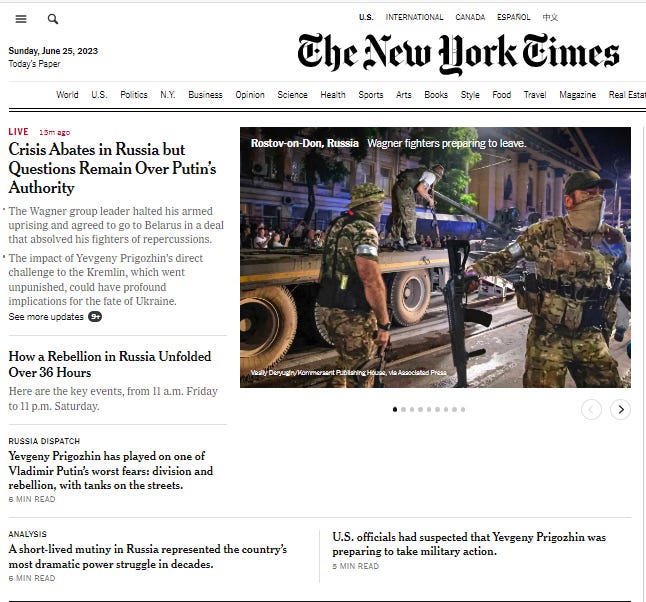
The Front Page of the New York Times of June 25, 2023:
Mark Galeotti in The Times of June 24, 2023:
Headline: Is this the end for Putin?
Sub-headline: When history records the downfall of the Russian president, it will say the endgame started here, writes Mark Galeotti
With armoured vehicles on the streets of Moscow, two Russian cities in the hands of rebel mercenaries and questions about the loyalty of his security forces, President Putin is facing the most serious challenge of his 23 years in power.
Even if the immediate crisis may be defused thanks to the intervention of Belarusian president Lukashenko, the damage is done. When history records his downfall, it will say the endgame began here.
Galeotti engages in hyperbole first, aided by his habit of using subtitles in his essay, it is a reduction that mimic’s the Chapters of a book… it imparts a certain resonance.
Leader the Kremlin created
A problem with numbers
No mercy for traitors
1917 all over again?
Absent leader now in firing line
The reader can make her own determination of the value of Galeotti’s Historical pastiche.
Here is a portion of a Galeotti essay of February 18, 2023:
Headline: Isolated, out of touch, but clinging on: how Russians see Putin
Sub-headline: A year on from the disastrous invasion of Ukraine, the Kremlin could be just one crisis away from collapse
Vladimir Putin is notorious for asking Russian historians how he will be judged a hundred years hence. With his invasion of Ukraine, he has ensured that he will be assessed a failure, an example of the way hubris can devour any initial successes.
Had Putin chosen to step down at the end of his second presidential term, in 2008, it is likely he would be remembered as someone who dragged Russia back from the brink of collapse, even if often by brutal methods.
He then spent four years running the country behind his proxy-president Dmitry Medvedev before returning to the Kremlin. Had he retired after his third term in 2018, he would have left a Russia in dispute with Ukraine and the West, but in possession of Crimea. As it was, though, he was not content, and let his desperation to leave his mark on history drive him to fatal overreach.
All of the above lacks empirical evidence, because it is based on Galeotti’s Mastery of Putinology After the introductory paragraphs Prof. Galeotti provides subject headings to frame his arguments: Yet The Critical Reader might wonder at Prof. Galeotti as a ‘Senior Associate Fellow’ at RUSI:
‘ABOUT RUSI‘
The Royal United Services Institute (RUSI) is the world’s oldest and the UK’s leading defence and security think tank. Our mission is to inform, influence and enhance public debate to help build a safer and more stable world.
Prof. Galeotti is a Government Employee, in a not very roundabout way. So this explanation of Prof. Galeotti‘s political standing provided by The Times is incomplete, in the most self-serving way.
Government employee @MarkGaleotti’s Putinology, @thetimes.
Political Observer looks at The Economist’s Past, to predict its…
The Reader of The Economist confronts the not so underlying tone of political moralizing.
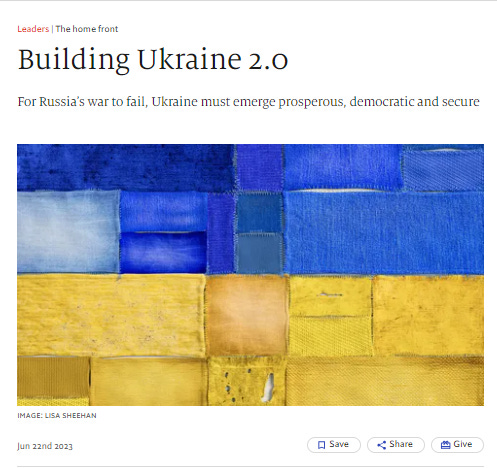
Ukraine’s war is raging on two fronts. On the 1,000km battlefront its armies are attacking the Russians’ deep defences. At the same time, on the home front Ukraine is defining what sort of country it will be when the fighting stops. Both matter, and both will pose a severe test for Ukraine and its backers.
…
The home front is less dramatic, but everything depends on it.
…
Ukraine’s nation-builders face formidable obstacles. The greatest is that, while Mr Putin is in power, this war is unlikely to end with a solid peace treaty.
…
The other obstacles are almost as formidable, though at least it is in the power of Ukraine and its allies to overcome them.
…
The World Bank has estimated that repairing the damage from the first year of war will cost more than $400bn—and that was before the collapse of the dam at Nova Kakhovka, most likely because of Russian sabotage.
…
To succeed, Ukraine must work on many dimensions at the same time. To attract workers and private capital, it needs to rebuild itself. To unleash the creativity and enterprise of its citizens, it must live by the rule of law.
…
Progress will help lock in Western support, which may ebb—especially if Donald Trump is elected in 2024. It will also signal to Mr Putin and his cronies that their war is futile.
…
The effort starts with money for rebuilding on a vast scale. Ukraine’s economy has stabilised at about two-thirds of its former size. Ultimately, its future rests on private investment, but government money will be needed first.
…
Many countries have a vital interest in Ukraine succeeding and Russian aggression being seen to have failed, but these are straitened times.
…
Instead they should find a legal process that allows them to treat the $330bn or so of Russian state money they have frozen as a fund for paying out compensation to Ukraine.
…
Next comes good government. The war has shunted aside many of the oligarchs who held Ukraine back. Their place has been taken by a cohort of entrepreneurs and activists, many of them with a background in technology.
…
However, Western officials warn that, for all his strengths, Mr Zelensky is bored by the detail that dogged reform entails. When Ukraine finally holds elections it risks lapsing back into the old, corrupt politics.
…
Eventually, Ukraine needs to join nato. That would offer permanent security at the lowest cost, because nato’s Article 5 guarantee would signal to Mr Putin and his successors that an attack on Ukraine was an attack on the entire alliance—a battle Russia could not win.
…
However, Ukraine gains little from joining while battle rages—because that would require suspending Article 5 and any doubt about when it applies would weaken nato. Instead Ukraine needs bilateral security guarantees and an accelerated path to nato membership.
…
This is a fearsome agenda. If Ukraine struggles on the battlefront, a greater burden will fall on the home front and the higher will be the obstacles to success. All the more reason for Ukraine and its allies to press ahead.
The Reader need only look at the ‘evolution’ of The Economist’s position on the Iraq War, as predictive of the how and why of Joe Biden’s Proxy War in Ukraine!
After this collection of David Cameron’s successors: Teresa May, Boris Johnson, Liz Truss and Rishi Sunak, Adrian Wooldridge, in the role of ‘Bagehot’ announces:
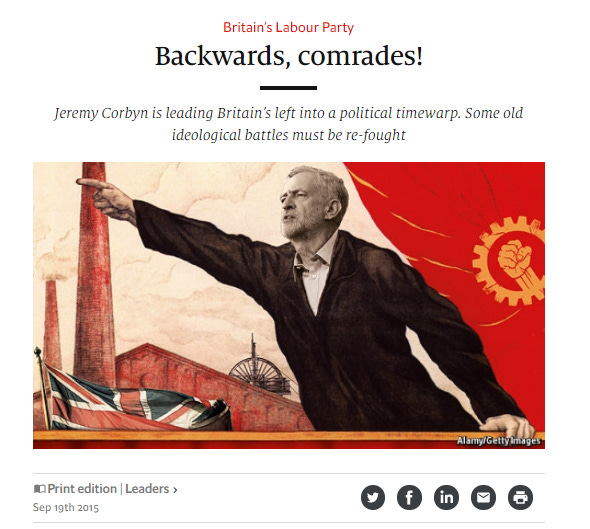
‘Bagehot’s’ ire at Johnson seems a bit overdrawn, given Boris past shenanigans! Cameron, Teresa May, Liz Truss and Rishi Sunak are really about a completely disconnected Tory Party, from the realties of British life. And the whole of the British Media’s lies, confected about Jeremy Corbyn as public/political menace:
None the less, Bagehot takes off at a gallop!
The death certificate for Boris Johnson’s career in politics read June 12th. A government statement appeared that evening appointing Alexander Boris de Pfeffel Johnson as “Steward and Bailiff of the Three Hundreds of Chiltern”, the title mps accept, according to Britain’s absurd constitution, in order to resign. He went because an inquiry into whether Mr Johnson deliberately misled Parliament found that he had. Not only that, he’d also impugned the investigating committee and joined a campaign of abuse and intimidation against it. Mr Johnson faced suspension as an mp for a remarkable 90 days. Given forewarning of the report, the former prime minister quit.
A funeral for Mr Johnson’s career had taken place some days before in a stuffy conference centre in Doncaster. The annual meeting of the Northern Research Group (nrg), a cartel of northern Conservative mps who owe their careers to Mr Johnson, was supposed to be a celebration. Instead it was a premature wake.
The miserable gathering was the best place to survey his political legacy. The nrg, rather than Britain’s departure from the European Union, represented the apogee of Mr Johnson’s political career. It emerged after the 2019 general election, when the party won an 87-seat majority under Mr Johnson as voters across northern England backed the Conservatives for the first time in living memory. In 2005, the Conservatives had 19 northern mps. Then in 2019, they managed 68, with voters enticed by Mr Johnson’s promise of nothing less than a realignment of British politics.
Bagehot wants to bury Boris deep, to expunge him from Political Memory: Bagehot in this regard is a Stalinist. And the ‘Brexit Vote’ was a political self- expulsion from the utterly un-governable E. U. Paradise?
The Reader approaches the remaining 745 words, of the Wooldridge/Bagehot meditation on British Politics, is about the toxic remainder of Boris, he’s its vital political actor in absentia? To engage in the high-toned rhetoric of a highly self-conscious Oxbridger: Caesars assassins cannot withdraw to work of their knives?
Out of self-defense, let this Reader engage in some careful pruning of this essay, while retaining its argumentative integrity, or at the least an attempt at such.
…
Now, however, the realignment has reversed. Conservatives are losing everywhere. But support is falling fastest in the northern constituencies the party was so proud of winning.
…
Four years on, northern voters who backed the Tories have little to show for it. Conservative mps were happy to give excuses.
…
Problems were more fundamental than mere faulty execution. Not for the first time in his life, Mr Johnson had made impossible promises.
…
Brexit has weighed on growth. This meant a government committed to cutting immigration instead had to boost it, to give the economy a hand.
…
Instead, mps offered bromides that would be best left in an airport self-help book. “It’s about being a victor, not a victim,” said Nick Fletcher, the mp for Don Valley, a post-industrial constituency on the outskirts of Doncaster.
…
“Hands in the air if you think the north is awesome,” pleaded one chairwoman at a fringe event, channelling a children’s television presenter.
…
Any cause for optimism came, in the self-help vernacular, from a negative place. Voting Conservative for the first time was a big deal.
…
Labour will have to lose because the Conservatives are not trying to win. The party is on defensive manoeuvres. That means placating voters in the south-east. In the latest budget, the government promised more money for child care, which is most unaffordable in the south-east.
…
The Conservatives need to win voters in the north of England to hold power. The party needs to maintain voters in the south to exist.
…
I know it’s over and it never really began
Rishi Sunak, Mr Johnson’s successor, talks a good game when it comes to the north. He wears the fact he represents a northern seat rather heavily, labelling himself a “prime minister for the north”.
…
Instead, Mr Sunak’s speech to the delegates in Doncaster became an accidental eulogy for the form of Conservativism that Mr Johnson personified in 2019 but which is dead today.
Who can forget that team of Adrian Wooldridge and John Micklethwait that birthed such best sellers: ‘The Company: A Short History of a Revolutionary Idea’, of 2005, ‘God Is Back: How the Global Revival of Faith Is Changing the World’ of 2009, ‘The Right Nation: Conservative Power in America’ of 2004,‘The Witch Doctors: Making Sense of the Management Gurus’ of 1998, ‘A Future Perfect: The Challenge and Hidden Promise of Globalization of 2000.
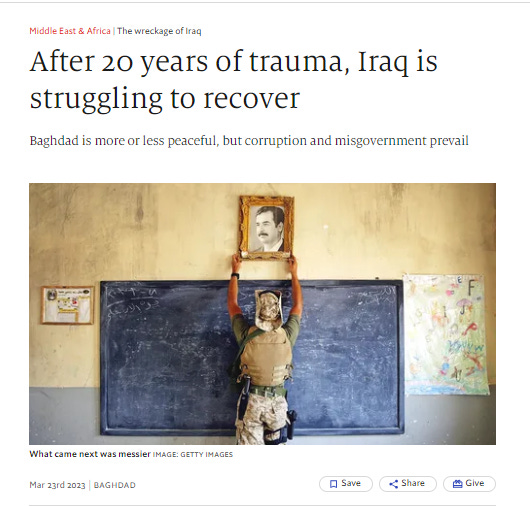
Reading ‘Right Nation’ , long after its apologetics for Bush The Younger’s Neo-Cons, and its catastrophic crime of the Iraq War – I confronted an uneasy sense of déjà vu, as a long time reader of The Economist, that I’d read it all before, in another key…
I’ve written about Wooldridge before:
Who can forget that team of Adrian Wooldridge and John Micklethwait that birthed such best sellers: ‘The Company: A Short History of a Revolutionary Idea’, of 2005, ‘God Is Back: How the Global Revival of Faith Is Changing the World’ of 2009, ‘The Right Nation: Conservative Power in America’ of 2004,‘The Witch Doctors: Making Sense of the Management Gurus’ of 1998, ‘A Future Perfect: The Challenge and Hidden Promise of Globalization of 2000.
Reading ‘Right Nation’ , long after its apologetics for Bush The Younger’s Neo-Cons, and its catastrophic crime of the Iraq War – I confronted an uneasy sense of déjà vu, as a long time reader of The Economist, that I’d read it all before, in another key…
These paragraphs, after the bad news provided by Boris Johnson’s exercise of rank political stupidity, and his victimhood melodrama…
Luck is an overlooked part of politics. It is in the interests of both politicians and those who write about them to pretend it plays little role. Yet, as much as strategy or skill, luck determines success. “Fortune is the mistress of one half of our actions, and yet leaves the control of the other half, or a little less, to ourselves,” wrote Machiavelli in “The Prince” in the 16th century. Some polls give Labour a 20-point lead. Partly this is because, under Sir Keir Starmer, they have jettisoned the baggage of the Jeremy Corbyn-era and painted a picture of unthreatening economic diligence. Mainly it is because they are damned lucky.
Interjection: ‘Bagehot’ never lets that Oxbridger Education go to waste, as persuasive to his Readers. And because this is The Economist ‘Bagehot’ talks money:
If Sir Keir does have a magic lamp, it has been buffed to a blinding sheen. After all, it is not just the behaviour of Mr Johnson that helps Labour. Britain is suffering from a bout of economic pain in a way that particularly hurts middle-class mortgage holders, who are crucial marginal voters. Even the timing helps. Rather than a single hit, the pain will be spread out until 2024, when the general election comes due. Each quarter next year, about 350,000 households will re-mortgage and become, on average, almost £3,000 ($3,830) per year worse off, according to the Resolution Foundation. Labour strategists could barely dream of a more helpful backdrop.
The burning question of the purging of not just Jeremy Corbyn and Diane Abbott from the Party, but the denial of the the facts presented by the inconvenient:
The British Press is the servant of the collapsed Neo-Liberal Swindle, and its invention of an ‘Anti-Semitic Crisis’ within the Labour Party, in the control of the Left Corbynite Menace.
The Reader is then treated to the other political fortunes and misfortunes:
Nicola Sturgeon, the most talented Scottish politician of her generation, found herself arrested and quizzed over an illicit £100,000 camper van and other matters to do with party funds. The snp’s poll rating has collapsed and another 25 seats are set to fall into the Labour leader’s lap thanks to pc McPlod and (at best) erratic book-keeping by the snp.
…
It is not the first time police have come to Sir Keir’s aid. He promised to quit in 2022 if police fined him for having a curry and beer with campaigners during lockdown-affected local elections in 2021.
…
Luck will always play a large role in a first-past-the-post system that generates big changes in electoral outcomes from small shifts in voting. Margins are often tiny. Mr Corbyn came, according to one very optimistic analysis, within 2,227 votes of scraping a majority in the 2017 general election, if they had fallen in the right places.
…
Sir Tony Blair reshaped Labour and won three general elections. But he only had the job because John Smith, his predecessor, dropped dead at 55. (“He’s fat, he’s 53, he’s had a heart attack and he’s taking on a stress-loaded job” the Sun had previously written, with unkind foresight.)
Bagehot being a Thatcherite …
Without the Falklands War in 1982, Margaret Thatcher would have asked for re-election soon afterwards based on a few years of a faltering experiment with monetarism. Formidable political talent is nothing without a dash of luck.
…
Too much good luck can be a bad thing. David Cameron gambled three times on referendums (on the country’s voting system, on Scottish independence and on Brexit).
….
More Machiavelli quotation
“A Prince who rests wholly on fortune is ruined when she changes,” wrote Machiavelli. It was right in 1516; it was right in 2016.
In the final paragraph of ‘Bagehot’s essay
Fortune has left Labour in a commanding position. Arguments against a Labour majority rely on hope (perhaps inflation will come down sharply) not expectation. Good luck may power Labour to victory in 2024, but it will not help them govern. The last time Labour replaced the Conservatives, in 1997, the economy was flying. Now, debt is over 100% of gdp. Growth prospects are lacking, while public services are failing. It will be a horrible time to run the country. Bad luck.
When all else fails what ‘Bagehot’ can provide to his readership, is an ad hoc pastiche of Machiavellian Cynicism,in place of actual political thought. In sum The Reader must choose their Machiavelli : ‘The Prince’ or ‘Discourses on Livy’?
The most famous example from high politics is, of course, Gerald Ford pardoning Richard Nixon for offenses related to Watergate, although that episode dates from a different era when politics was a more serious business for more serious people. Ford didn’t go around bragging that he’d pardon Nixon to garner attention and curry favor with Nixon supporters, while Nixon, for all his desperate flaws, was a man of considerable substance and achievement.
Ford, of course, justified his act of clemency on grounds of moving on from, as he put it in his national address, “a tragedy in which we all have played a part. It could go on and on and on, or someone must write the end to it. I have concluded that only I can do that, and if I can, I must.”
We are still far away from getting to anything like this place. First, Trump would have to lose the Republican nomination, and he’s currently the strong favorite. Then, some other Republican would have to win the presidency, or President Joe Biden would have to see the wisdom of potentially keeping the vanquished Trump out of jail, either after beating him again or defeating another Republican.
That this sentence fragment deserves loud guffaws… ‘The most famous example from high politics…’
American Politics/Life continues to sink in the mire of an utterly collapsed Neo-Liberal Swindle, heartily embraced by both New Democrats and Republicans: and that Trump, DeSantis, and even Vivek Ramaswamy, are the toxic political issue, of that historical fact . Inaugurated by New Democrat Bill Clinton, is a reality that is anathema to Lowry, as the flaccid successor to Wm. F. Buckley Jr..
Reader, thank you for your forbearance… Just one more quotation:
The conventional wisdom is that our politics is over-heated. The worry over this is often exaggerated (things have been as or more feverish before), but having a former president stand trial in a federal criminal case, and potentially spend the rest of his life in jail, is only going to make things more intense and the country more divided. A pardon itself would be a flash point, as the Ford pardon of Nixon was, but it would at least take the unprecedented possibility of a former president behind bars off the table.
LOVE IN A TIME OF HATE: Art and passion in the shadow of war, 1929–39 Translated by Simon Pare
As a reader of ‘The Brothers Mann: The Lives of Heinrich and Thomas Mann, 1871-1950 by Nigel Hamilton of 1975.
And Thomas Mann’s ‘Diaries, 1918-1939’ of 1982:
I had some knowledge of the milieu, the persons/characters and their shared fates, that is the subject of the the two books under review. This final paragraph of Chamberlin’s review is evocative of the that whole milieu:
They were all enemies of Nazism, certainly. But what kind of politics, what kind of society, would have best suited this licentious, aesthetic-minded generation, with its gigantic artistic talents and potential for deep moral waywardness? Presumably, our ultra-liberal own. Perhaps that’s why Illies remains so reserved in his moral judgements, finding the antisemitic vamp Alma Mahler pretty nasty, but only the Hitler-loving film-maker Leni Riefenstahl (“there was a strong streak of elitism to her nymphomania”) “diabolical”. He’s rather lenient, to this reviewer’s mind, and rather hard on Thomas Mann’s “noun-heavy moralizing”. I would have liked to hear him call Brecht not only a great artist, but also a pernicious moral fraud. Illies engages with some relish in his tale, where Wittstock, two generations older, is outraged and sad. In making these observations, though, I may be the product of a staider generation. So let me conclude by saying that, for all the compelling studies on the Weimar Republic, no one will want to miss either of these well-translated books on Weimar writers and Weimar in love.
Let me recommend Chamberlain’s ‘Motherland: A Philosophical History of Russia’.
The First two paragraphs of Marcus Wheeler’s essay seem to contradict what Mark Lilla offers in The New York Times review , below this entry:
Headline: Motherland: a Philosophical History of Russia by Lesley Chamberlain
Sub-headline: Marcus Wheeler is provoked by Lesley Chamberlain’s history of Russian philosophy.
This book is a tour de force if only in that it encompasses an enormous subject – the ‘long tradition’ of Russian philosophical thought from 1815 to 1991 – in fewer than 350 pages. The author is not a professional or academic philosopher but a writer and journalist: she has however studied Russian and German language and literature and philosophy, and the present work is informed by a deep understanding of these three intellectual disciplines. When she writes on the last page that Russian philosophy “is a branch of German philosophy, perhaps even of German poetry”, she restates, albeit in a deliberately provocative way, what British philosophy students used to be told fifty years ago – that philosophy in Russia was wholly derivative from Hegel and German Idealism (and, by implication, not worth bothering with). Like many of us, Lesley Chamberlain was first drawn to 19th century Russian thought by the writings of Isaiah Berlin – his celebrated articles in Encounter on “A Marvellous Decade” and these and the other essays assembled in Russian Thinkers and elsewhere. Chamberlain surprisingly presents Berlin himself as a philosopher in the Russian tradition: in fact, his claim to fame rests far less on his original, recognisably Western-style contributions to philosophy than on his work as a historian of social and political ideas.
Chamberlain owes much not only to Berlin but to more systematic historians of Russian thought, such as Andrzej Walicki, Frederick Copleston and James Scanlan (though she does not mention Derek Offord, who has published extensively in this field in recent years). She sets herself however the ambitious and original aim of distinguishing in the Russians between social and political ‘thought’ and ‘philosophy’ proper and of relating their teachings to the general tradition of Western philosophy from Descartes to present-day post-modernism. To this end she has divided the book into four parts. Part I – entitled “The Making of the Intelligentsia” – is a lucid and straightforward sequential summary of the principal figures and movements from 1815 to 1917 – Chaadaev, Westernisers and Slavophiles, Populists, Marxists and fin-de-siècle ex-Marxists and religious thinkers. The title of Part II – ‘The Making of Russian Philosophy’ – leads the reader to expect a parallel treatment of the evolution of philosophical views, but its three component chapters are more or less discrete self-contained essays. In the first of these, as at intervals throughout the book, Hegel appears prominently. The author is thoroughly versed in his teachings (to her credit, since in British universities Hegel and Idealism have been virtually mothballed since World War II) and explains cogently why his view of society as constantly subject to change through conflict appealed to young Russians suffocated by their static autocracy; as also why his identification of reality and rationality came to offend Belinsky and others by seeming to ignore human suffering and injustice. She presents nearly all the Russian dissident liberals (whom, confusingly, she later calls “anarchists”) as “Counter-Rationalists” preaching a “Counter-Enlightenment”. This, since she describes herself as a “Cartesian rationalist”, may account for her harsh judgment that Russian philosophical history amounted to “two short centuries of intellectual and moral defeat for Russia.”
Now, understanding the soul is also well and good. But what happens when soulfulness stands in the way of rational philosophy and science? Isn’t there a price to be paid? That is the question Lesley Chamberlain poses in “Motherland: A Philosophical History of Russia.” The question is not new, nor are most of her answers. There are very fine studies of 19th-century Russian thought available in English — by Isaiah Berlin, Joseph Frank, E. H. Carr, Martin Malia — and the interested reader will want to turn to those first. But by focusing specifically on how Western philosophical ideas from Descartes through Marx were absorbed into Russian thinking, Chamberlain does complicate the received picture somewhat. As she sees it, the decisive struggle was not simply between Westernizers and anti-Westernizers, but between Russians who stood by the philosophical legacy of France and England, and those who drew sustenance from the far murkier thinkers of modern Germany.
…
What did the Russians learn from the Germans? This is hard to make out from the badly confused accounts of Kant, Fichte, Hegel and Schelling given by Chamberlain, an English journalist and novelist. The main story, though, she gets about right. What the 19th-century Russian intellectuals found in, and partly projected onto, Germany was a romantic alternative to the supposedly cold, heartless logic of Descartes and his progeny. They were especially drawn to F. W. J. Schelling, whose philosophy of nature, a hash of intuition and metaphysical speculation, was closer to theosophy than to modern science. (Lots about “life,” nothing about the pancreas.) Schelling’s doctrines proved to be infinitely adaptable and unfalsifiable, and thus served as useful defenses against French and English rationalism. Like Napoleon’s troops, the modern ideas of Bacon, Descartes, Locke and Hume were turned back at the gates of Moscow and beat a slow retreat through the snow.
…
Marcus Wheeler seems to contradict Mr. Lilla’s assertions that somehow Chamberlain is less of an Historian than ‘ Isaiah Berlin, Joseph Frank, E. H. Carr, Martin Malia’? Does the question regarding Chamberlain reading of that History, about Lilla’s preference for himself and his brother Historians were more reliable? In the long quotation by Marcus Wheeler, above, I’ve placed in a bold font, his comment on Chamberlain reliance on Berlin’s scholarship. As a subscriber of The New York Review Of Books, of the time, I too read Berlin’s ‘Russian Thinkers’ and others.
Here is Chamberlain’s review of ‘Doubt, Atheism, and the Nineteenth-Century Russian Intelligentsia’ by Victoria Frede in 2012.
Headline: Between Belief and Despair
Sub-headline: A group of thinkers tried to explain Russia to a West that could understand it only in terms of “communism” or “freedom.”
We are used to thinking of a great parting of the ways dividing the Russian 19th century unevenly in half, from around 1860, with a rather uncouth and propagandizing atheism of “New Men” taking over from the subtle rhetoric of their more spiritual predecessors. Something of the kind did happen under the influence of materialist philosophies spreading from the West. But partly too—as Ms. Frede shows in a highly original study of minor figures attending the revolutionary Petrashevsky Circle in 1849—it happened because nonbelief was a daring political move in a cruel, inert country. No great theory of personal conduct or philosophical insight was required. Nonbelief itself could be a simple act of defiance. Dostoevsky, another young participant in the Circle who was nearly executed for his apparent political intentions, would later evoke doubt as an essential feature of Russian spiritual life.
Ms. Frede ends her study with a portrait of the radical critic Dmitri Pisarev, a man of the 1860s who is remembered, if at all, for once declaring that a pair of boots was more valuable than the works of Shakespeare. Pisarev deserves his rediscovery by Ms. Frede as the psychologically complex figure he is. Desperate to extract himself from a controlling family, Pisarev latched onto doubt, and the materialism of the body, as the only way he could secure his personal freedom. He spent time in prison and had a mental breakdown and might be best re-imagined as a figure in some unwritten novel, representing one of the many possibilities of Russian dissent.
“Doubt, Atheism, and the Nineteenth-Century Russian Intelligentsia” is an encouraging example of what the end of the Cold War has meant for Russian scholarship. In both Russia and the West, vested interests have been removed from the business of “atheism.” We can see much more clearly now how Lenin, who needed the commitment of the old spiritual intelligentsia but not their inwardness, used atheism as a tool. We can also see how Western historians upholding Enlightenment values underplayed Russian doubt, confusing it with irrationality and missing an enduring clue to what was culturally at stake.
I purchased and read “Doubt, Atheism, and the Nineteenth-Century Russian Intelligentsia” onChamberlain’s recommendation. Victoria Frede’s book was revelatory, to say the least! Chamberlain is part of a long and indispensable tradition, of Writers, Book Reviewers, Critical Intellectuals, who before the Internet nourished my mind in the Age Of Print, and into the Political Present!
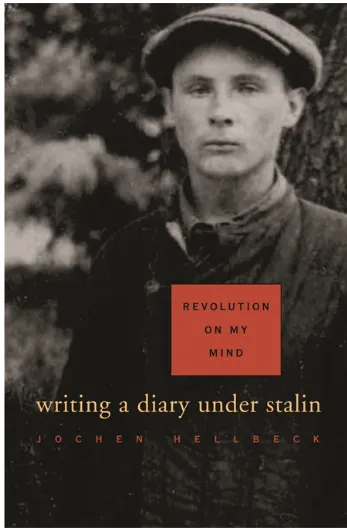
Below is a link to Jochen Hellbeck’s ‘Revolution on My Mind: Writing a Diary under Stalin’ an example of a revelatory History of the Soviet Union, with its focus on individual lives of its citizens.
Old Socialist’s long quotation from ‘Liberalism at Large: The World According to the Economist’ by Alexander Zevin provides long overdue historical context!
If Bagehot viewed America through the prism of the British Empire and its interests, what did he have to say about the latter? Bagehot’s editorship was less rich in incident than Wilson’s – sitting between bursts of warfare and annexation in the 1850s and 1880s–1890s – and Bagehot showed the same breezy, flexible confidence in imperial destiny as he did in English political economy. Whether in Canada, the Cape, New Zealand or Australia, he admitted that colonists could be difficult, demanding, costly, and confrontational with natives. But he opposed the idea of cutting them loose. ‘We are pre-eminently a colonizing people. We are, beyond all comparison, the most enterprising, the most successful, and in most respects the best, colonists on the face of the earth.’140 He countenanced force wherever that valiant spirit was obstructed by recalcitrant subjects, or non-Westerners, though in such cases he preferred it to be moderate, and directed from London.
Closest to home, he backed Gladstone’s efforts to ‘pacify Ireland’ after 1868: disestablishing the Church of Ireland – Protestant, in a country four-fifths Catholic – and passing very limited tenure reform to give evicted farmers compensation for their improvements to the land. Any step outside the 1801 Act of Union, however, was anathema. The Economist attacked both the Fenian Brotherhood, made up of armed republicans in America and Ireland, as well as the Home Rule League, which sought greater autonomy through conventional parliamentary forms. Gladstone was right to ‘tread out the Fenian folly’ following an uprising in 1867, which proved that the organization preferred sowing strife to practical politics. But since Home Rule was a ‘gigantic and impossible constitutional revolution’, it was hardly less of a folly. A parliament for Ireland would tear down the entire edifice of the British state, creating a federal instead of imperial parliament in London, unable to override the Irish one ‘without provoking something like a rebellion on every separate occasion’. Home Rulers would ‘be imprudent, but they would be far more logical, if they were to raise a cry at once for an independent Irish Republic’.141 The one consolation for the defeat of the Liberals in 1874 that so shocked Bagehot was, ‘at least it delivers us from the rule of the faction which is anti-English in essence, and which wishes to destroy the Empire’.142 His idea for political reform in Ireland was to suppress the office of viceroy: concentrating the symbolic majesty of the British state in such a person lent credence to the claim of Irish nationalists to live in a subjugated colony – as if Dublin were no different than Delhi.143
Perhaps the most far-reaching colonial crisis during the period was not in Ireland, but in the West Indian colony of Jamaica. Here, in 1865, Governor Edward John Eyre responded to an uprising of former slaves in Morant Bay with brutal force, declaring martial law and deploying troops, who burned and looted over a thousand homes, and killed several hundred black Jamaicans, including a mixed-race member of the Jamaica Assembly. This looked like an organized lynching designed to shore up the power of white sugar planters, whose fortunes had declined since the advent of free labour, free trade and lower-cost sugar a generation earlier – and these events caused massive
controversy when news of them reached Britain. Though Bagehot rebuked black rebels as ‘negro Fenians’, he was much more critical of Governor Eyre. For a time he made common cause with John Stuart Mill, who in 1866 set up the Jamaica Committee to press for Eyre to be put on trial; a host of liberals joined Mill, including John Bright, Charles Darwin, Herbert Spencer and many others. Opposite them stood Thomas Carlyle and the members of the Governor Eyre Defence and Aid Committee. Bagehot attacked Carlyle in the Economist for defending Eyre’s ‘carnival’ of violence as ‘the worship of brute force’, and a threat to law, justice and liberty – not just in Jamaica, but in England. ‘On Mr. Carlyle’s principles of judging human actions, as exemplified in this Eyre case, Philip II and Alva have a right to the honour and thanks of posterity.’144 But as might be expected, his objection was not primarily moral. Bagehot agreed that blacks were inferior to whites, and acknowledged the importance of maintaining order in the Empire. To assure this in keeping with the needs of capital, however, required some cooperation from subject peoples. The Economist pointed to the tantalizing investments to be made in China’s railways, canals, tea planting, silk growing, and steam navigation, ‘beyond any experience we have yet acquired’, and similar opportunities in ‘Japan, Indochina, Persia, Asiatic Turkey’ and Africa, ‘from Abyssinia to the Cape’. To unlock these treasures, one point had be kept in mind – ‘that very large bodies of dark laborers will work willingly under a very few European supervisors’.145
As it turned out, gaining access to these markets involved more than investment prospectuses. It required armed compulsion, especially in East Asia. Bagehot saw British and French interventions in China to prop up the tottering Qing dynasty against Taiping rebels – a radical millenarian rebellion that spread from rural Guangxi to convulse the country, in part due to prior Western wars to force it open – as a
regrettable necessity; but with Englishmen ‘leading the fleets and armies, and administering the finances of the Celestial Empire’, soon to be ‘Governors and Viceroys over vast provinces’, its violent repression had a silver lining. Farther east in Japan, trade – and the sort of extra-territorial legal treatment that British merchants should expect – was also at stake, in a nation that had shown still stronger distrust of Westerners than China. The Economist was unsure if the Royal Navy had legitimate grounds to bombard Kagoshima in 1863, to punish the ‘Daimio Satsuma’ for the death of a British merchant. But once begun, the paper pushed for widening the war. ‘Possibly we may have to bombard the Spiritual Emperor as well as the Feudal Baron, if his palace lie within a mile or two of the shore. Anyhow we are in for it: we must now hold our ground and make good our position; and we must do this by force and at the cost of blood.’146 As the smoke settled afterwards, it worried that in continuously shelling a town of 150,000 (‘as large as Sheffield’) for over forty-eight hours ‘we do seem to have outstepped all the now recognized boundaries of civilized and credible warfare’. Satsuma’s representatives later put the death toll at 1,500.147
Not all imperial undertakings were military during these years. Bagehot grumbled in 1875 when Disraeli, as prime minister, opted to buy 176,602 shares in the Suez Canal from the Khedive of Egypt, bringing the total Britain owned to just under half. As an investment yielding 5 per cent it was and would allow the Khedive to ‘reform his finances’. But Bagehot was unsure if it would solve the problem it was meant to address – making sure the passage to India stayed open, and in British hands. ‘We do not know what will be the course of history or the necessities of future times.’ ‘If we are prepared to take hold of Egypt, will this share in the Suez Canal help us in so doing? Will it not be better to take the country when necessary, without making public beforehand our intention to do so?’148 India itself was non-negotiable, whatever route was taken there, as Bagehot affirmed in 1863 at the death of Elgin – the man sent east to break Chinese resistance in the Second Opium War and open Japan, subsequently appointed viceroy of India. His successor, Sir John Lawrence, had the ‘single quality’ needed to ‘keep a vast population which wants to recede, perpetually advancing’. What was that? ‘Force’.149
Perhaps the most revealing example of the open-ended imperialism of the Economist under Bagehot was its enthusiasm for the least successful of all such ventures: the invasion of Mexico at the end of 1861 by France, with support from Spain and Britain. It applauded Napoleon III for rebuilding a failed state unable to pay its creditors in Europe, and for balancing the US, with its back turned fighting the Civil War. The installation of an Austrian archduke, Maximilian, on Mexico’s throne three years later, was a particular stroke of brilliance – a better administrator than ‘any obtainable half-caste or Indian president’, whose rule would ensure the export of everything from silver to apples, and timely interest payments on Mexico’s sovereign debt.150 Three years later Maximilian was executed by firing squad in Querétaro, after French forces hastily withdrew.
In Physics and Politics, Bagehot explained his approach to empire in more theoretical terms, as a complement to these snapshots in the Economist. Applying his take on positivism and the natural sciences to human societies around the world, he divided them into three evolutionary epochs: a ‘preliminary age’, primitive, tribal and customary; a ‘fighting age’, in which some nations prevailed over others thanks to their martial qualities; and a third, progressive, industrial and peaceful ‘age of discussion’, where the ‘higher gifts and graces have rapid progress’. This, of course, was Victorian Britain: the class rule of the ten thousand educated members of society that Bagehot had outlined in the English Constitution found an evolutionary basis in ‘adaptation’ and ‘natural selection’. Bagehot added that some law of imitation must operate inside nations to account for their success in the world – a copying process, working its way from ‘predominant manners’ down and then inherited, in a Lamarckian sense. Bagehot was himself copying social evolutionists – not least Herbert Spencer and John Lubbock – by making such claims, and then extending them outwards. British wars were justified in China, for example, since its ancient civilization had been arrested at an earlier stage of development. There, to ‘crack the cake of custom’ might indeed require cannonballs.151
Colby Smith and Sam Learner rely on evoctaive Graphs at three points in their essay. Not to speak of :
…
The latest survey, conducted in partnership with the Kent A Clark Center for Global Markets at the University of Chicago Booth School of Business, predicts the Fed will lift its benchmark rate to at least 5.5 per cent this year. Fed funds futures markets suggest traders favour just one more quarter-point rate rise in July.
Top Fed officials have signalled a preference for forgoing a rate rise at their next two-day meeting on Tuesday, while keeping the door ajar to further tightening. After 10 consecutive increases since March 2022, the federal funds rate now hovers between 5 per cent and 5.25 per cent, the highest level since mid-2007.
…
A selection of sentences is more than in order :
Of the 42 economists surveyed between June 5 and June 7, 67 per cent forecast the federal funds rate to peak between 5.5 per cent and 6 per cent this year.
More than half of the respondents said the peak rate will be achieved in or before the third quarter, while just over a third expect it to be reached in the final three months of the year.
“They haven’t done enough for long enough yet to get inflation down,” said Dean Croushore, who served as an economist at the Fed’s Philadelphia Reserve Bank for 14 years.
Despite mounting expectations that the Fed is not yet done with its tightening campaign, most of the economists thought the Fed would skip a June move.
“The economy turned out to be much more resilient than we originally thought and the question is: is that resilience temporary and the hikes in the pipeline are sufficient or does the Fed need even further hiking?
An added complication is the pullback by regional lenders following the collapse of Silicon Valley Bank, First Republic and a handful of other institutions.
Among respondents, however, concerns about inflation appeared to outweigh banking sector worries.
By the end of 2024, roughly a third of the respondents said it was “somewhat” or “very” likely that core PCE would exceed 3 per cent. More than 40 per cent said it was “about as likely as not”.
“There has barely been any progress on core inflation, the real economy is performing vastly better than anyone could possibly have expected and policymakers have yet to fully adjust to that reality,” said Jason Furman,
The biggest factors driving down the rate of inflation will be rising joblessness and falling wage gains, 48 per cent of the economists said, followed by global headwinds stemming from a weakening Chinese economy and strong US dollar.
The Final Two Paragraphs:
Recession calls have been pushed back as well. Most economists do not see the National Bureau of Economic Research declaring one until 2024, compared to surveys conducted last year in which roughly 80 per cent expected a recession in 2023.
About 70 per cent said the peak unemployment rate in a forthcoming recession would not be reached until the third quarter of 2024 or later. Gabriel Chodorow-Reich of Harvard University said he is bracing for a mild recession in which unemployment rises to about 6 per cent.



 StephenKMackSD's Blog