@tomfriedman on Vladimir Putin’s War in Ukraine: its almost a rhetorical Keystone Cops comedy…

Political Cynics’ selective reading.

MAY 10, 2023

The opening paragraph:

I have not written much about the war in Ukraine lately because so little has changed strategically since the first few months of this conflict, when three overarching facts pretty much drove everything — and still do.

Next paragraph:

Fact No. 1: As I wrote at the outset, when a war of this magnitude begins, the key question you ask yourself as a foreign affairs columnist is very simple: Where should I be? Should I be in Kyiv, the Donbas, Crimea, Moscow, Warsaw, Berlin, Brussels or Washington?

No. 2 and Plan B

Which leads to fact No. 2: Putin never had a Plan B. It’s now obvious that he thought he was going to waltz into Kyiv, seize it in a week, install a lackey as president, tuck Ukraine into his pocket and put to an end any further European Union, NATO or Western cultural expansion toward Russia. He would then cast his shadow across all of Europe.

This leads to fact No. 3: Putin has put himself in a situation where he can’t win, can’t lose and can’t stop. There’s no way he can seize control of all of Ukraine anymore. But at the same time, he can’t afford to be defeated, after all the Russian lives and treasure he has expended. So he can’t stop.

To put it differently, because Putin never had a Plan B…

Putin’s Plan B is to disguise that Putin’s Plan A has failed

….

Operation Save My Face.

Western “globalists and elites

Putin invaded Ukraine to preserve Russian family values.

Putin is quite frightened today by two subjects: arithmetic and Russian history.

in lyrics from the song “Everybody Talks” by one of my favorite rock groups, Neon Trees.

EVERYBODY TALKS.

Plan B — starting with subtraction.

Mr. Friedman seems, from this point to have regained his political/argumentative composure, after his reliance on free imaginative variation, including a quotation from his favorite band ‘Neon Trees’.

I’ll quote from a selection of portions of these paragraphs:

The White House reported last week that an estimated 100,000 Russian fighters have been killed or wounded in Ukraine…

That is a big number of casualties — even in a big country — and you can see that Putin is worried that his people are talking about it, because,…

Putin would not be going to such lengths if he was not fearful that, despite his best efforts, everyone was whispering…

Read the recent essay in The Washington Post by Leon Aron, a historian of Putin’s Russia and a scholar at the American Enterprise Institute, about Putin’s visit in March to the Russian-occupied Ukrainian…

“Two days after the International Criminal Court charged Putin with war crimes and issued a warrant for his arrest,” Aron wrote, “the Russian president came to Mariupol for a few hours.

Aron told me that the Russian media later scrubbed “It’s all lies” from the audio, but the fact that it had been left in there may have been a subversive act by someone in the official Russian media hierarchy.

Which leads to the other thing Putin knows: “The gods of Russian history are extremely unforgiving of military defeat,” Aron said. In the modern era, “when a Russian leader ends a war in a clear defeat — or with no win — usually there is a change of regime.

It’s for these reasons that Aron, who just finished a book about Putin’s Russia, argues that this Ukraine conflict is far from over and could get a lot worse before it is.

“There are now two ways for Putin to end this war he cannot win and cannot walk away from,” Aron said.

And the other, he argued, “is to somehow force a direct confrontation with the U.S. — bring us to the precipice of an all-out strategic nuclear exchange — and then step back and propose to a scared West an overall settlement, which would include a neutral, disarmed Ukraine and his holding on to the Crimea and Donbas.”

In the above Mr. Friedman takes the word of a Neo-Con?

It’s impossible to get into Putin’s head and predict his next move, but color me worried. Because what we do know, from Putin’s actions, is that he knows his Plan A has failed. And he will now do anything to produce a Plan B to justify the terrible losses that he has piled up in the name of a country where everybody talks and where defeated leaders don’t retire peacefully.

Plan A and B make a return to the stage, along with Friedman’s ‘color me worried’.

Political Cynic
Posted in Uncategorized | Leave a comment

@RColvile in two keys: Immigration and the NHS.

Philosophical Apprentice considers two cases.

MAY 7, 2023

Mr. Colvile’s April 29, 2023 essay ‘Britain’s legal migration numbers matter more than small boats’ ignores the the fact that the ‘Refugee Problem’ that he attempts to ‘diagnose’, might find its actual beginning point, with the murderous political adventurism of the Bush/Cheney War On Terror, that is , if political candor were its starting point. This report from the New York Times, is a stark reminder of what Journalism might resemble:

Sept. 8, 2020Updated Sept. 10, 2021

Headline: At Least 37 Million People Have Been Displaced by America’s War on Terror

Sub-headline: A new report calculates the number of people who fled because of wars fought by the United States since Sept. 11, 2001.

Mr. Colvile’s attempt at Historical Reductivism is self-serving: the diminutive framing is the tool of a propagandist. I searched the essay for mention of that ‘War On Terror’ and its continuing toxic Global legacy, not found. The essay at 1,254 words is true to the Neo-Conservative obfuscation, wedded to a highly politicized logorrhea.

Thanks for reading StephenKMackSD’s Newsletter! Subscribe for free to receive new posts and support my work.

Subscribed

The American interventions in Iraq and Afghanistan have been abysmal failures, with long lasting catastrophic consequences. The focus of Colvile’s intervention avoids that toxic legacy, by careful rhetorical procedures of evasion and absence, of a possible broad raging historical faming. As head of a Think Tank, he draws on the power of other employees, to provide viable argumentative alternatives, to actual historical facts.

Mr. Colvile’s concluding paragraph trades in the cultivation of bourgeois political respectability.

Whenever people accuse the UK of being a backward, prejudiced country, I always point to our extraordinary record of welcoming and assimilating immigration. My children and I are among the millions of Britons who wouldn’t exist without it. But, for all the focus on the boats in the Channel, it is those coming in perfectly legally who are the bigger story — and will do far more to reshape Britain


In his latest essay Mr. Colvile comments on the NHS:

Headline: Robert Colvile Ending strikes is just the start — there are harder problems for the NHS

Robert Colvile Sunday May 07 2023,

One of the joys of the local elections is seeing people scramble on to their hobby horses. It’s clear, they will intone, that the real cause of the Tories’ problems was net zero. Or sacking Boris. Or letting in too many migrants. Or too few.

In fact, the things people are upset about tend to be the same things as they have consistently been telling pollsters. Primarily, as Tim Shipman reports today, that they’ve looked at their bank accounts and realised — to paraphrase the Tory chairman, Greg Hands — that there’s no money left.

But alongside the cost of living horror show another problem has been dominating the focus groups: the NHS. During the recent strikes public concern rose by 8 points in April alone.

On this front there is a chink of light. Steve Barclay, the health secretary, has reached a pay deal with enough of the unions to sign off a national settlement, although some are still aggrieved. There have even been what one insider describes as “constructive” discussions with the junior doctors, who are on a separate deal.

It will definitely help the NHS to have staff on the wards rather than the picket lines. But, as ministers know full well, that is hardly the end of it.

https://www.thetimes.co.uk/article/ending-strikes-is-just-the-start-there-are-harder-problems-for-the-nhs-pdxhzw0b5

One of Mr. Covile’s may guises is his posing as the voice of reason, in a cacophony of voices. As a Thatcherite Political Romantic of a certain kind, iteration, embodiment… he strikes that perpetual pose , in a newspaper, dedicated to the dismembering of The Welfare State.

What might The Reader make of this?

Headline: 37 NHS GP practices have been sold to a private US health company – here’s what it means

Sub-headline: An American health insurance company has taken over 37 GP practices in London, sparking fears the NHS is being sold by stealth.

An American health insurance company has taken over 37 GP practices in London, sparking fears the NHS is being sold by stealth.

Private Eye magazine reported this week that Operose Health, the UK subsidiary of US health insurance giant Centene Corporation, took over the 37 GP practices this week, adding to the 22 primary care services the company already runs in the UK. The firm now has full control of the NHS-funded contracts to run the London surgeries.

During the 2019 election campaign, former Labour leader Jeremy Corbyn claimed in a debate that he had seen internal documents showing Boris Johnson had signalled willingness to allow US healthcare companies greater access to the NHS.

Johnson repeatedly denied that the NHS would be “on the table” in any deals between the UK and the US, however.

GP practices have traditionally been owned privately by GPs themselves.

https://www.edinburghnews.scotsman.com/health/37-nhs-gp-practices-have-been-sold-to-a-private-us-health-company-heres-what-it-means-3172193

The above article is about the reality of the dismantling of that Welfare State, in sum the NHS, is already a political fact, and that the above report is just confirmation of that reality. Note the cynicism of the opening sentence, posing as a variety of political wisdom? ‘One of the joys of the local elections is seeing people scramble on to their hobby horses.’

A selection of sentences demonstrates Colvile’s argumentative thrust:

The good news for Rishi Sunak is that waiting lists have stopped rising, sticking at 7.2 million over the past half-year.

This newspaper has chronicled the horrors of the A&E crisis: the ambulance that took 30 minutes to reach a dying baby, the corridors “stacked with patients like cars in a traffic jam”.

For the NHS workforce, it is clear that the problems go far beyond salary. True, the latest staff survey found that only a quarter of staff were satisfied with their pay.

Barely half felt their organisation would act on concerns they raised, or would recommend it as a workplace.

The key danger, they say, is a steady erosion of the goodwill on which the health service has always relied. For example, it is thought there has been a significant rise in the amount of “exception reporting” — junior doctors claiming for overtime worked, rather than just doing it unpaid.

The head of health policy at No 10, Bill Morgan, published a report days before getting the job about the long-term failure to train enough NHS staff.

But in 2021 more than half of advertised consultant physician posts in England and Wales went unfilled, and three quarters of those had no applicants at all. The more short-handed you are, the more you have to rely on locums and overseas labour.

The government hopes to address this with its big workforce plan, due later this year, but building capacity takes at least a decade.

Unless we can keep people healthier for longer, or galvanise GDP growth, we’ll soon be a health system with a vestigial economy attached.

A Thatcherite like Colvile cares neither for patient care, nor patient outcomes, ideological conformity is his ruling singularity, while sounding the notes of a cultivated bourgeois morality.

Fixing this, in other words, will be a long-term, multi-government project. It will also require flexibility and imagination within the sector. The medical unions are calling for a huge expansion of medical training. But it was the BMA that voted against new medical schools in 2008 to avoid an “overproduction of doctors with limited career opportunities”.

Does it really make sense for doctors to train for years across a number of areas when they will largely end up in one specialty? Should the same person be diagnosing your condition and cutting you open? What if we trained more nurse associates and sub-consultant doctors to free up doctors and nurses? Shouldn’t we be able to offer doctors better salaries to work in places or specialties that are struggling to recruit? The reaction to such suggestions tends to be frosty, to say the least.

The priority for the government and the health sector is just to get a grip on waiting lists and make the NHS run like a normal service again. But if we can’t fix its long-term problems, it won’t just be the Tories who suffer.

Philosophical Apprentice

Posted in Uncategorized | Leave a comment

Emmanuel Macron as refracted through @TheEconomist lens

Old Socialist wades into the shit !

May 5, 2023

How quickly the ‘Jupertarian Politics’ of Macron was discarded by Macron, and by The Economist. Now rendered as:

Headline: Emmanuel Macron hopes to reinvent himself in 100 days

Sub-headline: France’s president would also benefit from curbing some of his own instincts

During his audacious first bid for the French presidency, in 2017, Emmanuel Macron would scold supporters at campaign rallies who jeered when he name-checked his rivals. “Don’t whistle at them; let’s beat them!” the 39-year-old pretender urged the crowds with a smile, adapting a slogan borrowed from the high priest of political positivity, America’s Barack Obama. French politics, Mr Macron argued forcefully then, was in need of benevolence and collective endeavour not obstructive division. It was time to move an irritable, rebellious country to a more stable, consensual place.

The above paragraph is a re-writing of History, nothing new for The Economist. That now discarded grandiose nomenclature of ‘Jupertarian Politics’ was the blind for the Neo-Liberalization of France. It was abandoned with the appearance of the gilets jaunes protests about fuel prices. The Macron extra-constitutional Pension Reforms have now galvanized the working class and the middle class, into a full scale Rebellion in France. Macron’s ‘audacity’ as argued by this political rag is more self-serving myth-making. I’ve put in bold font the last two sentences of this shit!

The Economist writers/editors are Stalinists by nature, they re-write a History Made to Measure:

Six years later, France seems stuck in an impasse. The French are once again fired up by revolutionary rage and seem convinced that the country is run by an anti-democratic despot bent on destroying the bedrock of all that the French cherish. The opposition trades in a form of declinist misérabilisme. The grotesque effigies of the president’s head in a noose, or The grotesque effigies on the cobbled streets of Paris, glorify violent revolt. On May 1st an armour-clad policeman was set alight by a Molotov cocktail. It was the low point of the 13th one-day strike against Mr Macron’s modest decision to raise the minimum pension age from 62 years to 64, which is now law. Petrol-bombing troublemakers represent a minuscule minority. But 63% of the French want to keep up the struggle against the new law, and 72% say they are unhappy with Mr Macron as their president.

The Economist writer, or writers, produce a collection of hysterical crescendos: the country is run by an anti-democratic despot bent on destroying the bedrock of all that the French cherish. The Rebels are a minority: The grotesque effigies… who glorify violent revolt… armour-clad policeman was set alight by a Molotov cocktail… Petrol-bombing troublemakers …

Read about the historical record of the French Police here :

The Reader is in the melodramatic territory of Sydney Carton as played by Ronald Coleman in A Tale of Two Cities, as he ascends to the guillotine declaiming ‘It is a far, far better thing that I do, than I have ever done;’

A selection of quotations from the remainder of this screeching political document:

The latest instrument of choice for protesters is more prosaic, but no less symbolic: the saucepan. A few years back the gilets jaunes (yellow jackets) adopted high-vis fluorescent jackets to mark the fury of those who felt invisible and ignored by the president. This time, protesters stage casserolades, or concerts of banging pots and pans, to signify discontent at his failure to listen.

Every evening, images of real war and extreme hardship on the European continent are beamed into its living rooms. Yet France has turned the raising of the pension age to 64 into a national psychodrama. Forget the coming upheaval of artificial intelligence, or quantum computing, or the worrying level of southern Europe’s water table. France is heading to the barricades to fight yesterday’s battles. And its re-elected president is portrayed, absurdly, as an autocrat for having gone ahead and done what he said during his campaign that he would.

Militant unions care little for the culture of consensus. Among the books prominently displayed for sale during a recent day of protest in Paris were Lenin’s “The State and Revolution” and Alan Woods’s “The Ideas of Karl Marx”.

Mr Macron lost his majority, mishandled his pension reform, alienated even moderate union leaders, and found himself having to push the law through parliament without a direct vote. The advocate of consensus-building between the left and the right ended up driving a bulldozer through the centre of French politics

Where does this leave Mr Macron, who has four more years in office? Guiding and nudging the prickly French out of their comfort zone is a challenge for any leader. For the president, his “100 days” is a way of buying time, giving people a chance to let off steam and countering the populist charge that he is disconnected.

A new prime minister would make sense only if he or she could reboot the government. Without a formal coalition, bill-by-bill negotiation will render tricky anything but the most uncontroversial reform.

The Economist offers in its final paragraph – confronts Macron as an insufferable Anti-Democratic Neo-Liberal… its too late for a mealy-mouthed political character analysis, of this utterly failed Technocrat. Just more shit!

Mr Macron is a serious, intelligent, ideas-driven leader, who thinks ahead and knows where he is trying to take France. But he is also someone who reckons he knows better than everybody else, and has trouble concealing it. This makes his connection with the French tense, and his governing style solitary and abrasive. In this respect, the saucepan-banging is a broader metaphor. For there is a big difference between talking and listening, not to mention believing that your interlocutor has something useful to say. If a reinvented president is to emerge from the “100 days”, it might usefully be one who has also learned to curb his own instincts

Old Socialist

Posted in Uncategorized | Leave a comment

@politico under the rubrics of Politics, Policy, Power: Rich Lowry on Trump, again.

Political Observer grows impatient.

MAY 3, 2023

The last few Politico commentaries on Trump, by Lowry, read as if it were written by a Trump advocate/apologist/tactician. The latest is no exception:

Headline: Opinion | Trump’s Election Denialism Is Already Winning

Sub-headline: It’s up to Republican opponents to make it a vulnerability rather than a strength

Presidents of the United States who have lost elections generally don’t go on to dominate their parties and win the office again.

Donald Trump has found a work-around, by denying he was defeated in 2020. This effort has been overwhelmingly successful among its target audience of Republican voters and has tilted the playing field of the 2024 nomination battle in his favor.

Trump has made himself the incumbent in exile, the sitting president in the hearts and minds of his supporters, the martyr of shadowy forces (so shadowy, in fact, that they can’t be readily identified) and the true heir chiseled out of his rightful throne by an unscrupulous pretender.

This creates a terrible dilemma for Trump’s opponents: How do you run against a defeated president without noting the highly relevant fact that he was, ahem, defeated?.

This followed by polling data, an abundance of political speculation, and ending here:

Give Trump this: He doesn’t necessarily accept public opinion as it is but tries to shape it. Although there’d be widespread Republican doubts about the 2020 election no matter what he said, the belief that it was stolen wouldn’t be as deep and pervasive without his persistent (and deceptive) advocacy. He’s changed the landscape in his favor, and his opponents simply accept it at their peril.

For Trump to lose the nomination, what should be his chief vulnerability needs to be a vulnerability — and his Republican opponents must try to make it one.

https://www.politico.com/news/magazine/2023/05/04/trump-election-denialism-winning-00095194

What never occurs, within Lowry’s imaginative political speculations, is what Robert Kennedy Jr. and Marianne Williamson might offer to the American electorate: that might render the myth of the ‘stolen election’ moot, or at the least tangential, or even irrelevant, in the face of four more years of Senile Old Joe: AIPAC groveler Kamala Harris, and her bloodthirsty Neo-Con political allies, a clear and present danger to what remains of The Republic?

Political Observer

Posted in Uncategorized | Leave a comment

Direct from The Versailles Dining Room, of the Hoover Institution, Professional Hysteric @nfergus opines on on AI

Political Observer examines the comic moments…

MAY 3, 2023

Let me offers a selection of some of the comic moments from Mr. Ferguson’s 3, 893 word Encyclical – like all Neo-Cons he attempts to drown The Reader in his self-congratulatory verbosity. How might that Reader approach this rhetorical monstrosity?

So let me offer a disinterested view. I have zero skin in this game. I have no investments in AI, nor does it threaten my livelihood. Sure, the most recent large language models can generate passable journalism, but journalism is my hobby. The AI doesn’t yet exist that could write a better biography of Henry Kissinger than I can, not least because a very large number of the relevant historical documents are not machine-readable. 

Mr. Ferguson garnishes his essay with Literary, Movie adaptations/quotations:

I am reminded of Liu Cixin’s The Dark Forest, which describes the invasion of Earth by the ruthless and technologically superior Trisolarans.

Another sci-fi analogy that comes to mind is John Wyndham’s Day of the Triffids (1951), in which most of humanity is first blinded by rays from satellites and then wiped out by carnivorous plants genetically engineered — by the dastardly Soviets — and farmed for their vegetable oil.

Not by producing Schwarzenegger-like killer androids, but merely by using its power to mimic us in order to drive us individually insane and collectively into civil war.

We are already well on our way to Raskolnikov’s nightmare at the end of Crime and Punishment, in which humanity goes collectively mad and descends into internecine slaughter.

While Mr. Ferguson was still in swaddling clothes, in 1968, he missed Stanley Kubrick’s epic 2001: A Space Odyssey ? ‘We’ watched HAl ‘malfunction’ the beginning of AI hysteria? Or might ‘we’ look to Fritz Lang’s Metropolis ?

That arbiter of American bougsiouse taste, The New Yorker, offers this collection of quotations from various critical commentaries, on Kubrick’s cinematic ‘Nietzschean pastiche’…

“2001: A Space Odyssey”: What It Means, and How It Was Made

Fifty years ago, Stanley Kubrick and Arthur C. Clarke set out to make a new kind of sci-fi. How does their future look now that it’s the past?

By Dan Chiasson

April 16, 2018

https://www.newyorker.com/magazine/2018/04/23/2001-a-space-odyssey-what-it-means-and-how-it-was-made

Political Observer

Posted in Uncategorized | Leave a comment

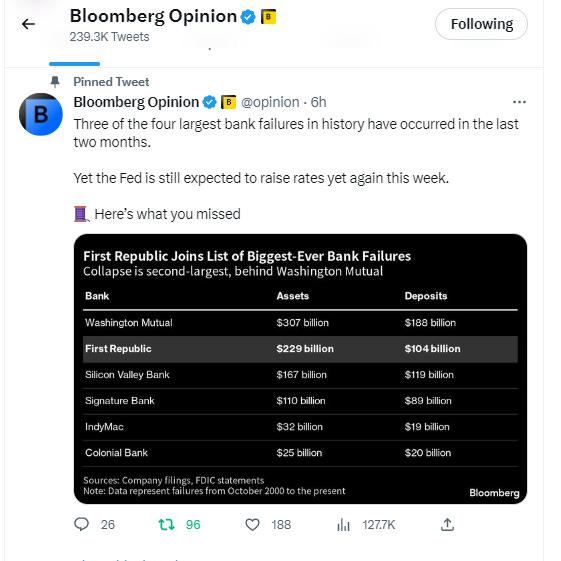
@NYT: Nothing quite compares to @nytdavidbrooks, as a Modern Day Babbitt. While Bloomberg reports on one more Bank Failure

Old Socialist comments.

Headline: The Power of American Capitalism

The window dressing of this essay/propaganda is of interest

Pay attention to the Framing. Mr. Brooks shamelessly appropriates Mark Twain.

The mighty Mississippi rolls on.

The mighty rolling river sweeps up new generations.The mighty rolling river sweeps up new generations.

But American capitalism rolls on.

Here is a sample of the Brooks’ argument:

The mighty Mississippi rolls on. If you don’t live near it, you might never think of that wide, powerful river. You may associate it with old Mark Twain stories. But every day, 24/7, it rolls on.

American capitalism is kind of like that. You can invent fables about how America is in economic decline. You can rail against “neoliberalism.” But the American economy doesn’t care. It just keeps rolling on.

The Economist magazine published a report on American economic performance over the last three decades. Using an avalanche of evidence and data, the main thrust of the article is that far from declining, American capitalism is dominant and accelerating.

Back in 1990, for example, America’s gross domestic product per capita was nearly neck and neck with that of Europe and Japan. But by 2022 the U.S. had raced ahead

Brooks is a modern day Babbitt. Should The Reader even be surprised? at who the villain is, in this would be polemic?

In 2013, Thomas Piketty published a much discussed book called “Capital in the Twenty-First Century” arguing that widening inequality is an inherent feature of modern capitalism. The problem is that right around the publication of his book, inequality stopped widening, the economist Noah Smith notes, and it now appears to be slightly decreasing.

The American model of capitalism is under assault from the left, which rails against the supposed horrors of neoliberalism and globalization, and from Tucker Carlson-style populists, who often treat American capitalism as a great betrayal. But it has proved superior to all real world alternatives.

In fact, I’m kind of amazed. We’ve lived through a wretched political era. The social fabric is fraying in a thousand ways. But American capitalism rolls on.

Bloomberg offers some Sobering News:

Old Socialist

Posted in Uncategorized | Leave a comment

The Freudian Apologists can’t let go of their ‘Great Man’: Adam Kirsch postulates ‘Freud as Talmudist’

Philosophical Apprentice comments.

I will begin with a link to my January 4, 2019 essay:

On ‘Becoming Freud’ : Adam Phillips as incompetent Freudian Apologist/Propagandist. A comment by Philosophical Apprentice

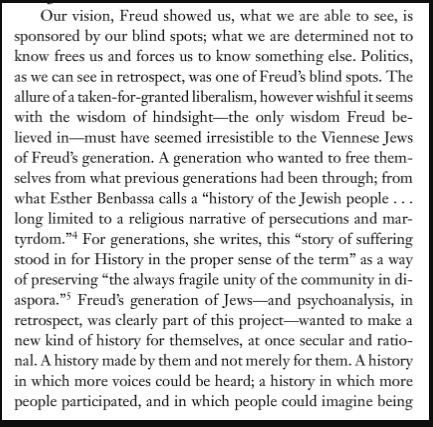
I am reading ‘Becoming Freud’ and read this paragraph with amazement :

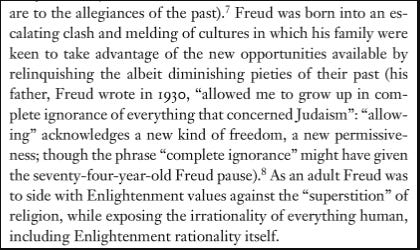
Freud always presented Psychoanalysis as a Science, not a tool for Jewish Emancipation, from European oppression in all its iterations, but as a methodology for liberation from the interaction between the Id, Ego and Super-Ego and the malign Unconscious. Freud constructs a Melodrama taking place inside the person.

How can a person raised in ‘complete ignorance of everything that concerned Judaism’, a  defender of Enlightenment rationality, the author of a ‘Science’ called Psychoanalysis be allied in the project of Jewish Emancipation as Mr. Phillips presents it?

That Phillips somehow thinks that part  of his readership might not be former analysands, and or readers/explorers of Freud and his critics strikes this reader as the myopia of the propagandist: the evidence that leads this reader to that conclusion is the Phillips engages in the denaturing of the language of Freud, his arcane jargon,  to borrow Adorno’s more that fitting description of Heidegger’s rhetorical practice,  is disappeared, in favor of a set of easily understood concepts. All of this is made more palatable by Phillips’ fluid writing style, that serves him well.

Phillips ‘biography’ is not just flawed, but is an incompetent apologetic for Freud: Phillips is not just inconsistent, but just sloppy from chapter to chapter about Freud’s childhood, his father kept all thing Jewish from his son…

Mr. Kirsch in his review of ‘Freud: The Making of an Illusion’ by Frederick Crews’ of Sept. 29, 2017, postulates that Freud ‘His claims may seem unscientific or absurd, but we still inhabit the mental universe that he created.’

The appearance of Mr. Crews’s book, which focuses on the early part of Freud’s career before he became world famous, has renewed all these charges in the press. Mr. Crews is trained as a literary critic, not a psychologist, yet in the course of a decades-long obsession with Freud, he has made himself an expert in everything related to his quarry, from the history of neurology to the side effects of cocaine. The Javert of psychoanalysis, Mr. Crews aims not just to debunk Freud, but to defame him, to banish him from serious consideration forever. The index entries under “Freud, Sigmund” give a sense of the book’s tenor: “abandoned by patients; alcohol, recourse to; bribery on behalf of; impotence of; vindictiveness of” and more. Yet Mr. Crews’s quest remains self-contradictory, for you can’t destroy a thinker’s legacy by attacking him; only oblivion can do that, and criticism is the opposite of forgetting. Reading this book, you can’t help feeling that Freud must be important indeed to inspire such anger and warrant such effort.

Mr. Crews’s full-spectrum attack has the unintended effect of undermining Mr. Crews’s valid insights into the deep flaws of Freud’s thinking. It would be enough to prove Freud was not a scientist, and that psychoanalysis is not a science—claims that are now widely accepted. But when Mr. Crews adds that he was a liar and thief, or speculates that he practiced incest with his sister and adultery with his sister-in-law, the reader starts to lose faith in his impartiality.

https://www.wsj.com/articles/why-the-freud-wars-will-never-end-1506695958#comments_sector

I find the last sentence, of this part of Mr. Kirsch’s essay, highly implausible, at the very least. Mr. Cruz is too careful a writer/thinker to be careless about facts, and the avoidance of hyperbole, as a toxin that renders argument null. The Reader can explore the ‘Cruz Argumentative Methodology’ by reading this, posted by By John Horgan on June 12, 2019 in the Scientific American:

Headline: Why Freud Should Be Dead

Sub-headline: Freud’s most implacable modern critic recounts the flaws of psychoanalysis and its founder and deplores their persistent influence

https://blogs.scientificamerican.com/cross-check/why-freud-should-be-dead/

And this exchange of letters in The New York Review of Books of April 21, 1994 issue:

Where else might The Reader look, for the use of the Talmud, as an intellectual prop for a polarizing thinker//writer ?

Headline: Leo Strauss and Modern Judaism

So, then, why have I been asked? As has been mentioned, I dedicated my last book1 to the memory of Leo Strauss. But why did I do that? One does not do such a thing lightly. I think if one dedicates a book at all, there should be some thought behind it. I could quote Allan Bloom, who has written, “[T]hose who have lived with his books over a period of many years have been changed, as were Glaucon and Adeimantus, by the night they spent with Socrates.” I take it this is not a controversial statement. In my case this has been true, though not with his books but with certain crucial encounters. I would not be immodest enough to mention my own affairs were it not for the fact that I think that Judaism-or at least Jewish faith and destiny in our time-has been at stake in these encounters.

https://claremontreviewofbooks.com/leo-strauss-and-modern-judaism/

Winter 1985

Thank you to the patient Reader!

Philosophical Apprentice


Added April 30, 2023 :

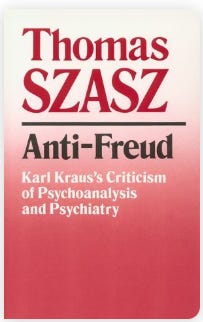
In my haste I had forgotten Thomas Szasz invaluable book, that makes available Karl Kraus’s comments on Freud, Psychoanalysis and Psychiatry and provides invaluable historical context.

’Anti-Freud: Karl Kraus’s Criticism of Psychoanalysis & Psychiatry’

Thomas Szasz (Preface, translation, commentary)Karl Kraus

P.A.

Posted in Uncategorized | Leave a comment

@NYT: Bret Stephens reminisces about his long ago casual conversation with Rupert Murdoch…

Political Cynic wonders why and how this was published by The Paper of Record!

Note how Stephens opens his essay:

In the summer of 2011, Rupert Murdoch stopped by my small office at The Wall Street Journal, where I was a columnist and editor. He was just back from London, where he had given testimony to a parliamentary committee investigating the phone-hacking scandal by his British tabloids (and where he was attacked with a shaving-foam pie). The scandal ultimately resulted in the closure of News of the World, at one point one of the world’s biggest-selling English-language newspapers.

This was about the ‘murdered schoolgirl Milly Dowler’ : Mr. Stephens feigns ignorance?

I don’t remember many specifics about the conversation — Murdoch loved to talk politics and policy with his journalists, sometimes by taking us to lunch at the Lamb’s Club in Midtown Manhattan — but I do remember the gist of what he said about the fiasco: Never put anything in an email. His private takeaway, it seemed, wasn’t to require his companies to adhere to high ethical standards. It was to leave no trace that investigators might use for evidence against him, his family or his favorite lieutenants.

Here is how Reuters covered the ‘murdered schoolgirl Milly Dowler’

LONDON (Reuters) – Journalists from the News of the World tabloid misled police after hacking the mobile phone of murdered schoolgirl Milly Dowler, action which sparked a scandal engulfing News Corp, a letter from police published on Monday said.

Surrey Police said reporters had lied to police after hacking into Dowler’s voicemail messages in 2002 and put pressure on detectives working on her case.

The paper, part of News International, the British arm of Rupert Murdoch’s media empire, had demanded answers after claiming it had information Dowler had contacted a recruitment agency, the force said.

One of its reporters had claimed the tabloid had got Dowler’s mobile phone details from school children, while the letter discloses someone had called the agency pretending to be Dowler’s mother.

It later emerged a message from the agency had mistakenly been left on Dowler’s phone because they had the wrong number on their files.

The force dismissed speculation that information published by the News of the World (NOTW) had come from collusion between detectives and the paper.

“The NOTW obtained that information by accessing Milly Dowler’s phone,” Surrey’s Assistant Chief Constable Jerry Kirkby wrote in a letter to lawmakers investigating phone-hacking.

It was the revelation by the Guardian newspaper last July that the tabloid’s reporters had illegally accessed the voicemail of missing Dowler, who was later found murdered, which caused the phone-hacking to hit the headlines amid widespread public revulsion.

News Corp took the drastic step of shutting down the 168-year-old paper, pulled its plan to take full control of Britain’s highly profitable satellite broadcaster BSkyB and Murdoch also personally donated 1 million pounds ($1.6 million) to charities nominated by the Dowler family.

News International also paid the family a further 2 million pounds for behavior Murdoch described as “abhorrent.”

“The interception of Milly Dowler’s phone was shocking and totally unacceptable,” a News International spokeswoman said on Tuesday.

“The abhorrent nature of what was discovered to have happened at the News of the World ultimately led to its closure last year,” she added.

In a twist to the Dowler story last December, police said there was no evidence about a central claim in the original Guardian story that News of the World journalists had deleted voicemails, which had given her parents false hope she was still alive.

An inquiry set up by Prime Minister David Cameron into newspaper practices in the wake of the furor heard that the most likely explanation was that the voicemails had been automatically removed after a 72-hour limit.

https://www.reuters.com/article/industry-us-newscorp-hacking-dowler/news-corp-hacking-tabloid-misled-uk-police-idUKTRE80M1R220120123

Mr. Stephens’ long ago encounter with The Great Man, led to the preposterous title of his essay ‘The Tragedy of Fox News’ ? Mr. Stephens in not a Journalist!

Political Cynic

Posted in Uncategorized | Leave a comment

@RColvile on the Dominic Raab Political Melodrama.

American Writer comments.

Being an American Hick, I can only think that Robert Colvile’s essays on British Politics, reminds me of those BBC adaptations of Anthony Trollope’s Pallisers Novels. Though I read a part of ‘Vivian Grey’, until he left England for the Continent, and his encounter with Marquess of Carabas. I later read with profit Benjamin Disraeli: The Novel as Political Discourse by Michael Flavin and The Silver Fork Novel Fashionable Fiction in the Age of Reform by Edward Copeland

Such is Mr. Colvile’s attempts at political reconstructions, he brings a novelists mentality, that makes way for even what might be considered gossip, for the politics of the British Present, for example this paragraph:

For George Osborne, it was Cornish pasties. For Dominic Raab, it is Pret A Manger. Back in 2018, the then housing minister’s diary secretary was caught advertising on a website for “sugar daddies”. But what transfixed Westminster was her revelation that her boss always ordered the same lunch: a chicken and bacon baguette, superfruit pot and vitamin volcano smoothie. More recently, it was Pret tomatoes that the justice secretary was accused of hurling in a “fit of rage”.

Mr. Colvile offers more of this political gossip, he strays into the territory of the tabloid:

Now, the man some of his colleagues duly nicknamed “The Vitamin Volcano” is out, but not without one last eruption. The deputy prime minister’s resignation letter made it clear that he was going with the most intense reluctance. It was accompanied by a lengthy column in The Daily Telegraph, in which he robustly defended his record and complained of “trial by media for six months, fuelled by warped and fabricated accounts leaked by anonymous officials”, talked about “informal tip-offs . . . that unionised officials were targeting me and other ministers” and complained of enduring a “Kafkaesque saga . . . shorn of the safeguards most people enjoy”.

The quick appearance of Rishi Sunak is introductory to public moralizing:

For many people, this will come across as intensely hypocritical. A bullying politician has been found out, and received his comeuppance. Spare the pity for the people who had to put up with him. But it’s not as simple as that — although it would be a lot easier for the government if it were.

Enter Adam Tolley KC

Reading through the report by Adam Tolley KC, it is clear that Raab is a driven and often abrasive character. Two of his permanent secretaries took him aside to ask him to treat staff better — awkwardly, he disputed both accounts, although Tolley found firmly for the officials. There were definitely people who felt emotionally bruised and battered after having to deal with him.

Mr. Colvile explores the ‘Rabb Managerial Style’ that is 763 words: a pastiche of the novelist’s of character analysis? I’ll take the liberty of quoting portions of this part of the essay:

But equally, the picture that emerges is not quite the tomato-throwing tyrant of the media allegations.


When Raab expressed his frustration, it seems to have been over bad work rather than bad people. Some people found being upbraided “humiliating and upsetting”.


But Tolley finds against the original collective complaint from within the Ministry of Justice that Raab had created a “perverse culture of fear” (though he praises the complainants for having the courage to come forward).


When Raab expressed his frustration, it seems to have been over bad work rather than bad people.


At the heart of this, in other words, is a gap between what was meant and what was felt. Raab saw himself as enforcing high standards, in pursuit of urgent national priorities — for example, in negotiating the fate of Gibraltar post-Brexit, or trying to push through the Ministry of Justice’s “cultural resistance”.


Some will feel that politicians should be held to a higher standard; others that the threshold for dismissing the deputy prime minister should be more categorical, or that there should be a halfway house between innocence and dismissal, as there would be in any other workplace.


 But as mentioned above, he is not going quietly. Raab and those around him insist that the complaints were part of a co-ordinated campaign, spearheaded by a few determined people rather than representing the collective verdict of the department.


 There is already a conviction in the Tory party that the state is not working as it should. Some whisper darkly of a Remain-voting “blob” determined to frustrate their efforts.


The final paragraphs of Mr. Colvile’s essay, as a would be ‘political novelist’ of the present, looks like what he is, in actuality, a Tory Loyalist Technocratic, in its British Newspaper.

Of course, there are many ministers, including Dominic Raab, who praise the calibre and dedication of officials they work with. But it is hard to avoid the sense that something within the relationship has curdled.

The other week, a new group called the Effective Governance Forum published a report on Whitehall. Among its criticisms was that ministers control vast organisations with little management experience at sufficient scale, in uneasy coalition with the permanent secretary who actually runs the department. The Raab controversy is likely to make those relationships just that little bit harder to manage — and the government’s priorities that bit harder to deliver. 

https://www.thetimes.co.uk/article/dominic-raabs-angry-departure-will-add-poison-to-the-whitehall-well-20m7ljdp6

American Writer

Posted in Uncategorized | Leave a comment

@NYT: Neo-Con Bret Stephens attacks ‘the progressive left’…

Old Socialist comments.

Neo-Con Bret Stephens attacks ‘the progressive left’ that all purpose epithet, as a place holder for actual thought. The use of the ‘lower case’ is an act of political diminution, in sum shaming!

Headline: Undeterred Criminals Plus Demoralized Cops Equals More Crime

Mr. Stephens provides two narratives of the Adam Toledo shooting:

Version One:

Two years ago, a white Chicago police officer named Eric Stillman fatally shot Adam Toledo, an unarmed 13-year-old Mexican American with no criminal record, while the boy was complying with the officer’s orders following a late-night foot chase. The killing brought greater awareness to police brutality in Latino communities, yet no charges were filed against Stillman. Since then, Chicago has been able to turn a corner on violent crime, thanks partly to investments in after-school youth programs. Murders are down by 20 percent from two years ago.

Version Two:

Another version goes like this. On March 29, 2021, at 2:36 a.m., Stillman and his partner responded to a call that shots were being fired. Stillman pushed Ruben Roman, a 21-year-old with a criminal record, to the ground and chased Toledo, who was holding a 9-millimeter handgun, down a dark alley. Stillman yelled “drop it.” Toledo tossed the gun behind a fence and turned toward him. The officer fired the fatal shot less than a second after Toledo got rid of the gun. Stillman then immediately jumped to Toledo’s aid and called for an ambulance.

Does this interjection between the versions offered by Mr. Stephens surprise the reader?

That’s one version of events, the version favored by the progressive left.

The essay then becomes statistical :

Homicides are, in fact, down in Chicago, but they remain at some of the highest rates since the 1990s, and overall crime spiked by 41 percent between 2021 and 2022. Last weekend alone, mass hooliganism overwhelmed Chicago’s downtown while 11 people were killed and 26 wounded in shootings across the city.

Mr. Stephens resorts to Political Melodrama:

Maybe there’s a lesson in this, simple and old-fashioned as it may seem. When bad guys walk free and brave cops have to fear for their jobs for doing their jobs, crime tends to go up. And when the national conversation about the Adam Toledo tragedy revolves around the officer’s split-second, life-or-death decision instead of the question “What is a 13-year-old child doing with a 21-year-old criminal firing a gun at 2:30 a.m.?” then we are deeply confused about the nature of our problems, to say nothing of the way to a solution.

A sample of sentences, paragraphs that follows the above, indicate that The Reader is confronting propaganda:

A similar dynamic is playing out in other big cities, too. Police morale is abysmal. One way in which this fact registers is in high levels of voluntary resignations and early retirements, leading to critical staffing shortages.

New Orleans isn’t alone. A recent academic analysis found that 11 out of the 14 cities it studied suffered from higher-than-expected losses to their police after the George Floyd protests of 2020, with Seattle losing the highest proportion of its force.

Then there’s the other side: The growing sense of impunity among the criminally inclined.

In Chicago, the proportion of crimes reported that resulted in arrest, which stood at nearly 31 percent in 2005, fell to 12.3 percent in 2021, according to an analysis last year by The Chicago Sun-Times.

In New York, where major crimes rose by 22 percent last year, complaints of shoplifting have nearly doubled over the past five years — while the arrest rate since 2017 fell by almost half.

In other words, lax enforcement when it comes to petty criminality has led to big-time criminality. And the consequence of supposedly “victimless” crimes like shoplifting has created a palpable sense of disorder, menace and fear — each conducive to the anything-goes atmosphere in which crime invariably flourishes.

Will things get better? Eventually, yes, when a critical mass of voters recovers the simple combination of common sense and political will. But whether it occurs sooner or later is a difference that will be measured in thousands of lives, harmed or ended by the crime we collectively let happen.

We have heard voices like Mr. Stephens before, Joe Biden:

Hillary Clinton:

1996: Hillary Clinton on “superpredators” (C-SPAN)

Old Socialist

Share

Posted in Uncategorized | Leave a comment