On the burning question of : The burr under @GoldsteinBrooke saddle: Fatima Mousa Mohammed’s Free Speech Rights! And her right to defend Palestinian Moral/Political existence!

Old Socialist comments.

Headline: She Attacked Israel and The N.Y.P. D. It Made Her Law School a Target

Sub-headline: A student gave a commencement address at the famously progressive CUNY law school. Two weeks later, she was attacked by the tabloids and the mayor, and the school disavowed her speech.

Ginia Bellafante has served as a reporter, critic and, since 2011, as the Big City columnist. She began her career at The Times as a fashion critic, and has also been a television critic. She previously worked at Time magazine

An excerpt of Fatima Mousa Mohammed speech, as ‘reported’ in The New Your Times:

She looked out into the audience now and saw “movement lawyers, business attorneys, professors, librarians,” she said. “I see future lawyers who will defend tenants and not those who dispossess our communities from their homes.” In these instances, her tone was optimistic and celebratory rather than indignant, though there was plenty of indignation.

“Let us remember that Gaza, just this week, has been bombed with the world watching,” she said at one point. “That daily, brown and Black men are being murdered by the state at Rikers.” She praised CUNY as “one of the very few legal institutions created to recognize that the law is a manifestation of white supremacy that continues to oppress and suppress people in this nation and around the world.”

As it happened, much of her commentary fell under the umbrella of conventional leftist rhetoric — the call to fight against capitalism, racism, imperialism — delivered with a zealotry not unfamiliar among the young and warrior-minded. But it was the fierceness she brought to her denunciation of “Israeli settler colonialism” and CUNY’s collaboration with “the fascist N.Y.P.D.” that especially inflamed the political class, even if her own audience, including the law school dean, seemed receptive.

Recall that this is The New York Times

Where does Brooke Goldstein fit into this? See her C.V. here:

Brooke Goldstein is a New York City-based human rights attorney, author, and award-winning filmmaker. She serves as Executive Director of The Lawfare Project, a nonprofit organization dedicated to raising awareness about and facilitating a response to the abuse of Western legal systems and human rights law. Brooke is also the founder and director of the Children’s Rights Institute (CRI), a nonprofit organization whose mission is to track, spotlight, and legally combat violations of children’s basic human rights around the world. CRI has a special focus on the state-sponsored indoctrination and recruitment of children to become suicide-homicide bombers, child soldiers, and human shields.

Brooke’s first book, co-authored with Aaron Eitan Meyer and titled Lawfare: The War Against Free Speech: A First Amendment Guide For Reporting in an Age of Islamist Lawfare, gives practical guidance to journalists who wish to speak truthfully about the national security threats faced by liberal democracies.

Brooke’s second book, End Jew Hatred: A Manual for Mobilization, will be released in September 2023. End Jew Hatred shows how the Jewish people can affect real and lasting change by championing the Jewish cause as a minority rights issue, and by harnessing the power of grassroots mobilization, direct action, and legal activism.

Brooke’s award-winning documentary film, The Making of a Martyr, uncovers the illegal, state-sponsored indoctrination and recruitment of Palestinian children for suicide-homicide attacks. Filming Martyr, Brooke secured firsthand interviews with active and armed members of the Al-Aqsa, Fatah, Islamic Jihad, and Hamas terrorist groups as well as with families of suicide bombers, children imprisoned for attempting to blow themselves up, teachers at terrorist-run schools, and others involved in the phenomenon of child suicide bombing. Martyr is currently broadcast on television stations throughout the globe and is ranked as IMDb’s seventh most popular title on the West Bank.

Brooke is a regular commentator on FOX News and has been featured in several media, including CNN, The New York SunSwindle MagazineDefense Technology International, and on WABC News Talk Radio, and has been published in a variety of sources, including the New York Daily NewsCommentary MagazineThe American SpectatorThe Counter Terrorist MagazineSpecial Ops Magazine, and others. She also hosts the television series Outspoken on Jewish Broadcasting Service (JBS) and is a contributor at Newsmax.

Brooke is a seasoned public speaker and has lectured and taught seminars at numerous schools, including the Benjamin N. Cardozo School of Law, New York University, Berkeley University, Stanford University, and others. Brooke has also been invited to brief government officials at the U.S. State Department, the White House, the Pentagon, the U.K. Parliament, and U.S. Central Command on issues of asymmetric warfare and human rights.

Brooke is the 2007 recipient of the E. Nathaniel Gates Award for Outstanding Public Advocacy and the 2009 Inspire! Award bestowed by the Benjamin N. Cardozo School of Law, was listed in 2009 as one of “36 Under 36 Young Innovators” by the Jewish Week, formerly served as an adjunct fellow at the Hudson Institute, and is currently a Term Member at the Council on Foreign Relations, an associate fellow at the Henry Jackson Society, a Lincoln Fellow at the Claremont Institute, a member of the Scholars for Peace in the Middle East’s (SPME) Council of Scholars, an advisory board member of Belev Echad Charity, and a board member of The Mideast Reporter. She is also a recipient of The Blue Card’s 2016 The Irene Hizme Tikkun Olam Award, the UJA’s 2017 Defender of Israel award, and Belev Echad Charity’s 2015 Pillar of Courage award. In 2019, she was inducted into the Manhattan Jewish Historical Initiative’s (MJHI) Manhattan Jewish Hall of Fame. In 2020, she was named among the JNS top 40 global advocates for Israel online. In 2022, Brooke was presented with the Canadian Antisemitism Education Foundation’s (CAEF) Advocate Award of Excellence in recognition of The Lawfare Project’s work. In 2023, she was honored to receive the WIZO Charlotte and Sami Rohr Defender of Israel Award, established to pay tribute to those who have acted as guardians and protectors of the State of Israel and its people.

From 2007-2009, Brooke served as director of the Legal Project at the Middle East Forum, an organization that arranges financial support for and pro-bono legal representation of persons wrongfully sued for exercising their right to free speech on issues of national security and public concern.

Additionally, Brooke is the co-founder of A2B Film Productions, Inc., a Canada-based independent documentary film production company focused on creating films that explore issues ignored by the mainstream media.

Canadian born, Brooke earned her B.A. from McGill University and received her J.D. from the Benjamin N. Cardozo School of Law. She also attended Columbia University and University of Toronto’s exchange programs.

In her role as Executive Director of The Lawfare Project, Goldstein incubated, provided the seed funding for, and founded the progressive Jewish organization Zioness. She coined the phrase, “Zionism is a progressive value.”

https://www.thelawfareproject.org/staff-bios

It is an 825 word ‘Press Release’ , not a C.V. Like her allies @Freedland and @AnthonyJulius6, she is a professional political hysteric, on the search for Anti-Semites, under the bland descriptor of Jew Haters, as the in order too of avoiding the Law Court, for defamation.

See her latest tweet for the next installments of the continuing Melodrama, rooted in her inability to recognize the fact that Free Speech, and that Palestinians must defend their right to merely exists, even in the reality… Thank you Fatima Mousa Mohammed!

Old Socialist
Posted in Uncategorized | Leave a comment

Neo-Con Bret Stephens, @GrahamTAllison, “Thucydides’ trap”, ‘How Do We Manage China’s Decline?’ & …

Political Cynic breathes deep, and chokes, on the incense burnt in the names of misbegotten expertise.

Mr. Bret Stephens is a political opportunist, always looking to guild his commentaries with some high sounding, and not the least pretentious opening paragraph.

Several years ago, the Harvard political scientist Graham Allison coined the term “Thucydides’ trap.” It was based on the ancient historian’s observation that the real cause of the Peloponnesian War “was the rise of Athens and the fear that this instilled in Sparta.” Allison saw the pattern of tensions — and frequent wars — between rising and ruling powers repeating itself throughout history, most recently, he believes, with the challenge that a rising China poses to American hegemony.

This offers some insights into Graham Allison:

Graham Allison is a professor of government at the Harvard Kennedy School, where he was the founding dean. He is a former U.S. assistant defense secretary and the author of Destined for War: Can America and China Escape Thucydides’s Trap?

https://foreignpolicy.com/author/graham-allison/

Graham Allison was a an integral part of The American National State, who wooed the cadre of American Political Hicks, with an evocative catch phrase.

On the actual ‘American Foreign Policy And It’s Thinkers’ Read Perry Anderson’s:

https://newleftreview.org/issues/ii83/articles/perry-anderson-consilium

This paragraph acts as framing:

It’s an intriguing thesis, but in China’s case it has a glaring flaw: The main challenge we will face from the People’s Republic in the coming decade stems not from its rise but from its decline — something that has been obvious for years and has become undeniable in the past year with the country’s real estate market crash.

Stephens becomes prescriptive:

Western policymakers need to reorient their thinking around this fact. How? With five don’ts and two dos.

The Reader might observe that Allison has had actual experience as ‘ a former U.S. assistant defense secretary’, that Stephens can’t even match, nor I! Yet Stephens continues to scribble away ‘as if’ …

First, don’t think of China’s misfortunes as our good fortune.

Second, don’t assume the crisis will be short-lived.

Third, don’t assume competent economic management.

Fourth, don’t take domestic tranquillity as a given.

Fifth, don’t suppose that a declining power is a less dangerous one.

Sixth, do stick to four red lines.

Seventh, do pursue a policy of détente.

The final paragraphs:

We should not seek a new cold war with China. We cannot afford a hot one. The best response to China’s economic woes is American economic magnanimity. That could start with the removal of the Trump administration tariffs that have done as much to hurt American companies and consumers as they have the Chinese.

Whether that will change the fundamental pattern of Beijing’s bad behavior is far from certain. But as China slides toward crisis, it behooves us to try.

The New Cold War with China is of long standing, to act as if this is not a political fact, is self-serving myopia- yet for a Neo-Conservative ghoul, to play the part of The Voice Of Political Reason, is not just unconvincing, but disingenuous. The reader might ask, what expertise dose Stephens offer his readership on China, besides his list? The other Times Neo-Conservative, @nytdavidbrooks, could have written a better exercise in a proffered, for want of better descriptors, Political Realism, Political Pragmatism ?

Political Cynic

Posted in Uncategorized | Leave a comment

As a Reader I’ve grown tired of political commentators whose Anti-Historicism demonstrates a cultivated ignorance! The case of Tom Friedman & David Brooks

Political Observer recalls the Republican Convention of 1964, and the importance of Newspapers.

I watched the 1964 Republican Convection, as a high-school drop-out, I watched too much television. The expulsion of William Scranton, or at the least the public shaming of a Liberal, that Goldwater exemplified in his ‘ Extremism in pursuit of Liberty is no vice’. was the beginning of the end for the Liberal Republican, as political actor. That eventually became the Goldwater/ Reagan toxin, that metastasized into the ‘Tea Party’ and evetually Trump/Trumpism.

But my fascination with politics started in 1960 and the Kennedy’s: I read that Hearst rag The Herald Examiner provided gossip of Kennedy’s sexual escapades, in its ‘reporting’ on the Democratic Convention of 1960. My brother and sisters were taken with that cult of political glamour, too much television? As a younger child I had delivered the ‘Los Angeles Mirror’, in the time of the The Johnny Stompanato murder… my mother made my brother, and I swear, that we would not read the newspapers we folded, before delivery. Newspapers played a big part in my childhood and after.

It comes as no surprise that political commentators, self-proclaimed foreign policy experts, wedded to jejune moralizing, like Friedman and Brooks- yet in all their political babble, about the political toxicity about Trump and Trumpism, not one word about the Liberal Republicans of another time?

Millicent Fenwick, Edward Brooke, Mark Hatfield, Nelson Rockefeller, Jacob Javits, Charles Percy, William Scranton, Margaret Chase Smith

What better way, than through a History, of those ignored/forgotten exemplars of a pragmatic Republican Party?

Political Observer

Posted in Uncategorized | Leave a comment

A Thatcherite on ‘back to basics’: @RColvile’s Neo-Liberalism on the vexing question of ‘Government Spending’: via a frivolous ‘Culture Department’?

Old Socialist eventually finds, the elusive, diminutive, ‘Culture Department’.

The Reader might just ask what is a ‘Culture Department’?

Here are the opening paragraphs of Colvile’s essay, that does not mention that ‘Culture Department’ :

Here’s a riddle for you. Energy costs are lower than they were yet some people are having to pay more. How come? The answer, as Rishi Sunak explained last week, is that during the energy crisis, the government lopped an average of £1,500 off every bill in the country.

This was treated by the left as a hideous blooper from an out-of-touch prime minister. In fact, it’s a statement of the bleeding obvious. Not to mention a perfect example of where we are when it comes to spending. The British state is forking out more than ever before. Yet politicians get precious little thanks for any of it — just endless calls to spend even more.

This point was driven home by two other stories. First, it was announced that government borrowing is lower than expected. Hooray, chorused Tory MPs — room for tax cuts! But then the Institute for Fiscal Studies put out a report on the long-term state of the public finances, which threw cold water on any such enthusiasm. It showed not only that the gap between tax and spend is still cavernous, but also that spending is set to climb over the next half-century at pretty much a 45-degree angle.

“The UK’s ageing population will effectively confront policymakers with a choice in coming decades,” wrote the authors. “Increase levels of tax substantially to fund higher spending or substantially reduce the scope of the public services that the British state provides.”

Any business would take drastic action to repair its balance sheet if faced with such a combination of heavy debt and rising costs (and indeed the rising cost of heavy debt — thanks to higher interest rates, the annual bill to repay our creditors is likely to top £100 billion, making it larger than any departmental budget bar the NHS). But adjusting outgoings to incomings doesn’t seem to be in Britain’s political vocabulary. Instead, we are adding to our commitments: the big social care and childcare reforms in this parliament essentially boiled down to spending more on each.

https://www.thetimes.co.uk/article/do-we-need-a-culture-department-its-one-question-to-be-asking-when-money-is-tight-mjzj8wbbb

In these 339 words, The Reader has yet to confront that ‘Culture Department’. But Mr. Colvile is concerned with various problems of a ‘balance sheet’ : he imitates the patois of the bookkeeper. That should not surprise, as Colvile’s adoration of Thatcher, who came from a Nation Of Shopkeepers, and their ‘values’, is a kind vulgarized, penny-pinching Neo-Liberalism: one writ small, the other writ as World Historical Fraud.

Finally, here is where The Reader confronts momentarily, a diminutive ‘a department for culture’ …

Let’s throw out a few. Do we genuinely need a department for culture?

Not to forget Colvile’ faith in the Myth of ‘The Market’ :

What could instead be done at local level — or by the market?

A revelatory collection of Neo-Liberal/Thatcherite clichés follows :

Why does NHS England duplicate many of the functions of the Department of Health and Social Care?

(The language of priorities is the religion of socialism, and all that.)

At some point, for example, politicians will have to address the inexorable rise in NHS compensation costs (which have almost doubled in the past seven years), or the fact that the proportion of the working-age population claiming disability benefits has more than trebled since the early 1990s, despite all the medical advances over that period.

But we also need people to pay more of the costs of their old age.

Asking people to cover more of their care costs, for example via an insurance scheme funded post-mortem by a limited fraction of their property wealth.

All of these challenges are the work of decades rather than years. Many would be deeply controversial. But in the absence of a miraculous surge in growth and productivity, the choice ahead of us is clear. Either we do some hard thinking about what the public sector shouldn’t be doing, as well as what it should — or we resign ourselves to a future of far higher taxes, and a far larger state.

Colvile is a practiced Thatcherite /Neo-Liberal. This is The Times!

Old Socialist

Posted in Uncategorized | Leave a comment

The Economist and Le Monde comment on ‘The German Malaise’.

Old Socialist offers a selection.

Leaders | Economic malaise

Is Germany once again the sick man of Europe?

Its ills are different from 1999. But another stiff dose of reform is still needed

Nearly twenty-five years ago this newspaper called Germany the sick man of the euro. The combination of reunification, a sclerotic job market and slowing export demand all plagued the economy, forcing unemployment into double digits. Then a series of reforms in the early 2000s ushered in a golden age. Germany became the envy of its peers. Not only did the trains run on time but, with its world-beating engineering, the country also stood out as an exporting powerhouse. However, while Germany has prospered, the world has kept on turning. As a result, Germany has once again started to fall behind.

Europe’s biggest economy has gone from a growth leader to a laggard. Between 2006 and 2017 it outperformed its large counterparts and kept pace with America. Yet today it has just experienced its third quarter of contraction or stagnation and may end up being the only big economy to shrink in 2023. The problems lie not only in the here and now. According to the imf, Germany will grow more slowly than America, Britain, France and Spain over the next five years, too.

https://www.economist.com/leaders/2023/08/17/is-germany-once-again-the-sick-man-of-europe

Aug 17th 2023


Business | Angst

German bosses are depressed

And dissatisfied with the government

“We are at a dangerous point,” worries Arndt Kirchhoff, boss of the employers’ association in North Rhine-Westphalia and one of three brothers who run Kirchhoff, a maker of car components. Germany recently slipped into a technical recession. Many companies are investing abroad rather than at home. Chinese consumers are importing less after the lifting of pandemic restrictions than German manufacturers had been hoping. And Ukraine’s counter-offensive against Russian invaders is injecting uncertainty into Germany’s backyard.

https://www.economist.com/business/2023/06/08/german-bosses-are-depressed

Jun 8th 2023 | BERLIN


Finance and economics | How the wheels came off

The German economy: from European leader to laggard

Its problems are deep-rooted, knotty and show little sign of being fixed

The 2010s were Germany’s decade. A Jobwunder (employment miracle) that began in the 2000s reached full flower, largely unimpeded by the global financial crisis of 2007-09, as labour reforms introduced by Gerhard Schröder, chancellor from 1998 to 2005, combined with China’s demand for manufactured goods and a boom in emerging markets to add 7m jobs. From the mid-2000s to the end of the 2010s, Germany’s economy grew by 24%, compared with 22% in Britain and 18% in France. Angela Merkel, chancellor from 2005 to 2021, was lauded for her grown-up leadership. Populism of the Trump-Brexit variety was believed to be a problem for other countries. Germany’s social model, built upon close relationships between unions and employers, and its co-operative federalism, which spread growth across the country, wowed commentators, who published books with titles such as “Why the Germans Do It better”. Germany’s footballers even won the World Cup.

https://www.economist.com/finance-and-economics/2023/08/17/the-german-economy-from-european-leader-to-laggard

Aug 17th 2023 | BERLIN


Europe | Germany own goals

Germany is becoming expert at defeating itself

Bureaucracy and strategic blunders are starting to pile up

In “the twelve tasks of asterix”, an animated film from 1976, one of the feats the diminutive Gaul must perform is to secure a government permit. To do so he must visit a vast office called The Place That Sends You Mad. In a recent open letter Wolfram Axthelm, the head of the German Wind Energy Association, likened modern Germany’s infuriating bureaucracy to Asterix’s challenge. A particular gripe was the 150-odd permits demanded by Autobahn GmbH, a state-owned firm that runs Germany’s vaunted motorways, for transporting outsize components of wind turbines, such as blades. Between byzantine rules on load dimensions, faulty software, perennial roadworks and a lack of personnel to process complaints, a backlog of some 20,000 applications has built up. A company that recently trucked a turbine from the port of Bremen to a site in the northern state of Schleswig-Holstein found that although the distance is barely 100km (62 miles), road restrictions made the journey five times that long.

https://www.economist.com/europe/2023/08/17/germany-is-becoming-expert-at-defeating-itself

Aug 17th 2023 | BERLIN


Le Monde, even quotes The Economist !

Germany’s slowdown is good news for no one

EDITORIAL

The German economy is going through a worrying slump. In addition to cyclical and structural difficulties, a fragmented political landscape is hampering the efforts needed to get back on track.

Published today at 12:31 pm (Paris)

Have the Germans caught the French bug? Doubt and self-flagellation seem to have taken hold of our neighbors on the other side of the Rhine, demoralized by economic indicators that accompany growth at half-mast. According to forecasts by the International Monetary Fund, Germany is likely to be the only G7 country to experience a recession this year.

Inflation, which is higher than in France, partly explains this underperformance. Other causes are inherent to the German model: the decline in industrial production is felt more keenly because Germany’s economy is more industrialized; competition, particularly from China, in the electric car market is hitting Germany harder because of the importance of the automotive industry. The fallout from the Covid-19 period and the impact of the war in Ukraine are particularly hard on a model that draws its strength from exports. It is symptomatic that the two countries whose economies have benefited most from globalization, China and Germany, are finding it harder than the others to recover. In fact, the German economy is the most China-dependent in Europe, an asset that has now become a handicap.

British weekly The Economist drove the point home with its fatal cover question this week, “Is Germany once again the sick man of Europe?”, bringing back the trauma of a previous resounding cover story which, in 1999, had decreed the same country “the sick man of the euro”.

https://www.lemonde.fr/en/opinion/article/2023/08/23/germany-s-slowdown-is-good-news-for-no-one_6104927_23.html

Old Socialist

Posted in Uncategorized | Leave a comment

Andrew Preston’s reviews two books, in the August 18/25, 2023 edition of the TLS: On an attempted rehabilitation of the Psychohistorian and Psychohistory!

Political Observer comments on Preston’s self-willed ignorance.

The Players: Andrew Preston, William Bullitt, Sigmund Freud, Woodrow Wilson, Patrick Weil, Zachary Jonathan Jacobson, Richard Nixon.

Andrew Preston’s review begins here:

Shortly after the US election of 2016 a group of psychiatrists denounced Donald Trump as a psychologically unbalanced sociopath – cruel, narcissistic, paranoid, prone to delusions of grandeur – and thus a danger to the world. But in doing so they had to wrestle with two contradictory principles of their profession: a psychiatrist shouldn’t offer diagnoses for people they have never met, let alone treated, a principle also known, thanks to an earlier American political episode, as the Goldwater rule; yet a psychiatrist also has a duty, not only moral but legal, to warn if someone’s mental illness poses a danger to others. This seemed compelling in Trump’s case, but in publicly offering a diagnosis, their decision to prioritize the second principle over the first generated fierce debate over whether a president’s state of mind was fair game.

Most observers agreed it was. During the Trump era sensational revelations of a psychologically unstable president made Michael Wolff’s Fire and Fury one of the fastest-selling books in publishing history. As Nancy Pelosi put it, “You understand that this is not a person of sound mind”. In response, Trump’s self-diagnosis will long be remembered: he wasn’t just “smart, but genius … and a very stable genius at that!”

Presidential sanity is not a new concern, and politicians have long been subject to psychological analysis. The Goldwater rule emerged after a large number of psychiatrists claimed that Senator Barry Goldwater, campaigning for the White House in 1964, was mentally unfit for the presidency. After his election loss to Lyndon B. Johnson – himself a curious psychological study – Goldwater successfully sued for defamation and the American Psychiatric Association issued its cautionary guideline. But that hasn’t stopped a cottage industry about it from arising.

Should The Reader look askance at the title of Patrick Weil’s book under review?

The Madman In The White HouseSigmund Freud, Ambassador Bullitt and the lost psychobiography of Woodrow Wilson

The ‘psychobiography’ was published in 1966, a ‘redacted version’: this from the publisher of Weil’s book, Harvard University Press. I’ve placed in bold font the last paragraph.

After two years of collaboration, Bullitt and Freud signed off on a manuscript in April 1932. But the book was not published until 1966, nearly thirty years after Freud’s death and only months before Bullitt’s. The published edition was heavily redacted, and by the time it was released, the mystique of psychoanalysis had waned in popular culture and Wilson’s legacy was unassailable. The psychological study was panned by critics, and Freud’s descendants denied his involvement in the project.

For nearly a century, the mysterious, original Bullitt and Freud manuscript remained hidden from the public. Then in 2014, while browsing the archives of Yale University, Weil happened upon the text. Based on his reading of the 1932 manuscript, Weil examines the significance of Bullitt and Freud’s findings and offers a major reassessment of the notorious psychobiography. The result is a powerful warning about the influence a single unbalanced personality can have on the course of history.

https://www.hup.harvard.edu/catalog.php?isbn=9780674291614#:~:text=After%20two%20years%20of%20collaboration,and%20only%20months%20before%20Bullitt’s.

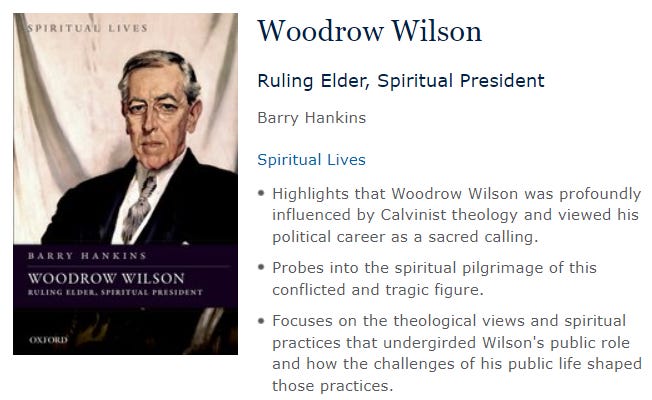
On Woodrow Wilson, The Reader might look to an alterative provided by Barry Hankins:

This Andrew Preston paragraph, pronounces that ‘essentially every biographer is a psychohistorian’.

Historians and biographers, whose only methodological guardrail is the availability of primary sources, have no such qualms. Judging a personality, and its disorders, is inherent to the practice of biography. At the extreme end is the genre of psychohistory, which blends historical method with psychoanalytical theory, but essentially every biographer is a psychohistorian.

Patrick Weil’s The Madman in the White House, a detailed study of Woodrow Wilson and his statecraft, falls into this category. Wilson reluctantly brought the US into the First World War and, during the Paris Peace Conference, attempted to create a new world order, known as Wilsonianism, along liberal internationalist lines. By ensuring the attainment of its other principles – the promotion of democracy, self-determination, collective security – the League of Nations was Wilsonianism’s bedrock. This was always going to be a tough sell in America, but Wilson refused to compromise on the League’s basic design. His unstoppable force met the immovable objections of the Republican Party, led by Henry Cabot Lodge, and, though Wilson was a strong president, Republicans controlled the Senate. Lodge prevailed, and the standoff meant that the US never ratified the Treaty of Versailles or joined the League. Wilson predicted that the consequence would be another world war.

Psychohistory and the Psychohistorian had passed from the scene decades ago. Prof. Preston’s ignorance, of this second half of Robert Coles 1973 essay, seems inexcusable given his credentials!

Shrinking History, Part Two

Robert Coles

March 8, 1973 issue

No doubt somewhere there is a historian prepared to insist that any psychoanalyst who wants to write about history take a full graduate course and spend a few years doing “proper” historical research. But some scholars have to some degree combined the two disciplines—the historian Bruce Mazlish, for example, or the political scientist E. Victor Wolfenstein. Both men have psychoanalytic knowledge—of an order Dr. Eissler would doubtless find acceptable—as well as training in their professions.

Professor Mazlish has been an especially active proponent of what he and others (Robert Jay Lifton, Joel Kovel, John Demos) call “psychohistory.” Each of these men has his own particular way of working with historical materials from a psychological (more precisely, psychoanalytic) point of view. They share a common interest in drawing upon several disciplines in the hope of seeing human experience more broadly, and escaping the rigidities and biases inherent in any particular psychoanalytic formulation. Robert Wallerstein has perhaps made the best case for such activity:

Yet as one goes through Mazlish’s In Search of Nixon: A Psychohistorical Inquiry or Wolfenstein’s The Revolutionary Personality: Lenin, Trotsky, Gandhi, it seems clear that both scholars have as many dangers to avoid as opportunities to grasp. In both books we are warned that psychoanalytic “reductionism” is offensive and perhaps a thing of the past. Nevertheless, Nixon is called “oral” and “anal” at various points, as are Lenin, Trotsky, and Gandhi. Ambivalences are discussed, problems with mothers and fathers described at length.

In the case of Mazlish’s book an interesting dialectic of sorts takes place. First the President is described or typed. (“Orality is an important element in Nixon’s character.”) Then the reader is informed that such a description merely makes Richard Nixon a human being. If he has used a “genital metaphor and an anal one,” then “others frequently use similar metaphors.” After we have read two-thirds of his book, in which words or phrases like “passivity,” “death anxiety,” and “survivor guilt” are pervasive, Mazlish makes this statement: “What we have been discussing up to now may be thought of as the psychological banalities of Nixon’s character.” One wonders, at this point, why the author has bothered to write this book at all, especially since the rest of the book offers nothing else about the President’s “character,” only an extensive justification of the value of “psychohistory” as “science.”

Zachary Jonathan Jacobson writes ‘On Nixon’s Madness: An emotional history’ … The Reader might ask herself, what is an ‘emotional history’, or might it be? Could it be a kind of modern day reductionism of Psychoanalysis/Psychohistory? Andrew Preston seems, at the least, duly impressed : ‘brilliant, insightful, beautifully written book’.

If historians ranked the maddest of the modern presidents, it’s certain Wilson wouldn’t top the list. That honour would more likely go to Zachary Jonathan Jacobson’s subject, Richard Nixon. But in this brilliant, insightful, beautifully written book, Jacobson takes a different approach from Weil’s. Rather than diagnosing Nixon’s pathologies, he uses the infamous “madman theory” as a point of entry into one of the most consequential presidencies in history.

Andrew Preston’s praise of Zachary Jonathan Jacobson ‘emotional history’ reads like maladroit Anti-Trump propaganda, with Nixon acting the part as the ‘bizarre personality, along with his clumsy attempts to manipulate reality so that it would conform to an image he not only wanted to project, but needed to believe’.

Nixon has been written about more extensively than most presidents, so the audacious originality of On Nixon’s Madness is a truly impressive feat. Jacobson’s account examines Nixon’s bizarre personality, along with his clumsy attempts to manipulate reality so that it would conform to an image he not only wanted to project, but needed to believe. As Jacobson observes: “It was as if Nixon had never quite mastered the role of Richard Nixon”. He was “ill-calibrated”. The results – including the prolonging of the war (the madman theory turned out to be a strategic dud) and the Watergate crisis – destroyed Nixon and destabilized an increasingly divided nation.

Most presidents have displayed strange or antisocial behaviour. Perhaps that’s because they’ve all to some extent been mentally ill: who other than a narcissist would even want the job? Others may have had the sense not to say it out loud, but Trump wasn’t the only president to believe “I alone can fix it”. Maybe Wilson and Nixon were indeed mad. But if so, they probably all were.

My comment is a sketch, at best, but it might just enable The Reader to navigate Prof. Preston essay, via some sources that transcended the imperatives of propaganda.

Political Observer

Posted in Uncategorized | Leave a comment

The Economists rhetorically exhumes ‘Germany the sick man of the euro’: Capitalists and Neo-Liberals ejaculate in unison!

Old Socialist comments.

The opening paragraph of this exhumation is not surprising:

Nearly twenty-five years ago this newspaper called Germany the sick man of the euro. The combination of reunification, a sclerotic job market and slowing export demand all plagued the economy, forcing unemployment into double digits. Then a series of reforms in the early 2000s ushered in a golden age. Germany became the envy of its peers. Not only did the trains run on time but, with its world-beating engineering, the country also stood out as an exporting powerhouse. However, while Germany has prospered, the world has kept on turning. As a result, Germany has once again started to fall behind.

https://www.economist.com/leaders/2023/08/17/is-germany-once-again-the-sick-man-of-europe?itm_source=parsely-api

That Golden Age ushered in by ‘a series of reforms in the early 2000s ushered in a golden age. Germany became the envy of its peers’ – The Reader will take note that proof of that ‘age’ is presented in the negative?

Europe’s biggest economy has gone from a growth leader to a laggard. Between 2006 and 2017 it outperformed its large counterparts and kept pace with America. Yet today it has just experienced its third quarter of contraction or stagnation and may end up being the only big economy to shrink in 2023. The problems lie not only in the here and now. According to the imf, Germany will grow more slowly than America, Britain, France and Spain over the next five years, too.

To be sure, things are not as alarming as they were in 1999. Unemployment today is around 3%; the country is richer and more open. But Germans increasingly complain that their country is not working as well as it should. Four out of five tell pollsters that Germany is not a fair place to live. Trains now run so serially behind the clock that Switzerland has barred late ones from its network. After being stranded abroad for the second time this summer as her ageing official plane malfunctioned, Annalena Baerbock, the foreign minister, has aborted a trip to Australia.

A bit of argumentative reductionism might helps to try to grasp The Economist’s argumentative points, if they exist as such, instead of being chock-a-block assertions about a time period ‘Between 2006 and 2017’ attached to ‘not as alarming as they were in 1999’.

A collection of sentences and or paragraphs might help illuminate?

For years Germany’s outperformance in old industries papered over its lack of investment in new ones. Complacency and an obsession with fiscal prudence led to too little public investment, and not just in Deutsche Bahn and the Bundeswehr.

The geopolitics mean that manufacturing may no longer be the cash cow it used to be. Of all the large Western economies, Germany is the most exposed to China. Last year trade between the two amounted to $314bn.

Another difficulty comes from the energy transition. Germany’s industrial sector uses nearly twice as much energy as the next-biggest in Europe, and its consumers have a much bigger carbon footprint than those in France or Italy.Cheap Russian gas is no longer an option and the country has, in a spectacular own goal, turned away from nuclear power (see Europe section).

Editor: The utter dishonesty of The Economist, not to address the fact that America and or its hirelings/allies destroyed the Nord Stream pipelines!

THE COVER-UP

MAR 22, 2023

The Biden Administration continues to conceal its responsibility for the destruction of the Nord Stream pipelines

Seymour Hersh

Seymour Hersh

THE COVER-UP

It’s been six weeks since I published a report, based on anonymous sourcing, naming President Joe Biden as the official who ordered the mysterious destruction last September of Nord Stream 2, a new $11-billion pipeline that was scheduled to double the volume of natural gas delivered from Russia to Germany. The story gained traction in Germany and Western Europe, but was subject to a near media blackout in the US. Two weeks ago, after a visit by German Chancellor Olaf Scholz to Washington, US and German intelligence agencies attempted to add to the blackout by feeding the…

Read more

5 months ago · 1994 likes · Seymour Hersh

Editor: a collection of clichés follows:

Increasingly, too, Germany lacks the talent it needs. A baby boom after the second world war means that 2m workers, on net, will retire over the next five years.

For Germany to thrive in a more fragmented, greener and ageing world, its economic model will need to adapt.

The temptation may therefore be to stick with the old ways of doing things.

Instead of running scared, politicians must look ahead, by fostering new firms, infrastructure and talent. Embracing technology would be a gift to new firms and industries. A digitised bureaucracy would do wonders for smaller firms that lack the capacity to fill out reams of paperwork.

Editor: After that collection of clichés, the The Economist offers an Agenda 2030:

Just as important will be attracting new talent. Germany has liberalised its immigration rules, but the visa process is still glacial and Germany is better at welcoming refugees than professionals. Attracting more skilled immigrants could even nurture home-grown talent, if it helped deal with the chronic shortage of teachers. In a country of coalition governments and cautious bureaucrats, none of this will be easy. Yet two decades ago, Germany pulled off a remarkable transformation to extraordinary effect. It is time for another visit to the health farm.

The insufferable arrogance of Oxbridgers, and the pretenders to that toxic status, yet not one reference, to two rhetorical actors in German Political History, Realpolitik or Ostpolitik? Surely those references could have transformed the jejune into The World Historical?

Old Socialist

Posted in Uncategorized | Leave a comment

On David Brooks as Fraudulent American Political Moralist.

Philosophical Apprentice comments.

Having read all but nearly 600 words of Mr. Brooks’ essay ‘Hey, America, Grow Up! of Aug. 10, 2023.

The Avatars of David Brooks latest scolding, are the misbegotten trio of Philip Rieff, Christopher Lasch and Tom Wolfe.

Philosophical Apprentice comments.

Brooks is the paradigmatic New York Times Public Intellectual, who couches this essay of moral/political chatter, with this attempt at confronting ‘the decline of the American psyche’, via Philip Rieff, Christopher Lasch and Tom Wolfe. The pseudo-profound, sometimes attached to Public Moralizing is now ‘the why’ that defines the Brook’s métier. I’ll leave it to The Reader to evaluate my commentary! The inclusion of Tom Wolfe is the singular comic note here.

Here are the first two paragraphs of Mr. Brooks essay in the The Atlantic of August 14, 2023

Headline: How America Got Mean

Sub-headline: In a culture devoid of moral education, generations are growing up in a morally inarticulate, self-referential world

https://www.theatlantic.com/magazine/archive/2023/09/us-culture-moral-education-formation/674765/

Over the past eight years or so, I’ve been obsessed with two questions. The first is: Why have Americans become so sad? The rising rates of depression have been well publicized, as have the rising deaths of despair from drugs, alcohol, and suicide. But other statistics are similarly troubling. The percentage of people who say they don’t have close friends has increased fourfold since 1990. The share of Americans ages 25 to 54 who weren’t married or living with a romantic partner went up to 38 percent in 2019, from 29 percent in 1990. A record-high 25 percent of 40-year-old Americans have never married. More than half of all Americans say that no one knows them well. The percentage of high-school students who report “persistent feelings of sadness or hopelessness” shot up from 26 percent in 2009 to 44 percent in 2021.

My second, related question is: Why have Americans become so mean? I was recently talking with a restaurant owner who said that he has to eject a customer from his restaurant for rude or cruel behavior once a week—something that never used to happen. A head nurse at a hospital told me that many on her staff are leaving the profession because patients have become so abusive. At the far extreme of meanness, hate crimes rose in 2020 to their highest level in 12 years. Murder rates have been surging, at least until recently. Same with gun sales. Social trust is plummeting. In 2000, two-thirds of American households gave to charity; in 2018, fewer than half did. The words that define our age reek of menace: conspiracypolarizationmass shootingstrauma, safe spaces.

In the first paragraph Brooks presents empirical evidence, and in the second paragraph an admixture of the anecdotal and the empirical. But The Reader detects in these paragraphs Brooks’ adherence to bourgeoise political respectability, as his measure of what is ‘normal’. As I child I recall all those Saturday Evening Post covers illustrated by Norman Rockwell, on reflection to be the epitome of ‘niceness’ … that is before Rockwell discovered the Civil Rights Movement.

Given that I will not spend eighty dollars, on a marginal publication, that is the headquarters of Neo-Conservatives, in search of cultivating political respectability. So as my critical strategy, I will search the New York Times database and other sources for Mr. Brook’s political moralizing, in its more more diminutive expressions.

On Meanness, let me begin with this Brooks’ essay of July 15, 2021:

The American Identity Crisis

Here is an excerpt of Brooks’ political moralizing:

I guess what befuddles me most is the behavior of the American left. I get why Donald Trump and other American authoritarians would be ambivalent about America’s role in the world. They were always suspicious of the progressive package that America has helped to promote.

But every day I see progressives defending women’s rights, L.G.B.T.Q. rights and racial justice at home and yet championing a foreign policy that cedes power to the Taliban, Hamas and other reactionary forces abroad.

If we’re going to fight Trumpian authoritarianism at home, we have to fight the more venomous brands of authoritarianism that thrive around the world. That means staying on the field.

Not to forget this War Mongering essay: ‘The Collapse of the Dream Palaces’ of April 28, 2003. I’ll just post the link to the ‘essay’, it is a moral/political obscenity. A man who had never served in a war, writes dull witted war propaganda! In ‘The American Identity Crisis’ he carefully air-brushed it as the abandonment of American Values.

https://www.washingtonexaminer.com/weekly-standard/the-collapse-of-the-dream-palaces

Brooks’ Hymn to American Capitalism:

Headline: ‘The Power of American Capitalism’ of April 20, 2023

My point is not that American capitalism is perfect. My point is that there is a tension between economic dynamism and economic security. For reasons deeply rooted in our culture, the American brand of capitalism has always been tilted toward dynamism, with freer markets and smaller welfare states.

In 2013, Thomas Piketty published a much discussed book called “Capital in the Twenty-First Century” arguing that widening inequality is an inherent feature of modern capitalism. The problem is that right around the publication of his book, inequality stopped widening, the economist Noah Smith notes, and it now appears to be slightly decreasing.

The American model of capitalism is under assault from the left, which rails against the supposed horrors of neoliberalism and globalization, and from Tucker Carlson-style populists, who often treat American capitalism as a great betrayal. But it has proved superior to all real world alternatives.

In fact, I’m kind of amazed. We’ve lived through a wretched political era. The social fabric is fraying in a thousand ways. But American capitalism rolls on

On the vexing question of Thomas Piketty’s ‘Capital’, Brooks missed R.A’.s ten part review of ‘Capital’ in The Economist. I relied on this exercise of political honesty, as the antidote to this dismissive, in deed reductive Economist essay.

The Economist explains

Thomas Piketty’s “Capital”, summarised in four paragraphs

A very brief summary of “Capital in the Twenty-First Century”

May 5th 2014

https://www.economist.com/the-economist-explains/2014/05/04/thomas-pikettys-capital-summarised-in-four-paragraphs

Let me offer this set of essays by R.A. , that acted as a kind of ‘redemption’ to these utterly tarnished ‘four paragraphs’ …

Free exchange | Book clubs

Reading “Capital”: Introduction

A discussion of a new book on wealth inequality

Feb 27th 2014

https://www.economist.com/free-exchange/2014/02/27/reading-capital-introduction

Free exchange |

Book clubs Reading “Capital”: Introduction, continue

Mar 6th 2014

https://www.economist.com/free-exchange/2014/03/06/reading-capital-introduction-continued

Free exchange |

Book clubs Reading “Capital”: Chapter 1

Mar 13th 2014

https://www.economist.com/free-exchange/2014/03/13/reading-capital-chapter-1

Free exchange | Book club

Reading “Capital”: Chapter 2

On the lengthening shadow of past wealth

Mar 20th 2014

https://www.economist.com/free-exchange/2014/03/20/reading-capital-chapter-2

Free exchange | Book clubs Reading “Capital”:

Chapters 3 and 4

How capital has changed

Mar 27th 2014

https://www.economist.com/free-exchange/2014/03/27/reading-capital-chapters-3-and-4

Free exchange | Book clubs

Reading “Capital”: Chapters 5 and 6

Meet the new wealth, same as the old wealth

Apr 4th 2014

https://www.economist.com/free-exchange/2014/04/04/reading-capital-chapters-5-and-6

Free exchange | Book clubs

Reading “Capital”: Chapters 7, 8, and 9

Apr 11th 2014

https://www.economist.com/free-exchange/2014/04/11/reading-capital-chapters-7-8-and-9

Free exchange | Book clubs

Reading “Capital”: Chapters 10, 11, and 12

Why inequality matters

Apr 17th 2014

https://www.economist.com/free-exchange/2014/04/11/reading-capital-chapters-7-8-and-9

Free exchange | Book clubs

Reading “Capital”: Part 4, Conclusion, and recap

Apr 25th 2014

https://www.economist.com/free-exchange/2014/04/25/reading-capital-part-4-conclusion-and-recap

Brooks is a propagandist, though not a particularly adept practitioner, of the art of mendacity. Though he is still be employed by The New York Times, as that toxic American Political Type: The New York Times Public Intellectual.

Philosophical Apprentice

Posted in Uncategorized | Leave a comment

The Avatars of David Brooks latest scolding, are the misbegotten trio of Philip Rieff, Christopher Lasch and Tom Wolfe.

Philosophical Apprentice comments.

The framing of this latest David Brooks essay, in which he ponders ‘the decline of the American psyche’ what ever that might be? What are the credentials that Brooks offers The Reader? His long apprenticeship to Wm. F. Buckley Jr. : Depth Psychology and Buckley were antithetical.

If I were asked to trace the decline of the American psyche, I suppose I would go to a set of cultural changes that started directly after World War II and built over the next few decades, when writers as diverse as Philip Rieff, Christopher Lasch and Tom Wolfe noticed the emergence of what came to be known as the therapeutic culture.

Philip Rieff published his book the Triumph of the Therapeutic: Uses of Faith After Freud, Harper & Row in 1966.

Old Master

FRED BAUMANN

June 1, 2006

Cultural critic Phillip Rieff has been a man of few but powerful words. Now, at age 84, he has published the first volume of a new trilogy.

Philip Rieff is what we might call an obscure famous man. Among intellectuals of
a certain kind and generation he is the master who in 1965 published The Triumph
of The Therapeutic: The Uses of Faith After Freud
, a pioneering work that charted
the rise of the therapeutic ethos in Western culture (and whose basic thesis was
borrowed some years later by the late Christopher Lasch for The Culture of
Narcissism
). He is also famous to University of Pennsylvania denizens of a certain
period, for he was Benjamin Franklin Professor of Sociology there for many years
until his retirement in 1992. And for those who like to follow more personal
matters, he is famous for having married Susan Sontag and fathered the journalist
David Rieff.

Those of ‘us’ who came of age trying to master the Freudian patois, Rieff’s book was another hurdle.

Christopher Lasch published his book ’The Culture of Narcissism: American Life in an Age of Diminishing Expectations’ in 1979. And Tom Wolfe of ‘The ‘Me Decade and the Third Great Awakening.”

The Book of Self-Love

By Lee Siegel

Feb. 5, 2010

This would all sound familiar to Christopher Lasch. Just over 30 years ago, in “The Culture of Narcissism,” Lasch, a historian at the University of Rochester, took what was still mainly a narrowly clinical term and used it to diagnose a pathology that seemed to have spread to all corners of American life. In Lasch’s definition (drawn from Freud), the narcissist, driven by repressed rage and self-hatred, escapes into a grandiose self-conception, using other people as instruments of gratification even while craving their love and approval. Lasch saw the echo of such qualities in “the fascination with fame and celebrity, the fear of competition, the inability to suspend disbelief, the shallowness and transitory quality of personal relations, the horror of death.” “The happy hooker,” Lasch wrote, “stands in place of Horatio Alger as the prototype of personal success.”

Not all reviewers cottoned to Lasch’s relentlessly grim tone, but Time magazine described him as a “biblical prophet,” and the broader public embraced his jeremiad. Appearing at a time of inflation and recession, oil shortages, soaring crime rates and faltering cities, Lasch’s book leapt onto the best-seller list, making him famous. Jimmy Carter was so taken with Lasch’s ideas that he invited the academic author to advise him on the famous “malaise” speech of July 1979.

Lasch wasn’t the first to comment on our rising self-absorption. Three years earlier, Tom Wolfe had written an epoch-anointing cover story in New York magazine called “The ‘Me’ Decade and the Third Great Awakening.” But where Wolfe celebrated narcissism as a millenarian outburst of vitality — “the greatest age of individualism in American history,” as he put it with winking enthusiasm — Lasch saw a decadent defiance of nature and kinship. In “The Culture of Narcissism,” he asked a simple question that cut deeper than Wolfe’s provocation: How had the radical changes in American economic and social arrangements since the 19th century affected the individual? Armed with Marx’s conviction that economic forces shape character and with Freud’s insight into the bourgeois mind, he answered with a sulfurous indictment of contemporary American life. “Long-term social changes,” Lasch wrote, have “created a scarcity of jobs, devalued the wisdom of the ages and brought all forms of authority (including the authority of experience) into disrepute.”

Mr. Brooks demonstrates that his inclusion of Tom Wolfe, before he became an American Silver Fork Novelist. Mr. Brookes continues his exercise in self-serving hyperbole.

In earlier cultural epochs, many people derived their self-worth from their relationship with God, or from their ability to be a winner in the commercial marketplace. But in a therapeutic culture people’s sense of self-worth depends on their subjective feelings about themselves. Do I feel good about myself? Do I like me?

From the start, many writers noticed that this ethos often turned people into fragile narcissists. It cut them off from moral traditions and the normal sources of meaning and identity. It pushed them in on themselves, made them self-absorbed, craving public affirmation so they could feel good about themselves. As Lasch wrote in his 1979 book, “The Culture of Narcissism,” such people are plagued by an insecurity that can be “overcome only by seeing his ‘grandiose self’ reflected in the attentions of others.”

Lasch continued: “Plagued by anxiety, depression, vague discontents, a sense of inner emptiness, the ‘psychological man’ of the 20th century seeks neither individual self-aggrandizement nor spiritual transcendence but peace of mind, under conditions that increasingly militate against it.”

Mr. Brooks’ change of decade to the near present, or the past present?

Fast forward a few decades, and the sense of lostness and insecurity, which Lasch and many others had seen in nascent form, had transmogrified into a roaring epidemic of psychic pain. By, say, 2010, it began to be clear that we were in the middle of a mental health crisis, with rising depression and suicide rates, an epidemic of hopelessness and despair among the young.

Before long, safetyism was on the march. This is the assumption that people are so fragile they need to be protected from social harm.

This was accompanied by what you might call the elephantiasis of trauma.

A mega-best-selling book about trauma, “The Body Keeps the Score,” by Bessel van der Kolk, became the defining cultural artifact of the era.

Before long, safetyism was on the march. This is the assumption that people are so fragile they need to be protected from social harm.

For many people, trauma became their source of identity. People began defining themselves by the way they had been hurt.

Apparently, every national phenomenon has to turn into a culture war, and that’s what happened to the psychological crisis. In one camp, there were the coddlers.

Editor: Magically Political Hysterics Greg Lukianoff and Jonathan Haidt appear:

Greg Lukianoff and Jonathan Haidt described the first bad idea in “The Coddling of the American Mind.” It was the notion that “what doesn’t kill you makes you weaker,” inducing people to look at the wounds in their past and feel debilitated, not stronger.

The traumatized person is cast as a passive victim unable to control his own life.

Editor: more Pop Psychology, or it it just self-serving political kitsch?

But overprotective parenting and overprotective school administration don’t produce more resilient children; they produce less resilient ones.

Editor: Jordan Peterson and Josh Hawley appear as part of ‘an army of masculinist influencers’.

The counterreaction to the coddlers came from what you might call the anti-fragile coalition. This was led by Jordan Peterson and thousands of his lesser imitators — from Senator Josh Hawley to an army of masculinist influencers.

Editor: the cast of characters grows with nearly every paragraph. A self-protective reductionism is not just necessary but demanded.

“Take the lamentations about atrophying manhood and falling sperm counts. Call it what you want, but the core idea is always shaped like trauma.

Editor: The Reader has 541 more words, of this diatribe, to reach before it’s end… my patience has reached its end! Neo-Conservatives always alienate their readership, via their insufferable arrogance, Mr. Brooks follows that self-destructive imperative to the letter.

Philosophical Apprentice

Posted in Uncategorized | Leave a comment

Would be @NYT Torquemada, Bret Stephens, considerers the case of Paul Ryan.

Philosophical Apprentice comments.

The first paragraphs of Stephens diatribe against Paul Ryan offers:

Shortly after last year’s midterms, when Republicans failed to take the Senate and eked out only a thin majority in the House, Paul Ryan gave an interview to ABC’s Jonathan Karl in which he described himself as a “Never-Again Trumper.” It’s worth recalling what Ryan and other Republicans said about Donald Trump the first time he ran to see what a sham this feeble self-designation is likely to become.

In 2015, Ryan, the House speaker then, denounced Trump’s proposed Muslim ban as “not conservatism,” “not what this party stands for” and “not what this country stands for.” Then-Gov. Mike Pence of Indiana privately complained that Trump was “unacceptable,” according to the G.O.P. strategist Dan Senor, before he accepted the vice-presidential nomination. Ted Cruz called Trump a “sniveling coward” for insulting his wife, Heidi, before declaring that “Donald Trump will not be the nominee.”

They all folded — and they all will fold again. Their point of principle wasn’t that Trump had crossed so many moral and ethical lines that they would rather live with a Democrat they could honorably oppose than a Republican they would be forced to dishonorably defend. Their point was simply that Trump couldn’t win. When he did, they became powerless to oppose him.

Seven years later, they’ve learned nothing.

In his interview with ABC, Ryan said he was “proud of the accomplishments” of the Trump years, citing tax reform, deregulation, criminal-justice reform, and conservative Supreme Court justices and federal judges. So why oppose Trump in 2024? “Because I want to win,” Ryan said, “and we lose with Trump. It was really clear to us in ’18, in ’20 and now in 2022.”

Should The Reader be at all surprised that Politics, as practiced, is about the ability to adapt to an ever-changing landscape… call it hypocrisy if you must, yet the ability to adapt and change, with the shifting political tides, defines political careers across the political spectrum.

This set of imperatives fails to register with Mr. Stephens, who is for want of a more accurate descriptor is a Straussian, of a particular kind, unmasked by Nicolas Xenos.

Mr. Stephens in this ‘essay’ dons the robes of Tomás de Torquemada, to expose Ryan as one of many, who have come to terms with the ‘Trump Phenomenon’. Yet this ‘Phenomenon’ is about a completely failed Political Class: The Republicans and The New Democrats.

The Neo-Cons had their political moments with the Wars in Iraq and Afghanistan, both murderous and ignominious losses, and the monument’s to America’s failed hegemonic ambition: Guantanamo, Abu Ghraib and its many ‘black sites’…

Stephen’s, in the robes of Torquemada, seeks to strike, from inconvenient political memory, these crimes, by pointing to Paul Ryan, as a dubious political hack. Note that Ryan, demonstrated a kind of political wisdom, in abandoning his powerful position, as the in order too… he cultivated a possible status as a ‘wise political elder’?

Philosophical Apprentice

Posted in Uncategorized | Leave a comment