Contemplate the ‘failure’ of Putin’s 45 delegation’s.. the question of the decline of the of attendance to delegations, demonstrates that mollifying the American Hegemon is the wise course for African Nations?
Headline: Putin hosts African leaders in St Petersburg in bid to salvage reputation
Sub-headline: The second Russia-Africa summit, taking place on July 27-28, provides an opportunity for the Russian president to reassure his African counterparts, some of whom are anxious about the consequences of the war in Ukraine.
…
All these achievements on the African continent must be preserved from Moscow’s perspective. The Saint Petersburg summit is, therefore, of the utmost importance. But the targeted model cultivated by Moscow, mainly based on security and informational influence for the benefit of ruling elites, is likely to show its limits in the long term. In Sochi, Putin had pledged to double trade between Russia and Africa, then valued at $20 billion. Four years later, trade is stalling at $18 billion, representing 5% of Europe-Africa trade and 6% of China-Africa trade. As for Russian investment, it represents less than 1% of foreign capital invested in Africa. These figures call into question the extent of Moscow’s political influence with respect to its effective economic presence.
The Economist opening paragraphs set the stage with a vegetable seller, Nassirou mahamadou the local color provided by a ‘stringer’? … Its hard to imagine a privileged Oxbridger consorting with ‘locals’ .
Nassirou mahamadou, a vegetable seller perched on a stool in Niamey, the capital of Niger, does not look like a fighter. Yet at the mention of threats by Niger’s neighbours to use force to reinstate Mohamed Bazoum, the president who was ousted in a coup on July 26th, he swells with anger. “If they come here, we [civilians] are going to war alongside the army.” He is outraged that the Economic Community of West African States (ecowas), the regional bloc, is considering sending troops to battle the junta, even as it has done little to fight the jihadists that he says are the bigger threat. “ecowas has weapons to attack Niger but not to kill the terrorists,” he says. “It’s a disgrace.”
The regional bloc had threatened to use force if Mr Bazoum were not reinstated by August 6th. Yet as the clock ticked down to that deadline, the coup leaders showed no sign of giving up power. Instead they filled a stadium with cheering supporters (pictured), who beheaded a rooster painted in the colours of France, the former colonial power. As the deadline day ended the junta closed Niger’s airspace altogether, claiming that two other African countries had been preparing troops for deployment to Niger. It said Niger’s armed forces were “ready to defend the integrity of our territory”. As this article was published ecowas appeared to be buying time by calling for an extraordinary summit on August 10th.
The Reader needs to prepare herself for this 1,542 word essay. This is a History Made To Measure. This Colonial Rag shared in the ‘values’ of The British Empire e. g.
How Britain stole $45 trillion from India
And lied about it.
There is a story that is commonly told in Britain that the colonisation of India – as horrible as it may have been – was not of any major economic benefit to Britain itself. If anything, the administration of India was a cost to Britain. So the fact that the empire was sustained for so long – the story goes – was a gesture of Britain’s benevolence.
New research by the renowned economist Utsa Patnaik – just published by Columbia University Press – deals a crushing blow to this narrative. Drawing on nearly two centuries of detailed data on tax and trade, Patnaik calculated that Britain drained a total of nearly $45 trillion from India during the period 1765 to 1938.
Headline: French intelligence hits back at Macron over its ‘failure’ to predict Niger coup
Sub-headline: Spy agency says the Elysée was advised to send troops to protect president Mohamed Bazoum but declined for fear of seeming ‘colonialist’
…
As for anticipating the putsch, he said: “It was Gen Tchiani who had foiled other previous coup attempts. People trusted him. Who would have thought he would do it? In my opinion, this was a last-minute decision because he was going to be fired.”
“Perhaps we didn’t look closely enough at the very strong anti-French sentiment that existed within the presidential guard – much more than in other parts of the Niger army that were trained by the French, such as the special forces,” he added.
A senior French source told The Telegraph: “Looking at Ukraine, Mali, Burkina Faso and now Niger, nobody saw it coming. Macron is right to be angry. Is this him seizing the moment to change intelligence chief?”
In an apparent bid to bolster its reputation, the DGSE last week claimed that it was aware of Wagner’s plans to launch a rebellion against president Vladimir Putin in June before the CIA. French secret agents claim they received plaudits from their US counterparts for predicting the failed insurgency.
However, Mr Macron has another bone of contention against Mr Emié. Unlike MI6 and the CIA, the DGSE failed to anticipate Putin’s invasion of Ukraine last year, claiming the Americans and British were scaremongering.
What ‘The West’ needs, demands is another losing Theater of War ? For Macron the uranium of Niger is of vital interest. An alliance between Senile Old Joe and Macron, offers Nuland and Sullivan more latitude in their quest for an already fracturing Hegemony.
The Reader needn’t resort to the doom saying political hysterics of Niall Ferguson, to find that ‘we’ are in trouble, of the most dire kind! That Reader just needs to consult this ‘essay’ for a package of bad news.
Some quotations from this evaluation are instructive:
…
Yet even controlling for human, economic, and democratic development, people living in countries with greater scientific and technological development as measured by per capita scientific publications, patents, and citations tended to be more optimistic about science and technology. Whether such optimism creates a culture that drives scientific ambition and productivity or whether such outputs boost optimism is not a question we can answer with our data. The most likely explanation, however, is a reinforcing, virtuous circle of optimism driving output and output reinvigorating optimism, irrespective of the stage of economic and democratic development a country may be in. In all, controlling for individual-level factors within countries, our model predicts 53 percent of the between-country differences in terms of scientific optimism.
…
There is, however, one important caveat to these relationships. When we examined the relationship between individual-level beliefs about state authority and country-level context, we observed that the influence of state authority skepticism on scientific optimism is significantly more pronounced among those living in highly developed countries (see Figure 1). In wealthy countries, for individuals who distrust the police, military, or courts, they may be more prone to view the close association between scientific research, technological innovation, militarization, and surveillance as operating in the service of social control, rather than economic growth, as their counterparts in developing countries might primarily view science. Overall, our final model including country-level and individual-level factors accounted for 15 percent of within-country, individual variation in scientific optimism.
…
Apart from the religious, those who are more distrustful of various forms of societal authority and conventional norms also expressed greater reservations about science. Somewhat paradoxically, moral relativism across countries is significantly related to reservations about the impact of science and technology on faith, morality, and the perceived importance to life. Notably, the relationship between defiance of traditional authority and scientific reservations varies strongly by the level of democratic development in a country. In countries with fewer civil liberties and press freedoms, science may still be closely associated with forms of government and societal control; thus, those who are distrusting of traditional authority expressed higher levels of scientific reservations. In contrast, their counterparts living in strongly democratic countries expressed far fewer reservations about science and technology (see Figure 5).
The Reader might inquire what ‘universal values’ means? But short of that, look to these paragraphs, as steeped in Oxbridger self-serving Political Mendacity- wedded to an apologetic for the murderous political adventurism, of the Neo-Conservative clique, still in charge of American Foreign policy: Victoria Nuland and Jake Sullivan. That morphs into: ‘This is one way to see America’s doomed attempts to establish democracy’ , as if political misadventure applies?
This is one way to see America’s doomed attempts to establish democracy in Iraq and Afghanistan, as well as the failure of the Arab spring. Whereas the emancipation of central and eastern Europe brought security, thanks partly to membership of the European Union and NATO, the overthrow of dictatorships in the Middle East and Afghanistan brought lawlessness and upheaval. As a result, people sought safety in their tribe or their sect; hoping that order would be restored, some welcomed the return of dictators. Because the Arab world’s fledgling democracies could not provide stability, they never took wing.
The subtlety the Chinese argument misses is the fact that cynical politicians sometimes set out to engineer insecurity because they know that frightened people yearn for strongman rule. That is what Bashar al-Assad did in Syria when he released murderous jihadists from his country’s jails at the start of the Arab spring. He bet that the threat of Sunni violence would cause Syrians from other sects to rally round him.
A selection of topic sentences is instructive, as to the propaganda strategy of this intervention: the imperative of enlarging the canvas, denies to a possible critic, a way to capture the possible political essence of this essay, composed of stitched together tangents. The vexing question of the Sociological Method that ‘reduces’ via mathematical formulas, amount to a reductionist standpoint. The question becomes can Sociology, in its various iterations, come to terms with the actuality of Cultures, not with a mere mathematical homogenization?
…
Something similar has happened in Russia. Having lived through a devastating economic collapse and jarring reforms in the 1990s, Russians thrived in the 2000s.
…
Something similar has happened in Russia.
…
Even in Western countries, some leaders seek to gain by inciting fear.
…
Polarising politicians like Donald Trump and Jair Bolsonaro, the former presidents of America and Brazil, saw that they could exploit people’s anxieties to mobilise support.
…
Even allowing for that, the Chinese claim that universal values are an imposition is upside down.
…
China’s answer is based on creating order for a loyal, deferential majority that stays out of politics and avoids defying their rulers, at the expense of individual and minority rights.
…
A better answer comes from sustained prosperity built on the rule of law.
…
However, the deepest solution to insecurity lies in how countries cope with change.
…
Where does The Reader eventually find herself? This defence of ‘Universal Values’ is a defence of Classical liberalism.
And that is where universal values come into their own. Classical liberalism—not the “ultraliberal” sort condemned by French commentators, or the progressive liberalism of the left—draws on tolerance, free expression and individual inquiry to tease out the costs and benefits of change. Conservatives resist change, revolutionaries impose it by force and dictatorships become trapped in one party’s–or, in China’s case, one man’s–vision of what it must be. By contrast, liberals seek to harness change through consensus forged by reasoned debate and constant reform. There is no better way to bring about progress.
Universal values are much more than a Western piety. They are a mechanism that fortifies societies against insecurity. What the World Values Survey shows is that they are also hard-won.
In The Real World ‘we’ live in the political crater of an utterly collapsed Neo-Liberalism: The Economist was one of the political champions of the Neo-Liberal Trinity: Hayek/Mises/ Friedman. Advocating/Apologizing/Rationalizing for The American Proxy War in Ukraine, and fomenting a War with China is the business of The Economist, under the rubric of ‘Universal values’.
Mr. Stephens can reach a state of high dungeon, in just moments, and maintain it’s screeching intensity, over the course of 868 words, in his latest moralizing diatribe. With telling changes of scene for Oregon to Portugal: quoting from Jeff Bezos Neo-Con- Rag ‘The Washington Post’s Anthony Faiola and Catarina Fernandes Martins’ and The Economist, who still employs the embalmed remains of Walter Bagehot, ghosted by Adrian Wooldridge. The history of this monument to looking backward is here:
Neo-Conservatives are steeped in the intellectual/philosophical mendacity employed by Leo Strauss, who tried to re-write the History of Western Philosophy. Mr. Stephens is an inhabitant of Strauss’ tiny island nation, barely peeking out of that vast sea of Counter-Evidence.
Like his political ally Niall Ferguson’s hyperbole, Mr. Stephens paints a vivid, disturbing portrait of the these two locations, undergirded by the failed attempts of a class of incompetent civic/medical actors, to solve such a vexing societal problem. Yet the compelling case of the human misery of addiction, does not prick the conscience Mr. Stephens. He is full of indignation at failed policies that attempt to ameliorate such misery.
The Reader need only look at the political trajectory of The Neo-Liberals, and their wholesale dismantling of The Welfare State, as path to a more perfect expression of the Free Market? And The War Mongering of the Neo-Cons in Afghanistan, Iraq, Guantanamo, Black Sights etc. – and the soldiers, nurses, and other personnel returning to civilian life, as possible explanations for the loss of Hope in the ‘West’ : Oregon, Portugal ?
Mr. Stephens’ posture of Public Moralist fractures, as The Reader continues her rhetorical journey.
The Reader, as always, confronts the Stalinist Erasure of 2016: after the resignation of David Cameron precipitated by the Brexit vote, the rise of Mrs. May, the defamation of Jeremy Corbyn by the whole of respectable British Political Class, from The Times to the ‘Left’ Guardian, to reduce it drastically… Not forgetting the rise of the political buffoon Boris Johnson, then Liz Truss and the redoubtable Kwasi Kwarteng, ending with kleptocratic Rishi Sunak. That Political History is carefully avoided by Mr. Colvile: that trades upon that convenient political mythology, that what the reader and writer hold dear, in sum, that British Politics are ‘normal’ rather than completely collapsed in that conveniently manufactured Stalinist Erasure.
Headline: The Ulez lesson: voters like eco policies, as long as they cost net zero
The New Labour Party, that is under discussion, is the product of the bad faith of a whole political class, led by Thatcherite Colvile. He begins his political melodrama here:
It’s hard to feel sorry for Sadiq Khan. In a crowded field he is perhaps the most excruciatingly annoying politician in modern Britain. But I did feel just a twinge of sympathy over the speed and brutality with which Sir Keir Starmer chucked the mayor of London under a bright red double-decker bus after the Uxbridge by-election.
Labour lost because of Ulez, the ultra-low emisssion zone. Ulez was Khan’s policy. So Khan should think again. After all, said Starmer, “we are doing something very wrong if policies put forward by the Labour Party end up on each and every Tory leaflet”.
It’s certainly true that — as some of us predicted — Ulez has become hugely toxic, to the point that even Labour’s own candidate in Uxbridge distanced himself from it. But there’s something more complicated going on here than just Khan being monstrously tin-eared.
Britain’s air is too dirty, especially in its cities. That’s true not just generally but legally: there is a large volume of British and European regulation setting limits and targets for pollutants, and the courts have made clear they are to be taken seriously.
Note that Colvile presents this as a battle between Khan and Tony Blair’s political catamite Starmer. What might a Thatcherite profit from a presented battle two New Labour stalwarts?
So why the backlash? The weird thing is that Ulez ought to be popular. The think tank I run, the Centre for Policy Studies, recently produced a report on the future of driving, including a detailed study of clean air zones. Polling for the project by BMG Research found that 79 per cent of voters were concerned about air quality, including 83 per cent of Tory voters. Some 52 per cent of the public had specific concerns about air quality in their local area, and 64 per cent said politicians had done too little about it. We also found good evidence that the original, smaller Ulez had done its job, with the number of non-compliant vehicles on the roads falling sharply.
Yet we also found — and warned — that the expansion of Ulez to cover the whole of Greater London was turning into a case study of how not to do it, so much so that it risked discrediting the whole idea.
Thatcherite Mr. Colvile speaks for the ‘Low-income families’?
Ulez expansion, by contrast, felt like a cash grab. Low-income families were being told they would have to pay £12.50 a day to drive to work or pop to the shops. The money for replacement cars was both inadequate (£2,000) and late. The whole thing was rushed in without allowing time for families to adapt — in the middle of a cost of living crisis that was already hammering those same families’ incomes. And the mayor appeared mostly deaf to their complaints, apart from whining about central government and demanding more funding (perhaps if he cut his PR budget …).
Mr. Colvile then speaks of :
Since the Uxbridge result there have been loud voices arguing — especially from the right — that both Labour and the Tories need to rethink not just Ulez but the whole net-zero agenda, just as the Chesham and Amersham by-election loss in 2021 led Boris Johnson to junk his planning reforms.
The above paragraph operates under another political fiction that Colvile is capable of the politically self-serving, in the guise of presenting both sides, on the question?
Has The Reader lost patience with Colevile, yet? I’ll present some telling remainders of his argument:
…
We also have a particular problem in the UK of policymaking that is essentially declaratory, based on setting high-level targets and then puzzling through the actual ramifications later.
…
Take net zero itself, which was waved through into law essentially as a goodbye gift from the Tory party to Theresa May, with no real detail or scrutiny of what it would take to actually get there.
…
(Editor: note the resort to Political Moralizing via ‘if we go with the grain of human nature’ !)
Whenever I write about the net-zero emissions policy, I make the point thatit will work only if we go with the grain of human nature. That means focusing on incentives and innovation. People will accept swapping petrol cars for electric vehicles, or a gas boiler for a heat pump, when and only when it is cheaper or more convenient for them personally.
Governments can tilt the balance via grants and incentives — or indeed by actually getting that charging infrastructure built — but if they try to force the issue, they will come a cropper.
…
Uxbridge and Ulez don’t mark the death of net zero, or even of air quality campaigns — not least because those legal standards and obligations are firmly in place.
…
( Editor: Thatcherites are constitutionally incapable of something resembling: ‘on those voters who could least afford it, in the midst of the worst cost of living crisis for a generation.’ )
Khan’s stroke of genius was to place the full burden of meeting his targets on those voters who could least afford it, in the midst of the worst cost of living crisis for a generation. No wonder they turned the air blue.
Mr. Wooldridge’s essay about Sunak is awash in political cynicism? its a convenient posture, that almost mimics critical thinking, under a heavy veneer of the ersatz.
Note that Wooldridge ‘shows’ Sunak in his various guises in the first three paragraphs of this essay:
Followers of Rishi Sunak on social media are treated to high politics and low culture. In one post, the prime minister accused Labour of being on the same side as “criminal gangs” who profit from smuggling people across the Channel into Britain. In another, a beaming Mr Sunak posed with his young family mulling whether to see “Barbie”, the pinktastic film about the doll, or “Oppenheimer”, a biopic about the godfather of the atom bomb. “Barbie first it is,” posted the unapologetically lowbrow politician.
Mr Sunak’s perky and nerdy demeanour covers an overlooked fact: he is comfortably the most right-wing Conservative prime minister since Margaret Thatcher. Taking a hard position on asylum-seekers is just the beginning. On everything from social issues, devolution and the environment to Brexit and the economy, Mr Sunak is to the right of the recent Tory occupants of 10 Downing Street. Yet neither voters nor his colleagues seem to have noticed.
Critics dismiss Mr Sunak’s hardline position on small boats crossing the Channel as focus group-led posturing. Mr Sunak has made stemming the flow of people across those waters one of the main goals of his government. The prime minister has curtailed the right of asylum for people who arrive in small boats. A barge for 500 asylum-seekers is docked in Dorset waiting for its human cargo. Mr Sunak wants to solve the crisis in the most aggressive and prominent way. If it is all for show, it is a needlessly expensive blockbuster. There is a simpler explanation for Mr Sunak’s approach: he believes in it.
Wooldridge, in the next five paragraphs, writes a made to measurer potted history of the Tories. These topic sentences are indicative of the Wooldridge attempt at a methodology.
…
Where recent Conservative prime ministers dragged the party towards liberalism, Mr Sunak is resolutely traditionalist.
…
Each recent Conservative prime minister has boasted of their environmentalism.
…
Critics within the party moan that Mr Sunak is a closet leftie: a man who was too quick to spend money when he was chancellor during the pandemic and is too slow to cut taxes now that he is prime minister.
…
When it comes to Brexit, now a religious question for the Conservatives rather than a policy one, Mr Sunak was always a believer.
…
Mr Sunak’s credentials as a right-winger are close to immaculate.
…
The final two paragraphs are -let me highlight a selection of Wooldridge’s wan attempt, at an informed analysis of Sunak’s status as right-winger. Yet the long time reader of Wooldridge, finds the terminus of his political analysis of Sunak, awash in political hypocrisy: in sum Wooldridge is an unapologetic Right-Winger. Given that, what might be the political purpose of this multi-layered polemic?
Right On
Ultimately, Mr Sunak’s strange reputation is due to the scrambling of British politics after 2016, which mangled the old left-right axis.Mr Sunak’s most decisive act was to bring down Mr Johnson. If Mr Johnson was Brexit incarnate, then his assassin must be a Remainer stooge. Right-wing Brexiters flocked to the Remain-supporting Ms Truss, who was loyal to Mr Johnson, in the leadership contest last summer; Mr Sunak relied on a rump of more liberal Tory mps. Nor was this delusion isolated to Conservatives. After the unprofessionalism of Mr Johnson and the chaos of Ms Truss, centrists welcomed the rise of the diligent Mr Sunak, mistaking competence for liberalism. They assumed he was one of their own based on his age, manner and background rather than his views. Many of them still do.
It is this ideological dissonance that creates the danger for Mr Sunak. He is left channelling another former prime minister who had to persuade his party his views were genuine. In 2001, after New Labour had secured re-election, one party wallah asked Sir Tony if he would ditch his rightward drift. Sir Tony replied: “It’s worse than you think. I really do believe in it.” Mr Sunak is right-wing out of conviction, rather than convenience—even if few others believe it.
Capitalism’s failure to lift living standards, impose the rule of law and tame flourishing corruption and nepotism have given way to fond memories of the times when the jobless rate was zero, food was cheap and social safety was high.
“(The bad) things have been forgotten,” said Rumen Petkov, 42, a former guard now clerk at the only prison still functioning on the Persin island.
“The nostalgia is palpable, particularly among the elderly,” he said, in front of the crumbling buildings of another old jail opened on the site after the camp was shut in 1959. The communists imprisoned dozens of ethnic Turks here in the 1980s when they refused to change their names to Bulgarian.
Some young people in the impoverished town of Belene, linked to the island with a pontoon bridge, also reminisce: “We lived better in the past,” said Anelia Beeva, 31.
“We went on holidays to the coast and the mountains, there were plenty of clothes, shoes, food. And now the biggest chunk of our incomes is spent on food. People with university degrees are unemployed and many go abroad.”
In Russia, several Soviet-themed restaurants have opened in Moscow in recent years: some hold nostalgia nights where young people dress up as pioneers — the Soviet answer to the boy scouts and girl guides — and dance to communist classics.
Soviet Champagne and Red October Chocolates remain favourites for birthday celebrations. “USSR” T-shirts and baseball caps can be seen across the country in summer.
While there is scant real desire for old regimes to be restored, analysts say apathy is a vital outcome.
“The big damage of the nostalgia…is that it dries out the energy for meaningful change,” wrote Bulgarian sociologist Vladimir Shopov in the online portal BG History.
The year 1989 brought the fall of the Berlin Wall and the collapse of communism in Eastern Europe. It was also the year that the economic theories of Reagan, Thatcher, and the Chicago School achieved global dominance. And it was these neoliberal ideas that largely determined the course of the political, economic, and social changes that transformed Europe—both east and west—over the next quarter century
Philipp Ther—a firsthand witness to many of the transformations, from Czechoslovakia during the Velvet Revolution to postcommunist Poland and Ukraine—offers a sweeping narrative filled with vivid details and memorable stories. He describes how liberalization, deregulation, and privatization had catastrophic effects on former Soviet Bloc countries. He refutes the idea that this economic “shock therapy” was the basis of later growth, arguing that human capital and the “transformation from below” determined economic success or failure. Most important, he shows how the capitalist West’s effort to reshape Eastern Europe in its own likeness ended up reshaping Western Europe as well, in part by accelerating the pace and scope of neoliberal reforms in the West, particularly in reunified Germany. Finally, bringing the story up to the present, Ther compares events in Eastern and Southern Europe leading up to and following the 2008–9 global financial crisis.
…
Goldberg ends her ‘essay’ with
One silver lining to Brexit is that it offers a cautionary tale for the rest of Europe. After Britain voted to leave the E.U. in 2016, there’s been fear, among some who care about the European project, that France or Italy could be next. But as The Guardian reported, as of January, support for leaving the E.U. has declined in every member state for which data is available. As governments across the continent move rightward, the E.U. itself is moving in a more conservative direction, but it’s not coming apart.
“I don’t think you’re going to see other countries in the E.U. leaving the E.U. if for no other reason than because they’ve seen the impact on us,” said Khan. But there’s a larger lesson, one most Western countries seemingly have to continually relearn. Right-wing nationalist projects begin with loud, flamboyant swagger. They tend to end unspeakably.
If The Reader consults François Duchêne’s hagiography of ‘Jean Monnet: The First Statesman of Interdependence’ reviewed here..
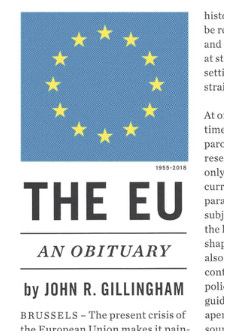
No one can seriously doubt the existence of a crisis in the affairs of the European Union. As the implications of the treaties on which it is based, including the Maastricht timetable for economic and monetary union, become ever more widely appreciated, and as the ordinary citizen in most member countries begins to participate in the debate over the future of the Union and its institutions (a debate hitherto largely confined to the United Kingdom), the glow of the European ideal begins to fade and the demand for precise definitions as to what it is all for becomes louder. We are all Euroskeptics now.
The only country seemingly unaware of this change in public attitudes is the United States of America. Washington continues to act on the assumption that a “United States of Europe” is the continent’s inevitable destiny, and American ambassadors continue to proclaim in London, and no doubt elsewhere, that nothing must be allowed to frustrate this “manifest destiny,” even at the expense of the solidarity of the English-speaking and Atlantic worlds.
Ever since I began studying this process nearly forty years ago, I have been puzzled by the uncritical acceptance in the United States of the view that only with common institutions exercising sovereign power could Europe flourish economically, and play a proper role in its own defense. For while it is understandable that the United States should welcome the apparent decision of the countries of Western and Southern Europe to end their age old strife–did not Americans twice have to intervene to redress the balance?–the assumption that, without the institutions of Brussels, Luxembourg, and Strasbourg, these countries would once again be preparing for armed conflict is on the face of it wholly implausible.
…
Should The Reader look to the continuing Rebellion’s in France, or the Revolt of the Dutch Farmers against the EU, as indicative of the fracture of Monnet’s ‘vision’? Or might The Reader be blunt: Michelle Goldberg is out of her depth, yet fully congruent with current ‘political wisdom’. Yetthe fracturing of a Utopian Capitalist Collectivism, in sum The EU , tinctured in an etiolated Neo-Liberalism, is under attack by The Populist Menace?
WARSAW — Last week, a friend asked me what I could learn from a four-day trip to Ukraine I was planning that I couldn’t glean just by reading the news. It was a fair question. With the trip now behind me, I can answer.
I learned how strange it is to visit a country to which no plane flies and, as of last Monday, no ship sails — thanks to Vladimir Putin’s cruel and cynical withdrawal from the Black Sea Grain Initiative through which Ukrainian farm products reached hungry countries like Kenya, Lebanon and Somalia. The only feasible way for a visitor to get from the Polish border to Kyiv is a nine-hour train ride, where the sign inside the carriage door urges, “Be Brave Like Ukraine.”
…
Mr. Stephens doesn’t quite reach the level of apologetics that fellow Neo-Con Francis Fukuyama expresses:
Headline: Author Francis Fukuyama, a Stanford fellow, backs far-right Azov group after school visit
Francis Fukuyama, a well-known author and researcher at Stanford University, said he is “proud to support” the Azov brigade, a Ukrainian military unit with longstanding far-right ties and connections to neo-Nazis.
“I think you need to do a little more reading on Azov,” he wrote. “They originated among Ukrainian nationalists, but to call them neo-Nazis is to accept Russia’s framing of what they represent today. By the time they defended Mariopol they were fully integrated into the [Armed Forces of Ukraine] and are heroes that I’m proud to support.”
Just last year, that same institute published a report on what’s known as the “Azov Movement,” the broader network of military and political organizations that were born out of what was originally a battalion. The institute’s report said that Azov “mixes classic right wing themes, including antisemitism, ethnocentrism, homophobia, and racism, with more populist economic proposals arguing for a greater role of the state in society.”
When Russia invaded Ukraine in February of last year, Russian President Vladimir Putin said his ostensible goal was to “denazify” Ukraine through force — a comment many saw as a direct reference to groups like Azov. While Putin’s claim that the Ukrainian government is run by neo-Nazis has been widely dismissed, and was used as a false pretense to invade Ukraine, the country nevertheless has some real far-right elements.
First formed as a paramilitary group in 2014, Azov quickly earned praise for its prowess on the battlefield as it fought alongside Ukrainian forces and other paramilitary groups in clashes with Russian-backed separatists. Just months after its initial formation, the unit was integrated into the Ukrainian National Guard as an official “Special Purposes Regiment.” Since Russia’s most recent invasion, the unit has received widespread praise from Western institutions and officials for its heroics in the field — namely the role it played in defending Mariupol from Russian invaders in the spring of 2022.
But apart from its combat expertise, the brigade is also known for its association with neo-Nazi ideology and other far-right beliefs. Azov was formed by Andriy Biletsky, the founder of two other far-right groups in Ukraine, who in 2010 reportedly said that the country’s national purpose was to “lead the white races of the world in a final crusade … against Semite-led Untermenschen [inferior races].” Azov often uses symbols that are similar to those used by Nazi soldiers during World War II, including the wolfsangel, totenkopf and sonnenrad.
The Reader has to wonder at a writer, thinker, intellectual celebrity, not to speak of relentless self-promoter, seems to have suspended his critical judgement, in the interests of ideology? Though it should not surprise that the gloss of Hegel’s highfalutin chatter, made this man’s career. ‘The End of History’ was superb public relations. The Philosophical Provincials swooned over this. Fukuyama entered the Pantheon of The Moment of Intellectual Celebrity. Who can forget Edward Bernays contribution to the study of Propaganda ? Its offers the key to the rise of Fukuyama, as that rare being whose thought is transformational?
Back to Mr. Stephens:
Is it pure luck that he should encounter R2P Zealot Samantha Power?
I learned what it was like to sit in conference rooms and walk along corridors that would soon be shattered by Russian ordnance. On Tuesday, I joined a diplomatic group led by Administrator Samantha Power of the United States Agency for International Development on a visit to the port of Odesa. Power met first with Ukrainian officials to discuss logistical options for their exports after Putin’s withdrawal from the grain agreement, then with farmers to discuss issues like de-mining their fields and de-risking their finances. The stately Port Authority building in which the meetings took place, a purely civilian target, was struck barely a day after our departure.
Mr. Stephens was given a guided tour. This wasn’t happenstance, as he presents it. He sounded all the notes of the brave Ukrainians, stalwart Samantha Power … this is propaganda dressed casually. Mr. Stephens is an ally of Victoria Nuland, Jake Sullivan, in sum the Neo-Con coterie, that salivates over war, with the enemies of the American Hegemon. The Neo-Cons exalt War, with no experience of service in its stark realities, as a soldier doing the fighting. Mr. Stephens provides the window dressing and then boards his flight… scribbling in his notebook as Ukraine become memory, attached to propaganda.
The Reader experiences a kind of political vertigo, while reading this meandering ‘essay’. Even Tom Friedman and David Brooks manage to express coherence of very particular kinds, in their political/moral/commentaries. Frank Bruni’s political observation, are tinctured in Pop Culture references, that are not just amateurish but maladroit- his practice of comedy lacks the sophistication, that experience in front of an audience brings.
Paragraph 1
It feels dangerous to write about Robert F. Kennedy Jr.: In the lag between when I put the finishing touches on this and when it becomes publicly available, I could be a conspiracy theory or two behind.
Paragraph 2
I could be mulling his apparent belief that the coronavirus was diabolically engineered to spare Chinese and Ashkenazi Jewish people while he has already moved on to the hypothesis that Ron DeSantis is a hologram gone haywire (I could buy into this one), the revelation that earbuds deliver subconsciously perceptible government propaganda through our auditory canals or the epiphany that French bulldogs cause global warming. He’s a crank who cranks out whoppers the way Taylor Swift disgorges perfect pop songs.
Paragraph 3
But we hang on her words for her craft. We hang on his for his clan. Kennedy is where paranoia meets legacy admissions. Like Donald Trump, with whom he has much more in common than he probably cares to admit, he’s an elitist hawking anti-elitism, an insider somehow branding himself an outsider, a scion styled as a spoiler, a populist as paradox. Why do Americans keep falling for these arrogant oxymorons?
Paragraph 4
But we hang on her words for her craft. We hang on his for his clan. Kennedy is where paranoia meets legacy admissions. Like Donald Trump, with whom he has much more in common than he probably cares to admit, he’s an elitist hawking anti-elitism, an insider somehow branding himself an outsider, a scion styled as a spoiler, a populist as paradox. Why do Americans keep falling for these arrogant oxymorons?
Paragraph 5
Oh, I understand the appeal of the perspective that narcissists like Trump and Kennedy peddle: that sinister operators deploy nefarious tricks to shore up their own dominance and keep hard-working, well-intentioned, regular folks in their places. It’s an exaggeration of inequities and injustices that really do exist, and it simplifies a maddeningly complex world. Ranting about George Soros or Anthony Fauci feels a whole lot better than raging at the vicissitudes of fate.
Paragraph 6
But why turn to preachers like Trump and Kennedy for this anti-gospel? It’s like consulting sharks about veganism. Trump commenced his career with a big, fat wad of money from his rich father. He attended business school in the Ivy League. He hobnobbed with big-name politicians before he turned against them. He has an eagle’s nest of a penthouse in the financial capital of the world.
Paragraph 7
But why turn to preachers like Trump and Kennedy for this anti-gospel? It’s like consulting sharks about veganism. Trump commenced his career with a big, fat wad of money from his rich father. He attended business school in the Ivy League. He hobnobbed with big-name politicians before he turned against them. He has an eagle’s nest of a penthouse in the financial capital of the world.
Paragraph 8
But why turn to preachers like Trump and Kennedy for this anti-gospel? It’s like consulting sharks about veganism. Trump commenced his career with a big, fat wad of money from his rich father. He attended business school in the Ivy League. He hobnobbed with big-name politicians before he turned against them. He has an eagle’s nest of a penthouse in the financial capital of the world.
Paragraph 11
But Kennedy’s place in a bona fide dynasty has also meant access, influence, mulligans. “Kicked out of an elite roster of prep schools, he still managed to arrive at Harvard in 1972,” Rebecca Traister wrote in an excellent recent profile of him and his presidential campaign in New York magazine, where she also described how he is “leaning hard into his family in this contest; his logo even borrows the iconography of his father’s 1968 campaign.”
Paragraph 12
In an insightful column in The Times, my colleague Michelle Goldberg noted how, at a June rally in New Hampshire, Kennedy pitched his presidential bid as a return of his family’s magic and majesty. “We can restore America to the awesome vitality of the original Kennedy era,” he told an adoring crowd.
Paragraph 14
All of which makes him an especially incoherent opportunist. Let’s be clear: As Kennedy promotes the specter of microchips in vaccines, as he posits that H.I.V. may not be the sole cause of AIDS, as he says that Anne Frank had it better than Americans under Covid lockdown, as he claims that Covid vaccines are often deadlier than what they’re supposed to prevent, as he fingers the C.I.A. for his uncle’s assassination and Prozac for mass shootings, he can portray a society in which the deck is stacked against all the little people because the deck has been stacked so heavily in his favor. His rapt audiences and his shimmering Kennedy-ness are inextricable.
Paragraph 16
All of which makes him an especially incoherent opportunist. Let’s be clear: As Kennedy promotes the specter of microchips in vaccines, as he posits that H.I.V. may not be the sole cause of AIDS, as he says that Anne Frank had it better than Americans under Covid lockdown, as he claims that Covid vaccines are often deadlier than what they’re supposed to prevent, as he fingers the C.I.A. for his uncle’s assassination and Prozac for mass shootings, he can portray a society in which the deck is stacked against all the little people because the deck has been stacked so heavily in his favor. His rapt audiences and his shimmering Kennedy-ness are inextricable.
Is the evidence clear that Bruni, and his New Democrat allies, are doing to both Kennedy and Cornel West what was done to Jeremy Corbyn in Britain. The one difference is that The Republicans control the House, and have provided ample evidence, that the New Democrats don’t just believe in Censorship, in the name of their political imperative. But demanded that the Hearings be in Executive Session.
The Reader is presented with paranoid political chatter of The New Democrats, recycled by an employee the Paper Of Record, The New York Times. The New Democrats are in a Political Panic over not just Kennedy but Cornel West as alternatives to the Party Of Censorship. The Reader need only look to:
This is the Sick Bitch Who Obama Appointed Chair of the Democratic National Committee and Defended Even after She was Exposed as a Crook:
Mr Ferguson no longer writes a column of opinion, but now resorts to that Straussian Methodology of writing a 2,626 word manifesto. That apes the Starussian ‘History of Philosophy’ as re-written in light of ideological imperatives ?
Could it be that Ferguson writing his new book in installments, to test the waters? Modesty is not a virtue that this Intellectual Technocrat, masquerading as an Historian might aspire? But the student of Strauss cultivates another kind of virtue of an ideological stripe?
The first paragraphs of the ‘essay’ :
Is democracy on a roll? You would think so if you listened to President Joe Biden’s speech at last week’s North Atlantic Treaty Organization summit in Vilnius, Lithuania. It was vintage Biden, the rhetoric alternately soaring and stumbling. He started with “the transformational power of freedom” in Lithuania and its Baltic neighbors as they broke free of Soviet rule, lighting up “the flame of liberty.” The enlargement of NATO and the advance of democracy are one and the same, he argued, because the alliance is “bound by democratic values.”
The war in Ukraine, the president declared, is a war between a coalition of democracies and a Russian autocracy that poses a threat “to democratic values we hold dear, to freedom itself.” In the same way, the Quad partnership between Australia, India, Japan and the US is “bringing major democracies of the region together to cooperate, keeping the Indo-Pacific free.” Biden depicted the world in Manichean terms, divided starkly between the democracies, united in “the defense of freedom,” and their benighted foes, who would prefer “a world defined by coercion and exploitation, where might makes right.”
Fine words. But what if democracy, far from being ascendant, is really in retreat? For the past few years, my Hoover Institution colleague Larry Diamond has been warning of a “democratic recession.” As he put it in a recent Foreign Affairs essay: “In countries as diverse as Bangladesh, Hungary, and Turkey, elections have long ceased to be democratic. Autocrats in Algeria, Belarus, Ethiopia, Sudan, Turkey, and Zimbabwe have clung to power despite mounting public demands for democratization. In Africa, seven democracies have slid back into autocracy since 2015, including Benin and Burkina Faso … the world is mired in a deep, diffuse, and protracted democratic recession.”
…
After the appearance of Larry Diamond of The Hoover Institution, in the next paragraph ‘Freedom House’ and Fareed Zakaria have brief walk-ons. Mr. Ferguson’s manifesto commences in earnest. Scrolling through this hysterical diatribe, it reads like his ‘The Great Degeneration’ : See Dr. Mark Kass’s brief, but insightful review:
The final paragraphs of Mr. Ferguson’s diatribe, featuring himself, hardly a surprise.
Finally, what about the challenge to American democracy posed by technological change? Two weeks ago, I wrote about the rise of corporations to positions of power unmatched since the 17th and 18th centuries. A central theme of my book The Square and the Tower was that the originally decentralized internet had swiftly and unexpectedly become dominated by a handful of network platform companies: Microsoft, Apple, Amazon, Alphabet, Meta. Does this threaten democracy? Indeed it does.
And the spectacular breakthrough of large language models such as OpenAI’s ChatGPT has implications for next year’s election that could be even bigger than the impact of big data in 2012 and Facebook ads in 2016. If both Democrats and Republicans are not already frantically working on applying artificial intelligence to voter mobilization in the key counties of swing states, I would be astonished. Remember: The people who first work out how to exploit any new technology are, in this order: 1. The nerds 2. The crooks and 3. The campaign operatives.
Democracy is not in recession. The invasion of Ukraine has elicited real democratic unity. The response to the challenge posed by China is weaker, but it is real. The idea of a global descent into illiberal democracy or electoral autocracy is exaggerated by dubious statistics.
But the future of democracy hinges, as it always has, on how far voters in the most important democracy are willing to vote their rights away. And the mechanisms to persuade them to do so have never been more powerful. Democracy is on a roll. The question is whether it is rolling toward a cliff edge. We shall find out in less than 16 months.
Like that notorious Neo-Conservative, who has converted to ‘Liberalism’, Francis Fukuyama, Mr. Ferguson’s defence/advocacy for democracy, is really a defence of a carefully Managed Democracy. It’s champion was Walter Lippmann’s faith in ‘experts’ in modern parlance Technocrats, who will check the ever-present threat of too much democracy.

 StephenKMackSD's Blog