Headline: How to Save a Sad, Lonely, Angry and Mean Society
A selection from Brooks’ latest Public Moralizing. Yet not a word about the Gaza Genocide! Brooks does offers an extended diagnosis of what ails us…
Many professors seem to have lost faith too. They’ve become race, class and gender political activists. The ensuing curriculum is less “How does George Eliot portray marriage?” and more “Workers of the world, unite!”
…
I confess I still cling to the old faith that culture is vastly more important than politics or some pre-professional training in algorithms and software systems. I’m convinced that consuming culture furnishes your mind with emotional knowledge and wisdom; it helps you take a richer and more meaningful view of your own experiences; it helps you understand, at least a bit, the depths of what’s going on in the people right around you.
…
The novelist Alice Walker lamented that she lacked models.
…
Then she found the novelist and anthropologist Zora Neale Hurston, who, decades before…
…
I’d argue that we have become so sad, lonely, angry and mean as a society in part because so many people have not been taught or don’t bother practicing to enter sympathetically into the minds of their fellow human beings. We’re overpoliticized while growing increasingly undermoralized, underspiritualized, undercultured.
The alternative is to rediscover the humanist code. It is based on the idea that unless you immerse yourself in the humanities, you may never confront the most important question: How should I live my life?
…
In the History of Mr. Brooks’ political opinionating/moralizing, where might The Reader place this misbegotten, vulgar, attempt to construct a usable literary/political character, Joey Tabula-Rasa: Mark Twain made both Tom Sawyer and Huckleberry Finn vivid characters in his novels! Joey is an inanimate political place-holder, conjured by a maladroit practitioner of propaganda:
…
What lessons will they draw from the events of the past month? How will the fall of Saddam affect their voting patterns, their approach to the next global crisis? One way to think about this is to conduct a thought experiment. Invent a representative 20-year-old, Joey Tabula-Rasa, and try to imagine how he would have perceived the events of the past month.
PROFESSOR ROGER Scruton, the darling of the intellectual right, was sacked as a commentator for The Wall Street Journal yesterday in an editotial after admitting he took money from the tobacco industry to place stories in the national press.
The philosopher, a professor of aesthetics at Birkbeck College, London University, has been told to “take a holiday” from the prestigious newspaper because he failed to disclose his ties with Japan Tobacco.
An editorial in yesterday’s European edition of The Wall Street Journal admitted: “We’ve come in for criticism lately because one of our contributors, the British conservative writer Roger Scruton, wrote an essay for our European edition while being paid by a Japanese tobacco company.
“Our long-time standard is that such financial ties should be disclosed, so readers can make up their own minds.” The move follows his sacking last week by the Financial Times over his tobacco links.
The Wall Street Journal had intervened to defend Professor Scruton over his £4,500-a-month contract with the tobacco giant.
But it said yesterday: “Mr Scruton had an obligation to tell us and his readers about his tobacco financing when he was writing about tobacco issues; he didn’t, and so he will be taking a holiday from our pages.”
Newspaper executives in America are said to be “furious” at Professor Scruton’s claims that he can use his contacts to place pro-tobacco articles.
In an e-mail, sent to Japan Tobacco last October, Professor Scruton boasted: “We would aim to place an article every two months in one or other of The WSJ (Wall Street Journal), The Times, the Telegraph, The Spectator, the Financial Times, The Economist, The Independent or the New Statesman.”
Professor Scruton and his wife, Sophie, are consultants to Japan Tobacco, which produces Camel cigarettes.
Yesterday, Clive Bates, the director of the anti-tobacco group Ash, said: “Japan Tobacco should follow the FT and Wall Street Journal and dump Roger Scruton. Anything he says on tobacco now will immediately be discredited.”
A spokesman for The Wall Street Journal said last night that Professor Scruton, who has worked for the paper since 1996, was not told in advance about the editorial.
Iris Murdoch :
Attention is a moral act. The key to becoming a better person, Iris Murdoch wrote, is to be able to cast a “just and loving attention” on others. It’s to shed the self-serving way of looking at the world and to see things as they really are. We can, Murdoch argued, grow by looking. Culture gives us an education in how to attend.
If attention is a moral act, where might The Reader place Mr. Brooks’ inattention to the Gaza Genocide?
My brief collection of evocative fragments from this ‘essay’:
There are many ways to explain the two biggest conflicts in the world today–while the two battlefronts may look very different- a titanic geopolitical struggle between two opposing networks of nations and nonstate actors- post-post-Cold War- the relatively stable Pax Americana/globalization era-the fall of the Berlin Wall in 1989-this is no ordinary geopolitical moment-
A collection of Friedman’s provisional rhetorical actors:
…
Resistance Network
…
Inclusion Network
…
Resisters
….
Includers
…
Further on in this Rhetorical Juggernaut The Reader encounters Chrystia Freeland:
…
At a breakfast with NATO leaders devoted to the Ukraine issue at Davos this year, Canada’s deputy prime minister, Chrystia Freeland, noted that it is we, the West, who should be thanking the Ukrainians, not forcing them to beg us for more weapons.
She also eloquently formulated the stakes: “What Putin wants is to transform the world order” that evolved since World War II and the post-Cold War — where “the competition between nations was about who can be richer and who can help their people prosper the most. … Putin hates that world because he loses in that world — his system is a loser in a peaceful, global, wealth-enhancing paradigm. And so what he wants is to move us back to dog-eat-dog, to a 19th-century, great power competition, because he thinks he can, if not win, be more effective there. … Let’s not think that this is a Ukrainian problem; this is a problem for us all.”
She is exactly right.
…
Chrystia Freeland has a problem with the truth, and Friedman as a ‘reporter’ is compromised!
Headline: Chrystia Freeland’s granddad was indeed a Nazi collaborator – so much for Russian disinformation
The news conference on Monday by Foreign Affairs Minister Chrystia Freeland was interesting not for the announcement that Canada was extending its training mission to Ukraine but for the questions and answers about the minister’s grandfather.
There have been a number of articles circulating about Freeland’s Ukrainian grandfather Michael Chomiak and his ties to the Nazis.
Some of those articles have appeared on pro-Russian websites. Freeland, who strongly supports Ukraine and is a major critic of Russia’s seizure of the Crimea, suggested to journalists that the articles about her grandfather were part of a Russian disinformation campaign. (The Russian government sees Freeland as virulently anti-Russian and has placed her on their travel ban).
“American officials have publicly said, and even Angela Merkel has publicly said, that there were efforts on the Russian side to destabilize Western democracies, and I think it shouldn’t come as a surprise if these same efforts were used against Canada,” Freeland told reporters after they raised questions about the articles about her grandfather.
The Globe and Mail also reported that an official in Freeland’s office denied the minister’s grandfather was a Nazi collaborator.
In addition, the claims were dismissed outright by those in the Canadian-Ukrainian community. “It is the continued Russian modus operandi that they have,” Paul Grod, president of the Canadian Ukrainian Congress told the Globe and Mail. “Fake news, disinformation and targeting different individuals. It is just so outlandish when you hear some of these allegations – whether they are directed at minister Freeland or others.”
Well it actually isn’t so outlandish. Michael Chomiak was a Nazi collaborator.
What are the sources for the information that Freeland’s grandfather worked for the Nazis?
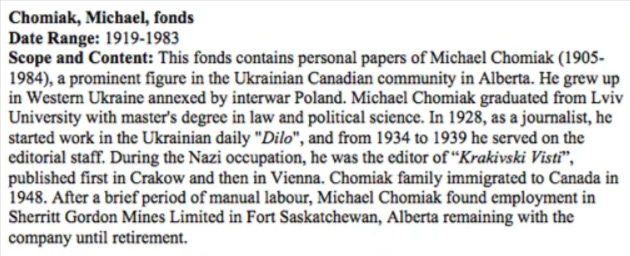
For starters, The Ukraine Archival Records held by the Province of Alberta. It has a whole file on Chomiak, including his own details about his days editing the newspaper Krakivski Visti. Chomiak noted he edited the paper first in Crakow (Cracow), Poland and then in Vienna. The reason he edited the paper in Vienna was because he had to flee with his Nazis colleagues as the Russians advanced into Poland. (The Russians tended to execute collaborators well as SS members).
See archive entry below:
So what was the Krakivski Visti? It, like a number of publications, had been seized by the Nazis from their Jewish owners and then operated as propaganda outlets.
Here is what the Los Angeles Holocaust Museum has to say about Krakivski Visti and a similar newspaper, Lvivski Visti, both publications associated with the Nazi regime.
“The editorial boards carried out a policy of soliciting Ukrainian support for the German cause,” the Holocaust Museum noted. “It was typical, within these publications, to not to give any accounts of the German genocidal policy, and largely, the editions resorted to silencing the mass killing of Jews in Galicia. Ukrainian newspapers presented the Jewish Question in light of the official Nazi propaganda, corollary to the Jewish world conspiracy.”
Now cut & paste, bricolage are tools of the writer, yet when used in tandem with outworn political cliche, attached to the practice of ersatz thought, equals what Friedman practices. Note that in this essay and his practice, as a New York Times Public Intellectual, Friedman treats word count as being equal to seriousness!
Political Observer on the Propaganda Imperatives of @NYT Bret Stephens & David Brooks.
Like his Fellow Traveler David Brooks , Bret Stephens attempts to change the subject from the 24,100 dead in Gaza, by means of his latest essay: The Meaning of Gaza’s Tunnels! The opening paragraphs.
Ever since Israel withdrew its soldiers and settlers from Gaza in 2005, critics have accused it of blockading and immiserating the territory — turning it, as they say, into an “open-air prison.”
The charge was always preposterous. Gaza shares a border with Egypt. Gazans were often treated in Israeli hospitals for cancer and other life-threatening conditions. Israel provided Gaza with much of its electricity and other critical goods even after Hamas came to power in 2007.
Now, as Israeli troops uncover more of Gaza’s vast underground city, the falsity of the accusation has become even more apparent.
According to a report this month in The New York Times, Israeli defense officials now estimate that Hamas’s tunnels measure between 350 and 450 miles in a territory that’s just 25 miles long. (By comparison, the London Underground is only 249 miles long.) Some of Gaza’s tunnels are wide enough for cars; some are more than 150 feet deep; some serve as munitions depots; others are comfortably kitted out as command bunkers.
…
The Question could be posed as : how might a captive people defend itself against its captors, that controls every aspect of their lives, including enforcing strict calorie management ! Not a question that would ever occur, to a former editor of The Jerusalem Post, a columnist and editor for the Wall Street Journal, nor a New York Times opinion writer might entertain, especially one trained by Wm. F. Buckley Jr.!
Like Mr. Brooks, Mr. Stephens’ propaganda imperative is shifting the current narrative, from the horrific Genocide practiced by Netanyahu and his Military, to a more manageable and easily manipulated set of questions, like Hamas Tunnels! And Brooks’ metastasizing ‘Administrative State’.
Both of these men are Neo-Conservatives: as such they are both the inheritors of the Legacy of Leo Strauss and his Re-Write of the History of Philosophy. And the deployment by the Platonic Guardians of the self-serving Noble Lie, as a necessity to the governance, of the lesser beings under their sway. It’s glaringly obvious that Stephens and Brooks are self-appointed members of this mendacious Political, Moral, Intellectual Class.
Let me go to the end of Mr. Stephens’ turgid melodrama, that the reader can explore at her leisure:
It’s possible that Israel could fight with more discrimination to spare Palestinian lives while still destroying Hamas’s ability to make war. If so, it behooves Israel’s constant critics to explain precisely how, and to do so in a way that doesn’t let Hamas off the hook. Otherwise, the tragic reality of this war is that it is going to be catastrophic for Gaza — not because Israel wills it, but because Hamas spent years of cynical efforts to make it so.
Hamas could have averted this tragedy if it had turned Gaza into an enclave for peace rather than terror. It could have averted it if it had not started four previous rounds of war against Israel. It could have averted it if it had honored the cease-fire that held on Oct. 6. It could have lessened the blow against Gazans by fighting in the open, not behind civilians. It could have eased it by releasing all of its hostages. It could end it now by surrendering its leaders and sending its fighters into exile.
After 75 years of subjugation and terror, the resistance to Zionism became shockingly real! The Israeli Army underwritten and supplied by American arms, and a never ending flow of money, was brought low by an ‘Army’ as yet to be defeated! A Slave Revolt while Israel commits Genocide? The Houthi’s offer the only resistance to Israeli/American teetering hegemony.
J.G.A. Pocock in the London Review of Books offers this frontal attack on The Paradise Lost of Brexit:
J.G.A. Pocock offers this on Brexit: Vol. 38 No. 14 · 14 July 2016
Profoundly anti-democratic and anti-constitutional, the EU obliges you to leave by the only act it recognises: the referendum, which can be ignored as a snap decision you didn’t really mean. If you are to go ahead, it must be by your own constitutional machinery: crown, parliament and people; election, debate and statute. This will take time and deliberation, which is the way decisions of any magnitude should be taken.
The Scots will come along, or not, deciding to live in their own history, which is not what the global market wants us to do. Avoid further referendums and act for yourselves as you know how to act and be.
Jean Monnet’s Steel and Coal Cartel that eventuated, in fact metastasized, into a slap-dash ungovernable political something, as revered by Martin Wolf, shares in the Spirit of Davos’ Collectivism? In the name of a World transformed by benign Technocratic Interventions ? What of those unruly States like Poland?
Headline: How Poland became Europe’s biggest rebel
Sub-headline: Support for the EU remains strong, but the confrontation with
Brussels is prompting a debate on the Polish right about ‘Polexit’
On October 7, from a spartan courtroom in Warsaw, Julia Przylebska read out a verdict that echoed across the whole EU. In a few sentences, the head of Poland’s constitutional court declared that key elements of the union’s law were “not compatible” with her country’s constitution.
The verdict brought to a head years of feuding between Warsaw and Brussels over a controversial overhaul of the Polish judiciary, and the backlash was immediate and sustained. Luxembourg’s foreign minister warned Poland it was “playing with fire”. When Poland’s prime minister Mateusz Morawiecki joined a fiery debate in the European Parliament this week to defend his government’s actions, MEP after MEP took the floor to lambast him.
“This is the first time ever that a court of a member state finds that the EU treaties are incompatible with the national constitution,” Ursula von der Leyen, the head of the European Commission, told Morawiecki during the debate. “This ruling calls into question the foundations of the European Union. It is a direct challenge to the unity of the European legal order.”
Monnet’s Cartel, as a possible counter weight to the Soviets, and a would be Pan-Europeanism, that collides with the once ascendent Nationalism, and the revelation of Globalism’s imperatives?
I’ll just ‘sample’ key paragraph’s of this wan apologetic that Mr. Friedman offers, on behalf Blinken, in a Newspaper that is the active partner of The American National Security State. Note that Friedman mentions Blinken being a Jew, yet not his own status as Jew! Nor the fact that his standing as a ‘Political Centrist’, and apologist for American/Israeli crimes, makes him the perfect interviewer for Davos. And its collection of Politicians, Political Technocrats, Billionaire Thieves, and their apologists, to remake ‘The West’: as it continues to sink in the mire of Neo-Liberalisms watershed of Catastrophe!
Headline: Blinken’s Search for Humanity in the Gaza War
…
My own way of dealing with the nightmarish nature of this war is to focus all my energies on thinking about how to stop it. But I can always think about China, or something else, if I want. That’s not the case if you are Secretary of State Antony Blinken and you are Jewish and you understand how unspeakably vicious the Hamas onslaught was on Oct. 7. Not to mention if you understand that Israel has a right to self-defense, but you also understand that Palestinian civilian casualties in Gaza have reached numbers you cannot ignore and that could leave a long-term stain on Israel and America.
So when I was invited to Davos to interview Blinken before a large audience today, I asked him bluntly the question people here have been asking me: One of the things you hear so often from people given the high number of civilian casualties in Gaza is, for the United States, do Jewish lives matter more than Palestinian Muslim lives or Palestinian Christian lives, given the incredible asymmetry of the casualties?
Blinken did not hesitate for a second to give an impassioned and heartfelt answer that I thought did him and America proud — an answer that neither obscured the vast human tragedy that has been triggered by Israel’s retaliation nor let Hamas off the hook for its role in starting the whole thing.
“No — period,” Blinken immediately shot back at me.
“I think for so many of us,” he continued, “what we’re seeing every single day in Gaza is gut-wrenching, and the suffering we’re seeing among innocent men, women and children breaks my heart. The question is: What is to be done? We’ve made judgments about how we thought we could be most effective in trying to shape this in ways to get more humanitarian assistance to people — to get better protections and minimize civilian casualties at every step along the way. Not only have we impressed upon Israel its responsibilities to do that, we’ve seen some progress in areas where, absent our engagement, I don’t believe it would have happened.”
Blinken continued: “But that in no way, shape or form takes away from the tragedy that we’ve seen and continue to see. It’s why we’re at it relentlessly, every single day. All I can tell you, Tom, is just on a purely human level, it’s devastating,” he said, referring to the “gut-wrenching” suffering that Israel has inflicted on the Palestinians in Gaza. “But it also reinforces my conviction that there has to be — and there is — another way that answers Israel’s most profound concerns” about security.
Mr. Brooks still thinks of himself as an agenda setting political commentator/writer. Here I will assign motive to Mr. Brook’s intervention. As the protégé of Wm. F. Buckley Jr., and a Neo-Conservative, no matter how abraded by political/careerist opportunism: The Noble Lie*, as celebrated by Leo Strauss, and his coterie of American Jingo’s is active in his mentality. Mr. Brooks seeks, in his way, to present a crisis that will render the The Gaza Genocide in shadow, as an imperative that must be acted upon, without delay!
Headline: Death by a Thousand Paper Cuts
In his 1, 245 word essay, the patient Reader arrives at these final paragraphs:
…
Organizations are trying to protect themselves from lawsuits, but the whole administrative apparatus comes with an implied view of human nature. People are weak, fragile, vulnerable and kind of stupid. They need administrators to run their lives. They have to be trained never to take initiative, lest they wander off into activities that are deemed by the authorities to be out of bounds.
The result is the soft despotism that Tocqueville warned us about centuries ago, a power that “is absolute, minute, regular, provident and mild.” In his Liberties essay, Edmundson writes that this kind of power is now centerless. Presidents and executives don’t run companies, universities or nations. Power is now held by everyone who issues work surveys and annual reports, the people who create H.R. trainings and collect data. He concludes: “They are using the terms of liberation to bring more and more free people closer to mental serfdom. Some day they will awaken in a cage of their own devising, so harshly confining that even they, drunk on their own virtue, will have to notice how their lives are the lives of snails tucked in their shells.”
Trumpian populism is about many things, but one of them is this: working-class people rebelling against administrators. It is about people who want to lead lives of freedom, creativity and vitality, who find themselves working at jobs, sending their kids to schools and visiting hospitals, where they confront “an immense and tutelary power” (Tocqueville’s words) that is out to diminish them.
Mr. Brooks ends his self-serving polemic with the notion of ‘soft despotism’ and Trump garners a mention. Yet the Murderous appetite of the Neo-Conservatives in ‘The War on Terror’ stands as the clear evidence, that Brooks’ sounding the alarm, is about a wan and self-serving attempt to change the subject!
Headline: At Least 37 Million People Have Been Displaced by America’s War on Terror
Sub-headline: A new report calculates the number of people who fled because of wars fought by the United States since Sept. 11, 2001.
*
…
In the Republic the Noble Lie is supposed to make the citizens of Callipolis care more for their city. Schofield (2009) argues that the guards, having to do philosophy from their youth, may eventually find philosophizing “more attractive than doing their patriotic duty” (115). Philosophy, claims Schofield, provides the guards with knowledge, not with love and devotion for their city. The Noble Lie is supposed to engender in them devotion for their city and instill in them the belief that they should “invest their best energies into promoting what they judge to be the city’s best interests” (113). The preambles to a number of laws in the Laws that are meant to be taken as exhortations to the laws in question and that contain elements of traditional mythology (see 790c3, 812a2, 841c6) may also be taken as “noble lies”.
…
Plato’s eschatological myths are not complete lies. There is some truth in them. In the Phaedo the statement “The soul is immortal” is presented as following logically from various premises Socrates and his interlocutors consider acceptable (cf. 106b–107a). After the final argument for immortality (102a–107b), Cebes admits that he has no further objections to, nor doubts about, Socrates’ arguments. But Simmias confesses that he still retains some doubt (107a–b), and then Socrates tells them an eschatological myth. The myth does not provide evidence that the soul is immortal. It assumes that the soul is immortal and so it may be said that it is not entirely false. The myth also claims that there is justice in the afterlife and Socrates hopes that the myth will convince one to believe that the soul is immortal and that there is justice in the afterlife. “I think”, says Socrates, that “it is fitting for a man to risk the belief—for the risk is a noble one—that this, or something like this, is true about our souls and their dwelling places” (114d–e). (Edmonds (2004) offers a interesting analysis of the final myth of Phaedo, Aristophanes’ Frogs and the funerary gold leaves, or “tablets”, that have been found in Greek tombs). At the end of the myth of Er (the eschatological myth of the Republic) Socrates says that the myth “would save us, if we were persuaded by it” (621b). Myth represents a sort of back-up: if one fails to be persuaded by arguments to change one’s life, one may still be persuaded by a good myth. Myth, as it is claimed in the Laws, may be needed to “charm” one “into agreement” (903b) when philosophy fails to do so.
How very convenient that Simon Kuper is both an employee of The Financial Times and and a contributor to Volta!
Simon Kuper
is a British writer. After studying History and German at Oxford and attending Harvard University as a Kennedy Scholar, he began writing about sports “from an anthropological perspective” and joined the Financial Times in 1994. His column today is called “Opening Shot” and is a fixture of the FT’s Weekend Edition.
Da Empoli understands power, partly because he once wielded some, as adviser for years to Matteo Renzi, who from 2014 to 2016 was Italy’s would-be modernising prime minister. That’s why his novel has become a guide — devoured by many western politicians — to the mindset of the Kremlin. The book covers Russian power since the 1990s, a subject that da Empoli had been obsessively researching since first visiting Moscow in 2010.
Surveying the diners in Jack’s, he remarks: “In Russia, power is a big beast. In Switzerland power is a kitten, and it’s been domesticated. Through history, it’s been diluted, distributed, at local level and through referendums. Swiss politicians are boring. That’s quite a good thing. The more spectacular a political system, the worse it is, in many ways.”
We’ve eaten together before — we know one another from Paris, where we both live, and in 2016 the progressive think-tank he ran, Volta, published some of my essays as an Italian ebook. After da Empoli switched from writing in Italian to French, I enjoyed his essayistic political books. I then watched him become a star. His novel appeared in April 2022, weeks after Russia’s full-scale invasion of Ukraine. He says: “I never thought it would sell more than 3,000 copies. And when the war broke out, I thought it would be wiped out completely.” It has sold about 650,000 copies in France alone.
…
Should this sentence surprise The Reader? It reeks of Hollywood kitsch!
I then watched him become a star. His novel appeared in April 2022, weeks after Russia’s full-scale invasion of Ukraine
The Reader can further her reading of this Anti-Putin Propaganda and Mr. Giuliano da Empoli story of his political/literary evolution.
…
Renzi was not Vladimir Putin, but da Empoli believes some aspects of power are universal. “I think the difference between leader and adviser is that the leader is 100 per cent into his action. There’s no distance between what he does and thinks and who he is. It’s so intense, you need to mobilise so many resources, that the only way is if you’re in it 100 per cent. The adviser keeps a distance, which allows him to be more lucid, and maybe keep giving good advice. This suits certain personalities. It suits me perfectly.”
The job would inform his literary depiction of the Kremlin’s “wizard”, Putin’s imagined consigliere Vadim Baranov. Putin, da Empoli explains, exercises a “premodern” type of power that baffles western European politicians. “He operates with codes that maybe some of our ancestors would have understood better than we do. But Putin’s practically never been on the internet. He’s not on social media. Baranov provides the postmodern theatrics that are also important in Putin’s power.”
…
My analysis is not complete! What I seek to comment upon is the reception of Giuliano da Empoli’s fiction, in two highfalutin journals, of respectable bourgeois political opinion. Can @TheEconomist be next? Or will the perpetually exhumed Bagehot comment from the perspective of 1843?
The New Statesman of January 15, 2024
Headline: The Wizard of the Kremlin takes us inside the mind of Putin’s spin-master
Sub-headline: Giuliano da Empoli’s fictionalized portrait of Vladislav Surkov dramatises the birth of the post-truth world.
David Sexton’s ‘review’ lacks Kuper’s melodramatic enthusiasm, if that is the right descriptor. Mr. Sexton’s paragraph about the fictional set-up -The Reader can evaluate this for what it is , Anti-Putin propaganda, refracted through a ‘character’ modeled on Vladislav Surkov .
…
The fictional set-up is creaky but effective. An unnamed narrator is in Moscow to study Yevgeny Zamyatin, the author of the pioneering dystopian novel We (1924). He spots that a Twitter account he follows, attributed to the now retired “Wizard of the Kremlin”, has cited the writer, and promptly responds by completing the quote. The following evening, a Mercedes whisks him to Baranov’s elegant house, where the Wizard, for no particular reason (“you’ve come all this way”), launches into the full story of his life, over glasses of whisky, through the night. The pretence of the fireside chat is soon dropped, however; the yarn incorporates much extended explanatory dialogue, supposedly recalled verbatim. The one apparently wholly fictional component of the story is Baranov’s grand amour, the beautiful and demanding Ksenia, whom he hooks up with while a penniless theatre student, but loses to his nerdy but super-rich friend Mikhail (Khodorkovsky). Ksenia is, I fear, a cipher for the spirit of Russia, “a tigress”, “a strange and cruel nymph”.
….
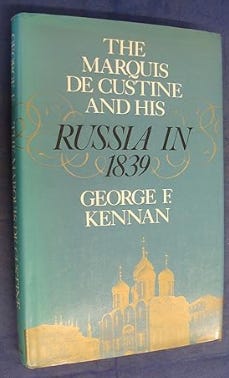
The Wizard of the Kremlin is a fast, easy read, smartly translated by Willard Wood, which efficiently dramatises great sweeps of Russia’s recent political history. Its success in France can be attributed both to the country’s special relationship with Russia and to its flattering embrace of a familiar literary perspective on Russia and its tsars. Baranov repeatedly quotes from the French aristocrat Astolphe de Custine’s scathing Letters from Russia (1839). Baranov says that his revered grandfather told him that Custine, that “son of a bitch” who said the whole country was a prison, remains the best interpreter of Russia. Robin Buss’s Penguin Classics translation of the letters is a treat.
George F. Kennan offers this:
While the War In Ukraine continues, financed by the EU, America and a collection of malign political actors; the Genocide in Gaza resisted militarily by the Houlis alone, and South Africa, in the International Court of Justice: there can be no doubt that ‘The West’ is not just in a ‘Decline’ as once diagnosed by Oswald Spengler, but a total surrender to War Criminal Benjamin Netanyahu’s Crimes against Humanity. Giuliano da Empoli’s fiction provides a necessary ‘bad actor’, on the World Stage, as a Second -Front that respectable Liberals/Neo-Liberals/Neo-Conservatives can focus their Moral Awareness, about a clear and present danger. While Trump wins handily, a political creature birthed by the New Democrats, The Republicans, The Neo-Conservatives!
In my haste to comment on Mr. Ganesh’s latest essay, I commented about the Hunger and Homelessness in Britain. I failed in my moral duty, yes Kant!, to, at the least, mention the Gaza Genocide underwritten by American weaponry, and an utterly bankrupt Political Morality; that has infected that mythical ‘Western Civilization’: that is the sine qua non of Newspapers and Websites, who publish political commentary. The European Settler State is a historical/moral toxin; the History of America is the most glaring example!
Best regards to my Readers.
StephenKMackSD
It seems rather hard to forget this report by Jim Waterson of Buzz-Feed, from 2017!
Headline: Here’s What Happened When Jeremy Corbyn Supporters Protested Outside The New Statesman
Sub-headline: “With this kind of New Statesman who needs Murdoch?” ask protestors who took their campaign against media coverage of Corbyn to the streets.
A selective yet informative selection of this report:
A group of Jeremy Corbyn supporters gathered outside the offices of the New Statesman on Thursday night to demand the left-wing magazine recants its criticisms of the Labour leader, does more to promote his agenda, and asked to be given 30 pages in the magazine’s next issue to make a pro-Corbyn case.
…
The current issue of the magazine features a cover entitled “Wanted: An opposition” and features multiple articles criticising Corbyn and the current state of the Labour party, which the protestors said filled at least 30 print pages.
…
Sam Weinstein, a retired union official, aged 68, told BuzzFeed News the magazine was guilty of “scabbing” on the Labour party by opposing the leader shortly before the local elections. He suggested it was part of a plan to ensure the party performed badly and to make it easier to remove Corbyn.
“We expect it from the Daily Mail – what we don’t expect is to be stabbed in the back by people who claim they’re supporters of ours,” he said. “It’s nothing but treachery.”
…
“There is nobody who is unbiased in relation to Corbyn – Paul Mason has been good. The Guardian has been terrible. The Independent at times has been a bit better. Every interview you watch is absolutely biased. Who needs Murdoch if the New Statesman is going to behave like this? You would expect the Labour media would not trash the elected Labour leader.”
…
The initial request for pro-Corbyn coverage may have failed. New Statesman deputy editor Helen Lewis said they would struggle to find the room to accommodate the protestors’ demand for 30 pages: “The normal flatplan is 64 pages, so it would have a pretty severe effect on the critics section. And there’s no way we would drop the crossword, the readers would go mad. Compared with that, being rude about Jeremy Corbyn is really small fry.”
The above demonstrates, to say the least, a betrayal of political solidarity , or just cowardice on the part of the New Statesman and it’s deputy editor Helen Lewis.
Freddy is in top form when evaluating the oily Mr. Cameron , the reader might even call him catty! Though Cameron is never less that self-congratulatory, in his attempt at feigned modesty. He recalls the character of Flashman in Tom Brown’s School Days!
Morning Call: Cameron returns
The Foreign Secretary faces MPs for the first time since his return.
…
But first, a report from David Cameron’s first appearance before MPs since he became Foreign Secretary.
Selective quotation:
…
Cameron’s return from the wilderness (also known as the Cotswolds) was made possible by a prompt ennoblement to the House of Lords. He was handed some ermine and told to deal with the unfolding war between Israel and Hamas to allow, some speculate, Sunak to devote more time to winning over voters at home.
…
But whatever one makes of his merit as a diplomat, Cameron is the picture of a consummate politician. His ability to evade questions is second to none. He slides past questions with a disarming charm. “If we step back and look at the big picture”; “I’m a bit torn on this”; “I don’t recall every piece of paper put in front of me”; “I’ll answer a slightly different question if I may”; “I am not a lawyer.”
…
Cameron resisted answering whether Israel was breaking international law but under the persistent questioning of Kearns, who reminded him how happily he has accused other countries of war crimes in the past, the Foreign Secretary said that Israel was “de facto” occupying Gaza and that he was “worried that Israel has taken action that might be in breach of international law”. He went on to call for another humanitarian pause and threatened to upgrade the travel ban on Israeli settlers in the West Bank to a full sanction. Cameron, remember, called Gaza a “prison camp” as prime minister in 2010, and condemned Israel’s invasion of Lebanon in 2006 as “disproportionate”.
There has been a marked shift in the government’s approach since he took office. On 16 December, he wrote a joint article with Annalena Baerbock, his German counterpart, calling for a sustainable ceasefire and for Israel to kill fewer civilians.
But his belief in Britain’s ability to act on these concerns seemed minimal. When Kearns pressed Cameron on whether the UK can restrain Israeli air strikes, he could only muster: “I hope they listen to us.” For all the urbane confidence, it was not a compelling endorsement of British power abroad.
This Reader wonders what Freddie and The New Statesman will do, if Jeremy Corbyn enters as a third party candidate, in the next election? As Starmer is Tony Blair’s house pet, and a New Labour stalwart, the only real ‘Left Vote’ would be Corbyn. That is if political consistency of a kind were an imperative?
Political Commentator wonders, where the Homeless & Hungry might fit into ‘Ganesh World’?
…………………………………………………………………………………………………………………………
January 11, 2024:
In my haste to comment on Mr. Ganesh’s latest essay, I commented about the Hunger and Homelessness in Britain. I failed in my moral duty, yes Kant!, to, at the least, mention the Gaza Genocide underwritten by American weaponry, and an utterly bankrupt Political Morality; that has infected that mythical ‘Western Civilization’: that is the sine qua non of Newspapers and Websites, who publish political commentary. The European Settler State is a historical/moral toxin; the History of America is the most glaring example!
When reading Mr. Ganesh I am remined of his remarkable talent as a stylist. Yet his latest essay in which he opines about that ‘red wall’, and other vexing political questions : Kenneth Kohlrabi is the comments section, also wonders what that might be.
This expression of Mr. Ganesh as political commentator reminds this reader of Tom Wolfe’s ‘The Kingdoms Of Speech’. A possible point of intellectual/political fracture is reached between the imperatives of the feuilleton, as a form, reserved for another part of a Newspaper? Mr. Ganesh essay seems trapped, in the moment, in the rhetorical styles of both Gideon Rachman and Edward Luce, equal to lackluster political commentaries!
Here are some reviews, Wolfe’s the first of which seems to be deeply attached to Chomsky’s Marxism as indictive of what? And Jerry A. Coyne’s
There are some indicators of Mr. Ganesh’s power, yet the rhetorical prestidigitations of another literary Ganesh are missed.
That was the beginning of my comment on Mr. Ganesh latest essay. Mr. Ganesh was/is an avid reader of Mr. Wolfe’s. Yet in this instance Mr. Wolfe wrote, as if, he could hope to match, or exceed, the work of two writers, intellectuals, World Historical Thinkers. When his whole career was writing about the mundane of popular culture, in it’s widest sense, as satire from a ‘Conservative’ point of view. His most infamous project was ‘Radical Chic & Mau-Mauing the Flak Catchers (1970)’ in which he ‘satirized’ Leonard Bernstein’s soirée for the Black Panther Party. Was it an expression of Mr. Wolfe’s not so latent ‘Southern-ness’, or more pointedly his racial animus towed Jews and Blacks!
Back to Mr. Ganesh:
The Reader need only look at the Political Leaders of Britain from David Cameron, Mrs. May, Boris Johnson, Liz Truss & Kwasi Kwarteng , Rishi Sunak as expressions of political/legal exhaustion. With Tony Blairs’s house-pet Kier Starmer as Political Pretender. Will the roundly defamed, by this newspaper and its confederates, Jeremy Corbyn enter the contest?
Does this sentence answer any questions? ‘And so it is with some justification that I announce the death (through natural causes) of big-government Toryism’ This is the chatter of a would-be Party Technocrat, who acts as if Homelessness and Hunger are not epidemic?
With Homelessness at record levels:
Rough sleeping rises in UK amid tidal wave of homelessness
Dennis Moore
19 March 2023
For the first time in five years there has been a marked rise in rough sleeping across England.
Office for National Statistics (ONS) data shows that in 2022, an estimated 3,069 people were sleeping out on the streets of England, a rise of 26 percent. This is the biggest year on year rise since 2015 and exposes the pretense of the Conservative government’s 2019 manifesto promise to “end the blight of rough sleeping” by 2024.
Even this rise is not the full picture as the numbers of those sleeping out on the streets does not include those who are homeless, living in temporary shelters or hostels.
There has been a rise in rough sleeping across all regions of England. London and the southeast represented half of those on the streets, with Westminster local authority in London recording the largest number of rough sleepers, 250 people, an increase from 63. Christchurch, Poole and Bournemouth showing a doubling of rough sleepers.
Poverty across UK forces 11.3mn Britons into hunger, report reveals
A landmark research study has revealed an excruciating extent of food poverty across Britain as the general public grapple with soaring inflation and the highest cost-of-living in a generation.
More than eleven million people or one in seven persons throughout the UK faced hunger in the last year due to a shortage of money, according to a new study by a leading charity organization, the Trussell Trust.
According to the charity, the latest findings are just the tip of the iceberg and the shortage of money is not limited to just hunger pangs among the impoverished Britons.
It said the impact of poverty leads to worrying social isolation and loneliness, spiraling debt, and a decline in physical and mental health.
Trussell Trust said its food banks network distributed close to 3 million emergency food parcels in the past 12 months, as the levels of need were even more than during the peak of the coronavirus pandemic, and more people found themselves incapable of covering the cost of essentials such as heating and food.
Mr. Ganesh moral/political vacuity is the expression of a ‘Technocrat’/Reporter’, ensconced in his comfortable office! Informing his readers about questions of would be political orthodoxy, he knits together for consumption by his readers/acolytes: who can chatter to each-other about such a pressing question:
‘And so it is with some justification that I announce the death (through natural causes) of big-government Toryism’
Political Observer offers some selective quotation of Stephen’s moralizing politics.
Bret Stephens when he isn’t proclaiming his moral uprightness and virtue, he can’t resist the temptation to attack the Civil Rights Era and The Great Society of Johnson, on its periphery. The Left in the political imagination of Stephens is about that time, place , it politics , its imperatives and its political/legal evolution.
Here is a selection from Stephens essay of Jan. 2, 2024 that demonstrates his own set of imperatives . Stephens’s self-concept is about being a Political Moralist!
…
The answer, I think, is this: Where there used to be a pinnacle, there’s now a crater. It was created when the social-justice model of higher education, currently centered on diversity, equity and inclusion efforts — and heavily invested in the administrative side of the university — blew up the excellence model, centered on the ideal of intellectual merit and chiefly concerned with knowledge, discovery and the free and vigorous contest of ideas.
Why did that change happen? I’ve seen arguments that it goes back to the 1978 Bakke decision, when the Supreme Court effectively greenlit affirmative action in the name of diversity.
But the problem with Bakke isn’t that it allowed diversity to be a consideration in admissions decisions. It’s that university administrators turned an allowance into a requirement, so a kind of racial gerrymander now permeates nearly every aspect of academic life, from admissions decisions to faculty appointments to the racial makeup of contributors to essay collections. If affirmative action had been administered with a lighter hand — more nudge than mandate — it might have survived the court’s scrutiny last year. Instead, it became a pervasive regime that frequently got in the way of the universities’ higher goals, particularly the open exchange of ideas.
This is the poisoned pool in which Harvard now swims.
…
That respect is now being eroded to the point of being erased. For good reason. People admire, and will strive for, excellence — both for its own sake and for the status it confers. But status without excellence is a rapidly wasting asset, especially when it comes with an exorbitant price. That’s the position of much of American academia today. Two-hundred thousand dollars or more is a lot to pay for lessons in how to be an anti-racist.
Nobody should doubt that there is still a lot of excellence in today’s academia and plenty of good reasons to send your kids to college. But nobody should doubt, either, that the intellectual rot is pervasive and won’t stop spreading until universities return to the idea that their central purpose is to identify and nurture and liberate the best minds, not to engineer social utopias.

 StephenKMackSD's Blog