What might a New York Times columnist offer in terms of expertise on this question Policy? A four point list?
Headline: How Biden Can Avenge Navalny’s Death
Finances:
Recognition:
Dissidents:
Power:
Stephens offers the wise council of David Petraeus, on what should be done.
David Petraeus, the retired general and former C.I.A. director, had a specific suggestion: “The White House should announce the provision of the Army Tactical Missile System to Ukraine, which would double the range to approximately 300 kilometers of the missiles provided by the U.S. to date.”
David Petraeus is a political actor worthy of trust?
Headline: How David Petraeus avoided felony charges and possible prison.
On April 23, 2015, Petraeus pleaded guilty in Charlotte. The judge upped the fine to $100,000.
…
For this to go away, he said, Petraeus would have to plead guilty to lying to the FBI and mishandling classified information, a misdemeanor. In the statement of facts that would accompany the plea agreement, prosecutors also said they would want to reference a message Petraeus sent to the CIA workforce in 2012 after John Kiriakou, a former agency officer, was convicted of leaking classified information.
“Oaths do matter, and there are indeed consequences for those who believe they are above the laws that protect our fellow officers and enable American intelligence agencies to operate with the requisite degree of secrecy,” Petraeus had said.
Petraeus’s lawyer, David E. Kendall, declined to comment. But another person familiar with the meeting said he described the lying charge as “a nonstarter.” The Kiriakou reference was also off the table, he said.
Both Petraeus and Stephens self-concepts are wedded, in Petraeus’ case to his expertise in Military Matters. Yet afflicted with the pleasures/alliances with a younger women, and the sharing of classified data, as demonstrated from the above quoted Washington Post report. While Stephens draws on the inheritance from Plato’s ‘Noble Lie’, as presented by Leo Strauss: although as a propagandist he is given to constructing a ‘History Made to Measure’, that is the first resort to which the Pundit Classpractices, in its many iterations.
Political Observer asks the burning question: How long before Old Money Gavin Newsom replaces Senile Old Joe?
Here are the opening paragraphs Of Mr. Friedmans latest’s diatribe against Trump, and his political coterie. Yet Biden, and his Neo-Cons, are in the political imagination of Friedman, above reproach. Even as the obscene death tole in Gaza, and widening war in the ‘Middle East’ metastasizes, by the minute, hour, day!
I’ve got a suggestion for the next Trump-G.O.P. fund-raising scheme. You know how sports memorabilia stores sometimes sell basketballs autographed by an entire N.B.A. team? Well, I was imagining that Donald Trump could sell white flags at $1,000 a pop that say, “We surrendered Ukraine to Russia,” autographed by him and the House and Senate MAGA sycophants he’s assembled to deny Ukrainians the weapons they need to stave off Vladimir Putin’s onslaught.
For an extra $500, you could get a white flag autographed solely by Trump and J.D. Vance and emblazoned with Vance’s immortal words, “I don’t really care what happens to Ukraine.” Or one signed by House Speaker Mike Johnson, big enough to sum up his worldview: I was for Ukraine aid until I was against it, but I could be for it again if Trump is not against it. This is a matter of principle for me. Either way, it’s all Biden’s fault.
And then the ultimate collector’s item. For an extra $1,000, a giant white surrender flag, made from the softest Sea Island cotton, signed by Lindsey Graham, that says: “I gave up the principles of John McCain and a free Ukraine because Trump told me to. But I got a round of golf at Trump’s West Palm Beach course. Can I still be on ‘Meet the Press’?”
The last gift comes with a pair of Trump’s new branded tennis shoes, guaranteed by Trump and personally tested by Graham, to be the fastest shoe on the market to run away from any ally or foe — or anything principled that you’ve ever said.
I’ve got a suggestion for the next Trump-G.O.P. fund-raising scheme. You know how sports memorabilia stores sometimes sell basketballs autographed by an entire N.B.A. team? Well, I was imagining that Donald Trump could sell white flags at $1,000 a pop that say, “We surrendered Ukraine to Russia,” autographed by him and the House and Senate MAGA sycophants he’s assembled to deny Ukrainians the weapons they need to stave off Vladimir Putin’s onslaught.
For an extra $500, you could get a white flag autographed solely by Trump and J.D. Vance and emblazoned with Vance’s immortal words, “I don’t really care what happens to Ukraine.” Or one signed by House Speaker Mike Johnson, big enough to sum up his worldview: I was for Ukraine aid until I was against it, but I could be for it again if Trump is not against it. This is a matter of principle for me. Either way, it’s all Biden’s fault.
And then the ultimate collector’s item. For an extra $1,000, a giant white surrender flag, made from the softest Sea Island cotton, signed by Lindsey Graham, that says: “I gave up the principles of John McCain and a free Ukraine because Trump told me to. But I got a round of golf at Trump’s West Palm Beach course. Can I still be on ‘Meet the Press’?”
The last gift comes with a pair of Trump’s new branded tennis shoes, guaranteed by Trump and personally tested by Graham, to be the fastest shoe on the market to run away from any ally or foe — or anything principled that you’ve ever said.
…
Reader who can forget this from Jan. 31, 2024 ?
A Biden Doctrine for the Middle East Is Forming. And It’s Big.
There are two things I believe about the widening crisis in the Middle East.
We are about to see a new Biden administration strategy unfold to address this multifront war involving Gaza, Iran, Israel and the region — what I hope will be a “Biden Doctrine” that meets the seriousness and complexity of this dangerous moment.
And if we don’t see such a big, bold doctrine, the crisis in the region is going to metastasize in ways that will strengthen Iran, isolate Israel and leave America’s ability to influence events there for the better in tatters.
A Biden Doctrine — as I’m terming the convergence of strategic thinking and planning that my reporting has picked up — would have three tracks.
…
Besides this Mr. Friedman has read Joe Bidens’ gut!
Biden is as pro-Israel in his gut as any president I have ever covered.
Political Cynic comments upon a Zionist Apologetics, in thrall to 1993 Oslo Accords!
The Financial Times has a ready supply of ‘writers’, to comment upon divisive issues, that must be handled by writers not connected with this newspaper? As a kind of self-defense, against its readership’s resort to a comments section, filled with caustic rejoinders. That leads the editors of this newspaper no alternative but to post a notice to its readers that the ‘Comments have not been enabled for this article’ Such is the case of this essay by Michael Goldfarb :
Israel-Hamas war
You can have justice or peace. But you can hardly ever have both
A popular protest slogan and the reality that for peace to prevail, sometimes justice is impossible
What might The Reader make of this declaration by Michael Goldfarb?
What is the process by which an historical event becomes sacred and incorporated into religious practice? Does that process even exist in the 21st century? Do events of “Biblical proportions” still happen?
The 75th anniversary of Auschwitz’s “liberation” by the Red Army approaches. I covered the 50th anniversary commemoration for NPR and I have been wrestling with these questions ever since.
I am a secular Jew. When I arrived at the dreadful place in January 1995, I hadn’t seen the inside of a synagogue for 15 years, yet by the time my two day visit was over I had been overwhelmed by a powerful emotion that I can only describe as religious.
Mr. Goldfarb begins his essay with a critique of a pro-Palestinian marchers refrain:
“No justice, no peace!” shout pro-Palestinian marchers moving through cities in Europe and the US.
Mr. Goldfarb then recounts his experiences in Northern Ireland, torture in Greece and Chile. An he argues that ‘ The Holocaust could not have happened without the willing participation of many people’ and Some 99 per cent of the perpetrators never faced justice. Many SS members simply returned to their lives after the war. call these jejune at best! But more of the same ‘Yet many were re-employed in the legal system because peace, or at least stability, was needed so the country could provide a bulwark against Soviet expansionism.’
The Reader reaches the final five paragraphs of this lackluster exercise of Zionist Apologetics, via a maladroitly exercised History Made to Measure!
How did survivors and their wider communities feel about this absence of justice? At the commemoration to mark the 50th anniversary of the Red Army’s liberation of Auschwitz, I stood in the small crowd at the ruins of crematorium II and listened to Holocaust survivor and Nobel peace prize winner Elie Wiesel read a prayer he had written for the occasion:
Here are some critical comments on Elie Wiesel:
Martin Peretz, editor of The New Republic, considers Wiesel a public joke and a misapplication of the dignified Nobel Peace Prize.
Irving Howe declares in The New Republic that Wiesel is a publicity seeker; Alfred Kazin augments the charge with claims that the famed death camp survivor is both shallow and self-aggrandizing.
Jeffrey Burke of the New York Times Book Review carries denunciation to greater extremes by lambasting Wiesel for redundancy and purple prose. Such strong dissent impels Wiesel to unburden his conscience and to master the same objectivity in memoir that he demands of his newspaper reportage.
“God of forgiveness, do not forgive the murderers of Jewish children here.” Then he described from memory frightened children being forced down the steps to the changing room and taken into gas chambers. “God, merciful God, do not have mercy on those who had no mercy on Jewish children.” This otherwise reserved and saintly man was calling down a heavenly justice on the perpetrators, because earthly justice had fallen short.
The present crisis in Gaza will ask similar questions of those charged with its resolution. When the conflict ends, and it must, who will define what justice means for crimes that were committed? After the second world war, the victors revived the International Court of Justice as a forum for cases brought by nations, not individuals, to adjudicate among other things “genocide”, a crime that had only just been identified as the scale of the Holocaust was revealed. But the term, and the laws concerning it, are in their infancy. Genocide is difficult to prove and nearly impossible to get recompense for. The recent case brought by the South African government against Israel at the ICJ for the way it is prosecuting its war against Hamas in Gaza demonstrates this.
The court found “plausibility” in South Africa’s accusation but it did not rule that Israel was in breach of the genocide convention. It did not order Israel to end its incursion into Gaza, but “provisionally” asked it to minimise civilian casualties. It asked Israeli politicians to refrain from making genocidal statements, something most Israelis and vast swaths of the Jewish diaspora wish for.
Simple ideals rarely survive their encounter with the legal and political processes necessary to make peace or justice a reality. After the Oslo Accords were signed in 1993, marking the beginning of a process that could have led to a two-state solution, Bill Clinton, Yitzhak Rabin and Yasser Arafat spoke of a “peace of the brave”, not a peace of the just. For now, as the “justice” both sides are seeking is not tempered with mercy, there can be neither peace, nor justice, no matter how many miles are marched demanding both.
I have placed in bold font the most self-serving parts of these paragraphs, highlighting the Oslo Accords of 1993, as an expression of the toxic nostalgia engaged in by Michael Goldfarb!
As a Reader of a certain age, nearing 80, I have to wonder about David Brook’s status as a New York Times Public Intellectual, born in 1961! By the 1970’s I was reading Russian Thinkers, Against the Current, Age of Enlightenment: The 18th Century Philosophers [The Mentor Philosophers Series] And all these essay published in The New York Review of Books.
Isaiah Berlin
Isaiah Berlin (1909–1997) was a philosopher and historian of ideas who held the Chichele Professorship of Social and Political Theory at Oxford. The final volume of his correspondence, Affirming: Letters 1975–1997, was published in December 2015.
I will quote the relevant paragraphs of Brook’s essay dealing with Berlin:
…
That idea is known as value pluralism. It’s most associated with the British philosopher Isaiah Berlin and is based on the premise that the world doesn’t fit neatly together. We all want to pursue a variety of goods, but unfortunately, these goods can be in tension with one another. For example, we may want to use government to make society more equal, but if we do, we’ll have to expand state power so much that it will impinge on some people’s freedom, which is a good we also believe in.
As Damon Linker, who teaches a course on Berlin and others at the University of Pennsylvania, noted recently, these kinds of tensions are common in our political lives: loyalty to a particular community versus universal solidarity with all humankind; respect for authority versus individual autonomy; social progress versus social stability. I’d add that these kinds of tensions are rife within individuals as well: the desire to be enmeshed in community versus the desire to have the personal space to do what you want; the desire to stand out versus the desire to fit in; the cry for justice versus the cry for mercy.
…
Berlin had a word for people who think there is one right solution to our problems and that therefore we must do whatever is necessary in order to impose it: monists. Berlin was born in pre-revolutionary Russia and came of age in the 1930s, when two monist philosophies were on the march, Marxism and fascism. They claimed to be all-explaining ideologies that promised an ultimate end to political problems.
…
We pluralists resist that kind of Manichaean moralism.
…
We pluralists believe that conflict is an eternal part of public life — we’re always going to be struggling over how to balance competing goods — but it is conflict of a limited sort, a debate among patriots, not a death match between the children of light and the children of darkness.
…
Pluralism is a creed that induces humility (even among us pundits, who are resistant to the virtue). A pluralist never believes that he is in possession of the truth, and that all others live in error. The pluralist is slow to assert certainty, knowing that even those people who strenuously denounce him are probably partially right. “I am bored by reading people who are allies,” Berlin once confessed.
…
He was more interesting when writing about specific people — like Machiavelli or Churchill — than when writing about abstract ideas.
…
Berlin argued that if there were a final set of solutions, “a final pattern in which society could be arranged,” then “liberty would become a sin.”
…
I’ve left this paragraph, out of the order of its presentation, this self serving political chatter…
In the 1980s, I thought the chief worry was economic sclerosis and that Reagan/Thatcher policies, including tax cuts, were the right response. Now I think the chief worry is inequality and social fragmentation, and I think the Biden policies, including tax increases, are the right response.
Those ‘right responses’ to the 1980’s , in sum the Neo-Liberal Swindle that produced the Economic catastrophe of 2007-2008, and the ruination of both the Working Class and The Middle Class – Brooks lacks the integrity to face his culpability, while proclaiming his Pluralism.
Reader, consider this essay in The London Review of Books:
Many years later, reviewing Personal Impressions for the New Statesman, I mentioned the old story of Berlin acting as an academic gatekeeper, and barring the appointment of Isaac Deutscher to a chair at Sussex University. This denial had the sad effect of forcing Deutscher – who had once given Berlin a highly scornful review in the Observer – to churn out Kremlinology for a living: as a result of which he never finished his triad or troika of Stalin, Trotsky and Lenin biographies. In the next post came a letter from Berlin, stating with some anguish that while he didn’t much approve of Deutscher, his opinion had not been the deciding one. I telephoned Tamara Deutscher and others, asking if they had definite proof that Berlin had administered the bare bodkin, and was told, well, no, not definite proof. So I published a retraction. Then came a postcard from Berlin, thanking me handsomely, saying that the allegation had always worried and upset him, and asking if he wasn’t correct in thinking that he had once succeeded more in attracting me to Marxism than in repelling me from it. I was – I admit it – impressed. And now I read, in Ignatieff’s book, that it was an annihilatingly hostile letter from Berlin to the Vice-Chancellor of Sussex University which ‘put paid to Deutscher’s chances’. The fox is crafty, we know, and the hedgehog is a spiky customer, and Ignatieff proposes that the foxy Berlin always harboured the wish to metamorphose into a hedgehog. All I know is that I was once told – even assured of – one small thing.
Isaac and Isaiah: The Covert Punishment of a Cold War Heretic by David Caute – review
Tariq Ali on a renowned scholar’s vendetta against a fellow refugee
…
Berlin was a liberal fanatic, a staunch empire loyalist, gliding effortlessly from Britain to the US when the time came. He was at his happiest when close to power, an instinctive courtier, unless insulted or ignored. During the 1970s he was invited to Iran, then under the Shah, when dissidents were being hanged naked or toasted on racks by the hated secret police. He accepted. His fee was never disclosed, but the subject of his talk, “On the Rise of Cultural Pluralism”, irritated the empress Farah Pahlavi. He was barely halfway through when the empress signalled a factotum to bring her torture to an end and stop the lecture. Berlin later confided to a friend that it was as if he had been “stung by several wasps”. But why had he gone in the first place?
Both of these essays explore the fact that Isaiah Berlin was not above defaming Isaac Deutscher! Pluralism matters how in Berlin’s treatment of Isaac Deutscher ?
Reader don’t miss to opportunity offered ‘Sir Isaiah Berlin Interview 1995 Michael Ignatieff’ although at times listening to Berlin, is muddled or simply beyond understanding? While Ignatieff is nearly ecstatic in his proximity to the Master.
The excerpts from a letter of 17, October 1989 demonstrates that Berlin was, at the least a political/moral conformist. His concerted campaign against Isaac Deutscher, proves that Berlin was just another Academic Politiker, who betrayed his ‘values’ when convenient!
Kaiser had good things to say, too, telling an anecdote about Alsop beguiling children in a small Vietnamese town—“Joe at his best.” But he found himself unable to place Alsop in his “mental closet.” “Certainly he was almost unique here as a genuine intellectual who knew his own mind, and also just knew a lot. He also played a very important role in the (now ended) era of punditry, but I fear the high point of his career was in intimidating JFK to make a commitment in Vietnam, a tragic error.” Moreover, Alsop “was a tormented soul, confused about his own sexuality, addicted to booze and tobacco, often just sad.” Kaiser asked Berlin: “What does all this add up to? How did you understand the man?” Following is Berlin’s reply, drawn from the fourth and final volume of his correspondence, Affirming: Letters 1975–1997, edited by Henry Hardy and Mark Pottle, to be published in the US later this year.
—Henry Hardy
…
With all this, he was bad-tempered, bibulous (as you say), could be a bully—but only towards people whom he suspected of opportunism, running with the tide, above all of holding views, whether in a weak and flexible way or in an obstinate and unyielding way, which he regarded as against the interests of the United States. Hence his dislike for Walter Lippmann (whom I knew well and who was indeed a twig that bent in the wind, honest, intelligent but of no character really, undone by his appalling embarrassment about his Jewish origins, which rattled like a skeleton in a half-opened cupboard); ditto my hero Stevenson, whom he regarded as a weakling, over-high-minded; Scotty Reston, for whom he had no moral or intellectual respect; but equally right-wingers like Arthur Krock, whom he despised as one of the vicious defenders of the extreme, slightly Fascist right. He was a deeply neurotic character, lonely, liable to periods of gloom and depression—hence, for the most part, the drink—and certainly to some extent undone by his crypto-homosexuality, which he sought to conceal all his life, but which became more and more widely known, although he never knew the extent to which it was known….
…
He could not resist charm and intelligence. Naturally, he began by violently denouncing Bob Silvers. When they met, they became fast friends. He was a great friend of my friend Stuart Hampshire, who is a lifelong socialist and whose views coincided with Joe Alsop’s at very few points. He became a friend of a man called Burdon-Muller, of whom I do not expect you to have heard (he was a rich, eccentric pro-Soviet who lived in Cambridge and Boston) as well as Franklin Roosevelt; and Ben Cohen, whom one cannot accuse of illiberal views—Joe thought him a saint and almost invariably right, though politically, of course, there were disagreements. He was friends, to my great indignation, with the horrible Lillian Hellman, who had praised his stance on civil liberties. But, of course, as time went on he became more and more reactionary, even though one could tease him about that and to some degree he laughed at himself for his lonely, rock-like attempt to stem the irresistible tide of vulgarity, decline in intellectual rigour, betrayal of the old civilisation, etc. which he perceived at Harvard, Washington and wherever.
…
He was a total original: the cruel bullying of which you speak did no doubt occur, and so did the drunkenness—if I had been there, even shivering in a corner, and said “Now, Joe, stop this, don’t go on like this,” I think he would have stopped. He prized friendship above almost everything—not above his patriotism, perhaps, but certainly everything else. Arthur Schlesinger’s obituary of him was fundamentally just and generous : he basically did not care for Arthur, unlike everyone else—he seemed too far to the left (!)—but adored his second wife, who is the daughter of a lady he once paid court to. So they remained on terms. Given this, Arthur’s piece about him is very creditable indeed. But they were not friends personally in the way that Chip Bohlen, Philip Graham (who once told me that he had once meditated joining the Soviet Army as a volunteer against the Finns), Fritchey, Evangeline Bruce or Aline and I were friends. In the end, it was his private person, his warm heart, his honesty, courage and integrity, which no political combination or personal advantage, of whatever kind, ever affected in the smallest degree, that drew one to him. In the end, one simply likes people for what they are, not for this or that reason—I think Montaigne said that.The way people look, speak, the expressions on their faces, what one experiences when they enter a room—this is what determines one’s fundamental feelings. He was a man on his own: his marriage was a disaster. He remained incurably solitary; his politics were more often than not deplorable—in personal conversation it became a joke—but you are right, in the kind of situations you describe he must have been often unspeakable.
I have done my best. I don’t know if that explains anything, I only hope it does. Please give my love to both your parents.
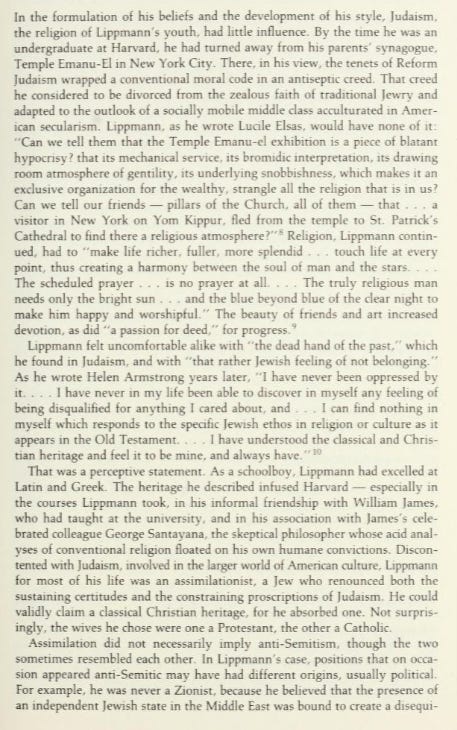
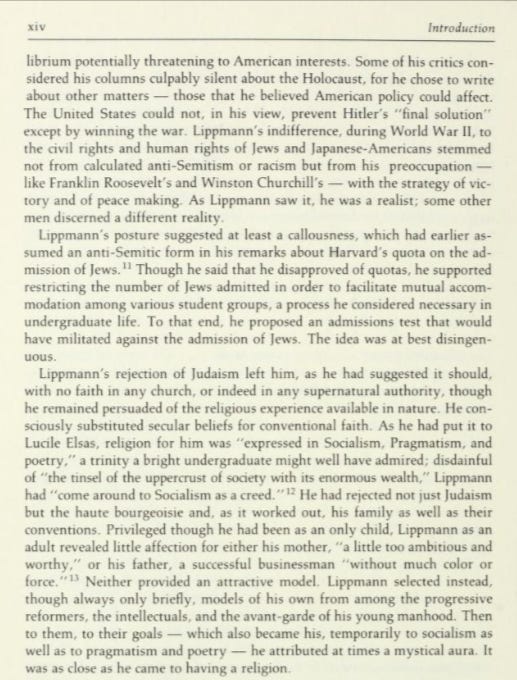
In John Morton Blum’s book Public Philosopher : The Selected Letters of Walter Lippmann presents Lippmann development on the question of Judaism, in his life and thought, sans the accusatory and shaming rhetoric of Berlin! Pages xiii to xiv
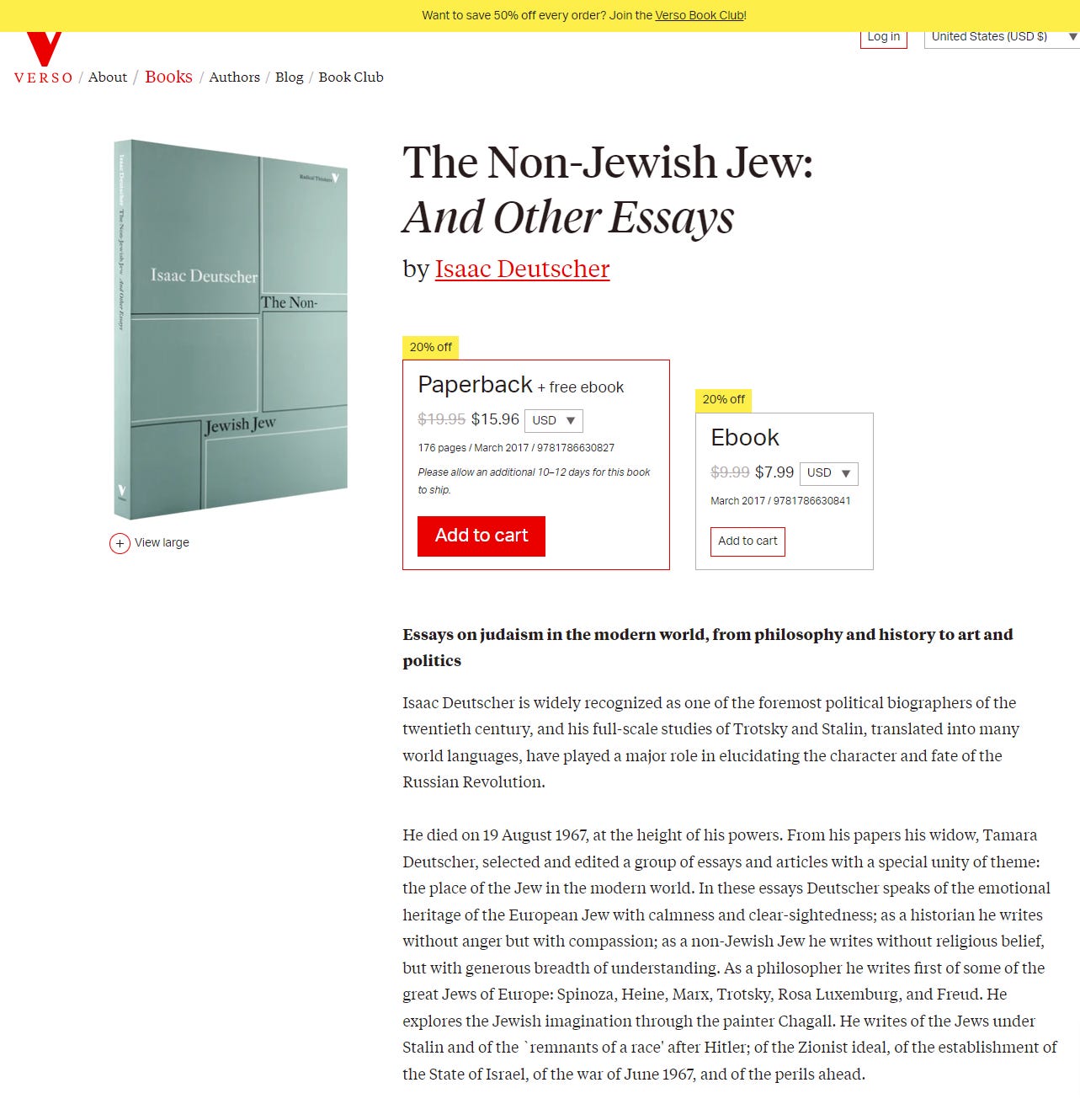
Here is a book of interest that should provide some insights into Isaac Deutscher as writer/thinker/Non-Jew:
Mr. Stephens first paragraph is instructive as to his self-serving ‘analysis’ of a snapshot of the bad actors in his melodrama. I will highlight these in bold font.
When historians look back on the early days of 2024, they probably won’t recall what, precisely, an elderly Democratic president couldn’t quite remember about the names or countries of other world leaders. They will note what 26 Senate Republicans chose to forget about world leadership.
…
On paper, the 70-to-29 vote looks like a bipartisan embrace of embattled democratic allies.
…
Republicans reverted to the isolationism of the original America First Committee of pre-World War II infamy.
…
…Oklahoma’s James Lankford. The cynicism would be breathtaking if it weren’t so predictable coming from the Trumpified right.
…Ron Johnson, we have the claim that although Vladimir Putin is “an evil war criminal,” Russia is certain to win the war,…
…
…J.D. Vance, this: “The supplemental represents an attempt by the foreign policy blob/deep state to stop President Trump from pursuing his desired policy.”
Mr Stephens inserts his diagnosis of the political opportunists:
What a mix of cruelty, defeatism, conspiracy-mongering and political servility.
Karen Sullivan offer a relevant study of the authoritarian personality that places Mr. Stephens in a larger historical and moralizing context :
The Inner Lives of Medieval Inquisitors
There have been numerous studies in recent decades of the medieval inquisitions, most emphasizing larger social and political circumstances and neglecting the role of the inquisitors themselves. In this volume, Karen Sullivan sheds much-needed light on these individuals and reveals that they had choices—both the choice of whether to play a part in the orthodox repression of heresy and, more frequently, the choice of whether to approach heretics with zeal or with charity.
In successive chapters on key figures in the Middle Ages—Bernard of Clairvaux, Dominic Guzmán, Conrad of Marburg, Peter of Verona, Bernard Gui, Bernard Délicieux, and Nicholas Eymerich—Sullivan shows that it is possible to discern each inquisitor making personal, moral choices as to what course of action he would take. All medieval clerics recognized that the church should first attempt to correct heretics through repeated admonitions and that, if these admonitions failed, it should then move toward excluding them from society. Yet more charitable clerics preferred to wait for conversion, while zealous clerics preferred not to delay too long before sending heretics to the stake. By considering not the external prosecution of heretics during the Middles Ages, but the internal motivations of the preachers and inquisitors who pursued them, as represented in their writings and in those of their peers, The Inner Lives of Medieval Inquisitors explores how it is that the most idealistic of purposes can lead to the justification of such dark ends.
Mr. Stephens self-presentation in this paragraph, is predictably self-congratulatory, yet The Reader confronts the political history of a Zionist without apology. Stephens engages in self-apologetics, it is his métier.
…
I’m surely among the most pro-Israel commentators around, but I can think of no moral or strategic argument in which hunger and disease among Gaza’s civilians serve anyone’s interests, least of all Israel’s.
…
It also echoes the prewar defeatism of figures like Robert Taft and Joseph Kennedy, who argued against helping Britain during the Blitz because Hitler was destined to win.
…
Today’s G.O.P. isolationists now have more in common with George McGovern’s “Come home, America” slogan than with anything Ronald Reagan or Dwight Eisenhower stood for.
…
…the Republican riposte to these failures reminds me of something the theoretical physicist Wolfgang Pauli reportedly said about a young physicist’s work: “It is not even wrong” —…
…
any more than a patient should put off getting a skin cancer removed until he loses 50 pounds. It is an idiotic linkage guaranteed to do harm.
…
In January 1945, Arthur H. Vandenberg, a Michigan Republican, gave a landmark Senate speech now remembered as the moment when his party finally began to put its reflexive isolationism behind it.
…
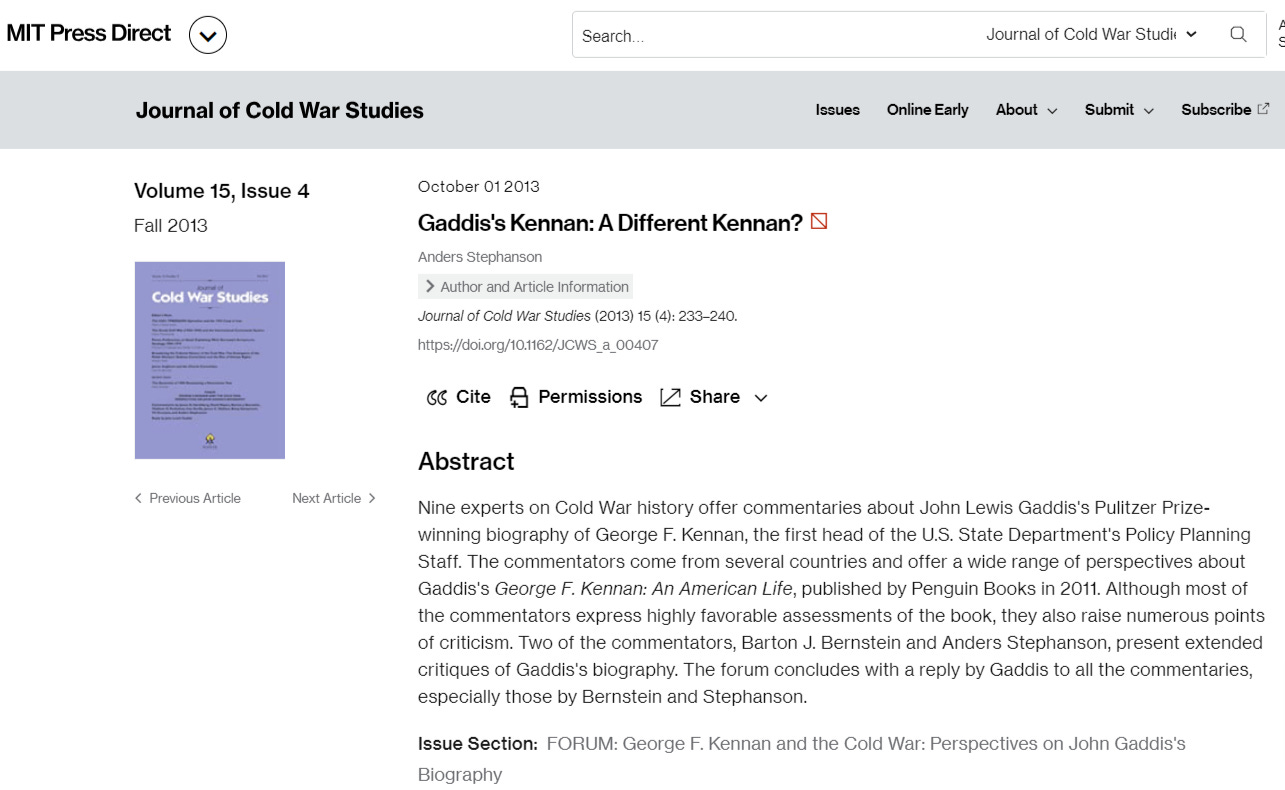
Mr. Stephens ransacks ‘History’ its ‘Bad Actors’ while Vandenberg and his arrival at an Enlightened position, while willfully forgetting George Kennan of The Long Telegram… Read the Fall 2013 of the Journal of Cold War Studies for a collection critical commentary on ‘Gaddis’s George F. Kennan: An American Life .
The eternally bumptious Stephens scolding of George McGovern, is just another reminder of his political posturing as a reliable New York Times Public Intellectual!
Mr. Lloyd proves that he riffs on certain themes of both Tories, and the Blairite political infatuation, with Mrs. Thatcher’s Hayekian toxic political/economic kitsch.
The Webb’s would, in fact find, this tantamount to a betrayal of what they advocated/practiced, in ‘The New Statesman’ .
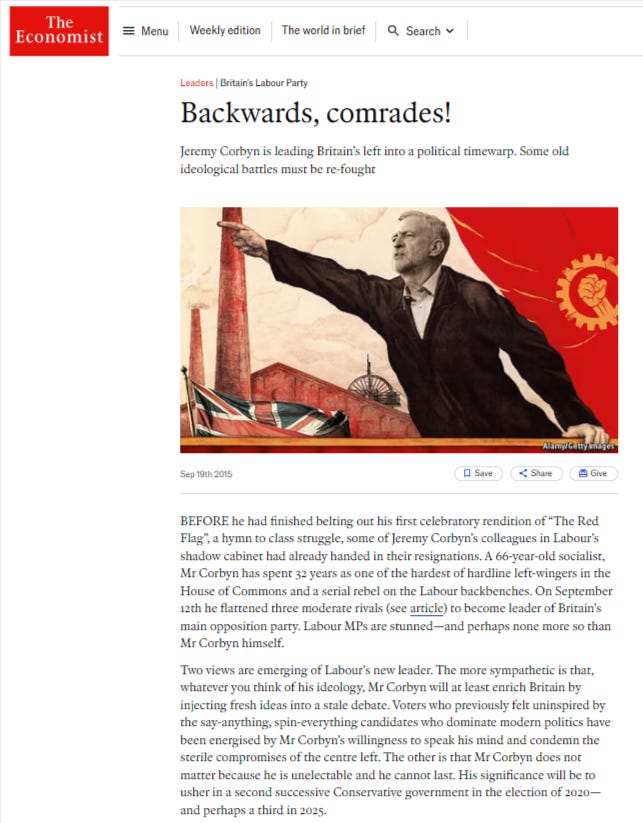
Today Labour promises less than it promised during the Corbyn years. But those promises often felt like charity, dreamt up by the privately-educated Marxists around him, with little understanding of working-class people.
In sum Corbyn was manipulated by ‘the privately-educated Marxists around him’ Mr. Lloyd recites a not quite well worn inditement of Corbyn, here given etiolated pictorial expression in The Economist!
On the Question of Starmer: he is Blair’s undemanding/un-imaginative political creature. This from The Financial Times interview of Lynton Crosby from September 19, 2020, offers some insights on Starmer:
Crosby backs Johnson to neuter EU with a ‘bit of crazy’ negotiation
Former adviser says British PM can secure trade deal and see off Labour’s Starmer at next election.
Lynton Crosby, the Australian strategist dubbed the “wizard of Oz” by clients, said Mr Johnson could win a fifth successive election for the Tory party in 2024 despite criticism over his handling of the Covid-19 pandemic.
In contrast, Labour leader Keir Starmer would struggle to dethrone the prime minister because he is risk averse, viewed as part of the political establishment and faces intense scrutiny over his time as director of public prosecutions, he added.
“In the past, the EU has thought Britain’s an easy touch and in the end they’ll roll over. And, you know, in negotiations, like this you need a little bit of crazy to keep your opponents guessing,” Sir Lynton told the Financial Times.
Political Cynic comments upon ‘The Sky Is Falling Political Melodrama’ .
Carol Tavris reviews two books for The Times Literary Supplement of February 9, 2024. I’ll focus on one of her enthusiasm: ‘The Canceling of The American Mind:How cancel culture undermines trust, destroys institutions, and threatens us all’ 464pp. Allen Lane. £25. by Greg Lukianoff and Rikki Schlott
Ms. Tavris offers thumbnail descriptions of both the authors:
Lukianoff, a lifelong liberal who joined the Foundation for Individual Rights and Expression (FIRE) in 2001, and is now its CEO, is well positioned to survey the changing landscape and report from the trenches.
Here is an extensive, and well deserved caustic review of Greg Lukianoff and Jonathan Haidt’s ‘The Coddling of the American Mind’ by John K. Wilson of December 28, 2018. The precursor to ‘The Canceling’ !
The Myth of the Campus Coddle Crisis: The Coddling of the American Mind
I’ll quote the last five devastating paragraphs of Mr. Wilson’s review:
…
There is no better example of “good vs. evil” thinking than claiming that we have to choose King or Hitler as our models. And the notion that “religion and patriotism” help unify us by appealing to a common humanity is a laughable claim in the age of Trump. The fact is, everybody tends to invoke common enemies, including Haidt and Lukianoff.
Haidt and Lukianoff have a blind spot that’s common among people who denounce Manichean thinking. They ignore their own Manichean tendencies. The whole idea of FIRE is deeply Manichean: FIRE is the good, and the censors are evil. That’s a story FIRE tells over and over again. And it’s a true story. They urge “taking a generous view of other people”(14) which is odd considering how thoroughly they denounce people who invoke concepts like microaggressions. For example, Haidt denounces the president of LSU for once saying something as innocuous as, “we’ll keep you safe here.”(199) But there’s nothing wrong with physical safety, and no reason to believe that this president was promising psychological safety by banishing any ideas that students might find offensive.
By psychologizing the problem of censorship, Haidt and Lukianoff lead us down a delusional path. They imagine that if only we could persuade people to talk about our common humanity, rather than our common enemies, we would eliminate the motivation to censor. But that’s an impossible task, and the only way to achieve it would be by massive repression of those who talk about common enemies.
The problem is not that some people have bad ideas. The problem is when institutions use censorship to try to suppress bad ideas. When you decide to target bad thinking rather than censorship, as Haidt and Lukianoff do in this book, you’re actually contributing to the problem. Many readers may respond to Haidt and Lukianoff’s book, as many conservatives have responded to the PC wars on campus, by concluding that we don’t need to get rid of campus censorship, we just need to start censoring the bad ideas. If common-enemy identity politics is the ultimate source of evil on campus, why shouldn’t we strive to eliminate it by firing the professors who are spreading these terrible ideas like a plague?
Haidt and Lukianoff seek to medicalize the campus free speech problem and offer their preferred mental health approach of CBT as the solution. If only we could cure these poor unfortunate young’uns and their sick thoughts, they think, the campus free speech problem would be solved. The entire history of higher education begs to differ with them. If we had censorship before safetyism (and we obviously did), that suggests safetyism isn’t the core cause of repression on campus. Every generation brings a few new excuses for censorship. But these generational differences are of little importance. Even if you could banish safetyism from the world, people would gravitate to another reason for silencing views they don’t like.
Rikki Schlott bills herself as a Libertarian troublemaker @NYPost. With a comment by Steven Pinker.
“Belies the accusation that the younger generation has been hijacked by authoritarians” – Steven Pinker
Greg Lukianoff must be desperate for partners in the business of ‘The Sky Is Falling Political Melodrama’ ! Recall that Lukianoff & Jonathan Haidt’s ‘The Coddling of the American Mind’ was modeled on Allan Bloom’s ‘The Closing of the American Mind’? or just engaged in some literary shoplifting, of the title, as part of sales promotion campaign. Carol Tavris does not offer a critical review, but treats Lukianoff/Schlott’s book as political revelation :
…
The Canceling of the American Mind, Greg Lukianoff and Rikki Schlott’s extensive assessment of the origins and extent of the problem, documents case after enraging case that escalated in the years since Hindley. (The “American” mind extends to Canada and the UK.) Lukianoff, a lifelong liberal who joined the Foundation for Individual Rights and Expression (FIRE) in 2001, and is now its CEO, is well positioned to survey the changing landscape and report from the trenches. Schlott, a “right-leaning libertarian”, is a Gen Z journalist. Their collaboration is the point: left and right staking out a path between extremes of both sides.
Lukianoff and Schlott’s definition of cancel culture is broader than the individuals who are “fired, disinvited, deplatformed, or otherwise punished” for speech that should be protected by America’s First Amendment standards. Their definition adds “… and the climate of fear and conformity that has resulted”. In polls they cite, the majority of Americans of all parties and ages are reluctant to share their views on topics of politics, race, sexual orientation, gender or religion, fearing loss of their jobs, grades or social support. In the preface, the social psychologist Jonathan Haidt, who was co-author with Lukianoff on this book’s predecessor The Coddling of the American Mind (2018), notes that cancel culture “has metastasized and spread far beyond universities … [now infecting] journalism, the arts, nonprofits, K-12 education, and even medicine”. Because cancel culture seeks to punish anyone who says or does the “wrong” thing, absent knowledge of their motivation or context, people censor themselves. “Show me an organization where people are afraid to speak up, afraid to challenge dominant ideas lest they be destroyed socially,” Haidt adds, “and I’ll show you an organization that has become structurally stupid, unmoored from reality, and unable to achieve its mission.”
Many organizations and institutions now fit that description, including Harvard and other elite universities, the ACLU, even the Unitarian Universalist Church, and Lukianoff and Schlott offer an illuminating history of the “slow-motion trainwreck” by which they went off the rails. The “First Great Age of Political Correctness, 1985–1995” gave us the term, pretty much confined to college campuses; its pompous usages were eventually laughed off. But there was nothing funny about the ensuing shift of position by the political left, which began equating freedom of speech, which it had long championed as a bedrock liberal value, with freedom of hate speech, which it was determined to eradicate. Social justice goals began trampling the once inviolate goal of protecting minority opinions, even if “hateful” opinions come from the minority individuals whose rights you otherwise care about. And who defines what “hate speech” is? We all agree that slurs and insults count. But am I guilty of hate speech if I publish a study whose findings you find hateful, hold an opinion about racism or gender that doesn’t conform to yours, or speak Words That Must Not Be Said? In the UK, Lukianoff and Schlott report, more than 3,000 people in 2016 alone were “detained and questioned by police for non-crime ‘hate incidents’ related to what they had said on-line”.
Between 1995 and 2013, the authors write, “viewpoint diversity on college campuses plummeted, tuition skyrocketed, and campus bureaucracy swelled”. In 2010 cancel culture “struck like lightning on college campuses”. The new generation of anti-free-speech activists began demanding speech codes, trigger warnings and the monitoring of “microaggressions”. Speakers – the famous, the eminent, the provocative – were being disinvited, which made national news, which generated more speaker bans. DEI (Diversity, Equity, and Inclusion) policies, at first a well-intentioned and overdue approach to making universities and companies more welcoming of people of colour, have become, as Lukianoff and Schlott document, an “ideological litmus test” that faculty and students question at their peril. Students applying for admission and scholars applying for academic positions must display evidence of their commitment to diversity and social justice, but only some kinds of diversity are acceptable: if you care about including working-class people, economically disadvantaged people or conservative people, forget it. Everyone knows the rule: conform or you’re out.
Two other societal factors fed into cancel culture. By 2013 university administrators had enacted policies that accommodated new student “demands” because they couldn’t afford not to. Once students became high-paying consumers rather than, well, students, administrators had to retain them no matter how badly they behaved, no matter how many rules of civil discourse they violated. With a student’s high tuition at stake, deciding between a professor’s expertise and a student’s hurt feelings was a no-brainer. And why the hurt feelings? The year 2013, as Haidt and Lukianoff have argued, also marked the emergence of a generation of overprotected, “overcoddled” children. In their view parents’ panic over their children’s physical and emotional safety led them sharply to curtail their free play and independence, while intervening constantly to protect them from the challenges, shocks, setbacks, teasing, risks, disappointments, anxieties and losses that we all need to become socially and emotionally competent. The result was a cohort of fearful, fragile young adults obsessed with finding safe spaces and safe ideas, with trigger warnings to help them avoid dangerous ideas.
…
Like Allen Bloom, and his almost inheritors Haidt & Lukianoff, and now the low-brow Lukianoff & Schlott the enemy of the political present is our own children! Call it by it’s name bourgeois political nihilism !
Here is a review by Carol Tavris of June 5, 1983 @NYT
THE HEARTS OF MEN, American Dreams and the Flight From Commitment. By Barbara Ehrenreich. 206 pp. New York: Anchor Press/Doubleday. $13.95.
…
Diagnosis matters if men and women are to travel beyond blaming. As it is, Miss Ehrenreich shrinks from the gloomy conclusions of her own account – that men will continue to pursue their own economic and psychological self-interest and women will have to fend for themselves and their children. Perhaps, she suggests wistfully, ”the male revolt can be seen as a blow against a system of social control which operates to make men unquestioning and obedient employees. If men are not strapped into the role of breadwinners, perhaps they will be less compliant as assemblers of nuclear weapons, producers of toxic wastes, or as white-collar operatives of the remote and unaccountable corporations.”
This sounds like the early feminist vision of women entering the worlds of government and business and transforming them into arenas of warmth and nurturance. Still, this lively book will do much to get men back into the conversation.
The final paragraphs of Tavris’ essay demonstrates, in the review of Ehrenreich book, that she can write an engaging critical analysis. Yet Tavris places herself outside the political/sexual/human context, of what she is commenting upon. Have times changed so much from 1983 to the present?
Mr. Stephens in his latest contribution to @NYT . Under the pretentious rubric:
Opinion
The Point
Conversations and insights about the moment.
Updated
Feb. 2, 2024, 9:24 p.m.
Mr. Stephens is a bellicose Neo-Con, without any kind of military experience. Yet he places his faith, based upon a complete ignorance of what war might be, or its imperatives, based on a Military model of 1988. As a Neo-Con he, perhaps, draws on the expertise of his fellow Neo-Cons, in the area of effective Military Strategy? Yet the lessons of Afghanistan, Iraq and Ukraine prove that the Neo-Conservative cadre has produced murder, chaos and political instability on a World Historical Scale!
B.A. with honors from the University of Chicago, and an M.Sc. from the London School of Economics: The Master of Science (M.Sc.) is an academic degree for post-graduate candidates or researchers, it usually takes from 4 to 7 years after passing the Bachelor … confers ‘expertise’ upon its graduates?
The last four paragraphs of Mr. Stephens essay are revelatory of his posturing!
The Biden administration has responded to some of these previous attacks with precision strikes — attempting to send a message to Tehran while hoping to avoid escalation. It hasn’t worked. To adapt an adage attributed to Leon Trotsky, we may not be interested in making war on Iran, but Iran is interested in making war on us.
What could get Tehran to stand down, at least for a time? Not attacking their proxies, which are now surely dispersing their forces in anticipation of U.S. strikes. A better model was 1988’s Operation Praying Mantis, a military operation launched in retaliation for an Iranian mine that nearly sank an American frigate during a period when Tehran was constantly attacking oil shipping in the Persian Gulf.
In that daylong engagement, the U.S. Navy sank six Iranian ships and destroyed two Iranian intelligence facilities on old oil platforms. Tehran got the point. Praying Mantis helped end Iran’s attacks on international shipping, and it was one of the factors that finally persuaded Iran’s leaders to agree to an end to the Iran-Iraq war.
Iran has used its proxies to start fires across the Middle East. They won’t be put out until the arsonist is taken down.
This will acquaint The Reader of Mr. Stephens with Edwin M. Yoder’s book about Joe Alsop, a political commentator who did not serve in WWII, but was in the Asian Theater of that War, and covered the war in Korea.
See this review of Mr. Yoder’s book in the Times of April 2, 1995, Section 7, Page 9:
JOE ALSOP’S COLD WARA Study of Journalistic Influence and Intrigue. By Edwin M. Yoder Jr.220 pp. Chapel Hill: University of North Carolina Press. $24.95.
NEWSPAPER columnists once wielded more power over Washington than television anchors do today. Walter Lippmann, James Reston and the Alsops, Joe and his younger brother Stewart, to name some of the most notable, pounded home, three or four times weekly, inside stories of palace intrigues, mythologically potent notions of “missile gaps” and “domino theories” and galleries of dragon slayers and dragons. Politicians and policy makers listened. They had to.
The columnists, with their five-star social and professional connections, knew more about what was going on in Byzantium-on-the-Potomac than Presidents and Speakers of the House. Everyone talked to them privately, and everyone knew that everyone talked to them privately. Not least, they could wound foes and protect friends. And they did, with much the same sting that William Safire, perhaps alone, possesses today.
“Walter Lippmann and the American Century,” Ronald Steel’s life of Lippmann, set a magisterial standard for understanding those days. Edwin M. Yoder Jr., himself a respected columnist for The Washington Post Writers Group and a former editorial page editor at The Washington Star, did not aim so high in “Joe Alsop’s Cold War.” Rightly so, as editorial writers are wont to put it, for Joseph Alsop could not rival Walter Lippmann’s mind or James Reston’s reportorial skills.
But Joe Alsop was a clever journalistic intriguer and influencemonger, as Mr. Yoder signals in his subtitle, a man decidedly of a class and type, yet unique — and important. As a member of the Winthrop and Chubb clans, Alsop had the ultimate WASP pedigree, manners and restraint, yet the same zest for public brawls as his cousins Theodore and Franklin Roosevelt. He wrote hatchetlike columns and a book on Chinese art. He also was a columnist who would brutalize the challengers of his outsized estimate of the Soviet threat, yet valiantly defend victims of redbaiting like the State Department adviser John Paton Davies and the physicist J. Robert Oppenheimer.
…
Mr. Stephens is a Zionist apologist/partisan and political propagandist, the Alsop Brothers were political operators and propagandists, with reach and influence for a reason! They were part of a long gone American Patrician Class, as explored in Mr. Yoder’s book, and Gregg Herken’s insightful book, that sometimes lapses into bestseller territory ‘The Georgetown Set’.
Like the Alsop brothers, who attended the Groton School for Boys, in Groton, Massachusetts, under the tutelage of the storied Endicott Peabody, Stephens attended an exclusive boys school Middlesex School in Concord, Massachusetts: so a sense of entitlement, attached to the pretense of expertise, is a natural attitude for Stephens to manifest?
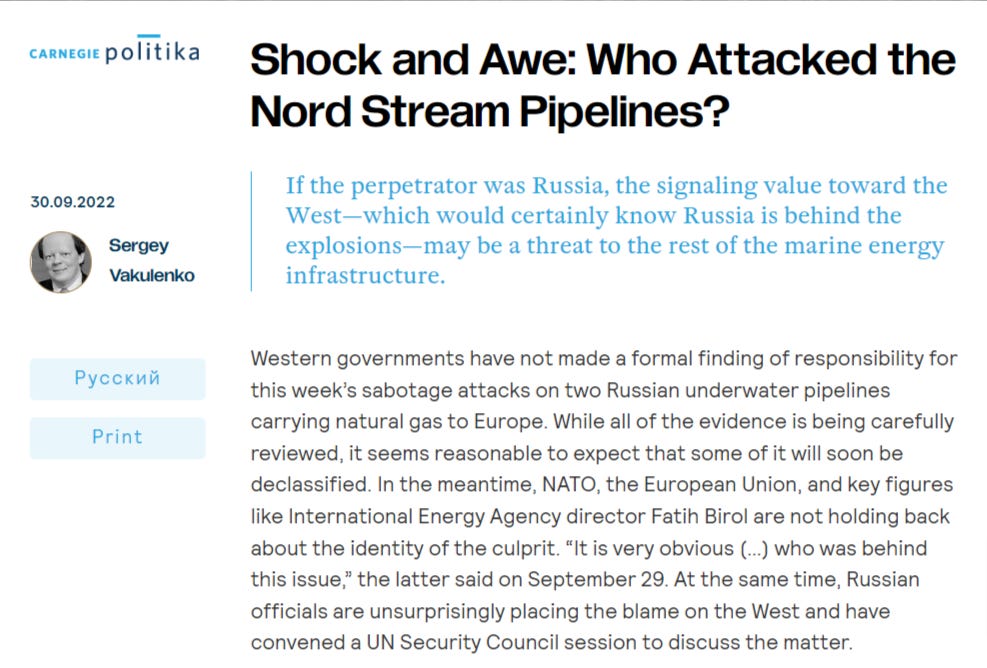
Constanze Stelzenmüller writes with the authority of a practiced journalist/propagandist. While careful in avoiding the attack on the Nord Stream Pipeline, as reported by her colleague who places, in the most maladroit way, the Russians. As part of a necessary framework for her evaluation of German politics, yet this direct attack on German Sovereignty was an Act of War against an ally! That might cause political reverberations over time, does not occur to a Political Technocrat? Although an operative of an American financed Think Tank might operate as an apologist!
Nord Stream, The Pan-European ‘Farmers Strike’, the American fomented and financed War in Ukraine, the reverberations of the Israel’s Genocide, and the enforced Famine against the Palestinians, also frames her political commentary, by their utter absence: keeping in mind that propaganda is tailored to an audience of readers, listeners, viewers , in this case a Financial Times reader. Which is not say that her essay is not readable, informative and instructive to a point, excuse my tortured syntax! The final paragraph invokes ‘The West’, but it appears in lower case , the very diminution of what a proper noun is!
In truth, it is much too early to say whether any of these extreme parties will succeed. But their presence will render Germany volatile and unpredictable in a year of high-stakes politics across the west. It will also make forming coalitions, and governing, more difficult. That could play into the hands of the extremists. But Scholz’s unhappy coalition in Berlin could take encouragement from those cheerful marchers: Germany’s middle is silent no more.
Headline: Abolish the U.N.’s Palestinian Refugee Agency
Is it predictable that three New York Times Public Intellectual’s Friedman/Brooks/Stephens should all be parties to the Gaza Genocide, and the Famine that is unfolding now? The first paragraphs of Stephens’ would be ‘bill of attainder’.
United Nations agencies and officials are no strangers to scandal and infamy.
Now comes the latest scandal of the United Nations Relief and Works Agency for Palestinian Refugees, better known as UNRWA.
Last Friday, Israeli officials presented the U.S. government with an intelligence dossier detailing the involvement of 12 UNRWA employees, seven of them schoolteachers, in the massacre of Oct. 7. As reported by The Times’s Ronen Bergman and Patrick Kingsley, the charges range from kidnapping an Israeli woman to storing rocket-propelled grenades to murdering civilians in a kibbutz.
Awful enough — and the U.N. rightly moved swiftly to terminate the employment of nine of those identified by the dossier. But that may be the least of it. “Intelligence estimates shared with the U.S. conclude that around 1,200 of UNRWA’s roughly 12,000 employees in Gaza have links to Hamas or Palestinian Islamic Jihad, and about half have close relatives who belong to the Islamist militant groups,” The Wall Street Journal reported on Monday.
…
‘Scandal and Infamy’ reeks of high dungeon. Yet Mr. Stephens like the Neo-Conservative he is, seeks to offer a Crime, that does not quite match the Zionist Crime of Genocide and Famine: though if true merits attention, and remedial legal action.
The Neo-Conservatives seeks to muddy the water of debate about crime, via mis-direction. Leo Strauss attempted to re-write the History of Philosophy, self-presenting as the holder of the vital interpretive key, that lay unnoticed for millennia? Zionist Loyalist Bret Stephens, in the present, offers himself as that indispensable political actor?
…
Defenders of UNRWA insist that without it, Palestinian civilians will suffer even more. But there is no reason other international agencies can’t shoulder the burden of the immediate relief effort for Gazans. In the meantime, the Biden administration and other governments need to ask hard questions of UNRWA’s senior officials, starting with Commissioner General Philippe Lazzarini.
To wit: If Lazzarini and his deputies didn’t know that UNRWA in Gaza was employing potentially hundreds of Hamas members or sympathizers, what sort of oversight were they exercising? And if they did know, are they not responsible? In either case — gross negligence or quiet complicity — they need to resign now.
The Israeli-Palestinian conflict should not be insoluble. But it can’t be solved so long as millions of Palestinians have been turned into the world’s only permanent refugees. By doing that, UNRWA makes itself an obstacle to peace — reason enough for it to finally go away.


 StephenKMackSD's Blog