The Trump Victory in The Supreme Court via @FT …

Political Cynic takes @FT pulse!

US Supreme Court rules that Donald Trump can remain on Colorado ballot

Decision is victory for former president and removes one obstacle in his run for White House US Supreme Court rules that Donald Trump can remain on Colorado ballot

https://www.ft.com/content/c90cfe99-a1bc-4dbc-9350-53aab0b66387

The Reader might start her inquiry of this Financial Times ‘report’ by this essay about Schenck v. United States: which is relevant to the Trump decision, no matter the resistance of the Oxbridger cadre of the Financial Times!

DEEP DIVE

Rereading Schenck v. United States

Please don’t falsely yell fire in a crowded theater.

BY EVELYN DOUEK & GENEVIEVE LAKIER

JULY 7, 2022

Analogies get misused all the time. Take, for example, the other famous metaphor Holmes introduced into American free speech law: namely, the metaphor of the “free trade,” or marketplace of ideas. This metaphor is frequently invoked on the other side of free speech debates, to suggest that speech regulation is somehow illegitimate because it interferes with the operation of an ideal speech market. Like the analogy to false cries of fire in a theater, the evocative power of this metaphor makes it a powerful weapon in free speech debates, and one that gets used to justify a deregulatory conception of free speech that ignores plenty of evidence of market failures in many arenas.

That analogies can be misused does not mean, however, that we should—or could—embrace an analogy-free legal debate. Analogies are also useful because they translate difficult conceptual ideas into more accessible language. They concretize complicated concepts and therefore broaden the base of people who can engage in the relevant debates. They can even, as is the case with the fire meme, be enlightening by highlighting the false factual premises that the analogizer is relying on.

This is why, even though we had some hesitation about adding fuel to the (ahem) fire of the debate about Holmes’ analogy, we thought it worthwhile to explore what not-so-flickering light the fire meme sheds on First Amendment law. To dismiss the invocation of the meme as a sign of ignorance or stupidity is to try to transform an important legal, public, and cultural debate about the proper regulation of speech in modern society into a technocratic debate about “holdings” and “dicta” (which, to reiterate, is a poor description of the meme’s doctrinal status today!) and to distract from the substantive issue.

The focus should remain on what is really troubling about most uses of the meme: not the invocation of a hypothetical that states a valid principle of First Amendment law, but the mistaken supposition about how people are affected by information they consume that motivates many of those who invoke the analogy in contemporary debates. False and inflammatory speech online is equated with speech acts that have coercive force. Participants in public discourse are too often characterized as mere automatons who can be made to join a stampede (or storming of the Capitol) at any moment. It is better to confront this incorrect view head-on even if that is harder to do than attempting to extinguish cries of false cries of fire in theaters.

In this case ‘no matter how odious’ Trump may be to the bourgeoise politics of the Financial Times. Reader recall :

Eugene Debs: When a prisoner ran for president

By Thomas Doherty April 21, 2023

Thomas Doherty is a professor of American Studies at Brandeis. This article originally appeared on The Conversation.

On April 4, 2023, Manhattan District Attorney Alvin Bragg announced the indictment of former president and current presidential candidate Donald Trump on 34 felony charges related to alleged crimes involving bookkeeping on a 7-year-old hush money payment to an adult film actress.

Trump is unlikely to wind up in an orange jumpsuit, at least not on this indictment, and probably not before November 2024, in any case. Yet if he does, he would not be the first candidate to run for the White House from the Big House.

In the election of 1920, Eugene V. Debs, the Socialist Party presidential candidate, polled nearly a million votes without ever hitting the campaign trail.

Debs was behind bars in the federal penitentiary in Atlanta, Georgia, serving a 10-year sentence for sedition. It was a not a bum rap. Debs had defiantly disobeyed a law he deemed unjust, the Sedition Act of 1918.

The act was an anti-free speech measure passed at the behest of President Woodrow Wilson. The law made it illegal for a U.S. citizen to “willfully utter, print, write, or publish any disloyal, profane, scurrilous, or abusive language about the United States government” or to discourage compliance with the draft or voluntary enlistment into the military.

By the time he was imprisoned for sedition, Eugene Victor Debs had enjoyed a lifetime of running afoul of government authority. Born in 1855 into bourgeois comfort in Terre Haute, Indiana, he worked as a clerk and a grocer before joining the Brotherhood of Locomotive Firemen in 1875 and finding his vocation as an advocate for labor.

Representing American socialism

For the next 30 years, Debs was the face of socialism in America. He ran for president four times, in 1900, 1904, 1908 and 1912, garnering around a million votes in the last cycle.

“The Republican, Democratic, and Progressive Parties are but branches of the same capitalistic tree,” he told a cheering mass of people in Madison Square Garden during the 1912 campaign. “They all stand for wage slavery.”

In 1916, he opted to seek a seat in Congress and deferred to socialist journalist Allan L. Benson to head the party’s ticket. Both lost.

In April 1917, when America joined World War I’s bloodbath in Europe, Debs became a fierce opponent of American involvement in what he saw as a death cult orchestrated by rapacious munitions manufacturers. On May 21, 1918, wary of a small but energized and eloquent anti-war movement, Wilson signed the Sedition Act into law.

Debs would not be muzzled. One June 18, 1918, in an address in Canton, Ohio, he declared that American boys were “fit for something better than for cannon fodder.”

In short order, he was arrested and convicted of violating the Sedition Act. At his sentencing, he told the judge he would not retract a word of his speech even if it meant he would spend the rest of his life behind bars. “I ask for no mercy, plead for no immunity,” he declared. After a brief stint in the West Virginia Federal Penitentiary, he was sent to serve out his sentence at the Atlanta Federal Penitentiary.

Imprisonment only enhanced Debs’ status with his followers. On May 13, 1920, at its national convention in New York, the Socialist Party unanimously nominated “Convict 2253” as its standard bearer for the presidency. Debs was later given new digits, so the campaign buttons read “For President, Convict No. 9653.”

As Debs’ name was entered into nomination, a wave of emotion swept over the delegates, who cheered for 30 minutes before bursting into a rousing chorus of the “Internationale,” the communist anthem.

A ‘front cell’ campaign

Debs’ opponents both were better funded and enjoyed freedom of movement: They were Warren G. Harding, the GOP junior senator from Ohio, and James M. Cox, governor of Ohio, for the Democrats.

Yet Debs did not let incarceration keep his message from the voters. In a wry response to Harding’s “front porch” campaign style, in which the Republican candidate received visits from the front porch of his home in Marion, Ohio, the Socialist Party announced that its candidate would conduct a “front cell” campaign from Atlanta.

In 1920, broadcast radio was not a factor in electioneering, but another electronic medium was just beginning to be exploited for political messaging. On May 29, 1920, in a carefully choreographed event, newsreel cameras filmed a delegation from the Socialist Party arriving at the Atlanta penitentiary to inform Debs officially of his nomination. The intertitles of the silent screen described “the most unusual scene in the political history of America – Debs, serving a ten-year term for ‘seditious activities,’ accepts Socialist nomination for Presidency.”

After accepting “a floral tribute from Socialist women voters,” the “Moving Picture Weekly” reported, the denim-clad Debs was shown giving “a final affectionate farewell” before heading “back to the prison cell for nine years longer.”

At motion picture theaters across the nation, audiences watched the staged ritual and, depending on their party registration, reacted with cheers or hisses.

The New York Times was aghast that a felon might canvass for votes from the motion picture screen.

“Under the influence of this unreasoning mob psychology, the acknowledged criminal is nightly applauded as loudly as many of the candidates for the Presidency who have won their honorable eminence by great and unflagging service to the American people,” read an editorial from June 12, 1920.

Public opinion turns

On Nov. 2, 1920, when the election results came in, Harding had trounced his Democratic opponent by a record electoral majority, 404 electoral votes to Cox’s 127, with 60.4% of the popular vote to Cox’s 34.1%. Debs was a distant third, but he had won 3.4% of the electorate – 913,693 votes. Debs’ personal best showing was in the presidential election of 1912, with 6% of the vote. To be fair, that was when he was more mobile.

Even with the Great War over and the Sedition Act repealed by a repentant U.S. Congress on Dec. 13, 1920, President Wilson, during his final months in office, steadfastly refused to grant Debs a pardon. But public opinion had turned emphatically in favor of the convict-candidate. President Harding, who took office in March 1921, finally commuted his sentence, effective on Christmas Day, 1921, along with that of 23 other Great War prisoners of conscience convicted under the Sedition Act.

As Debs exited the prison gates, his fellow inmates cheered. He raised his hat in one hand, his cane in the other, and waved back at them. Outside, the newsreel cameras were waiting to greet him.


As senile Old Joe tries to appear, as something other than a Zionists lap-dog, by his Air-Drop of food to the Palestinians: that reeked havoc and death on a desperate population: an enforced famine continues! Trump is a political inevitability. The New-Democrats, The Republicans, The Neo-Cons birthed Trump and recoil at the Monster they made. Not to speak of the fact that this Political Triad offers nothing!

Political Cynic
Posted in Uncategorized | Leave a comment

The ‘Liberal Fukuyama’, in The Financial Times.

Political Cynic offers some thoughts.

Not at all surprising that former Neo-Con, now ‘Liberal’  Fukuyama is plowing the same field that he furrowed in December 8, 2013, with a new cast of characters:

The Ties That Used To Bind

The Decay of American Political Institutions

Francis Fukuyama

We have a problem, but we can’t see it clearly because our focus too often discounts history. 

The days of swooning admiration for his Hegelian pastiche are long gone:

End of History by Francis Fukuyama: A Critique by Shahid H. Raja of Aug 13, 2023 supplies a detailed critique.

Vintage Neo-Conservative Fukuyama, reappears…

The Democrats have a lot of work to do to wake people up to the magnitude of the challenge the country faces. If that happens, there is a possibility that, rather than eking out another narrow victory, they will win decisively. If that happens, they can begin to think about reforms that will reverse the process of decay. Believers in a classically liberal America need to reduce the ability of political minorities to stymie majorities, and streamline our impossibly complex processes and procedures to make government more effective. But first, they need to win.

https://www.ft.com/content/2b204c19-4050-4316-852c-9b0dbfdf23a1

StephenKMackSD

Posted in Uncategorized | Leave a comment

@stephenkb of @FT can’t quite fathom the why of George Galloway’s sweeping win in Rochdale?

Political Observer offers Occam’s razor…

Headline: What George Galloway’s sweeping win in Rochdale says

Sub-headline: His campaign centred on Gaza, a welcome sign for the SNP, which may seek to exploit its difference from Labour’s stance to gain support

https://www.ft.com/content/3a831861-9a36-4945-a050-702daca4223f

What Stephen Bush offers is jejune at best, even garnished with a three color chart, an actual thought process would have helped! This wan paragraph is all The Reader gets.

What does the Rochdale by-election indicate? Not a lot, given that the Labour party abandoned its candidate too late to replace him on the ballot paper and it was too late for the Liberal Democrats — who do have a history in this constituency — to mount a serious crack at it. George Galloway’s campaign was essentially the only serious, organised political machine in town and he duly triumphed handsomely and emphatically despite a very impressive performance by David Tully, a local businessman running as an independent. Galloway won nearly 40 per cent of the vote at 12,335 votes, and Tully came in second at 6,638 votes.

Until it is shanghaied buy this political chatter:

It does suggest a couple of things about the national picture, though. First and foremost, if I were a Scottish National party MP in Glasgow, I would be feeling very happy this morning. I would feel that this result suggests that I can leverage the difference between the SNP and Labour positions on the Israel-Hamas war to my electoral advantage.

Apply Occam’s razor to the question, Mr. Bush must be an Oxbridger !

Occam’s razor, principle stated by the Scholastic philosopher William of Ockham (1285–1347/49) that pluralitas non est ponenda sine necessitate, “plurality should not be posited without necessity.” The principle gives precedence to simplicity: of two competing theories, the simpler explanation of an entity is to be preferred. The principle is also expressed as “Entities are not to be multiplied beyond necessity.”

https://www.britannica.com/topic/Occams-razor

In sum Galloway listened to his constancy! Its politics!

StephenKMackSD

Posted in Uncategorized | Leave a comment

@nytdavidbrooks attempt at playing the role of ‘Centrist’ is always amusing?

Newspaper Reader comments.

The first 570 word chatter is taken up with the paradigmatic figure of Howard Buffet, father of Warren Buffett. Reader proceed with caution when reading Buckley’s protege! A potted history of the Republican Party, with its focus on Howard Buffet, as the major actor, that is then displaced by Brook’s ‘History Made to Measure’ a creature of the opportunism. Enter ‘Historian/Apologist’ Matthew Continetti:

In his superb history of conservatism, “The Right,” Matthew Continetti describes dueling essays in 1989 between the conservative commentators Charles Krauthammer and Pat Buchanan that ran in the pages of The National Interest. Krauthammer argued that America should steer the world away from an unstable multipolar order and toward a more stable “unipolar world whose center is a confederated West.” Buchanan, one of the few remaining spokesmen for the older, isolationist G.O.P., titled his essay “America First — and Second and Third.”

At that time, the party embraced Krauthammer’s vision and rejected Buchanan’s. Within a decade Pat Buchanan had left the Republican Party, thoroughly marginalized. In 1999 the editors of the conservative magazine The Weekly Standard, where I worked, celebrated Buchanan’s departure from the party. In that same issue I wrote a humor piece trying to imagine the most hilariously unlikely version of the G.O.P. future. That piece was headlined “Donald Trump Inaugurated.”

Mr. Brooks then ventures in into the realm of Psychohistory, or its pastiche.

It turns out that some political tendencies never really die; they just lie dormant for a few decades, waiting for the emotional mood to change. It’s conventional to say that Trump destroyed the postwar Republican establishment. That’s not quite right. The Tea Party’s extreme disgust with the course of American life was already flowing by 2009. The Pew Research Center detected a surge in American isolationism back in 2013. In 2004 only 8 percent of Republicans thought the United States’ power in world affairs was declining. By 2013, after Iraq and Afghanistan, 74 percent of Republicans thought American was in decline. By 2021, nearly a third of Republicans thought violence might be necessary to save America. …

Speaking of ‘some political tendencies never really die’ : the Reader needs to acquaint herself with Brooks’ celebration of War & Patriotism, of a particular kind:

The Collapse of the Dream Palaces

April 28, 2003 4:00 am

More Psychohistory :

People often say that history is a battle of ideas, but sometimes it is just a succession of moods. It was a culture of pessimism — Trump’s belief that we’re living in an era of “American carnage” — that restored the old G.O.P., not any set of arguments. America has a dazzling economy and dominant military strength. Military spending as a percentage of G.D.P. is dangerously close to its postwar low. But the Republicans apparently lack the self-confidence to believe they can improve the world, or the willpower to substantially try.

And this wan final paragraph, Howard Buffett makes his return!

Some of my friends believe that after Trump the showman is off the stage, the future of the G.O.P. will be up for grabs. I disagree. Today’s Republicanism has deep roots in American history. I suspect the post-Trump Republicans will be just as inward-looking, but drab and defeatist, without the Trumpian razzle dazzle. Howard Buffett would feel at home.

Mr. Brooks is a New York Times Public Intellectual! The virtues of this form of life is a self-serving political/moral conformity, and a long career at The Paper of Record. The New York Times is the propaganda organ for The American National Security State!

Newspaper Reader

Posted in Uncategorized | Leave a comment

@tomfriedman on ‘Israel Is Losing Its Greatest Asset: Acceptance’

Queer Atheist comments

Tom Friedman’s latest essay focuses on the question of Israel’s loosing ‘acceptance’. Mr. Friedman’s attempt to impresses his readership with his world travels. And the almost hand-wringing white washing, of the Genocide practiced Netanyahu, aided by American arms and material, and crucial votes in the UN.

I’ve spent the past few days traveling from New Delhi to Dubai and Amman, and I have an urgent message to deliver to President Biden and the Israeli people: I am seeing the increasingly rapid erosion of Israel’s standing among friendly nations — a level of acceptance and legitimacy that was painstakingly built up over decades. And if Biden is not careful, America’s global standing will plummet right along with Israel’s.

I don’t think Israelis or the Biden administration fully appreciate the rage that is bubbling up around the world, fueled by social media and TV footage, over the deaths of so many thousands of Palestinian civilians, particularly children, with U.S.-supplied weapons in Israel’s war in Gaza. Hamas has much to answer for in triggering this human tragedy, but Israel and the U.S. are seen as driving events now and getting most of the blame.

That such anger is boiling over in the Arab world is obvious, but I heard it over and over again in conversations in India during the past week — from friends, business leaders, an official and journalists both young and old. That is even more telling because the Hindu-dominated government of Prime Minister Narendra Modi is the only major power in the global south that has supported Israel and consistently blamed Hamas for inviting the massive Israeli retaliation and the deaths of an estimated 30,000 people, according to Gazan health officials, the majority of them civilians.

That many civilian deaths in a relatively short war would be problematic in any context. But when so many civilians die in a retaliatory invasion that was launched by an Israeli government without any political horizon for the morning after — and then, when the Israeli prime minister, Benjamin Netanyahu, finally offers a morning-after plan that essentially says to the world that Israel now intends to occupy both the West Bank and Gaza indefinitely — it is no surprise that Israel’s friends will edge away and the Biden team will start to look hapless.

There is no ‘War in Gaza’: ‘That many civilian deaths in a relatively short war would be problematic in any context’ is the equivocating apologetics of a partisan: as if he were not neck deep in crude Zionist apologetics. But a Genocide and the forced famine against Palestinians: Israel blocking convoys of trucks with food, water, medical supplies, has eluded Friedman. ‘The Storied West’ is sinking in the muck and mire of a Zionism, that has metastasized into a recrudescence of Nazism!

Historical background offered by Anthony Quinton in his review of Paul Lawrence Rose’s book Revolutionary Antisemitism In Germany From Kant to Wagner.’

Princeton University Press, 389 pp., $29.95

Idealists Against the Jews

Anthony Quinton

November 7, 1991 issue

The suggestion of the title of Paul Rose’s imposing book that Kant, the patron saint of liberal humanitarianism, was in fact the initiator of an important, and perhaps the crucial, strand in German anti-Semitism may come as something of a shock. But for this and for a number of other, more comprehensive, propositions, Paul Lawrence Rose has assembled a powerful, if rather single-minded case. In twenty long chapters he presents the results of an enormous amount of reading in the primary and secondary literature of nineteenth-century German intellectual history, which is attested to by the luxuriant fringe of notes dangling at the bottom of nearly every one of the book’s 379 pages of text.

His main thesis is that the modern form of anti-Semitism in Germany started to acquire its peculiar virulence nearly a hundred years before Hitler was born; in 1793, to be precise. This was the year of publication of Kant’s Religion Within The Bounds of Reason, and of a defense of the French Revolution by Fichte, at a time when Fichte had not yet moved from Jacobinism to the emphatic nationalism of which he is best known as the prophet. Kant and Fichte were radicals who were convinced that the time had come for a moral transformation of mankind—or, at any rate; of Germany—through which all people should become truly free and rational moral agents, autonomous directors of their own lives, independent of the constraints of ossified custom and established authority. The Jews, to both of them, exemplified with the greatest intensity the kind of degraded moral existence to which they were opposed.

Rose’s second point is that this kind of fervently moral anti-Semitism is almost entirely the work of left-wing or, he thinks it is better to say, radical or revolutionary thinkers. (He reasonably holds that the terms “left” and “right” are not all that effectively discriminating when they are applied to revolutionaries.) Indeed he presents some evidence which supports his point with almost scientific purity. Those of his thinkers who drifted away from radicalism, either as they got older or through disappointment with the outcome of 1848, also muted or abandoned their anti-Semitism, unlike those who remained radical. Heine is one example. Then there are Karl Gutzkow and Heinrich Laube, members of the “Young German” movement of the 1830s and 1840s. Gutzkow was briefly jailed for his attack on marriage and religious orthodoxy. Although they retracted their anti-Semitism in later life they had made their mark by attacking Jews in their youth. Laube’s view that the Jewish interest in art was essentially commercial was the inspiration of Wagner’s Judaism in Music. Gutzkow, on a more comic level, seems to have been the first to say, or print, the familiar incantation: “Many of my best and dearest friends are Jews.” Marx is the most famous of Rose’s specimens who are conventionally regarded as men of the left. But he includes also Feuerbach and Bruno Bauer.

Queer Atheist

Posted in Uncategorized | Leave a comment

Edward Skidelsky quotes one of the Great Witnesses of the Nazi period, Victor Klemperer, in his public shaming of ‘Right-Wing bigots’

Newspaper Reader comments.

Headline: Academics can no longer speak freely

Sub-headline: Solving this crisis in higher education should transcend the division between the right and the left.

https://www.newstatesman.com/comment/2024/02/academic-free-speech

For many years, left-wing opinion-makers have told us that there is no crisis of free speech in British universities, that the whole idea is a fiction put about by right-wing bigots upset that they can no longer sound off with impunity, or by politicians and journalists intent on stirring up a culture war. To quote Nesrine Malik, writing in the Guardian in 2019, “the purpose of the free-speech-crisis myth is…to blackmail good people into ceding space to bad ideas”.

Anyone who works in a university knows that this is balderdash. The crisis in academia is of course a godsend to the right, but that doesn’t mean that it isn’t also real and serious. Indeed, it is much more serious than most people realise. High-profile cancellations are what make the headlines, but they are merely the occasional effect of something deeper: the capture of entire sections of the academic bureaucracy by ideological lobbies, which insist on imposing their beliefs on all and sundry. We have seen this sort of thing before. 

“Books, newspapers, official communications and forms issued by administrative departments – all swam in the same brown sauce,” wrote the German philologist Victor Klemperer, referring to the monotony of thought and language in Hitler’s Reich. The sauce is no longer brown, but apart from that, Klemperer could be describing a modern British university. 


The Reader might look to this essay by Mr. Skidelsky at ‘The Critic’ from 2021:

Headline: The Specter of Totalitarianism

The worst offenders in the new climate of intolerance are our universities.

https://thecritic.co.uk/issues/march-2021/the-spectre-of-totalitarianism

The new intolerance is often seen as a specifically left-wing phenomenon — an intensification of the “political correctness” which emerged on US campuses in the 1980s. But that is a one-sided view of the matter. It was US Zionists who pioneered the tactic of putting pressure on organisations to disinvite unfavoured speakers; far-right nationalists are among the keenest cyberbullies; and religious zealots of all stripes are prodigal of death threats. 

Generalising, one might say that left-wing groups, being more publicly respectable in our part of the world, prefer to pursue their objectives through institutions and the law, whereas right-wing groups seek out the anonymity of the internet. But the goal on each side is the same: it is to intimidate, suppress, silence. In any case, the distinction between “left” and “right” is becoming increasingly muddled, as lines shift and alliances regroup. All one can safely say is that the various forms of contemporary extremism imitate and incite each other. What has given way is the civilised middle ground.

For this reason, I prefer to speak not of “fascism” or “political correctness” but of “totalitarianism”, a label designed to pick out what is common to fanaticisms of left and right. Totalitarianism is often thought of as a type of regime, which may make my use of the term seem hyperbolic; after all, we still live in a democracy. But it can also be understood in a broad sense, as a frame of mind and a style of political action. Totalitarianism in this broad sense existed in Russia and Germany before the establishment in either country of a totalitarian regime, and it remained a force in West European politics even after the war, if only on the radical fringe. It is totalitarianism in this sense whose recent rise to prominence alarms me. A public inured to totalitarian habits of thought and action is unlikely to offer much resistance to a totalitarian takeover of the state.

Call Mr. Skidelsky a political opportunist, who writes a ‘History Made To Measure’: its like reading The Financial Times Opinion Section.

In the context of these two essays, The Reader might gain from reading Skidelsky’s essay of 1999 on Perry Anderson?

Headline: The New Statesman Profile – Perry Anderson

Sub-headline: He is one of Britain’s great Marxist intellectuals, yet now he seems a strangely conservative figure

https://www.newstatesman.com/politics/welfare/1999/03/the-new-statesman-profile-perry-anderson

Some revelatory quotation:

On Anderson’s critique of Fukuyama, as presented by Skidelsky:

A good example of this is his essay on Francis Fukayama’s The End of History. Fukayama’s grand narrative of historical progress – even though it culminates in the triumph of bourgeois liberal democracy – is of precisely the kind to win Anderson’s admiration. Anderson defends it against its detractors, claiming, on impeccably Marxist grounds, that their various refutations of Fukayama’s hypothesis amount to nothing more than local difficulties, and do not constitute a genuine contradiction. But then – as if suddenly realising what he has admitted – he amasses a whole set of difficulties of his own, ranging from environmental problems to feminism. But these are no more a fundamental contradiction than the difficulties he has previously dismissed. All are manageable within the confines of the present world-system. Fukayama has beaten Anderson at his own game.

Editor: Nothing impressed the intellectual bumkins across continents as much as Fukuyama’s Hegelian inflected chatter. Charlatan !


Editor: added 2/28/2024:

Then there is this dubious commentary about how Anderson must comport himself as a Public Intellectual. Not to speak of Anderson’s romance with ‘Latin American terrorism’.

Anderson is notoriously elusive. No interviews, no broadcasts – and even the London School of Economics, where he is a visiting lecturer, did not have a photograph to contribute to the illustration of this profile. Yet for all his elusiveness, his influence on British intellectual life has been enormous. The conduit of this influence was the New Left Review, the socialist bi-monthly which he edited from 1962 to 1982. Anderson’s goal was the introduction into Britain of a new kind of socialist culture, alternative to both the official Marxism of the Communist Party and the stolid reformism of the Labour Party. His followers saw themselves as a revolutionary vanguard. Inspired by Gramsci, they aimed to establish a socialist hegemony in the realm of ideas from which, they hoped, a revolutionary movement would follow. The leading lights of Continental Marxism – Lucacs, Gramsci, Benjamin, Adorno, Marcuse and Althusser – were published and discussed, often for the first time in Britain. Non-Marxist structuralists such as Lacan and Levi-Strauss were also introduced. High theory was interspersed with the other amour of the era: Latin American terrorism.


Just having re-read The Origins of Post-Modernity, a work of impeccable scholarship, historical insight, not offered by any writer/thinker, other than Fredric Jameson! The reader will note that the claim made by Skidelsky, is the same claim made by the critics of that Post-Modernism, Derrida being the target of choice.

Defeated on the political plane, Anderson has at last succumbed to the “siren voices of idealism”. His latest essay, The Origins of Postmodernity, is a work of cultural criticism in the classic tradition of Benjamin and Adorno. It is essentially a defence and an elaboration of Frederic Jameson’s thesis that postmodernism constitutes “the cultural logic of late capitalism”.

Postmodernism is a natural target of attack for a Marxist. What it signifies is the final disappearance of any critical perspective on the capitalist order. The Soviet Union, for all its imperfections, provided such a perspective, and its existence sustained the avant-garde throughout Europe and America. Now there is nothing but capitalism. Any revolt is immediately assimilated and commodified. Art, realising this, has abandoned its haughty intransigence and entered into alliance with the market. The tone of the essay is one of sorrowful resignation. Anderson can diagnose the malady, but he has no cure.

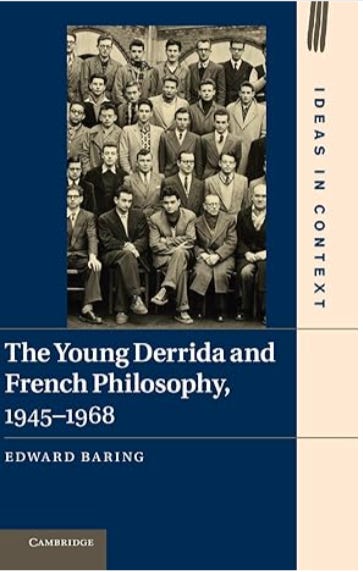
The Young Derrida and French Philosophy. 1945-1968

Edward Baring, Cambridge University Press, 2011, 326pp., $95.00 (hbk), ISBN 9781107009677.

Reviewed by Samir Haddad, Fordham University

2012.08.28

https://ndpr.nd.edu/reviews/the-young-derrida-and-french-philosophy


 Newspaper Reader 

Posted in Uncategorized | Leave a comment

@MelanieLatest self-willed forgetting of the War On Terror, and its crimes against Islamic States & Persons!

Newspaper Reader comments.

Headline: Islamophobia and antisemitism are not the same

Sub-headline: Prejudice against Muslims is deplorable but it’s not bigotry to call out the Islamist threat to Jews

https://www.thetimes.co.uk/article/islamophobia-and-antisemitism-are-not-the-same-nxgrqvxbt

Melanie’s self -willed forgetting of ‘The War On Terror’:

Melanie is a well paid Political Hysteric, whose specialty is to warn of the clear and present danger of Anti-Semitism. Yet these paragraphs below demonstrate that she is fixated on “Islamophobia” is not equivalent to antisemitism.’ Yet the Genocide being perpetrated by the Zionist State against the Palestinians, a Semitic People, can’t be used for furthering the Jewish Victimhood narrative, while Melanie’s focus is the more manageable domestic front, characterized by ‘People of goodwill parrot accusations of Islamophobia through ignorance or fear.’ To reduce Melanie’s ‘argument’ to its simplest terms Jewish Suffering/Victimhood is always Primary !

People of goodwill parrot accusations of Islamophobia through ignorance or fear. British Jewish leaders, with the community’s historic experience of antisemitism uppermost in their minds and eager to show solidarity with other victims of bigotry — and to keep their heads below any cultural parapet — have chosen to accept the definition of Islamophobia at face value. This has had unfortunate effects. Although statistics show the Islamic world is riddled with antisemitism and that “Arabs and Asians” are disproportionately involved in attacks on British Jews, Jewish community leaders never speak about the threat they face from Muslim antisemitism.

“Islamophobia” is not equivalent to antisemitism. It facilitates it. Derailing the parliamentary process last week as a result of threats to MPs over their attitude to a foreign conflict was an inflection point in the encroachment by intimidatory, radical Islamism. That danger must be called out and dealt with. To equate any such call with the Jew-hatred at the theological core of this menacing ideology is as Newspaper self-destructive as it is obscene.

Newspaper Reader

Posted in Uncategorized | Leave a comment

@FT & @TheEconomist @MESandbu on Western Plaster Saint Alexei Navalny.

Old Socialist comments.

Mr. Sandbu has many political admirers, fellow travelers!? The International Monetary Fund, in the person of Paolo Mauro, offers this in the final paragraphs of his review of ‘The Economics of Belonging’ :

His proposed policy package pushes the boundaries of the economics consensus but is not going to shock those who have followed recent debates. Key elements include net wealth taxes, universal basic income (or negative income taxation), and carbon taxes and dividends. Drawing on positive lessons from his native Norway (and an intriguing comparison of automated car washes in Scandinavia and their labor-intensive equivalent in the United States), Sandbu calls for de facto minimum wages. These force employers to select more productive processes, rather than creating low-skill jobs. To avoid the risk of unemployment for the low skilled, he calls for higher spending on education and retraining, as well as forceful demand stimulus. Economists will enjoy debating the pros and cons of each of these policies. Sandbu reasonably points out that they complement one another and work only as a package.

This book is a thorough and compelling overview of recent economic analyses of the factors underlying the electoral travails of the democracy/globalization model. I would have liked the author to venture more into the art of political persuasion. Even if the ultimate source of discontent is economic, political messages that resonate with people’s moral preferences stand a better chance of passing through parliament. Sandbu takes tentative steps in this direction. For example, he presents an intriguing right-wing perspective on universal basic income. He also points out that piecemeal reform efforts may be easier to block than his ambitious package. This reader hopes for more analysis of how to overcome political obstacles in Sandbu’s next columns and books.

Paolo Mauro is highly credentialed : director of the Economic and Market Research Department at the International Finance Corporation.


The Economist on two books, one by Sandbu:

Culture | Rethinking capitalism

Two authors wrestle with inequality and the allure of populism

https://www.economist.com/books-and-arts/2020/06/11/two-authors-wrestle-with-inequality-and-the-allure-of-populism

Martin Sandbu and Gene Sperling support free markets—but fear their power

I will comment on the Sandbu book:

On many measures inequality had not risen much over the preceding decade, or had risen more slowly than in past economic expansions. And yet political systems were gripped by a populist backlash which, at least in part, reflected an indignant reaction against perceived economic injustice. The liberals who had constructed the old order were suffering a crisis of confidence.

As usual the Oxbridgers seem to have ignored, subjected to a convenient erasure, the 2007-2008 Economic Catastrophe. And its many victims who now resort to Political Populism, as a methodology, to address their immiseration at the hands of Mises/Hyak/Friedman Cadre, and its apologists in The Corporate Media!?

In “The Economics of Belonging” Martin Sandbu, a columnist at the Financial Times, excoriates policymakers for unforced errors over recent decades and sets out an agenda for correcting course. In “Economic Dignity” Gene Sperling, a former top economic adviser to Presidents Bill Clinton and Barack Obama, argues for a new value system to underpin American economic policy.

Mr Sandbu’s book is in some respects the more optimistic of the two. He rejects the fatalistic argument that populism is a straightforward revolt against immigration and progressive cultural attitudes. Economic insecurity always triggers angst about culture and suspicion of outsiders, he points out. Fixing the economy, in other words, will heal cultural divides. The key is to get the economic diagnosis right. Trade, immigration and globalisation more broadly are easy scapegoats for lost manufacturing jobs and growing geographical inequality. But it is technological change that has really caused the rise of a service- and knowledge-based economy. The solution, thinks Mr Sandbu, is for governments to forge social contracts fit for technologically advancing economies, not to try to turn back the clock.

Yet his policy proposals do not reflect the “compensate the losers” redistribution for which economists frequently reach. Instead, he favours increasing workers’ productivity and bargaining power so that they are never too dependent on a single employer. To that end, monetary policy must put greater emphasis on keeping labour markets running hot, so that firms compete for workers rather than workers for jobs. Tax-free earnings allowances should be replaced with a small universal basic income, to reinforce safety-nets without laying poverty traps. And governments should direct investments in the knowledge economy, such as publicly funded research, towards places that have been left behind.

Mr Sandbu claims this agenda is not left-wing, and does not require an increase in government spending as a share of gdp. But it does require a recognition that individuals must not completely lose control over their economic fate to market forces. Otherwise, as they endeavour to wrench it back, they may be swayed by extremists.

On a fundamental level, these books are similar in attitude. Messrs Sandbu and Sperling both combine a basic support for free markets with a fear of their power. It is precisely because incentives are so potent that competitive forces must not be allowed to go haywire, as when firms gain an edge by reclassifying their workers as contractors, or by moving to tax havens. Such races-to-the-bottom define many of the policy failures of recent history.

And both books highlight the moral blind spots that many liberals and economists think have been exposed by the era of globalisation (and perhaps by the pandemic, too). Clarifying those problems, and finding solutions that avoid compromising too much on freedom and free markets, is crucial work

I offer the above as a prelude to Sandbu commentary on the question of Navalny. This essay by Alexey Sakhnin offers insights on Sandbu’s funeral oration:

Headline: Named Alexei Navalny Became a Liberal Hero

https://jacobin.com/2021/01/alexei-navalny-russia-protests-putin

Who was Navalny

Like most politicians in modern Russia, Navalny’s worldview was formed under the total dominance of right-wing, market liberal ideology. In 2000, he joined the liberal Yabloko party. In those years, by his own account, he was a classic neoliberal, supporting a regime of low public spending, radical privatization, reduction of social guarantees, “small government,” and total freedom for business.

However, Navalny soon realized that a purely liberal politics has no prospect of success in Russia. For most people, this ideology was discredited by the radical reforms of the 1990s. It symbolized poverty, injustice, inequality, humiliation, and theft. And after pro-Western liberal ideology had lost so much luster in the eyes of the population, it ceased to be of interest to the ruling class either. Following Vladimir Putin, Russian officials, politicians, and oligarchs proclaimed themselves as patriots and true inheritors of the Russian state. Liberal parties turned out to be of no use to anyone.

Navalny soon found a new ideological niche. In the late 2000s, he declared himself a nationalist. He participated in the far-right Russian Marches, waged war on “illegal immigration,” and even launched campaign “Stop Feeding the Caucasus” directed against government subsidies to poor, ethnic minority-populated autonomous regions in the south of the country. It was a time when right-wing sentiments were widespread, and urban youth sympathized with ultra-right groups almost en masse. It seemed to Navalny that this wind would fill his sails — and partly, it worked.

But Navalny did not get lost among the petty nationalist “führers.” He found a special niche that made him a hero far beyond the boundaries of the right-wing radical subculture. He became the country’s main fighter against corruption. He would buy small amounts of shares in large state-owned companies and thus get access to their documents. On this basis, he conducted and published high-profile investigations. Many of them were brilliant journalistic work — though some critics suspected that Navalny was simply involved in the “media wars” among rival financial-industrial groups, receiving “orders” from them and information that compromised their competitors.

In any case, the liberal narrative that corruption is the cause of the ineffectiveness of the state brought Navalny the sympathy of the mass of the middle class. Corporations’ top management and businessmen saw corruption as a major obstacle to their own success. Many subscribed to Navalny’s blog and increasingly sent him monetary donations.

In 2011-13, Russia was swept by a mass movement of protest against the rigging of parliamentary elections and growing authoritarianism, symbolized by Putin’s return to the presidency. Navalny took part in this — but failed to lead it. He got support mostly from middle-class people in the capital and the largest cities. But the working class, and the poor majority in general, did not trust him. They remained indifferent to his anti-corruption agenda, seeing corruption as only one of the techniques for enriching the elite and not the foundation of class inequality.

Indeed, it turned out that left-wing values ​​still have some influence in Russia. In those protests, thousands of people demonstrated under the red flags, and the leader of the Left Front, Sergei Udaltsov, became one of Russia’s most popular politicians. Navalny’s closest aide, Leonid Volkov, said in an interview that it was necessary to convince the Russian elite that an opposition victory would be better for them than a corrupt Putin government. But to do this, it was necessary to get rid of left-wing allies, who scared off big business.

So Navalny split the oppositional coalition and when leftist leaders were thrown in jail, he declined to intercede on their behalf.

Mr. Sandbu essay follows the Party Line on Navalny and Putin , this is The Financial Times! The final paragraphs of Sandbu political moralizing offers the plaster saint of Navalny, or just a convenient Western construct! Who has no relation to Andrei Sakharov, Yelena Bonner, Alexander Solzhenitsyn, Eugenia Semenovna Ginzburg, Varlam Tikhonovich Shalamov, Anna Akhmatova, Osip Mandelstam!

The lesson on both the military and the economic side is the danger of believing in the virtue of caution when that in practice means delay. Early “caution” has prolonged the suffering in Ukraine, emboldened the Russian dictator who thinks he can outwait Kyiv’s western supporters, and increased the cost of pushing him back. Whatever could have been achieved early, can now only be achieved in more time and at greater cost.

Navalny’s message before his last return to Russia was that “the only thing needed for the triumph of evil is for good people to do nothing”. Evil benefits, too, when good people are too cautious. Don’t keep making that mistake.

Old Socialist

Posted in Uncategorized | Leave a comment

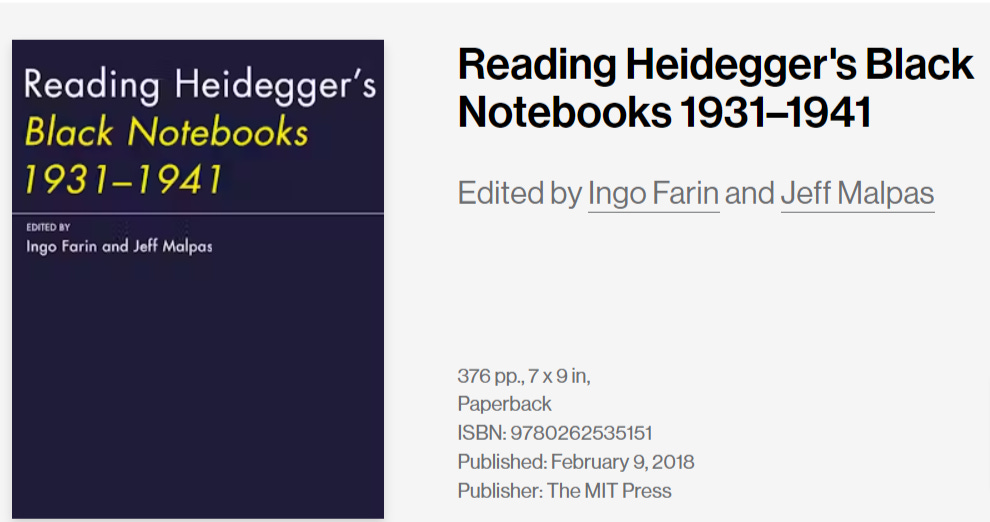
On reading reading ‘Heidegger’s Black Notebooks 1931–1941’ in light of the Gaza Genocide.

Using Kant’s Crocked Timber of Humanity as a starting point and this book:

The above tinctured in a bit of Hegelian Prestidigitation… can a possible case be made, that Heidegger’s ‘Jewish World Conspiracy’ has been realized in the Gaza Genocide, that is taking place as I write this?

Political Observer.

Posted in Uncategorized | Leave a comment

‘On Ganesh Chatter’ from February 20, 2024.

Political Cynic comments.

Headline: How Europe should negotiate with Donald Trump

Sub-headline: He is obsessed with money but his record suggests he doesn’t always drive a hard bargain

https://www.ft.com/content/191ad713-f4b2-459f-8c4c-d12e1d678232

As a regular reader of The Financial Times’ ‘Ganesh Chatter’ is always worthy of my attention, not to say of my political contempt, for his pretentious imitation of a boulevardier/raconteur. He resembles the Goncourt Brothers in a highly idiosyncratic, hybrid interpretation/political iteration.

On the question of hybridity see

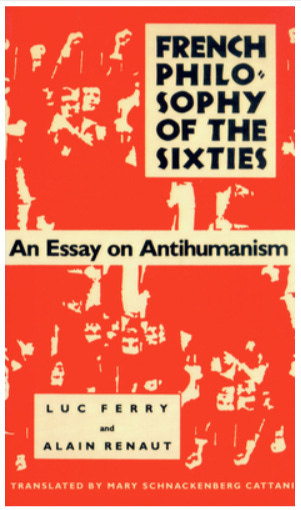
Reader look what I found in my internet search, that may not be completely relevant to ‘Ganesh Chatter’ but don’t miss r/badhistory reveltory comments on Jordan Peterson & French Philosophy here:

Jordan Peterson butchers French intellectual history of the 1960s: “the most reprehensible coterie of public intellectuals that any country has ever managed”

What happened to French intellectualism in the 1960s? Where did “identity politics” come from? What’s the connection to Marxism? And how do they differ in France and North America? If you’re interested in remaining confused yet angry about all of these questions, and vilifying a shape-shifting cast of (neo)marxists, postmodernists, radicals, and sundry scapegoats, allow me to introduce you to the narratives of Jordan B. Peterson, armchair intellectual historian of the transatlantic journey of French ideas to North American academia:

What happened in the late 1960s, as far as I can tell—this happened mostly in France, which has probably produced the most reprehensible coterie of public intellectuals that any country has ever managed—is that in the late 1960s when all the student activists had decided that the Marxist revolution wasn’t going to occur in the western world and finally had also realized that apologizing for the Soviet system was just not going to fly anymore given the tens of millions of bodies that had stacked up, they performed what I would call a philosophical sleight of hand and transformed the class war into an identity politics war. And that became extraordinarily popular mostly transmitted through people like Jacques Derrida, who became an absolute darling of the Yale English department and had his pernicious doctrines spread throughout north America partly as a consequence of his invasion of Yale. And what happened with the postmodernists is that they kept on peddling their murderous breed of political doctrine under a new guise. [Harvard talk]

Back to ‘Ganesh Chatter’:

He inhabits a world before David Ricardo, if not before Adam Smith, in which wealth is understood as a cake that nations compete for a cut of. More for thee means less for me.

(If Vladimir Putin had collective defence arrangements on another continent, the alt-right would hail it as “strategic depth”, not knock it as a burden.)

In other words, when Trump grumbles about “delinquent” allies, he doesn’t mean something wider or deeper or grander. It isn’t contempt for the west or admiration for predatory dictators talking.

The challenge for big thinkers in the Trump age is to accept that here is someone immersed in the bathos of accounts and invoices.

In 2018, he settled for a revised version of the North American Free Trade Agreement — achieving some demands, letting others go — instead of quitting it outright.

His amour propre is double-edged, spurring him to start quarrels but also to settle them on whatever terms he can spin as his own. It is hard to know which offends him more, in fact: being the mug in a deal, or being considered impotent to amend it.

The more practical one is how to stop him leaving or underfunding Nato in the meantime, or undermining it with his rhetoric. The answer is to take him at his word, and address the cash question. It isn’t code for something else.

but his followers and his enemies alike put a philosophical weight on him — as savior of Christendom, or 1930s fascist — that he doesn’t bear. His concerns aren’t at that level of abstraction.

Trained in ideas, the political class sees in grand terms — “authoritarian” this, “isolationist” that — a man who is, at bottom, a miser. The ultimate rule of negotiating with Trump is that no one will be worse at it than an intellectual.


The unctuous ‘savior of Christendom’ …

Political Cynic

Posted in Uncategorized | Leave a comment