Recall that @zannymb was one of Jeffrey Sachs ‘Shock Therapy Cadre’ of 1993? She opines on the Clear and Present Danger of Trump in 2024, among others!

Old Socialist’s inconvenient recollections !

Headline: Dr. Jeffrey Sachs, Shock Therapist

By Peter Passell

June 27, 1993

Sachs’s immediate concern is the implication for the Government’s budget, which must be slashed in order to bring inflation under control. If much of the nation’s health expenditures are now buried as fringe benefits on the books of enterprises that depend on Government subsidies, who will pick up the cost once the enterprises are forced to economize?

Getting a handle on the magnitude of the problem is obviously difficult in a country that cannot even explain why life expectancy has fallen sharply in the last two decades. But some number is better than none. And by pressing officials to address this and other pivotal issues, Sachs hopes to accelerate the pace of reform.

Sachs’s message of urgency is not universally accepted. Plenty of Western as well as Russian economists contend that a more gradual approach is not only possible but necessary. “Economic reform is a political process,” says Padma Desai at the Harriman Institute at Columbia University. “First, you must build consensus.”

And even his sympathizers acknowledge that Sachs’s high profile and world-class impatience could generate a backlash in a nation still adjusting to the reality that it is no longer a superpower. “There’s a real dilemma here,” says Stanley Fischer, an international economist at the Massachusetts Institute of Technology. “You have to make a lot of noise to get the attention of the West. But the more noise you make, the more you make it seem that the reform program is a Western program. And that could be the kiss of death.”

Please note that I’ve placed in bold font and italics Mr. Sachs reported ‘world class impatience’!

Here are the the last paragraphs of Beddoes latest broadside , about the coming Political Crises of 2024: In sum Trump and Trumpism!

Headline: 2024 will be stressful for those who care about liberal democracy

Sub-Headline: In theory it should be a triumphant year for democracy. In practice it will be the opposite

https://www.economist.com/the-world-ahead/2023/11/13/2024-will-be-stressful-for-those-who-care-about-liberal-democracy

Nothing, however, will compare to America’s election, either for grim spectacle or potential consequences. It is hard to believe the most likely outcome is a rematch between two old men, both of whom the majority of voters wish were not candidates.

Donald Trump’s very candidacy undermines American democracy. That the Republican Party would nominate a man who tried to overturn the results of the previous presidential election dims America as a democratic beacon. A second Trump term would transform America into a loose cannon with isolationist tendencies at a time of grave geopolitical peril. His fondness for strongmen, particularly Mr Putin, suggests that his boast to end the Russia-Ukraine conflict in 24 hours would be at Ukraine’s expense.

Mr Trump may not become the nominee, and if he does, he may well lose. But the odds of a second Trump term are alarmingly high. The consequences could be catastrophic—for democracy and for the world. ■

Zanny Minton Beddoes, Editor-in-chief, The Economist

Old Socialist

Posted in Uncategorized | Leave a comment

Le Monde takes the measure of Marcon’s ‘mis- steps’ regarding The Gaza Genocide!

Political Observer & Almost Marx comment.

The Headline and Sub-headline are descriptive of the ‘reportage’ of Benjamin Barthe  and Philippe Ricard:

Headline: France is still finding its bearings with the war in Gaza

Sub-headline : In two and a half months of conflict, President Emmanuel Macron has made a series of missteps and confused initiatives, struggling to grasp the scale of the carnage caused by Israeli strikes on the Palestinian enclave.

https://www.lemonde.fr/en/international/article/2023/12/27/on-the-gaza-war-france-is-still-searching-for-a-compass_6379088_4.html

How might The Reader even begin her approach this ‘Journalistic Monstrosity’ of 2,787 words? The first four paragraphs provide a preliminary sketch, a study, for the final rhetorical canvas?

The war in Gaza has shown no signs of de-escalation, with Israel pledging to “intensify” the fighting. French President Emmanuel Macron, just before Christmas, returned to the region for a visit to Jordan where, in keeping with tradition, he shared a Christmas meal with French troops deployed abroad. It was Macron’s third visit to the Middle East since the outbreak of hostilities, when Hamas attacked Israel on October 7.

The French president’s previous trips – first to Israel, Egypt and Jordan two weeks after the attacks; then to Dubai for COP28 and Qatar in early December – highlighted how difficult it has been for France to find its stance on the conflict. His visit to the troops taking part in Operation Chammal, which fights against the Islamic State (IS) organization in Syria and Iraq, was also to be understood in this context.

“French officials are still trying to figure out where they stand,” said a specialist of the region, who spoke on the condition of anonymity. “They’ve realized that their message isn’t getting through because of how inscrutable their positions are considered.” An official from the Elysée Palace, who also asked for anonymity, said: “We haven’t changed, events have.”

Over the past two months, French diplomacy has continually fumbled, alternating between missteps and confused initiatives, as if Paris, long in tune with Middle Eastern realities, had suddenly lost the region’s pulse.

That Reader encounters the eternal stand-by of ‘Journalistic Metaphysics’! Note that I have put in bold font , in the above four quoted paragraphs, examples of this style of Journalism. This is aided by sub-titles, collected here, with the word count

Setting the tone: The word count 368; A collection of Rhetorical Snapshots:

October 12 with Macron’s address, a grave tone, massacre committed by Hamas, hostages paraded like trophies, Macron, who went on to express his compassion for the Israelis, Israel has the right to defend itself, killing over 1,300 people, the president empathized with only one side. The tone was set, October 24. The death toll in Gaza now stood at 6,000, international coalition against the Islamic State (IS) organization in Iraq and Syria, of which France is a member, “also fight against Hamas.”, the philosopher Bernard-Henri Lévy, as the newspaper Libération claimed in early December? To equate Hamas with the absolute evil…

‘Reality check’ The word count 368. Rhetorical Snapshots:

“Honestly, it wasn’t a brilliant idea,” said a senior Arab leader, Macron’s advisors tried to rectify the situation, Macron had a “reality check” discussion, a level-headed Italian-Swiss with a long experience in the Middle East, would fuel polarization and misunderstanding, Israel had carte blanche to wage a war without rules, Macron listened attentively., accompanied by Patrick Durel, Alexis Le Cour Grandmaison, an Arabist formerly, to limit the fallout., that Macron had been misunderstood, quite a stir within the French diplomatic apparatus., long nicknamed the “Arab Street,”, Nicolas Roche, stationed in Iran,

The Foreign Ministry’s sudden remobilization: The word count: 379. Rhetorical Snapshots:

The Elysée and the Foreign Ministry immediately sought to contain this quiet rebellion., Anne-Marie Descôtes, “duty of loyalty.”, their mailing lists to avoid leaks, says something about the prevailing feverishness,” commented one diplomat, was a “real malaise” between the ministry’s “neoconservatives,”, The Foreign Ministry, which had been bypassed, was suddenly remobilized., Three focal areas were identified:, Macron pressured his teams to organize the event in less than a week., UN Secretary-General Antonio Guterres, Kenyan President William Ruto, Macron called for a “very rapid humanitarian pause” and for “working towards a ceasefire.”, with the carnage underway in Gaza, where 10,000 people were now dead and 700,000 displaced., Humanitarianism is impossible without politics,” , lamented Hugh Lovatt, a first visit to Gaza to support UNRWA employees traumatized by the death of nearly 100 of their colleagues under Israeli strikes, made a remarkable speech.,

‘Magic formula’ The word count 424: Rhetorical Snapshots:

the horror of the bombardments on Gaza entered the president’s vocabulary., But “de facto, today, civilians are being bombed. De facto, these babies, these ladies, these old people are bombed and killed. There is no reason for that and no legitimacy. So we do urge Israel to stop.”, which marked the beginning of a belated rebalancing spurred by the ongoing events, strained relations with Netanyahu, criticized the French president for making a “serious mistake, factually and morally.”, Macron prefers to contact the Israeli president, Isaac Herzog, or opposition figures such as Yair Lapid., Prior to the war in Gaza, Macron had shown little interest in the Israeli-Palestinian conflict., The French president was more interested in the Abraham Accords,He paid no attention to the fact that these agreements were contributing to weaken the Palestinian Authority, Macron has made it a habit to lean on the European Union as a channel of influence for a declining France., The weight of the Holocaust has forced Germany to align itself with Israel, as have certain Central European capitals such as Budapest and Prague.

‘The Gaullo-Mitterrandian line’ The word count: 384 : Rhetorical Snapshots:

“France has lost the singularity that enabled it to balance the European position with the capitals most sensitive to the Palestinian cause, such as Ireland, Belgium and Spain,” said a diplomat in Brussels., the man saving Europe’s honor is Spanish Prime Minister Pedro Sanchez, Denis Bauchard, a former French ambassador to Jordan, observed: “We carry little weight, despite having clearly refocused our positions. We make the right choices at the UN, along Gaullo-Mitterrand lines, but Arab capitals don’t give us credit for it.”, On December 5, Yahya Sinwar, the head of Hamas’s political wing in Gaza, was sanctioned by Paris., Does the alleged mastermind of the October 7 attack have hidden accounts in France? “No, of course not,” said a diplomatic source, “It’s political posturing, but symbolically, it’s important.”, On the other hand, no Arab country sent an emissary, even those that had established diplomatic relations with Israel and whose aversion to Islamist movements was well known, “Macron is too fond of public initiatives and spetacle politics,” said Lovatt, of the European Council on Foreign Relations.,

Note to The Reader: have Benjamin Barthe  & Philippe Ricard arrived at a point of a verifiable political critique, or something resembling such?

‘Failed 5-star cast’ the word count: 322, Rhetorical Snapshots:

The relaunch of the political process, the third pillar of the Macron plan, led to a previously unreported event:, discreetly organized with a dozen players from Israeli and Palestinian civil society., the Elysée was counting on the presence of such respected figures as Hanan Ashrawi, a veteran of the Madrid negotiations (in 1991), But this 5-star cast could not withstand the test of reality., Even the former Lebanese culture minister Ghassan Salamé, who had been approached to lead the debates, bowed out., only two Palestinians took part in the round table on December 10 – employees of NGOs with little notoriety, “This round table was a joke,” said one participant with a sigh, “a show totally detached from reality.”,

The same language for 30 years, The word count 272 .

I will end my polemical commentary/critique with the final sentence offered by Benjamin Barthe & Philippe Ricard:

A timid first step for French diplomacy, which has been sputtering the same language on the Israeli-Palestinian conflict for years.

Some further observations on Macron from September 6, 2023:

StephenKMackSD’s Newsletter

There is nothing like the complete dishonesty @TheEconomist: ‘Macron The Sainted’ and the fate of Neo-Liberalism, À la française.

The Economist @TheEconomist The most painful legacy for a leader who has done much to modernise France would be for his two-term presidency to be followed by the election of the hard-right Marine Le Pen https://econ.st/3qXNqIc https://twitter.com/TheEconomist/status/1699411143201099987?s=20…

Read more

4 months ago · stephenkmacksd.com/

Posted in Uncategorized | Leave a comment

Andrew Roberts in high dungeon over Walter Reid’s book on Churchill! Did he miss Richard Toye’s ‘Churchill’s Empire: The World That Made Him and the World He Made’ ?

Political Observer wonders!

A collection of reviews :

Churchill’s Empire

The World That Made Him and the World He Made

Author: Richard Toye

“Superb, unsettling new history …. Can these clashing Churchills be reconciled? Do we live, at the same time, in the world he helped to save and the world he helped to trash? Toye, one of Britain’s smartest young historians, has tried to pick through these questions dispassionately …. Of course, it’s easy to dismiss any criticism of these actions as anachronistic. Didn’t everybody in Britain think that way then? One of the most striking findings of Toye’s research is that they really didn’t: even at the time, Churchill was seen as standing at the most brutal and brutish end of the British imperialist spectrum …. Toye is no Nicholson Baker, the appalling pseudo-historian whose recent work Human Smoke presented Churchill as no different from Hitler. Toye sees all this, clearly and emphatically …. In the end, the words of the great and glorious Churchill who resisted dictatorship overwhelmed the works of the cruel and cramped Churchill who tried to impose it on the world’s people of color. Toye teases out these ambiguities beautifully. The fact that we now live at a time where a free and independent India is an emerging superpower in the process of eclipsing Britain, and a grandson of the Kikuyu ‘savages’ is the most powerful man in the world, is a repudiation of Churchill at his ugliest–and a sweet, unsought victory for Churchill at his best.” —Johan Hari, The New York Times Book Review

“Indeed, it is not too much to say that the story of Churchill’s life is the story of his view, vision, and valiant defense of the British Empire–the duties of empire and the maintenance of empire, the idea of empire and the ideals of empire. So it is surprising that, until Richard Toye took on the task, little has been written in book form about Churchill and the British Empire …. What is not generally or popularly recognized–but rectified by Toye–is that there were many Churchillian views on empire …. Toye argues convincingly that Churchill’s views on empire were not a fixed thing–and were not designed simply to enhance Britain’s role in the world …. The Empire faded as Churchill’s life did. But there was triumph after all, perhaps even a bit of poetry. The glory of them both–Empire and Churchill–survives them both.” —David M. Shribman, The Boston Globe

“Not a conventional biography, this is a probing and thoroughly enjoyable life focusing on the contradictions and dilemmas of Churchill’s imperialism…. Even veterans of Churchilliana will find plenty of fresh material, recounted with wit and insight into a man whose values were shaped by an age that no longer existed.” —PW, Starred Review

“Toye’s central thesis is that Churchill’s beliefs and actions were less predictable and more nuanced than his rhetoric and conventional wisdom suggest…. This is a carefully researched and exceptionally well-documented book that is a welcome addition to the literature. It is not a traditional biography but more of a study of Churchill’s behavior in a central area of his career. It makes extensive use of government archives, diaries, and secondary sources. The citation of newspaper articles to underscore the broader reaction to Churchill’s actions is especially welcome. It is fascinating reading.” —Terry Hartle, The Christian Science Monitor

“A dense, forgiving study of the great British leader who was both of his time and flexible enough to transcend it…. Toye considers this enormously complicated subject with admirable equanimity.” —Kirkus Reviews

“Lord Beaverbrook once said that Churchill had held every opinion on every subject and what Richard Toye demonstrates above all is that his opinions on the British Empire were anything but simple or consistent…. Toye traces Churchill’s shifts and velleities with impressive skill and erudition, using a vast range of contemporary newspapers to particularly good effect…. An important and original book.” —Piers Brendon, Literary Review

“Toye offers a nuanced portrait of Churchill as an imperialist that contradicts some of the simplistic views of him as a reactionary, Colonel Blimp-type character…. This work is a valuable contribution to greater understanding of an historical icon.” —Jay Freeman, Booklist

“Lucid and engaging…. Toye should be congratulated for steering clear of either simple apologia or political correctness. Following reviews, diaries and letters, he recreates the broad spectrum of imperialism at the time and presents Churchill’s drift into die-hard mode as a conscious move of political repositioning…. Churchill lovers will gain a clear sense of the culture and politics that has shaped his imperial outlook. At the same time, they will find a judicious account of the limitations of Churchill’s power…. Rather than yet another biography of Churchill, Toye has given us a thought-provoking, sensitive account of the nerve and muscle of empire.” —Frank Trentmann, The Daily Express

“There have been numerous studies of various aspects of Churchill’s relationship with the empire, but this is the first attempt at a comprehensive treatment in a single volume. It’s a complex and fascinating story…. What emerges from this densely argued book is that [Churchill’s] support for the empire was not for its own sake but as a means of keeping Britain itself as a factor on the world stage. As it declined, his concept of the commonwealth of English-speaking peoples as a major world force took its place. In the end, perhaps his greatest achievement was to accept the empire’s fall and dress it up as victory.” —David Stafford, BBC History Magazine

“Winston Churchill’s reputation as a hardline imperialist is questioned here…. This detailed, engaging biography dwells on the dichotomy between Churchill pre- and post-second world war: between a time he was considered almost a danger to the empire, and a time he was considered its saviour.” —Emmanuelle Smith, Financial Times

“An impressive new study…. This fascinating book shows how, during the second half of his career, that [die-hard] image came to replace the earlier picture where he appeared as a conciliatory figure–and even as a danger to the Empire he cherished and used against threats to Britain.” —John Hinton, The Catholic Herald

“The Churchill we salute as a lover of freedom and hater of tyranny muttered about kaffirs and blackamoors, and bore a lifelong commitment to subjecting swathes of the world to unwelcome British rule. How so? For answers, we may turn to Richard Toye’s excellent new book…. Toye presents Churchill as a complex, flexible, and ultimately a moral imperial thinker.” —Dan Jones, The Spectator

“Anyone with an interest in 20th-century history or in Churchill will find much that is surprising in this meticulously researched book, which is nevertheless written with great style and clarity.” —Susan Hill, The Lady

Political Observer

Posted in Uncategorized | Leave a comment

Another Iteration of Bagehot @TheEconomist takes aim at Keir Starmer! From December 14, 2023.

Newspaper Reader comments.

The first paragraph of this essay is as lackluster as Kier Starmer, as portrayed by Bagehot !

Usually, politicians try to offer optimism. Sir Keir Starmer’s Labour Party specialises in despair. “This is worse than the 1970s,” said Sir Keir in one speech. “We are in a hole.” Every Labour figure emits the same dirge about Britain’s high debt, low growth and exhausted public services. Even moments of hope are tempered with warnings of misery. In a rare bout of cheer, Sir Keir promised: “A realistic hope, a frank hope, a hope that levels with you about the hard road ahead.” Hooray!

https://www.economist.com/britain/2023/12/14/cheer-up-sir-keir-it-might-never-happen

This is followed by a Political History Made-To-Measure: dotted by almost evocative bon mots, or should they be labeled glancing insults, aimed at an un-impressive political mediocrity? The consideration of the careers of David Cameron, Mrs. May, Boris Johnson, Liz Truss and her partner Kwasi Kwarteng, Rishi Sunak, that are the thought to be precursors to a Starmer political ascendency, almost puts him – Starmer fits comfortably in the above collection of mediocrities

If Labour wins the next election, as is highly likely, the consensus is that it would inherit a total mess. In 1997 New Labour were handed a booming economy and low debt. In 2010 the Conservatives took over thriving public services. In 2024 Labour will receive neither. But the party harbours a dirty secret. Some problems will fix themselves; some things are better than they look; and a few conundrums can be solved with only a little effort. Pessimism is judicious. Sir Keir would enter office with the lowest expectations of any prime minister since the 1970s. The good thing about low expectations? They are easily met.

There is an ascertainable glee in this iteration of Bagehot, and yet The Reader …she has 835 words till the end of this polemic! In the interest of a self-serving brevity, in deference to political honesty, I’ll highlight what might be characterized as valuable to a potential Reader!

But the Office for Budget Responsibility, a fiscal watchdog, is already predicting growth of almost 2% by 2028 through no effort of Labour’s own.

That means the public finances are now highly geared: a small jump in growth can lead to a big jump in tax revenues. The Conservatives took the political pain; Labour can spend the proceeds.

The markets expect a slew of rate cuts in 2025, just in time to benefit a newish government. Public and private finances will then improve—and quickly. In the course of the next parliament, mortgage renewal will flip from being a moment of despair to one of relief.

Sir Keir says that his party will whittle down National Health Service (nhs) waiting lists, for instance, but these are due to peak next summer anyway.

Reforming Britain’s nhs is the more Augean task. After a bout of restrained spending from 2010, the service has been doused in cash in recent years yet barely treats more patients.

The backlog of moves delayed by lockdowns, when people could not travel, will clear. Labour’s promise to return net migration to its recent (and still historically high) norms is not much of a challenge, yet it will still be seen as an achievement.

Since eight in ten Labour voters say they would rejoin the eu, a tighter and more prosperous relationship with the eu is perfectly viable.

The Conservatives have swung from a vision of a small-state government sat snugly inside the eu to a free-spending one far outside it. In the process it went through five prime ministers, with often radically different agendas, in seven years.

Under the rubric of ‘Can’t have a triumph of low expectations without a triumph’ the last two paragraphs:

Bored Labour backbenchers will make trouble eventually. Assuming that things will inevitably improve is naive. Yet so is assuming that things must remain terrible.

But a golden inheritance brings high expectations. During the 2005 general-election campaign, Sir Tony was harangued by voters complaining that gps were too quick to see patients.

Luckily for Labour, when you have hit the bottom, the only way is up. 

Newspaper Reader

Posted in Uncategorized | Leave a comment

@TheEconomist considers the case of Elon Musk. This reminds me of the Tony Blankley notion that all politics is awash in an admixture jealousy & envy.

Political Observer comments.

Business | Schumpeter

Elon Musk’s messiah complex may bring him down

Saving humanity is all the rage right now 

I’ll confine myself to the final three paragraphs of this ‘analysis’ – its unfortunate that the Age of Freud is long past? Though too rarified a form of Psycho-Analysis for this ‘news magazine’ still moored in 1843?

A political given might be that the Self-Made Man is irksome to the Oxbridger conformist mentality? Yet both the Oxbridger and The Self-Made Man share a certain insufferable arrogance – sparks fly when they encounter each other? I’ll highlight some of the most telling …

Most troubling is the messiah complex. From Tesla and SpaceX to artificial intelligence (ai), Mr Musk acts as if he is on a mission to save humanity, by preventing climate catastrophe, providing an exit route via interplanetary travel, stopping machines from out-thinking man, or averting nuclear Armageddon (last year he stymied Ukraine’s efforts to strike back against Russia by refusing to extend its access to his Starlink satellites to Russian-occupied territory, on the grounds that such an attack might lead Vladimir Putin to retaliate with nukes). At times he sounds like a capricious Greek god who believes he holds the fate of the world in his hands. “Finally the future will look like the future,” he bragged when launching Tesla’s Cybertruck pickup on November 30th.

Saving humanity is in vogue right now. It is a dangerous fetish. Last month a charter to protect the world from the dangers of rogue ai almost destroyed Openai, maker of Chatgpt. A year ago Sam Bankman-Fried, now a convicted fraudster, claimed that the disastrous risks he took with his ftx crypto-exchange were in service of humanity. Such missionary zeal is not new in business. It pushed Henry Ford, inventor of the Model t, to raise workers’ living standards. But his saviour complex got the better of him and he ended up spewing antisemitic bile.

Mr Musk’s hubris, too, may end badly. For all the futuristic twaddle about the Cybertruck, drivers struggled to find its door handles. Yet in the grand scheme of things, his technical accomplishments will probably outweigh his all-too-human imperfections. For pioneering electric cars and reusable rockets, he has earned his place in history. Future generations will probably judge him the way today’s judges Ford: a handful will decry his flawed character; most will remember the majesty of his creations.

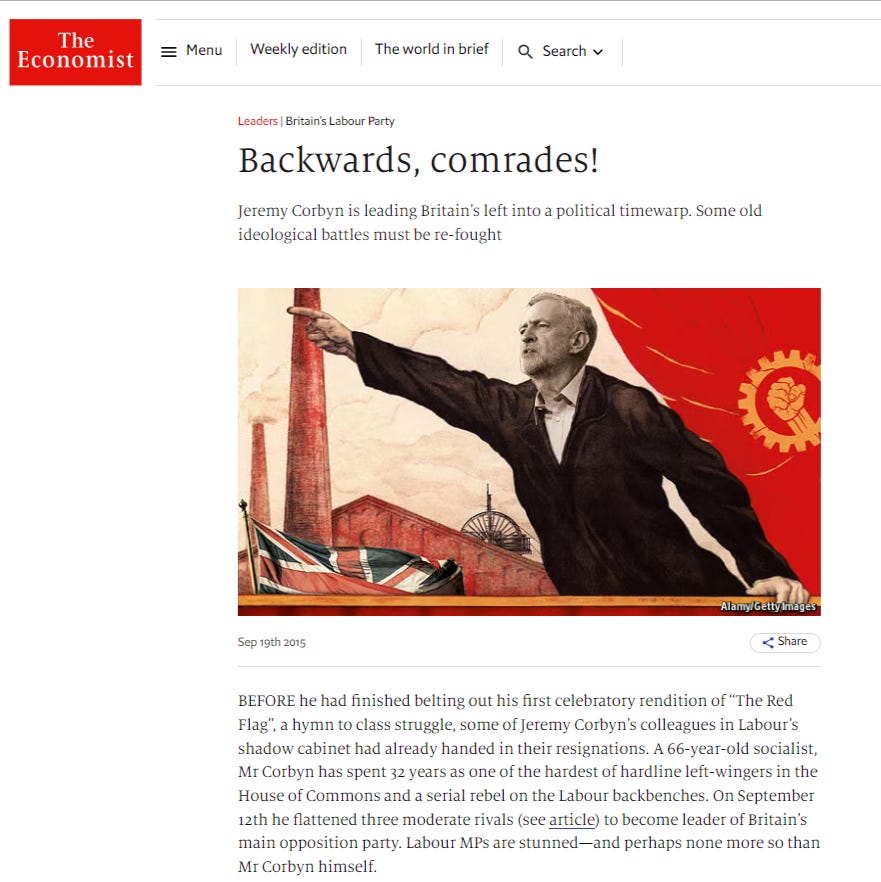
Those highlights demonstrate that The Economist can’t quite resist kissing Capitalist Ass, while warning of the danger of Musk, as a quixotic, indeed a toxic political actor. Would that the Oxbridgers might apply that standard to themselves:

https://www.economist.com/leaders/2015/09/19/backwards-comrades


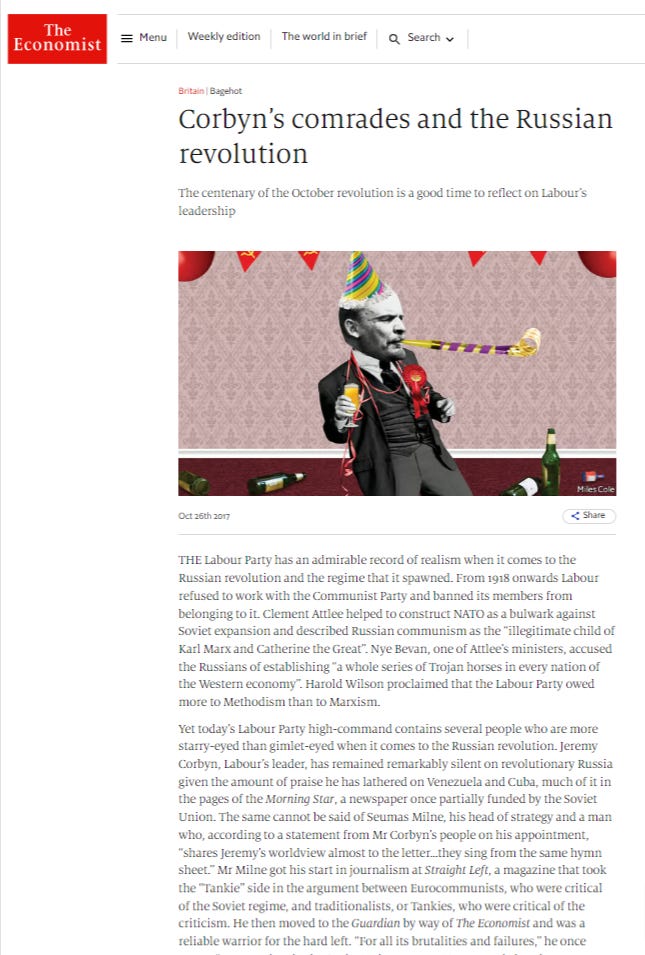
https://www.economist.com/britain/2017/10/26/corbyns-comrades-and-the-russian-revolution

Political Observer.

Posted in Uncategorized | Leave a comment

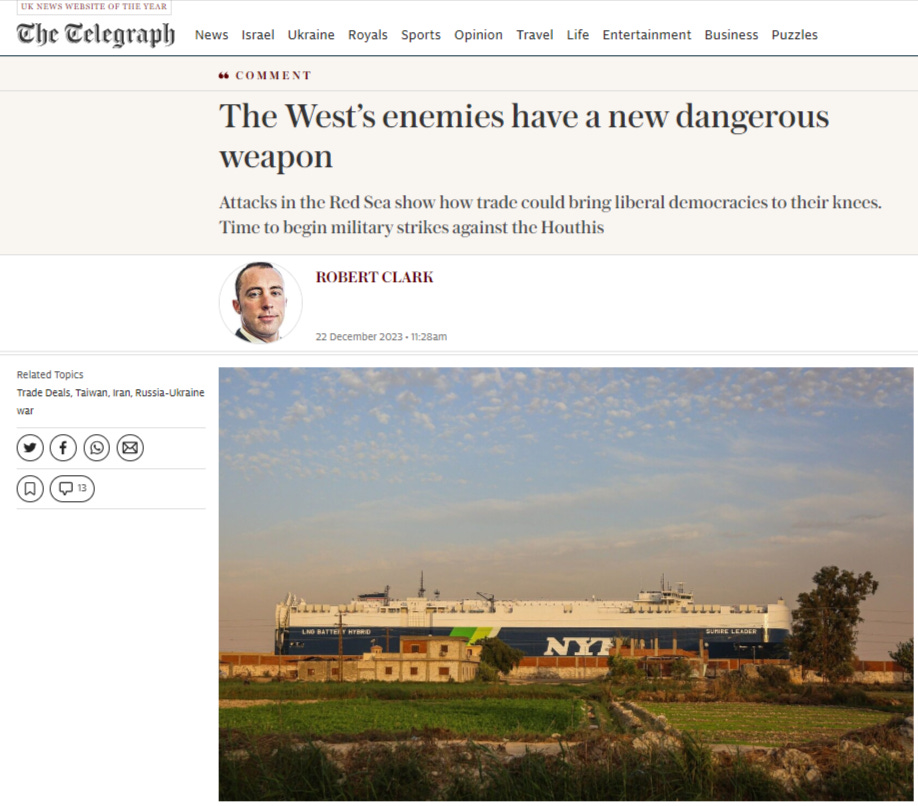
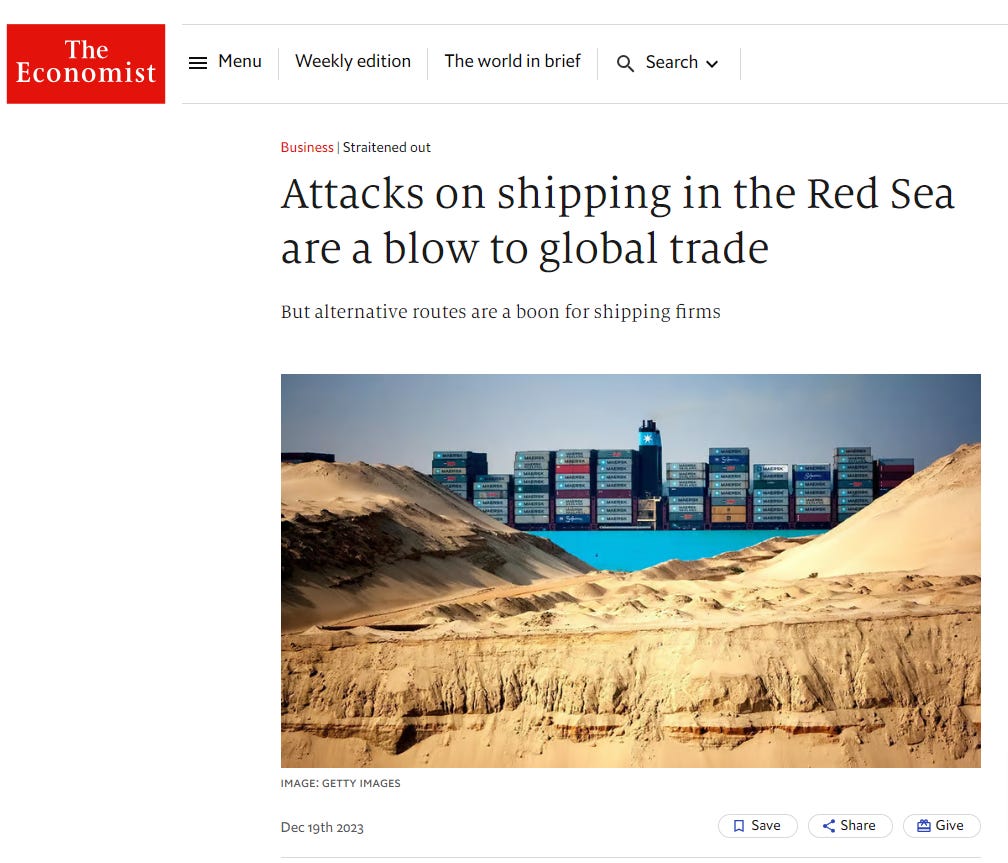
Under the rubric of Great Minds almost Think Alike ? The Telegraph and The Economist on ‘The Red Sea’.

Newspaper Reader comments.

Note the framing of the Telegraph report: ‘The West’s enemies’ ! This newspaper seems to be moored in the political territory once occupied by The Economist?

The last paragraphs from this ‘news story’ are instructive of an attitude of bellicosity!

We can already see this played out in the Red Sea, as Iranian-funded terrorist group the Yemini Houthis are closing international shipping lanes after a relatively successful campaign of hostage-taking and firing cruise missiles over a few short weeks. 

This campaign – from a non-state actor and terrorist organisation – has resulted in British Petroleum, one of the world’s largest businesses, declaring that it will be avoiding the Red Sea shipping lanes, crucial for exporting oil and gas from the Middle East to the markets of Europe and North America. 

This disruption to supply chains will likely lead to a run on the petrol price at the pumps in Britain over the Christmas period, while long-term significant costs will be incurred to ease flow and supply – again the brunt of which will be passed on at the pump. 

Weaponising trade cannot continue. We cannot let military and economic deterrence fail at a time when authoritarian regimes seek to damage our national interests in this way. It may not be war that brings down the current global order, but rather repeated shocks to global commerce and supply chains, should we choose to not do anything about it. A good place to start is military strikes against the Houthis. 

https://www.telegraph.co.uk/news/2023/12/22/trade-is-becoming-the-worlds-most-dangerous-weapon/


The Economist framing is sedate, even by Economist standards.

The tone of the article is sedate, even measured, as compared to the Telegraph’s bellicosity! The final paragraphs of The Economist’s news story:

Still, this Suez crisis will not “put a cork in global trade”, says Lars Jensen of Vespucci Maritime, a consultancy. The reason for the cautious optimism has to do with shipping’s remorseless cyclicality. In contrast to the Ever Given fiasco, supply chains are not currently under immense strain. Back then cuts to capacity coupled with a surge in spending by locked-down consumers had sent shipping rates surging to astronomical levels. A global index from Drewry, another consultancy, hit over $10,000 per standard container. On some routes, spot rates surpassed $20,000. That helped push shipping firms’ combined net profits in 2022 to $215bn, according to the John McCown Container Report, an industry compendium, compared with a cumulative loss of $8.5bn in 2016-19.

The shipping firms’ usual response to such price signals is to order new vessels. Those are starting to arrive. Though demand has remained flat over the past year or two, the global fleet’s capacity will swell by 9% this year and another 11% in 2024, according to ing, a bank. Already, the industry’s profits may have plunged by 80% in 2023. With capacity to spare, running longer routes should not cause the disruption seen at the height of covid-19. By mid-December Drewry’s index was becalmed at $1,500 or so (see chart). Rates could double as a result of the Red Sea turmoil, reckons Peter Sand at Xeneta, a freight-data firm. But they will probably stay well below their pandemic peaks—and so will shipping companies’ profits.

Newspaper Reader

Posted in Uncategorized | Leave a comment

@GwendolynSasse, in The Financial Times of December 20, 2023, on The War in Ukraine.

Philosophical Apprentice comments.

Opinion War in Ukraine

Headline: Time is of the essence in defending Ukraine

Sub-Headline: Western calls for peace talks ignore the Kremlin’s determination to pursue its war of conquest Time is of the essence in defending Ukraine

https://www.ft.com/content/36ba12ed-7a0f-4a3a-870e-b38363ad92d9

Read the first two paragraphs of Gwendolyn Sasse’s essay:

Time keeps ticking relentlessly. The challenge of crisis management and policymaking more generally is to get ahead of it rather than watching days, months or years go by. From the annexation of Crimea in 2014, Russia’s war against Ukraine has been characterised by diverging time horizons and the expectations that go with them. To date, connecting the different time zones of this war has proved impossible, but the urgent necessity of doing so has increased steadily. Time zones that drift apart create room for manoeuvre — in this case, for Russia and for those in western countries who want to polarise and undermine democratic values along the way.

Ukraine now has to get through its second winter since the full-scale invasion. The US presidential elections loom large over western support for Kyiv. The Israel-Hamas war reduces the already diminishing public attention span for Russia’s war in Ukraine. Next June’s European parliament elections may make the EU appear more fragile than ever. In the meantime, Russia has adjusted economically and politically to sustain a much longer war than initially intended.

Let The Reader consider this excerpt titled About us in reference to The Centre for East European and International Studies (ZOiS):

Eastern Europe is in a state of flux. The importance of dedicated regional research undertaken in long-term projects for providing the necessary profound knowledge is clearer today than ever before. Russia’s war of aggression against Ukraine underscores the value of our nuanced view of a region that defies common assumptions and ascriptions. A comprehensive and multi- or interdisciplinary approach is needed to capture and convey the diversity and dynamics of the region, including its entanglements.

Russia’s war on Ukraine is a watershed that presents major challenges not only to political actors worldwide but also to researchers. Data collection has become difficult or impossible in some cases, and cooperations have been terminated, adapted or newly established. As yet, we can only guess at the dimensions of the consequences of the war. Only high-quality regional research across a wide range of academic disciplines can rise to these challenges and provide crucial impetus for research, politics and public discourse.

https://www.zois-berlin.de/en/zois/about-us

Might the above quotation appear like a self-serving recitations of well worn cliches? that reads as if it were the rhetorical twin, of Gwendolyn Sasse’s two above quoted paragraphs?

In the interest of not wasting The Readers valuable time, let me focus on the other cliches as they appear to me… it may not be without fault, but might offer some insight into this Gwendolyn Sasse’s Political/Ideological/Methodology, if it can be named that ?

What are some of the time zones of this war?

The full-scale invasion of Ukraine felt like a surprise despite the preceding stages.

By definition, for Ukrainians, assistance always comes too late.

Making a promise for the future is one thing, delivering on promises in the present is something else.

The language framing the war is also marked by references to time.

Vladimir Putin himself thinks in centuries of continuity of Russian imperial rule.

In times of war, a word or phrase carries particular weight. But even a principled position is not sufficient in itself and has to be measured against current and future action.

It spreads a sense of uncertainty and creates space for those considering or calling for peace negotiations.

This must include a decision on using the remaining window of time to step up military assistance to Ukraine and military production in Europe.

Thinking about Russia’s war against Ukraine in temporal logic underlines that time is of the essence. The time zones of Ukraine and its western allies need to be reconnected before entirely new ones open up in 2024.

Philosophical Apprentice

Posted in Uncategorized | Leave a comment

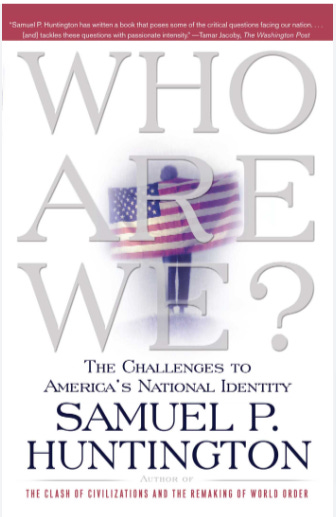
Donald J. Trump echoes Samuel P. Huntington on ‘poisoning the blood of our country’?

Carlos Lozada’s essay from 2017, wakes ‘us’ from our a-historical stupor? Premature Anti-Fascist wonders!

Former President Donald J. Trump said undocumented immigrants were “poisoning the blood of our country” in a recent interview, language with echoes of white supremacy and the racial hatreds of Adolf Hitler.

Trump simply echoes Samuel P. Huntington.

Carlos Lozada’s essay from 2017 provides answers:

Samuel Huntington, a prophet for the Trump era.

The writings of the late Harvard political scientist anticipate America’s political and intellectual battles — and point to the country we may become.

https://www.washingtonpost.com/news/book-party/wp/2017/07/18/samuel-huntington-a-prophet-for-the-trump-era/

Sometimes a prophet can be right about what will come, yet torn about whether it should.

President Trump’s recent speech in Warsaw, in which he urged Europeans and Americans to defend Western civilization against violent extremists and barbarian hordes, inevitably evoked Samuel P. Huntington’s “clash of civilizations” — the notion that superpower rivalry would give way to battles among Western universalism, Islamic militance and Chinese assertiveness. In a book expanded from his famous 1993 essay, Huntington described civilizations as the broadest and most crucial level of identity, encompassing religion, values, culture and history. Rather than “which side are you on?” he wrote, the overriding question in the post-Cold War world would be “who are you?”

So when the president calls on the nations of the West to “summon the courage and the will to defend our civilization,” when he insists that we accept only migrants who “share our values and love our people,” and when he urges the transatlantic alliance to “never forget who we are” and cling to the “bonds of history, culture and memory,” I imagine Huntington, who passed away in late 2008 after a long career teaching at Harvard University, nodding from beyond.

It would be a nod of vindication, perhaps, but mainly one of grim recognition. Trump’s civilizational rhetoric is just one reason Huntington resonates today, and it’s not even the most interesting one. Huntington’s work, spanning the mid-20th century through the early 21st, reads as a long argument over America’s meaning and purpose, one that explains the tensions of the Trump era as well as anything can. Huntington both chronicles and anticipates America’s fights over its founding premises, fights that Trump’s ascent has aggravated. Huntington foresees — and, frankly, stokes — the rise of white nativism in response to Hispanic immigration. He captures the dissonance between working classes and elites, between nationalism and cosmopolitanism, that played out in the 2016 campaign. And he warns how populist demagogues appeal to alienated masses and then break faith with them.

This is Trump’s presidency, but even more so, it is Huntington’s America. Trump may believe himself a practical man, exempt from any intellectual influence, but he is the slave of a defunct political scientist.

Huntington’s books speak to one another across the decades; you find the origins of one in the unanswered questions of another. But they also reveal deep contradictions. More than a clash of civilizations, a clash of Huntingtons is evident. One Huntington regards Americans as an exceptional people united not by blood but by creed. Another disowns that idea in favor of an America that finds its essence in faith, language, culture and borders. One Huntington views new groups and identities entering the political arena as a revitalization of American democracy. Another considers such identities pernicious, anti-American.

These works embody the intellectual and political challenges for the United States in, and beyond, the Trump years. In Huntington’s writings, idealistic visions of America mingle with its basest impulses, and eloquent defenses of U.S. values betray a fear of the pluralism at the nation’s core. Which vision wins out will determine what country we become.

***

Premature Anti-Fascist

Posted in Uncategorized | Leave a comment

Professional boulevardier Janan Ganesh diagnoses ‘The American Problem’, while ignoring the Genocide in Palestine… any surprise?

Political Reporter comments.

Opinion US society

America’s cultural supremacy and geopolitical weakness

The notion of ‘decline’ is too crude to capture what is happening to the US in the 21st century.

https://www.ft.com/content/dce07860-f39e-432b-a0f6-1a2124e4e1a3

The Reader has to wonder at the opening of Mr. Ganesh latest feuilleton!

The Opening Players:

Premier League, Arsenal, Liverpool, AC Milan, Roma, Marseille, Lyon, Chelsea Manchester United, US-owned.

This further elucidates Mr. Ganesh’s point?

The planet’s favourite game is being steered to a considerable extent from American boardrooms.

But quickly Mr. Ganesh reaches into his political repertoire for this paragraph:

Perhaps your test of cultural influence is higher-minded than that. Well, consider that US universities continue to dominate world rankings. Or that America accounts for 45 per cent of art sales by value, according to UBS, which is more than Britain and China, the next two markets, combined. To attend the Venice Biennale now is to enter a new Jazz Age in which experts from all over the world vie to advise American patrons on how to spend the spoils of their economic boom.

Next is this World-Historical/Political Pastiche that almost resembles actual thought?

This is a personal impression, and therefore unquantifiable, but I suggest that America has more cultural reach now than it did in its supposed unipolar moment of the 1990s. The police killing of George Floyd in Minneapolis three years ago set off protests in London, Paris and beyond. The beating of Rodney King in 1991 had no such international echo. Back then, Britain’s bien pensants didn’t follow US political media as though it were domestic fare, or tell each other to stop “gaslighting” and “do better”, much less couch all this second-hand argot in Upspeak. To adapt what Jefferson said about France, everyone, or at least everyone educated and liberal, seems to have two countries now: their own and America.

Sub-Heading: American Decline’s symptomology, a selection of The Players/Actors:

All the while, the geopolitical clout of the US wanes.

…has also failed to persuade much of the world to participate in sanctions against Russia

…20 years in Afghanistan.

…Bretton Woods institutions are fighting for relevance.

…proliferation of armed conflicts

…International Institute for Strategic Studies

…Pax Americana is giving way, if not to Pax Sinica then to no kind of Pax at all.

…the US struggles to corral the “global south”

…when liberal protocol moves on in all its clockwork fickleness.

Mr. Ganesh attempts to in his way, to appeal to his would-be, and actual Oxbridger readership, with maladroit asides, along with fretting about ‘that blunt word decline’.

What is happening to the US in the 21st century is too complex to be captured in that blunt word “decline”. As the nation’s share of world output has dropped, its influence on world culture — on the tastes, idioms and habits of foreigners — is as vast as ever. Whether your concerns are high brow (where should I do a postgraduate degree?), middling (what show will I stream tonight?) or popular (who owns Declan Rice?), America is inescapable. We are now a couple of decades into its relative loss of ground to China in traditional power terms. The knock-on effect for US prestige in other domains should be registering now. It is staggeringly negligible.

A selection from the two remaining paragraphs. It’s hard to be tolerant of Mr. Ganesh’s self-congratulatory chatter, ending in cynicism!

Is this good for Americans? You can see how it might be.

At the same time, all that cultural lustre blinded the British to the extent of their demotion from the geopolitical high table.

…such as abstention from the embryonic European project.

…the same trouble as Britain in recognising its diminished geopolitical status, and adapting its statecraft to compensate.

The trick is to not fall asleep on it.

Political Reporter

Posted in Uncategorized | 1 Comment

@TheEconomist offers a Christmas Present to The New York Times!

Political Observer comments.

A personal note:

As a long time subscriber of The Economist: I still have a page torn out of the February 24 , 2001 edition , a review of ‘Law Without Values: The Life, The Work , and The Legacy Of Justice Holmes’. I cancelled my subscription after The Economist discontinued the ‘comments section’. To my surprise, I received two telephone calls, from representatives of the magazine, asking me the ‘why’ of my cancellation? I told both of these men, that if The Economist wasn’t interested in my comments, I was no longer interested in reading this News Magazine. Time has past and I could not resist commenting upon a publication that was still moored in 1843.

I recommend Alexander Zevin book, a revelatory history, as a starting point:


When the New York Times lost its way

American media should do more to equip readers to think for themselves

https://www.economist.com/1843/2023/12/14/when-the-new-york-times-lost-its-way

At a mere , yet dizzying 17, 568 words, here are some revelatory paragraphs:

Whether or not American democracy endures, a central question historians are sure to ask about this era is why America came to elect Donald Trump, promoting him from a symptom of the country’s institutional, political and social degradation to its agent-in-chief. There are many reasons for Trump’s ascent, but changes in the American news media played a critical role. Trump’s manipulation and every one of his political lies became more powerful because journalists had forfeited what had always been most valuable about their work: their credibility as arbiters of truth and brokers of ideas, which for more than a century, despite all of journalism’s flaws and failures, had been a bulwark of how Americans govern themselves.

I hope those historians will also be able to tell the story of how journalism found its footing again – how editors, reporters and readers, too, came to recognise that journalism needed to change to fulfil its potential in restoring the health of American politics. As Trump’s nomination and possible re-election loom, that work could not be more urgent.

I think Sulzberger shares this analysis. In interviews and his own writings, including an essay earlier this year for the Columbia Journalism Review, he has defended “independent journalism”, or, as I understand him, fair-minded, truth-seeking journalism that aspires to be open and objective. It’s good to hear the publisher speak up in defence of such values, some of which have fallen out of fashion not just with journalists at the Times and other mainstream publications but at some of the most prestigious schools of journalism. Until that miserable Saturday morning I thought I was standing shoulder-to-shoulder with him in a struggle to revive them. I thought, and still think, that no American institution could have a better chance than the Times, by virtue of its principles, its history, its people and its hold on the attention of influential Americans, to lead the resistance to the corruption of political and intellectual life, to overcome the encroaching dogmatism and intolerance.

https://www.economist.com/1843/2023/12/14/when-the-new-york-times-lost-its-way

Where might the Critical Reader place this Economist Political Moralizing, directed at The New York Times, the American National Security State’s Pravda, when compared to The Economist campaign of lies and defamation against Jeremy Corbyn?

https://www.economist.com/leaders/2015/09/19/backwards-comrades

Or this :

https://www.economist.com/britain/2017/10/26/corbyns-comrades-and-the- russian-revolution


Perhaps this adaptation applies? Let publications without a clear record of lies and defamation should not cast aspersions?

Political Observer

Posted in Uncategorized | Leave a comment