Hume’s Imagination Tito Magri, Hume’s Imagination, Oxford University Press, 2023, 512pp., $165.00 (hbk), ISBN 9780192864147. Reviewed by Donald C. Ainslie, University of Toronto,
Sep 25, 2025
Sep 25, 2025
Sep 24, 2025
Editor: A very short quotation from Bret Stephens latest exercise of free imaginative variation, of September 23, 2025 in The New York Times:
…
It’s a cliché, but can’t be said enough, that speech is genuinely free only when it’s speech we like the least from those we dislike the most. Rosa Luxemburg put it well: “Freedom is always and exclusively freedom for the one who thinks differently.”
Shana tova.
(Hebrew. Used as a greeting during Rosh Hashanah and the Days of Awe; or shana tova (שָׁנָה טוֹבָה), “a good year”, or shana tova umetuqa (שָׁנָה טוֹבָה וּמְתוּקָה) “a good and sweet year”)
…
Editor: The very notion that Zionist Political Shill Bret Stephens would quote Rosa Luxemburg, makes this reader cringe!
Newspaper Reader.
Sep 23, 2025
Editor: Greg Lukianoff is co-author, with Jonathan Haidt, of “The Coddling of the American Mind: How Good Intentions and Bad Ideas Are Setting Up a Generation for Failure.” These political hacks, moderled themselves after Mr. Bloom’s hysterical book, “The Closing of the American Mind,” (Simon & Schuster, 1987). As a way to make their book ‘The Coddling’ appear as the sucessor of Bloom’s 1987 diatribe, that seemed the perfect cap-stone the waning Reagan Years?
Editor: From Mr. Bloom’s New York Times obituary:
Allan Bloom, the professor of political philosophy whose book on American universities became a best-selling text for conservative attacks on contemporary intellectual life, died yesterday at the University of Chicago’s Bernard Mitchell Hospital.
Mr. Bloom, 62 years old, died of peptic ulcer bleeding complicated by liver failure, said a spokesman at the University of Chicago, where Mr. Bloom had taught since 1979. He had been hospitalized for several weeks.
The publication of Mr. Bloom’s book, “The Closing of the American Mind,” (Simon & Schuster, 1987) transformed him from an obscure professor, little known outside the University of Chicago, to a cranky icon of conservative views about education, music, morals and the values held by society.
The book — a long, sometimes dense account of two decades in higher education, as seen through his own experience teaching at Chicago, Cornell and Yale — attributed many university problems to administrators’ having acquiesced to student demands in the 1960’s and 1970’s. He criticized the passing of such traditional university ideas as the reliance on the so-called great books of Western culture, and lamented that even students at the nation’s most elite universities seemed to have “lost the practice of and the taste for reading.” ‘Essential Reading’
…
At first Mr. Bloom said he had trouble finding a publisher for the book because it was considered stuffy and he was relatively unknown. But it came out just when tuition at private universities was soaring and questions about the value of education were mounting, and it resonated with American readers. It was No. 1 on The New York Times’ best-seller list for 10 weeks and has sold more than one million copies in the United States.
The book’s success surprised Mr. Bloom as much as it did everyone else.
“Sometimes I can’t believe it,” he told a reporter in 1988. “It’s fun being No. 1 on the best-seller list. It’s like being declared Cary Grant, or a rock star. All this energy passing through you. . . . “
But the book’s belligerent tone made Mr. Bloom a target of considerable criticism himself. His philosophical opponents questioned his scholarship and denounced him as rigid, sexist, elitist and anti-democratic. David Rieff, a senior editor at Farrar, Straus & Giroux, called Mr. Bloom vengeful, reactionary and an academic version of Lieut. Col. Oliver L. North. He said “The Closing of the American Mind” was a book “decent people would be ashamed of having written.”
…
Saul Bellow wrote his Novel ‘Ravelstein’ that featured the fact that ‘Ravelstein’ was gay!
Editor: Mr. Greg Lukianoff on ‘Hate Speech’ consonate with Critical Race Theory?
…
Or consider hate speech. The concept was developed in the 1980s by leftist legal scholars like Richard Delgado and Mari Matsuda, and it shaped the campus speech codes and so-called political correctness of the 1990s. Intellectuals on the right were quick to contest the idea of hate speech — U.S. law does not recognize a general hate-speech exception to the First Amendment, and never has. Charlie Kirk rejected the idea of using hate speech rationales to crack down on free speech. Yet after Mr. Kirk’s assassination, Republicans rushed to promise crackdowns on hateful expression, deploying the same concept.
…
Editor: Reader self-emamcipate from New York Times political chatter!
https://newleftreview.org/issues/ii153/articles/yongle-zhang-reconfiguring-hegemony
…
Winnism’s prospects
Fundamentally, both Fukuyama and Trump want the us to keep winning. However, Fukuyama predicates this on a ‘global fight’ for liberal-democratic principles, while understating the costs of such commitments. He epitomizes the ‘globalism’ that maga vilifies: spending American resources on state-building programmes to promote the spread of liberal democracy and sustain the us-led system; pressuring nations still ‘caught in history’ to move towards its specified end. Yet this hegemonic commitment has required formidable material underpinnings—and these are now starting to erode.
The scale of us sovereign debt provides an indication of the crisis. By 2024, federal debt had reached $34.5 trillion, or 125 per cent of gdp, and interest payments on it are running at $1 trillion per year, surpassing discretionary defence spending and approaching Social Security outlays. Persistently high interest rates create a debt-snowball effect and diminish capacities for crisis response. Unprecedentedly, the us Treasury Secretary has had to reassure the markets about the creditworthiness of fresh us government debt.footnote35 Ultimately, however, this depends upon the capacity of a robust real economy to serve as a tax base. Although nominal us gdp figures continue to rise, its real economy encompasses a hollowed-out manufacturing sector, crumbling infrastructure and declining consumer-spending power. The us faces intensifying competition as developing countries move up the value chain, challenging high-end sectors such as semiconductors and ai. Meanwhile, the overall decline of heavy industry has potentially grave implications for us military capability, which ultimately depends on the American shipbuilding industry to update the us Navy’s fleet and on Boeing’s production capacity for the us Air Force.
Trump’s policies—however crude—respond to a real problem of hegemonic overextension. Trump’s attacks on ‘globalism’ seem exaggerated, but they may reflect the fact that the us no longer has the economic capacity to sustain a global hegemonic system at any price. At some point a certain degree of strategic retrenchment will be inevitable, with the us choosing to act in certain areas, on certain issues, and refraining from doing so in others—reducing support for Ukraine and demanding that the Europeans step up, while extracting a quid-pro-quo mineral agreement from Kyiv, for example. Trump’s tweets about annexing Greenland, not to mention Canada and the Panama Canal, were widely derided. Yet there may be a coherent calculation of national interest behind his ‘neo-Monroe Doctrine’, based on consolidating America’s status as a hegemon over its three neighbouring oceans, thereby laying the groundwork for a reconfiguration of America’s hegemonic modality.
Trump’s mission of industrial rejuvenation constitutes a formidable challenge. The path to it—the tariff-based strategy to coerce trade-deficit reductions and manufacturing repatriation—remains obscured by systemic contradictions. It is predicated on three assumptions: first, that exporting nations cannot overcome their dependence on us markets; second, that American consumers will tolerate inflationary pressure; third, that domestic capacities—not least: skilled engineers—will be able to sustain manufacturing resurgence and supply-chain reintegration. China’s refusal to capitulate to Trump’s tariff demands demonstrated the asymmetry of the relationship—American reliance on Chinese goods exceeding Chinese dependency on American markets. Federal incentives may attract initial manufacturing investment, but systemic impediments—policy volatility, fragmented industrial eco-systems, chronic shortages of skilled and assembly-line labour—persist. The us government cannot pledge to subsidize the huge increase in payroll costs that real reshoring would entail. In any case, despite Trumpism’s protectionist tendencies, there is no real alternative to neo-liberalism on offer. The Big Beautiful Bill leads with tax cuts for the rich. Trump is neither willing nor able to challenge the mechanisms of wealth distribution in the us.
Fukuyama’s indignation at Trump’s consolidation of power by undermining key ‘rule of law’ norms—judicial independence, press freedom, civil liberties—fails to address Trumpism’s deeper problem for his paradigm.footnote36 For Trump has succeeded in shaking up America’s rigid political institutions, strengthening executive power and breaking the gridlock that plagued Clinton, Obama, Bush and Biden. But he has done so by deepening the system’s patrimonial tendencies, through his own highly unconventional political behaviour and his family’s blatant profiteering. Moreover, while weakening—indeed, assailing—the norms of liberal-democratic rule, Fukuyama’s second pillar, at home and abroad, he has arguably been more responsive to popular pressure, the third pillar, than recent Democratic Administrations.
Trump has so far largely succeeded in aligning American foreign policy with the perceptions of those who feel they are losing from globalization. Through a sovereignty-centric redefinition of us interests, he has re-categorized previous assets of the American imperium like usaid as external impositions. Liberal-democratic international institutions, constructed over decades, have become dispensable burdens, unless delivering tangible benefits. Economic concessions extracted from traditional allies—forcibly rewriting their domestic spending plans—get reframed as ‘wins’. Trump’s ‘repatrimonialization’ of foreign policy, to use Fukuyama’s term, relies on the exaggeration of American advantage over other countries through one-man public diplomacy, conducted in highly personalist terms, through face-to-face talks or social media barrages.
Trumpism’s victory discourse operates as a permanent confrontation with America’s liberal-democratic status quo—rolling the dice, pocketing the ‘wins’ and shrugging off the losses. Its operational algorithm systematically amplifies marginal gains while obfuscating costs—whether inflationary impacts or systemic uncertainties. This selective victory narrative intertwines with an escalating personality cult. Trump functions as the nexus connecting all the factions of his fractious base: Republican traditionalists, tech-right ideologues, the maga movement. His persona thus becomes the symbolic banner for this inherently contradictory coalition, revealing how personality cults emerge not merely from individual grandiosity but from the inherent logic of populist politics.
Will Trump’s victory narrative eclipse Fukuyamian liberalism, or is it more likely that the latter will undergo some sort of resurgence? The unstated truth of the ‘end of history’ paradigm was that liberal democracy’s triumph relied upon the hard power of the us—crucial for imposing its Cold War victory—as much as its ideological attraction. Fukuyama’s teleology remains dependent upon us global primacy. Yet the price of its hegemonic architecture is becoming unsustainable, compelling structural transformation—with Trump as its provisional agent. Should Trump succeed in renewing the economic foundations of American hegemony while preserving its institutional structures, the notion of an Anglophone liberal-capitalist ‘end of history’ may take on a new lease of life.
Conversely, failure might raise the question of whether American hegemony can perpetuate its ‘winning’ status under either paradigm. Though facing real systemic challenges, Trump’s responses have been rash and hasty, constituting a high-stakes political gamble. The repatrimonialization of government has suggested unpredictability rather than strength. Its main message is that countries need to rely on themselves. In that sense, Trump’s wager may end by accelerating multi-polarization. If so, we may expect a proliferation of colourful victory narratives, as Trump inspires other nations to develop their own ‘winning’ brands. Amid the hubbub of voices, perhaps a discourse serving the working class will find room to grow.
https://newleftreview.org/issues/ii153/articles/yongle-zhang-reconfiguring-hegemony
Political Observer.
Sep 23, 2025
Editor: I’m old enough to recall another time and place in America, and its celebrated lawyer Louis Nizer! His New York Time obituary of Nov. 11, 1994 is revelatory. I provide a sample of Eric Pace’s obituary!
Louis Nizer, Lawyer to the Famous, Dies at 92
By Eric Pace
Nov. 11, 1994
…
He was born in London on Feb. 6, 1902, and brought to the United States as a child. Early in his life, as the son of the owner of a Brooklyn dry-cleaning establishment, he made his voice and name heard in his noisy new hometown. As a youth, he won a Government citation for his patriotic speeches during Liberty Loan drives in World War I. Fresh out of Columbia College, he twice won the Curtis Oratorical Prize at Columbia Law School, from which he graduated in 1924.
As a fledgling lawyer in 1925, he talked his way into the newspapers when he championed the interests of a group of Brooklyn merchants. It was in 1926 that he and Mr. Phillips set up a law partnership, which grew into the prestigious firm of Phillips, Nizer, Benjamin, Krim & Ballon.
A combination of qualities brought Mr. Nizer his vast success. He was exuberantly competitive: “I enjoy the clash of ideas,” he once said. On trans-Atlantic voyages in the 1930’s, for lack of other realms to conquer, he passed the time winning shipboard table tennis tournaments.
He strongly identified with his clients’ interests. He once wrote what he called “A Lawyer’s Prayer,” which began: “I would pray, O Lord, never to diminish my passion for a client’s cause, for from it springs the flame which leaps across the jury box and sets fire to the conviction of the jurors.”
He was a master at preparing and presenting legal arguments. He cut an earnest and authoritative figure, presenting arguments that were not memorized outright, but planned meticulously, during long hours at his office.
Much of what he spoke or wrote was garnished with sweeping declarations that would resound pleasingly in a high-ceilinged courtroom, even if they were actually composed, say, for a modest book review.
“Nowhere is the cupidity and nobility of man better demonstrated than in the judicial arena” was the sort of thing he was apt to say.
Mr. Nizer was also a master at bons mots about people. Presenting Sara Delano Roosevelt, Franklin D. Roosevelt’s mother, at a banquet, he said: “A beautiful young lady is an act of nature. A beautiful old lady is a work of art. I introduce you to a work of art.”
…
Editor: That Hillery Clinton is given to lying, to cover herself in an imagined political virtue, is indicative of her self-agradisemet. That anchors her toxic egoism, that flutiates as need arises!
Free Speech, PoliticsSeptember 20, 2025
Charlotte Bronte once wrote “I believe that creature is a changeling: she is a perfect cabinet of oddities.” No quote better captured the chilling curiosity that is Hillary Clinton. This week, Clinton (without any sign of shame or self-awareness) attacked others for seeking censorship and blacklisting political opponents through government and corporate collaboration. Clinton is one of the most anti-free speech figures in the United States and actively campaigned for the censorship of opponents. Today, my column in the Hill discusses the hypocrisy of many on the left this week after the suspension of late-night host Jimmy Kimmel. However, there is simply no one in the same class as Clinton in hitting hypocrisy’s rock bottom.
This week, Clinton declared: “I think this is a very clear example of using the power of the state to suppress speech. It is a direct government action to try to intimidate employers, organizations, corporations, much of which we’ve already seen, to remove an opponent, even though it’s a comic.”
For many in the free speech community, the statement led us to spit out our morning coffee.
Clinton and her allies have long shown contempt for the intelligence of the voters, often denying facts or flipping positions while denying any inconsistencies. It was a record that produced not only polling as one of the least popular American politicians but also record lows in the public’s view of trustworthiness and authenticity. Clinton’s campaign routinely lied about major issues, including denying to the media that it funded the infamous Steele dossier.
For the record, I have repeatedly criticized Administration statements from recently on free speech and some of the actions taken against critics as threatening to our core values of free speech. This has included threats to prosecute hate speech and flag burning despite countervailing precedent. However, the last person any of us in the free speech community wants to see in this fight is Hillary Clinton.
As I have previously written, Clinton heralded the growing anti-free speech movement and noted that “there are people who are championing it, but it’s been a long and difficult road to getting anything done.”
In my book, I discuss the challenge for anti-free speech champions like Clinton is that it is not easy to convince a free people to give up their freedom.
…
Mr. Turley as wan ‘Political Centrist’ enlivens his essay with Joseph Welch’s question to Joe McCarthy!
Mr. Turley unsurprising moralizing chatter:
There has to be some lingering residue of shame left; some modicum of decency in refraining from such raw hypocrisy at these moments. Yet, we seem to be living in an era of post-shame politics. The only thing missing is lawyer Joseph Welch.
Newspaper Reader.
Sep 22, 2025
Editor: That Kier Starmer has ever represented anything other than political oppotunism and its twin utter mediocricy! That is the reason that Tony Blair chose him and his political catamite!
Editor: This first paragraph is a back-handed compliment to Starmers Handlers, and an attack on Corbyn, any surprise!
Keir Starmer knows the power of a wedge issue. When he was in Jeremy Corbyn’s shadow cabinet in 2018 he used Brexit to put himself between the then Labour leader and his supporters. “Nobody is ruling out Remain as an option,” he declared from the party conference platform in an ad-libbed remark that drew a standing ovation and enraged Corbyn’s team.
Editor: The Mass Murder by The Zionist Faschist State, of Palistinians had to reach such a toxic pitch, that even the toady’s of The Zionist Cadre had to do ‘something’ that mimicked ‘action’!
Now, before Labour assembles in Liverpool for conference this Sunday, Starmer is seeking to ensure he does not suffer the same fate. As he announced the UK’s decision to recognise Palestinian statehood, the Prime Minister spoke of a “moral responsibility to act” to keep the “hope of long-term peace alive”. But this was also a decision driven by politics. More than a third of the cabinet, including David Lammy, Yvette Cooper (now Foreign Secretary), Shabana Mahmood and Ed Miliband, privately pushed for recognition and over 130 Labour MPs signed a letter to Starmer demanding the same.
Recognition alone won’t satisfy the PM’s critics: expect Starmer to be challenged on whether he believes that what is unfolding in Gaza represents a genocide (the position now taken by Sadiq Khan and Ed Davey). But the decision represents a further toughening of the UK’s stance – ministers also point to the suspension of around 30 arms licences, the imposition of sanctions on two Israeli cabinet members, and the abandonment of trade talks with Israel.
Editor: Not mentined by
are the Rachel Reeves and Angela Rayner scandles! All folded into the remainder of this wan defence of Starmer in 347 words.
It isn’t only on the totemic issue of the Middle East that Starmer has acted. Last week, the long-promised Hillsborough law was introduced to parliament, meaning that public officials who cover up state-related disasters will face up to two years in prison. For Starmer, who greeted four Hillsborough family members outside No 10, this is a highly personal cause: an example of what he means by putting government “on the side of working people”.
But again, politics is in the mix. In July Andy Burnham warned that parts of Whitehall were “fighting hard to preserve the status quo” after an initial deadline for the bill of 15 April was missed. Had Starmer failed to deliver by the time Labour reached Liverpool – the city where the Sun is still boycotted over the Hillsborough disaster – outrage from Burnham and others would have ensued.
Then there’s the Employment Rights Bill. There was much talk of that being diluted after a reshuffle in which Peter Kyle took on the business brief while union allies such as Justin Madders were discarded. But Starmer has privately reassured MPs of his commitment to a bill that he believes is “good for workers, good for businesses and good for the economy” (with the government duly voting down House of Lords amendments). Once again, a potential conference flashpoint – this time with union general secretaries – has been averted.
Tensions endure: a motion submitted by Mainstream, the new soft-left group, backing the abolition of the two-child benefit cap has been barred from debate. But even here, the government is giving ground. At the weekend, Bridget Phillipson, Starmer’s preferred candidate for Labour’s deputy leadership race, declared that the policy was “spiteful”, adding that its abolition was “on the table”.
There’s a clear pattern here: a Prime Minister who often found himself on the wrong side of his party in his first year – over winter fuel payments, welfare cuts and his “Island of strangers” speech (eventually U-turning on all three) – is determined not to do so again. As rivals circle, Starmer is prepared to show Labour a little more love.
https://www.newstatesman.com/politics/uk-politics/2025/09/can-keir-starmer-defend-his-left-flank
American Observer.
I don’t claim that my commetary is in any way exhaustive! I am a poltical partisan who seeks to place George Eaton’s commetary under question?
Sep 21, 2025
…
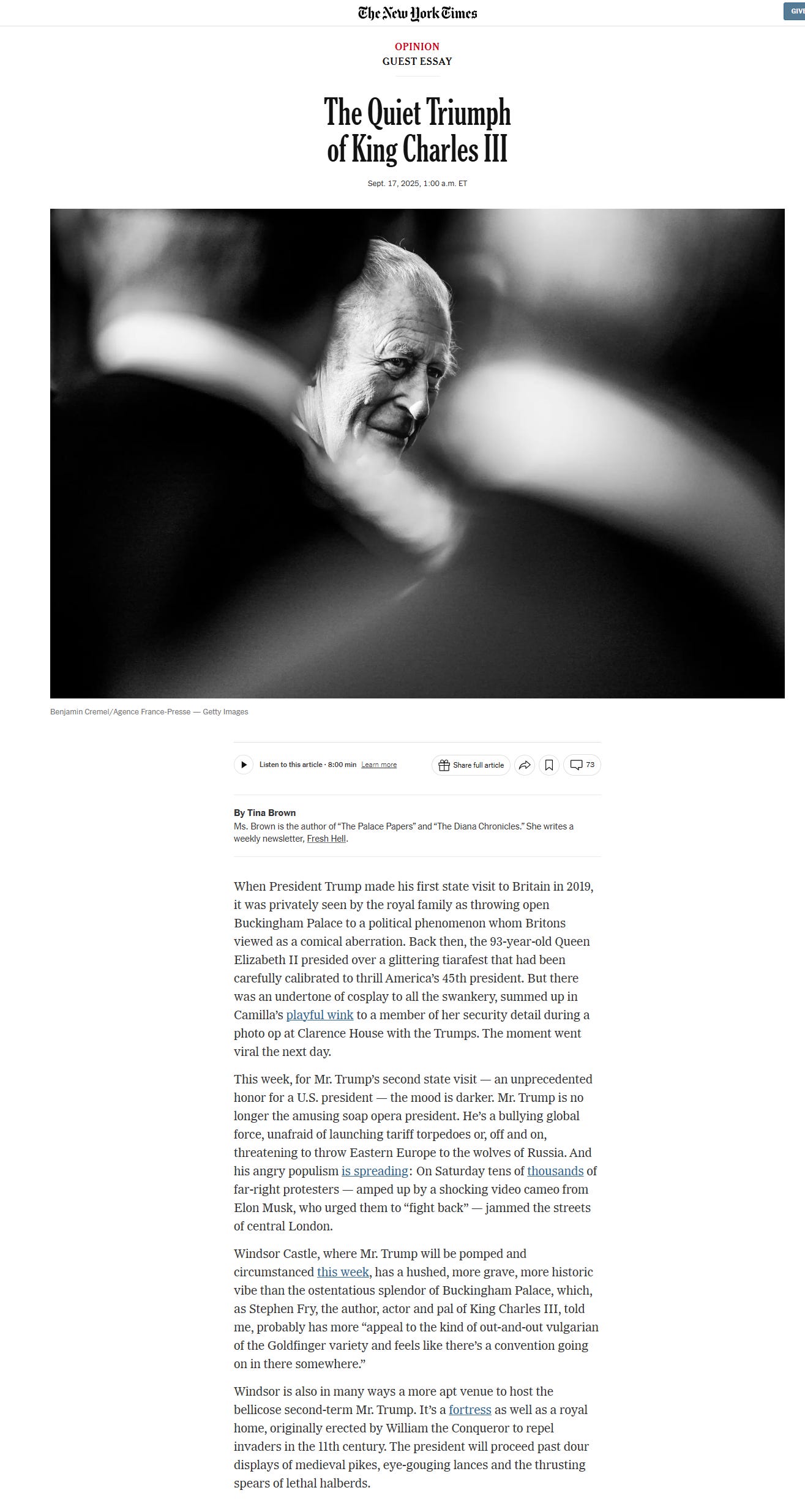
Editor: Look what Tina Brown missed!
June 25 2022
Headline: Prince Charles accepted €1m cash in suitcase from sheikh
Sub-headline: Heir to the throne sent money from former Qatari prime minister to his foundation
The Prince of Wales accepted a suitcase containing €1 million in cash from a controversial Qatari politician, The Sunday Times can reveal.
It was one of three lots of cash, totalling €3 million, which Prince Charles personally received from Sheikh Hamad bin Jassim bin Jaber Al Thani, the former prime minister of Qatar who is nicknamed “HBJ”, between 2011 and 2015.
On one occasion, Sheikh Hamad, 62, presented the prince with €1 million, which was reportedly stuffed into carrier bags from Fortnum & Mason, the luxury department store that has a royal charter to provide the prince’s groceries and tea.
On another, Charles, 73, accepted a holdall containing €1 million during a private one-on-one meeting at Clarence House in 2015. On Saturday night Clarence House said the money was “passed immediately to one of the prince’s charities who carried out the appropriate covenants and assured us that all the correct processes were followed”.
After the heir to the throne accepted the small suitcase, it was given to two advisers in the royal household who hand-counted the money. It was said to be in the form of €500 notes — a denomination dubbed the “bin Laden” because of its link to terrorist financing, and which has since been discontinued.
Palace aides then asked Coutts to collect the cash. The private bank, which is headquartered in the Strand in central London, and has served the royal family for centuries, is understood to have retrieved the suitcase from Charles’s London residence.
Each payment was deposited into the accounts of the Prince of Wales’s Charitable Fund (PWCF), a low-profile grant-making entity which bankrolls the prince’s pet projects and his country estate in Scotland. There is no suggestion the payments were illegal.
The prince’s meetings with Sheikh Hamad do not appear in the Court Circular, the list of official engagements undertaken by working royals.
The royal gift policy states that members of the royal family are allowed to accept a “cheque” as a patron of, or on behalf of, a charity. It is silent on cash.
There are questions over a “cash-for-access” culture at Clarence House, with the Metropolitan Police and Charity Commission investigating fundraising practices, including the sale of honours. Last year The Sunday Times reported that Michael Fawcett, Charles’s closest confidant, fixed an honour for a Saudi billionaire. There is no evidence the sheikh did not intend the monies to go to the charity and Sheikh Hamad did not comment on Saturday.
…
Editor: Tina is having too much fun with Trump as Comic Interest, in her collection of comments about Trump’s dull-wittedness: Brown places Trump in evocatine historical positions, to comic effect for the NYT reader. Who recalls her time at ‘The Dailey Beast’ as editor from October 2008 September 2013?
…
The Daily Beast Tries to Claw Its Way Back to Relevance
Can Joanna Coles and Ben Sherwood revive the once-buzzy news site and reclaim their perches atop the New York media world? Their own staff isn’t sure.
…
The Daily Beast, launched in 2008 by the longtime magazine editor Tina Brown and backed by Barry Diller’s IAC, became known over the years as a cheeky and aggressive tabloid with reporting on politics and national security that often had an impact belying the relatively small size of its newsroom.
…
Political Cynic.
Sep 20, 2025
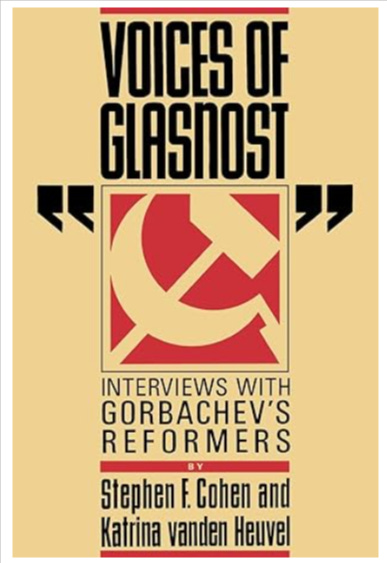
There can be no doubt that The Economist, under the direction of toxic Zanny Minton Beddoes, former partner in crime with Jeffrey Sachs, during the Post-Soviet period. See Stephen F. Cohen & Katrina Vanden Heuvel ‘Voices of Glasnost: Interviews with Gorbachev’s Reformers’, the details of what ‘Glasnost’ was about, in fact!
Editor: A selection of The Economist propaganda about various aspects of the political present, and its toxic actors, that constitutes the Economist Cadre of ‘experts’ : who are in fact about the evolution of the Neo-Liberal Toxin, in its many and various iterations: Name it Oxbridger Political Embroidery!
How Israel is losing America:
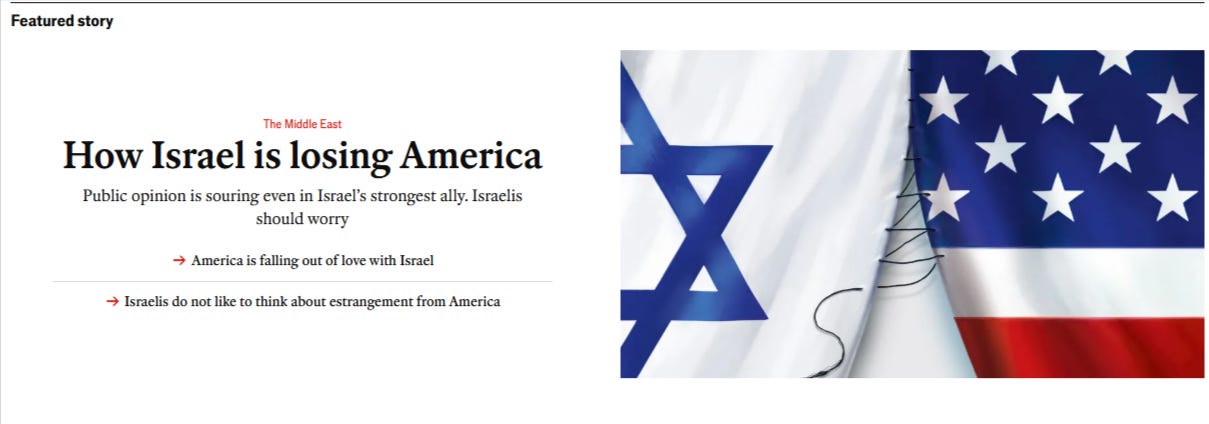
ON SEPTEMBER 14TH, after showing Marco Rubio, America’s secretary of state, the massive, 2,000-year-old blocks of the Western Wall at Jerusalem’s holiest site, Binyamin Netanyahu declared the alliance between their countries to be “as strong and as durable as the stones…we just touched”. Unfortunately, he is wrong.
As Israel becomes isolated over its war in Gaza, it depends increasingly on America. During the current UN General Assembly old friends, including Australia, Britain, Canada and France, will recognise a Palestinian state, even as Israel’s expansion of settlements in the West Bank makes real statehood less likely. America is all that stands between Israel and a pariah status that would have dire implications for its diplomatic, legal and military security.
ON SEPTEMBER 14TH, after showing Marco Rubio, America’s secretary of state, the massive, 2,000-year-old blocks of the Western Wall at Jerusalem’s holiest site, Binyamin Netanyahu declared the alliance between their countries to be “as strong and as durable as the stones…we just touched”. Unfortunately, he is wrong.
As Israel becomes isolated over its war in Gaza, it depends increasingly on America. During the current UN General Assembly old friends, including Australia, Britain, Canada and France, will recognise a Palestinian state, even as Israel’s expansion of settlements in the West Bank makes real statehood less likely. America is all that stands between Israel and a pariah status that would have dire implications for its diplomatic, legal and military security.
For all Mr Netanyahu’s blithe assurances that relations with America are perfectly solid, they are not. The prime minister has riled the Trump administration and is ignoring cracks deep within the foundations of the alliance. Democratic voters have long been drifting away from America’s most indulged ally. Republican voters are increasingly losing faith, too. A sudden loss of popular American support would be a catastrophe for Israel—a small country of 10m people in a dangerous and hostile neighbourhood.
The polling in America is startling. The share of Americans who back Israel over the Palestinians is at a 25-year low. In 2022, 42% of American adults held an unfavourable view of Israel; now 53% do. A recent YouGov/Economist poll finds that 43% of Americans believe Israel is committing genocide in Gaza. In the past three years unfavourable views of Israel among Democrats over 50 rose by 23 percentage points. Among Republicans under 50, support is evenly divided, compared with 63% for Israel in 2022. Between 2018 and 2021 the share of evangelicals under the age of 30 who backed Israelis over Palestinians plunged from 69% to 34%. Pollsters think that shift has endured.
To understand why this matters, go back to the years when America’s bond with Israel was a powerful amalgam of values and interests. Both are democracies founded by pioneers seeking refuge from persecution. Both believed that their country was exceptional: one a shining city on a hill, the other a light unto the nations. At the same time, their interests overlapped. During the cold war, Israel was a bulwark against Soviet expansion in the Arab world. After the Soviet collapse, they were still allied against Iran. After the attacks of September 11th 2001, they were united by a loathing of Islamist terrorism.
…
https://www.economist.com/leaders/2025/09/18/how-israel-is-losing-america
What Elon Musk gets wrong about Europe’s hard right
He imagines a continental revolt against Islam and elites
“You either fight back or you die,” Elon Musk told a big crowd in London on September 13th at a rally organised by Tommy Robinson, a convicted criminal who preaches anti-Muslim bigotry. Mr Musk has cultivated ties with insurgent hard-right parties across Europe. The continent is being overrun by Muslims, he claims, and faces demographic disaster and oppression by corrupt elites. It can be saved only by disruptive, MAGA-like parties that represent the true voice of citizens (take it as read: white, Christian ones).
In fact, to lump together Europe’s hard-right forces is a mistake. They all dislike immigration and wokery, and are fond of conspiracy theories and social-media pugnacity. But their paths are different. In France the hard right appears to be moderating as it gets closer to power. In Germany the Alternative for Germany (AfD) is radicalising further, but remains distant from power. Britain is in flux: as the rally showed, extreme views are becoming normalised, and the electoral system could yet propel the hard right into office.
Giorgia Meloni in Italy is actually in power. When she first soared in the polls, liberals panicked. Here, they feared, was a future prime minister rooted in post-fascist politics, who might unleash culture wars at home and an economic crisis in the European Union. Yet since winning office in 2022 Ms Meloni has proved pragmatic. She has been firm but not xenophobic on illegal migration. She has not waged a culture war, beyond trying to restrict surrogacy. She has cleaved to fiscal discipline, backed Ukraine against Russia and avoided open conflict with the EU. Her calculation is clear: Italy’s economy depends on European largesse, its companies on the single market, its bonds on the European Central Bank’s support.
In France Jordan Bardella shows early signs of following a similar script, positioning himself as the moderate face of Marine Le Pen’s National Rally ahead of a probable tilt at the presidency in 2027. (Ms Le Pen is currently barred from standing.) Mr Bardella is trying to reassure French business that a hard-right president need not mean fiscal ruin or a euro crisis. Whether he can honour that promise is doubtful. But even the act of wooing the establishment marks a shift.
Contrast those two cases with the AfD. It thrives in Germany’s east, where disaffection with the state runs deep. Its rhetoric is xenophobic and pro-Russian. Nonetheless a “firewall” put up by mainstream parties which refuse to work with it has so far blocked it from national or state-level office. It did well last year in state elections in the east, but without coalition partners failed to turn protest into power. And local elections in North Rhine-Westphalia, outside its eastern base, on September 14th showed its limited appeal west of the Elbe: it increased its share but failed to break out of the poorer areas.
…
Israel goes to the brink in Gaza city.
America’s monetary policy risks getting too loose.
N THE NIGHT of September 15th the Israel Defence Forces (IDF) launched its long-expected attack on Gaza city. “Israel is at a decisive moment,” said Binyamin Netanyahu, its prime minister, the next day. Under the cover of air strikes and artillery fire, two divisions moved towards the city’s central neighbourhoods. Two more are being held in reserve. For now, most of the IDF’s troops remain on the city’s outskirts. They have surrounded it on three sides, leaving open only the western exits, to the Mediterranean coastal road, for civilians fleeing south.
Most of the city’s residents are not leaving, though, risking yet another brutal chapter in a war that has dragged on for nearly two years. Israel has ordered them to move to “humanitarian zones” further south. Between 200,000 and 350,000 have done so; around 600,000 remain. Most have already seen their homes bombed and been displaced multiple times. Few can afford the cost of hiring a minivan to carry them and their belongings to Deir al-Balah, 15km away and still somewhat safer than Gaza city. Tents worth 150 shekels ($45) are going for 20 times that. “After all that, you don’t know if it will be declared a hostile environment and you’ll have to move again,” says Hisham over the sound of explosions. The former civil servant is staying in Gaza city.
In many ways this looks like a re-run of the first big offensive of the war. Then, as now, Israeli armoured columns wreaked havoc on Gaza city, while Israel’s leaders promised to wipe out Hamas. But since then at least 64,000 Gazans, most of them civilians, have been killed. So have nearly all of Hamas’s chiefs. Most of Gaza’s buildings have been damaged or destroyed. International aid organisations say people in much of the territory are starving.
The mood in Israel has changed, too. When the IDF attacked Gaza city 22 months ago, Israelis were nearly unanimous in their support. Hamas had burst out of Gaza, massacring hundreds and taking 250 hostages. (In all, nearly 1,200 people died.) The public agreed that Hamas needed to be destroyed.
…
https://www.economist.com/middle-east-and-africa/2025/09/16/israel-goes-to-the-brink-in-gaza-city
America’s monetary policy risks getting too loose
Jobs growth is probably weak because of low migration, not a cold economy
THE FEDERAL RESERVE is usually run by technocratic consensus. Today it has become a battleground. On September 17th the Fed cut interest rates for the first time since December, by a quarter of a percentage point, to 4-4.25%. One of its governors, Lisa Cook, could attend only because a court blocked President Donald Trump from sacking her. Another, Stephen Miran, was confirmed just before the meeting for a short stint, after which he says he will return to his job at the White House. It is an unseemly arrangement for a central bank that should be independent of politics. Mr Miran dissented in favour of a half-point rate cut. And he appears to have called for three such moves by the end of the year, twice what the next-most-doveish committee members suggested in their anonymous projections.
The Fed finds itself at a dangerous moment, and not just because of Mr Trump’s quest for lower rates. The economic argument for looser money is finely balanced. Mr Miran’s submission, though an outlier, was pivotal: by 10-9, the committee expects at least three rate cuts this year. That is what markets have been betting on, too. But following through on those expectations would be a mistake.
The case for easier money depends almost entirely on the labour market. Recent data and revisions show firms have created only 27,000 jobs per month on average since May, down from 123,000 in the first four months of the year. The hiring swoon has vindicated predictions made by Chris Waller, another Fed governor and the betting market’s favourite to replace Jerome Powell as chairman next year.
The trouble is judging how much poor jobs numbers—and an accompanying slowdown in economic growth—reflect softer demand for workers rather than their shrinking supply. Immigration has collapsed under Mr Trump. Agents reported just 8,000 “encounters” with illegal migrants on the southern border in July, compared with 100,000 in the same month last year. Some researchers think that net migration this year will be negative. The unemployment rate, which should reflect the balance between supply and demand, is only 4.3%—hardly evidence of a glut of workers.
…
Political Observer.
Sep 19, 2025
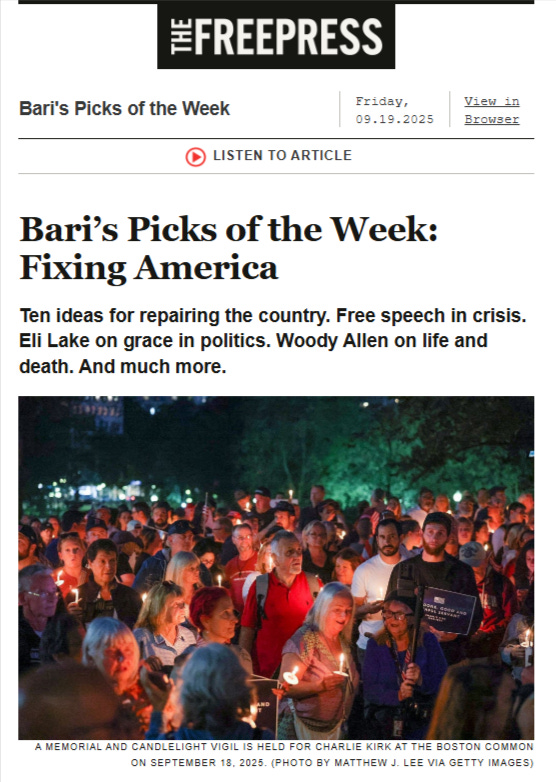
By Bari Weiss
Hi folks. This was a hard week. As we wrote in our editorial in the wake of the worst political assassination our country has witnessed in decades: “Charlie Kirk’s assassination has hit the staff of The Free Press hard. . . . We’re journalists, which means we are used to reporting on horrible events, including gun violence, assaults, and murders. So why does this one feel different? Why is there sure to be a prolonged impact from this tragedy?”
It’s because Kirk was assassinated for his views. It’s because he was murdered while practicing the virtues we aim to stand for here at The Free Press: speaking freely, and inviting good-faith debate from all corners.
I am proud of our reporters and writers always, but especially over these past days.
They’ve helped me make sense of this precarious moment, helped separate the signal from the noise, and kept cool heads in a moment where so many others are raising the temperature.
Let’s get to it.
Editor. Bari Weiss lets others do the Heavy Lifting :
We offered a 10-step guide to fixing our broken country.
Coleman Hughes: Demand Nonviolence
Abigail Shrier: Parent Your Kids
Mary Katharine Ham: Look for God
Tyler Cowen: Stop Blaming ‘Them’
Charles Fain Lehman: Don’t Tolerate Disorder
Greg Lukianoff: Bury the ‘Words Are Violence’ Cliché
Joe Nocera: Stop Worshipping Guns
Editor: This reeks of a tired old collection political hacks, warmed over for the occasion. Reminding the reader of Bari Weiss’s complete lack talent, as a scribbler devoid of talent, and bereft of literary skill!
Political Observer.
Sep 19, 2025
Headline: The Era of Dark Passions
Editor: My patience with Mr. Brooks ‘morlizing chatter’ is exhausted by his self-congratulation: Even his unremarcable ‘The Collapse of the Dream Palaces’ of 2003 which brought him to The New York Times, was a shopworn amagamation of War Mongering, via its feckless protaganist ‘Joey Tabla Rasa’! I will limit my commentary some select portions of his essay! Mr. Brooks re-writes his Own History in the first three paragraphs of his essay!
Sometimes when I have nothing better to do, I think back on the elections we had in the before times — when, say, Mitt Romney ran against Barack Obama or John Kerry ran against George W. Bush. I try to figure out why politics and society in general felt so different then.
It’s not because we didn’t have big disagreements back then. The Iraq war kicked up some pretty vehement arguments. It’s not because we weren’t polarized. Pundits have been writing about political polarization since at least 2000 and maybe well before.
Politics is different now because something awful has been unleashed. William A. Galston defines this awful thing in his fantastic new book, “Anger, Fear, Domination: Dark Passions and the Power of Political Speech.” Even before the Charlie Kirk assassination it was obvious that the dark passions now pervade the American psyche, and thus American politics.
…
Editor : What Reader of Mr. Brooks present essay will recall his War Mongering chatter via ‘‘Joey Tabla Rasa” ?
I will post this as of 9:02 AM Pacific Time 9/19/2025 and will add to its later in the day. ?
Political Cynic.