Newspaper Reader
Mar 11, 2026

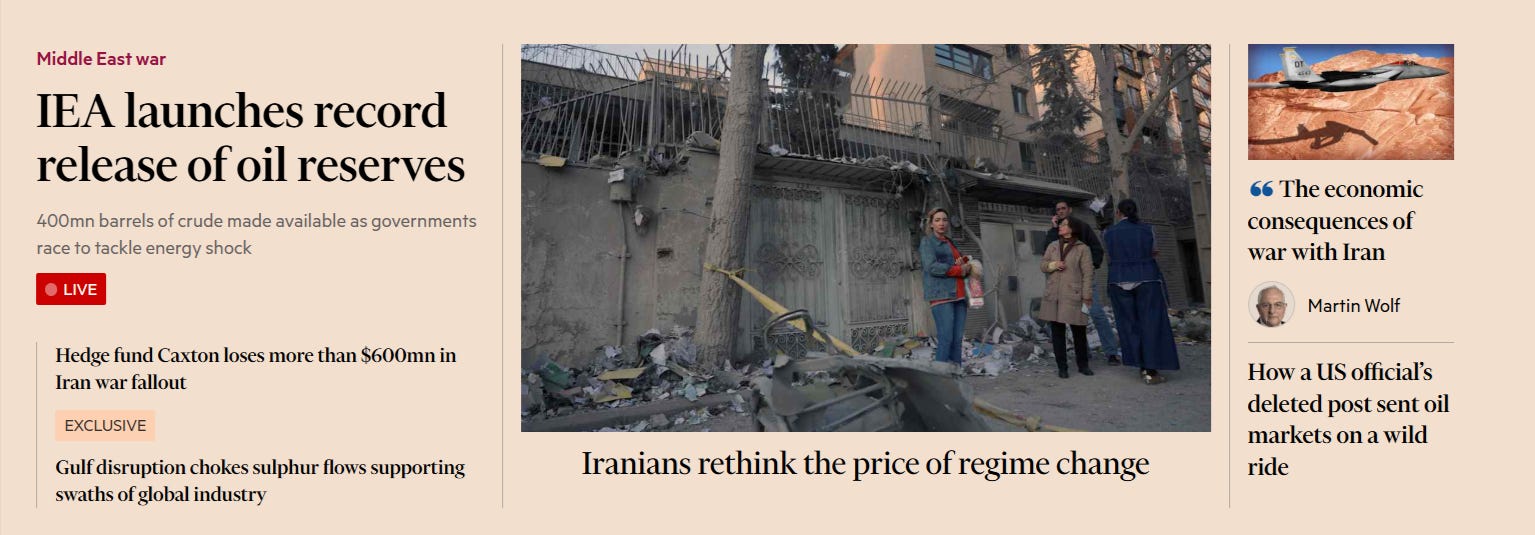

Newspaper Reader.
Mar 10, 2026
The most famous query in the history of modern warfare came from David Petraeus, then a major general, in an interview with Rick Atkinson, then a reporter, during the initial assault on Iraq: “Tell me how this ends.”
Editor: The first paragraphs of Bret Stephens latest essay demonstares a shocking ignorance of both Stephens and Petraeus? What might the reader think of Stephens own inexcusable ignoance of the what Petraeus did! And the fact that other actual ‘whistle blowers’ suffered jail time, while Petraeus received 2 years probation and pay a fine of $40,000.
Petraeus Sentenced To 2 Years’ Probation, Fine For Sharing Classified Info
April 23, 20157:31 AM ET
By
Former CIA Director and retired Gen. David Petraeus was sentenced Thursday to two years of probation and handed a $100,000 fine for the unauthorized removal and retention of classified material, in the form of notebooks he shared with his lover.
Under the terms of a plea deal, Petraeus, 62, will avoid jail time. As we reported last month, “The charge’s maximum possible punishments include a fine of $100,000 and a one-year prison sentence. Instead, prosecutors agreed that Petraeus should serve a two-year probation and pay a fine of $40,000.”
Judge David Kessler said he increased the fine to “reflect the seriousness of the offense.”
At issue are “black books” — eight notebooks in which Petraeus kept highly classified information that the government says included “the identities of covert officers, war strategy, intelligence capabilities and mechanisms, diplomatic discussions, quotes and deliberative discussions from high-level National Security Council meetings, and defendant David Howell Petraeus’s discussions with the President of the United States of America.”
That description comes from court documents that were filed along with the plea deal. The documents also included an email in which Petraeus promises to give the black books to Paula Broadwell, his biographer with whom he was having an affair.
The government also said that Petraeus gave false statements to FBI agents about giving Broadwell the notebooks, and that he also falsely swore when he left the CIA in 2012 that he did not have any classified material in his possession or control.
The black books were found in 2013, after the FBI conducted a search of Petraeus’ house. They had been sitting in an unlocked desk drawer, according to court documents.
Jesselyn Radack, an attorney for Edward Snowden, John Kiriakou and Thomas Drake, called the sentence handed to Petraeus a “travesty.”
“This sentence is nothing more than a slap on the wrist that highlights a gross double standard in leak prosecutions, which makes clear that the Obama administration’s record breaking number of Espionage Act prosecutions has nothing to do with protecting classified information and everything to do with punishing and silencing whistleblowers,” she said in a statement. “If leaks were the real concern, Petraeus would receive punishment as harsh as the government demanded for other accused leakers.”
Newspaper Reader.
Mar 10, 2026
Middle East & Africa | On their guard
Should the Gulf states join attacks on Iran?
A lack of trust in America and Israel, internal divisions and the risk of domestic strife all hamper a unified response
Editor: Let me empsize some of the belicose chatter coming from this ‘newspaper’ via its editor Zanny Menton Beddoes who once was one of Dr. Jeffrey Sachs, Shock Therapist in the post Soviet Union:
…
Getting a handle on the magnitude of the problem is obviously difficult in a country that cannot even explain why life expectancy has fallen sharply in the last two decades. But some number is better than none. And by pressing officials to address this and other pivotal issues, Sachs hopes to accelerate the pace of reform.
Sachs’s message of urgency is not universally accepted. Plenty of Western as well as Russian economists contend that a more gradual approach is not only possible but necessary. “Economic reform is a political process,” says Padma Desai at the Harriman Institute at Columbia University. “First, you must build consensus.”
And even his sympathizers acknowledge that Sachs’s high profile and world-class impatience could generate a backlash in a nation still adjusting to the reality that it is no longer a superpower. “There’s a real dilemma here,” says Stanley Fischer, an international economist at the Massachusetts Institute of Technology. “You have to make a lot of noise to get the attention of the West. But the more noise you make, the more you make it seem that the reform program is a Western program. And that could be the kiss of death.”
Still, Sachs’s brand of “shock therapy” has worked elsewhere. And there is good reason to believe that Russia’s future will turn on how well its leaders learn the catechism of change that he has worked so hard to promulgate.
…
The six members of the Gulf Co-operation Council (gcc) often struggle with the co-operation bit. Plans for a common currency and a railway across the Arabian peninsula are decades behind schedule. Foreign-policy disputes have led to years-long ruptures between monarchs.
Over the past ten days, war has brought a traumatic consensus. Since America and Israel attacked Iran on February 28th, more than 2,000 Iranian missiles and drones have rained down on Gulf states. The pain has not been equally distributed—more than half of Iran’s attacks thus far have been aimed at the United Arab Emirates (uae), compared with only a handful at Oman—but it has been felt everywhere. One of the most recent drone attacks, on March 9th, hit Bahrain’s sole oil refinery, injuring 32 people and leading the state-run oil company to declare force majeure.
Yet there is no unity on how to respond. That is not only because of long-standing disagreements between states, but also within them: some officials urge restraint, while others seek retaliation. Gulf states are paralysed because they do not trust any of the parties to this war—including themselves.
Editor: Zanny Menton Beddoes has the temprement resembling that of Sir Harry Paget Flashman, its creator George MacDonald Fraser made a hero out of cad! Though Zanny Menton Beddoes is a dullwitted Neo-Consevative!
…
Editor: The ‘ZMB’ Prognonis :
Start with America. In the months before Donald Trump (and Israel) struck Iran, all six gcc members urged him not to do it. When war began to look inevitable, some added a caveat: if you do it, do it right. They feared that America would drag them through a conflict only to leave the Islamic Republic wounded but intact.
Mr Trump’s vague suggestion on March 9th that the war could be nearing an end might have spooked them. Gulf rulers know that he can be unreliable. Less than a year ago, after all, he stood in Riyadh and denounced the “interventionists” who had “wrecked” the Middle East. And they can read the polls in America, which show a majority opposed to the war and the president’s approval rating stuck at 38%.
For the restrainers, then, joining the war seems an unacceptable risk: Gulf states might paint a target on themselves only to watch America pack up and leave soon after. A few officials muse about setting up a coalition like the one that fought Islamic State a decade ago, as a way to bind Mr Trump and draw in other allies. But that seems a hard sell with a president who is not fond of multilateralism.
At the same time, trust in Iran—never high—has evaporated. Saudi Arabia and the uae laboured for years before the war to improve their once-hostile relations with the Islamic Republic, while Qatar has long maintained friendly ties with it. All were attacked anyway. To more hawkish voices in the Gulf, restraint looks naive. It has not shielded them so far. As the war continues, Iran will probably keep escalating its attacks. Conciliatory messages from Masoud Pezeshkian, the Iranian president, and other officials have proved worthless.
They also worry about what happens when the war ends. Even assuming the country remains intact, Iran will presumably remain under onerous American sanctions and the regime may have billions of dollars in damage to contend with. It could seek to extort the gcc by keeping up a trickle of drone attacks or continuing to harass ships in the Persian Gulf. Those who argue for taking action now reckon it is better to try to create some deterrence by showing Iran that Gulf states can hit back, at a moment when America is still focused on their defence.
Editor: Reader recall that the whole of the Western Press tried but failed, to erase the pictures of The Zionist Faschist State under attack!
…
Editor: What the reader is fed is warmed over Political Melodrama!
Israel’s role is another complication. On March 8th several Israeli journalists reported in unison that the uae had joined the war by attacking a water-desalination plant in Iran. Their unsubstantiated stories were attributed to an unnamed “Israeli source”. The uae rushed to deny them. “This is fake news,” said Ali al-Nuaimi, a defence official.
In private, the Emiratis were furious. Since they established diplomatic ties with Israel in 2020 they have worked to build a close partnership, one that even endured the Gaza war, when other Arab states kept their distance. Now the Israelis were leaking something that was either a closely guarded secret or an outright falsehood (and probably a war crime to boot).
Nor was it the first time Israeli journalists made such a claim about a Gulf state. Five days earlier they reported that Qatar had carried out strikes in Iran. That too was denied. “It’s a dirty game,” says an official from a third Gulf country, who thinks Israel is trying to create a fait accompli by leaking reports of supposed gcc military action. This is becoming a widely-held view in the region. It is making even some interventionists uneasy.
The final issue is domestic. Though the Gulf states are monarchies, they cannot ignore public opinion. Bahrain is a particular worry. The island’s Shia majority has long complained of discrimination at the hands of its Sunni rulers. Mass protests in 2011 were brutally repressed by Bahraini police and armies from other Gulf states. Those grievances have not gone away. In some videos of Iranian strikes on the kingdom, the people filming can be heard cheering the attacks. Were Bahrain or other Gulf states to join the war, it might stir up fresh unrest.
The business community is starting to grumble, too. Khalaf al-Habtoor, a billionaire property mogul in Dubai, has posted several criticisms of the war on social media, accusing America of dragging the Gulf into danger, only to delete them later. His missives touch on a long-standing difference between Abu Dhabi, the uae’s capital, and Dubai, its commercial hub. The former is more comfortable with an assertive foreign policy and views Iran as a menace, while the latter would prefer to stay neutral and is often rapped by America’s Treasury for turning a blind eye to Iranian money-laundering.
For now, the restrainers seem to be winning the argument. A spectacular Iranian attack could tip the balance the other way, while a swift truce could end the debate. The longer the war drags on, the more contentious it will become.
Editor: The near total absence of American Political actors in this Economist failed panaorama, offers the reader what ? Trump, Hegseth and the crush of Reporters, on the plane, waiting for the latest chatter coming from the feckless Trump. Flashman was in its way about a still-born nostalgia?
Newspaper Reader.
Mar 09, 2026

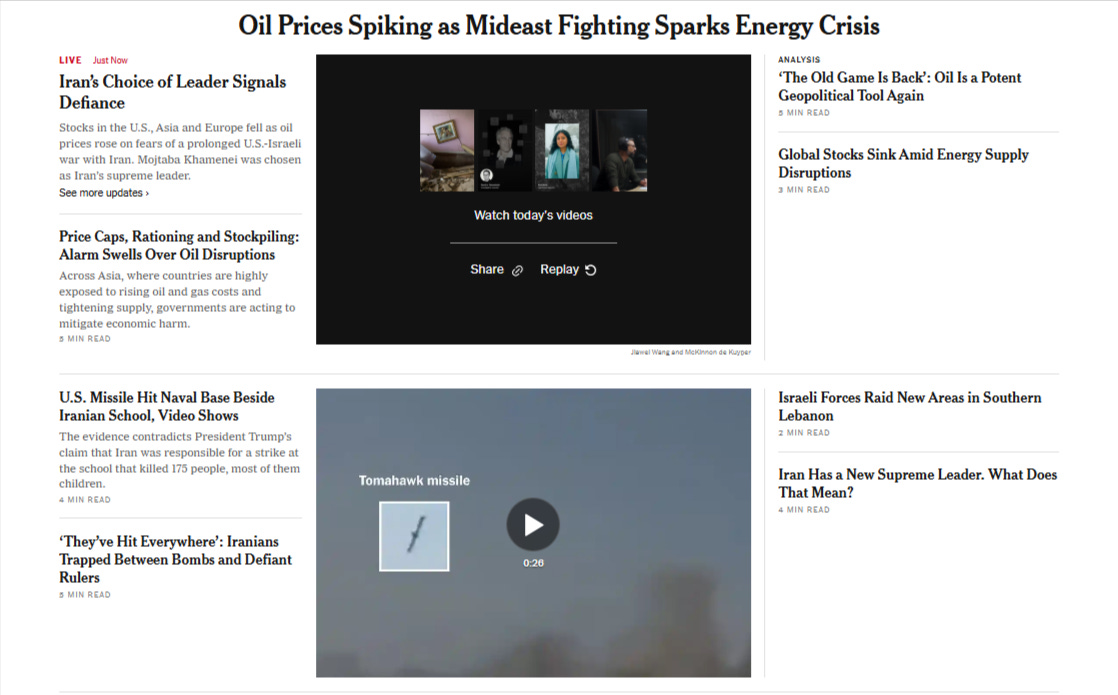
The U.S. and Israel are inflicting monstrous collective punishment on one of the largest cities in the world in a war they started.
Mar 9



The city of Tehran is being poisoned by a toxic cloud of smoke from the Israeli bombing of oil depots:
Iran’s capital was engulfed in a cloud of toxic smoke that unleashed black rainfall dozens of miles away on Sunday after overnight Israeli strikes on several fuel depots caused fires to burn for hours.
Images from Tehran, a city of nearly 10 million people, showed thick black smoke from the fires hanging over it, while residents reported difficulty breathing and oil-tainted rainfall staining everything around them.
The destruction of the country’s civilian infrastructure is terrible in itself, and the harm that the U.S. and Israel are doing to the population is appalling and indefensible. Millions of people are being threatened by toxic fumes and poisoned rain. The damage to the environment will be severe. The short and long-term effects on the health of the population of Tehran and the surrounding region will be grave. Iranians will be suffering the consequences of this war long after the bombing stops.
It is not surprising that a genocidal government would commit more crimes against humanity in this war, but it is important to recognize and condemn those crimes when we see them. Poisoning the air that the entire population breathes is a horrifying crime. The U.S. and Israel are inflicting monstrous collective punishment on one of the largest cities in the world in a war they started. The attackers have made clear through their actions that this is a war to wreck Iran and hurt its people.
The smoke from the fires is so thick that it has blotted out the sun:
Residents of Tehran woke up on Sunday morning to find it was still dark outside, an apocalyptic sight created by thick black smoke billowing from oil depots hit by Israeli strikes.
With the Sun blotted out, disoriented people in the Iranian capital had to turn on their lights to see through the gloom.
Gabriel da Silva, an atmospheric chemist, explains the dangers from the fumes and poisoned rain:
In the longer term, exposure to the compounds in the air and in this black rain is potentially increasing people’s cancer risk. When ultrafine particles (PM2.5) are inhaled, they can get into your bloodstream. This has been linked to a range of health impacts, including cancers, neurological conditions (such as cognitive impairment), and various cardiovascular conditions.
Once these heavily polluted plumes of air have their pollutants rained into natural waterways, they can also start to affect aquatic life, as well as human drinking water sources.
Another issue is that this black rain is depositing these compounds on buildings, roads and surfaces, which means they can make their way back into the air when disturbed by strong winds.
The poisoning of Tehran will be harming and killing innocent Iranians for years after the war is over. As we have seen in our government’s many other unnecessary wars from Southeast Asia to Iraq and beyond, there is always a trail of ruin and contamination left behind. The longer that this disastrous war goes on, the more devastating its effects will be.
…
Mar 08, 2026

The Desire for Terror
And the defense of democracy
Timothy Snyder
Mar 8
A purpose of the war on Iran might well be to provoke a terrorist attack inside the United States. This would provide Donald Trump with a pretext to try to cancel or “federalize” the coming Congressional elections.
Self-terrorism might not have been the initial aim; but as time goes by, and failures and atrocities mount, its appeal will grow. Trump could think that he has much to gain; the war itself makes terrorism more likely; there are plausible vectors of terror; and the United States has let down its defenses.
Trump has already telegraphed the move. We know that he is obsessed with the fall elections, which his party will almost certainly lose by spectacular margins, and that he fears the accordant loss of power. This is clear from his own statements and actions. In a social post right after starting the war, he claimed (wrongly) that Iran had tried to hurt his cause in past elections.
We lack any other explanation for the war, at least from the American side. Trump is incoherent, and his administration is inconsistent. Much of what has been said about Iran is not true. The propaganda is contradictory. It is as though the war itself is not the main goal, but that it was simply important to somehow get the thing started.
War, famously, is the extension of politics by other means. But what are the politics? The president and especially the Secretary of Defense present the United States as a kind of war crimes central, a place where the rules do not apply. War crimes to do not win wars. Instead they provoke further war crimes and other retribution.
The Tehran regime is, so to speak, a convenient partner in the mutual provocation of terror. Iran is ruled by ruthless people with a record and a capacity for carrying out terrorist attacks beyond its borders. A terrorist attack on the territory of the United States might be a response by Iran or one of its proxies. Trump seems to have anticipated this, without seeming to care about loss of life: “Like I said, some people will die.” And if they do, he has his pretext.
…
Timothy Snyder offers his own ‘evidence’?
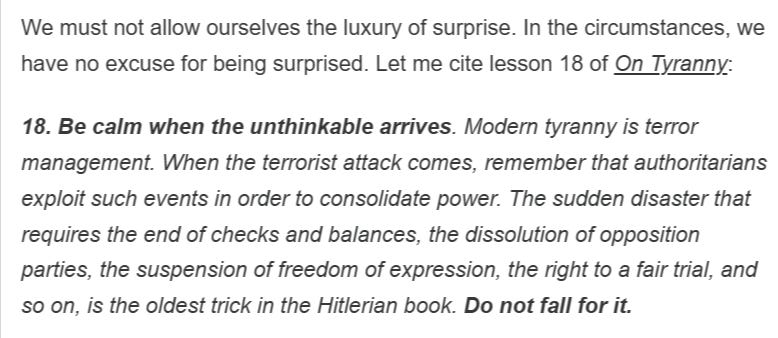
Newspaper Reader
Mar 08, 2026
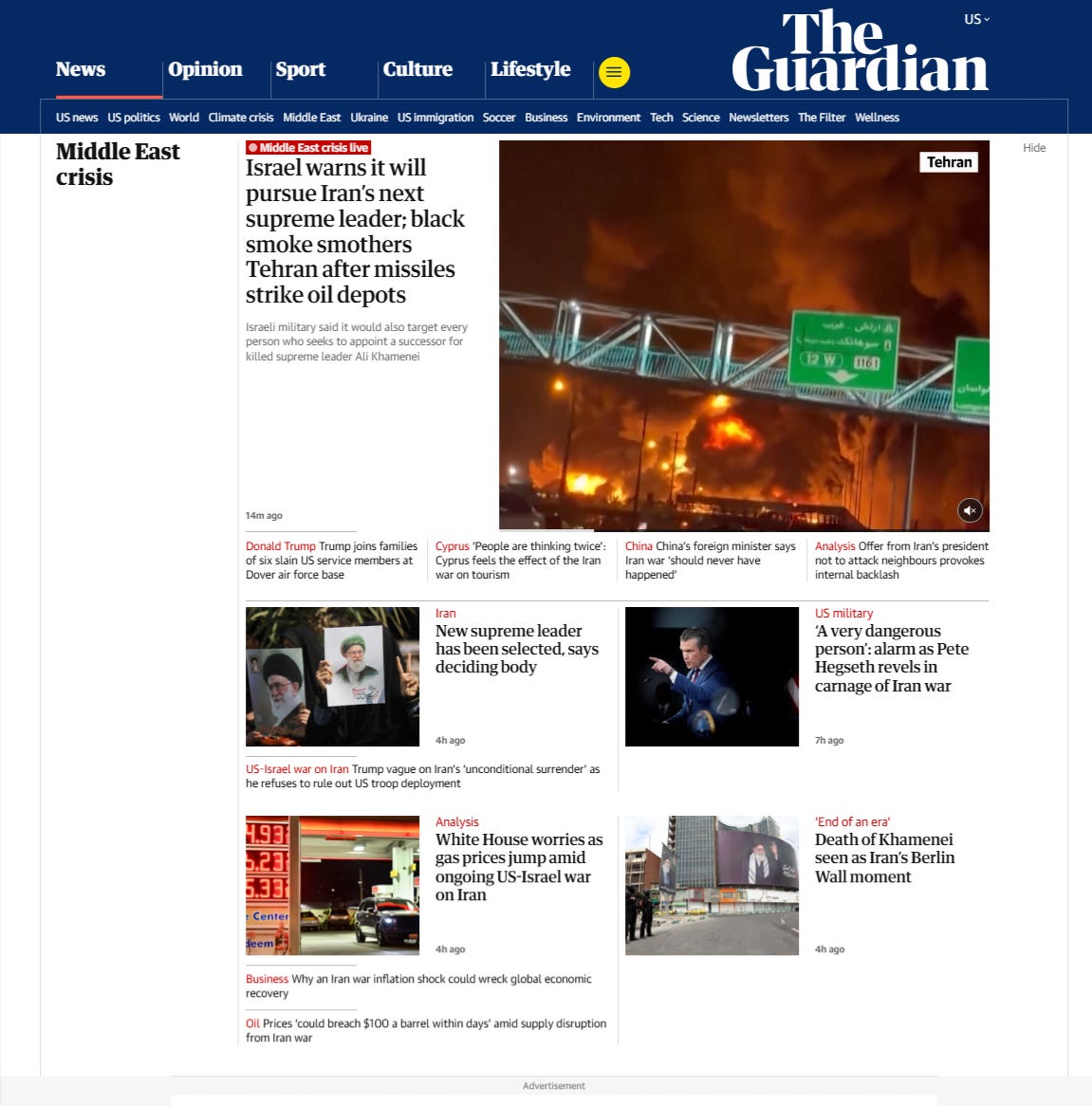
https://www.theguardian.com/us
Headline and sub-headline: Featuring ‘Iran experts believe’…
‘End of an era’: death of Khamenei seen as Iran’s Berlin Wall moment
Iran experts believe the symbolism of Ayatollah Ali Khamenei’s death is overwhelming and that the regime will struggle to fill the power vacuum
…
Mar 06, 2026
Excerpts from the Nuremberg Opening Statement Robert H. Jackson Chief of Counsel for the United States Nuremberg, Germany November 21, 1945
Wednesday, November 21, 1945 marked the second day in the Trial of the Major War Criminals before the International Military Tribunal (IMT), more commonly known today as the Nuremberg Trials. For the first time in history, military, economic, and political leaders identified as Major Offenders would be held to account for the actions of their government and military and its crimes against humanity and peace. Beginning the proceedings in the Palace of Justice on this, the second day of a trial that would not end for 293 subsequent days, was the opening statement for the prosecution delivered by American Supreme Court Justice and US Chief of Counsel, Justice Robert H. Jackson. Jackson’s opening statement, consisting of nearly 25,000 words and taking nearly three-and-a-half hours to read, remains one of the most famous and influential oratories in the canon of international law and criminal jurisprudence.
Appointed by President Truman and taking a leave of absence from the bench of the US Supreme Court, Associate Justice Jackson, along with other members of the IMT, labored for many months over the summer and fall of 1945 in an attempt to codify the legal precedents required to try individual members of the Nazi regime. Building off the framework of statements and declarations from the 1943 Moscow and 1945 Yalta and Potsdam Conferences, the task facing Jackson and the IMT remained a daunting one. All of the Allies agreed that Nazi Germany must be punished for the unprecedented nature of its crimes. However, it was also agreed that a predetermined ‘show trial’ was to be avoided to dispel as much as possible the idea of a vindictive victor’s justice. As such, each of the 22 Nazi defendants present at Nuremberg stood accused of one or more of the following four new categories of crimes outlined by Jackson and the IMT: “Participation in a common plan or conspiracy for the accomplishment of a crime against peace,” “Planning, initiating and waging wars of aggression and other crimes against peace,” “Participating in war crimes,” and “Crimes against humanity.”
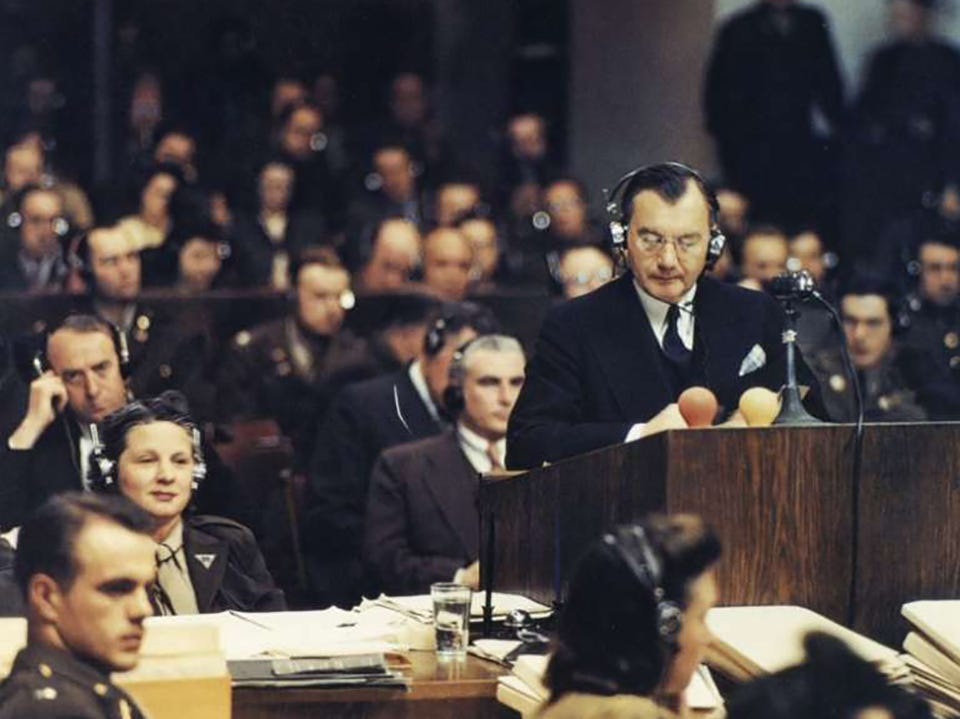
Justice Jackson Delivering the Opening Statement at Nuremberg. Courtesy of the US Army Signal Corps. Katherine Fite Lincoln Papers, Harry S. Truman Library & Museum.
Just as the IMT strove to define the new legal landscape, Jackson spent months drafting his opening statement which not only introduced these new concepts of international law to the Nuremberg court, but also indicated to a worldwide audience that justice for the victims of Nazi aggression would be served. In his statement, Jackson’s tone was analytical, deliberate, and extraordinarily thorough. Jackson’s tone matched the basis of the argument for the prosecution which chose to rely on documentary evidence, eschewing possibly volatile eyewitness testimony. Despite his dispassionate approach, Jackson began by acknowledging that he well understood the momentous nature of the trial both for himself and for world leaders to come.
Speaking of the defendants, “twenty-odd broken men…their fate of little consequence to the world,” Jackson focused on the actions of the Nazi leaders rather than their identities. The defendants embodied and signified all of the evils of Nazism which must be extinguished lest they arise again in the future.
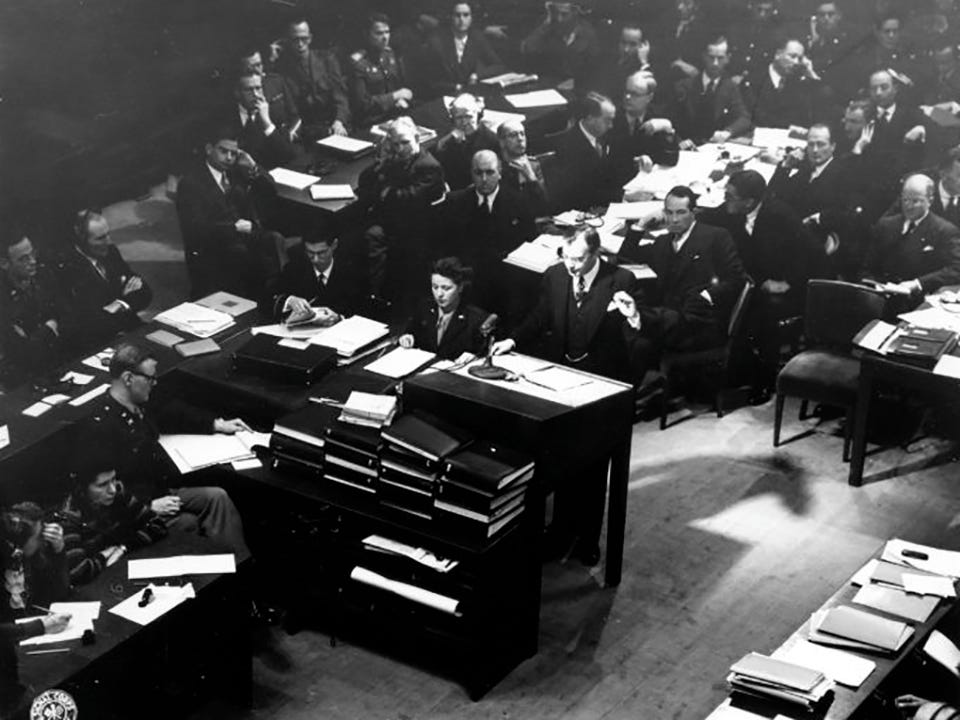
Justice Jackson Delivering the Opening Statement at Nuremberg. Courtesy of the US Army Signal Corps. Katherine Fite Lincoln Papers, Harry S. Truman Library & Museum.
For more than three hours, Jackson relentlessly made his argument, condemning the Nazi regime and its actions as criminal from the very moment of their inception to the arrival of their defeat. Albert Speer, the Nazi Minister of Armaments and War Production, was both impressed by Jackson’s “grand, devastating address,” but also comforted somewhat “from one sentence in it which accused the defendants of guilt for the regime’s crimes, but not the German people.” At the conclusion of his statement, Jackson was honest in his assessment of human history, but also hopeful in his appraisal for humanity’s future.
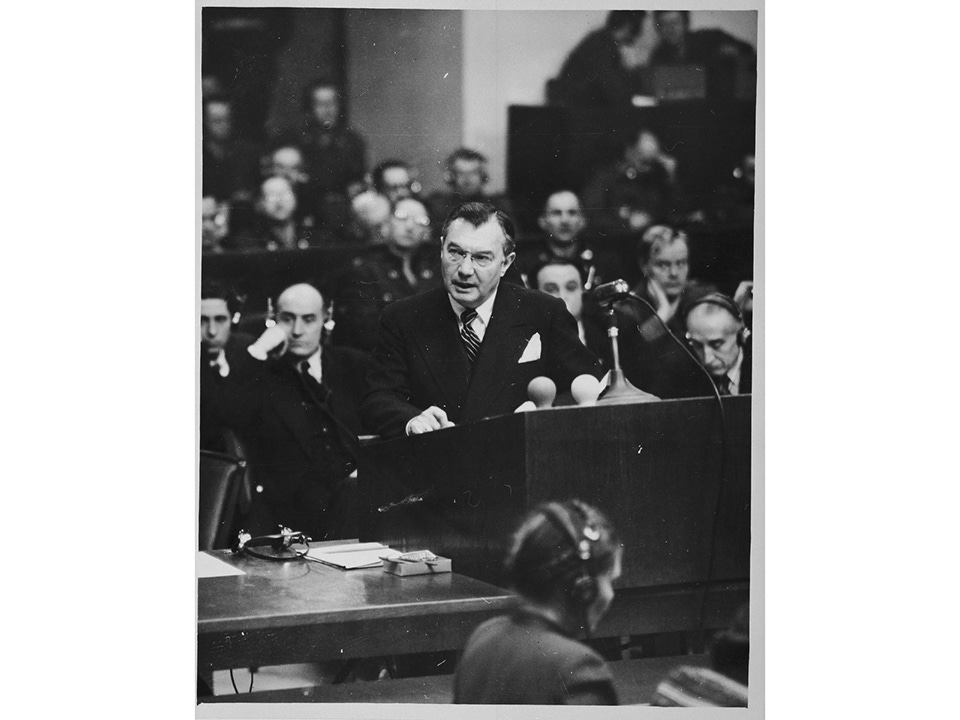
Chief American prosecutor Justice Robert Jackson delivers the opening speech of the American prosecution at the International Military Tribunal trial of war criminals at Nuremberg. United States Holocaust Memorial Museum, courtesy of Gerald (Gerd) Schwab.
Seventy-five-years later, Justice Jackson’s opening statement at Nuremberg remains one of the most significant and one of the most often cited affirmations on the role and responsibility of international law and human rights. Jackson’s opening statement continues to serve as a foundation for the course of international law and international criminal trials to the present day.
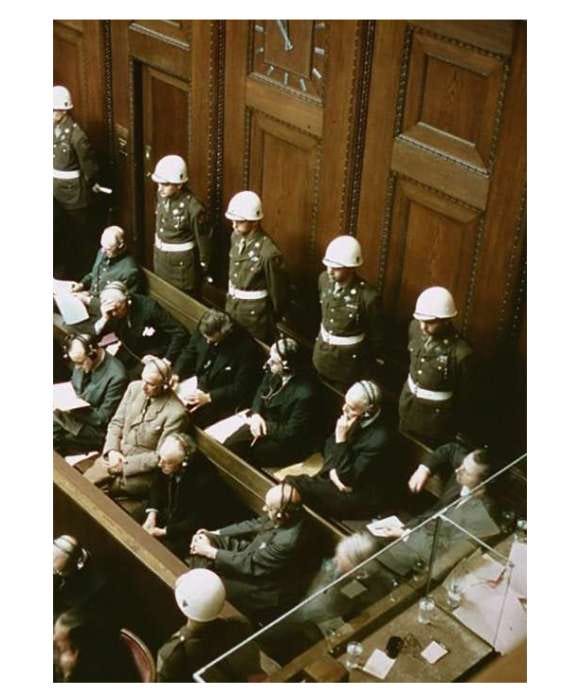
The first international war crimes tribunal in history revealed the true extent of German atrocities and held some of the most prominent Nazis accountable for their crimes.
This article is part of a series commemorating the 75th anniversary of the end of World War II made possible by the Department of Defense.
Contributor
Collin Makamson is the former Assistant Director of Education for Curriculum at The National WWII Museum.
Cite this article:
MLA Citation:
Collin Makamson . “’The Grave Responsibility of Justice’: Justice Robert H. Jackson’s Opening Statement at Nuremberg” https://www.nationalww2museum.org/war/articles/robert-jackson-opening-statement-nuremberg. Published November 20, 2020. Accessed March 6, 2026.
Copy MLA Citation
APA Citation:
Collin Makamson . (November 20, 2020). ‘The Grave Responsibility of Justice’: Justice Robert H. Jackson’s Opening Statement at Nuremberg Retrieved March 6, 2026, from https://www.nationalww2museum.org/war/articles/robert-jackson-opening-statement-nuremberg
Copy APA Citation
Chicago Style Citation:
Collin Makamson . “’The Grave Responsibility of Justice’: Justice Robert H. Jackson’s Opening Statement at Nuremberg” Published November 20, 2020. Accessed March 6, 2026. https://www.nationalww2museum.org/war/articles/robert-jackson-opening-statement-nuremberg.
Copy Chicago Style Citation
Topics
Mar 05, 2026
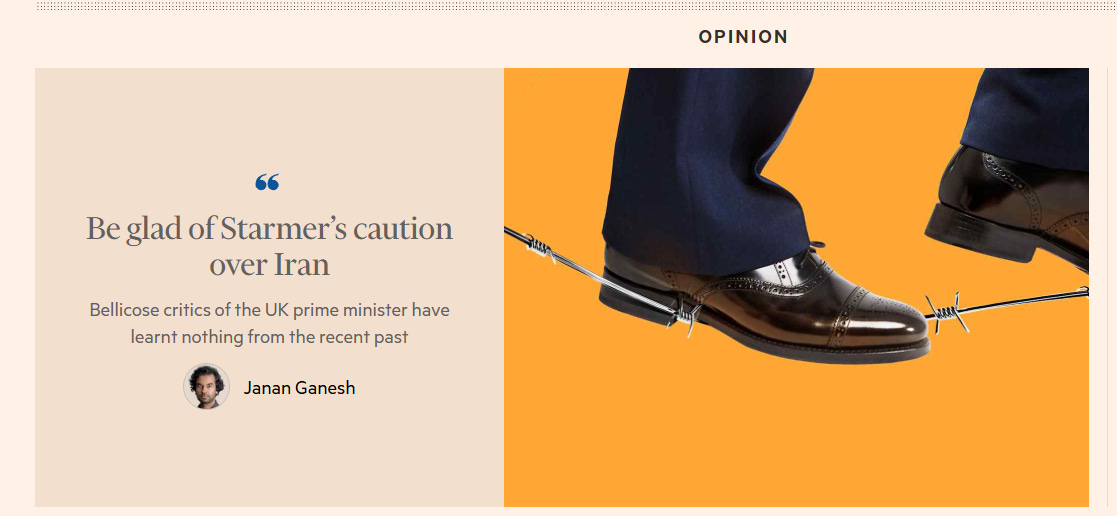
Be glad of Starmer’s caution over Iran
Bellicose critics of the UK prime minister have learnt nothing from the recent past

Janan Ganesh
Newspaper Reader.
Mar 04, 2026
Editor: Clive Crook’s sedate commentary on the feckless and illfated attack on Iran opens with a first paragraph, that then metaticises, as if the first and its sucessor are mirrors of each other, with this ‘The immediate danger is a setback in financial markets that gets out of hand’
President Trump’s extraordinary gamble in attacking Iran and risking a wider conflagration in the Middle East dials up the economic hazards facing the US economy from “very high” to “extreme.” The point is, this new stress compounds a series of other severe pressures already facing the economy, which is now even more unlikely to emerge unscathed.
The immediate danger is a setback in financial markets that gets out of hand. In many ways, some such reversal was already overdue, given the apparent overvaluation of US equities, the weight that the administration’s tariffs had already put on the economy’s back, a still-deteriorating fiscal outlook and a stubbornly persistent rate of inflation. Now let’s add the possibility of spiking energy prices, interrupted trade flows and global political turbulence.
Editor: Mr. Crook does not explore the pressing question of Trump as the political creature of Miriam Adelson! Mr. Crook spends his time via my selections of the economic questions he articulates as pressing – yet Adam Smith in his ‘Theory of Moral Sentiments’ and his ‘The Wealth of Nations’ viewed these two imperatives as congruent with each other!
…
Last week’s new inflation numbers were already cause for concern. The core producer price index, which excludes food and energy, increased by 0.8% in January, markedly higher than expected. Its main components feed into the Federal Reserve’s preferred metric, core PCE inflation.
…
Last week’s new inflation numbers were already cause for concern. The core producer price index, which excludes food and energy, increased by 0.8% in January, markedly higher than expected. Its main components feed into the Federal Reserve’s preferred metric, core PCE inflation.
…
Echoes of the 1970s: A lasting spike in oil prices would mean stagflation – higher inflation plus slower growth, a combination that the Fed is powerless to defeat.
…
Even before the Supreme Court overturned the administration’s so-called reciprocal tariffs, the outlook for public borrowing was testing limits. Budget deficits at 6% of gross domestic product, even with the economy at full employment and comfortably quiescent interest rates, mean that public debt (already near records) will continue to grow faster than the economy. That’s what “unsustainable” means.
…
To make good the shortfall, Trump has announced a new global tariff of 10% rising to 15% under Section 122 of the 1974 Trade Act; he also promised new “investigations” that could lead to new taxes under other authorities – actions that threaten to upend trade deals already made with numerous partners. In short, the court’s ruling guarantees two things: less revenue than previously expected, combined with even greater uncertainty about the future tariff regime.
…
(The US has a big current-account deficit, financed by an equally big capital-account surplus, but no “balance-of-payments deficit” in the usual meaning of that term.)
…
As long as import taxes can’t be relied on, and until Congress is forced to take budget control seriously, the revenue shortfall will worsen and maximum fiscal uncertainty will prevail. As a result, Washington will have little or no “fiscal space” to respond to a big economic setback with tax cuts and extra public spending.
…
How much disruption can the US economy, for all its amazing strengths, absorb? The Trump administration’s trade and budget policies were already gambling with financial disaster. Now, with the Iran strikes, the White House has just doubled down again.
Newspaper Reader.

 StephenKMackSD's Blog