Editor: Reader begin with these paragraphs of Stephens political refractions!
Most Americans probably don’t look back at March 2012 — if they remember it at all — and think of terrifyingly high gas prices. In the month when “The Hunger Games” ruled the box office and President Barack Obama was on his way to a comfortable re-election, the price of Brent crude closed the month around $123 a barrel. That would be about $175 a barrel in today’s dollars.
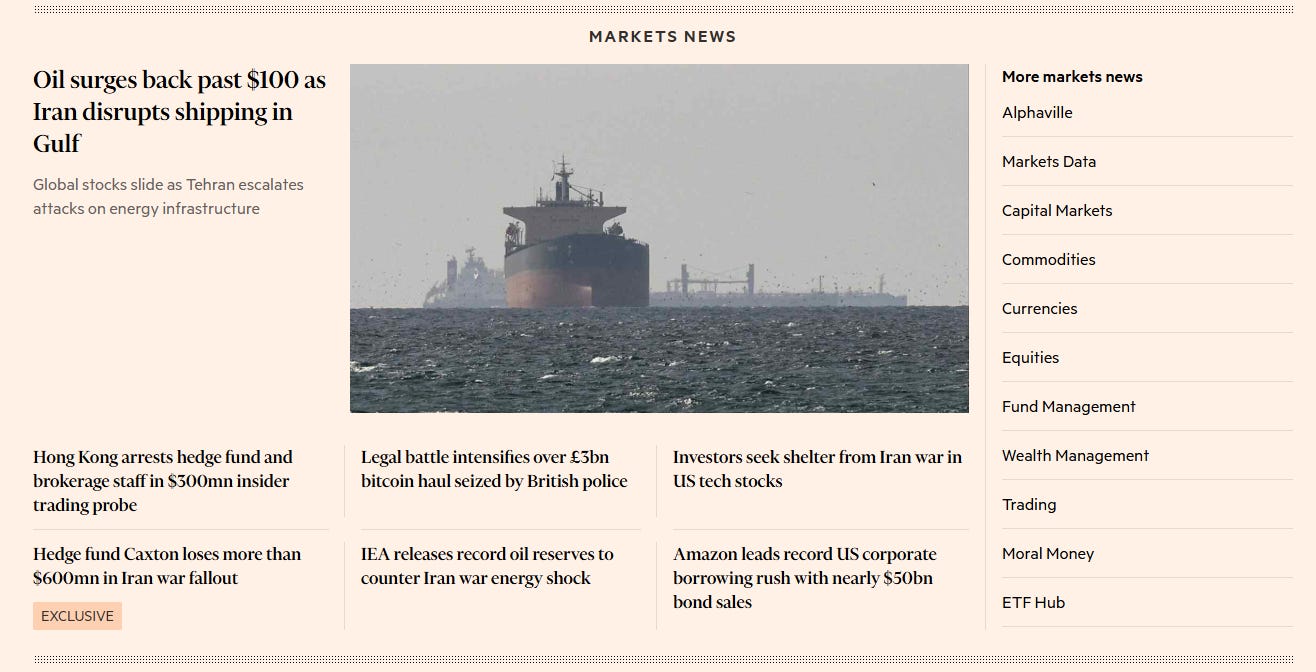
As of Tuesday, despite Iran’s effective closure of the Strait of Hormuz and its attacks on its neighbors’ energy facilities, it’s hovering around $100, slightly higher than the average inflation-adjusted price since January 2001, roughly $95.
That ought to provide some perspective on the panic over the war in the Middle East. To hear the critics’ version of events, an unprovoked and unnecessary attack on Iran, launched at Israel’s behest, is already a foreign-policy fiasco that has put the global economy at risk without any clear objective or endgame. As Senator Chris Murphy, a Connecticut Democrat, told NBC’s Kristen Welker over the weekend, “We’ve never seen this level of incompetence in war-making in this country’s history.”
Editor: Stephens begins his potted history via his ‘Under the rubric of ‘Really? Let’s take a tour of some of the recent history’ Reader I will selectively offer to forshorten this Historical pastisch!
…
During the 1991 Operation Desert Storm against Iraq’s Saddam Hussein,…
…
The U.S. air and land campaign in that operation lasted a full six weeks….
…
In the 1989-90 invasion of Panama, whose military phase lasted a few days, the United States lost 23 soldiers, with 325 more wounded.
…
During the Persian Gulf crisis that began with Iraq’s invasion of Kuwait in August 1990, the U.S. economy went into recession and the Dow fell by about 13 percent before the allied air war began.
…
At the outset of the 2003 invasion of Iraq, the United States made a failed decapitation strike against Saddam Hussein and his senior leadership, some of whom became leaders of the insurgency.
…
Between 1987 and 1988, in the final stages of the so-called tanker war, the Reagan administration reflagged Kuwaiti tankers and had the U.S. Navy escort them out of the Strait of Hormuz.
…
In 1991, Iraq fired roughly 40 missiles toward Israel. Hardly any were intercepted despite the deployment of Patriot batteries there.
…
In the months leading up to the second Iraq war, the George W. Bush administration made a case based on erroneous information that Saddam Hussein possessed weapons of mass destruction.
…
One of the worst mistakes of the wars in Iraq and Afghanistan was the attempt by U.S. administrators to remake societies in both countries — well-intended efforts with some noble results that nonetheless were beyond our grasp.
…
The Bush administration had little support from Arab nations during the 2003 invasion of Iraq and its aftermath.
…
In hindsight, the single biggest error of the gulf war was to end it too soon, before Saddam Hussein’s forces were thoroughly routed.
…
Editor: Stephens knows nothing about War! except his unslakable desires to chatter at full volume, as if he possesed comething akin to combat expiernce, as imagined in his fictional account of himself!
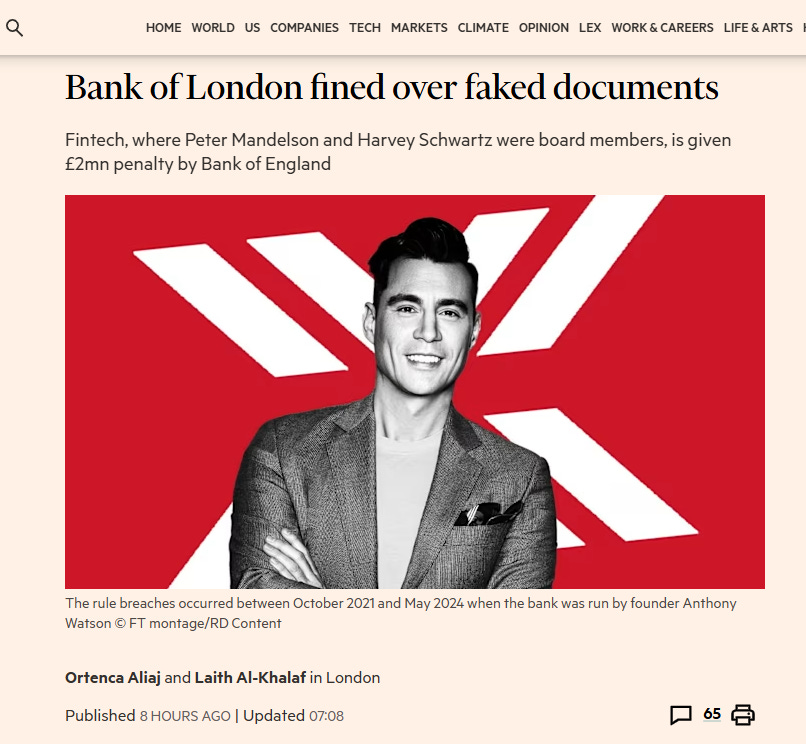
The Bank of London has received a £2mn fine for misleading regulators about its capital position over a three-year period, including by providing fabricated documents that sought to conceal its financial health.
The Bank of England’s Prudential Regulation Authority found that TBOL and its parent company, Oplyse Holdings, had breached more than a dozen rules in their attempt to mislead regulators about its capital position.
Former senior managers of the British fintech, which launched with a “unicorn” $1bn valuation in 2021, were found to have knowingly misled the regulator over its true capital position.
It is both the first time the PRA has fined a company for “failing to conduct its business with integrity” and taken enforcement measures against a parent financial holding group, the regulator said in a statement on Tuesday.
The PRA said on Tuesday that the breaches occurred between October 2021 and May 2024. The bank was at the time run by its founder Anthony Watson, a former Barclays executive.
The fintech’s holding company also had former Goldman Sachs heavyweight Harvey Schwartz and Lord Peter Mandelson on its board during the period. The PRA did not accuse the two men of wrongdoing.
They both stepped down in October 2024 after TBOL was thrust into the spotlight in September by a winding-up order from UK tax authorities over unpaid debt, which was subsequently withdrawn. Watson also stepped down in September 2024.
Watson told the FT that he “noted” the PRA’s action. He added: “The enforcement action announced today is against The Bank of London Group Limited and Oplyse Holdings Limited. I was not given any advance notice of it, nor was I a party to that settlement.”
Lord Mandelson and a spokesperson for Schwartz both declined to comment.
The PRA said it would have fined TBOL £12mn but that such a fine would have resulted in serious financial hardship for the fintech, and so the penalty was reduced to £2mn.
The fine threatens to derail the bank’s attempted turnaround, which has involved a major restructuring and a clear-out of the group’s leadership. The fintech’s parent company was renamed from Bank of London Group Holdings to “Oplyse Holdings” — a Danish word meaning to enlighten.
TBOL said in a statement: “The matters described in the notice relate to a period when the Bank was under previous ownership and management.
“The Bank, its new management and its investors remain committed to an open, transparent and constructive relationship with the PRA and FCA. The Board and leadership team are confident that, with these legacy matters settled and with the backing of its investors, the Bank will continue to enhance trust and be able to return to growth in 2026.”
TBOL launched in late 2021 with a $1.1bn unicorn valuation that it said would help the start-up clearing bank compete with the likes of Barclays and NatWest.
Watson cultivated close ties to Labour, donating almost £500,000 to the party and its politicians, and boasted a life of luxury on social media, including attendance to lavish parties and trips on private jet.
The PRA on Tuesday said the firm had failed to notify the regulator of a capital shortfall and repeatedly reported that capital qualified towards its common equity tier one (CET1) capital when they knew it to be false.
“Most seriously, a then senior manager falsified a series of documents in order to mislead the PRA as to the true capital position,” the PRA wrote in its final notice.
Former members of TBOL’s senior management, whom the PRA did not name, also “intentionally misled the PRA as to the true capital position” both at group and firm level.
“This included submitting to the PRA a false account of the consolidated and solo capital position in a report of the firm’s capital requested by the PRA,” according to the regulator.
The notice also pointed out that the relationship between the fintech and its parent company was not appropriately disclosed.
The PRA also concluded that TBOL leadership failed to tell regulators about ‘Project Rainbow’, the code name given to crisis talks held to prepare the bank for insolvency in 2024 amid a cash crunch. Those involved in discussing the group’s cash shortage were asked to sign a non-disclosure agreement.
“The PRA was never informed of Project Rainbow or any concerns with Group or the Firm’s solvency,” the notice states. “Neither was the PRA informed the Firm’s runway for operating cash lasted only until 1 May 2024.”
Headline: Do not let company founders hide from accountability
Sub-headline: Lyft’s dual class structure will prevent shareholders from having reasonable input
Recall Mr. Singer as the purchaser of Argentina’s bad debt? and the fact that Macri paid the ransom for re-admittance into the Free Market Club? as I recall 1.3 billion was the price tag! And less that a year and a half, with the peso in free fall, Macri applied and got an IMF bailout for his failing Austerity Lite: de Kirchner is waiting in the wings: the definition of ‘success’? That bit of inconvenient ‘Economic History’ puts Mr. Singer’s plea for ‘shareholder accountability’ garnished with self-congratulation where? Examples here:
My firm, Elliott Management, frequently encounters technology companies where founders or longtime managers created remarkable innovations but then struggled with the challenges of maturing products, expanding organisations or slowing growth.
They often respond by aggressively seeking new sources of growth, paying richly for acquisitions that do not fit with their business models or allocating capital towards peripheral activities that fail to generate returns. Worse, such efforts often damage the core businesses that brought success in the first place.
…
Many companies are able to pull off these transitions without active shareholder involvement. But even at the most successful tech groups, allegations of privacy violations and other abuses have been most acute at companies such as Facebook and Google where dual-class structures are in place.
…
Those with the insight and daring to found a business deserve our respect. But once they sell the vast majority of the company to the public, they should not be allowed to run it forever without any shareholder input. Public ownership must mean public accountability.
My selection of quotations is self-serving, but not anymore self-serving than Mr. Singer’s whole argument,that Capitalism, and its companies need investors like himself to keep them ‘honest’! Public Ownership and Public Accountability under the leadership of Vulture Capitalists like Singer is the sine qua non of Capitalist Virtue.
I have yet to read Robin Wigglesworth’s essay/news report, but I have read Mr. Edward. N. Littwak’s essay Hidden Costs at the Times Literary Supplement, August 19,2016 A review of The Panama Papers, that for it’s cast of characters, that includes Mr. Singer as a seeker after the his pound of flesh, President Macri of Argentina, and Cristina de Kirchner as clients of Mossack Fonseka. What was Argentina’s Neo-Liberal White Knight Mercri doing business where embezzler de Kirchner also did business? The Argentine Melodrama never ends, but there are more names of the politically respectable bourgeois politicians, and other civic actors…
Stayed tuned,
StephenKMackSD
2)
Poor Mr. Singer! The goose that laid the golden egg is kaput? Mr. Singer and his ilk produce nothing. He is not like the notorious Henry Ford, who at the least, paid his workers enough to buy the cars they produced on the assembly line! Ford produced a product that people bought, and provided jobs that enabled generations of Americans to purchase a home, to save for retirement, and put their children through school and even college. No matter Mr. Ford’s egregious beliefs, he did something that Mr. Singer and his investors cannot do, provide those jobs that built America and got us through two World Wars.
But times are now tough for the Vultures, as Capitalism, in it’s Neo-Liberal iteration, has collapsed, and what is on offer from the Elites, that the dread Populists are rebelling against, is the Utopianism of the TTP and the TTIP. Yet we as readers can see that this class of Capitalists relies on the ever shrinking detritus of a system mired in it’s own collapse. The Panama Papers demonstrates that both the Capitalists and their apologists in the Press, in Politics and Academia are wholly corrupt, or put bluntly, just on the take. So Mr. Singer’s dire warnings about an Economic ‘brokenness’ of the Bond Market: while we in America witness daily, the Sideshow of Clinton vs. Trump i.e. of two utterly loathsome self-seeking egoists vying to rule the ‘West’ garnished by the usual ‘the lesser of two evils’ bunk is just more bad news. Mr. Singer who makes Henry Ford look like a paragon of Capitalist Virtue, bemoans his lot: quelle dommage! In the vision of Ayn Rand the world is dived into producers and drones, so one might ask, what category does Mr. Singer fit into? Or to frame it in a way utterly antithetical to Rand, what tangible good does he produce? to frame it a language alien to the ‘Objectivism’ of Rand. The notion of ‘Objectivism’ being a stand in for greed. Perhaps we can turn to Hayek for the comforting news that the Market is the only really viable form of knowledge?
A few months ago, ThinkProgress launched a series of investigations into relationship of the right flank of the Supreme Court — Justices Clarence Thomas, Samuel Alito, and Antonin Scalia — with corporate donors and Republican operatives. In October, we revealed, through a document obtained from Koch Industries, that Scalia and Thomas had attended secret right-wing fundraisers organized by Charles Koch to coordinate political strategy. ThinkProgress has now discovered more events attended by conservative Supreme Court justices.
The Manhattan Institute, funded by major corporations like CIGNA, Koch Industries and ExxonMobil, is a conservative think tank in New York that produces right-wing policy papers as well as sponsoring speeches for judges and Republican politicians. In 2008, Justice Thomas headlined the Manhattan Institute’s Wriston Lecture; last October, Justice Alito was the headline speaker for the same event. According to the Manhattan Institute’s website, an individual must contribute between $5,000 to $25,000 to attend the Wriston Lecture. “To be invited to the Wriston Lecture,” Debbie Ezzard, a development official at the Manhattan Institute told ThinkProgress, “you have to give $5,000.”
During the question and answer period of the Wriston Lecture, Roger Hertog, a major neoconservative donor, asked Alito if he would attend the 2011 State of the Union. Ironically, Alito — while speaking at a political fundraiser filled with powerful conservative donors — said he would avoid the event because it has “become very political”:
HERTOG: My question has nothing to do with judicial philosophy. It’s a more mundane question. It’s a calendar question. Will you attend the State of the Union this year?
ALITO: I said in my talk that judges learn primarily from experience, and I’ve found the example of those with greater experience. For many years, the more senior members of the Supreme Court — Justice Stevens before he retired, Justice Scalia — stopped the practice of attending State of the Union addresses because they have become very political events and they’re very awkward for the justices. We have to sit there like the proverbial plotted plant most of the time and we’re not allowed to applaud or those of us who are more disciplined refrain from manifesting any emotion or opinion whatsoever.
Watch it:
Scalia, Thomas, and Alito ultimately refused to attend the SOTU last night. At the end of his question and answer period during the Wriston Lecture, Thomas pledged to the room of donors to meet with them on a more informal basis whenever they visit Washington, DC.
Notably, both Thomas and Alito were introduced at the Manhattan Institute by its chairman, Paul Singer. Singer is the manager of one of the nation’s largest hedge funds, Elliott Management, and has been one of the largest contributors to the Republican Party and conservative causes in recent years. An opponent of financial regulations, Singer’s hedge fund contributed 96% of Rep. Scott Garrett’s (R-NJ) campaign committee. Garrett is the new subcommittee chairman overseeing hedge funds, including regulations passed by Democrats last year which will affect Singer’s firm.
Singer is also a “seven figure” contributor to Crossroads GPS, a front group managed by Karl Rove that has taken advantage of the new campaign finance landscape post-Citizens United. As ThinkProgress has reported, it’s not the first time Alito or Thomas has headlined a political fundraiser with corporate donors:
– In November, shortly after his Manhattan Institute fundraising appearance, ThinkProgress interviewed Justice Alito as he entered the annual fundraising gala for the American Spectator, attended by then-RNC Chairman Michael Steele and top Republican donors. Alito told us that his attendance to the fundraiser was “not important.” However, as we noted, Alito was the main draw for donors when he headlined the same event in 2008. The American Spectator is nominally a magazine; in the 90s, it served as a slush fund for wealthy donors to pay opponents of President Clinton, and recently, it organized a lobby group called the “Conservative Action Project” to orchestrate opposition to President Obama.
– In 2009, while the Supreme Court heard arguments regarding the Citizens United case, Justice Thomas was featured at the annual fundraiser for the Heritage Foundation — and sat at a table for donors with investment banker Thomas Saunders and Sen. Jim DeMint (R-SC). After the Citizens United decision, Heritage created a new nonprofit called “Heritage Action” to run attack ads against Democrats.
– In 2009, while the Supreme Court heard arguments regarding the Citizens United case, Justice Alito headlined a fundraiser for the Intercollegiate Studies Institute (ISI) — the same corporate front that funded the rise of Republican dirty trickster James O’Keefe and anti-masturbation activist Christine O’Donnell. According to the sponsorship levels for the event, Alito helped ISI raise $70,000 or more from law firms like Young Conaway Stargatt & Taylor, LLP. ISI is run partially by lobbyist James Burnley, who also is on the board of FreedomWorks.
– Last year, Justice Thomas helped headline a fundraiser for the National Association of Broadcasters, a lobby group representing News Corp, Cox Media Group, and other media companies. The event raised hundreds of thousands for NAB’s charity from a host of corporate sponsors, including the U.S. Chamber of Commerce, PhRMA, and CBS Corp.
Pursuant to our reporting, the good government group Common Cause found that Thomas had also failed to report more than $686,000 in income from his wife on his ethics disclosure forms. Monday evening, Thomas filed letters with the Supreme Court amending the gap in disclosure.
Yesterday ProPublica reported that Paul “The Vulture” Singer flew Justice Samuel Alito on a private jet to Alaska for a luxury fishing vacation in early 2008 (which Alito failed to disclose). Singer subsequently had multiple cases before the Supreme Court — including a 15-year long dispute with Argentina.
I’ve been hunting Singer The Vulture for BBC TV since 2007, when he pocketed the money meant to aid those affected by the cholera epidemic in the Republic of Congo. And my 2012 cover story for The Nation, “Mitt Romney’s Bailout Bonanza”, revealed how Singer secretly set up Romney to make $100 million off Obama’s auto bailout.
Singer was the number one donor for the Republican Party in New York. He even helped Alberto Fujimori escape murder charges in Perú. The story of Paul Singer is featured in my film, The Best Democracy Money Can Buy, which I’m making available as a FREE download.
Here’s the real story of Singer’s vulture attack on Argentina, which resulted in a $4.65 billion cash settlement forcing the nation into default, from my book Billionaires & Ballot Bandits.
A call came in from New York to my bosses at BBC Television Centre, London. It was from one of the knuckle-draggers on the payroll of billionaire Paul Singer, Number One funder for the Republican Party in New York, million-dollar donor to the Mitt Romney super-PAC, and top money-giver to the GOP Senate campaign fund. But better known to us as Singer The Vulture.
“We have a file on Greg Palast.”
Well, of course they do.
And I have a file on them.
I had just returned from traveling up the Congo River for BBC and the Guardian. Singer’s enforcer indicated that Mr. Singer would prefer BBC not run a story about him — especially not with film of his suffering prey: children, cholera victims.
A call came in from New York to my bosses at BBC Television Centre, London. It was from one of the knuckle-draggers on the payroll of billionaire Paul Singer, Number One funder for the Republican Party in New York, million-dollar donor to the Mitt Romney super-PAC, and top money-giver to the GOP Senate campaign fund. But better known to us as Singer The Vulture.
“We have a file on Greg Palast.”
Well, of course they do.
And I have a file on them.
I had just returned from traveling up the Congo River for BBC and the Guardian. Singer’s enforcer indicated that Mr. Singer would prefer BBC not run a story about him — especially not with film of his suffering prey: children, cholera victims.
The mythos of the hedge fund manager is defined by a perceived mastery over market forces. Commentators often ascribe supernatural powers that hedge fund managers supposedly have over the market. Titles like “Hedge Fund Market Wizards” and “Money Mavericks” are typical. Paul Singer is decidedly not a master of the markets. Paul Singer is just an opportunistic lawyer who has found a niche doing something that most people couldn’t stomach—suing some of the poorest nations in the world. Singer is the pioneer of a strategy called debt vulturism, which does not require a savvy understanding of the markets. Indeed, Singer’s fund has been swindled by a fraudster selling fictitious securities. [1]
A hedge fund billionaire who calls income inequality “a wedge issue”
Paul Singer is a hedge fund billionaire and prominent New York-based philanthropist. Singer’s net worth is worth $1.92 billion, according to Forbes—easily making him one of the wealthiest New Yorkers. [2] Singer is the founder and CEO of hedge fund Elliott Management Corporation, controlling over $23 billion in assets. A leading Republican donor, Singer has contributed heavily to GOP candidates including to former presidential candidate Mitt Romney. [3] Singer’s fund, Elliott Management, was the top ranked contributor to the 2012 Republican vice presidential candidate Paul Ryan’s campaign committee and PAC in the 2012 cycle, contributing $40,000. [4]
Trump could always walk away and leave others to clean up. As Richard Haass, a senior official in past Republican administrations, noted, that would amount to a “we broke it, you own it” inversion of Colin Powell’s Pottery Barn rule. But that would be a Pyrrhic exit. Iran could continue to hold global energy hostage until it is satisfied that Trump will not resume hostilities. Of course, he could promise not to start bombing again. But would Iran trust him?
It is too soon to capture the extent of the damage done to American power. But we can be sure that Gulf war III will intensify the global arms race, especially among America’s confidence-shaken allies. We are likewise at the start of an alternative energy boom. Nuclear power, solar panels and windmills do need critical minerals. But there is currently no Strait of Hormuz choking off green energy supplies.
What remains to be seen is how Trump will find a way out of this morass. He wanted to bring down Iran’s regime. Now he is lifting sanctions on Iran so that it can sell more oil. Amid the torrent of feints, hype, invention and bluster, Trump’s goal is now to set the clock back. With planning like this, who needs chaos?
Who can forget Mr. Luce’s ‘interview with Kissinger in 2018? My comment:
‘While babies in Vietnam are still being born with catastrophic birth defects from the effects of Agent Orange, decades after the end of the American Anti-Communists crusade or just call it mass slaughter, The Great Man is treated to lunch by a pundit who disingenuously call him consigliere, as the-in-order-too of not sounding too much like what he is, a sycophant to The Great Man. Did Luce even mention his book ‘The Retreat of Western Liberalism’ ? Isn’t there some kind of obligation, on the part of the guest to know something of your host’s latest accomplishment? Or is the aged Great Man above that kind of social obligation?
The essay unfolds in an almost comic mode with Luce planning to waylay The Great Man into ‘spilling the beans’ on the Know-Nothing Trump. The dramatic tension is non existent, as this 95 year old is more interested in having an audience who simply listens, in awe, to his estimation and opinions about the wider historical scope of his intelligence: his specialty is Foreign Policy Metaphysics. The Great Man doesn’t disappoint himself .
Mr. Luce knows the Party Line by heart, as he helped to construct it: Russian revanchism, the end of the ‘rules based order’ meaning the erosion of NATO, in sum the ‘decline of American Power’. Or rather, the fact that Europe is no longer in need of American tutelage. The burning question is TRUMP and his chaotic practice politics and his disturbing propinquity for another political monster Putin.
This little melodrama ends with Luce helping The Great Man to his car in the rain, and the ‘server’ speaks to Luce with some pertinent information: “Dr Kissinger has been looking forward to this lunch for days,”
Political Observer
Lunch with the FT: Henry Kissinger ‘We are in a very, very grave period’
Can the reader of his latest essay wonder, has Mr. Luce discovered the 99%? If so, it qualifies as a belated victory for the Scruffy Hippiedom of Occupy Wall Street! So much for my lapse into the hyperbolic. Mr. Luce carefully lays out the likely next steps in the Trump/Bannon project of Economic Nationalism: this notion reeks of the most unsavory historical connotations.
Over the weekend the New Democrats have chosen the respectable Neo-Liberal Tom Perez to lead the Party. For some very informative background on the contest between Perez and Ellison see this Intercept report:
Why would I mention this election in regards to the Trump advocacy of an Economic Nationalist Agenda? Mr. Perez is the candidate of the Clinton/Brazil/Wassermann-Schultz, not forgetting Leon Panetta , faction of the New Democrats: a perpetuation of the ‘Old Guard’. The political corollary of the Pelosi/ Schumer congressional leadership.
How can the New Democrats hope to even mount an opposition to the Trump /Bannon political project, when they are still beholden to the utterly corrupt Clinton/Brazil/Wassermann-Schultz leadership? Who have willfully discarded the New Deal mantle of reform, in favor of being New Democrats, which is in fact a cosmetically enhanced Reaganism.
If the election of Perez tells the reader anything, it is that the New Democrats will be defeated in 2018, and if they persist in their addiction to the Clinton Neo-Liberalism, a defeat in 2020 is also very likely.
The formation of the ‘Resistance’, that has its root in the Clinton Apologists endless propagandizing, in the hope of Impeaching Trump, seems very unlikely with both Houses of Congress controlled by Republicans. The desperation of those apologists is such that Rachel Maddow condemned Jill Stein for her silence on the Russian Question:
Even given the Russian/Trump connection, and a pending congressional investigation, led by Republicans. Trump seems to be playing into the hands of the ‘resisters’ by his banning of the New York Times,CNN and Politico from White House briefings.Trump, the Peronist, doesn’t even rely on other political actors in creating exploitable political chaos, he creates it himself by banning reporters, and posting on twitter.
Yet the New Democrats refuse to confront the fact that the Neo-Liberal Age is over, in the 9th year of the watershed of the Economic Calamity of 2008. Reform or die, that is the stark choice that the New Democrats refuse to acknowledge. Could their adamant refusal to confront reality be the predictor of the rise of the Greens?
Headline: Magical thinking crosses party lines in America
Sub-headline: The left may prefer white magic to Donald Trump’s black, but everyone is dabbling
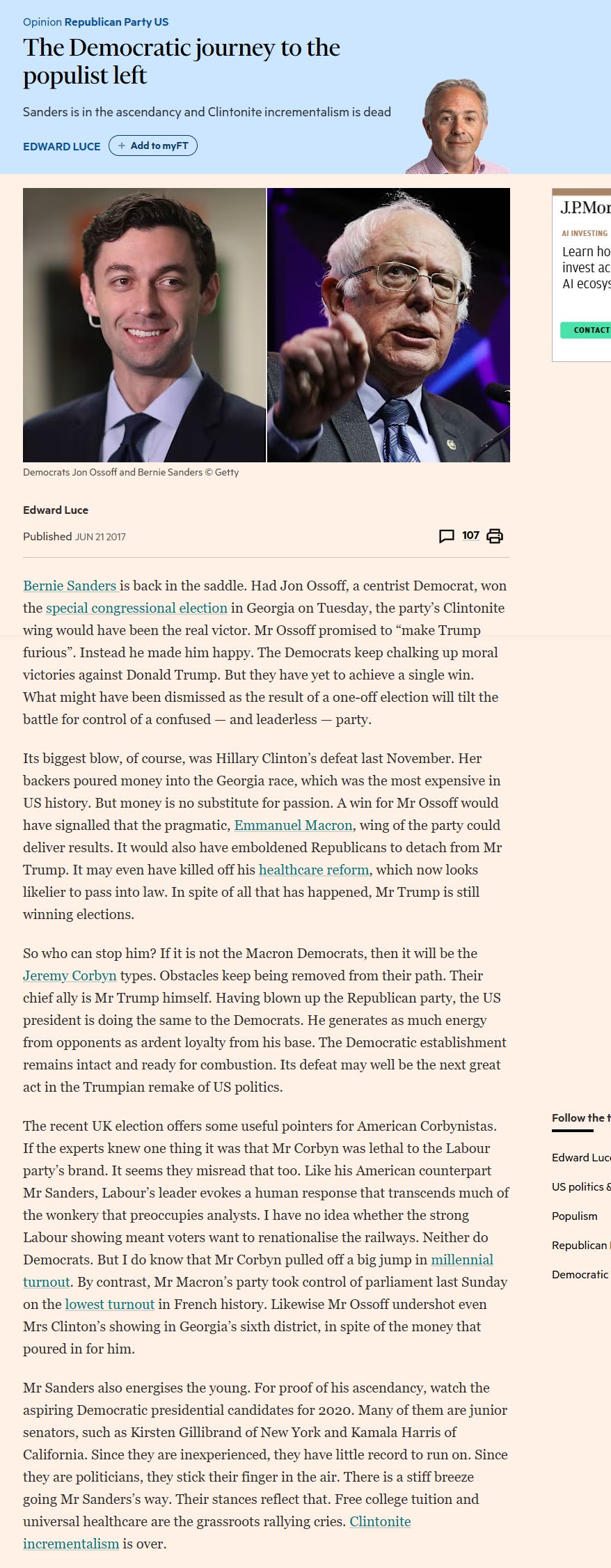
Mr. Luce wastes no time calling to account the New Democrats for their lackadaisical attitude toward Trump. Yet this elides from the political picture the responsibility of both Parties and Pundits, like Luce, in their long-term advocacy for the Neo-Liberal Swindle, and its aftermath from the 2008 Crash to the dismal political present present.Trump is a product of this political/economic catastrophe.
Yet in this thicket of Political Metaphysics, that lapses into Occult jabber, that is unintentionally comic, Luce fails to ask the salient question: where is the money coming from to support this crowded field of candidates?
The New Democrats, fully under the thumb of the Clinton coterie, not to speak of AIPAC, don’t have an inexhaustible supply of money to waste on these candidates. But to create the fiction of choice might that money be spent upon such candidates, as the in-or-too of lending that fiction plausibility? Also keep in mind the willful destruction of campaign finance reform orchestrated by Citizens United and Justice Roberts, champion of stare decisis ?
While after some maladroit stage management , a specialty of Mrs. Clinton and her minions , she will enter as the compromise candidate that offers the best chance to win in 2020. The only real problem with this sketch of a possible scenario is that Sen. Sanders, and his coterie, represent a real danger to this possible coronation of Hillary. So the imperative of attacking Sanders must begin as soon as possible, in sum, The Bernie Bros must be resuscitated and or re-imagined for this campaign.
In his haste to write his column, Mr. Luce misses an opportunity to think and imagine what might be plausible in an actual American Politics. In favor of a failed, not to speak of a maladroit Hegelian pastiche: Luce should stop reading the Straussian fabulist Fukuyama!
Polemic is a discourse of conflict, whose effect depends on a delicate balance between the requirements of truth and the enticements of anger, the duty to argue and the zest to inflame. Its rhetoric allows, even enforces, a certain figurative licence. Like epitaphs in Johnson’s adage, it is not under oath.
Headline: Brett Kavanaugh and the Republicans’ patriarchal bubble
Sub-headline: Party’s fight to approve Supreme Court nominee risks further alienation of female voters
Quite surprised that Mr. Luce has read the 1970 Feminist classic ‘Patriarchal Attitudes: Women in Society’ by Eva Figes. I still have my paperback copy that I bought at the Compton College bookstore in the early years of that decade.
As with his earlier essay Mr. Luce continues to frame his comments on Kavanaugh and the Republicans in an eternal political present, with the briefest nod to Kavanaugh’s reactionary political history. Anti-Patriarchy is the rhetorical ‘actor’ that is at the root of the Kavanaugh opposition, as argued by Luce. Trump’s growing unpopularity with women voters is another convenient framing employed by Mr. Luce. Yet the record of the almost wholesale Dixiecrat Migration, from the Democratic Party to the Republican Party, after the passage of the Civil Rights Act and the Voting Rights Act provides part of the answer to the ‘why’ of that racism, misogyny, homophobia and a generalized xenophobia that now dominate the Republican Party. Nixon’s ‘Southern Strategy’ and Reagan’s notorious Neshoba County Fair speech, that opened his 1980 run for the presidency are just two examples of this. The Party of Lincoln has been supplanted, by a Republican Party, that willfully cast aside Lincoln, in favor of its newest member’s racism and misogyny, that defined the Dixiecrat’s identity politics, and in due course the seductive mirage of Free Market Economics.
The sub-headline begins the inauspicious essay from Mr. Luce, in a Shakespearean allusion. The headline writers relied on their elite educations to provide the necessary garnish to Luce’s unalloyed hero worship of former FBI director Mueller.
Trump will feel dangerously vindicated — when you strike at a king be sure to kill him
A sample of Luce’s Hero Worship, a latter day Carlyle:
Spare a thought for Robert Mueller. He wrapped up an exhaustive investigation within two years of being asked to do so — easily beating his predecessors. Moreover, he stuck resolutely to his brief. Unlike Kenneth Starr, who expanded his probe into the Clintons’ failed real estate deal in Arkansas to include sex in the White House with an intern, Mr Mueller avoided fishing expeditions. He ran an operation with zero leaks. By any measure he embodied integrity and diligence in a town sorely deficient in both. Yet he managed to disappoint both wings of US politics.
In the Age of Trump Mr. Mueller is the yardstick by which all other political actors are measured. This is political desperation wedded to a deadline: vulgar melodrama ,the stuff of the small black and white screen of 1952:
Mr Mueller is indeed “America’s straightest arrow”.
Never fear the Party Line of Putin as The New Stalin makes its appearance with a warning that Russian Interference in American Elections future is a stark reality that needs to be faced!
…
By the same token, an outsized role was conferred on Vladimir Putin as the evil genius who robbed Hillary Clinton of the presidency. There were large dollops of evidence supporting both views.
…
Likewise, Mr Mueller proved the Russians interfered in the 2016 election — as they have tried to do in other democracies. That threat still exists. Mr Trump publicly requested Russia’s help and Russia obliged.It could happen again. Washington has done almost nothing to strengthen its electoral infrastructure since 2016.
Compare the Hero Worship of Mueller by Luce, with David Bromwich’s Hero Worship of Comey in The London Review of Books of August 9, 2018:
Comey’s memoir has now surpassed the combined sales of Michael Wolff’s portrait of the Trump White House, Fire and Fury, and Hillary Clintons’s election elegy What Happened. The book, written in an idiom identical to the one he uses in interviews and press briefings, is clearly the work of an un-ghosted author, and it contains passages most unusual for an official memoir:
There is a place I have visited on the coast of North Carolina where two barrier islands come close together. In the narrow passageway between them, the waters of the Atlantic Ocean meet the waters of the huge and shallow sound that lies behind the islands. There is turbulence in that place and waves appear to break even though no land is visible. I imagine that the leaders of the Department of Justice stand at that spot, between the turbulent waters of the political world and the placid waters of the apolitical sound. Their job is to respond to the political imperatives of the president and the voters who elected him, while also protecting the apolitical work of the thousands of agents, prosecutors, and staff who make up the bulk of the institution. So long as the leaders understand the turbulence, they can find their footing. If they stumble, the ocean water overruns the sound and the department has become just another political organ. Its independent role in American life has been lost and the guardians of justice have drowned.
This depth of formal piety cannot be faked; the passage shows the burden (as Comey sees it) of maintaining constitutional and legal restraints on Donald Trump.
The record of the FBI is one of criminality and mendacity pioneered by the execrable J. Edgar Hoover, that was continued by his successors Mueller and Comey: the FBI Crime Lab scandal just one of the many demonstrated coverups and incompetencies wedded to the lies of the FBI. The desperation experienced by The Midwives of Trump, like Luce and Bromwich, in the Age of Trump, that they helped to birth is thought never to be entertained.
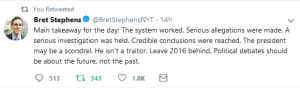
Also Mr. Luce giving credence to the ‘Russian Interference’ lie is that it provides political cover for the Clinton/Clapper/Brennan coterie, and their political allies like MSNBC, Maddow, Schiff and a host of fellow travelers, as the in-order-too of fomenting a New Cold War, based on a self-serving series of political lies. Bret Stephens enunciates the New Party Line:
This sounds like Obama saying that we need is ‘to put the past behind us’, that was his rationalization for not prosecuting the Wall Street Thieves who funded his campaign. Or Gerald Ford’s pardoning of Nixon, to spare the country the ordeal of a protracted exercise of Constitutionally mandated Rule of Law: The Empire must never seem to falter!
The New Cold War has been a fact for almost ten years, or even longer in its nascent stages: enthusiastically advocated by this newspaper and its hirelings!
In the political present ‘The Great Man’ now becomes the voice of reason instead of ‘the grand consigliere’.
Just select a paragraph, of Mr. Luce’s essay, for the current cast of heroes and villains:
Vladimir Putin, Russia’s president, said that whoever led in artificial intelligence would dominate the world. Kissinger, who, with Eric Schmidt, former chief executive of Google, is co-author of a new book, The Age of AI, says we have not yet begun to grasp the impact it is having on future warfare and geopolitical stability. The FT recently reported that China had tested a hypersonic missile, which could enable it to evade US missile defence systems. The Pentagon this week estimated that China planned to quadruple its nuclear arsenal by 2030. Nicolas Chaillan, the former head of AI at the Pentagon, told the FT he had resigned because he could not stand to watch China overtaking the US. “It is already over,” he said.
Note this Luce sentence – a retrospective apologetic for The Great Man’s’ murderous past.
Yet Kissinger’s analysis should be separated from moral evaluations of his cold war record.
The reader needs to steel herself for the final pronouncement, from Mr. Luce, on ‘The Great Man’:
At 98, he is among the few living figures to have played a leading role grappling with the last century’s existential threats. Each side eventually acquired an intimate knowledge about their nuclear capacities and doctrines that may be impossible to match on AI, he argues. There are no spy planes that could take pictures of China’s AI. There is no clear way of deterring attacks, or of knowing where they come from.
“With nuclear weapons it was possible to conceive of principles of deterrence in which there was some symmetry between the damage on each side,” he said. “If an unrestrained [US-China] arms race goes from nuclear to AI, the dangers of dramatic escalation would be very great.”
Political Reporter, and other guises, where they may apply!
What is telling is that FP was founded by Samuel P. Huntington of the ‘Clash of Civilizations’ and its racist twin ‘Who Are We?: The Challenges to America’s National Identity’ ! Luce was also a Speech writer to US Treasury Secretary, Lawrence Summers, 1999-2001. In sum Mr. Luce is a well connected political writer, and regular columnist for The Financial Times. He qualifies and one of Lippmann’s Technoctrat’s for hire, as a check against too much democracy!
Mr. Luce’s notorious interview with Kissinger, in the guise of The Great Man, is here:
Lunch with the FT: Henry Kissinger ‘We are in a very, very grave period’
Editor: In the bleek Age of Trump, Simon & Schuster provides Public Realations chatter:
An intimate and masterful biography of Zbigniew Brzezinski—President Carter’s national security advisor and one of America’s leading geopolitical thinkers—from one of the finest columnists and political writers at work today.
Zbigniew Brzezinski was a key architect of the Soviet Union’s demise, which ended the Cold War. A child of Warsaw—the heart of central Europe’s bloodlands—Brzezinski turned his fierce resentment at his homeland’s razing by Nazi Germany and the Red Army into a lifelong quest for liberty. Born the year that Joseph Stalin consolidated power, and dying a few months into Donald Trump’s first presidency, Brzezinski was shaped by and in turn shaped the global power struggles of the twentieth and early twenty-first centuries. As counsel to US presidents from John F. Kennedy to Barack Obama, and chief foreign policy figure of the late 1970s under Jimmy Carter, Brzezinski converted his acclaim as a Sovietologist into Washington power. With Henry Kissinger, his lifelong rival with whom he had a fraught on-off relationship, he personified the new breed of foreign-born scholar who thrived in America’s “Cold War University”—and who ousted Washington’s gentlemanly class of WASPs who had run US foreign policy for so long.
Brzezinski’s impact, aided by his unusual friendship with the Polish-born John Paul II, sprang from his knowledge of Moscow’s “Achilles heel”—the fact that its nationalities, such as the Ukrainians, and satellite states, including Poland, yearned to shake off Moscow’s grip. Neither a hawk nor a dove, Brzezinski was a biting critic of George W. Bush’s Iraq War and an early endorser of Obama. Because he went against the DC grain of joining factions, and was on occasion willing to drop Democrats for Republicans, Brzezinski is something of history’s orphan. His historic role has been greatly underweighted. In the almost cinematic arc of his life can be found the grand narrative of the American century and great power struggle that followed.
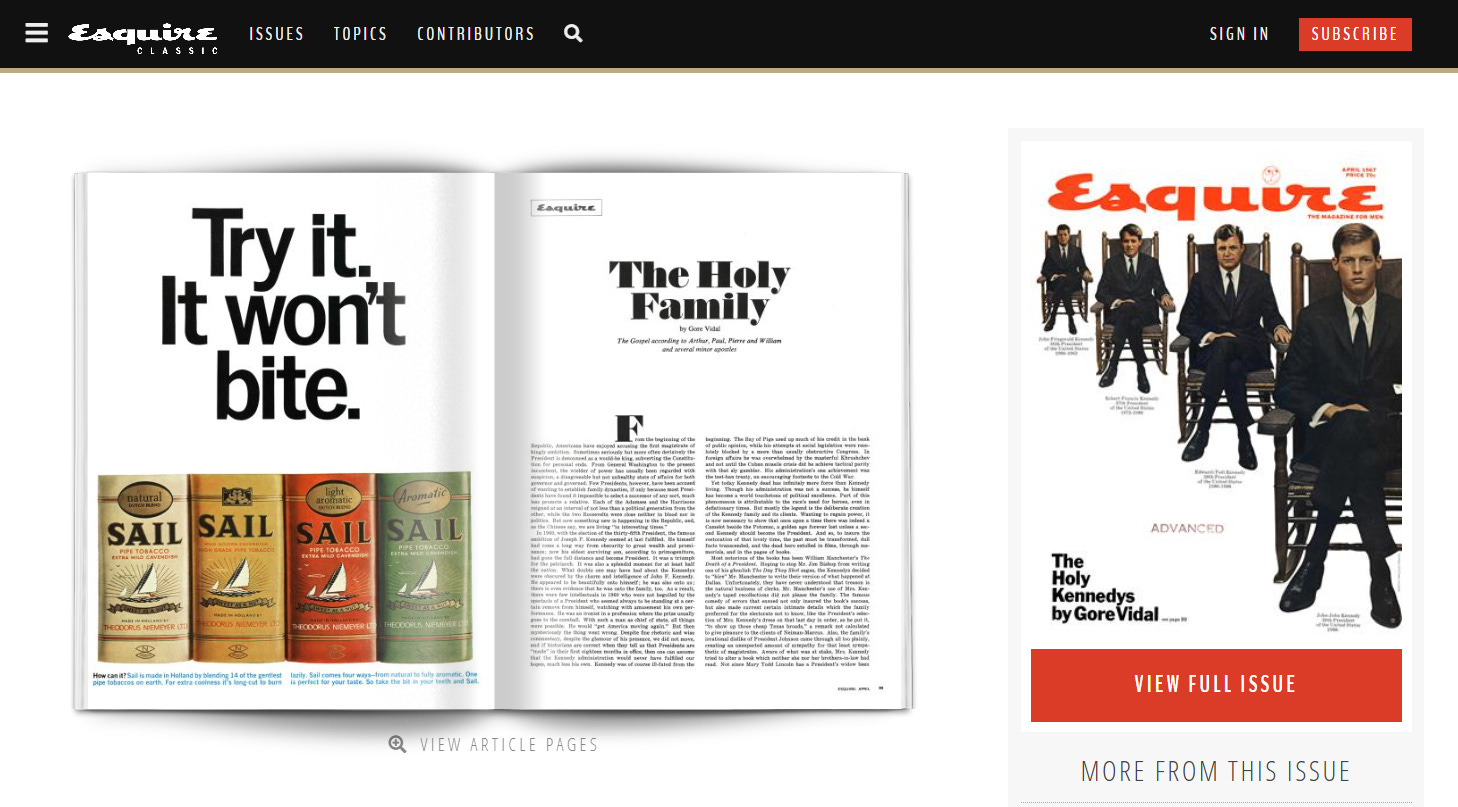
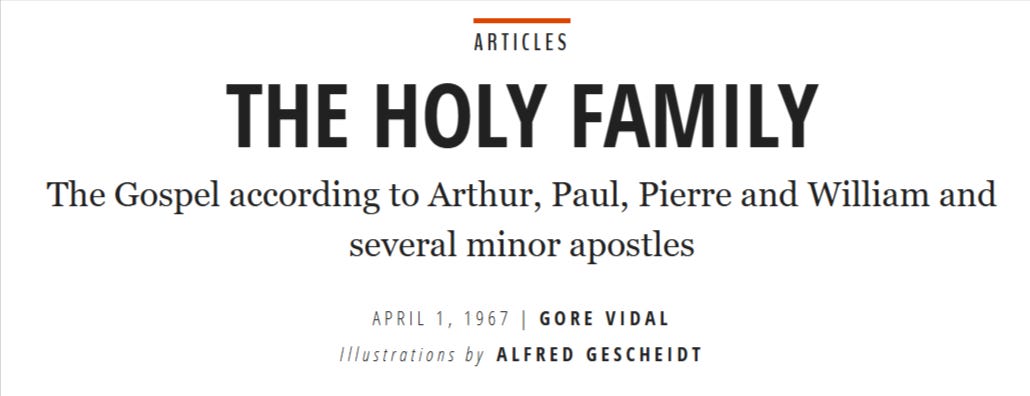
The reader need only look to this Esquire magazine issue of 1967 to find the precurosor of the the near adoration of the Kennedy family. Gore Vidal’s ‘The Holy Family’ was, and is, revelatory of the near adoration of the Kennedy Family and the concomitant toxic Mythology!
Editor: Now in vacious Age of Trump, what is left of that once vibrant Kennedy Mythology, in the political present! That de-evolution is expressed in this newspaper headline The Lost Horizon of John and Carolyn,as chronicled by Maureen Dowd in the New York Times. What can the reader make of the demise of once thriving Gossip Columnist, of another time! Maureen Dowd in this instance, now fills that empty space?
Once, in the mid-1990s, John F. Kennedy Jr. called me. He had a great voice, with a seductive thread of mischief running through it. Even on the phone, I could feel the magnetism of the reigning dreamboat.
He wanted to do a Q&A with me for his new magazine, George, which blended politics with pop culture.
“After all,” he said, “you’re the godmother of this form of journalism.”
I really wanted to meet J.F.K. Jr. But I write better than I talk, and I told him I was afraid that I’d be hopelessly inarticulate.
“That’s what editors are for!” he said puckishly, adding, “You’re the only person who has turned me down for this — except the pope.”
I was skeptical about George. Politics and entertainment were merging, and I was worried that the balance would tilt toward the superficial. George was a fanzine for “the giant puppet show” of politics, as J.F.K. Jr. called it — a strange blend of Vanity Fair and C-SPAN. Was it too frivolous, with a glossy debut cover of Cindy Crawford cosplaying George Washington? Was it weird to have a cover with Drew Barrymore vamping as Marilyn Monroe, the paramour of J.F.K. Jr.’s father and uncle?
J.F.K. Jr. was the nation’s magic child: little John-John saluting his father’s casket in a gesture that broke the nation’s heart, now all grown up. He had become a stylish, adventurous man surfing New York City on bikes and Rollerblades, searching for his purpose in life.
Miraculously, despite all his travails, he was a caring soul who tried to make people feel special. I thought he should use that magic for more than persuading Salma Hayek to pose with an elephant. He was considering a bid for New York governor when he died.
…
Editor: The Reader can almost hear the voices of Hedda Hopper, Louella Parsons, Rona Barrett, Joyce Haber and Liz Smith? But in the above paragraph, just quoted, she demonstrates a verifiable sympathy, or its distant cousin?
…
Editor: A selection from her commentay:
…
The cool aesthetics were a means to an end, an ensorcelling engine that put you in a position to change the world.
The Camelot myth has tattered, particularly with the rise of Robert F. Kennedy Jr. as a destructive, unhealthy force in Trump world.
…
The pair went from an unlimited horizon to a “false horizon,” when pilots get dangerously disoriented. All that promise literally vanished into thin air.
Editor: Dowd resorts to Romantic Kitch aimed at the disatisfaction of ‘Women, increasingly dejected by unsatisfying online interactions with men,’
Women, increasingly dejected by unsatisfying online interactions with men, were verklempt about the episode depicting John sending flowers to Carolyn’s office every day until she agreed to go out with him; they can’t get over the way that John, played by the hunky, if not savvy enough, Paul Anthony Kelly, gazes adoringly at Carolyn, played by the lovely, if not lusty enough, Sarah Pidgeon. They want to take cues from Carolyn’s “Rules”-like way of staying elusive.
…
Editor: Reader only 355 more words to wade through! Yet ‘unsatisfying online interactions with men,’ might that be corrected by person to person contact, between men and women? Or is that too simplistic an answer?
Newspaper Reader: Jeremy Waldron’ superb commentary and replies to The New York Review of October 9, 2014 & October 23, 2014 issues are worth the reader attention and contemplation!
One of the more delightful innovations of the Obama era was the requirement that every full-time employee—or taxpayer, I don’t know—has to provide proof of “health insurance offering and coverage”, when filing their taxes. It’s called a 1095-C form. The employer provides it to you, the employee, and we file it with your taxes.
The 1095-C form is yet one more way that Americans show to the world our pitch-perfect sense of how to waste time while pretending to do something good. Instead of having the government provide everyone with healthcare or health insurance, our leaders and experts come up with some sort of nudge that somehow or another is supposed to get us somehow closer to some group of people having some sort of access to some sort of coverage for some sort of healthcare—all the while doing nothing but forcing people to fill out more forms.
That’s the baseline of our country’s distinctive combination of sadism and tomfoolery.
But now comes along that bit of extra, which is so expressive of our moment. Where CUNY used to provide us with the 1095-C form—we’d get in the mail and file it with our taxes—some genius somewhere in the institution decided that it would be smarter and more efficient and save money and time for everyone to subcontract the providing of this one form to a private company.
Wait, it gets better.
Back in early February, all of us got a very strange and fishy-looking email from someone claiming to be an employee at CUNY, an email out of nowhere, from no apparent office at CUNY, saying that we had to register at some company or some website called bencorpaca, where we would provide company codes, social security numbers, passwords, the whole nine yards.
Obviously most people thought the email was one of the ten thousand phishing scams that we get every day at CUNY, despite our having ten thousand spam filters and twenty thousand passwords requiring thirty thousand verification codes and other security processes.
So the next day, after getting this initial suspicious-looking email, we get a follow-up email from the institution saying, “Many people have inquired regarding the legitimacy of the email received from the University Benefits Office this afternoon with the subject ‘ACA 1095C Tax Information.’ This email is legitimate and was validated with the sender at CUNY.”
In other words, click on the link you were sent, register with this new company, just so you can get one form—one fucking piece of paper, called a 1095-C, which was mandated by the Obama administration in order to, sort of, nudge people to, sort of, well you know the rest of the drill.
So today I go through this whole process. I click on the link. I enter the company code provided to me. I enter the last four digits of my social. And my email address. A new link is sent to me—so that I can sign up for the service that CUNY has subcontracted out to someone, in order to save time and money, in order to create efficiencies and synergies of scale—to sign up for the new service, come up with a new password, click this, waive that, sign this, so that, lo and behold, I can be told this: “No forms available. You will receive notification when your Form is available.”
It’s March 14. I wanted to finish filing my taxes this weekend. But now I wait. Because of :
In their book Nudge, Richard Thaler and Cass Sunstein considered the choices made by ordinary people about their retirement.
Many employees have the opportunity to enroll in a 401(k) plan, in which their contributions will be sheltered from taxes and to which their employer will also contribute. But a considerable number of people do not choose to enroll in a 401(k) plan and of those who do, many select levels of contribution that are far below what would be most advantageous to them. Why? Probably because of inertia. It is easier not to make a decision than go to the trouble of calculating an optimal contribution.
Employers sometimes try to educate people to make better choices, offering them retirement-planning seminars, for example. But the lessons of these seminars are soon forgotten: “Employees often leave educational seminars excited about saving more but then fail to follow through on their plans.” And so Sunstein and Thaler suggested a different strategy. Instead of teaching people to overcome their inertia, we might take advantage of their inertia to solve the problem. Suppose we arrange things so that enrollment at some appropriate level of contribution is the default position—the position that obtains if the employee does nothing. Something has to be the default position; why not make it the position that accrues most to the employee’s benefit, “using inertia to increase savings rather than prevent savings”?
I am most grateful to Jeremy Waldron for his generous and clear-headed review of my books Why Nudge? The Politics of Libertarian Paternalism and Conspiracy Theories and Other Dangerous Ideas [NYR, October 9]. Waldron worries that nudging poses a risk to autonomy and dignity, but it is important to see that nudges are meant to promote both of those values. Disclosure of relevant information (about the terms of a school loan or a mortgage, for example) is hardly a threat to human dignity. When people are asked what they would like to choose, their autonomy is enhanced, not undermined. (Active choosing is a prime nudge.) A GPS certainly nudges, but it does not compromise what Waldron favors, which is “a steadfast commitment to self-respect.” Waldron is right to worry about the risk of manipulation, but the whole idea of nudging is designed to preserve freedom of choice, and in that sense both autonomy and dignity.
Cass R. Sunstein Robert Walmsley University Professor Harvard University Cambridge, Massachusetts
Jeremy Waldron replies:
I appreciate this clarification. Many nudges simply involve an improvement of the decision-making environment and of the information available to choosers. Professor Sunstein is right that there can be no objection to that. But in his book, the term “nudge” also comprises attempts to manipulate people behind their backs, using their own defective decision-making to privilege outcomes that we think they ought to value. I think both of us should be concerned about that and about a world in which that more sinister sense of nudging becomes a widespread instrument of public policy.
October 23, 2014
Editor:Jeremy Waldron’s short but telling reply provides a telling commentary on the manipulation practised by decision making elites, to reduce it to the essentials, that are valued by those very elites. Corey Robin riffs on self-serving complaint via ‘Bullshit’!
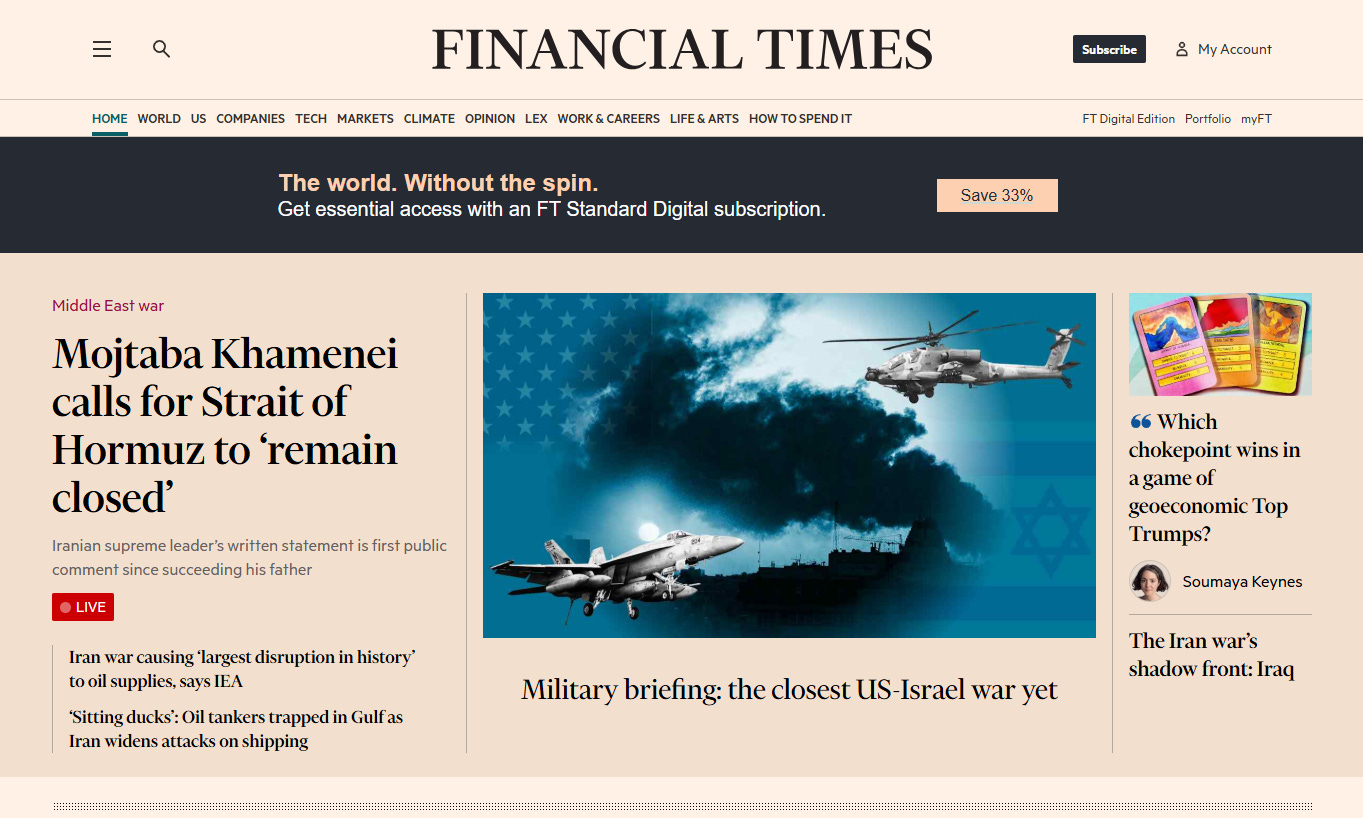
Newspaper Reader: What are Trumps confused reasons? What are Freedland’s political reasons?
Jonathan Freedland since his defaming of Jeremy Corbyn, with help from other Zionists Hysterics, he now carefilly frames his latest comment on the Trump’s War on Iran via this sentence fragment ‘Even taking Trump’s confused reasons for the Iran war at face value,’ Thereader might think that our ‘expert’ is really just what he is, another propagandist! In sum Freedland is a propgandist under the cover of political exploration, as an expanitory device?
Editor: Nothing gets in way of Freedland political chatter but his own well worn medacity!
Editor: Freedland brief attempt at ‘most charitable light’.
It’s not easy, but let’s try to look at this war in the best, most charitable light. Let’s try to see the US-Israel conflict with Iran as its prosecutors and advocates would want us to see it.
Editor: This next paragraph is not explanitory but is about Trumpism framed by a fellow Traveler:
They would say that it has two aims, both legitimate. The first is to weaken if not remove a regime that has done terrible evil to its own people. Who could mourn the supreme leader of a government that, according to one report, gunned down 30,000 of its citizens on the streets in just two days on 8 and 9 January? Listen to those Iranians who long ago reached the glum conclusion that the only way they could be rid of their tormentors was through external military action. As one exiled Iranian put it to me this week: “The Iranian people have been begging the world for help for so many years. They tried voting for change in 2009; they were killed. They tried protesting in 2019, 2022 and this year; they were massacred in the tens of thousands … They were out of all other options.”
Editor: A collection of Freedlands revelatory fragments leaves The Reader almost in augh of his ability to shape even mold the readers thought processes?
…
Iran hoped to make good on that threat by arming and funding the proxies – Hezbollah, Hamas and the Houthis – that formed its much-vaunted “ring of fire” around Israel. After 7 October 2023, Israel resolved not to wait for its enemies to strike, but to rob them in advance of the means to do so.
…
The goals identified by Donald Trump have shifted daily, if not hourly. One minute he wants regime change, the next he seeks merely an end to Iran’s nuclear programme. At breakfast, he insists on unconditional surrender; by lunchtime, he’s open to negotiation.
…
It offers vanishingly few examples of a dictatorship removed through the use of air power alone and, when US force has toppled regimes in the Middle East, the result has not been a smooth transition to democracy but rather the unleashing of enduring chaos and bloodshed: look no further than Iraq in 2003 and Libya in 2011.
…
After nearly half a century, the apparatus of the Islamic Republic is too entrenched, too committed to its own survival, to be felled so easily.
…
Editor: Freedland’s resort to David Petraeus, which is the very definition of political bankruptcy!
To distil what the former head of the CIA, David Petraeus, told the Unholy podcast this week: “We were hoping for Delcy Rodríguez … Instead, what we got is a young Kim Jong-un.”
…
Editor: War Criminal Benjamin Netanyahu makes his appearance. Netanyahu has now disappeared …
Benjamin Netanyahu may be urging Iranians to “take to the streets”, but how exactly are they supposed to do that, with an internet shutdown that makes organisation close to impossible and in the face of security forces ready to machine-gun their fellow citizens?
…
Editor: The Iranians now control the strait of Hormuz: ‘to disrupt the lives of hundreds of millions’ the manifest power of the Iran to manage its own oil reserves!
By effectively closing the strait of Hormuz, it has reminded the world of its chief deterrent: its chokehold over the global economy, its ability to disrupt the international oil supply, to drive up energy prices and therefore inflation, to disrupt the lives of hundreds of millions.
…
Editor: Ukraine war is already lost, to the chagrin of Freedland and his allies!
Putin now has more cash to fight Ukraine, already hurt by depleting stocks of drone interceptors, which are urgently needed in the Middle East.
…
Editor: Iran and its store of weapons of war, from even the crudet of weapony, to the most sophiticated: places Freedland’s bellicose chatter in line with ‘West’ headed by Trump, whose alligence is to Miriam Adelson. As Trump and his operatives, and the whole of the Western Media exalt the Party Line!
As for Iran itself, if the regime survives, it will have every reason to double down on its nuclear ambitions, reasoning that the best guarantee against US attack is the bomb. Think of it as the North Korea principle.
Every one of these risks was predictable and indeed predicted, but the warmakers went ahead anyway. Which brings us to the strongest reason to view this war not charitably, but in a cold, harsh light.
…
Editor: I will end with this final hyperbolic chatter from Friedland. Yet the reader confronts not the Iranian regime of 1979, but its now 47 years old State ! What remaines of the Gaza Genocide is the cowardice of a West, in the thrall of the perennial myth of Jewish Victionhood!
To confront the Iranian regime was to walk, with a lit match, towards a tinderbox soaked in gasoline. If it were to be done at all, whether by military or other means, it had to be done with the greatest care. But Trump has blundered in, crushing and trampling all before him, making a bad situation worse. He does not deserve the benefit of the doubt. He does not deserve his war to be assessed charitably. He deserves our contempt.
This reading completely misunderstands Smith’s thinking, as the economist Ronald Coase explained 50 years ago. (His article “Adam Smith’s View of Man” is the best short thing to read on this.) In the same paragraph as that tiresomely familiar quotation, Smith also observed, “In civilized society [man] stands at all times in need of the cooperation and assistance of great multitudes, while his whole life is scarce sufficient to gain the friendship of a few persons.” This is the puzzle that fascinates him throughout. For cooperation at a distance, benevolence (an admirable sentiment) can’t be expected, much less relied on; self-interest (deplorable in excess) is necessary.
Smith applies this thinking consistently to governments as well as to buyers and sellers – yet another contradiction of the modern caricature. He sees that rulers are also self-interested. They have the same motives as the rest of us and, crucially, face fewer constraints. He questions government interventions not because he wants private self-interest to prevail unhindered, but because he’s alert to the depredations of self-interested kings and ministers. He isn’t preaching self-love. He’s saying that self-love is a fact of human nature – a necessary evil, part of what makes commercial society work, and something that must be kept within bounds.
The Wealth of Nations, mainly concerned with cooperation at a distance, is appropriately preoccupied with self-interest and incentives, more than with benevolence. The Theory of Moral Sentiments is mainly concerned with the norms and intuitions that guide people in their relationships with families, friends, neighbors and fellow citizens, where benevolence and related sentiments, such as affection, loyalty and sympathy, figure more prominently. But again Smith applies the same basic framework: He sees self-love and benevolence intermingling and acting together. As he illustrates at length, our benevolent instincts often serve our interests, as when they promote trust (which successful commerce requires) or burnish our status, reputation or self-esteem.
As you’d expect, this framing gives rise to another line of criticism: Smith’s view of human nature, not just of commercial society, is mean and dispiriting. He isn’t content to argue that society is and should be ruled by selfishness; he also thinks that true benevolence doesn’t exist, regarding this sentiment as either fraud or self-deception.
Again, this critique is wrong. There’s such a thing as genuine benevolence, Smith believed, and it’s admirable; sometimes, it also rewards the benevolent, which is good, because it encourages benevolence. There’s no contradiction. Indeed, this understanding of benevolence and self-interest interacting in ways that, according to circumstances, moderate or reinforce each other – in turn helping commercial society to flourish – points ineluctably to adaptation and natural selection. Smith’s “science of man” anticipates Darwin.
Maybe we often misunderstand Smith’s project of morals and markets because he was more concerned with seeing and understanding how societies work than in advocating any particular course of action. His recommendations are well known, and the classical liberals he inspired (an endangered species, sadly) advocate them still: liberty, rule of law, limited government, competition, free trade. Yet he had little time for theoretical abstraction and delighted above all in observing and disentangling unforeseen or unintended consequences. As a result he ranged far beyond economics, as it’s now understood, through moral and political philosophy, sociology, and social psychology. He was driven by curiosity more than conviction.
This is why the charge of market fundamentalism is risible. First and foremost, Smith was a pragmatist: He saw that commercial society worked, and applied his open mind to asking why. After 250 years, his answers are still enlightening.
Editor: A long quotation from Charlotte Brown’s review of D. D. Raphael’s ‘The Impartial Spectator: Adam Smith’s Moral Philosophy.
Raphael’s discussion of the way Smith develops the idea of an impartial spectator to explain how we morally judge ourselves is as elegant as it is economical. His discussion spans several chapters, which include a critical appraisal of Smith’s theory of conscience and an examination of Smith’s account of moral rules and the virtues; but his chapter, “The Impartial Spectator,” is the central one. Here Raphael is especially careful to detail Smith’s revisions.
Raphael prefaces this discussion with a brief chapter on the role of the ‘spectator’ in Hutcheson’s and Hume’s moral theories. On his reading, Smith follows his predecessors in grounding moral judgments in the feelings of a spectator, attempting, as they did, to capture the disinterestedness of the moral sentiments of approval and disapproval. According to Raphael, Hutcheson’s and Hume’s idea of a spectator is that of a stranger — someone who is “indifferent in the sense of not being an interested party.” (34) All three philosophers aim to provide an empirical account of the moral sentiments.
Hutcheson was the first to insist that our approval of someone else’s actions can be disinterested, “uninfluenced by any thought of benefit to oneself.” (28) He claims that we possess a special moral sense, in addition to our other senses, that disposes us to feel approval or disapproval when we survey people’s character traits and actions. Hume’s contribution is that he saw the need to explain our capacity to approve and disapprove. He traces it to sympathy: we sympathize with the person herself and everyone with whom she interacts. We judge her character traits and actions expressive of them to be virtuous or vicious in terms of whether they are good or bad for everyone affected. Raphael thinks that the idea of an impartial spectator is present in Hume, although not the term.
On Raphael’s reading of Smith, he only needs the simpler idea of a spectator as “not being an interested party” to explain moral judgments we make about others. His originality and lasting contribution lie in his account of how we come to judge ourselves: how we acquire conscience, how it operates, and how it becomes authoritative.
There are two central features of Smith’s explanation of conscience, both of which were present at all stages in the development of his theory. One is that conscience is a social product, a “mirror of social feeling.” The other is that an agent is able to judge herself only by imagining what an impartial spectator would approve or disapprove of in her conduct.
Smith first stresses the impartiality of the reactions of spectators in his discussion of the virtue of self-command: when an agent tries to moderate his passions to the point where a spectator can sympathize. The virtue of self-command is essential to our being able to see ourselves as others do. Conscience originally springs from our “social experience” of being judged by others and being spectators who judge others. We have a natural desire to be loved and we dread blame. Because we love praise and hate blame, we learn to see our conduct through the eyes of others. We come to approve or disapprove of ourselves by imagining how spectators would judge us.
Raphael argues that Smith increasingly came to trust “imagination more and society less.” (38) One reason is that he was bothered by an objection that Sir Gilbert Elliott raised after TMS first appeared: if conscience is merely a reflection of actual spectators’ social attitudes, how would judgments of conscience differ from those of actual spectators?
However, even in the first edition, Smith’s spectator isn’t an actual bystander, but one we imagine. In the 2nd and 6th editions, Smith stresses even more that the spectator is a creation of imagination. Self-examination requires an ability to divide ourselves:
Whenever I endeavor to examine my own conduct … I divide myself as it were into two persons: and that I, the examiner and judge, represent a different character from that other I, the person whose conduct is examined into and judged of. The first is the spectator… The second is the agent… (TMS III. 1.6)
I become a judge of my own conduct by imagining what I would feel if I were a spectator of my own behavior. I then compare these feelings with the feelings that I as an agent actually have.
This leads to Smith’s famous idea of an internal, impartial spectator — “the man within.” Although conscience is initially a product of the approval and disapproval of others, Smith retains the traditional idea that “the voice of conscience represents the voice of God.” As a superior tribunal, it may conflict with the judgments of actual spectators. How does conscience gain its independence and become a higher authority?
Once we are capable of judging ourselves, we make a new distinction between being praised and being praiseworthy, being blamed and being blameworthy. We want not only praise, but to be praiseworthy; we dread not only blame, but to be blameworthy. Actual spectators may be partial and ill informed, but we are able to view ourselves without partiality or misunderstanding. I may gain the approval of others, for example, by pretending to be virtuous. But since I am able to judge what others would think of me, if they knew everything and were impartial, I realize that I do not merit praise. Not only may the judgments of the internal, impartial spectator differ from those of actual spectators, conscience comes to represent a higher tribunal. Smith eventually saw that being “flattered by the praise of society,” while ignoring the superior verdicts of conscience, is a sign of vanity.
At one point, Raphael remarks that a spectator theory is able to explain more easily third-person judgments, and also second-person judgments, but is “apt to be in difficulties with judgments made in the first person (about ‘me’ or ‘us’).” (31) But, on his view, what is original and enduring in Smith’s thought is his explanation of our capacity to judge ourselves from the point of view of an impartial spectator. He also notes that a spectator theory is “more comfortable with passing verdicts on what has been done in the past than with considering and deciding what should be done in the future.” (31) Does Raphael think that Smith is able to explain how we go from being a spectator of our own conduct to being a moral agent who tries to live up to her own ideals of conduct? In the moment of action, we may not be able to view ourselves impartially. But doesn’t the importance of the internal, impartial spectator lie in the fact that the spectator is the person to whom we, as agents, try to conform our conduct, thereby becoming worthy of love and praise? Raphael says that, according to Smith, an agent who attains a high degree of self-command can “identify himself with the imagined spectator to the extent of obliterating the natural feelings of self-regard.” (41)
Raphael maintains that Smith’s psychological and sociological explanation of conscience also shows that judgments of conscience possess a kind of authority or normativity. Does he think that Smith is able to show that they are authentically normative — answering a justificatory question about why we ought to approve as an impartial and well-informed conscience would? Or does he think that Smith is answering a question in “moral anthropology” — explaining why we are inclined to think that the judgments of conscience are normative?
Interestingly, Hume sketches a process that is similar in some ways to Smith’s account of conscience. According to Hume, sympathy ensures that we will catch the moral feelings other people have about us. Since we care deeply about what others think about us, our internalization of the praise and blame of others has the effect of making us see ourselves as others see us, valuing ourselves as others value us. Sympathy thus pressures us to survey ourselves as we appear to others. Hume says that sympathy may even go so far as to make us disapprove of our own vices, even though they benefit us.
Anyone interested in Adam Smith’s moral philosophy or in 17thand 18thcentury British moral philosophy will find Raphael’sTheImpartial Spectatora stimulating book.



 StephenKMackSD's Blog