Jonathan Turley raides Tom Wolfe’s “Radical Chic: That Party at Lenny’s,”circa 1970!

Old Socialist : Tom Wolfe is the shield/cover that Turley uses for his attack on ‘America’s Armchair Revolutionaries’

stephenkmacksd.com/

Jul 19, 2025

America’s Armchair Revolutionaries: How the Left is Rediscovering Marxism as the Ultimate Virtue Signal

By jonathanturley on July 19, 2025

Below is my column in The Hill on the rise of American armchair revolutionaries, particularly among young, affluent college graduates. It is part of the “radical chic” fostered from higher education to Hollywood for citizens who have no memory of the failures of socialism and communism in the 20th Century.


Editor: Mr. Turley seems to be not just out of touch, but a purveyor of shopworn ignorance! In sum he presents Wolfe as a truth teller, rather than social critic with certain verifiable prejudices, that read like leftovers from 1970 !


Journal du Voyeur

Jason Epstein

December 17, 1970 issue

Editor: some selective quotations from this essay are instructive!

Sometime in December, Kempton, at the suggestion of the Panthers’ lawyers, asked some well-connected and respectable friends who have a town house on the East Side whether they would arrange an evening at home to raise money for the Panthers’ defense. Not only were the defendants desperately poor, but Kempton felt it important that their situation be publicized; for, as he wrote at the time, “If they cannot be saved from being tried as strangers, they have no chance to be tried fairly at all.” Liberal New Yorkers are quick to respond to such appeals, especially where civil liberties appear to be in jeopardy. Furthermore, the Panthers had by this time gained a certain interest—not to say glamour—as the authentic voice of black misery and rage. One tended to hear in their violent language and the shallow Marxism that accompanied it not the sound of revolution but the cry of pain. What liberals found most interesting and hopeful about the Panthers were their efforts to supply dignity and political direction to black street people. Their talk of violent revolution, their identification with third world political leaders, and even the weapons they carried seemed, by contrast, largely rhetoric and theater.

To many liberals it also appeared that the Panthers were right to claim that federal and local officials were out to destroy them. Attorney General Mitchell had begun to talk of preventive detention. Fred Hampton, the Illinois Panther leader, had been shot in his bed by a posse of Chicago police, and Bobby Seale, the national chairman, had been bound and gagged by Judge Hoffman at the Chicago conspiracy trial for having repeatedly demanded no more than his constitutional right to defend himself. Moreover, evidence of the torture and murder of Alex Rackley in New Haven—a crime with which Seale had also been charged, to which two Panthers had already confessed, and for which a third was later to be found guilty—had not yet been made public; nor had any other evidence of Panther violence been produced, including whatever evidence Hogan might have had against the New York Panthers. In any case, what was on Kempton’s mind was not the guilt or innocence of the defendants but the need to raise money for their defense and to make them visible.

Thus Kempton’s friends sent out their invitations. About forty people came, including Felicia Bernstein, wife of the conductor. The Panthers who addressed these guests were articulate and calm. Their problems were obviously genuine. They talked about their breakfast program for ghetto children and said nothing to suggest that they were terrorists. They did, however, insist that they were revolutionaries, an admission that did not deter Mrs. Bernstein from agreeing to arrange a similar meeting at her own house some two weeks hence. Soon thereafter she sent elegantly engraved invitations, in her name but not in her husband’s, to perhaps a hundred people who might be interested in the case. Meanwhile, Charlotte Curtis, the society reporter for The New York Times, who had been in touch with Kempton on other matters, learned of his interest in the Panthers and said she would like to write a piece on their wives. Kempton thought this would be useful to the defendants and suggested that she come along to the Bernsteins’ party.

Tom Wolfe was another guest whom Mrs. Bernstein had not herself invited, but who came anyway. The present book is the result of his visit.

Editor:

God!” Bernstein interrupts Cox at one point in the evening, “most of the people in this room have had a problem being wanted.” To Wolfe this statement is laughable. Bernstein, he says, “has steered the Black Panther movement into a 1955 Jules Feiffer cartoon. Rejection, Security, Anxiety, Oedipus, Electra, Neurosis…,” etc. This misses the point. To be wanted is hardly a psychoanalytic cliché. It is an absolute spiritual necessity—for the Panthers, for the Bernsteins, and for everyone in between. The point that Wolfe misses and that Bernstein spontaneously grasped is that what we all fear is to be abandoned not simply in an indifferent and purposeless universe, but in our indifferent, purposeless, and ungoverned cities.

The prospect is not bright. According to Gibbon, when the Romans of the second century learned that their empire was waning and that their familiar gods could no longer be trusted, only a few kept their heads. Most hastened to attach their faith to whichever substitutes came their way. The result eventually was Christianity. For Americans there appears to be no such likely replacement for the faith we once had in ourselves. Some take drugs, others call the police. For most there is nothing left to do but try to pretend that things are the same, and to blame their anxiety on the failures or conspiracies of others. Such paranoia is the common refuge of a frightened people. Crises of faith are hard to bear. As therapy, delusion may seem preferable to truth. On the other hand, reality cannot be denied for long, nor does a flag on the lapel restore our lost democracy.

Yet even in such times as these, there remains a choice of action. We may blame others for our misfortunes and confront our problems with benign neglect, hoping that they will go away by themselves, or, like Felicia Bernstein and Barbara Walters, we may ask, seriously and with compassion, if anything can still be done.

Tom Wolfe’s view of things to come is darker yet. At the end of his essay he has a vision. There is a concert. Bernstein is conducting. The audience consists of

…fools, boors, philistines, Birchers, B’nai Brithees, Defense Leaguers, theatre party piranhas, UJAviators, concert hall Irishmen, Wasp ignorati, toads, newspaper readers—they were booing him—Leonard Bernstein—Boooooooooo. That harebrained story in the Times had told how he and Felicia had given a party for the Black Panthers and how he had pledged a conducting fee for their defense fund, and now stretching out before him in New York, was a great, starched, white-throated audience of secret candy store bigots, greengrocers, Moshe Dayans with patches over both eyes. Booooooo Boooooooo it was unbelievable. But it was real—he was their whipping boy and a bunch of $14.50 cretins were booing him and it was an insomniac hallucination in the loneliness of 3 AM.

Of course Wolfe can only have imagined that this was Bernstein’s dream. Though such a concert did take place soon after the editorial appeared in the Times and Bernstein was, in fact, booed, the terrible vision, with all its hatred and violence, its fear and disgust, is Wolfe’s own and in his authentic voice. The terrified conductor, the howling mob, the forgotten music may indeed be our future, as Wolfe seems to be saying. Still, we may hope that his perception in this particular is as faulty as it is generally.

Editor: Note the bad political actor in the Turley diatribe is Zohran Mamdani! The Neo-Cons and The New Democrats are in a panic over the Mamdani election. And to this the fact that Tueley was 9 in 1970, so his acquaintanceship with Wolfe’s diatribe is historical, rather that contemporaneous: I recall it vividly !


Editor: Mr. Turley refuses to acnowledge that The Rebellion Against The Elites continues!

Latte Leninist, “radical chic”, Marxism-lite, Young Democratic Socialists of America, [boycott-divestment-sanctions against Israel],

Marxism coming to America, young people for socialism and even communism, radical shifts to socialism in Great Britain and France destroyed their economies,

Notably, most of Mamdani’s proposals would violate the Constitution or bankrupt the city,

Such considerations are rarely raised, let alone resolved, in radical conferences, She added, “it’s our responsibility as people who are within the United States to go as hard as possible to decolonize this place because that will reverberate all across the world.

Because the U.S. is the greatest predator empire that has ever existed.”, Take University of Chicago Assistant Professor Eman Abdelhadi, who used her recent appearance at the Socialism 2025 conference to denounce the University of Chicago as an “evil” and “colonialist” institution,

Lenin once mocked many in the West as idiots who would “transform themselves into men who are deaf, dumb and blind [and] toil to prepare their own suicide.” What he never imagined was how some would still be transforming themselves decades after the revolution failed.

Old Socialist.

Posted in Uncategorized | Leave a comment

Reading and re-reading A.W. Moore’s essay in the London Review…

Philosopical Apprentice.

stephenkmacksd.com/

Jul 17, 2025

Tractatus Logico-Philosophicus
by Ludwig Wittgenstein, translated by Michael Beaney.
Oxford, 100 pp., £8.99, May 2023, 978 0 19 886137 9

Tractatus Logico-Philosophicus
by Ludwig Wittgenstein, translated by Alexander Booth.
Penguin, 94 pp., £14.99, December 2023, 978 0 241 68195 4

Tractatus Logico-Philosophicus
by Ludwig Wittgenstein, translated by Damion Searls.
Norton, 181 pp., £19.99, April, 978 1 324 09243 8

https://www.lrb.co.uk/the-paper/v46/n15/a.w.-moore/a-tove-on-the-table


My notes :

Part of the aim of the book is to indicate what it is about the world that makes it possible for us to represent it, in thought or in language. Wittgenstein is led to a vision of crystalline purity. The world is the totality of facts. Facts are determined by states of affairs. States of affairs, each of which is independent of every other, are configurations of objects. These objects would have existed however the facts had been. If the facts had been different, it would have been because the objects had been configured differently, not because there had been different objects. Representation itself consists of facts. Thus a thought or a statement is a fact, determined by a configuration of ‘signs’. In the most elementary case the signs stand for objects, and the fact that they are configured in the way they are represents that the corresponding objects are configured in the same way. The thought or statement in question thereby serves as a ‘picture’ of the corresponding fact. It is true if the objects are configured in that way, and it is false if they are not. In a less elementary case, for example in the case of a conjunction of two statements, truth or falsity is determined by the truth or falsity of its constituents: a conjunction of two statements is true if both its constituents are true, false otherwise.

The whole thing has the air of a metaphysical disquisition on the fundamental character of reality and our engagement with it. The culmination, however, consists of two remarkable propositions that cast doubt on this impression: the penultimate proposition, numbered 6.54, in which Wittgenstein says that anyone who understands him will eventually recognise what he has been saying as nonsensical (by ‘nonsensical’ he does not mean absurd or foolish, but quite literally lacking in meaning); and the final proposition, numbered 7, in which, as if in explanation of the propensity to produce such nonsense, he says that we must keep silent about what we cannot speak about.

The book’s point is an ethical one … [It] consists of two parts: the one presented here plus all that I have not written. And it is precisely this second part that is the important one. My book draws limits to the sphere of the ethical from the inside as it were … I have managed in my book to put everything firmly into place by being silent about it.

The book’s point is an ethical one … [It] consists of two parts: the one presented here plus all that I have not written. And it is precisely this second part that is the important one. My book draws limits to the sphere of the ethical from the inside as it were … I have managed in my book to put everything firmly into place by being silent about it.

P. A.

Posted in Uncategorized | Leave a comment

Can it even be a surprise that Zionists Thomas L. Friedman & Bret Stephens take aim at Zohran Mamdani?

Old Socialist comments.

stephenkmacksd.com/

Jul 17, 2025

Editor: Friedman lectures Mamdani as if the Gaza Genocide were in a rear view mirror, of History. No surprise Friedman’s vacuous chatter is about feckless political conformity, practised over time, in The Paper Of Record!

First, if you are discussing a mantra — like “globalize the intifada” — that takes 15 minutes to explain why it doesn’t mean what it obviously means, I’d suggest that you distance yourself further from that mantra.

May I offer an alternative? “Two states for two peoples.” It works really well with drums — “Two states, for two peoples.”

While that solution may be a long shot, it has the virtue of being the only viable, just solution to the Israeli-Palestinian conflict — one that many Americans still support, and one, if this Gaza war ever ends, I believe many Israelis and Palestinians and Arabs and Muslims and Jews in New York City will as well. There is no other viable alternative. There is no one-state solution; there is no three-state solution. The only alternative to “two states for two peoples” is, in my opinion, no states for two peoples — just a grinding forever war between two peoples living intertwined with each other.

Second, the world does not need the mayor of New York City to be another commentator on the Israeli-Palestinian conflict. The world is awash with commentators on this issue. We don’t need any more. We need leaders ready to be conveners of those looking for the only just solution.

Tell voters more about how you will use your office to bring together Israelis, Palestinians, Arabs, Muslims and Jews who aspire to build two states for two peoples.


Editor: Bret Stephens essay is awash in ‘Left Bad Actors’ :

Two groups must be especially thrilled by the prospect of Zohran Mamdani becoming New York’s next mayor.

The first: young, progressive-leaning voters who gave the charismatic 33-year-old State Assembly member his come-out-of-nowhere victory in last month’s Democratic primary. They want what he wants: rent freezes, free public buses, city-owned grocery stores, tax hikes for corporations and millionaires, curbs on the police, a near doubling of the minimum wage to $30 an hour and the arrest of Benjamin Netanyahu.

The second: Republicans who want to make sure that Democrats remain the perfect opposition party — far-left, incompetent, divided, distrusted and, on a national level, unelectable. Remember when Ronald Reagan ran against the “San Francisco Democrats” in 1984 and carried 49 states? Get ready for the G.O.P. to run against “Mamdani Democrats” for several election cycles to come.

That’s a thought that ought to give moderate Democrats pause before they accept Mamdani’s mayoralty as a political fait accompli, or even think of getting behind him. Among the reasons the Democratic Party’s brand has become toxic in recent years is progressive misgovernance in places like Los Angeles; San Francisco; Oakland, Calif.; Portland, Ore.; Seattle; and Chicago. If Mamdani governs on the promises on which he’s campaigned, he’ll bring the same toxicity to America’s biggest city.

Editor: Stephens final quote is from Karl Marx:

Marxists often counsel: “Sharpen the contradictions.” With Mamdani as mayor, it would be Trump who’d be doing the sharpening.

Old Socialist

Posted in Uncategorized | Leave a comment

After Adam Liptak’s attack against Justice Ketanji Brown Jackson, can the reader make a connection between Thomas Friedman & Bret Stephens defamation of Zohran Mamdani ?

Newspaper Reader comments.

stephenkmacksd.com/

Jul 16, 2025

@NYT, in the person of @adamliptak takes aim at Ketanji Brown Jackson!

Posted on July 8, 2025 by stephenkmacksd

stephenkmacksd.com/

Jul 08, 2025

Headline: Justice Ketanji Brown Jackson Makes Herself Heard, Prompting a Rebuke

Sub-headline: In solo dissents this term, the justice accused the conservative majority of lawless bias. On the term’s last day, Justice Amy Coney Barrett fired back.

Editor: The first paragraphs of Adam Liptak scolding chatter? Steeped in animus toward the newist member of the Court, is unsurprising, this is The New York Times!

Justice Ketanji Brown Jackson wrote just five majority opinions in the Supreme Court term that ended last month, the fewest of any member of the court. But her voice resonated nonetheless, in an unusually large number of concurring and dissenting opinions, more than 20 in all.

Several of them warned that the court was taking lawless shortcuts, placing a judicial thumb on the scale in favor of President Trump and putting American democracy in peril. She called the majority’s opinion in the blockbuster case involving birthright citizenship, issued on the final day of the term, “an existential threat to the rule of law.”

Justice Jackson, 54, is the court’s newest member, having just concluded her third term. Other justices have said it took them years to find their footing, but Justice Jackson, the first Black woman to serve on the court, quickly emerged as a forceful critic of her conservative colleagues and, lately, their approach to the Trump agenda.

Her opinions, sometimes joined by no other justice, have been the subject of scornful criticism from the right and have raised questions about her relationships with her fellow justices, including the other two members of its liberal wing.

Editor: In sum Justice Jackson has overstepped the bounds of deference to the senior members of the Court?


The History of the Neo-Confederate Supreme Court is well Documented, and its holdovers

ConstitutionHuman RightsLost HistoryObama AdministrationPoliticsRight Wing

The Neo-Confederate Supreme Court

February 28, 2013

On Wednesday, the five partisan Republicans on the U.S. Supreme Court showed that they wanted to do their part in devaluing the votes of blacks, Hispanics, Asian-Americans and young urban whites. So the key GOP justices indicated during oral arguments that they are looking for excuses to strike down the heart of the Voting Rights Act.

Right-wing Justice Antonin Scalia shocked the courtroom when he dismissed the Voting Rights Act as a “perpetuation of racial entitlement,” suggesting that the right of blacks to vote was some kind of government handout.

But almost as troubling was the remark from Justice Anthony Kennedy who insisted that the Voting Rights Act, which was first enacted by Congress in 1965 and was renewed overwhelmingly in 2006, was an intrusion on Alabama as an “independent sovereign,” states’ rights language reminiscent of the Old Confederacy.

Indeed, the five Republican justices also including John Roberts, Clarence Thomas and Samuel Alito seem to have absorbed a Neo-Confederate interpretation of the Constitution that is at odds with what the Framers intended.


Editor: Freighted with respectable bourgeois political chatter, here is the would-be ‘Bill of Attainder’ against Justice Jackson, confected by Liptak!

Justice Jackson, who did not respond to a request for comment, has also been a harsh critic of the court’s use of truncated procedures in ruling on emergency applications.

“This fly-by-night approach to the work of the Supreme Court is not only misguided,” she wrote in April, when the court said that Venezuelan men the administration was seeking to deport to El Salvador had sued in the wrong court. “It is also dangerous.”

In a dissent from an emergency ruling in June granting Elon Musk’s Department of Government Efficiency access to sensitive Social Security data, Justice Jackson accused the majority of giving Mr. Trump favored treatment. “What would be an extraordinary request for everyone else,” she wrote, “is nothing more than an ordinary day on the docket for this administration.”

When the court let Mr. Trump lift humanitarian parole protections for more than 500,000 migrants in May, Justice Jackson wrote that the majority had “plainly botched” the analysis, “rendering constraints of law irrelevant and unleashing devastation.”

Justices Jackson and Sotomayor are the only members of the court who have served as trial judges. In the last term, Justice Jackson repeatedly criticized the majority for undermining the authority of their colleagues on the front lines.

In the dissent that prompted Justice Barrett’s rebuke, she decried the majority’s “dismissive treatment of the solemn duties and responsibilities of the lower courts.”

Last year, in a dissent in a public corruption case, Liptak seemed to allude to revelations by ProPublica and others that Justices Clarence Thomas and Samuel A. Alito Jr. had failed to disclose luxury travel provided to them by billionaire benefactors, a strikingly critical swipe on a sensitive topic.

“Officials who use their public positions for private gain threaten the integrity of our most important institutions,” she wrote. “Greed makes governments — at every level — less responsive, less efficient and less trustworthy from the perspective of the communities they serve.”

Editor: How uttery inconveient for a sitting Justice of The Supreme Court , Justice Jackson, to remind the other members of the Court, that she is capable of telling critical evaliations of their corrupt practises?

Political Observer.


Editor: Friedman’s respectable bourgouise chatter!

When I see someone running for mayor defending a useless, meaningless, far-left mantra that helps no one, and who prefers commenting at a distance and not convening energetically, it makes me wonder how he will deal with the really hard issues on the West Bank of the East River — not the West Bank of the Jordan — that most New York voters care most about.


Editor: Stephens is not just a Zionist like Friedman, but a former editor of the Jerusalem Post, one of the propaganda organs for the Zionist Faschist State! Stephens presents ‘The Left’ in all its various toxic hues! It’s a cartoon from the lineage of Joseph McCarthy!

The first: young, progressive-leaning voters who gave the charismatic 33-year-old State Assembly member his come-out-of-nowhere victory in last month’s Democratic primary. They want what he wants: rent freezes, free public buses, city-owned grocery stores, tax hikes for corporations and millionaires, curbs on the police, a near doubling of the minimum wage to $30 an hour and the arrest of Benjamin Netanyahu.

Editor: a telling bit of misplaced hyperbolie:

Marxists often counsel: “Sharpen the contradictions.” With Mamdani as mayor, it would be Trump who’d be doing the sharpening.

Newspaper Reader.

Posted in Uncategorized | Leave a comment

Katrina Forrester reviews Melinda Cooper’s ‘Counterrevolution: Extravagance and Austerity in Public Finance’

Philosophical Apprentice comments.

stephenkmacksd.com/

Jul 15, 2025

Headline: ‘I appreciate depreciation’ Katrina Forrester

Sub-headline: Counterrevolution: Extravagance and Austerity in Public Finance
by Melinda Cooper. Princeton, 564 pp., £28, May 2024, 978 1 942130 93 2

https://www.lrb.co.uk/the-paper/v47/n12/katrina-forrester/i-appreciate-depreciation

Editor: the quotation of the final paragraphs of Katrina Forrester’s review of Melinda Cooper book, does not even approach the value of these two invaluable Public Intellectual, to the toxin of Neo-Liberalism. And the exhaustion of the whole of America’s Political Class in the Age Of Trump, and its political precusors, offered as bearers of a kind of ersatz revelation over time?

Cooper’s​ account of the family – not only a reproductive unit or a means of pooling income, providing care and maintaining authority, but a tax shelter and vehicle for holding assets – is part of a larger story about the selective application of austerity and extravagance under neoliberalism. Today, she writes, capitalism is no longer based on returns on industrial investment, a ‘regime of accumulation organised around production and measurable in terms of growth’. Instead we have a ‘regime of asset price appreciation’ – managed largely through tax exemptions and expenditures, and based on capital gains – in which the private family wealth fund rivals the public corporation. The rentier and the debtor: this is, Cooper’s analysis suggests, the primary class division of 21st-century capitalism.

The scale of this transformation may be overstated. The family has long been a key organisational unit of capitalist social relations; the corporation persists, and public asset managers remain more powerful than private firms; and there have always been wealthy dynasties, though profitable new financial instruments have been made available to them. Public incentives to private investment were part of the logic of postwar American liberalism from the beginning, and were inscribed in earlier tax codes. Older class divisions endure, and the accumulation of capital continues through old-fashioned means of production, which coexist with the novel monetary and fiscal environments described in Counterrevolutions. Although Cooper understates these continuities, she also rejects the common diagnosis that capitalism is in a long downturn. This diagnosis is made across the ideological spectrum, from economic liberals to social democrats to the Marxist left (to which Cooper is otherwise sympathetic). Her response is that we are overlooking the boom that followed the crisis of 2008 and putting too much emphasis on long-term decline because we use outdated economic indicators that were developed to measure growth during the Fordist phase of capitalism. It is true that savings rates and industrial investment have plummeted, but new forms of investment have replaced them, and these can only be revealed by accounting for capital gains (especially those that remain unrealised).

The point of this argument is as much political as diagnostic. What Cooper wants to show is that state fiscal decisions have always been the product of antagonistic struggle – over the extent of the social wage, state debt, and the actions that capitalist actors and institutions are willing to permit. Austerity is a choice. The protection of the family at the expense of other ways of living is a choice. The transfer of public wealth to private wealth is a choice – it’s a choice to make housing a financial asset, for example. Is abundance possible for all? Cooper thinks it is, if only we can realise the possibilities afforded by control of the money supply.

While politicians have long insisted, in Theresa May’s words, that ‘there is no magic money tree’ – that we need to balance the books and live within our means – what Cooper wants us to learn from her history of the battles over the tax code in the US is that those limits are not as they are presented to us. ‘We do not lack the means,’ she writes, ‘to collectivise public debt issuance, to monetise that debt, to channel that money into collective spending on education, healthcare, welfare and the transition to renewable energy, or to redistribute the ensuing social wealth. What we lack is the political will.’ Historically, the terms and occasions on which balanced budgets can be transgressed have been set by capital, not labour. But what if we shook the magic money tree and distributed its fruits fairly: if we seized the instruments of wealth creation and socialised finance, could we finally find a way of getting everything for everyone?

The trouble, as Cooper well knows, is working out how to move towards supply-side socialism in a situation where the radical left is a long way away from power (with the democratic socialist Zohran Mamdani’s victory in the Democratic primary for mayor of what was once Trump’s New York, perhaps it is closer than one might think). But limiting the power of capital over the state isn’t just a matter of changing the ruling party, or limiting the influence of neoliberals, as Cooper sometimes seems to suggest. The relation of the state to capital runs deeper, and though there are political choices to make, they are rarely made in circumstances of our choosing. The project of using technocratic means to achieve radical abundance is beset with structural constraints. And, as Cooper’s book shows, the daily struggles of economic life under capitalism remain as much about the organisation and control of time, work and sexuality as they are about the supply and distribution of money. What her account documents is that the horrors of austerity have been the flipside of a commitment by the state to asset-owners; a commitment that could end. ‘Extravagance for everyone’ is a rallying cry that gets at the true meaning of the right to life – a demand long distorted by the anti-abortion movement. Call it the hope or the dream – too long deferred – of public luxury.

https://www.lrb.co.uk/the-paper/v47/n12/katrina-forrester/i-appreciate-depreciation

Philosophical Apprentice.

Posted in Uncategorized | Leave a comment

On ‘Becoming Freud’ : Adam Phillips as incompetent Freudian Apologist/Propagandist. A comment by Philosophical Apprentice

Posted on January 4, 2019 by stephenkmacksd

I am reading ‘Becoming Freud’ and read this paragraph with amazement :

https://yalebooks.yale.edu/book-details/embed/#?secret=viZKs29FjE#?secret=s63PSG6JRx

An apt analogy of Mr. Phillips book: a Studio Head, in the Golden Age of Hollywood, calling in The Wise Hack to do a re-write on a property. Such is Mr. Phillips’ role as the intellectually mendacious redeemer of the Legend of Freud. Call this intervention by its name propaganda!

Freud always presented Psychoanalysis as a Science, not a tool for Jewish Emancipation, from European oppression in all its iterations, but as a methodology for liberation from the interaction between the Id, Ego and Super-Ego and the malign Unconscious. Freud constructs a Melodrama taking place inside the person. But this quote should put the readers mind at rest as to Freud’s commitment to Jews and Judaism:

How can a person raised in ‘complete ignorance of of everything that concerned Judaism’, a  defender of Enlightenment rationality, the author of a ‘Science’ called Psychoanalysis be allied in the project of Jewish Emancipation as Mr. Phillips presents it?

That Phillips somehow thinks that part  of his readership might not be former analysands, and or readers/explorers of Freud and his critics strikes this reader as the myopia of the propagandist: the evidence that leads this reader to that conclusion is the Phillips engages in the denaturing of the language of Freud, his arcane jargon,  to borrow Adorno’s more that fitting description of Heidegger’s rhetorical practice,  is disappeared, in favor of a set of easily understood concepts. All of this is made more palatable by Phillips’ fluid writing style, that serves him well.

To put it bluntly Phillips writes in a time in which the Freud Legend is at its nadir. The reason being, that the critical evaluation of Freud has been the undoing of his ‘Science’ and the rise of Freud as Metaphysician, Jewish Liberator or Jewish Story Teller. In Phillips re-write of Freud: he is what you desire him to be!

Mr. Phillips ‘Becoming Freud’  is the perfect candidate for an Audio Books, since the footnotes are merely superfluous scholarly  garnish, to his version of Freud.  Or to be blunt its like Velveeta Cheese, its ‘processed cheese food’ an ersatz version of the real thing.  It is destined to end up casually placed on coffee tables, or night stands, to give the impression that its possessor is well read!  I found my copy on the remainder table for $4.00

Here is a link to my essay, that contains a long list of writers who approached Freud in a critical way. I can recommend the work of Frederic Crews and John C. Ferrell :

‘Eli Zaretsky on Political Freud, a comment by Philosophical Apprentice’

For the surprising literary antecedent to Freud’s ‘psychoanalytic project’, Cervantes’ Quixote,  see ‘Freud’s Paranoid Quest,Psychoanalysis and Modern Suspicion by John C. Farrell, Chapter 6 ‘Freud as Quixote’:

http://nyupress.org/books/9780814726501/

And see this unsurprisingly hostile review of Mr. Farrel’s book in the New York Times by Sarah Boxer titled ‘Flogging Freud’:

https://www.nytimes.com/books/97/08/10/reviews/970810.10boxert.html

Some of the Evaluations of Freud and Psychoanalysis:

Freud, Biologist of the Mind by Frank Sulloway

Freud Evaluated, The Completed Arc by Malcolm Macmillan https://mitpress.mit.edu/books/freud-evaluated

The Memory Wars, Freud’s Legacy in Dispute by Frederick Crews https://en.wikipedia.org/wiki/The_Memory_Wars

Follies of the Wise, Dissenting Essays by Frederick Crews https://books.google.com/books/about/Follies_of_the_Wise.html?id=SKQGIZHuhW8C

Unauthorized Freud: Doubters Confront a Legend by Frederick Crews http://www.amazon.com/Unauthorized-Freud-Doubters-Confront-Legend/dp/0670872210

Freudian Fallacy: An Alternative View of Freudian Theory by E.M. Thornton

http://www.amazon.com/Freudian-Fallacy-Alternative-View-Theory/dp/0385278624/ref=asap_bc?ie=UTF8

The Psychoanalytic Movement: The Cunning of Unreason,3rd Edition by Ernest Gellner, Forward by Jose Brunner

http://www.wiley.com/WileyCDA/WileyTitle/productCd-0631234136.html

Anti-Freud: Karl Kraus’s Criticism of Psychoanalysis and Psychiatry by Thomas Szasz

http://www.amazon.com/Anti-Freud-Krauss-Criticism-Psychoanalysis-Psychiatry/dp/0815602472

Which includes many of the books I have read on Freud since I entered therapy in 1969.

Philosophical Apprentice

______________________________________________________________

Added January 04,2019

Title:  NEW INSIGHTS INTO FREUD

March 17, 1985 New York Times

Daniel Goleman reports on psychology for The Times. Excerpts from Freud’s letters are from ”The Complete Letters of Sigmund Freud to Wilhelm Fliess, 1887-1904,” translated and edited by Jeffrey Moussaieff Masson; Cambridge, Mass., and London, England: The Belknap Press of Harvard University Press, c 1985 Sigmund Freud Copyrights Ltd. and J. M. Masson; to be published in April 1985.

WHEN SIGMUND FREUD learned in 1936 that his letters to Wilhelm Fliess, the German doctor who had been his closest friend at the turn of the century, had been purchased from a bookseller by his student, Princess Marie Bonaparte, he was aghast. Freud, by then world famous as the father of modern psychotherapy, wrote her immediately, saying: ”Our correspondence was the most intimate you can imagine. It would have been highly embarrassing to have it fall into the hands of strangers . . . I do not want any of them to become known to so-called posterity.” He later asked her to destroy them.

Almost a half-century later, the full text of that correspondence is being published. The letters have appeared, in part, before; the new edition, however, to be published next month, is the first complete and unexpurgated version. In it, passages never seen before, or quoted only in part or out of context, can be read in full, their meanings and implications presented for all to see.

https://www.nytimes.com/svc/oembed/html/?url=https%3A%2F%2Fwww.nytimes.com%2F1985%2F03%2F17%2Fmagazine%2Fnew-insights-into-freud.html

Freud’s mania for controlling the narrative on his self-conception as an hero figure, is simply confirmed in the first paragraphs of this long report on the Fliess/Freud correspondence by Daniel Goleman. Freud writes to Princess Marie Bonaparte:

”Our correspondence was the most intimate you can imagine. It would have been highly embarrassing to have it fall into the hands of strangers . . . I do not want any of them to become known to so-called posterity.” He later asked her to destroy them.

P.A.

_____________________________________________________

Added January 05, 2019

Here is more of  Phillips’ breathtaking historical/personal phantasmagoria:

Begin at ‘Out of the turbulent ,uprooted history…’ . The reader can call this by its rightful  name, a Freudian Melodrama aided by Lacan’s borrowings from Saussure. And ending in ‘…the individual’s desire for extinction.’ Don’t call this pessimism, but the expression of Freudian nihilism, pronounced by a revisionist’s failed attempt at his project.

P.A.

___________________________________________________________________________________________

Added January 05, 2019 1:00 PM PST

Its taken some time to come to this realization: what I’ve offered as an explanation for Phillips’ style of argument, as ‘historical/personal phantasmagoria’ is that he engages in the most important tools of Psychoanalysis ‘free association’, in a biographical/historical/personal key. That appears, at first reading, as that phantasmagoria but is simply an adaptation of Freud’s methodology, to discover what the patient does not want to ‘share’ with her/his analyst.

That ‘Free Association’ reads as a meandering, evocative rhetorical style, that mimics, in a way, the aphoristic style of the seer or mystic, or even the Greek Heraclitus.

P.A.

Posted in Uncategorized | Leave a comment

Jonathan Freedland on ‘We’re becoming inured to Trump’s outbursts – but when he goes quiet, we need to be worried’

Old Socialist on the very elastic political standards of Jonathan Freedland & Fellow Travelers!

stephenkmacksd.com/

Jul 13, 2025

Headline: We’re becoming inured to Trump’s outbursts – but when he goes quiet, we need to be worried

Sub-headline: Across the US, without soundbites or stunts, the president is building a police state and eroding democracy

https://www.theguardian.com/commentisfree/2025/jul/11/donald-trump-us-police-state-democracy

Editor: The first three paragraphs from Freedland’s diatribe:

In the global attention economy, one titan looms over all others. Donald Trump can command the gaze of the world at a click of those famously short fingers. When he stages a spectacular made-for-TV moment – say, that Oval Office showdown with Volodymyr Zelenskyy – the entire planet sits up and takes notice.

But that dominance has a curious side-effect. When Trump does something awful and eye-catching, nations tremble and markets move. But when he does something awful but unflashy, it scarcely registers. So long as there’s no jaw-dropping video, no expletive-ridden soundbite, no gimmick or stunt, it can slip by as if it hadn’t happened. Especially now that our senses are dulled through over-stimulation. These days it requires ever more shocking behaviour by the US president to prompt a reaction; we are becoming inured to him. Yet the danger he poses is as sharp as ever.

Consider the events of just the last week or so, few of them stark enough to lead global news bulletins, yet each one another step towards the erosion of democracy in and by the world’s most powerful country.

https://www.theguardian.com/commentisfree/2025/jul/11/donald-trump-us-police-state-democracy


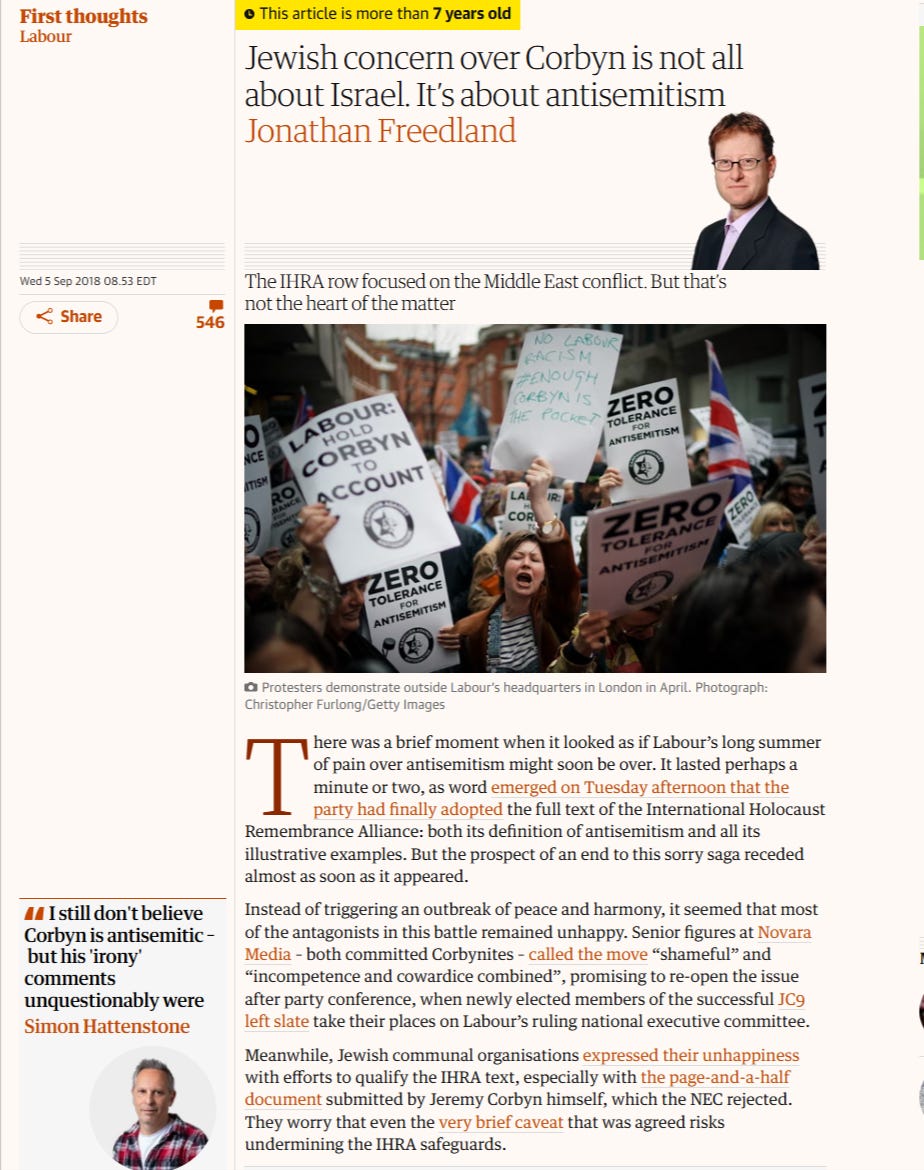
Editor: This Reader can’t quite forget Friedman’s attack on Jeremy Corbyn of Wed 1 May 2019! Columnist Daniel Finkelstein does the the heavy lifiting, while Freedland maitaines safety in distance!

Headline: Jeremy Corbyn is either blind to antisemitism – or he just doesn’t care

Sub-headline: Labour’s leader may claim he didn’t see the racism in JA Hobson’s book. But can the party indulge that delusion?

https://www.theguardian.com/commentisfree/2019/may/01/jeremy-corbyn-blind-antisemitism-hobson

On the contrary, the bit Corbyn praised as “correct and prescient” was, in his words, “Hobson’s railing against the commercial interests that fuel the role of the popular press,” which appears squarely in the section where Hobson’s target is “this little group of financial kings”, these “cosmopolitan” men who he had already identified as Jews. (The chapter, incidentally, is called “Economic Parasites of Imperialism,” with “parasites” an image recurrent in anti-Jewish propaganda.) This is not a mere aside by Hobson that might accidentally be overlooked in a skim-read by a busy politician. There are pages and pages of it.

No one is arguing that Corbyn was obliged to denounce the whole book. He could simply have nodded to the problem with a tiny caveat: something like, “Despite some passages that read uncomfortably to the modern ear …” But there is nothing like that. He might have made the move Finkelstein himself made when writing recently about Churchill, in a column headlined: “Winston Churchill was a racist but still a great man”. Corbyn could have said something similar about Hobson or his book. But he didn’t do that either. A Labour spokesman has said that: “Jeremy completely rejects the antisemitic elements of [Hobson’s] analysis.” But if that’s true, why did he not say so when he wrote about it?

Perhaps the Labour leader’s explanation will be the same one he offered for his defence of a mural depicting hook-nosed, Jewish bankers playing Monopoly on the backs of the poor: that he simply did not see the racism. But in the Hobson text, it’s there in black and white. It would be very hard to miss, especially if you’re a “lifelong anti-racist” as Corbyn always insists he is. But perhaps that will be what he’ll say: that he couldn’t see the racism even when it stared him in the face. Because the only other explanation available is that he didn’t object to this part of Hobson’s analysis – as he did to other parts, describing one element of the book as “strange” – because he didn’t see anything wrong with it.

We all know that it’s painful to admit flaws in those we admire. Corbyn should have done it about Hobson, but did not. Now that task falls to Labour MPs, members, supporters and voters. The Labour leader may tell himself that he is the victim here, a serially unlucky anti-racist who means well, but keeps overlooking racism against Jews even when it’s right in front of him, whether on the platforms he shares or the books he praises. Now the rest of the Labour family have to decide how much longer they are willing to indulge that delusion.

Editor: Friedland in his concluding paragraphs argues: ‘No one is arguing that Corbyn was obliged to denounce the whole book’. It’s a throwaway line, that refies the statement!


https://www.theguardian.com/news/2019/nov/19/corrections-and-clarifications

On 8 November, the politics live blog republished a tweet by the Guardian columnist Jonathan Freedland that wrongly stated that a shortlisted Labour parliamentary candidate, Councillor Majid Mahmood, had been fined over antisemitic comments made on Facebook. In fact, Mr Freedland confused individuals, both solicitors with the same name, and we are happy to confirm that Councillor Majid, who sits for Labour on Birmingham city council, has not been so fined. We apologise to Councillor Majid for the error and any damage that it has caused him.


Headline: Review: Dangerous Hero: Corbyn’s Ruthless Plot for Power by Tom Bower — portrait of a monomaniac

Sub-headline: If Jeremy Corbyn became prime minister, he would easily be the most dangerous, most indolent and least intelligent holder of the office in history

https://www.thetimes.com/culture/books/article/review-dangerous-hero-corbyns-ruthless-plot-for-power-by-tom-bower-portrait-of-a-monomaniac-8x0spp3d8?region=global

Review by

Dominic Sandbrook

Sunday February 24 2019, 12.01am GMT, The Sunday Times

his is one of the most depressing books I have ever read. It is a forensically detailed portrait of a man with no inner life, a monomaniac suffused with an overwhelming sense of his own righteousness, a private schoolboy who failed one A-level and got two Es in the others, a polytechnic dropout whose first wife never knew him to read a book.

It is the story of a man who does not appear to have gone to the cinema or listened to music, takes no interest in art or fashion and refused to visit Vienna’s magnificent Schönbrunn Palace because it was “royal”. It tells how he bitterly opposed the Anglo-Irish Agreement, deeply regretted the fall of the Berlin Wall and praised the men who attacked New York on September 11, 2001, for showing an “enormous amount of skill”. In some parallel universe, this man would currently be living in well-deserved obscurity. In reality, Jeremy Corbyn is the leader of Her Majesty’s opposition and the bookmakers’ favourite to become our next prime minister.

For the veteran biographer Tom Bower, whose previous subjects include Mohamed al-Fayed, Richard Branson, Simon Cowell, Tony Blair and Prince Charles, Corbyn is the easiest target imaginable. The details of his life are well known. Born in 1949, the son of a skilled engineer and a maths teacher, he was brought up in a large 17th-century farmhouse in Shropshire called Yew Tree Manor. At school he was a loner and an underachiever, so lazy that his headmaster told him: “You’ll never make anything of your life.”

Editor: The above is pure agitprop! Yet The Economist manages to even surpass the Friedland Jeremy Corbyn political hysterics!

Leaders | Britain’s Labour Party

Backwards, comrades!

Jeremy Corbyn is leading Britain’s left into a political timewarp. Some old ideological battles must be re-fought

Sep 19th 2015|5 min read

BEFORE he had finished belting out his first celebratory rendition of “The Red Flag”, a hymn to class struggle, some of Jeremy Corbyn’s colleagues in Labour’s shadow cabinet had already handed in their resignations. A 66-year-old socialist, Mr Corbyn has spent 32 years as one of the hardest of hardline left-wingers in the House of Commons and a serial rebel on the Labour backbenches. On September 12th he flattened three moderate rivals (see article) to become leader of Britain’s main opposition party. Labour MPs are stunned—and perhaps none more so than Mr Corbyn himself.

Two views are emerging of Labour’s new leader. The more sympathetic is that, whatever you think of his ideology, Mr Corbyn will at least enrich Britain by injecting fresh ideas into a stale debate. Voters who previously felt uninspired by the say-anything, spin-everything candidates who dominate modern politics have been energised by Mr Corbyn’s willingness to speak his mind and condemn the sterile compromises of the centre left. The other is that Mr Corbyn does not matter because he is unelectable and he cannot last. His significance will be to usher in a second successive Conservative government in the election of 2020—and perhaps a third in 2025.

Both these views are complacent and wrong. Mr Corbyn’s election is bad for the Labour Party and bad for Britain, too.

Cowards flinch and traitors sneer

Start with the ideas. In recent decades the left has had the better of the social arguments—on gay rights, say, or the role of women and the status of the church—but the right has won most of the economic ones. Just as the Tory party has become more socially liberal, so, under Neil Kinnock and then Tony Blair, Labour dropped its old commitment to public ownership and accepted that markets had a role in providing public services. Mr Blair’s government put monetary policy in the hands of an independent Bank of England and embraced the free movement of people and goods within Europe.

The argument today has moved on—to the growing inequality that is a side-effect of new technology and globalisation; to the nature of employment, pensions and benefits in an Uberising labour market of self-employed workers (see article); and to the need for efficient government and welfare systems. Fresh thinking on all this would be welcome—indeed it should be natural territory for the progressive left. But Mr Corbyn is stuck in the past. His “new politics” has nothing to offer but the exhausted, hollow formulas which his predecessors abandoned for the very good reason that they failed.

Only in the timewarp of Mr Corbyn’s hard-left fraternity could a programme of renationalisation and enhanced trade-union activism be the solution to inequality. If just spending more money were the secret of world-class public services, Britain, which cut almost 1m public-sector jobs in the previous parliament, would have been a cauldron of discontent. In fact voters’ satisfaction with public services rose. If you could create macroeconomic stability by bringing the Bank of England back under the government’s thumb, then Britain would not have spent the post-war decades lurching from politically engineered booms to post-election busts.

Time and again, Mr Corbyn spots a genuine problem only to respond with a flawed policy. He is right that Britain sorely lacks housing. But rent controls would only exacerbate the shortage. The previous Conservative/Liberal Democrat coalition government should indeed have been less austere. It could have boosted demand by spending more on infrastructure. But Mr Corbyn’s notion of “people’s QE”—getting the Bank of England to print money to pay for projects—threatens to become an incontinent fiscal stimulus by the backdoor (rather than serve as an unorthodox form of monetary policy when interest rates are at zero). There is no denying that young people have been harmed by Tory policies that favour the old. But scrapping university-tuition fees would be regressive and counterproductive. For proof, consider that in England more poor students go to university than when higher education was free, whereas in Scotland, whose devolved government has abolished tuition fees, universities are facing a funding crisis and attract no more poor students than they did.

To see where Mr Corbyn’s heart lies, you have only to look at the company he has kept. He admires the late Hugo Chávez for his legacy in Venezuela. No matter that chavismo has wrecked the economy and hollowed out democracy. He indulges Vladimir Putin’s authoritarian kleptocracy in Russia and blames NATO for provoking its invasion of Ukraine. He entertains Hamas, which has repeatedly used violence against Israel and admires Syriza, the radical left party that has governed Greece with almost unmatched incompetence. Yet he is stridently anti-American, anti-Israel and anti-NATO and quietly anti-European Union (apparently, it’s a free-market conspiracy—see article). He even scolded China’s Communist Party for its free-market excesses.

To argue that Mr Corbyn’s ideas will improve the quality of political discourse in Britain just because they are different is about as wise as Mr Corbyn’s refusal this week to sing the national anthem at a service to commemorate the Battle of Britain. Policies this flawed will crowd out debate, not enrich it.

The Corbyn of history

Perhaps that doesn’t matter. Mr Corbyn had no expectation of winning the leadership, and for a man who has never had to compromise, the drudgery of party management, media appearances and relentless scrutiny must be a hardship. Even if he is not pushed, he may not choose to stay for long.

Yet the leader of the opposition is one Tory meltdown away from power. Even if Mr Corbyn fails ever to become prime minister, as is likely, he will still leave his mark on the Labour Party. The populism and discontent that brought him the leadership will not just subside. The loathing of Westminster that he represents and the fantasies that he spins will make the task for the next centrist Labour leader all the harder. There is nothing to celebrate about Mr Corbyn’s elevation. For Britain, it is a grave misfortune.

Old Socialist

Posted in Uncategorized | Leave a comment

Published Jan. 16, 2015: Gillian Tett on ‘A Debt To History’

Political Observer on the value of truth telling!

stephenkmacksd.com/

Jul 13, 2025


As the crucial election looms in Greece later this month, newspapers have been full of pictures of demonstrations (or riots) in Athens. But there is another image hovering in my mind: an elegant dining hall on the shores of Lake Lucerne in Switzerland. Last summer I found myself in that spot for a conference, having dinner with a collection of central bank governors. It was a gracious, majestic affair, peppered with high-minded conversation. And as coffee was served, in bone-china crockery (of course), Benjamin Friedman, the esteemed economic historian, stood up to give an after-dinner address. The mandarins settled comfortably into their chairs, expecting a soothing intellectual discourse on esoteric monetary policy. But Friedman lobbed a grenade.

“We meet at an unsettled time in the economic and political trajectory of many parts of the world, Europe certainly included,” he began in a strikingly flat monotone (I quote from the version of his speech that is now posted online, since I wasn’t allowed to take notes then.) Carefully, he explained that he intended to read his speech from a script, verbatim, to ensure that he got every single word correct. Uneasily, the audience sat up.

For a couple of minutes Friedman then offered a brief review of western financial history, highlighting the unprecedented nature of Europe’s single currency experiment, and offering a description of sovereign and local government defaults in the 20th century. Then, with an edge to his voice, Friedman pointed out that one of the great beneficiaries of debt forgiveness throughout the last century was Germany: on multiple occasions (1924, 1929, 1932 and 1953), the western allies had restructured German debt.

So why couldn’t Germany do the same for others? “There is ample precedent within Europe for both debt relief and debt restructuring . . . There is no economic ground for Germany to be the only European country in modern times to be granted official debt relief on a massive scale and certainly no moral ground either.

“The supposed ability of today’s most heavily indebted European countries to reduce their obligations over time, even in relation to the scale of their economies, is likely yet another fiction,” he continued, warning of political unrest if this situation continued.

There was a frozen silence. Indeed, the room was so stunned that when the conference organisers asked for questions, barely anyone moved. Friedman did not name Greece in particular. But everyone knew what he meant. And while central bankers are normally a genteel, collegiate breed who go to great lengths to avoid causing any offence to each other, Friedman had exposed a deep divide.


To many of the Germans and representatives of other northern European nations present that night, it seemed outrageous — if not immoral — for anyone to suggest that Greece’s debts be written off. After all, they muttered over their coffee, Athens was mired in years of corruption and bureaucratic incompetence, if not fraud. “How can you forgive debt when a country has a retirement age of 50?” one official observed.


Officials from Europe’s periphery nations were even more indignant. To them, Germany faced a moral duty to help places such as Greece, given the aid that it had previously enjoyed (and which Friedman so obligingly listed). In any case, with a debt to GDP ratio reaching 175 per cent, it seemed impossible to see how the country could ever pay off its debts — even if it tried.

Either way, what became clear that night was that the question of how to handle Greece is a deeply emotional issue, not just a matter of economics — even (or especially) among central bankers. In one sense, that is no surprise.


As David Graeber noted in his seminal book Debt: The First 5,000 Years, credit is a social and political construct. And whenever societies have operated in the past with few constraints on how much credit they can create, this has invariably caused debt to spiral until it either triggered social implosions or the society has used rituals to forgive that debt. In the past, there have been many such safety valves, be it the debt jubilees used in biblical Israel or the practice of “wiping the slate clean” (that recorded debts) in ancient Mesopotamia.


The problem in Europe today, however, is that it is unclear who has the power to wipe the slate clean. For while the western allies had enough control of Germany to restructure its debt after the second world war, power is diffused today in a more muddled and muddied way. Meanwhile, the idea of forgiving debt has acquired so many moral overtones that Americans struggle to accept mortgage write-offs, as the economists Atif Mian and Amir Sufi note in their recent book House of Debt. And in Europe, Friedman thinks that the mood is so punitive that it is akin to the 19th-century “retributive philosophy” that created debtors prisons. Default is deemed immoral.

But the longer that Greece writhes under that debt burden, the more that passions get inflamed — on all sides. Even inside the sombre halls of central banks. Perhaps it is time for someone to distribute Graeber’s book more widely among Europe’s central bankers. Luckily, it is now available in both German — and Greek.

gillian.tett@ft.com

Political Observer.

Posted in Uncategorized | Leave a comment

What has happened @TheEconomist!?

Political Observer’s Historical Recollections, of the once ascendant Micklethwait & Wooldridge!

stephenkmacksd.com/

Jul 12, 2025


This reader just has to recall those ‘Best-Seelers’ authored by Micklethwait & Wooldridge. These books were the measuring device of the toxin of Neo-Liberalism , and Bush The Younger’s ‘War on Terror’!


“The Witch Doctors: Making Sense of the Management Gurus” (1996):

“A Future Perfect: The Challenge and Hidden Promise of Globalization” (2000):

“The Company: A Short History of a Revolutionary Idea” (2003):

“The Right Nation: Conservative Power in America” (2005):

“God Is Back: How the Global Revival of Faith Is Changing the World” (2009):

“The Fourth Revolution: The Global Race to Reinvent the State” (2014):

“The Wake-Up Call: Why the Pandemic Has Exposed the Weakness of the West – and How to Fix it” (2020):


Editor: The Economist was once a much more powerful force via Micklethwait & Wooldridge publications. Reading the first paragraphs of this political essay the reader experiences the diminution of the power this newspaper, under the leadership of Zanny Minton Beddoes. Not to speak of the utter vulgarity of the framing and the use of Pop Culture Enterainment as source!


“The Inbetweeners”, a cult sitcom broadcast between 2008 and 2010, has a surprising hold over British politics. It followed the lives of four teenage boys, offering an amusing portrait of the often psychopathic cruelty of British teen boys decades before “Adolescence” did it on Netflix without the jokes. Will McKenzie, a nerdy boy holding a briefcase, arrives at a new school and within seconds is dubbed a “briefcase wanker”.

It is this phrase that lives on in Westminster, which is riddled with millennials who came of age when the sitcom was on screen. The hard left deride Sir Keir Starmer’s party as “Briefcase Labour”—technocratic dweebs more interested in policy than politics. Some mps, meanwhile, complain to the Sunday Times about “ultra loyalist briefcase wankers who have been practising their maiden speeches…since they were ten”. If only. A good government is an alliance between nerds and the jocks who used to bully them at school. In this government, the nerd:jock ratio is off. Far from too many briefcase wankers, Labour has too few.


Editor: That Starmer and his New Labour Party are an utter failure, is beyond doubt! While Jeremy Corbyn’s new party is being attacked by the usual reactinary chatter=boxes! But reader don’t waste your valuable time with the current iteration of the long dead Bagehot! See seek immideate relief with John Crace!

https://www.theguardian.com/profile/johncrace


Editor: The wan Ghost of Bagehot appears in the final paragraph!

Nihilism is growing among Labour’s nerds. Perhaps whatever achievements New Labour managed came about due to a wall of money, rather than all those pdfs. Such pessimism can become self-fulfilling. Labour is the last chance for sweeping incrementalism. Other more chaotic projects are waiting should the party fail. Sir Keir’s project is one of improving the lives of voters—little by little, spreadsheet by spreadsheet—in the hope they will both notice and thank the government. It is an uninspiring vision, but it is all they have. Only the briefcase wankers can save them now.

Political Observer.

Posted in Uncategorized | Leave a comment

@adamliptak: of the New York Times and unknown ‘free-lance writer’ David Sypher Jr. of ‘The Spectator World’ diagnose the problem of Ketanji Jackson?

Political Dissident comments at lenkth!

stephenkmacksd.com/

Jul 11, 2025

Editor: Mr. Adam Liptack:

@NYT, in the person of @adamliptak takes aim at Ketanji Brown Jackson!

stephenkmacksd.com/

Jul 08, 2025

Headline: Justice Ketanji Brown Jackson Makes Herself Heard, Prompting a Rebuke

Sub-headline: In solo dissents this term, the justice accused the conservative majority of lawless bias. On the term’s last day, Justice Amy Coney Barrett fired back.

Editor: The first paragraphs of Adam Liptak scolding chatter? Steeped in animus toward the newist member of the Court, is unsurprising, this is The New York Times!

Justice Ketanji Brown Jackson wrote just five majority opinions in the Supreme Court term that ended last month, the fewest of any member of the court. But her voice resonated nonetheless, in an unusually large number of concurring and dissenting opinions, more than 20 in all.

Several of them warned that the court was taking lawless shortcuts, placing a judicial thumb on the scale in favor of President Trump and putting American democracy in peril. She called the majority’s opinion in the blockbuster case involving birthright citizenship, issued on the final day of the term, “an existential threat to the rule of law.”

Justice Jackson, 54, is the court’s newest member, having just concluded her third term. Other justices have said it took them years to find their footing, but Justice Jackson, the first Black woman to serve on the court, quickly emerged as a forceful critic of her conservative colleagues and, lately, their approach to the Trump agenda.

Her opinions, sometimes joined by no other justice, have been the subject of scornful criticism from the right and have raised questions about her relationships with her fellow justices, including the other two members of its liberal wing.

Editor: In sum Justice Jackson has overstepped the bounds of deference to the senior members of the Court?


The History of the Neo-Confederate Supreme Court is well Documented, and its holdovers

ConstitutionHuman RightsLost HistoryObama AdministrationPoliticsRight Wing

The Neo-Confederate Supreme Court

February 28, 2013

On Wednesday, the five partisan Republicans on the U.S. Supreme Court showed that they wanted to do their part in devaluing the votes of blacks, Hispanics, Asian-Americans and young urban whites. So the key GOP justices indicated during oral arguments that they are looking for excuses to strike down the heart of the Voting Rights Act.

Right-wing Justice Antonin Scalia shocked the courtroom when he dismissed the Voting Rights Act as a “perpetuation of racial entitlement,” suggesting that the right of blacks to vote was some kind of government handout.

But almost as troubling was the remark from Justice Anthony Kennedy who insisted that the Voting Rights Act, which was first enacted by Congress in 1965 and was renewed overwhelmingly in 2006, was an intrusion on Alabama as an “independent sovereign,” states’ rights language reminiscent of the Old Confederacy.

Indeed, the five Republican justices also including John Roberts, Clarence Thomas and Samuel Alito seem to have absorbed a Neo-Confederate interpretation of the Constitution that is at odds with what the Framers intended.


Editor: Freighted with respectable bourgeois political chatter, here is the would-be ‘Bill of Attainder’ against Justice Jackson, confected by Liptak!

Justice Jackson, who did not respond to a request for comment, has also been a harsh critic of the court’s use of truncated procedures in ruling on emergency applications.

“This fly-by-night approach to the work of the Supreme Court is not only misguided,” she wrote in April, when the court said that Venezuelan men the administration was seeking to deport to El Salvador had sued in the wrong court. “It is also dangerous.”

In a dissent from an emergency ruling in June granting Elon Musk’s Department of Government Efficiency access to sensitive Social Security data, Justice Jackson accused the majority of giving Mr. Trump favored treatment. “What would be an extraordinary request for everyone else,” she wrote, “is nothing more than an ordinary day on the docket for this administration.”

When the court let Mr. Trump lift humanitarian parole protections for more than 500,000 migrants in May, Justice Jackson wrote that the majority had “plainly botched” the analysis, “rendering constraints of law irrelevant and unleashing devastation.”

Justices Jackson and Sotomayor are the only members of the court who have served as trial judges. In the last term, Justice Jackson repeatedly criticized the majority for undermining the authority of their colleagues on the front lines.

In the dissent that prompted Justice Barrett’s rebuke, she decried the majority’s “dismissive treatment of the solemn duties and responsibilities of the lower courts.”

Last year, in a dissent in a public corruption case, Liptak seemed to allude to revelations by ProPublica and others that Justices Clarence Thomas and Samuel A. Alito Jr. had failed to disclose luxury travel provided to them by billionaire benefactors, a strikingly critical swipe on a sensitive topic.

“Officials who use their public positions for private gain threaten the integrity of our most important institutions,” she wrote. “Greed makes governments — at every level — less responsive, less efficient and less trustworthy from the perspective of the communities they serve.”

Editor: How uttery inconveient for a sitting Justice of The Supreme Court , Justice Jackson, to remind the other members of the Court, that she is capable of telling critical evaliations of their corrupt practises?

Political Observer.


Editor: David Sypher Jr.

Ketanji Jackson pushes ideology over the Constitution

Dissent is a sacred tool, not a soapbox.

Thursday, July 10, 2025

When a Supreme Court justice warns that the decisions of her colleagues pose an “existential threat to the rule of law,” it’s not just a legal disagreement – it’s a performance. Justice Ketanji Brown Jackson’s recent dissents, particularly in Trump v. Casa, show a troubling shift in the role of a justice. Instead of offering careful counterpoints rooted in constitutional reasoning, she delivers ideological monologues that sound tailor-made for MSNBC clips and Essence Fest applause lines.

Editor: Who does David Sypher Jr. choose as his champion but the long dead Neo- Confederate Antonin Scalia! This assisted by Even Justice Sotomayor’ that is supposed to represent what an actual ‘dissent might be’ within respectable bourgouise bounds?

This isn’t a critique of dissent itself. Dissent is vital to the integrity of the Court. The late Antonin Scalia built an entire legacy on it – scorching in tone, yes, but always grounded in jurisprudence. Even Justice Sotomayor, who leans progressive, typically stays within the framework of legal analysis. But Jackson’s dissents feel different. They are often infused with the emotional urgency of a political stump speech rather than the deliberative tone of a judicial opinion. That’s not a matter of style – it’s a matter of purpose.

Editor: Should The Reader look to Korematsu v. United States (1944) and two dissents of Roberts

Korematsu v. United States (1944)

Summary

Korematsu v. United States, 323 U.S. 214 (1944) was a U.S. Supreme Court case that upheld Japanese internment camps. After the attack on Pearl Harbor on December 7, 1941, President Franklin Roosevelt issued Executive Order 9066. Executive Order 9066 resulted in the eviction of thousands of Japanese American children, women, and men from restricted areas in the West Coast and held many of them in internment camps in order of preventing the occurrence of war crimes. Fear and uncertainty manifested among the general American public and the government from the attack. Congress and the Executive acted in response of the public’s concern and targeted individuals of Japanese ancestry as potential war threats. Living during the wartime tension, Fred Korematsu, a Japanese American, tried to live out of trouble. Korematsu would lie about his ethnicity and background saying he was Mexican American in order to avoid governmental exclusion. Korematsu didn’t escape the Executive Order 9066 when he refused to leave his home in San Leandro, California violating Exclusion Order Number 34.

The U.S. Supreme Court ruled in favor of Korematsu’s conviction resulting in him going to a Japanese internment camp. The majority opinion, delivered by Justice Black, justified their ruling by stating that Congress and the Executive have the right to issue military orders that evicted and placed individuals in internment camps based off their Japanese ancestry due to the fact that potential of espionage existing among Japanese Americans outweighed their constitutional rights. This case ruling has been regarded as one of the worst Supreme Court decisions made by many historians due to the lack of civil rights granted to Korematsu. After Korematsu v. United States, Korematsu’s conviction was reversed.

Timeline 1

Background

After the attack on Pearl Harbor on December 7, 1941 by Japanese military, Franklin D. Roosevelt issued Executive Order 9066 on February 16, 1942. The Executive Order allowed United States Military to transport individuals, implying those of Japanese ancestry, to live in designated and restricted areas and issued curfews for the latter group of individuals as a result of wartime prevention and protection. The order did not mention a particular group. It was mostly applied to the Japanese American population. The population was largely located on the West Coast. A Nisei Order was issued which meant that all U.S. born sons and daughters of Japanese immigrants of the southern California terminal island, were ordered to evacuate their homes only bringing what they could carry. After the Pearl Harbor attack, great hostility towards individuals of Japanese ancestry increased in fear of said individuals potentially being spies plotting another attack. The United States suffered immensely from the Pearl Harbor attack and many citizens were terrorized with the image of the attack. The United States President and Congress acted in response to the attack and the political attitude of the the nation’s fear of war and terror. A second executive order was issued on March 18, 1942. This executive order created the War Relocation Authority. This agency was responsible for speeding up the relocation process for Japanese relocation. The evacuees were sent to the Manzanar War relocation center. On May 3, 1942 Fred Korematsu was issued the Exclusion Order Number 34. Korematsu failed to submit to his relocation destination. Consequently, Korematsu was then arrested on May 30 and taken to Tanforan Relocation Center. He was convicted of violating a military order and received a five year probation sentence.

Procedural History

Korematsu appealed to the Ninth Circuit Court of Appeals. His appeal was denied citing that the case doubted whether or not it had jurisdiction to hear the appeal.

After being denied, Korematsu appealed to the Supreme Court.

On April 5, 1943 oral arguments were held.

On December 8, 1944 the United States supreme court delivered its opinion on the Korematsu case, upholding Korematsu’s conviction

On December 18, 1944 the U.S. supreme court handed down an Ex-Parte Endo, which the justices unanimously ruled that the U.S. government could not continue to detain a citizen who was “concededly loyal” to the United States.

Issues

  • Did the Presidential Executive Order 9066 violate Korematsu’s 14th Amendment Equal Protection Clause and his 5th Amendment rights to ‘life, liberty, and property.”?
  • Korematsu felt that his rights were being violated. He felt that he was being deprived of his rights live freely without the appropriate legal process.
  • Did Congress go beyond its power by issuing an exclusion that deprived Japanese American of their rights?
  • Did the Presidential Executive Order 9066 violated habeas corpus?
    • Under a writ of habeas corpus, a person should be able to obtain relief from unlawful detention. However, Korematsu was denied this right.

Arguments by Petitioner (or Appellant or Plaintiff or Prosecution)

  • Korematsu believed the orders, proclamations, and congressional law were unconstitutional because these laws deprived Korematsu of his rights, the same rights to other citizens of the United States, without his 5th Amendment right to due process of the law.
  • The laws created by the government deprived Korematsu of equal protection of the law on the basis of racial discrimination. The Fifth Amendment’s due process clause protects individuals on the federal level. The Fourteenth Amendment applies to the state level. As a result, both the Fourteenth and Fifth Amendment are the same. Korematsu believed there was an inconsistency with the application of both amendments because it is not fair that some amendments are applied to certain citizens in certain places when these amendments were created to protect every individual on every level. Korematsu believed the government’s new laws stemmed from racial prejudice not ‘military necessity’ which justified the internments.
  • The government ordered Korematsu to immediate deportation and internment without telling him the cause of his conviction, informing him of any accusations towards him, and without granting him the right to an impartial trial. Thus, Korematsu believed his Six Amendment rights were violated as well.

Arguments by Respondent (or Appellee or Defendant)

  • The Respondent believed that congressional law, proclamations, and executive orders done by the government were constitutional for the nature of the time, and they were valid exercise of the war power. Court precedent in Hirabayashi ruled that the unification of the president and Congress is enough to create “any substantial basis” to incorporate that a “protective measure is necessary to meet the threat of sabotage and espionage.”
  • A substantial basis exists to convey that individuals of Japanese ancestry, despite being born on United States soil, were affiliated and proud of Japan during the Pearl Harbor attack. To distinguish among Japanese Americans who weren’t proud for Japan and those who were was nearly impossible.

Decision

In a 6–3 ruling issued on December 18, the court upheld Korematsu’s conviction. The decision of the case written by justice Hugo Black, was related to a case in the previous year Hirabayashi v. United States. Both cases rested on the principle that deference to Congress and the military authorities, due to the recent events of the Pearl Harbor attack, Justice Hugo Black Stated it had to do with racism. In his Argument Korematsu was not excluded because of race or hostility; He was excluded because the United States was at war with japan and there was a fear of invasion along the west coast. Justice Hugo Black Believe proper security measures should be taken; congress should have the authority to do so.

Majority Opinion (Black)

Justice Hugo Black wrote the majority opinion, which was joined by Justices Stone, Reed, Douglas, Rutledge, and Frankfurter. Justice Black begins with stating that “that all legal restrictions which curtail the civil rights of a single racial group are immediately suspect.” Justice Black noted that the Court’s ruling was controversial because it authorized exclusionary orders towards individuals of Japanese ancestry. Yet, Justice Black justified the Court’s decision by stating “Korematsu was not excluded from the Military Area because of hostility to him or his race. He was excluded because we are at war with the Japanese Empire….because Congress, reposing its confidence in this time of war in our military leaders–as inevitably it must– determined that they should have the power to do just this.” The decision was based off the necessary measures Congress and the Executive must make during war time. The threat of the possibility of the presence of espionage among Japanese ancestry outweighed Japanese Americans constitutional rights because of these war time measures. To this date, many historians critique Korematsu v. United States as one of the worst decisions made by the Supreme Court.

Concurring Opinion (Frankfurter)

Justice Felix Frankfurter wrote a concurring opinion that there is no evidence present in the Constitution that prohibits Congress from implementing valid military orders. Frankfurter believed that the Constitution can be interpreted in a way that Congress and the Executive have special powers to protect and defend the nation from imminent danger, such as war. Frankfurter states, “To find that the Constitution does not forbid the military measures now complained of does not carry with it approval of that which Congress and the Executive did. That is their business, not ours.” standing behind the military orders created by Congress and the Executive.

Dissenting Opinion (Jackson)

Justice Robert H. Jackson wrote a dissenting opinion where he expressed sentiments to reverse Korematsu’s conviction. Justice Jackson’s dissenting opinion is regarded by many as one of the most influential opinions of a Supreme Court Justice because he believed Korematsu’s conviction was unconstitutional based off racial discrimination. Despite the tension existing during the time of Korematsu’s conviction, after the Pearl Harbor attack, Justice Jackson didn’t believe that Congress nor the Executive had the right to deprive Korematsu from his rights. His dissent is full of examples of how Japanese Americans do not hold a threat to the nation. One of his most famous quotes from his opinion is the following “Korematsu was born on our soil, of parents born in Japan. The Constitution makes him a citizen of the United States by nativity and a citizen of California by residence. No claim is made that he is not loyal to this country. There is no suggestion that apart from the matter involved here he is not law abiding and well disposed. Korematsu, however, has been convicted of an act not commonly a crime.” which clearly states how Korematsu, being an American citizen, was deprived of his rights based off his ancestry.

Dissenting Opinion (Murphy)

Justice Frank Murphy wrote a dissenting opinion remembered most by historians due to the passionate use of the racism. Justice Murphy found no justification for Korematsu’s conviction and immediately believed that his conviction should have been reversed. Justice Murphy believed that the military orders “legalized racism” because Korematsu was at no fault being in the presence of his home, and not being granted his right to an impartial trial. Not only was Justice Murphy in discontent with the lack of constitutional rights granted to Korematsu, but Justice Murphy was upset with the treatment of all Japanese in internment camps. He also highlighted the hypocrisy of the Court’s rule that such military actions outweigh an individual’s rights as these laws are upheld to the strict scrutiny standard. Justice Murphy states, “I dissent, therefore, from this legalization of racism. Racial discrimination in any form and in any degree has no justifiable part whatever in our democratic way of life. It is unattractive in any setting, but it is utterly revolting among a free people who have embraced the principles set forth in the Constitution of the United States.” believing that every American, despite external or internal circumstances, are entitled to their constitutional rights regardless of ancestry or external appearances because most Americans lineage stems from foreign lands.

Dissenting Opinion (Roberts)

Justice Owen Josephus Roberts wrote a dissenting opinion arguing that Korematsu’s conviction was unconstitutional because his loyalty to the United States wasn’t the reason why he was convicted. The reason Korematsu was convicted was solely due to his race. Also, Korematsu was excluded from his home for doing nothing. Justice Roberts, as the other dissenters believed Korematsu imposed no national threat to the country, and that him posing a threat wasn’t a true indicator to his conviction, which makes the conviction ultimately unconstitutional.


In Trump v. Casa, a case about whether the Biden administration could block a Trump-era executive order related to birthright citizenship, Jackson went far beyond dissent. She warned that the Court had opened the door to “uncontainable” executive power and “executive lawlessness,” claiming that this decision placed the very structure of American government at risk. If you’re wondering whether this sounds like a measured legal analysis or the script for a constitutional horror movie, you’re not alone.

Editor: The two dissents by Roberts in Korematsu, represent the possibility of impassiomed rhetoric, as a methhology to prick the consciousness of the reader/listener!

Justice Amy Coney Barrett, writing separately, took issue with the tone and lack of doctrinal clarity in Jackson’s dissent – and rightly so. Legal dissents, no matter how passionate, should be rooted in precedent, logic, and a serious engagement with the constitutional questions at hand. Jackson’s opinion reads more like a dire cable news commentary than a legal roadmap.

Editor: Jackson’s opinion reads more like a dire cable news commentary than a legal roadmap’: I sum Jackson disturbs the quiet but unaddresses considerations laying fallow?

What’s even more telling is where Jackson chose to defend her approach: the Essence Festival in New Orleans, a culturally rich but highly political venue. In front of a friendly audience, she doubled down, saying the public needed to know the stakes and that “transparency strengthens democracy.” But there’s a difference between transparency and theatrics. When a Supreme Court justice positions herself as a political narrator warning the masses of institutional collapse, she’s no longer just interpreting the Constitution – she’s shaping the narrative.

Editor : ‘When a Supreme Court justice positions herself as a political narrator warning the masses of institutional collapse, she’s no longer just interpreting the Constitution – she’s shaping the narrative’ The reader of this essay wonders at the very notion ‘of institutional collapse’ as the very definition of The Age of Trump?

This kind of rhetorical grandstanding might earn applause from progressive audiences, but it comes at a steep cost to the institution of the Court. Judicial authority is built on the perception of impartiality – on the idea that justices, even when they disagree, are operating from shared constitutional principles, not political tribes. When dissents are laced with catastrophic language designed to rally ideological bases, the public doesn’t just lose trust in one opinion – it starts to lose trust in the entire Court.

Editor: ‘Judicial authority is built on the perception of impartiality – on the idea that justices, even when they disagree, are operating from shared constitutional principles, not political tribes’ The reader confronts the inelutable fact that the Court is a Tribal Council!


It’s not as if Jackson is unaware of the effect she’s having. She noted in her public remarks that she authored twenty-four opinions this term – second only to Clarence Thomas – and spoke nearly 79,000 words during oral arguments. That’s not the resume of a quiet constitutionalist. It’s the profile of someone who understands the power of visibility and is using her platform as more than a legal mind – she’s becoming a political symbol.

Editor: ‘It’s the profile of someone who understands the power of visibility and is using her platform as more than a legal mind – she’s becoming a political symbol.’ In sum Jackson is an ‘Activist Judge’, though a term long abandoned but usable!

Of course, some will say this is exactly the point. That Jackson represents something bigger than the Court – that her voice is necessary to challenge what many see as a hard-right turn. But that’s precisely the problem. When a justice views the bench as a place to “challenge” the Court rather than serve on it, we’re no longer in the realm of law. We’re in the realm of ideology – and the robes are just set dressing.

Editor: ‘When a justice views the bench as a place to “challenge” the Court rather than serve on it, we’re no longer in the realm of law.’ See Roberts above for the propinquity between Law and Polotics!In the most incoveient terms terms Politics and The Law are bed-fellows?

There’s a troubling double standard at work here, too. Imagine if Justice Clarence Thomas, who rarely speaks publicly, suddenly took to conservative rallies to call liberal rulings an “existential threat” to the Constitution. The headlines would be endless. His impartiality would be questioned, and the legitimacy of the Court would be under fire. Yet when Jackson does it, it’s celebrated as “speaking truth to power.”

Editor: Justice Clarence Thomas is corrupt to his Neo-Confederate core!

The Court isn’t supposed to be a place for personal catharsis or political expression. It’s not Congress. It’s not a cable news roundtable. It’s the final guardian of the Constitution – a role that demands discipline, not dramatics. Dissent is a sacred tool, not a soapbox.

Editor: ‘Dissent is a sacred tool, not a soapbox’

Justice Jackson may see herself as a truth-teller in a time of crisis. But what the Court – and the country – needs is not louder dissents, but better ones. Ones that engage the law, not the emotions. Ones that respect the constitutional order rather than stage-manage its demise.

Editor: …the transformation of judges into pundits?

Because in the end, the greatest threat to the rule of law isn’t a conservative majority – it’s the transformation of judges into pundits.

Political Dissident.

Posted in Uncategorized | Leave a comment