Recent Comments
Archives
- June 2026
- May 2026
- April 2026
- March 2026
- February 2026
- January 2026
- December 2025
- November 2025
- October 2025
- September 2025
- August 2025
- July 2025
- June 2025
- May 2025
- April 2025
- March 2025
- February 2025
- January 2025
- December 2024
- November 2024
- October 2024
- September 2024
- August 2024
- July 2024
- June 2024
- May 2024
- April 2024
- March 2024
- February 2024
- January 2024
- December 2023
- November 2023
- October 2023
- September 2023
- August 2023
- July 2023
- June 2023
- May 2023
- April 2023
- March 2023
- February 2023
- January 2023
- December 2022
- April 2022
- March 2022
- February 2022
- January 2022
- November 2021
- October 2021
- September 2021
- August 2021
- July 2021
- June 2021
- May 2021
- April 2021
- March 2021
- February 2021
- January 2021
- December 2020
- November 2020
- October 2020
- September 2020
- August 2020
- July 2020
- June 2020
- May 2020
- April 2020
- March 2020
- February 2020
- January 2020
- December 2019
- November 2019
- October 2019
- September 2019
- August 2019
- July 2019
- June 2019
- May 2019
- April 2019
- March 2019
- February 2019
- January 2019
- December 2018
- November 2018
- October 2018
- September 2018
- August 2018
- July 2018
- June 2018
- May 2018
- April 2018
- March 2018
- February 2018
- January 2018
- December 2017
- November 2017
- October 2017
- September 2017
- August 2017
- July 2017
- June 2017
- May 2017
- April 2017
- March 2017
- February 2017
- January 2017
- December 2016
- November 2016
- October 2016
- September 2016
- August 2016
- July 2016
- June 2016
- May 2016
- April 2016
- March 2016
- February 2016
- January 2016
- December 2015
- November 2015
- October 2015
- September 2015
- August 2015
- July 2015
- June 2015
- May 2015
- April 2015
- March 2015
- February 2015
- January 2015
- December 2014
- November 2014
- October 2014
- August 2014
- July 2014
- June 2014
- May 2014
- April 2014
- March 2014
- February 2014
- January 2014
- December 2013
- November 2013
- October 2013
- September 2013
- August 2013
- July 2013
- June 2013
- May 2013
- April 2013
- March 2013
- January 2013
- December 2012
- November 2012
- October 2012
- September 2012
- August 2012
- July 2012
- June 2012
- May 2012
- April 2012
- March 2012
- February 2012
- January 2012
- December 2011
- November 2011
- October 2011
- September 2011
- August 2011
- July 2011
- June 2011
- May 2011
- April 2011
- March 2011
- February 2011
- January 2011
- December 2010
Categories
Meta
After Tunisia: Don’t forget Palestine | Books | guardian.co.uk
Your 10 Arab writers gave voice to the wave of optimism that is sweeping through their countries in the wake of the peaceful revolution in Tunisia (“After Tunisia”, 29 January). It was melancholy to note, however, that Raja Shehadeh, the Palestinian lawyer and writer, cannot share in this optimism. While the rest of the Arab world is at long last moving towards participatory democracy, a police state is emerging in Palestine with active western support.
Until a few years ago, Palestine was the only democracy in the Arab world. In January 2006, Hamas won a free and fair election but was not allowed to enjoy the fruits of its victory. Israel, the US and the European Union refused to recognise the Hamas-led government and did everything in their power to undermine it. These countries never tire of extolling the virtues of democracy but when the people vote for the wrong party, they condemn the outcome. It was always a mistake to pursue security at the expense of freedom and democracy. And it would be short-sighted to persist in this policy towards any Arab country, including Palestine, for without democracy there can be no lasting peace.
via guardian.co.uk
Posted in Uncategorized
Leave a comment
The Good Doctor,The Muslim Brotherhood,Mohamed ElBaradei and the Egyptian Military
http://www.washingtonpost.com/wp-dyn/content/article/2011/02/03/AR2011020305173.html?wpisrc=nl_opinions
The Good Doctor (TGD) reminds us that he is an inveterate paternalist, if we ever could have entertained such a doubt. He is also given to breathtakingly reductionist historical snap-shots, arranged a la David Hockney, to produce a re-imagined view of the world and its occurrences in time: history. But he reminds us that history must be made under the guiding, benevolent hand of American thinkers, like himself. That is, in sum, his argument illustrated by the telling example of the Iranian Revolution, i.e. Radical Islam. Although one could argue that the Greens of Iran represent a nascent yet suppressed, subjugated people just as the Egyptians once were. But we must move to the present moment in the Political Melodrama as constructed by TGD, our dramaturge. The dramatis personae being the Muslim Brotherhood, Mohammed ElBaradei and the Egyptian military: TGD being a Neo-Conservative, he cannot forgive Mr. ElBaradei’s sin of a lack of solidarity with the Weapons of Mass Destruction theology, of the lead-up to the Iraq War, although that remains unmentioned. The military are the key players in the drive for democracy and Mr. ElBaradei is a ‘menace’. This excerpt from Wikipedia is illustrative of the cause of TGD’s ill will toward Mr. ElBaradei:
‘One of the major issues during ElBaradei’s second term as the Director General of the IAEA was the Agency’s inspections in Iraq. ElBaradei disputed the US rationale for the 2003 invasion of Iraq from the time of the 2002 Iraq disarmament crisis, when he, along with Hans Blix, led a team of UN weapons inspectors in Iraq. ElBaradei told the UN Security Council in March 2003 that documents purporting to show that Iraq had tried to acquire uranium from Niger were not authentic.
ElBaradei described the U.S. invasion of Iraq as "a glaring example of how, in many cases, the use of force exacerbates the problem rather than solving it."[13] ElBaradei further said "we learned from Iraq that an inspection takes time, that we should be patient, that an inspection can, in fact, work,"[14] and that he had "been validated" in concluding that Saddam Hussein had not revived his nuclear weapons program.[15]
In a 2004 op-ed piece on the dangers of nuclear proliferation, in the New York Times (February 12, 2004), ElBaradei stated "We must abandon the unworkable notion that it is morally reprehensible for some countries to pursue weapons of mass destruction, yet morally acceptable for others to rely on them for security – and indeed to continue to refine their capacities and postulate plans for their use."[16] He went on to say "If the world does not change course, we risk self-destruction."
Given this enlightening historical frame, is the hostility that TGD expresses toward Mr. ElBaradei in any way surprising, given the imperatives of his ideological politicking. For a thinker with no military experience, he seems to place an inordinate amount of faith in this one branch of civil society, as the engine of reform and peaceful change. Is this faith misplaced? Neither he nor I can answer that question, but it is worth pondering the question of an ascendant military, in a civil society struggling to realize a republican equilibrium. TGD supplies no empirical evidence of the condition of other civic institutions, and their ability to perform their necessary functions, in a coordinated effort at remaking the Egyptian state.
Posted in Uncategorized
1 Comment
Cockeyed Platonist, the Great Mental Tide and the Eclipse of Authority
http://www.nytimes.com/2011/02/01/opinion/01brooks.html?partner=rssnyt&emc=rss
Cockeyed Platonist (CP) titles his latest political essay ‘The Quest for Dignity’. His penchant for the overarching abstraction, the form of his thought, his intellectual modus vivendi is again manifested. We are treated to this argumentative reductionism, again, in his idea of ‘the great mental tide’ that he postulates as occurring some fifty years ago. In sum a suspicion of ‘trusted authority’ and the belief in a ‘fixed place in the social order’ as no longer viable. That would, perhaps, place this notion outside the memory of most of his readership, making it attractively out of a manifest critical scrutiny that could be exercised by a historically sophisticated reader, or even an aging reader with recall. He continually refers to a ‘people’ and a ‘they’ both remaining undefined, un-described and tantalizingly amorphous. This is speculating pseudo-philosophizing of the most trivializing kind, but the expression of an intellectual pragmatism bordering on the mythical, even the Hegelian: a happenstance of his style of argument? These critical evaluations are fascinating in themselves, but we must move further into the essay, to plum its depths, if any. One primary idea is the ‘freedom recession’ defined as: ‘more governments retreating from democracy than advancing toward it’ ; this all being a mere introduction to critiques of Hillary Clinton and The Obama Administration for being confused and seemingly ineffective in the Egyptian Crisis. CP links to a set of imperatives issued by the Working Group for Egypt and characterizes its recommendations as ‘smart and concrete’, again undefined, which upon reading , a two page report, seems to be stating the absolutely obvious; garnished with the signatures of the appropriately credentialed experts, an issue paramount in CP’s world view. A critic could safely say two thing of this essay: the abstractions are capacious enough to accommodate what passes for analysis and that the cliché is in the hands of a man wholly enamored of its seductive intellectual power.
Posted in Uncategorized
Leave a comment
Civic Mechanic and made to measure Rhetorical Politics
http://www.thedailybeast.com/blogs-and-stories/2011-02-01/egypt-protests-prove-george-w-bush-doctrine-right/
Civic Mechanic (CM) presents us here with a collection of random thoughts and intellectual cliches quickly stitched together into an ill fitting garment. It is misshapen, baggy and full of holes especially where the seams show. Bad construction with shoddy materials are the clues to its 'success'.
Posted in Uncategorized
Leave a comment
Unveiled: New York Public Library’s New 5th Ave. Facade! – Gothamist
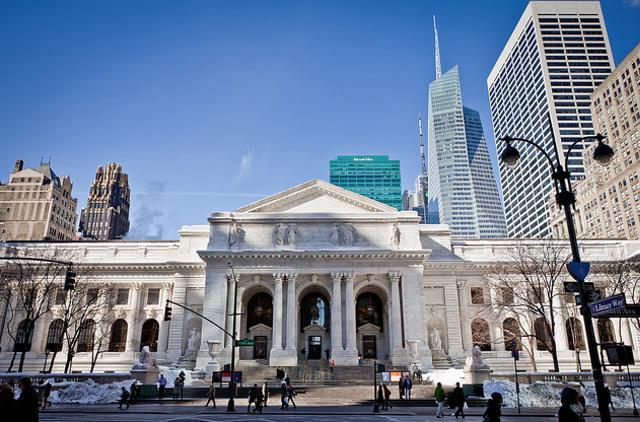
via gothamist.com
The Public Library is the cornerstone of a vibrant intellectual life of this republic. Public institutions are essential to our civic life. The Civil Service Worker is an indispensable part of our lives,made richer by their presence and their commitment to service.
Posted in Uncategorized
Leave a comment
The Great Will, Rick Santorum and the Birth of the Myth of the Relentless Ethicist
http://www.washingtonpost.com/wp-dyn/content/article/2011/02/02/AR2011020205042.html
The Great Will (TGW) adopts the rhetorical guise of reportage in his extended and seemingly unapologetic press release for candidate Rick Santorum: titled ‘Rick Santorum’s appeal to the GOP base’. The obvious question for a political cynic like me presents itself as: is TGW on the payroll? Given his history with Ronald Reagan as candidate and President that is a legitimate question. But here is the piece de resistance of this relentless hagiography:
‘Santorum does not ignore economic issues, but as a relentless ethicist, he recasts those as moral issues: "What is European socialism but modern-day monarchy that 'takes care' of the people?" He is, of course, correct that America's debt crisis is, at bottom, symptomatic of a failure of self-control, a fundamental moral failing.’
TGW, as one of the most prominent of America’s Fake Political Moralists, he cannot resist the political opportunity to lecture his vast audience on their ‘fallen state’, his perennial subject. Yet we cannot resist pointing at the many failings of Political Conservatism and its economic corollary ‘Free Market Economics’ as demonstrably vacuous, in terms of anything but a corrupt, self- promoting burlesque of the Social Darwinism of Herbert Spencer.
Posted in Uncategorized
Leave a comment
Chomsky: Why the Mideast Turmoil Is a Direct Threat to the American Empire | | AlterNet
February 3, 2011 |
LIKE THIS ARTICLE ?Join our mailing list:Sign up to stay up to date on the latest headlines via email.
In recent weeks, popular uprisings in the Arab world have led to the ouster of Tunisian dictator Zine El Abidine Ben Ali, the imminent end of Egyptian President Hosni Mubarak’s regime, a new Jordanian government, and a pledge by Yemen’s longtime dictator to leave office at the end of his term. We speak to MIT Professor Noam Chomsky about what this means for the future of the Middle East and U.S. foreign policy in the region. When asked about President Obama’s remarks last night on Mubarak, Chomsky said: “Obama very carefully didn’t say anything… He’s doing what U.S. leaders regularly do. As I said, there is a playbook: whenever a favored dictator is in trouble, try to sustain him, hold on; if at some point it becomes impossible, switch sides.” We continued the interview with Chomsky for 50 minutes after the live show. Continue reading
Posted in Uncategorized
Leave a comment

 StephenKMackSD's Blog