Here is my commentary on Mr. Bromwich’s American Breakdown in 2018 in The London Review of Books :
The ‘insights’ of david.bromwich@yale.edu : a collection of quotes and commentary on his London Review of Books essay ‘American Breakdown’. Part One? By Political Observer (Revised)
Mr. Bromwich manages to avoid the current political hysteria ,or simply to mute it, therefore making it more palatable to the reader, than the Corporate Media hysterics.He even manages to shame these political actors, yet at the same moment to exercise a kind of restrained iteration of the current Party Line.
Much of the damage to US politics over the last two years has been done by the anti-Trump media themselves, with their mood of perpetual panic and their lack of imagination. But the uncanny gift of Trump is an infectious vulgarity, and with it comes the power to make his enemies act with nearly as little self-restraint as he does.
Mr. Bromwich’s Bill of Attainder includes Trump’s appointment of Scott Pruitt to the EPA, and his successor Andrew Wheeler both products of an utterly corrupt American Corporatism. Next in order of consideration is Iran, and the Wars of Empire: Afghanistan, Iraq, Syria, Libya, Somalia, all fully endorsed by the New Democrats, led by ‘tougher than any man in the room’ Mrs. Clinton. An utter inconvenience to Mr. Bromwich’s reserved indictment.
But the patient, indeed, doubtful reader of this writer’s judgement is taken aback by this deviation from the Party Line:
Russia remains the obsessional concern. Not wanting to restart the Cold War might seem one of the few good ideas attributable to Trump, no matter how he came by it, but the pride of the Democrats is invested in pushing him towards renewed conflict: stiffer sanctions, cyber implants, enhanced deployments and joint military exercises with Nato – nothing (it is said) should be ‘off the table’. American commentators lack even a minimal awareness of the circumstances of the eastward push of Nato after 1990. President George H.W. Bush, in return for a united Germany, had promised that Nato would expand ‘not one inch eastward’; and the evacuation of this pledge in the years that followed, under Clinton, the younger Bush and Obama, has rightly been considered a betrayal by every Russian leader from Gorbachev to Putin.
History intrudes itself into a subject not mentioned, but the constant sub-text of the Anti-Trump coterie’s agitprop : The New Cold War fomented by Mrs. Clinton, her minions, and the perpetually bloodthirsty Neo-Conservatives, who have a continuing political romance with her jingoism, expressed by the notion of her ‘toughness’. History is again utterly inconvenient, Mr. Bromwich should be congratulated for this moment of clarifying honesty. A long quote from the virtuous martyred American political saint Lincoln adds more historical depth.
Next in order of appearance are political hysterics Senator Joe McCarthy and Congressman Adam Schiff. Then to Patrick Buchanan and his :
‘Many Putin actions we condemn were reactions to what we did. Russia annexed Crimea bloodlessly. But did not the US bomb Serbia for 78 days to force Belgrade to surrender her cradle province of Kosovo? How was that more moral than what Putin did in Crimea?’
By this quotation from Mr. Buchanan, identifies Mr. Bromwich as an Apostate to the current New Cold War Mythology!
Next in line are considerations of the Republican Party’s ‘collaboration’ with Trump and the utterly preposterous , but self-congratulatory notion of the ‘Resistance’. Recall the quote from Goya: ‘The sleep of reason brings forth monsters’ !
Mr. Bromwich then opines that:
Police, for the most part, haven’t yet shown a pro-Trump disposition, and Democrats should want to keep things that way. Among officers of law enforcement at all levels, Trump’s role as an instigator of popular disorders is the strongest point against him.
The years 2016 and 2017 have escaped the political memory of Mr. Bromwich, in which 2600, mostly black people, were murdered by police in America, without one conviction in a court of law. The Police have already rendered a verdict. The ‘Broken Widows Policy’ of the Manhattan Institute, has evolved into a siege mentality- the domestic corollary of the War on Terror. A bourgeois pundit like Mr. Bromwich dare not go that far in his Apostasy.
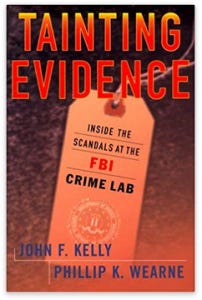
The first part of Mr. Bromwich’s ends with the ‘Democrats’ and the feckless dullard Comey, playing a new role as FBI Hero, straight out of the manufactured lore of movies,radio and television propaganda, spanning generations. The scandal of the FBI Crime Laboratory remains unmentioned in Mr. Bromwich commentary:
See John F. Kelly author of Tainting Evidence : Behind the Scandals at the FBI Crime Lab on C-Span address here of July 10, 1998:
….
Reflections on the New Encampment Culture
There were many puzzling features of the recent protests. This coming year, universities must course correct—while protecting the right to dissent.
I had better now make my position clear to avoid a misunderstanding. In April and May, and earlier for that matter, I would have supported a campus teach-in, or better, a campus-originated march on the White House or the Pentagon to demand an immediate Israeli cessation of bombing and to press for the negotiation of a ceasefire, under threat of withdrawal of American support. It took a very few days, however, for the protests to face in an altogether different direction: what began as an anti-war protest had turned anti-Israel, without regard to peace or war, and it seemed clear that, for some people, the Palestinian flag had taken on a new meaning, including the erasure of Israel from the map.
It had become unclear anyway—in strictly political terms—by what logic the universities were the most effectual staging ground for a protest. Yet the encampments, the slogans they chanted, and the symbols they asked to be known by, all seemed a natural expression of the politics that has come in the public mind to represent the universities.
The long-term consequences of the specialization of campus politics have been unhappy for American society generally. Political complexity of mind is rare among students, but the same students will go on to be full-time citizens. Some of the fault is traceable to university administrators: their political position-taking, after recent elections and supreme court decisions and certain shocking local or national events, has seemed to define the boundaries of polite opinion. Such public statements are now being pulled back, with recent moves toward “institutional neutrality,” and that is a good thing. The idea that universities, as if they were a person, should carve out an official stance on social and political issues of the day is a recent innovation; it has had a fair trial and been found useful mainly as an instrument of social control and conformity—neither of which qualifies as an educational value.
…
Two telling political/moral questions present themselves in Mr. Bromwich’ s long essay: that he is ‘The Voice of Reason’ and that somehow Jewish Students are not subject to the ‘Call of Tribalism’, or that Jewish Vagilities didn’t attacked UCLA student with impunity!
Mr. Bromwich is a ‘Liberal’, this political creature long, left behind in an American Politics dominated by New Democrats, Republicans, Neo-Conservatives , all held together by AIPAC money!
A wrong lesson has been learned from an airbrushed memory of the 1960s. The antiwar protests of that time may have begun in college teach-ins, but they went on to organized marches in big cities. Disrupting the universities became part of the program only in a later and decadent phase; and even as the narrowest of tactics, it never made sense. The truth is that “shut-it-down” campus protests were the path of least resistance, the method closest to home, but they pushed against the necessary ethic of a university because they involved an element of coercion.
The implication for the present moment is clear. On no account should students or their faculty supporters be allowed to prevent the speech or disrupt the intellectual work of any member of a university. If students opt out of attending classes, or otherwise fail to satisfy academic expectations, the normal penalties should apply. Meanwhile, of course, the right to dissent has as natural a home in a university as it does in a free society more broadly.
Lets hear from that original ‘60’s’ Radical Mario Savio: I watched this on the ‘Evening News’ of the time!
Editor: Mr. Brooks column of Sept. 25, 2025 provides a‘Political Theology’, in five paragraphs! I’ve placed in italics some of the key points, of this excerpt. Charlie Kirk was a Zionist Apologist, in sum a Fellow Traveler, whose political evolution toward Catholicism, was an unhappy fact to his Zionist Pay Masters, according to his close friend Candace Owens!
…
The problem is that politics is prosaic. Deliberation and negotiation work best in a mood of moderation and equipoise. If you want to practice politics in the mood best suited for the altar call, you’re going to practice politics in a way that sends prudence out the window.
Fourth, a destructive kind of syncretism prevails. Syncretism is an ancient religious problem. It occurs when believers try to merge different kinds of faith. These days, it’s faith in Jesus and the faith in MAGA all cocktailed together. Syncretism politicizes and degrades faith and totalizes politics.
Fifth, it kicks up a lot of hypocrisy. It’s nice to hear Carlson say he practices a religion of love, harmony and peace, but is that actually the way he lives his life?
Finally, it causes people to underestimate the power of sin. The civil rights movement had a well-crafted theory of the relationship between religion and politics. The movement’s theology taught its members that they were themselves sinful and that they had to put restraints on their political action in order to guard against the sins of hatred, self-righteousness and the love of power. Without any such theory, MAGA imposes no restraints, and sin roams free.
The critics of Christian nationalism sometimes argue that it is a political movement using the language and symbols of religion in order to win elections. But the events of the past week have proved that this is a genuinely religious movement and Charlie Kirk was a genuinely religious man. The problem is that unrestrained faith and unrestrained partisanship are an incredibly combustible mixture. I am one of those who fear that the powerful emotions kicked up by the martyrdom of Kirk will lead many Republicans to conclude that their opponents are irredeemably evil and that anything that causes them suffering is permissible. It’s possible for faithful people to wander a long way from the cross
Editor: The final Brooks puerile pronouncement should not surprise!
It’s possible for faithful people to wander a long way from the cross.
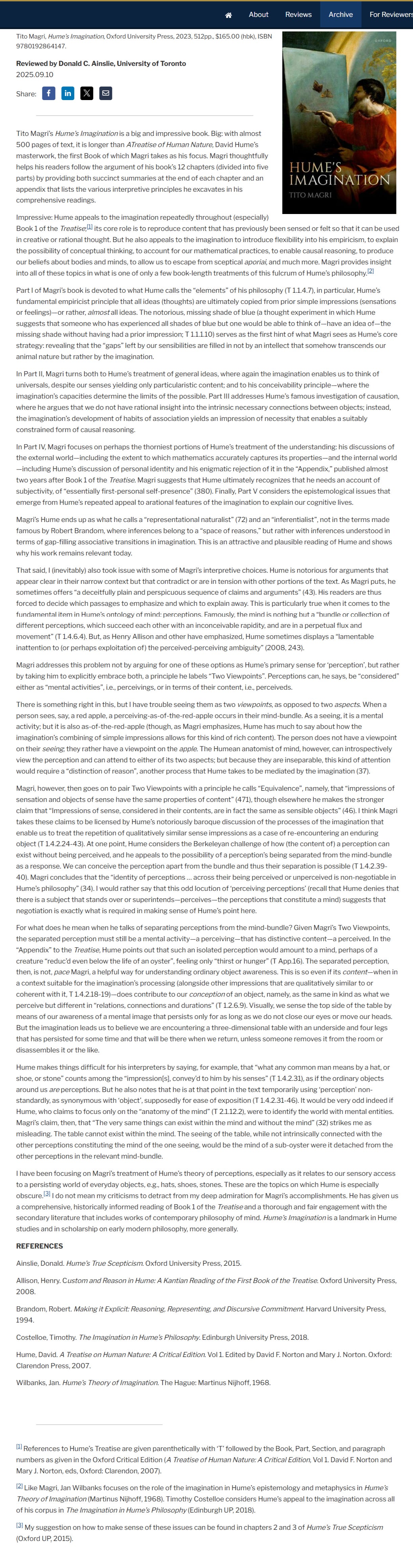
Hume’s Imagination Tito Magri, Hume’s Imagination, Oxford University Press, 2023, 512pp., $165.00 (hbk), ISBN 9780192864147. Reviewed by Donald C. Ainslie, University of Toronto,
Editor: A very short quotation from Bret Stephens latest exercise of free imaginative variation, of September 23, 2025 in The New York Times:
…
It’s a cliché, but can’t be said enough, that speech is genuinely free only when it’s speech we like the least from those we dislike the most. Rosa Luxemburg put it well: “Freedom is always and exclusively freedom for the one who thinks differently.”
Shana tova.
(Hebrew. Used as a greeting during Rosh Hashanah and the Days of Awe; or shana tova (שָׁנָה טוֹבָה), “a good year”, or shana tova umetuqa (שָׁנָה טוֹבָה וּמְתוּקָה) “a good and sweet year”)
…
Editor: The very notion that Zionist Political Shill Bret Stephens would quote Rosa Luxemburg, makes this reader cringe!
Editor: Greg Lukianoff is co-author, with Jonathan Haidt, of “The Coddling of the American Mind: How Good Intentions and Bad Ideas Are Setting Up a Generation for Failure.” These political hacks, moderled themselves after Mr. Bloom’s hysterical book, “The Closing of the American Mind,” (Simon & Schuster, 1987). As a way to make their book ‘The Coddling’ appear as the sucessor of Bloom’s 1987 diatribe, that seemed the perfect cap-stone the waning Reagan Years?
Editor: From Mr. Bloom’s New York Times obituary:
Allan Bloom, the professor of political philosophy whose book on American universities became a best-selling text for conservative attacks on contemporary intellectual life, died yesterday at the University of Chicago’s Bernard Mitchell Hospital.
Mr. Bloom, 62 years old, died of peptic ulcer bleeding complicated by liver failure, said a spokesman at the University of Chicago, where Mr. Bloom had taught since 1979. He had been hospitalized for several weeks.
The publication of Mr. Bloom’s book, “The Closing of the American Mind,” (Simon & Schuster, 1987) transformed him from an obscure professor, little known outside the University of Chicago, to a cranky icon of conservative views about education, music, morals and the values held by society.
The book — a long, sometimes dense account of two decades in higher education, as seen through his own experience teaching at Chicago, Cornell and Yale — attributed many university problems to administrators’ having acquiesced to student demands in the 1960’s and 1970’s. He criticized the passing of such traditional university ideas as the reliance on the so-called great books of Western culture, and lamented that even students at the nation’s most elite universities seemed to have “lost the practice of and the taste for reading.” ‘Essential Reading’
…
At first Mr. Bloom said he had trouble finding a publisher for the book because it was considered stuffy and he was relatively unknown. But it came out just when tuition at private universities was soaring and questions about the value of education were mounting, and it resonated with American readers. It was No. 1 on The New York Times’ best-seller list for 10 weeks and has sold more than one million copies in the United States.
The book’s success surprised Mr. Bloom as much as it did everyone else.
“Sometimes I can’t believe it,” he told a reporter in 1988. “It’s fun being No. 1 on the best-seller list. It’s like being declared Cary Grant, or a rock star. All this energy passing through you. . . . “
But the book’s belligerent tone made Mr. Bloom a target of considerable criticism himself. His philosophical opponents questioned his scholarship and denounced him as rigid, sexist, elitist and anti-democratic. David Rieff, a senior editor at Farrar, Straus & Giroux, called Mr. Bloom vengeful, reactionary and an academic version of Lieut. Col. Oliver L. North. He said “The Closing of the American Mind” was a book “decent people would be ashamed of having written.”
…
Saul Bellow wrote his Novel ‘Ravelstein’ that featured the fact that ‘Ravelstein’ was gay!
Editor: Mr. Greg Lukianoff on ‘Hate Speech’ consonate with Critical Race Theory?
…
Or consider hate speech. The concept was developed in the 1980s by leftist legal scholars like Richard Delgado and Mari Matsuda, and it shaped the campus speech codes and so-called political correctness of the 1990s. Intellectuals on the right were quick to contest the idea of hate speech — U.S. law does not recognize a general hate-speech exception to the First Amendment, and never has. Charlie Kirk rejected the idea of using hate speech rationales to crack down on free speech. Yet after Mr. Kirk’s assassination, Republicans rushed to promise crackdowns on hateful expression, deploying the same concept.
…
Editor: Reader self-emamcipate from New York Times political chatter!
Fundamentally, both Fukuyama and Trump want the us to keep winning. However, Fukuyama predicates this on a ‘global fight’ for liberal-democratic principles, while understating the costs of such commitments. He epitomizes the ‘globalism’ that maga vilifies: spending American resources on state-building programmes to promote the spread of liberal democracy and sustain the us-led system; pressuring nations still ‘caught in history’ to move towards its specified end. Yet this hegemonic commitment has required formidable material underpinnings—and these are now starting to erode.
The scale of us sovereign debt provides an indication of the crisis. By 2024, federal debt had reached $34.5 trillion, or 125 per cent of gdp, and interest payments on it are running at $1 trillion per year, surpassing discretionary defence spending and approaching Social Security outlays. Persistently high interest rates create a debt-snowball effect and diminish capacities for crisis response. Unprecedentedly, the us Treasury Secretary has had to reassure the markets about the creditworthiness of fresh us government debt.footnote35 Ultimately, however, this depends upon the capacity of a robust real economy to serve as a tax base. Although nominal us gdp figures continue to rise, its real economy encompasses a hollowed-out manufacturing sector, crumbling infrastructure and declining consumer-spending power. The us faces intensifying competition as developing countries move up the value chain, challenging high-end sectors such as semiconductors and ai. Meanwhile, the overall decline of heavy industry has potentially grave implications for us military capability, which ultimately depends on the American shipbuilding industry to update the us Navy’s fleet and on Boeing’s production capacity for the us Air Force.
Trump’s policies—however crude—respond to a real problem of hegemonic overextension. Trump’s attacks on ‘globalism’ seem exaggerated, but they may reflect the fact that the us no longer has the economic capacity to sustain a global hegemonic system at any price. At some point a certain degree of strategic retrenchment will be inevitable, with the us choosing to act in certain areas, on certain issues, and refraining from doing so in others—reducing support for Ukraine and demanding that the Europeans step up, while extracting a quid-pro-quo mineral agreement from Kyiv, for example. Trump’s tweets about annexing Greenland, not to mention Canada and the Panama Canal, were widely derided. Yet there may be a coherent calculation of national interest behind his ‘neo-Monroe Doctrine’, based on consolidating America’s status as a hegemon over its three neighbouring oceans, thereby laying the groundwork for a reconfiguration of America’s hegemonic modality.
Trump’s mission of industrial rejuvenation constitutes a formidable challenge. The path to it—the tariff-based strategy to coerce trade-deficit reductions and manufacturing repatriation—remains obscured by systemic contradictions. It is predicated on three assumptions: first, that exporting nations cannot overcome their dependence on us markets; second, that American consumers will tolerate inflationary pressure; third, that domestic capacities—not least: skilled engineers—will be able to sustain manufacturing resurgence and supply-chain reintegration. China’s refusal to capitulate to Trump’s tariff demands demonstrated the asymmetry of the relationship—American reliance on Chinese goods exceeding Chinese dependency on American markets. Federal incentives may attract initial manufacturing investment, but systemic impediments—policy volatility, fragmented industrial eco-systems, chronic shortages of skilled and assembly-line labour—persist. The us government cannot pledge to subsidize the huge increase in payroll costs that real reshoring would entail. In any case, despite Trumpism’s protectionist tendencies, there is no real alternative to neo-liberalism on offer. The Big Beautiful Bill leads with tax cuts for the rich. Trump is neither willing nor able to challenge the mechanisms of wealth distribution in the us.
Fukuyama’s indignation at Trump’s consolidation of power by undermining key ‘rule of law’ norms—judicial independence, press freedom, civil liberties—fails to address Trumpism’s deeper problem for his paradigm.footnote36 For Trump has succeeded in shaking up America’s rigid political institutions, strengthening executive power and breaking the gridlock that plagued Clinton, Obama, Bush and Biden. But he has done so by deepening the system’s patrimonial tendencies, through his own highly unconventional political behaviour and his family’s blatant profiteering. Moreover, while weakening—indeed, assailing—the norms of liberal-democratic rule, Fukuyama’s second pillar, at home and abroad, he has arguably been more responsive to popular pressure, the third pillar, than recent Democratic Administrations.
Trump has so far largely succeeded in aligning American foreign policy with the perceptions of those who feel they are losing from globalization. Through a sovereignty-centric redefinition of us interests, he has re-categorized previous assets of the American imperium like usaid as external impositions. Liberal-democratic international institutions, constructed over decades, have become dispensable burdens, unless delivering tangible benefits. Economic concessions extracted from traditional allies—forcibly rewriting their domestic spending plans—get reframed as ‘wins’. Trump’s ‘repatrimonialization’ of foreign policy, to use Fukuyama’s term, relies on the exaggeration of American advantage over other countries through one-man public diplomacy, conducted in highly personalist terms, through face-to-face talks or social media barrages.
Trumpism’s victory discourse operates as a permanent confrontation with America’s liberal-democratic status quo—rolling the dice, pocketing the ‘wins’ and shrugging off the losses. Its operational algorithm systematically amplifies marginal gains while obfuscating costs—whether inflationary impacts or systemic uncertainties. This selective victory narrative intertwines with an escalating personality cult. Trump functions as the nexus connecting all the factions of his fractious base: Republican traditionalists, tech-right ideologues, the maga movement. His persona thus becomes the symbolic banner for this inherently contradictory coalition, revealing how personality cults emerge not merely from individual grandiosity but from the inherent logic of populist politics.
Will Trump’s victory narrative eclipse Fukuyamian liberalism, or is it more likely that the latter will undergo some sort of resurgence? The unstated truth of the ‘end of history’ paradigm was that liberal democracy’s triumph relied upon the hard power of the us—crucial for imposing its Cold War victory—as much as its ideological attraction. Fukuyama’s teleology remains dependent upon us global primacy. Yet the price of its hegemonic architecture is becoming unsustainable, compelling structural transformation—with Trump as its provisional agent. Should Trump succeed in renewing the economic foundations of American hegemony while preserving its institutional structures, the notion of an Anglophone liberal-capitalist ‘end of history’ may take on a new lease of life.
Conversely, failure might raise the question of whether American hegemony can perpetuate its ‘winning’ status under either paradigm. Though facing real systemic challenges, Trump’s responses have been rash and hasty, constituting a high-stakes political gamble. The repatrimonialization of government has suggested unpredictability rather than strength. Its main message is that countries need to rely on themselves. In that sense, Trump’s wager may end by accelerating multi-polarization. If so, we may expect a proliferation of colourful victory narratives, as Trump inspires other nations to develop their own ‘winning’ brands. Amid the hubbub of voices, perhaps a discourse serving the working class will find room to grow.
Editor: I’m old enough to recall another time and place in America, and its celebrated lawyer Louis Nizer! His New York Time obituary of Nov. 11, 1994 is revelatory. I provide a sample of Eric Pace’s obituary!
He was born in London on Feb. 6, 1902, and brought to the United States as a child. Early in his life, as the son of the owner of a Brooklyn dry-cleaning establishment, he made his voice and name heard in his noisy new hometown. As a youth, he won a Government citation for his patriotic speeches during Liberty Loan drives in World War I. Fresh out of Columbia College, he twice won the Curtis Oratorical Prize at Columbia Law School, from which he graduated in 1924.
As a fledgling lawyer in 1925, he talked his way into the newspapers when he championed the interests of a group of Brooklyn merchants. It was in 1926 that he and Mr. Phillips set up a law partnership, which grew into the prestigious firm of Phillips, Nizer, Benjamin, Krim & Ballon.
A combination of qualities brought Mr. Nizer his vast success. He was exuberantly competitive: “I enjoy the clash of ideas,” he once said. On trans-Atlantic voyages in the 1930’s, for lack of other realms to conquer, he passed the time winning shipboard table tennis tournaments.
He strongly identified with his clients’ interests. He once wrote what he called “A Lawyer’s Prayer,” which began: “I would pray, O Lord, never to diminish my passion for a client’s cause, for from it springs the flame which leaps across the jury box and sets fire to the conviction of the jurors.”
He was a master at preparing and presenting legal arguments. He cut an earnest and authoritative figure, presenting arguments that were not memorized outright, but planned meticulously, during long hours at his office.
Much of what he spoke or wrote was garnished with sweeping declarations that would resound pleasingly in a high-ceilinged courtroom, even if they were actually composed, say, for a modest book review.
“Nowhere is the cupidity and nobility of man better demonstrated than in the judicial arena” was the sort of thing he was apt to say.
Mr. Nizer was also a master at bons mots about people. Presenting Sara Delano Roosevelt, Franklin D. Roosevelt’s mother, at a banquet, he said: “A beautiful young lady is an act of nature. A beautiful old lady is a work of art. I introduce you to a work of art.”
…
Editor: That Hillery Clinton is given to lying, to cover herself in an imagined political virtue, is indicative of her self-agradisemet. That anchors her toxic egoism, that flutiates as need arises!
Charlotte Bronte once wrote “I believe that creature is a changeling: she is a perfect cabinet of oddities.” No quote better captured the chilling curiosity that is Hillary Clinton. This week, Clinton (without any sign of shame or self-awareness) attacked others for seeking censorship and blacklisting political opponents through government and corporate collaboration. Clinton is one of the most anti-free speech figures in the United States and actively campaigned for the censorship of opponents. Today, my column in the Hill discusses the hypocrisy of many on the left this week after the suspension of late-night host Jimmy Kimmel. However, there is simply no one in the same class as Clinton in hitting hypocrisy’s rock bottom.
This week, Clinton declared: “I think this is a very clear example of using the power of the state to suppress speech. It is a direct government action to try to intimidate employers, organizations, corporations, much of which we’ve already seen, to remove an opponent, even though it’s a comic.”
For many in the free speech community, the statement led us to spit out our morning coffee.
Clinton and her allies have long shown contempt for the intelligence of the voters, often denying facts or flipping positions while denying any inconsistencies. It was a record that produced not only polling as one of the least popular American politicians but also record lows in the public’s view of trustworthiness and authenticity. Clinton’s campaign routinely lied about major issues, including denying to the media that it funded the infamous Steele dossier.
For the record, I have repeatedly criticized Administration statements from recently on free speech and some of the actions taken against critics as threatening to our core values of free speech. This has included threats to prosecute hate speech and flag burning despite countervailing precedent. However, the last person any of us in the free speech community wants to see in this fight is Hillary Clinton.
As I have previously written, Clinton heralded the growing anti-free speech movement and noted that “there are people who are championing it, but it’s been a long and difficult road to getting anything done.”
In my book, I discuss the challenge for anti-free speech champions like Clinton is that it is not easy to convince a free people to give up their freedom.
There has to be some lingering residue of shame left; some modicum of decency in refraining from such raw hypocrisy at these moments. Yet, we seem to be living in an era of post-shame politics. The only thing missing is lawyer Joseph Welch.
Editor: That Kier Starmer has ever represented anything other than political oppotunism and its twin utter mediocricy! That is the reason that Tony Blair chose him and his political catamite!
Editor: This first paragraph is a back-handed compliment to Starmers Handlers, and an attack on Corbyn, any surprise!
Keir Starmer knows the power of a wedge issue. When he was in Jeremy Corbyn’s shadow cabinet in 2018 he used Brexit to put himself between the then Labour leader and his supporters. “Nobody is ruling out Remain as an option,” he declared from the party conference platform in an ad-libbed remark that drew a standing ovation and enraged Corbyn’s team.
Editor: The Mass Murder by The Zionist Faschist State, of Palistinians had to reach such a toxic pitch, that even the toady’s of The Zionist Cadre had to do ‘something’ that mimicked ‘action’!
Now, before Labour assembles in Liverpool for conference this Sunday, Starmer is seeking to ensure he does not suffer the same fate. As he announced the UK’s decision to recognise Palestinian statehood, the Prime Minister spoke of a “moral responsibility to act” to keep the “hope of long-term peace alive”. But this was also a decision driven by politics. More than a third of the cabinet, including David Lammy, Yvette Cooper (now Foreign Secretary), Shabana Mahmood and Ed Miliband, privately pushed for recognition and over 130 Labour MPs signed a letter to Starmer demanding the same.
Recognition alone won’t satisfy the PM’s critics: expect Starmer to be challenged on whether he believes that what is unfolding in Gaza represents a genocide (the position now taken by Sadiq Khan and Ed Davey). But the decision represents a further toughening of the UK’s stance – ministers also point to the suspension of around 30 arms licences, the imposition of sanctions on two Israeli cabinet members, and the abandonment of trade talks with Israel.
are the Rachel Reeves and Angela Rayner scandles! All folded into the remainder of this wan defence of Starmer in 347 words.
It isn’t only on the totemic issue of the Middle East that Starmer has acted. Last week, the long-promised Hillsborough law was introduced to parliament, meaning that public officials who cover up state-related disasters will face up to two years in prison. For Starmer, who greeted four Hillsborough family members outside No 10, this is a highly personal cause: an example of what he means by putting government “on the side of working people”.
But again, politics is in the mix. In July Andy Burnham warned that parts of Whitehall were “fighting hard to preserve the status quo” after an initial deadline for the bill of 15 April was missed. Had Starmer failed to deliver by the time Labour reached Liverpool – the city where the Sun is still boycotted over the Hillsborough disaster – outrage from Burnham and others would have ensued.
Then there’s the Employment Rights Bill. There was much talk of that being diluted after a reshuffle in which Peter Kyle took on the business brief while union allies such as Justin Madders were discarded. But Starmer has privately reassured MPs of his commitment to a bill that he believes is “good for workers, good for businesses and good for the economy” (with the government duly voting down House of Lords amendments). Once again, a potential conference flashpoint – this time with union general secretaries – has been averted.
Tensions endure: a motion submitted by Mainstream, the new soft-left group, backing the abolition of the two-child benefit cap has been barred from debate. But even here, the government is giving ground. At the weekend, Bridget Phillipson, Starmer’s preferred candidate for Labour’s deputy leadership race, declared that the policy was “spiteful”, adding that its abolition was “on the table”.
There’s a clear pattern here: a Prime Minister who often found himself on the wrong side of his party in his first year – over winter fuel payments, welfare cuts and his “Island of strangers” speech (eventually U-turning on all three) – is determined not to do so again. As rivals circle, Starmer is prepared to show Labour a little more love.


 StephenKMackSD's Blog