In a House Of Commons debate about the appointment of Peter Mandelson, SNP MP Stephen Flynn made his feelings clear regarding Prime Minister Sir Keir Starmer and his handling of the Jeffrey Epstein saga. …
Editor: The first two paragraphs of this execise, in a bubious approximation, of the intellectual giant Bagehot?
In retrospect, the signs were there. In February 2025 Peter Mandelson was asked by the Financial Times about his relationship with the deceased sex offender Jeffrey Epstein. The soon-to-be British ambassador to America offered a forthright response. “I’m not going to go into this. It’s an FT obsession and frankly you can all fuck off. OK?”
Exactly a year on, Lord Mandelson has gone, and Sir Keir Starmer’s government is embroiled in Britain’s worst political scandal of this century. The peer lost his job in September, after emails emerged in which he questioned Epstein’s conviction for procuring a minor. On January 30th another tranche of emails revealed an intimate relationship. Lord Mandelson and Epstein giggled about strippers and joked about “a well hung young man”, in between discussing multi-million-dollar jobs post-politics and casually leaking confidential government documents. A political embarrassment has become a criminal investigation. Lord Mandelson’s behaviour raises depressing questions about the past but a more intriguing one about the present. What is the point of Sir Keir staying in office?
Editor: Let me engage in a bit of self-serving prestidigitation! The Reader might even conjecture, that I follow the well worn a pastisch of what an ‘actual Bagehot’ might opine?
…
“Keir’s not driving the train. He thinks he’s driving the train, but we’ve sat him at the front of the DLR,” a driverless train in east London, which has a pretend control panel for the enjoyment of toddlers. Somehow the Starmer train has still crashed.
…
To add insult, former ministers shuffled to the backbenches last year were surprised to learn that Lord Mandelson had offered advice on the reshuffle, in between canapés at the White House. It is one thing to lose your job; it is another to do so at the behest of a man who will go down as a 21st-century John Profumo, a Tory minister whose exit because of sex, lies and spies became the benchmark for government-crushing scandal.
…
Sir Keir’s failings on Lord Mandelson were common across parts of the Labour Party, which could never resist the charms and talents of the former minister, despite his flaws. More gifted politicians than Sir Keir have fallen prey to them.
…
In a rare bout of clear-eyed analysis, Sir Keir saw the damage being done by the Mandelson scandal. He warned his cabinet that “the public don’t really see individuals in this scandal, they see politicians.” For all the prime minister’s failings, he understands the seriousness of the moment, even if he does not himself possess the means to meet it. Sir Keir is correct that the shamelessness personified by Lord Mandelson is a fatal poison for the body politic. But if he truly believed what he said, he too would go.
Editor: The Reader of this essay might even come to the unwelcome conclusion, that David Cameron, Theresa May, Boris Johnson, Liz Truss, Rishi Sunak and Kier Starmer represent the utter failure of the whole British Political Class! How telling that Jeremy Corbyn was/is a possible represetative of a politics of reliability, and steadfastness, that even the shade of Bagehot might have found …?
Editor: The regular reader of @NYT recalls the acent of David Brooks to the New York Times cadre of Zionist apologists, via his war mongering ‘The Collapse of the Dream Palaces’! But who can forget the New York Times’ Bret Stephens toxic essay March 21,2023 ? The Final paragraphs of Stephens war mongering chatter is instructive of the perpetual mendacity of the Straussian!
20 Years On, I Don’t Regret Supporting the Iraq War
March 21, 2023
…
Then there was the argument that we could have contained Hussein indefinitely through sanctions and other means. Maybe in theory, but not in practice. The human misery caused by the sanctions against Iraq had become a fervent global cause by the late 1990s. They were internationally unsustainable. They were also easily flouted for the regime’s benefit, as the U.N.’s oil-for-food scandal laid bare.
Ultimately, the choice for the United States and our allies in early 2003 wasn’t invasion or containment. It was invasion or, over time, the quasi-rehabilitation of Hussein’s Iraq. This was a Hussein that, as the Duelfer report on Iraq’s W.M.D. noted in 2004, “wanted to recreate Iraq’s W.M.D. capability — which was essentially destroyed after 1991 — after sanctions were removed and Iraq’s economy stabilized.”
Finally, there is the argument that George W. Bush and his administration lied about the intelligence. I think they sincerely believed the (mis)judgments of the C.I.A., which, as the bipartisan Robb-Silberman report concluded, sincerely believed in them itself. “The intelligence community was dead wrong in almost all of its prewar judgments about Iraq’s weapons of mass destruction,” the report noted. But it “was what they believed.” The consequences of this confusion are dangerous.
Critics of the war now make the point that the intelligence fiasco wrecked America’s credibility. It’s true. But no less damaging was the never-ending “Bush lied” charge that, 10 years later, morphed into the “Obama lied” charge when it came to Bashar al-Assad’s use of chemical weapons in Syria or the suggestion that President Biden is lying about last year’s sabotage of the Nordstream pipeline. One conspiracy theory tends to beget another, in ways that are destructive to all sides.
Readers will want to know whether, knowing what I know now, I would still have supported the decision to invade. Not for the reasons givenErnst Jünger at the time. Not in the way we did it. But on the baseline question of whether Iraq, the Middle East and the world are better off for having gotten rid of a dangerous tyrant, my answer remains yes.
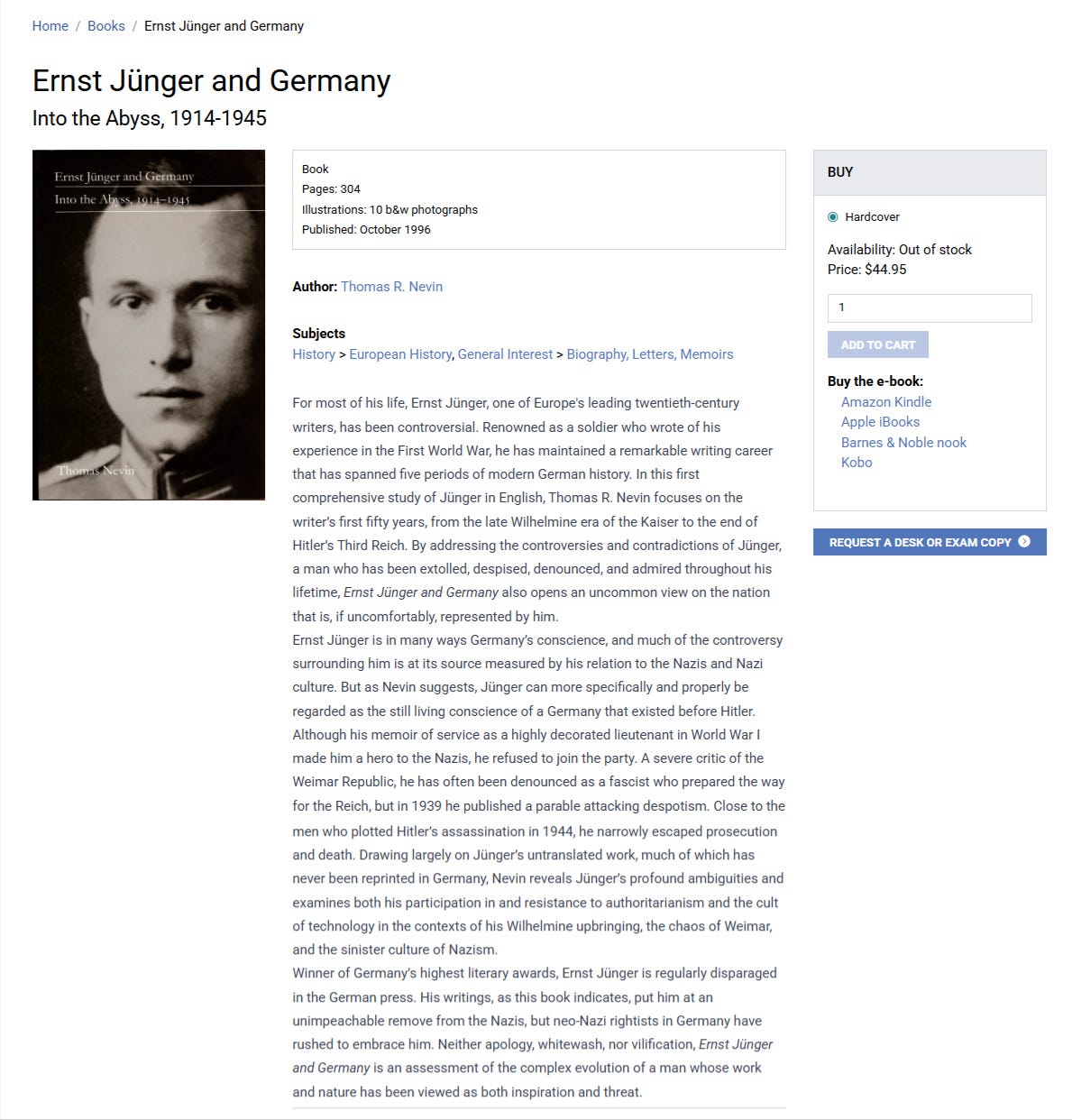
Editor: Mr. Stephens is the etiolated version of Ernst Jünger? Thomas R. Nevin book provides vauable insights into Ernst Jünger!
Gavin Newsom has a memoir coming out this month, “Young Man in a Hurry” — another heavy hint that he intends to run for the Democratic Party’s presidential nomination. To judge by some of the more fawning media profiles (Vogue describes him as “lithe, ardent, energetic, a glimmer of optimism in his eye; Kennedy-esque”), he’s practically already won.
Democrats should be careful whom they crush on. Newsom’s record as governor of California is a Republican strategist’s perfect foil. Among the more salient points:
Editor: Stephens does not wastes valuable time with his wan introduction before the Main Event: Stephens self-presentation as an critic of Newsom’s record of political incompetence, yet the fact that Stephens is a Straussian of a kind, the ‘as if’ at play here is that the reader suffers from the same self-serving political mendacity that afflicts Stephens? The Reader need only look at this L.A. Times essay of September 7, 2018:
How eight elite San Francisco families funded Gavin Newsom’s political ascent
Gavin Newsom wasn’t born rich, but he was born connected — and those alliances have paid handsome dividends throughout his career.
A coterie of San Francisco’s wealthiest families has backed him at every step of his political rise, which in November could lead next to his election as governor of California.
San Francisco society’s “first families” — whose names grace museum galleries, charity ball invitations and hospital wards — settled on Newsom, 50, as their favored candidate two decades ago, said Willie Brown, former state Assembly speaker and former mayor of the city.
“He came from their world, and that’s why they embraced him without hesitancy and over and above everybody else,” said Brown, who is a mentor to Newsom. “They didn’t need to interview him. They knew what he stood for.”
A Times review of campaign finance records identified eight of San Francisco’s best-known families as being among Newsom’s most loyal and long-term contributors. Among those patrons are the Gettys, the Pritzkers and the Fishers, whose families made their respective fortunes in oil, hotels and fashion. They first backed him when he was a restaurateur and winery owner running for a seat on the San Francisco Board of Supervisors in 1998, and have continued their support through the governor’s race.
They are not Newsom’s largest donors: The families in total have given about $2 million of the $61 million that donors have contributed to his campaigns and independent committees backing those bids. But they gave while he was a relative unknown, providing crucial support to a political newcomer in the years before his campaign accounts piled high with cash from labor unions, Hollywood honchos, tech billionaires and donors up and down the state.
Now the families appear poised to see their investments pay off.
These donors are mostly liberal, inspired by Newsom’s history as an early supporter of progressive causes, including same-sex marriage as San Francisco mayor in 2004. But some are Republicans, including President Trump’s new ambassador to Austria, who are drawn by Newsom’s background as a small businessman.
The front-runner’s opponents have attacked him for his connections. During the primary, two of his Democratic rivals, Antonio Villaraigosa and John Chiang, painted Newsom as the beneficiary of wealth and privilege. John Cox, his GOP opponent in the November election, reiterated the theme in a new website titled “Fortunate $on.” And an independent expenditure committee supporting the Republican spent a quarter-million dollars late last month on an ad calling Newsom “a child of privilege, his path greased by family and political connections and billionaire patrons.”
Newsom, whose campaign did not respond to a request for comment on this article, has long been tied to San Francisco society.
His father, Bill, was a lifelong friend of Gordon Getty, the son of oil magnate J. Paul Getty — they attended high school together. Bill Newsom later managed the Getty family trust on behalf of Gordon, estimated by Forbes to be worth more than $2 billion in 2018. Bill Newsom was so close with the family that he helped deliver the ransom money after the 1973 kidnapping of J. Paul Getty’s grandson, John Paul Getty III.
Editor: Bret Stephens streches his Straussian Musculature ?
Affordability.
…
And in 16 California counties, including Los Angeles, San Francisco, San Diego and Alameda, a six-figure salary can still be deemed “low-income” for a family of three, according to the state’s housing department.
…
Poverty and income inequality.
California also has one of the country’s highest rates of income inequality: In 2022, the average income of the top 5 percent was nearly $600,000 higher than the average income of the bottom 20 percent.
…
Homelessness.
“California alone accounted for 44 percent of all individuals who experienced chronic homelessness in the country,” according to a 2024 report from the U.S. Department of Housing and Urban Development.
…
Flight.
Last year, the National Taxpayers Union Foundation found that another Californian leaves the state every minute and 44 seconds, the fastest rate in the nation.
…
Education.
Cal Matters found that while the state had increased “per pupil spending by 102 percent since 2013, reading comprehension has remained flat while math skills have dropped.”
…
Energy costs.
It also has to do with the regulatory burden Newsom has imposed on its energy suppliers, potentially leading to the loss of 20 percent of its refining capacity in a single year.
…
Crime.
Result: “Driven by larcenies, property crime jumped after Prop 47 compared to the nation and comparison states,” according to the Public Policy Institute of California. Newsom also opposed a 2024 ballot measure, Proposition 36, that reversed much of Prop 47. It passed anyway — with 68 percent of the vote.
…
Wokeness.
Newsom understands that Democrats’ obsession with progressive social justice causes, and the censorious spirit that goes with it, hurt the party in 2024, which is why he has gone out of his way to engage with right-wing influencers on his podcast, “This Is Gavin Newsom.”
…
Editor: Stephens Under the rubric of Political Kitch.
As the early swooning over Newsom suggests, some voters’ hearts are fluttering over the prospect of his candidacy. Democrats who take the 2028 stakes seriously should stick to just using their brains.
Headline: Starmer gives dossier to police on Peter Mandelson’s Epstein emails
Sub-headline: Prime minister has asked officials to press ahead with legislation to remove Mandelson from Lords as he faces investigation over leaked email allegations
Sir Keir Starmer has handed police a dossier about Lord Mandelson allegedly leaking highly sensitive information on the economy to Jeffrey Epstein.
On Tuesday morning the Cabinet Office sent the Metropolitan Police details about emails from the then-business secretary to the late paedophile financier.
Starmer told his cabinet that the alleged leaks were “disgraceful”, and has asked officials to draw up legislation to remove Mandelson’s peerage “as quickly as possible”. He added that Mandelson had “let his country down”. Legislation which will remove Mandelson’s peerage and titles is expected to be presented within the next few weeks.
A spokesman for the prime minister said an “initial review of the documents” found “likely market sensitive information around the 2008 crash” seems to have been passed on from Mandelson to Epstein.
Downing Street added that “only people operating in an official capacity had access to this information” and that “strict handling” procedures appeared to have been “compromised”.
The police have been sent an “initial assessment” of the emails contained in the Epstein files by the Cabinet Office, with officials giving their opinion that the rules around handling confidential information had been broken. This is designed to help police determine whether the threshold for the offence of misconduct in public office has been met.
Starmer said he was “not reassured that the totality of the information” about Mandelson and Epstein had “yet emerged”.
Scotland Yard is reviewing the allegations that Mandelson committed a criminal offence by leaking Downing Street emails and inside information to Epstein when he was business secretary.
Baroness Harman, a former Labour deputy leader, told BBC Radio 4’s Today programme that the government should push ahead with primary legislation to strip Mandelson of his peerage while reforming the Lords “concurrently”.
She said: “What Peter Mandelson has done is pass a stain over not just this government but over politics as a whole. I’m sure the government are in absolutely no doubt about the seriousness of it. It was in the manifesto. There was a proposal of reform of the Lords. In the meantime I think the prime minister could be advising the King to stop him being a privy counsellor.
“I also think he’s on leave of absence at the moment from the House of Lords having stepped out of the Lords to be our ambassador. It would be good for the Lords to pass a motion to say that he’s not to reapply to come back in.
“I think it could be done concurrently. It could be that under the current procedure the government bring in a bill to strip Peter Mandelson of his title of being a peer but at the same time the government bring in through the Lords changed processes to actually modernise the rules.”
The Liberal Democrats said that they would be prepared to work on a cross-party basis to pass a “simple” act of parliament to strip Mandelson of his peerage.
Karin Smyth, a health minister, told Times Radio: “We don’t have a majority in the Lords, which is why … it needs to be approached on a cross-party basis. Legislation on these sorts of matters actually gets quite complicated on the sort of criteria and the rules and how that’s done.”
Smyth said everyone was “learning and seeing shocking levels of emails” from Mandelson, who “was not forthcoming”.
Asked if it reflected poorly on Starmer, Smyth told Times Radio: “This is a shocking state of affairs. There’s absolutely no doubt about that. But at this time, a couple of years ago, Peter Mandelson was very active in all aspects of public life.”
Smyth also said the peer’s interview with The Times, in which he said he wanted to “reset”, showed he was not taking the allegations seriously. Smyth told Sky News it reminded her of “men that have been involved in similar sorts of behaviour” who “seem to not be able to recognise their own self”.
Harman said she had long believed Mandelson to be untrustworthy, but “could never have believed” he would leak information while a cabinet minister.
She said: “I was of the view that Peter Mandelson was untrustworthy from the 1990s, but he was appointed by Tony Blair, he was appointed by Gordon Brown, and appointed again by Sir Keir Starmer.
“But even I, who had a view that he was untrustworthy, I could never have believed that, Gordon Brown having appointed him to the cabinet, that he would sit in that cabinet and leak information whilst the government was struggling to protect the country from the global financial crisis.”
Brown, who was the subject of several of the leaks, said the information in the Epstein files was “shocking” and called for the government to investigate.
Downing Street earlier said it had asked the cabinet secretary to conduct a review of “all available information” about Mandelson’s contacts with Epstein during his time as a minister.
Mandelson has resigned from the Labour Party over the documents, which suggest he was paid $75,000 by Epstein. He said he had no recollection of the payment. Mandelson confirmed that his husband, Reinaldo Avila da Silva, was given $10,000 by Epstein to cover the cost of an osteopathy course.
In an exclusive interview with The Times after quitting Labour, Mandelson said: “The decision wasn’t easy but I feel better for it as I need to reset. I am a New Labour person and always will be wherever the current party situates itself. But I think I want a sea change. I want to be an outsider looking in and not the other way round.”
The documents appear to reveal the extent of Mandelson’s relationship with Epstein. In 2009, at the height of the financial crisis, they suggest he passed on a memo from Nick Butler, a senior adviser to Brown, which suggested the government should sell off assets to pay down debt incurred from bailing out Britain’s banks and also apparently discussed plans for potential tax cuts.
Epstein immediately responded “what salable [sic] assets”. The reply was land and property. Later that year Brown announced plans to sell £16 billion of assets including the Dartford Tunnel and Channel Tunnel Rail Link.
In another exchange it appears that Mandelson forwarded an email sent to Brown’s secret Downing Street email address by Baroness Vadera, one of his closest economic advisers and a minister. The memo exposed divisions at the top of government over the handling of the financial crisis.
In April 2010 Mandelson appears to have sent Epstein a note about a meeting between Alistair Darling, then the chancellor, and Larry Summers, who was then the US treasury secretary. The next day he sent details of a meeting between himself and Summers, including banking regulation.
Days before Labour was lost the 2010 election, Mandelson apparently confirmed details of a planned €500 billion bailout of the euro, telling Epstein it “Sd be announced tonight”.
He also seemed to give Epstein warning of Brown’s resignation as prime minister, claiming he had “finally got him to go” hours before the news became public. On Monday, Brown said he had written to the cabinet secretary last year asking him to investigate the “disclosure of confidential and market-sensitive information from the then business department”.
Butler, whose memo was seemingly passed to Epstein, said Mandelson was guilty of a “disgusting breach of trust” that was “presumably intended to give Epstein the chance to make money”.
Meanwhile the former US president Bill Clinton and his wife, Hillary, have also agreed to testify in person before Congress as part of its investigation into Epstein. They made an 11th-hour offer to appear before the oversight committee after the House prepared to vote to hold them in contempt.
For months, the Clintons had refused to testify, describing the subpoena by the committee’s Republican chairman as “invalid and legally unenforceable”.
Is Gavin Newsom running for President? “I’m not thinking about running, but it’s a path that I could see unfold,” he has said, offering a new twist on the tradition of pre-announcement coyness. Many political kibitzers consider Newsom to be the front-runner for the Democratic nomination—“an odd claim,” the New Yorker staff writer Nathan Heller points out in this week’s issue, “about a race in which nobody is yet running.”
Newsom, who leads the nation’s most populous and powerful state, continues to position himself in direct opposition to Donald Trump. To do so, he sometimes seems to borrow from Trump’s noisy tactics of self-presentation. Newsom is brash, confrontational, unrelenting. He gleefully baits the President on social media, weaponizing Trump’s own tactics against him. He recently helped lead California to pass Proposition 50, a sort of tit-for-tat legislative response to gerrymandering in Texas, a moment that galvanized Democrats nationally (and, conveniently, allowed Newsom to flex his coalition-building skills). His hope is to extend his appeal well beyond states as reliably blue as California. As the veteran Democratic Party operative James Carville told Heller, “Part of his selling will have to be, I can play in the middle of the country—I can play fresh water and I can play salt water.”
In this Profile, Heller provides a definitive portrait of Gavin Newsom. He explores Newsom’s upbringing (perhaps less humble than Newsom cares to admit) in the Bay Area and his dramatic rise in California politics. Heller charts how Newsom’s early battles with dyslexia still influence his working style today. (The Governor memorizes speeches rather than reading them, because he sees lines on a teleprompter “as a single image, like a Chinese character.”) His report is filled with fascinating details about Newsom’s character, his thinking, and his flaws. We learn a great deal about how he operates. The Governor reads a compendium of right-wing blogs every morning. He has nine thousand twenty-two contacts in his phone, “and is in touch with a startling number of them,” Heller writes. (“It’s like his focus group,” one former adviser said.) Newsom does not suffer from blandness. Reported over many months, Heller’s piece makes it plain that Newsom’s life and career is filled with personal drama, political confrontation, and raw ambition. He can, “at times,” Heller notes, “seem more like the Tom Cruise of politics, more successful than beloved.” But he is studying the recent past with care to make sure he optimizes his chances in 2028. As Heller writes, Newsom “dutifully records every explanation he hears for the Democrats’ losses in 2024 on a list that now runs to twenty-seven pages.”
Heller, who had deep access to Newsom and the people in his personal and political worlds, pulls off a difficult feat: he offers a fresh and useful perspective on a politician who has been around for a long time. At a moment when the nation’s focus is, rightfully, on the chaos sown by the current Administration, it’s a look at what might come next. Depending, of course, on whom you ask. Some in California are a little less coy about Newsom’s future. Willie Brown, a former mayor of San Francisco said, matter-of-factly, of Newsom’s Presidential aspirations, “I think he’s had that in mind from Day One.”
Newsom, for his part, likes to play it cool. “He tells people that, if his political career ended tomorrow, he would return to life in business, and what a mercy that would be,” Heller writes. “But the feint convinces almost no one.”
…
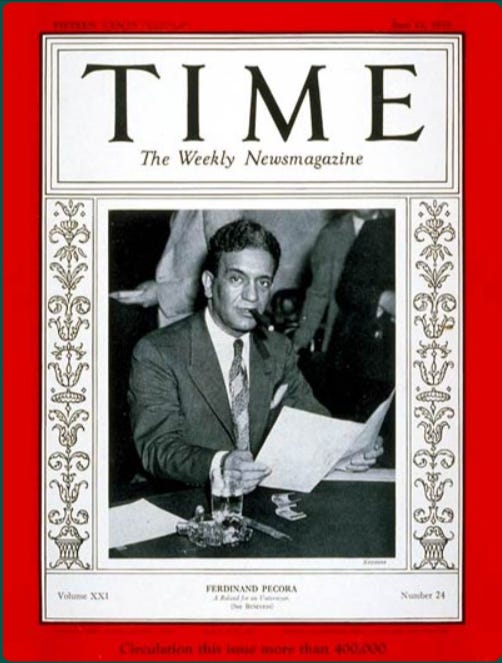
The New Democrats of a retooled and medatious Reaganism, whose betrayel of FDR & Ferdinand Pecora of Glass-Steagall Banking Act of 1933, is about the utter bankruptcy of a Political Party, that has become the toxic and self-aggrandizing twin of The Republicans!
Editor: In the face of Trump and Trumpism, in its various expressions of internal political moral/civic/intitutional collapse: what David Remnick offers what is not quite an introduction, that he manages to construct a kind of political melodrama, that he mines from Nathan Heller’s reportage!
Editor: the opening paragraphs of this diatribe the Econonist fellow traverls provide a sketch of what is to follow. The miscreants are named and shamed. In italics below, and the virtious in bold font! The Economist writer is attached to her self-regard, while ignoring the powerful figure of Adam Smith! And his The Theory of Moral Sentiments (1759) and his An Inquiry into the Nature and Causes of the Wealth of Nations (1776) that are equal in importance, to a possible intellectual rapprochement, that eludes the The Economists self-serving reductivist Intelectual History !
Liberalism is a broad church. In this series we have ranged from libertarians such as Robert Nozick to interventionists such as John Maynard Keynes. Small-government fundamentalists like Friedrich Hayek have rubbed shoulders with pragmatists such as John Stuart Mill.
But there are limits. Our last brief seeks to sharpen the definition of liberalism by setting it in opposition to a particular aspect of the thought of three anti-liberals: Jean-Jacques Rousseau, a superstar of the French Enlightenment; Karl Marx, a 19th-century German revolutionary communist; and Friedrich Nietzsche, 30 years Marx’s junior and one of philosophy’s great dissidents. Each has a vast and distinct universe of ideas. But all of them dismiss the liberal view of progress.
In this primer
Liberalism encompasses diverse views, from libertarians like Nozick to interventionists like Keynes. Yet it is opposed by thinkers like Rousseau, Marx and Nietzsche, who dismiss the liberal vision of progress.
Rousseau believed society corrupts natural goodness. Marx argued progress can be achieved not by inquiry and debate, but only through class struggle. And Nietzsche believed society was in moral collapse, and that people needed to rediscover their noble morality.
The illiberal view of progress has a terrible record. Robespierre invoked Rousseau. Stalin and Mao hailed Marx, and Hitler revered Nietzsche. Each showed the dangers of power concentrating in people who professed to have all the answers. Liberalism’s greatest strength may be that it does not have them.
Liberals believe that things tend to get better. Wealth grows, science deepens understanding, wisdom spreads and society improves. But liberals are not Pollyannas. They saw how the Enlightenment led to the upheaval of the French revolution and the murderous Terror that consumed it. Progress is always under threat.
And so liberals set out to define the conditions for progress to come about. They believe that argument and free speech establish good ideas and propagate them. They reject concentrations of power because dominant groups tend to abuse their privileges, oppressing others and subverting the common good. And they affirm individual dignity, which means that nobody, however certain they are, can force others to give up their beliefs.
In their different ways Rousseau, Marx and Nietzsche rejected all these ideas. Rousseau doubted that progress takes place at all. Marx thought progress is ordained, but that it is generated by class struggle and revolution. Nietzsche feared that society was descending into nihilism, but appealed to the heroic übermensch in each person as its saviour. Those coming after them did terrible things in their name.
…
Editor: In the final paragraphs of this essay, Nietzsche and his epigones take center stage. Name it political histeria mongering for the Economist reader to chew on! Via Sue Prideaux!
The will to power
Nietzsche sets out his view of progress in “On the Genealogy of Morality”, written in 1887, two years before he was struck down by insanity. In writing of extraordinary vitality, he describes how there was a time in human history when noble and powerful values, such as courage, pride and honour, had prevailed. But they had been supplanted during a “slave revolt in morality”, begun by the Jews and inherited by the Christians under the yoke of the Babylonians and later the Romans. Naturally, the slaves elevated everything low in themselves that contrasted with their masters’ nobility: “The miserable alone are the good…the suffering, deprived, sick, ugly are also the only pious, the only blessed…”.
The search for truth remained. But this has led ineluctably to atheism, “the awe-inspiring catastrophe of a 2,000-year discipline in truth, which in the end forbids itself the lie involved in belief in God.” “God is dead…” Nietzsche had written earlier. “And we have killed him.”
It takes courage to stare into the abyss but, in a life of pain and loneliness, courage was something Nietzsche never lacked. Sue Prideaux, in a new biography, explains how he tried desperately to warn the rationalists who had embraced atheism that the world could not sustain the Christian slave morality without its theology. Unable to comprehend suffering in terms of religious virtue or the carapace of virtue vacated by religion, humanity was doomed to sink into nihilism, in a bleak and meaningless existence.
Nietzsche’s solution is deeply subjective. Individuals must look within themselves to rediscover noble morality by becoming the übermensch prophesied in “Thus Spake Zarathustra”, Nietzsche’s most famous work. Characteristically, he is vague about who exactly an übermensch is. Napoleon counted as one; so did Johann Wolfgang von Goethe, the German writer and statesman. In his lucid survey of Nietzsche’s thought, Michael Tanner writes that the übermensch is the heroic soul eager to say Yes to anything, joy and sorrow alike.
Nietzsche is not susceptible to conventional criticism—because ideas pour out of him in a torrent of constantly evolving thought. But both left and right have found inspiration in his subjectivity; in linguistic game-playing as a philosophical method; and in how he merges truth, power and morality so that might is right and speech is itself an assertion of strength. He is father to the notion that you cannot divorce what is being said from who is saying it.
The illiberal view of progress has a terrible record. Maximilien Robespierre, architect of the Terror, invoked Rousseau; Joseph Stalin and Mao Zedong invoked Marx; and Adolf Hitler invoked Nietzsche.
Newspaper Reader offers these essay from January 18, 2026, on ‘The Cult of Reinhold Niebuhr’ wedded to the self-congratulation of an unapologetic New York Times War Monger!
David Brooks infatuation with Reinhold Niebuhr is equal to Brooks impersination of the very tallented Mario Buatta the Princed Chintz? With apologies to the very talented Mr. Buatta. Mr. Brooks does not write political commentary, but resorts to a feckless impersonation, of what actual political commetary might resemble, a pastisch of Walter Lippmann? Here are a selection of my comments on Neibuhr over time.
On The Theopolitics of Reinhold Niebuhr by Political Observer
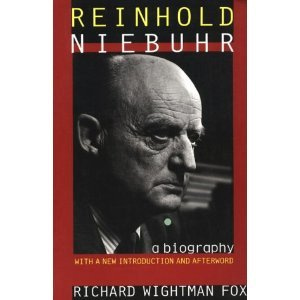
I’ve just finished a Reinhold Niebuhr biography by Richard Fox published in 1985. That I find Mr. Niebuhr repugnant as person and Christian Moralist is a statement of my prejudice, without apology. I felt that I wanted to understand who the man was and where he came from. Those questions are answered in some detail in Mr. Fox’s biography, although Mr. Fox seems to be satisfied with hagiography rather that critical engagement with Mr. Niebuhr as theopolitician. Niebuhr appears to be a religious and political conformist swept along from Socialism to Cold War Liberalism: always a little too anxious to prove his patriotism, his Americaness. Niebuhr has become the object of a cult headed by President Obama, perhaps because of the tough minded moralizing represented by Christian Realism: which could be more accurately named Christian Imperialism. It has something in common with the Protestant Christian Politics of Woodrow Wilson, with an emphasis on the necessary use of violence, to reach political ends deemed important enough to warrant it. In the name of the greater political good, even as necessary to emancipate, if only temporarily, man from his natural sinful and irredeemable self-hood. This cliché of the Christian Tradition reeks of the self-hating Augustine, and his successors, who institutionalized the persistent, morally destructive Christian anti-humanism. Imperial Politics with a thin veneer of carefully cultivated piety is an American tradition. I would call Niebuhr hopelessly Middlebrow: more about the care and maintenance of bourgeois political respectability and the self-exculpatory, as key to ex post facto rationalizations identified as ‘Philosophy’ . I was impressed, and moved by one person’s character in Mr. Fox’s biography of Reinhold, and that was the love, devotion and steadfastness of his brother Richard. Engaging with the ‘Philosophy’ of Mr. Niebuhr using the valuable historical frame provided by Mr. Fox will enrich my further reading.
Niebuhr’s reputation as a primary American Philosopher demonstrates with stunning clarity the paucity of intellectual standards in America. He was no Sartre, Heidegger nor was even comparable to William James. He was, in fact, a tent preacher with intellectual and moral pretension. As Richard Fox’s near worshipful biography points out, time after time, Niebuhr was a craven political and moral conformist: in his days in Chicago he opined that the working class shouldn’t give up violence as a methodology and that he was Marxient thinker. Those pronouncements came back to haunt him when J. Edgar Hoover was stalking him. The political result was Niebuhr’s letter denouncing ‘The Left’, not to speak of formation the ADA, with ‘Vital Center’ author Arthur Schlesinger, Jr. Protecting ‘Liberal Free Speech’ but throwing ‘The Left’ to the McCarthy/Nixon wolves and their political capo J.Edgar Hoover. Please read Schlesinger’s diary entries from the early 50’s, where he makes noises like ‘Big Jim McLain‘, the use of the word ‘commies’ is indicative of the political myopia demonstrated by sons, who edited his diaries for publication. Accurate history is more important than covering your old man’s ass! Those entries, read in the political present express both the comedy and menace of Schlesinger’s obsequious political conformity.
Niebuhr shared something in common with ‘friendly witness’ Elia Kazan: the rationalization that bound their separate careers was that they both thought that their ‘radical pasts’ should not interfere with their very important, indeed vital life mission. Kazan’s was making movies and Niebuhr’s was winning converts to ‘Christian Realism’ ,which was in sum a riff on ‘render unto Caesar’ and the central belief in ‘Inherent Evil’ of the human person. Institutional Christian Self-Hatred is Augustine’s self-loathing for being human writ large, and his later epigones.
The reader can see the why of President Obama’s admiration for this ersatz ‘American Philosopher’, both share a belief in, not just the imperfectability of the human person, but its inherent ‘Evil’, allied with a political/moral rhetoric that appeals to the aspirations of their respective audiences. Christian Realism advocates/embraces not just the idea of the saved and dammed in eschatological terms, but in terms of the Cold War ethos. That ethos has now been applied, by Obama, to the Age of The War on Terror, and the utterly catastrophic Neo-Liberal Theology, that has been operative since the Reagan era. Note that Obama never praised FDR, but was fulsome in his praise for Reagan.
Almost Marx
Here is an excerpt from Alice Bamford’s review of Amanda Anderson’s ‘Bleak Liberalism’ in the New Left Review of May/June 2017. Which places ‘Liberalism’ and its primary thinkers like Schlesinger and Niebuhr, among others, to an examination of their political mendacity: which looks like a utter betrayal of what that ‘Liberalism’ could have been. If only its thinkers/defenders had exercised something like dissent as a singular moral/political imperative of that very ‘Liberalism’. Is the Liberal thinker/actor even capable of such an act of moral imagination?
Yet while ostensibly offering a defence of ‘political liberalism’, Anderson’s case rests on a near total abstraction from politics as such. Despite the pivotal role played by their thought in her narrative, the record of Anderson’s chosen Cold War liberals is never examined. Clergyman Niebuhr approved the atomic obliteration of Hiroshima and Nagasaki, applauded the development of the H-bomb, and advocated the ethnic cleansing of Palestine. Schlesinger colluded with (and lied about) the us invasion of Cuba, backed Kennedy’s wars in Indochina and counselled Americans under Johnson that ‘we must hold the line in Vietnam’, even telling Defense Secretary Robert McNamara, architect of escalation under both presidents: ‘You have been one of the greatest public servants in American history, and your departure from the government is an incalculable loss to this nation.’ Aron never spoke out against the French occupation of Indochina, or torture in Algeria; Camus not only refused to condemn France’s Algerian war, but backed the Suez expedition against Egypt. Berlin witch-hunted Isaac Deutscher out of a job in the British academy. Such particulars of the past, however, are too mundane for reference on the nebulous plane at which the history of ideas enters Bleak Liberalism.
How can one dismiss the Christian Realism of Reinhold Niebuhr? Because his special brand of intellectually inflected political conformism fits so handily in this modern age of outright attacks on citizens, by their own government? Of drone attacks on civilian populations, argued by government agencies to be the locus of terrorist activities? Of preemptive war against states possessing weapons of mass destruction? That he is a Christian Theologian add luster to his varied career as political apologist for the Cold War and the National Security State. While some might even argue that he is the thinking man’s Billy Graham, with a more persuasive intellectual resume. With his ally Mr. Schlesinger singing his praises, as an intellectual leader, and with their creation of what was to be the ADA, a refuge of Liberals anxious to establish their credentials as anti-communists: freedom of political expression for right and left wing social democrats only! One need only read Mr. Schlesinger’s tedious and self-congratulatory diary entries of the period; with his penchant for the use of the word ‘commie’, to identify political dissidents of that benighted age in America.
As for Mr. Niebuhr’s status as political philosopher, he has an intellectual breadth and a seemly ever changing, evolving set of ideas tending toward conservatism as he aged. The addition of the fallen nature of ‘man’, the sine qua non of the Christian mythology, appealed to the deep stain of Puritanism still active in the American consciousness: the world historical battle between good and evil as background. He was a public intellectual with something to offer Liberal and Conservative thinkers, a kind of Cold War Pragmatist, perfect for our age of suspicion, our age of terror, peopled by intellectual pretenders of all stripes.
I find the public career of Mr. Andrew Sullivan puzzling, disappointing even infuriating. I started reading him when he was writing for The New York Observer and subsequently as he and Christopher Hitchens kept the debate of 9/11 within the bounds that they thought as reasonable, intellectually and politically acceptable, two stern enforcers of their continually evolving master ideas.
The two rhetorical policeman dismissing the charlatans who dared to express an opinion outside the the ken of these two intellectual capos. Vicious, dismissive and utterly ruthless to those they identified as unfit to comment on the most recent American Wound. Part of the collection of jingos and war mongers in the American intelligentsia that announced themselves in the subsequent day and weeks after the attacks on the World Trade Center.
Both became enthusiasts, celebrants of the Iraq War and just as quickly became disenchanted of their momentary celebration of the martial spirit, in the name of the honored dead and the need for retribution, even though their was no connection between the 9/11 perpetrators and Iraq, none.
That sorry, dismal, murderous folly is almost behind us or so Mr. Sullivan instructs us in his latest essay titled An End in Sight. He congratulates President Obama and, of course, himself in the process. But let me point to one telling paragraph:
“My view entirely. I’m struck too by his Niebuhrian grasp of the inherent tragedy of wielding power in an age of terror – a perspective his more jejune and purist critics simply fail to understand. This seems like a heart-felt expression of Christian realism to me:”
It is totally appropriate that Mr. Sullivan should frame his argument using the name of Niebuhr and his intellectual child ‘Christian Realism’ to add a certain theological/political gloss to his argument, that bit of cosmic melodrama that so appeals to his inflated sense of himself as a modern seer, prophet.
In that regard Mr. Niebuhr and Mr. Sullivan are kindred spirits in the celebration of God and the political realism, the Christian Realism that recognizes the importance of the state, as the indispensable political actor that can bring their respective religiously inflected politics into the realm of the actionable, the real. In a way, Mr. Sullivan and Mr. Niebuhr, in their respective personal and historical contexts, are acolytes of the dyad of state power/masculine power.
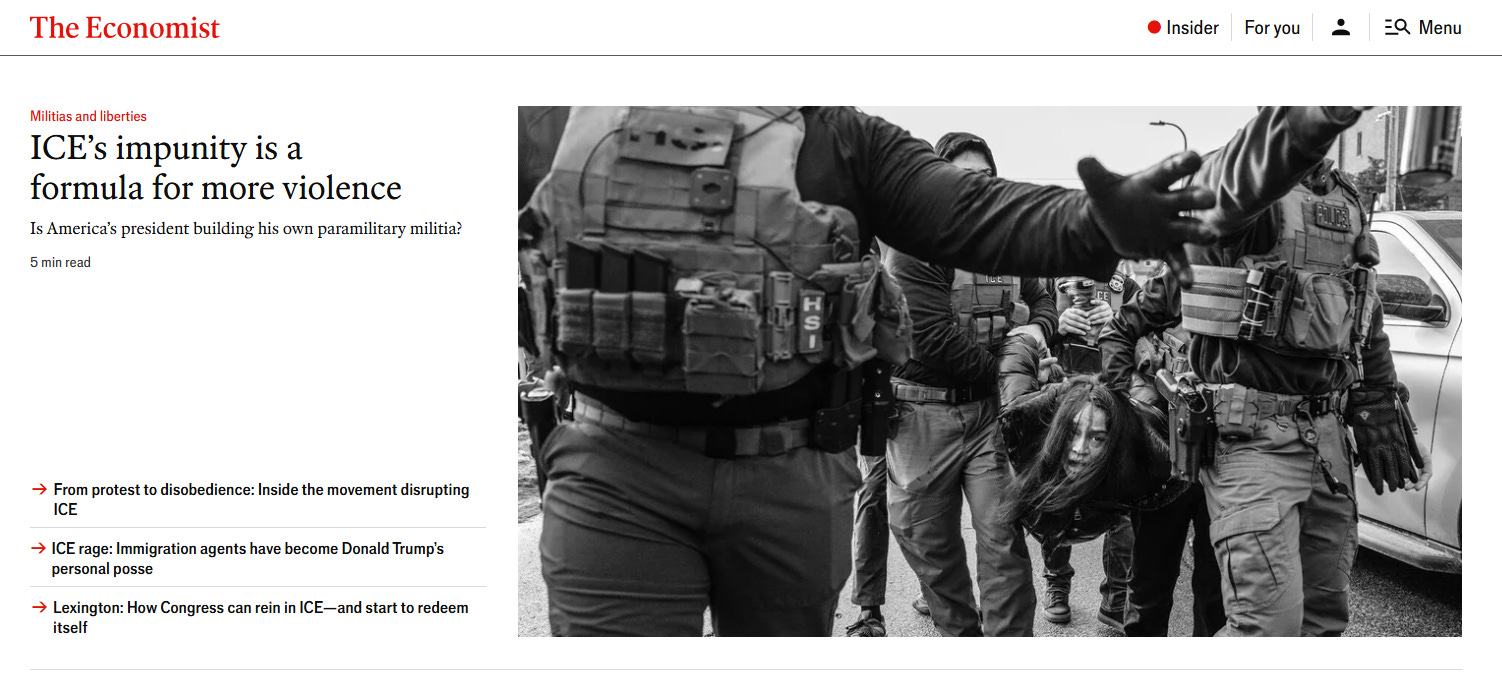
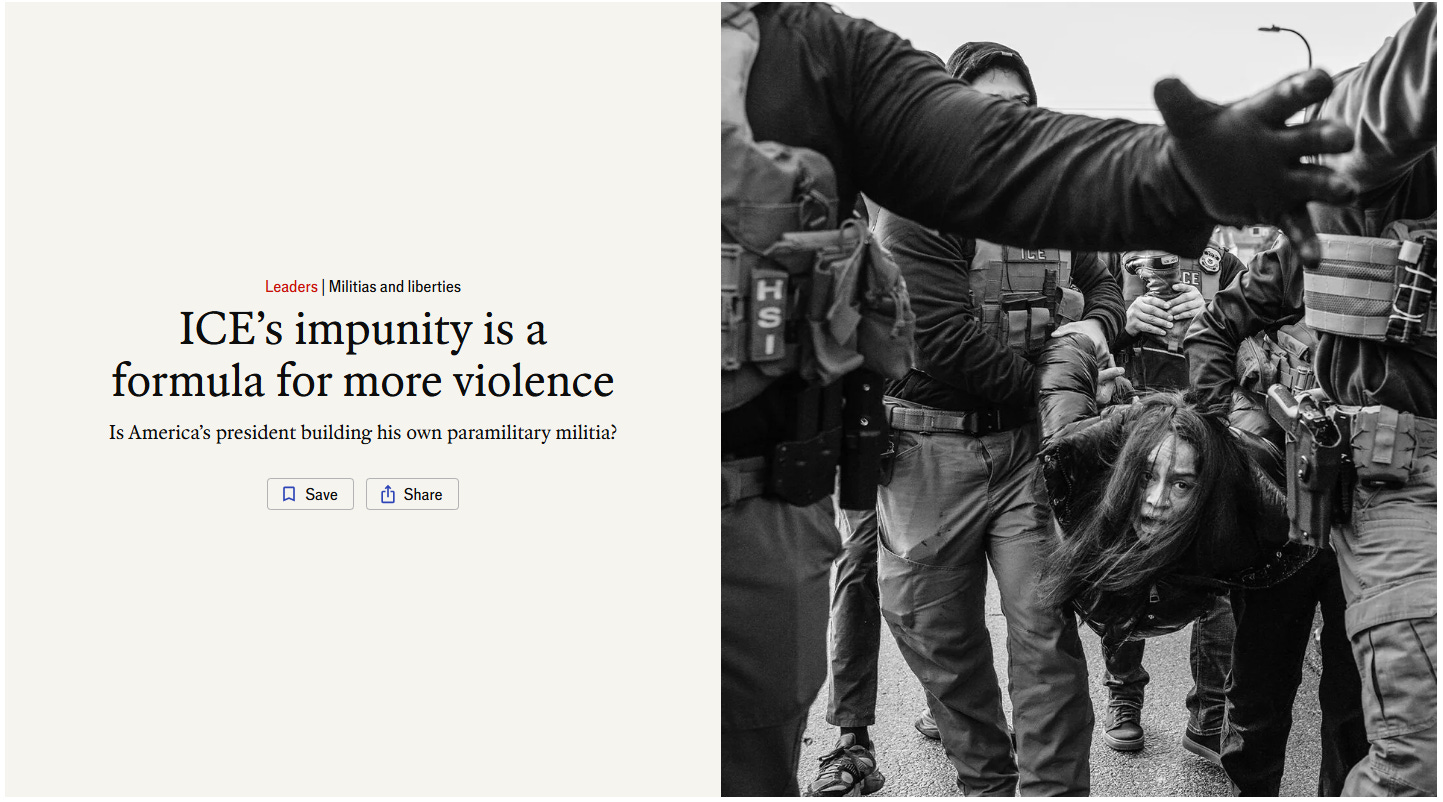
Newspaper Reader on The Economists’ Zanny Menton Beddoes as would be Photo-Journalist in black & white : Margaret Bourke-White, Dorothea Lange, Lee Miller were the real thing !