The Financial Times on David Koch: Old Socialist comments

Who can forget this moment in the life of this notorious Oligarch/Hyper-Reactionary? As reported by John Gapper @FT, Gapper’s report in a bold font, and note his use of utterly dismissive characterizations of the audience : “harried Brooklyn moms and salivating balletomanes” !

Headline: Theater Audience Boos Tea Party Billionaire David Koch

David Koch masks his role as one of the top financiers of the Tea Party movement and pro-polluter front groups by loudly tacking his name to more laudable charities, like the New York city ballet. Koch, who has professed his devotion to “The Nutcracker” ballet performance by Alexei Ratmansky, made a matching grant of $2.5 million so that it could go on this season. At a special opening of the performance at the Brooklyn Academy of Music shortly before Christmas, Koch made an appearance to talk about his donation. The Financial Times’ John Gapper was in the audience and witnessed a crowd of “harried Brooklyn moms and salivating balletomanes” erupting in boos at the sight of the Tea Party billionaire:

The excitement started even before the show when David H. Koch, the co-owner of Koch Industries, the largest privately-own industrial conglomerate in the US, came out on stage to talk about his $2.5m sponsorship of the production. Most people applauded but there were also boos from near where I sat in the balcony, followed by an angry debate in the row in front of me, with one of the booers declaring “he’s an evil man” and a couple next to her telling her to “shut up” and to leave the theatre. […] Once Mr Koch had left the stage, the booing stopped and the ballet started.

https://thinkprogress.org/theater-audience-boos-tea-party-billionaire-david-koch-4f701bc64c0a/

The defense of Oligarchs is a full time job for the Financial Times ‘reporter/apologist’!

Old Socialist

https://www.ft.com/content/d0d949c4-c5a5-11e9-a8e9-296ca66511c9


Posted in Uncategorized | Leave a comment

janan.ganesh@ft.com on ‘moderation to the point of tedium’. Political Observer comments

The cast of characters of Mr. Ganesh’s latest political melodrama is a crowded field! First to appear in the headline of this Capitalist Apologetic newspaper is ‘The Populist Left’ ,hardly a surprise: the specter of Marx in his various political/economic iterations, is the idee fixe of the Free Market Coterie. From Mises/Hayek/Friedman, and the great charlatan Ayn Rand, and her comic-book Objectivism. Piketty has lost his appeal as the target Economic Radical of choice? Piketty is mere Economic Liberalism, in sum, Left-Wing Social Democracy , while Marx is the eternal Nihilist Revolutionary.

The ‘actors‘ in order of their appearance:

the Great Depression, Franklin Roosevelt, Barack Obama . John Maynard Keynes , the Tea Party, Donald Trump, Bernie Sanders , Elizabeth Warren, Joe Biden, Federal Reserve,  China, Trumpism, Populism, recession, Michael Bennet, Bourbon restoration, the Bilderberg classes, Polls, Revealed Truth, Lyndon B Johnson’s Great Society,  Chile, Germany, Gini coefficient, Wall Street Democrats, Moderation

The above framing of his essay is suggestive of historical/political knowledge of American politics and its actors, one of Mr. Ganesh’s glaring points of weakness.  The reader eventually comes to this pronouncement on what the Democrats have to offer the electorate, in contradistinction to Trump’s erratic political nihilism: Moderation to the point of tedium is still the Democrats’ surest way to victory next year. In sum, Mr. Ganesh presents the argument of the New Democrats that only a ‘Centrist’ can win against Trump. Define that ‘Centrism’ as the alliance between the New Democrats,  the Neo-Conservatives and their Neo-Liberal fellow travelers: Biden,Harris,Warren, Booker etc. All the New Democrats can offer is a carbon copy of Hillary Clinton! This qualifies as just another form of political nihilism.

Political Observer

https://www.ft.com/content/4a3ae51c-c343-11e9-a8e9-296ca66511c9


Posted in Uncategorized | Leave a comment

@TheEconomist Oxbridgers on the possibility of a ‘Global Downturn’. Political Observer comments

Headline: Markets are braced for a global downturn

Sub-headline: The signals from bonds, currencies and commodities are increasingly alarming 

Its almost as if American Television’s dreck merchant Aaron Spelling had reincarnated as a writer or writers for the Economist. The opening paragraph, of this essay, is awash in the kind of tarted up melodrama Aaron made his trademark. But this time delivered in the almost plumy Oxbridger patois.

Looking for meaning in financial markets is like looking for patterns in a violent sea. The information that emerges is the product of buying and selling by people, with all their contradictions. Prices reflect a mix of emotion, biases and cold-eyed calculation. Yet taken together markets express something about both the mood of investors and the temper of the times. The most commonly ascribed signal is complacency. Dangers are often ignored until too late. However, the dominant mood in markets today, as it has been for much of the past decade, is not complacency but anxiety. And it is deepening by the day.

The concluding paragraph after all the gloom in its near perfect expression, comes this almost caution, or just its politically useful simulacrum, shaded with a canny cynicism.

When people look back, they will find plenty of inconsistencies in the configuration of today’s asset prices. The extreme anxiety in bond markets may come to look like a form of recklessness: how could markets square the rise in populism with a fear of deflation, for instance? It is a strange thought that a sudden easing of today’s anxiety might lead to violent price changes—a surge in bond yields; a sideways crash in which high-priced defensive stocks slump and beaten-up cyclicals rally. Eventually there might even be too much exuberance. But just now, who worries about that?

https://www.economist.com/leaders/2019/08/17/markets-are-braced-for-a-global-downturn

Political Observer


Posted in Uncategorized | Leave a comment

Andy Divine on the ‘brilliant,bespoke’ Michael Anton! Political Observer comments

Andy opens his essay of August 16, 2019, with praise for Straussian Michael Anton as ‘brilliant, bespoke’ it might be a faux pas to call a man ‘chic’?  Mr. Anton began his career, at least to my knowledge, with his The Suit: A Machiavellian Approach to Men’s Style under the pretentious non de plume of  Nicholas Antongiavanni  in 2006. Is this book the ‘root‘ of Andy’s use of the word ‘bespoke’? Andy begins his essay:

In the first year of the Trump presidency, I had a very pleasant dinner with Michael Anton, the brilliant, bespoke Straussian who went to work for Trump’s National Security Council for a while. I wanted to talk to him about reactionism, that streak in conservative thought that can become revolutionary in its hostility to modernity, but the conversation ended up sprawling far beyond that topic. Anton is something of an intellectual pariah — a Washington Post columnist wrote last year that “there is little reason to ever listen” to him — but he’s a pariah in part because he’s a reactionary with a first-class mind. And that’s why I often listen to him. He reminds me why I’m a conservative, …

http://nymag.com/intelligencer/2019/08/andrew-sullivan-the-limits-of-my-conservatism.html#comments

Not to forget Anton’s essay of  March 2016 under the pen name of Publius Decius Mus:

The Flight of 93 Election

But we can probably do better than we are doing now. First, stop digging. No more importing poverty, crime, and alien cultures. We have made institutions, by leftist design, not merely abysmal at assimilation but abhorrent of the concept. We should try to fix that, but given the Left’s iron grip on every school and cultural center, that’s like trying to bring democracy to Russia. A worthy goal, perhaps, but temper your hopes—and don’t invest time and resources unrealistically.

By contrast, simply building a wall and enforcing immigration law will help enormously, by cutting off the flood of newcomers that perpetuates ethnic separatism and by incentivizing the English language and American norms in the workplace. These policies will have the added benefit of aligning the economic interests of, and (we may hope) fostering solidarity among, the working, lower middle, and middle classes of all races and ethnicities. The same can be said for Trumpian trade policies and anti-globalization instincts. Who cares if productivity numbers tick down, or if our already somnambulant GDP sinks a bit further into its pillow? Nearly all the gains of the last 20 years have accrued to the junta anyway. It would, at this point, be better for the nation to divide up more equitably a slightly smaller pie than to add one extra slice—only to ensure that it and eight of the other nine go first to the government and its rentiers, and the rest to the same four industries and 200 families.

Will this work? Ask a pessimist, get a pessimistic answer. So don’t ask. Ask instead: is it worth trying? Is it better than the alternative? If you can’t say, forthrightly, “yes,” you are either part of the junta, a fool, or a conservative intellectual.

And if it doesn’t work, what then? We’ve established that most “conservative” anti-Trumpites are in the Orwellian sense objectively pro-Hillary. What about the rest of you? If you recognize the threat she poses, but somehow can’t stomach him, have you thought about the longer term? The possibilities would seem to be: Caesarism, secession/crack-up, collapse, or managerial Davoisie liberalism as far as the eye can see … which, since nothing human lasts forever, at some point will give way to one of the other three. Oh, and, I suppose, for those who like to pour a tall one and dream big, a second American Revolution that restores Constitutionalism, limited government, and a 28% top marginal rate.

But for those of you who are sober: can you sketch a more plausible long-term future than the prior four following a Trump defeat? I can’t either.

The election of 2016 is a test—in my view, the final test—of whether there is any virtù left in what used to be the core of the American nation. If they cannot rouse themselves simply to vote for the first candidate in a generation who pledges to advance their interests, and to vote against the one who openly boasts that she will do the opposite (a million more Syrians, anyone?), then they are doomed. They may not deserve the fate that will befall them, but they will suffer it regardless.

https://www.claremont.org/crb/basicpage/the-flight-93-election/

On the ‘Straussians’ and their intellectual apologists like Andy, the reader need only look to Nicholas Xenos’ book ‘Cloaked in Virtue’ for a telling expose of Leo Strauss and his mendacious, not to speak of politically self-serving, re-reading of the Philosophical Tradition!

Andy Divine has just commenced his latest encyclical! Of interest to readers is that Andy began as a Thatcherite, then ‘evolved’ into a Neo-Conservative, and finally became a Neo-Liberal. With the carefully recorded political enthusiasms along the way: of the racist Conservative Sociology of ‘The Bell Curve’ and the Iraq War, to name just two examples of his non-existent good judgement. I will stop here, as the I have reached the maximum number of unpaid views, and think that five dollars is too high a price to pay for Andy’s self-congratulatory chatter!

Political Observer


Posted in Uncategorized | Leave a comment

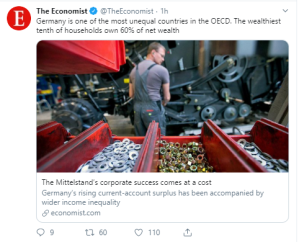
@TheEconomist jumps on the ‘Inequality Bandwagon’? Old Socialist comments

The Posh Boys & Girls @TheEconomist  now find it necessary to address the vexing question of ‘inequality’ ? In this  very narrow political/historical context:

Headline: The Mittelstand’s corporate success comes at a cost

Sub-headline: Germany’s rising current-account surplus has been accompanied by wider income inequality

The imf has long wrung its hands at the savings glut. Last month, in its annual report on global imbalances, it repeated a warning that Germany’s current-account surplus was “substantially” stronger than warranted by economic fundamentals. In a separate paper it presented evidence that the growing current-account surplus was accompanied by increasing inequality (see chart). The link, it says, is high corporate profitability.

Around the turn of the millennium Germany’s exports took off, as rapidly growing emerging economies started to buy its high-value-added manufacturing goods in bulk. That, together with stingier welfare benefits and government policies encouraging wage restraint, helped push up profits. But corporate success did nothing for poorer households because of a highly unequal distribution of wealth.

To localize the political phenomenon of ‘inequality’ is to denature its global effects!

But note that it isn’t The Economist’s Posh Boys and Girls making the claim of ‘increased inequality,‘ but the IMF! In sum its  Germany’s  ‘stingier welfare benefits and government policies encouraging wage restraint, helped push up profits.’, Austerity  is the culprit? The Virtuous Northern Tier Mythology of 2014 is kaput!

Germany’s corporate wealth tends to be kept in the family. The country has relatively few listed firms: 60% of corporate assets belong to privately owned firms. Many are family-run. Even among the publicly listed ones two-thirds are family-controlled, and controlling shareholders hold larger stakes than those in, say, Britain or Sweden. This leaves less equity for outsiders.

The rich tend to spend a smaller share of their incomes than the poor. German tycoons are also thriftier than their peers elsewhere. Though Germany’s authorities tend to blame an ageing society for its high savings rate, the true culprits appear to be the moguls of the Mittelstand.

But the ‘solution’ to this problem is framed in the notion of an ‘economic model is in need of repair.’ 

Government officials say that some of these trends are reversing. The labour market has tightened, allowing wages to rise and profits to fall. But the imf reckons that in order for disposable household incomes to regain their 2005 share of gdp, wage growth would have to outstrip nominal gdpgrowth by 1.5 percentage points for the next decade—a tall order.

Policy could speed things along: tax relief for low-income households to reduce the concentration of income, and property and inheritance-tax reform to reduce the concentration of wealth. But that would mean recognising that a much-vaunted economic model is in need of repair.

Looking back to 2014  a short review, that appeared in The Economist, was Anti-Piketty Propaganda, in service to a denial that ‘inequality’ was problem in need of being addressed. It was both Occupy Wall Street and Piketty that focused on the vexing question of inequality. Not the IMF nor The Economist!

https://www.economist.com/the-economist-explains/2014/05/04/thomas-pikettys-capital-summarised-in-four-paragraphs

As rebuttal to this short essay, look to the first of a set of essays considering Piketty’s Capital, titled ‘Reading “Capital”: Introduction, that is less framed in political hysteria- the fact that these essays were, to say the least, more considered, written by R.A. , at least at the time of my reading, proves that sometimes honesty trumps ideological fixations? The links below are from 2014.

https://www.economist.com/free-exchange/2014/02/27/reading-capital-introduction

https://www.economist.com/free-exchange/2014/03/06/reading-capital-introduction-continued

https://www.economist.com/free-exchange/2014/03/13/reading-capital-chapter-1

https://www.economist.com/free-exchange/2014/03/20/reading-capital-chapter-2

https://www.economist.com/free-exchange/2014/03/27/reading-capital-chapters-3-and-4

https://www.economist.com/free-exchange/2014/04/04/reading-capital-chapters-5-and-6

https://www.economist.com/free-exchange/2014/04/11/reading-capital-chapters-7-8-and-9

https://www.economist.com/free-exchange/2014/04/17/reading-capital-chapters-10-11-and-12

https://www.economist.com/free-exchange/2014/04/25/reading-capital-part-4-conclusion-and-recap

Old Socialist

P.S. Also, consider  John Cassidy’s  New Yorker essay titled ‘Piketty’s Inequality Story in Six Charts’ :

https://www.newyorker.com/news/john-cassidy/pikettys-inequality-story-in-six-charts


Posted in Uncategorized | Leave a comment

edward.luce@ft.com on ‘The Hong Kong Test’ . Old Socialist comments

Headline: America is failing the Hong Kong test

Sub-headline: Indifference to pro-democracy protests highlights degeneration of US foreign policy

Mr. Luce frames his lament, maladroitly, in the deeply held notion of American Exceptionalism. Except that this version of exceptionalism renders the execrable facts offered by Hiroshima Nagasaki ,carpet bombing and Agent Orange in Indochina, the betrayal of the Kurds by Bush The Elder, the use of white phosphorus in Fallujah, Abu Ghraib and Guantanamo Bay, and the ‘War on Terror’ that has metastasized to at least eight fronts, that we know about: in sum, Mr. Luce lives and works in The United States of Amnesia, so the record that Mr. Luce finds politically irresistible, is one of self-willed  forgetfulness.

Hong Kong’s political position , has since its June 30/July 1, 1997 reversion to Chinese sovereignty, and the mass exodus before and after this ‘reversion’, establishes in the thought of the reader, a conflict conceived in terms of a political melodrama, at least according to Corporate Media.

The long democratic tradition of Hong Kong as a ‘Crown Colony‘: the demonstrators have every reason to openly rebel against a dictatorial Beijing:  the long tradition of Hong Kong is democratic, and its citizens will not be bullied! What  role do Western NGO’s  have in exacerbating this crisis, is an absolutely valid question. Where are, what could only be called ‘mediators’, in what China might call an internal political matter?  This melodrama is being played out in full view of the world, by way of Smart Phones produced in the sweatshops of Asia/China. I’m conflicted about the protests, as portrayed in Corporate Media, as a political melodrama that features Chinese thugs beating protesters, that evolves, in its telling, into a political morality play.

Trump is not the betrayer of the toxic myth of American Exceptionalism, nor is he  its fulfillment, but one of its many denouements !

Old Socialist

https://www.ft.com/content/1d76126a-bedc-11e9-b350-db00d509634e

______________________________________________________________

@naoyb @StephenKMackSD

Thank you Bea sam for your comment: on the ‘Democratic Tradition’ as viewed by the demonstrators, which is what is central to this political crisis, as viewed by Luce :‘Hong Kong would continue its capitalist system and way of life for 50 years after 1997.’ To Thatcher Capitalism and Democracy were synonymous.

The Basic Law was drafted on the basis of the Sino-British Joint Declaration signed between the Chinese and British governments on 19 December 1984, represented by Premier Zhao Ziyang and Prime Minister Margaret Thatcher respectively. The Basic Law stipulates the basic policies of China regarding the Hong Kong Special Administrative Region. As stipulated in the Joint Declaration and following the “one country, two systems” principle, socialism practised in mainland China would not be extended to Hong Kong. Instead, Hong Kong would continue its capitalist system and way of life for 50 years after 1997.[4]

The Hong Kong Basic Law sets out the sources of law, the relationship between the Hong Kong SAR and the Central Government, the fundamental rights and freedoms of Hong Kong residents, and the structure and functions of the branches of local government, and it provides for the amendment and interpretation of the Basic Law. The courts of Hong Kong are given the power to review acts of the executive or legislature and declare them invalid if they are inconsistent with the Basic Law.

The source of authority for the Basic Law is disputed. Chinese legal scholar Rao Geping argues that the Basic Law is a purely domestic legislation deriving its authority from the Constitution of the People’s Republic of China,[5] while some legal scholars arguing that the Basic Law derives its authority directly from the Sino-British Joint Declaration.[citation needed] The argument is relevant in that it affects the level of authority that the PRC has in making any changes to the Basic Law. It is also essential in determining the Hong Kong courts’ jurisdiction in issues related to the PRC domestic legislations.

https://en.wikipedia.org/wiki/Hong_Kong_Basic_Law

On the vexing question of (Did Beijing hand down a dictate to HK)? The demonstrators view themselves as the victims of Beijing, so the point provides the ‘why’ of Luce’s lamentations about an ebbing Pax Americana! These demonstrations provide the fertile ground for his polemic against Trump as betrayer of a hallowed American Tradition.

Regards,

StephenKMackSD


Posted in Uncategorized | Leave a comment

In the pages of The Financial Times: Macri declared a failure! Political Observer comments

Mr.  Torres’ essay doesn’t even begin to offer something like a diagnosis, for the failure of Macri’s failed ‘Austerity Lite’. Awash in Econo-Speak , a stand-in for obfuscation.  Or is this offered in lieu of an actual diagnosis. In sum, this is how it ‘should’ have happened?


It is important to note that the fund considers Argentina’s debt to be “sustainable but without a high probability”. In IMF jargon, this implies the possibility of restructuring public debt (or “reprofiling” it: a kind of “light” restructuring). To avoid this happening, the government needs to count on the private investor’s willingness to refinance all their claims at maturity.

In the stuttering comic jargon of the Technocrat: ‘“reprofiling” it: a kind of “light” restructuring’.

Macri is a failure. This ‘stunning declaration’ in the pages of The Financial Times: the home of Macri advocacy/apologetics.    

His reformist political campaign emphasized the fight against corruption, public investment, and Argentina’s new “integration into the world”. But the electorate felt more closely touched by the vivid arguments coming from their pockets.

https://www.ft.com/content/18fe4dfe-bdb7-11e9-9381-78bab8a70848

Political Observer


Posted in Uncategorized | Leave a comment

From the pages of The Financial Times: Macri stumbles, Economic Disaster follows! Political Observer comments

The Greek Chorus in this latest installment of The Argentine Political Crisis, 2019 Edition is made up of Economic Technocrats, representing those Investment Houses, left high and dry with the election of  Néstor Kirchner and his successor Cristina and their ‘Economic Populism’. Nothing spooks these ‘experts’ like any possible return of a De Kirchner to power! The membership of the chorus does not evoke surprise

‘said Greg Lesko, a portfolio manager at Deltec Asset Management.

‘Eddy Sternberg, a portfolio manager for emerging markets debt at Boston-based asset manager’

‘said Paul McNamara, a fund manager focused on emerging markets at GAM.Bloomberg data show’

‘said Tiago Severo, economist at Goldman Sachs.’

‘warned Yerlan Syzdykov, the global head of emerging markets at Amundi Asset Management.’

What grabs the readers attention is the graphic of the Argentine Century Bond losing its value!

What can the reader make of the fact that the Argentine peso went into near free fall, less that a year and a half after Macri election? Or that Pratt-Gay was fired in December of 2016.

Headline:Argentina finance minister axed on economic uncertainty 

Sub-headline: President requests resignation of Prat-Gay due to ‘differences’ in department

https://www.ft.com/content/2d82da08-cb8c-11e6-864f-20dcb35cede2

That Macri’s Austerity Lite didn’t work is a thought that will never occur to this newspaper’s editors  nor its ‘reporters’ .

If the reader is looking for a bit more doom and gloom she need only look to this Andrés Oppenheimer essay from July 31, 2019:

Headline:Argentina will become a hopeless country if Cristina Fernandez wins

Argentina’s populist former president Cristina Fernandez de Kirchner — who is nominally running for vice-president, but is the indisputable No. 1 on her ticket — is leading in most polls for the Aug. 11 primaries, and for the October presidential elections.

If her ticket wins and ousts the current president, Maurcio Macri, Argentina will sink into an even deeper economic crisis.

That’s my conclusion after getting internal statistics from international financial institutions. They confirm what some independent Argentine economists have been saying for a long time.

The figures show that Argentina is an unviable country — a nation that spends much more than it produces. They also show that the bulk of the country’s current economic hardship is a legacy of the governments of late President Nestor Kirchner (2003-2007) and, his widow, Cristina Fernandez (2007-2015.)

https://www.miamiherald.com/news/local/news-columns-blogs/andres-oppenheimer/article233335402.html

Political Observer

https://www.ft.com/content/e135af72-bcf1-11e9-89e2-41e555e96722


Posted in Uncategorized | Leave a comment

The Financial Times and Elisabeth Braw on the necessity of an alliance between Business & National Security States. Political Observer comments

Headline:Business must prepare for aggression by states

Sub-headline: Companies should consider participating in military exercises

A hireling from  RUSI (https://rusi.org/) Elisabeth Braw advocates what is ,in sum, Fascism: the vital connection between National Security States and their suppliers of weapons of war, and the technologies to wage that war/wars against ‘The Enemy’. First in order of priority is Russia and then China: the future of humanity is to wage war against our enemies. Huntington, in his manifesto, ‘The Clash of Civilizations’ provides the paranoid template, that looks upon the capacious category of The Other as the enemy!
Major General Mats Engman provides a neutral  sounding rhetorical stand-in for the American military power of NATO. But the readers patience is rewarded with this appearance of those ‘Russians’ by implication:

In Ukraine, Russian military activities have been mixed with disinformation campaigns and cyber attacks. They have brought down banks, media outlets and government agencies.

Ms. Braw follows this with an admonition:

Governments thus need the private sector to prepare for national security contingencies with their armed forces. Given that they would face devastating consequences if caught unprepared in a national security crisis, companies would benefit from participating.

Think of a conventional attack in combination with a range of hacks against companies, combined with seizures of commercial freighters, which would both disrupt vital supply chains. As Britain is currently discovering, supply chains are the lifeblood of the just-in-time economy: shuttling food, fuel, medicines and industrial components to where they are needed. Britain, for example, imports half of the food the country consumes. If one link in the chain goes down, it no longer functions.

In steps Rear Admiral Sverre Nordahl Engeness of the Norwegian Navy who planned the ‘Trident Juncture’ 

TRIDENT JUNCTURE WILL SHOW THE WORLD THAT NATO IS RELEVANT, UNITED AND READY TO DEFEND ITSELF IN THIS ARTICLE 5 SCENARIO, TESTING OUR COLLECTIVE DEFENCE. – Admiral James G. Foggo, Commander of Allied Joint Force Command Naples

https://www.nato.int/cps/en/natohq/157833.htm

The last walk-on features Andrew Cuomo, speaking about a ‘power outage’ that any objective source would attribute to an infrastructure, in dire need of a massive amount of both money, and time to match the needs of the 21st Century!

“We were lucky,” New York governor Andrew Cuomo said last month after engineers restored power to 72,000 New Yorkers hit by a power cut. By joining the armed forces in exercising contingencies, companies would not have to rely on luck.

The imperatives of a New Cold War is the animating force behind Ms. Braw’s polemic, and her publishers at The Financial Times.

Political Observer

https://www.ft.com/content/f05b9be2-b922-11e9-8a88-aa6628ac896c


Posted in Uncategorized | Leave a comment

Andy Divine drowns in a sea of definite/indefinite pronouns, in the first part of his latest polemic. Political Observer looses patience!

AndyDivineOnTrumpRomeAugust092019

In Andy Divine’s latest essay he puts rhetorical distance between himself as political scribbler, and these political actors: *some, others, many, we, ours, they, one. 

Andy’s political desperation expresses itself in the second part of his essay by resorting to Gore Vidal, Patrick Buchanan’s  A Republic, Not an Empire  and  Cullen Murphy’s Are We Rome?’ But note the publication date of Mr. Murphy’s polemic of 2007!

Tom Holland attempts to answer Andy’s burning question with his essay:

Headline: America Is Not Rome. It Just Thinks It Is

The conviction that Trump is single-handedly tipping the United States into a crisis worthy of the Roman Empire at its most decadent has been a staple of jeremiads ever since his election, but fretting whether it is the fate of the United States in the twenty-first century to ape Rome by subsiding into terminal decay did not begin with his presidency. A year before Trump’s election, the distinguished Harvard political scientist Joseph Nye was already glancing nervously over his shoulder at the vanished empire of the Caesars: “Rome rotted from within when people lost confidence in their culture and institutions, elites battled for control, corruption increased and the economy failed to grow adequately.” Doom-laden prophecies such as these, of decline and fall, are the somber counterpoint to the optimism of the American Dream.

And so they have always been. At various points in American history, various reasons have been advanced to explain why the United States is bound to join the Roman Empire in oblivion. In 1919, in the wake of the Russian Revolution, The New York Times warned that the Huns and the Vandals were massing again. “The Roman Empire and its civilization were destroyed by barbarian hordes coming from the East—and it is from the east that comes the wind.” Thirty years earlier, visiting the abandoned Roman city at Baalbek in Lebanon, Brooks Adams—the great-grandson of John Adams—had been inspired by the spectacle of shattered greatness to dread that his own country’s gilded age was bound to end in similar ruin. In the decades before the Civil War, opponents of slavery repeatedly cited the fall of Rome as a warning of what might happen to a slave-owning society. In the 1830s, opponents of Andrew Jackson cast him as a dictator and a demagogue whose tyranny would inevitably bring the infant republic to share in the fate of the ancient empire. Present anxieties that Trump’s presidency portends America’s decline and fall are the contemporary expression of a tradition quite as venerable as the United States itself.

https://www.nybooks.com/daily/2019/08/06/america-is-not-rome-it-just-thinks-it-is/

The links provided by Holland are revelatory!  Andy’s essay is defined by an unslakable verbosity. My patience…

Political Observer


Added August 11, 2019 8:27 AM PDT

*Here are some examples of Mr. Divine’s use of definite/indefinite pronouns that constitutes the dramatis personae of the first part of essay, with a bit more context : this strategy allows Andy to  frame these comments outside Andy’s personal agency, and places these thoughts, beliefs within the realm of nebulous others. Or that places these thought as products of a another rhetorical phantom of ‘we’.  

Upon his election, some panicked, Others saw merely, Many contended ,  so we cast around, we now have a solid record,  like ours,  It practiced, It became,its territory, It won

Political Observer


Posted in Uncategorized | Leave a comment