At The Financial Times: George F. Kennan revisionism?

Political Observer comments.

Mr. Kuper has missed this issue of the Journal of Cold War Studies Volume 15, Issue 4 Fall 2013:

https://direct.mit.edu/jcws/article/15/4/233/13418/Gaddis-s-Kennan-A-Different-Kennan

This issue takes a critical look at the Gaddis biography, as the preferred methodology for assessing the career of Kennan. Here is an excerpt of Anders Stephenson’s assessment:

Here lies the crux of the matter, and so of Gaddis’s ediªce as well. Everything turns on two issues. The ªrst is “the Soviet issue” itself. The divergence between Kennan and Lippmann on this matter in September 1947 hinges on the notion of “normality.” Difference is inscribed in the world, but in Kennan’s depiction as opposed to Lippmann’s the Soviet regime is and has always been abnormal, alien, and hostile, and now because of World War II was also dangerously placed: an abnormality piled on an abnormality, as it were. From the moment Kennan began seriously pondering the Soviet Union in the late 1920s and into the summer of 1948, he ultimately declined to recognize Moscow’s legitimacy as an international actor (he did not consider the Nazi regime, unpleasant and aggressive though it might be, equally beyond the pale until the war). The “Long Telegram” and the “X” article express this posture. Their speciªc accounts of the Soviet Union and its foreign relations are empirically wrong and strangely structured: wrong in denying that Moscow had ever made “deals” and compromises when in fact it had made a whole string of them, as Kennan well knew; strange in rooting Soviet policy wholly in domestic sources as though the outside world had no meaning except as a construction set forth to legitimate the regime at home. Astonishingly, the massive, near-death experience of the Soviet Union in World War II is almost entirely absent from the article. Suppose the United States had gone through a similar experience, the area between the Rockies and the industrial northeast had been essentially leveled by the Wehrmacht, 25 million had been killed, New York had been under siege for 900 days, and New Yorkers, the lucky ones, had been forced to eat rats while Washington was being bombarded. Can one imagine a persuasive postwar analysis of U.S. foreign policy that largely ignored such a sequence of events? I think not (and one can visualize the kind of security claims the U.S. government would have insisted on afterward). Yet, despite the antinomies and palpable errors of the “Long Telegram” and subsequent “X” article, they were received with a stupeªed sense of discovery, a discovery of “truth revealed.” Lippmann never fell into that trap, and Kennan himself, once confronted with the effects of the truth revealed, which is to say the Cold War, began to look for alternatives and ways to reconstitute some kind of diplomacy proper. The “normality” argument did not go away. It was famously resurrcted in 1967 by Arthur Schlesinger, Jr., in Foreign Affairs; and Gaddis reiterates it now again in celebrating the virtues of the Long Telegram. In fact, the Soviet Union proved remarkably orthodox in its devotion to power politics and classical European notions of international relations. What was really “wrong” with Iosif Stalin was, one might say, his abnormal “normality”—his hyper-realist reduction of all meaning to pure and ruthless interest. This was a man who had had The Prince translated for himself and then marked it up with care. Thus one might have chosen another basis for rejecting dealings with Moscow; for example, on ethical grounds: “this regime is a horrible dictatorship and, regardless of what we said and did during our wartime alliance, one must not accept such a regime qua regime.” This is a coherent position but notoriously difficult to maintain insofar as, typically, one has to distinguish this particular dictatorship by degree from others that are worth dealing with. Right-wing dictatorships aside, the ethical aspect as regards “Communism” was soon effectively discarded because of the need to support Josip Broz Tito’s regime in Yugoslavia. In treating this issue, Gaddis seems to favor the idea that “domestic” Communism was of no real (i.e., strategic) concern to the United States as long as it did not support Moscow and expansionism in foreign affairs. The effortless oscillation between quasi-realist pragmatism and Cold War ideology is in itself characteristic of the Cold War as actual geopolitics: “freedom, indivisible and sacred, will everywhere be defended by the Leader of the Free World, but it may be that we are not really capable of doing that so China (1948–49) will have to be written off, though we will not put it exactly like that and certainly not in public.”

https://direct.mit.edu/jcws/article/15/4/233/13418/Gaddis-s-Kennan-A-Different-Kennan

These two long paragraphs point to what Mr. Kuper uses, both of the Long Telegram and the Mr. X essay, as the rhetorical frame, that just alludes to Kennan’s change of mind about the Soviets. Mr. Stephenson ends his review of the Gaddis biography with these paragraphs:

Gaddis, on reºection, might well have agreed with this and gone on to take the other side of the argument. What he does is less interesting and indeed a bit tiresome. Having said that Kennan was essentially right in 1946– 1947, he faced the task of ªguring out what to do with half a century’s worth of withering Cold War critique, which in effect repudiated his erstwhile position. The predictable solution is a bracketing operation of another order:

Kennan the Early Prophet eventually proved right in the Age of Reagan when containment ªnally brought to maturity the Soviet regime’s “seeds of its own destruction,” a regime that had been so alien to Mother Russia. Meanwhile, Kennan the Late Prophet lost his way amid his emotions, his often charming eccentricities, and his ªxations on cultural degeneration in the West, all of which prevented him, tragically, from reconciling himself to the Truth of Reagan. Kennan’s half-century of critique, then, can be safely quarantined within a realm of egocentric peculiarity. The truth of the Cold War is duly preserved. I myself happen to think that Kennan was quite right in castigating Reagan as an egregiously irresponsible ªgure, a ªgure who, like Gaddis himself, seems to have been surprised that Soviet leaders actually believed there was danger afoot when the United States moved massively to resurrect the Cold War in the name of erasing the “Evil Empire” and so brought the world yet again, unnecessarily, to the brink of nuclear liquidation.

Political Observer
Posted in Uncategorized | 1 Comment

Edward Luce Or Patrick G. Vaughan? History Made To Measure or History?

Political Reporter asks the question.

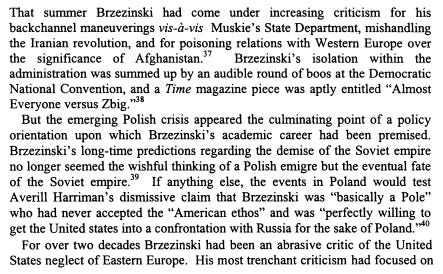
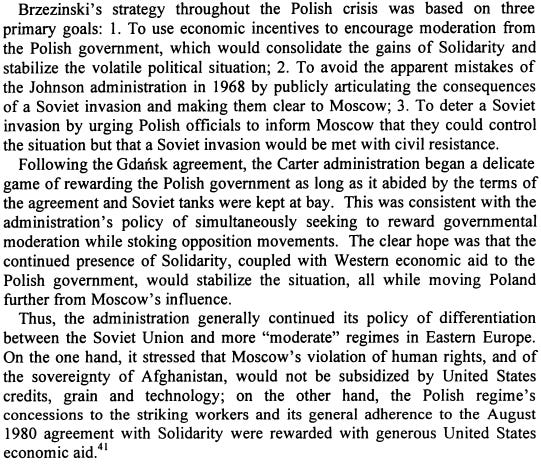
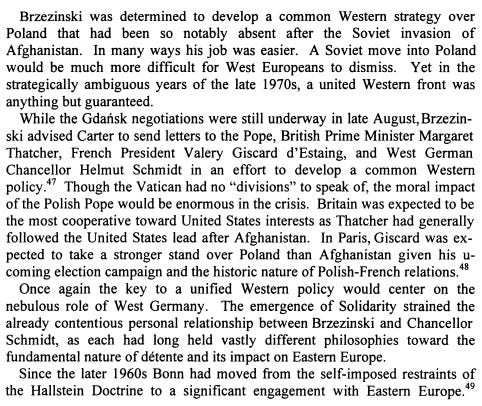
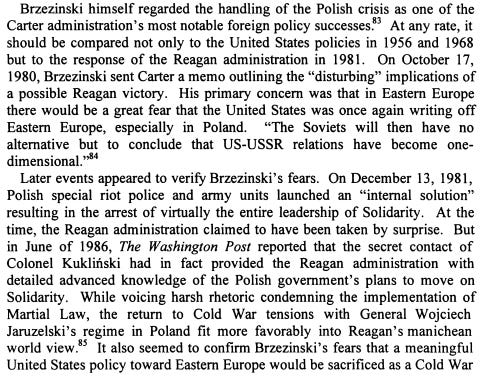
This historical essay by Patrick G. Vaughn has escaped the attention of Mr. Luce: 

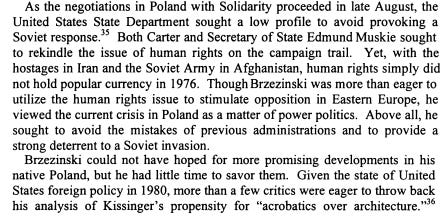
VAUGHAN, PATRICK G. “BEYOND BENIGN NEGLECT: ZBIGNIEW BRZEZINSKI AND THE POLISH CRISIS OF 1980.” The Polish Review, vol. 44, no. 1, University of Illinois Press, 1999, pp. 3–28, http://www.jstor.org/stable/25779091.

Page 11 of PDF:

Page 12 of PDF:

Page 14 of PDF:

Page 15 of PDF:

Page 26 of the PDF:

Mr. Luce was born in 1968 , so he has no actual usable historical/political memory of 1980. I was 35 years old in 1980, and recall the events of that year, especially the rise of Lech Walesa and Solidarity. Mr Luce was looking for a ‘framing device’ for his recent essay, ‘a tough guy’ ! Luce names Zbigniew Brzezinski who showed the Soviets …

Its almost programmatic in terms of History Made To Measure, steeped in Political Melodrama, that evokes the faded memory, of that 21 inch black and white screen World of 1952. What one of Luce’s readers will possess a memory of , the historical knowledge, to challenge his assertions? Or just do a bit of research?

Headline: Biden should use cold war handbook to stop Putin’s Ukraine threat

Sub-headline: Jimmy Carter’s team helped secure the 1980 Soviet ‘non-invasion’ of Poland

https://www.ft.com/content/9aff8609-34b9-478c-8563-b2f20f1ef81f


Carter’s trump card was Zbigniew Brzezinski, his hawkish national security adviser, who was a native-born fluent Polish speaker and naturalised American, and who drew on a secret weapon — Ryszard Kuklinski, a senior Polish military official and spy for the CIA. Kuklinski was also a Polish liaison to the Soviet military. His reports were so tightly held that only Carter, Brzezinski and Walter Mondale, the vice-president, were permitted to read them.

The collection of screen captures I have offered, of Patrick G. Vaughn’s revelatory essay, offers a more nuanced view, of the events and actors, that Mr. Luce’s reductivism can’t even begin to approach! Why? Because Mr. Luce has produced propaganda? Without apology!

Political Reporter

Posted in Uncategorized | Leave a comment

Name your Anti-Putin Poison @TheEconomist: The Long Form.

Political Cynic comments.

The ‘The Long Form’ begins:

Heading: Crisis in Ukraine 

 Headline: How Russia has revived NATO 

Sub-headline: Ukraine has forced America and its allies to bond. But the country’s future is still uncertain

https://www.economist.com/international/2022/02/12/how-russia-has-revived-nato 

This is a 2,389 word essay, that attempts to tell/narrate the Ukraine Crisis Story, that begins with the Macron, Putin’s meeting:

Vladimir Putin’s giant oval table in the Kremlin is as extreme as it is kitsch. Sitting far from foreign visitors may be his way of social distancing. But it also betokens the gulf that separated Russia’s leader from his guest, Emmanuel Macron of France. It may also illustrate what diplomats say is Mr Putin’s worrying isolation from the world. None can claim to read his mind as he masses some 130,000 troops on the borders around Ukraine. Is he about to launch the biggest war in Europe since the fall of the Berlin Wall? Or is it all a big bluff?

This first paragraph devolves in to Anti-Putin Hysteria, that is unsurprising. And The Reader need only look to the use of ‘nato’ in small caps, instead of NATO in capital letters, as a maladroit attempt at diminishment, in this History Made To Measure. The Major Actors, ideas, descriptors, and other useful ballast, in this War Mongering Melodrama:

Putin, Macron, NATO, Olaf Scholz, Angela Merkel,2014,, Viktor Yanukovych, Crimea, eastern Donbas, Petro Poroshenko, the Minsk accords, Rada, Volodymyr Zelensky, the separatist territories, Zerkalo Nedeli , Arsen Avakov, “Finlandisation”, Finland, Sweden, Austria, Wolfgang Ischinge, Balkans, Afghanistan, European Defence Community, Jens Stoltenberg, Britain, Iceland, Norway, eu, Canada, nato’s Article 5, Nord Stream 2, ‘non-military “grey zone” actions’, “European sovereignty”, ‘refounding moment’, ‘eu’s growing sovereignty’, Intermediate-Range Nuclear Force Treaty, force de frappe, Jacques Chirac, Estonians, Britain, Russian brutishness, America’s commitment, Mr Trump, Middle East, China, Taiwan, Mr Ischinge, American hegemon, the Mediterranean, migration.

This panoramic vision of the Political Actors, places, ideas etc. that defies The Reader attempt at constructing a possible reply – like all War Propaganda, this is designed to evoke negative emotion, rather than to place thought, analysis and Historical Inquiry, as the central imperative/obligation of that Inquiry.

But the final sentence, of this call to arms, is instructive of the use of anonymous sources, with an attachment to State Power, that must be taken on ‘faith’!

“It is the European dilemma,” says a German diplomat. “European sovereignty is impossible. But it has never been more necessary.”

Political Cynic

Posted in Uncategorized | Leave a comment

On reading Jochen Hellbeck and Mike Davis.

Philosophical Apprentice.

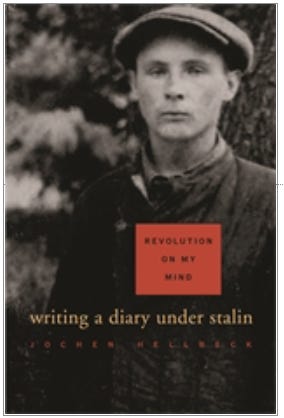
Reading ‘Revolution on My Mind:Writing a Diary under Stalin’ by Jochen Hellbeck and am on page 155, of this compelling book.

Revolution on My Mind is a stunning revelation of the inner world of Stalin’s Russia. We see into the minds and hearts of Soviet citizens who recorded their lives during an extraordinary period of revolutionary fervor and state terror. Writing a diary, like other creative expression, seems nearly impossible amid the fear and distrust of totalitarian rule; but as Jochen Hellbeck shows, diary-keeping was widespread, as individuals struggled to adjust to Stalin’s regime.

Rather than protect themselves against totalitarianism, many men and women bent their will to its demands, by striving to merge their individual identities with the collective and by battling vestiges of the old self within. We see how Stalin’s subjects, from artists to intellectuals and from students to housewives, absorbed directives while endeavoring to fulfill the mandate of the Soviet revolution—re-creation of the self as a builder of the socialist society. Thanks to a newly discovered trove of diaries, we are brought face to face with individual life stories—gripping and unforgettably poignant.

The diarists’ efforts defy our liberal imaginations and our ideals of autonomy and private fulfillment. These Soviet citizens dreamed differently. They coveted a morally and aesthetically superior form of life, and were eager to inscribe themselves into the unfolding revolution. Revolution on My Mind is a brilliant exploration of the forging of the revolutionary self, a study without precedent that speaks to the evolution of the individual in mass movements of our own time.

https://www.hup.harvard.edu/catalog.php?isbn=9780674032316+

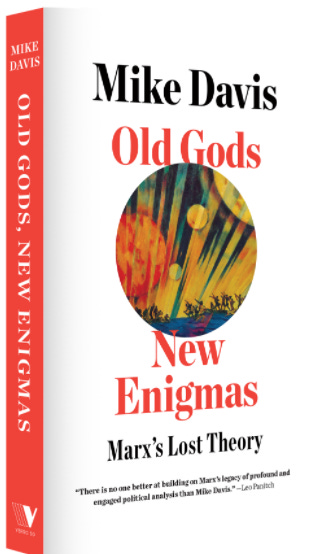
A book I am also reading, as its would be ‘counter point’, to stretch that notion to the point of fracture? or just intellectual perversity? Mike Davis’ ‘Old Gods, New Enigmas: Marx’s Lost Theory’:

Is revolution possible in the age of the Anthropocene?

Marx has returned, but which Marx? Recent biographies have proclaimed him to be an emphatically nineteenth-century figure, but in this book, Mike Davis’s first directly about Marx and Marxism, a thinker comes to light who speaks to the present as much as the past. In a series of searching, propulsive essays, Davis, the bestselling author of City of Quartz and recipient of a MacArthur Fellowship, explores Marx’s inquiries into two key questions of our time: Who can lead a revolutionary transformation of society? And what is the cause—and solution—of the planetary environmental crisis?

Davis consults a vast archive of labor history to illuminate new aspects of Marx’s theoretical texts and political journalism. He offers a “lost Marx,” whose analyses of historical agency, nationalism, and the “middle landscape” of class struggle are crucial to the renewal of revolutionary thought in our darkening age. Davis presents a critique of the current fetishism of the “anthropocene,” which suppresses the links between the global employment crisis and capitalism’s failure to ensure human survival in a more extreme climate. In a finale, Old Gods, New Enigmas looks backward to the great forgotten debates on alternative socialist urbanism (1880–1934) to find the conceptual keys to a universal high quality of life in a sustainable environment.

Old Gods, New Enigmas

Philosophical Apprentice

Posted in Uncategorized | Leave a comment

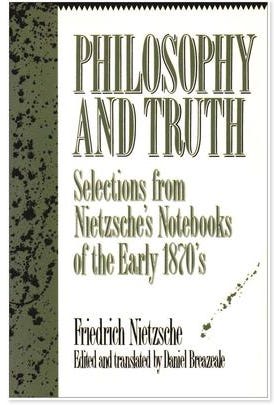
My struggle with reading ‘The Poetry of Friedrich Nietzsche’ By Philip Grundlehner.

Philosophical Apprentice comments.

I purchased ‘The Poetry of Friedrich Nietzsche’ what seemed like decades ago, from a Oxford University Press book sale.

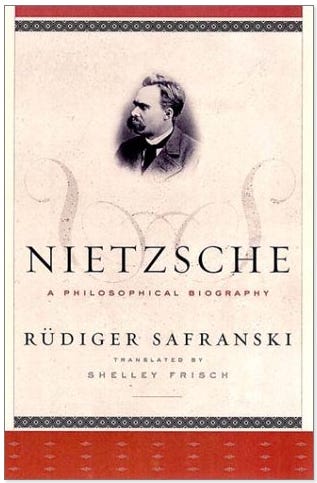
I had read Rudiger Safranski’s Philosophical Biography of Nietzsche, well before reading about Nietzsche’s poetry. Some of his thought’s, positions seemed unhinged.

And some of ‘Philosophy and Truth’ :

As a ‘misfit’ I might have felt a sense of sympathy, or felt a kind of resonance- he inspired both Adorno and Heidegger…

Perhaps my next book should be Alexander Nehamas’ book ? Though it will have to wait.

Philosophical Apprentice

Posted in Uncategorized | Leave a comment

Peter Thiel as ‘reported’ in The Financial Times.

Political Observer comments.

If Capitalism is represented by an ‘investor’, Peter Thiel, what might that say about the state of Capitalism? The Peddler of the 21st Century, Jeff Bezos, employees thousands in his chain of warehouses, and its fleets of delivery vans. Bezos built it from the ground up, Thiel made some very lucky investments, but has only financed people like Bezos. Mr. Thiel is like Sherman McCoy (lead character in ‘Bonfire of the Vanities’, now utterly forgotten) but ‘he’ is reborn in the political present, although with a taste for political thugs, like Henry Ford. That is why Zuckerberg and his familiar Sandberg have ended their political relationship with Thiel.

The job of reinforcing the imperatives of The American National Security State, in their ‘Metaverse’, is a small price to pay- even though Facebook’s popularity/profitability are sinking! Rumble, Substack, TikTok ,and Joe Rogin are the New Places to Be, the New Internet Toys! Facebook is Old News!

The Reader might just compare Thiel with Henry Luce of the Time/Life Empire, now long forgotten. Although ‘Time’ still has 23 million readers.

Political Observer

https://www.ft.com/content/82774b98-965d-4ed8-9876-cd250ed1448c

Posted in Uncategorized | Leave a comment

Gideon Rachman’s new dialectic: ‘Putin the Rational’ vs ‘Vlad the Mad’, via Richard Nixon.

Political Observer comments.

Headline: Putin, Ukraine and the madman theory of diplomacy

Sub-headline: Western leaders cling to the hope that the Russian leader is bluffing about an invasion

https://www.ft.com/content/3d8b94e9-0db7-4aa5-ac6a-9fef2ce43ab6

‘Putin the Rational’ vs. ‘Vlad The Mad’ are the latest ‘catch phrases’ or propaganda devices from Mr. Rachman. As one of The Financial Times’ cadre of War Mongers, so enamored is Mr. Rachman of his borrowed, and embroidered upon creations, that he repeats each, as the place holders of actual thought: this is War Propaganda, the point of which is not to produce rational argument, but to evoke strong negative emotion.

‘Vlad The Mad’ is repeated five times, ‘’Putin the Rational’ is repeated seven times. The source of Mr. Rachman’s riff :

It was Richard Nixon who outlined the “madman theory”, when the US president told aides that it could be helpful if America’s enemies thought he was crazy enough to use nuclear weapons.

This Reader wonders if Biden, and his Amazon Cadre of Policy advisors , Wendy Sherman, Victoria Nuland, Samantha Power and Susan Rice will make of the ‘manufactured Ukrainian Crisis’? After the ignominious Afghan withdrawal, that has led to famine, or its equivalent, and the kidnapping of leading Afghan woman?

https://www.dw.com/en/afghanistan-un-pressures-taliban-over-missing-womens-activists/a-60524065

Political Observer

Posted in Uncategorized | Leave a comment

The War in Ukraine as ‘reported/advocated’ in The Financial Times: plokhii@fas.harvard.edu

Political Observer comments.

Serhii Plokhy

January 27, 2022

Headline: The empire returns: Russia, Ukraine and the long shadow of the Soviet Union

Sub-headline: As the Kremlin attempts to reassert control over its neighbours, Ukrainian historian Serhii Plokhy uncovers the deep roots of the crisis

https://www.ft.com/content/0cbbd590-8e48-4687-a302-e74b6f0c905d

Note Mr. Plokhy’s impressive qualifications:

Serhii Plokhy is professor of Ukrainian history at Harvard University. His new book ‘Atoms and Ashes: From Bikini Atoll to Fukushima’ will be published in May by Allen Lane. Copyright © 2022, Serhii Plokhy

At a approximately 2000 words, with what is meant to be evocative, illustrative photographs, that act as a filler to this essay- Professor Plokhy provides the usual History Made To Measure, of a more sophisticated kind. How can The Reader question an expert in the field of Ukrainian history? That Reader might just opine, that Professor Plokhy has written a more sophisticated version of War Propaganda. And that he has Copyrighted his essay, to discourage unwanted critics from direct quotation of his polemic?

As informative as Professor Plokhy might be, in its truncated explanatory frame -a revelatory part of what he ignores is explained in this essay :

Headline: NATO Expansion: What Gorbachev Heard

Sub-headline: Declassified documents show security assurances against NATO expansion to Soviet leaders from Baker, Bush, Genscher, Kohl, Gates, Mitterrand, Thatcher, Hurd, Major, and Woerner :Slavic Studies Panel Addresses “Who Promised What to Whom on NATO Expansion?”

Washington D.C., December 12, 2017 – U.S. Secretary of State James Baker’s famous “not one inch eastward” assurance about NATO expansion in his meeting with Soviet leader Mikhail Gorbachev on February 9, 1990, was part of a cascade of assurances about Soviet security given by Western leaders to Gorbachev and other Soviet officials throughout the process of German unification in 1990 and on into 1991, according to declassified U.S., Soviet, German, British and French documents posted today by the National Security Archive at George Washington University (

http://nsarchive.gwu.edu).

The documents show that multiple national leaders were considering and rejecting Central and Eastern European membership in NATO as of early 1990 and through 1991, that discussions of NATO in the context of German unification negotiations in 1990 were not at all narrowly limited to the status of East German territory, and that subsequent Soviet and Russian complaints about being misled about NATO expansion were founded in written contemporaneous memcons and telcons at the highest levels. 

The documents reinforce former CIA Director Robert Gates’s criticism of “pressing ahead with expansion of NATO eastward [in the 1990s], when Gorbachev and others were led to believe that wouldn’t happen.”[1] The key phrase, buttressed by the documents, is “led to believe.”

President George H.W. Bush had assured Gorbachev during the Malta summit in December 1989 that the U.S. would not take advantage (“I have not jumped up and down on the Berlin Wall”) of the revolutions in Eastern Europe to harm Soviet interests; but neither Bush nor Gorbachev at that point (or for that matter, West German Chancellor Helmut Kohl) expected so soon the collapse of East Germany or the speed of German unification.[2]

The first concrete assurances by Western leaders on NATO began on January 31, 1990, when West German Foreign Minister Hans-Dietrich Genscher opened the bidding with a major public speech at Tutzing, in Bavaria, on German unification. The U.S. Embassy in Bonn (see Document 1) informed Washington that Genscher made clear “that the changes in Eastern Europe and the German unification process must not lead to an ‘impairment of Soviet security interests.’ Therefore, NATO should rule out an ‘expansion of its territory towards the east, i.e. moving it closer to the Soviet borders.’” The Bonn cable also noted Genscher’s proposal to leave the East German territory out of NATO military structures even in a unified Germany in NATO.[3] 

https://nsarchive.gwu.edu/briefing-book/russia-programs/2017-12-12/nato-expansion-what-gorbachev-heard-western-leaders-early

Political Observer

Posted in Uncategorized | Leave a comment

The War in Ukraine as ‘reported/advocated’ in The Financial Times: plokhii@fas.harvard.edu

Political Observer comments.

Serhii Plokhy

January 27, 2022

Headline: The empire returns: Russia, Ukraine and the long shadow of the Soviet Union

Sub-headline: As the Kremlin attempts to reassert control over its neighbours, Ukrainian historian Serhii Plokhy uncovers the deep roots of the crisis

https://www.ft.com/content/0cbbd590-8e48-4687-a302-e74b6f0c905d

Note Mr. Plokhy’s impressive qualifications:

Serhii Plokhy is professor of Ukrainian history at Harvard University. His new book ‘Atoms and Ashes: From Bikini Atoll to Fukushima’ will be published in May by Allen Lane. Copyright © 2022, Serhii Plokhy

At a approximately 2000 words, with what is meant to be evocative, illustrative photographs, that act as a filler to this essay- Professor Plokhy provides the usual History Made To Measure, of a more sophisticated kind. How can The Reader question an expert in the field of Ukrainian history? That Reader might just opine, that Professor Plokhy has written a more sophisticated version of War Propaganda. And that he has Copyrighted his essay, to discourage unwanted critics from direct quotation of his polemic?

As informative as Professor Plokhy might be, in its truncated explanatory frame -a revelatory part of what he ignores is explained in this essay :

Headline: NATO Expansion: What Gorbachev Heard

Sub-headline: Declassified documents show security assurances against NATO expansion to Soviet leaders from Baker, Bush, Genscher, Kohl, Gates, Mitterrand, Thatcher, Hurd, Major, and Woerner :Slavic Studies Panel Addresses “Who Promised What to Whom on NATO Expansion?”

Washington D.C., December 12, 2017 – U.S. Secretary of State James Baker’s famous “not one inch eastward” assurance about NATO expansion in his meeting with Soviet leader Mikhail Gorbachev on February 9, 1990, was part of a cascade of assurances about Soviet security given by Western leaders to Gorbachev and other Soviet officials throughout the process of German unification in 1990 and on into 1991, according to declassified U.S., Soviet, German, British and French documents posted today by the National Security Archive at George Washington University (

http://nsarchive.gwu.edu).

The documents show that multiple national leaders were considering and rejecting Central and Eastern European membership in NATO as of early 1990 and through 1991, that discussions of NATO in the context of German unification negotiations in 1990 were not at all narrowly limited to the status of East German territory, and that subsequent Soviet and Russian complaints about being misled about NATO expansion were founded in written contemporaneous memcons and telcons at the highest levels. 

The documents reinforce former CIA Director Robert Gates’s criticism of “pressing ahead with expansion of NATO eastward [in the 1990s], when Gorbachev and others were led to believe that wouldn’t happen.”[1] The key phrase, buttressed by the documents, is “led to believe.”

President George H.W. Bush had assured Gorbachev during the Malta summit in December 1989 that the U.S. would not take advantage (“I have not jumped up and down on the Berlin Wall”) of the revolutions in Eastern Europe to harm Soviet interests; but neither Bush nor Gorbachev at that point (or for that matter, West German Chancellor Helmut Kohl) expected so soon the collapse of East Germany or the speed of German unification.[2]

The first concrete assurances by Western leaders on NATO began on January 31, 1990, when West German Foreign Minister Hans-Dietrich Genscher opened the bidding with a major public speech at Tutzing, in Bavaria, on German unification. The U.S. Embassy in Bonn (see Document 1) informed Washington that Genscher made clear “that the changes in Eastern Europe and the German unification process must not lead to an ‘impairment of Soviet security interests.’ Therefore, NATO should rule out an ‘expansion of its territory towards the east, i.e. moving it closer to the Soviet borders.’” The Bonn cable also noted Genscher’s proposal to leave the East German territory out of NATO military structures even in a unified Germany in NATO.[3] 

https://nsarchive.gwu.edu/briefing-book/russia-programs/2017-12-12/nato-expansion-what-gorbachev-heard-western-leaders-early

Political Observer

Posted in Uncategorized | Leave a comment

Sylvie Kauffmann, editorial director and columnist at Le Monde, opines on the ‘trustworthiness’ of Emmanuel Macron, in The Financial Times,

The Neo-Liberalizer of France is too cozy with Putin ?

Before I begin with the essay of Kaufmann, let me quote from Wolfgang Streeck’s essay on Europe of January 7, 2022:

In fact, the French political class seems increasingly disillusioned with the preferred German route to ‘Europe’, which it sees less and less as leading toward a ‘European sovereignty’ modelled on the French that can be projected worldwide.  Instead the impression is growing that integration by law would end in nothing better than government by bureaucracy supervised by a supranational legal expertocracy – suited perhaps to building an international neoliberal market but unable to found an imperial state capable of acting on a global scale. Indications are that recent political pronunciamientos in the run-up to the French presidential elections on the value of national as distinguished from European sovereignty are related to growing doubts over German-style integration by law.

And there are further signs of fracture. Shortly before the holidays, two weeks after discontinuing the infringement procedure against Germany, the European Commission started several additional such procedures against Poland. At issue were various judgments of the Polish constitutional court that insist on the primacy of Polish constitutional law over European law where in the Treaties member states had not conferred specific competences to the EU and by implication the CJEU. Preparing the decision, von der Leyen was quoted by the EU’s PR office as saying that ‘EU law has priority over national law, including constitutional law’, a principle which according to her ‘had been accepted by all EU member states as members of the European Union’. Rhetoric like this has the potential of waking up hordes of sleeping dogs in national capitals, as it offers a taste of what a prominent, politically unsuspicious German European law specialist – a profession with a deeply rooted déformation professionnelle making it condone even the most daring deployment of law in furtherance of ‘ever closer union’ – has found himself prompted to call a ‘coup d’état from above’, by means of integration by law in its new, extended version.

https://newleftreview.org/sidecar/posts/ultra-vires

How long could Neo-Liberalism, in its Common Market infancy last? A question that will never be asked by this newspaper, nor Kauffmann! That ‘evolved’ into the E.U., that looks to be held together by Public Relations, expressed not by Law, but by political improvisation, into a ‘Super State’. The vexed question, that this Financial Times guest writer can produce, is about Macron’s loyalty, to that teetering monument of post war resistance to Soviet revanchism- Kauffman provides , in part a predictable answer about Macron:

Can Macron be trusted on Russia at a time when European unity is so crucial? This is a legitimate question, given traditional suspicions of French complacency towards Russia and a no less traditional irritation caused by the Gallic taste for an independent foreign policy.

https://www.ft.com/content/c23575d4-f491-4691-84d7-6fd0e93e1ebe

Macron political assent was was marked by ‘spoiled ballots’ , ‘blank ballots’, etc. in the low 30’s. His Jupertarian Politics was quickly discarded with the rise of the gilets jaunes, that are still active, although reduced in scope:

Headline: Who are the gilets jaunes today?

Sub-headline: A core group of gilets jaunes protesters are refusing to let diminished turnout deter them as they continue to demonstrate, mainly in Paris

The gilet jaunes protests once attracted hundreds of thousands, but the third anniversary of the movement’s launch in late November saw some 1,800 take to the streets of the capital.

Some former participants have been put off by clashes between police and protesters, while others have a sense of resignation, with fuel prices, the original grievance, higher than ever today. Covid has also taken over as the main focus of concern.

However, those remaining have no plans to hang up their yellow vests any time soon.

“I’ve been here since the beginning, and I’ll be here until the end,” said Paris-based protester Perrine, who declined to give her last name due to safety concerns. “My passion hasn’t changed – I’m loyal. I fully support the gilets jaunes,” she said.

The group formed after a fuel tax rise was proposed to combat climate change in late 2018.

Citizens united behind a petition created by a businesswoman to demand the measure be abandoned. It soon became a focus for all kinds of grievances against the status quo for those who felt they were not listened to by politicians.

https://www.connexionfrance.com/French-news/Who-are-the-gilets-jaunes-today-they-continue-to-demonstrate-mainly-in-Paris

Macron is a political opportunist, who longs for the World Stage, hardly a surprise! But the The Reader of this newspaper must be a bit surprised, that the enthusiasm that greeted Macron’s election, has turned sour. But the editors have chosen to let Kaufmann, of the ultra respectable Le Monde, deliver the ‘bad news’ about this, now, tarnished political star. As a possible callabo of Putin? Although Kauffman, in her last paragraph shifts the political focus onto Putin The Terrible.

So can Macron be trusted on Russia? The better question might be whether Putin can be trusted on Ukraine. But by now, we all know the answer.

Political Observer

Posted in Uncategorized | Leave a comment