Political Cynic on FT’s Political Weather Man Wolf , and Timothy Garton Ash, as the ghost of the Neo-Liberal/Neo-Conservative Swindle?
Nov 15, 2026
Editor : Might the Reader look to two valuable sourses of information?
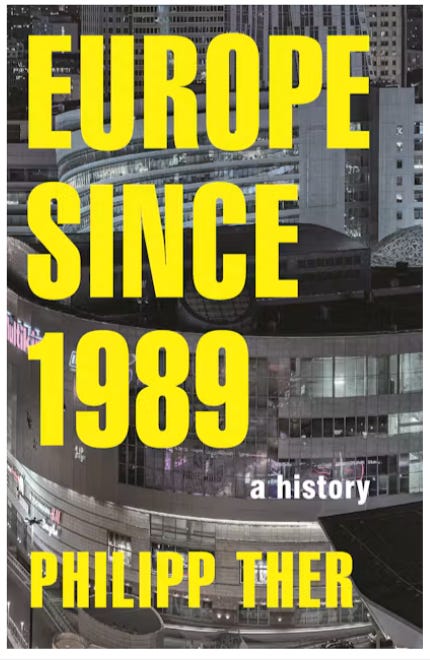
The year 1989 brought the fall of the Berlin Wall and the collapse of communism in Eastern Europe. It was also the year that the economic theories of Reagan, Thatcher, and the Chicago School achieved global dominance. And it was these neoliberal ideas that largely determined the course of the political, economic, and social changes that transformed Europe—both east and west—over the next quarter century. This award-winning book provides the first comprehensive history of post-1989 Europe.
Philipp Ther—a firsthand witness to many of the transformations, from Czechoslovakia during the Velvet Revolution to postcommunist Poland and Ukraine—offers a sweeping narrative filled with vivid details and memorable stories. He describes how liberalization, deregulation, and privatization had catastrophic effects on former Soviet Bloc countries. He refutes the idea that this economic “shock therapy” was the basis of later growth, arguing that human capital and the “transformation from below” determined economic success or failure. Most important, he shows how the capitalist West’s effort to reshape Eastern Europe in its own likeness ended up reshaping Western Europe as well, in part by accelerating the pace and scope of neoliberal reforms in the West, particularly in reunified Germany. Finally, bringing the story up to the present, Ther compares events in Eastern and Southern Europe leading up to and following the 2008–9 global financial crisis.
A compelling and often-surprising account of how the new order of the New Europe was wrought from the chaotic aftermath of the Cold War, this is essential reading for understanding Europe today.
Vol. 43 No. 1 · 7 January 2021
Ever Closer Union?
Share on BlueskyShare on FacebookEmailPrint
15,258 words
Quantitatively speaking, the shift in the centre of gravity of work on the EU from America to Europe itself has been a product of a now vast academic industry: some five hundred Jean Monnet chairs are currently planted across the Union. In the midst of a sea of conformity, a cluster of thinkers has emerged whose writing represents a qualitative advance in critical understanding of the Union. In independence of spirit closer in type to Gramsci’s ‘traditional’ intellectuals, as distinct from the ‘organic’ variant represented by Luuk van Middelaar, these are not to be found nestling in official positions; form no collective school of thought; and are of diverse national and generational backgrounds. A short list would include Giandomenico Majone (Italy), theorist of regulation; the jurists Dieter Grimm (Germany) and Thomas Horsley (Britain); the sociologists Claus Offe and Wolfgang Streeck (Germany); the political scientists Christopher Bickerton (Britain), Morten Rasmussen (Denmark) and Antoine Vauchez (France); the historians Kiran Klaus Patel (Germany) and Vera Fritz (Luxembourg). In the work of these and other scholars, the dynamics of European integration emerge in a cooler, more searching light than in van Middelaar’s panegyrics, revealing what these omit and scrutinising what they don’t with a finer lens.
The Union, as we know it today, is a complex composed of five principal institutions: the European Commission, the European Court of Justice, the European Parliament, the European Council and the European Central Bank. A consideration of these can begin with the term conventionally encompassing the story of their development, ‘European integration’. This came from America, as Patel has shown, and was adopted to avoid another term too pointed for tactical purposes in the politics of the 1950s. The word it replaced was ‘federation’, rejected by governments and what interested opinion then existed, if ardently espoused by a small but committed minority of activists. For them and their academic sympathisers, ‘integration’ supplied a more neutral term for progress towards an ideal best kept, for time being, in petto. Nowhere was it more helpful than in characterising the work of the Court of Justice, which was, as van Middelaar emphasises, the first mover in the ‘passage to Europe’ after the Treaty of Rome.
Today the court remains, of all Union institutions, the most withdrawn from the public. Discreetly situated in Luxembourg, not exactly a European crossroads, and composed of judges appointed – one per country – by member states, its proceedings are hidden from public scrutiny; its decisions permit no admission of dissent; its archives grant minimal access to researchers. In modus operandi, the ECJ is the antithesis of the US Supreme Court, whose emoluments it comfortably tops – its president receives a salary worth $400,000, plus many allowances; the chief justice in Washington a measly $277,000. Its origins date back to the first stage of integration: the European Coal and Steel Community (ECSC) born of the Schuman Plan was endowed with a Court of Justice that was rolled forward into the European Economic Community set up by the Treaty of Rome five years later, and then into the European Union created at Maastricht.
Thanks to the pioneering work of a young historian from Luxembourg, Vera Fritz, we now have a detailed scholarly study of the composition of the court in the first twenty years of its existence. Her findings are illuminating. There were seven founding judges and two advocates-general. Who were they? The Italian president of the court, Massimo Pilotti, had been deputy secretary-general of the League of Nations in the 1930s. There he acted as the long arm of the fascist regime in Rome, advising Mussolini on what counter-measures to take to shield Italy from condemnation by the League for its actions in Ethiopia. On resigning his post in 1937, Pilotti took part in the celebrations in Genoa of the conquest of Ethiopia; and during the Second World War headed the high court of occupied Ljubljana after Italy’s annexation of Slovenia, where resistance was met with mass deportations, concentration camps, and police and military repression. The German judge on the court, Otto Riese, was so devoted a Nazi that without any duress – he spent the war as an academic in Switzerland – he retained his membership of the NSDAP until 1945. His compatriot Karl Roemer, an advocate-general to the court, spent the war in occupied Paris managing French companies and banks for the Third Reich; after the war, he married Adenauer’s niece, and acted as defence lawyer for the Waffen SS charged with responsibility for the massacre of the occupants of the French village of Oradour. The other advocate-general, Maurice Lagrange, was a senior functionary in the Vichy government, fully committed to the ideology of a ‘National Revolution’ to sweep away the legacy of the Third Republic. Acting as link-man between the judicial apparatus of the Conseil d’État and the political apparatus of the Council of Ministers, Lagrange was in charge of co-ordinating the first wave of persecution of French Jews. When Laval took over the reins of Vichy in 1942, transferring Lagrange back to the Conseil d’État, Pétain thanked him for his ‘rare perseverance’ in the regime’s legislative and administrative work, to which Lagrange replied that ‘for me it has been a great privilege to be so closely associated with the enterprise of national renovation you have undertaken for the salvation of our country. I am convinced that every Frenchman can and should take part in this work.’ After the war he was chosen by the Americans to help democratise the civil service in Germany, and by Monnet to help draft the treaty establishing the Coal and Steel Community.
That figures like these were the ornaments of Europe’s first Court of Justice reflected, of course, the closing of political ranks after the Cold War set in, when what mattered was not the misdeeds of the fascist past but the menace of communist present. It was a time when the last commander of the Charlemagne Division of the SS, fighting to the last bullet to defend Hitler in his bunker, could emerge as best choice for the Robert Schuman Prize for services to European unity.* Why should European justice too not let bygones be bygones? More generally, appointments to the court had little or nothing to do with juridical qualifications. Nearly all were political. The Belgian judge was a leading figure in the Catholic Party of his country; one of the Dutch judges was the brother of a prewar foreign minister; the French judge, Jacques Rueff, a former deputy governor of the Banque de France, was one of the founders of the Centre National des Indépendants et Paysans; a Catholic trade unionist from the Netherlands and a socialist magistrate from Luxembourg rounded out the set.
Among the next levy of judges were a founder of the Christian Democratic Union (CDU) in Berlin, later a deputy for the party in the Bundestag; the son of a leader of the Anti-Revolutionary Party (Calvinist) in the Netherlands; a former aide to Dino Grandi, minister of justice for the Duce, and brother of the then finance minister in Italy; a co-founder of the Christian Social Party in Belgium; a one-time Nazi and stalwart of the SA (1933 vintage), latterly a Social Democrat in Germany; a long-time functionary in the Italian colonisation of Rhodes; a former chef de cabinet to the civil and military governor of Algeria. Justice à l’européenne was never blindfold: its eyes were wide open, and round its head was a bandana gaudy with the colours of the establishment parties of the time.
The second wave of appointees also included one who was, in the words of an admirer, Europe’s equivalent of John Marshall, the patriarch of the Supreme Court in the US, responsible for establishing its authority across the land. Robert Lecourt was a leading politician in the French version of the Christian Democratic parties of Italy and Germany, the Mouvement Républicain Populaire (MRP), which formed part of every government of the Fourth Republic, for which it supplied the second and second to last prime ministers. The most significant difference between the MRP and its equivalents in Rome and Bonn was that France possessed a large colonial empire of which the party was a zealous defender, resolute in prosecuting the country’s wars in Indochina and Algeria. Joining de Gaulle’s government with the arrival of the Fifth Republic in 1958, the MRP split over his announcement of a referendum on self-determination in Algeria. The party’s long-standing leader, Georges Bidault, joined the paramilitary OAS, which launched armed resistance against de Gaulle in the name of Algérie française and narrowly failed to assassinate him, while his colleagues in the party hewed to de Gaulle. Lecourt, who like Bidault and others in the party had been active in the Resistance, had a doctorate in law and served as minister of justice in 1948, 1949 and 1957. Under de Gaulle, he held portfolios for France’s colonies in Africa and elsewhere. In May 1962, he was appointed to the European Court of Justice.
…
https://www.lrb.co.uk/the-paper/v43/n01/perry-anderson/ever-closer-union
…
90,939 views Nov 13, 2026 Martin Wolf on the World
Before the 2026 midterms, Timothy Garton Ash, emeritus professor of European studies at the University of Oxford and author of ‘Europe in 7½ Chapters’, described the elections as a crucial test of US democracy.
Now, with the Democrats’ sweeping victory, could the tide be turning against rightwing populism on both sides of the Atlantic or will Europe’s nationalist parties continue to gain ground? Garton Ash and Martin Wolf discuss the common factors between European nationalists, what European politicians can learn from a Democrat victory and whether there’s reason to hope for the future of liberal democracy.
To enjoy future episodes, be sure to subscribe to ‘Martin Wolf on the World’ wherever you get your podcasts.
Host: Martin Wolf
Producer: Mischa Frankl-Duval
Senior producers: Edwin Lane, Laurence Knight
Executive producer: Manuela Saragosa
Video editor: Richard Topping
Senior Audio Engineer: Breen Turner
Broadcast engineers: Andrew Georgiades
Podcast development: Laura Clarke
FT Global Head of Audio: Flo Phillips
Learn more at http://www.ft.com/martin-wolf-on-the-world
/ financialtimes


