https://ndpr.nd.edu/reviews/against-aristotelian-character-education-practical-wisdom-flourishing-and-liberal-democracy/
May 02, 2026
Against Aristotelian Character Education: Practical Wisdom, Flourishing, and Liberal Democracy
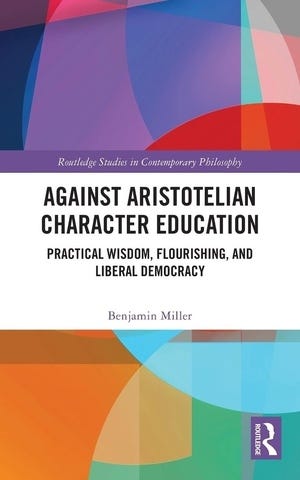
Benjamin Miller, Against Aristotelian Character Education: Practical Wisdom, Flourishing, and Liberal Democracy, Routledge, 2025, 290pp., $160.00 (hbk) ISBN 9781032960685.
Reviewed by Kirsten Welch, Baylor University
2026.05.1
Character education is having a heyday. Established in 2012 at the University of Birmingham, the Jubilee Centre for Character and Virtue is just one among many organizations dedicated to furthering character education; the Centre claims to have influenced education in the UK and beyond, having formed partnerships with other character-focused organizations and individuals in over 175 countries (Harrison, 2023). The Jubilee Centre, in good company with many of its peer organizations, draws explicitly on Aristotelian foundations and centers its character education framework on concepts of human flourishing and phronesis (Jubilee Centre, 2022).
It is against this backdrop that Benjamin Miller presents the argument of his book Against Aristotelian Character Education: Practical Wisdom, Flourishing, and Liberal Democracy. Whereas many Aristotelians and neo-Aristotelians trot along their merry way, invoking ideas from Aristotle as they shape contemporary character education initiatives, Miller demands that these educators slow down and consider whether this path is in fact one they ought to be following. His book considers a simple but too often unasked question: Is Aristotelian character education actually compatible with liberal democracy?
Miller’s answer to this question is a firm “no”. His basic argument is as follows:
1. Either we can practice Aristotelian character education, or we can support liberalism, but we cannot do both.
2. We ought to support liberalism.
3. Therefore, we must not practice Aristotelian character education.
Against Aristotelian Character Education focuses primarily on establishing the truth of the disjunctive first premise; in other words, Miller’s main concern is to demonstrate the incompatibility of Aristotelian (and also any variety of neo-Aristotelian) character education with liberal democracy. Although, as Miller acknowledges, there are some thinkers who argue that the second premise is false (in other words, that we should give up on liberalism), he notes that most people who endorse some version of Aristotle-inspired character education also consider themselves to be staunchly in favor of liberalism. “Liberalism is the bedrock justification for civil liberties” (240) writes Miller; therefore, giving up on liberalism means giving up on “the types of personal freedom and equality that characterizes [sic] democracies around the world today” (41). This, he thinks, is not a bullet even most die-hard Aristotelians would be willing to bite.
Miller’s argument for the truth of the first premise above divides into two main steps. In the first half of the book, through some careful exegetical work focused on the Nicomachean Ethics, Eudemian Ethics, and Politics, Miller seeks to establish that, for Aristotle, being virtuous involves what he calls an “extensive knowledge requirement”. This extensive knowledge requirement takes the form of a “specifiable, detailed, and complete value theory” (43), which includes a correct conception of the best human life. Expressed negatively, the extensive knowledge requirement says that it is impossible to be virtuous without extensive knowledge of what is objectively valuable in the world, in what order those things are valuable, and why those things are valuable.
Miller offers three separate arguments in support of the extensive knowledge requirement. First, he surveys what Aristotle explicitly has to say about the knowledge needed for virtue, making a presumptive case for the truth of the extensive knowledge requirement. Second, turning to Eudemian Ethics 8.3 and Politics 2.9, he examines Aristotle’s critique of the Spartan regime in order to show that extensive ethical knowledge is required for virtue—the Spartan regime failed because the Spartans “get the order of the value hierarchy wrong” (96), which means that the Spartans are wrong about what it means to flourish as a human being. And third, Miller argues that extensive political knowledge is required for virtue because, for Aristotle, political expertise and practical wisdom are exactly the same thing: “the fully virtuous person must have extensive knowledge related to politics to be virtuous, because this knowledge is part of practical wisdom” (111).
Miller’s argument here relies on the way in which practical wisdom is an integral feature of Aristotle’s virtue theory. Miller’s interpretive argument is compelling, and in my view, one of the most significant contributions in this first part of the book is the way in which he reveals how many scholars within Aristotle studies “are at least implicitly committed” to the extensive knowledge requirement, even though they often leave this commitment unstated or even seek to deny it (79).
Miller’s main audience, however, is not other scholars of Aristotelian texts. Rather, he makes a point of identifying his intended audience as those who seek to apply Aristotelian thought to the sphere of education (4). It is to this audience that he turns in the second half of the book, addressing this question: If we’re going to do some version of Aristotelian character education, what must we necessarily import along with it? Must we also endorse the extensive knowledge requirement? Miller offers a resounding “yes!”, claiming that his main goal for the non-specialist applicators of Aristotle in his audience is “to recognize that the Aristotelian theory of virtue, even modernized versions of it, are inexorably committed to the view that Aristotelian virtues require Aristotelian values” (44). Miller argues that, if contemporary character educators want to hang onto the most attractive features of Aristotle’s theory—his focus on human flourishing and his integration of practical wisdom—then they too must endorse something along the lines of the extensive knowledge requirement for virtue.
The problem, of course, is that endorsing the extensive knowledge requirement is exactly the thing that makes Aristotelian character education incompatible with liberalism. The extensive knowledge requirement ought to make Aristotelian character education a non-starter for anyone committed to liberalism because of the way in which liberalism involves endorsement of two central features, pluralism and antipaternalism, both of which stem from and are necessary for liberalism’s commitment to equality and freedom. Pluralism, according to Miller, is “the idea that there are many different and incompatible ways of living a good human life” (152), and antipaternalism is “the idea that the government should not forcibly impose ways of valuing, believing, and living on its citizens using the argument that the government knows better than the citizens what is best for them” (152).
But, because “Aristotelian virtues require Aristotelian values”, practicing Aristotelian character education involves affirming and educating students into one and only one ultimate vision of the good life. Therefore, Aristotelian character education cannot allow for pluralism. Similarly, any attempts at this sort of character education will necessarily involve imposing ways of valuing on people that they themselves have not chosen. Therefore, Aristotelian character education violates the principle of antipaternalism. As a result, Aristotelian character education undermines equality and freedom and has no place in a liberal society.
Miller argues that even the best recent attempts to avoid these pitfalls fail to do so; he considers Kristjánsson’s (2015) ACE theory and Curren’s (2013) Aristotelian necessities theory as two influential examples. There are at least two ways in which neo-Aristotelian character educators might try to escape the strong demands of the extensive knowledge requirement. First, they might seek to “soften” the contents of Aristotelian value theory, hedging on what exactly constitutes “human flourishing”. This approach is an attempt to deny that the knowledge required for virtue must be extensive and is at the heart of the “thick but vague” strategy, which tries to present a conception of human flourishing that is thick (so that it can ground character education) but also vague (so that it can accommodate various understandings of the good life).
Miller’s contention is that gutting a conception of the good human life enough to make it compatible with liberalism requires us to give up on thinking about the good human life in terms of objective “flourishing” because of the way in which that flourishing, within an Aristotelian framework, depends on having extensive knowledge of what a good human life is. But backing away from the centrality of human flourishing undermines Aristotelian character education both by making it unfeasible (it depends on an appeal to flourishing) and by undermining one central motivation for pursuing it in the first place, which is to help people flourish as human beings.
The second way in which character educators who want to hold onto an Aristotelian approach might resist Miller’s argument is by rejecting the claim that knowledge of value is a requirement for virtue. If we need not convey knowledge of value to students in order to engage in character education, then we need not violate the principles of pluralism and antipaternalism, because we are not telling anybody what they ought to care about or believe. Miller argues that this sort of strategy likewise fails because to say that virtue does not require knowledge is to completely undermine the virtue of practical wisdom, which is a type of knowledge about value.
There are two main consequences of this strategy: first, practical wisdom is the virtue that makes all the other Aristotelian virtues possible, so throwing it out makes Aristotelian character education impossible; and second, practical wisdom is the other main feature of Aristotle’s approach that makes him so attractive, so throwing it out makes Aristotelian character education much less appealing. The upshot of the second half of the book is that Miller attacks Aristotelian character education where it hurts most: he shows how two of its most attractive features—a focus on human flourishing and the centrality of practical wisdom—are the very things that make it incompatible with liberalism and the very things that must be abandoned by anyone who is committed to supporting liberal democracy.
Miller’s argument is clear and compelling, and his book enters into a conversation that is crucial to continue within the field of character education. Against Aristotelian Character Education, nevertheless, leaves several important questions hanging. These questions do not undermine Miller’s project in this particular book—in fact, the two I bring up here are ones he notes that he does not have the time or space to address fully—but I raise them here in the spirit of continuing the conversation where Miller leaves off.
First, Miller notes early on that his argument is meant to apply only to public education (35). Private education, insofar as it is not mandatory, does not run the risk of undermining liberalism in the same way that state-sponsored public education does. Although Miller makes it clear that this is not his area of concern, it is an area that is worthy of exploration with respect to Miller’s argument, especially given that many Aristotle-inspired character education initiatives do happen in private educational contexts. Does Miller’s argument against Aristotelian character education undermine the projects of these contexts too?
Second, Miller’s suggestion at the end of the book is to shift the focus of character educators to the cultivation of “civic virtues”, especially civic virtues that “can help to mediate potential conflicts between citizens’ personal worldviews and their commitments to democratic freedom and equality” (31). Miller is sure to point out that his recommendations here are, in many senses, preliminary, and I agree that fleshing them out is a project beyond the scope of this current book. Nevertheless, I was left wondering about how exactly Miller conceives of “civic virtue” and whether such a virtue—especially one that mediates “potential conflicts” between personal worldviews and commitments to freedom and equality—could itself escape the demand of some sort of extensive knowledge requirement regarding a value hierarchy.
Against Aristotelian Character Education deserves the careful attention of both Aristotle scholars and those who seek to apply Aristotelian insights to the sphere of education. Aristotle interpreters, translators, and applicators alike should take note and seriously consider Miller’s challenge to interrogate more closely the commitments that underlie the work of character education.
REFERENCES
Curren, Randall, 2013, “A Neo-Aristotelian Account of Education, Justice, and the Human Good,” Theory and Research in Education, 11 (3): 231-249.
Harrison, Tom, 2023, “Welcome,” The Jubilee Centre for Character and Virtues. University of Birmingham. https://www.jubileecentre.ac.uk/about/welcome/
Jubilee Centre for Character and Virtues. (2022). The Jubilee Centre Framework for Character Education in Schools (3rdedition). University of Birmingham. https://www.jubileecentre.ac.uk/wp-content/uploads/2024/12/The-Jubilee-Centre-Framework-for-Character-Education-in-Schools.pdf
Kristjánsson, Kristján, 2015, Aristotelian Character Education, New York: Routledge.


