Apr 18, 2026
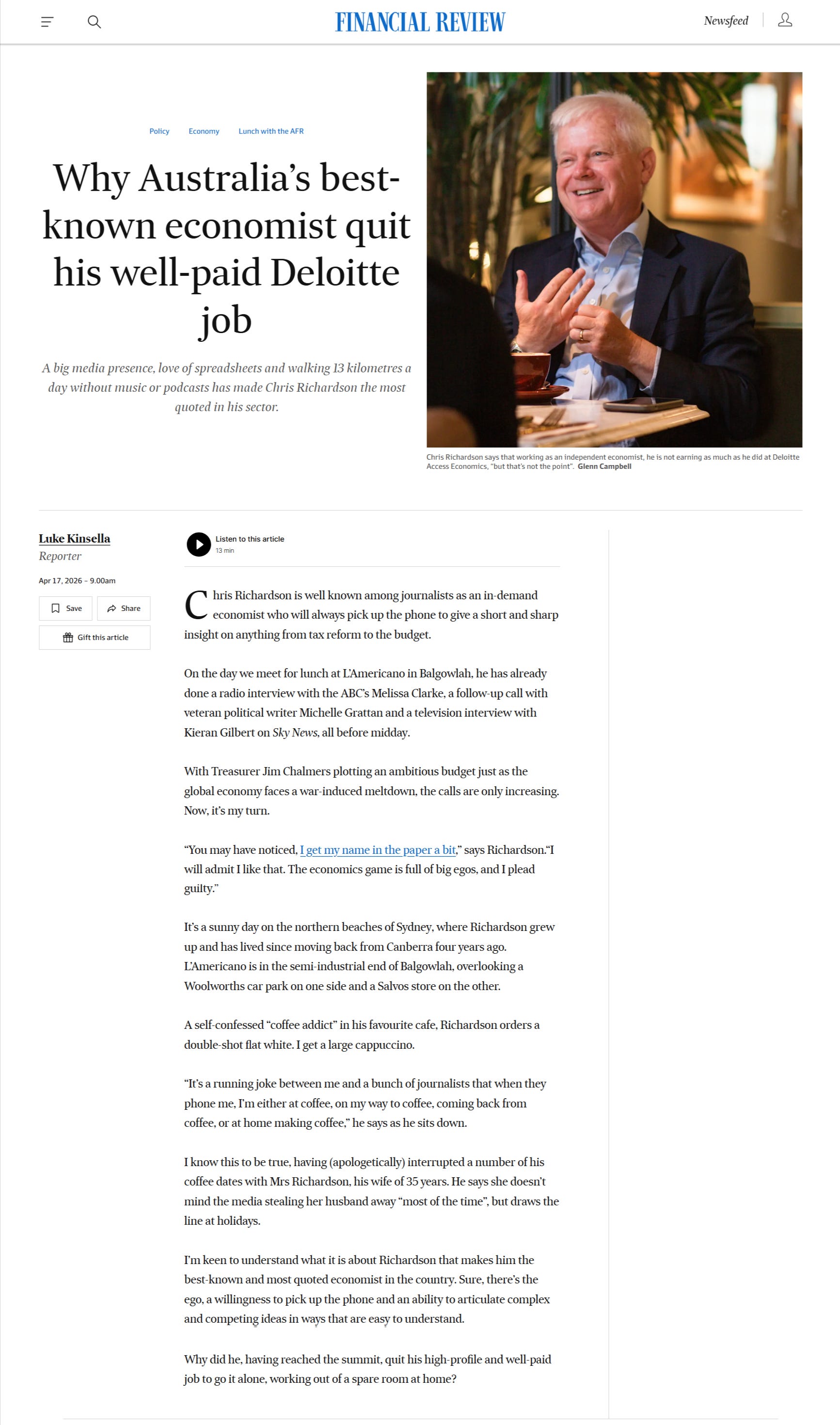
…
Richardson’s goal is to be the most trusted economist in the country. He says trust in economics, politicians and the media is under pressure and making the job of economic reform harder.
“Everybody needs a sense of purpose, and mine is to explain what the hell is going on and help the national conversation,” he says.“You journalists are searching for understanding, and it’s a privilege to be asked to help.”
Richardson’s mother was a teacher and his father was an economist at Westpac, so I ask whether he is following in the footsteps of both.
“I’ve never thought of it like that, but that would make a lot of sense,” he says.
“I’ve always really admired teachers. They often get to see the moment where they make a difference, which is when the person they’re explaining something to finally gets it. That’s a moment of pure joy.”
He says a common phrase in the Richardson household is “to be fair”, one he got from his parents and passed on to his kids, and which is foundational to his economic thinking.
“You need to actively try to see the other side of an argument.”
Richardson flips a switch and becomes Mr Richardson (the teacher mode journalists are familiar with), explaining what he thinks are the two basic goals of any economy: prosperity and fairness.
“The underlying assumption is that the two are in competition, but they work hand in hand,” he says.
“If you can get the prosperity right, it’s easier to get the fairness right. In fact, a lot of the angst and the fights around the distribution of the pie come back to our failures on prosperity.
“The most prosperous countries are the fairest countries.”
We’re a short drive from where Richardson went to school at St Augustine’s College in Brookvale, where his love of economics and numbers began.
He went on to the University of Sydney, where he won the University Medal in economics in 1982, which he gave to his high school mathematics teacher, Mrs Binstead, as thanks.
…
Political Observer.


