American Enterprise Institute (AEI), a private nonprofit American institution of research founded in 1943 by American industrialist Lewis H. Brown. One of the oldest and most-influential think tanks in the United States, it supports limited government, private enterprise, and democratic capitalism. Its headquarters are in Washington, D.C.
AEI originally consisted of 12 resident thinkers who set up the institute to serve as an advocate for big business and the promotion of free enterprise. It became a major research organization and think tank in the 1970s, under the leadership of William Baroody, Sr., who served as president of the institute until 1978. During his presidency the AEI expanded to 145 resident scholars, 80 adjunct scholars, and a large support staff.
From its founding the AEI played a prominent role in politics in the United States, and people affiliated with the organization have served in influential government positions. Its influence grew stronger during the administration of Pres. George W. Bush, in which Dick Cheney, an AEI member, served as vice president of the United States. Also, because most of the AEI’s board of directors are typically CEOs of major U.S. companies, the organization can also exercise considerable influence through its connections in the business world.
Editor: Does Mr. Brands 4012 word essay move any reader to pay close attention to this political monstorsity, as it evolves in the telling? Reader the only course open to the reader is Selective Quotation from this exercise in __________? Or should that Reader think of The Age Of Feacture? as a possible or even an attemp at considerations beyond his ken?
Polemic is a discourse of conflict, whose effect depends on a delicate balance between the requirements of truth and the enticements of anger, the duty to argue and the zest to inflame. Its rhetoric allows, even enforces, a certain figurative licence. Like epitaphs in Johnson’s adage, it is not under oath.
Headline: After Catalans, Italian regions step up autonomy call
Sub-headline:Northern League uses Lombardy and Veneto referendums to push for special status
Its not just the European Project that is under threat from the dreaded Populist Monster , but the Nation State, the very foundation of Monnet’s Coal and Steel cartel, that suffers from the pretensions of Democracy, as it has evolved. First the long historical evolution of Catalan, and now the lukewarm votes in Lombardy and Veneto for ‘more autonomy’, approved by the Italian Constitutional Court.
This ambiguous position is reflected in Sunday’s referendums, which are consultative and non-binding. They are carefully phrased to ask voters if they want more “autonomy” without threatening “national unity”. Unlike the Catalan vote they have been approved by the Italian constitutional court.
As informative as this news story by Rachel Sanderson is, as to the political actors in the Italian politics of the present, should the reader look to Daniel T. Rogers’ book ‘Age of Fracture‘, written in an American political/historical/economic context, for a telling simile/metaphor for the evolving European crisis? That describes both the EU and the Nation State, caught in the rip tide of history, exacerbated by the utterly failed Neo-Liberal Dispensation?
Foreign Policy is a global affairs magazine offering diverse perspectives on issues shaping nations and the world.
The war in the Persian Gulf has created global shock waves—by roiling the world economy, unsettling U.S. alliances, creating epic disruptions to freedom of navigation, and bringing the nuclear nonproliferation order to a tipping point. But one of the most important and potentially destabilizing implications of this conflict has been to throw U.S. strategic insolvency into harsh relief.
The war has featured impressive tactical feats by the United States and Israel, such as the killing of dozens of high-ranking Iranian officials in the opening hours of the fight. The capabilities on display over Tehran—and U.S. President Donald Trump’s penchant for military risk-taking—have surely been sobering for Washington’s adversaries in Moscow and Beijing. Yet the war has had more ambiguous, sometimes damaging, strategic outcomes. It has also caused an alarming depletion of key U.S. weapons stockpiles while ripping capabilities away from other dangerous theaters. In short, the conflict has badly strained a military that has been trying to do too much with too little for far too long.
There’s a saying in the Defense Department that every U.S. war plan is an existential threat to all the other war plans. A draining conflict in the Middle East may make it harder for Washington to deter a far more devastating fight in the Western Pacific—and usher in a dangerous period in which an overtaxed U.S. military struggles to respond to surging global risks.
Danger doesn’t have to bring disaster: It’s possible that the United States will navigate the coming years without a catastrophic failure of deterrence. Crises can have silver linings: If this crisis catalyzes greater, sustained urgency in closing the gap between the Pentagon’s sprawling commitments and its all-too-finite capabilities, it may have a salutary strategic effect. But the period immediately ahead looks menacing. The world is getting more violent and more disordered—just as Trump’s war has made Washington’s chronic overstretch more acute.
Trump didn’t create the problem of U.S. military and strategic overstretch. It has been building across multiple presidencies.
Over the past two decades, the global threat environment has gotten uglier and more crowded. A country that once towered over adversaries now faces challenges from revisionist great powers, angry rogue states, and tenacious nonstate foes. Looming above all other dangers is a new cold war—with the risk of a catastrophic hot war—against a relentlessly arming China. Yet the United States has sought to handle what increasingly looks like a perilous prewar situation with a post-Cold War approach to military spending. U.S. defense budgets, typically between 3 and 4 percent of GDP, have remained low by historical standards. Fatigue from long wars in Iraq and Afghanistan after 9/11 made the politics of defense more difficult. The predictable result has been a growing mismatch between Washington’s global commitments and its military resources—a mismatch that one nonpartisan expert commission after another has identified and that one administration after another has tried and failed to fix.
The seemingly perpetual pattern is one in which each new administration promises to better apportion scarce resources through stricter prioritization—only to end up intervening in precisely those places it aimed to avoid. Barack Obama promised a pivot to the Pacific but ended up mired back in the Middle East. The first Trump administration touted the return of great-power rivalry but was then consumed by crises with North Korea and Iran. Joe Biden sought to stabilize relations with Moscow and Tehran so that the Pentagon could finally gear up for China. But then Russia launched a full-scale invasion of Ukraine in 2022, and the Middle East exploded a year later. The desire for focus and the divestment of lesser problems has consistently collided with the realities of a messy world in which Washington still has global interests. Trump’s second term was supposed to fix this problem but made it much worse.
Let me disagree with the characterization of Marcia Greenberger in regards to the comments of Justice Scalia as ‘shocking’. There is nothing ‘shocking’, prima facie, in the comments of Scalia regarding women, women’s rights etc., they are in fact totally predictable and Ms. Greenberger doesn’t use the opportunity to speak to the intelligence of her audience but panders to level of propaganda; the stilted language of the ‘press release’. Scalia is a political romantic and his ‘philosophy’ flows from the concept of unbridled male power and its care and maintenance. ‘Originalism’ then grows out of that romanticism as simply a reification of his naturally felt and expressed superiority. What counts here is not appealing to an utterly bankrupt press but to historically verifiable actualities. Conservatism is by its very nature about the privileging of male power as beyond the appeals of reason or even the changing nature of our political/ethical world as it evolves into the future: heedless of the political or moral will of a minority of ‘thinkers’ and ‘activists judges’ who resemble King John ordering the tides to cease: this being a definition of the utter futility of the sovereign male in all his guises.
Senate Minority Leader Chuck Schumer takes $1,727,974 from AIPAC
Senator Susan Collins of Maine $646,758 she has received from AIPAC.
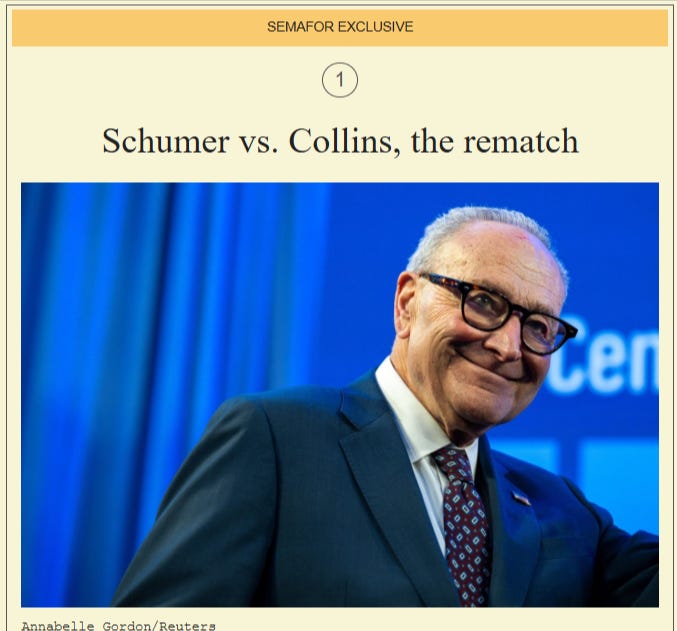
Senate Minority Leader Chuck Schumer is still intensely focused on ousting Sen. Susan Collins, R-Maine, despite divisions in his caucus over her opponent, Graham Platner, Semafor’s Burgess Everett reports off a new interview with Schumer. “We’re going to beat Susan Collins and take back the majority,” Schumer said, ticking off three reasons why he thinks Collins will lose: Medicaid cuts hitting Maine, her handling of President Donald Trump, and resentment over the end of Roe v. Wade. Collins told Semafor separately she’s seen this before — and won: “We heard the same song six years ago, exactly.” And she praised the Democrats who aren’t backing Platner: “That shows discernment, integrity, and wisdom on their part.” Schumer made sure to widen his path to the majority to six seats, and offered up a new catchphrase about Trump’s second midterm: “Costs, chaos and corruption.”
This reader can only marvel at the Chief Justice John Roberts daring to present himself as the ‘voice of reason’ in contradistinction to Trump’s Know-Nothingism. That the leader of the Neo-Confederate/Originalist coterie, that now dominates the Supreme Court, and the author of the opinion of that Court, in the matter of Shelby County v. Holder. With the aid of Judicial Troglodyte Antonin Scalia’s ‘red head’ , a dull-witted pseudo- argument, that passed for an adequate reply to Justice Ginsberg’s eviscerating dissent, demonstrates the desperation of the whole of America’s political class.
That both Scalia and Roberts were/are the front men for a Federalist Society’s blatant racism under the rubric, self-apologetic of ‘Originalism’. That Brown v. Board I and II, presented as ‘Sociology’ rather than ‘Law’ is about the recrudescence of the Dixiecrats in the garb of bourgeouise political respectability: The Federalist Society!
Such is the desperation, indeed the political malevolence of these civic actors, that they look to Learned Hand’s ‘evolution’ of the question of Brown I and II :
That practice exemplified the pursuit of justice within the bounds of the law. Hand was a lot more comfortable working within that firm constraint than in dealing with the very broad terms of the Constitution. He was intrepid about deciding what was properly before his court and scrupulous about refusing to make decisions about matters that were not—a version of judicial restraint far more realistic and less severe than what he vainly preached about restraint in applying the Constitution. It was this pragmatic, disciplined, and fair-minded approach and Hand’s trenchant, dignified, and urbane application of it that made him so admired by lawyers across the legal spectrum.
‘Judicial restraint’ is another name for rationalization of injustice, because state legislatures were never going to recognize, that the lives and the psychic and psychological health and well being of black children was a moral and civic imperative! Warren and eight other Justices made that commitment to those children, and the fate of the Nation ‘conceived in Liberty’ for some and not for others!
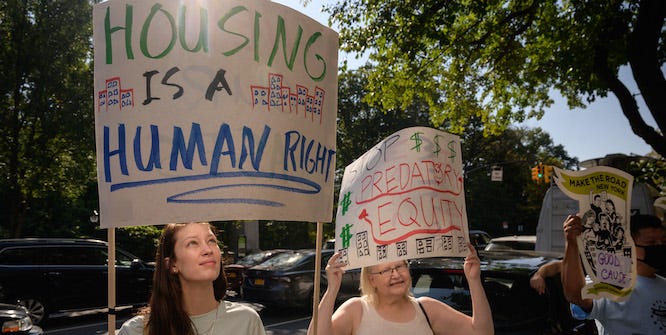
Protesters and tenants facing displacement hold placards as they attend a rally against private equity-backed firm Greenbrook Partners in Brooklyn, New York on October 15, 2021. (Ed Jones/AFP via Getty Images)
After a long journey through the academy and into public discourse, neoliberalism has finally been widely accepted as a description of post-1970s economic reality. But recent political developments, especially since the pandemic, have generated discussion about the possibility that something new is emerging.
We asked three historians whether we are witnessing the end of neoliberalism. Amy C. Offner and Gary Gerstle also responded.
—Editors
In a January 2018 Dissent forum, I argued that neoliberalism is a useful term for identifying and conceptualizing a “multifaceted configuration of power against which a diverse, democratic left could and should unite.”
A lot has happened since then. The COVID-19 pandemic revealed that our social safety net lay in tatters. Episodes of escalating climate crisis are unmistakable. Movements for black lives have identified racial capitalism—including neoliberal variety—as a root cause of racial injustice. The neoliberal order has been exposed as fraudulent, inefficient, and inequitable.
Yet despite some significant advances by the left, neoliberalism hardly lies in the dustbin of history. Here’s an update on the four core features of neoliberalism that I identified in 2018.
1) Neoliberalism refers to a set of coherent but flexible ideas centered on the belief that markets organize society best. Financial markets hold primary place in the neoliberal model of the market, where investment and investors play pivotal roles.
Despite the egregious failures and enduring crises of private-sector financial markets and institutions in recent years, neoliberal claims about their efficacy endure. The same goes for the neoliberal commitment to maximizing returns to shareholders.
The notion that we need what Mariana Mazzucato calls an “entrepreneurial state”—rather than laissez-faire financial markets—to fund large-scale, long-term investments for public purposes has gained traction during the Biden administration, influencing the 2021 Infrastructure Investment and Jobs Act and the 2022 CHIPS and Science Act. Even so, the president has repeatedly genuflected to Silicon Valley entrepreneurs and their financial backers. As long as they continue to wield power and influence within the White House, and as long as they keep up their campaign contributions to politicians of both parties, neoliberal dogma about private-sector financial markets will continue to inform economic policy. And it would seem that those financiers continue to dodge reputational damage.
None of this damaged the ability of VC, PE, and other managers of private market assets—that is, assets that are not listed on public exchanges—to raise money from investors. Fundraising soared to all-time highs in 2021 and 2022. These firms now sit on a stunning $3 trillion in “dry powder”—funds they haven’t bothered to invest (even as they collect management fees).
Meanwhile, corporations continue to prioritize stock buy-backs to boost the price of their shares, rather than making investments in research, development, production, or jobs. In 2022, S&P 500 corporations set a new record by repurchasing $1.26 trillion of their own stock. Pharmaceutical and biotech corporations’ buy-backsenriched executivesat the expense of research and development for new vaccines and treatments for COVID-19 and everything else. American chip-makers now need federal support because they squandered $168 billion on share repurchases between 2010 and 2021. The major airlines, meanwhile, spent a whopping 96 percent of their cash flows in the last decade to repurchase their own shares, resulting in billions in bailouts during the pandemic. Pressure from unions may have prevented the airlines from resuming buy-backs once federally mandated prohibitions expired; railroad unions have launched a similar campaign after the Norfolk Southern disaster in East Palestine, Ohio, in February.
Finally, it’s possible that new approaches to monetary policy helped repel another Volcker Shock in response to the recent rise in inflation. Even so, as soon as wages—especially for low-paid workers—began to reverse their forty-year decline relative to asset prices, the Federal Reserve raised interest rates.
2) Neoliberalism is a range of policies and institutions that release markets from restraints that democracy might impose and that reconfigure the state and civil society in the image of the market. Neoliberal policy and institutions give priority to investment and investors.
Neoliberal tenets about financial markets, investment, and investors persist because these beliefs suffuse a century’s worth of economic policy.
Over the last forty years, U.S. households borrowed vast amounts of money to take advantage of these tax breaks to acquire homes, retirement portfolios, insurance policies, and savings accounts for healthcare and higher education. These leveraged, self-managed, individualized safety nets proved flimsy. When the inevitable financial crises hit in 2008 and 2020, the federal government chose to rescue corporations, not citizens. Pandemic-era assistance and income-support programs amounted to a mere fraction of the cost of bailouts and interventions by the Fed. When they expire this fall, Americans will face the full force of the deep, structural problems in our economy.
3) Neoliberalism identifies a specific moment in the history of capitalism. During the period of “financialization” that began in the 1970s, claims over wealth yet to be produced exploded, infiltrated the lives of people across the world, dominated corporate decision-making, and transformed international relations and global governance.
The term neoliberalism references a period since the 1970s in which the financial sector and financial activity have predominated. Mapping the precise contours of financialization helps us to identify points of pressure in our current moment, which is dominated by a specific set of players: asset managers.
U.S. households invest their savings in mutual and pension funds. Asset management companies, in turn, invest funds pooled from households in stocks, bonds, and riskier private-market assets managed by PE, VC, and hedge funds. At present, the industry holds $98 trillion in global assets under management. Private-market assets represent $20 trillion of that total and generate half the industry’s revenue. BlackRock, Vanguard, and State Street together own an estimated 22 percent of the average S&P 500 company, up from 13.5 percent in 2008, according to Boston Consulting Group.
This matters tremendously for how power operates in and through financial markets. Asset managers’ voracious appetite for returns goads the share repurchases mentioned earlier. And collusion and monopolistic practices may occur when asset management firms hold seats on the boards of competing companies. As Americans’ entanglements with finance—as investors and as borrowers—intensified over the last four decades, it was asset managers who gained the upper hand within the corporations in which Americans invested, and the financial institutions that lent to them.
4) Neoliberalism is a disposition toward personal and social life.The neoliberal subject commits himself or herself to accumulating financial and “human capital” for the self and for future generations, always looking to maximize returns on investments of money, time, or emotion.
The Supreme Court’s decision to strike down Biden’s plan for student loan forgiveness threatens to trap students’ dreams for the future in a cage of lifetime indebtedness. For now, we’ll face continued pressure to cultivate ourselves as bearers of human capital while surveillance capitalists enrich themselves by commodifying our personal information.
In 2018, I argued that the term neoliberalism “acknowledges the deep connections between a great many . . . of our most pressing challenges.” It “can help us explore those connections empirically, and to challenge outcomes that are often taken for granted or perceived as inevitable.”
I still believe this. But I wonder, now, how much is at stake in the use or abuse of the term neoliberalism? More pressing, I think, is the need to integrate into our work the concepts—including racial capitalism and the political philosophy of care—that connect best with the social movements of our day. Only on shared discursive terrain can we build a winning political coalition that will put neoliberalism in its grave.
So what would the death of neoliberalism look like?
Congress would abolish tax breaks for income from investment, inheritance, and fund managers’ compensation. The Securities and Exchange Commission would outlaw stock buy-backs (as it did before 1982), or Congress would snuff out the practice with taxation. Federal, state, and local governments would fund public projects for climate repair and resilience, care infrastructure, and reparative justice for African Americans. The Federal Reserve would target interest rates to suppress asset-price inflation and to sustain full employment.
When all Americans enjoy better, more secure public options to achieve well-being and security, when children’s life chances are not determined by the wealth of their parents or grandparents—only then might neoliberalism pass into history.
Julia Ott is an associate professor in the history of capitalism at the New School in New York City. She is the author of When Wall Street Met Main Street (Harvard, 2011) and the upcoming Why Wealth Is White.
Editor: These first paragarpghs of Stephens eviseration of Graham Platner porvides Stephens with an opportunity to sound the notes of Cotton Mather, of another time and place in American History? Reader do I exagerate? this self-serving apologist needs to deflect the from the crimes of the Gaza Genocide? And the crimes of agains Lebanon? Mr. Stephens finds Graham Platner as the perfect atitdote to the crimes of Netanyahu and his cadre? I quote Stephens paragraph as demonstrative of his ‘methology of deceit’ !
It isn’t clear what effect, if any, Graham Platner’s multiplying personal scandals will have on his chances in the Maine Democratic primary that’s occurring as I write this, to say nothing of November’s general election against Susan Collins, the incumbent Republican senator. But there are at least two good, if contradictory, possibilities.
The first is absolution — not only for Platner, but for every nominee or candidate, Republican or Democratic, with a blemished personal history — on the grounds that we elect or install people in high office to achieve the results we desire, not to serve as paragons of moral rectitude. If nothing else, this could make our politics less repellent to talented if imperfect people who now steer clear of public service because they don’t want to put themselves or their families through the inevitable media inquisition that comes with every campaign.
The second is consistent judgment of anyone, Democrat or Republican, who falls far short of clear and unyielding standards of moral conduct. Perhaps this will finally re-erect the political barriers that formerly prevented shameless people, our current president not least, from degrading our politics and setting a putrescent example of what is — and what isn’t — necessary to reach the high places of American life.
What ought to stop is what we have now: inconsistent standards selectively applied according to our political bias.
Lest you’ve been wintering in Antarctica, here’s what’s lately been learned about Platner, the 41-year-old combat veteran and oyster farmer:
That his wife had told a campaign aide that he had been trading sexually explicit messages with six women, and perhaps as many as a dozen, before the beginning of his political run. That a former girlfriend, Lyndsey Fifield, alleges that he lied when he claimed he did not know a chest tattoo he had gotten during his military service strongly resembled an official insignia of the Nazi SS, and that he had once referred to it as “my Totenkopf.” That Fifield also alleges that he had once “twisted her arm behind her back, shoved her into a bedroom and held the door closed from the other side so she couldn’t get out” and that she later described him as “the most toxic literally abusive man on earth.” That she said he referred to women as “hatchet wounds,” using a crude word for female genitalia. That other women romantically connected to Platner also described unsettling behavior.




 StephenKMackSD's Blog