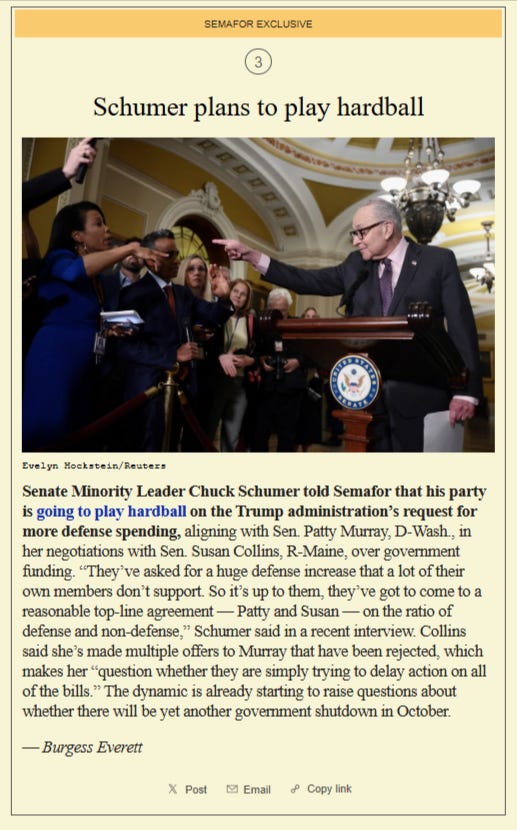
Schumer ,The Clintons & Debby Wasserman Schultz never Play Hareball, they just cash those checks! Semafor pretends that it is Politico…
Jun 16, 2026
Jun 16, 2026
Jun 16, 2026
Political Cynic : TNR on the Hunter Biden political rehabilitaion offers no surprises ?
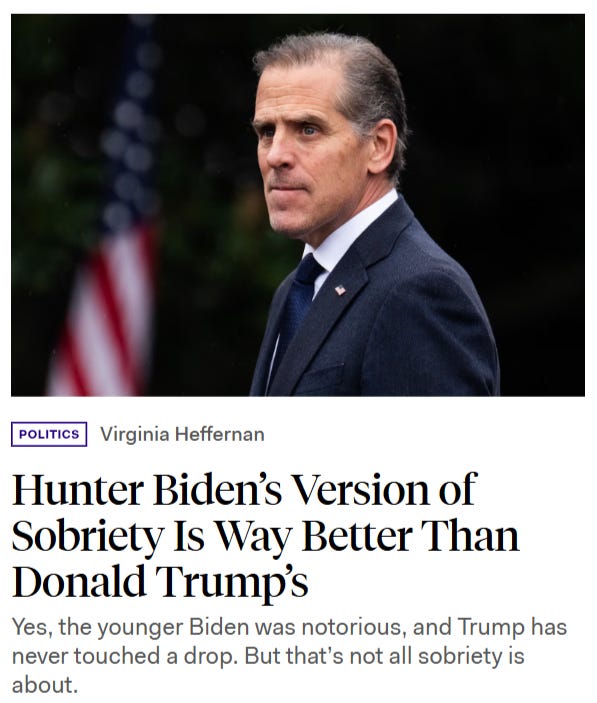
Hunter Biden is back, seven years drug-free, and spoiling for social media fights. He’s won kudos for his (only slightly creaky) clapbacks to his haters. “Hunter went from smoking crack to smoking MAGAs,” observed one fan last week. Last seen advising his father to defy common sense by staying in the 2024 presidential race, Hunter is today owning his crackhead days and flexing his recovery from addiction. He’s even launched a kind of secular ministry with the hope, he says, of “giving people the space to talk about what they’re going through” and helping them see “the incredible promises they can receive if they stay the course” of recovery.
…
Sobriety proceeds a day at a time, and it’s hard to know what Hunter Biden’s interior life is like these days.
On the one hand, Biden has exhibited real candor and willingness to help others in his recent tweets and interviews. On the other hand, it’s not clear how close he stays to the moral demands of true sobriety. “I know what I’ve done, I know the amends I have to make,” he now says. But Lunden Roberts, the mother of one of Hunter’s children, has written movingly and without rancor about raising their daughter in Arkansas while Biden first refused to acknowledge his child, then paid less than expected in support, then seemed to ghost his daughter. Making a complete amends to one’s children and partners is usually considered a first step toward lasting sobriety.
As Hunter Biden would surely be the first to attest, the path to sobriety is winding and difficult, and, as A.A. says, “We seek progress, not perfection.” Biden’s voice is welcome in the public sphere, and not for the zingers. Rather, he has opened the possibility—just the possibility—that with attention to our moral responsibilities we Americans might one day find a less furious, more honest, and more charitable way to live.
https://newrepublic.com/article/211754/hunter-biden-sobriety-better-trump
Jun 15, 2026
Robert J. Shiller January 2017
JEL No. E00, E03, E30, G02, N1
ABSTRACT
This address considers the epidemiology of narratives relevant to economic fluctuations. The human brain has always been highly tuned towards narratives, whether factual or not, to justify ongoing actions, even such basic actions as spending and investing. Stories motivate and connect activities to deeply felt values and needs. Narratives “go viral” and spread far, even worldwide, with economic impact. The 1920-21 Depression, the Great Depression of the 1930s, the so-called “Great Recession” of 2007-9 and the contentious politicaleconomic situation of today, are considered as the results of the popular narratives of their respective times. Though these narratives are deeply human phenomena that are difficult to study in a scientific manner, quantitative analysis may help us gain a better understanding of these epidemics in the future.
Robert J. Shiller Sterling Professor of Economics and Professor of Finance Cowles Foundation, Yale University 30 Hillhouse Avenue New Haven, CT 06511 robert.shiller@yale.edu and NBER
…
By narrative economics I mean the study of the spread and dynamics of popular narratives, the stories, particularly those of human interest and emotion, and how these change through time, to understand economic fluctuations. A recession, for example, is a time when many people have decided to spend less, to make do for now with that old furniture instead of buying new, or to postpone starting a new business, to postpone hiring new help in an existing business, or to express support for fiscally conservative government. They might make any of these decisions in reaction to the recession itself (that’s feedback), but to understand why a recession even started, we need more than a theory of feedback. We have to consider the possibility that sometimes the dominant reason why a recession is severe is related to the prevalence and vividness of certain stories, not the purely economic feedback or multipliers that economists love to model. The field of economics should be expanded to include serious quantitative study of changing popular narratives. To my knowledge, there has been no controlled experiment to prove the importance of changing narratives in causing economic fluctuations. We cannot easily prove that any association between changing narratives and economic outcomes is not all reverse causality, from the outcomes to the narratives. But there have been true controlled experiments showing that people respond strongly to narratives, in the fields of marketing (Escalas 2007); journalism (Machill et al. 2007 ); education (McQuiggan et al. 2008); health interventions (Slater et al. 2003); and philanthropy (Weber et al. 2006).
My goal in this paper is to describe what we know about narratives and the penchant of the human mind to be engaged by them, to consider reasons to expect that narratives might well be thought of as important, largely exogenous shocks to the aggregate economy. This address extends some earlier work I have done with George Akerlof (Akerlof and Shiller, 2009, 2015) and some of my own earlier work going back decades (Shiller 1984), but develops the analysis and captures a much broader relevant literature.
Of course, almost nothing beyond spots on the sun is truly exogenous in economics, but new narratives may be regarded often as causative innovations, since each narrative originates in the mind of a single individual (or a collaboration among a few). Joel Mokyr (2016) calls such an individual a “cultural entrepreneur,” and traces the concept back to David Hume (1742) who wrote that “what depends on a few persons is, in great measure, to be ascribed to chance, or secret and unknown causes; what arises from a great number may often be accounted for by determinate and known causes.”.
…
Jun 15, 2026

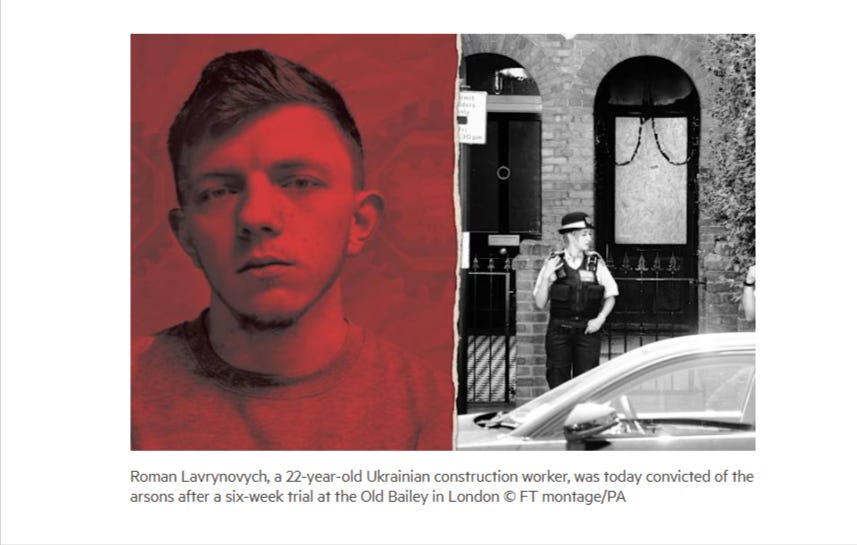
On the prima facie case against Stanislav Carpiuc, Petro Pochynok and Roman Lavrynovych.
Mystery ‘El Money’ figure offered to pay men to set fire to property linked to Starmer, court hears
Three defendants deny plotting arson attack on two homes and a car connected to prime minister in London last year
https://www.theguardian.com/uk-news/2026/apr/29/men-accused-arson-attacks-keir-starmer-london
…
He also said Telegram messages recovered by the police between Lavrynovych and El Money showed he had been recruited, instructed and promised with payment in cryptocurrency for the fires. Pochynok had been recruited by Carpiuc to help Lavrynovych with the first fire, the court heard, while Carpiuc’s role involved planning and receiving payment.
“The evidence demonstrated that there was here, no coincidence,” said Atkinson. “Rather, the vehicle and the two properties in question had been targeted, and the acts of arson at these locations had been planned and directed, with those involved promised payment for their participation.”
The court heard more than 320 messages dating back to September 2024 were recovered between Lavrynovych and El Money, who communicated in Russian in contrast to the Ukrainian used by the defendants.
Jurors were shown CCTV footage of Lavrynovych buying white spirit in south-east London two days before the Toyota was set on fire, the court heard. Each of the properties was allegedly set alight by Lavrynovych in the “dead of night, when the occupants of the addresses would inevitably have been asleep”, jurors were told.
“The prosecution’s case is that when he did so he must have intended to endanger – to risk – the lives of the people living inside those houses,” said Atkinson.
He added: “Why else would you set fire to the front door, blocking the residents’ escape?”
Editor: Should the reader here wonder about the instructions to Jurors, about the mysterious El Money, as pay master to these political actors! What might that mean? The reader might recall that British Police have arrested citizens for expressing political dissent to the Gauza Genocide by imprisonment!
Jurors were told it was “no part of your considerations” to decide who El Money was and “what reason he might have had” to coordinate the defendants’ actions. Atkinson also said the jury did not need to decide “what motivated” the defendants to carry out the arson attacks.
“It does not matter whether they knew that the property they were targeting was connected to the prime minister or whether that formed part of their motivation,” said Atkinson.
After the attacks, El Money had encouraged Lavrynovych to leave London, the court heard. “Look, you attacked the home of a very high-ranking person in Britain. I’ll send you money, you need to leave the city,” said the message read in court.
“If the police detain you, secretly write the word ‘geranium’ and I’ll send a lawyer to you, I’ll give you money for a week and a new phone. We won’t be in touch for a week.”
The trial is expected to continue until the end of May.
Newspaper Reader.
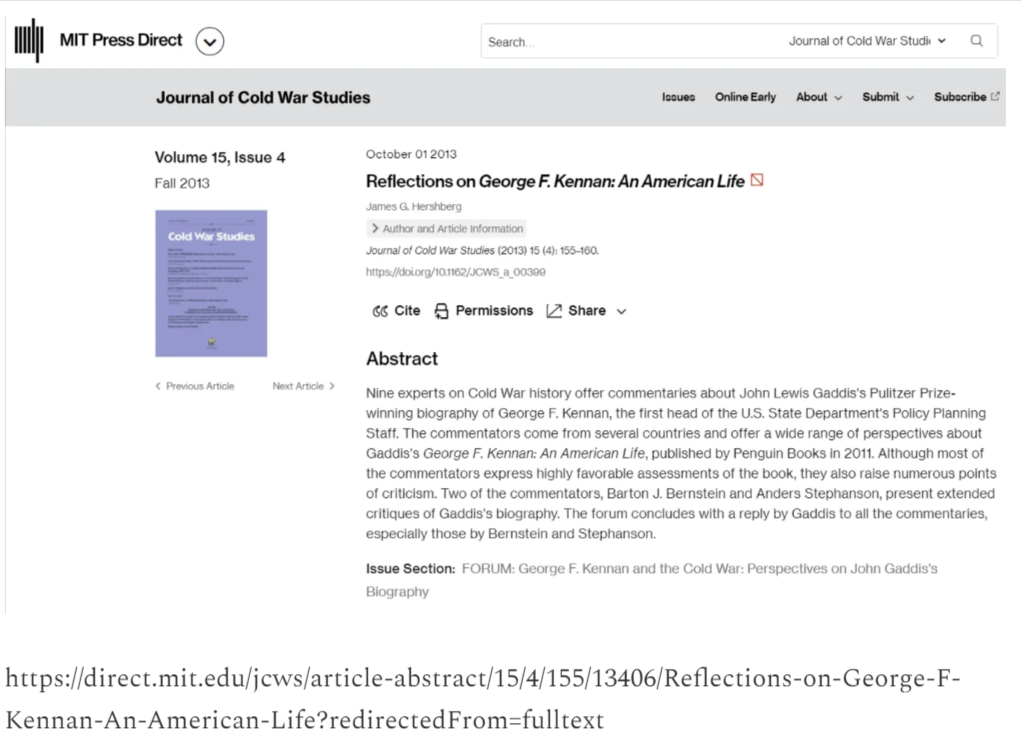
Editor: On the pressing question of History, and its manipulations by Political Opportunist, begin your exploration with this issue of Journal of Cold War Studies Volume 15, Issue 4 Fall 2013:
At The Financial Times: George F. Kennan revisionism?
Posted on February 17, 2022 by stephenkmacksd
Political Observer comments.
Mr. Kuper has missed this issue of the Journal of Cold War Studies Volume 15, Issue 4 Fall 2013:
https://direct.mit.edu/jcws/article/15/4/233/13418/Gaddis-s-Kennan-A-Different-Kennan
This issue takes a critical look at the Gaddis biography, as the preferred methodology for assessing the career of Kennan. Here is an excerpt of Anders Stephenson’s assessment:
…
Here lies the crux of the matter, and so of Gaddis’s ediªce as well. Everything turns on two issues. The ªrst is “the Soviet issue” itself. The divergence between Kennan and Lippmann on this matter in September 1947 hinges on the notion of “normality.” Difference is inscribed in the world, but in Kennan’s depiction as opposed to Lippmann’s the Soviet regime is and has always been abnormal, alien, and hostile, and now because of World War II was also dangerously placed: an abnormality piled on an abnormality, as it were. From the moment Kennan began seriously pondering the Soviet Union in the late 1920s and into the summer of 1948, he ultimately declined to recognize Moscow’s legitimacy as an international actor (he did not consider the Nazi regime, unpleasant and aggressive though it might be, equally beyond the pale until the war). The “Long Telegram” and the “X” article express this posture. Their speciªc accounts of the Soviet Union and its foreign relations are empirically wrong and strangely structured: wrong in denying that Moscow had ever made “deals” and compromises when in fact it had made a whole string of them, as Kennan well knew; strange in rooting Soviet policy wholly in domestic sources as though the outside world had no meaning except as a construction set forth to legitimate the regime at home. Astonishingly, the massive, near-death experience of the Soviet Union in World War II is almost entirely absent from the article. Suppose the United States had gone through a similar experience, the area between the Rockies and the industrial northeast had been essentially leveled by the Wehrmacht, 25 million had been killed, New York had been under siege for 900 days, and New Yorkers, the lucky ones, had been forced to eat rats while Washington was being bombarded. Can one imagine a persuasive postwar analysis of U.S. foreign policy that largely ignored such a sequence of events? I think not (and one can visualize the kind of security claims the U.S. government would have insisted on afterward). Yet, despite the antinomies and palpable errors of the “Long Telegram” and subsequent “X” article, they were received with a stupeªed sense of discovery, a discovery of “truth revealed.” Lippmann never fell into that trap, and Kennan himself, once confronted with the effects of the truth revealed, which is to say the Cold War, began to look for alternatives and ways to reconstitute some kind of diplomacy proper. The “normality” argument did not go away. It was famously resurrcted in 1967 by Arthur Schlesinger, Jr., in Foreign Affairs; and Gaddis reiterates it now again in celebrating the virtues of the Long Telegram. In fact, the Soviet Union proved remarkably orthodox in its devotion to power politics and classical European notions of international relations. What was really “wrong” with Iosif Stalin was, one might say, his abnormal “normality”—his hyper-realist reduction of all meaning to pure and ruthless interest. This was a man who had had The Prince translated for himself and then marked it up with care. Thus one might have chosen another basis for rejecting dealings with Moscow; for example, on ethical grounds: “this regime is a horrible dictatorship and, regardless of what we said and did during our wartime alliance, one must not accept such a regime qua regime.” This is a coherent position but notoriously difficult to maintain insofar as, typically, one has to distinguish this particular dictatorship by degree from others that are worth dealing with. Right-wing dictatorships aside, the ethical aspect as regards “Communism” was soon effectively discarded because of the need to support Josip Broz Tito’s regime in Yugoslavia. In treating this issue, Gaddis seems to favor the idea that “domestic” Communism was of no real (i.e., strategic) concern to the United States as long as it did not support Moscow and expansionism in foreign affairs. The effortless oscillation between quasi-realist pragmatism and Cold War ideology is in itself characteristic of the Cold War as actual geopolitics: “freedom, indivisible and sacred, will everywhere be defended by the Leader of the Free World, but it may be that we are not really capable of doing that so China (1948–49) will have to be written off, though we will not put it exactly like that and certainly not in public.”
…
https://direct.mit.edu/jcws/article/15/4/233/13418/Gaddis-s-Kennan-A-Different-Kennan
These two long paragraphs point to what Mr. Kuper uses, both of the Long Telegram and the Mr. X essay, as the rhetorical frame, that just alludes to Kennan’s change of mind about the Soviets. Mr. Stephenson ends his review of the Gaddis biography with these paragraphs:
Gaddis, on reºection, might well have agreed with this and gone on to take the other side of the argument. What he does is less interesting and indeed a bit tiresome. Having said that Kennan was essentially right in 1946– 1947, he faced the task of ªguring out what to do with half a century’s worth of withering Cold War critique, which in effect repudiated his erstwhile position. The predictable solution is a bracketing operation of another order:
Kennan the Early Prophet eventually proved right in the Age of Reagan when containment ªnally brought to maturity the Soviet regime’s “seeds of its own destruction,” a regime that had been so alien to Mother Russia. Meanwhile, Kennan the Late Prophet lost his way amid his emotions, his often charming eccentricities, and his ªxations on cultural degeneration in the West, all of which prevented him, tragically, from reconciling himself to the Truth of Reagan. Kennan’s half-century of critique, then, can be safely quarantined within a realm of egocentric peculiarity. The truth of the Cold War is duly preserved. I myself happen to think that Kennan was quite right in castigating Reagan as an egregiously irresponsible ªgure, a ªgure who, like Gaddis himself, seems to have been surprised that Soviet leaders actually believed there was danger afoot when the United States moved massively to resurrect the Cold War in the name of erasing the “Evil Empire” and so brought the world yet again, unnecessarily, to the brink of nuclear liquidation.
Political Observer
Adam Roberts at The Economist opines: ‘Why the West shouldn’t be afraid to confront Putin’!
Posted on September 21, 2024 by stephenkmacksd
Political Observer wonders what are Mr. Roberts’s qualifications to utter such an irresponsible, indeed bellicose pronouncement?
Editor: Here is the portion of Mr. Roberts essay devoted to Vladimir Putin and the American and EU War in Ukraine. Mr. Roberts come from an Economist Tradition that produced that Great Oxbridger Tag-Team of John Micklethwait and Adrian Wooldridge! That produced that classic apologetic for the War Mongering Bush The Younger: ‘The Right Nation: Conservative Power in America’ and his coterie of henchmen: Dick Cheney, Donald Rumsfeld and ‘Turd Blossom’ Karl Rove! As a regular reader of The Economist from the 1990’s, till they closed the comments section. When I attempted to read ‘Right Nation’ I experienced déjà vu, the already seen, as the literary/political style these two re-write men.
Hello from London,
Will conflict with Russia escalate? Vladimir Putin, again, wants to make you believe so. Joe Biden may be poised, at last, to say that Ukraine may use western-supplied weapons to hit military targets—such as airfields, logistics bases, or missile launchers—in Russian territory. That would be welcome, if overdue. Mr Putin, who booted out some British diplomats to show his anger on Friday, suggests this would be a step towards outright war between the West and Russia. His goal, of course, is to intimidate the West into inaction. But with bullies, caving into threats is a mistake. The West must dare to confront the aggressor. Ukraine, as the victim of aggression, has every right to fight back. Its allies should support it.
Russia continues to rain missiles, drones and artillery shells on Ukrainian cities and villages. Its forces are creeping towards making meaningful gains in the Donbas region of Ukraine. Across the country, Mr Putin’s goal is to destroy power supplies ahead of the winter, to further spread misery for ordinary people. Even as his forces commit war crimes, however, he has threatened Ukraine’s foreign supporters that they must not cross his red lines. At the same time, his forces continue to carry out sabotage and attempt assassinations in Europe, and to meddle in elections abroad, including in America.Mr Putin’s threats of escalation, therefore, must be seen for what they are. He is aggressive when he observes weakness in others, not when he is met by strength. Some in the West were previously fearful about supplying battle tanks to Ukraine, and then F-16 fighter jets. As on those occasions, the lesson to take is that standing by the government in Kyiv, helping Ukraine to fend off its aggressor, is the right way to act.
The Economist and their employee Adam Roberts attempt to re-heat The Old Cold War.
Reader begin your sturdy of that Cold War, with this issue of the Journal Of Cold War Studies Fall of 2013, that offers critiques of John Lewis Gaddis’s Pulitzer Prize-winning biography of George F. Kennan , with insightful critical evaluations by critics not sycophants!
Political Observer
Jun 14, 2026
Forensic anthropologists identify 17 dictatorship victims in Córdoba military field
The judiciary revealed the list in a press conference alongside their relatives. ‘Today, we feel free,’ one of them said
Martina Jaureguy
The Argentine Team of Forensic Anthropology (EAAF, by its Spanish initials) identified 17 people who were killed and buried in a military field in Córdoba during the last dictatorship.
The finding adds to 12 identifications announced in March, as part of an excavation and remains analysis work the EAAF has been carrying out since 2025 at the compound where Córdoba’s largest and deadliest clandestine center of detention, torture and extermination, La Perla, operated.
The Córdoba judiciary announced the list of names of the identified victims in a press conference on Tuesday after notifying their relatives, who were also present at the briefing.
Over 2,000 people were kidnapped and disappeared by Argentina’s last dictatorship at the infamous “La Perla” death camp but, until last year, no bodies had ever been found there.
The EAAF, a world-renowned NGO, carried out a 20-year investigation at the site. Their findings confirm that the area of Loma del Torito inside the La Perla compound was used as a mass grave, like many witnesses described throughout the past decades.
During the press conference, Córdoba Judge Miguel Hugo Vaca Narvaja said that “it is possible that there will be more identifications.”
While there are no estimations of the total number of individuals who were buried at the site, the judiciary stated that “a great number of human bone remains” were found scattered there.
The judge announced the names of only 16 of the victims, as one of the families asked for the name of their relative to remain anonymous. The list includes several couples who were buried together, including Ester Felipe and Luis Mónaco; Nélida Noemí Moreno de Goycochea and José Luis Goycochea Escudero; as well as Rosa Cristina Godoy de Cruspeire and Carlos Cayetano Cruspeire
The rest of the list names Gilberto Néstor Lellin D’Francesco, Graciela María de los Milagros Doldan, Juan Carlos Navarro Moyano, Adrián José Ferreyra Rivero, Víctor Carlos Díaz Rinero, Marta Susana Vera Ledesma de Comba, Silvia del Valle Taborda, Gustavo Daniel Torres, Edelmiro Cruz Bustos, Oscar Segura Ranieri.
A moving homage
Relatives of several of the identified victims thanked the EAAF and all those involved in the process, deeply moved after finally learning what happened to their loved ones after almost five decades.
“Today I’m not here to say ‘goodbye’ to my dad. Today, I can finally say ‘hello,’” said Ernesto Ferreyra, son of Adrián José Ferreyra, who was a psychology student and member of the Revolutionary Workers’ Party (PRT). Ernesto was born 11 days after his father was kidnapped in March 1976.
“When I became a father, I understood what he must have felt when he was not able to meet me,” he said.
Luis Navarro, brother of communist militant and industrial worker Juan Carlos Navarro, thanked all those who were involved in finding him and the rest of the identified victims. “When we asked about our relatives, we were told that if there was no body, there was no crime, and we couldn’t do anything,” he lamented in tears.
“Today, I call for justice to be made, and for punishment for those who murdered my brother, like many others,” Luis pleaded. “It is my wish they find many more.”
One of the daughters of Oscar Segura Ranieri highlighted the importance of the identifications, stating that “families are finding their loved ones after 50 years, and they can finally grieve and have a wake.”
Another woman, daughter of Juventud Radical member Edelmiro Cruz Bustos, cited a passage of the Bible her mother used to read to her: “‘You will know the truth, and the truth will set you free.’ And today, we feel free,” she said.
Cover image credit: EAAF
Jun 14, 2026
Juan Marcos Pollio
Since taking office in late 2023, Javier Milei has tried, in more ways than one, to get Argentines to pull their dollars out from “under the mattress” — that is, to bring them into the formal economy.
The first initiative was the Asset Regularization Regime, a tax amnesty that allowed Argentines to declare previously hidden assets. It launched on July 18, 2024, and its final phase closed on May 8, 2025, with more than US$32 billion brought into the open.
Although experts considered it a major success, it wasn’t enough for the Milei administration. In 2025, Congress passed the Fiscal Innocence Law, allowing Argentines to use their undeclared dollars under a presumption of innocence before the tax authority.
That wasn’t enough either. Earlier this month, Economy Minister Luis Caputo sent Congress a revamped and expanded version of the law, making it even easier for taxpayers to regularize undeclared dollars.
One of the bill’s most notable changes is that it scraps the wealth and income ceilings for joining the regime — meaning that, from now on, “large taxpayers” will also be able to benefit.
Milei’s is hardly the first government to try to get savers to declare their dollars. If anything, it’s the norm: the administrations of Alberto Fernández, Mauricio Macri, and Cristina Fernández de Kirchner all did the same, with varying degrees of success.
That’s because the amount of dollars Argentines hold outside the system is enormous. According to official INDEC data, the estimated total at the end of 2025 was US$254.9 billion, up 4.5% from a year earlier.
For comparison, the loan the International Monetary Fund (IMF) extended to Argentina in 2018 — the largest in the institution’s history — was US$45 billion.
Dollar demand isn’t letting up
Despite the stability of the exchange rate, Argentines’ appetite for buying dollars hasn’t eased. According to Central Bank data, between January and April of this year, foreign-currency purchases by individuals with no specific purpose reached US$8.5 billion.
Christian Naud, senior economist at the research firm ACM, told the Herald that this early-year demand for dollars comes down to several factors.
On one hand, “there’s precautionary demand and a rebuilding of dollar portfolios, made easier by the normalization of access to the foreign-exchange market since April of last year.”
But there are also transactional uses: “Card payments, tourism, services abroad and, in general, greater household demand for imported goods and services,” he said.
Naud said the real value of the exchange rate “helps explain part of this dynamic.”
When the dollar is “lagging” in real terms, it becomes cheaper for the middle and upper classes — it loses value against the peso, which fuels demand.
Naud noted that in May, the dollar’s real value sat just below its May 2017 levels and 11% below the January-April 2018 average.
That reference is no accident: April 2018 marked the start of the currency crisis that would end with Argentina’s return to the IMF, triggered by a heavy outflow of foreign capital that had been in the country doing carry trade — cashing in on high peso yields.
Looking ahead to next year, Naud said “precautionary demand can be expected to gain weight as the 2027 election starts to come onto the market’s radar.”
For years, pre-election periods in Argentina have come with a surge in dollar demand — a time-honored defensive strategy by savers against inflation volatility.
In September 2025, for instance — the month of the Buenos Aires Province election, in which Milei was defeated — Argentines bought US$5 billion, the most since 2018.
Naud expects similar pressure on the dollar in the run-up to the October 2027 presidential election.
“Uncertainty over the continuity or reversal of the current economic program will probably increase dollar hedging,” he added.
A brief history of Argentina’s dollar ‘obsession’
Horacio Augusto Pereira, senior researcher at the Center for International Strategies of Governments and Organizations (CIG) at Universidad Austral, told the Herald that the Argentine economy suffers from “a chronic disaster: high inflation, devaluations every other minute, distrust of the peso.”
“What do people do in the face of that? Rationally, they take refuge in dollars to survive,” he said. “Every time inflation takes off, demand for dollars to hoard goes up. That drains reserves, pressures the exchange rate and ends up creating the very scarcity we then try to manage with currency controls.”
Economic historian Julián Zicari told the Herald that until the 1930s, the U.S. dollar “was just another currency” — the pound sterling and even gold mattered far more.
That would change after World War II, as the United States cemented its position as the dominant Western superpower.
Locally, the shift took hold because “Argentina’s economic crises, from the second half of the 20th century onward, would be tied to a shortage of dollars.”
Economic sociologist Ariel Wilkis told the Herald that “over the past eight decades, Argentines’ relationship with the dollar has changed over time,” and pointed to a handful of moments that steadily pushed the dollar to the center of economic life.
He singled out “the great devaluation of the 20th century — the 1958 one, under Arturo Frondizi’s government,” adding that “throughout the 1960s, devaluations were constant.”
Frondizi devalued the peso by 68.2% in late 1958, sending inflation past triple digits — 113% — for the first time in Argentine history.
Another moment Wilkis highlighted was the last military dictatorship, a period that combined “a policy of economic opening” with “a huge availability of dollars in the financial system.”
A new turning point came with the hyperinflation under Raúl Alfonsín’s government in 1989. Wilkis said that crisis “spread the use of the dollar to extreme levels — in everyday payments, for example” and “created the conditions for the convertibility policy of the following decade,” which pegged the peso one-to-one to the dollar.
Under Carlos Menem’s presidency, through the 1990s and until January 2002, Argentina lived under that convertibility regime, in which one peso was worth exactly one dollar.
“The paradox of that decade is that, on one hand, the dollar disappears from public life — the currency peg means we stop paying attention to it — and at the same time it becomes a formalized currency in financial life: opening dollar bank accounts, taking out dollar loans, paying debts in dollars, and so on,” Wilkis said.
The sociologist noted that while other countries have gone through crises similar to Argentina’s, they didn’t necessarily turn the dollar into a “popular currency.”
The Argentine difference, he argued, rests on two complementary dynamics: one sociopolitical, the other sociocultural.
The first is “a systematic accumulation of failures by governments, decade after decade, to build a strong national currency.”
The second is “the social learning around the importance of the dollar — how to use it, how to read it, and how to gain a financial edge from it,” the product of one economic crisis after another.
Jun 14, 2026
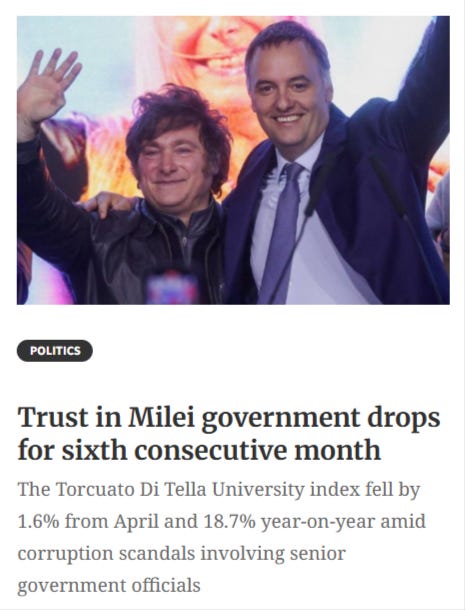
Argentines’ trust in the government fell for the sixth consecutive month in May, dropping by 1.6% from April and 18.7% year-on-year, according to an index compiled by the Torcuato Di Tella University.
The cumulative decline so far in 2026 stands at 19%, amid a series of corruption scandals involving senior officials, particularly illicit enrichment allegations against Chief of Staff Manuel Adorni.
The index, compiled monthly by the University’s School of Government, is measured on a scale of 0 to 5 based on public opinion surveys.
In May, it stood at 1.99 points, the second lowest score since the start of Javier Milei’s government in December 2023.
This brought the president’s overall average trust score since he took office to 2.41 points, the lowest in the series, although the index has “remained relatively high during Javier Milei’s presidency,” the university’s report stated.
Scandals
The lowest level of trust remains September 2025, when the index stood at 1.94 points after a scandal involving alleged ties between then-libertarian candidate José Luis Espert and businessman Fred Machado — who was under investigation for drug trafficking in the United States — forced Espert to withdraw from the legislative race.
The sharpest decline in trust over the past six months came in April, when the index fell by 12%, coinciding with the peak of the allegations against Manuel Adorni.
The chief of staff has faced scrutiny since March, when reports revealed he had purchased two luxury properties since joining the administration as presidential spokesperson in December 2023 that were not included in his asset declarations. He also came under fire for several costly trips allegedly paid for in cash and U.S. dollars.
In addition to the allegations against Adorni and Espert, the government also faced serious turmoil when Milei’s sister, Presidency Secretary Karina Milei, was accused of spearheading a bribery scheme within the now-extinct National Disability Agency, involving supposed large illegal payments in exchange for providing state contracts to pharma and medical companies. The judicial investigation continues.
The government regained some of the trust it had lost after winning the 2025 legislative elections, but the Adorni scandal in March, in addition to worsening living conditions, appear to have reverted the situation.
The index
In May, three of the five categories taken into account to calculate the trust index suffered a decrease: the government’s capability (-5.6%) — the lowest for the current administration — concern about the country’s general well-being (-2.5%), and honesty (-1.6%).
However, the segments regarding a general evaluation of the government, as well as efficiency, went up by 3% and 0.5% respectively.
If divided by gender, the overall trust figure marked a new decrease among women, but was higher than last month among men, and also among people above the age of 50.
Jun 14, 2026
Diljit Dosanjh: Morni | The Tonight Show Starring Jimmy Fallon
1819 – 1892
The past and present wilt—I have fill’d them, emptied them.
And proceed to fill my next fold of the future.
Listener up there! what have you to confide to me?
Look in my face while I snuff the sidle of evening,
(Talk honestly, no one else hears you, and I stay only a minute longer.)
Do I contradict myself?
Very well then I contradict myself,
(I am large, I contain multitudes.)
I concentrate toward them that are nigh, I wait on the door-slab.
Who has done his day’s work? who will soonest be through with his supper?
Who wishes to walk with me?
Will you speak before I am gone? will you prove already too late?
Jun 14, 2026
Britain | Bagehot
British politicians are racing to the hard right
Amid riots in Belfast, Restore promises to put “murderous third-world savages to death”
https://www.economist.com/britain/2026/06/10/british-politicians-are-racing-to-the-hard-right
When a Sudanese refugee was caught attacking a man in Belfast on June 8th, Restore, a far-right party, pledged: “A Restore Britain government will put murderous third-world savages to death.” Tragedy brought clarity: the British right is moving right. Ideas that were until recently extreme, whether capital punishment or mass deportations, are now mainstream. Small parties, such as Rupert Lowe’s Restore, may attract low single-digit support in polls. Yet they are pulling Reform UK and the Conservatives further to the right with a simple remorseless logic: that there is no limit to how nasty the British public can be.
What was once taboo is now up for debate. After footage of the attack in Belfast emerged, Mr Lowe pledged to have the accused executed “with the British people’s approval”. Thanks to his party’s surprising breakthrough in Makerfield, which soon faces a by-election where Restore is expected to come third, way ahead of the Conservatives, these sweeping threats are now read out on BBC Radio 4 as just another political opinion. Others are more coy. The death penalty will “be back within the next decade as an issue of major national debate”, said Nigel Farage, Reform’s leader, last year, passively. It is something that will bubble up naturally. If so, runs Mr Farage’s logic, so be it.
Calls for execution were soon replaced by calls for mass deportations. “Deport them all,” said one anchor from GB News, a right-wing channel ostensibly regulated by Ofcom. “Nothing else will stop this.” A once-lonely demand by Mr Lowe that “millions must go” has become a key policy for Reform, which sits at the top of the national polls. It is a remarkable lurch right. In late 2024 Mr Farage still cowered from the idea of mass deportations. “I’m not going to get dragged down the route of mass deportations or anything like that,” he said. Skip forward a year and his tune had changed. Standing in front of a mock airport-departures board with the destinations of “Sudan”, “Afghanistan” and “Yemen”, Mr Farage launched an Illegal Migration (Mass Deportation) Bill.
Editor: The first three paragraphs are the product of fear and hysteria about ‘the other’ in its various guises. Since the Fall of the Empire and the seminal Windrush Generation, and other forms of Migration, from various and former British Protetorates, Colonies!
The final paragraphs:
https://www.economist.com/britain/2026/06/10/british-politicians-are-racing-to-the-hard-right
Fundamentally, the British right has bet that the British public are, for want of a better word, bastards. Mr Lowe expanded on this philosophy in a podcast: “When you’re called a racist, or you’re called a bigot, or you’re called right-wing—which I don’t even think we are, I just think we’re the common-sense party—the three key words are: ‘I don’t care’.” But what if people do? There is a reason the first line of defence is always “I’m not racist, but”, rather than “I am racist, and”. It is an irony of British populism that those politicians who claim to speak for the people are often furthest from them.
Once the fever breaks, support for the death penalty wilts as people are grilled on who should actually be put to death. The idea of “mass deportations” is a bold one in a country where the mistaken deportation of a few dozen British citizens led to the fall of a home secretary and a years-long scandal that still shames the state. Punitive sentences for those who burned down houses in Belfast will be cheered by voters, who will care little for the rioters’ motivation. That politicians are willing to discuss the idea of civil war—never mind race war—reveals a political elite utterly disconnected from the daily frustrations of British voters.
Come and have a go if you think you’re hard enough
The right’s base instincts fill the airwaves in part because there are few willing to fight them. Britain is cursed by a prime minister incapable of meeting this particular moment, as high-profile crimes blend with ridiculous fantasy. Never has a prime minister proved less willing to use their pulpit. While his opponents preach anarchy, Sir Keir Starmer is mute, surrendering to the right’s idea that the public are irredeemable. Fatalism has infected Labour when it comes to dealing with Reform, which, though first in the polls, is only roughly as popular as Rishi Sunak’s Conservatives, who enjoyed their worst-ever result in the 2024 general election.
It is after a heinous crime that the right’s low expectations of hard bigotry become clear. The British right is offering a world in which criminals are put to death; where “millions must go”; where pogroms are the inevitable result of a country in which white people are now second-class citizens. It is increasingly clear what the likes of Mr Farage and Mr Lowe are selling. The hope is that British voters will not buy it. ■
Editor: The final paragraphs of this iteration of a ‘Usable Bagehot’, in the political present, seeks to employ a mirage, in place of what the ‘Historical Bagehot’ was in actuality?
Walter Bagehot
British economist and journalist
https://www.britannica.com/money/Walter-Bagehot
https://www.economist.com/britain/2026/06/10/british-politicians-are-racing-to-the-hard-right


 StephenKMackSD's Blog