Headline: Economics can’t explain all the anger of voters
Sub-headline: If it did, the US should have much healthier politics than Europe
Janan Ganesh
Editor: Mr. Ganesh specialises in ‘Pop History’ that acts the part of the actual thing itself , without its reilization. Its fluidity of application to various iterations is the key to the ‘Ganesh Methodology’. Reader I’ll begin here:
Except for the most tiresome pedants, who celebrated the millennium on January 1 2001 rather than 2000, we are nearing the quarter-point of our century. What are the surprises so far? What would people have found hard to believe 25 years ago?
…
Here’s another. The US would outclass Europe in economic growth, and be no happier for it. If people ultimately vote on their material experience — a common sense thing to suppose —
…
How odd. Perhaps what voters do is compare their economic experience with that of their own forebears, not with that of contemporaries in other countries. The data that matters is longitudinal, then, not latitudinal.
…
In the 1980s, Sinn Féin won 1 or 2 per cent of the vote in Irish general elections. In the noughties, this went up to around 6. Though it didn’t break through, the party scored 19 per cent in last month’s election.
….
It has to reckon with the fact that Ireland, despite a savage crash in 2008, is richer than it was a couple of generations ago, and to little obvious glory for the established political order that oversaw most of that success.
…
Greece, which had a scarring economic experience in the last decade, and an excuse to turn to the fringes, has a prime minister who is the toast of international moderates. Italy, which underwent less structural reform, has a populist. Not only is there no faithful correlation between economic circumstances and political choices, there isn’t even a useful line of best fit.
…
If not just economics, then, what is bugging voters? Immigration, in large part. But even this isn’t a clincher.
…
Another explanation for what is going on is “hedonic adjustment”. As incomes rise, so do expectations. Voters become quicker to revolt. In other words, economics is decisive, but not how you’d imagine.
…
This was Joe Biden-ism. In fact, it is much of western liberalism. There is impeccable common sense to it, but also an intellectual ponderousness. Conservatives have been quicker to intuit that stranger forces than material interest are at work in the world, and to master them.
…
Just to stipulate, then, I’m a growth zealot. I want 20mn Londoners, not 10mn. But the case for growth must be that it is good in and of itself, that more stuff for more people is intrinsically worthwhile, that romanticising the pre-industrial world is imbecilic tweeness.
…
Editor: Ganesh flirts with the evocative fragment as I present it, as an itegral part of my self-seving critique! Yet his final paragraph ends in another collection of more of the same: I’ll repeat: ‘Mr. Ganesh specialises in ‘Pop History’ that acts the part of the actual thing itself , without its actual reilization. Its fluidity of application to various iterations, is the key to the ‘Ganesh Methodology’. In the end it resembles a riff on kitsch !
In fact, the causal link between economic performance and political outcomes has broken down in both directions. Not only can a nation have a thriving economy to no obvious benefit to its politics, it can sustain awful politics without incurring economic damage. At this time of year, we are asked to reflect on all the things in life that money can’t buy. To “love” and “class”, add civic sanity.
This reader must first recognise Mark Colley exceptional reporting on Justin Trudeau! He quotes :
“It was very hard,” said Kathleen Wynne of her experience in the 2018 Ontario election, when as premier she suffered a stunning loss that reduced her Liberal party to seven seats before she resigned as party leader. “The whole thing was brutal because it did feel like, as the leader, I was letting people down and that’s a horrible feeling.”
….
Knowing when to quit is part of the dilemma.
There are signs. According to Raymond Blake, a professor at the University of Regina who specializes in 20th century Canadian politics, two of the biggest are public and party discontent. A lapse of judgment is another. Failure to meet expectations, too.
But even with the signs, it can be hard to quit. History is littered with examples of those who have hung on past their expiration date.
“It’s really, really tough for anyone who’s at the top of their game to give it up,” Blake said. “Walking away is tough.”
…
Psychologically speaking, our careers become deeply ingrained in who we are, according to Marie-Hélène Budworth, the director of York University’s school of human resource management who has a PhD in organizational behaviour. At a dinner party, the answer to the question “Who are you?” is often occupation.
Quitting leaves the quitter searching for a new answer.
“It can be a real struggle to make the decision to leave it behind,” Budworth said, “because you’re leaving part of your identity.”
This dilemma, of course, is only exaggerated for a role as public-facing as the prime minister of Canada.
Budworth also suggests social circle could play a role in Trudeau’s decision. Often, the people around us agree with our views. It can create the notion of a false consensus — that most people are on my side because this small group is.
And there’s also the public consequences of quitting.
“We live in a world where quitting is often seen as failure,” Budworth explained. “Someone who quits couldn’t hack it. They couldn’t make it work.”
It doesn’t help people aren’t good at remembering accomplishments, Budworth said. Instead, our nature is to simply remember how something ends. Thus, leaving in a cloud of controversy “does leave a lasting scar,” Blake said.
It impacts legacy. Rehabilitating public opinion is a natural process for any public leader once they’ve left office. Trudeau’s legacy will be damaged if he leaves now, but it will suffer even more if he sticks around and is crushed in the next election, Blake predicted.
…
Compare this above selection from Mark Colley insightful reporting, though he does miss the the disturbing fact of Freedlands Ukranian connection as reported in his own newspaper :
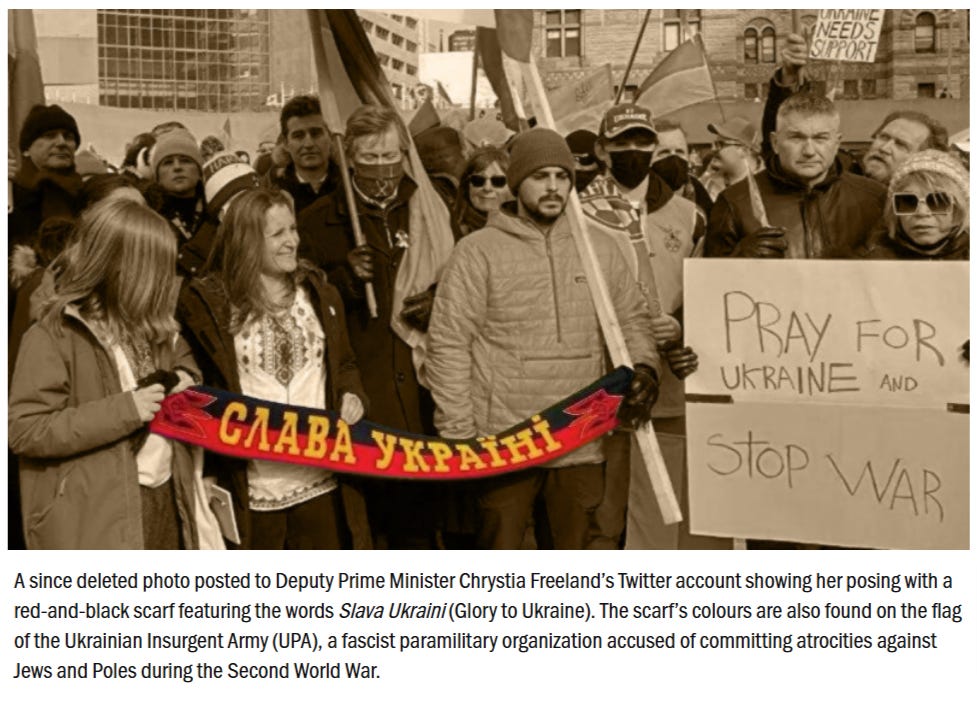
The controversy over Chrystia Freeland and the red Ukrainian scarf, explained
Deputy Prime Minister Chrystia Freeland has been caught in a controversy over a red and black scarf.
Headline: Trudeau’s Top Lieutenant Resigns With a Bang
Sub-headline: Chrystia Freeland is a serious woman. She spent a decade at the right hand of an unserious man, Justin Trudeau. Her resignation on Monday was shocking in its bluntness — and in its impact on politics north of the border.
What a crazy month for geopolitical bingo. Who had a successful Syrian revolution on their card? Or martial law in South Korea? Or, a world-class-worthy-of-Shakespeare political drama in Ottawa?
The day up north began with a resignation letter from Canadian Deputy Prime Minister and Finance Minister Chrystia Freeland. Before anyone dares to suppress a yawn — and I am well aware that New York Times columnist Flora Lewis’s “Worthwhile Canadian Initiative” won the New Republic’s prize in 1986 for most boring headline ever written — this was no ordinary letter. Chrystia Freeland is no ordinary politician.
Freeland is, first of all, a journalist. She can write. She has also, going back to 2013 when Justin Trudeau recruited her from the ink-stained world, been steadfastly loyal to him. In her various cabinet posts after Trudeau and the Liberals won power two years later, Freeland kept the rapier always sheathed. In words spoken and written, she was measured. A team player, always. Old friends from the Financial Times, her professional home for many years (where for three years in the mid-1990s she was my boss), were amazed/annoyed by how disciplined she was when they had to cover her. Chrystia was no Boris, as in former British Prime Minister Johnson, another hack-turned-pol, who was desperate to charm and entertain his old pals in the trade. Then Monday came her letter, published on X.
…
As for the letter itself, you don’t have to know anything about Canadian politics to appreciate the sight of a rhetorical rapier plunged straight in in the bright light of day. You tried to demote me, she writes, so I quit. She didn’t need to say it but it was noticed that Trudeau did the same to other prominent women in his cabinet, and Freeland wasn’t going to let him do it to her. She was building up her steam. “You and I have found ourselves at odds,” she writes. I see President-elect Donald Trump’s “aggressive economic nationalism,” in the form of tariffs, as “a grave challenge,” she writes. You, Dear Justin, are into “costly political gimmicks” — the details here are boring but basically involve fiscal giveaways over the holidays — “which we can ill afford.” You are unserious, she implies. Then she lays out what it “means” to be “serious.” To act in “good faith and humility,” to face “the threat” from Trump, to be a nation “strong, smart and united.” You, Pretty Boy, are not able to lead this kind of Canada. I am. I’ll be running for my seat in the next election, she writes. And as everyone can read between the lines, I’ll be running to lead the party.
…
Editor: Matthew Kaminski wallows in it! It’s almost like reading Puck! He then expolores on it periphery Freedland Ukraine connection in its carfully scrubbed version:
On the world stage, Freeland was a particularly prominent voice on behalf of Ukraine, the birthplace of her mother Halyna, where both of them worked in the early days of its independence. She was taken very seriously in G7 finance and foreign policy councils, even though Freeland was speaking on behalf of a country that — unwilling to spend on defense, falling well short of the NATO minimum guidelines of 2 percent of GDP — was itself not taken seriously.
Editor: Here is the un-laundered version
Headline: Chrystia Freeland’s ties to Ukrainian nationalists reveal a double standard
Sub-headline: The deputy prime minister was photographed with a scarf associated with the Ukrainian far-right at a demonstration in Toronto
Canadian Deputy Prime Minister Chrystia Freeland spoke at a rally against Russia’s invasion of Ukraine on February 27, in which she was photographed holding up a scarf associated with a Ukrainian paramilitary organization that massacred thousands of Jews and Poles during the Second World War.
Freeland, who has made her Ukrainian heritage a major focus of her political brand, tweeted out the photo of her holding up a black and red scarf that had “Slava Ukraini,” or “Glory to Ukraine” written on it, with the relatively innocuous caption, “We stand united. We stand with Ukraine.”
The scarf’s colour scheme, as well as the slogan on it, were adopted by the Ukrainian Insurgent Army (UPA), an offshoot of the more radical wing of the Organization of Ukrainian Nationalists led by Stepan Bandera.
The UPA collaborated with the Nazis to ethnically cleanse Volhynia and Eastern Galicia of Poles and Jews in an attempt to establish an ethnically-pure Ukrainian state, which culminated in the murder of 100,000 Poles by 1943, according to historian Terry Martin.
“Red and black are the colours of the Bandera Wing of the Organization of Ukrainian Nationalists. The flag symbolizes blood and soil, and was adopted by that organization in 1941, along with an explicitly totalitarian program. The black-and-red banner is a symbol intimately connected with the most radical Ukrainian right-wing tradition,” Per Anders Rudling, a historian of nationalism, explained to the Toronto Star.
Natalia Khanenko-Friesen, director of the Canadian Institute of Ukrainian Studies, confirmed to the National Post that the colours represent blood and soil, but reassures the reader that it’s not the fascist kind. “Blood as life, as blossom, and not as blood lost in battles,” she declared. Freeland deleted the tweet and then posted an image of her at the rally without the scarf. But as many pointed out, the replacement photo still has a UPA flag in the distant background—a testament to the prominence of UPA symbology at the rally.
At Passage, Davide Mastracci notes UPA flags were also seen at Ukraine solidarity rallies in Montreal, Winnipeg, Vancouver, Prince George, BC, Edmonton and London, Ontario.
While Toronto Mayor John Tory rushed to condemn the use of swastikas by fringe cranks at a pro-Palestine rally in Toronto last year, he stood right behind Freeland while she held up the UPA scarf at the pro-Ukraine protest.
…
Editor: It is easy to see that Freedland’s letter come at an auspisious momet , as Joe Biden leaves office and Trump assumes office in America. The Ukraine War is reaching its denouement with a fated Russian victory? A politically weakned Trudeau and Freedland acting as an unofficial voice for Ukraine offers…
Editor: Garrett Graff recites the propganda that has infected generations of apologist for J.Edgar Hoover corrupt personal feifdom!
When Donald Trump said over Thanksgiving that he was nominating Kash Patel to be FBI director, the announcement sent shudders through official Washington — Patel, besides being simply unqualified for such a big role, has explicitly laid out a retaliatory agenda that would weaponize the FBI against Trump’s foes. But there was one important wrinkle in Trump’s move: The simplest argument against Patel taking over the FBI was that there was no vacancy atop the FBI.
Current FBI Director Christopher Wray had years left on his term. Wednesday, in a jaw-dropping announcement underneath the FBI seal at an employee town hall, Wray said he would serve out the rest of the Biden administration and then step down.
Wray’s surprise decision is, simply put, a damning decision, an abdication of leadership, and a terrifying indication of how unready Washington remains for a second Trump term.
Wray’s decision undermined decades of hard work — by Congress, presidents, the Justice Department and the FBI itself — to move it out of a partisan, political framework. The FBI’s highest guiding principle is supposed to be the rule of law — and federal law is clear: The FBI director serves a 10-year-term, a length meant to isolate the role from political winds. Similarly, in federal law, there is a mechanism for removing an FBI director who errs — they can be fired, but only for cause. The role is not meant to be like the CIA director, attorney general or Defense secretary and turn over at noon on Jan. 20 for a new administration; it is, in fact, explicitly designed to NOT do so. Ronald Reagan spent almost all of his presidency with Jimmy Carter’s FBI director; George W. Bush inherited Bill Clinton’s FBI director; Barack Obama, in turn, inherited Bush’s, and Joe Biden will have spent his entire presidency with Wray, Trump’s choice to head the bureau.
Those safeguards and traditions exist because the FBI, in the wrong hands, is incredibly dangerous to American democracy.
The FBI is the most powerful, best resourced, and far-reaching law enforcement agency, not just in the United States, but anywhere in the world. Nothing compares to the sweeping breadth of its investigative powers; the intelligence and information it collects, wittingly and unwittingly, on all manner of Americans, powerful and not, guilty and innocent alike; and the resources and technologies it can bring to bear against anyone in its investigative sights. Even its routine investigations can paralyze and bankrupt businesses, upend lives, careers and families, and destroy reputations — and even do so when it doesn’t bring federal charges at the end. Under J. Edgar Hoover’s half-century reign, he deployed those resources to ruin the lives of civil rights activists and antiwar protesters, harass literary figures such as James Baldwin, blackmail gay people and persecute anyone he didn’t feel was sufficiently patriotic. We’ve spent a half-century as a nation trying to make sure that never happens again — and now Trump is explicitly saying he wants to restart that darkest chapter of the FBI’s history.
Editor: What resemembled praise, turned to ‘that darkest chapter of the FBI’s history’ : Yet it isn’t long before Garrett Graff is featuring Christopher Wray as the once Heroic Face of the FBI , who morphes now ino its betrayer of ‘the bureau’s core values’ : a record of self-serving lies, mendacity, corution and invented political paranoia! In sum, in Garrett Graff Political Melodrama, Christopher Wray plays the part of a Political Opportunist!
The reality is that Wray’s action repudiates all of the bureau’s core values and principles and the hard work of scores of FBI leaders across a half-century. It is a decision that seems to help only one person: Wray, easing his way back into polite legal society and a top-shelf corporate or legal role with a minimum of awkward fuss and Trump vitriol. It certainly sends a terrible message to the workforce, public servants who we as a nation will desperately want to stand up for the rule of law in the years to come: Cave to Trump or just get out of the way.
Robby Soave is just another self-promoter who renders opinions -this cadre of would-be ‘political technocrats’ chokes the corporate internet, with rendered opinions on the issues of the day, with a manufactured solemnity as if he were- his model is more akin to the dispeptic chatter and ‘personal style’ of George F. Will :
Editor: New York Times review
UP FROM INDIVIDUALISM
By Michael J. Sandel July 17, 1983
…
Mr. Will does not offer a detailed solution to the predicament he describes. His purpose is less to promote particular programs than to change the character and tone of the debate. His political vision here might best be described as communitarian conservatism. He favors a welfare state that embodies an ethic of common provision, a military draft that expresses a deepened citizenship, a market economy restrained by considerations of the public good and restrictions on abortion, pornography and sexual permissiveness in hopes of elevating society’s moral sensibilities.
Like all communitarian ethics, Mr. Will’s invites the objection that to mix politics and morality, for whatever good ends, is to consort with totalitarian possibilities. Mr. Will replies, plausibly enough, that the greater vulnerability lies in atomized, dislocated societies, not in stable communities with a lively sense of common purposes and shared traditions.
Still, ”Statecraft as Soulcraft” leaves a lurking worry. Missing from it is any clear commitment to democracy. For example, the American institution most powerfully equipped for democratic soulcraft, the public school, finds scant support from Mr. Will, who for all his praise of the public estate, would subsidize private schools through tuition tax credits. And despite his assurance that soulcraft is ”the citizenry working on itself,” he also asserts that ”the basic political right is to good government, not self-government.”
If the aim of politics is, as Mr. Will says, ”a warm citizenship, approximating friendship, based on a sense of shared values and a shared fate,” democracy would seem an essential, not merely an incidential ingredient. Liberals and democrats would do well to take up the challenge Mr. Will puts to his fellow conservatives – to argue for a vision of the good society, unembarrassed by the thought that it has nothing to do with politics.
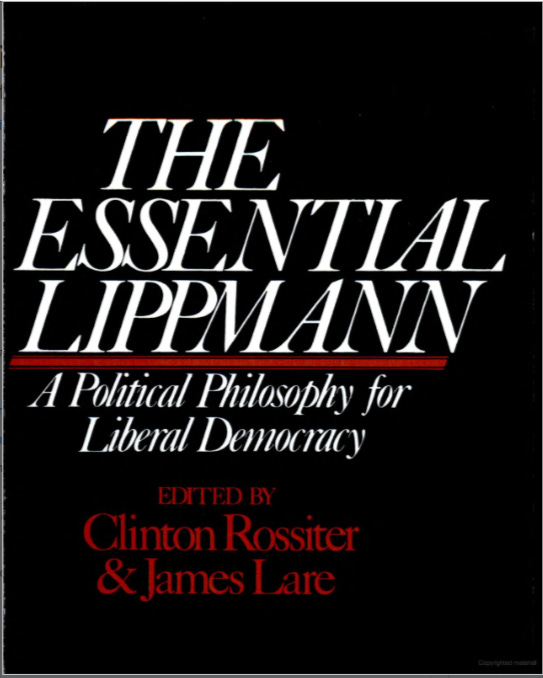
Editor : Reader aquaint herself/himself with this essay on Lippmann via this NYT essay by Ronald Steel July 21, 1985
Headline: THE BIOGRAPHER AS DETECTIVE: WHAT WALTER LIPPMANN PREFERED TO FORGET
…
If I never grew really close to Walter Lippmann, I nonetheless came to respect him enormously for his intelligence, his integrity and his decency. He was a man who, in his 80’s, could still be outraged by folly, and who, despite all the public idiocies he had witnessed, did not become cynical. Even when I grew exasperated with him for a judgment made or an action taken, I could not forget that he never stopped trying to make men listen to reason or believing that they could be made better.
I had hoped that he would not ask to see the drafts of my book. And he did not, except once, just a few months before he died. Surprisingly, he was not interested in what I thought of his opinions of the great political issues he had been involved in, or of the monumental egos he had observed. The only thing he cared to see was what I had written about his time at Harvard. He wanted, in those last days, to evoke the moments of his own spring – when William James came knocking on his door to introduce himself to the Yard’s brightest sophomore, when the fearsome Santayana invited him to dinner and made him blush with terrible gossip of the philosophy faculty, when he himself hovered between the pre-Raphaelite estheticism of the Circolo Italiano and the earnest moral endeavor of the Socialist Club. B Y the time he died in 1974 Lippmann had, I think, long since made his peace with himself and was willing to let others make their judgments as they would. He did not seem particularly concerned with posterity. He had done the best he could, and beyond that no one could ask more.
What he taught me is that one can be a part of one’s time without surrendering to it, that even accomplishments such as his are three parts hard work to one part genius, and that the greatest pitfall is not worldly fame but ceasing to care about making a difference. He was very much like his youthful hero, H. G. Wells, of whom he once wrote, he ”seemed to win by a constant renewal of effort in which he refused to sink either into placid acceptance of the world, or into self-contained satisfaction with his vision.” That was the Walter Lippmann I came most to admire, a man who made a very long journey -one of endless discoveries.
…
”The Biographer as Detective,” an essay by Ronald Steel in the July 21 Book Review, was not properly credited. It was adapted from a lecture in a series on the art and craft of American biography, held at the New York Public Library and sponsored by the Book-of-the-Month Club.
A correction was made on
Aug. 4, 1985
Editor: I read this book over many years,
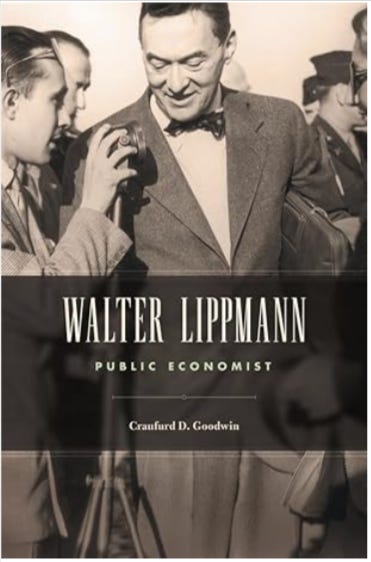
Editor : I am currently reading : ‘Walter Lippmann: Public Economist’ Hardcover – October 20, 2014 by Craufurd D. Goodwin: I can only manage 5 or 6 pages at time, though it is engagingly written and argued !
Editor: The ‘as if’ of the commentators like Mr. Soave, and his cadre: what to name them? Is that the Neo-Liberal Age is Past: instead what is alive and present is its natural sucessor, even its twin political manifestations: ‘The Rebellion Against The Elites’, across ‘The Mythical West’ that Soave and his cohort seek to render inocouious. Fritz Stern offers a telling History from 1974.
Editor: With no Reporters based in Moscow these two ‘reporters’ rely on reports by ‘Russia’s Investigative Committee’ .
Russia’s Investigative Committee, a major crimes unit, said Lieutenant General Igor Kirillov, the head of the military’s nuclear, chemical and biological defence forces, had died in an explosion caused by a bomb placed on a scooter.
Editor: This is The Financial Times and the job of its ‘reporters’ is the write Political Propganda! I highlight the sources provided by the ‘reporters’ !
Kirillov is the most prominent military officer to be assassinated since Russia began its full-scale of invasion of Ukraine in 2022.
Ukraine’s SBU security service had a day earlier put out a “notice of suspicion” — essentially a warrant — for Kirillov over alleged “war crimes committed” against Kyiv’s forces.
A Ukrainian intelligence official with direct knowledge of the attack told the Financial Times that the SBU was behind the killing. “Kirillov was a war criminal and a completely legitimate target, as he gave orders to use banned chemical weapons against the Ukrainian military,” the official said. “Such an inglorious end awaits all who kill Ukrainians. Retribution for war crimes is inevitable.”
The official said the scooter carrying the explosives had been detonated when Kirillov and his assistant, identified in Russian media as Ilya P, were near the entrance of a house on Ryazansky Prospekt in Moscow where the driver had come to take the general to work.
Video footage shared with the Financial Times shows Kirillov and his assistant exiting the building and walking a few steps before an explosion takes place.
The blast shook the walls of several nearby buildings and sent shrapnel flying for dozens of metres, according to Russian media, damaging several windows.
Kirillov was hit with UK sanctions in October “for the deployment of barbaric chemical weapons in Ukraine”, including the toxic choking agent chloropicrin.
The UK said Kirillov was also “a significant mouthpiece for Kremlin disinformation”, a reference to public briefings in which he regularly accused Kyiv of plotting to use chemical weapons and develop a nuclear “dirty bomb”.
Last year Kirillov even claimed Ukraine had plans to launch special US-designed drones carrying “infected mosquitoes” that would spread malaria among Russia’s forces. Kirillov also led Russian efforts to discredit reports showing that Moscow’s ally, the recently ousted dictator Bashar al-Assad, used chemical weapons in Syria’s civil war.
…
Tuesday’s bombing bore hallmarks of the work of Ukraine’s spy agencies inside Russia, where they have cultivated a network of covert operatives to carry out targeted killings of key military personnel and acts of sabotage against their enemies’ war machine to disrupt Moscow’s ongoing invasion.
Ukraine’s intelligence agencies rarely claim explicit public credit for the assassinations.
…
Political Reporter.
………………………………………………………………………………………………………………….
Added December 18, 2024 :
Russia Arrests Kirillov Murder Suspect, Claims Kiev Involved;
The Financial Times’s political romance with Neo-Liberalism in its various hues and iterations, recall this from December 26, 2016 in The Financial Times! Mauricio Macri Neo-Liberalism Lite was not quite enough! Milei is the true answer to the Argentine Conunderumn! Call it the half mad ,shitty version of Neo-Faschism!
Editor: What does the Buenos Aires Herald of December 15, 2024 have to say:
Tuesday marked one year since President Javier Milei took office, and he took to the airwaves to deliver a national address in which he promised to eliminate 90% of taxes, get rid of currency controls, and allow Argentines to spend dollars alongside pesos. Alongside promises of a near prosperous future thanks to policies for the “common man” was the usual “anti-caste” rhetoric. Warnings against opposing government reforms peppered the speech: “You can either get on the train or be run over by it.”
A common refrain among Milei’s supporters is that he is not a far-right government. He’s simply trying to implement policies in Argentina that are common among pro-market governments all over the world, and he values liberty above all things. Sure, he says some wild things, but that’s his personal style, and we shouldn’t take it literally. What’s far-right about all that?
It’s true that many of Milei’s economic policies are relatively common elsewhere. But some mark a throwback to the 1990s in their singular belief that a free market and a small state cure all ills, despite a deluge of subsequent studies that found that these policies tend to increase inequality and concentrate wealth at the top.
In Argentina, the litmus test for whether a political figure was far right, as opposed to simply conservative, has mostly been their support — either outspoken or veiled — for the military dictatorship’s narrative about political violence in 1970s Argentina.
As democracy advanced, the Argentine political and judicial system progressively reached a popular consensus that what the military called the “Dirty War” was actually a ploy to disguise the horrific truth: that the dictatorship had run a systematic plan to disappear and murder a portion of the population that opposed the imposition of their political order. This scheme also included an ultra-liberal economic program that increased foreign debt, hindered industrialization, and left an accumulated inflation rate of more than 8,000%.
In the 1990s and early 2000s, calls for “a complete memory” were only marginal. Included in this group, essentially proponents of the denialist “Two Demons Theory” that equated state terrorism with the armed resistance groups, were a few former dictatorship officials, as well as the relatives of military officers — current VP Victoria Villarruel being one of them — who were finally being tried and sentenced for crimes against humanity.
By 2015, the consensus was so well-grounded that PRO leader Mauricio Macri, who had previously echoed some of the dictatorship’s ultra-right rhetoric, notably had to tone it down when becoming president. It was actually during his administration that the ESMA Museum and Site of Memory officially opened, following years of work under the Kirchners’ presidencies. In 2016, during Barack Obama’s official visit to Argentina, Macri even joined the former US president in honoring dictatorship victims at the Parque de la Memoria for the 40th anniversary of the coup.
But now, Milei has vindicated the sectors of the Argentine far-right that deny the dictatorship’s crimes and demonize human rights groups like Mothers and Grandmothers of Plaza de Mayo. This has come in the form of rhetoric describing state terror as a “war,” disputing the number of the dictatorship’s victims, and calling human rights organizations’ work a “con” ( curro ). He has also followed the strategies of other far-right world leaders, who have turned “culture wars” into the rallying cry of their base.
The issues within this category range from reproductive rights and protection of LGBTQIA+ people to attacks on immigrants and Indigenous people. Milei has also included targets of his own, bashing groups that have historically been at the center of Argentina’s civil society and are a source of pride for the country, like public universities, film institute INCAA, and the top publicly-funded research institute CONICET.
The president has consistently sought to include these actors within the “caste” by accusing them of being privileged sectors that use public resources that do not yield any benefits for the population. By beating this drum, Milei has managed to tune in to one of the most effective strategies of the global far-right: the battle of elites versus commoners.
In Milei’s unique Argentina-centered vision of this conflict, the dilemma is between sectors or individuals that depend on the state for financing, no matter their mission, importance, or success, and the rest who have to cover it out in the wilderness of the “free market.” The president thanked such Argentines specifically for their sacrifice at the top of his December 10 speech.
His security policy has swung towards punitivism, with Security Minister Patricia Bullrich explicitly looking to Salvadoran strongman Nayib Bukele’s system of mega prisons. The government also lowered the minimum age to carry firearms legally and will also seek to reduce the age of criminal responsibility, according to Milei’s speech on December 10.
Policies have so far been regressive, in the sense that poverty exploded by 11 points and inequality, as measured by GINI coefficient, spiked. And although formal salaries may be starting to gain ground against inflation, workers in this sector have lost 6% of purchasing power since Milei came into office. It should also be noted that informal workers have lost even more.
His supporters might argue that such economic hardship is a necessary price to pay to wrestle the country into shape after what they see as years of aberrant and ruinous policies: better to rip off the band-aid than incur more suffering because nothing changes.
Relying heavily on free market principles without considering their potential social impacts can lead to negative consequences, such as increasing poverty. It’s essential to strike a balance between economic growth and the well-being of all citizens to ensure that progress doesn’t come at the expense of the most vulnerable.
These costs have moved in lockstep with deliberate attacks on the rights of women, minorities, and Argentina’s national memory about state terror. To argue that such positions are merely conservative or right-of-center rather than far-right implies normalizing that which can never be normal.
Argentina completes one year under the extreme right
Milei’s defenders dispute this category, but rejecting it implies normalizing aberrations
Tuesday marked one year since President Javier Milei took office and delivered an inaugural address in which he promised to eliminate 90% of taxes, lift the currency controls and allow Argentines to spend dollars alongside pesos. Along with promises of a prosperous future thanks to policies for the “common man” was the usual “anti-caste” rhetoric. The speech was peppered with warnings against those who oppose government reforms: “Either you get on the train or it runs you over.”
A common refrain among Milei’s supporters is that his is not a far-right government. He is simply trying to implement policies in Argentina that are common among pro-market governments around the world, and he values freedom above all else. True, he says some crazy things, but that is his personal style, and we should not take him literally. What is far-right about all this?
It is true that many of Milei’s economic policies are relatively common elsewhere. But some of them date back to the 1990s, with his singular belief that a free market and a small state cure all ills, despite the avalanche of subsequent studies that found that these policies tend to increase inequality and concentrate wealth in the hands of a few.
In Argentina, the litmus test for determining whether a political figure was far-right, rather than simply conservative, has largely been his or her support, overt or veiled, for the military dictatorship’s narrative about political violence in 1970s Argentina.
As democracy advanced, the Argentine political and judicial system gradually reached a general consensus that what the military called the “dirty war” was in fact a ploy to disguise the horrible truth: that the dictatorship had carried out a systematic plan to disappear and murder a part of the population that opposed the imposition of its political order. This plan also included an ultra-liberal economic program that increased the foreign debt, slowed industrialization and left an accumulated inflation rate of more than 8,000%.
In the 1990s and early 2000s, calls for a “complete memorial” were marginal. This group, essentially supporters of the denialist “two demons theory,” which equated state terrorism with armed resistance groups, included some former officials of the dictatorship, as well as relatives of repressors (among them the current vice president Victoria Villarruel) who were finally being tried and convicted for crimes against humanity.
By 2015, that consensus was already so well cemented that PRO leader Mauricio Macri, who had previously echoed some of the dictatorship’s far-right rhetoric, had to moderate noticeably upon becoming president. Indeed, it was during his administration that the ESMA Museum and Site of Memory was officially inaugurated, after years of work during the Kirchner presidencies. In 2016, during Barack Obama’s official visit to Argentina, Macri even joined the former US president in honouring victims of the dictatorship at the Parque de la Memoria on the occasion of the 40th anniversary of the coup.
But now, Milei has vindicated sectors of the Argentine far right that deny the crimes of the dictatorship and demonize human rights organizations such as the Mothers and Grandmothers of Plaza de Mayo. This has happened in the form of rhetoric that describes state terrorism as a “war,” questions the number of victims of the dictatorship, and calls the work of human rights organizations “a job.” She has also followed the strategies of other far-right world leaders, who have turned “culture wars” into the rallying cry of their base.
Topics within this category range from reproductive rights and the protection of LGBTQIA+ people to attacks on immigrants and indigenous peoples. Milei has also added her own targets, attacking groups that have historically been at the center of Argentine civil society and are a source of pride for the country, such as public universities, the national film institute (INCAA) and the main publicly funded research institute (CONICET).
The president has constantly sought to include these actors within the “caste,” accusing them of being privileged sectors that use public resources and do not provide any benefit to the population. With this song, Milei has managed to tune in to one of the most effective strategies of the global extreme right: the battle of the elites against ordinary people.
In Milei’s particular view of this conflict, which is focused on Argentina, the dilemma is between the sectors or individuals that depend on the State for their financing, regardless of their mission, importance or success, and the rest who have to make do in the desert of the “free market.” The president specifically thanked those Argentines for their sacrifice in the first part of his speech on December 10.
Its security policy has veered toward punitivism, with Security Minister Patricia Bullrich explicitly resorting to Salvadoran dictator Nayib Bukele’s mega-prison system. The government has also lowered the minimum age for legally carrying firearms and will seek to lower the age of criminal responsibility.
Policies so far have been regressive, in the sense that poverty has grown by 11 points and inequality, as measured by the GINI coefficient, has soared. And while formal wages may be starting to gain ground against inflation, workers in this sector have lost 6% of their purchasing power since Milei came to power. It should also be noted that informal workers have lost even more.
Milei’s supporters might argue that such economic hardships are a necessary price to pay to get the country moving again after what they see as years of aberrant and ruinous policies: it is better to rip off the band-aid than to continue suffering because nothing changes.
Over-reliance on free market principles without considering their potential social impacts can lead to negative consequences, such as increased poverty. It is essential to strike a balance between economic growth and the well-being of all citizens to ensure that progress does not come at the expense of the most vulnerable.
These costs have come in tandem with deliberate attacks on women’s rights, minorities, and Argentina’s national memory of state terrorism. To argue that such positions are merely conservative or center-right rather than far-right is to normalize something that should never be normal.
Disney’s $15mn defamation payout to Donald Trump has set a dangerous precedent for media freedom, said legal experts and news executives, as the incoming president threatens to “straighten out” the “corrupt” press.
Disney-owned ABC News last week agreed to pay Trump the huge sum to settle a defamation suit he brought in March after star anchor George Stephanopoulos said on-air that the former president had been found “liable for rape”.
A New York jury found Trump liable in a civil case for sexual abuse, but not rape. While Stephanopoulos in May said he would not be “cowed out of doing my job”, on Saturday he and ABC expressed their “regret” over his comment about Trump.
The network’s decision left some lawyers, journalists and media executives puzzled — and prompted fears that Trump, who has threatened libel lawsuits against news media for decades, could use presidential power to muzzle the press.
“I genuinely don’t know what ABC was thinking when they agreed to do this . . . Unless there is something we don’t know, it looks like it was a weak suit,” said Genevieve Lakier, a law professor at the University of Chicago. “For ABC to give in and settle so quickly, surely it will embolden similar suits. I am disturbed.”
ABC’s decision to settle was “dangerous” and would have a “chilling effect”, said Samantha Barbas, a University of Iowa law professor. “It will embolden Trump and his allies to keep bringing these libel suits. If they feel they can silence the press or control the press, intimidate it in any way, that’s going to be a real incentive for them to come forward with more claims.”
Trump on Monday said he would bring additional defamation lawsuits against media groups. “I think you have to do it because they’re very dishonest. We need a great media. We need a fair media,” he said. “We have to straighten out the press. Our press is very corrupt, almost as corrupt as our elections.”
The standard for proving defamation under US law is high. As a public figure, Trump would have to prove that Stephanopoulos’s comment was false and made with “reckless disregard” for the truth, according to legal scholars.
“The constitutional standard in these sorts of defamation cases is extraordinarily defendant-friendly — literally the strongest protection in the world — so ABC came into this suit with a boulder on the scale in its favour,” said RonNell Andersen Jones, a University of Utah law professor.
Lawyers cautioned that there could be information that might have influenced ABC’s decision to settle that is not publicly known, making it impossible to determine the network’s motive.
But the agreement fuelled speculation that ABC settled with Trump to avoid further wrath from the incoming president. He has doubled down on his attacks on the media, threatening to revoke broadcast licences for news channels including ABC.
A Disney spokesperson referred questions about the settlement to ABC. ABC did not immediately respond to requests for comment.
Chief executives across corporate America are preparing for Trump 2.0, with big tech companies including Amazon and Meta recently donating millions of dollars to his inauguration fund.
Disney has a particularly thorny association to grapple with. Senior Disney executive Dana Walden, considered a potential successor to chief executive Bob Iger, is a longtime friend of Kamala Harris — a point Trump hammered this election year as he slammed ABC.
Iger, who has regularly donated to Democrats, drew attention for not making any political contributions this year, adding to a sense that media bosses are trying to avoid antagonising Trump.
As he criticised media groups on Monday, Trump suggested his lawsuits could even target The Des Moines Register, an Iowa newspaper, for publishing a poll showing he would lose a state he ended up winning comfortably.
Trump also noted plans for separate suits against CBS’s 60 Minutes programme, journalist Bob Woodward, The New York Times and The Washington Post.
In the 1980s, then a real estate developer, Trump sued the Chicago Tribune when its architecture writer described his proposed Manhattan skyscraper as an “ugly monstrosity”. That suit was dismissed. Trump has also lost defamation lawsuits against media groups including CNN and the NYT.
But dealing with these lawsuits is expensive and time-consuming for news organisations, which can also be legally obliged to make public their internal communications.
In the wake of the ABC settlement, some news organisations are questioning whether they have the means to defend themselves. One media attorney said he had received “a flurry of emails this morning asking if we have enough libel insurance”.
…
Trump’s case against ABC was also filed in Florida. One experienced media lawyer told the Financial Times that the network might have faced difficulty winning over a Florida jury, partly because of Stephanopoulos’s aggressive questioning of Nancy Mace, a member of the US Congress, during the broadcast.
“You are trying to shame me as a rape victim,” Mace said to Stephanopoulos in the interview. The combination of Disney executive Walden’s friendship with Harris and the tone of the interview meant they “had a real risk of losing the jury”, the lawyer said.
“Juries today are increasingly unhappy with the press, and would like to punish the press”, said Barbas at the University of Iowa. “We may be entering an era of libel warfare.”
Is the fact that Ms. Applebaum/Mrs. Sikorsky should issue such a ringing endorsement of the demonstrably failed successor to the Free Market Delusion, Austerity, be anything like a surprise? A number of dissenting opinions on the notion of Austerity’s putative success: http://www.slate.com/blogs/moneybox/2014/06/11/economic_austerity_how_it_failed_in_one_chart.html http://www.salon.com/2015/02/06/joseph_stiglitz_austerity_failed_greece_partner/ http://www.project-syndicate.org/commentary/greece-eurozone-austerity-reform-by-joseph-e–stiglitz-2015-02 http://www.nybooks.com/articles/archives/2013/jun/06/how-case-austerity-has-crumbled/ The alliance between the Neo-Cons and the Neo-Liberals is of long standing: Ms. Applebaum is a Neo-Con in all but name. But the fact that her badly cobbled together propaganda realizes itself in this argument : the social/political potency of the idea/practice of ‘national renewal’ as a particular historical/political aspiration across Europe ending in the alliance of Right and Left, as she narrates the story. Need we, as readers, look any further that the Coup Government of Ukraine as an object lesson of this narrative? Right Sector and Svoboda are active participants in that Coup Government. In view of this, should the Greek’s be offered the same tolerance/acceptance that Ms. Applebaum not only accepts but celebrates as worthy of our approbation and material aid in Ukraine? Please don’t mention the collusion between the banks/investment houses and Greek Oligarchs to hide the reality of the actual condition of Greek indebtedness, it is antithetical to this writer’s ideologically charged essay. The Putin hysteria mongering, Russophobia is a function of The New Cold War rhetoric that the Neo-Cons/R2P zealots have adopted in anticipation of WWIII, and her marriage to Radosław Sikorski Polish politician and journalist.
Political Observer
Editor: Episode MCIII of The American Political Melodrama: Anne Applebaum confronts the Trump victory, and the possible cessation of The New Cold War. Political Cynic comments
I missed my favorite Neo-Con/New Cold Warrior Anne Applebaum’s November 9,2016 Washington Post commentary on the Trump election. She blocked me from following her twitter account, but her columns are fair game. Here is a telling excerpt from that essay, that clearly demonstrates her status as New Cold Warrior.
A few weeks ago, I spoke at an event attended by commanders of land forces from all across Europe. To a man, they remained grimly committed to their job, which everyone in the room understood to be twofold: protect Europe from terrorism, and protect Europe from Russia. The meeting was led, as is natural in a NATO context, by American generals. Now we can no longer assume that American generals will always be leading such meetings. We also cannot assume that Russian military advances, or hybrid-warfare advances, into Ukraine or the Baltic states will be pushed back by an alliance of like-minded countries.
You could call her what she is, a NATO apologists: ‘…commanders of land forces from all across Europe.’ is indicative of her loyalty. Russian revanchism is met with Western Resolve in the New Cold Warrior mythology. Ms. Applebaum, just one among many Western ‘policy experts’, who have made war with Russia a cause célèbre. She and her allies, like the utterly notorious Nuland/Kagan duo, and fellow travelers the R2P zealots like Samantha Power and Michael Ignatieff, who are Russophobes as acolytes of Isaiah Berlin’s ‘Liberalism’: hallmarks of which are the courtship of the politically powerful and a sycophantic homage to the current political orthodoxy.
Political Cynic
Editor: Neo-Con Anne Applebaum writes on The Never Trumpers, its all in The Family! Political Observer selectively comments
On the why of the rise of the ‘nativist government’ in Mitteleuropa read ‘Europe Since 1989’ by Phillipp Ther. Chapter 4. Getting on the Neoliberal Bandwagon and Chapter 5. Second-Wave Neoliberalism. These countries rejected any form, of what they considered to be ‘Socialism’, and as a result that Neoliberalism’s toxicity was all pervasive. And was the political precursor of those nativist governments. Applebaum uses this occasion to advertise her book!
I’d had a similar experience myself, in Poland a few years earlier — I’ve described what happened when a nativist government took over the country in my new book, Twilight of Democracy —
The reader has to cultivate patience when reading Applebaum, she is of the Leo Strauss School of self-serving rhetorical bloat, as a means to create an exploitable reader fatigue. That contributes to a wan acceptance, on the part of that reader’s surrender, to what was/is presented as somehow meeting argumentative standards.
After the preliminary cast of characters that establishes a verisimilitude, she has demonstrated her mastery of the politics of her own ménage. Applebaum is a Neo-Conservative and a friend/ally of the Bush Coterie, that has now appears in the political guise of The Lincoln Project and Republican Voters Against Trump.
A more rough hewn, as compared to a once Conservatism of a ‘genteel world’. As a person in her mid fifties, how can she ‘know’ of that world, except by study? She is not just a Political Historian, but an Historian of Sensibilities?
These organisations moved the argument away from the rooms in Washington and into a different sphere. In doing so, they recognised a changed reality: once upon a time, conservative politics was a genteel world where well-written articles for literary magazines or editorial pages could exert great influence. At least at the high end, voters as well as politicians listened to William F Buckley in the National Review or George Will in the Washington Post. The election of 2016 proved that was no longer true. Nowadays, real politics mostly happens somewhere else: in the swamps of social media, in the great battle for attention, in advertising wars and duelling YouTube video clips.
The Lincoln Project waded into those swamps, battles, wars and duels with gusto, drawing fire. Their breakthrough moment was an advertisement on the theme of “Mourning in America” — a direct reference to the famous Ronald Reagan advertisement and slogan, “Morning in America”. The video had sad music, Americans in hospitals and an ominous voiceover: “Under the leadership of Donald Trump, our country is weaker, and sicker and poorer.”
In this essay Applebaum self-presentation is that of outside commentator, when, again, she is a Fellow Traveler.
In its defence, the Lincoln Project’s founders are all former Republican strategists, their real target is Republican voters rather than the president, and they believe that much of the language Republicans are used to hearing from their party is already overwrought. The point is to give them familiar symbols, people and stories with which they can identify, and which will persuade them to turn against the president. Outrage is a tactic needed to break through what feels like a wall of indifference, even in the news media: “It’s not just the consumers of information that are numb,” Weaver told me, “It’s also the conveyors.”
More of Mr. Weaver:
None of these groups are affiliated directly with the Biden campaign, and they don’t want to be. “We’re just blowing up supply lines,” says Weaver. “We’re not responsible for winning the war.”
What reader can forget Mr. Weaver’s other self -congratulatory comment on the French Resistance and supply lines :
“We are like the French resistance. We are blowing up the supply lines,” said John Weaver, a veteran Republican political consultant and one of the co-founders of the group, which is named after President Abraham Lincoln.
This followed by more of Applebaum’s jejune political observations, the reader is then presented with this shameless political advocacy, or just call it propaganda!
Follow @projectlincoln and @RVAT2020 if you want to watch them try.
Editor: A short review in The Economist of Applebaum’s ‘Twilight’ .
Twilight of Democracy. By Anne Applebaum. Knopf; 224 pages; $16. Penguin; £16.99
Anne Applebaum starts her tale at the point where Mr Davies ends: with the new millennium. On New Year’s Eve the American-born journalist and her husband, Radoslaw Sikorski, who later became Poland’s defence minister and foreign minister, gathered friends at their manor house. The air was crisp with optimism. After decades behind the Iron Curtain Poland had joined NATO and was in the EU’s waiting room. But during the following 20 years the camaraderie crumbled. United by their rejoicing in the collapse of communism, the guests split into liberal and populist-conservative camps. The latter, represented by the Law and Justice party (PiS), is now in power. Over the past eight years it has weakened Poland’s hard-won democracy by packing courts and public media with party loyalists. Other post-communist countries, notably Hungary, experienced similar developments.
In “Twilight of Democracy”, which was published soon after the re-election of the PiS government in 2019, Ms Applebaum, a former correspondent for The Economist, traces how intellectuals—frustrated, self-pitying and opportunistic, in her description—became agents of populism. She names and shames old friends who became leading supporters of the PiS government. Some may play prominent roles in the parliamentary election due in late 2023.
Other liberals have criticised Ms Applebaum’s pro-Western assumptions. In “The Light That Failed”, Ivan Kratsev, a Bulgarian academic, and Stephen Holmes, an American one, argue that eastern Europeans resent being cast as imitators of the progressive West. Populists have seized on their disillusionment. Pro-Western liberals like Ms Applebaum, Mr Krastev says, have tragically failed to respond with a compelling narrative of their own.
MORE illegal recordings are destabilising the Polish government this week. The juiciest revelation so far is that the foreign minister, Radek Sikorski (pictured), said in January that he viewed Poland’s alliance with America as “worthless”.