Editor: there can never be enough of Friedman’s prepetual dull-wittedness, and mendacious fellow traveling, with the American National Security Sate!
Five Quick Takes on Regime Change in Syria
Dec. 8, 2024.
For the past few weeks, I have been arguing that Israel has inflicted the equivalent of a Six Day War-level defeat on Iran and its resistance network, and this would have vast consequences. Well, irony of ironies, the Assad family in Syria took power in 1971, in part because of Syria’s devastating defeat in the 1967 war. What goes around comes around.
Hold on to your hats, though; you haven’t seen anything yet. Here are five quick observations.
…
Political Observer.
Editor: Bret Stephens is a Neo-Conservative and Professional Zionist!
As for Iran, Israel’s retaliatory strike in late October on key military facilities left it too weakened and exposed to save Assad. Tehran is now rapidly withdrawing its once-considerable military presence in Syria. Cut off from this military supply chain, Hezbollah has never been in a more precarious position, giving the Lebanese people their own rare opportunity to bring this terrorist militia to heel and restore their sovereignty after decades of de facto Syrian and Iranian occupation.
Victory, as the saying goes, has a thousand fathers. But credit for Syria’s liberation from Assad must also be given for Israel’s courageous decisions to ignore calls for cease-fire and pursue its enemies — whether in Gaza, Beirut, Hodeidah, Damascus, or Tehran. Each of these actions was denounced at the time for risking “escalation.” But victory over terrorists and tyrants has a way of paying dividends for the victorious and defeated alike.
Let’s hope the next leaders in Syria recognize the debt and finally seek peace, after 76 years of fruitless rejection, with their Jewish neighbor.
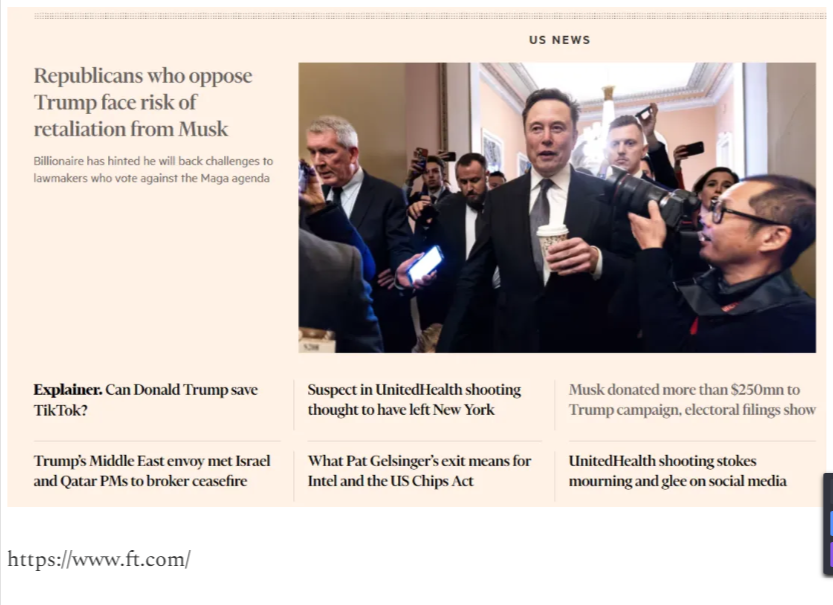
Political Reporter muses about this photograph: It look like a still from Orson Wells’ Citizen Kane! Newspaper Reporters surround ‘The Great Man’. Though it’s well below the fold!
As for Iran, Israel’s retaliatory strike in late October on key military facilities left it too weakened and exposed to save Assad. Tehran is now rapidly withdrawing its once-considerable military presence in Syria. Cut off from this military supply chain, Hezbollah has never been in a more precarious position, giving the Lebanese people their own rare opportunity to bring this terrorist militia to heel and restore their sovereignty after decades of de facto Syrian and Iranian occupation.
Victory, as the saying goes, has a thousand fathers. But credit for Syria’s liberation from Assad must also be given for Israel’s courageous decisions to ignore calls for cease-fire and pursue its enemies — whether in Gaza, Beirut, Hodeidah, Damascus, or Tehran. Each of these actions was denounced at the time for risking “escalation.” But victory over terrorists and tyrants has a way of paying dividends for the victorious and defeated alike.
Let’s hope the next leaders in Syria recognize the debt and finally seek peace, after 76 years of fruitless rejection, with their Jewish neighbor.
It can’t surprise that Mr. Colevile is a man of High Privelidge, wedded to a toxic Thatcherite Political Nostalgia, that is employed in its various regitsters?
Headline: Starmer is stumbling but it’s too early for Tories to celebrate
Sub-headline: It’s one thing to promise to do better next time, another to persuade voters to believe that
In the first paragraphs Mr. Colvile primes the reader with his ‘just one of the fellas’ self-presentation:
In struggling to explain the spate of injuries affecting his new club, Swindon Town, Ian Holloway has happened upon an unusual explanation. The club’s training ground, the manager believes, is haunted — so he’s going to ask his wife to carry out a spiritual cleansing.
Perhaps, once she’s done, Mrs Holloway should pay a trip to Downing Street. Since entering office, Keir Starmer seems to have become a living embodiment of that Simpsons meme in which Bart laments that this is the worst day of his life, and Homer corrects him: worst day of your life so far.
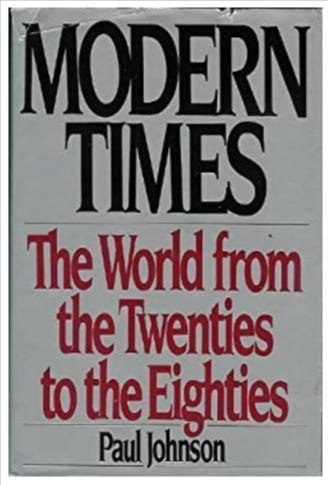
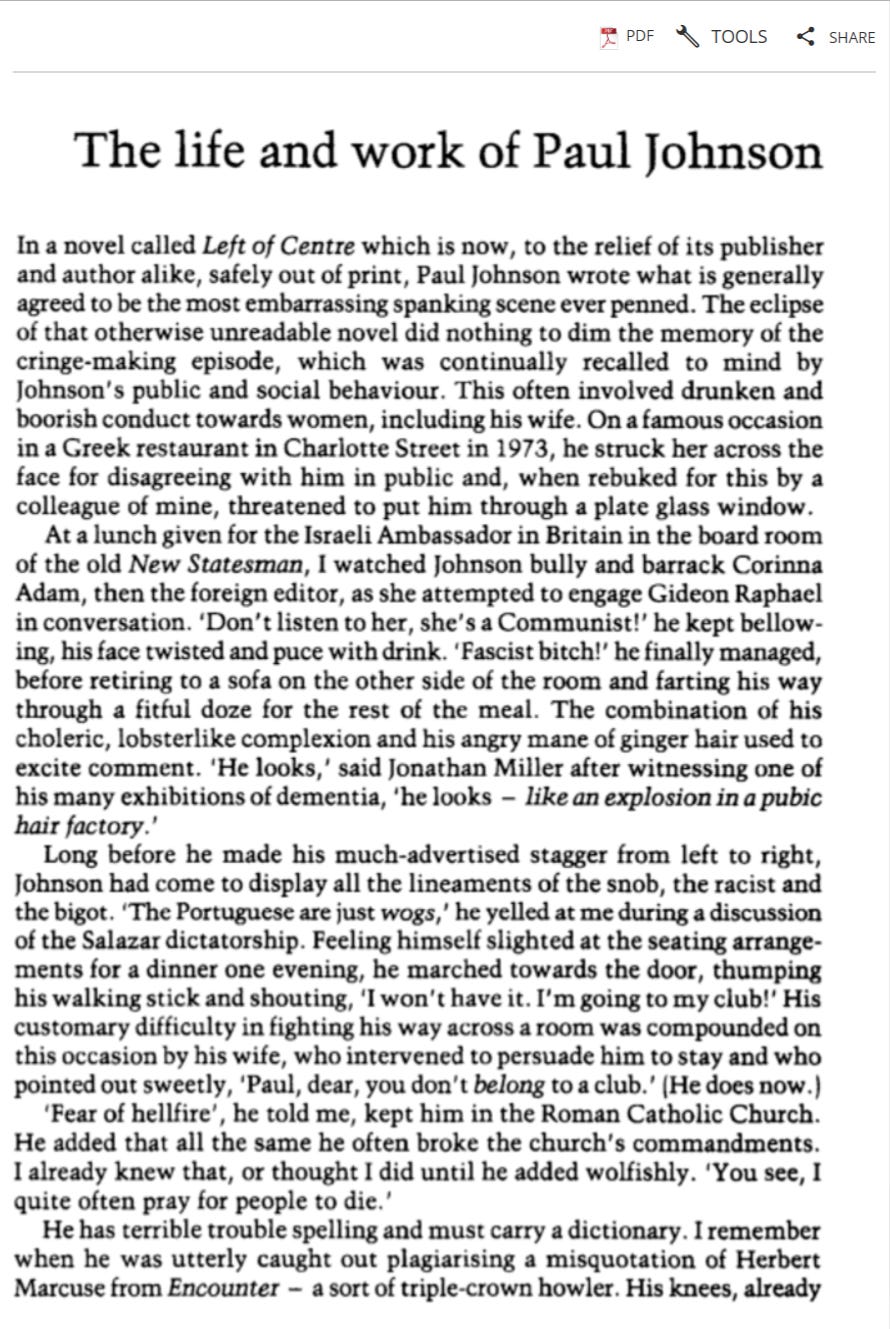
Editor: To add some important political precursors to Mr. Colevile’s essay, this Reader can recall reading the first edition of Paul Johnson’s book of 1983.
Editor: Here is the Mises Institute Robert Nisbet in the New York Times of June 26, 1983, Sunday, Late City Final Edition Section 7: the final paragraphs of Mr. Nisbet’s essay :
…
As this sample of chapters fairly shouts, ”Modern Times” presents a world that has been mostly grim and depressing during the last 60 years. Looking only at the United States we may, if we choose, take comfort in advances in medicine, high technology and mass production of consumer goods. But, welcome as they may be, these advances are hardly likely to be of much effect against the steady decline of economic productivity; the continuous advance of statism, irrespective of administration; the serious, perhaps calamitous degradation of our culture, starting with the educational system, and the constant threat of inflation, massive deficits and high interest rates. I am thinking only of this country. Anyone who can find more hope elsewhere in the world is welcome to try.
Mr. Johnson concludes his book with an overview and assessment under the heading, ”Palimpsests of Freedom.” As that title indicates, he finds some good signs among the bad events he has recounted. He is correct in taking comfort in the death of any serious belief in socialism and statism in the West at the present time. He is correct also in his perception that the social sciences, even economics, and the ideologies embedded in them, are in the doldrums, suggesting that a new start may be made one of these days on getting back to ”the proper study of mankind” -man. I have reservations, though, about his notion that sociobiology might be that new start. On the other hand, if Mr. Johnson means that, on the evidence of human history and especially that of the 20th century, we may well have to wait a few hundred thousand years for improvement of the human lot through the same evolutionary processes that brought homo sapiens into being, I can’t argue; he just may be right. In the meantime, we can take a great deal of intellectual pleasure in his book, which is a truly distinguished work of history.
The result is a state of play in which British politics looks — if you’re allowed to use this kind of ablist metaphor these days — like a bunch of one-legged men in an arse-kicking contest. Reform will surely make gains in the council elections, and may well become the main opposition in Wales. But neither it nor the Tory party is yet strong enough to knock the other out.
Badenoch has made a promising start as leader (and I’m not just saying that because I introduced her on stage). But the Conservatives still have a huge amount of brand damage to repair. Labour is floundering on both sides of the border — in Scotland it has again fallen behind the SNP, leading Scottish Labour to denounce Rachel Reeves’s totemic cuts to the winter fuel payment.
Ed Davey, for his part, seems more interested in reaching No 1 than No 10, his main contribution to the national debate in recent weeks being the release of a Christmas charity single, recorded with a group of carers, called Love Is Enough. Having listened to it, I am prepared to donate quite a large amount if it will guarantee that no one else has to.
Recently, the pollster James Kanagasooriam — who first came up with the idea of the red wall — proposed a new model of the political cycle. He argued that it’s not just about voters moving between left and right, but the level of “block dominance”. Essentially, parties win elections when they unite a block of voters on the left or right. But as they become more unpopular, they fracture their own coalition and unify disillusioned voters around the most likely challenger on the other side.
Labour’s support base appears to be breaking down with unparalleled speed. The big question — especially given the recent shattering of the Tories’ own coalition — is whether voters eventually coalesce around one opposition option, or whether we’re in for a messy, muddled, multiparty age.
How very puzzling that Colevile fails to mention Mrs. Thatcher famous/infamous decalartion, that ‘Tony Blair was my greatest accomplishment’ : in sum Mr. Colevile is attacking the grandchild of the Iron Lady, that is Kier Starmer, as titular leader of New Labour! With Tony Blair dehind the curtain, controling the levers of power?
Editor: Even Zionist stalwert Bret Stephens can’t resist the siren call !
A Disgraceful Pardon
Dec. 2, 2024
…
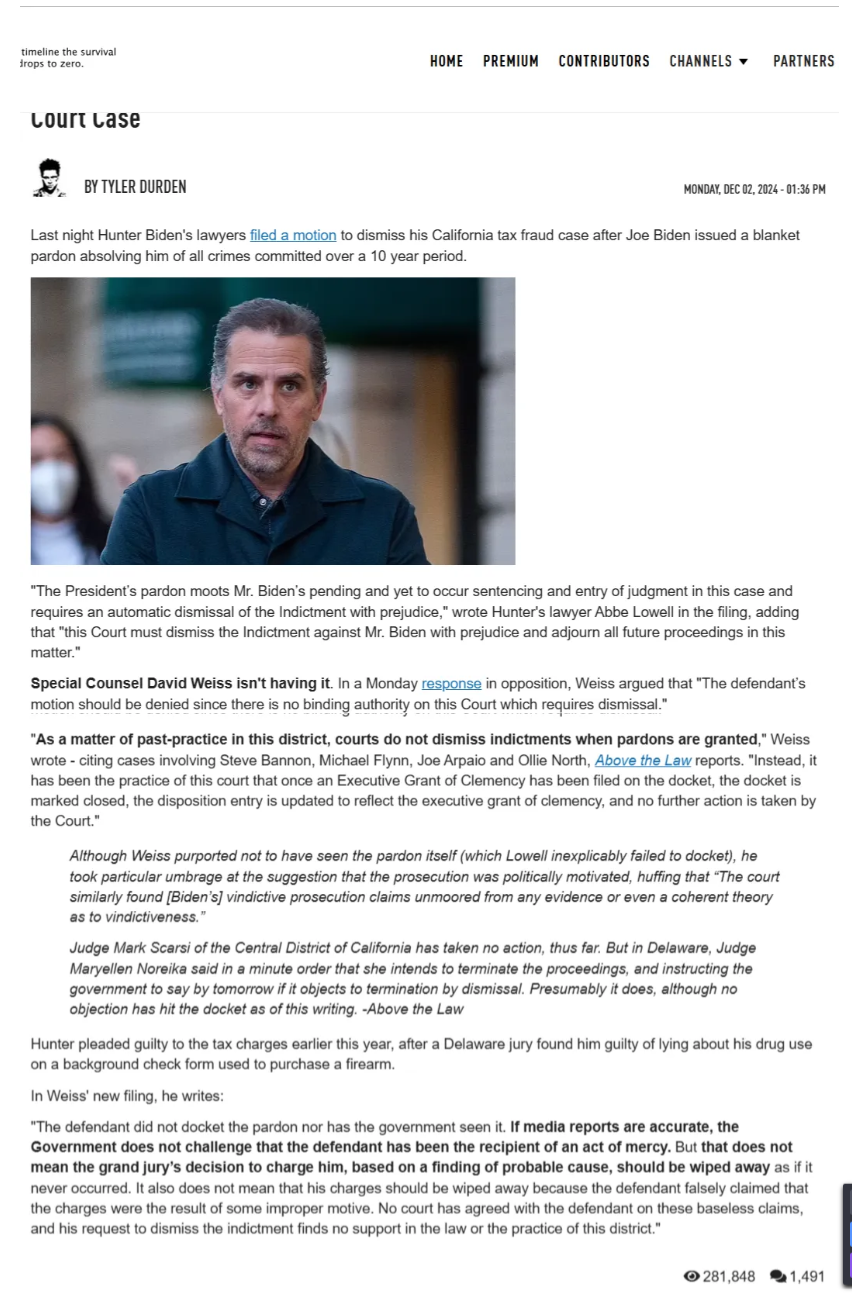
It was always a good bet that the president would break his word as soon as it was politically safe to do so. But he doubled down on dishonesty in his statement about the pardon, claiming Hunter’s prosecution was a result of “political pressure” on the judicial process. Nonsense. The charges stem from Hunter’s reckless lifestyle, abetted and financed by his willingness to trade shamelessly on the family name. A previous plea agreement between Hunter and federal prosecutors fell apart last year under scrutiny from a federal judge.
…
Editor: Reader stay tuned for Mr. Stephens Dec. 3, 2024 praise for fellow Zionist shill Rahm Emanuel, who will put New Democratic house in order?
Israel’s President Isaac Herzog spoke to Elon Musk this week in a bid to enlist the world’s richest man to keep the stalled negotiations for the release of Israeli hostages on the incoming Trump administration’s agenda.
The conversation, which took place at the urging of some of the families of hostages still being held by Hamas, was part of Herzog’s “wide and fairly extensive efforts to apply pressure on all parties”, a person familiar with the conversation said. About 100 hostages, more than a third of whom are believed to be dead, are still held in the besieged enclave.
The unconventional outreach to Musk, who has no official role involving the Middle East in President-elect Donald Trump’s incoming administration, underlines both Musk’s outsize role during the transition period and the lengths to which the desperate families of hostages must resort to inject urgency into the issue.
While it’s unclear what day Musk and Herzog spoke, Trump posted on his social network Truth Social on Monday evening that if the hostages are not released by the time he takes office on January 20 “there will be ALL HELL TO PAY in the Middle East”.
Trump has spoken multiple times to Prime Minister Benjamin Netanyahu since winning the election — even hosting Netanyahu’s wife and son at his Mar-a-Lago resort earlier this week — and to Herzog, who has a ceremonial role in Israeli politics.
In an earlier conversation on November 11, Herzog “emphasised the urgent need to secure the return of the Israeli hostages”, according to his office.
The latest conversation between Musk and Herzog was of a “general nature, and from a policy to . . . put pressure wherever pressure can be placed to keep the issue” front and centre, the person familiar with the conversation said. The call was first reported by Israel’s Channel 12.
The person said the call was not simply an attempt to influence Trump. “Musk’s role in the Trump camp is one thing but he is also the key figure of one of the most important social media platforms for awareness and narrative,” they said.
Musk did not immediately respond to a request for comment.
Hamas took 250 people hostage in its surprise October 7, 2023 raid on Israel, which killed 1,200 people, according to local officials. While dozens were released in a brief Israeli hostage-for-Palestinian prisoner swap in November that year, the rest have remained captive despite many failed rounds of indirect negotiations between the US and Israel with mediators Egypt and Qatar.
Seven of the remaining hostages also hold American nationality, although five of them are believed to be dead.
Trump has blamed outgoing US President Joe Biden for failing to secure the release of the hostages, and is banking on a renewed set of negotiations to succeed. This could repeat the spectacle of the release of US diplomats held hostage in Iran under Jimmy Carter, who were freed as Ronald Reagan took power in 1981.
Negotiations have stalled over Hamas’s demand that the staggered release of all the hostages accompany assurances that Israel’s war in Gaza will simultaneously wind down and eventually end.
Netanyahu has resisted this, sparking street protests in Israel as more hostages either die from their injuries, from Israeli bombings or are executed by Hamas as IDF forces close in on their locations.
But this last week a tentative new approach was made, according to two people familiar with the situation. They said Ronen Bar, chief of Israeli domestic intelligence service Shin Bet, conveyed to Egyptian intelligence that Israel would agree to a 60-day ceasefire in exchange for the release of the female hostages, wounded and elderly.
Editor: There can be no surprise that reporters Mehul Srivastava & Joe Miller follows the @FT Party Line on The Gaza Genocide! Yet the penultimate paragraph of this ‘report’ offers the horrific facts of that metaticising atrosity! And the active criminal complicity of the National Security States of ‘The Mythical West’!
Israel’s offensive has killed at least 42,000 Palestinians, most of them women and children, according to local health officials, displaced most of the entire 2.3mn population in the besieged enclave and triggered a severe hunger crisis.
Political Observer offers more that just this front page. I offer selections from Claire Gatinois and Solenn de Royer, of Le Mond’s, postmortem of Macron’s ‘twilight’?
Editor: The Reader has to congratulate Le Monde, and its reporters Claire Gatinois and Solenn de Royer, for their 3633 word exsumation of Macron and Macronism? The Reader might even choose her favorite selections, and totally ignore my own! One might read the reportage of Claire Gatinois and Solenn de Royer as contemporary riff on Rise and Fall of Cesar Birotteau by Honoré de Balzac? That might also riff on the themes of Lucien de Rubempré of The Splendors and Miseries of Courtesans? The Reader might become annarored, even seduced, by the style of these two reporters, and again ignore my own! This vast canvas invites dissent, as does the title of this essay, followed by Chapter Headings, in a nod to the novel as formative ?
Editor: engaging in some self-serving shorthand will make this more palatlatable?
Since the disastrous dissolution, which saw him lose around a hundred MPs, Macron has grown weary of criticism,…”Who are you talking about?”…I think I’ve flipped everyone quite nicely,” he wrote to his interlocutor, convinced that inviting MPs to lunch in small groups, as he’s been doing since the summer, is enough to win them back…Macron prefers to mince words… president Nicolas Sarkozy, who never misses an opportunity to have a dig at his predecessor, Jacques Chirac… said former conservative senator Pierre Charon (Les Républicains, LR)…Roger-Petit, known as “BRP,” who used to encourage “the chief” to be “Gaullian” by calling “the people” back to the polls…One witness to the scene reported that lawyer and editorialist Charles Consigny…Former manager of the Elysée presidential palace and current vice president of Publicis France, Clément Leonarduzzi – nicknamed “Clément Leonardisso” (a play on “dissolution”) by Macron supporters –… The identical reconstruction of the cathedral, five years after it was ravaged by fire, is seen as a signature achievement of Macron’s presidency and an opportunity for redemption. It will be an “unforgettable moment that will resonate worldwide,” said Leonarduzzi.
‘I let them’
…the president has retreated to his small circle of communicators: the strategist Jonathan Guémas, his collaborator Jonas Bayard and the indispensable Roger-Petit. These loyal “musketeers” keep alive the story of an “inevitable” dissolution… “We’ve avoided a massacre,” some strategists want to believe, convinced that a “clarification” has indeed taken place: the far-right Rassemblement National (RN) has shown that it is not ready to take power… “We’ve avoided a massacre,” some strategists want to believe, convinced that a “clarification” has indeed taken place: the far-right Rassemblement National (RN) has shown that it is not ready to take power…Alexis Kohler has struggled to maintain control during Macron’s second term…Despite rumors of his imminent departure for the banking sector, his exit keeps being postponed. “I can’t leave him,” he told a visitor in September,…Following a cabinet meeting, Macron slipped away, unwilling to linger with the members of the current government who are no longer from his own party and who he distrusts….”The light has shifted,” said a member of the president’s cabinet, who added: “We are in the sublime of effacement, as Stendhal would say.”…”What do we do?” asked distraught Renaissance senator François Patriat on the sidelines of former prime minister Elisabeth Borne’s decoration ceremony on November 25…in the morning, they are told “not to touch anything,” and to “let [Prime Minister Michel] Barnier govern”; in the evening, the president is pleased to have his own men in government to “weigh in.”
Barnier, the ‘Leclerc tank’
“Well, we didn’t understand each other,” Barnier would occasionally say on his way home from a meeting with the president, whom he had to endure downplaying the staggering public deficit while firmly cautioning against raising taxes….But beneath his pleasant, polished façade, the prime minister can be sensitive and rigid, concerned about his prerogatives. “You thought you were dealing with a courteous, malleable gentleman, but you’ve inherited a Leclerc tank that runs over you,” a person close to the prime minister told the teams at the presidency….”At the European level, Michel Barnier is an element of stability,” said Patrick Hetzel, higher education minister and a close friend of Barnier.
‘He’s no longer the same’
Macron hoped to regain a little breathing space by devoting himself to geopolitics….A “clear victory,” he wrote to the president, who immediately replied, “Yes, and we must turn this into an opportunity.”…At the end of November, at the G20 summit in Rio de Janeiro, Brazil, he made the point to his peers that he was a “veteran”: Few people can boast such longevity….which came into effect on November 27, between Hezbollah and the Israeli authorities. The American president, Joe Biden, went so far as to salute his counterpart for this fruitful “partnership….In September, his friends found him tired and emaciated. The post-dissolution elation was followed by a period of uncertainty. What if this self-confident president was starting to have doubts?…He’s a “warrior,” said former MP Vignal, convinced that Macron will regain his panache. “Leave the bullshit to the government,” he suggested by text message at the end of the summer, urging him to embark on a tour of France, as he did after the Yellow Vests movement and the protests against the pension reform….Conservative MP Olivier Marleix compared him to a “dead star.”
‘Emmanuel is a child’
As his influence wanes, Macron clings to the trappings of power….”The scum,” said the president, who sends those who criticize him for enjoying his “good pleasure” back to the bitter camp….A month later, he showed the same ease in sunny Rio de Janeiro, on the sidelines of the G20, alternating between jogging along Copacabana Bay and sightseeing with Brigitte, enjoying the attention of passers-by everywhere. “I love Rio,” he said….the French president, dressed casually, replied that the Haitians are “complete morons” for having dismissed their prime minister, Garry Conille, whom he described as “astounding.” He added that they only have themselves to blame if chaos reigns…The windows of the Elysée Palace are lit up late at night. What does Macron think about when he can’t sleep? Perhaps he reflects on all those he “fed,” as he puts it, over the past seven years, and who are now turning their backs on him? Outside the palace, gossip circulates. His little quirks are dissected and mocked, much like his habit of always insisting to be served first; or the newly ordered chairs for the Council of Ministers embossed with “RF” (for “République Française”)…”Emmanuel is a child,” former French president François Hollande once told Le Monde, “he plays.” He’s a “theater kid” who “has always mistaken society with the stage,” said essayist Alain Minc…doesn’t have harsh enough words for the dissolution (“the worst political trauma the Fifth Republic has seen in 50 years”) and its instigator, a “child king” with “narcissism pushed to a pathological level” and a propensity for “denying reality.”…
‘Curse of the gods’
On the evening of the dissolution, which risked paving the way for the far right to form a government, former advisers to the Elysée thought fondly of former interior minister Gérard Collomb, who died in 2023. Upon leaving the Interior Ministry in 2018, the Lyon native had warned his friend, the president, against hubris, the “curse of the gods” that afflicts those who become “too sure of themselves.”…”The gods blind those they want to lose,” said the former Greek teacher, who was laughed at by everyone at the time….His former minister Jean-Michel Blanquer, who was one of the most eager to praise the intelligence and disruption of this much-admired young president, blamed this “fallen angel” for having “taken the country with him into the void he had chosen to rush into.”… During their summer tête-à-tête, the president said: “Make me a note with a few points on which to move forward.” “I’m not your collaborator,” said the former trade unionist.- “You’ve always been tough,” said the president, who has never been considerate of intermediary bodies…. This is what sociologist Marc Joly has attempted to analyze in a book, La Pensée Perverse au Pouvoir (“Perverse Thinking in Power”), surprised to see so many comments on the president’s supposed “madness” in the wake of his decried decision.
He feels replaced
Brigitte Macron has put on a show, displaying an unalterable cheerfulness: “The French don’t deserve him,” she told actress Arielle Dombasle, who accompanied the presidential couple to Morocco. “We’re counting our friends, and there aren’t many of them,” she told TV host Stéphane Bern…. But it’s François Mitterrand that Macron looks to for inspiration, wondering how the old monarch went about governing souls. At the end of his two terms in office, the Socialist president pretended to support Lionel Jospin, the Socialist candidate to succeed him, while sabotaging him under the table. Like him, Macron, who will not be able to stand for re-election in the next presidential election, seems incapable of imagining his successor. “Talking to him about 2027 is like talking to him about death,” said a close friend….”The president loves a fight. And here, he has no fight. He feels like he’s been replaced,” said Renaissance MP Karl Olive, as former prime minister Gabriel Attal, 35, prepares to take over the reins of the presidential party….”And I’ll be honest,” said the president, “even Gabriel got us into trouble by being so egotistical.” “You put him out of a job without notice!” said Vignal. Haunted by this balance sheet, which he fears will be erased, overshadowed by the abyssal debt and political decay, Macron spoke to a few friends about the idea of writing a book, a “credo” that would revisit his policy platform work, Révolution, published in 2016. “Michel Barnier will be your Medvedev,” a writer told Macron, in an allusion to the short-lived Russian president who enabled Vladimir Putin to return to power after two successive terms…. In 1940, the historian analyzed the causes of the nation’s collapse, and wrote that “the story of this strange defeat, that of our French will, dulled by conservatism, lulled to sleep by conformism, softened by bureaucracy, abandoned by part of its elites,” said Macron, believing that the past holds lessons for the present. The man who got himself elected by presenting himself as a transgressive reformer, eager to overcome the blockages of the Fifth Republic, and who has ended up a paralyzed Fifth Republic leader, doesn’t seem to see how much this “strange defeat” resonates with his own.
Israel’s President Isaac Herzog spoke to Elon Musk this week in a bid to enlist the world’s richest man to keep the stalled negotiations for the release of Israeli hostages on the incoming Trump administration’s agenda.
The conversation, which took place at the urging of some of the families of hostages still being held by Hamas, was part of Herzog’s “wide and fairly extensive efforts to apply pressure on all parties”, a person familiar with the conversation said. About 100 hostages, more than a third of whom are believed to be dead, are still held in the besieged enclave.
The unconventional outreach to Musk, who has no official role involving the Middle East in President-elect Donald Trump’s incoming administration, underlines both Musk’s outsize role during the transition period and the lengths to which the desperate families of hostages must resort to inject urgency into the issue.
While it’s unclear what day Musk and Herzog spoke, Trump posted on his social network Truth Social on Monday evening that if the hostages are not released by the time he takes office on January 20 “there will be ALL HELL TO PAY in the Middle East”.
Trump has spoken multiple times to Prime Minister Benjamin Netanyahu since winning the election — even hosting Netanyahu’s wife and son at his Mar-a-Lago resort earlier this week — and to Herzog, who has a ceremonial role in Israeli politics.
In an earlier conversation on November 11, Herzog “emphasised the urgent need to secure the return of the Israeli hostages”, according to his office.
The latest conversation between Musk and Herzog was of a “general nature, and from a policy to . . . put pressure wherever pressure can be placed to keep the issue” front and centre, the person familiar with the conversation said. The call was first reported by Israel’s Channel 12.
The person said the call was not simply an attempt to influence Trump. “Musk’s role in the Trump camp is one thing but he is also the key figure of one of the most important social media platforms for awareness and narrative,” they said.
Musk did not immediately respond to a request for comment.
Hamas took 250 people hostage in its surprise October 7, 2023 raid on Israel, which killed 1,200 people, according to local officials. While dozens were released in a brief Israeli hostage-for-Palestinian prisoner swap in November that year, the rest have remained captive despite many failed rounds of indirect negotiations between the US and Israel with mediators Egypt and Qatar.
Seven of the remaining hostages also hold American nationality, although five of them are believed to be dead.
Trump has blamed outgoing US President Joe Biden for failing to secure the release of the hostages, and is banking on a renewed set of negotiations to succeed. This could repeat the spectacle of the release of US diplomats held hostage in Iran under Jimmy Carter, who were freed as Ronald Reagan took power in 1981.
Negotiations have stalled over Hamas’s demand that the staggered release of all the hostages accompany assurances that Israel’s war in Gaza will simultaneously wind down and eventually end.
Netanyahu has resisted this, sparking street protests in Israel as more hostages either die from their injuries, from Israeli bombings or are executed by Hamas as IDF forces close in on their locations.
But this last week a tentative new approach was made, according to two people familiar with the situation. They said Ronen Bar, chief of Israeli domestic intelligence service Shin Bet, conveyed to Egyptian intelligence that Israel would agree to a 60-day ceasefire in exchange for the release of the female hostages, wounded and elderly.
Editor: There can be no surprise that reporters Mehul Srivastava & Joe Miller follows the @FT Party Line on The Gaza Genocide! Yet the penultimate paragraph of this ‘report’ offers the horrific facts of that metaticising atrosity! And the active criminal complicity of the National Security States of ‘The Mythical West’!
Israel’s offensive has killed at least 42,000 Palestinians, most of them women and children, according to local health officials, displaced most of the entire 2.3mn population in the besieged enclave and triggered a severe hunger crisis.
Editor: This from Chicago Magazine of Febuary 1, 2017 might just put Mr. Stephens enthiasm for Rahm Emanuel, into another, more accurate perspspective !
Headline: Rahm Emanuel: The Least Popular Mayor in Modern Chicago History
Sub-headline:The mayor’s job approval drops well below the Bilandic Line in the latest Tribune poll—and his approval rating among white voters is just four points ahead of Harold Washington’s in 1985. By Whet Moser February 1, 2016, 3:56 pm
A decade ago, TV writer John Rodgers was trying to figure out how low George W. Bush’s approval ratings would go. A friend predicted 27 percent, because that was the percentage of the vote the hapless Alan Keyes received in his comically lopsided Senate race against Barack Obama. “Twenty-seven percent of the population of Illinois voted for him,” his friend said. “They put party identification, personal prejudice, whatever ahead of rational judgment.” (Bush would drop to 25 percent in the Gallup poll, making it a pretty impressive prediction.)
The Tribune just polled ‘s approval rating. What do you know: it is 27 percent.
It’s a big poll for a local politician, almost 1,000 respondents, and Emanuel gets killed on basically every question. The only thing resembling a bright spot is that “only” 41 percent of respondents think he should resign, versus 51 percent who don’t. But the racial breakdown is dramatic. Whites are 26 percent for resigning versus 69 percent against, while blacks and Hispanics have basically same split: 51 percent and 50 percent for resignation, respectively, versus 40 percent against. It’s a big blow for a politician who needed the black vote to win a surprisingly contested second term.
How bad is 27 percent? It’s real bad. According to my search of Tribune job approval polls, since the era of Daley dominance began no mayor has ever been this unpopular. In fact, it’s so bad that it’s six points below the previous worst.
Richard J. Daley
He served before the age of regular job-approval polling, but a Gallup poll taken 10 years after his death in 1986 gave him a 73 percent job-approval rating. Before his last election, Daley won a Trib poll in a four-way mayoral primary with 55 percent.
Michael Bilandic
Remember him? He was the machine politician whose handling of the 1979 blizzard—both logistically and politically—is a famous cautionary tale for urban leaders. Prior to it, he had a 48-percent approval rating, according to a WBBM poll; afterwards, he fell to 33 percent.
Jane Byrne
She won because of Bilandic’s collapse, but a year later had a mere 35 percent job-approval rating—and, according to the Tribune in 1980, her good/excellent numbers were actually lower than Bilandic’s.
Harold Washington
Racial tensions caused problems for Washington in City Council, but his top-line numbers were good: 54 percent approval versus 36 percent disapproval in 1985 (though the split was 33/58 for whites), and 67 percent approval in 1987. The Trib used the northwest and southwest sides as a proxy for white voter approval that year, and he notched 47 percent in the former and 32 percent in the latter.
Eugene Sawyer
Washington’s successor was unable to fill his shoes, but his numbers weren’t atrocious. In 1988 the Tribune polled residents on a number of questions about his performance; 55 percent thought he was not “strong, decisive, and independent”; 54 percent thought he was not an “effective leader”; and 45 percent said he wasn’t “good at getting things done.”
Richard M. Daley
For most of his tenure, Da Mare maintained high approval ratings: 80 percent in 1991, 79 percent in 1999. After the Hired Truck scandal, arguably the biggest of his time in office, it slipped to 53 percent in 2005. By late 2009, after the parking-meter deal turned into a disaster, even the great Daley slipped to a Byrne-level 35 percent.
As for Rahm? His highest job approval ratings are among whites, but they’re bad, too: 37 percent, a mere four points above Harold Washington’s approval rating among whites in 1985.
Editor: Mr Stephens assumes that his particular reader won’t bother to check readily avavalable sourses of information! He is a propgandist by avovation and temperament. In this particular instance Mr. Stephens dons the weak guise of a Political Reformer of the New Democratic Party, fogetting that the Neo-Conservatives and the New Democrats have made an allience in the 2024 election. That Bill & Hillary Clinton, Braack Obama are now desperate to begin a political reinvention, post the resounding victory of Trump.
Mr. Stephens wastes no time in presenting Rahm Emanuel as the answer, yet the first paragraph above makes plain the fact Stephens wastes no time pointing out that Progressive Left as a natural enemy of the Parties hierarchy and presents Rahm Emanuel the natural enemy of : ‘The progressive left despises his pragmatism and liberal centrism’. Stephen’s re-invents Emanuel?
There’s a buzz around Rahm Emanuel — the former Bill Clinton adviser, former Illinois congressman, former chief of staff to President Barack Obama, former mayor of Chicago — possibly becoming the next head of the Democratic National Committee. The progressive left despises his pragmatism and liberal centrism. He has a reputation for abrasiveness. And his current job, as ambassador to Japan, has traditionally served as a posting for high-level political has-beens like Walter Mondale and Howard Baker.
But he also has a gift for constructing winning coalitions with difficult, unexpected partners.
…
Editor: Mr. Stephens relies on the well worn bad actor of ‘the progressive left’ that always falls into line with the New Demcratic majorty!
Editor: Here is a New York Times essay on ‘The Brothers Emanuel’ of June 15, 1997 by By Elisabeth Bumiller
The best Rahm Emanuel story is not the one about the decomposing two-and-a-half-foot fish he sent to a pollster who displeased him. It is not about the time – the many times – that he hung up on political contributors in a Chicago mayor’s race, saying he was embarrassed to accept their $5,000 checks because they were $25,000 kind of guys. No, the definitive Rahm Emanuel story takes place in Little Rock, Ark., in the heady days after Bill Clinton was first elected President.
It was there that Emanuel, then Clinton’s chief fund-raiser, repaired with George Stephanopoulos, Mandy Grunwald and other aides to Doe’s, the campaign hangout. Revenge was heavy in the air as the group discussed the enemies – Democrats, Republicans, members of the press – who wronged them during the 1992 campaign. Clifford Jackson, the ex-friend of the President and peddler of the Clinton draft-dodging stories, was high on the list. So was William Donald Schaefer, then the Governor of Maryland and a Democrat who endorsed George Bush. Nathan Landow, the fund-raiser who backed the candidacy of Paul Tsongas, made it, too.
Suddenly Emanuel grabbed his steak knife and, as those who were there remember it, shouted out the name of another enemy, lifted the knife, then brought it down with full force into the table.
”Dead!” he screamed.
The group immediately joined in the cathartic release: ”Nat Landow! Dead! Cliff Jackson! Dead! Bill Schaefer! Dead!”
Rahm Emanuel and Israel It was inevitable that the world would eventually realize the unhappy fact that President-elect Barack Obama will not represent a complete break with the past 60 years of American diplomacy. By tapping Rahm Emanuel, a fierce partisan of Israel who volunteered as a mechanic in northern Israel during the first Gulf War, it is fair …
By David Kenner, Middle East editor at Foreign Policy from 2013-2018.
His father, a pediatrician still practicing near Chicago, immigrated to the United States from Israel and spoke Hebrew with his son, when Emanuel was a boy. Emanuel volunteered as a civilian volunteer in the Israel Defense Forces during the 1991 Gulf War, serving in one of Israel’s northern bases, rust-proofing brakes.
Mr Stephens avoids the mention that he and Emanual are not just Zionists but of the the most belicose iteration of that cardre. Mr. Stephens acts as a conduit for Emanual’s politics, which he characterises as: But he also has a gift for constructing winning coalitions with difficult, unexpected partners.
With Hillary Clinton’s hysterical attack on the Constitutional guarantee of Free Speech, and calling her students Foreign Agents: and Biden Pardoning his son- when will be the propitious moment arrive for Rahm Emanuel to take the lead role of The New Democratic Party ? Mr. Stephens is a propagandist and constructs a senario dubed ‘Flip the Script’, that reeks of the arcaine vocabulary of those mythically re-engeneered ‘Mad Men’?
The Financial Times employes: Edward White in Shanghai, Cheng Leng in Hong Kong, Kana Inagaki in London and Stephen Morris in San Francisco and ‘Additional reporting by Ding Wenjie and Joe Leahy in Beijing!’
Editor : after these below quoted selections from this Financial Times diatritribe against Elon Musk, there remain 1826 words.
…
Musk could potentially provide a “critical bridge” between China and the Trump administration, says Philippe Houchois, an analyst with US investment bank Jefferies.
…
Given the stakes for Tesla, the entrepreneur might be expected to act as a “moderating influence” on Trump’s planned tariffs, Houchois adds — and “how much or [for] how long markets ignore potential conflicts of interests ranging from political responsibilities to governance and compensation, is unclear”.
…
Two Democratic senators have sought a federal investigation into Musk’s reported communication with Russian leader Vladimir Putin, raising concern over Musk’s high-level security clearances and billions of dollars in US government funding.
….
Other parts of his empire run directly into points of tension between the US and China. SpaceX, his commercial rocket and satellite business, has drawn sharp criticism from Chinese military analysts who see the company and its vast network of Starlink satellites as part of the American military’s expansion into space. And X, the social media platform, is banned in China.
Yaqiu Wang, research director for China at Freedom House, a US-based advocacy group, warns that Beijing has become “very deft” at manipulating foreign business leaders — including leveraging their companies’ access to the country — to compel them to “toe” the Communist party line, she warns.
“Musk is not only vulnerable to Beijing’s pressure given his extensive business interests in China, he also seems to genuinely enjoy close relationships with China’s authoritarian leaders,” she says. “This dynamic creates ample opportunities for the CCP to influence Trump’s China policy.”
…
The prospect of facilitating the loan sparked fierce competition among Chinese banks. Some lobbied the Ministry of Industry and Information Technology, one of Tesla’s regulators in Beijing, to be added to the list of approved lenders. From the bankers’ point of view, the deal was not only financially failproof, but it was also an opportunity to demonstrate alignment with Beijing’s supportive green industrial policy.
In the end, loans totalling nearly $1.4bn came from a consortium of some of the country’s biggest state-owned lenders: China Construction Bank, Agricultural Bank of China, Industrial and Commercial Bank of China and Shanghai Pudong Development Bank. The interest rate on the debt was pegged at 90 per cent of China’s one-year benchmark interest rate, a discount that state lenders usually offer to their best clients, almost always other Chinese groups.
Editor: What are the Imperatines Of Capital but prophet! Espessially in the watershed of the Economic Collapse of 2007-2008: that Obama said ‘lets put this behind us’ and his Simpson -Boles Austerity that cratered! Obama betrayed the very people who voted for him, while embracing his Wall Street backers
What the Financial Times, and its many contributers don’t just miss, but ignore is that Elon Musk’s self-consept is World-Historical in nature ! His self-concept transcenedes the rest of the Trump ‘the hangers on’! His Rocket Ships do what no others have done, his World Wide Starlink, Neuralink is a neurotechnological company that’s developing a brain-computer interface (BCI) that allows users to control devices with their thoughts.



 StephenKMackSD's Blog