Newspaper Reader can’t forget all those years in front of that black & white 21 inch screen !
Feb 26, 2026
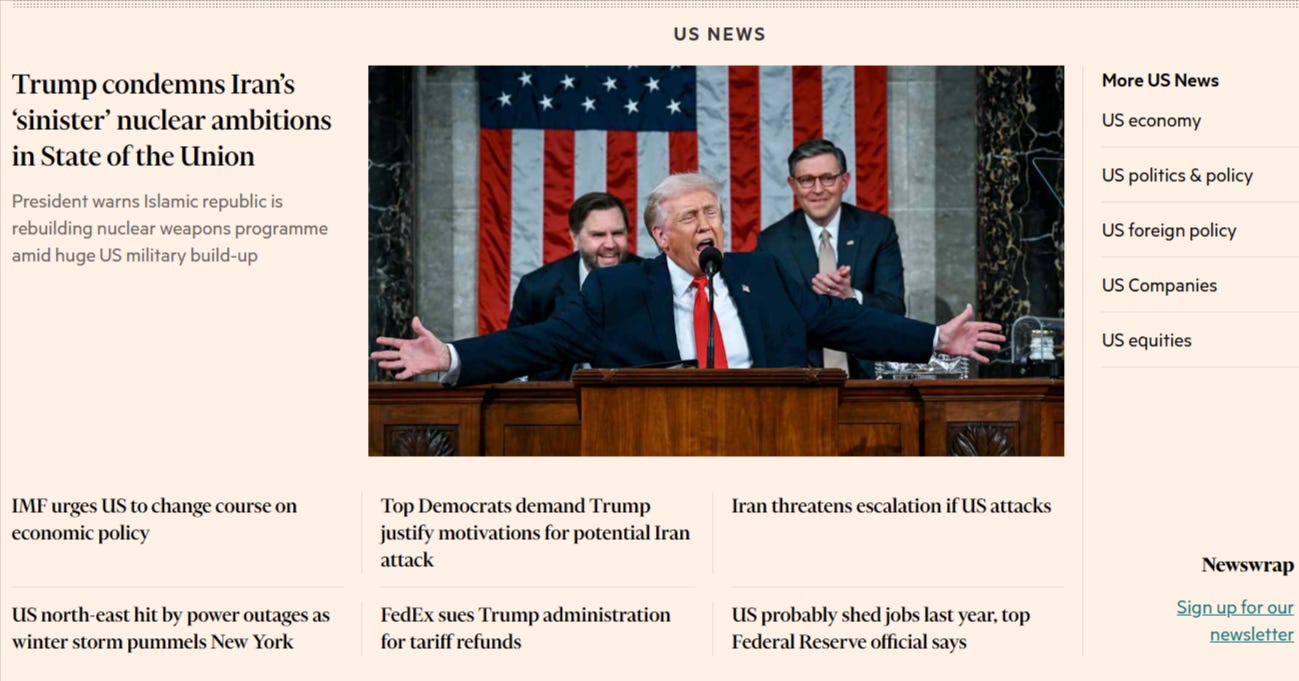
Trump condemns Iran’s ‘sinister’ nuclear ambitions in State of the Union
Newspaper Reader.
Feb 26, 2026
Trump condemns Iran’s ‘sinister’ nuclear ambitions in State of the Union
Newspaper Reader.
Feb 26, 2026

Jeffrey EpsteinJeffrey Epstein
The Langs’ troubling friendship with Jeffrey Epstein
Former French culture minister Jack Lang and his daughter Caroline Lang appear thousands of times in the most recently released documents. All evidence suggests that she had a much closer relationship with the sex offender than she now admits.
By Raphaëlle Bacqué and Ivanne Trippenbach
Published yesterday at 6:00 pm (Paris), updated yesterday at 9:03 pm
17 min read.
On June 20, 1990, before dawn, Jack Lang arranged to meet his guests at Le Bourget airport, just north of Paris. President François Mitterrand’s minister of culture had big plans to export the annual national music celebration he had created to the Soviet Union. His round trip to Moscow involved celebrities (Eddy Mitchell, Charlélie Couture, Alain Delon), a filmmaker tasked with capturing the event, and around 15 journalists. Out on the tarmac, the delegation discovered their aircraft: a private Boeing 727, fully fitted out with a lounge, bedroom and bathroom. The plane had been lent by a “friend,” answered Monique Lang, the minister’s wife, when asked about the mysterious owner’s identity. That “friend,” French diplomats whispered to the stunned guests, was Robert Maxwell.
The British media mogul and Lang had already known each other for several years. In 1987, the Socialist culture minister and the businessman, a former Labour MP in the House of Commons in London, even formed an alliance. At the height of the battle over the privatization of TF1 television station, undeterred by any mixing of business and politics, it was with Lang’s support that Maxwell and Francis Bouygues, head of the world’s largest construction group, managed to convince Mitterrand to choose them to buy France’s first television channel.
Maxwell also became a valuable patron for Lang. On July 18, 1989, they were side by side at the inauguration of the Grande Arche de la Défense, the giant monument aligned with the Arc de Triomphe. It was one of those celebrations that characterized the Lang years, complete with champagne and saxophonists dressed as astronauts. The British businessman had saved his friend’s colossal project by contributing 150 million francs (€42 million today).
The businessman also demonstrated his generosity by contributing 500,000 francs to fund events and commemorations related to the bicentennial of the French Revolution, notably for the digitization of period documents, affording himself the pleasure of attending all the Parisian ceremonies. Maxwell was, in fact, so close to Lang, who was also the mayor of Blois, in central France, that he owned a printworks in that city. In October 1989, he attended the Estates General of European Culture there at Lang’s invitation. Without even visiting his own printworks.
At the time, one of the minister’s two daughters, Caroline Lang, was 28 years old. After appearing in the films L’Argent (Money, 1983) by Robert Bresson and Chronicle of a Death Foretold (1986) by Francesco Rosi, she studied to obtain a doctorate in public law. And, for her first foray into professional life, she was hired by none other than Maxwell Communications in London. As always with the Lang family, blurring the lines was the rule, with private interests and public service, family and ministry all intertwined. At Jack Lang’s own office, Monique, in everyone’s eyes, acted as the head of communications, welcoming all the important artists on behalf of her husband.
…
In Epstein’s “little black book” – his address book, which the FBI seized as early as 2009 while investigating his embezzlement and sexual abuse of minors in Florida – Caroline Lang’s name is already there: three phone numbers and a New York address, apartment 9C at 400 East 52nd Street, in the heart of Manhattan. Had the daughter of the former Socialist minister already been noticed, as early as the 2000s or even before, by this businessman determined to spin his web around the world? Very few French nationals appeared in this directory that contained some 1,700 names. When contacted by Le Monde, Caroline Lang declined to comment.
Wildly close-knit clan
Since January 30 and the publication of the Epstein files, the documents have cast a raw light on the connection binding the Lang family, particularly Caroline, to Epstein. Their extensive correspondence, which lasted seven years, from 2012 until the sex offender’s arrest in 2019, reveals an intimate and troubling relationship.
Records show that on March 24, 2012, the American hosted a dinner in Paris attended by Caroline Lang, along with filmmaker Woody Allen and his spouse, Soon-Yi Previn, and US Ambassador Charles Rivkin and his wife. Epstein, who had been convicted four years earlier of soliciting prostitution of a minor, took care to keep paparazzi at bay, even as he returned to Parisian high society and rebuilt his extraordinary network. The following day, Jack Lang’s daughter thanked him by email for inviting her to his table. On March 26, she visited his luxurious Paris apartment at 22 Avenue Foch in the 16th arrondissement. Welcomed by the butler, she spent some time with the American, discussing Japanese literature and Vladimir Nabokov, the writer whose most famous novel, Lolita (1955), is also the confession of a sexual predator about the relationship he had with a 12-year-old girl.
…
Newspaper Reader.
…
This apparent nonchalance of the Lang family, pampered by their American friend, never seemed to be shaken. But it did not reflect Epstein’s true situation. For several months, the FBI had been on his trail. On November 28, 2018, the Miami Herald published an in-depth investigation titled “How a future Trump Cabinet member gave a serial sex abuser the deal of a lifetime.” The “serial sex abuser” in question was Epstein. The Trump administration official mentioned by the Florida daily was Alexander Acosta, the very man who, 10 years earlier, had accepted a secret deal with the millionaire to reduce his sentence to 18 months in prison in exchange for his guilty plea to soliciting prostitution from a minor, at a time when the FBI had identified 33 victims. This time, the journalist behind the investigation found around 80 women claiming to have been sexually assaulted and raped by the businessman between 2001 and 2006, when they were between 13 and 16 years old.
Did Caroline Lang hear about this article published on the other side of the Atlantic? In any case, she knew that her friend was accused of “international sex trafficking” and of “sex orgies” with a very large number of young women, some of whom were minors at the time. On March 4, 2019, Epstein himself sent her the letter to the editor his own lawyers had just published in The New York Times, in response to the Miami Herald investigation and the inquiries now being conducted by the largest American daily newspaper. Caroline Lang replied to thank him.
Fifteen days later, however, she invited him, as usual, to a family lunch on Place des Vosges. “Perfect, as usual, I will be on time,” Epstein replied with delight. She also invited him to a contemporary interpretation of Swan Lake at the Théâtre National de Chaillot with her parents on March 30, 2019.
The next day, Epstein told her in an email that Jack Lang had a “proposal” for him. Through Caroline, a meeting was arranged between the two men at the café Ma Bourgogne, Place des Vosges, to discuss it. It is not known what idea Jack Lang had for his American friend. However, his daughter Caroline would be among the last French people to see Epstein, who was arrested by the FBI on July 6, 2019, as he returned from Paris aboard his private jet. On August 8, 48 hours before he was found dead in his prison cell, the convicted sex offender included her in his will, leaving her $5 million (€4.2 million).
Newspaper Reader.
Feb 25, 2026
Politics • International Politics • Opinions
Why Is This Canadian Foreign Minister ‘Proud’ of Her Family’s Nazi Past?
Chrystia Freeland apparently blames Russian disinformation for her grandfather’s Nazi editorials that described Poland as ‘infected by the Jews’
By Mikhail Klikushin • 03/22/17 7:30am
Chrystia Freeland, the newly appointed Foreign Minister of Canada. Nicolas Maeterlinck/AFP/Getty Images
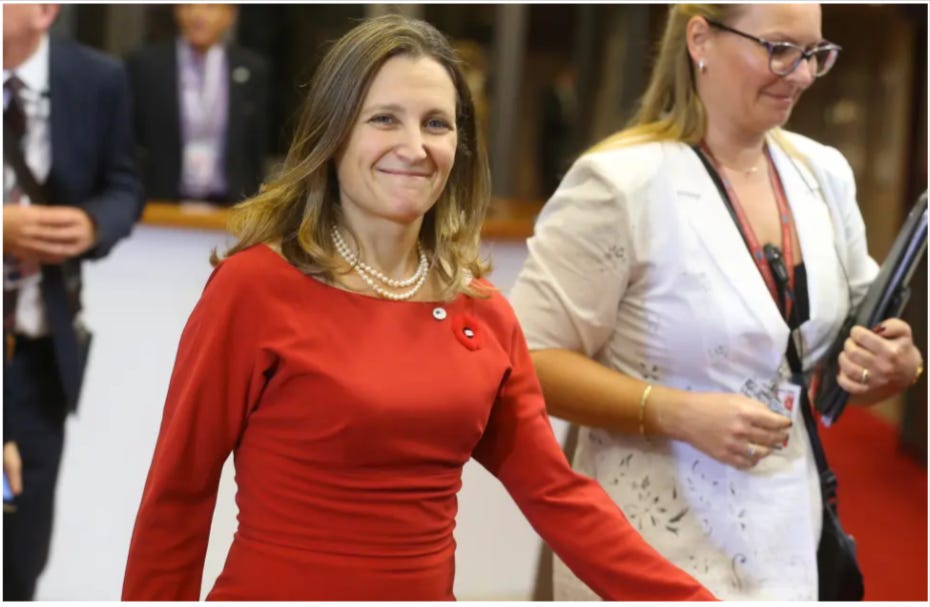
When asked at a press conference on March 6 about the allegations that her maternal grandfather was a Nazi collaborator, Chrystia Freeland, newly appointed Foreign Minister of Canada, former journalist and a writer, a master of words, found only clumsy sentences to deliver what would have earned no more than a ‘C’ in a high school debate class.
“It’s no secret that Russians do not like you and banned you from the country,” began the question. “Recently, there has been a series of articles in pro-Russian websites about you and your maternal grandparents, making accusations that [your grandfather] was a Nazi collaborator. I’d like to get your view—is this a disinformation campaign by the Russians to try to smear you and discredit you, which they have a tendency to do?”
With a poorly-camouflaged expression of pain on her face, Freeland replied:
“It’s public knowledge that there have been efforts—as U.S. intelligence sources have said—by Russia to destabilize the U.S. political system. I think that Canadians and indeed other Western countries should be prepared for similar efforts to be directed at us. I am confident in our country’s democracy and I am confident that we can stand up to and see through those efforts.”
“I don’t think it’s a secret,” she continued, “American officials have publicly said—and even [German Chancellor] Angela Merkel has publicly said—that there were efforts on the Russian side to destabilize Western democracies, and I think it shouldn’t come as a surprise if these same efforts were used against Canada. I think that Canadians and indeed other Western countries should be prepared for similar efforts to be directed at them.”
What? Angela Merkel? Was her grandfather a Nazi collaborator or wasn’t he? Freeland dodged the question.
As The Globe and Mail reported, when asked to refute the allegation, her office responded: “People should be questioning where this information comes from, and the motivations behind it.”
While the story created a storm of Canadian press, apart from The Washington Post and Bloomberg, U.S. media shied away.
Freeland, a former Canadian journalist of Ukrainian descent, has authored two books on corrupt Russian oligarchs—surely, her books on the Ukrainian oligarchs who flushed her beloved Ukraine down the toilet are on the way. She speaks Russian fluently, and understands Russian culture—including Russian politics. So, she certainly could have mustered a better answer to shrug off the uncomfortable questions about rumors of her grandfather’s collaboration with the Nazi regime in WWII Poland.
This meme, shorter and better seasoned than her actual response, would have worked: “You are Sourkovskaya propaganda!”
The term, overwhelmingly popular in Russian political newspeak, has origins in the name of Mr. Vladislav Sourkov, Vladimir Putin’s personal advisor and at one point a major Kremlin ideologist. It means “Sourkov’s propaganda,” of course, and first surfaced in 2011, when journalists from a pro-Kremlin television network tried to break into the office of opposition NGOs, demanding an interview from its representative.
Fighting off the aggressive guests armed with microphones and cameras, the opposition employee gave only one explanation for his refusal to be interviewed.
“You are Sourkovskaya propaganda!” he said more than 80 times in a five-minutes span.
“You are Sourkovskaya propaganda” is the pathetic last line of defense for righteous politicians against the evil reality of stubborn questions that will not evaporate.
But first: Is it such big news that politicians of the Canadian Foreign Minister’s level have relatives that collaborated with Nazis during WWII?
Recent history is replete with examples of world leaders with similar skeletons from their relatives’ Nazi or Soviet past.
Former Estonian Foreign Minister Marina Kaljurand, despite strong electoral support, dropped out of last year’s presidential race when it was revealed that her father, during the WWII, fought on the side of Nazis in the 19th Latvian SS Division. He had a rank of SS Untersturmfuhrer and received two Iron Crosses from Nazi military authorities.
Kaljurand said she never knew her father—and never said she was proud of him.
Russian media revealed that the father of Olexandr Turchynov—former Prime Minister of Ukraine, former Acting President of Ukraine and current head of the Council of National Security of Ukraine—was a member of the Nazi punitive auxiliary police battalion, responsible for annihilating a number of villages in Russia. After the war, Turchinov’s father was sentenced to 25 years of hard labor in Siberia, but in 1955, just five years later, was released during Khrushchev’s thaw.
Ukraine ignored the news and Turchynov never responded to this example of Sourkovskaya propaganda.
Lithuanian President Dalia Grybauskaitė had insisted her father, Polikarpas Grybauskaitė, was a firefighter after the war when, in fact, he served Stalin’s dreaded NKVD—which is nothing to be proud about in Lithuania.
In 2014, when a book on Grybauskaitė’s past came out—sealing her nickname Red Dalia—her subordinates called it an “informational attack against Lithuania by the people connected to Kremlin.”
The revelation of Grybauskaitė’s father’s work for NKVD, Stalin’s dreaded secret service, didn’t lead to impeachment because the notion of Sourkovskaya propaganda had been introduced by that time.
Parents and grandparents—not children—should be responsible for these crimes. But, more often than not, they get away with them.
Kurt Waldheim, oberleutnant of the Nazi Wehrmaht, bearer of the Iron Cross, became President of Austria and the fourth General Secretary of the UN. All of his life he lied about his role in WWII, later admitting he “made mistakes” and asking for forgiveness in his posthumous latter.
At 79, after hiding his secret for all of his life, German novelist and Nobel Prize Laureate Gunter Grass admitted that at the age of 17 he joined Waffen SS and was a member of the Nazi party during the war. This fact “oppressed” him, he said, the “disgrace” later became “a burden.” The revelation ended “Grass’s moral authority” in Germany and around the world.
Pope Benedict Xvi had to resign—the first Pope to do so since 1415! A lot of people in his flock could not forget that, in his youth, Joseph Aloisius Ratzinger was a member of Hitler Jugend and wore a Wehrmaht uniform during the war.
Lech Wałęsa, ex-President of Poland and leader of the Solidarity movement—another Nobel Prize Laureate—vehemently denies he was a KGB agent with the operative nickname ‘Bolek,’ though recently-discovered documents state otherwise.
The list goes on.
Michael Chomiak, grandfather of Canadian Foreign Minister Chrystia Freeland, was no a Gunter Grass—though he had a direct relation to publishing.
Born Mykhailo Chomiak, he fled his Polish hometown of Lviv for another Polish town, Cracow, in 1939—right before Stalin’s annexation of this part of the country. His granddaughter claims he was smart enough to foresee what Stalin’s regime would do in his motherland Ukraine.
To make a long story short, Chomiak preferred Hitler’s regime to Stalin’s.
But does that make him a Nazi collaborator, or is this all a bunch of Sourkovskaya propaganda?
Here’s a fact: after Hitler ‘reunited’ Poland in the beginning of WWII, Chomiak chose not to return to his beloved Lviv which he missed so much, but to remain in Cracow. There, from 1940 to 1944, he served as editor-in-chief of the Ukrainian Nazi newspaper, under the command of Hans Frank (Governor-General of Poland, Nazi lawyer, executed at the Nuremberg Trials). Chomiak’s direct supervisor was none other than Emil Gassner, head of the press department in Nazi-occupied Poland.
During WWII, in occupied Poland, the Nazis entrusted Chomiak with this position, editing Krakivski Visti (Cracow News). His office and printing presses had been taken from the Jewish owners of the Nowy Dziennik newspaper, who were sent to the extermination camps.
It was a lot of work for Chomiak, but he didn’t have to start from scratch—thanks to the confiscated (Jewish) resources. In the beginning of 1940, the newspaper printed just two issues a week, increasing later to three, and then, after much organizational effort on Chomiak’s part, became a daily.
His Nazi bosses settled Chomiak comfortably in an apartment in Crakow that had been “freed” from its previous Jewish owners.
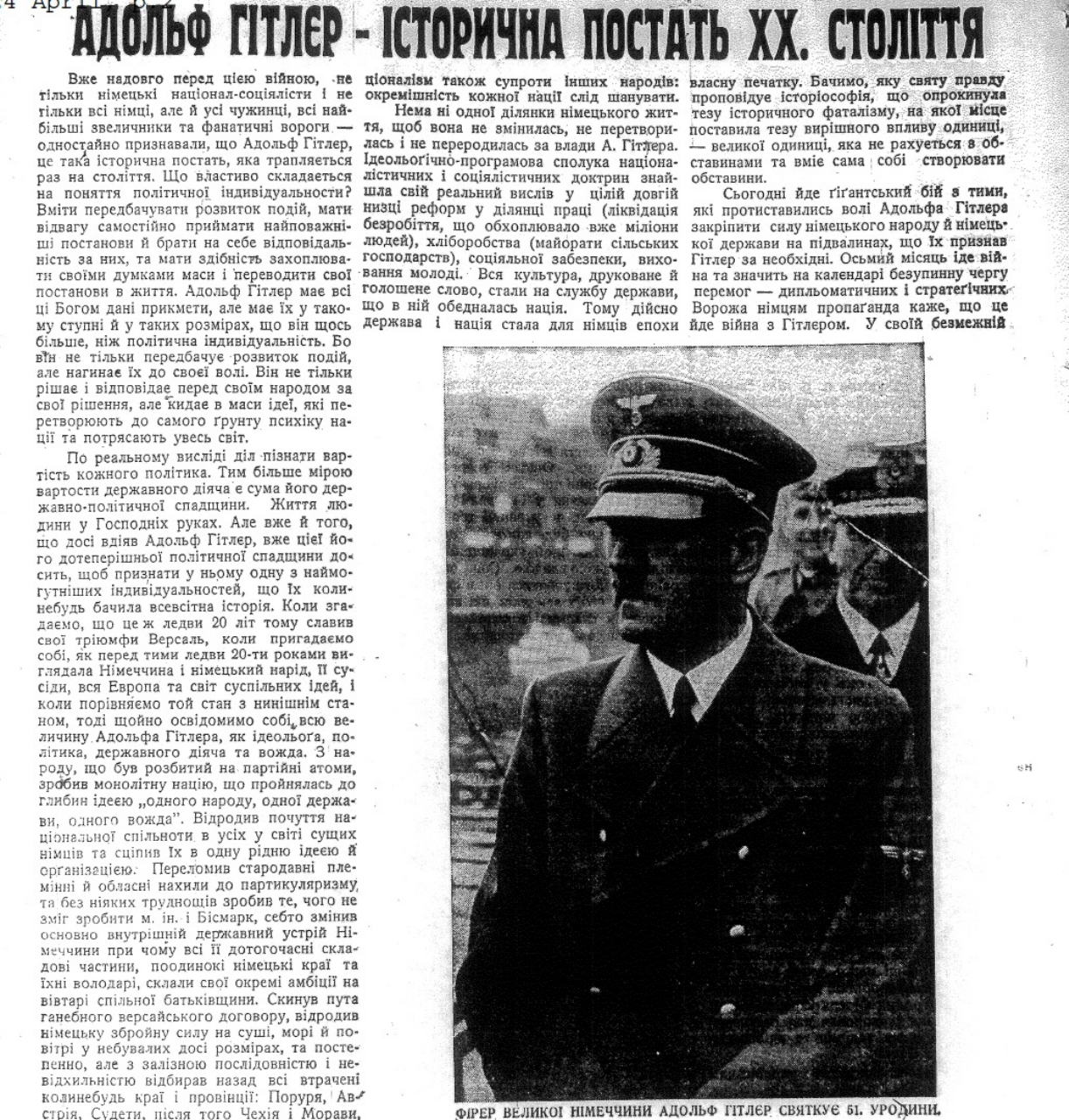
Krakivski Visti spread Nazi propaganda for five years, praising Adolf Hitler and Governor-General Hans Frank on behalf of the “Ukrainian people,” and spitting venom against Jews, Poles and Russians.
“With the great joy, the Ukrainian population welcomes the establishment of just German order, the representative of which they have found in you, dear Mr. General Governor,” wrote Krakivski Visti on November 1, 1940. “This happiness has been expressed by Ukrainian people not only with flowers that German soldiers that entered our region were covered with, but also with the sacrifices with blood that the fight against Polish usurpers demands.” Ukrainians were ready for a “happy cooperation” with the Nazis, the newspaper claimed—happy to help with the “establishment of plans of the new order in Europe,” Mykhailo Chomiak’s newspaper printed.
In 1943 and 1944, Krakivski Visti hailed the formation of the 14th Waffen SS Division Halychyna, composed of Ukrainian volunteers, fighting against partisans and annihilating civilians.
Krakivski Visti welcomed the “German bombs falling on London that created a lot of heavy house fires.” The “bombing of industrial plants in Birmingham, Coventry, the port of Liverpool was good,” it reported with enthusiasm.
Editor-in-chief Chomiak undoubtably approved of the Nazi’s campaign to exterminate the Jews. According to The Globe and Mail, Prof. Himka, a relative of Freeland, “acknowledged that Mr. Chomiak was a Nazi collaborator,” although he pointed out that “the Germans made the editorial decisions to run anti-Semitic articles and other Nazi propaganda.”
After a mass shooting of Jews in Kiev at Babi Yar, Krakivski Vesti wrote that the city was better without the Jews. “There is not a single one left in Kiev today, while there were 350,000 under the Bolsheviks,” the newspaper reported with satisfaction. The Jews “got their comeuppance.” Without Jews, Kiev became “beautiful, glorious.”
Editorials described Poland as “infected by the Jews.” All in, about 25 percent of the newspaper’s content was devoted to Nazi propaganda—anti-Semitic, but also anti-Polish and anti-Russian.
In Canadian newspapers, some supporters of Freeland and her grandfather—especially those of Ukrainian descent—paid attention to the fact that Mykhailo Chomiak never personally signed any story published by the Krakivski Visti. But if he was smart enough to foresee the consequences of Stalin’s occupation of Lviv when he ran to Nazi-occupied Cracow, he was smart enough not to sign any story in his paper. Foreseeing his next possible run—out of Cracow—Chomiak wouldn’t have wanted to risk, one day, being held accountable for them.
There is no doubt Chomiak was very good at what he did for the Nazis in Krakivski Visti—otherwise, why would he be taken to Vienna, together with his family, in 1944 with the retreating Nazi army? German recourses were scarce—and they spent them on Chomiak.
He did not stay in Cracow to join Polish resistance.
In Vienna, he continued to publish the newspaper.
From Vienna, with the help of his retreating Nazi bosses, he resettled in Bavaria.
For the third time, he chose Hitler over Stalin.
And, by that point, wasn’t Stalin an ally of the United States?
It was in Bavaria that Chomiak surrendered to Americans and, three years later, immigrated to Canada to reunite with his sister. The “quiet Canadian” never told his relatives about his work for Nazis. The truth came out only after his death in 1984, when his private papers were found in the attic of his house.
“Foreign Affairs Minister Chrystia Freeland knew for more than two decades that her maternal Ukrainian grandfather was the chief editor of a Nazi newspaper in occupied Poland that vilified Jews during the Second World War,” The Globe and Mail reported.
Some say Chomiak’s past has nothing to do with Freeland and the whole thing was blood libel orchestrated by Russians.
But, having known for more than 20 years about her grandfather’s past, why has Freeland been portraying him as a victim of both Stalin and Hitler?
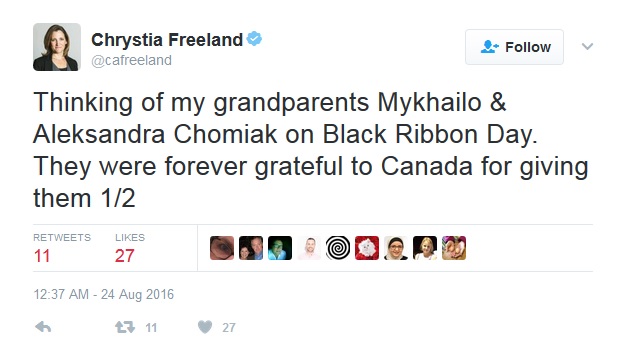
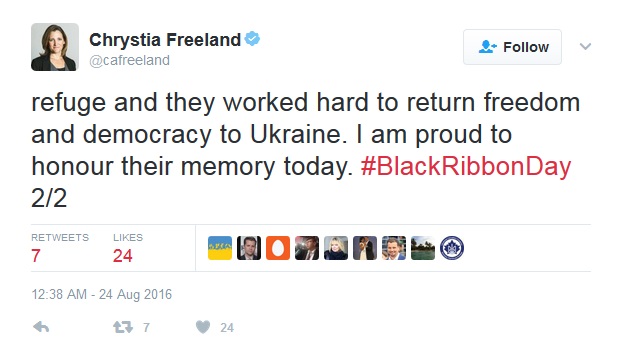
On 24 of August, 2016, a day after Black Ribbon Day, commemorating victims of both Stalinism and Nazism, Freeland Tweeted the following: “Thinking of my grandparents Mykhailo & Aleksandra Chomiak on Black Ribbon Day. They were forever grateful to Canada for giving them refuge and they worked hard to return freedom and democracy to Ukraine. I am proud to honour their memory today.”
Unlike Gunter Grass, Mykhailo Chomiak never apologized for his collaboration with the Nazis.
And his granddaughter, the Canadian Foreign Minister, should not be doing it for him. Rather, she must make two things clear: On what grounds does she consider him to be a victim of Nazis and Stalin? And what part of his past is she so proud to honor?
As far as Kremlin Sourkovskaya propaganda is concerned, yes—a number of Russian media outlets republished The Washington Post story following Freeland’s ill-fated press-conference. Otherwise, there has been deafening silence…
This is most likely because Russians are now busy digging into their NKVD-KGB archives, hoping to find a dusty Nazi party card inscribed with the name Mykhailo Chomiak.
Feb 24, 2026
The Case for Striking Iran
Feb. 22, 2026
…
But it doesn’t mean there isn’t a compelling case for action. Three, in fact.
Iran poses a threat to global order by way of its damaged but abiding nuclear ambitions, its deep strategic ties to Moscow and Beijing, its persistent threats to maritime commerce and its support for international terrorism.
It poses a threat to regional stability, not just through its support for anti-Israel proxies like Hamas and Hezbollah, but also by its meddling in Lebanon, Iraq, Yemen and (until the overthrow of the Bashar al-Assad regime) Syria.
And it’s a mortal threat to the life and safety of its own people, many thousands of whom it slaughtered last month. There was a time not long ago when Americans, both left and right, cared enough about human rights to believe it could, in some circumstances, justify military intervention.
…
Editor: Mr. Stephens is to say the least a Zionist Apologist/Advocate! He tries to mimic a kind of a disinterested point of view, but his regular readers are well aquainted with his tried and true methologies!
The US Has Three Options If It Wants to Hit Iran
February 23, 2026 at 2:26 PM PST
The Pentagon has set the table for major strikes against Iran. With US and Iranian officials negotiating in Geneva, President Donald Trump has threatened significant attacks to induce Tehran to accept a complete end to its nuclear program. What options are available to the president, and which would do the most to pressure Tehran?
Given the US force package in the Middle East, the administration has three “buckets” of capabilities for threatening the Islamic Republic.
The first is non-kinetic warfare, meaning nothing actually blows up. This includes cyberattacks to knock out military and civilian targets, reducing Iranian defense and response capability. There is also information warfare: more propaganda, a better flow of information to the Iranian people, and smuggling in more Starlink terminals to help them get around the regime’s internet clampdown.
Another non-kinetic option could be using radio-frequency tools to degrade microchips in key systems — the “discombobulator” weapon Trump discussed after the raid that seized the Venezuelan dictator Nicolás Maduro.
The second bucket is “limited” strikes. This is what the president seems to have settled on in much of his public commentary. The strategy could include one or two days of strategic attacks against military targets such as ballistic-missile batteries and production facilities; command-and control hubs, especially those of the Iranian Revolutionary Guard Corps; and possibly leadership targets such as Supreme Leader Ayatollah Ali Khamenei.
These strikes would use Tomahawk missiles launched from Arleigh Burke-class destroyers; drones and manned electronic-warfare aircraft; and land- and carrier-based F-35 Lightning stealth fighters. Iran’s air forces should be taken out on the ground before the fight really starts.
Finally, there is bucket three, the truly big tools. This might include several weeks of strikes to wipe out several levels of the Iranian leadership, both religious and secular; hitting what is left of Iran’s nuclear program; destruction of the electric grid; strikes against oil production and refining facilities; and assaults on Iranian naval and maintenance facilities on the Indian Ocean and Persian Gulf.
A campaign of this scale would potentially include the “Sunday punch” of both strategic bombers — likely the B-2s used to devastate Iran’s nuclear sites last summer — and far greater numbers of land-based F-35s, plus sea-based F-18 hornets.
…
Editor: What James Stavridis offer to the reader is what Bret Stephens cannot begin to match! The Military experience that Stavridis posses, even if still attched to a Idiology of Military Supremacy of Weaponry of many and varied kinds, may espress an Idiology of a kind: Yet in sum Mr. Stephens essay is about a purely idiological defence of the Zionist Faschist State manipulation of Donald Trump, via Miriam Adelson’s money, to reduce to it’s essientials!
Newspaper Reader.
Feb 23, 2026
Editor: The first two paragraphs of Stephens column
President Trump appears poised to order strikes on Iran — indeed, by the time you read this column, he may already have done so — while barely bothering to spell out his reasons. The lack of explanation is a serious moral and political mistake: At the very least, Americans deserve to know what they’re getting into, why, for how long and for what result.
But it doesn’t mean there isn’t a compelling case for action. Three, in fact.
Editor. Under the rubric ‘At the very least, Americans deserve to know what they’re getting into, why, for how long and for what result.’
…
Iran poses a threat to global order by way of its damaged but abiding nuclear ambitions, its deep strategic ties to Moscow and Beijing, its persistent threats to maritime commerce and its support for international terrorism.
…
It poses a threat to regional stability, not just through its support for anti-Israel proxies like Hamas and Hezbollah, but also by its meddling in Lebanon, Iraq, Yemen and (until the overthrow of the Bashar al-Assad regime) Syria.
…
And it’s a mortal threat to the life and safety of its own people, many thousands of whom it slaughtered last month. There was a time not long ago when Americans, both left and right, cared enough about human rights to believe it could, in some circumstances, justify military intervention.
…
Editor: This all carefully laundered via ‘a compelling case for action’ !
…
The regime has lost much of its nuclear infrastructure; watched its regional proxies be overthrown, decimated and incapacitated; presided over the implosion of its economy; and lost whatever domestic and international legitimacy remained to it.
The regime has lost much of its nuclear infrastructure; watched its regional proxies be overthrown, decimated and incapacitated; presided over the implosion of its economy; and lost whatever domestic and international legitimacy remained to it.
No wonder protests in Iran have resumed, this time among university students who are bravely undaunted by the terrifying risk. Their protests seem connected to the 40-day memorials for the victims of last month’s massacres. But it’s not a stretch to assume those protests are also a signal to Trump that his promise last month to Iranians that “help is on its way” hasn’t been forgotten, and that ordinary Iranians are prepared to join the fight for their own liberation.
If so, then there is at least a reasonable chance that a sustained military operation that not only further degrades the regime’s nuclear, missile and military capabilities — a desirable outcome in its own right — but also targets its apparatus of domestic repression could embolden the type of sustained mass protests that could finally bring the regime down. Even more so if the leaders who give the orders, including the supreme leader and his circle, are not immune from attack.
For all of its willfulness and the evil it has wreaked over 47 years, the regime does not stand 10 feet tall. It nearly fell during the 2009 Green Movement against that year’s fraudulent elections. It nearly fell again in 2022 during the Women, Life, Freedom protests.
The difference on those occasions was the absence of external military support. Donald Trump now has a unique opportunity to provide it. Despite the risk that military strikes entail, the bigger risk, in the judgment of history, would be to fail to take it.
Editor: To the Zionist Loyalist like Stephens, and his fellow travelers, the imagined future articulated in his column, presages an inevitable future?
Editor.
Feb 22, 2026
Editor: ‘The Collapse of the Dream Palaces’was the turning point of Mr. Brooks political career! He became a New York Times opinion writer. Evan Goldstein’s fawining ‘interview’ is a monument to political confromity and obsequiousness!
For more than two decades, David Brooks has been a fixture of The New York Times opinion page — “the kind of conservative writer that wouldn’t make our readers shriek and throw the paper out the window,” as one Times editor put it when Brooks was hired. A temperamental moderate with a knack for affectionately mocking the elite, Brooks trafficked in wry bemusement rather than moral prescription. In a classic 2001 article in The Atlantic, he trained his eye on “organization kids” — the apolitical, hyperstriving careerists of the Ivy League, whom Brooks regarded as both inordinately obsessive about grabbing the next brass ring and oddly incurious about life’s deeper questions. These students prioritized the cultivation of what Brooks calls résumé virtues at the expense of eulogy virtues, the qualities you hope to be remembered for at your funeral. While he plainly felt something had gone awry, he struck a pose of cocked-eyebrow observer rather than finger-wagging scold.
In the years since, his critique of elite higher education has taken on a sharper tone. In his 2024 Atlantic cover story, “How the Ivy League Broke America,” his target isn’t the psychological malformation of elites, but the entire system that’s anointed their rise. Our method of sorting and sifting via college admissions is bad for higher education and bad for the country, Brooks argues. The architects of the American meritocracy dreamed of a world of “class-mixing and relative social comity; we ended up with a world of rigid caste lines and pervasive cultural and political war. … We ended up with President Trump.”
Now Brooks is moving to the belly of the beast. He recently announced that he would be leaving the Times to take up a new position at Yale University, where he has taught on and off for years. He was recruited to New Haven directly by Yale’s president, Maurie D. McInnis. In his new role, he will lecture, convene discussions on campus, and — what else? — start a podcast in a partnership between Yale and The Atlantic.
I called him on his last day as an employee of The New York Times. We spoke about what Trump gets right, why this is a time for reform in higher ed, and the false consciousness of progressive professors. Our conversation has been edited for length and clarity.
…
Editor: Marcus Stanley in 2021 takes on the question of David Brooks!
What does David Brooks see when he looks in the mirror?
The War on Terror-era neocon is at it again, scolding America for withdrawing from Afghanistan and advocating we stay in the game.
If you were politically aware during the buildup to the 2003 Iraq War, David Brooks’s recent column calling for America to stay in Afghanistan and take a more aggressive role overseas might feel uncomfortably familiar.
Once again, as he did when promoting the Iraq invasion, he calls for America to be the “indispensable nation” and “democracy’s champion.” Once again, there is the obliviousness to the human costs of a supposedly humanitarian U.S. intervention. That was already strange in 2003, but it’s now grotesque after the death of more than 1.3 million human beings in just the first ten years of the War on Terror that Brooks had championed.
The studied turning away from the costs of our wars to those who live in the places where they are fought turns almost surreal in the part of his column devoted to Afghanistan. Brooks cheerfully informs us that “in 1999, no Afghan girls attended secondary school…and as of 2017 the figure had climbed to nearly 40 percent,” all at the cost of “relatively few” American casualties. The cost of a quarter of a million Afghan dead, over 70,000 of them civilians, in a country with a smaller population than California gets zero mention in his column. Neither does the widespread human rights violations associated with the foreign military presence, ranging from torture and detentions to ignoring the return of institutionalized child rape by U.S.-aligned Afghan security forces, something that even the Taliban never tolerated.
After Iraq and Afghanistan, Brooks observes, America “lost faith in itself and its global role, like a pitcher who has been shelled and lost confidence in his own stuff.” Apparently the U.S. is losing its mojo in the democracy-championing business. With the upcoming 20th anniversary of 9/11 the champions of the War on Terror seem to think we are reaching some kind of statute of limitations for the relevance of our past actions. One might have more confidence in this assertion if there had been real accountability and reckoning in Washington for the individuals and ideology that drove the catastrophic decisions made after 9/11.
But this article underscores that there has been no such reckoning. What it instead illustrates is the through-line that links the ideology of global dominance that drove our decisions then, and the way we still look at the world today. The invasion of Iraq was justified by commentators like Bill Kristol using a Manichean distinction between “a world order conducive to our liberal democratic principles and our safety, or… one where brutal, well-armed tyrants are allowed to hold democracy and international security hostage.” Twenty years later, Brooks, a champion of that invasion, still depicts the world as “enmeshed in a vast contest between democracy and different forms of autocracy…a struggle between the forces of progressive modernity and reaction.” And it’s true, as Brooks claims, that this view is close to that espoused by some in the Biden administration.
…
The more subtle difference, acknowledged by Brooks in a brief statement that “we’re never going back to the Bush doctrine,” is a belief we can avoid the overreach of boots-on-the-ground invasions of foreign countries while still pursuing claims to unilateral U.S. global leadership. This recasts the Iraq and Afghanistan wars as driven not by ideological overreach but by a short-sighted failure to anticipate the practical difficulties of invasion and occupation. Calls for new hot wars are out; a sweeping, ill-defined global cold war with the forces of reaction domestically and abroad is in. But cold wars carry their own dangers — including igniting a hot war in any of the numerous simmering low-level conflicts with our ideological enemies around the world, from Ukraine to the Persian Gulf to the Taiwan Strait.
Brooks closes by saying that without aggressively fighting this new global conflict between authoritarianism and progressive values we won’t be able to “look at ourselves in the mirror without a twinge of shame.” It’s an odd moral calculus that tries to ignore shameful acts facilitated by the United States itself and instead calls on us to be ashamed of the actions of foreign governments based on the vague hypothetical claim that U.S. intervention could prevent them. But it’s at the heart of the humanitarian interventionism Brooks sold 20 years ago and is still selling today. We should hope that this time there won’t be buyers in Washington.
Editor: Andrew Bacevich in 2013 on Brooks:
David Brooks is constantly wrong
Takes a lot to be the voice on the New York Times op-ed page most consistently wrong about war in the Middle East!
September 15, 2013
The final paragraphs of Bacevich’s revelatory essay on Brooks:
…
Sprinkling his columns with references to “irony” as he channeled the spirit of Reinhold Niebuhr, Brooks might have chosen to reflect deeply on all that had gone wrong in Iraq and in his own calculations. Was the main problem simply incompetence on the part of George W. Bush, his advisers, and his generals—a splendid initiative squandered through faulty implementation? Or did failure derive from deeper causes, perhaps a fundamental misunderstanding of war or history or human nature itself? Or could the problem lie, at least in part, with a perversely undemocratic military system that condemned soldiers to waging something like perpetual war at the behest of a small coterie of Washington insiders, while citizens passively observed from a safe distance?
Sharing the inclination of his countrymen, Brooks chose not to engage in any searching inquiry at all. Rather than reflecting on Iraq, he looked for new fields in which to test his theory of using military power to spread American ideals while redeeming American culture at home. Afghanistan—a war already under way for more than a decade—presented just the second chance he was looking for. Based on a quick visit, Brooks concluded that Afghanistan was nothing like Iraq. U.S. military efforts there promised to yield a different and far more favorable outcome. “In the first place,” he wrote during his government-arranged reporting trip in early 2009, “the Afghan people want what we want . . . That makes relations between Afghans and foreigners relatively straightforward. Most [U.S.] military leaders here prefer working with the Afghans to the Iraqis. The Afghans are warm and welcoming.” Even better, they actually “root for American success.”
That wasn’t all. In contrast to its fumbling performance in Iraq, the U.S. military had now fully mastered the business of winning hearts and minds. Know-how had displaced ineptitude, with the union of John Wayne and Jane Addams now fully consummated. Further, with the distraction of Iraq now out of the way, the troops in Afghanistan possessed the wherewithal needed for “reforming the police, improving the courts, training local civil servants and building prisons.” As Brooks put it, “we’ve got our priorities right.” Furthermore, “the Afghans have embraced the democratic process with enthusiasm.” Unlike the recalcitrant and ungrateful Iraqis, they were teachable and amenable. Brooks commended President Obama for “doubling down on the very principles that some dismiss as neocon fantasy: the idea that this nation has the capacity to use military and civilian power to promote democracy, nurture civil society and rebuild failed states.” Granted, the trial run in Iraq had gone badly, but why cry over spilled milk? Besides, Iraq had served as an education of sorts. Brooks felt certain that trying again in Afghanistan would yield a better outcome. In short, that war was “winnable.”
Yet Afghanistan proved no more winnable than Iraq had been, at least not within the limits of what the United States could afford and the American public was willing to pay. The U.S. troops who burned Korans, defiled Taliban corpses, and gunned down innocent civilians in shooting sprees made it difficult for Afghans to appreciate the Jane Addams side of the American soldier. As for John Wayne, Hollywood had thought better than to film him urinating on dead enemy fighters. By 2012, an epidemic of “green-on-blue” incidents—Afghan security forces murdering their U.S. counterparts—revealed the absurdity of Brooks’s blithe assertion that Afghans “want what we want” and “root for American success.” What most Americans wanted was to be done with Afghanistan. In hopes of arranging a graceful withdrawal, they might allow Washington to prolong the war a bit longer, but with the usual terms fixed firmly in place: only so long as someone else’s kid does the fighting and future generations get stuck with the bill.
Newspaper Reader.
Feb 20, 2026
What reader who confronts the almost evolution, to near political respectability of James Kirchick, as a possible New York Times replacement for David Brooks? History may disabuse that reader?
James (“Jamie”) Kirchick is a fellow at the neoconservative Foundation for Defense of Democracies (FDD) and a contributing editor at the New Republic. A former writer-at-large for Radio Free Europe/Radio Liberty, Kirchick has also contributed to various rightist outlets like the Weekly Standard and Commentary magazine’s Contentions blog, as well as numerous mainstream publications, including the Los Angeles Times and Politico.[1]
On Anti-Semitism
Like others of his ideological kin—such as Lee Smith, also at FDD—Kirchick has wielded accusations of anti-semitism in an effort to sideline those who are critical of hardline Israeli polices and one-sided U.S. support for them. In a February 2012 op-ed for Israel’s liberal Haaretz, Kirchick defended “pro-Israel” U.S. writers like Josh Block—a fellow at the Progressive Policy Institute and former AIPAC spokesperson—who had been criticized for arguing that progressive, Democratic Party-affiliated organizations like the Center for American Progress (CAP) allowed their writers “to say borderline anti-semitic stuff.” Kirchick misleadingly claimed in the article that Block was “ultimately vindicated” when CAP criticized use of terms like “Israel-firster” in its publications.[2] However, it was Block who was forced to back off his anti-semitism claims, telling a reporter that anyone “suggesting” the he thinks CAP is anti-semitic is simply trying “to distract from what I am actually saying.”[3] Kirchick apparently missed this retraction from Block.[4]
According to Kirchick, the real back story to this episode is what he calls a growing “leftist McCarthyism” aimed at “questioning the loyalties of American Jews.” To support this claim, Kirchick argued—without providing any supporting evidence—that big-name scholars and journalists in the United States have recently experienced success in their careers precisely because of their willingness to criticize Israel. He wrote: “Figures ranging from University of Chicago professor John Mearsheimer to journalists Peter Beinart and Andrew Sullivan have all seen their careers blossom as a result of their harsh and unrelenting criticism of Israel. Indeed, obsessively attacking Israel is a bona-fide way to resuscitate one’s career, not destroy it.” He concluded: “Since the 1950s, liberals have routinely accused conservatives of ‘McCarthyism. Now the tables have turned, and it is leftists questioning the loyalties of American Jews.”[4]
…
Editor: Note the political depth of this revelatory document, that casts a serching light on James Kirchick’s political evolution. If that even begins to describe his trojetory, that now rests in the hands of The New York Times editors and readers?
Newspaper Reader

 StephenKMackSD's Blog