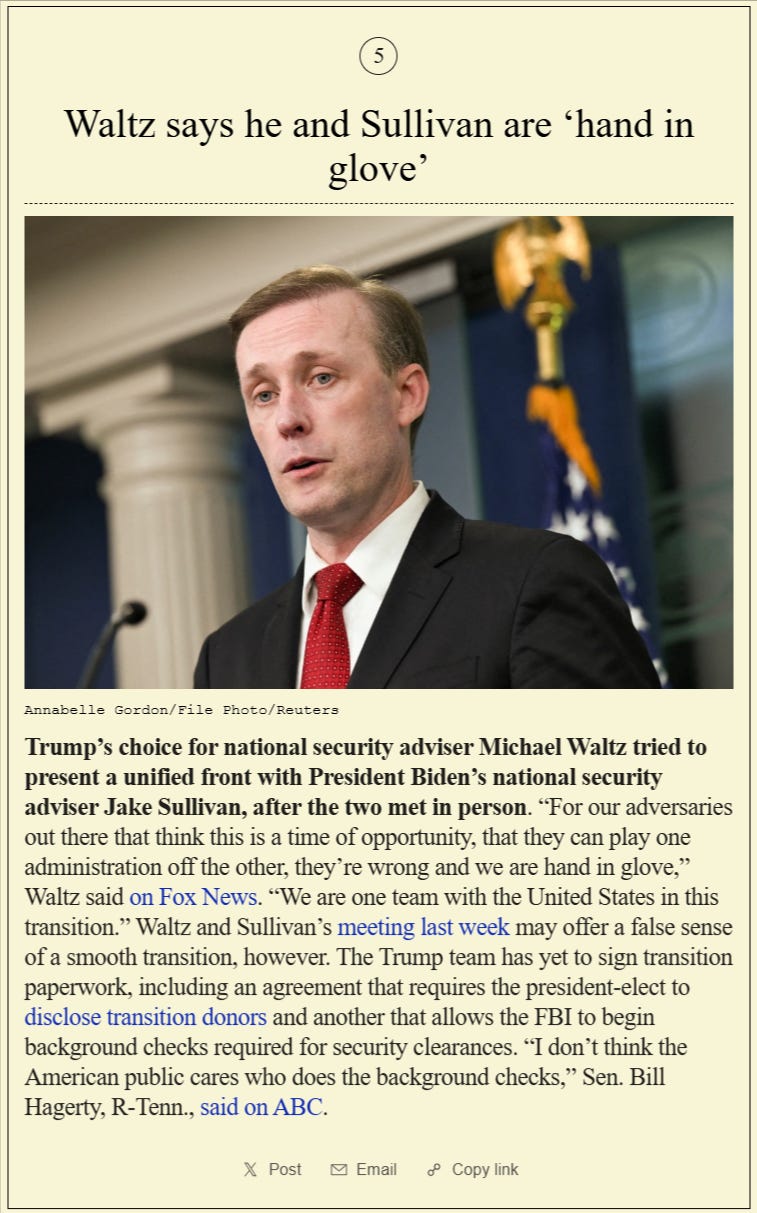
When ever I go to the Library, just a block away, I always see Time magazine on the shelf. I usually find this magazine in almost in pristine condition, as I turn its pages -its of the Century of Cold Warrior Henry Luce- its a time capsuel – And I wonder at its why ? Times are tough for Libraries! Print is in decline, unless its on the Internet. The rows of computers are the first things you see as you enter, the books are just past these computers. In sum times have changed so that ‘Time’ is obselite as a print magazine, but is active on the Internet: Semafor/Principals is about a more carfully packaged and sucinct form of ‘News’ with large Corporate Sponsers: in sum Semafor/Principals is the newest iteration of respectable bourgeois politics, designed to inform its readers about what is important, within the confines of that bourgeois framing!
The Reader can only look to the election of Trump, as the most serious challenge to that respectable bourgeois politics: Trump’s political irrationalism was victorious in the face of The New Democrats: Biden, Harris and arch maniputator Hillary Clinton have been rebuked by Voters.
The reader can clearly see in the actions of Joe Biden’s surrogates Sullivan and Blinken, in suppling Storm Shadow cruise missiles to Ukraine, a strategy to weaken Trumps position before he even takes office!
Blinken, Sullivan and Hillary Clinton are in charge, as Biden’s cognative decline deepens. How many more Ukranian and Russian lives must be sacrificed, to the macinations of morally banrupt cadreas composed of Republicans, New Democrats and the notorious shape-shifting Neo-Consevative’s? The political career of Francis Fukuyama offers the paradigmatic case! He now considers himself a ‘Liberal’ !
Newspaper Reader.
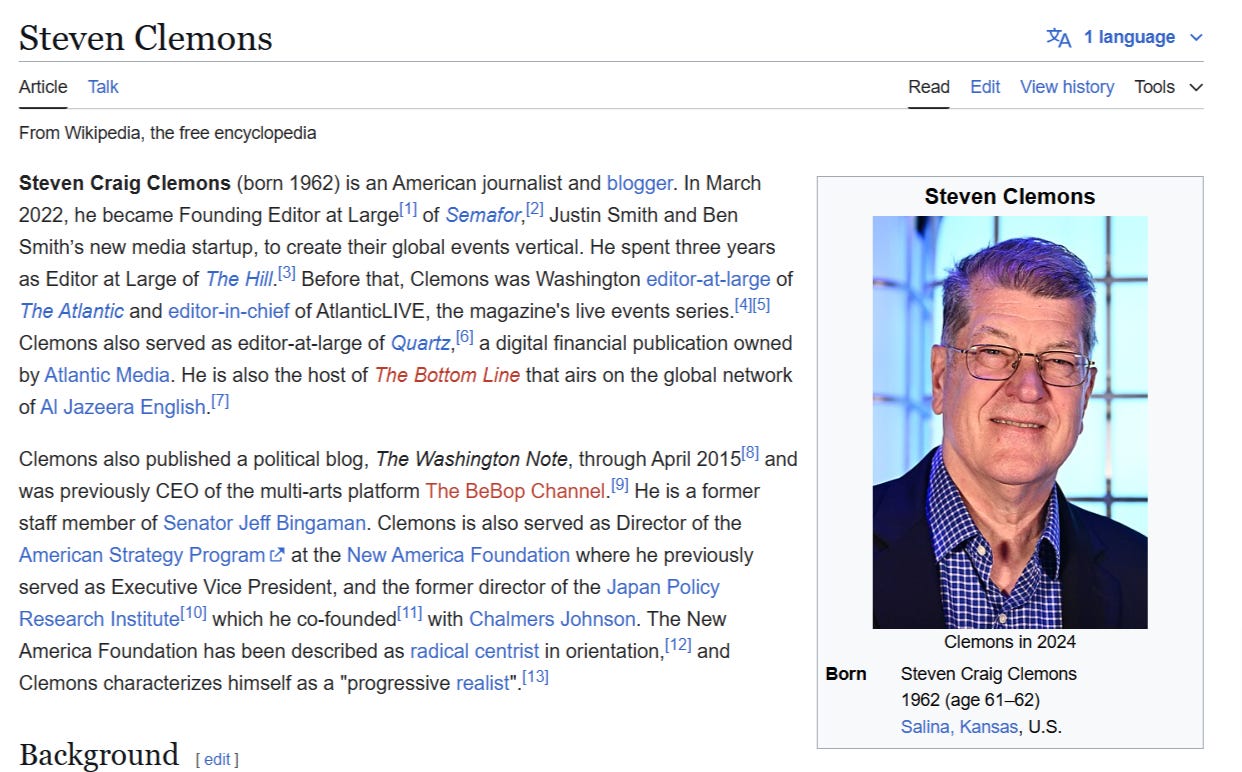
The Reader might wonder what ever happened to Steven Clemons?
The opening paragraph of the Crace essay, in which Crace assumes the role of Peterson:
Just a few years ago, I was an unknown professor writing academic books that nobody read. Then, with God’s help, I decided to stop feeling sorry for myself and develop my potential. Pinkos and wishy-washy liberals had cornered the market in cod psychology, so I guessed there must be a huge hunger for a self-help book, backed up with religion, mythology, CAPITAL LETTERS and stating the obvious – one directed at responsible, socially minded conservatives craving some pseudointellectual ideology to prop up their beliefs. And bingo! Here are my 12 Rules for Life.
1 Stand up straight with your shoulders straight
2 Treat yourself like someone you are responsible for helping
3 Befriend people who want the best for you
4 Compare yourself to who you were yesterday, not the useless person you are today
6 Set your house in order before you criticise the world
7 Pursue what is meaningful, not what is expedient
8 Tell the truth. Or at least don’t lie
9 Assume the person you are listening to knows something you don’t
10 Be precise in your speech
11 Do not bother children while they are skateboarding
12 Pet a cat when you encounter one in the street
Digested read digested: Blessed are the Strong, for they shall inherit the Earth.
Editor: the hapless simplicity of Peterson’s list of ‘Imperatives’, leaves Crace with so much room to riff on themes: yet Peterson’s don’t actually corear, but are almost sugestive of coherence, but in fact merely gambol in its vicinity?
Political Cynic: I feel I have entered into the weak rhetorical eddie of Peterson Speak!
Read the beginning senteses of Mr. Colevile’s essay:
A few years ago my wife made a fateful financial decision. She was worried that we didn’t have enough money coming in, especially given the exorbitant costs of childcare. Her employer, a large bank, offered a great set of benefits. But why did we need them? We were young, in good shape, watching our weight.
I remember we laughed, in particular, at the idea that she’d need life assurance any time soon, let alone at the absurdly generous rate they were offering. So — for the sake of an extra £22.81 a month — she moved that slider down as far as it would go: from eight times her salary to just two.
By early 2019, when the company asked again for her benefit choices, no one was laughing. Andrea was in hospital, seriously ill. She tried to log in to change her decisions. But she couldn’t get it to work, defeated by a combination of horrendously fiddly remote working settings (this was before the pandemic), awful hospital wi-fi and increasing lethargy.
When we think about losing a loved one, especially before their time, we think about the emotional shock. It seems almost callous to focus on the finances. But there is often an awful financial shock, too. In my case I suddenly found myself with a mortgage, two children (one less than a year old) and — if I wanted to continue working — vastly increased childcare costs, all to be covered by one salary rather than two.
Worse, even if your loved ones have savings or assets, you cannot actually make use of them, often for many months. Everyone I spoke to was very understanding. But they all needed certified copies of the death certificate, or the will, or ultimately the grant of probate. Even when her pension was paid out, or her bank account was folded into mine, I wasn’t sure I could touch any of it until the inheritance tax calculations had been finished and the probate process was done.
But there was an exception. Andrea’s “death in service” benefits weren’t as large as they might have been had she pushed the slider back up. But they were still a tax-free lump sum I knew I could rely on to keep the lights on — along with a discretionary payment her employer kindly made, equivalent to her notice period. Together they gave me breathing space: a guarantee that I could keep paying the bills while I worked out what the hell to do next
…
Should this be titled Thatcerite meets ‘The Reality Principal?’ Or should the Reader look to the fact that there are the Hungry, the Homeless, The Pensioners without heat, Hungry families, Rough Sleepers across Britain, that are suffering from the Neo-Thatchrite politics of Kier Starmer and Rachel Reeves?
It’s not that Mr. Colvile’s plight of loss is not moving, and its aftermath in personal and economic terms, was not devistating! His moral/political failure, to connect his suffering to the suffering of others, in an embrace of a common fate: this is about Class and felt Etitlement, of a well paid Thatcherite, to enveigh against his almost fellow travelers!
Editor: The final pargraphs of Colvile’s essay:
…
This is, in other words, a tax on tragedy. As journalists have pointed out, it will even apply to the police, though it is unclear whether it will affect the special awards for those who die in the line of duty.
I do not believe that the civil servants who made these decisions were being deliberately callous. The technical consultation feels far more like an exercise in bureaucratic tidying-up, in making sure that if the chancellor wants to extend inheritance tax to pensions, there will be no gaps left in the net.
But, at the risk of repeating myself, death-in-service benefits are different. They are not a fiddle. They are not a con. They are not something you can game. They are a payment made when, and only when, something has gone horribly wrong in someone’s life. They are, for many of us, a vital lifeline in the midst of death. And it cannot be right, morally or legally, for the taxman to take a chunk — let alone for that to happen only to people with a particular kind of pension setup or a particular marital status, or who want to make the payment to one dependant rather than another.
I’m not a pensions expert. I certainly don’t have the grasp of detail to make a formal submission to the Treasury consultation. And there are probably all sorts of fiddly details I’ve got wrong.
All I know is that I can’t think of a worse tax, at a worse time. Ministers should, and must, think again.
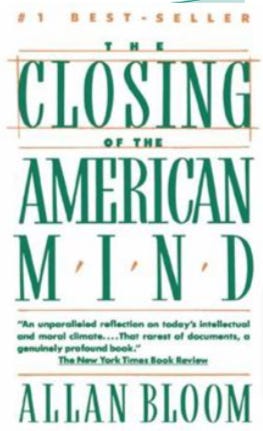
Jorden Peterson is the almost natural inheritor of the mantle of Allan Bloom! There is present in both thinkers/actors/politicians the scolding/shaming mentality of the Old Testament Prophet, tintured in The Abrahamic Tradition, that is an ever-present toxin, in Human History!
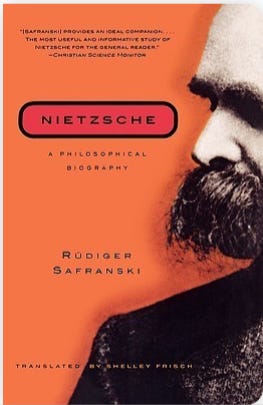
Peterson’s personal melodrama adds a certain luster to his turn tword GOD, but his turn tword Nietzsche is not just befudding, but expressive of his particular expression- his scatter-gun approach to the vexing questions facing ‘Humanity’ in the political present.
Adorno’s engagement with Nietzsche is evident throughout his work. He believed that he was confronted by the same paradox which beset Nietzsche, namely, how to present or ground a philosophy or point of view when the aim of that philosophy is to criticise reality or society altogether and thus the prevailing norms of philosophical or sociological discourse as well. Both writers, therefore, according to Adorno use ‘indirect methods’92 to express their criticism and to avoid grounding their philosophy in the ways which they deem undesirable. Adorno selfconsciously but unobtrusively weaves many of Nietzsche’s positions into his own thought, often by inverting them as a way of appropriating them. For example, Adorno’s pronouncement that ‘Life does riot live’ (Das Leben lebt nicht),93 which introduces the first part of Minima Moralia, is an inversion of the message which runs through Nietzsche’s philosophy – the commandment to ‘live life’. These connections between Nietzsche and Adorno inform all of the latter’s œuvre, but they are most explicit in Minima Moralia.
Like Nietzsche, Adorno’s work is inimitable and idiosyncratic and his convictions are often arrogantly stated in a way which contrasts strangely with the modest attempt to present a philosophy which is ungrounded and ungroundable. Yet both Nietzsche and Adorno undercut and contradict even their most sacred assertions and provide instructions for interpreting their strongly-voiced claims. The works of both must be read from a methodological point of view and not literally. In both cases too, their work was designed to resist popularisation, but in effect encouraged it. They tried, in very different ways, to make their style esoteric in order to defy the norms which they opposed, and they wrote in essays or in fragments to avoid the appearance and presuppositions of the traditional philosophical system. Yet fragments and aphorisms are easily detachable and equally easily misunderstood, since their significance can only be appreciated on the basis of an understanding of the whole of which they are the fragments – hence the paradoxes that such idiosyncratic and radical thinkers can be so widely and quickly assimilated but so often misunderstood. Nietzsche wrote for the most part a lapidary, brilliant German which was often deceptively clear, while Adorno’s German ranges from the poetic to the obtuse. Both men, nevertheless, fired the imagination of the younger generation, and had a strong effect on the work of their respective epigoni.
Adorno shared Nietzsche’s programme of a ‘transvaluation of all values’.94 ‘Morality’, ‘values’ and ‘norms’ do not imply a moral dimension distinct from other dimensions but characterise the construction and imposition of ‘reality’. Nietzsche, according to Adorno, refused ‘complicity with the world’95 which, where Adorno is concerned, comes to mean rejecting the prevalent norms and values of society on the grounds that they have come to legitimise a society that in no way corresponds to them – they have become ‘lies’.96 Adorno shared Nietzsche’s epistemological aim to demonstrate that the apparent fixity of the world or values arises from the systematic debasement of dynamic aspects of reality in our thinking and philosophy. Like Nietzsche, Adorno was a moralist, concerned toAdorno’s engagement with Nietzsche is evident throughout his work. He believed that he was confronted by the same paradox which beset Nietzsche, namely, how to present or ground a philosophy or point of view when the aim of that philosophy is to criticise reality or society altogether and thus the prevailing norms of philosophical or sociological discourse as well. Both writers, therefore, according to Adorno use ‘indirect methods’92 to express their criticism and to avoid grounding their philosophy in the ways which they deem undesirable. Adorno selfconsciously but unobtrusively weaves many of Nietzsche’s positions into his own thought, often by inverting them as a way of appropriating them. For example, Adorno’s pronouncement that ‘Life does riot live’ (Das Leben lebt nicht),93 which introduces the first part of Minima Moralia, is an inversion of the message which runs through Nietzsche’s philosophy – the commandment to ‘live life’. These connections between Nietzsche and Adorno inform all of the latter’s œuvre, but they are most explicit in Minima Moralia.
Editor: Perhaps the answer to his vexing question is that this Chaos, is the expression of the inner life of Jordan Peterson, to engage in a bit of worn out Pop Psychololgy: recall the long gone time of I’m OK Your OK ! Allied with the Melodrama that is the Peterson Saga, that resembles that long forgotten Hollywood Vomit, as Raymond Chandler dubbed those movies, and the their cadre of synchophants, called reporters: Hedda and Louella needed a Dominick Dunne and a Canadian Fronteersman to give hysteria mongering a kind of legitimacy?
Subheadline: A 33-year-old American woman is the discreet CEO of the social media platform that, following the American presidential election, is seen as a promising alternative to the controversies surrounding X.
Officially launched in February 2023, the microblogging platform Bluesky, with 33-year-old Jay Graber as its CEO, got off to a timid start. Initially limited to a number of selected subscribers, a year later it opened up to the public and today appears as a safe haven for those who are fleeing X. Developed starting in 2019 within Twitter, Bluesky is now a public benefit corporation that has hybrid articles of association making it both a for-profit company as well as having a mission to make a positive impact on society. Unlike its competitors, it is an open-protocol operation, where the technology is accessible to all and is improved as users add to it. In an interview in March with technology news site The Verge, Graber said that the company’s mission is “to build something that’s actually a better social ecosystem for people.”
…
A woman in a man’s world
Graber is a rarity in the male-dominated world of Silicon Valley. None of the five Gafams (Google, Apple, Facebook, Amazon and Microsoft) has ever been headed by a woman, and 89% of positions of power in the tech sector are held by men. On November 13, The Guardian newspaper announced the closure of its X account and, for the past two weeks, a million new subscribers have been flocking to Bluesky every day, taking the number of subscribers to over 20 million. a far cry from the 400 million daily users claimed by X, which nevertheless, puts Graber and her management team firmly in the spotlight.
Clémentine Goldszal can hardly control her ersatz feminism for the clone of twitter/X!
One of the advantiges of being almost eighty years of age, at least in my case, is that you can recall from memory, the political controversies as they unforded on the Evenining News. The “The Negro Family: The Case for National Action.” of March 1965 is one of those memories. And that Bret Stephens resurrects the ghost of Mr. Moynihan, as some kind of arbeter of public/political morality, raised the hackles of a person alive, and sentient, at the inauspicious rise of Moynihan! The Reader might not need to wonder at the propinquity between Bret Stephens and Mr. Moynihan: Opportunism!
Editor: Mr. Stephens might have been inspired by this National Affaires essay number 61 • Fall 2016 ? At a brisk 4922 words this is political hagiography, read the final paragraphs
What, then, shall we make of Moynihan’s pungent critiques of liberals, critiques accompanied by his frequent praise of conservative thinkers ranging from Burke to Oakeshott, Kristol to Strauss?
This, after all, is someone who said that after the Great Society he “had considerably scaled down my expectations of what government could do about most things — in the early 1960s in Washington we thought we could do anything, and we found out different — and had acquired the discipline of not being too much impressed by clever-seeming people.” Liberalism in that era, he complained, “lost a sense of limits.” He lectured Democrats in 1968 — in a volume edited by a Republican congressman, and, to add insult, entitled Republican Papers — that “somehow liberals have been unable to acquire from life what conservatives seem to be endowed with at birth, namely, a healthy skepticism of the powers of government to do good.”
Citations to conservatives, meanwhile, pepper his writings. Moynihan studied at the London School of Economics around the time Michael Oakeshott arrived there, and he appears to have attended at least some of the latter’s lectures. Significantly, he deployed Oakeshott against both parties, such as when he accused each of excessive scientism in the formation of social policy: “A larger possibility is that we are seeing at work in both ‘liberal’ Democratic and ‘conservative’ Republican administrations the demon that Michael Oakeshott has identified as Rationalism — the great heresy of modern times.” (Again the quotation marks framing “liberal” and “conservative” are suggestive.) He quoted Burke at least two dozen times in his writings. He invoked Podhoretz against liberal doomsaying.
Part of the explanation for all this is that he believed liberalism needed to be nourished by an internal critique from which, especially amid the moralism of the 1960s, it had insulated itself. About his 1976 run for Senate, he said, “I ran as a liberal willing to be critical of what liberals had done. If we did not do this, I contended, our liberalism would go soft.” Moreover, some conservatives have mistaken Moynihan’s capacious intellectual curiosity, which spanned not only a diversity of topics but also a diversity of perspectives, for political compatibility. Instead, his particular proclivity for associating with, reading, and quoting conservative thinkers arose from a suppleness and habit of mind that actively sought disagreement — an aptitude largely, and sadly, lost not merely among statesmen but among scholars, a similarly insular profession.
In assessing Moynihan’s relationship to neoconservatism, the issue of party is inescapable as well. Whether because the movement has shifted, because the major political parties have realigned, or both, neoconservatism is more monolithically Republican today than when Kristol wrote in 1976. There is also no question that the second generation of neoconservatives is less Burkean and more Wilsonian than the first.
But the explanation, ultimately, distills to this: Moynihan was neither a neoconservative nor a paleoliberal. Moynihan was Moynihan. He believed in government as an agent of good, but also in limitation as a condition of life. As he wrote in 1973: “Increasingly, it is what is known about life that makes it problematical….The unexpected, the unforeseen: the public life of our age seems dominated by events of this cast.” He believed in a politics rooted in empirical circumstance rather than theoretical abstraction. He championed the subsidiary units of society — family, ethnic group, neighborhood. He respected society’s complexity, but also believed some problems required political and national solutions.
I have called this “Burkean liberalism.” But if the issue of Moynihan and the neoconservatives comes down to labels, perhaps a time may come when individuals of a certain bent, with a certain combination of beliefs, will describe themselves as “Moynihan liberals.” This would be as good a time as any.
Pundits far and wide portray Daniel Patrick Moynihan as a prophet without honor, whose unpopular message carried great potential but went sadly unheeded. Nothing could be further from the truth.
The culmination of this shift came in 1970, when Moynihan—then a member of the Nixon administration—wrote a memo that called for “a period of benign neglect” in national discussions of race. While acknowledging that “the seeds of neoconservatism” existed in the original report, Geary nonetheless identifies a shift in Moynihan’s perspective. By arguing that “the main problem was not African American inequality, but intemperate discussions of race,” Moynihan left little room for his earlier call to “national action.” Geary portrays Moynihan’s turn to the right as the result of his desire for professional advancement and his thin-skinned attitude toward his critics, not as a sign of the affinity between his ideas and those of his more thoroughly conservative fans. This is, perhaps, wishful thinking. Further, while Geary bemoans the exhaustion of 1960s liberal reform—encapsulated in miniature in Moynihan’s own exasperation with his feminist and left-wing critics—he lays too much of the blame on the doorsteps of some of Moynihan’s most incisive and unforgiving critics.
Advocates of Black Power were some of the earliest and most forceful critics of Moynihan’s “pathological” view of black family life. Stokely Carmichael’s insistence that “the reason we’re in the bag we’re in isn’t because of my mama, it’s because of what they did to my mama” cut to the heart of the Moynihan Report’s failings. Geary suggests that the Black Power movement, with its focus on reclaiming black cultural power and self-determination, not only undersold the report’s progressive call to address black unemployment but also abandoned the radical economic proposals of the civil rights movement. He laments the “unfortunate and largely unintended consequence of the Moynihan Report controversy” that “Moynihan and many of his critics shifted debate about inequality away from political economy,” identifying Black Power as one of the principal culprits of this turn away from economic issues and toward questions of identity, self-representation, and cultural worth.
This widely held idea, echoed by Geary, is a misrepresentation; in fact, he shortchanges Black Power’s own economic message. Carmichael and his collaborator, the political scientist Charles V. Hamilton, devoted most of their 1967 book Black Power to the economic and political obstacles to black mobilization and empowerment in the South and North. Carmichael and Hamilton emphasized that at the core of the problem of “institutional racism”—a term they coined—was the lack of “decent housing, decent jobs, and adequate education.” Furthermore, activists regularly invoked the signs and language of Black Power in a variety of local struggles, whether organizing against discriminatory union leadership in Detroit’s Chrysler plants or fighting for tenants’ rights on Baltimore’s housing board.
Like many writers on today’s left who are disappointed with modes of organizing based in marginalized groups’ demands for recognition, Geary disregards the power of collective consciousness to spark broad-based political action. One of the legacies of the sixties—captured by slogans like “Black Power” and “the personal is political”—is that the arenas of political economy and culture cannot be so easily disaggregated. Degrading representations are social facts, imbricated in the political economy of their day. By treating Black Power primarily as a shift from economics toward culture in the national debate on inequality, Geary unfortunately ignores its invocation in campaigns for fair housing, equal employment, and welfare rights.
The controversy surrounding the Moynihan Report is certainly a tangle of threads, and Geary skillfully unravels it, eloquently tracing each strand of debate. The report’s central legacy, unfortunately, seems all too clear. The Moynihan Report, by identifying the culture and family structure of poor black people as the cause of their poverty, has given ammunition to opponents of anti-poverty programs for decades. More broadly, it has contributed to the sadly common view that racism is a thing of the past—that we need to look elsewhere for the causes of contemporary inequality. Activism undertaken beneath the sign of Black Lives Matter has unsettled this willful blindness to the ongoing violence, discrimination, and economic deprivation directed at African Americans. If, as Geary argues, we still need “national action to ensure social and economic equality for African Americans,” we must acknowledge and support the independent black political action that has been, and remains, so crucial to realizing that goal.
Editor: the final paragraphs of Stephen’s ersatz Morality Play, with a telling fragment of Dostoyevsky…
…
There’s a guiding logic here — and it isn’t to “own the libs,” in the sense of driving Trump’s opponents to fits of moralistic rage (even if, from the president-elect’s perspective, that’s an ancillary benefit). It’s to perpetuate the spirit of cynicism, which is the core of Trumpism. If truth has no currency, you cannot use it. If power is the only coin of the realm, you’d better be on the side of it. If the government is run by cads and lackeys, you’ll need to make your peace with them.
“Man gets used to everything, the beast!” Dostoyevsky has Raskolnikov observe in “Crime and Punishment.” That’s Trump’s insight, too — the method by which he seems intent to govern.
There’s a hopeful coda to Moynihan’s warning. In the years after he published his essay, Americans collectively decided that there were forms of deviancy — particularly violent crime — that they were not, in fact, prepared to accept as an unalterable fact of life. A powerful crime bill was passed in Congress, the police adopted innovative methods to deter violence, urban leaders enforced rules against low-level lawbreakers, bad guys were locked away, and cities became civilized and livable again.
Part of that achievement has been undone in recent years, but it’s a reminder that it’s also possible to define deviancy up. In politics, we can’t start soon enough.
Old Socialist
November 21, 2024:
Editor: Reader you will notice that both Stephens and Moynihan are/were tough on crime, the closing paragraph of the Moynihan essay is instructive about ‘the decline of the American civic order’!
Editor: the final paragraph is instructive about American Politics, since the end of the Civil Rights, era and the rise of The New Nixon and his epigones across party lines!
Mr. Stephens offer a link to the Moynihan essay here, its final paragraph
THE HOPE–if there be such–of this essay has been twofold. It is, first, to suggest that the Durkheim constant, as I put it, is maintained by a dynamic process which adjusts upwards and downwards. Liberals have traditionally been alert for upward redefining that does injustice to individuals. Conservatives have been correspondingly sensitive to downward redefining thatweakens societal standards. Might it not help if we could all agree that there is a dynamic at work here? It is not revealed truth, nor yet a scientifically derived formula. It is simply a pattern we observe in ourselves. Nor is it rigid. There may once have been an unchanging supply of jail cells which more or less determined the number of prisoners. No longer. We are building new prisons at a prodigious rate. Similarly, the executioner is back. There is something of a competition in Congress to think up new offenses for which the death penalty is seemed the only available deterrent. Possibly also modes of execution, as in “fry the kingpins.” Even so, we are getting used to a lot of behavior that is not good for us. As noted earlier, Durkheim states that there is “nothing desirable” about pain. Surely what he meant was that there is nothing pleasurable. Pain, even so, is an indispensable warning signal. But societies under stress, much like individuals, will turn to pain killers of various kinds that end up concealing real damage. There is surely nothing desirable about this. If our analysis wins general acceptance, if, for example, more of us came to share Judge Torres’s genuine alarm at “the trivialization of the lunatic crime rate” in his city (and mine), we might surprise ourselves how well we respond to the manifest decline of the American civic order. Might.
Editor: The Reader might judge that the final sentence of the essay is reminiscent of Joe Biden and Hillary Clinton’s hysterical predetors speaches!
Joe Biden:
User Clip: Joe Biden Senate remarks on “predators”
Note also the final florish of the Mr. Moynihan essay ‘…to the manifest decline of the American civic order’ which expresses the Neo-Conservate ethos of Bret Stephens, and The New Democrats in the Age of Trump!
Asked what he thinks farmers’ next steps will be, following Tuesday’s demonstration, Tom Bradshaw said: “I think you’ll have all seen the media reports about what farmers across the United Kingdom think they should be doing next.”
It comes as farmers have threatened the government with “militant action” over the policy, which they argue will cause food shortages and the breakup of family farms.
“The ball is in the government’s court. They have to be the ones that now decide how they react to this”, Mr Bradshaw told journalists at the NFU’s mass lobby event, which saw union members engage with around 150 members of parliament in an event held alongside the demonstration on Whitehall.
But Oliver Atkinson, a farmer from Hampshire who took part in the protest, suggested that even Mr Bradshaw would not go far enough to force the government’s hand on the issue.
He told The Independent there is a feeling among the agricultural community that the NFU chief needs to take a tougher approach in his talks with ministers, and be more supportive of protests and demonstrations.
Mr Atkinson said he expects further local action to be taken following on from today’s protest if the government doesn’t backtrack.
Tuesday’s protest saw TV personality Jeremy Clarkson urge the government to back down over the policy, saying it is a “hammer blow to the back of the head” for the agricultural industry.
…
Editor: even the stogy Jeremy Clarkson, who usually writes for The Times, is a partisan of the Farmers, as he plays one on television?
Marc Santora reported from Kyiv, Ukraine, and Eric Schmitt from Washington.
Nov. 19, 2024Updated 10:59 a.m. ET
Ukraine’s military used American-made ballistic missiles on Tuesday to strike into Russia for the first time, according to senior U.S. and Ukrainian officials, just days after President Biden gave permission to do so in what amounted to a major shift of American policy.
The pre-dawn attack struck an ammunition depot in the Bryansk region of southwestern Russia, Ukrainian officials said. Russia’s Ministry of Defense said in a statement that Kyiv used six ballistic missiles known as the Army Tactical Missile System, or ATACMS. A senior American official and a senior Ukrainian official, who spoke on the condition of anonymity to discuss ongoing operations, confirmed that ATACMS were used.
The strike represented a demonstration of force for Ukraine as it tries to show Western allies that providing more powerful and sophisticated weapons will pay off — by degrading Russia’s forces and bolstering Ukraine’s prospects in the war.
Officials in Kyiv had pleaded for months for permission to use ATACMS to strike military targets deeper inside Russia before the Biden administration relented and gave its assent. The authorization came just months before the return to office of President-elect Donald J. Trump, who has said he will seek a quick end to the war in Ukraine.
This is the stuff of T.V. Guide of the 1950’s : consider Julius La Rosa being fired by Arthur Godfrey on Air! Or is that stretcing the point?
Editor: let me quote at lenkth this Hollywood Reporter ‘scoop’?
Seven years after they last spoke to him, MSNBCMorning Joe hosts Joe Scarborough and Mika Brzezinski traveled to Mar-a-Lago over the weekend to meet with President-elect Donald Trump.
The duo, who used to be friends with Trump, turned into fierce critics during his first term in office, and he returned the favor, occasionally ripping into them in posts on X (formerly Twitter). At the top of Monday’s program, they disclosed their trip, acknowledging that his decisive win influenced their decision.
“Joe and I realized it’s time to do something different and that starts with not only talking about Donald Trump, but also talking with him,” Brzezinski said. “For those asking why we would go speak to the president-elect during such fraught times, especially between us, I guess I would ask back, why wouldn’t we? Five years of political warfare has deeply divided Washington and the country.”
“What we did agree on was to restart communications,” Brzezinski added. “My father [former Jimmy Carter national security adviser Zbigniew Brzezinski] often spoke with world leaders with whom he and the United States profoundly disagreed. That is a task shared by reporters and commentators alike.”
“I will tell you a lot of Democratic leaders we have talked to this past week since the election have told Mika and me, it’s time for a new approach,” Scarborough added.
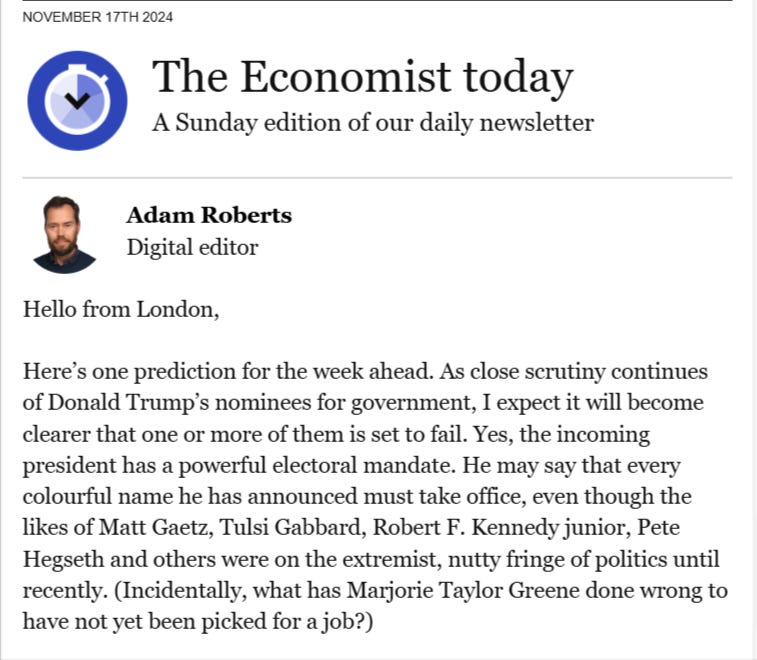
Editor: here is an email from The Economist of November 17, 2024 by Adam Roberts : Digital Editor
I suspect, instead, that Mr Trump is being more Machiavellian. He probably also foresees, and may even welcome, that one or more of his chosen figures will fall away. Perhaps the Senate will block an appointment. Maybe, as details of police inquiries become public in one or more cases, a preferred candidate will be obliged to withdraw. Most of his chosen candidates will get through, but when one or more are blocked Mr Trump can have his cake and eat it: he will bewail the deep state, telling supporters that his opponents want to block the radical changes that he would supposedly bring.
And here’s my second prediction, for the slightly longer term. Elon Musk and Mr Trump will have an almighty falling out. I can’t see either man being willing to submit for long to the discipline or constraints that come from working closely with (or for) the other. Each expects to be the top dog. We suggest today how the Department of Government Efficiency, the joke-named institution that Mr Musk is set to run, might make the budget cuts it is set up to achieve. But stripping away a lot of public spending is bound to upset the lives of a lot of ordinary Americans—the ones who just voted for Mr Trump—by slashing funds for welfare, infrastructure, defence or by failing to pay off debt.
For all the drama in American politics, meanwhile, the most powerful effects of Mr Trump’s pending arrival as president are already being felt in foreign affairs—most obviously in Ukraine and Russia. Volodymyr Zelensky is putting on a brave face, saying that the war in his country will end sooner than had been expected, perhaps in 2025. With Russian forces continuing to gain territory, and Vladimir Putin bringing in extra fighters from North Korea, an early ceasefire is not the same as a good outcome for Ukraine. As our columnist on geopolitics writes in our new column, The Telegram, this might mean acquiescing, more or less, to Russian terms. In places such as Crimea and the eastern Donbas region, Russia will keep direct control of the territory it stole. In the rest of Ukraine, Russian influence will be indirect but still real, just as the Soviet Union held a veto over Finland’s political alignment during the cold war.
Dateline (our history quiz) and our test of whether you’ve kept up with the week’s news, the pint-sized news quiz, are both live. Can you get high scores in both?
Here’s my final prediction for the week: you will hear a lot more forecasts about 2025 from my colleagues. We are poised to publish the new edition of “The World Ahead”, setting out our political, economic, technological, cultural and other judgments for the coming year. (You can re-read last year’s edition, meanwhile, and check how we did last time around.) Our correspondents around the world, along with editors in London and some guest writers, will provide the best possible guide to the trends and events in 2025. It’s going to be a lively year. And if you’re a subscriber, you can join a live event on November 21st with Tom Standage, who edits “The World Ahead”. Sign up here.
A postscript to the various predictions for the American presidential election. I had vowed to namecheck everyone who correctly foresaw the number of electoral college votes that each candidate would get. Somehow, last week, I forgot to include mention of Nikos Kotalakidis, who correctly predicted that Mr Trump would take 312 votes to 226 for Ms Harris. Congratulations Nikos.
Editor : Can The Reader imagine those unrepentent Oxbridgers John Micklethwait and Adrian Wooldridge of that long list of books : The Company: A Short History of a Revolutionary Idea (Modern Library Chronicles Series Book 12) ,The Right Nation: Conservative Power in America,The Fourth Revolution: The Global Race to Reinvent the State, God Is Back: How the Global Revival of Faith Is Changing the World, The Wake-Up Call: Why the Pandemic Has Exposed the Weakness of the West, and How to Fix It, A Future Perfect: The Challenge and Promise of Globalization, ever writing something like the quoted paragraph below?
Finally, I want to hear your views about Ukraine and Russia. What outcome do you expect for the conflict there, in 2025? Will Mr Putin soon be in a position to boast about defeating his neighbour, even after Ukraine received billions in military support from the West? Or is some other result possible? Might Mr Trump, anxious for a quick end to the fighting but also not to lose face, achieve a compromise that brings peace with Ukrainian (and Western) honour? Email me at economisttoday@economist.com with your thoughts.







 StephenKMackSD's Blog