What is telling is that FP was founded by Samuel P. Huntington of the ‘Clash of Civilizations’ and its racist twin ‘Who Are We?: The Challenges to America’s National Identity’ ! Luce was also a Speech writer to US Treasury Secretary, Lawrence Summers, 1999-2001. In sum Mr. Luce is a well connected political writer, and regular columnist for The Financial Times. He qualifies and one of Lippmann’s Technoctrat’s for hire, as a check against too much democracy!
Mr. Luce’s notorious interview with Kissinger, in the guise of The Great Man, is here:
Lunch with the FT: Henry Kissinger ‘We are in a very, very grave period’
While babies in Vietnam are still being born with catastrophic birth defects from the effects of Agent Orange, decades after the end of the American Anti-Communists crusade or just call it mass slaughter, The Great Man is treated to lunch by a pundit who disingenuously call him consigliere, as the-in-order-too of not sounding too much like what he is, a sycophant to The Great Man. Did Luce even mention his book ‘The Retreat of Western Liberalism’ ? Isn’t there some kind of obligation, on the part of the guest to know something of your host’s latest accomplishment? Or is the aged Great Man above that kind of social obligation?
The essay unfolds in an almost comic mode with Luce planning to waylay The Great Man into ‘spilling the beans’ on the Know-Nothing Trump. The dramatic tension is non existent, as this 95 year old is more interested in having an audience who simply listens, in awe, to his estimation and opinions about the wider historical scope of his intelligence: his specialty is Foreign Policy Metaphysics. The Great Man doesn’t disappoint himself .
Mr. Luce knows the Party Line by heart, as he helped to construct it: Russian revanchism, the end of the ‘rules based order’ meaning the erosion of NATO, in sum the ‘decline of American Power’. Or rather, the fact that Europe is no longer in need of American tutelage. The burning question is TRUMP and his chaotic practice politics and his disturbing propinquity for another political monster Putin.
This little melodrama ends with Luce helping The Great Man to his car in the rain, and the ‘server’ speaks to Luce with some pertinent information: “Dr Kissinger has been looking forward to this lunch for days,”
Editor: In the bleek Age of Trump, Simon & Schuster provides Public Realations chatter:
An intimate and masterful biography of Zbigniew Brzezinski—President Carter’s national security advisor and one of America’s leading geopolitical thinkers—from one of the finest columnists and political writers at work today.
Zbigniew Brzezinski was a key architect of the Soviet Union’s demise, which ended the Cold War. A child of Warsaw—the heart of central Europe’s bloodlands—Brzezinski turned his fierce resentment at his homeland’s razing by Nazi Germany and the Red Army into a lifelong quest for liberty. Born the year that Joseph Stalin consolidated power, and dying a few months into Donald Trump’s first presidency, Brzezinski was shaped by and in turn shaped the global power struggles of the twentieth and early twenty-first centuries. As counsel to US presidents from John F. Kennedy to Barack Obama, and chief foreign policy figure of the late 1970s under Jimmy Carter, Brzezinski converted his acclaim as a Sovietologist into Washington power. With Henry Kissinger, his lifelong rival with whom he had a fraught on-off relationship, he personified the new breed of foreign-born scholar who thrived in America’s “Cold War University”—and who ousted Washington’s gentlemanly class of WASPs who had run US foreign policy for so long.
Brzezinski’s impact, aided by his unusual friendship with the Polish-born John Paul II, sprang from his knowledge of Moscow’s “Achilles heel”—the fact that its nationalities, such as the Ukrainians, and satellite states, including Poland, yearned to shake off Moscow’s grip. Neither a hawk nor a dove, Brzezinski was a biting critic of George W. Bush’s Iraq War and an early endorser of Obama. Because he went against the DC grain of joining factions, and was on occasion willing to drop Democrats for Republicans, Brzezinski is something of history’s orphan. His historic role has been greatly underweighted. In the almost cinematic arc of his life can be found the grand narrative of the American century and great power struggle that followed.
Editor: Reader note the framing of this New York Times essay by Jeremy W. Peters:
What I Cover
I write about debates over freedom of speech and expression as they impact our country’s most important institutions, with a particular focus on college campuses. If there is a simmering free-speech controversy at a university, local government or cultural institution, I want to be covering it. I’m interested in how institutions grapple with tensions over the most contentious issues of the day — politics, race, democracy, war — and whether they are making any progress toward resolving the extreme polarization in American society.
Editor: Self-congratulation rules this political moment, without a readable text to refer to as check against the self-serving?
Editor: The Times offers this collection of political actors, thinkers, assistants in the production of propaganda!
Hosted by Michael Barbaro
Produced by Caitlin O’Keefe,Asthaa Chaturvedi and Stella Tan
Edited by Lisa Chow and Larissa Anderson
With Paige Cowett
Original music by Marion Lozano and Elisheba Ittoop
Engineered by Alyssa Moxley
Featuring Jeremy W. Peters
…
Warning: This episode contains strong language.
From the outside, the political movement created by Donald J. Trump has never seemed more empowered or invulnerable.
But Steve Bannon, who was the first Trump administration’s chief strategist, sees threats and betrayals at almost every turn, whether it’s bombing Iran or allowing tech billionaires to advise the president.
Jeremy W. Peters, a national reporter at The Times, talks to Mr. Bannon about those threats and why, to him, the future of the MAGA movement depends on defeating them.
…
Queer Atheist.
With this: ‘Warning: This episode contains strong language’ the reader might wonder, about the demographic that this New York Times political intervention is carefully aimed?
It’s Monday, June 29. This is The Front Page, your daily window into the world of The Free Press—and our take on the world at large. Today: Arthur Brooks on the secret to a fulfilling life; Jed Rubenfeld on a blockbuster Supreme Court decision; Olivia Reingold on how New York’s political establishment is scrambling to stop Zohran Mamdani; River Page on the revisionist history of Pride Month; and much more.
But first: The ideological insurgency against the Jewish people.
Glastonbury is a music festival organized by hippie farmers in the southwest of England. For years it’s been a place people go to camp, drink too much cider, and listen to music. At least, that was roughly the deal when I skipped school to attend 18 years ago. But if the footage out of Somerset this weekend is anything to go by, moments at this year’s festival resembled a hate rally.
In a performance on Saturday afternoon, the front man of the punk duo Bob Vylan led the crowd in anti-Israel chants. Among them: “From the river to the sea,” and perhaps most disturbingly: “Death, death to the IDF.” Thousands in the crowd joined in. This was on one of the festival’s main stages, and broadcast live on the BBC.
The presence of a performer like this, chanting things like this, with thousands joining in, at a mainstream festival is deeply troubling. And the incident was quickly condemned by British prime minister Keir Starmer. But if you think these were just the hateful chants of a few bad apples, you’re missing the point, says Ayaan Hirsi Ali. They are part of something much bigger, much scarier, she argues: a movement that wants to cleanse the culture. First, of Israel. Then, of Jews. Then, of the rest of us.
Editor: Neither Oliver Wiseman nor Ayaan Hirsi Ali understand that Hip-Hop has become the voice of ‘Popular Resistance’, across language and time: Glastonbury is its natural place! Both Wiseman & Hirsi Ali are not just the fellow travelers, of the Zionist Faschist State, but its propagandists, as the number of dead,wounded, and murdered lie under the rubble as yet to be found!
Editor: The Neo-Cons have a long and toxic American History: Oliver Wiseman& Ayaan Hirsi Ali share in that legacy!
Fathers and Sons
By Timothy Noah
Jan. 13, 2008
…
The first half of Heilbrunn’s book relates neoconservatism’s origins and its journey to the brink of political power in the late 1970s. It’s a familiar tale, told better in “The Neoconservatives: The Men Who Are Changing America’s Politics,” published in 1979 by Peter Steinfels (then the executive editor of Commonweal and now a columnist on religion for The New York Times). Steinfels came at the neocons from farther to the left than Heilbrunn and consequently was more critical. But the Steinfels book was also more rigorously analytic and, strangely, more generous in granting neocons their due as thinkers. Chalk it up to the narcissism of small differences. As best I can make out, Heilbrunn retains most of the foreign-policy views that he held before but applies them with greater judiciousness, and can no longer bear the sight of those who don’t. (The neocons’ domestic policies seem to interest Heilbrunn not at all; he scarcely mentions them.)
From both Steinfels and Heilbrunn, we learn that neoconservatism was the final stop of an ideological journey for a group of New York intellectuals, typically the children of Jewish immigrants, that began during the early 1940s in Alcove 1 of the cafeteria at City College. Alcove 1 was the gathering place for a group of brilliant young Trotskyists that included Irving Kristol, Seymour Martin Lipset, Nathan Glazer and Melvin Lasky. Along with Irving Howe, who would later break with Trotskyism but not with the left, and Daniel Bell, who never accepted Marxist orthodoxies in any form, the Alcove 1 Trotskyists waged intellectual battle with the Stalinists in Alcove 2, who vastly outnumbered them.
…
From both Steinfels and Heilbrunn, we learn that neoconservatism was the final stop of an ideological journey for a group of New York intellectuals, typically the children of Jewish immigrants, that began during the early 1940s in Alcove 1 of the cafeteria at City College. Alcove 1 was the gathering place for a group of brilliant young Trotskyists that included Irving Kristol, Seymour Martin Lipset, Nathan Glazer and Melvin Lasky. Along with Irving Howe, who would later break with Trotskyism but not with the left, and Daniel Bell, who never accepted Marxist orthodoxies in any form, the Alcove 1 Trotskyists waged intellectual battle with the Stalinists in Alcove 2, who vastly outnumbered them.
…
Coaxed by a diverse group of thinkers that included Sidney Hook, Reinhold Niebuhr and Samuel M. Levitas, known as Sol, the veterans of Alcove 1 eventually drifted away from Trotskyism, becoming stalwarts of the anti-Communist left, where they were joined by Norman Podhoretz, then a young literary scholar. With the advent of the cold war, the proto-neocons pushed for a hard line against the Soviet Union, sometimes harder than that of anti-Communist liberals like Arthur Schlesinger Jr. and George F. Kennan; few if any of them expressed concern when they discovered that Encounter, a magazine that Irving Kristol co-founded in 1952, was secretly underwritten by the Central Intelligence Agency. The student radicalism of the late 1960s disillusioned proto-neocons about the left; George McGovern’s landslide defeat in 1972 disillusioned many of them about mainstream liberalism and the Democratic Party; and after Ronald Reagan entered the White House in 1981, a number of them stopped resisting the “conservative” label, joined the Republican Party and began to exercise power.
2 – The Premature Jewish Neoconservatives
Published online by Cambridge University Press: 05 June 2012
For poor, young Jewish intellectuals in New York in the 1930s, City College was where the action was. In dingy, horseshoe-shaped alcoves lining the college lunchroom, the students spent hour after hour in ideological debate that was often more spirited and stimulating than the classroom lectures.
There were separate alcoves for Catholics, Zionists, and Orthodox Jews, but the pro-Stalinist and anti-Stalinist radicals made the most noise and commanded the most attention. The Stalinists in Alcove Two outnumbered the other factions and controlled the student newspaper, which defended the Moscow trials in editorials. They had close to fifty allies among City College’s left-leaning faculty, and, Irving Howe remembered, one in their group, Julius Rosenberg, would later be executed along with his wife, Ethel, for conspiring to steal America’s atomic secrets.
The group in Alcove One was a mixed bag. Although they were all pretty radical in their college days, many would later make their names as prominent neoconservatives. They were united in their opposition to the Soviet dictator and often sought to provoke his backers (who were not permitted to speak to them) in Alcove Two. On other political issues, however, they disagreed with one another as often as not. For example, while Howe and Irving Kristol backed the revolutionist Leon Trotsky, who broke away from Stalin and was later murdered in Mexico, Nathan Glazer and Daniel Bell were anti-Trotskyites.
Mr. Ignatieff reviews Mr Pankaj Mishra’s latest book ‘Age of Anger: A History of the Present’. Some quotations from this review reflects both Mr. Ignatieff’s elite western prejudices and his status as apologist, in fact as agent for Western Imperialism/Capitalism.
The reader might just make the connection between the practice of ‘Responsibility to Protect’ (R2P) of the acolytes of Isaiah Berlin , like Mr Ignatieff and Samantha Power and their natural political allies the perpetually bellicose Neo-Conservatives: the one invades other countries in the name of ‘Human Rights’ the other in the name of American hegemony.
‘There’s a lot of anger in this age of ours, but not all anger is the same and not all anger has equal justification. To describe terrorism as an act of anger, for example, may seem to imply that it has a justifying cause. In lumping together the anger of workers left high and dry by plant shutdowns, young people unable to find a secure job, and jihadi killers, Mishra fails to distinguish an anger that results in indiscriminate slaughter and has no justification whatever.’
The collapse of the Neo-Liberal Dispensation in the ‘West’ in 2008 and the subsequent economic privation of the working classes, while the elites continue to flourish has eluded the attention of Mr.Ignatieff. The Occupy Wall Street movement, although crushed by Mayor Bloomberg, in New York City, captured the debate with its telling descriptor of 1% vs. 99%: the plutocrats were rhetorically routed by the Great Unwashed. Yet the myth of the Self-Correcting Market has yet to manifest itself. The barista with a Masters or PhD has reached the commonplace. Mr.Ignatieff doesn’t seem to understand that those ‘jihadi killers’ are a manifestation against American Imperialism and its allies, Islamic autocracies. On the question of justification for anger Mr. Ignatieff misses the point, for ideological reasons.
Mishra doesn’t bother with such distinctions, it seems, because he sympathizes with the anger of jihadists and believes it has some justification. At one point, for example, he says of the ISIS terrorists that they have “aimed at exterminating a world of soul-killing mediocrity, cowardice, opportunism and immoral deal-making.” Never, so far as I know, has a free and freedom-loving intellectual handed a gang of killers such a lofty worldview. Mishra would not justify terrorist acts—he would recoil at the very idea—yet in seeing its perpetrators as holy warriors against “modernity” he justifies their arguments.
Mr. Ignatieff then attempts to shame, to defame Mishra as a fellow traveler of ISIS with this fragment: “aimed at exterminating a world of soul-killing mediocrity, cowardice, opportunism and immoral deal-making.” the jihadis are anti-imperial, anti-Neo-Liberal, anti-American, in a world where Afghanistan and Iraq are still the subject to American invasion, occupation, warfare. With the Drone War waged at the whim of America and its ‘allies’, its dwindling ‘Coalition Partners’. The Syrian debacle is still evolving. Yet the rage of the ever expanding, ever morphing Islamic Fundamentalism- the anger of the invaded and occupied, and their sisters and brothers, viewing the carnage from distances thought to be unimaginable to Mr. Ignatieff, simply confirms the failure to win ‘hearts and minds’. The ever expanding American remit of ‘The War on Terror’ is a failure that continues to make more enemies than friends. This state of Perpetual war, only confirms the WASP paranoia of American National Security State operative Samuel P. Huntington, whose Vietnam crime still manifests itself in birth defects caused by the indiscriminate use of Agent Orange. Compare this to the use of depleted uranium and white phosphorous in Iraq.
For some insights into Mr. Ignatieff ‘s particular brand of Liberal Moralizing, the reader can review his May 2, 2004 essay in the New York Times Magazine titled ‘Lesser Evils’. It offers some insight on the very questions asked by Mr. Ignatieff of Mr.Mishra:
‘But thinking about lesser evils is unavoidable. Sticking too firmly to the rule of law simply allows terrorists too much leeway to exploit our freedoms. Abandoning the rule of law altogether betrays our most valued institutions. To defeat evil, we may have to traffic in evils: indefinite detention of suspects, coercive interrogations, targeted assassinations, even pre-emptive war. These are evils because each strays from national and international law and because they kill people or deprive them of freedom without due process. They can be justified only because they prevent the greater evil. The question is not whether we should be trafficking in lesser evils but whether we can keep lesser evils under the control of free institutions. If we can’t, any victories we gain in the war on terror will be Pyrrhic ones.’
…
‘They were at war with us, and we convinced ourselves that we were not at war with them. Post-Church, we may have betrayed a fatal preference for clean hands in a dark world of terror in which only dirty hands can get the job done.
But dirty hands need not be lawless.’
Also for some insights into the ‘Responsibility to Protect'(R2P) construct see this essay by Sarah de Geest – Research Assistant for the Human Security Center, in her essay titled ‘Russian Intervention in Ukraine: R2P Limits and reclaiming the Concept and Narrative’. In her essay Ms. de Geest describes and quotes from Mr. Ignatieff’s position on Ukraine:
Michael Ignatieff is one of the scholars that helped articulate the R2P principle at the International Commission on Intervention and State Sovereignty (ICISS) in 2001[5]. Later, in a 2014 address at Chatham House, he touched upon the different ways[6] in which Mr. Putin has mangled R2P’s imminent (and not so imminent) purposes:
Who do we protect: we should protect everyone, not just ethnic Russians or citizens who identify themselves as Russian. For example, this protection should have extended to the victims of February 18th in Kiev where 25 demonstrators died and more than a thousand were wounded in the violent clashes with the police[7],
The threat itself: it is pertinent that the threat embodies serious mental and bodily harm, for example ethnic massacre and genocide. In Ukraine there was no known threat that amounted to this “just cause threshold”[8],
How do we protect: What are the limits that are both legally and practically implied? Should unilateral action be allowed? Should Russia be allowed to essentially lead Crimea on a fast track unilateral secession?
Given Mr. Ignatieff ‘s position on ‘dirty hands’ and its servant ‘lawfulness’ in his May 2, 2004 essay in the New York Times Magazine titled ‘Lesser Evils’, he manages to echo the legal pasticheur John Yoo. Given the moral/rhetorical intervention and his R2P stance on Ukraine, the glaringly obvious question arises : what is the difference between the R2P Interventionist and the Neo-Conservative’s unslakable bellicosity? Is it simply a question of the rationalization used, to invade and subjugate, or simply to use the cudgel of power, to blackmail these lesser beings into submission, to the political will of a ruthless Empire? Yet this Empire can’t seem to win any of it’s Wars of Choice!
Notice that Mr. Ignatieff’s essay appears in the New York Review of Books, the ideological center of the ‘Cult of Isaiah Berlin,‘ and its creature the R2P Public Intellectual. And that Mr. Mishra is a regular contributor to this publication, indeed, he is a favorite. Yet he is now guilty of deviationism, and the good grey Mr.Ignatieff is assigned the task of publicly shaming this political nonconformist. Yet Mr. Ignatieff’s book chat is just the most pedestrian kind of literary journalism, it doesn’t even qualify as polemic, just an unimaginative political scolding by a literary/political hack.
Francis Fukuyama’s The End of History and the Last Man has been widely regarded as a celebration of the triumph of the West.footnote1 Its message, on the accepted view, is that, with victory in the Cold War and the death of Communism, the Western way of life has emerged as the culmination of humanity’s historical evolution. As the end state towards which that evolution has been tending it represents a pattern of universal validity, a light to itself and to all non-Western societies still struggling in history. It will be argued here that this interpretation is wholly misconceived and, indeed, that it must be stood on its head to obtain the true meaning of the book. The distinctive core of what the West stands for, in Fukuyama’s view, is liberal democracy. What his book tells us is that this is itself a transitory historical form, the process of whose dissolution is already well advanced. It is a verdict inescapably grounded in the logic of the argument, in the fundamental tenets of the philosophy of history Fukuyama espouses. Thus, in the classic style of that subject, he arrives on the scene too late, when a way of life has grown old beyond hope of rejuvenation. There is a sharp irony in the fact that philosophy’s grey on grey should be taken in this case as an expression of maturity and vigour. Something is owed here to the complex perversity of the times, but something also, it must be admitted, to the strangely half-hearted, double-minded and inadequately self-conscious way in which Fukuyama has approached his task. All this constitutes, however, a reason not for abandoning the agenda he has set but for taking it onwards towards completion.
…
Editor: I will selectively quote from this essay, that has not been matched by anyone I have encountered over the years!
…
For Fukuyama to appropriate this body of thought he has to make a simple, strategic assumption. It is that ‘we can understand’ Kojève’s universal and homogeneous state as liberal democracy.footnote14 The crux of the matter is then easy to state: ‘Kojève’s claim that we are at the end of history . . . stands or falls on the strength of the assertion that the recognition provided by the contemporary liberal democratic state adequately satisfies the human desire for recognition.’footnote15 The incisiveness of this formulation is, unfortunately, not matched by Fukuyama’s response. Indeed, he never manages thereafter to hold the question steadily in his sights, still less to provide an unequivocal and authoritative answer. This failure is the chief source of the impression of systematic ambiguity left by his book. For the issue at stake, the satisfactoriness of liberal democratic recognition, is the best clue to the array of conflicting appearances it presents. Moreover, to survey the variety of views Fukuyama seems to endorse on it is not simply to encounter a medley of contending strains, all with much the same claim to be the true voice of their author. Instead we find on one side a line of thought that seems lifeless, blinkered, without much sense of personal involvement. On the other there is a strong thread of argument, drawn out with energy, individuality and full awareness. It confronts and seems able to rebut in its own terms the claims of the first side without meeting any answering denial or even engagement. Hence, the theme of recognition can shed light on the question raised earlier of authenticity, of which are the deep and which the shallow features of Fukuyama’s position.
…
The Influence of Leo Strauss
There is, to begin with, a line of thought comprising the indications that Fukuyama accepts the essentials of Kojève’s case. That he is in some measure disposed to do so is hardly surprising since they provide the theoretical basis of his official doctrine in its first version. Thus, for much of the time he seems content to take over the substance of Kojève, giving it a liberal democratic gloss. In this frame of mind the liberal democratic state is conceived of as providing a fully satisfying recognition on Kojèvian lines. That is to say, it recognizes all human beings universally ‘by granting and protecting their rights’.footnote16 Recognition becomes reciprocal ‘when the state and the people recognize each other, that is, when the state grants its citizens rights and when citizens agree to abide by the state’s laws’.footnote17 At times Fukuyama even outdoes Kojève in propounding the merits of this arrangement, as in the claim, surely absurd on any literal reading, that ‘The liberal democratic state values us at our own sense of self-worth.’footnote18 We seem here to be firmly grounded in the brave new, and historically final, world of liberal democracy. Yet a different and deeper note soon intrudes, growing more insistent as the discussion proceeds. To appreciate it fully one has to take account of another element in the intellectual background of Fukuyama’s work. This is the presence there of Kojève’s major critic and interlocutor, Leo Strauss. Their debate was sustained for over thirty years, chiefly by means of a correspondence which has now reached the public realm in the second edition of Strauss’s On Tyranny.footnote19 The influence of Strauss on Fukuyama is much less prominently advertised than is that of Kojève, surfacing only in copious footnotes. Yet it is no less significant.footnote20 Indeed, Fukuyama’s book may be read as the record of a struggle in which the latter has the better of things in the end. To read it in terms of this unacknowledged drama is to gain an otherwise unobtainable perspective on its many evasions and equivocations.
…
The question of what is ‘more Marxist’ about such a vision may be set aside here, except to note the obvious distancing function of that description. What is important is that we appear to be at a strategic turning point in the argument. For Kojève’s abstract statism is surely being decisively rejected. The comments on it have every appearance of constituting a considered verdict, reached through a prolonged engagement, not to say infatuation, with its object. It crowns a spirited and committed movement of thought and the position being criticized is never rehabilitated thereafter. This is as close as we shall get to noting an authentic, principled shift in Fukuyama’s thinking. It provides both an obituary for his Kojèvianism and a clear indication of an alternative way forward. If the thesis that history ends in liberal democracy is to be sustained it is plainly not to the liberal democratic state that we should look for a consummating satisfaction. Instead we have to turn to the sphere of community life with its host of mediating institutions, to what is today generally referred to as ‘civil society’.
…
Fukuyama’s thinking about these matters has another important dimension to consider. It consists in his awareness of a viable, indeed flourishing, alternative, even at the supposed end of history, to liberal democracy. Earlier he had noted that Asian societies offer a sense of community conspicuously absent from the contemporary United States.footnote40 Their ‘community-orientedness’, it now appears, is grounded not in contracts between self-interested parties but in religion or some near-substitute such as Confucianism.footnote41 The recognition they provide is a kind of ‘group recognition’ that is vanishing from the West. What the individual works for is the recognition that the group accords him and the recognition of the group by other groups.footnote42 He derives his status ‘primarily not on the basis of his individual ability or worth, but insofar as he is a member of one of a series of interlocking groups’.footnote43 The resulting emphasis on group harmony has, Fukuyama acknowledges, implications for political life. Even Japanese democracy looks, he observes, somewhat authoritarian by American or European standards, while elsewhere in Asia authoritarianism of a more overt variety is widespread.footnote44 Here we witness the raising of a spectre that comes increasingly to haunt the pages of Fukuyama’s book. The manner in which his focus gradually shifts from West to East in pursuit of it is itself a major aspect, as well as a symbol, of the complex dislocations that characterize the work.
The haunting power of this vision can be fully appreciated only if one notes another factor in the situation. It takes one back to the first of Fukuyama’s historical mechanisms, ‘the logic of advanced industrialization determined by modern natural science’. It is a logic which, according to a constant theme in his work, ‘creates a strong predisposition in favour of capitalism and market economics’.footnote45 He is equally constant in holding that it has no such tendency to favour liberal democracy. Indeed, democracy is, he assures us, ‘almost never chosen for economic reasons’.footnote46 More emphatically still, it has ‘no economic rationale’ and ‘if anything, democratic politics is a drag on economic efficiency’.footnote47 The reasons for this are in part rather familiar ones which have been articulated by Lee Kuan Yew and, in a more sophisticated form, by Joseph Schumpeter. The basic idea is that democracy interferes with economic rationality in decision making. It does so through its tendency to indulge in policies that sacrifice growth and low inflation to requirements of redistribution and current consumption.footnote48 In addition Fukuyama employs a more interesting and distinctive line of reasoning. It holds that ‘the individual self-interest at the heart of Western liberal economic theory may be an inferior source of motivation to certain forms of group interest’. Hence it is that ‘the highly atomistic economic liberalism of the United States or Britain’ becomes ‘economically counter-productive’ at a certain point. It does so when it begins to erode the work ethic on which capitalist prosperity ultimately depends.footnote49 Thus, the logic of the industrialization process would seem to point neither to liberal democracy nor to socialism but to what Fukuyama calls ‘the truly winning combination’ of liberal economics and authoritarian politics; that is to a ‘market-oriented authoritarianism’.footnote50 This projection of theory is, in his view, fully in line with the empirical evidence, for instance, the historical record of authoritarian modernizers as against their democratic counterparts.footnote51 It is borne out most strikingly by the contrast between the lack of ‘economic functionality’ shown by democracy in America in recent years and the economic success, indeed economic miracle, achieved by neo-Confucian, authoritarian capitalism in South-East Asia.footnote52
…
It is time to draw some threads of this discussion together. The nub of the matter, it is now clear, is that both of Fukuyama’s historical regulators lead decisively away from liberal democracy. That system is economically dysfunctional and cannot provide satisfying recognition either. In each case the root cause of failure is the same, the radical individualism that corrodes the ties of community on which, ultimately, meaningful recognition and economic success alike depend. A less triumphal message would be hard to conceive. It tells us that the contemporary Western way of life is doomed, just as communism was and for essentially the same reason, an inability to resolve the fundamental contradictions of desire which have driven human history up to now. To point this out is in a sense to reach the outer limits of a programme of showing what may with confidence be inferred on the basis of Fukuyama’s argument. It is, however, a verdict of a somewhat negative kind. Given that we in the contemporary West are not experiencing the end of history, it is natural to wonder whether anything more positive might be said about the significance of the stretch of historical time through which we are passing. The complex theoretical apparatus Fukuyama has assembled might after all be expected to have some kind of intelligible perspective to offer on the current wanderings of history’s wagon train. To raise this issue is to be brought up at once against the looming presence of the alternative form of capitalism he calls ‘market-oriented authoritarianism’. The status of, and prospects for, this system need a closer look.
Editor: Reader if you are looking for an example of ‘The Cult Of Fukuyama’ let me offer this, via Antonio Y. Vázquez-Arroyo, Rutgers University-Newark
…
Within this impressive oeuvre, The End of History remains unparalleled as Fukuyama’s most theoretically ambitious work and the book that made him famous. Yet since the 1990s, The End of History has arguably acquired that status of a work whose title is repeatedly invoked, by scholars and pundits alike, but the actual content seldom seriously considered: Benedict Anderson’s Imagined Communities and C. L. R. James’s The Black Jacobins readily come to mind as longstanding examples of that curious fate. Except that unlike these two other classics and highly esteemed works, Fukuyama’s book, like the essay that preceded it, has been mostly vilified by critics across the political spectrum. Leftists intemperately or condescendingly dismiss it, and fellow travelers within the bandwidth of right-wing liberalism harshly indulge in analogous dismissals, or similarly superficial invocations often caricaturizing its argument. Virtually everywhere across the scholarly political spectrum, the actual theoretical solvency and historical cogency of the work, including its actual argument, were skidded over, vulgarized, or simplified.4 Academic political theorists are not exception: within its precincts Fukuyama’s argument has been mentioned but largely unexamined. But for anyone who cares to dispassionately read the book, this is a work that belongs to a well-known genre: political theorizing qua philosophy of history. More specifically: it is best situated within a subcategory within it: philosophies of historical closure that narrate the present in terms of a historical terminus as part of a larger universal history. But not only that. The End of History constituted a genuinely original intervention in this field, one that repays serious consideration for its theoretical originality. Limitations of space preclude any comprehensive treatment of every aspect of Fukuyama’s construction of universal history. Instead, below are some observations about the basic conceptual, theoretical, and political architecture of his argument, and a brief consideration of its central claims about liberal democracy, the central theme in his narrative of universal history
David Caute, author of Isaac and Isaiah: the Covert Punishment of a Cold War Heretic, has long been a historian of ideas and a novelist. I always preferred the latter persona, in particular Comrade Jacob, a generally sympathetic account of Winstanley and the Diggers during the English Revolution (his history tutor at Oxford was Christopher Hill). Caute was alienated by fanaticism of any sort. Passions paralyzed reason. The need for certainties often meant the abandonment of truth. The logic of all this is that opinions are preferable to convictions. But opinions, even if slyly expressed, are never built on air. Some of these characteristics are on display again in his new, fascinating account of a spat between two intellectuals—conservative and marxist– in the early Sixties. The debate is an old one. A French friend who died a few years ago used to tell me that a great deal revolved on one’s attitude to ‘the masses’: what his great-grandfather called the ‘rabble’, his grandfather referred to as ‘Communards’ and his children were being taught was ‘terrorism’.
Caute has expanded a cold war footnote has been expanded into an entire volume and has performed a valuable service for all students of the period. The work is essentially a portrait of the late Sir Isaiah Berlin with whom the author shared a perch at All Souls College, Oxford and where they occasionally engaged in lofty conversations. One of the less elevated talks concerned Isaac Deutscher. It troubled Caute at the time.
The liberal political philosopher, Isaiah Berlin and the Marxist historian, Isaac Deutscher were both asylum seekers, given refuge and residence in Britain during the early decades of the last century. That was about all they had in common. Their intellectual trajectories pointed in opposite directions. Berlin was escaping the Russian Revolution. Deutscher was in flight from the armies of the Third Reich, poised to take Poland. Both of them were Jews, the first a Zionist, who annoyed Chaim Weizmann by refusing all his requests to shift to Tel Aviv as an adviser, the second famously defined himself as a ‘non-Jewish Jew’, and despite arguing with Ben Gurion, remained sympathetic to Israel till the 1967 war. His next-of-kin had perished in the camps. His surviving relations lived in Israel. He died later that year at 60. His last interview in the New Left Review took the form of a prescient warning to Israel, comparing its intransigence to that of old Prussia:
“To justify or condone Israel’s wars against the Arabs is to render Israel a very bad service indeed and harm its own long-term interest…The Germans have summed up their own experience in the bitter phrase ‘Man kann sich totseigen!’ ‘You can triumph yourself to death’.”
Sir Isaiah Berlin became an influential figure in British and American public life. To this day he is worshipped by Silvers et al at the NYRB. His packed early morning lectures on Marx that one attended at Oxford were bracing. He was a witty raconteur, intelligent and not averse to replying to hostile questions. His speaking style was confected, a parody of an upper class English voice replete with stutter and a disjointed laugh. Even his loyal biographer, Michael Ignatieff, was compelled to remark on his over-the-top Anglophilia. He was a liberal fanatic, a staunch empire loyalist, gliding effortlessly from Britain to the United States when the time came. He was at his happiest when close to power, an instinctive courtier, unless insulted or ignored. During the 1970’s he was invited to Iran, then under the iron heel of the Shah, when dissidents were being hung naked or toasted on racks by the hated secret police. He accepted. His fee was never disclosed, but the subject of his talk, ‘On the Rise of Cultural Pluralism’ irritated the Empress Farah Dibah, no doubt after she realized that Vico and Herder were not brand names of the latest nail polish from Paris. He was barely halfway through his talk when the Empress signalled a courtier to bring her torture to an end. Berlin later confided to a friend that it was as ‘if stung by several wasps.’ Why did he go in the first place?
Berlin has been much written about. Michael Ignatieff’s 1998 biography was itself the subject of a savage assault by Christopher Hitchens in the London Review of Books, probably the finest essay he ever wrote, underlining all that Ignatieff had left out. This included justifications of the 1965 massacre of over a million Communists and other leftists in Indonesia as well as the horrors of the Vietnam war, a conflict planned and carried through by the liberal technocrats of the Democratic Party who Berlin adored. Isaac Deutscher has yet to find a biographer. Deeply hostile to American imperialism, he was never uncritical of the Soviet Union and, as a consequence, was often slandered in the Stalinist press. He had a visceral dislike of ex-Marxists who supposedly saw the light and became cold war pawns, subsidized by the CIA via the Congress for Cultural Freedom. Encounter was a particular bête-noire. Forced to live off free-lance earnings writing for The Economist and The Observer, Deutscher sometimes cut corners to meet a deadline, but the prose was always meticulous. His Trotsky trilogy is beautifully written, leading to comparisons with Joseph Conrad.
The everyday journalism detracted from his research. His disabled young boy needed specialist care and Deutscher had to write continuously to earn the money. That is one reason why he wanted the stability of a university post. He was offered one by the University of Sussex, but as I wrote at the time in The Black Dwarf, Berlin blackballed him. And as Caute reveals, consistently denied the accusation. His detailed excavation of the archives leaves no doubt whatsoever that Berlin lied. He was guilty as charged. When the Vice-Chancellor of Sussex consulted him on Deutscher, he let the guillotine drop without any hesitation: ‘The candidate of whom you speak is the only man whose presence in the same academic community as myself I should find morally intolerable.’ But he wanted to be helpful: he would not object to Eric Hobsbawm or C.Wright Mills. End of story. But why? It was not just the politics. Caute suggests, plausibly, that the reason for the bile was personal. Despite the mask and self-denigration, Berlin was insecure and vain. His first book, Historical Inevitabilty, was critically reviewed by Deutscher in the Observer. The insult would never be forgiven.
Caute’s account of Berlin’s earlier vendetta against Hannah Arendt is a real eye-opener. She and Albert Einstein had in 1948, together with other prominent Jewish intellectuals, criticized Israel for its encouragement of ‘fascist’ style nationalists who had carried out massacres in Deir Yassin and elsewhere. Berlin was a loyal Zionist from afar, Arendt was anything. But that could not be the only reason. She was never impressed by his intellect and may well have made this clear at some private gathering. Consulted by Faber and Faber as to whether they should publish The Human Condition, her book on political theory, Berlin responded: ‘I could recommend no publisher to buy the UK rights of this book. There are two objections to it: it will not sell and it is no good.’ The book was never published in the UK. Later when Eichmann in Jerusalem, created a storm in US literary circles, Berlin stoked his close friend John Sparrow (the Warden of All Souls) to rubbish it in the TLS (all reviews were at that time anonymous). Arendt and Mary McCarthy did some detective work, and discovered the identity of the reviewer. McCarthy wrote later that ‘Hannah was convinced that several passages could not be the work of a gentile.’
In Caute’s words, Berlin regarded Deutscher as a ‘specious, dishonest, arrogant charlatan and an enemy of Israel.’ He should have come clean, but ‘such was his high standing that the effect of the frankness might have been no less fatal.’ Readers of the book will judge for themselves which of them was the specious, dishonest, arrogant charlatan.
How inconvient is History in its ability to place ‘The Great Man’ in an ulflatering light!
Editor: where might the reader place the idea of R2P (Responsibility To Protect) as the ‘Liberal’ version of Neo-Consevatism?
The Responsibility to Protect Doctrine, and the Duty of the International Community to Reinforce International Humanitarian Law and its Protective Value for Civilian Populations
from Part V – The Interaction Between R2p And Humanitarian Law Obligations To Protect Civilian Populations
Published online by Cambridge University Press: 19 September 2018
Summary
INTRODUCTION: INTERNATIONAL HUMANITARIAN LAW AND R2P AS NECESSARY ALLIES
The responsibility to protect doctrine (R2P) was once described by Michael Ignatieff, one of its architects, as follows: ‘A tyrant who butchers his people forfeits his right to rule, or suspends his right to rule. If he won’t protect his people then someone else should’. In an open letter where he was arguing in favour of a military option to address the situation in Libya in 2011, former Australian foreign minister Gareth Evans, stated that ‘state sovereignty is not A licence to kill. No state can abdicate the responsibility to protect its people from crimes against humanity, let alone justify perpetrating such crimes’. More recently, Russian Foreign Minister Sergey Lavrov evoked R2P language, as a justification for the military intervention in Crimea, stating that ‘we are talking here about protection of our citizens and compatriots, about protection of the most fundamental of the human rights’.
When invoked to support a military intervention in a third state, regardless of what the underlying intention is, it is apparent that R2P challenges the current international legal order, at least in its traditional form. Indeed, the legal order set forth in the Peace of Westphalia in the seventeenth century rests on three main pillars: the state as the (main) subject of law, state sovereignty, and reciprocity. State sovereignty is currently enshrined in the first paragraph of Article 2 of the United Nations Charter; its corollary principle of non-intervention in states’ domestic affairs is also enshrined in the same Article, under paragraph. In the traditional dynamics of the international legal order, a conditional relationship between the two concepts was established: sovereignty can only be enjoyed by a state if it respects every other state’s sovereignty.
Many aspects of public international law and international relations pose challenges to state sovereignty. When peoples assert their right to selfdetermination, or when heads of states are held personally accountable for violations of the law and customs of war, the sovereignty of the state in question is somehow compromised. That being said, R2P, with its new approach to intervention on human protection grounds, changes the fundamentals of the rapport between sovereignty and non-intervention.
Editor: Mr. Ignatieff still seems to be moored in a past, that simply echoes his master : Isaiah Berlin, and the R2P Imperative he established, that is the ‘Liberal’ equivelent of Neo-Conservatism. Not to forget his ally Samantha Power, now distant from the levers of power! This reader seems to detect, in Ignatieff’s essay, an echo of Christain Eschatology?
As pelude to Sullivan’s 4313 word diatribe, this reader recalls his entusiasm for The War On Terror that faded, and his entusism for the ‘Bell Curve’ of Charles Murray. Even the New York Magazine ended Sullivan’s employment.
Reader just scan the pages of his commentary, as it metaticises as you attempt to grasp its chock-a-block arguments, or what it might mean, if taken apart to inspect its inner workings?
These ending paragyaphs of Sullivans’ featuring political charlatan Francis Fukuyama, as the one clear voice of sanity, resoliteness, commitment to freedom, ring hollow. Fukuyama is now a commited ‘Liberal’, in the Age Of Trump!
…
History strongly suggests that periods of toleration of gay men and lesbians can swiftly end if the public senses an overreach. That may be where we now are. No society has ever been as free for gay men, lesbians and transgender people as the modern West today. There is no such thing as the Human Rights Campaign’s “state of emergency,” and it was absurd to say so. But for some activists, there has to be. As Francis Fukuyama put it in “The End of History and the Last Man,” “Experience suggests that if men cannot struggle on behalf of a just cause because that just cause was victorious in an earlier generation, then they will struggle against the just cause.”
Returning to a civil rights model and abandoning the quixotic attempt to end the sex binary do not mean, as some might have it, throwing trans people under the bus. Trans people are already on the bus; they are protected from employment discrimination under the 1964 Civil Rights Act. Their existing rights should be defended and expanded to public accommodations — especially the adult right to have access to gender medicine through Medicaid, which is now being threatened. Americans should back us on that. But fighting a losing battle to allow trans women to compete in women’s sports and for biological men to be in women’s intimate spaces, and to perpetuate risky, inadequately tested sex changes on children, including gay and lesbian ones, is dumb, offensive to common sense and risks a much bigger backlash.
This does not mean the L.G.B.T.Q.+ project should be shut down entirely. We need to defend our wins; we need to protect the interests of gays, lesbians and trans people. We need to greatly expand help and care for children with gender dysphoria, prevent bullying and increase mental health resources. Protecting them from often irreversible sex changes should not mean abandoning them. It should mean renewed concern, support and, above all, solid, evidence-based research on how best we can help.
But in America, on, this anniversary of the Obergefell decision, we also need to remember a critical thing: We won. We won because we defended free speech, reached out to right and left and center, left others and children alone — and trusted liberal democracy. That trust was rewarded with one of the swiftest successes in civil rights history. Let’s not throw it away.
Editor: This final paragraphs featuring this ‘and trusted liberal democracy’ ! Neo-Consevatives only trust themselves. Leo Strauss re-wrote the History of Philosphy for a reason, Andrew Sullivan and Francis Fukuyama are his benificearies!
Old Socialist.
June 27, 2025
In Sullivan’s diatribe he quotes :
…
In the Netherlands, the famous Dutch protocol for gender-affirming care was pioneered in the 1990s with far stricter safeguards in place than exist in the United States today
…
One concern is specific for boys who transition to girls in early puberty. “If you’ve never had an orgasm pre-surgery, and then your puberty’s blocked, it’s very difficult to achieve that afterwards,” a pioneering trans surgeon, Dr. Marci Bowers, has said. Research on this is minimal, and so caution is necessary in jumping to conclusions.
…
There, of a cohort of 70 adolescents referred to an Amsterdam clinic from 2000 to 2008, 62 were same-sex attracted. And it’s easy to see that one way to “cure” yourself of attraction to the same sex is to become the opposite one. At Britain’s now-shuttered Tavistock clinic, according to the investigative journalist Hannah Barnes, staff members had a dark joke that at the rate they were going, there would be “no gay people left.”
The very fact that ‘In the Netherlands, the famous Dutch protocol for gender-affirming care’, Dr. Marci Bowers, At Britain’s now-shuttered Tavistock clinic, quoted might lead the reader to treat Mr. Sullivan’s hysterical diatribe as just what it is!
Editor: The opening paragraph of this essay via George Soros, offers the reader insight into both political/philosopical actors!
In October 2011, the European Court of Human Rights ruled that George Soros had violated insider trading laws more than two decades ago in dealings with the French bank Société Générale. Soros has given billions of his personal wealth to fund liberal political organisations, notably his own Open Society Foundations, which operate on a global scale and have supported anti-totalitarian movements from Poland’s Solidarity to Zimbabwe’s Movement for Democratic Change, as well as countless other organisations that promote human rights. He has promised to give $100 million to Human Rights Watch over the next ten years. The decision of the European Court, however, brings Soros to book for the nastier things he does when he’s not being a philanthropist. His teacher and mentor, Karl Popper, might have seen this as an example of the paradox of unintended consequences. Soros’s actions also illustrate one of the central puzzles of Popper’s liberalism. Like Soros, Popper wanted to have it both ways: he wanted to unify the humanitarian left while celebrating the openness of the free market, with all its imbalances. Did he succeed?
Editor: The final paragraphs of this essay, while recognising the value of this whole essay, and its explorations of Popper, and his evolving philosopical imperatives and his self-infatuation, a clear and present danger to all who put pen to paper!
…
One of the most interesting exchanges from this period is a series of letters between Popper and the philosopher Rudolf Carnap. (It’s clear that Popper, too, thought they were interesting, since he sent Hayek a copy of his responses to Carnap’s questions.) In 1946, after reading an attack by Popper on Marx and historicism, Carnap wrote to ask ‘whether or to what extent you still regard yourself as a socialist’. Popper replied that he rejected the term ‘socialism’, but claimed that he shared much with the socialists: a belief in the ‘greater equalisation of incomes’, in ‘experimentation in the political and economical sphere’, and even in the partial ‘socialisation of means of production’. The public ownership of industries and services could work well, he suggested, and it was certainly important that the state have the power to break up monopolies. But he attached two provisos, which, he thought, brought out the differences between the socialist position and his own. He argued that socialisation would be possible only if ‘the considerable and serious dangers raised by such experiments are frankly faced, and means are adopted to meet these dangers’, and if ‘the mystical and naive belief is given up that socialisation is a kind of cure-all’. Freedom could not be ‘saved’ without ‘improving distributive justice, i.e. without increasing economic equality’. More important, it could be achieved only if its defenders were willing to use trial and error, to accept that socialisation sometimes would promote freedom, and sometimes would not. Popper believed that income disparities might be even greater in a socialised, centralised economy. It was also more likely, he believed, that in such an economy powerful people would have too much control over individuals’ thoughts and actions. As Carnap pointed out in response, Popper differed from socialists in other ways, too – notably in his lack of concern for issues of economic power and exploitation, and in his emphasis on distribution rather than production.
When did Popper leave all this behind? In a 1956 letter to the American journalist Henry Hazlitt, a neoliberal and one of the founding members of the Mont Pélerin Society, Popper retracted the ideas he’d outlined in The Open Society that now seemed to him too statist and too Keynesian, in particular the concern with full employment. He still thought it important to reduce poverty and support public education, but no longer had the goal of increasing equality. From this point on, he starts to look more like a Cold Warrior. His attacks on totalitarianism in general became attacks on communism in particular, and what he perceived as the choice between the open and the closed society became ever starker. Where once he had tried to unify the individualist left, he now became a critic of it. By the early 1970s he had declared himself in ‘diametrical opposition’ not only to Marxists, but also to the New Left. Radical students saw him as a representative of the conservative establishment; he saw them as representing the decline of Western civilisation. He objected to what he called the ‘conspiracy theory of society’ – namely, the idea that the capitalist system is evil or morally base. Yes, the open society was in ‘urgent need of reform’, but it was still the case that people had never had it so good. During the postwar decades, he withdrew from public life, spent less time at the LSE and became more and more intellectually isolated. Though he never described it in quite these terms, he came to see the biggest problem in the capitalist West as that of moral decline. Indeed, it sometimes seems that, for Popper, all that was morally objectionable in society could be blamed on individual failures of moral and intellectual responsibility. When he listed what was wrong with the world, alcohol, drugs and crime were high on the list. These were not just symptoms, he believed, but were themselves the problems. In democracies, it was not the structures of society that were at fault, but the citizens: when things go wrong, they have only themselves to blame. By 1981, Popper was so angry at outright opponents of capitalism that he claimed he didn’t care about social inequality any more. What did it matter if the rich got richer?
Despite Popper’s continual assertions that he remained a critic of modern politics, the West appeared to get off scot-free. All he cared about was whether or not a government could be removed without bloodshed. If it could, it was a democracy. Many political theorists of Popper’s generation had been sceptical about idealistic visions according to which democracy expresses the ‘general will’. They argued that such visions obscured the reality that democracies are competitive systems in which voters elect leaders – so-called ‘elite democracies’. Popper certainly shared this view. But whereas his fellow Austrian Joseph Schumpeter had argued that real-life competitive democracies tended to be less competitive – and less open – than free markets, Popper didn’t spill much ink on the flaws in his model of the open society. He may have wanted it to be open to critical discussion, but he was surprisingly uninterested in the question of how to ensure that such discussion would be open to everyone and conducted on equal terms. Though he advocated a continual ‘fight against bureaucracy’, he didn’t see the need for an equivalent fight against private corporate interests.
While it isn’t so surprising that Popper gave up on equality (it was always an instrumental good for him, a necessary step on the path to liberty), it is striking that he gave up on – or at least toyed with giving up on – aspects of individual freedom. In his later writings, population growth is a constant concern. In 1972, after the publication of The Limits to Growth thesis, with its Malthusian predictions of economic and social collapse, he wrote that in order to preserve life on earth, we must find ways to address the problem, and to do so without coercion. How? Education, he argued, was the only way out, the only way to slow population growth without constraining freedom. How to avoid giving up on freedom in the face of this danger is a recurrent theme in After ‘The Open Society’. He is less obviously troubled by threats to freedom of speech. In 1989, he declined an invitation to sign the Society of Authors’ letter declaring support for Salman Rushdie after the fatwa was declared. By this time he seems to have become open to arguments for censorship. The last essay in this volume argued that the power of television must be controlled and violent images restricted. Only then could a democratic society remain ‘civilised’. Popper’s suggestion here was that the primary function of ‘civilisation’ was to reduce violence – censorship was the cost of keeping a society open.
This picture of Popper in old age is not a flattering one, but a picture of the younger Popper might not be very flattering either. Though he listed modesty and a readiness for critical debate as the highest intellectual virtues, he was famously dogmatic – and the dogmatism shines through in these writings. For a man who declared (in a technical context, it’s true) that there is ‘no such thing as justification’, he seems to have spent a lot of time justifying himself. Many of the early essays are directed at the (many) critics of The Open Society who saw it as polemical, emotional, even hysterical. His defence – that although it aimed at peace, it was also his ‘war effort’ – was reasonable, but his tone was sometimes less so. He wrote letters to friends that included third-person defences of his work so they could pass them off as their own. And he could appear remarkably self-important: in a lecture on Tocqueville, he noted how impressive it was that in some of his views on the paradoxes of freedom and equality, ‘Tocqueville anticipated me.’
These quirky and revealing writings show that Popper was not as consistent as he would have liked to think. But the editors sometimes seem too close to him to notice. Jeremy Shearmur was Popper’s assistant for many years, and gives the impression that he wants the reader to feel as he did on first reading some of these essays – when one unpublished fragment tails off, he tells us that ‘alas no more material follows.’ Popper’s own inconsistencies – particularly his celebration of individual freedom and unwillingness to face up to its consequences – are reflected in the editors’ decisions. And terminology that reminds us of Popper’s historical context has been removed, thanks to a somewhat squeamish political correctness: as the editors make clear in the introduction, they have ‘changed the use of Mohammedans for the followers of Islam, as it is now recognised as offensive’. But the updating – or whitewashing, take your pick – of Popper’s terminology doesn’t extend to eliminating the term ‘Negro’, which he apparently continued to use as late as 1988. By then, he was out of touch. The idea of The Open Society may have had a long and illustrious afterlife, but as the title of this volume inadvertently suggests, the political writings that followed are perhaps best understood as a long and not so illustrious footnote to the ‘war effort’ of Popper’s middle years.
Editor: Also read the reply of Jeremy Shearmur.
Letters
Vol. 34 No. 11 · 7 June 2012
Katrina Forrester reads Popper as if he was a proponent of market liberalism, or ‘neoliberalism’ (LRB, 26 April). But this isn’t the case. Popper certainly valued liberty and markets; but within the broad commitments of the ‘open society’ he was willing to accept considerably more government involvement than neoliberals – or any conservative, for that matter – would. Any account of Popper’s views is complicated by the fact that he found admirers on the left as well as on the right. But today there is no reason to think that support for liberty and (well-regulated) markets alone entails any particular position on the liberal spectrum. Part of the interest of After ‘The Open Society’, the collection of Popper’s writings that Forrester reviews, which I co-edited, is that it shows the extent to which Popper never fully joined with Hayek and other neoliberals. For example, late in his career he proposed that the state take a 51 per cent share in all public companies (but not an active role in management). His attention to the problem of overpopulation and his (curmudgeonly) worry about the effects of mass market television, also tell against a neoliberal interpretation of his views, especially when a more consistent social democratic interpretation is available. Popper was explicitly critical of ‘free market ideology’. But the main contribution of his political philosophy was towards the defence of the widely shared liberal commitments of the ‘open society’, within which more specific policy prescriptions may be worked out through trial and error.
Jeremy Shearmur Australian National University
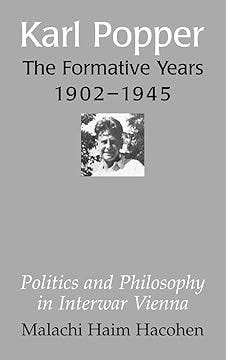
Editor: See Chapter 9 Plato, Socrates, Classical Athens , and the West in Haim Hacohen’s Karl Popper: The Formative Years 1902-1945 for insights into Popper’s view of Plato!



 StephenKMackSD's Blog