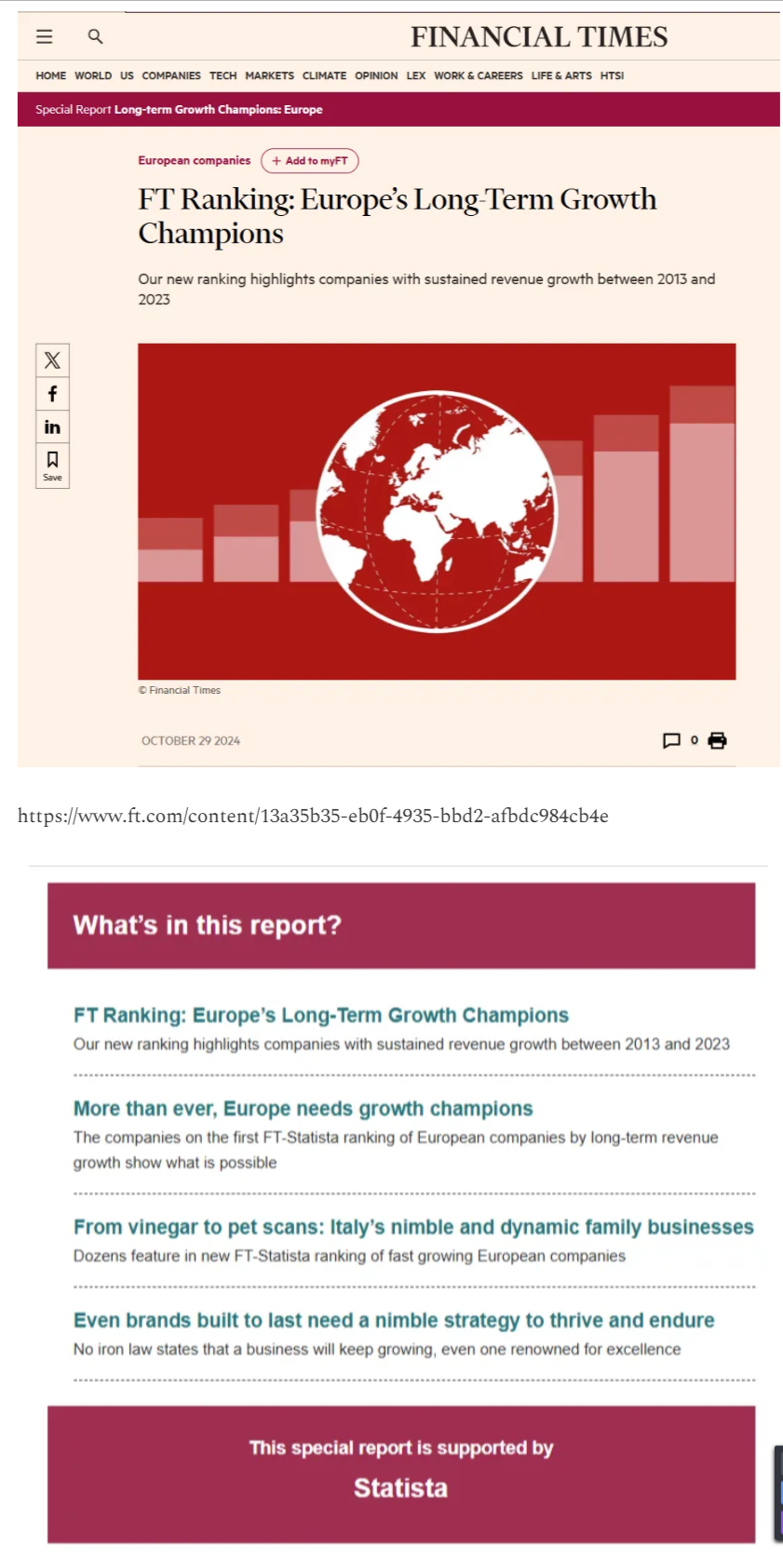
Editor: The question might occour to The Reader: What is Statista
Statista is a global data and business intelligence platform with an extensive collection of statistics, reports, and insights on over 80,000 topics from 22,500 sources in 170 industries. Established in Germany in 2007, Statista operates in 13 locations worldwide and employs around 1,100 professionals.
Empowering people with data. Our pursuit of knowledge and innovation drives us to be thought leaders in the field. As pioneers in shaping the future of the data economy, our ultimate goal is to create a world that is more transparent, reliable, and trustworthy. We strive to empower fact-based decision-making that positively impacts society.
Editor: For those Hungry Capitalists on the hunt for readily usable self-exculpitory apologetics!
Anti-Capitalist.
…………………………………………………………………………………………………………………………..
On the Politics of the Periphery
New urban forms characterizing contemporary metropolises reflect a certain continuity with the patterns of the past. They also include unexpected forms of settlement and design that have emerged in response to social and economic needs and as a way of leveraging new technologies. Politics of the Periphery sets out to explore sub/urban governance in diverse contexts in order to better understand how materiality and space are shaped by the possibilities and constraints of confronting actors.
This collection, edited by Pierre Hamel, examines the empirical aspects of collective action and planning in eight urban regions around the world – across North America, Europe, Asia, and Africa – and reveals the impacts and consequences of various structures of suburban governance. The case studies feature a diverse range of local actors facing both the specificity of their respective milieus and the broader context of extended urbanization as metropolitan regions cope with new territorial challenges.
The book focuses on suburbanization processes that characterize most of these post-metropolitan regions and questions whether it is possible to improve suburban governance in the face of growing uncertainties arising from structural and subjective transformations. Paying close attention to the relationship between the local and the global, Politics of the Periphery challenges the planning processes of evolving metropolitan regions.
Leo Strauss re-wrote the History Of Philosophy so that the Neo-Conservatives like Stephens could use it as there/his touch-stone? This just a bit of hyperpbole! yet Strauss betrayel of the facts of the History Of Philosphy is/was an act of the betrayel, of that Philiosopical Tradition, that became the lynch pin of Neo-Conservatism!
Editor:Mr. Stephens is the former editor of The Jerusalem Post which might leade The Reader to obvious conclusions
…
Now that Israel is the war’s clear victor, it needs to bring its hostages home. Let Hamas try to rule from the ruins it made.
That doesn’t mean that Jerusalem should cut a weak deal. Above all, it would be a mistake for Israel to agree to bring back the hostages in stages, since it would give Hamas an incentive to raise the price for every additional hostage. Trump can be especially helpful here by informing Hamas’s patrons in Qatar that the United States would revoke Qatar’s status as a major non-NATO ally and move the Al-Udeid air base — forward headquarters of the U.S. Central Command — to the United Arab Emirates if all of the hostages aren’t released by Jan. 20. Let the conniving Qataris figure out the rest.
Other players? The Turks will have to be deterred by Washington from trying to use Syria’s revolution as an opportunity to settle scores against the Kurds. That means, especially, maintaining our detachment of forces in eastern Syria. The Saudis will also need to demonstrate regional leadership by helping rebuild Syria and resuming negotiations for diplomatic normalization with Israel.
None of this will be simple or straightforward. But the end of al-Assad’s wretched regime unlocks many doors.
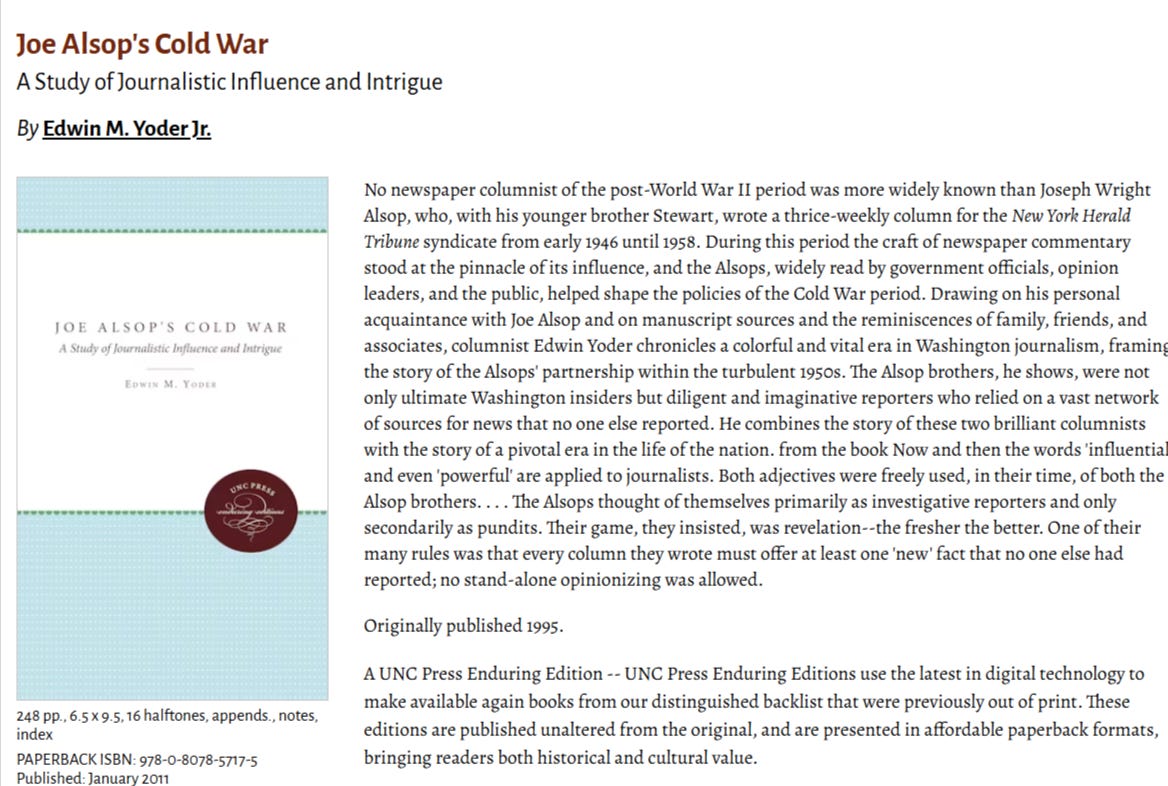
Compare Mr. Stephens politics to the notorious Cold Warrior Joe Alsop’s , via Edwin M. Yoder Jr.
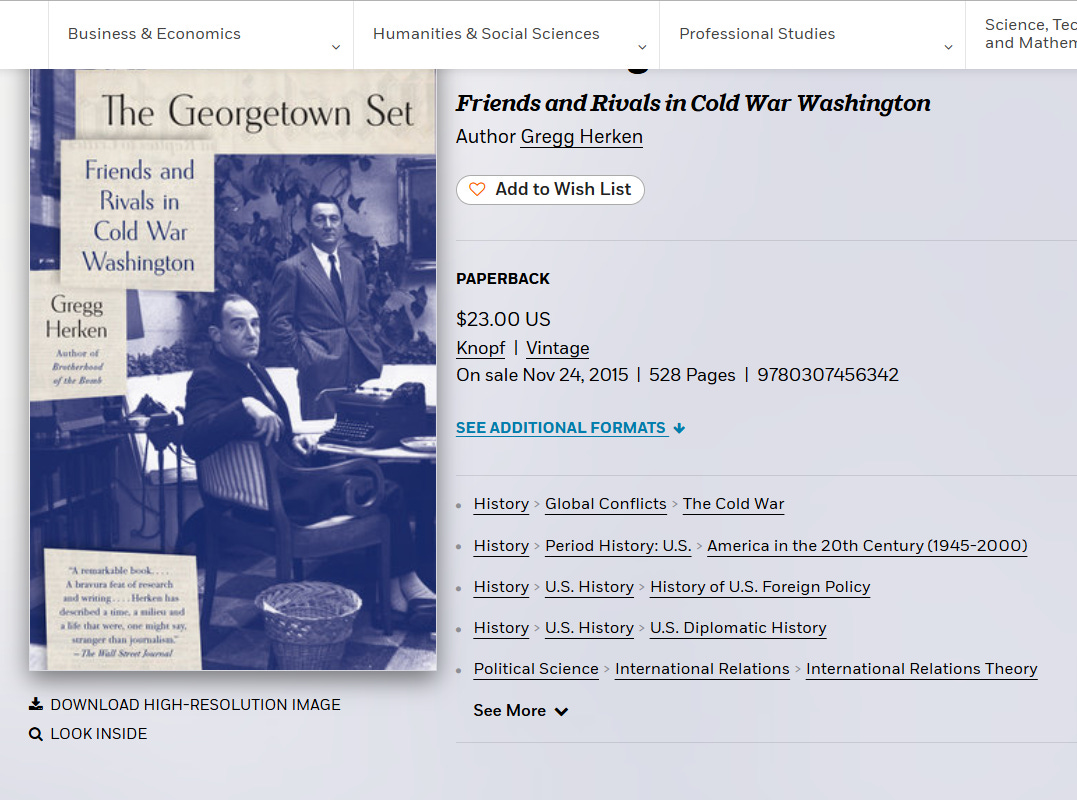
In the years after World War II, Georgetown’s leafy streets were home to an unlikely group of Cold Warriors: a coterie of affluent, well-educated, and connected civilians who helped steer American strategy, for better and worse, from the Marshall Plan through McCarthyism, Watergate, and Vietnam. The Georgetown set included Phil and Kay Graham, husband-and-wife publishers of The Washington Post; Joe and Stewart Alsop, odd-couple brothers who were among the country’s premier political pundits; Frank Wisner, a driven, manic-depressive lawyer in charge of CIA covert operations; and a host of other diplomats, spies, and scholars. Gregg Herken gives us intimate portraits of these dedicated and talented, if deeply flawed, individuals, who navigated the Cold War years (often over cocktails and dinner) with very real consequences reaching into the present day. Throughout, he illuminates the drama and fascination of that noble, congenial, curious old world,” in Joe Alsop’s words, bringing this remarkable roster of men and women not only out into the open but vividly to life.
Editor: The thing that sets Joe Alsop apart from Mr. Stephens is that Joe was in the Asian Theater of War during WWII, and in Korea during that War- he was too old for Vietnam.Mr. Stephens is in sum a Zioninst Propgandist !
Political Cynic wallows in @FT Political Propaganda! Should @NTY follow suit? Another ? Where is my favorite Janan Genesh, with his attempted riffs on the long forgotten Tom Wolfe?
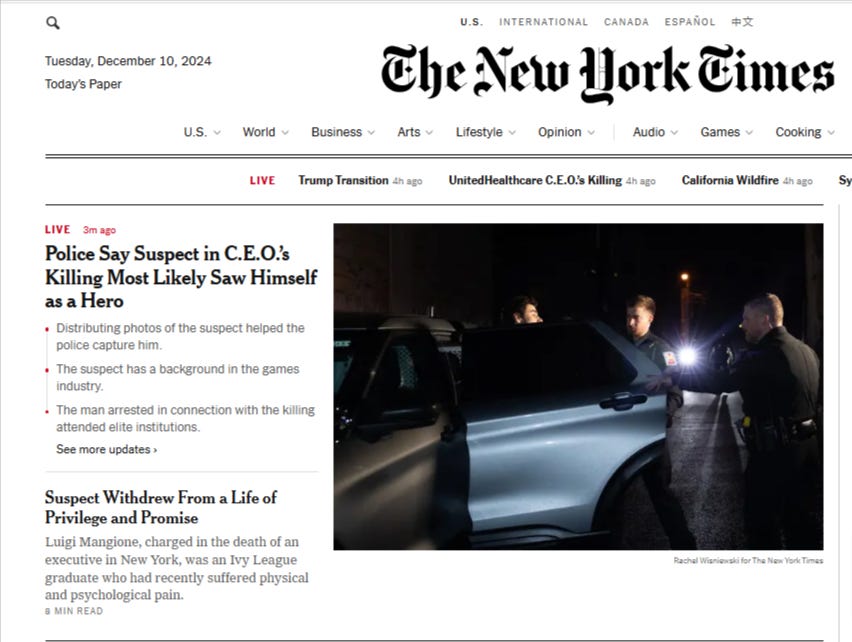
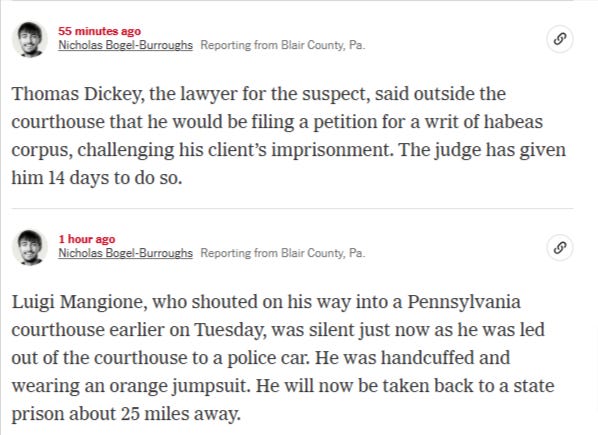
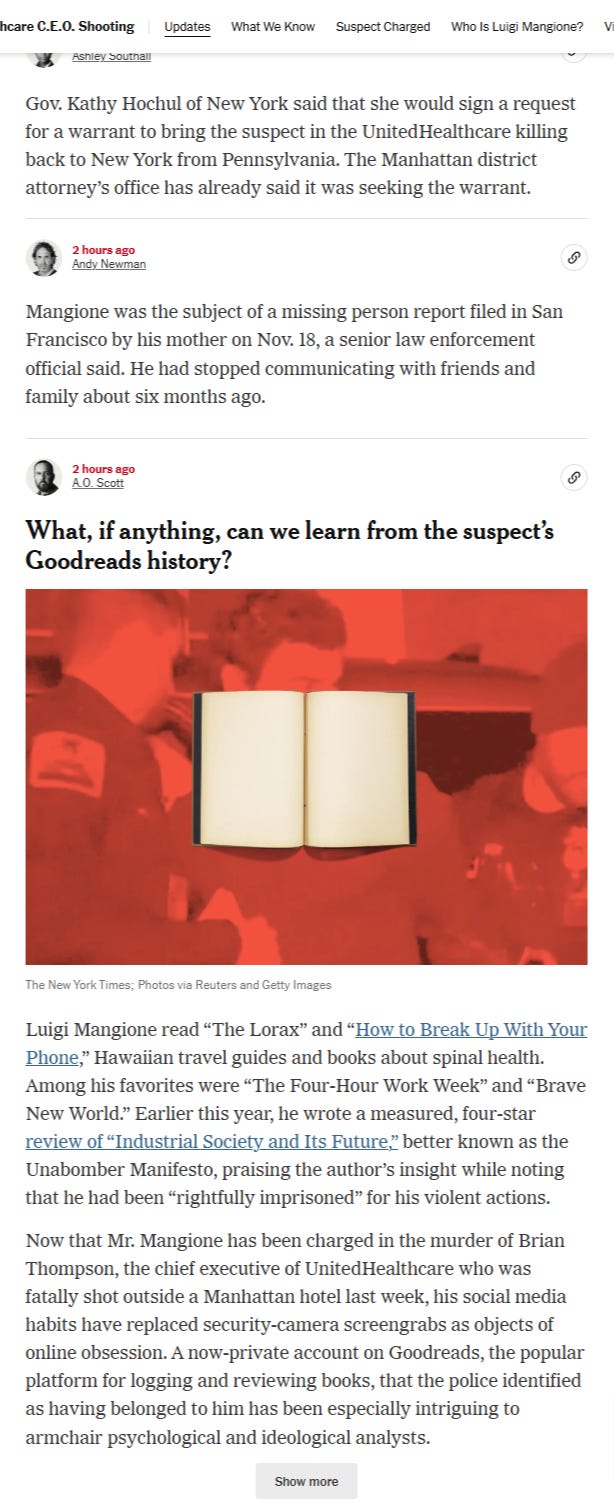
The New York Times begins the construction of a plausable suspect in the murder of Brian Thompson: Reader refresh your memory of a dire crime in the Asssination of John F. Kennedy! And the Warren Comission Jr. Council, Arlen Spector and that Comissions finding of ‘The Magic Bullet’! The pruest fiction, to hide the political macinations of The American National Security States culpability in the Kennedy Murder:
The Construction of the ‘The Singular Harrative’ has begun in the photograhs delow:
Editor: The tiling effect of these ‘reports’ add an ersatz verrisimilitude ?
…
This the Evolution not of a News Story, but the birth of National Secutity State Propaganda Made To Measure! In the wake of the Kennedy Murder the arbiters of political respetability coined the phrase ‘conspiracy theorists’ as a term of opprobrium.
The Reader might consider the recent election of Donald Trump and the abysmal defeat of Harris, as instructive about The Rebellion Against The Elites? As much as you may didaine it! Think of the gilets jaunes in France, The Canadian Truckers Strike, the Netherland’s Farmers Strike, The Farmers Revolt in France, and the recent Farmers Strike in Britain , led by Jeremy Clarkson! I’m sure I’ve forgotten more that I recall!
Adnan Vatansever, reader in Russian Political Economy at King’s College London’s Russia Institute, estimates that Russia’s spending on the war in Ukraine (including associated spending such as the spiralling cost of recruiting soldiers and welfare payments to casualties) could be approaching ten per cent of the country’s GDP.
…
However, Vatansever explains that rising wages are also inflating demand, creating a “price spiral”. The result is that inflation in Russia is now running at nearly ten per cent. On Russian social media, clips have circulated of shoplifters raiding butter, the cost of which has risen by more than 25 per cent in the last year.
…
The reason for this, Vatansever explains, is that “Russia is no longer a normal economy”. Putin is aggressively subsidising the lifestyles of Russian citizens with very high public spending, but because the country is disconnected from capital flows – there is almost no foreign investment in Russia, nor are Russians investing abroad – the demand for imported goods keeps growing, the rouble keeps getting weaker, and this compounds the effect of inflation.
Russia has also been artificially inflating its housing market by subsidising mortgages, creating a dangerous housing bubble. Property prices in Russian cities have more than doubled since the Ukraine war began, but when this subsidy was withdrawn for most homebuyers in July, demand halved, leaving an unstable bubble that Vatansever says “could lead, at some point, to a financial crash in Russia, if that bubble bursts”.
…
For previous crises, Vatansever told me, Russia has been prepared with large financial reserves, but this is no longer the case; part of Russia’s policy of “de-dollarisation” involved holding around $207 billion of its central bank reserves in euro assets, which have been frozen since 2022, and won’t be thawed any time soon (unless they’re handed over to Ukraine). The one remaining financial buffer is Russia’s national wealth fund. If the global oil price falls below $60 a barrel this will, according to a report by the Russian central bank, be depleted in about a year. It is very hard to say how sincerely we should believe anything Trump says, of course – but most economists were already predicting a slower rate of growth for next year.
Russia’s Central Bank raised its key policy rate to 21 percent in late October as the Russian authorities struggle to manage a wartime economy that is in danger of overheating due to a combination of factors including rising inflation, sanctions pressure, and record defense sector spending. While Kremlin officials and many international analysts insist that the Russian economy remains in remarkably good shape, the country’s longer term economic outlook is becoming increasingly precarious.
Despite frequent predictions of impending economic meltdown, there is currently little sign that the Russian economy is in immediate danger. At the same time, the full-scale invasion of Ukraine appears to have placed Vladimir Putin in an unenviable economic position. If the war continues for an extended period and is accompanied by factors including increased sanctions, inefficient military leadership, and pervasive corruption, this could plunge Russia into a severe economic recession.
Ending the conflict also presents economic risks. Russia’s unprecedented military spending since 2022 has enriched elites and boosted domestic demand, overheating the economy. If the war ends, this fiscal stimulus will cease, potentially causing a significant drop in real incomes for much of the population. This could lead to heightened social tensions and undermine the stability of the ruling regime.
Vladimir Putin frequently claims that Western sanctions have been counterproductive and often uses his public addresses to boast of Russia’s wartime economic performance. Official data broadly supports this narrative, with Russia reporting strong GDP growth in 2023 and during the first half of the current year.
A range of factors are fueling the current growth of the Russian economy, with military expenditure perhaps the single most important driver. The Russian authorities allocated around six percent of GDP for the military in 2024, representing the highest total since the Cold War. Further increases are planned for 2025. Nor does this cover all war-related costs. Significant additional spending is required to fund a range of defense-related industries and to finance the occupation of Ukrainian regions currently under Kremlin control.
…
Despite the outward appearance of stability, Russia’s wartime economy faces mounting challenges. Russia’s National Welfare Fund is steadily dwindling, while export revenues have gradually declined during 2024 as a result of tightening sanctions and constraints on resource extraction caused by limited access to modern technologies.
Economists are now warning that the Russian economy is in danger of overheating, largely as a result of unprecedented military spending. Meanwhile, Russia’s low unemployment rate of around 2.5 percent is more indicative of a severe labor shortage than a healthy economy. The problems caused by this lack of workforce add to the challenges created by sanctions-related restrictions on access to Western equipment, exacerbating Russia’s technological deficit.
Inflation currently poses the single greatest threat to Putin’s wartime economy, and was a key factor behind the recent decision to hike the country’s key interest rate. Russia’s Central Bank aims to reduce inflation to around four percent in 2025, but this may not be a realistic target. Indeed, official inflation data from the Kremlin may actually underestimate the rising cost of living for ordinary Russians.
Over the past year, even official Russian government bodies such as Rosstat have cautiously acknowledged negative economic trends such as rising inflation, labor shortages, and declining activity in some sectors of the economy. Taken together, these negative factors are likely to contribute to a period of slower growth, if not stagnation.
…
Editor: The Reader must always keep in mind that The Atlantic Council is the propganda arm of NATO!
MOSCOW, Aug 28 (Reuters) – The Russian economy has shown solid growth in many sectors while unemployment remains at a record low, new data showed on Wednesday, prompting officials to hint at a brighter outlook for the year despite Western sanctions over the war in Ukraine.
Driven by military production, industrial output rose by 3.3% in July compared with a 2.7% increase the previous month, and by 4.8% since the start of the year, compared with 3.1% growth in the same period in 2023.
A preliminary estimate for gross domestic product (GDP) growth in the first half of the year stood at 4.6%, compared with 1.8% for the same period last year.
Officials attributed this growth to strong capital investment, including by the private sector, which in the second quarter rose by 8.3% year-on-year to 8.44 trillion roubles ($92 billion), following 14.5% growth in the first quarter of the year.
“Given such high results in the first half of the year, we expect even higher figures for the entire year of 2024 than we had initially projected in the economic forecast published in April,” said Polina Kryuchkova, deputy economy minister.
The data suggested the economy was holding up despite Western economic sanctions and problems with international payments with Russia’s major trading partners, such as China, which led to a 9% fall in overall imports in the first half of the year.
However, they also pointed to overheating, which forced the central bank to hike its benchmark interest rate by 200 basis points to 18% in July, the highest level in more than two years.
The central bank said persistent labour shortages and wage growth, as well as high inflation, were the main signs of an overheated economy and promised to maintain tight monetary policy and fight inflation until it cools.
New statistics showed that real wages rose 6.2% year-on-year in June, following an 8.8% increase in the previous month, while average nominal wages rose 15.3% year-on-year to 89,145 roubles a month.
Wage growth in Russia is being spurred by the payouts handed to contract soldiers fighting in Ukraine, which have become a new benchmark in the economy as workers in fast-growing sectors facing acute labour shortages demand similar pay from employers.
In the first half of the year, real wages grew by 9.4%, while nominal wages increased by 18.1% compared with the same period in 2023, according to the new data. Unemployment remained at a historically low level of 1.9 million people in July, or 2.4% of the workforce.
Editor: there can never be enough of Friedman’s prepetual dull-wittedness, and mendacious fellow traveling, with the American National Security Sate!
Five Quick Takes on Regime Change in Syria
Dec. 8, 2024.
For the past few weeks, I have been arguing that Israel has inflicted the equivalent of a Six Day War-level defeat on Iran and its resistance network, and this would have vast consequences. Well, irony of ironies, the Assad family in Syria took power in 1971, in part because of Syria’s devastating defeat in the 1967 war. What goes around comes around.
Hold on to your hats, though; you haven’t seen anything yet. Here are five quick observations.
…
Political Observer.
Editor: Bret Stephens is a Neo-Conservative and Professional Zionist!
As for Iran, Israel’s retaliatory strike in late October on key military facilities left it too weakened and exposed to save Assad. Tehran is now rapidly withdrawing its once-considerable military presence in Syria. Cut off from this military supply chain, Hezbollah has never been in a more precarious position, giving the Lebanese people their own rare opportunity to bring this terrorist militia to heel and restore their sovereignty after decades of de facto Syrian and Iranian occupation.
Victory, as the saying goes, has a thousand fathers. But credit for Syria’s liberation from Assad must also be given for Israel’s courageous decisions to ignore calls for cease-fire and pursue its enemies — whether in Gaza, Beirut, Hodeidah, Damascus, or Tehran. Each of these actions was denounced at the time for risking “escalation.” But victory over terrorists and tyrants has a way of paying dividends for the victorious and defeated alike.
Let’s hope the next leaders in Syria recognize the debt and finally seek peace, after 76 years of fruitless rejection, with their Jewish neighbor.
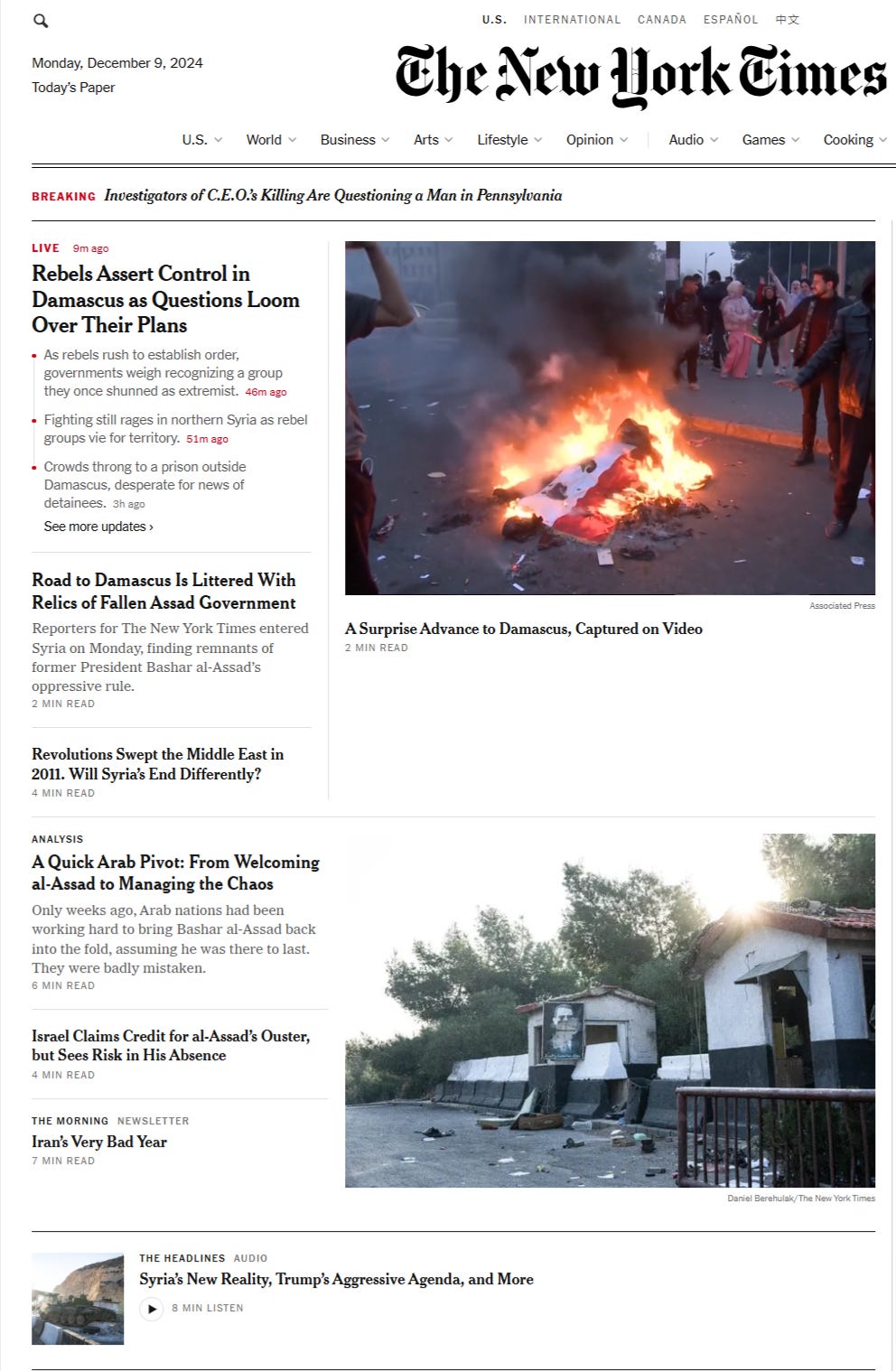
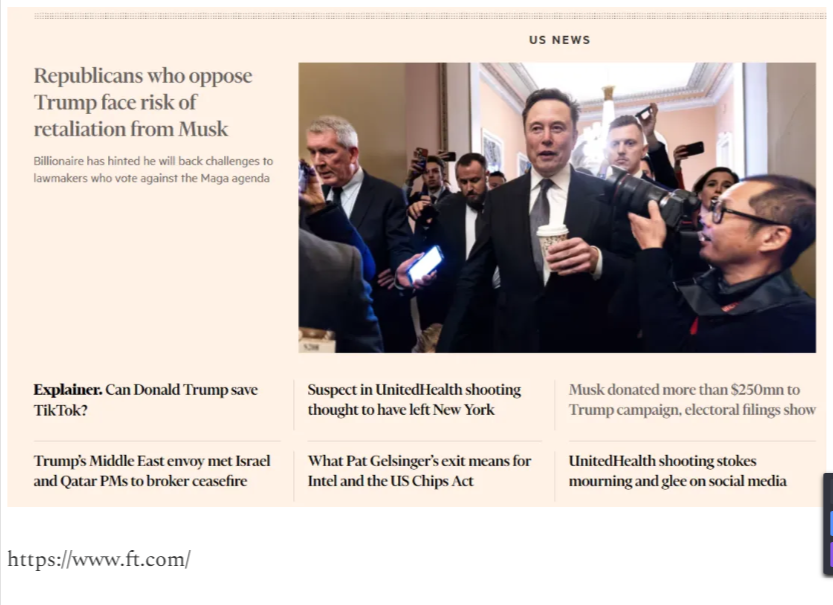
Political Reporter muses about this photograph: It look like a still from Orson Wells’ Citizen Kane! Newspaper Reporters surround ‘The Great Man’. Though it’s well below the fold!
As for Iran, Israel’s retaliatory strike in late October on key military facilities left it too weakened and exposed to save Assad. Tehran is now rapidly withdrawing its once-considerable military presence in Syria. Cut off from this military supply chain, Hezbollah has never been in a more precarious position, giving the Lebanese people their own rare opportunity to bring this terrorist militia to heel and restore their sovereignty after decades of de facto Syrian and Iranian occupation.
Victory, as the saying goes, has a thousand fathers. But credit for Syria’s liberation from Assad must also be given for Israel’s courageous decisions to ignore calls for cease-fire and pursue its enemies — whether in Gaza, Beirut, Hodeidah, Damascus, or Tehran. Each of these actions was denounced at the time for risking “escalation.” But victory over terrorists and tyrants has a way of paying dividends for the victorious and defeated alike.
Let’s hope the next leaders in Syria recognize the debt and finally seek peace, after 76 years of fruitless rejection, with their Jewish neighbor.
It can’t surprise that Mr. Colevile is a man of High Privelidge, wedded to a toxic Thatcherite Political Nostalgia, that is employed in its various regitsters?
Headline: Starmer is stumbling but it’s too early for Tories to celebrate
Sub-headline: It’s one thing to promise to do better next time, another to persuade voters to believe that
In the first paragraphs Mr. Colvile primes the reader with his ‘just one of the fellas’ self-presentation:
In struggling to explain the spate of injuries affecting his new club, Swindon Town, Ian Holloway has happened upon an unusual explanation. The club’s training ground, the manager believes, is haunted — so he’s going to ask his wife to carry out a spiritual cleansing.
Perhaps, once she’s done, Mrs Holloway should pay a trip to Downing Street. Since entering office, Keir Starmer seems to have become a living embodiment of that Simpsons meme in which Bart laments that this is the worst day of his life, and Homer corrects him: worst day of your life so far.
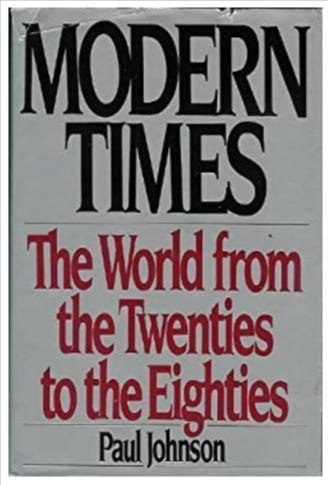
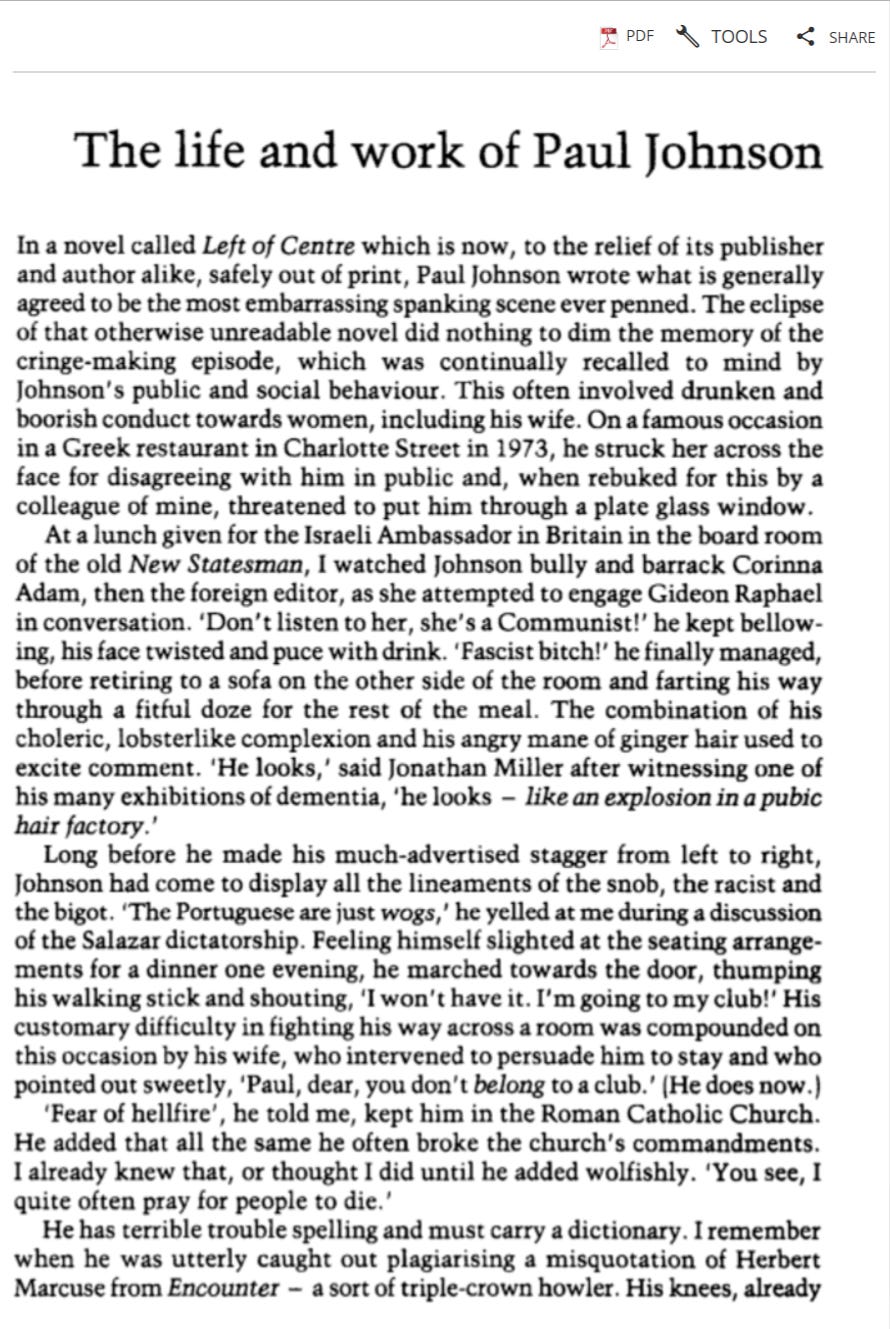
Editor: To add some important political precursors to Mr. Colevile’s essay, this Reader can recall reading the first edition of Paul Johnson’s book of 1983.
Editor: Here is the Mises Institute Robert Nisbet in the New York Times of June 26, 1983, Sunday, Late City Final Edition Section 7: the final paragraphs of Mr. Nisbet’s essay :
…
As this sample of chapters fairly shouts, ”Modern Times” presents a world that has been mostly grim and depressing during the last 60 years. Looking only at the United States we may, if we choose, take comfort in advances in medicine, high technology and mass production of consumer goods. But, welcome as they may be, these advances are hardly likely to be of much effect against the steady decline of economic productivity; the continuous advance of statism, irrespective of administration; the serious, perhaps calamitous degradation of our culture, starting with the educational system, and the constant threat of inflation, massive deficits and high interest rates. I am thinking only of this country. Anyone who can find more hope elsewhere in the world is welcome to try.
Mr. Johnson concludes his book with an overview and assessment under the heading, ”Palimpsests of Freedom.” As that title indicates, he finds some good signs among the bad events he has recounted. He is correct in taking comfort in the death of any serious belief in socialism and statism in the West at the present time. He is correct also in his perception that the social sciences, even economics, and the ideologies embedded in them, are in the doldrums, suggesting that a new start may be made one of these days on getting back to ”the proper study of mankind” -man. I have reservations, though, about his notion that sociobiology might be that new start. On the other hand, if Mr. Johnson means that, on the evidence of human history and especially that of the 20th century, we may well have to wait a few hundred thousand years for improvement of the human lot through the same evolutionary processes that brought homo sapiens into being, I can’t argue; he just may be right. In the meantime, we can take a great deal of intellectual pleasure in his book, which is a truly distinguished work of history.
The result is a state of play in which British politics looks — if you’re allowed to use this kind of ablist metaphor these days — like a bunch of one-legged men in an arse-kicking contest. Reform will surely make gains in the council elections, and may well become the main opposition in Wales. But neither it nor the Tory party is yet strong enough to knock the other out.
Badenoch has made a promising start as leader (and I’m not just saying that because I introduced her on stage). But the Conservatives still have a huge amount of brand damage to repair. Labour is floundering on both sides of the border — in Scotland it has again fallen behind the SNP, leading Scottish Labour to denounce Rachel Reeves’s totemic cuts to the winter fuel payment.
Ed Davey, for his part, seems more interested in reaching No 1 than No 10, his main contribution to the national debate in recent weeks being the release of a Christmas charity single, recorded with a group of carers, called Love Is Enough. Having listened to it, I am prepared to donate quite a large amount if it will guarantee that no one else has to.
Recently, the pollster James Kanagasooriam — who first came up with the idea of the red wall — proposed a new model of the political cycle. He argued that it’s not just about voters moving between left and right, but the level of “block dominance”. Essentially, parties win elections when they unite a block of voters on the left or right. But as they become more unpopular, they fracture their own coalition and unify disillusioned voters around the most likely challenger on the other side.
Labour’s support base appears to be breaking down with unparalleled speed. The big question — especially given the recent shattering of the Tories’ own coalition — is whether voters eventually coalesce around one opposition option, or whether we’re in for a messy, muddled, multiparty age.
How very puzzling that Colevile fails to mention Mrs. Thatcher famous/infamous decalartion, that ‘Tony Blair was my greatest accomplishment’ : in sum Mr. Colevile is attacking the grandchild of the Iron Lady, that is Kier Starmer, as titular leader of New Labour! With Tony Blair dehind the curtain, controling the levers of power?
Editor: Even Zionist stalwert Bret Stephens can’t resist the siren call !
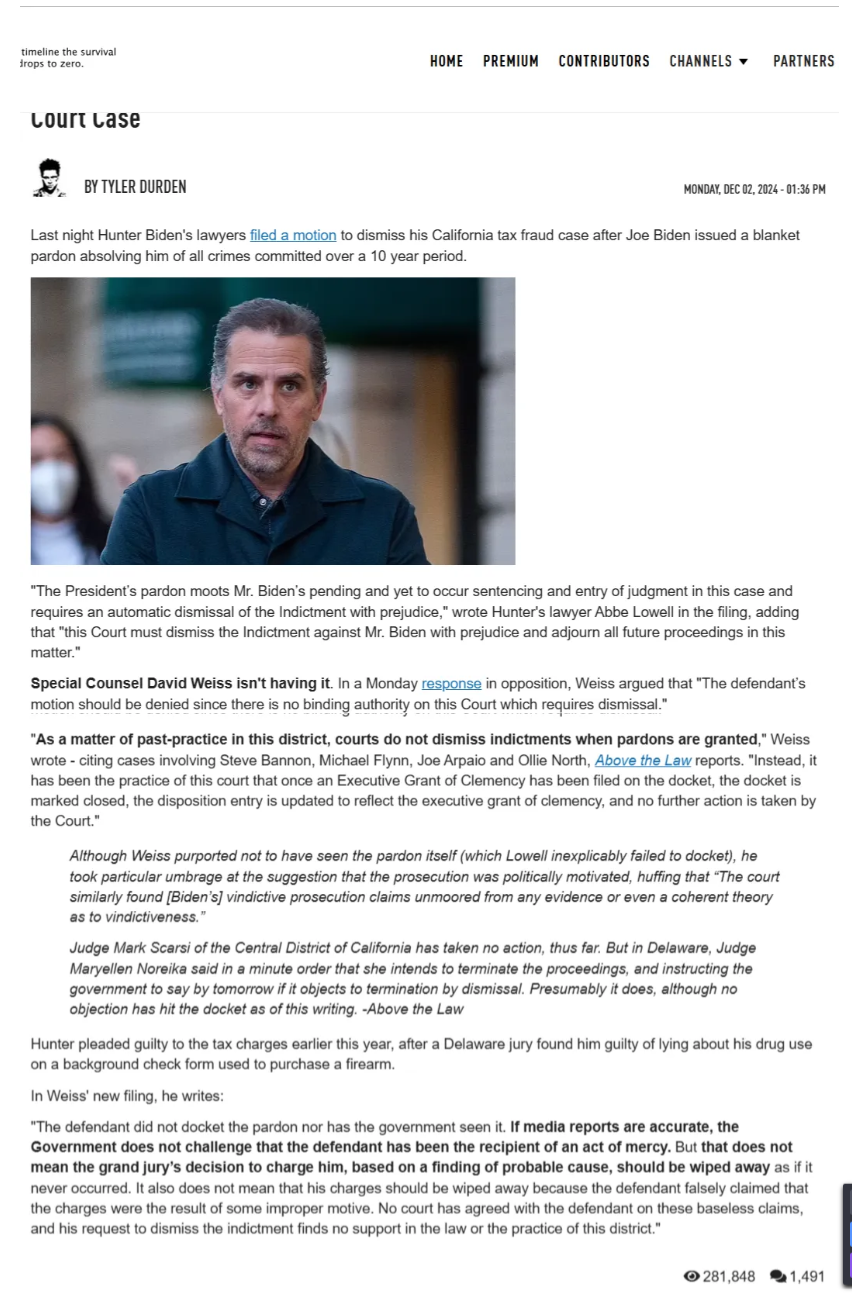
A Disgraceful Pardon
Dec. 2, 2024
…
It was always a good bet that the president would break his word as soon as it was politically safe to do so. But he doubled down on dishonesty in his statement about the pardon, claiming Hunter’s prosecution was a result of “political pressure” on the judicial process. Nonsense. The charges stem from Hunter’s reckless lifestyle, abetted and financed by his willingness to trade shamelessly on the family name. A previous plea agreement between Hunter and federal prosecutors fell apart last year under scrutiny from a federal judge.
…
Editor: Reader stay tuned for Mr. Stephens Dec. 3, 2024 praise for fellow Zionist shill Rahm Emanuel, who will put New Democratic house in order?



 StephenKMackSD's Blog