On The perpetual mendacity of Jonathan Freedland!

Fri 18 Mar 2016 16.09 EDT

stephenkmacksd.com/

Feb 13, 2026

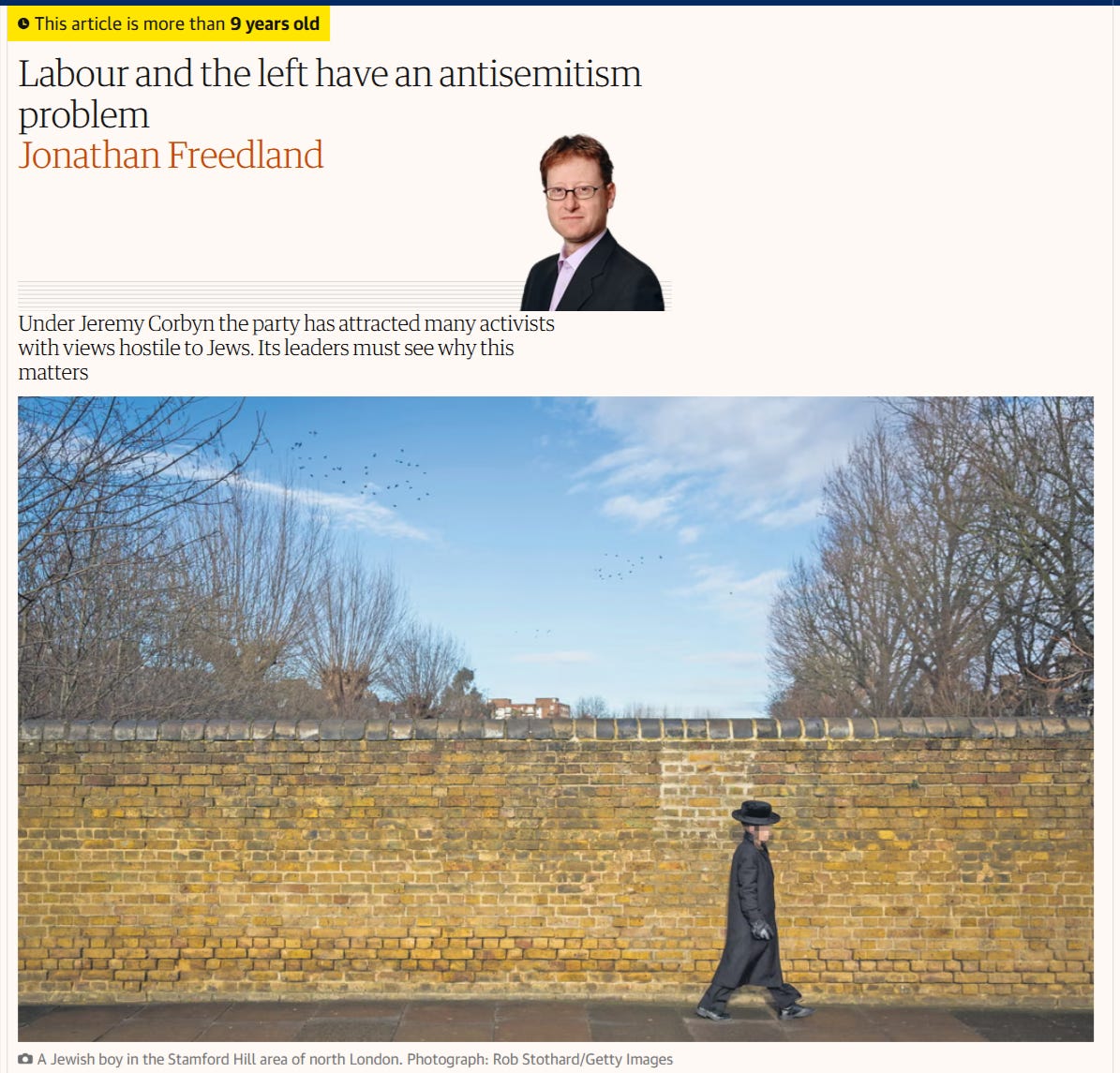
As the Conservative party divides its time between running the country and tearing itself apart over Europe, Labour has been consumed with a rather different problem. In the past two weeks, it has had to expel two activists for overt racism. That follows the creation of an inquiry into the Labour club at Oxford University, after the co-chair resigned saying the club was riddled with racism. The racism in question is hatred of Jews.

I suspect many in Labour and on the wider left dearly wish three things to be true of this problem. That these are just a few bad apples in an otherwise pristine barrel; that these incidents aren’t actually about racism at all but concern only opposition to Israel; and that none of this reflects negatively on Jeremy Corbyn.

Start with the bad apples. The cases of Gerry Downing and Vicki Kirby certainly look pretty rotten. The former said it was time to wrestle with the “Jewish Question”, the latter hailed Hitler as a “Zionist God” and tweeted a line about Jews having “big noses”, complete with a “lol”.

It’d be so much easier if these were just two rogue cases. But when Alex Chalmers quit his post at Oxford’s Labour club, he said he’d concluded that many had “some kind of problem with Jews”. He cited the case of one club member who organised a group to shout “filthy Zionist” at a Jewish student whenever they saw her. Former Labour MP Tom Harris wrote this week that the party “does indeed have a problem with Jews”. And there is, of course, the word of Jews themselves. They have been warning of this phenomenon for years, lamenting that parts of the left were succumbing to views of Jews drenched in prejudice.

I hope many on the left will pause next time Jews raise the alarm about antisemitism

But this is the brick wall Jews keep running into: the belief that what Jews are complaining about is not antisemitism at all, but criticism of Israel. Jews hear this often. They’re told the problem arises from their own unpleasant habit of identifying any and all criticism of Israel as anti-Jewish racism. Some go further, alleging that Jews’ real purpose in raising the subject of antisemitism is to stifle criticism of Israel.

You can see the appeal of such an argument to those who use it. It means all accusations of antisemitism can be dismissed as mere Israel-boosting propaganda. But Downing and Kirby make that harder. Their explicit targets were Jews.

What of those who attack not Jews, but only Zionists? Defined narrowly, that can of course be legitimate. If one wants to criticise the historical movement that sought to re-establish Jewish self-determination in Palestine, Zionism is the right word.

But Zionism, as commonly used in angry left rhetoric, is rarely that historically precise. It has blended with another meaning, used as a codeword that bridges from Israel to the wider Jewish world, hinting at the age-old, antisemitic notion of a shadowy, global power, operating behind the scenes. For clarity’s sake, if you want to attack the Israeli government, the 50-year occupation or hawkish ultra-nationalism, then use those terms: they carry much less baggage.

To state the obvious, criticism of Israel and Zionism is not necessarily anti-Jewish: that’s why there are so many Jewish critics of Israel, inside and outside the country. But it doesn’t take a professor of logic to know that just because x is not always y, it does not follow that x can never be y. Of course opposition to Israel is not always antisemitic. But that does not mean that it is never and can never be antisemitic. As Downing and Kirby have helpfully illustrated.

I hope that, as a result, many on the left will pause next time Jews raise the alarm about antisemitism. I hope they’ll remember that, while most anti-Israel activists are acting in good faith, some are motivated more darkly, while others carelessly express their opposition to Israel in language or imagery that has a melancholy history.

There’s a deeper reason to pause. Many good people on the left want to make things neat and simple by saying that Israel and Zionism have nothing to do with Jews or Judaism. That they can deplore the former even while they protect and show solidarity with the latter. But it’s not quite as easy as that.

While many Jews – especially in conversations with each other – condemn Israeli government policy going back many years, they do identify strongly with Israel and its people. A recent survey found that 93% of British Jews said Israel formed some part of their identity. Through ties of family or history, they are bound up with it. When Jews pray they face east – towards Jerusalem. And they have done that for 2,000 years.

It’s inconvenient, I know, but that needs to be remembered by those who insist that there’s no connection between Israel and Jews, that it’s perfectly possible to loathe everything about Israel – the world’s only Jewish country – without showing any hostility to Jews.

Jews themselves usually don’t see it, or experience it, that way. That doesn’t mean no one should ever criticise Israel, for fear of treading on Jewish sensitivities. Of course it doesn’t. But it does mean that many Jews worry when they see a part of the left whose hatred of Israel is so intense, unmatched by the animus directed at any other state.

They wonder why the same degree of passion – the same willingness to take to the streets, to tweet night and day – is not stirred by, say, Russia, whose bombing of Syria killed at least 1,700 civilians; or the Assad regime itself, which has taken hundreds of thousands of Arab lives. They ask themselves, what exactly is it about the world’s only Jewish country that convinces its loudest opponents it represents a malignancy greater than any other on the planet?

Which brings us to Jeremy Corbyn. No one accuses him of being an antisemite. But many Jews do worry that his past instinct, when faced with potential allies whom he deemed sound on Palestine, was to overlook whatever nastiness they might have uttered about Jews, even when that extended to Holocaust denial or the blood libel – the medieval calumny that Jews baked bread using the blood of gentile children. (To be specific: Corbyn was a long-time backer of a pro-Palestinian group founded by Paul Eisen, attending its 2013 event even after Eisen had outed himself as a Holocaust denier years earlier. Similarly, Corbyn praised Islamist leader Sheikh Raed Salah even though, as a British court confirmed, Salah had deployed the blood libel.)

Thanks to Corbyn, the Labour party is expanding, attracting many leftists who would previously have rejected it or been rejected by it. Among those are people with hostile views of Jews. Two of them have been kicked out, but only after they had first been readmitted and once their cases attracted unwelcome external scrutiny.

The question for Labour now is whether any of this matters. To those at the top, maybe it doesn’t. But it feels like a painful loss to a small community that once looked to Labour as its natural home – and which is fast reaching the glum conclusion that Labour has become a cold house for Jews.

Fri 18 Mar 2016 16.09 EDT

Newspaper Reader.
Posted in Uncategorized | Leave a comment

Jeremy Corbyn interview.

Newspaper Reader.

stephenkmacksd.com/

Feb 13, 2026

The Truth about Peter Mandelson | Jeremy Corbyn interview

Posted in Uncategorized | Leave a comment

Political Observer shares the wealth: The Duran on The Fall of Starmer…

Newspaper Reader .

stephenkmacksd.com/

Feb 13, 2026

UK Starmer coalition of the willing crumbles

The Duran

Posted in Uncategorized | Leave a comment

Chris Norlund is an essential Voice!!!

StephenKMackSD!!!

stephenkmacksd.com/

Feb 12, 2026

Editor: Chris Norlund

@realchris

398K subscribers•2.6K videos

Breaking news. Stay informed. Every day. …morechrisnorlund.com/investand 4 more links

Subscribe

Join

https://www.youtube.com/@realchris

StephenKMackSD !

Posted in Uncategorized | Leave a comment

George Eaton seemes to have resorted to a kind of ersatz psychoanalysis to describe Keir Starmer’s most pressing issue of the moment : Antonia Romeo, Simon McDonald etc, etc, etc, …

Political Observer : Mr. Eaton focuses on this melodrama, while Starmer and his cadre hope to quell the near revolt, or something akin to that? Have I miss-read it?

stephenkmacksd.com/

Feb 12, 2026

Keir Starmer has entered the anger stage of his premiership. As much was made clear by his response to Ed Davey at yesterday’s PMQs. After the Lib Dem leader, with a reasonable but wounding tone, accused Starmer of a “catastrophic lack of judgment” over the appointments of Peter Mandelson and Matthew Doyle, the Prime Minister snapped back that Davey “should take accountability and responsibility” for austerity. That might have worked as a riposte to a question over public spending but it fell short given Davey’s subject was links to paedophiles.

The latest story concerns the case of Sean Morton, an ex-Labour councillor twice convicted of possessing indecent images of children. Doyle, Starmer’s longest-serving director of communications, campaigned for Morton – who stood as an independent candidate in May 2017 – even after he had been charged (Doyle says he accepted Morton’s claims of innocence and has apologised). The Sunday Times’ Gabriel Pogrund reported as much on 27 December 2025 but it was not until Tuesday of this week, as the Mandelson scandal swirled, that Doyle had the Labour whip withdrawn. For now, as the party investigates, he retains his peerage (Lucy Powell, Lisa Nandy and party chair Anna Turley have called for its removal).

It is Starmer’s judgment that is once again the central question. The Prime Minister did not know that Doyle had campaigned for Morton but he did know that he had been “supportive” of him. Five days before Doyle’s peerage was announced, Scottish Labour’s Pam Duncan-Glancy resigned as the party’s education spokesperson over her close friendship with Morton, making the Prime Minister’s decision to proceed even stranger.

But had Starmer kept his word he would never have been in this invidious position. Back in 2022, he told Labour peers that he would strip politicians of the power to make appointments to the Lords, vowing to “restore trust” after Boris Johnson stuffed the house with “lackeys and donors”. Starmer was right: peerages, doled out as a reward for factional allies or a bauble to potential foes, are an inevitable source of scandal.

Yet in office the temptations of patronage have proved irresistible to Starmer. And so Britain’s unelected second chamber – the largest in the world after China’s National People’s Congress – continues to swell (with only hereditary peers set to be removed).

There is a complacent view in Westminster that subjects such as Lords reform are the preserve of constitutional obsessives, a distraction from the “bread and butter” of politics (in 2009, David Cameron privately described Lords reform as a “third-term issue”). But the elevation of those with links to Epstein and Morton has seen Labour, in the words of Emma Lewell MP, branded the “paedo protectors party”. Starmer is certainly right to be angry – but principally with himself.


Editor: The question that is avoided at all costs, with Eaton and the whole of the British Polititcal Class, is the reality of Jeremy Corbyn’s forced expultion from respectable British Politics. That made way for Tony Blair’s political catamite Keir Starmer!

Political Observer.

Posted in Uncategorized | Leave a comment

It’ been some time since I have read Janan Ganesh, but the wayward political trojectory remaines his metier! Even though it appears to be something like shadow boxing, of a kind.

Newspaper Reader.

stephenkmacksd.com/

Feb 11, 2026

Opinion Keir Starmer

Britain should pray that Starmer survives

The country did not and would not vote for the Labour left

https://www.ft.com/content/c9a27925-47f8-4542-a165-102bca95bce3?_gl=1*1q02gi4*_up*MQ..*_gs*MQ..&gclid=Cj0KCQiA7rDMBhCjARIsAGDBuECByS3jXNiuAIZyosnWC1Vc5YhNpLVzqme-IetpaiN4-oAZ7m06JDgaAkyMEALw_wcB&gclsrc=aw.ds&gbraid=0AAAAAC_ArBvX8wYT7mVc_PO4z7zQedf8u


An unsustainable situation can be sustained for quite a long time. John Major, Gordon Brown and Theresa May all governed the UK for years after the apparent collapse of their authority. On balance, it is better that Sir Keir Starmer does the same.

“On balance”, because there is no good outcome here. Starmer can only survive by pleasing the many Labour MPs to his left. If he falls, the likeliest successor will come from that same quarter. Either way, Britain is about to get a government it did not and would not vote for. When the likes of Ed Miliband tell Starmer to implement “change”, that is Labour-speak for “policies we couldn’t persuade the country to support in 2015”. Or indeed 2017 or 2019.

So why, if there is to be a mandate-less turn to the left anyway, should Starmer stay?

First, he has at least shown some aptitude for foreign affairs (outside of the occasional ambassadorial appointment). Don’t assume that his successor as prime minister would be able to continue his ongoing diplomatic project: a rapprochement of sorts with Europe and China without alienating the US. The world is not tranquil enough right now to risk finding out.

The other reason to keep Starmer is that a new prime minister would come under immediate pressure to call a general election. If one takes place, a country that has not known much calm for a decade would be disrupted again. Even if it doesn’t, that prime minister would be paralysed by a lack of mandate.

Now a word about the principal alternative to Starmer. From time to time, a political party convinces itself that it has a real “character” on its books. Any evidence that voters are less charmed is tuned out. A Conservative example is Jacob Rees-Mogg, the cartoon blue blood who so amused the wider electorate that he lost his seat. Angela Rayner is Labour’s character. The personal ratings of the former deputy prime minister, who resigned over a property tax, are comparably bad to those of Jeremy Corbyn. Still the notion persists that voters would love her straight-talking woman-of-the-people shtick.

Other alternatives to Starmer include an electoral reject from over a decade ago (Miliband) and the changeling Andy Burnham. In all three cases, the scariest thing is their analysis of the government’s plight.

You have to have access to a special plane of consciousness to believe that Labour is unpopular because it is not leftwing enough. This is a government that removed a child benefit cap that a majority of voters wanted to remain in place (including most Labour voters). It increased taxes on “working people”, having said that economic growth would obviate the need for such measures. It increased regulation on employers and — those other class enemies — landlords. A large plurality of Brits now believe that taxation and spending are too high.

Labour is disliked in large part because it has governed to the left of the prospectus on which it was elected. Anyone who believes the direct opposite is too eccentric of mind to hold the highest office.

And so it must be Starmer. Better a semi-reluctant leftward turn than an enthusiastic one. None of this is to exonerate him. The Tories took six years in office to begin disintegrating. His government has done it in about 18 months, and even that is an overgenerous estimate. In truth, it never recovered from that first Budget.

Besides the incompetence, there is the question of Starmer’s fibre. Before he let a chief of staff called Morgan McSweeney twist in the wind, he let a chief of staff called Sue Gray twist in the wind. He gave up on welfare reform because of protests that would register 4.5 at most on a Richter scale of political dissent. (The government died with that capitulation, I think.) It should be a big thing to suggest that a prime minister is a moral coward. Notice how little fuss there is when the Conservative leader Kemi Badenoch does just that. People know.

Still, if Britain should have learned anything from the past decade, it is to scrutinise the idea of “change” more seriously. The faults of EU membership never amounted to a case for leaving. The odiousness of the post-2016 Conservatives was never a good reason to give Labour a landslide. Here is a third opportunity to learn the lesson. The failure of Starmer is not an argument for a new leader.

Part of me thinks a Rayner or Burnham putsch is historically necessary: that only when an avowedly leftwing government is tried and tested to destruction will Britain accept that it must reform its unaffordable state. But that is a columnist’s fancy. Countries must prioritise the practicalities, such as having the least bad available prime minister at any given time.

When asked to re-elect a Labour government to a full second term, the British have always said no, except under Tony Blair. As rash as it is to predict an election that could be three and a half years away, Labour should start to contemplate a scale of defeat on an unrecoverable scale. It is already inviting trouble by straying some way from its 2024 mandate. It is now shaping up to do even more of what no one voted for, egged on by “soft left” MPs who would be out of their depth in a champagne coupe. In suggesting that Starmer should remain in charge of all this, it is hard to know if one is doing him a favour or volunteering him for hell.

Editor: The actual problem that Ganesh’s shadow boxing of a kind seeks to obfuscate, via his political roulette, is that Jeremy Corbyn was subject to a Public Linching, led by respectable political hacks like himself!

Newspaper Reader.


Two comments from readers of The Financial Times:

2/12/2026

2 Likes

2 Restacks

Posted in Uncategorized | Leave a comment

Reader compair and contrast the commetaries of Alexander Mercouris and John Authers on the political fate of Starmer & Morgan McSweeney!

Newspaper Reader.

stephenkmacksd.com/

Feb 11, 2026

Alexander Mercouris

Starmer Clings On As UK Gov Unravels;

0:00 – Introduction and reminder to like and subscribe
0:31 – Overview of the British political crisis involving Peter Mandelson and Keir Starmer
3:15 – Starmer’s admission of knowledge about Mandelson’s Epstein connections
6:50 – Starmer’s chief of staff Morgan McSweeney scapegoated and resignation
11:32 – Analysis of McSweeney’s resignation letter and implications for Starmer
18:01 – Responsibility for Mandelson’s appointment likely lies with Starmer
25:47 – Additional resignations and growing crisis in Starmer’s government
28:21 – Impact of upcoming Manchester by-election on leadership change timing
30:39 – Prospects for policy change under potential new Labour leadership
33:19 – Insider information on Rishi Sunak’s views on Ukraine policy
36:00 – Critique of Starmer’s character and political actions


Headline: Starmer Has an Epstein, Not Truss, Moment

Sub-headline: Personal probity is the very least of the British prime minister’s problems, and markets are in for a period of uncertainty.

https://www.bloomberg.com/opinion/newsletters/2026-02-10/uk-politics-starmer-has-an-epstein-not-truss-moment?srnd=phx-opinion


Epstein’s Political Victims

The Jeffrey Epstein scandal is poised to bring down its first major political leader. That’s not surprising. But it’s amazing that the head to roll looks likely to be that of British Prime Minister Keir Starmer. Unlike US President Donald Trump, there is no evidence that he ever even met the convicted pedophile. Personal probity is the very least of his problems.

And yet he is in terrible political trouble. His House of Commons majority is unassailable and his mandate runs until the summer of 2029, but bettors predict he will be out of office by the end of June:

Editor: This collection of ‘data’ titled ‘A Prime Minister in Trouble’ is political window dressing, a holdover from John Authers time as ‘A former chief markets commentator at The Financial Times’ .

The catalyst was his 2024 decision to make the Labour Party grandee Peter Mandelson ambassador to the US, in the hope that he could smooth the relationship with Trump. Mandelson was fired after his gushing correspondence to Epstein came to light, and the scandal rose to a far more dangerous level last week when the latest downloads revealed emails he had sent to the disgraced financier when he was deputy prime minister, alerting him to market-sensitive policy decisions. This is extremely bad for Mandelson; but there’s no suggestion Starmer knew this when he hired him.

The appointment attracted much commentary at the time, but little condemnation. However, in the last two days, Starmer’s chief-of-staff and head of communications have been forced to resign over the issue, with his chief civil servant now likely to follow. Monday brought a call from Anas Sarwar, the Labour Party’s leader in Scotland, for the prime minister to stand down.

How can a long-dead American pedophile possibly bring down a British prime minister he never met? Tina Fordham of Fordham Global Foresight offers two explanations:

I can’t decide is this just the latest example of the particular disease we have here in the UK, where our politicians are seemingly simultaneously comparatively cheap to bribe…and our political culture is deeply self-righteous…or if the UK government is merely the first casualty in what will become a wider Epstein-induced decapitation strike on the Western political and business establishment.

Editor: John Authers then trades in ‘Market Metaphysyics’? Though it resembles Miss Havisham’s wedding cake!

Markets must now tolerate protracted uncertainty. Labour Party elections take about two months, and there’s no clear front-runner. The most plausible candidates are ideologically to the left of Starmer, and more likely to stoke fiscal problems. Gilt yields jolted up noticeably after Sarwar called for him to go.

Editor: With only 304 more words and graphs, that awaits the reader attention, and waining patience!

Newspaper Reader.

Posted in Uncategorized | Leave a comment

The team of Micklethwait & Wooldridge once ruled the pages of The Economist. Their War On Terror hysteria was framed via ‘The Right Nation: Conservative Power in America’!

An Economist Reader from Dec 09, 2021 offers insights. Zanny Menton Beddoes has replaced this duo- note that she conducts her interviews, as if her male companions were mere widow dressing!

stephenkmacksd.com/

Feb 10, 2026

Adrian Wooldridge on the Political Apostacy of The Quincy Institute’s Andrew Bacevich and Michael Swaine. Richard Fontaine, of the Centre for a New American Security, shares the stage!

An Economist Reader comments.

stephenkmacksd.com/

Dec 09, 2021

Headline: What will America fight for?

Sub-headline: The world that the West built after the attack on Pearl Harbour is cracking, not least because America is lukewarm about preserving it

What writer/propagandist, at The Economist, but the redoubtable Adrian Wooldridge, would have the brass to write these paragraphs:

A Line of white-painted moorings in Pearl Harbour—the old “Battleship Row”—traces the history of America’s participation in the second world war. At one end a memorial straddles the sunken remains of the USS Arizona, a battleship destroyed during Japan’s surprise attack on December 7th 1941; most of the 1,177 sailors who perished on board remain entombed in the wreck. At the other end, the USS Missouri looms above the tree-line with its imposing 16-inch guns. It was on her deck that General Douglas MacArthur accepted the formal surrender of imperial Japan, ending the war.

“The ships are the book-ends of the war,” notes James Neuman, the official historian of the naval base at Pearl Harbour. “Their legacy is with us every single day.” Families of deceased veterans still come to scatter their ashes in the waters. Some 30 survivors of the attack will attend a ceremony this week to mark its 80th anniversary.

The “date which will live in infamy”, as Franklin Roosevelt called it, transformed America’s place in the world. The country abandoned isolationism and, with “righteous might”, entered the war in the Pacific. Four days later Hitler declared war on America, ensuring that it would join the war in Europe. Victory in the global conflict, hastened by the use of nuclear weapons against Japan, established America as the world’s dominant power, which would go on to defeat the Soviet Union in the cold war.

The American Wound tended by a British Jingo! America’s revenge against the ‘infamy’ were two Atomic Bombs, dropped on Hiroshima and Nagasaki, and horrific deaths of civilian populations, and the long lasting deadly effects of radiation on those who survived the blasts! The only nation to ever use Atomic weapons is now the stewards of political sanity? Mr. Wooldridge is in the territory of the Michael Bay, Jerry Bruckheimer, Randall Wallace epic ‘Pearl Harbor’ of 2001?

And its just the first 238 words of this 4,062 word shaming polemic.

A History Made to Measure follows. With the addition of a list of the Bad Policy Actors: Quincy Institute for Responsible Statecraft’s Andrew Bacevich and Centre for a New American Security’s Richard Fontaine.

The prime venue for such thinking is the Quincy Institute for Responsible Statecraft, a think-tank in Washington set up in 2019 with money from both Charles Koch, a generous funder of right-wing causes, and George Soros, a supporter of liberal internationalist groups. Quincy cheered the withdrawal from Afghanistan. “We were very much heartened by Biden’s decision,” says Andrew Bacevich, its president. He urges Mr Biden to leave the Middle East next. odd military bases and depots around the globe. Such ideas have deep roots. He also thinks America should, over time, withdraw from NATO and close many of its 750-George Washington’s farewell address in 1796 enjoined the young nation to “to steer clear of permanent alliances with any portion of the foreign world”. The think-tank takes its name from America’s sixth president, John Quincy Adams, who declared that America “goes not abroad, in search of monsters to destroy”.

Yet the Quincy recipe is too strong for most Democrats and Republicans. Commentators chastise it for endangering global stability and America’s security, and being soft on Chinese human-rights abuses. Public opinion seems divided. A poll for the Chicago Council on Global Affairs last summer found that Americans approved of the withdrawal from Afghanistan, but were far from ready to abandon American primacy in the world. For the first time, a majority also favoured defending Taiwan.

What of Mr Biden himself? “On one side, he looks like our kind of guy,” says Mr Bacevich. “On the other, defence spending is going up for no particular reason. And the administration seems to be leaning into the idea of a cold war with China. Right now, Biden is all over the map.”

**************************************************

Richard Fontaine, head of the Centre for a New American Security, a think-tank whose alumni occupy some prominent positions in the Biden administration, says opinion among foreign-policy experts is broadly split by generation: younger scholars, disillusioned by years of fruitless war in Iraq and Afghanistan, are often sympathetic to the idea of restraint. Any zeal to export democracy has abated. “There is a big disillusionment with the missionary role,” he notes. “They say, ‘after Trump, the Capitol riots and covid, are we really going to tout our model?’” The restrainers’ arguments have been seeping into Washington’s discourse—both among doves who want to reduce America’s commitments globally, and among China hawks who want America to do less in the Middle East and Europe the better to direct attention and resources to Asia and the Pacific.

The Reader’ stamina is being tested, as there are 2,530 words remaining ! Mr. Wooldridge has come to the readers assistance by titling the parts of his essay.

Troubles in battalions

Biden’ his time

Pounding sand

Awaiting the big wave in Hawaii

In need of friends

With the naming of the Apostates, Wooldridge begins his extemporaneous ramblings, on the politics that plague the Neo-Liberal/Neo-Conservative Cadre, that now constitutes ‘Political Centrism’:

Joint Comprehensive Plan of Action, NATO, Ukraine , China, Taiwan etc., etc. … The Bad Actor Michael Swaine of the Quincy Institute appears:

Others favour retaining a military presence in the Indo-Pacific to “balance” China. Michael Swaine of the Quincy Institute says the cost of war would be enormous. America’s best hope of maintaining stability is not to embark on an arms race with China, but to reduce tensions and seek an accommodation based on an American commitment not to allow Taiwanese independence. “You cannot have deterrence without some degree of reassurance,” he says.’

Wooldridge did identify the Quincy Institute’s, Andrew Bacevich and Michael Swaine, as the central bad actors, in his Political Melodrama. Note Bacevich’s stand on NATO, as the ultimate crime against the American Imperium!

He also thinks America should, over time, withdraw from NATO and close many of its 750-George Washington’s farewell address in 1796 enjoined the young nation to “to steer clear of permanent alliances with any portion of the foreign world”.

The concluding paragraph, is the point of arrival of Wooldridge’s shaming polemic, framed by A History Made to Measure. Was it worth The Readers time and patience?

Nevertheless, for all the lurches in America’s politics at home and abroad, many countries will continue to cleave to their main ally. As China, Russia and Iran become increasingly assertive, other countries may be driven closer to America for their own protection. America’s greatest strength is that its magnetic power goes beyond fear. On the day your correspondent visited Pearl Harbour, a pair of British offshore-patrol vessels were moored alongside American destroyers as part of a new, semi-permanent deployment to the Indo-Pacific. And a Japanese submarine was sailing out of port, with its crew lined up topside in white ceremonial uniform. If America succeeds in retaining its dominance in the world, it will be in no small part thanks to its ability to draw in old friends and foes alike.

An Economist Reader

Posted in Uncategorized | Leave a comment

The Great Man is the object of facination in The Financial Times!

Newspaper Reader : @FT seemes to echo Zanny Menton Beddoes, and her cadre of kitch meisters, that are Re-Writing American History via readable Politial Snapshots. Daumier & Hogarth be dammed!

stephenkmacksd.com/

Feb 10, 2026

Posted in Uncategorized | Leave a comment

Adrian Wooldridge from 2012: The Visible Hand and A Powerfil New Form Of State Capitalism!

Old Socialist.

stephenkmacksd.com/

Feb 09, 2026

Special report

The visible hand

The crisis of Western liberal capitalism has coincided with the rise of a powerful new form of state capitalism in emerging markets, says Adrian Wooldridge

Jan 21st 2012

https://www.economist.com/special-report/2012/01/21/the-visible-hand


State capitalism increasingly looks like the coming trend. The Brazilian government has forced the departure of the boss of Vale, a mining giant, for being too independent-minded. The French government has set up a sovereign-wealth fund. The South African government is talking openly about nationalising companies and creating national champions. And young economists in the World Bank and other multilateral institutions have begun to discuss embracing a new industrial policy.

That raises some tricky questions about the global economic system. How can you ensure a fair trading system if some companies enjoy the support, overt or covert, of a national government? How can you prevent governments from using companies as instruments of military power? And how can you prevent legitimate worries about fairness from shading into xenophobia and protectionism? Some of the biggest trade rows in recent years—for example, over the China National Offshore Oil Corporation’s attempt to buy America’s Unocal in 2005, and over Dubai Ports’ purchase of several American ports—have involved state-owned enterprises. There are likely to be many more in the future.

The rise of state capitalism is also undoing many of the assumptions about the effects of globalisation. Kenichi Ohmae said the nation state was finished. Thomas Friedman argued that governments had to don the golden straitjacket of market discipline. Naomi Klein pointed out that the world’s biggest companies were bigger than many countries. And Francis Fukuyama asserted that history had ended with the triumph of democratic capitalism. Now across much of the world the state is trumping the market and autocracy is triumphing over democracy.

Ian Bremmer, the president of Eurasia Group, a political-risk consultancy, claims that this is “the end of the free market” in his excellent book of that title. He exaggerates. But he is right that a striking number of governments, particularly in the emerging world, are learning how to use the market to promote political ends. The invisible hand of the market is giving way to the visible, and often authoritarian, hand of state capitalism.

Editor: Reader look to Wooldridge’s Cast Of Characters and the redoubtable Ian Bremmer, given to exaggeration!

Old Socialist.

Posted in Uncategorized | Leave a comment