NEW YORK — Federal prosecutors alleged in a recent court filing that New York City Mayor Eric Adams engaged in illegal activity beyond the bribery case laid out in a September indictment.
On Monday night, officials from the Department of Justice submitted a motion to the court that mentioned the additional evidence in the “ongoing investigation,” but did not go into detail about what it showed.
“Although the indictment and discovery provide Adams with more than sufficient information as to his alleged co-conspirators and aiders and abettors, law enforcement has continued to identify additional individuals involved in Adams’s conduct, and to uncover additional criminal conduct by Adams,” Edward Kim, the acting U.S. Attorney for the Southern District in New York, wrote.
The filing was designed to push back on a request from Adams’ attorney, Alex Spiro, that the government provide a detailed list of evidence, called a bill of particulars, which it will be using at trial. In opposing that ask, Kim said prosecutors did not want to be hemmed in by the list at trial, and that disclosing the names of additional co-conspirators in advance would allow Adams to engage in witness tampering.
“The Indictment provides ample cause to believe that as potential witnesses became known to Adams and his allies, measures were taken to influence their testimony,” Kim wrote, citing a portion of the initial indictment alleging an Adams staffer instructed a business owner to destroy evidence relevant to the case. “And even without a likelihood of physical violence, the threat of witness tampering further supports denial of a bill of particulars in a white-collar case.”
…
Kim’s office declined to comment, though Adams addressed the revelations at an unrelated press conference.
“Even Ray Charles can see what is going on,” he said. “I have an attorney, Alex Spiro, who is handling that. I’ve said over and over again: I’ve done nothing wrong.”
In a subsequent statement Spiro brushed off the new filing as a media strategy.
“This is amateur hour,” he said in a statement. “They are just looking for a headline instead of doing the right thing. I assume we are at the point where New Yorkers are not falling for it.”
…
The government has previously hinted they may have more allegations against the New York City mayor. During an October hearing, an assistant U.S. attorney told Judge Dale Ho it was possible that the justice department would file a superseding indictment against Adams.
Yet since then, prosecutors have made no such effort. And Adams’ legal team — which has now reviewed reams of evidence held by the U.S. attorney via the discovery process — has expressed confidence federal gumshoes don’t have the goods.
“The incriminating evidence the government hoped to obtain does not exist,” Spiro wrote in a December filing. “The government’s ‘evidence’ thus reveals what defense counsel knew all along: this case is an egregious overreach by prosecutors with no interest in a search for the truth.”
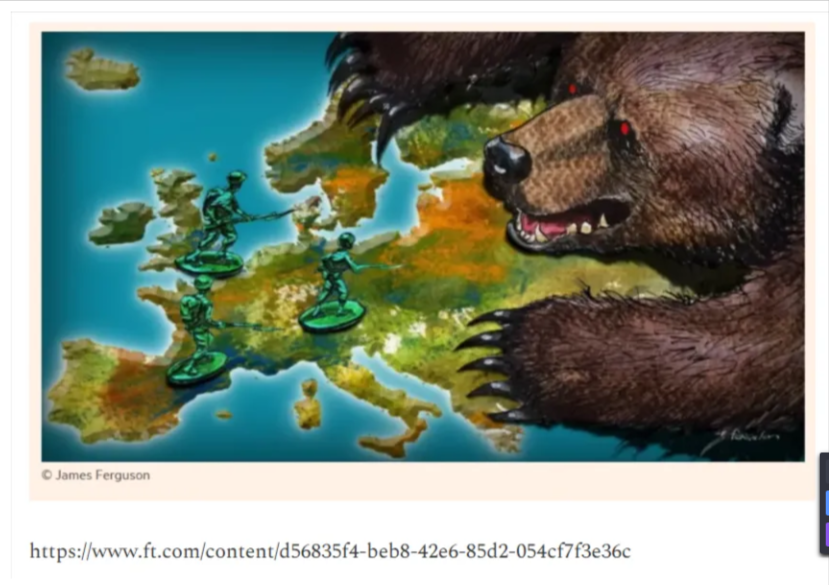
The rapacious Russian Bear is the nightmare of ‘Europe’ : the hallowed remaines of the ghost of Jean Monnet’s Coal and Steel Cartel, of The Cold War years. As that is by now the ricketry remains of a dream of ‘Europe’, incapable of its own realization, but hanging on a notion of its viability, via Technocratic chatter at high volume. From Newspapers like The Financial Times, and its cadre of Experts like Gideon Rachman. NATO is the linchpin that now holds together this unrealised fraturing Super State! Not to speak of a Cold War relic rehabilitated as need be!
Editor: Some telling quotataions from this NATO propaganda refracted through Gideon Rachman as its enuciator
…
Mark Rutte, Nato’s recently appointed secretary-general, warned last month that: “Russia’s economy is on a war footing . . . Danger is moving towards us at full speed.” He urged Nato to rapidly increase defence production and “shift to a wartime mindset”.
…
Last April, General Christopher Cavoli, Nato’s supreme commander in Europe, cautioned that: “Russia shows no sign of stopping. Nor does Russia intend to stop with Ukraine.” Western analysts argue that Russia is already engaged in a hybrid war with Europe — involving regular acts of sabotage that risk mass casualties.
…
Editor: ‘European defence analysts worry’. Rachman as Diagnostician:
Elbridge Colby, who has just been nominated as under secretary of defence for policy, wrote in the FT last year that China is a much higher priority for the US than Russia and argued that the “US must withhold forces from Europe that are needed for Asia, even in the event of Russia attacking first”.
European defence analysts worry that a US military pullback from Europe would encourage Russian aggression. In a recent book, Keir Giles of Chatham House argues: “The withdrawal of America’s military backing for Nato is the surest possible way of turning the possibility of Russia attacking beyond Ukraine into a probability.
Editor: Vladimir Putin acts as goad to a hapless Europe? Rachman sounds the alarm!
But the extent of the casualties Vladimir Putin is willing to absorb should also be a warning. The Russian army is now larger than it was at the beginning of the war in 2022. And, as Rutte recently pointed out, the country is producing “huge numbers of tanks, armoured vehicles and ammunition”.
European countries lack the manpower and equipment to engage in a war of attrition of the kind Russia is fighting in Ukraine. At the beginning of last year, the British army had 73,520 — the fewest since 1792. The German army has 64,000.
Editor: Mr. Rachman on Poland, Germany, France, Britains as to who is best able to confront the menace of Putin in Economic terms.
The closer you get to the Russian border, the more seriously the Russian threat is taken. Poland is on course to increase its defence spending to 4.7 per cent of GDP in 2025. But in the bigger western European economies, it’s a different story. Germany and France barely hit 2 per cent last year; Britain was at 2.3 per cent.
France has a budget deficit of 6 per cent of GDP and public debt of well over 100 per cent. The British government is also highly indebted and struggling to raise revenue.
But Germany — with a debt-to-GDP ratio of just over 60 per cent — has the fiscal space to spend a lot more on defence. It also still has a considerable industrial and engineering base.
Editor Mr. Rachman demonstrate a kind of surity , in sum he places his wager on Germany.
Friedrich Merz of the Christian Democrats, who will probably emerge as German chancellor after elections this year, takes the threat from Russia seriously. He could preside over a historic shift. If Germany relaxed its constitutional provisions against deficit financing — and accepted the need for common EU debt to finance European defence — it could transform the continent’s security landscape.
Even 80 years after the end of the second world war, some of Germany’s neighbours — particularly Poland and France — will feel queasy about German rearmament. But, in the interests of their own security, they need to get over it.
Editor: Mr. Rachman’s well oiled political machinery failes to factor in the rise of Alternative for Germany!
Membership of NATO corresponds to Germany‘s interests with regard to foreign and security policy, as long as NATO’s role remains that of a defensive alliance. We are in favour of a substantial strengthening of the European component of the North Atlantic Alliance. To achieve this objective, it is necessary to restore the military capabilities of the German Armed Forces, and to align these with strategic and operative requirements. The AfD thus calls for a restoration of Germany’s defensive capabilities, not only for the purpose of ensuring national defence as the main task of the German Armed Forces, but also to meet Alliance requirements, and perform crisis prevention measures. Membership of NATO corresponds to Germany‘s interests with regard to foreign and security policy, as long as NATO’s role remains that of a defensive alliance. The AfD believes that predictability in meeting commitments towards NATO allies is an important goal of German foreign and security policy, so that Germany can develop more political weight to shape policies, and gain influence. We advocate that any engagement of NATO must be aligned to German interests, and has to correspond to a clearly defined strategy. NATO has to be reformed, and the armed forces of the European partner states have to be restructured in such a way that they can ensure security in Europe and at its periphery. Wherever German Armed Forces, as part of NATO operations, are involved beyond the borders of its Alliance partners’ territory, shall, in principle, only be carried out under a UN mandate, and only if German security interests are taken into account. The Allies and Germany work together on equal terms and with mutual respect. They co-operate in questions of major international importance. Against this background, and 70 years after the end of World War II, and 25 years after the end of a divided Europe, the renegotiation of the status of Allied troops in Germany should be put up for discussion. The status of Allied troops needs to be adapted to Germany’s regained sovereignty. The AfD is committed to the withdrawal of all Allied troops stationed on German soil, and in particular of their nuclear weapons.
4.4.1 No European Army
The AfD rejects the idea of a combined European military force, and subscribes to well-equipped and trained German Armed Forces as the pillar of German sovereignty. This does not preclude the continuous co-operation of the German Armed Forces with its Allies. Germany needs military forces whose leadership, strength and equipment are adapted to the requirements of future conflicts, and which comply with the highest international standards. It needs troops which are trained according to the requirements of modern combat, as well as an administration which is oriented towards the welfare of the troops, combined with considerably reduced bureaucracy
Another indispensable factor is the existence of national defence capabilities, which are necessary to remain independent in key technologies, to keep pace with the latest developments in armaments technology, and to preserve jobs in the domestic defence industry. The military budget has to be increased to a level which is adequate for preserving the security and freedom of Germany and its Allies. The size and equipment of the armed forces need to be adapted to both the tasks at hand, and to foreign and security policy requirements. Furthermore, the intelligence services should be restructured and reformed. They are an important instrument in detecting threats at home and abroad. The AfD rejects the current practice of funding intelligence services according to budgetary constraints
During the week-long commemoration of the Charlie Hebdo attacks, free speech organisations around the world, spearheaded by the writers’ group Pen International, pointed out that the biggest threats to free speech came from governments “ostensibly motivated by security concerns”.
Pen’s statement on the issue drew critical attention to France’s new surveillance laws – which have elsewhere been condemned by human rights groups as being too intrusive and carrying no judiciary control.
And, while free speech is the foundation stone of a progressive, functioning democracy we can’t champion it in isolation, while losing sight of other key principles. The democracies whose politicians insist that we are all Charlie are the same ones chipping away at other freedoms. What of the suggestions of passport-stripping coming from both French and British governments – for dual-nationality terrorism convicts and those returning from fighting with ISIL, respectively? This might be one of the most anti-democratic things a state can do, flying in the face of the fundamental right to citizenship by birth.
It’s only when we get rid of what one writer has described as “discursive segregation” in the context of free speech and Charlie Hebdo, that we can start to fight for and uphold these invaluable collective rights, together. It’s the capacity to fight for two seemingly opposing things at the same time that we need to find – because, until we do, how will we ever find the operational common ground between them?
Rachel Shabi is a journalist and author of Not the Enemy: Israel’s Jews from Arab Lands.
The views expressed in this article are the author’s own and do not necessarily reflect Al Jazeera’s editorial policy.
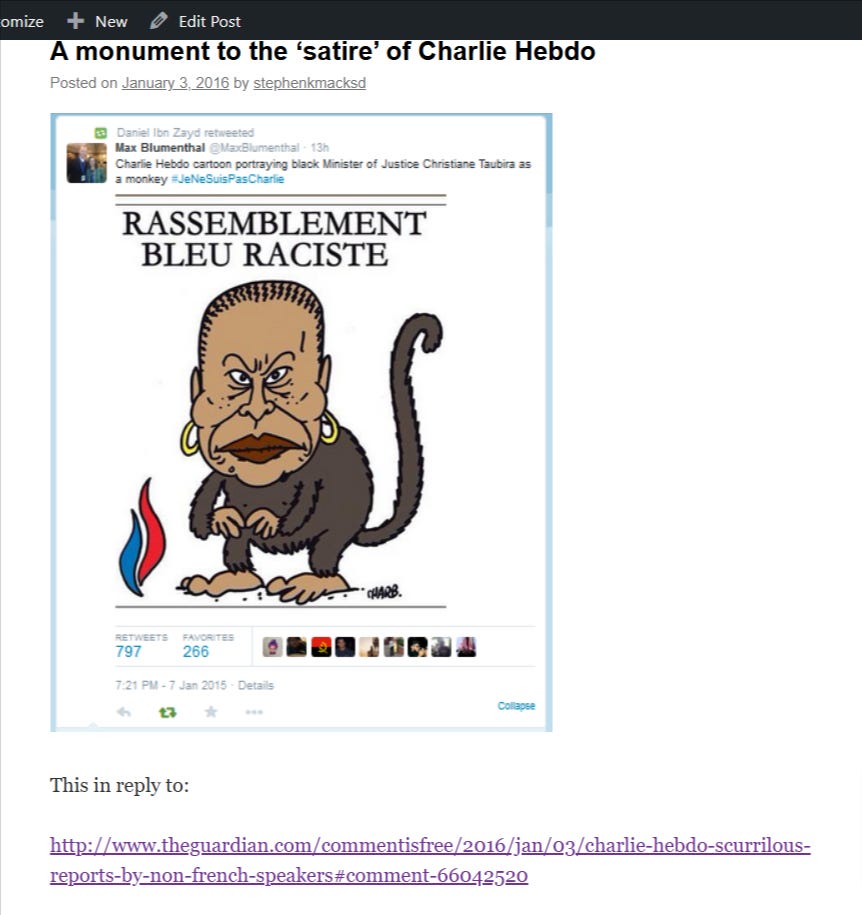
Editor: A quick reminder of what Charlie Hebdo’s Satire expressed! All now carefully scrubbed from the record!
Recall that Haidt used a riff on Bloom’s ‘The Closing of the American Mind’ to sell his ‘The Coddling of the American Mind’. Note his title as ‘A professor of ethical leadership at New York University’ call this being ‘ kicked uptairs’ equal toavaucious honerific. It should not surprise that he is a staunch New Democrat: He’s Hillary Clinton wet dream: maufaturing crisies on order, for the New Democrats/Republicals/Neo-Consertatives, to screech on command, about the various, and myraid threats to the Natural Political Order of a toxic Centrism. The first paragraph is riddled with unintentional comedy, name it vulgerised political kitsch, which I will highlight!
A professor of ethical leadership at New York University, Haidt made his name with The Righteous Mind, a 2012 book that explained the deep psychological impulses that lie behind our political choices. His 2018 book with Greg Lukianoff, The Coddling of the American Mind, drew a link between the rise of hyper-woke “snowflakes” on university campuses and the mental health crisis caused by safety-first childhoods that have been swamped by technology.
The Anxious Generation is in many ways a sequel. In it he traces the abyss into which our children have sunk since 2010. Last year, a report from NHS England found that one in five children and young people aged 8 to 25 had a “probable mental disorder”— where poor mental health has affected their daily lives — including problems with hyperactivity, concentration, emotions and behaviour.
Caroline Scott’s 2207 word essay/propganda featuring Haidt as would-be expert , on the vexing question of phones, and the possible/probable dangers to children, and other political actors, like parents. The question is where are the Parents of children who are, after all the guardians of their own children? Mr. Haidt is simply a self-promoting ‘expert’ with something to sell, his self-ascribed ‘expertise’ is about politics by other means!
Haidt rejects this criticism, saying he has collected “dozens of correlational and longitudinal studies” that “reveal a fairly consistent relationship in which heavy users of social media are at much higher risk of mental illness or poor mental health than everyone else”.
For many parents, the academic debate is just that: academic. They have the irrefutable evidence of their own eyes. Since my son started using an app called Opal, which limits his YouTube habit, his screen time has reduced from four hours a day to one and a half. He’s joined the debating society at university and a gym. And he’s definitely happier.
Editor:The Reader of Mr. Ganesh’s latest essay is a bit puzzled by his story telling methodology. The cast of characters keeps evolving, let me attempt to demonstarte the ‘how’ of it, as a kind of wayward political meander.
I once met a sweet old couple in west Texas who still felt sore at Jimmy Carter.
…
Bashing the 39th US president, who died on Sunday, was never just a conservative sport, though.
…
He was a recurring punchline in The Simpsons too.
…
On the other hand, without that anger, that historic snapping of public patience at the end of the 1970s, there wouldn’t have been the corresponding appetite for new ideas. No rage, no Reagan.
…
I am increasingly convinced of something that we might call the Carter Rule: rich democracies need a crisis in order to change. It is almost impossible to sell voters on drastic reforms until their nation is in acute trouble.
…
But the electorate wasn’t fed up enough at that stage to entertain a total rupture with the postwar Keynesian consensus. There had to be more pain.
…
Things had to get worse to get better.
…
Editor: Here Ganesh’s political story telling attempts to takes flight, in a report on the Neo-Liberal Capture of The West, that began with Mrs. Thatcher Hayekian Revolution, carefully laundered by Ganesh’s etolted chatter, about worse/better as a kind of convient story telling device.
But doesn’t this describe Emmanuel Macron in recent years? And look at his ordeal. If the president of France had tried to pass his controversial budget in response to a sovereign debt crunch, rather than to avoid one, it would have commanded more of a hearing. Had he raised the state pension age amid a crisis, not to stave one off, the protests would not have been so intense. There are no votes in preventive action. Few of us mean it when we urge governments to think long-term, to fix roofs while the sun is shining, and so on.
Editor: The uttery corrupt Macron then becomes the subject of Ganesh’s apologetic: he describes Macron’s ‘ordeal’, this The Financial Times! , but leaves his Anti-constitutional political methodology untouched, garnished via well worn platiudes.
Editor: The Will To Believe fully graps our would be Shahrazad.
Once you see the Carter Rule in one place, you start to see it everywhere.
…
It is now plain that Europe could have weaned itself off Russian energy long ago. But it took a war to force the issue.
…
(Including the sublime one of Manmohan Singh, the finance minister and later prime minister who died three days before Carter.)
…
The problem with this argument is that it is next of kin to a sort of strategic defeatism: an active desire for things to get worse, that they might improve.
…
Otherwise, Argentina would have put its economic house in order decades ago.
…
This is even truer of high-income countries, where enough voters have enough to lose that even small tweaks to the status quo are provocative.
…
And so to Britain. If any leader today should pore over Carter’s life and times, it is Sir Keir Starmer. The prime minister has useful ideas, as Carter did. As with the “malaise” speech, his bleakness about the state of things at least shows that he understands how much needs to change.
…
Like Carter, he is stuck in one of those pockets of history when the national stomach for change is growing, but not in time for his administration.
…
Those who think Starmer is too cautious might overrate the role of individual agency. It is the public that decides when it is ready to make difficult trade-offs.
…
In politics, as in marriage, there is a world of difference between dissatisfaction and breaking point.
…
Not long after, it lined up exquisitely with the public mood. The tragedy of Carter was one of timing, not talent.
…
Newspaper Reader offer a link to Michael K Smith’s
Having run as a Washington “outsider,” he immediately filled his administration with Trilateral Commission members, hoping that a coterie of Rockefeller internationalists could resurrect the confidence of American leaders and enrich business relations between Japan and the United States.
His Secretary of State was Cyrus Vance, a Wall Street lawyer and former planner of the Vietnam slaughter. Secretary of Defense Harold Brown was Lyndon Johnson’s Air Force Secretary and a leading proponent of saturation bombing in Vietnam. Secretary of the Treasury Michael Blumenthal was the standard rich corporation president. Attorney General Griffen Bell was a segregationist judge who disclosed that he would request “inactive” status as a member of Atlanta clubs closed to blacks and Jews [Carter himself stated that housing should be segregated]. Energy coordinator James Schlesinger was a proponent of winnable nuclear war. Transportation Secretary Brock Adams was a staunch proponent of Lockheed’s supersonic transport. National security adviser Zbigniew Brzezinski was an anti-Soviet fanatic who said in an interview with the New Yorker that it was “egocentric” to worry that a nuclear war between the U.S. and U.S.S.R. would entail “the end of the human race.” Since it was unlikely that every last human being would perish in such event, Brzezinski recommended that critics of U.S. nuclear policy abstain from narcissistic concern for the mere hundreds of millions of people who would.
…
Headline: Things have to get worse to get better
Sub-headline : Voters can’t be sold on change until their nation is in acute trouble
Editor:The Reader of Mr. Ganesh’s latest essay is a bit puzzled by his story telling methodology. The cast of characters keeps evolving, let me attempt to demonstarte the ‘how’ of it, as a kind of wayward political meander.
I once met a sweet old couple in west Texas who still felt sore at Jimmy Carter.
…
Bashing the 39th US president, who died on Sunday, was never just a conservative sport, though.
…
He was a recurring punchline in The Simpsons too.
…
On the other hand, without that anger, that historic snapping of public patience at the end of the 1970s, there wouldn’t have been the corresponding appetite for new ideas. No rage, no Reagan.
…
I am increasingly convinced of something that we might call the Carter Rule: rich democracies need a crisis in order to change. It is almost impossible to sell voters on drastic reforms until their nation is in acute trouble.
…
But the electorate wasn’t fed up enough at that stage to entertain a total rupture with the postwar Keynesian consensus. There had to be more pain.
…
Things had to get worse to get better.
…
Editor: Here Ganesh’s political story telling attempts to takes flight, in a report on the Neo-Liberal Capture of The West, that began with Mrs. Thatcher Hayekian Revolution, carefully laundered by Ganesh’s etolted chatter, about worse/better as a kind of convient story telling device.
But doesn’t this describe Emmanuel Macron in recent years? And look at his ordeal. If the president of France had tried to pass his controversial budget in response to a sovereign debt crunch, rather than to avoid one, it would have commanded more of a hearing. Had he raised the state pension age amid a crisis, not to stave one off, the protests would not have been so intense. There are no votes in preventive action. Few of us mean it when we urge governments to think long-term, to fix roofs while the sun is shining, and so on.
Editor: The uttery corrupt Macron then becomes the subject of Ganesh’s apologetic: he describes Macron’s ‘ordeal’, this The Financial Times! , but leaves his Anti-constitutional political methodology untouched, garnished via well worn platiudes.
Editor: The Will To Believe fully graps our would be Shahrazad.
Once you see the Carter Rule in one place, you start to see it everywhere.
…
It is now plain that Europe could have weaned itself off Russian energy long ago. But it took a war to force the issue.
…
(Including the sublime one of Manmohan Singh, the finance minister and later prime minister who died three days before Carter.)
…
The problem with this argument is that it is next of kin to a sort of strategic defeatism: an active desire for things to get worse, that they might improve.
…
Otherwise, Argentina would have put its economic house in order decades ago.
…
This is even truer of high-income countries, where enough voters have enough to lose that even small tweaks to the status quo are provocative.
…
And so to Britain. If any leader today should pore over Carter’s life and times, it is Sir Keir Starmer. The prime minister has useful ideas, as Carter did. As with the “malaise” speech, his bleakness about the state of things at least shows that he understands how much needs to change.
…
Like Carter, he is stuck in one of those pockets of history when the national stomach for change is growing, but not in time for his administration.
…
Those who think Starmer is too cautious might overrate the role of individual agency. It is the public that decides when it is ready to make difficult trade-offs.
…
In politics, as in marriage, there is a world of difference between dissatisfaction and breaking point.
…
Not long after, it lined up exquisitely with the public mood. The tragedy of Carter was one of timing, not talent.
…
Newspaper Reader offer a link to Michael K Smith’s
Having run as a Washington “outsider,” he immediately filled his administration with Trilateral Commission members, hoping that a coterie of Rockefeller internationalists could resurrect the confidence of American leaders and enrich business relations between Japan and the United States.
His Secretary of State was Cyrus Vance, a Wall Street lawyer and former planner of the Vietnam slaughter. Secretary of Defense Harold Brown was Lyndon Johnson’s Air Force Secretary and a leading proponent of saturation bombing in Vietnam. Secretary of the Treasury Michael Blumenthal was the standard rich corporation president. Attorney General Griffen Bell was a segregationist judge who disclosed that he would request “inactive” status as a member of Atlanta clubs closed to blacks and Jews [Carter himself stated that housing should be segregated]. Energy coordinator James Schlesinger was a proponent of winnable nuclear war. Transportation Secretary Brock Adams was a staunch proponent of Lockheed’s supersonic transport. National security adviser Zbigniew Brzezinski was an anti-Soviet fanatic who said in an interview with the New Yorker that it was “egocentric” to worry that a nuclear war between the U.S. and U.S.S.R. would entail “the end of the human race.” Since it was unlikely that every last human being would perish in such event, Brzezinski recommended that critics of U.S. nuclear policy abstain from narcissistic concern for the mere hundreds of millions of people who would.
Editor : Mitch McConnell is a Historian of Note, a small selection from his History Made To Measure:
When he begins his second term as president, Donald Trump will inherit a world far more hostile to U.S. interests than the one he left behind four years ago. China has intensified its efforts to expand its military, political, and economic influence worldwide. Russia is fighting a brutal and unjustified war in Ukraine. Iran remains undeterred in its campaign to destroy Israel, dominate the Middle East, and develop a nuclear weapons capability. And these three U.S. adversaries, along with North Korea, are now working together more closely than ever to undermine the U.S.-led order that has underpinned Western peace and prosperity for nearly a century.
The Biden administration sought to manage these threats through engagement and accommodation. But today’s revanchist powers do not seek deeper integration with the existing international order; they reject its very basis. They draw strength from American weakness, and their appetite for hegemony has only grown with the eating.
Many in Washington acknowledge the threat but use it to justify existing domestic policy priorities that have little to do with the systemic competition underway. They pay lip service to the reality of great-power competition but shirk from investing in the hard power on which such competition is actually based. The costs of these mistaken assumptions have become evident. But the response to four years of weakness must not be four years of isolation.
Even though the competition with China and Russia is a global challenge, Trump will no doubt hear from some that he should prioritize a single theater and downgrade U.S. interests and commitments elsewhere. Most of these voices will argue for focusing on Asia at the expense of interests in Europe or the Middle East. Such thinking is commonplace among both isolationist conservatives who indulge the fantasy of “Fortress America” and progressive liberals who mistake internationalism for an end in itself. The right has retrenched in the face of Russian aggression in Europe, while the left has demonstrated a chronic allergy to deterring Iran and supporting Israel. Neither camp has committed to maintaining the military superiority or sustaining the alliances needed to contest revisionist powers. If the United States continues to retreat, its enemies will be only too happy to fill the void.
…
In January 1934, William Borah, a Republican senator from Idaho and an outspoken isolationist, addressed a meeting of the Council on Foreign Relations in New York. Because peace had prevailed for 15 years following the end of World War I, Borah argued, global military spending was excessive. Tensions between European powers, he insisted, could not be solved by outsiders: “It will be a long time, I venture to believe, before there will be any necessity or any justification for the United States engaging in a foreign war.”
Of course, by the end of the 1930s, the Nazi conquest of Europe had driven a dramatic swing in U.S. public opinion away from Borah’s isolationist daydream. By May 1940, as German forces invaded France, 94 percent of Americans supported any and all necessary investments in national defense. By June, more than 70 percent favored the draft.
The United States saw the light during World War II. But must it take another conquest of a close ally before the country turns its belated attention to the requirements of national defense? Isolation is no better a strategy today than it was on the eve of World War II. Today, in fact, in the face of linked threats even more potent than the Axis powers, a failure to uphold U.S. primacy would be even more catastrophically absurd than was the refusal to assume that responsibility 85 years ago. The last time around, the naive abdication of the requirements of national defense made reviving the arsenal of democracy on a short timeline unnecessarily difficult. As Admiral Harold Stark, then the chief of naval operations, observed in 1940, “Dollars cannot buy yesterday.”
…
Editor : Senator Mitch McConnell does not sound the notes of a Walter Lippmann nor a George Kennan, but of the long forgotten voice of Joseph Alsop!
Political Observer can’t get enough of the careless packaging of ‘News’, in its de-evolution into National Security State Propganda & the triumph of John H. Kellogg’s Breakfast Cereal ?





 StephenKMackSD's Blog