In the years since Zbigniew Brzezinski published his first book, The Permanent Purge, nearly six decades ago, he has been in turn a prominent scholar of the Cold War, one of the leading foreign policy public intellectuals in the United States, National Security Adviser to President Jimmy Carter, and, increasingly after the turn of the century, a critic of U.S. foreign policy. Still an active presence and a strong voice in international affairs, he published his latest book, Strategic Vision: America and the Crisis of Global Power, in 2012 and continues to scrutinize U.S. engagement around the globe with a keen, skeptical eye. Brzezinski has never been afraid to speak his mind and remains for some a controversial figure.
Charles Gati has produced a valuable, informative book that examines the many facets of Brzezinski’s life and works and seeks to place the man, his era, and his writings within the broader context of the United States, along with its adversaries and partners, adapting to a changing world. The book is also a classic immigrant success story. Part personal reminiscences and part academic analysis, the volume features chapters by scholars, former officials, journalists, former students, and—at the end—a section in which Gati interviews Brzezinski about his life. This is not a conventional Festschrift, and it contains some chapters that are critical of Brzezinski’s writings and policies. But it succeeds in highlighting the unique contributions made by this scholar/practitioner.
Like his fellow Central European immigrant Henry Kissinger (with whom, the book argues, he has enjoyed a collegial, not an antagonistic, relationship over many decades), Brzezinski was able with perseverance and strong willpower to rise up in the traditional foreign policy establishment, constantly contending with suspicions that his Polish background made it impossible for him to view the Soviet Union objectively. Indeed, when Jimmy Carter appointed Brzezinski, former Defense Secretary Robert Lovett opined: “We shouldn’t have a National Security Adviser like that who’s not really an American. I can’t imagine anyone negotiating with the Russians with his loathing and suspicion” (p. 17).
Brzezinski’s record as an analyst of the Soviet system and its strengths and weaknesses has largely been vindicated by history, even though some of his ideas were contested at the time. His early writings focused on the theory of totalitarianism, which he modified to explain the post-Stalinist evolution. He understood the weaknesses of the command economy and the rigid party organization and its obsession with control, eventually predicting in his book The Grand Failure that the system had inherent weaknesses that would facilitate its collapse. Mark Kramer reminds us that Brzezinski’s analysis of Soviet-style regimes remains a “rich, provocative, stimulating source” (p. 58).
Brzezinski’s works were roundly denounced—and avidly read—in the USSR, as was clear during a unique U.S.-Soviet conference on Eastern Europe, organized by Charles Gati and Oleg Bogomolov, that took place under the auspices of the International Research and Exchange Council in the turbulent fall of 1989. I was part of the delegation with Gati and Brzezinski, who was making his first visit ever to the Soviet Union. Also in the delegation was Marin Strmecki, who vividly recounts the scene in his chapter here. Lecturing to a hushed, standing-room-only crowd at the venerable Soviet Diplomatic Academy, Brzezinski told his audience that the USSR must recognize that its East European allies had the right to self-determination, and he praised Mikhail Gorbachev’s liberalizing actions to date but said they had to go further. At the end of his speech, the auditorium erupted in thunderous applause. He went on from there to visit Katyń, the place that symbolized the massacres of Polish officers by Soviet troops at the beginning of World War II. The USSR had only just begun to admit the truth about Katyń, and he held a groundbreaking televised meeting with Soviet and Polish officials. The critic of Communism had become a player in the system’s demise.
Brzezinski’s years in the White House coincided with some of the most dramatic moments in U.S. foreign policy—the normalization of relations with China, the signing of the second Strategic Arms Limitation Treaty, the Arab-Israeli Camp David peace accords, the Iran hostage crisis, the Soviet invasion of Afghanistan, and the signing of the Panama Canal Treaty. The book argues that more was achieved in these years than in many other administrations; it also discusses the rivalry between Brzezinski and Secretary of State Cyrus Vance for the president’s ear and for control of the agenda.
The legacy of Brzezinski’s White House years remains controversial. He was the author of the policy of arming the Mujahideen in Afghanistan to fight the Soviet occupation. Although this policy undoubtedly helped accelerate the Soviet Union’s collapse, the Mujahideen were the forbearers of the Taliban and ultimately of al Qaida. Brzezinski says he has no regrets about his support of the Mujahideen. Others might disagree.
In the 21st century, Brzezinski became a harsh critic of the invasion of Iraq and many other aspects of the foreign policy of the George W. Bush administration. He also believes that the decision to stay in Afghanistan and try to modernize it was a mistake—as Soviet leaders had found out in the 1980s at great cost. Brzezinski has also been increasingly outspoken in his criticism of Israel’s policies in recent years, although he tells Gati that the only foreign country in which he feels at home—apart from Poland—is Israel. He argues for a long-term view of Russia’s evolution beyond the shadow of Putin and continues to believe that the younger generation will eventually change Russia for the better. (The Levada Center’s periodic surveys of Russian young people raise questions about this optimistic notion.)
Brzezinski’s rise and continuing influence are a testimony to the unrivaled opportunities the United States offers its immigrants, especially those with his talents, intellectual strengths, and drive. As Brzezinski himself points out at the end of the book, America is the only country in which someone called “Zbigniew Brzezinski” can make a name for himself without changing his name.
Book title: Zbig By Edward Luce. Avid Reader Press; 560 pages; $35. Bloomsbury; £30
Editor: These paragraphs attempt to inflate the political reputation of Brzezinski, as the ghost like apparition as Kissinger fades from popular memory! This sentence offer clues to what Luce’s politcs are about:
…
Editor: Please note my placing some sentences in italics for emphasis!
Brzezinski further tightened the screws by picking up where Kissinger had left off, persuading Carter to normalise relations with China. The Soviet leadership’s feeling of isolation seemed to curb their behaviour. And after Russians invaded Afghanistan in 1979, he financed the mujahideen insurgency which, over the next decade, weakened the Kremlin.
As the sun went down on the Soviet Union, Brzezinski’s reward was to be treated in Poland as a national hero. More surprising was a visit to Moscow in 1989. Addressing the foreign service’s Diplomatic Academy, Brzezinski was his usual uncompromising self, laying out the need for a market economy, democracy and a loose federation of republics. When he finished he was met with raucous applause. To the Americans in the room, that moment marked the cold war’s end.
The question of why Brzezinski’s accomplishments are not more recognised has many answers. Kissinger was deceitful and charming; Brzezinski honest and too often rude. One was a brilliant self-publicist; the other had no time for Washington games. Nobody ever doubted who commanded Kissinger’s loyalty: himself. Brzezinski was thought by the WASP establishment to be putting Poland first. Whenever Carter was critical of Israel—and tensions were high in the lead-up to the Camp David Accords between Egypt and Israel in 1978—Brzezinski was accused of antisemitism, a charge this book refutes.
But the main reason is that Carter’s presidency was overshadowed by the mishandling of the Iranian revolution in 1979 and the hostage-taking that blighted his last year in office. Mr Luce argues that, in the run up to the revolution, Brzezinski’s advice was ignored. That does not quite wash: on other matters he was usually able to bulldoze the State Department aside. The Iranians delayed the release of the hostages until five minutes after Ronald Reagan took office. This ensured Reagan got the credit—just as he did for the collapse of the Soviet Union.
Neither Brzezinski nor Kissinger ever served in government again, but both retained a taste for power. During the presidential campaign, Kissinger had sought to ingratiate himself with Reagan by blaming the mess in Iran on Carter’s preference for human rights. When he heard of Kissinger’s muck-spreading, Brzezinski’s mordant retort was typical: “I conclude that, although power corrupts, the absence of power corrupts absolutely.”
Zbigniew Brzezinski’s The Choice is superficially an election-year foreign policy tour d’horizon, more sophisticated in analysis and recommendations, and certainly more statesmanlike in temper, than current writings by the Bush administration’s supporters. It is a nuanced expression of the conventional wisdom among American foreign policy experts, and a condemnation of the self-defeating arrogance of the Bush administration’s conduct during the past two and a half years.
“‘Globalization’ in its essence means global interdependence,” Brzezinski writes. Therefore the American choice today is between attempting to create “a new global system based on shared interests,” or attempting to “use its sovereign global power primarily to entrench its own security.” The latter risks ending in “self-isolation, growing national paranoia, and increasing vulnerability to a globally spreading anti-American virus.” There would even be a risk of the United States becoming a garrison state.
One might think there are other, wider possibilities for a United States uneasily enjoying its “unilateral moment” (as the neoconservatives put it), while seeing itself as “the indispensable nation…standing taller because it sees further” (as the last Democratic secretary of state said). However, Brzezinski implicitly rejects the notion that the United States might be better off if it modified its notion of national mission and concomitant aggrandizement of national power in acknowledgment of the good sense in George Kennan’s counsel (in this journal over four years ago) that for Americans “to see ourselves as the center of political enlightenment and as teachers to a great part of the rest of the world [is] unthought-through, vainglorious, and undesirable.” Kennan added that “this planet is never going to be ruled from any single political center, whatever its military power.”
Brzezinski’s book therefore needs to be considered at two levels. The first is within the political assumptions in which it has been written, undoubtedly shared by most American foreign policy analysts and political figures today. The second would take account of the skeptical perspective articulated by Kennan and question the assumptions widely held among American officials and experts concerning the desirability or happy inevitability, and benevolent consequences, of American global hegemony.
…
This developed against a background of anxiety about the growing hostility of the Islamic states toward the US, coincident with Samuel Huntington’s argument that a war between civilizations was on its way. The attacks of September 2001 brought uncertainty to an end. The Bush administration launched its “War on Terror,” which despite President Bush’s explicit denial that Islam was at fault, was widely and emotionally seen as resembling a war between civilizations, with Islamic militants taken as representative of much of Islam and the United States as champion of the West (uneasily followed by its traditional allies).
…
Brzezinski deplores the administration’s determination to disconnect the war it had declared from its political and historical sources. He writes that The US inclination, in the spring of 2002, to embrace even the more extreme forms of Israeli suppression of the Palestinians as part of the struggle against terrorism is a case in point. The unwillingness to recognize a historical connection between the rise of anti-American terrorism and America’s involvement in the Middle East makes the formulation of an effective strategic response to terrorism that much more difficult.
Thus, he writes, an initial surge of solidarity with the United States that found expression in Europe and elsewhere just after the attacks waned as the Bush administration revealed its view of the struggle and of the appropriate response:
Culminating in the “axis of evil” formulation, the American perspective on terrorism increasingly came to be viewed as divorced from terrorism’s political context. The nearly unanimous global support for America gave way to increasing skepticism regarding the official US formulations of the shared threat.
Combined with the administration’s treatment of its supposed allies and its attacks on the United Nations and other international institutions, this skepticism was responsible for the international isolation in which the United States found itself by the time it decided to invade Iraq.
…
Editor: the final paragraphs of William Pfaff essay are instructive of Brzezinski’s Foreign Policy.
The ultimate criticism to be made of the position Brzezinski shares with many other foreign policy experts is that it ignores or denies the importance of what historically has been the principal force in international relations—the competitive assertion of national interests, founded on divergent values and ambitions among nations, assuredly including democratic ones.
His argument presumes that such differences will find resolution in some version of an end of history, achieved through convergence with the United States. Brzezinski and those who share his views would seem to believe in what has been called the Whig interpretation of history: that history’s purpose has been to lead up to us. The pursuit of national interest by other states produces the “global chaos” against which he warns. Condoleezza Rice made the identical argument, as in a speech last year to the International Institute for Strategic Studies in London, saying that policies based on balance of power are the road to war.
This position rejects both the classical Western view of history, which is not progressive, and the realist school of political philosophy dominant in past Western political thought, which traditionally has taken a disabused view of human nature and political possibility. The progressive view is a manifestation of hope, or of faith. It amounts to an ideology, teleological in nature. It denies the proposition that hegemony produces hubris, inviting the attention of Nemesis, ending in destitution.
The notion that the United States has an exemplary national mission has always been central to American political thought and rhetoric. In Woodrow Wilson’s view (and that of many in the US today) this mission was divine in origin. Wilson (a president respected by today’s notably secular neoconservatives) held that the hand of God “has led us in this way,” and that we are the mortal instruments of His will—a view that has repeatedly found an echo in the discourse of George W. Bush. This sense of mission lies behind the American claim to an exceptional role in international society.
Brzezinski argues that the practical consequence today of America’s global security role and its extraordinary global ubiquity [is to give the United States] the right to seek more security than other countries. It needs forces with a decisive worldwide deployment capability. It must enhance its intelligence (rather than waste resources on a huge homeland security bureaucracy) so that threats to America can be forestalled. It must maintain a comprehensive technological edge over all potential rivals…. But it should also define its security in ways that help mobilize the self-interest of others. That comprehensive task can be pursued more effectively if the world understands that the trajectory of America’s grand strategy is toward a global community of shared interest.
This belief that the United States has a unique historical mission—whether or not divinely commissioned—is not open to logical refutation. But an American policy that rests on a self-indulgent fiction must be expected to come to a bad end.
Every country has a “story” it tells itself about its place in the contemporary world. We are familiar enough with the American story, beginning with the City on a Hill and progressing through Manifest Destiny toward Woodrow Wilson’s conviction we are “to show the way to the nations of the world how they shall walk in the paths of liberty…. It was of this that we dreamed at our birth.” The current version of the story says that this exalted destiny is fatefully challenged by rogue nations with nuclear weapons, failed states, and the menace of Islamic extremists. Something close to Huntington’s war of civilizations has begun. National mobilization has already taken place. Years of struggle lie ahead.
The “isolation” of the United States today is caused by the fact that its claims about the threat of terrorism seem to others grossly exaggerated, and its reaction, as Brzezinski himself argues, dangerously disproportionate. Most advanced societies have already had, or have, their wars with “terrorism”: the British with the IRA, the Spanish with the Basque separatist ETA, the Germans, Italians, and Japanese with their Red Brigades, the French with Palestinian and Algerian terrorists, Greeks, Latin Americans, and Asians with their own varieties of extremists.
America’s principal allies no longer believe its national “story.” They have tried to believe in it, and have been courteous about it even while skepticism grew. They are alarmed about what has happened to the United States under the Bush administration, and see no good coming from it. They are struck by how impervious Americans seem to be to the notion that our September 11 was not the defining event of the age, after which “nothing could be the same.” They are inclined to think that the international condition, like the human condition, is in fact very much the same as it has always been. It is the United States that has changed. They are disturbed that American leaders seem unable to understand this.
When American officials and policy experts come to Europe saying that “everything has changed,” warning that allied governments must “do something” about the anti-Americanism displayed last year in connection with the Iraq invasion, the Western European reaction is often to marvel at the Americans’ inability to appreciate that the source of the problem lies in how the United States has conducted itself since September 2001. They find this changed United States rather menacing. An Irish international banker recently observed to me that when Europeans suggest to visiting Americans that things have changed in Europe too, as a direct result of America’s policies, “it’s as if the Americans can’t hear.” A French writer has put it this way: it has been like discovering that a respected, even beloved, uncle has slipped into schizophrenia. When you visit him, his words no longer connect with the reality around him. It seems futile to talk about it with him. The family, embarrassed, is even reluctant to talk about it among themselves.
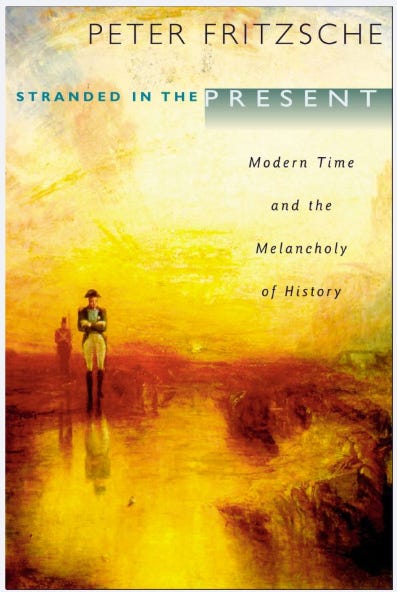
In this inventive book, Peter Fritzsche explores how Europeans and Americans saw themselves in the drama of history, how they took possession of a past thought to be slipping away, and how they generated countless stories about the sorrowful, eventful paths they chose to follow.
In the aftermath of the French Revolution, contemporaries saw themselves as occupants of an utterly new period. Increasingly disconnected from an irretrievable past, worried about an unknown and dangerous future, they described themselves as indisputably modern. To be cast in the new time of the nineteenth century was to recognize the weird shapes of historical change, to see landscapes scattered with ruins, and to mourn the remains of a bygone era.
Tracing the scars of history, writers and painters, revolutionaries and exiles, soldiers and widows, and ordinary home dwellers took a passionate, even flamboyant, interest in the past. They argued politics, wrote diaries, devoured memoirs, and collected antiques, all the time charting their private paths against the tremors of public life. These nostalgic histories take place on battlefields trampled by Napoleon, along bucolic English hedges, against the fairytale silhouettes of the Grimms’ beloved Germany, and in the newly constructed parlors of America’s western territories.
This eloquent book takes a surprising, completely original look at the modern age: our possessions, our heritage, and our newly considered selves.
Praise
Peter Fritzsche’s prose is both elegant and arresting, his insights always interesting. Stranded in the Present will attract a wide audience not only of experts but of general readers interested in how modern culture constructs its own past.—James Sheehan, Stanford University
An elegantly written book on an important and long neglected topic. Peter Fritzsche weaves a fascinating tale of how we came to our sense of modern time and the consequences of it. I expect this book to become a standard point of reference for the argument that the notion of modern time had an abrupt ‘beginning’ in the French revolutionary and especially Napoleonic wars. These upheavals created a kind of nostalgia about the past, that is, for what was lost in the transition to the modern. Thus melancholy and the conviction that our times are distinctly modern go hand in hand. Stranded in the Present provides an accessible, thoughtful, and even beautiful example of how to think about the category of time. It will be much discussed in many different circles.—Lynn Hunt, University of California, Los Angeles
In an evocatively titled work, Fritzsche conveys the disruption of time-honored social customs and intellectual assumptions in Prussia, France, Britain, and the United States caused by the French Revolution. More profound and ideological than its predecessor in the American Colonies, the French Revolution was similar to World War I in the proportion of civilian and military casualties, the collapse of old political systems, the new visibility given to the military in cultural life, and the anomie induced among writers and common folk alike. Drawing upon letters, journals, and resurgent fairy tales by the likes of the Brothers Grimm, Fritzsche reveals how many people recognized their contemporaries as fellow ‘time comrades,’ affected by a new concept of history that was no longer circular but linear.—Frederick J. Augustyn, Library Journal
Fritzsche argues forcefully and convincingly for the revolutionary mindsets that accompanied the events of the [French] Revolution and its seemingly endless aftershocks. The creation of a new sensibility about the place of the individual in the drama of history provides the impetus for Fritzsche’s work, which traces the dislocations experienced by individuals living through these literally unsettling times…A rich cultural history that draws upon an impressive array of sources to create a tapestry of this new historical awareness…The work is written quite well, making it accessible to a wide readership beyond specialists in modern history. Its style is evocative, eloquent, at times poetic. The author effectively captures the richness of the period under investigation, roughly 1780-1850. We meet some lesser-known figures in the history of Western Europe and the United States, as well as some more familiar names whose stories are told in intriguing ways. Fritzsche’s readings of primary sources are sound, at times quite illuminating, and his mastery of secondary literature on a wide variety of topics stands out, revealing the challenge and reward of writing this type of cultural history. In a word, Stranded in the Present is an enjoyable and informative work whose relatively short length disguises its richness and depth.—Matthew E. Brown, H-Net Reviews
Fritzsche’s book surveys the culture of everyday, postrevolutionary life, turning up a surprising range of provocative details about the melancholy that the rupture of the French Revolution effected, creating the sense of the past as lost. Drawing mainly from letters, memoirs, biographies, journals, fiction, and poetry, rather than “official documents” of the period, Fritzsche’s study brings us closer to the intimate effects of large-scale historical change, above all to the self-conscious “historicization of private life.”…What is most exciting about the study, however, is cumulative: The way in which Fritzsche imagines an alternative to the choice between rupture and continuity in the sense of history. The sense of rupture, Fritzsche’s study helps us to see, was the necessary predecessor to self-conscious engagement with the past, and the only creative means forward.—Emily Rohrbach, Studies in Romanticism
Stranded in the Present offers an insightful treatment of the modern period and the changing concept of historical time.—Bette W. Oliver, Libraries and Culture
[An] inspiring book…A brilliant study on the history of the making of remembrance and of our feelings toward the past.—Hasso Spode, Journal of Social History
Peter Fritzsche has given us a bold and ambitious book which will confirm his status as one of the leading intellectual and cultural historians of modern Europe…Fritzsche marshals a fascinating array of evidence, ranging from well-known products of the Romantic period like the writings of Francois-Rene Chateaubriand, William Cobbett, the Grimm Brothers, and Sir Walter Scott to those of more obscure but no less interesting personalities, such as the German art collector Sulpiz Boisserée and Friedrich Schlegel’s wife Dorothea, whose correspondence Fritzsche mines to good effect…Who, after finishing Fritzsche’s book, will be able to think about the early nineteenth century as other than lost, fragmented, ruptured, shipwrecked, dispossessed, melancholic, broken, nostalgic.—Robert Wohl, Modernism/modernity
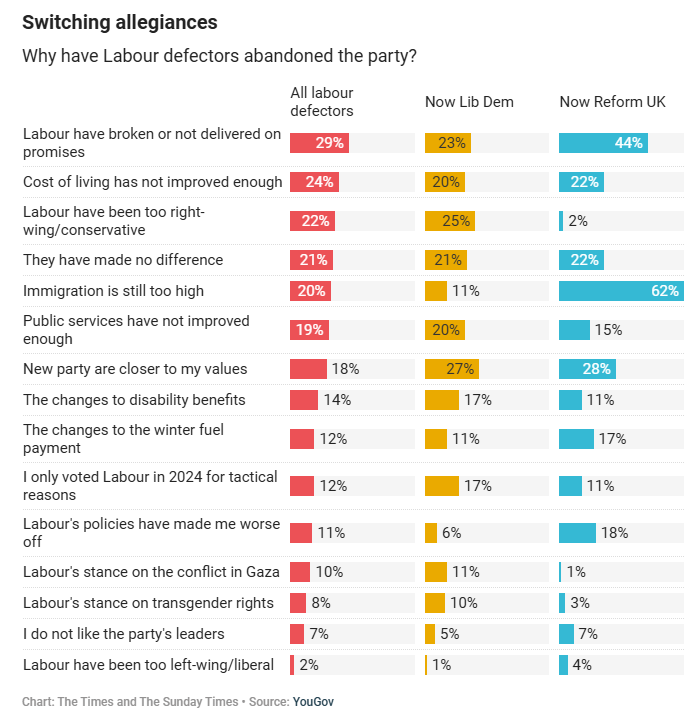
Sir Keir Starmer’s popularity has slumped to its lowest level on record with the fall most acute among Labour voters, according to YouGov research that will stoke concerns in Downing Street.
The proportion of Labour voters with a favourable view of the UK prime minister has plunged from 62 per cent to 45 per cent in just one month, the polling company found. It is the first time that Starmer has recorded a net negative approval rating among Labour supporters.
Some Labour MPs fear that Starmer’s shift to the right on several policy issues, in an attempt to neutralise the threat from Reform UK, has alienated many of the party’s natural supporters.
The Labour government has announced deep cuts to the international aid budget, set out tough reforms to the welfare system and this week announced new restrictions on immigration.
A speech by Starmer on Monday was criticised by some Labour MPs who suggested his reference to Britain’s risk of becoming an “island of strangers” accidentally echoed language used by Enoch Powell in his controversial 1968 “rivers of blood” address.
More than 100 Labour MPs have signed a private letter to their chief whip calling for tweaks to the welfare reforms, in a sign of jitters inside the Parliamentary Labour party.
…
Across all voters surveyed by YouGov in May, just 23 per cent of Britons expressed a favourable view of Starmer, marking a five-point drop from the same time in April.
That takes his popularity back to its previous nadir of July 2021 when he was opposition leader and the then Tory prime minister Boris Johnson was enjoying a “vaccine bounce” during the Covid-19 pandemic.
With the proportion of people with an unfavourable opinion of Starmer rising from 62 per cent in April to 69 per cent today, Starmer’s net favourability rating has sunk to -46, the lowest ever recorded by YouGov.
The same polling showed that the public view of Farage has ticked up from 27 per cent to 32 per cent in a month, even if 59 per cent of voters still do not like him, reflecting a net favourability rating of -27.
Farage is slightly more popular among Tory voters than the party’s leader Kemi Badenoch, YouGov suggests. Overall 16 per cent of the public have a favourable opinion of her, while 55 per cent hold an unfavourable view, giving a net score of -39.
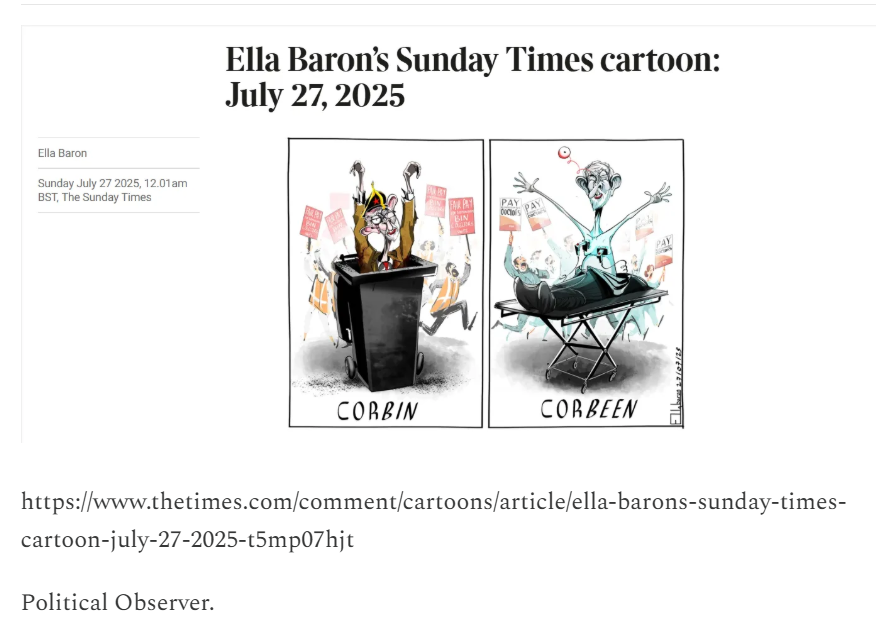
Editor: The Reader just has to wonder at the Times attack on Corbyn, as Starmers numbers appear to be sinking, as reported in the The Financial Times of May 16 2025 !
Wednesday July 23 2025,
Headline: Keir Starmer approval rating: tracking the PM’s popularity
Sub-headline: One year into office, the Labour prime minister has seen his approval ratings collapse. Follow the latest opinion polls with our live tracker
The final paragraphs of Ketanji Brown Jackson dissent, offer much more than the political chatter, of the would be Guardians of bourgeois political respectability, in the organs of political conformity, passing as arbiters of what is and and is not valuable, and respectable in the life in of that Long Dead Republic!
…
TRUMP v. UNITED STATES JACKSON, J., dissenting
…
All of this leads me to ponder why, exactly, has the majority concluded that an indeterminate “core”-versus-“official”-versus-“unofficial” line-drawing exercise is the better way to address potential criminal acts of a President? Could it be that the majority believes the obviously grave dangers of shifting from the individual accountability model to the Presidential accountability model might nevertheless be offset by the great benefits of doing so? Cf. J. Bentham, A Fragment on Government and an Introduction to the Principles of Morals and Legislation 3 (W. Harrison ed. 1948) (arguing that acts can be justified by the maxim that “it is the greatest happiness of the greatest number that is the measure of right and wrong” (emphasis deleted)).
Some of the majority’s analysis suggests as much. As far as I can tell, the majority is mostly concerned that, without immunity, Presidents might “be chilled from taking the ‘bold and unhesitating action’ required of an independent Executive.” Ante, at 13. The Court’s opinion candidly laments that application of the law to Presidents might not be evenhanded, and that, as a result, Presidents might be less “‘vigorous’ and ‘energetic’” as executive officers. Ante, at 10; accord, ante, at 39. But that concern ignores (or rejects) the foundational principles upon which the traditional individual accountability paradigm is based. Worse still, promoting more vigor from Presidents in exercising their official duties—and, presumably, less deliberation— invites breathtaking risks in terms of harm to the American people that, in my view, far outweigh the benefits.
This is not to say that the majority is wrong when it perceives that it can be cumbersome for a President to have to follow the law while carrying out his duty to enforce it. It is certainly true that “[a] scheme of government like ours no doubt at times feels the lack of power to act with complete, all-embracing, swiftly moving authority.” Youngstown, 343 U. S., at 613 (Frankfurter, J., concurring). But any American who has studied history knows that “our government was designed to have such restrictions.” Ibid. (emphasis added). Our Constitution’s “separation of powers was adopted by the Convention of 1787, not to promote efficiency but to preclude the exercise of arbitrary power. The purpose was, not to avoid friction, but . . . to save the people from autocracy.” Myers v. United States, 272 U. S. 52, 293 (1926) (Brandeis, J., dissenting).
Having now cast the shadow of doubt over when—if ever—a former President will be subject to criminal liability for any criminal conduct he engages in while on duty, the majority incentivizes all future Presidents to cross the line of criminality while in office, knowing that unless they act “manifestly or palpably beyond [their] authority,” ante, at 17, they will be presumed above prosecution and punishment alike.
But the majority also tells us not to worry, because “[l]ike everyone else, the President is subject to prosecution in his unofficial capacity.” Ante, at 40 (emphasis added). This attempted reassurance is cold comfort, even setting aside the fact that the Court has neglected to lay out a standard that reliably distinguishes between a President’s official and unofficial conduct. Why? Because there is still manifest inequity: Presidents alone are now free to commit crimes when they are on the job, while all other Americans must follow the law in all aspects of their lives, whether personal or professional. The official-versus-unofficial act distinction also seems both arbitrary and irrational, for it suggests that the unofficial criminal acts of a President are the only ones worthy of prosecution. Quite to the contrary, it is when the President commits crimes using his unparalleled official powers that the risks of abuse and autocracy will be most dire. So, the fact that, “unlike anyone else, the President is” vested with “sweeping powers and duties,” ibid., actually underscores, rather than undermines, the grim stakes of setting the criminal law to the side when the President flexes those very powers.
The vision John Adams enshrined in the Massachusetts Declaration of Rights—“‘a government of laws and not of men’”—speaks directly to this concept. Mine Workers, 330 U. S., at 307 (Frankfurter, J., concurring in judgment). Adams characterized that document as an homage to the Rule of Law; it reflected both a flat “rejection in positive terms of rule by fiat” and a solemn promise that “[e]very act of government may be challenged by an appeal to law.” Id., at 308. Thanks to the majority, that vision and promise are likely to be fleeting in the future. From this day forward, Presidents of tomorrow will be free to exercise the Commander-in-Chief powers, the foreign-affairs powers, and all the vast law enforcement powers enshrined in Article II however they please—including in ways that Congress has deemed criminal and that have potentially grave consequences for the rights and liberties of Americans.
VI
To the extent that the majority’s new accountability paradigm allows Presidents to evade punishment for their criminal acts while in office, the seeds of absolute power for Presidents have been planted. And, without a doubt, absolute power corrupts absolutely. “If one man can be allowed to determine for himself what is law, every man can. That means first chaos, then tyranny.” Id., at 312. Likewise, “[i]f the Government becomes a lawbreaker, it breeds contempt for law; it invites every man to become a law unto himself; it invites anarchy.” Olmstead, 277 U. S., at 485 (Brandeis, J., dissenting). I worry that, after today’s ruling, our Nation will reap what this Court has sown.
Stated simply: The Court has now declared for the first time in history that the most powerful official in the United States can (under circumstances yet to be fully determined) become a law unto himself. As we enter this uncharted territory, the People, in their wisdom, will need to remain ever attentive, consistently fulfilling their established role in our constitutional democracy, and thus collectively serving as the ultimate safeguard against any chaos spawned by this Court’s decision. For, like our democracy, our Constitution is “the creature of their will, and lives only by their will.” Cohens v. Virginia, 6 Wheat. 264, 389 (1821).
For my part, I simply cannot abide the majority’s senseless discarding of a model of accountability for criminal acts that treats every citizen of this country as being equally subject to the law—as the Rule of Law requires. That core principle has long prevented our Nation from devolving into despotism. Yet the Court now opts to let down the guardrails of the law for one extremely powerful category of citizen: any future President who has the will to flout Congress’s established boundaries.
In short, America has traditionally relied on the law to keep its Presidents in line. Starting today, however, Americans must rely on the courts to determine when (if at all) the criminal laws that their representatives have enacted to promote individual and collective security will operate as speedbumps to Presidential action or reaction. Once selfregulating, the Rule of Law now becomes the rule of judges, with courts pronouncing which crimes committed by a President have to be let go and which can be redressed as impermissible. So, ultimately, this Court itself will decide whether the law will be any barrier to whatever course of criminality emanates from the Oval Office in the future. The potential for great harm to American institutions and Americans themselves is obvious.
…
The majority of my colleagues seems to have put their trust in our Court’s ability to prevent Presidents from becoming Kings through case-by-case application of the indeterminate standards of their new Presidential accountability paradigm. I fear that they are wrong. But, for all our The majority of my colleagues seems to have put their trust in our Court’s ability to prevent Presidents from becoming Kings through case-by-case application of the indeterminate standards of their new Presidential accountability paradigm. I fear that they are wrong.
But, for all our sakes, I hope that they are right. In the meantime, because the risks (and power) the Court has now assumed are intolerable, unwarranted, and plainly antithetical to bedrock constitutional norms, I dissent.
Editor : This is what the Independant offers its readership on the new party of Corbyn & Sultana!
Headline: Jeremy Corbyn confirms plan to create new political party with Zarah Sultana
Sub-headline: Ex-Labour leader said it was ‘time for a new kind of political party’ to take on Starmer – but Labour grandee warns it will only help Tories and Reform
Editor: This 535 word essay ends with these paragraraphs:
Mr Corbyn led the Labour Party from 2015 to 2020 before being suspended following a row over a report into antisemitism in the party.
He was expelled in 2024 and successfully contested the summer election as an Independent candidate.
Ms Sultana had the Labour whip withdrawn after rebelling against the government to vote to scrap the two-child benefit cap. She resigned her Labour membership in 2025.
Editor: not to forget this from political fabulist, or in more telling terms, the Party Hack Jonathan Freedland, of Wed 1 May 2019.
Headline: Jeremy Corbyn is either blind to antisemitism – or he just doesn’t care
Sub-headline: Labour’s leader may claim he didn’t see the racism in JA Hobson’s book. But can the party indulge that delusion?
In today’s Times, the columnist Daniel Finkelstein has dug out a 2011 reissue of JA Hobson’s 1902 work, Imperialism: A Study. The foreword was written by Jeremy Corbyn in 2011. Across eight pages, the then Labour backbencher lavishes praise on the book. His very first sentence describes it as a “great tome”. Among other things, he calls it “very powerful,” “brilliant”, as well as “correct and prescient”. The trouble is, Hobson was not just an accomplished analyst of international politics – for the Manchester Guardian, as it happens – but an egregious anti-Jewish racist.
…
No one is arguing that Corbyn was obliged to denounce the whole book. He could simply have nodded to the problem with a tiny caveat: something like, “Despite some passages that read uncomfortably to the modern ear …” But there is nothing like that. He might have made the move Finkelstein himself made when writing recently about Churchill, in a column headlined: “Winston Churchill was a racist but still a great man”. Corbyn could have said something similar about Hobson or his book. But he didn’t do that either. A Labour spokesman has said that: “Jeremy completely rejects the antisemitic elements of [Hobson’s] analysis.” But if that’s true, why did he not say so when he wrote about it?
Perhaps the Labour leader’s explanation will be the same one he offered for his defence of a mural depicting hook-nosed, Jewish bankers playing Monopoly on the backs of the poor: that he simply did not see the racism. But in the Hobson text, it’s there in black and white. It would be very hard to miss, especially if you’re a “lifelong anti-racist” as Corbyn always insists he is. But perhaps that will be what he’ll say: that he couldn’t see the racism even when it stared him in the face. Because the only other explanation available is that he didn’t object to this part of Hobson’s analysis – as he did to other parts, describing one element of the book as “strange” – because he didn’t see anything wrong with it.
We all know that it’s painful to admit flaws in those we admire. Corbyn should have done it about Hobson, but did not. Now that task falls to Labour MPs, members, supporters and voters. The Labour leader may tell himself that he is the victim here, a serially unlucky anti-racist who means well, but keeps overlooking racism against Jews even when it’s right in front of him, whether on the platforms he shares or the books he praises. Now the rest of the Labour family have to decide how much longer they are willing to indulge that delusion.
Editor: In sum Corbyn has deviated from the acceptable definitional frame! One thinks of Isaiah Berlin, and his sub-rosa attacks on the Marxist historian Isaac Deutscher, as a telling object lesson of the how of academic politicking, Mr. Freedland pratises this in the light of day!
Editor: Reader look to The Economist of July 23, 2025 as to this publications willfull tone deafness, as to what is of actual political moment! The Re-animated Ghost of the long dead Bagehot, serves the political purpose of a usable political frame, by which to measure the political present through an aperition?
Under the rubric : ‘To govern is to soothe’ offers the reader
…
Compromise on planning speaks to a deeper crisis of confidence. The planning bill sailed through the Commons. Harsher amendments tabled by a Labour rebel (since booted out of the party) were voted down overwhelmingly. Yet now Labour’s planning reforms have been watered down before the government has even lost a vote. At times this Labour government behaves as if it is illegitimate. Elections become a mere starting point to negotiate with the actual powers in Britain, rather than a mandate to do anything. Consultations must be run; inquiries held; stakeholders engaged. If well-organised groups oppose a policy, who is His Majesty’s Government to argue otherwise?
Come autumn, if the weakened planning bill sails through the upper house without complaint from the larger environmental charities, perhaps it will have been worth it. The faster it passes Parliament, the quicker people can start building. The Office for Budget Responsibility has always priced the bill into its growth forecasts, arguing that planning changes will make the British economy about 0.2% bigger in 2029 than it would otherwise have been. It is not much, but it is much needed.
That is not the only possible path. After all, the government has been here before. Environmental ngos had initially praised the government’s plans. A month later they labelled them “cash to trash”. The same incentives are in play again. Why stop at the current concession if more can be squeezed? Less politic environmentalists are already grumbling. “The fight goes on,” declared one association of ecologists. Larger groups may join them. If they do, all that will be left is a less effective law, a public scrap and a government that will wish it had held its ground and won.
Headline: No, Israel Is Not Committing Genocide in Gaza
It may seem harsh to say, but there is a glaring dissonance to the charge that Israel is committing genocide in Gaza. To wit: If the Israeli government’s intentions and actions are truly genocidal — if it is so malevolent that it is committed to the annihilation of Gazans — why hasn’t it been more methodical and vastly more deadly? Why not, say, hundreds of thousands of deaths, as opposed to the nearly 60,000 that Gaza’s Hamas-run Health Ministry, which does not distinguish between combatant and civilian deaths, has cited so far in nearly two years of war?
It’s not that Israel lacks the capacity to have meted vastly greater destruction than what it has inflicted so far. It is the leading military power of its region, stronger now that it has decimated Hezbollah and humbled Iran. It could have bombed without prior notice, instead of routinelywarning Gazans to evacuate areas it intended to strike. It could have bombed without putting its own soldiers, hundreds of whom have died in combat, at risk.
It isn’t that Israel has been deterred from striking harder by the presence of its hostages in Gaza. Israeli intelligence is said to have a fairly good idea of where those hostages are being held, which is one reason, with tragic exceptions, relatively few have died from Israeli fire. And it knows that, as brutal as the hostages’ captivity has been, Hamas has an interest in keeping them alive.
Nor is it that Israel lacks diplomatic cover. President Trump has openly envisaged requiring all Gazans to leave the territory, repeatedly warning that “all hell” would break out in Gaza if Hamas didn’t return the hostages. As for the threat of economic boycotts, the Tel Aviv Stock Exchange has been the world’s best-performing major stock index since Oct. 7. 2023. With due respect to the risk of Irish boycotts, Israel is not a country facing a fundamental economic threat. If anything, it’s the boycotters who stand to suffer.
In short, the first question the anti-Israel genocide chorus needs to answer is: Why isn’t the death count higher?
…
Editor: The Reader reels from the first paragraph of Bret Stephens’s political apologetic. Yet The Reader sees no mention of Francesca Albanese, Special Rapporteur on the occupied Palestinian territories? The final paragraphs of Stephen’s historically inflected propganda make way for these paragraphs:
…
Some readers may say that even if the war in Gaza isn’t genocide, it has gone on too long and needs to end. That’s a fair point of view, shared by a majority of Israelis. So why does the argument over the word “genocide” matter? Two reasons.
First, while some pundits and scholars may sincerely believe the genocide charge, it is also used by anti-Zionists and antisemites to equate modern Israel with Nazi Germany. The effect is to license a new wave of Jew hatred, stirring enmity not only for the Israeli government but also for any Jew who supports Israel as a genocide supporter. It’s a tactic Israel haters have pursued for years with inflated or bogus charges of Israeli massacres or war crimes that, on close inspection, weren’t. The genocide charge is more of the same but with deadlier effects.
Second, if genocide — a word that was coined only in the 1940s — is to retain its status as a uniquely horrific crime, then the term can’t be promiscuously applied to any military situation we don’t like. Wars are awful enough. But the abuse of the term “genocide” runs the risk of ultimately blinding us to real ones when they unfold.
The war in Gaza should be brought to an end in a way that ensures it is never repeated. To call it a genocide does nothing to advance that aim, except to dilute the meaning of a word we cannot afford to cheapen.
Editor: The Reader must confront the fact that Stephens was from 2002 to 2004, the editor-in-chief of The Jerusalem Post, a political arm of the Zionist State! He is a Zionist with deep connections to that state, and a Neo-Conservative: Leo Strauss re-wrote the ‘History Of Philosophy’, so that his political epigones, like Stephens, might acquire a fictional relationship to that mendacious re-write. Stephens operates within that benighted legacy !
As Hunter Biden continues to unleash profanity-laden attacks on Democrats, George Clooney, and others, it appears that former special counsel David Weiss is doing his own unloading. In a recent closed-door interview, Weiss said that he faced obstacles in his effort to prosecute the former President’s son, including a virtual boycott from DOJ attorneys in joining his team.
Weiss told the House Judiciary Committee staff that he struggled to staff his effort. He noted that he received no support from former Deputy Attorney General Lisa Monaco, who many viewed as the practical head of the department as opposed to former Attorney General Merrick Garland. Notably, Weiss says that he thought that Monaco might have recused herself because he received no support or even interaction with her.
Weiss’s speculation on Monaco’s staff is curious. Usually, recusals are made known to other attorneys to create a wall of separation over any potential conflicts of interest. It is bizarre if Weiss still does not know if such a recusal had occurred.
In the meantime, Weiss said that he found himself an effective persona non grata within the department as he sought staff support. When he went to the director of the Executive Office for United States Attorneys, he was told that they had received just one resume from an attorney willing to investigate the president’s son.
As opposed to investigating Trump, it appears that DOJ attorneys did not relish or support such efforts directed against the Bidens.
Weiss said, “All I know is I didn’t get a whole lot of resumes.” He also described the environment for support as “a drought” within the department.
For his testimony, the Trump DOJ gave Weiss permission in a letter to talk to Congress about Hunter Biden’s cases. The department noted, however, that it could not authorize Weiss to talk about the former first son’s confidential tax information.
Weiss was asked about his failure to charge Hunter Biden under the Foreign Agents Registration Act. Some of us wrote extensively about the strong basis for such a charge as an unregistered foreign agent given past charges brought against Trump figures and others.
Yet, as reported by Fox, Weiss “told the committee his team had no serious discussions about charging Hunter Biden under a foreign lobby law called the Foreign Agents Registration Act.”
I have previously testified on the Foreign Agents Registration Act and have previously written about the disturbing disconnect in the treatment of the President’s son as opposed to figures like Paul Manafort.
The charge was always one of the greatest fears of the White House. If Hunter Biden were a foreign agent, it would magnify the influence-peddling scandal and further link his conduct to the work of his father as vice president and later president.
What was previously known about millions received from China, Russia, and other countries made such a charge obvious. In the past, the Justice Department has frequently used the charge in high-profile cases to pressure defendants and encourage cooperation or plea agreements. During the Trump Administration, an official could not visit Epcot without incurring a FARA charge from the DOJ.
This charge has been a favorite of the DOJ before the President’s son was implicated in a massive influence peddling scheme with foreign figures.
According to reports, Weiss seemed to shrug off the FARA question.
Weiss declined to answer many questions, suggesting that he was still limited in doing so. The Trump Administration should be able to remove all such barriers. Weiss has much to answer for in his tenure as special counsel. This is an important start, but should not be the end of the inquiry.
Is it possible to treat an author as a philosophical authority and meet these requirements? I would argue that it is. This requires some combination of critical judgment and trust in the philosophical authority. Readers might treat a thinker as a philosophical authority in that they trust that what the thinker says is worthy of serious consideration, and that studying it will lead them closer to the truth. This use of authority is compatible with the first requirement; indeed, it encourages readers to reflect on what the philosopher says and to think with the text. And this use of authority is compatible with the second requirement. Although readers trust that studying the authority’s thought will lead them closer to the truth, they are free to use their critical judgment and to disagree.
The combination of trust and critical judgment makes possible an interesting structural feature in the relationship to a philosophical authority. The trust that one places in a philosophical authority can and should be confirmed or disconfirmed through the process of philosophical inquiry. If I trust that a particular thinker is a reliable source of insight, I can confirm this by reflecting critically on the thinker’s works. If these reflections bear fruit, my original trust is confirmed or even strengthened. On the other hand, a false authority can be found out in the course of philosophical investigation, if the reflections come up empty.
This trust-confirmation structure is also present for other types of authorities—in particular, the teacher. Indeed, the teacher is a particularly apt model for understanding Heidegger’s philosophical authority. Arendt notes the great fame and success that Heidegger enjoyed as a teacher,17 and so much of his thought was developed in his lecture courses. In the case of a teacher, students have to trust that what is taught is true and important to learn. Ideally, the students will be able to confirm the truth and importance of what they have learned as they continue their studies. Of course, a philosophy teacher does not teach particular philosophical positions so much as a way of thinking. As Arendt writes about Heidegger: “There is a teacher; one can perhaps learn to think.” 18 The students have to trust that this way of thinking is fruiful and leads to the truth. Its success in doing so confirms the original trust.
If the legitimate use of philosophical authority has this trust-confirmation structure, there might seem to be relatively li!le risk involved: any false authority will be found out soon enough. However, the task of interpretation sometimes requires that readers postpone critical evaluation—especially when the philosopher’s thought is demanding. In order to evaluate a philosophical position, one must first understand it. In the case of a difficult thinker like Heidegger, this requires that readers take a deep dive into the philosopher’s thought, trying out the ideas and seeing the world through the philosopher’s conceptual framework. All of this takes time and delays full critical evaluation, even if preliminary evaluations are possible along the way. In fact, there is the danger that the task of critical evaluation is postponed indefinitely—either because readers are unsure that they fully understand the philosopher’s thought, or because they are unsure by what criterion it should be judged. In the meantime, readers immersed in the philosophy trust that the effort will pay off, and that their thinking is directed toward the truth. If the philosopher is not worthy of this trust, there is certainly a risk. A false authority might shape their thinking, however subtly, in ways that distort reality and make them more open to the kind of twisted ideology expressed in the Black Notebooks. Indeed, the philosopher Karl Jaspers had this risk in mind when he recommended Heidegger be banned from teaching ater the war, claiming that his mode of thinking “would have a very damaging effect on students at the present time.”19
Editor: Of the many books cited in Mark Thomas’ essay he mentions two valuable books in his essay!
Heidegger, Philosophy, Nazism: AuthorJulian Young, University of Auckland Published: May 1997
Editor: The Table of Cotents is defines the territory!
Chapter 1 The rejection of epistemic authority 1. Authority, equality, and self-reliance in the epistemic realm 2. The epistemological case for epistemic self-reliance 2.1 Mistrust of taking beliefs from others 2.2 Self-reliance and the nature of knowledge: Plato and Locke 2.3 Self-reliance and Cartesian doubt 3. The case from ethics: self-reliance and autonomy 4. Authority and autonomy in the intellectual domain 5. The value of reflective self-consciousness
Chapter 2 Epistemic self-trust 1. The natural authority of the self 2. The natural desire for truth and the pre-reflective self 3. The desire for truth and the reflective self 4. Self-trust and the alternatives 5. The conscientious believer and the nature of reasons
Chapter 3 Epistemic trust in others 1. Epistemic egoism 2. The need for trust in others 2.1. Why epistemic egoism is unreasonable 2.2. Epistemic egocentrism 3. Trust in others and the two kinds of reasons 3.1 The distinction between deliberative and theoretical reasons 3.2 The two kinds of reasons and parity between self and others 4. Epistemic universalism and common consent arguments
Chapter 4 Trust in emotions 1. The rational inescapability of emotional self-trust 2. Trustworthy and untrustworthy emotions 3. Admiration and trust in exemplars 4. Trust in the emotions of others 5. Expanding the range of trust
Chapter 5 Trust and epistemic authority 1. Authority in the realm of belief 2. The contours of epistemic authority: the principles of Joseph Raz 3. Pre-emption and evidence 4. The value of truth vs. the value of self-reliance
Chapter 6 The authority of testimony 1. Conscientious testimony 2. Testimony and deliberative vs. theoretical reasons 3. Principles of the authority of testimony 4. Testimony as evidence and the authority of testimony 5. The parallel between epistemic and practical authority
Chapter 7 Epistemic authority in communities 1. Epistemic authority and the limits of the political model 2. Authority in small communities 2.1 Justifying authority in small communities 2.2 Justifying epistemic authority in small communities 3. Communal epistemic authority 4. The epistemology of imperfection
Chapter 8 Moral authority 1. The prima facie case for moral epistemic authority 2. Skepticism about moral authority 2.1 Skepticism about moral truth 2.2 Moral egalitarianism 2.3 Autonomy 3. Moral authority and the limits of testimony 3.1 Emotion and moral belief 3.2 Moral authority and understanding 4. Communal moral authority and conscience
Chapter 9 Religious authority 1. Religious epistemic egoism 2. Religious epistemic universalism 3. Believing divine testimony 3.1 Faith and believing persons 3.2 Models of revelation 4. Conscientious belief and religious authority
Chapter 10 Trust and disagreement 1. The antinomy of reasonable disagreement 2. Disagreement and deliberative vs. theoretical reasons 3. Self-trust and resolving disagreement 4. Communal epistemic egoism and disagreement between communities
Chapter 11 Autonomy 1. The autonomous self 1.1 The norm of conscientious self-reflection 1.2 Autonomy from the inside and the outside 2. Attacks on the possibility of autonomy: Debunking self-trust 3. Epistemic authority from the outside 4. Self-fulfillment Bibliography Index
Editor : Not relying wholly on the above table of contents, see this review by Anne Baril.
Epistemic Authority: A Theory of Trust, Authority, and Autonomy in Belief
Linda Trinkaus Zagzebski, Epistemic Authority: A Theory of Trust, Authority, and Autonomy in Belief, Oxford University Press, 2012, 279pp., $45.00 (hbk), ISBN 9780199936472.
To re-cap the main thread of the argument: 1) epistemic self-trust is both rational and inescapable, 2) consistent self-trust commits us to trust in others, 3) among those we are committed to trusting are some we ought to treat as epistemic authorities, and 4) some of these authorities can be in the moral and religious domains. (3) Zagzebski concludes that there is epistemic authority in a strong sense — an epistemic authority that “has all of the essential features of practical authority” (139) (though at times she seems to make concessions that suggest a more moderate position; see, e.g., 116-117).
Zagzebski’s argument is characteristically clear and compelling, but, like any interesting argument, controversial. In the space remaining I will note a few reservations about her understanding of rationality, and the role it plays in her argument.
Zagzebski argues that epistemic self-trust is rational because it is needed to resolve dissonance. (50) There are at least three kinds of dissonance that she proposes that rationality involves resolving: 1) dissonance among beliefs, 2) dissonance among beliefs, emotions, and actions, and 3) dissonance between, on the one hand, beliefs (and, I believe, also emotions and actions) and, on the other hand, desires (31). As accounts of rationality, I find each proposal increasingly problematic. And since her argument for epistemic authority seems to depend on her claim that epistemic self-trust is rational not only in the first sense, but also in the second and third senses, my worries about her account of rationality, if merited, threaten not only her account of rationality, but her defense of epistemic authority.
One sort of dissonance it is rational to resolve, by Zagzebski’s account, is dissonance among beliefs. We might object to even this relatively modest account of rationality, on the grounds that the most rational response to dissonance among beliefs isn’t always to resolve that dissonance.[4] But according to Zagzebski, epistemic self-trust (which itself comprises epistemic, emotional, and behavioral elements) is rational not merely in that it resolves dissonance among beliefs, but in that it resolves dissonance among mental states more generally. (43-45, 47, 190) She proposes that a person is less rational to the extent that her beliefs, actions, and emotions (especially her feelings of trust) are not in harmony. (44)
But it seems to me perfectly rational that we should continue to act as if our faculties are getting the truth, and feel trusting of them, even if upon reflection we don’t believe they are getting the truth. By way of analogy, consider what is the practically rational response when we learn surprising things about the world, such as the fact that apparently solid objects are mostly empty space. It seems to me perfectly practically rational to act as if such objects are as solid as they appear, and to feel trusting in their apparent solidity, even if, when I reflect, I don’t believe that they are solid (at least, not in the way they appear to be). Likewise, it seems perfectly rational to me for a person to continue to act as if her faculties are trustworthy, even if upon reflection she concludes that she cannot justifiably believe that they are.
This certainly seems more rational than — as Zagzebski seems to propose — changing one’s belief to ‘fit’ one’s behavior, for the sake of psychological harmony. This wouldn’t reflect the special status that epistemic considerations have in our cognitive economy. Someone who believes something for which she lacks good evidence, for the sake of psychological comfort (such as Stella, who refuses to believe Blanche’s claim that she was raped by Stella’s husband), is less rational — paradigmatically so — than one who accepts the fact and attempts to deal with it. The same, mutatis mutandis, when it comes to someone who changes her beliefs for the sake of psychological harmony.
We should also be skeptical of the proposal that a person who experiences dissonance between her beliefs and desires is thereby less rational. Is a person who believes there is a war, and hates that there is a war, really less rational than a person who resolves this dissonance by somehow managing to get rid of her belief that there is a war, or changing her feelings about war? Zagzebski says that the resolution of this kind of dissonance is less pressing than other species — that we can “get along well enough with the dissonance.” But she still claims that “nonetheless, it is better if dissonance is resolved” and that the harmony that results from unconscious resolution of conflict between desires, or between a belief and a desire “gives us a model of the kind of rationality that is desirable for the same reason we desire harmony in our beliefs: We naturally desire and attempt to achieve a harmonious self.” (31) But (granting that the alleged dissonance is best described as a dissonance between belief and desire, rather than between, say, world and mind) does this kind of dissonance really call for resolution at all?
Note that these objections do not trade on replacing the ‘broad’ rationality that Zagzebski is interested in with a ‘narrow’ understanding of rationality, where only cognitive states can be evaluated as rational or irrational. (30, 44) Even one who grants that aims, values, and emotions play an important role in forming beliefs, and ultimately in assessments of a being’s rationality,[5] may be skeptical that a person is any less rational for failing to resolve dissonance between her mental states in the way Zagzebski proposes.
Two further reservations arise from the way Zagzebski employs this understanding of rationality in her argument for epistemic authority. The first concerns her argument from self-trust to other-trust. Zagzebski bases her conclusion that we should trust ourselves on the grounds that we will experience psychic dissonance if we don’t. She concludes that since we trust ourselves, we should trust others who are similar in the relevant respects (especially with respect to their faculties): “If I have a general trust in myself and I accept the principle that I should treat like cases alike, I am rationally committed to having a general trust in them also.” (55) But when we understand the sense in which Zagzebski holds that it is rational to trust ourselves, this conclusion doesn’t seem to follow. To illustrate: imagine that you trust yourself because I’ll give you a cupcake if you do. Imagine also that Joe has faculties similar to yours. The fact that you trust yourself (for the sake of the cupcake) gives you no reason to trust Joe. If the only reason offered for trusting yourself in the first place is the attractive reward to be attained thereby, then the fact that, enticed by this incentive, you trust yourself does not give you reason to trust anyone else, no matter how similar their faculties are to yours. The only way a reason to trust yourself — whether getting a cupcake, or avoiding psychic dissonance — should extend to trusting others is if the same reward is offered for doing so.[6]
The final reservation I have concerns Zagzebski’s claim that the rationality (so understood) of self-trust commits us to belief on authority, as she claims. If rationality is understood in terms of the kind of psychological harmony attendant upon the resolution of dissonance, and this psychological harmony is cashed out in terms of success “in living a life that survives their own future conscientious self-reflection, a life of harmony within the self” (148; illustrated by her example of the monk, 146-148), it seems possible that a person may be best able to achieve this psychological harmony not by deferring to epistemic authority, but by striving towards an ideal of epistemic self-reliance (9). This possibility seems especially salient when it comes to the way a person forms beliefs in the moral and religious domains. Understanding one’s reasons for beliefs about such important matters, and coming to one’s beliefs on the basis of one’s own understanding, seems to me to be an important part of living well. If what is rational is ultimately justified by facts about what it is for us to live well, in a way that best survives our “conscientious self-reflection” (148), then it seems possible that, at least for some of us, what is rational is to work out our beliefs in important realms (paradigmatically, moral and religious realms), for ourselves, rather than taking beliefs on others’ authority.
Epistemic Authority is rich, wide-ranging, and provocative. I strongly recommend it, especially to anyone who is interested in epistemic autonomy, epistemic authority, and the rational defensibility of faith and of believing on the authority of one’s epistemic community. It will generously reward a careful and thorough read.
Below is my column in The Hill on the rise of American armchair revolutionaries, particularly among young, affluent college graduates. It is part of the “radical chic” fostered from higher education to Hollywood for citizens who have no memory of the failures of socialism and communism in the 20th Century.
Editor: Mr. Turley seems to be not just out of touch, but a purveyor of shopworn ignorance! In sum he presents Wolfe as a truth teller, rather than social critic with certain verifiable prejudices, that read like leftovers from 1970 !
Editor: some selective quotations from this essay are instructive!
…
Sometime in December, Kempton, at the suggestion of the Panthers’ lawyers, asked some well-connected and respectable friends who have a town house on the East Side whether they would arrange an evening at home to raise money for the Panthers’ defense. Not only were the defendants desperately poor, but Kempton felt it important that their situation be publicized; for, as he wrote at the time, “If they cannot be saved from being tried as strangers, they have no chance to be tried fairly at all.” Liberal New Yorkers are quick to respond to such appeals, especially where civil liberties appear to be in jeopardy. Furthermore, the Panthers had by this time gained a certain interest—not to say glamour—as the authentic voice of black misery and rage. One tended to hear in their violent language and the shallow Marxism that accompanied it not the sound of revolution but the cry of pain. What liberals found most interesting and hopeful about the Panthers were their efforts to supply dignity and political direction to black street people. Their talk of violent revolution, their identification with third world political leaders, and even the weapons they carried seemed, by contrast, largely rhetoric and theater.
To many liberals it also appeared that the Panthers were right to claim that federal and local officials were out to destroy them. Attorney General Mitchell had begun to talk of preventive detention. Fred Hampton, the Illinois Panther leader, had been shot in his bed by a posse of Chicago police, and Bobby Seale, the national chairman, had been bound and gagged by Judge Hoffman at the Chicago conspiracy trial for having repeatedly demanded no more than his constitutional right to defend himself. Moreover, evidence of the torture and murder of Alex Rackley in New Haven—a crime with which Seale had also been charged, to which two Panthers had already confessed, and for which a third was later to be found guilty—had not yet been made public; nor had any other evidence of Panther violence been produced, including whatever evidence Hogan might have had against the New York Panthers. In any case, what was on Kempton’s mind was not the guilt or innocence of the defendants but the need to raise money for their defense and to make them visible.
Thus Kempton’s friends sent out their invitations. About forty people came, including Felicia Bernstein, wife of the conductor. The Panthers who addressed these guests were articulate and calm. Their problems were obviously genuine. They talked about their breakfast program for ghetto children and said nothing to suggest that they were terrorists. They did, however, insist that they were revolutionaries, an admission that did not deter Mrs. Bernstein from agreeing to arrange a similar meeting at her own house some two weeks hence. Soon thereafter she sent elegantly engraved invitations, in her name but not in her husband’s, to perhaps a hundred people who might be interested in the case. Meanwhile, Charlotte Curtis, the society reporter for The New York Times, who had been in touch with Kempton on other matters, learned of his interest in the Panthers and said she would like to write a piece on their wives. Kempton thought this would be useful to the defendants and suggested that she come along to the Bernsteins’ party.
Tom Wolfe was another guest whom Mrs. Bernstein had not herself invited, but who came anyway. The present book is the result of his visit.
…
Editor:
God!” Bernstein interrupts Cox at one point in the evening, “most of the people in this room have had a problem being wanted.” To Wolfe this statement is laughable. Bernstein, he says, “has steered the Black Panther movement into a 1955 Jules Feiffer cartoon. Rejection, Security, Anxiety, Oedipus, Electra, Neurosis…,” etc. This misses the point. To be wanted is hardly a psychoanalytic cliché. It is an absolute spiritual necessity—for the Panthers, for the Bernsteins, and for everyone in between. The point that Wolfe misses and that Bernstein spontaneously grasped is that what we all fear is to be abandoned not simply in an indifferent and purposeless universe, but in our indifferent, purposeless, and ungoverned cities.
The prospect is not bright. According to Gibbon, when the Romans of the second century learned that their empire was waning and that their familiar gods could no longer be trusted, only a few kept their heads. Most hastened to attach their faith to whichever substitutes came their way. The result eventually was Christianity. For Americans there appears to be no such likely replacement for the faith we once had in ourselves. Some take drugs, others call the police. For most there is nothing left to do but try to pretend that things are the same, and to blame their anxiety on the failures or conspiracies of others. Such paranoia is the common refuge of a frightened people. Crises of faith are hard to bear. As therapy, delusion may seem preferable to truth. On the other hand, reality cannot be denied for long, nor does a flag on the lapel restore our lost democracy.
Yet even in such times as these, there remains a choice of action. We may blame others for our misfortunes and confront our problems with benign neglect, hoping that they will go away by themselves, or, like Felicia Bernstein and Barbara Walters, we may ask, seriously and with compassion, if anything can still be done.
Tom Wolfe’s view of things to come is darker yet. At the end of his essay he has a vision. There is a concert. Bernstein is conducting. The audience consists of
…fools, boors, philistines, Birchers, B’nai Brithees, Defense Leaguers, theatre party piranhas, UJAviators, concert hall Irishmen, Wasp ignorati, toads, newspaper readers—they were booing him—Leonard Bernstein—Boooooooooo. That harebrained story in the Times had told how he and Felicia had given a party for the Black Panthers and how he had pledged a conducting fee for their defense fund, and now stretching out before him in New York, was a great, starched, white-throated audience of secret candy store bigots, greengrocers, Moshe Dayans with patches over both eyes. Booooooo Boooooooo it was unbelievable. But it was real—he was their whipping boy and a bunch of $14.50 cretins were booing him and it was an insomniac hallucination in the loneliness of 3 AM.
Of course Wolfe can only have imagined that this was Bernstein’s dream. Though such a concert did take place soon after the editorial appeared in the Times and Bernstein was, in fact, booed, the terrible vision, with all its hatred and violence, its fear and disgust, is Wolfe’s own and in his authentic voice. The terrified conductor, the howling mob, the forgotten music may indeed be our future, as Wolfe seems to be saying. Still, we may hope that his perception in this particular is as faulty as it is generally.
Editor: Note the bad political actor in the Turley diatribe is Zohran Mamdani! The Neo-Cons and The New Democrats are in a panic over the Mamdani election. And to this the fact that Tueley was 9 in 1970, so his acquaintanceship with Wolfe’s diatribe is historical, rather that contemporaneous: I recall it vividly !
Editor: Mr. Turley refuses to acnowledge that The Rebellion Against The Elites continues!
Latte Leninist, “radical chic”, Marxism-lite, Young Democratic Socialists of America, [boycott-divestment-sanctions against Israel],
Marxism coming to America, young people for socialism and even communism, radical shifts to socialism in Great Britain and France destroyed their economies,
Notably, most of Mamdani’s proposals would violate the Constitution or bankrupt the city,
Such considerations are rarely raised, let alone resolved, in radical conferences, She added, “it’s our responsibility as people who are within the United States to go as hard as possible to decolonize this place because that will reverberate all across the world.
Lenin once mocked many in the West as idiots who would “transform themselves into men who are deaf, dumb and blind [and] toil to prepare their own suicide.” What he never imagined was how some would still be transforming themselves decades after the revolution failed.


 StephenKMackSD's Blog